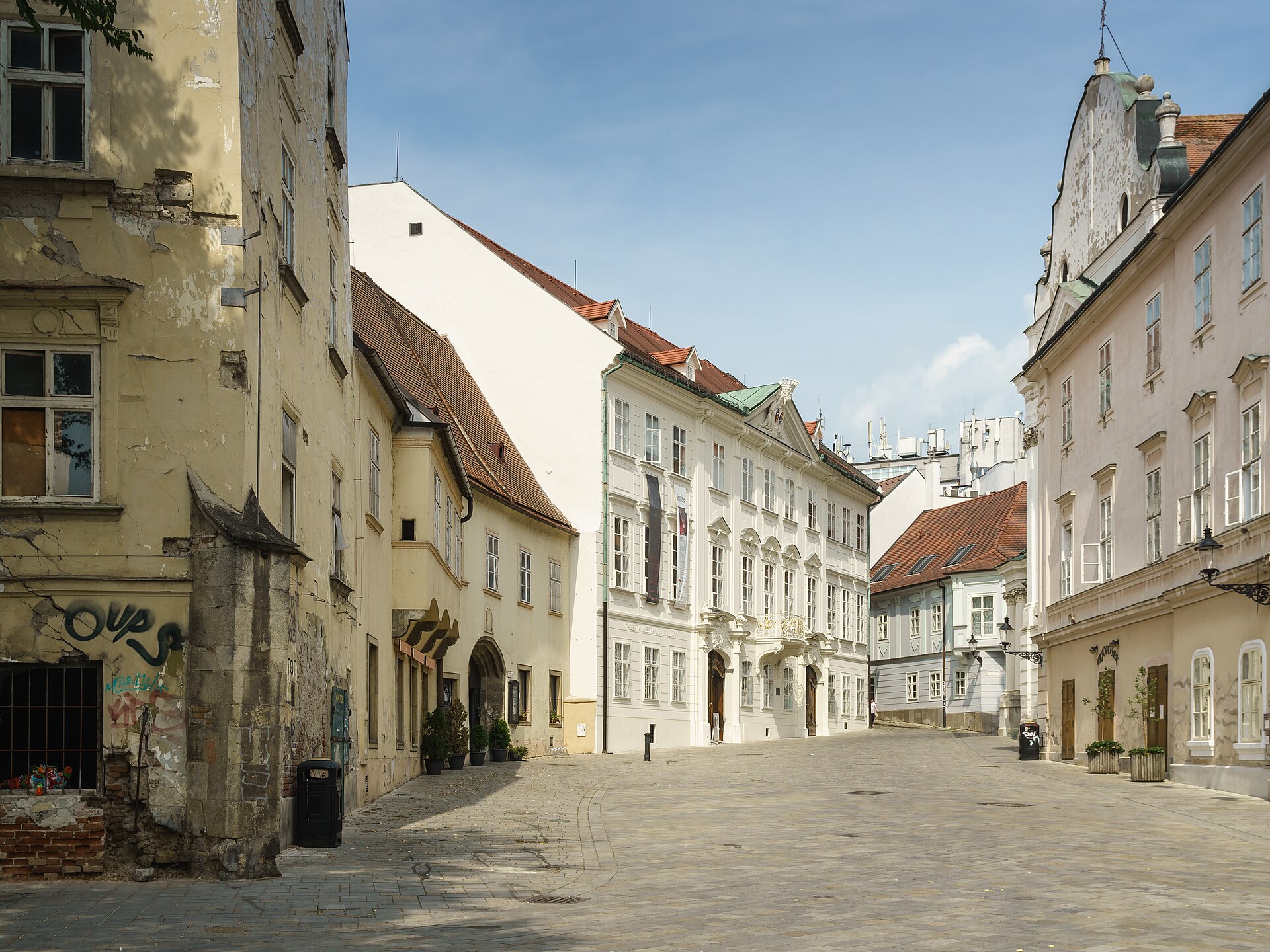
The Rococo facade of Mirbach Palace, on Frantiskanske namestie, seat of Bratislava City Gallery since 1975.
Radler59, CC BY-SA 4.0Bratislava City Gallery
Museum · Galeria mesta Bratislavy · Founded 1961
Open, admission and hours confirmed 6 September 2026 · 13 sources
On this page 16 sections
ContentsClose
GMB's roughly 35,000-object collection is strongest exactly where its two buildings point it: Central European Baroque and Rococo painting and sculpture at Mirbach Palace, and a continuous run of Slovak art from the Gothic period through the 20th century at Palffy Palace, anchored by an in-situ archaeological sequence (Celtic, Slavic, medieval) that few galleries anywhere can show beneath their own exhibition floors. Its single most visited object, by visitor account, is a contemporary installation rather than an old master: Matej Kren's Pasaz.
| Local name | Galeria mesta Bratislavy |
|---|---|
| Kind | Museum |
| Founded | 1961 |
| City and country |  Bratislava, Slovakia Bratislava, Slovakia |
| Address | Frantiskanske namestie 11 (Mirbach Palace) and Panska 19 (Palffy Palace), 815 35 Bratislava, Slovakia |
| Website | gmb.sk |
| Status | Open, confirmed |
| Record last verified |
Visiting
- Hours
- Tue-Sun11:00 to 18:00Applies to both Mirbach Palace and Palffy Palace
- Closed
- Monday.
- Admission
- Adult, one palace (Mirbach or Palffy)EUR 8Covers all exhibitions in that palace
- Adult, both palacesEUR 10Combined ticket
- Annual pass, both palacesEUR 40Unlimited entry for 365 days, plus 20 percent off GMB publications
- Reduced (ISIC, ITIC, EURO26, 60+, Carers Card)EUR 450 percent discount off the single-palace price
- Under 18FreeFree
- Fine art, art history, architecture, aesthetics or cultural studies studentsFreeFree with ISIC or an academic transcript
Free entry: First Wednesday of every month. Exhibition opening and closing events- Tickets
- gmb.sk/en/detail/pricing-structure The museum's own ticket page.
- Do I need to book?
- No advance booking required for individual visitors; organised groups are capped at 30 people and should arrange in advance
- Address
- Frantiskanske namestie 11 (Mirbach Palace) and Panska 19 (Palffy Palace), 815 35 Bratislava, Slovakia Map
- Website
- gmb.sk
- Telephone
- +421 949 002 942
- [email protected]
Before you go how long, access, photography, bags, eating, shop
- How long to allow
- Visitor accounts vary widely: some spend as little as ten minutes on the Passage installation alone, others report touring all floors of a single palace in twenty minutes to an hour
- Access
- The Mirbach Palace entrance is wheelchair accessible with a lift to the upper floors. At Palffy Palace only the ground floor is wheelchair accessible. One personal assistant accompanying a visitor with reduced mobility is admitted free on advance request
- Photography
- Personal photography and filming are permitted without flash or tripod and at a safe distance from the works, except where a work is marked with a no-photography sign. Professional photography needs advance permission from the gallery directorate; academic use is 10 EUR, wedding or commercial use 50 EUR
- Bags
- Items larger than 30 x 40 cm or longer than 40 cm, including bags, backpacks and umbrellas, and outer clothing, must be left in the cloakroom. A lost locker key costs 20 EUR
- Eating
- Emil Cafe, on site, serving coffee, natural wines and light refreshments
- Shop
- Ex Libris Bookshop, a curated selection of art and cultural publications
Prices and hours change. We take them from the institution's own pages and print the day we read them, and you can check the current position at the source we used. Confirm before you travel.
What is inside
Mirbach Palace - Noble Floor
The piano nobile of the 1768-1770 Rococo mansion, kept largely as built: tiled stoves, wooden wall panelling hung with rare 18th-century graphic sheets, a console table, mirrors and elaborately stuccoed ceilings.
Mirbach Palace - Central European Baroque painting and sculpture
The permanent collection housed in the palace, built around Baroque and Rococo painting and sculpture from the Central European sphere, shown alongside temporary exhibitions.
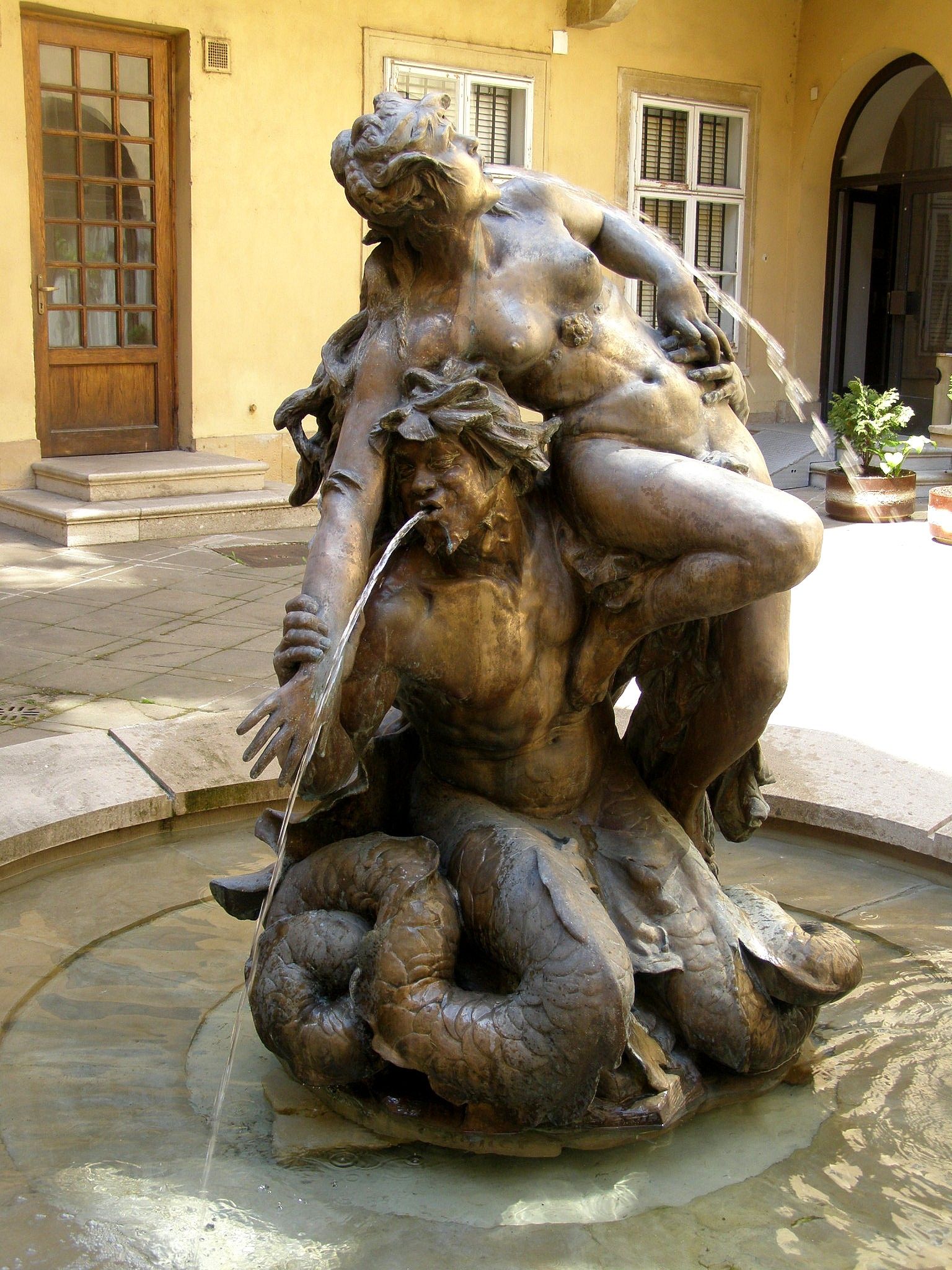
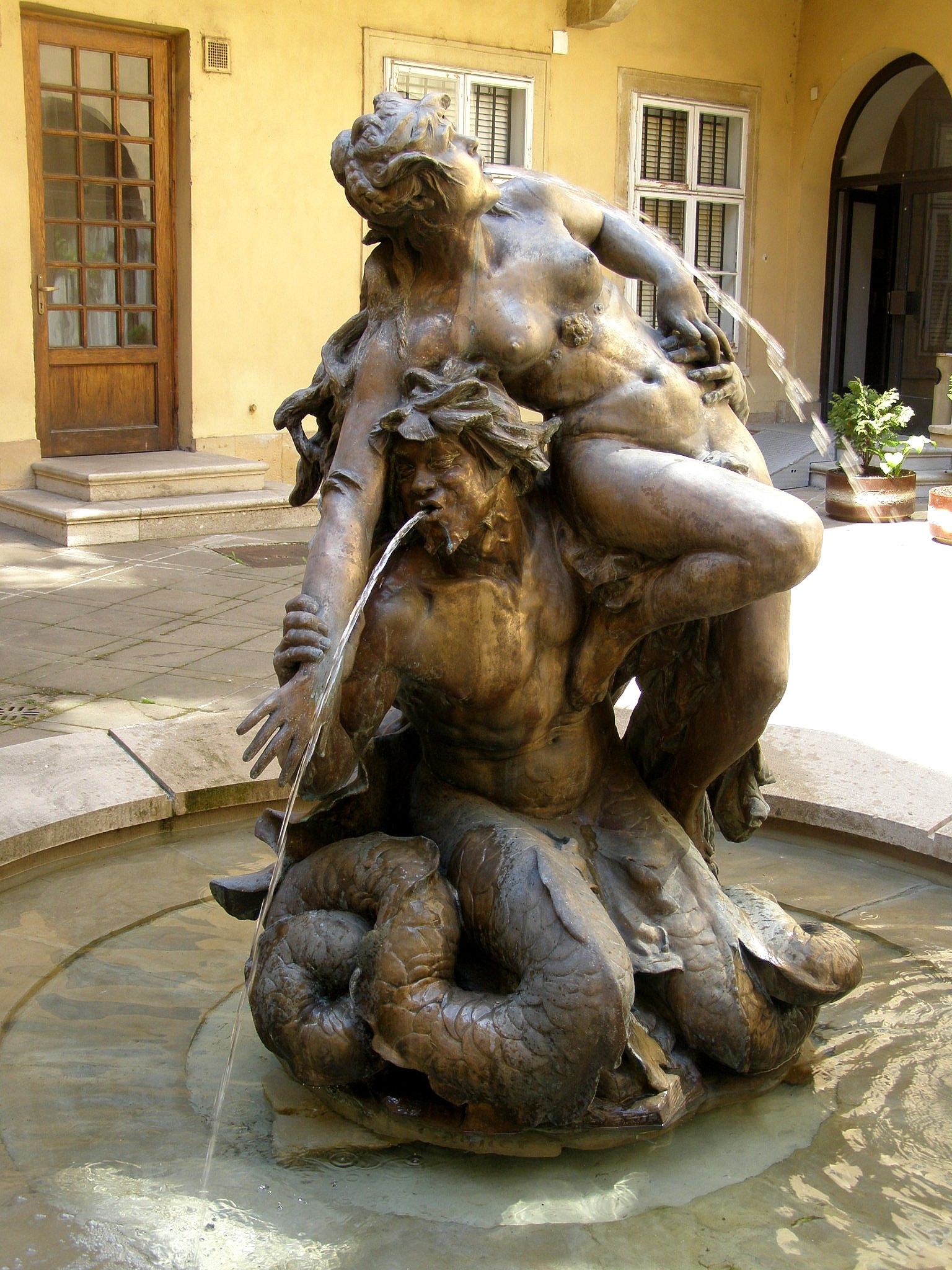
Photograph by Lure · CC BY-SA 3.0 Mirbach Palace - courtyard and the Triton fountain
An inner courtyard holding a 1981 bronze cast of Viktor Tilgner's Triton and a Nymph, one of three known casts of the sculptor's design; the others stand in Vienna's Volksgarten and in the Slovak National Gallery's collection, a different institution from GMB.
Palffy Palace - Gothic to 20th-century Slovak art
A permanent exhibition spread over three floors and the basement, opening with Gothic painting and sculpture and running through Slovak fine art of the 19th and 20th centuries.
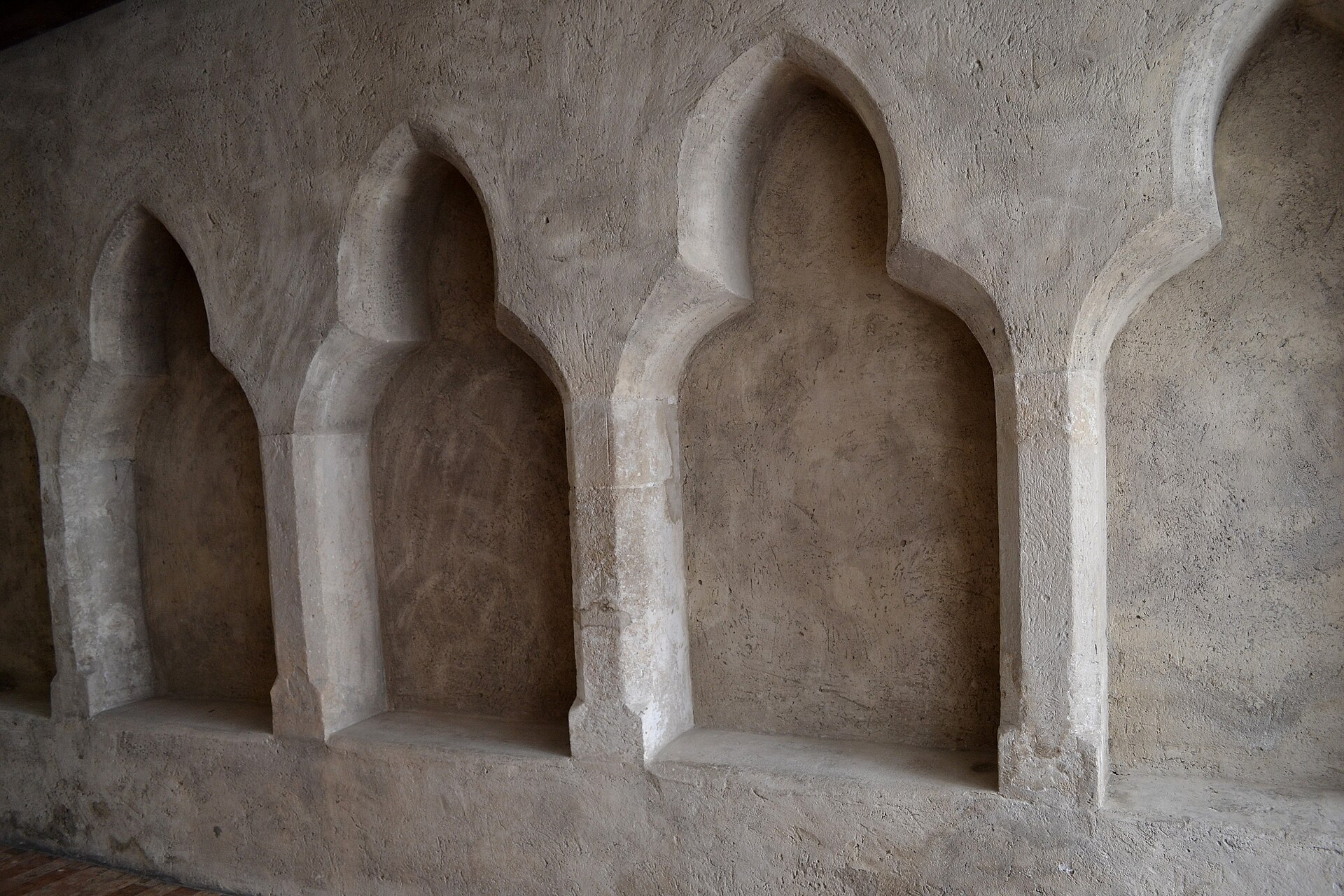
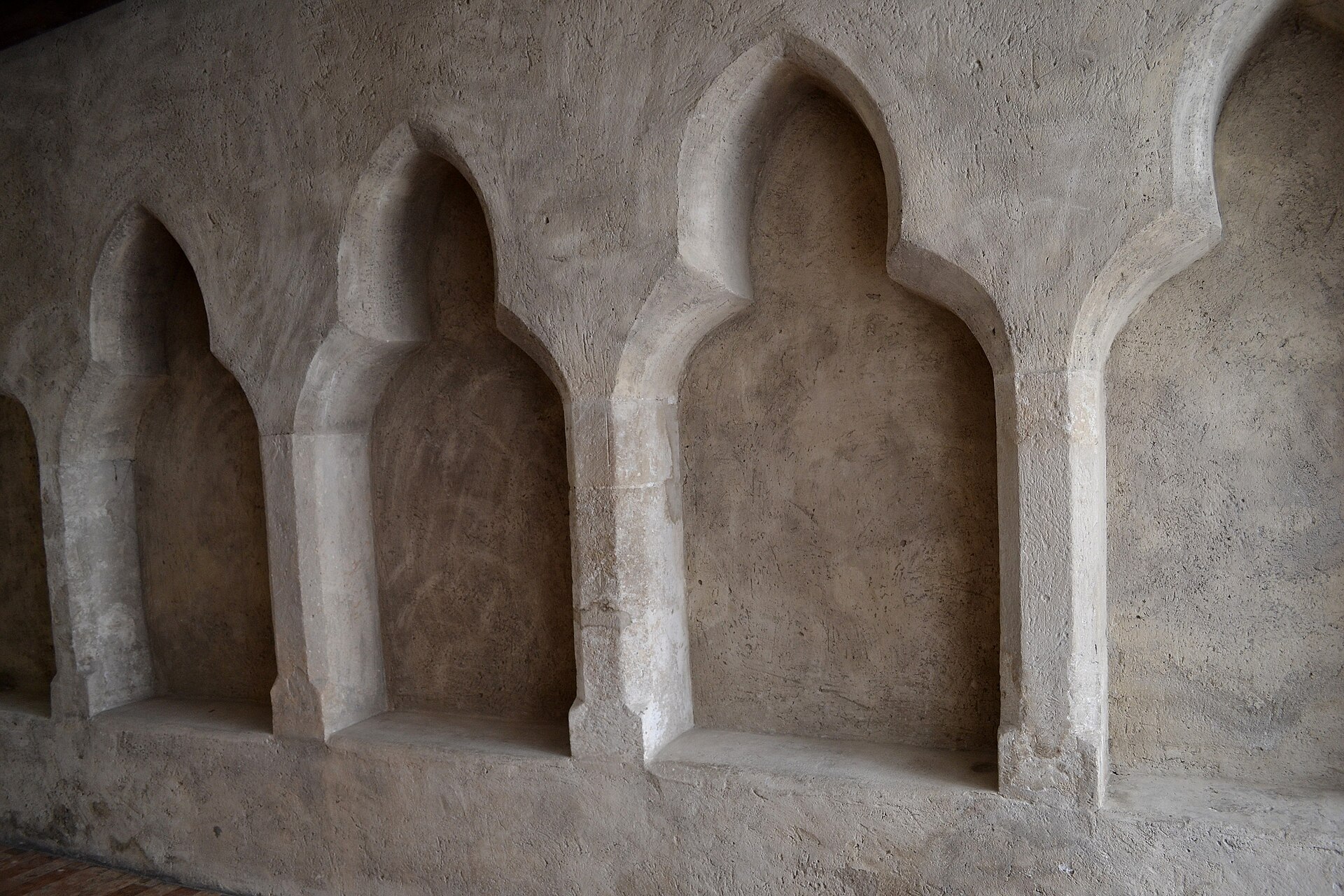
Photograph by Lure · CC BY-SA 3.0 Palffy Palace - basement archaeology and the Gothic core
Excavated remains left in place and displayed where they were found: a 1st-century Celtic settlement with a storage shaft and a grave close to evidence of a mint, Slavic graves of the 9th-10th centuries, Roman-era building material reused in medieval walls, and a mid-14th-century Gothic core with a chapel under star vaulting.
Palffy Palace - Pasaz (Passage) by Matej Kren
A permanent site-specific installation of mirrors and roughly 12,000 discarded library books, about 220 x 380 x 608 cm, donated by the artist to the gallery in 2004 and, by visitor accounts, its most photographed single work.
What to see first
Pasaz (Passage)
Matej KrenA corridor of roughly 12,000 books doubled by mirrors into an illusion of infinite space; donated to the gallery by the artist in 2004 and, on visitor accounts, the single most visited work GMB holds.7
Charakterova hlava c. 9 (Character Head no. 9, variant: Simplicity of the Highest Degree)
Franz Xaver MesserschmidtOne of Messerschmidt's obsessive series of expressive busts, made around 1770 and now catalogued in GMB's own collection.11
Triton and a Nymph (fountain)
Viktor Tilgner (1981 bronze cast)The centrepiece of the Mirbach Palace courtyard, one of three casts of the design; version safety note: another cast belongs to the Slovak National Gallery, a separate institution.2
The Gothic core and chapel of Palffy Palace
Unknown medieval builders, mid-14th centuryA star-vaulted chapel and building fabric uncovered during restoration, exhibited in place rather than removed to a case, alongside Celtic, Slavic and Roman-era finds from the same excavation.3
Gothic painting and sculpture of the permanent collection
Various, medieval Central European workshopsThe opening section of Palffy Palace's permanent hang, the material one reviewer found thin against major Italian and Viennese collections and another called a must-see.12
Slovak fine art of the 19th and 20th centuries
Various Slovak artistsThe core of GMB's claim to be the reference collection for Slovak art of the period, running the length of Palffy Palace's upper floors.3
Central European Baroque and Rococo painting and sculpture
Various, 17th-18th centuryThe permanent collection installed on Mirbach Palace's own Rococo noble floor, so the setting and the objects are of a piece.2
Exhibitions on now
Past exhibitions here
Two palaces, one civic gallery
Bratislava City Gallery (Galeria mesta Bratislavy, GMB) is not one building but two, run as a single municipal institution since it was established by the city in 1961. It has no purpose-built home of its own: it occupies Mirbach Palace, a Rococo town house on Frantiskanske namestie in the Old Town, and Palffy Palace, a Classicist mansion a short walk away on Panska ulica. Between them the two houses hold a collection the gallery itself states runs to roughly 35,000 works, making GMB the second-largest gallery of its kind in Slovakia after the Slovak National Gallery, which is a separate institution with its own building on the Danube embankment and should not be confused with GMB or credited with GMB's holdings.
The two-building structure is not a historical accident to be tidied away; it shapes what each palace shows. Mirbach, the older acquisition, carries the Baroque and Rococo painting and sculpture collection inside rooms built for exactly that kind of display. Palffy, reconstructed for the gallery a decade or so later, carries the Gothic-to-modern survey of Slovak art on floors built above a basement that turned out, once restoration began digging into it, to be an archaeological site in its own right. A visitor buying the combined ticket is not touring one collection split across an annex; they are touring two different buildings that answer two different questions about the same city's art.
Mirbach Palace: a brewer's Rococo town house
The site at Frantiskanske namestie 11 has been built on since at least the 14th century, and documented use of the plot goes back to 1379. An earlier building on the site, known as Weittenhof, burned down in 1733 after being let to a theatre company. The brewer Johann Michael Spech bought the ruin, secured permission to rebuild in 1768, and completed the new mansion by around 1770 under the master mason Matej Hollrigl; the identity of the architect is not settled, though the Austrian Franz Anton Hillebrandt has been proposed. The result is a four-wing, two-storey Rococo building around an inner courtyard, its main facade carrying the light, asymmetric rocaille ornament the style is named for.
The building changed aristocratic hands several times, through Count Imre Csaky and Count Koloman Nyary among others, before Baron Emil Mirbach became its last private owner. Mirbach bought the palace in 1917 and left it to the city on condition it become a fine art museum; Bratislava took possession in 1949, mounted its first exhibitions there the following year, and, after a lengthy restoration, opened the Municipal Gallery in the building in April 1975. The palace was declared a state cultural monument in 1963, and a further facade restoration in 2016 recovered its original appearance. Two rooms on the noble floor still carry their original 18th-century wall panelling, hung today with period graphic sheets, and the courtyard is dominated by a 1981 bronze cast of Viktor Tilgner's sculpture Triton and a Nymph - one of three known casts of that design, the others standing in Vienna's Volksgarten and in the Slovak National Gallery's own collection.
Palffy Palace: a building excavated as much as restored
Palffy Palace, at Panska 19, has a different kind of history: it is as much an archaeological site as a gallery. The plot held the seat of Pozsony county until the administration moved out in the mid-1850s, after which the Palffy family, the county's former hereditary chiefs, rebuilt it as a Classicist residence and used it for their own collections. When the city restored the building for the gallery in the 1980s, work below ground uncovered a stack of earlier occupation: a 1st-century Celtic settlement complete with a storage shaft and a grave close to evidence of minting, Slavic graves from the 9th and 10th centuries, and Roman-era building material later reused in medieval walls. Beneath all of that sat a Gothic core dated to the middle of the 14th century, including a small chapel under star vaulting. Rather than clear the basement for gallery space, GMB left the finds in place and built the display around them.
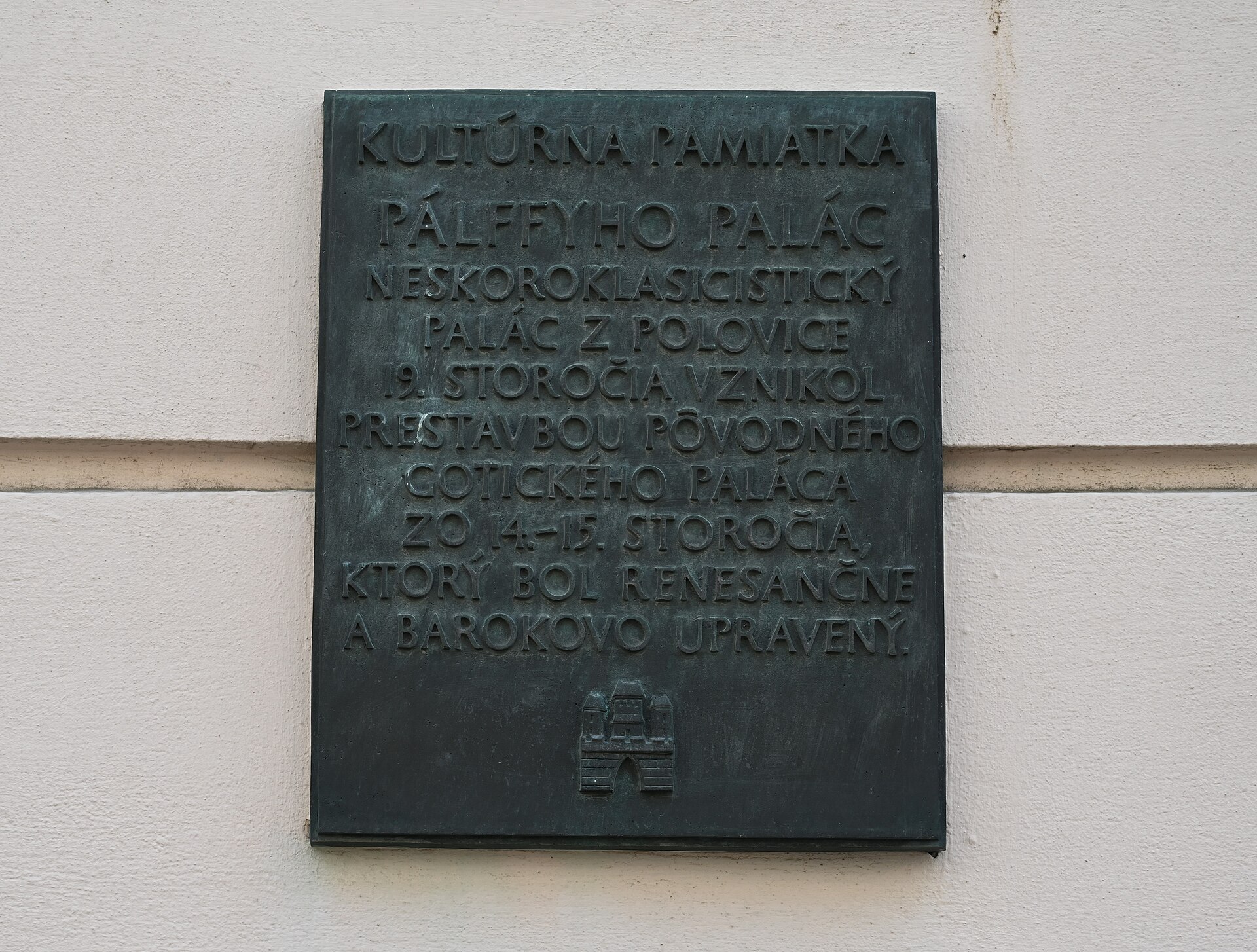
The palace opened as a City Gallery venue in the late 1980s (sources give both 1987 and 1988), and today runs three permanent exhibitions across its floors and basement alongside temporary shows. Palffy Palace is the venue named in visitor accounts for the gallery's best-known single work, Matej Kren's installation Pasaz, and for the Celtic-mint material that GMB has built into a dedicated presentation of the site's own excavation.
What is inside: from a character head to a corridor of books
Mirbach Palace's permanent collection is built around Central European Baroque and Rococo painting and sculpture, installed on the same noble floor whose stucco ceilings, panelling and stoves were built for a private household rather than a museum circuit - visitors are looking at art inside the kind of room the art was originally made to furnish. Among the sculptures GMB holds is a Character Head by the 18th-century Austrian sculptor Franz Xaver Messerschmidt, part of the same obsessive series of expressive, grimacing busts the artist is known for; GMB's example, catalogued as Character Head no. 9, a variant subtitled Simplicity of the Highest Degree, dates to around 1770.
Palffy Palace opens with Gothic painting and sculpture and runs forward through Slovak fine art of the 19th and 20th centuries, the collection GMB treats as its central claim to being a reference gallery for Slovak art of that period. Underneath that survey sits the basement archaeology described above, presented as a site rather than a case of finds. And running through the building, acquired as a gift from the artist in 2004, is Matej Kren's Pasaz: a passage roughly 220 by 380 by 608 centimetres built from about 12,000 books pulled from library discards, lined with mirrors so the shelving appears to run away in both directions without end. Visitor accounts across a decade of reviews return to this one installation more than to any other object GMB holds, single work most likely to be the reason a visitor remembers the gallery at all.
Planning a visit: hours, admission, access
Both palaces keep the same hours, Tuesday to Sunday 11:00 to 18:00, closed Monday. A single-palace ticket is 8 EUR, a combined ticket covering both palaces is 10 EUR, and an annual pass giving unlimited entry to both for a year is 40 EUR with a further 20 percent off GMB's own publications. Holders of ISIC, ITIC, EURO26, a 60-plus card or a Carers Card pay half price; visitors under 18 and students of fine art, art history, architecture, aesthetics or cultural studies enter free with ID. Entry is also free on the first Wednesday of every month and at exhibition openings and closings.
Mirbach Palace's entrance and upper floors are wheelchair accessible by lift; at Palffy Palace only the ground floor is accessible, a real constraint given how much of that building's most distinctive material - the basement archaeology - sits below grade. A personal assistant accompanying a visitor with reduced mobility is admitted free on request. Personal photography without flash or tripod is allowed except where a work is marked otherwise; anything larger than a bag, coat or umbrella goes into the cloakroom. On site, GMB runs Emil Cafe for coffee and light food and the Ex Libris Bookshop for art and cultural titles.
What visitors say
GMB's Tripadvisor listing, read for this page, carries 58 reviews averaging 4.1 out of 5: 20 rated Excellent, 24 Good, 13 Average, none Poor and one Terrible. The pattern across those reviews is consistent. Visitors who mention Pasaz treat it as the highlight of their trip almost without exception, several saying it was the best single thing they saw anywhere in Bratislava; the Celtic and archaeological material in the Palffy basement and the restored condition of both palace buildings draw similarly unprompted praise.
Where visitors are less impressed, it is usually about depth rather than the buildings themselves. One reviewer who had recently visited leading museums in Italy and Vienna found the opening run of Gothic religious art underwhelming by that comparison; a 2018 visitor thought the lighting in the contemporary-art basement rooms could be better; and a French visitor in 2024, in an automatically translated review, described the palace as showing its age and in need of fresh investment in how the collection is presented, while still recommending a visit for pieces such as the Messerschmidt heads. No reviewer disputes what is here; the disagreement is over how well GMB has kept pace with presenting it.
What visitors say
Visitors consistently single out one work, Matej Kren's book-and-mirror installation Pasaz, as the reason to come and the thing they remember; they also praise the two restored palace interiors themselves. Criticism, where it appears, is about depth and presentation rather than the buildings: a Gothic and religious-art opening that some found thin next to major Italian or Austrian collections, uneven lighting in the contemporary basement rooms, and a general sense from a few visitors that the display and information for international visitors has not been refreshed in some time.
What is praised, what is criticised
- Praised: Matej Kren's Pasaz (Passage) installation of mirrors and roughly 12,000 books, repeatedly called the best single reason to visit
- Praised: The two historic palace buildings themselves, their Rococo and Classicist interiors, and the archaeological remains left visible in the Palffy Palace basement (Celtic, Slavic and medieval Gothic finds)
- Criticised: One visitor who had recently seen major Italian and Viennese museums found the Gothic and religious-art opening section underwhelming by comparison, and several reviews note that captioning and context for international visitors is limited
- Criticised: A 2024 visitor review characterised the building and its displays as due for renewal ('deserves new blood'), and a 2018 review noted the basement contemporary-art lighting could be improved
Ratings on other platforms
Tripadvisor: 4.1 from 58 ratings, read 6 September 2026
A platform average is a tertiary source: it moves, it is not audited, and we quote no visitor's words.
Questions about Bratislava City Gallery
Where is Bratislava City Gallery?
Frantiskanske namestie 11 (Mirbach Palace) and Panska 19 (Palffy Palace), 815 35 Bratislava, Slovakia.
How much does it cost to visit?
Adult, one palace (Mirbach or Palffy): EUR 8; Adult, both palaces: EUR 10; Annual pass, both palaces: EUR 40; Reduced (ISIC, ITIC, EURO26, 60+, Carers Card): EUR 4; Under 18: free. As confirmed 6 September 2026.
When is it open?
Tue-Sun 11:00-18:00. Closed: Monday. As confirmed 6 September 2026.
What should you see first?
Pasaz (Passage) (Matej Kren); Charakterova hlava c. 9 (Character Head no. 9, variant: Simplicity of the Highest Degree) (Franz Xaver Messerschmidt); Triton and a Nymph (fountain) (Viktor Tilgner (1981 bronze cast)); The Gothic core and chapel of Palffy Palace (Unknown medieval builders, mid-14th century); Gothic painting and sculpture of the permanent collection (Various, medieval Central European workshops); Slovak fine art of the 19th and 20th centuries (Various Slovak artists).
What we could not confirm
- Sources disagree by a year on when Palffy Palace opened as a City Gallery venue: Wikipedia's Johann Palffy Palace entry implies a late-1980s opening without a precise year, and secondary sources split between 1987 and 1988. GMB's own site does not state the year on the page fetched for this record.
- GMB's own collection database (webumenia.sk) was not searched exhaustively for this record; a fuller pass would likely surface further highlights beyond the handful confirmed here.
Images
Sources
- 1Bratislava City Gallery, official homepage (opening hours, buildings, on-site cafe and bookshop) gmb.sk
- 2Bratislava City Gallery, Mirbach Palace detail page gmb.sk/en/detail/mirbach-palace
- 3Bratislava City Gallery, Palffy Palace detail page gmb.sk/en/detail/palffy-palace
- 4Bratislava City Gallery, pricing structure gmb.sk/en/detail/pricing-structure
- 5Bratislava City Gallery, contacts page gmb.sk/en/detail/Contacts
- 6Bratislava City Gallery, visitor regulations gmb.sk/en/detail/visitor-regulations
- 7Bratislava City Gallery, Matej Kren: Pasaz detail page gmb.sk/detail/matej-kren-pasaz
- 8Wikipedia, Bratislava City Gallery en.wikipedia.org/wiki/Bratislava_City_Gallery
- 9Wikipedia, Mirbach Palace en.wikipedia.org/wiki/Mirbach_Palace
- 10Wikipedia, Johann Palffy Palace en.wikipedia.org/wiki/Johann_P%C3%A1lffy_Palace
- 11Web umenia (Slovak National Gallery collections portal), Franz Xaver Messerschmidt, Character Head no. 9 webumenia.sk/en/dielo/SVK:GMB.B_1411
- 12Tripadvisor, City Gallery of Bratislava, reviews and rating tripadvisor.com/Attraction_Review-g274924-d3294729-Reviews-City_Gallery_of_Bratislava-Bratislava_Bratislava_Region.html
- 13Wikidata, Q913415, Bratislava City Gallery wikidata.org/wiki/Q913415