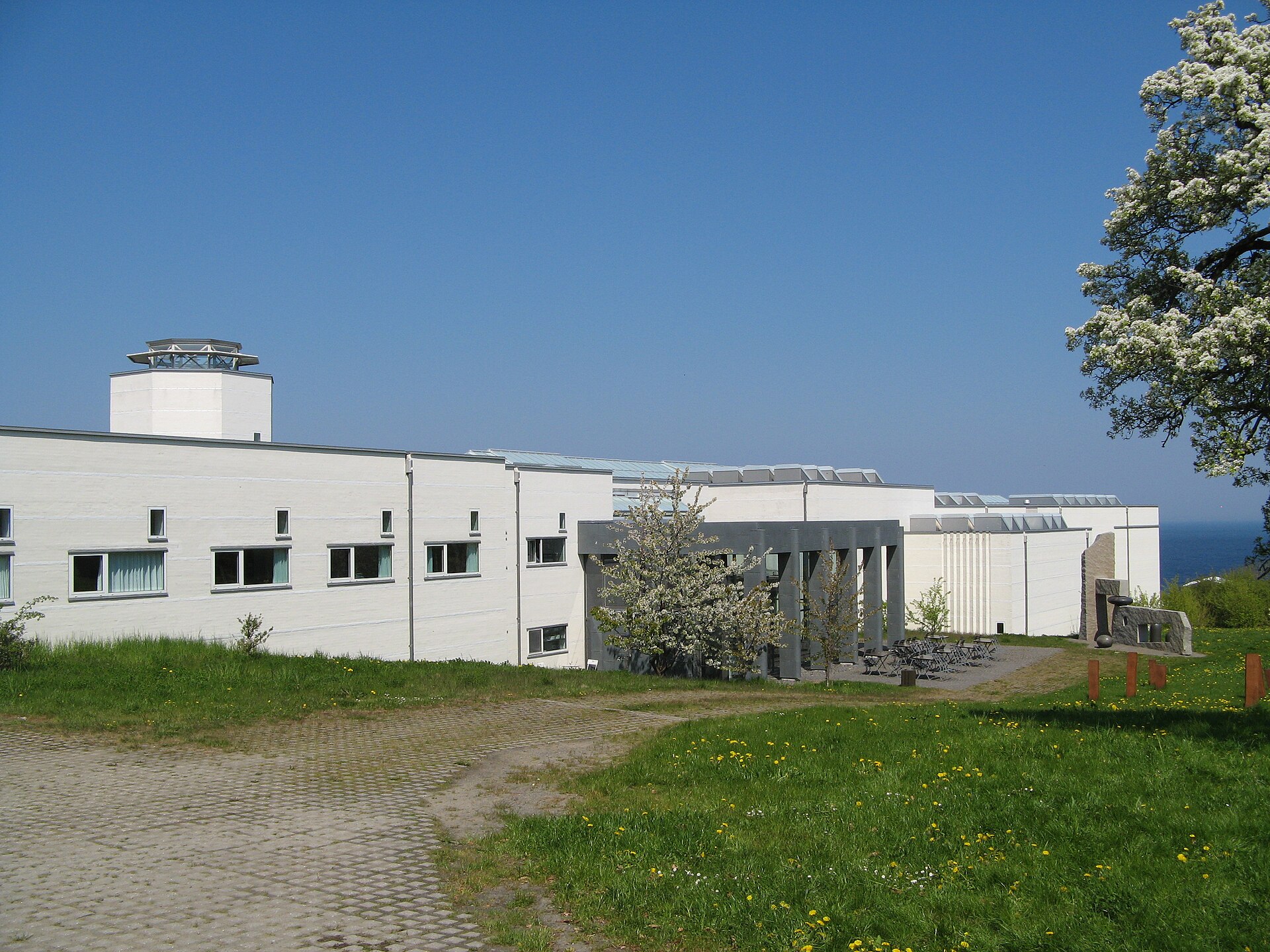
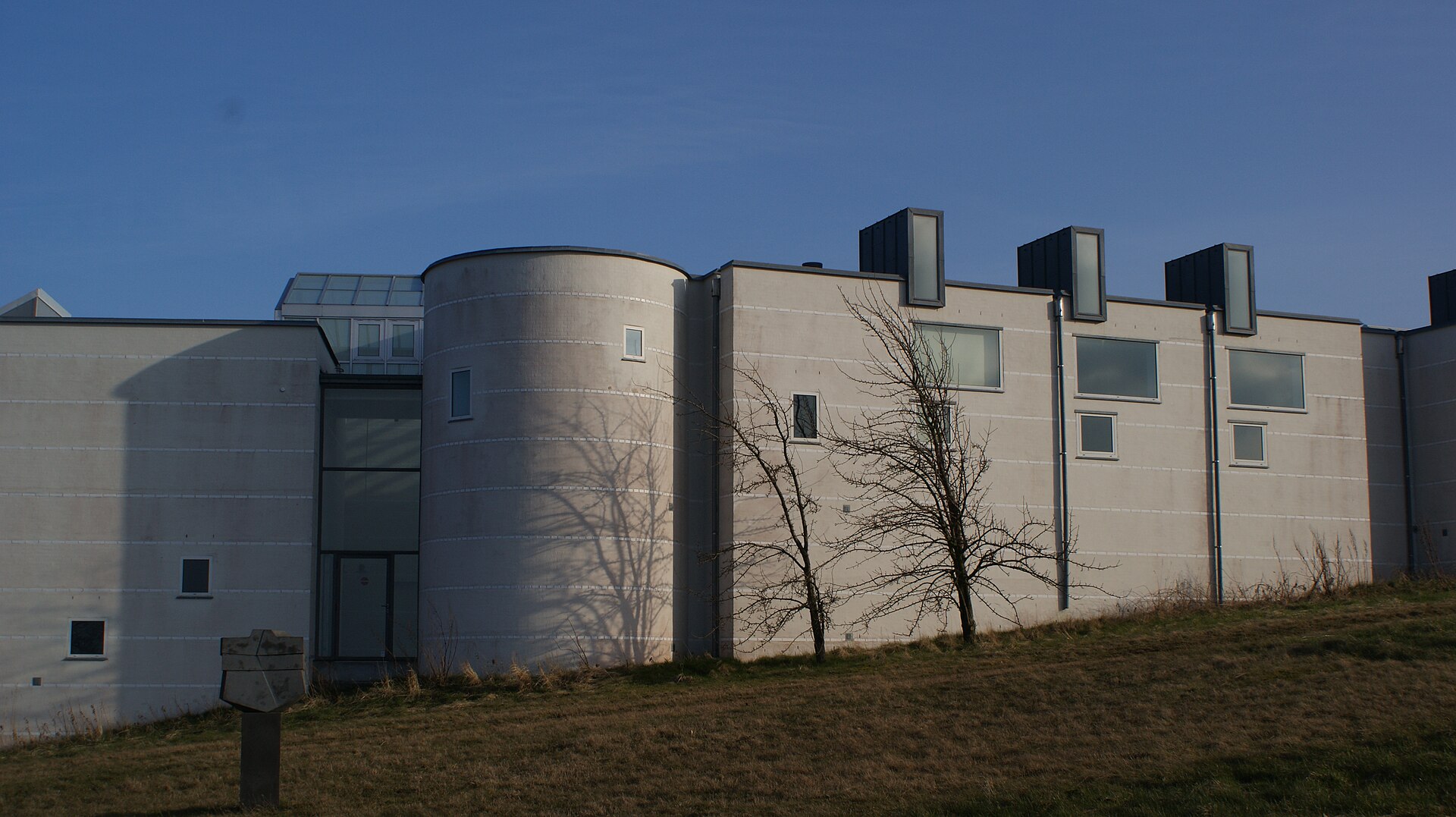
The white museum building seen across grass toward the Baltic.
Hans-Peter Balfanz, CC BY-SA 3.0 · Photograph by HapebalfBornholms Kunstmuseum
Museum · Founded 1893
Open, admission and hours confirmed 20 November 2026 · 20 sources
On this page 17 sections
ContentsClose
The collection is strongest where it is most local: the Zahrtmann circle and the Bornholm school of about 1910 to 1930, the Von Garvens wartime avant-garde, and post-war sculpture made with the island's own stone and industrial pipes [9][10][14]. It is thin on any claim to be a general survey, and the museum itself says its focus is art and crafts tied to Bornholm [3].
| Kind | Museum |
|---|---|
| Founded | 1893 (collection, in Ronne); present building 1993 |
| City and country |  Gudhjem, Denmark |
| Address | Otto Bruuns Plads 1, 3760 Gudhjem, Denmark |
| Website | bornholms-kunstmuseum.dk |
| Status | Open, confirmed |
| Record last verified |
Visiting
- Hours
- Fri-Sun (November to March)10:00 to 17:00winter season, which includes 20 November 2026
- Tue-Sun (April to October)10:00 to 17:00summer season
- Wed-Sun, winter holiday weeks 7 and 8 of 202610:00 to 17:00as printed on the visit page for 2026
- Easter Monday 6 April, Whit Monday 25 May, 26 and 27 December 202610:00 to 17:00listed as open on the visit page
- Closed
- Monday to Thursday from November to March, except the dates above. Monday from April to October, except the dates above.
- Admission
- AdultDKK 100
- StudentDKK 50
- Under 18Freefree
- Member of Bornholms MuseumsforeningFreefree; one friend at 50 percent off
- Group of more than 20Free20 percent discount on the ticket price (no separate fee stated)
- Klippekort, six venues in one weekDKK 250valid 7 days from purchase; sold at the ticket desk of any of the six attractions
- Do I need to book?
- Not stated on the visit page; group guided tours are offered and the page links to them without booking details
- Address
- Otto Bruuns Plads 1, 3760 Gudhjem, Denmark MapBus Bus stop Helligdommen (Bornholms Kunstmuseum)
Car Large car park, free - Website
- bornholms-kunstmuseum.dk
- Telephone
- +45 56 48 43 86
- [email protected]
Before you go how long, access, photography, bags, eating, shop
- How long to allow
- Not stated by the museum. The collection, the special rooms and the grounds suggest allowing time for a walk to the cliffs as well.
- Access
- Wheelchair access with a lift and accessible toilets; the tower is not accessible to wheelchair users. The 2024 annual report itself names toilets, cafe and entrance as problem areas it wants to improve.
- Photography
- No professional photography, and no flash, tripod or selfie stick.
- Bags
- Not stated.
- Eating
- Cafe Helligdommen, open to all during museum opening hours (home page).
- Shop
- A museum shop exists; no details on the visit page. Strollers are allowed only with swivel front wheels.
Prices and hours change. We take them from the institution's own pages and print the day we read them, and you can check the current position at the source we used. Confirm before you travel.
What is inside
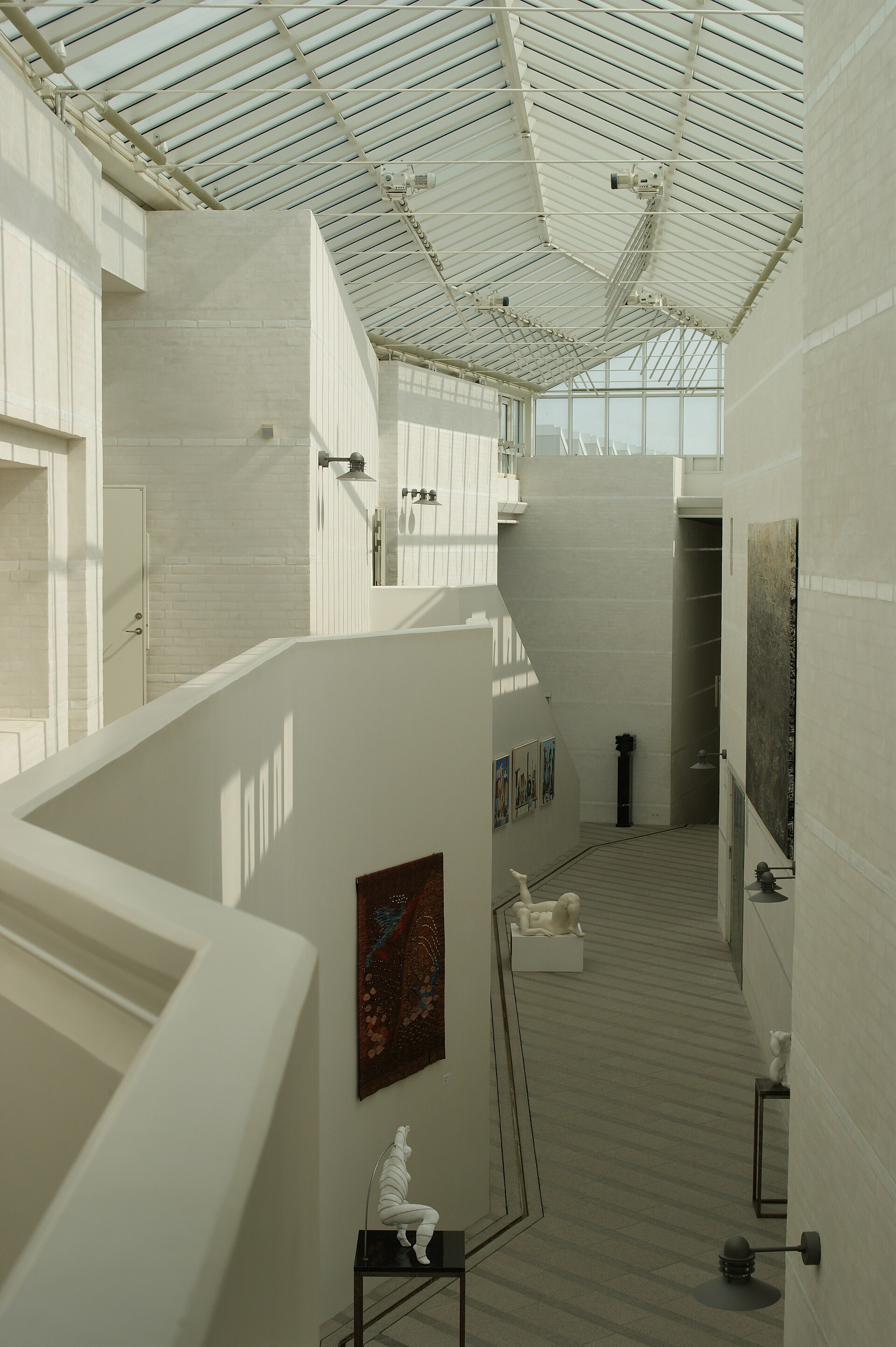
Photograph by Jens Cederskjold · CC BY 3.0 The museum street
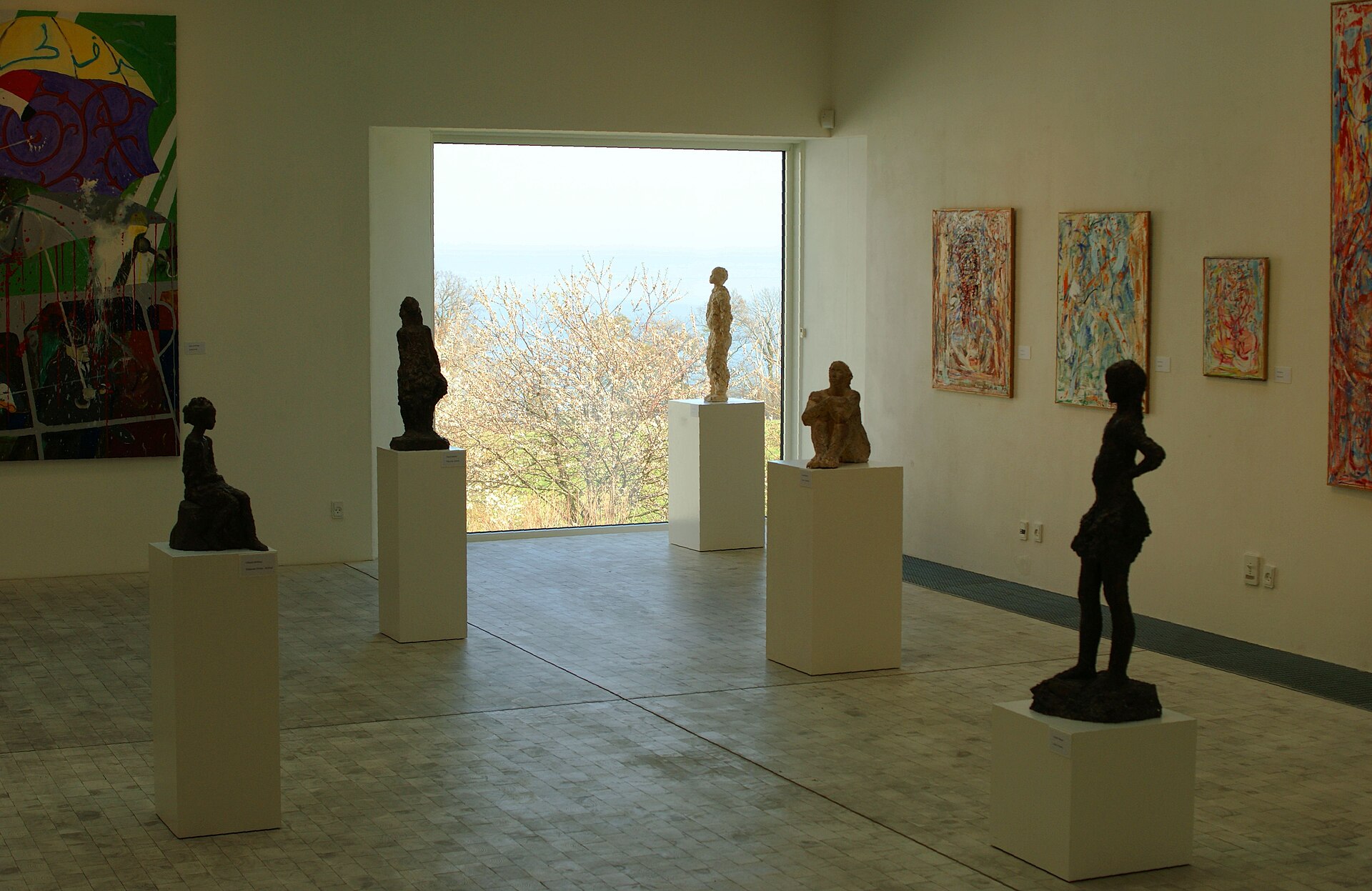
The glass-covered, granite-paved inner street along which the galleries lie, with the Sanctuary Spring running through it as water art. The street also takes display shows; in 2024 a Rabakken ceramics and sculpture display was shown here, and in 2025 part of the Westman retrospective.
The Zahrtmann and Bornholm school galleries
A collection presentation of 1860 to 1925 built around Kristian Zahrtmann and his pupils, with works by Edvard Weie, Karl Isakson, Olaf Rude, Jais Nielsen and the Funen painters Fritz Syberg and Peter Hansen; the permanent sections also cover the Skagen painters and Lars Hansen.
Experimental art from the Second World War to today
A collection presentation of 1930 to 2024 on how artists answered social crises, with around thirty named artists including Asger Jorn, Sonja Ferlov Mancoba, Oluf Host, Pipin Henderson, Jorgen Haugen Sorensen and Silas Inoue.
Special exhibition rooms
Two special-exhibition rooms plus the museum street; the 2025 Inge Lise Westman retrospective of nearly 100 objects filled them. The museum says it holds six to eight special exhibitions a year; the next opens on 12 December 2026 (Sonja Ferlov Mancoba, Living Beings).
The sculpture garden and grounds
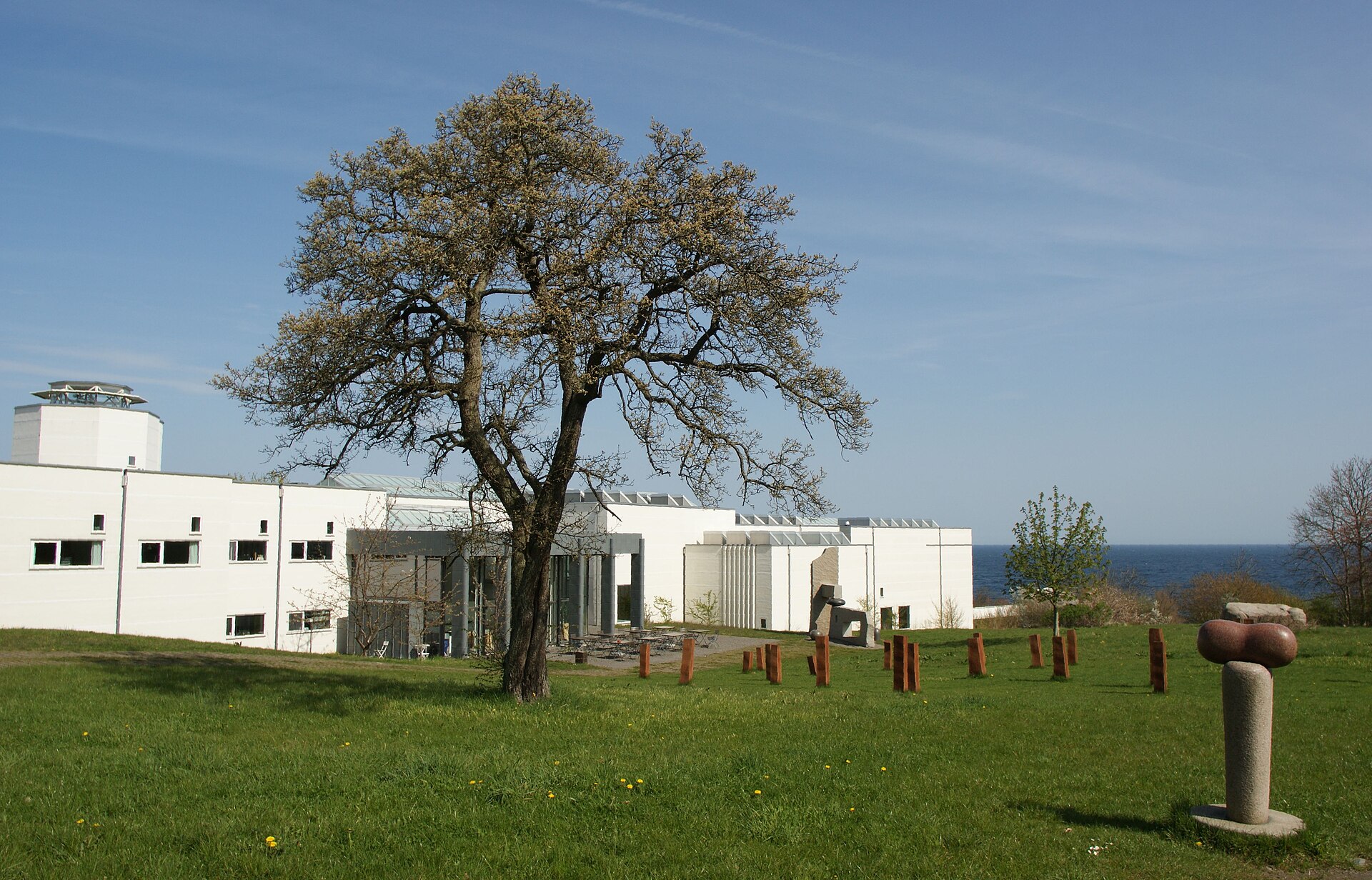
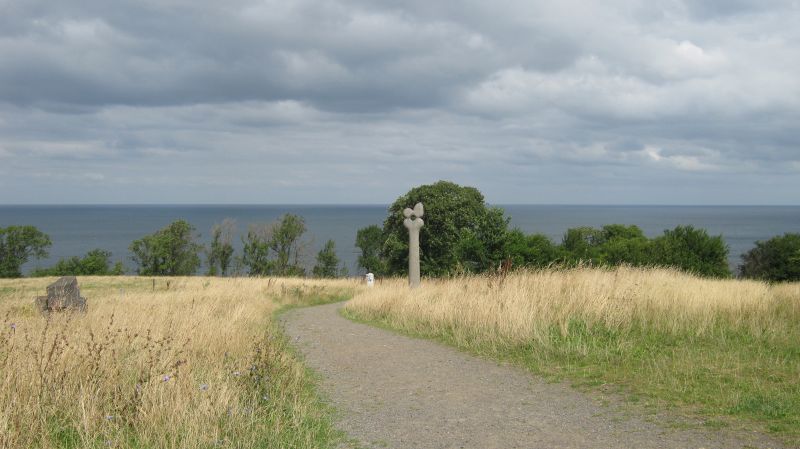
Granite, bronze, steel and marble works around the building by Hein Heinesen, Ole Christensen, Peter Bonnen, Jun-Ichi Inoue, Pipin Henderson and Soren Georg Jensen, some on deposit from state bodies and some in store, set on open pasture with a tower and an outdoor bridge for sea views.
Children's studio and drawing corner
A children's studio being made permanent in 2025 and a drawing corner in the foyer with seating and materials; 1,462 pupils were taught in 2025 and 21 family workshops were held.
What to see first
Leonora Christina in prison, making herself a porridge
Kristian Zahrtmann, 1896Named by the museum as one of two Zahrtmann paintings on its collection page; it shows the teacher whose school produced the Bornholm painters.7
The mystical wedding in Pistoia
Kristian Zahrtmann, 1894The second Zahrtmann work the museum names, a large history picture of the kind Zahrtmann's late career became known for.7
Forest road, Christianso
Edvard Weie, 1920A named Bornholm school landscape, from the group that took French colour experiment to the island.9
Standing nude model
Karl Isakson, 1918-1919Named by the museum as a core work of the Bornholm school and a sign of the Cezanne influence the museum describes.9
Self-portrait
Lars Hansen, 1862The founder-benefactor whose 1871 will paid for a museum; the museum says his ideas about education shape it more than his pictures do.12
Gudhjem, 1946
Erik OrtvadFrom the Von Garvens section on the wartime avant-garde that gathered around Herbert von Garvens.10
Sea, Geometry and the Body
Hein Heinesen, 1993, blue Ronne graniteA gift from the State Art Foundation for the museum's 1993 opening, standing with the building itself.11
Apache Dance
Gustaf Munch-PetersenDescribed by the 2024 annual report as a new main work acquired that year.16
The Lithography Press, 1976
Paul StoltzeNamed in the museum's art-after-the-war section next to the Bornholm industrial sculpture.14
A white building on the cliffs above the Baltic
Bornholms Kunstmuseum stands on open grazing land above the Helligdomsklipperne, the Sanctuary Rocks, about six kilometres north of Gudhjem on the northern coast of Bornholm. It is not in the town of Ronne, where the island's older museum of history and local life sits, and the two should not be confused. The art museum has its own address at Otto Bruuns Plads 1 and its own collection, though both institutions now share a director and a board [1][3][15].
The museum's own account of its history is short. It describes a white building put up in 1993, popular from the start with islanders and tourists alike, and enlarged in 2003 for more exhibition space, administration rooms and storage. It calls the building one of the best things in modern Danish architecture [3][5]. The collection itself is older than the building: the Danish sources trace the museum to 1893, when it began in Ronne as part of Bornholms Museum, and say it became independent when it moved into the new premises in 1993 [17][18].
What a visitor meets first is the setting. The museum has a large free car park, a bus stop named Helligdommen (Bornholms Kunstmuseum) and a path along the cliffs, and the sea is never far from any window [6]. The building follows the fall of the ground toward the water across three levels, with more than 4,000 square metres of floor [5]. In the museum's own words the building invites exploration, and visitors can climb a tower or walk an outdoor bridge for views over the Baltic and the green land around [5].
Architecture: a competition, a spring and a glass street
The museum's site says the building came out of an official architectural competition in 1990, won by Johan Fogh and Per Folner; the firm is today listed as Fogh & Folner Arkitekter [5][19]. The Danish encyclopaedia Lex adds that the same firm designed the extension of 2002 to 2003, which brought two new exhibition buildings and a new administration building [17].
The plan is organised around an inner street covered in glass and paved with granite, with the exhibition rooms on either side. Lex describes a spring running down through this street, made into a work of water art [17]. The museum names it as the Sanctuary Spring, Helligdomskilden, which it says was believed in the Middle Ages to have healing powers, and says it greets visitors at the entrance [5].
Light is the other subject of the building. Bornholm is known for its light, and the museum says it is brought in through small windows set at unexpected angles and through a transparent ceiling that links the galleries and the skylit halls [5]. The museum also says it holds six to eight special exhibitions each year in these skylit halls [3].
The same sources are less comfortable about the building's present condition, and that belongs on the page. The 2025 annual report, written by the director, says the building is large and wonderful but has reached an age at which parts of it are worn, and that the original solutions for the cafe, the entrance and climate control are no longer up to date. It says negotiations over several years with the building's owner, the Bornholm regional municipality, on a new operating agreement have so far produced no result [15]. A visitor should expect an architectural landmark with some visible wear, not a restored one.
What the collection is, and why it centres on Bornholm
This is a museum of the art of one island. The collection covers art and crafts connected with Bornholm from the Danish Golden Age to the present, and the museum presents it as a way to follow the breakthrough of modernism [3][4]. The main strength is the group of painters known as the Bornholm school, with Oluf Host, Olaf Rude, Karl Isakson and Niels Lergaard among the names the museum and the encyclopaedia give first [17][18].
The museum's website divides the collection into named sections: Bornholms landskab, Lars Hansen, the Zahrtmann era, the Skagen painters, the Bornholm school, Linien pa Bornholm, the Von Garvens art collection, art after the war, recent times, crafts and the sculpture garden [4]. Crafts are real here, not a footnote: Lex lists ceramics and glass beside the paintings [17], and Bornholm's ceramic tradition around the Hjorth works in Ronne and the Rabakkevaerket clay works reaches into the sculpture on show [13][14].
Ownership is worth knowing. According to Danish Wikipedia, the collection is owned and run by Bornholms Museumsforening, the museum association, while the buildings belong to the regional municipality, and the construction of 1993 was supported by several foundations including Realdania, Augustinus Fonden and Knud Hojgaards Fond [18]. The association had 2,503 memberships at the end of 2025 [15]. Members enter free [2].
Lars Hansen, Zahrtmann and the Skagen painters
The oldest layer is the founder's. Lars Hansen, born 1813, was a portrait painter from Bornholm who worked for the Swedish court and painted the poet Adam Oehlenschlager. When he died in 1872 he left his considerable fortune to pay for a museum and a technical school in Ronne, and gave his own works to the planned museum. The museum says his ideas about education and cultural enrichment for the island shape the institution more than his paintings do. A self-portrait of 1862 represents him [12].
Kristian Zahrtmann, who lived from 1843 to 1917, is the figure around whom the early modern story turns. He taught at the Free Study Schools in Copenhagen from 1885 to 1908, trained 194 students, and had a pupil body that included both the Funen painters and the Bornholm painters. The museum's wall text in the current collection show says he fought for his students' freedom to paint in their own way at a time when the Royal Academy still stressed correct drawing, and it quotes him from 1907 on letting the pupil feel like something unto himself [8]. His pupil A. S. Danneskiold-Samsoe, with Axel Salto and the critic Paul Uttenreitter, helped to make Bornholm known as a place to paint [7]. Two Zahrtmann paintings are named on the collection page: Leonora Christina in prison, making herself a porridge, of 1896, and The mystical wedding in Pistoia, of 1894 [7].
The Skagen painters have their own section. Holger Drachmann spent time on Bornholm between 1865 and 1874, Michael Ancher was born at Rutsker and raised in Ronne, and Lauritz Tuxen, who co-founded the Free Study Schools with Zahrtmann and P. S. Kroyer, summered in Gudhjem in later life. The museum's text compares the pull of Bornholm's cliffs at Helligdommen and Hammershus to that of Skagen's light [13].
The Bornholm school and the line from France
The Bornholm school is the museum's centre of gravity. The museum describes a circle of artists active on Bornholm and on Christianso from about 1910 to 1930: Karl Isakson, Edvard Weie, Oluf Host, Olaf Rude, Kraesten Iversen and Niels Lergaard. They were not defined by one style. They formed from friendships among the students of Zahrtmann's school, and they were among the first in Denmark to take in new European movements, above all the colour experiments, abstraction and cubism of French painting, with Cezanne, Matisse and Picasso as the named influences [9].
Landscape was the favoured subject because it let them experiment with colour, and the museum argues that their pictures of the Bornholm landscape helped to found a new Nordic landscape tradition that reached later Danish art [9]. Two works are named in the museum's text: Weie's Forest road, Christianso, of 1920, and Isakson's Standing nude model, of 1918 to 1919 [9].
A reader should hold one distinction. The museum treats the Bornholm school as a group of friends and pupils rather than a programme, and the 2025 annual report says plainly that the nature-minded Inge Lise Westman marked a different starting point from the Bornholm painters' view of landscape, because she did not come to the island to study the light or to stand before a particular view [15]. The museum is aware that its own story has more than one centre.
The wartime avant-garde and the Von Garvens story
One section carries the most unusual history in the house. Herbert von Garvens was a German aristocrat, art collector and dealer who ran a gallery in Hannover in the 1920s, where he worked with the avant-garde. His view of art could not be reconciled with the art policy of rising Nazism, and he was homosexual, which also lay outside what that regime accepted. In 1936 he moved to Bornholm and lived at Sandkas until his death in 1953 [15][10].
The 2025 annual report says his house was hung with art on every surface, with Kandinsky, Munch and Ensor beside Asger Jorn, Else Alfelt and Claus Johansen, and that his work on the island, in exchange with the Copenhagen scene, brought international inspiration to Danish artists [15]. The museum's collection page names the avant-garde artists who came to Bornholm during and after the war: Carl-Henning Pedersen, Else Alfelt, Asger Jorn, Erik Thommesen, Sven Dalsgaard, Erik Ortvad and Henry Heerup, with the foreign artists Eugene Brands, Constant and Anton Rooskens. Two works are named, Ortvad's Gudhjem, 1946, and Thommesen's Woman [10]. The page is honest that this influx left few marks in Danish art history, and that the artists moved on after the war when Europe's cities regained their pull [10].
The archive matters as much as the paintings. His letters to his friend and partner Eli Rasmussen came to the museum after his death, and a book built on them by the art historian Mogens Lau, who spent some twenty years collecting the material, became the museum association's yearbook for 2024. The museum reports that Politiken reviewed it with five hearts [16][15].
Sculpture, ceramics and the garden
The museum's sculpture garden is listed on its site as a section of the collection and is described there as art around the museum. The named works include Hein Heinesen's Sea, Geometry and the Body, of 1993, in blue Ronne granite, a gift from the State Art Foundation for the opening; Ole Christensen's Growth III, of 1978; Peter Bonnen's rusted-steel My Ethiopian Cemetery, of 1992; Jun-Ichi Inoue's Fellowship - Heaven Together with Fire, of 2001 to 2002; and Pipin Henderson's bronze Myth, of 1996. Several works are on deposit from Statens Museum for Kunst or the State Art Foundation, and some, the page says, are in storage [11].
Post-war sculpture on the island is tied to local industry. The museum's text says that sculptors Ole Christensen, Soren Georg Jensen and Jorgen Haugen Sorensen worked with natural materials and then, in the 1960s, with industrial ones, making sculpture from extruded pipes made by the Rabakkevaerket in Ronne and from prefabricated sewer pipes. Jensen made concrete works based on the crystal structures of granite, and Haugen Sorensen developed a surrealist manner that joins pleasure with morbid ugliness [14]. The 2024 annual report adds that a display of Rabakken works was shown in the museum street, with Christensen, Jensen, Haugen Sorensen, Peder Rasmussen, Gerd Hiort Petersen and Walasse Ting [16].
The director says the sculpture park is to be re-established, which tells a visitor that some of it is not what it was [16]. The site does not say whether the garden can be entered without a ticket, and this page does not claim it can.
Closure, reopening and an abandoned expansion
This is the part of the museum's recent life that reviewers on travel sites miss, and it explains why some listings still call the museum closed. In the winter of 2023 to 2024 the museum took down its exhibitions, moved works into temporary stores and sent staff home, preparing for a large building project: an extension that would house a Museum for Light and a new Bornholms Museum together [16]. By its own account, from the middle of May 2024 the project began to fail, and it was then stopped. The director wrote that it had financing of 183 million Danish kroner but still lacked 126 million, and could not be scaled down within the permits and needs without starting again [16].
The museum then had six weeks to open its season. The 2024 report says the museum was empty, with holes in the walls, no kitchen, no cafe and no shop, and that Bornholms Museum lent four people to paint rooms and build a new shop. It reopened on 10 July 2024 with two collection presentations and a special exhibition, and an algae treatment of the facade was done before opening [16]. Visitors that year numbered 14,972 over the open period 10 July to 31 December, against 34,376 in 2023; in 2025 they numbered 30,328 [15].
For a traveller the practical point is simple: the museum is open and has been since July 2024. Third-party pages still showing the museum as temporarily closed or closed for renovation were reading the closure of 2024, not today. The museum's own pages, read on 20 November 2026, give opening days for November to March and show no closure notice [2].
Now and next: Zahrtmann, the interwar years and Sonja Ferlov Mancoba
Three presentations are on the museum's current-exhibitions page. The first is Courage, Freedom and the Colour Purple - Zahrtmann and His Students, from 10 July 2024, with works by Zahrtmann, Weie, Isakson, Rude and Jais Nielsen, and the Funen painters Fritz Syberg and Peter Hansen [8]. The second, from the same date, is Can Art Unite the World? Experimental Art from the Second World War to Today, a collection show with some thirty artists, among them Asger Jorn, Sonja Ferlov Mancoba, Oluf Host, Inger Sif Heeschen, Silas Inoue and Nicolai Howalt [16]. The third, Danish Art in the Interwar Period, opened on 20 March 2026 [4].
The museum's home page lists a coming show, Sonja Ferlov Mancoba: Living Beings, which opens on 12 December 2026 [1]. Ferlov Mancoba is bound up with the museum's biggest unbuilt plan. Her estate proposes to give the museum a copy of each of her more than one hundred bronzes, to be shown in a pavilion designed by Tadao Ando. After a storm in 2023 the site was rethought, and in 2024 it was decided to put the pavilion beside the museum, on the field below the car park. By the 2025 report the project was still waiting for a local plan and for approval from the Coastal Directorate, and for a firm budget before fundraising could continue [15].
The museum also held a large Inge Lise Westman retrospective from 10 May to 30 October 2025, and a Herbert von Garvens show built from the museum's own collection. A show by the Danish American sculptor Anders Herwald Ruhwald followed in 2025 [15].
What visitors say
We read two third-party scores, both from one aggregator page and both tertiary, and the museum's own annual reports. Visitors in the sample that aggregator shows praise the architecture, the light and views toward the sea, the quality of the shows, wheelchair access, the grounds and the cafe, and reasonable prices. The museum's own director is franker than the visitors: the building is ageing, the budget is tight and a large expansion was abandoned. We read no named newspaper review of the museum as a whole.
What is praised, what is criticised
- Praised: The building and its interior light, with views toward the sea and Christianso (aggregator summary)
- Praised: The quality of the shows, local Bornholm art and some international work
- Praised: Wheelchair access, free parking, prices and discounts for groups and children
- Criticised: The building is worn, and the museum's director names the cafe, entrance, toilets and climate control as no longer up to date
- Criticised: Visitor numbers fell to 14,972 in 2024 after the closure and recovered to 30,328 in 2025, still below the 34,376 of 2023
- Criticised: A planned extension was stopped for want of 126 million Danish kroner, leaving the access and flow problems it was meant to solve
Ratings on other platforms
Google (via Wanderlog): 4.4 from 1,106 ratings, read 20 November 2026
Tripadvisor (via Wanderlog): 4.3 from 77 ratings, read 20 November 2026
A platform average is a tertiary source: it moves, it is not audited, and we quote no visitor's words.
Questions about Bornholms Kunstmuseum
Where is Bornholms Kunstmuseum?
Otto Bruuns Plads 1, 3760 Gudhjem, Denmark.
How much does it cost to visit?
Adult: DKK 100; Student: DKK 50; Under 18: free; Member of Bornholms Museumsforening: free; Group of more than 20: free. As confirmed 20 November 2026.
When is it open?
Fri-Sun (November to March) 10:00-17:00; Tue-Sun (April to October) 10:00-17:00; Wed-Sun, winter holiday weeks 7 and 8 of 2026 10:00-17:00; Easter Monday 6 April, Whit Monday 25 May, 26 and 27 December 2026 10:00-17:00. Closed: Monday to Thursday from November to March, except the dates above. Monday from April to October, except the dates above. As confirmed 20 November 2026.
How do you get there?
Bus: Bus stop Helligdommen (Bornholms Kunstmuseum); Car: Large car park, free.
What should you see first?
Leonora Christina in prison, making herself a porridge (Kristian Zahrtmann, 1896); The mystical wedding in Pistoia (Kristian Zahrtmann, 1894); Forest road, Christianso (Edvard Weie, 1920); Standing nude model (Karl Isakson, 1918-1919); Self-portrait (Lars Hansen, 1862); Gudhjem, 1946 (Erik Ortvad).
What we could not confirm
- The museum's 2026 programme for the interwar show lacks a published description; only the title and date are on the exhibitions page.
- The Sonja Ferlov Mancoba pavilion still awaits permits and a funded budget as of the 2025 annual report.
- The museum site does not say whether the sculpture garden can be entered without a ticket.
Images
Sources
- 1Bornholms Kunstmuseum, home page (address, phone, current and coming shows), read 2026-11-20 bornholms-kunstmuseum.dk/
- 2Bornholms Kunstmuseum, Besog (opening hours and prices), read 2026-11-20 bornholms-kunstmuseum.dk/da/bes%C3%B8g/
- 3Bornholms Kunstmuseum, Museet (history, building, collection), read 2026-11-20 bornholms-kunstmuseum.dk/da/museet/
- 4Bornholms Kunstmuseum, current exhibitions and collection sections, read 2026-11-20 bornholms-kunstmuseum.dk/da/udstillinger/aktuelle-udstillinger/
- 5Bornholms Kunstmuseum, The architecture (English), read 2026-11-20 bornholms-kunstmuseum.dk/en/about-us/the-architecture/
- 6Bornholms Kunstmuseum, Visitor info (English: access, parking, bus, photography), read 2026-11-20 bornholms-kunstmuseum.dk/en/visit/visitor-info
- 7Bornholms Kunstmuseum, collection: The Zahrtmann era, read 2026-11-20 bornholms-kunstmuseum.dk/da/udstillinger/den-faste-samling/zahrtmann-epoken
- 8Bornholms Kunstmuseum, Courage, Freedom and the Colour Purple (English), read 2026-11-20 bornholms-kunstmuseum.dk/en/exhibitions/current-exhibitions/courage-freedom-and-the-colour-purple-zahrtmann-and-his-students/
- 9Bornholms Kunstmuseum, collection: Bornholmerskolen, read 2026-11-20 bornholms-kunstmuseum.dk/da/udstillinger/den-faste-samling/bornholmerskolen
- 10Bornholms Kunstmuseum, collection: Von Garvens Kunstsamling, read 2026-11-20 bornholms-kunstmuseum.dk/da/udstillinger/den-faste-samling/von-garvens-kunstsamling
- 11Bornholms Kunstmuseum, collection: Skulpturhaven, read 2026-11-20 bornholms-kunstmuseum.dk/da/udstillinger/den-faste-samling/skulpturhaven
- 12Bornholms Kunstmuseum, collection: Lars Hansen, read 2026-11-20 bornholms-kunstmuseum.dk/da/udstillinger/den-faste-samling/lars-hansen
- 13Bornholms Kunstmuseum, collection: Skagensmalerne, read 2026-11-20 bornholms-kunstmuseum.dk/da/udstillinger/den-faste-samling/skagensmalerne
- 14Bornholms Kunstmuseum, collection: Kunsten efter krigen, read 2026-11-20 bornholms-kunstmuseum.dk/da/udstillinger/den-faste-samling/kunsten-efter-krigen
- 15Bornholms Kunstmuseum, Annual report 2025 (Aarsberetning 2025), PDF, read 2026-11-20 bornholms-kunstmuseum.dk/media/11514/bkr-aarsberetning-2025-til-tryk.pdf
- 16Bornholms Kunstmuseum, Annual report 2024 (Aarsberetning 2024), PDF, read 2026-11-20 bornholms-kunstmuseum.dk/media/10498/bkm-aarsberetning-2024-final-til-tryk.pdf
- 17Lex.dk (Den Store Danske), Bornholms Kunstmuseum, , read 2026-11-20 lex.dk/Bornholms_Kunstmuseum
- 18Danish Wikipedia, Bornholms Kunstmuseum, , read 2026-11-20 da.wikipedia.org/wiki/Bornholms_Kunstmuseum
- 19English Wikipedia, Bornholm Art Museum, , read 2026-11-20 en.wikipedia.org/wiki/Bornholm_Art_Museum
- 20Wanderlog, place page for the museum (aggregated Google and Tripadvisor scores), , read 2026-11-20 wanderlog.com/place/details/33196