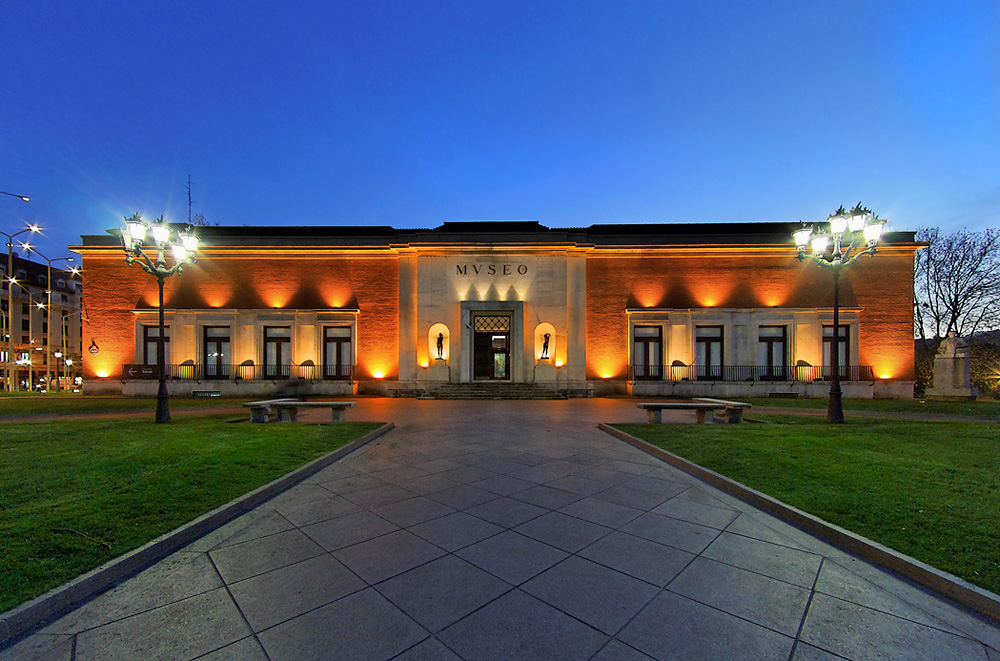
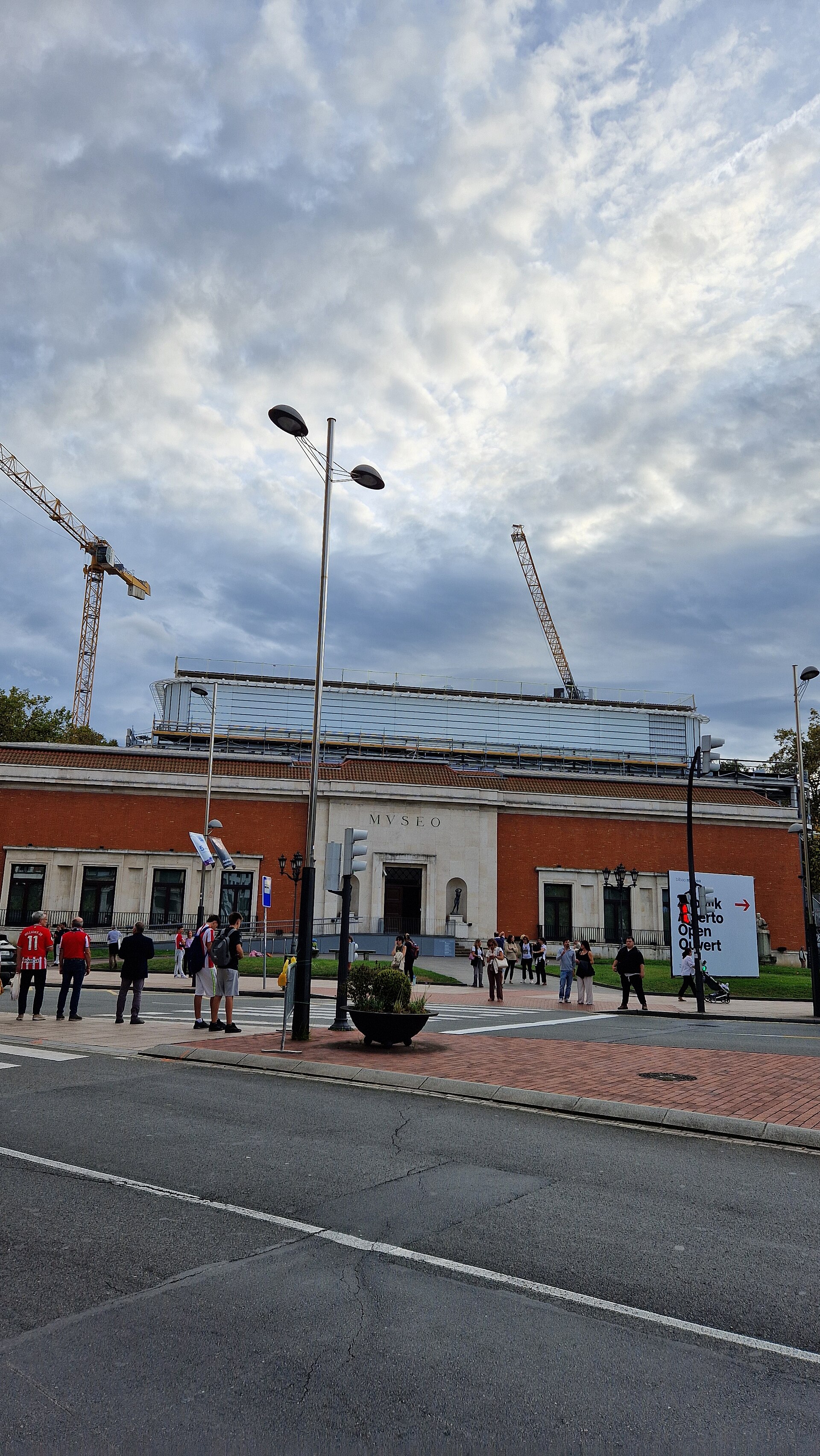
The neoclassical facade of the 1945 building, illuminated at night, with MVSEO lettering over the entrance.
MuseoBBAABilbao · CC BY-SA 3.0Bilbao Fine Arts Museum
Museum · Museo de Bellas Artes de Bilbao · Founded 1908
Open, admission and hours confirmed 26 August 2026 · 9 sources
On this page 15 sections
ContentsClose
The collection's strength is twofold and traceable directly to its double origin: a genuinely deep holding of Basque art, described by the museum's own history as the most complete artist list of its kind, built from the same early 20th-century civic patronage that founded the museum itself, alongside old-master and modern European painting bought through named, documented transactions - the 1919 exhibition purchases, Echevarrieta's 1919 gift, the 1924 and 1990s old-master acquisitions - rather than through inherited dynastic or colonial-era collecting. Few mid-sized European museums can trace as much of their founding collection to specific, dated purchase decisions by named civic bodies.
| Local name | Museo de Bellas Artes de Bilbao |
|---|---|
| Kind | Museum |
| Founded | Museum of Fine Arts founded 5 October 1908, opened 8 February 1914; a separate Museum of Modern Art founded 1922, opened 25 October 1924; the two merged into one building in 1945 (de facto) and 1969 (administratively) |
| City and country |  Bilbao, Spain Bilbao, Spain |
| Address | Plaza Eduardo Chillida, 48009 Bilbao, Bizkaia, Spain |
| Website | bilbaomuseoa.eus/en |
| Status | Open, confirmed |
| Record last verified |
Visiting
- Hours
- Monday to Saturday, except Tuesday10:00 to 20:00
- Sunday10:00 to 15:00
- Closed
- Tuesday. 25 December. 1 January. 6 January. Special reduced hours (10:00-15:00) on 24 and 31 December, unless either date falls on a Tuesday. Temporary closure 31 August to 5 October 2026 for the final phase of the Agravitas construction works; the museum's own site states this is to prepare for the reopening of the new museum, and regional press (Deia, 20 August 2026) reports the museum closes its doors 30 August 2026 and reopens 6 October 2026, with free admission 6-13 October to mark the reopening..
- Admission
- Standard admission, during the expansion worksFreeThe museum's own visit page states admission is free for the duration of the Agravitas expansion and renovation project. Re-confirmed 2026-08-26: the museum's own site now states this temporary arrangement runs only until the museum closes on 31 August 2026 for the final construction phase, reopening 6 October 2026 with free admission for the reopening week (6-13 October) only; admission policy for the fully reopened museum after that week was not stated on the pages consulted and should be re-checked once the new building opens.
Free entry: Every day, for the duration of the Agravitas expansion works (see notes above)- Tickets
- entradas.bilbaomuseoa.eus/muslinkIV/index.jsp The museum's own ticket page.
- Do I need to book?
- No, admission is currently free and walk-in during the expansion works
- Address
- Plaza Eduardo Chillida, 48009 Bilbao, Bizkaia, Spain MapMetro Moyua station
Tram Abandoibarra or Guggenheim stop
Bus Bilbobus lines 1, 10, 13 and 18 stop at Museo Plaza; several further lines stop nearby at Alameda Rekalde and Gran Via - Website
- bilbaomuseoa.eus/en
- Telephone
- +34 944 39 60 60
- [email protected]
Before you go how long, access, photography, bags, eating, shop
- How long to allow
- Not confirmed on the pages consulted for this file
- Access
- A temporary ramp has been installed at the historic 1945 building's original entrance to improve accessibility during the works, per the museum's own Agravitas project page
- Photography
- Not stated on the pages consulted for this file; not confirmed
- Bags
- Not stated on the pages consulted for this file; not confirmed
- Eating
- Not confirmed as currently operating; the museum's own material notes public services were consolidated in an earlier 2001 renovation and does not state cafe status during the present works
- Shop
- Online store operating (linked from the museum's own site); on-site shop hours during the works not confirmed
Prices and hours change. We take them from the institution's own pages and print the day we read them, and you can check the current position at the source we used. Confirm before you travel.
What is inside
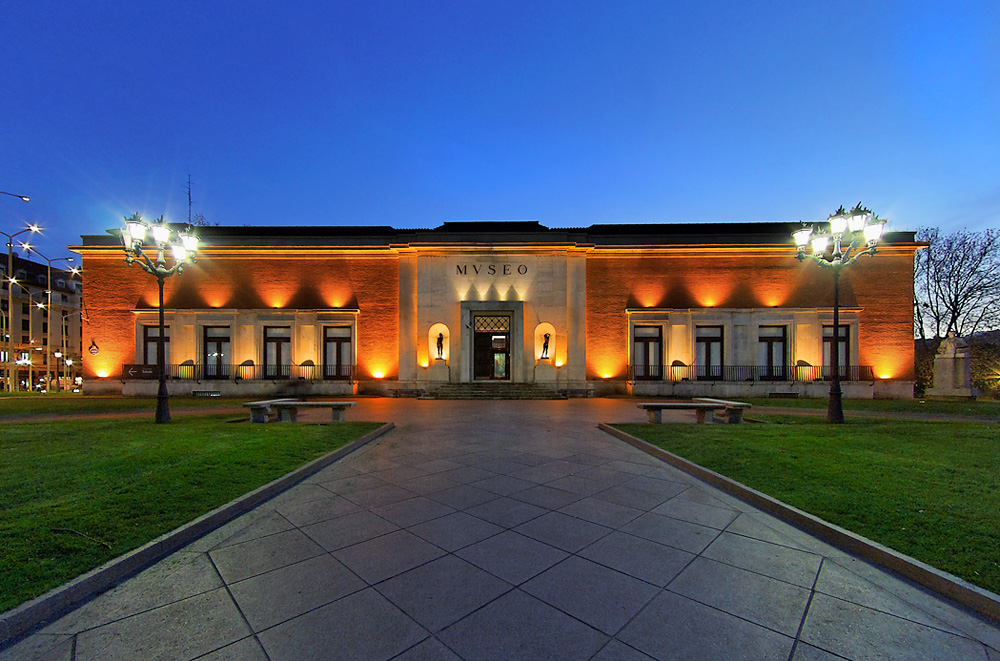
Photograph by MuseoBBAABilbao · CC BY-SA 3.0 The 1945 building (Museo Plaza entrance)
The neoclassical building opened 17 June 1945, designed by Fernando Urrutia and Gonzalo Cardenas on a plan the museum's own history page compares to Juan de Villanueva's 1785 design for the Prado, built to give the merged Museum of Fine Arts and Museum of Modern Art a single home after the Civil War. Declared a Historical-Artistic Monument in 1962. Currently the entrance most affected by construction; the least-affected part of it remains open with a temporary accessibility ramp.
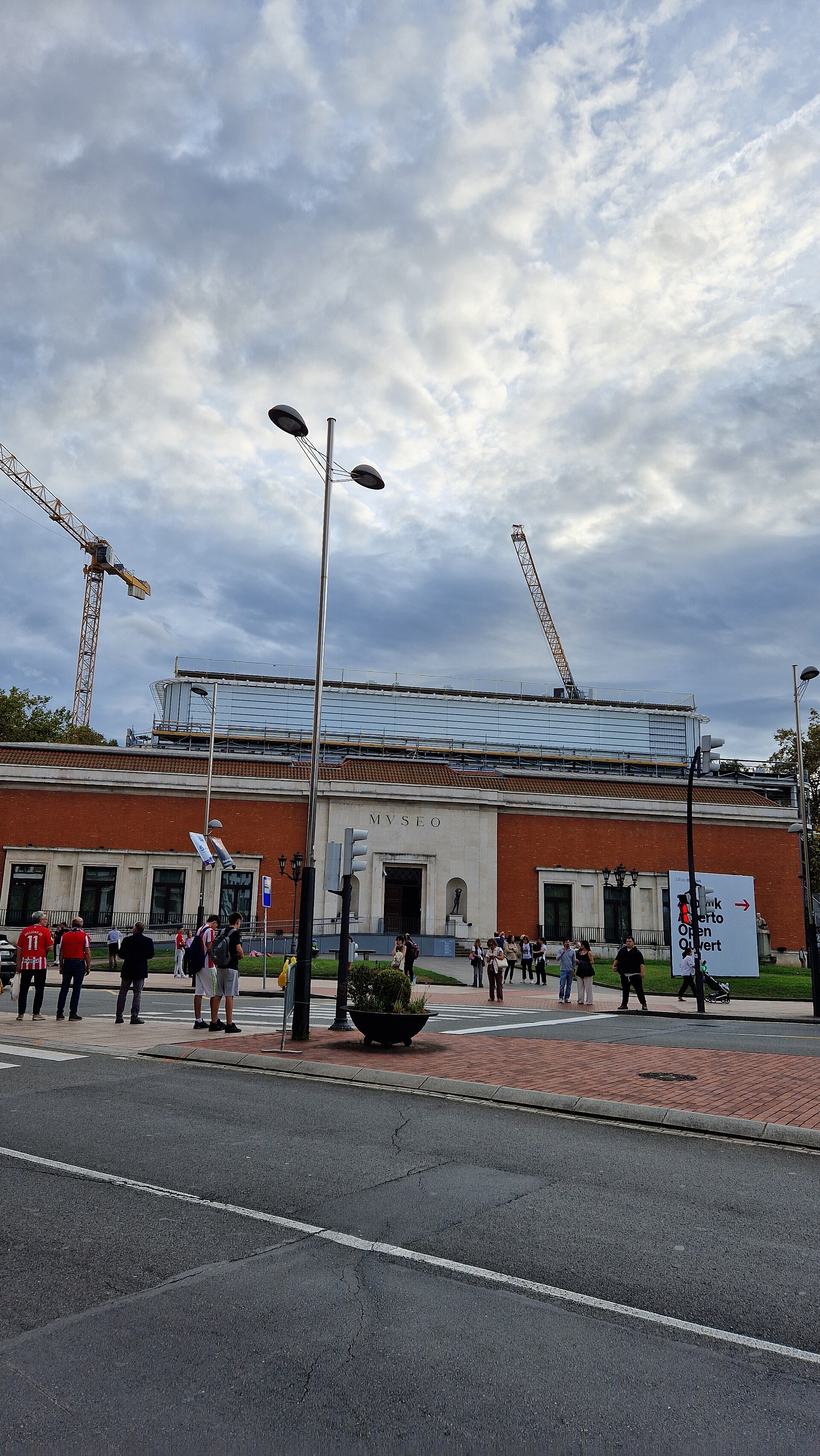
CC0 The 1970 building
The museum's first extension, completed 1970 to a design by Alvaro Libano and Ricardo Beascoa influenced by Mies van der Rohe, included in 2010 in the international register of Modern Movement architectural heritage. Since October 2025 this building, entered from Plaza Eduardo Chillida, has hosted all of the museum's public activity while the 1945 building and the new Agravitas extension are under construction, showing the permanent collection in a rotating format the museum calls BBKateak alongside temporary shows.
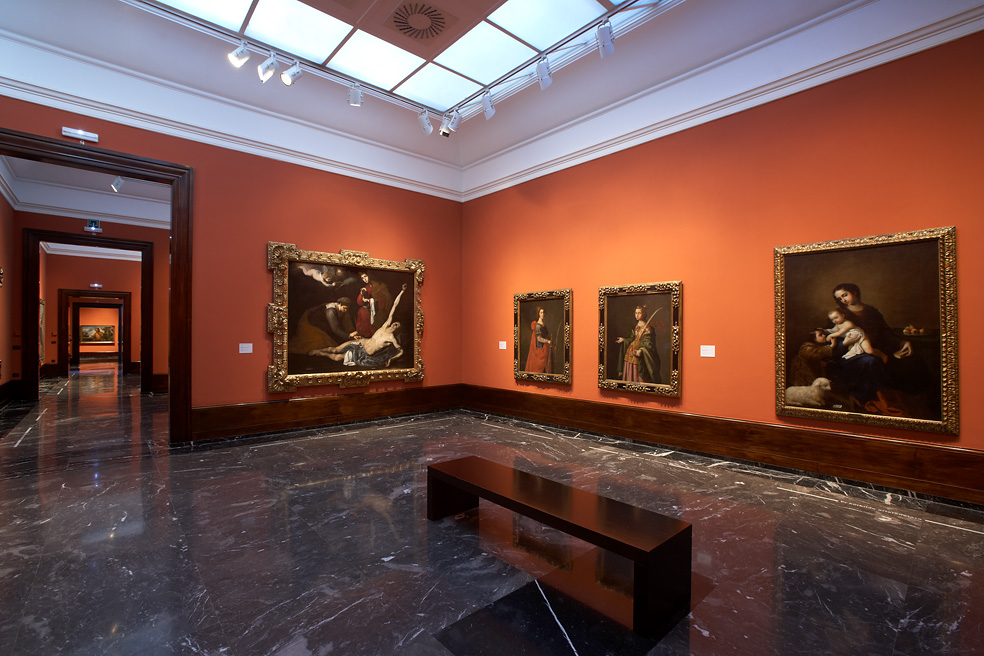
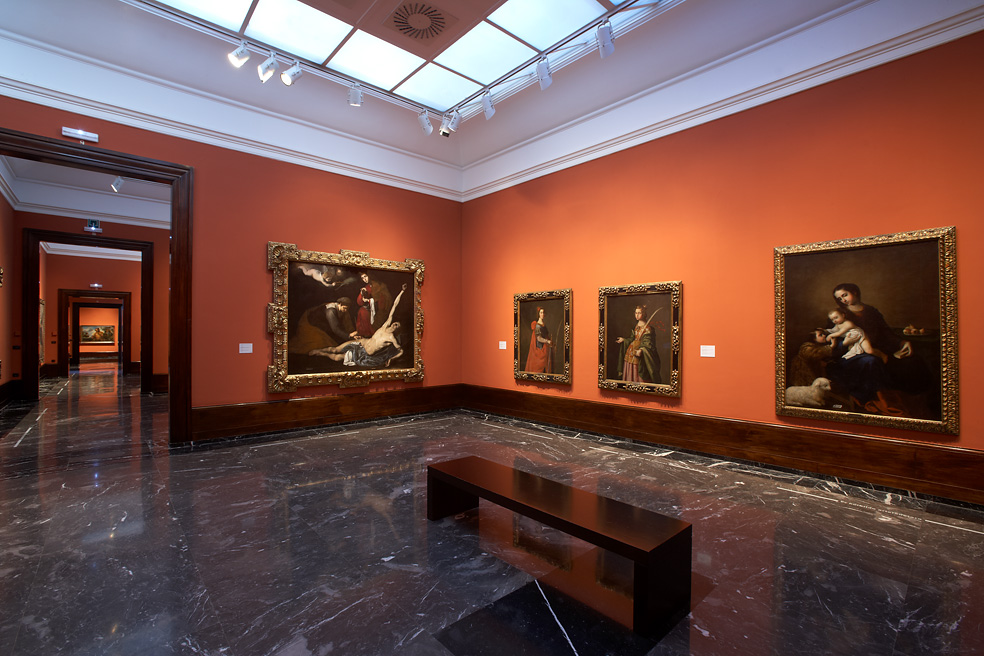
Photograph by MuseoBBAABilbao · CC BY-SA 3.0 The old masters galleries (Sala Antiguo)
Holds the museum's Renaissance, Mannerist and Baroque paintings: El Greco's Annunciation, Martin de Vos's Abduction of Europe, Ribera's Saint Sebastian Cured by the Holy Women, Zurbaran's Virgin with the Child Jesus and Saint John the Baptist as a Child, and later acquisitions including Anton van Dyck's Lamentation over the Dead Christ and Antonio Moro's Portrait of Philip II.
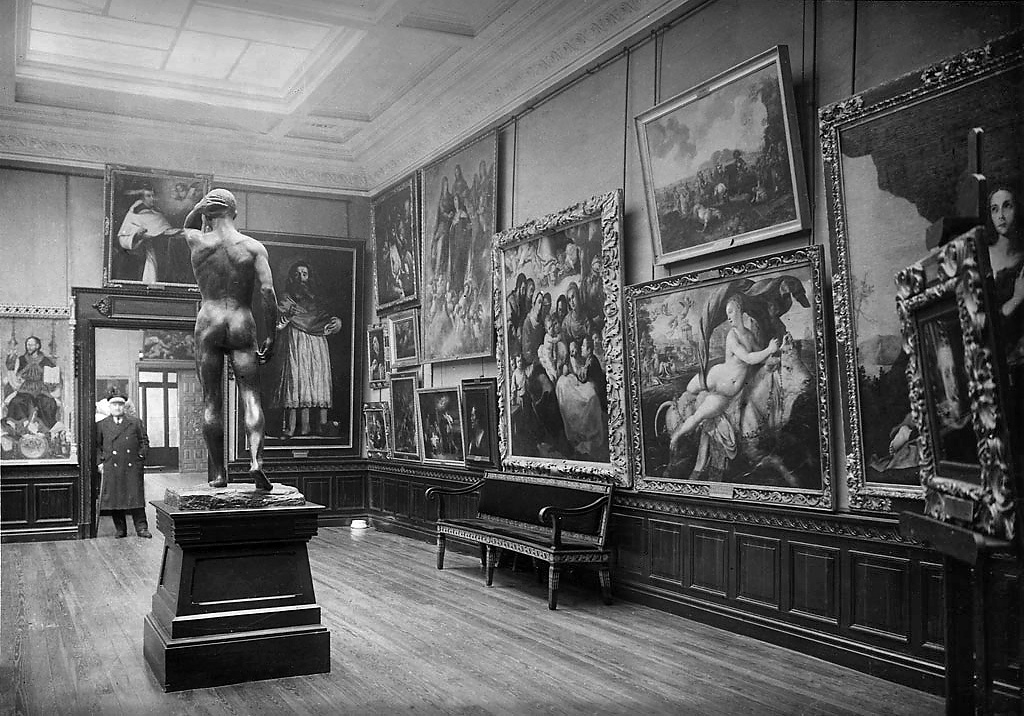
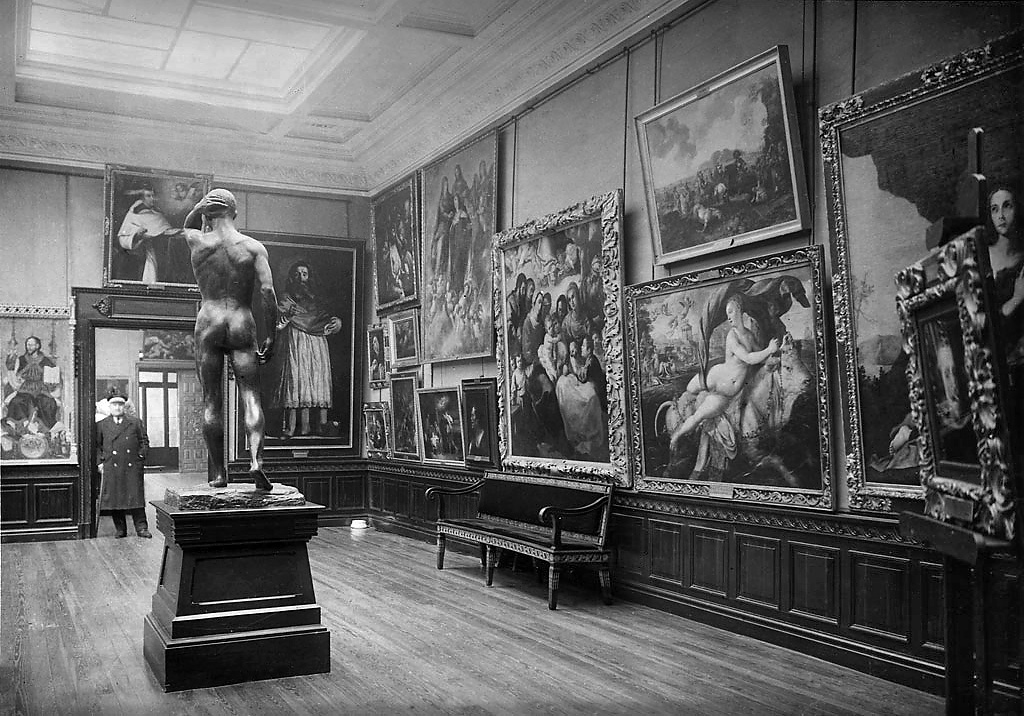
Photograph by MuseoBBAABilbao · CC BY-SA 3.0 The Atxuri room (historic)
Not a room in the current building but the first home of the collection: three rooms fitted out in 1914 by the municipal architect Ricardo Bastida in the former Atxuri Civil Hospital, by then repurposed as the School of Arts and Crafts, where the original Museum of Fine Arts opened with about 250 works before it outgrew the space.
Basque art
The museum's own history page calls this 'the best collection of Basque art, with the most complete list of artists': Adolfo Guiard, Dario de Regoyos, Francisco Iturrino, Aurelio Arteta, Jorge Oteiza, Ignacio Zuloaga and Eduardo Chillida among them, reflecting the collection's origin in the early 20th-century Bilbao bourgeoisie's own patronage of local artists.
Modern and contemporary collection
Built from the 1919 First International Exhibition of Painting and Sculpture onward: Gauguin, Cassatt, and later Antoni Tapies, Miquel Barcelo, R. B. Kitaj and Richard Serra. From October 2025 this material has been shown in the 1970 building; a purpose-built BBK Museoa space of more than 2,000 square metres is planned within the Agravitas extension.
What to see first
The Abduction of Europe
Martin de VosDonated in 1919 by the Bilbao businessman Horacio Echevarrieta, brokered through the Basque sculptor and dealer Francisco Durrio, who had lived in the Bateau-Lavoir in Montmartre and worked in ceramics alongside Picasso - a direct personal link between the Paris avant-garde circle and the museum's founding donations.3
Woman Seated with a Child in Arms
Mary CassattBought by the Provincial Council of Biscay at the 1919 First International Exhibition of Painting and Sculpture in Bilbao; at the time, and for long afterward, it was the first work by Cassatt in a public collection in Spain.3
Washerwomen in Arles (Laveuses a Arles)
Paul GauguinBought at the same 1919 exhibition as the Cassatt, and likewise the first Gauguin to enter a Spanish public collection; the two purchases became the founding nucleus of the separate Museum of Modern Art created in Bilbao five years later.3
Lot and His Daughters
Orazio GentileschiAcquired in 1924, the same year the Museum of Modern Art opened, showing the older Museum of Fine Arts continuing to buy Baroque paintings even as a second, rival institution for contemporary art was being founded across town.3
Saint Sebastian Cured by the Holy Women
Jose de RiberaBought in the same 1924 purchasing round as the Gentileschi, part of the pre-Civil War Museum of Fine Arts' old-master holdings.3
The Holy Family
Jan GossartAcquired despite the acute economic difficulties of the years around the 1945 opening of the merged museum's new building - the museum's own account states plainly that major purchases continued through wartime reconstruction rather than pausing for it.3
Portrait of Philip II
Antonio Moro (Anthonis Mor)Bought in the early 1990s alongside a Van Dyck Lamentation, part of a deliberate push to strengthen the old-master holdings under director Jorge de Barandiaran, the same period the Basque Government joined Bilbao City Council and the Provincial Council of Biscay as a governing institution of the museum.3
The two Fine Arts Museums evacuated in 1936
Various, the museum's own collectionsWhen the Civil War began in July 1936, the Museum of Fine Arts' collection was moved into the Uribitarte warehouses against the risk of air raids, while roughly thirty works, mostly by Basque artists, went to decorate the Basque Government's offices at the Carlton Hotel; the Museum of Modern Art's holdings were shipped to France by sea in early 1937 ahead of Franco's troops taking the city that June, and recovery and return of the exiled works was completed only by the end of 1939.3
Exhibitions on now
Past exhibitions here
- Closed29 Apr to 30 Aug 2026Confirmed · check before you travel
Two rival museums, born sixteen years apart
The museum now on Plaza Eduardo Chillida did not start as one institution. Bilbao's industrial and shipbuilding bourgeoisie, prosperous at the turn of the 20th century and wanting a cultural institution to match, backed the founding of the Museum of Fine Arts on 5 October 1908, a joint civic effort involving the town council, the provincial council and a group of artists. It opened its doors on 8 February 1914, installed in three rooms fitted out by the municipal architect Ricardo Bastida inside the former Atxuri Civil Hospital, by then repurposed as a School of Arts and Crafts. The painter Manuel Losada became its first director. The collection, based on deposits from the Provincial Council, the City Council, the state and several local institutions, along with private donations, grew to around 250 works before the building proved both too small and too poorly located to draw visitors.
A second, separate institution followed. In 1922 a motion to the Provincial Council proposed a dedicated Museum of Modern Art, built around works acquired at Bilbao's 1919 international exhibition together with new donations; it opened on 25 October 1924 under the painter Aurelio Arteta, with 137 works, in rooms attached to the Provincial Council's own building. For over a decade Bilbao ran two separate public art museums, born of the same civic impulse but organisationally distinct, each too cramped for its own growing collection.
1919: the exhibition that decided what the second museum would hold
The immediate cause of the Museum of Modern Art's founding was a single exhibition. In 1919 the Provincial Council, chaired by a commission under Ramon de la Sota, staged the First International Exhibition of Painting and Sculpture in Bilbao, bringing in work by Picasso, Cezanne, Gauguin, Van Gogh, Maurice Denis and Mary Cassatt, among others - a delayed but decisive exposure of the Bilbao art world to the international avant-garde, a year after Robert and Sonia Delaunay had already shown there at the Association of Basque Artists' invitation. The Provincial Council bought at that exhibition Cassatt's Woman Seated with a Child in Arms and Gauguin's Washerwomen in Arles, at the time the first works by either painter in any Spanish public collection; Ramon de la Sota separately bought and donated Zuloaga's Portrait of the Countess Mathieu de Noailles. That purchased group, plus later donations and acquisitions, became the founding nucleus the new Museum of Modern Art opened around five years later. The same year, 1919, the Bilbao businessman Horacio Echevarrieta donated Martin de Vos's Abduction of Europe to the older Museum of Fine Arts, a gift brokered by the Basque sculptor and art dealer Francisco Durrio, who had lived for decades in Montmartre's Bateau-Lavoir, worked in ceramics alongside Picasso, and stayed close to Paul Gauguin - one direct, named thread connecting Bilbao's museum-founding generation to the Paris art world it was trying to catch up with.
Evacuated, exiled, and brought home
The Spanish Civil War broke out in July 1936 and suspended both museums' development immediately. Facing the risk of air raids, the Museum of Fine Arts moved its collection into the Uribitarte warehouses; around thirty works, mostly by Basque artists, went instead to decorate the offices of the Basque Government's Presidency, provisionally housed at the Carlton Hotel. At the start of 1937 most of the Museum of Modern Art's holdings were shipped out of the country to France by sea. Franco's troops took Bilbao in June 1937 and brought the city's institutions under new control; efforts to recover both museums' collections, and to bring the works exiled in France back to Spain, began soon after and were completed by the end of 1939. The sources consulted for this record describe that return as accomplished but do not itemise whether anything sent to France, or into the Uribitarte storage, failed to come back.
One building for both museums, then a second building on top of the first
Even before the war ended, the problem of housing two collections in one place was already being solved on paper: in 1938 the architects Fernando Urrutia and Gonzalo Cardenas were commissioned to design a single new building for both museums, on a neoclassical plan the museum's own history explicitly compares to Juan de Villanueva's 1785 design for the Prado. Approved by the provincial and city authorities in February 1939, the new Museum of Fine Arts of Bilbao opened on 17 June 1945, merging the two collections into one address de facto, though the administrative merger of the two institutions was not completed until 1969. The building was declared a Historical-Artistic Monument in 1962.
By the 1960s that single building was already too small again. A first extension, designed by Alvaro Libano and Ricardo Beascoa after a tour of European museums, opened in 1970: an L-shaped, glass-fronted structure influenced by Mies van der Rohe, distinct enough architecturally from the 1945 building that in 2010 it was added to the international register of Modern Movement architectural heritage in its own right. A further renovation in 2001, led by the architect Luis Maria Uriarte with Rafael Moneo and Norman Foster on the selecting jury, physically linked the two buildings and consolidated visitor services that had previously been scattered piecemeal through both.
What is happening right now, and why entry costs nothing
The museum is, as of 2026, mid-construction. A 2019 international competition for a further expansion and renovation, run under the motto Agravitas, was won by Foster + Partners working with the Basque architect Luis Maria Uriarte, beating fifty-seven competing teams; the stated aim is to restore the 1945 building's original entrance to public use and add roughly 6,700 square metres of new construction, a new BBK Museoa exhibition space of over 2,000 square metres, and improved accessibility, layered respectfully over the existing 1945 and 1970 buildings rather than replacing them. The first stone was laid in November 2022 and the first structural pillar in January 2024. Rather than close during construction, the museum kept a reduced but genuine public programme running throughout: through most of 2025 in the 1945 building, then from October 2025 in the renovated 1970 building, entered from Plaza Eduardo Chillida, with the permanent collection shown in a rotating format the museum calls BBKateak. For the duration of the works, admission is free.
That decision appears to have worked on its own terms. The museum's director, Miguel Zugaza, told the regional newspaper Deia in January 2026 that 2025 had been 'a very special situation' precisely because the institution had chosen not to close, and the museum recorded 211,848 visitors that year - a 2 percent rise on 2024 and its best total in six years - which he presented as validation of the effort to keep the doors open through a major building project rather than as an unrelated success. A visitor arriving expecting the museum's usual 1945 facade will instead be redirected to a different building's entrance, on a different square, for as long as the Agravitas project runs.
What visitors say
Coverage of the museum in 2025-2026 centres less on individual visitor sentiment than on the fact that it has stayed open and kept growing its audience through a major construction project, which the museum's own director treats as the year's central achievement rather than a side note.
What is praised, what is criticised
- Praised: The museum's decision to keep public access running throughout the Agravitas construction, rather than closing for the duration of the works, is repeatedly framed by the museum's own director and by regional press coverage as the notable achievement of the current period
- Praised: The Basque art holdings are singled out by the museum's own account as unusually complete for the region, naming Guiard, Regoyos, Iturrino, Arteta, Oteiza, Zuloaga and Chillida as a coherent group rather than isolated names
- Criticised: The scale of the current construction work is disruptive by any account: an original 1945 entrance has been temporarily closed off, activity relocated to the 1970 building, and a temporary accessibility ramp installed in place of normal step-free access
- Criticised: The library, normally open for on-site consultation, has been reduced to an appointment-only service for the duration of the works, a concrete loss of a normal visitor service rather than a mere inconvenience
Questions about Bilbao Fine Arts Museum
Where is Bilbao Fine Arts Museum?
Plaza Eduardo Chillida, 48009 Bilbao, Bizkaia, Spain.
How much does it cost to visit?
Standard admission, during the expansion works: free. As confirmed 26 August 2026.
When is it open?
Monday to Saturday, except Tuesday 10:00-20:00; Sunday 10:00-15:00. Closed: Tuesday. 25 December. As confirmed 26 August 2026.
How do you get there?
Metro: Moyua station; Tram: Abandoibarra or Guggenheim stop; Bus: Bilbobus lines 1, 10, 13 and 18 stop at Museo Plaza; several further lines stop nearby at Alameda Rekalde and Gran Via.
What should you see first?
The Abduction of Europe (Martin de Vos); Woman Seated with a Child in Arms (Mary Cassatt); Washerwomen in Arles (Laveuses a Arles) (Paul Gauguin); Lot and His Daughters (Orazio Gentileschi); Saint Sebastian Cured by the Holy Women (Jose de Ribera); The Holy Family (Jan Gossart).
What we could not confirm
- The sources consulted for this record describe the 1936-1939 evacuation, exile in France, and eventual recovery of both museums' collections as completed, but do not state whether any works were lost, damaged, or failed to return; this record does not assert a clean outcome beyond what the sources state.
- The exact scope of visitor services (cafe, shop, on-site library consultation) currently operating during the Agravitas works, beyond what the museum's own site states about the library's appointment-only access, was not confirmed in the sources consulted and should be checked close to any planned visit.
- The Agravitas project's completion date was not stated in the sources consulted for this record; only the 2022 first-stone and 2024 first-pillar milestones were confirmed, and the museum's own construction-period visitor guidance should be treated as the current source of truth rather than this record.
- The museum closes 31 August 2026 (per its own site) / 30 August 2026 (per Deia, 20 August 2026) for the final phase of the Agravitas works and reopens 6 October 2026, restoring the original 1945 entrance; admission is free for the reopening week (6-13 October) but the admission policy, hours and which wings are open once the fully expanded museum settles into normal operation were not stated on the sources consulted for this re-check and need confirming after the reopening.
Images
Sources
- 1Bilbao Fine Arts Museum, Plan your visit (museum's own site) bilbaomuseoa.eus/en/visita/planifica-tu-visita
- 2Bilbao Fine Arts Museum, Project Agravitas (museum's own site) bilbaomuseoa.eus/en/museum/project-agravitas
- 3Bilbao Fine Arts Museum, History of the museum (museum's own site) bilbaomuseoa.eus/en/museum/history
- 4Wikidata Q127064, Bilbao Fine Arts Museum (, identity and coordinates) wikidata.org/wiki/Q127064
- 5Wikipedia, Bilbao Fine Arts Museum () en.wikipedia.org/wiki/Bilbao_Fine_Arts_Museum
- 6Bilbao Fine Arts Museum, homepage (museum's own site) bilbaomuseoa.eus/en/
- 7Bilbao Fine Arts Museum, footer contact details (museum's own site) bilbaomuseoa.eus/en/prices-and-schedules
- 8Deia, El Bellas Artes de Bilbao alcanza en 2025 su mejor cifra de visitas de los ultimos seis anos, Maite Redondo, 2 January 2026 deia.eus/cultura/2026/01/02/bellas-artes-bilbao-alcanza-2025-10532237.html
- 9Deia, El Bellas Artes Bilbao cierra el 30 de agosto para la ultima fase de obras previa a su reapertura el 6 de octubre, Maite Redondo, 20 August 2026 deia.eus/cultura/2026/08/20/bellas-artes-bilbao-cierra-30-11454510.html