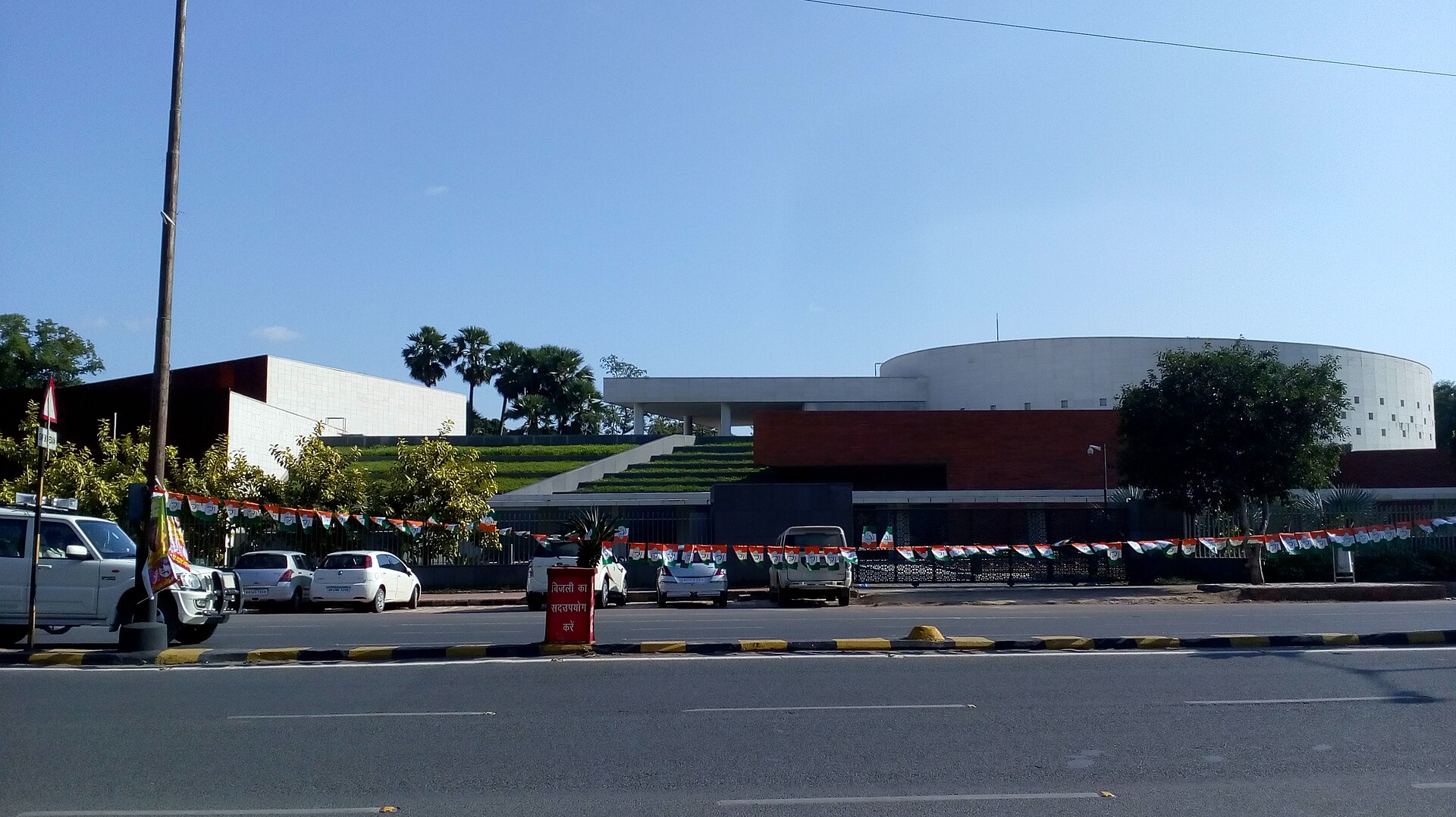
The museum's Bailey Road facade, showing the terraced green roof and the curved orientation-theatre pavilion designed by Maki and Associates with Opolis Architects.
Shivamsetu, CC BY-SA 4.0On this page 14 sections
ContentsClose
Bihar Museum's strongest holdings are archaeological and sculptural: Mauryan, Sunga, Kushan, Gupta and Pala-period stone and bronze work from the ancient Magadh region, anchored by the Didarganj Yakshi and supported by terracotta figurines, temple architectural fragments such as the 12th-century Makara gargoyle, and Buddhist and Jain bronzes drawn largely from sites across Bihar. Its second, less usual strength is ethnographic and diasporic: a dedicated Diaspora Gallery tracing Bihari indentured migration to the Caribbean and the Indian Ocean world, and a Regional Art Gallery built around living craft traditions, Manjusha, Madhubani and Tikuli painting, and Mithila papier-mache and terracotta work, that most Indian state museums treat as folk-art footnotes rather than gallery-scale subjects.
| Kind | Museum |
|---|---|
| Founded | Planning began with a July 2011 memorandum between the Bihar government and Lord Cultural Resources; Maki and Associates with Opolis Architects won the design competition in 2011-12; construction began October 2013; the museum partially opened 15 August 2015 and all nine core galleries opened October 2017 |
| City and country |  Patna, India Patna, India |
| Address | Nehru Path, Patna, Bihar 800001, India |
| Website | biharmuseum.org |
| Status | Open, confirmed |
| Record last verified |
Visiting
- Hours
- Tue-Sun10:00 to 17:00Galleries
- Tue-Sun10:00 to 19:00Children's Gallery, Children's Cafe, Museum Shop and Library
- Tue-Sun10:00 to 21:00The Pot Belly restaurant
- Closed
- Monday. Selected religious and national holidays.
- Admission
- Indian Adult (regular, 10:00-17:00)INR 100
- Indian Children (regular)INR 50
- International Adult (regular)INR 500
- International Children (regular)INR 250
- School Group TourINR 25Per student
- Indian Adult (evening, 17:00-19:00)INR 50Discounted evening ticket
- Indian Children (evening)INR 25Discounted evening ticket
- International Adult (evening)INR 500Same as the regular international rate
- International Children (evening)INR 250Same as the regular international rate
- Tickets
- biharmuseum.org/visit The museum's own ticket page.
- Do I need to book?
- Not required for individual visitors; tickets are sold at a physical counter near the entrance, with cash, card and UPI accepted. Group visits require advance reservation.
- Address
- Nehru Path, Patna, Bihar 800001, India MapAir Patna Airport is about 10 minutes from the museum by road, per the museum's own visitor page.
Rail Patna railway station is about 10 minutes from the museum by road, per the museum's own visitor page. - Website
- biharmuseum.org
- Telephone
- +91 612 223 5732
- [email protected]
Before you go how long, access, photography, bags, eating, shop
- How long to allow
- The museum does not publish a typical visit duration. With nine core exhibition spaces (Orientation, History Art, Regional Art, Diaspora, Visible Storage, Contemporary Art and Children's galleries, plus Gallery A, B and C) spread across a 5.6-hectare campus, a visitor covering the main history and art galleries should allow at least two to three hours, more with the Children's Gallery.
- Access
- Wheelchairs are available free of charge on a first-come first-served basis. Two accessible lifts serve the galleries next to the Bihari Diaspora gallery, and accessible restrooms are on every level.
- Photography
- Personal cameras and mobile phones are permitted in the galleries. The museum links a separate photography-guidelines document from its FAQ page that this research pass could not open directly; see notes_for_editor.
- Bags
- A baggage room near the main entrance stores visitors' luggage.
- Eating
- The Pot Belly, the museum's own restaurant, serves Bihari cuisine 10:00 to 21:00; a separate Children's Cafeteria serves the Children's Gallery 10:00 to 19:00.
- Shop
- An in-house museum shop sells souvenirs and publications; a separate kids' retail counter sells children's souvenirs and toys.
Prices and hours change. We take them from the institution's own pages and print the day we read them, and you can check the current position at the source we used. Confirm before you travel.
What is inside
Orientation Gallery
The visit's starting point: a pre-show film on excavation and dating methods, Gupta-period gold and silver coinage bearing Chandragupta I and Queen Kumaradevi, a 7th-century red sandstone Padmapani Avalokiteshvara, and a Bidri-work dumbbell illustrating medieval decorative metalwork applied to everyday objects.
History Art Gallery
The museum's centrepiece room, built around the Didarganj Yakshi. Also holds Patna School paintings, Buddhist and Jain bronzes, terracotta figures including a 3rd-century BCE dancing girl, a 12th-century Makara gargoyle, Company-era Daniell prints of Hindu deities, and medieval miniature painting.
Regional Art Gallery
Bihar's living craft traditions: Manjusha scroll painting from Bhagalpur, papier-mache sculpture of the folk goddess Adi-Shakti, and Mithila terracotta tableaux depicting the Sama-Chakeba sibling festival.
Diaspora Gallery
A gallery, unusual for an Indian state museum, tracing Bihari indentured and contract-labour migration to the Caribbean, Mauritius, Fiji and South Africa, through a marigold-flower canopy installation, the Bhojpuri 'Bidesiya' songs of poet Bhikhari Thakur, and the Caribbean 'Chutney' music genre that grew out of that migration.
Visible Storage
A dense open display of terracotta artifacts and sculpture, with a separate Coin Storage section running from early punch-marked coins to medieval currency.
Contemporary Art Gallery
A rotating selection of present-day Indian painting and sculpture in varied media, curated for contextual and cultural relevance rather than as a fixed permanent hang.
Children's Gallery
Six themed, hands-on learning zones (Orientation Room, Wildlife Sanctuary, Chandragupta Maurya and Sher Shah Suri history sections, Arts and Culture, and Discovery) built around a life-size tiger figure, an interactive Grand Trunk Road map, a fabricated 'Mauryan Throne' with a touchscreen Chanakya quiz, and displays on the sparrow, Bihar's state bird.
What to see first
Didarganj Yakshi
Unknown Mauryan-period sculptorA 1.57-metre polished Chunar sandstone figure of a Yakshi holding a fly-whisk, sometimes called the 'Mona Lisa of India' for its expression; discovered on the Ganges bank at Didarganj in 1917, held for decades at Patna Museum, and now the centrepiece of Bihar Museum's History Art Gallery.6
Padmapani Avalokiteshvara
Unknown, 7th centuryA red sandstone sculpture of the compassionate Buddha manifestation holding a lotus, dated to the 7th century CE and displayed in the Orientation Gallery.11
The Gargoyle (Makara waterspout)
Unknown, 12th centuryA temple rainwater spout carved as a Makara sea-creature with a yaksha at its mouth, illustrating 12th-century architectural engineering alongside its mythological subject.7
Dancing Girl in terracotta
Unknown, 3rd century BCEA Mauryan-period terracotta figure whose carved skirt and hairstyle the museum's own gallery text reads as showing Greek stylistic influence, evidence of contact and exchange with the Hellenistic world.7
Gupta gold and silver coinage
Gupta imperial mintCoins bearing Chandragupta I and Queen Kumaradevi of the Licchavi dynasty, read by the museum as evidence of the queen's standing in imperial administration during what is conventionally called the Golden Age of Indian history.11
Manjusha Art panel (Bhagalpur)
Unknown regional artist, Ang regionAn acrylic-on-canvas example of Bhagalpur's Manjusha painting tradition, narrating the story of Shiva and Vishahri Devi across sequential frames using a deliberately restricted three-colour palette.8
Sama-Chakeba terracotta tableau
Unknown regional artist, Mithila regionTerracotta figures narrating the folk tale of Sama, Krishna's daughter, and her brother Chakeba, the origin story for a nine-day Mithila festival honouring sibling bonds.8
Marigold Canopy
Bihar Museum, Diaspora Gallery installationA canopy of marigold flowers built to express connection with the Bihari diaspora, a symbolic centrepiece rather than an excavated object, opening the gallery's account of indentured migration.9
A campus chosen by international competition
In July 2011 the Bihar government signed a memorandum with the Canadian firm Lord Cultural Resources to plan a new state museum for Patna, and put the design out to an international competition. Coop Himmelblau, Norman Foster and Partners, Snohetta and Studio Daniel Libeskind were among the entrants; the Tokyo practice Maki and Associates, working with the Indian firm Opolis, won it, scoring 77.56 percent against Foster and Partners' 75.59 percent. The Bihar cabinet approved the selection on 24 January 2012 and the contract was signed in Patna the following day. Construction began in October 2013 on a 5.6-hectare site on Bailey Road, next to the Patna High Court.
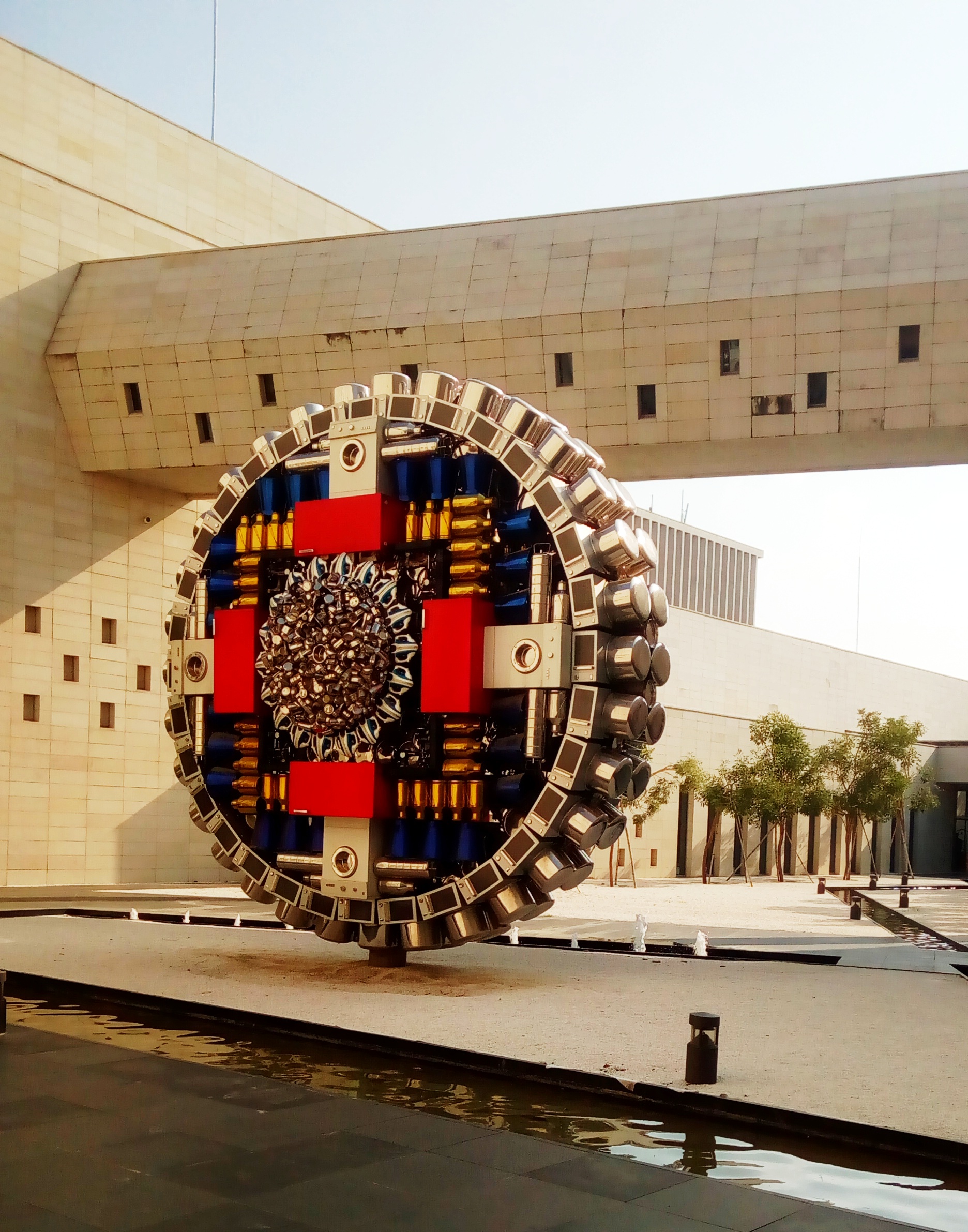
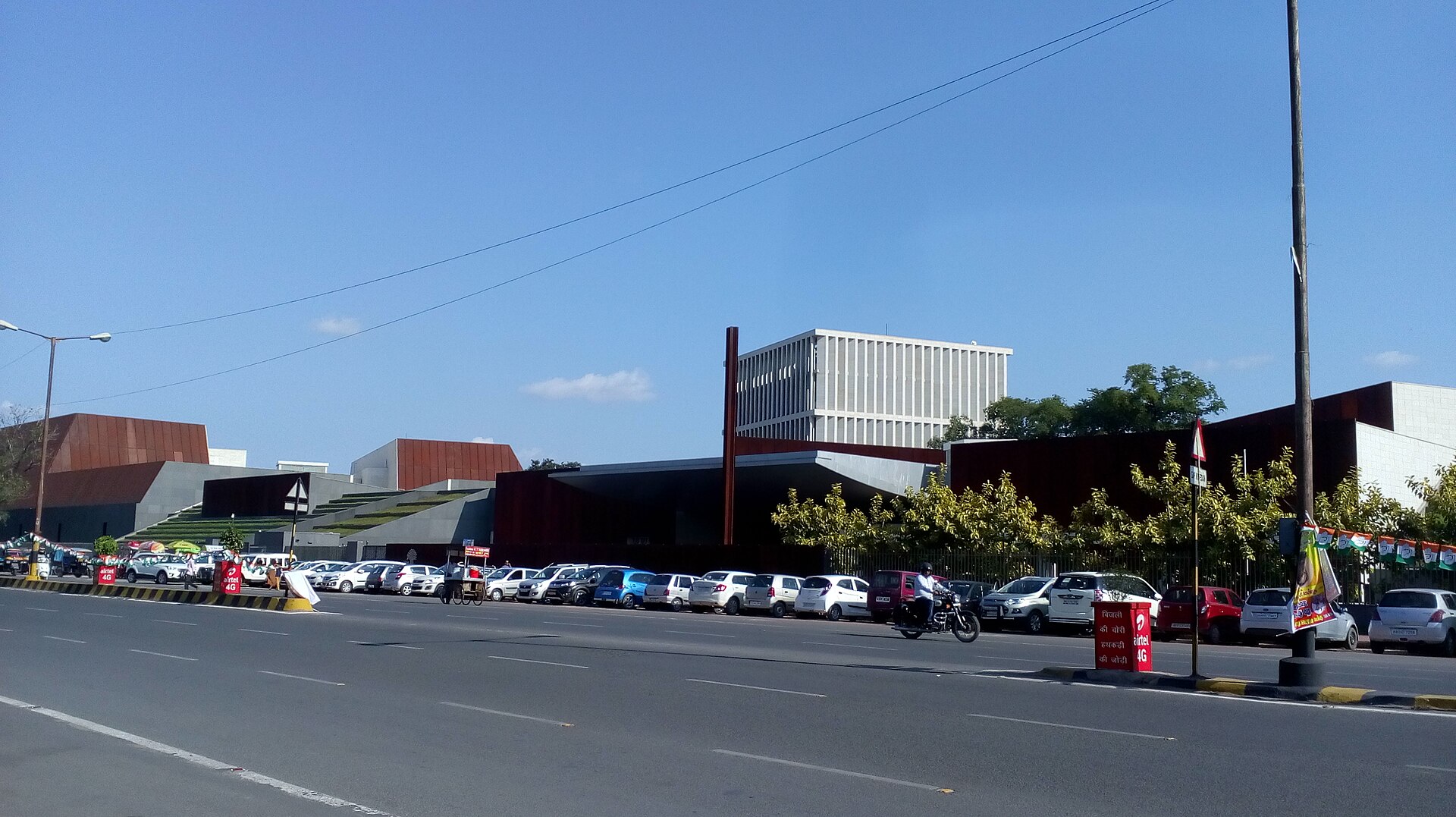
Fumihiko Maki's firm did not design a single building. It designed a campus: an interlinked landscape of pavilions, courtyards and covered bridges intended to let visitors move between exhibition, education and event spaces without the feeling of one long institutional block. Concrete and stone define the exterior, with warm-toned cladding on the angular exhibition wings and a pale, curved pavilion housing the orientation theatre. A central courtyard and a Buddha courtyard organise the plan; cloistered walkways connect the History and Regional Art galleries to the Children's Gallery and the Diaspora Gallery. AWA Lighting Designers handled the interior lighting, Mahendra Raj Consultants the structural engineering and Lord Cultural Resources the exhibition design; Ohtori Consultants and Forethought Design Consultants planned the landscape. The finished built area runs to roughly 24,000 to 25,000 square metres. In December 2019 the museum received a provisional GRIHA five-star rating, India's own green-building standard, for the campus's environmental design.
From a memorandum to nine galleries
The museum opened in stages. On 15 August 2015 only the children's museum, the main entrance area and an orientation theatre were ready; the remaining nine core galleries followed in October 2017, more than six years after the design competition closed. The project's budget is recorded at around Rs 498 crore, then about USD 52 million. A separate, later commitment, cabinet approval in August 2023 for roughly Rs 542 crore, covers an underground tunnel connecting Bihar Museum to the older Patna Museum a short distance away; Chief Minister Nitish Kumar laid its foundation stone on 8 March 2026, and the museum's own published news record shows him inspecting the tunnel under construction the same year.
What is inside: from the Orientation Gallery to the Contemporary Art Gallery
Bihar Museum organises its holdings, more than 20,000 catalogued artifacts by one page on its own site, over 30,000 by another, across nine galleries plus the Children's Gallery. The Orientation Gallery opens the visit with a short film on excavation and scientific dating methods and holds Gupta-period coinage alongside a 7th-century red sandstone Padmapani Avalokiteshvara. The History Art Gallery is the museum's centrepiece room, built around the Didarganj Yakshi and also showing Patna School paintings, Buddhist and Jain bronzes, terracotta figures, Company-era Daniell prints of Hindu deities, and medieval miniature painting. The Regional Art Gallery is given over to Bihar's living craft traditions: Manjusha scroll painting from Bhagalpur, papier-mache sculpture, and Mithila terracotta narrative tableaux. The Diaspora Gallery, unusual for an Indian state museum, follows Bihari indentured and contract-labour migration to the Caribbean, Mauritius, Fiji and South Africa through folk music, including the Bhojpuri 'Bidesiya' songs of the poet Bhikhari Thakur and the Caribbean 'Chutney' fusion genre that grew out of it. Visible Storage keeps a dense open display of terracotta and a separate coin storage; the Contemporary Art Gallery rotates a changing selection of present-day Indian painting and sculpture. Three further rooms, Gallery A, B and C, are named in the museum's own navigation without published gallery-level descriptions at the time of this research. The Children's Gallery, run as six themed learning zones covering Bihar's wildlife and Mauryan and Sur-era history, is aimed at school-age visitors and stays open two hours later than the history and art galleries.
The Didarganj Yakshi and the dispute with Patna Museum
The Didarganj Yakshi, a 1.57-metre Chunar sandstone figure holding a fly-whisk and polished to the mirror finish associated with Mauryan-period stone carving, is Bihar Museum's best-known object and the centrepiece of the History Art Gallery. The museum's own account of its discovery gives two versions: a formal one, in which a letter to the then Commissioner of Patna, E.H.S. Walsh, credited a local man named Ghulam Rasul with finding it on the Ganges bank at Didarganj; and an oral one, recorded in a police inspector's report dated 20 October 1917, in which villagers chasing a snake into a hole dug up the buried statue. Either way, 1917 was also the year Patna Museum was formally established, and the Yakshi became that museum's signature piece for close to a century.
It no longer is. More than 100 objects, including the Yakshi, were moved out of Patna Museum into Bihar Museum's collection as the newer institution's galleries filled; the dividing line the two museums now use is 1764, with pre-1764 archaeological and art holdings assigned to Bihar Museum and later material staying at Patna Museum. The Wire reported on 27 January 2018 that the transfers were contested: Pushparaj Shastri, an activist with the Save Patna Museum campaign, alleged that whole galleries were emptied under the label of maintenance work, on decisions taken unilaterally inside the state's culture ministry, and that many objects had been donated to Patna Museum specifically rather than to the state's collection in general, a donor-consent question he said the transfers had not addressed. The historian Nayanjyot Lahiri told the same publication that a museum being made to permanently part with its collection for another museum's benefit was close to unheard of. The report also noted a 2015 Patna High Court finding that the Bihar Museum project was not in the public interest, and set Bihar Museum's Rs 100 adult ticket, prohibitive by the state's per-capita income on the reporter's account, against Patna Museum's Rs 20. The Rahul Sankrityayan collection was slated for transfer on the same basis and kept at Patna Museum only after the donor's daughter objected in writing.
Eight years on, the public record shows the two institutions moving toward each other rather than apart: both report to the same Director General, Anjani Kumar Singh, and the state is now building a tunnel to connect them underground, with Patna Museum itself having recently opened a new building of its own. Whether the legal and donor-consent questions The Wire's reporting raised in 2018 were ever formally resolved is not addressed on either museum's own site.
A working programme, not a static hang
Bihar Museum runs a continuous exhibition and events calendar rather than a fixed permanent hang alone. As of late September 2026 its Multipurpose Hall is showing 'Marching from the Margins,' a retrospective of the painter Krishen Khanna, the last surviving member of Bombay's Progressive Artists' Group, running 13 September to 14 October 2026; it followed 'The Paper Boat,' a survey of the sculptor Rajesh Ram's work that closed 6 September 2026. The museum has run a Biennale since 2021, with a third edition inaugurated in August 2025 under the title 'Reclaiming Culture,' and lists institutional partnerships including memoranda of understanding with the Indian Council for Cultural Relations, the Indira Gandhi Rashtriya Manav Sangrahalaya in Bhopal, the Indian Institute of Heritage in Noida, NIFT Patna and Anant National University in Ahmedabad. Its own published visitor log records calls by, among others, the writer Shashi Tharoor, the actor Manoj Bajpayee, the Reserve Bank of India's Governor, the President of Mauritius and several foreign consuls-general, alongside a steady programme of artist talks, seminars and school workshops. A conservation lab on site cares for the collection's stone, bronze, textile and paper objects; a library offers discounted membership; and The Pot Belly, the museum's in-house restaurant, serves Bihari cuisine until 21:00, two hours after the last of the history galleries close.
Version safety: two museums, one road
Bihar Museum and Patna Museum are two separate institutions a short distance apart on and off Bailey Road in Patna, and this record describes only the former. Patna Museum, established in 1917, is the older of the two and retains everything in the shared collection dated after 1764, along with material donated or curated for it directly; Bihar Museum, inaugurated in stages from 2015, holds the pre-1764 archaeological and art collection, the Diaspora, Regional Art, Children's and Contemporary Art galleries, and, since the transfer described above, the Didarganj Yakshi. Any claim on this page about 'Bihar Museum' refers to the Nehru Path institution photographed here, designed by Maki and Associates with Opolis Architects, and not to Patna Museum's own recently rebuilt premises on Buddha Marg.
What visitors say
Aggregated visitor commentary consistently frames Bihar Museum as unusually accomplished by the standard of Indian state museums: reviewers repeatedly reach for comparisons to MoMA, the Met and the British Museum to describe the building and its upkeep, and single out the Children's Gallery as exceptional. The same commentary just as consistently notes a gap between the scale of the architecture and the depth of object-level information on display, and Justdial's own aggregated review summary lists limited detail beside individual artifacts and a narrow range of collection-related merchandise in the shop as the most repeated complaints.
What is praised, what is criticised
- Praised: The scale, cleanliness and contemporary design of the Maki and Associates and Opolis building, often compared by visitors to major international museums
- Praised: The Children's Gallery's hands-on, technology-assisted exhibits for young visitors
- Praised: The Didarganj Yakshi and the History Art Gallery's Mauryan and Gupta-period sculpture
- Criticised: Justdial's aggregated review summary lists limited detailed information beside individual artifacts as a repeated visitor complaint
- Criticised: The museum shop's limited range of items tied to the collection
- Criticised: Named journalism (The Wire, 27 January 2018) reported that Bihar Museum's Rs 100 adult ticket, against Patna Museum's Rs 20 at the time, sits awkwardly against Bihar's per-capita income
Ratings on other platforms
Justdial: 5 from 23,432 ratings, read 28 September 2026
Tripadvisor: 4.3 from 49 ratings, read 28 September 2026
Facebook: 4.8 from 35 ratings, read 28 September 2026
A platform average is a tertiary source: it moves, it is not audited, and we quote no visitor's words.
Questions about Bihar Museum
Where is Bihar Museum?
Nehru Path, Patna, Bihar 800001, India.
How much does it cost to visit?
Indian Adult (regular, 10:00-17:00): INR 100; Indian Children (regular): INR 50; International Adult (regular): INR 500; International Children (regular): INR 250; School Group Tour: INR 25. As confirmed 28 September 2026.
When is it open?
Tue-Sun 10:00-17:00; Tue-Sun 10:00-19:00; Tue-Sun 10:00-21:00. Closed: Monday. Selected religious and national holidays. As confirmed 28 September 2026.
How do you get there?
Air: Patna Airport is about 10 minutes from the museum by road, per the museum's own visitor page; Rail: Patna railway station is about 10 minutes from the museum by road, per the museum's own visitor page.
What should you see first?
Didarganj Yakshi (Unknown Mauryan-period sculptor); Padmapani Avalokiteshvara (Unknown, 7th century); The Gargoyle (Makara waterspout) (Unknown, 12th century); Dancing Girl in terracotta (Unknown, 3rd century BCE); Gupta gold and silver coinage (Gupta imperial mint); Manjusha Art panel (Bhagalpur) (Unknown regional artist, Ang region).
What we could not confirm
- Whether the legal and donor-consent questions raised by the Save Patna Museum campaign and reported by The Wire in January 2018 over the transfer of more than 100 objects from Patna Museum were ever formally resolved is not stated on either museum's own site.
- The museum's own pages give inconsistent totals for the size of the collection: the collection page states more than 20,000 artifacts, the homepage states more than 30,000.
- A completion date for the underground tunnel linking Bihar Museum and Patna Museum, whose foundation stone was laid 8 March 2026, has not been published.
- Scholarly dating of the Didarganj Yakshi is unsettled: Bihar Museum's own object label reads 3rd century BCE on Mauryan-polish grounds, while other published analysis of its ornamentation and forelock treatment argues for a Kushan-period date around the 1st to 2nd century CE.
Images
Sources
- 1Bihar Museum, official site, 'Plan your visit' (hours, ticket prices, address, transport) biharmuseum.org/visit/
- 2Bihar Museum, official homepage (current exhibitions, amenities, news feed, collection count) biharmuseum.org/
- 3Bihar Museum, official site, 'About us' biharmuseum.org/about/
- 4Bihar Museum, official site, 'Collection' (timeline, themes, gallery list, object count) biharmuseum.org/collection/
- 5Bihar Museum, official site, 'Explore Collection' object listing biharmuseum.org/collection-listing/
- 6Bihar Museum, official site, object page for the Didarganj Yakshi biharmuseum.org/didarganj-yakshi/
- 7Bihar Museum, official site, 'History Art Gallery' biharmuseum.org/historical-art-gallery/
- 8Bihar Museum, official site, 'Regional Art Gallery' biharmuseum.org/regional-art-gallery/
- 9Bihar Museum, official site, 'Diaspora Gallery' biharmuseum.org/diaspora-gallery/
- 10Bihar Museum, official site, 'Visible Storage' biharmuseum.org/visible-storage/
- 11Bihar Museum, official site, 'Orientation Gallery' biharmuseum.org/orientation-gallery/
- 12Bihar Museum, official site, 'Children's Gallery' biharmuseum.org/children-gallery/
- 13Bihar Museum, official site, 'Contemporary Art Gallery' biharmuseum.org/contemporary-art-gallery/
- 14Bihar Museum, official site, 'Amenities and Accessibility' biharmuseum.org/amenities-and-accessibility/
- 15Wikipedia, 'Bihar Museum' () en.wikipedia.org/wiki/Bihar_Museum
- 16Wikipedia, 'Didarganj Yakshi' () en.wikipedia.org/wiki/Didarganj_Yakshi
- 17Wikidata, Q15961638 () wikidata.org/wiki/Q15961638
- 18ArchDaily, 'The Bihar Museum / Maki and Associates + Opolis' archdaily.com/889978/the-bihar-museum-maki-and-associates-plus-opolis
- 19The Wire, 'Patna Museum Being Eclipsed by Swankier Bihar Museum', 27 January 2018 m.thewire.in/article/culture/patna-museum-eclipsed-swankier-bihar-museum
- 20Justdial, Bihar Museum listing ( rating, read 28 September 2026) justdial.com/Patna/Bihar-Museum-Golambar/0612PX612-X612-201001022805-Z2C3_BZDET
- 21Google search results for 'Bihar Museum Patna', showing Tripadvisor and Facebook rating snippets (, read 28 September 2026) google.com/search?q=Bihar+Museum+Patna
- 22Patna Division, Government of Bihar, Bihar Museum listing (phone number, ) patnadivision.bih.nic.in/places-centres/bihar-museum/
- 23Wikimedia Commons, File:Bihar Museum Bailey Road 01.jpg commons.wikimedia.org/wiki/File:Bihar_Museum_Bailey_Road_01.jpg
- 24Wikimedia Commons, File:Bihar museum.jpg commons.wikimedia.org/wiki/File:Bihar_museum.jpg
- 25Wikimedia Commons, File:Bihar Museum Bailey Road 02.jpg commons.wikimedia.org/wiki/File:Bihar_Museum_Bailey_Road_02.jpg


