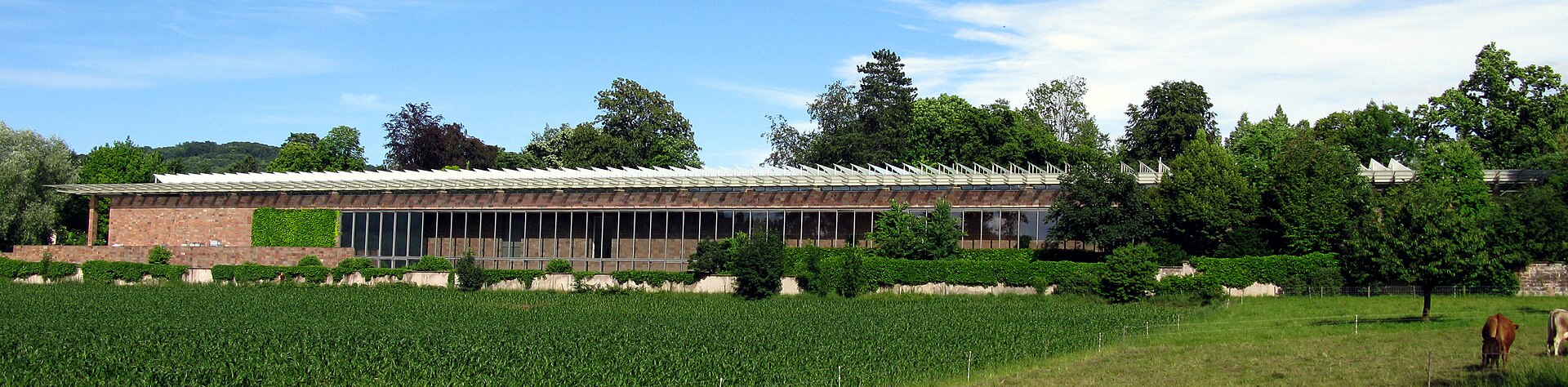
The museum's long garden facade, seen from the surrounding fields, showing Renzo Piano's porphyry walls and floating glass roof.
Andreas Schwarzkopf, CC BY-SA 3.0Fondation Beyeler
Museum · Founded 1982
Open, admission and hours confirmed 9 September 2026 · 13 sources
On this page 16 sections
ContentsClose
The Beyeler collection is small by museum standards, around 400 works by roughly 90 artists, but concentrated at the top of the market it once traded in: more than thirty Picassos, the water-lily sequence by Monet, and depth in Rothko, Giacometti and Bacon that few museums of comparable size can match. Its African, Oceanic and Alaskan sculpture, roughly two dozen pieces, is proportionally larger than the painting holdings suggest, and is shown as art rather than ethnography.
| Kind | Museum |
|---|---|
| Founded | 1982 |
| City and country |  Riehen, Switzerland Riehen, Switzerland |
| Address | Baselstrasse 101, CH-4125 Riehen, Switzerland |
| Website | fondationbeyeler.ch |
| Status | Open, confirmed |
| Record last verified |
Visiting
- Hours
- Mon, Tue, Thu, Fri, Sat, Sun10:00 to 18:00
- Wed10:00 to 20:00
- Admission
- AdultCHF 2520 CHF on Tuesdays
- Visitors up to age 25 (with ID)Freefree
- Visitors with disabilities (IV-pensioners with ID)CHF 20
- Accompanying person for a visitor with a disabilityFreefree
- Tickets
- tickets.fondationbeyeler.ch The museum's own ticket page.
- Do I need to book?
- Advance online timed-entry tickets recommended; school groups must reserve; the Prozentbuch two-for-one voucher can only be redeemed at the museum ticket office
- Address
- Baselstrasse 101, CH-4125 Riehen, Switzerland MapTram Tram line 6 from Basel Badischer Bahnhof directly to Riehen
Car Zentrum parking garage at Baselstrasse 70, open 24 hours, with a combined park-and-ride ticket covering parking plus return transit for two people - Website
- fondationbeyeler.ch
- Telephone
- +41 61 645 97 00
- [email protected]
Before you go how long, access, photography, bags, eating, shop
- How long to allow
- Not stated by the museum; not asserted here
- Access
- The museum publishes a separate accessibility page covering access for visitors with disabilities and offers a reduced 20 CHF rate for IV-pensioners with ID, with free entry for an accompanying person
- Photography
- Not confirmed from sources fetched; not asserted here
- Bags
- Not confirmed from sources fetched; not asserted here
- Eating
- Beyeler Restaurant im Park, a la carte and lunch menus, beside the museum's pond
- Shop
- Museum shop selling art editions, design objects and the foundation's own publications, on site and online
Prices and hours change. We take them from the institution's own pages and print the day we read them, and you can check the current position at the source we used. Confirm before you travel.
What is inside
Impressionist and modern painting galleries
The collection's Impressionist and early modern core, including three connecting rooms built around Claude Monet's late water-lily canvases, alongside Cezanne, van Gogh and Braque drawn from the Beyelers' own dealing collection.
Picasso and postwar rooms
More than thirty Picasso paintings and sculptures spanning his career, shown with Mark Rothko's large abstract fields, Francis Bacon's figure paintings, and more recent acquisitions by Gerhard Richter, Jean-Michel Basquiat and Wolfgang Tillmans added since the founders' deaths.
Non-Western sculpture galleries
Roughly two dozen sculptures and masks from Africa, Oceania and Alaska, collected by the Beyelers as art in its own right and shown among the modern paintings rather than set apart as ethnographic material.
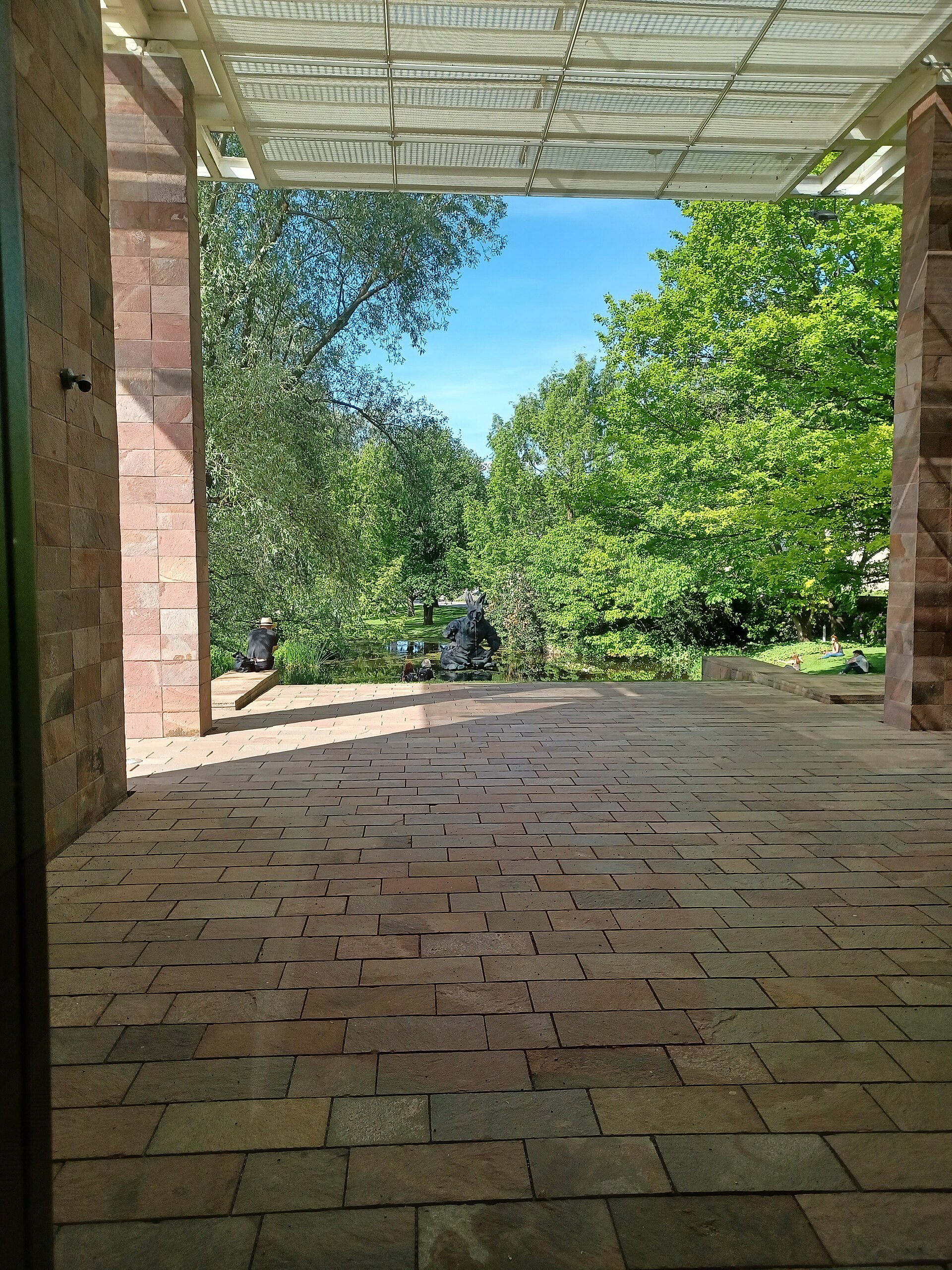
Photograph by Moleskine · CC BY-SA 4.0 Berower Park and outdoor sculpture
The English-style landscape park surrounding the building, its reflecting pond visible from the ground-floor rooms and colonnade, and outdoor sculpture including Alexander Calder's monumental standing mobile The Tree (1966) beside the pond and later additions such as Thomas Schutte's Hase (2013).
What to see first
Nympheas (Water Lilies)
Claude MonetAnchors three connecting rooms and is the single most consistently mentioned sequence in the museum, the anchor of its Impressionist holdings.3
Picasso paintings and sculptures
Pablo PicassoMore than thirty works spanning his career, the collection's single deepest holding and the clearest legacy of Ernst Beyeler's own decades dealing in the artist's work.7
Giacometti sculptures
Alberto GiacomettiShown freestanding so visitors can walk around them, drawn from the Beyelers' direct dealings with the artist during his lifetime.3
Rothko room
Mark RothkoA dedicated room of large abstract-expressionist canvases, central to the museum's postwar American holdings.3
Bacon figure paintings
Francis BaconFour works forming part of the museum's postwar figurative holdings alongside the abstract-expressionist room.5
Sixty Last Suppers
Andy WarholA monumental late Warhol shown in the foundation's recent painting-focused rehangs of the permanent collection.7
The Tree (1966)
Alexander CalderA monumental standing mobile installed beside the park pond, one of the collection's few permanently sited outdoor sculptures.9
African, Oceanic and Alaskan sculpture
Various makersAbout two dozen objects the Beyelers collected as art in their own right, shown among the modern paintings rather than segregated as ethnographic material.3
Exhibitions on now
Past exhibitions here
Two dealers and a foundation
Ernst Beyeler and his wife Hildy Beyeler-Kunz ran the Galerie Beyeler in Basel from 1945, building relationships with artists including Picasso, Miro and Giacometti and dealing in modern masters through the second half of the twentieth century. In 1982 they established the Beyeler Foundation to hold the private collection they had assembled outside the trade, works the couple had chosen to keep rather than sell. By the early 1990s the foundation needed a permanent home, and the Beyelers commissioned the Italian architect Renzo Piano to design a museum in Riehen, the small municipality bordering Basel to the north where the couple already owned land. Construction began in 1994; the building opened to the public on 18 October 1997, thirteen years before Ernst Beyeler's death in 2010. Hildy Beyeler had died in 2008. The foundation is registered as a Swiss charitable foundation, a Stiftung, and its collection is designated a class A cultural property of national significance under the Swiss federal heritage inventory, the country's highest such classification. Sam Keller, previously director of Art Basel, has led the foundation since 2008 and has continued its acquisitions programme since the founders' deaths.
Renzo Piano's building in Berower Park
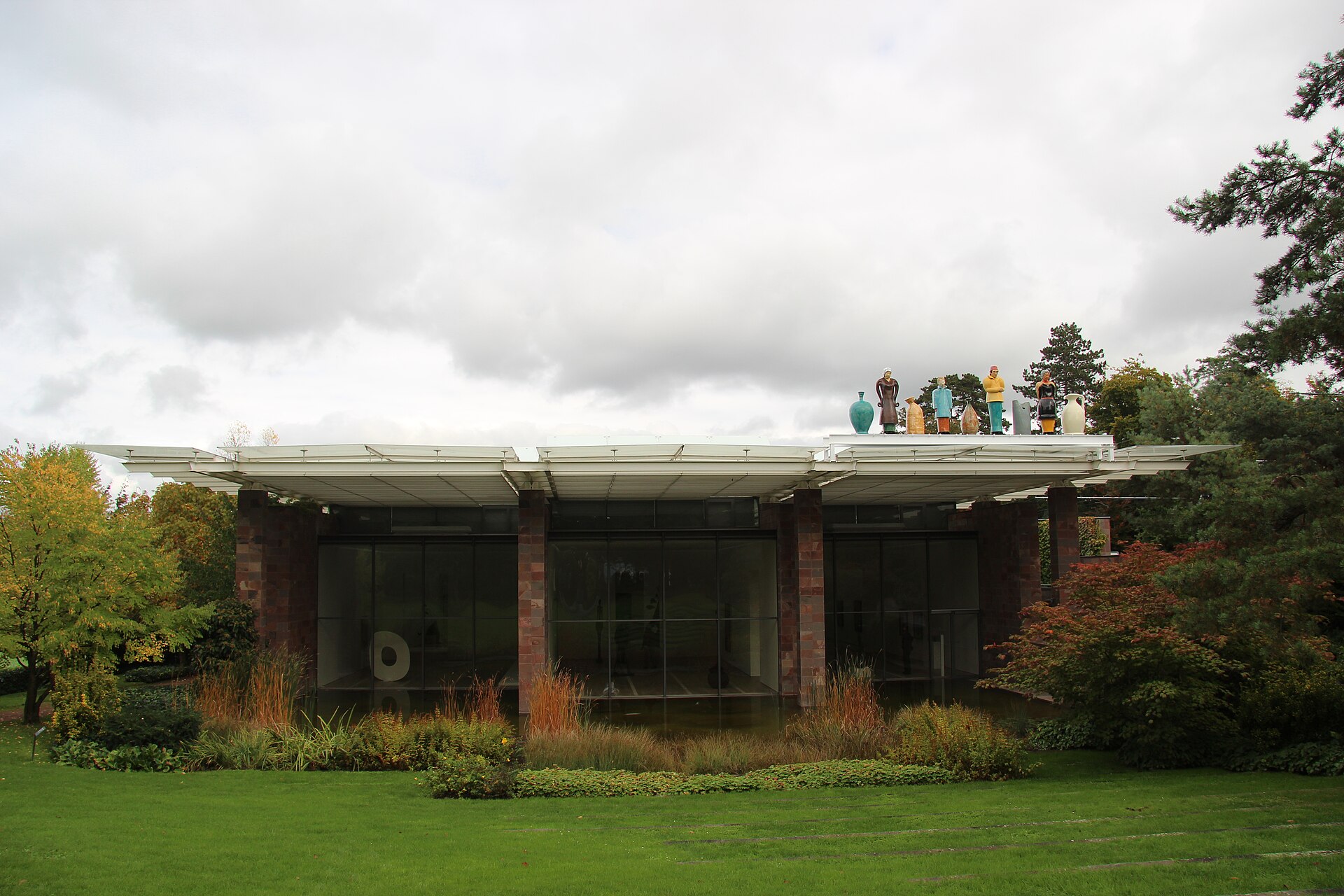
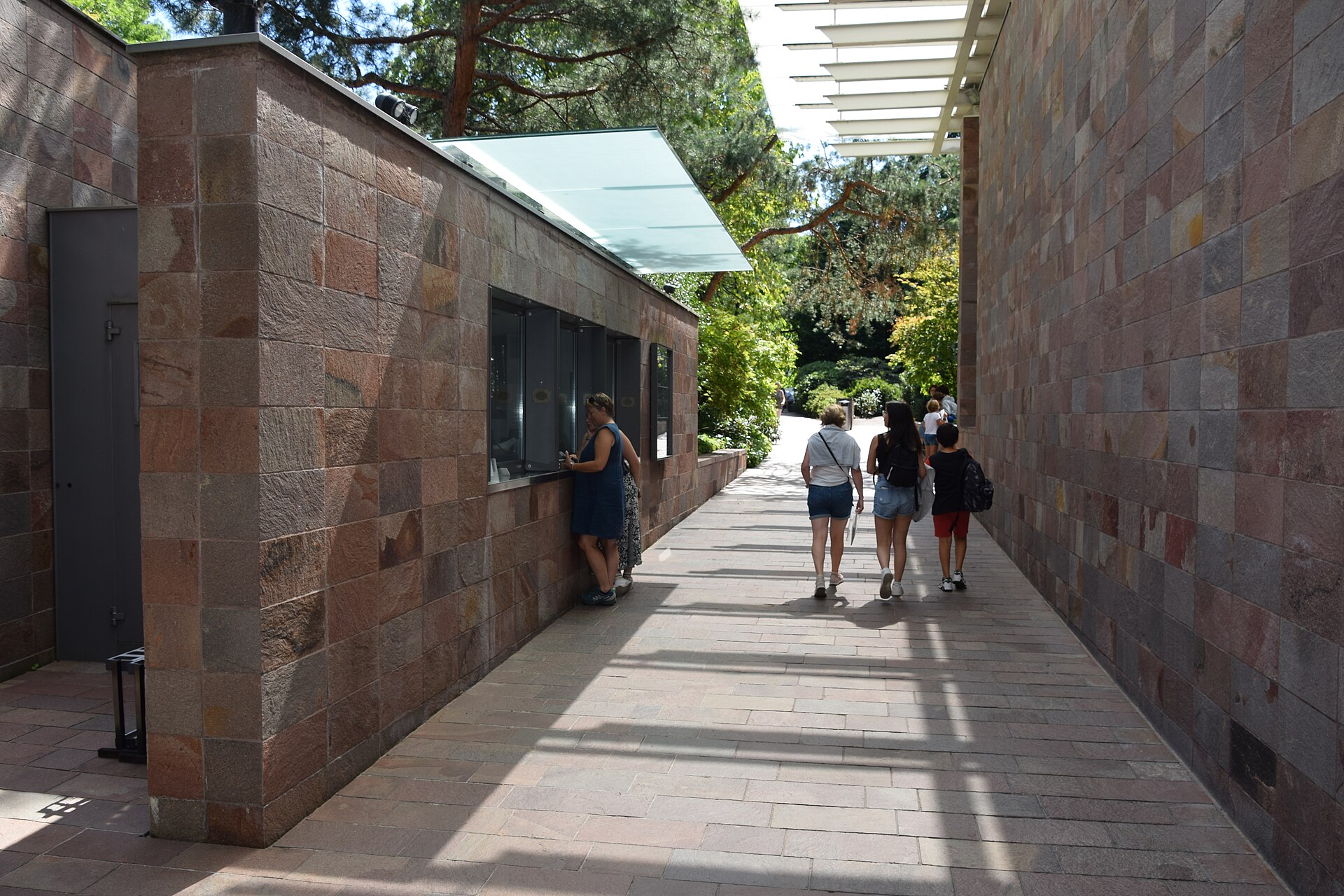
Piano's design sits inside Berower Park, an English-style landscape park that already existed on the site, and the building is arranged as a long, low pavilion rather than a freestanding block. Four parallel porphyry-stone walls run north to south, 115 metres long and seven metres apart, roofed by a lightweight glass canopy that filters northern light onto the galleries below while keeping low eastern and western sun off the pictures. The glazed garden facade overlooks cornfields and the vineyard slope of the Tullinger hills beyond the park, so the building reads as a garden pavilion rather than a civic monument. A shallow reflecting pond runs along part of the garden side, used for outdoor sculpture display and visible from the ground-floor rooms and colonnade. The museum opened at just over 3,200 square metres of exhibition space and was extended by a further 458 square metres in 1999, the only significant change to Piano's building since it opened. The park itself doubles as sculpture ground: Alexander Calder's monumental standing mobile The Tree (1966) stands beside the pond, and the foundation has added further outdoor pieces since, including Thomas Schutte's bronze Hase (2013).
What the collection holds
The Beyelers began collecting inside the canon their gallery traded in, Cezanne, Monet, van Gogh, Braque, and the foundation's rooms still open with that material, including three rooms built around Claude Monet's late water-lily canvases, one of the sequences visitors most associate with the museum. Pablo Picasso is the collection's single deepest holding, more than thirty paintings and sculptures spanning his career, reflecting Ernst Beyeler's long dealing relationship with the artist. Postwar and contemporary rooms hold Mark Rothko's large abstract fields and Francis Bacon's figure paintings, with later acquisitions by Gerhard Richter, Jean-Michel Basquiat and Wolfgang Tillmans that the foundation has added since Beyeler's death to keep the collection moving past its founders' own decades. Alongside the European and American painting, the foundation holds a body of sculpture and mask work from Africa, Oceania and Alaska, roughly two dozen objects the Beyelers collected as art in its own right rather than as ethnographic reference, and the foundation continues to show it inside the same rooms as the modern paintings rather than in a separate department.
Building again: the Zumthor expansion
The foundation is in the middle of the largest change to its site since 1997. The architect Peter Zumthor's studio was selected after a design study that considered eleven firms, and the resulting project adds a new museum building of about 1,500 square metres of exhibition space across three storeys, a separate administration and delivery building, and a glass pavilion for talks, concerts and other events seating 200 to 300 people. The project also folds in the neighbouring Iselin-Weber Park, previously private, doubling the size of publicly accessible grounds around the museum, and restores several older buildings on the combined site for education use, a music listening room, a greenhouse and a small project space. The foundation states the work is privately financed at a cost of 120 million Swiss francs, with the Wyss Foundation and the Beyeler foundation itself as the principal backers. The new buildings are opening progressively from autumn 2026, with the whole expanded campus expected to be complete and open by January 2027. None of the construction affects the original Renzo Piano building, which continues to operate on its normal year-round schedule throughout.
Visiting today
The museum opens 365 days a year, including public holidays, from 10 a.m. to 6 p.m. on Monday, Tuesday, Thursday, Friday, Saturday and Sunday, and until 8 p.m. on Wednesday. Adult admission is 25 Swiss francs, reduced to 20 francs on Tuesdays; visitors up to the age of 25 are admitted free on production of identification, a policy the foundation has kept in place through its recent price rises. Tickets are sold in advance online for timed entry, and the foundation recommends booking ahead rather than arriving without one. The Beyeler Restaurant im Park serves an a la carte and lunch menu beside the museum's pond, and the shop sells art editions, design objects and the foundation's own publications both on site and online. Riehen sits on tram line 6 out of Basel, reachable directly from Basel's Badischer Bahnhof station, and the foundation also operates a car park a short walk away on Baselstrasse with a combined parking-and-transit ticket for visitors arriving by road.
Reputation and its limits
By visitor numbers the Fondation Beyeler is Switzerland's most attended art museum. In 2016 it recorded around 332,000 visitors, a figure it has cited since as evidence of its position as the country's best-attended art museum, drawing on the strength of its collection and a steady programme of loan exhibitions built around its own core holdings. That popularity is also the standard criticism made of it: marking the museum's twentieth anniversary in 2017, one Swiss curator told The Art Newspaper that its programme is purely blue-chip and that the foundation rarely takes risks and is a victim of its own success, a judgement made about an institution built on a private collection of already-canonical modern masters rather than on contemporary discovery. Visitors' own complaints run in a narrower register: queues at busy weekends despite timed tickets, an entry price some regard as high set against a permanent collection that does not fill every room at once, and occasional confusion when part of the building is given over to a single-artist rehang without much notice on the website. None of this touches the building or the park, which are consistently the most praised part of any visit, or the water-lily rooms, which remain the collection's best-known draw.
What visitors say
Visitors and critics consistently rank the Fondation Beyeler among Switzerland's best museums for the combination of Renzo Piano's building, Berower Park and a small but very high quality collection. The same popularity draws the main complaint made of it, that its programme favours secure, already-canonical names over emerging or difficult work.
What is praised, what is criticised
- Praised: The Renzo Piano building and its integration with Berower Park, including natural light in the galleries and views out to the pond and surrounding countryside
- Praised: The Monet water-lily rooms, the single most consistently mentioned feature of a visit
- Praised: Free admission for visitors up to age 25, cited as unusually generous for a museum of this quality
- Criticised: Queues and crowding on busy weekends despite timed-entry ticketing
- Criticised: An entry price (25 CHF) some visitors weigh against a permanent collection that does not fill every room at once, and occasional confusion when a single-artist rehang temporarily replaces the collection with little advance notice on the website
- Criticised: A programme one Swiss curator called purely blue-chip, prioritising established modern masters over contemporary risk-taking
Ratings on other platforms
Google: 4.6 from 7,301 ratings, read 9 September 2026
A platform average is a tertiary source: it moves, it is not audited, and we quote no visitor's words.
Questions about Fondation Beyeler
Where is Fondation Beyeler?
Baselstrasse 101, CH-4125 Riehen, Switzerland.
How much does it cost to visit?
Adult: CHF 25; Visitors up to age 25 (with ID): free; Visitors with disabilities (IV-pensioners with ID): CHF 20; Accompanying person for a visitor with a disability: free. As confirmed 9 September 2026.
When is it open?
Mon, Tue, Thu, Fri, Sat, Sun 10:00-18:00; Wed 10:00-20:00. As confirmed 9 September 2026.
How do you get there?
Tram: Tram line 6 from Basel Badischer Bahnhof directly to Riehen; Car: Zentrum parking garage at Baselstrasse 70, open 24 hours, with a combined park-and-ride ticket covering parking plus return transit for two people.
What should you see first?
Nympheas (Water Lilies) (Claude Monet); Picasso paintings and sculptures (Pablo Picasso); Giacometti sculptures (Alberto Giacometti); Rothko room (Mark Rothko); Bacon figure paintings (Francis Bacon); Sixty Last Suppers (Andy Warhol).
What we could not confirm
- The foundation's own site does not itemise which specific paintings hang in the permanent collection at any given time; room-by-room content changes with each rehang and is not archived publicly in the sources fetched.
- Fuller phased opening dates for the Zumthor expansion beyond autumn 2026 and January 2027 were not published by the foundation in the pages fetched for this record.
Images
Sources
- 1Fondation Beyeler, Visit page (hours, opening statement, transport, current notices), fetched 2026-09-09 fondationbeyeler.ch/en/visit
- 2Fondation Beyeler, Opening Hours and Prices page (admission, hours, contact, facilities), fetched 2026-09-09 fondationbeyeler.ch/en/visit/opening-hours-prices
- 3Wikipedia, 'Fondation Beyeler' (; founding history, architecture, collection overview, 2016 visitor figure), fetched 2026-09-09 en.wikipedia.org/wiki/Fondation_Beyeler
- 4Fondation Beyeler, 'New Museum Building' page on the Peter Zumthor expansion project, fetched 2026-09-09 fondationbeyeler.ch/en/museum/new-museum-building
- 5The Art Newspaper, 'Fondation Beyeler builds on 20 years of success', 15 June 2017 theartnewspaper.com/2017/06/15/fondation-beyeler-builds-on-20-years-of-success
- 6Wanderlog listing citing the Google aggregate rating for Fondation Beyeler (), fetched 2026-09-09 wanderlog.com/place/details/28538/fondation-beyeler
- 7Fondation Beyeler, 'Presentation of the Collection' past-exhibition page (collection display, Picasso and Warhol detail), fetched 2026-09-09 fondationbeyeler.ch/en/exhibitions/past-exhibitions/presentation-of-the-collection
- 8Wikidata Q673833, Fondation Beyeler (; identity, coordinates, founding date, director), fetched 2026-09-09 wikidata.org/wiki/Q673833
- 9Fondation Beyeler collection database, 'The Tree' (Alexander Calder, 1966), fetched 2026-09-09 fondationbeyeler.ch/sammlung/werk?tx_wmdbbasefbey_pi5%5Bartwork%5D=228&cHash=1002b473fab17fa5f47403b6b1f53b7e
- 10Wikimedia Commons file page, licence and credit for the lead image, fetched 2026-09-09 commons.wikimedia.org/wiki/File:Fondation_Beyeler_in_Riehen_2.jpg
- 11Wikimedia Commons file page, licence and credit, fetched 2026-09-09 commons.wikimedia.org/wiki/File:Fondation_Beyeler,_Riehen,_Switzerland.JPG
- 12Wikimedia Commons file page, licence and credit, fetched 2026-09-09 commons.wikimedia.org/wiki/File:20220808_Basel_Beyeler_011.jpg
- 13Wikimedia Commons file page, licence and credit for the park/pond wing image, fetched 2026-09-09 commons.wikimedia.org/wiki/File:Garten_Teich.jpg


