Berestye Archaeological Museum
Museum · Arkheologicheskiy muzey "Berestye" · Founded 1982
Open, admission and hours confirmed 23 September 2026 · 12 sources
On this page 13 sections
ContentsClose
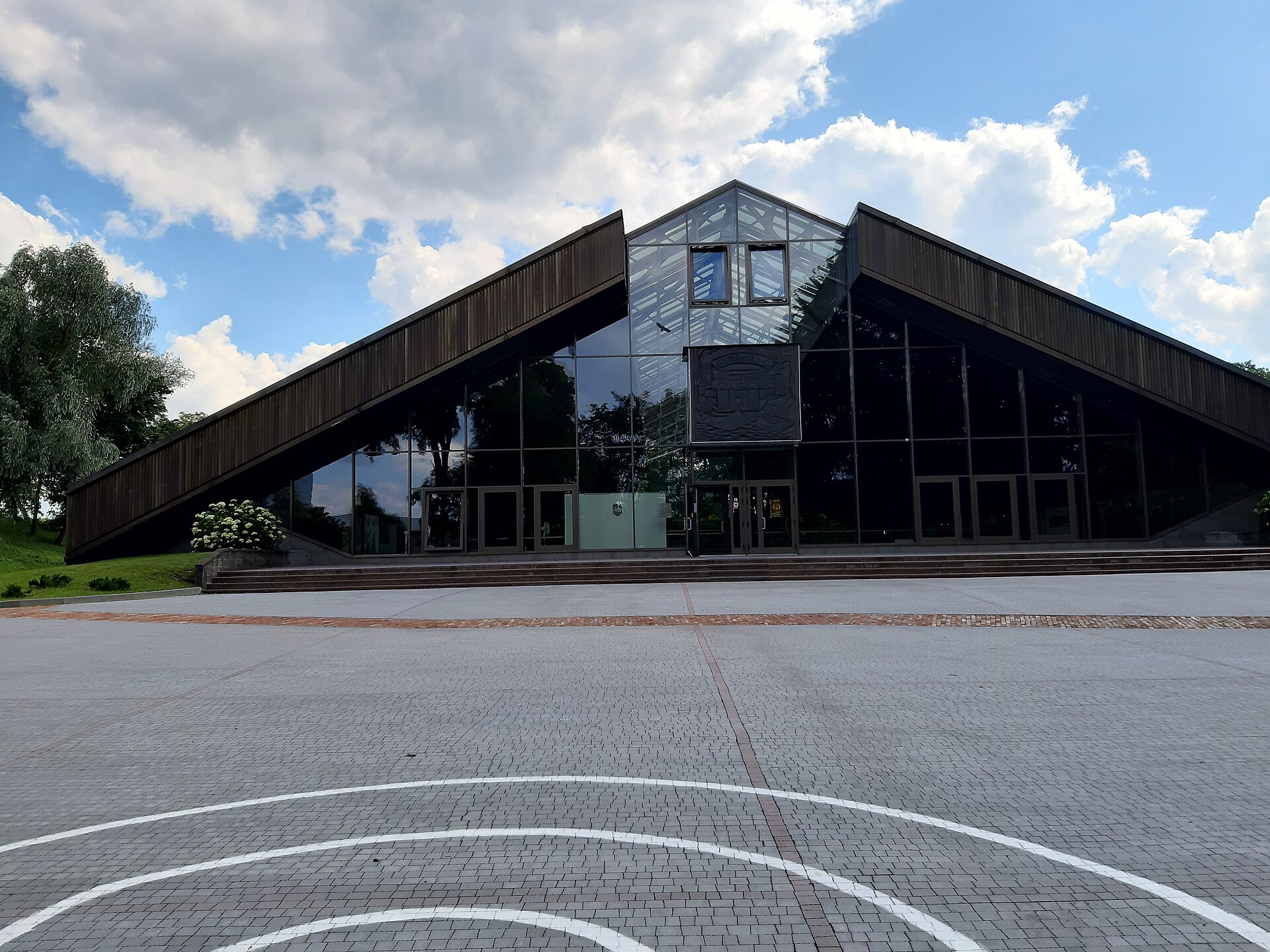
Berestye's strength is total depth on a single, narrow subject rather than range: everything the museum shows comes from one excavated quarter of one medieval town, recovered between 1969 and 1981 and left largely in the ground rather than redistributed to a larger encyclopaedic collection elsewhere. That gives it a rare completeness for the period, an entire working neighbourhood of houses, streets, workshops and the tools and rubbish of daily life, rather than the isolated grave goods or single spectacular finds that represent most East Slavic sites of the eleventh to thirteenth centuries. Its individual masterpieces, the alphabet comb, the figurative chess king, the billon kolt, the oak ard, sit inside that larger context rather than standing apart from it, each one readable against the ordinary quarter that produced it.
| Local name | Arkheologicheskiy muzey "Berestye" |
|---|---|
| Kind | Museum |
| Founded | 1982 |
| City and country |  Brest, Belarus Brest, Belarus |
| Address | Krepostnoy proezd 15, 224018 Brest, Belarus |
| Website | brokm.by/berestye |
| Status | Open, confirmed 23 September 2026 |
| Record last verified | 23 September 2026 |
Visiting
- Hours
- Daily11:00 to 19:00Ticket office closes at 18:30. Berestye is the only one of the parent museum's five sites with no fixed weekly closing day.
- Closed
- No weekly closing day; open every day including Monday. Closes earlier, at 18:00, on the day before a public holiday. Occasional unscheduled sanitary days for cleaning and maintenance are announced individually on the museum's own news page rather than on a fixed recurring date (for example 30 June 2026 and 9 September 2026).
- Admission
- AdultBYN 8.45Standard entrance ticket, the same institution-wide price posted for all five branches of the Brest Regional Museum of Local Lore, of which this is one.
- Students (vocational, specialised-secondary and higher education)BYN 6.40
- SchoolchildrenBYN 4.15
- Thematic tour, "Hewn with an Axe" (Rubleno toporom)BYN 15.70A guided theme tour specific to the Berestye branch, on the timber building technique of the excavated quarter, on top of the entrance ticket.
- Thematic tour of the museum's groundsBYN 21.40Covers the fortifications and territory immediately around the pavilion, by advance booking, on top of the entrance ticket.
- Family tourBYN 16.60On top of the entrance ticket.
Free entry: Last Wednesday of every month: 50 percent off the standard entrance ticket at every branch of the Brest Regional Museum of Local Lore, Berestye included (excludes commercial temporary exhibitions). Last Wednesday of every month: free entry for organised groups of pupils in general secondary, vocational or specialised-secondary education, by advance booking only (excludes commercial temporary exhibitions). Certain visitor categories are admitted free under Article 164, paragraph 4 of the Belarus Code on Culture (20 July 2016, No. 413-Z); the museum's own price page cites this legal provision without itemising every exempt category on the page as fetched- Do I need to book?
- No advance ticket is required for ordinary entry; guided tours, the theme lecture and quest-tours are booked ahead by phone.
- Address
- Krepostnoy proezd 15, 224018 Brest, Belarus MapOn foot The branch stands inside the Brest Fortress memorial grounds, next to the Kholm Gate, on the Fortress Passage (Krepostnoy proezd). It is reached on foot through the fortress grounds rather than from an ordinary city street.
- Website
- brokm.by/berestye
- Telephone
- +375 162 53 10 11
- [email protected]
Before you go how long, access, photography, bags, eating, shop
- How long to allow
- The exhibition halls and the excavation together are compact enough that a TripAdvisor reviewer recorded a visit of about fifteen minutes with no guide, while the museum's own recommended route (orientation film, the elevated walkway around the dig, then the flanking thematic halls) runs closer to an hour.
- Access
- Not stated on the museum's own pages as fetched; not confirmed either way.
- Photography
- General photography inside the exhibition is a paid, ticketed service rather than a free allowance: the price list separately charges for photographing in the museum's interiors, for video filming in the exposition, for television filming, and for photographing a single unique exhibit on request.
- Bags
- Not stated on the museum's own pages as fetched.
- Eating
- Not stated on the museum's own pages as fetched; no cafe or restaurant is listed among the branch's own services.
- Shop
- Not stated on the museum's own pages as fetched.
Prices and hours change. We take them from the institution's own pages and print the day we read them, and you can check the current position at the source we used. Confirm before you travel.
What is inside
Photograph by Δημήτριος · CC BY-SA 4.0 The excavation itself
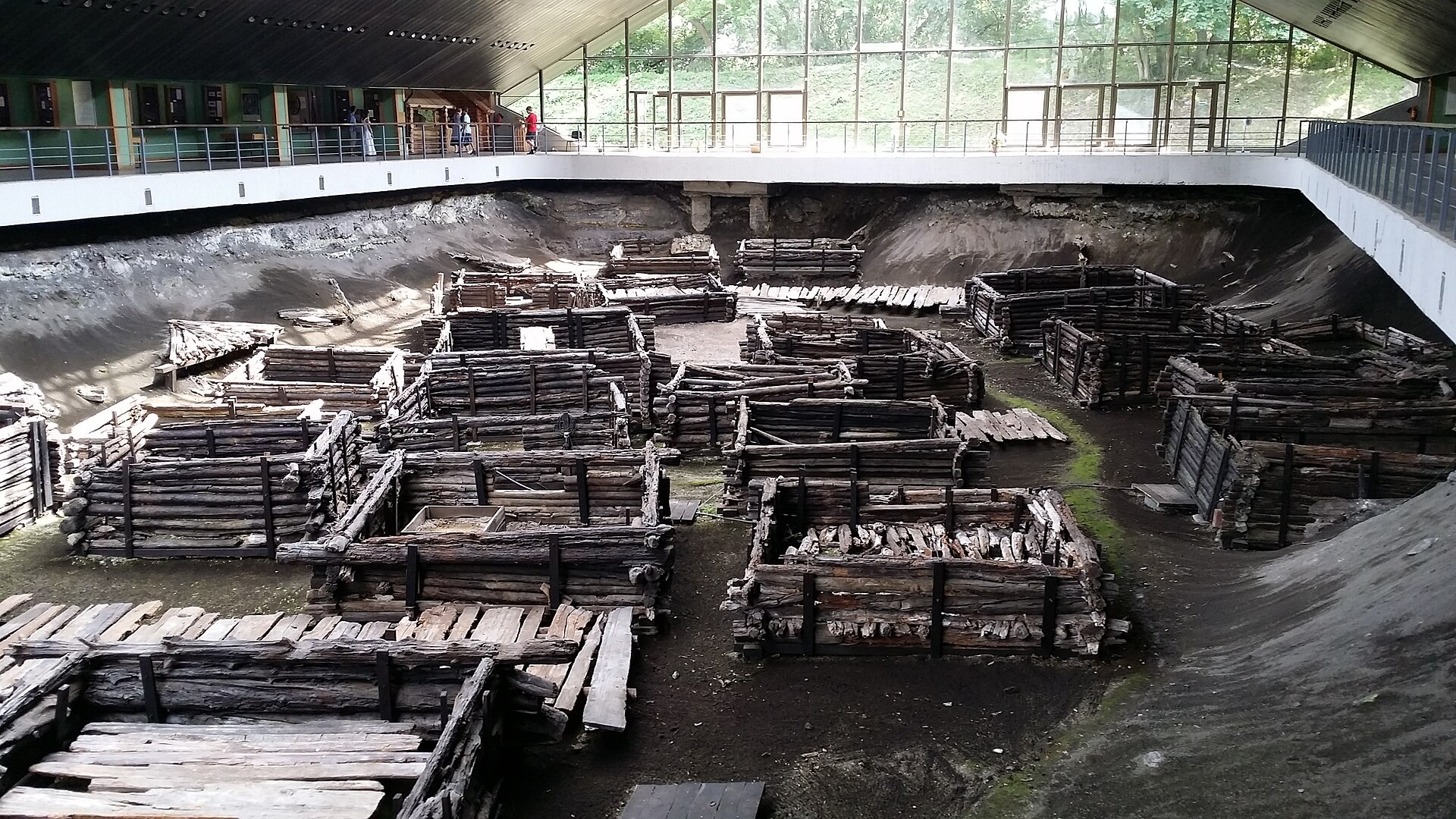
The reason the building exists: an open archaeological trench 1,118 square metres in area, reached down to a depth of about four metres, holding part of a craftsmen's quarter of thirteenth-century Berestye in place exactly as it was uncovered. Twenty eight wooden residential and outbuilding structures stand in their original positions, along with two wood-paved streets, a palisade line and the remains of clay ovens. The buildings are single-room, ground-level, square structures of coniferous logs that once stood wall to wall in rows three or four deep between the streets, spaced only 0.4 to 0.6 metres apart; waterlogged, oxygen-poor soil under a cultural layer up to seven metres thick kept the timber from rotting, and many walls survive to five or nine courses of logs, with some reaching twelve, which the museum's own account calls a considerable rarity for wood this old anywhere in Europe. Visitors look down on the trench from an elevated walkway that runs around it rather than walking among the timbers themselves.
Photograph by Чаховіч Уладзіслаў · CC BY-SA 3.0 The craft and material halls
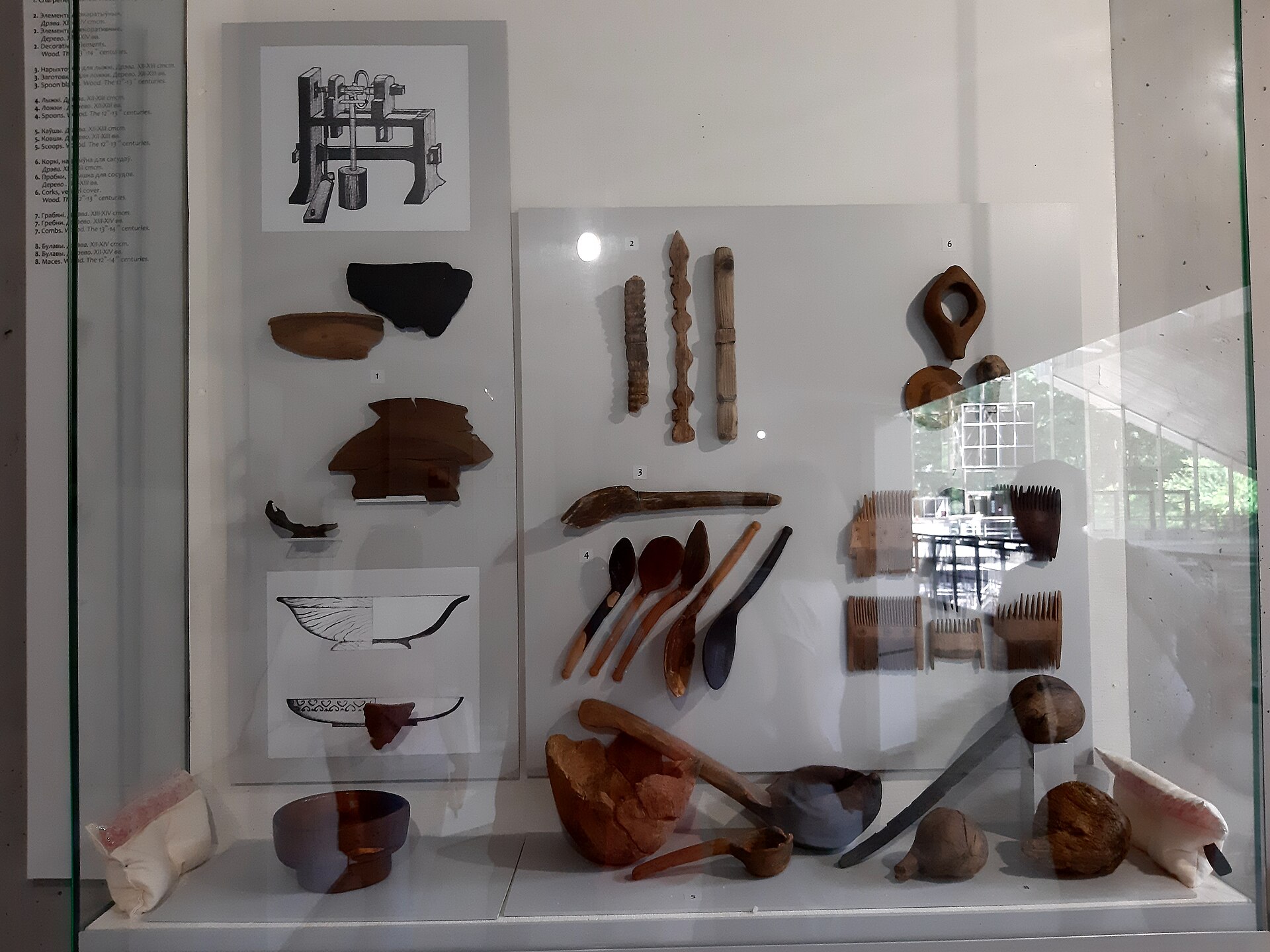
Exhibition halls totalling 252 square metres flank both long sides of the excavation, holding roughly 1,200 of the site's finds arranged by craft: ironworking, the working of non-ferrous metals, bone carving, leatherworking, spinning and weaving, and pottery and woodworking. Cases here hold the everyday output of a working medieval quarter rather than showpieces alone: locks and keys, scissors, knives, weapons, farm tools, glass and metal bracelets, wooden tableware, combs, children's toys, spoons, fragments of wool cloth, leather footwear, and worked parts from an oil press, a foot-operated mortar, a reel, a hand mill, a flax brake and a loom.
Photograph by Чаховіч Уладзіслаў · CC BY-SA 3.0 Land, herd and forest
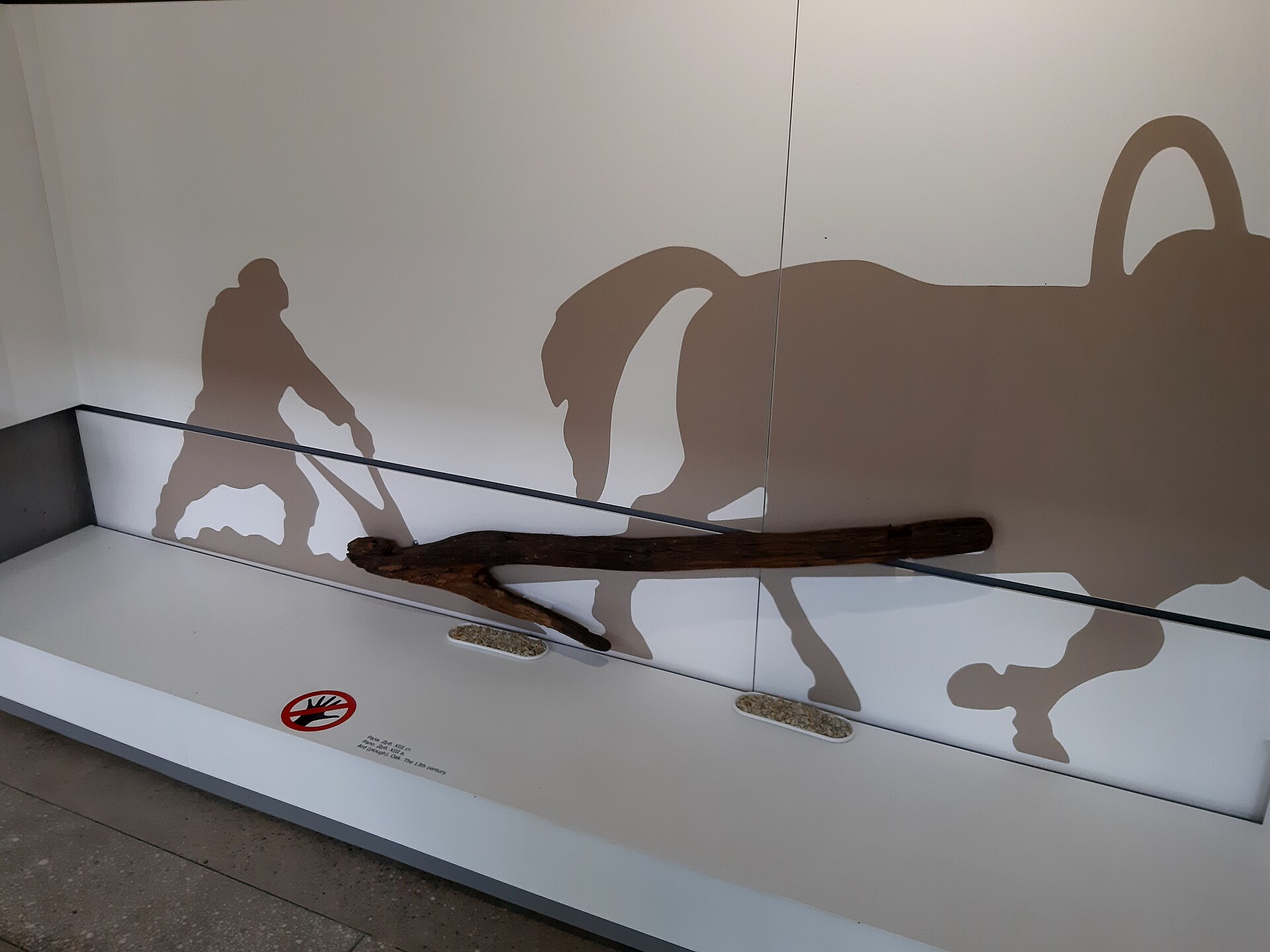
A section on farming, animal husbandry, hunting and fishing, the activities that fed the quarter alongside its crafts. It holds the museum's single most unusual agricultural find, a wooden ard, the simple hooked ploughshare that broke the soil before the true plough, together with tools connected to livestock and the chase: antlers, worked bone and animal skulls drawn from the excavation's large osteological collection, which the museum's own count puts at 21.5 percent of everything recovered on site.
Trade, culture and the history of the dig
A section on Berestye's reach beyond its own streets, built around the imported objects that prove it: cowrie shells brought from the Indian Ocean and reworked locally into jewellery or used as a form of currency, evidence the museum reads as proof of trade contacts running through the Dnieper region, Volhynia, the Black Sea coast, the Caucasus, the East, the Baltic and western Europe. The same section carries material on the settlement's culture, the history of the excavation itself and the history of the Berestye stronghold that stood on the same ground before the craftsmen's quarter. No verified photograph of this specific hall exists yet; it is described here from the museum's own text rather than shown.
The cinema hall and digital services
A small screening room where visitors can watch any of six documentary films about Berestye or an animated short on the town's history, part of a wider run of digital services the museum has added to the original 1982 pavilion: a QR-code audio guide in Russian, Belarusian, English, Chinese and Polish, a virtual walk-through of the excavation, and 3D headsets showing reconstructed panoramas of the medieval town. No verified photograph of this room exists yet; it is described here from the museum's own text rather than shown.
What to see first
The Berestye boxwood comb
Unknown Berestye craftsman, 13th centuryA double-sided boxwood comb carved with the letters of the Cyrillic alphabet on both faces. The museum describes it as the oldest and only surviving teaching aid for literacy found anywhere on the territory of modern Belarus.1
The figurative bone chess king
Unknown Berestye craftsman, 13th centuryA carved bone chess king, finely cut and finished, found in the excavation. Of the roughly seventy medieval chess pieces recovered across the whole territory of modern Belarus, only four, this king among them, are figurative rather than the abstract forms typical of the period; the museum treats it as one of the finest examples of the carver's craft found on site.1
The billon kolt with a sprouting-grain motif
Unknown Berestye jeweller, early 13th centuryA hollow temple-pendant of billon (a low-grade silver alloy) decorated with a symbolic design of sprouting grain, its interior cavity meant to hold a scrap of cloth soaked in scented oil. The museum names it among the most valuable and costly single objects in the whole collection.1
The oak ard
Unknown Berestye craftsman, 13th centuryA wooden ard, the simple hooked implement that broke soil before the true plough, found in the 13th-century cultural layer. The museum states it is the only oak ard of this period known from anywhere in Europe.1
The Indian Ocean cowrie shells
Traded object, 11th to 12th centuryCowrie shells reaching Berestye from the Indian Ocean, reworked into women's jewellery or used as a form of small currency; the museum cites them as direct physical evidence of the town's trade contacts running east through the Caucasus and beyond, and west into the Baltic and western Europe.1
The excavated craftsmen's quarter itself
Berestye residents, 13th centuryTwenty eight log buildings, two paved streets, a palisade and clay oven remains, left in place rather than lifted to a case; several walls survive to nine or even twelve courses of logs, a level of preservation the museum's own account calls rare anywhere in Europe for structures this age.1
The reconstructed Berestye dwelling
Museum reconstruction, based on excavated 13th-century originalsA built reconstruction of an ordinary thirteenth-century Berestye house, standing among the thematic halls to give the excavated foundations and fittings shown elsewhere in the museum a single, walkable domestic interior to be read against.1
A building shaped like the thing it protects
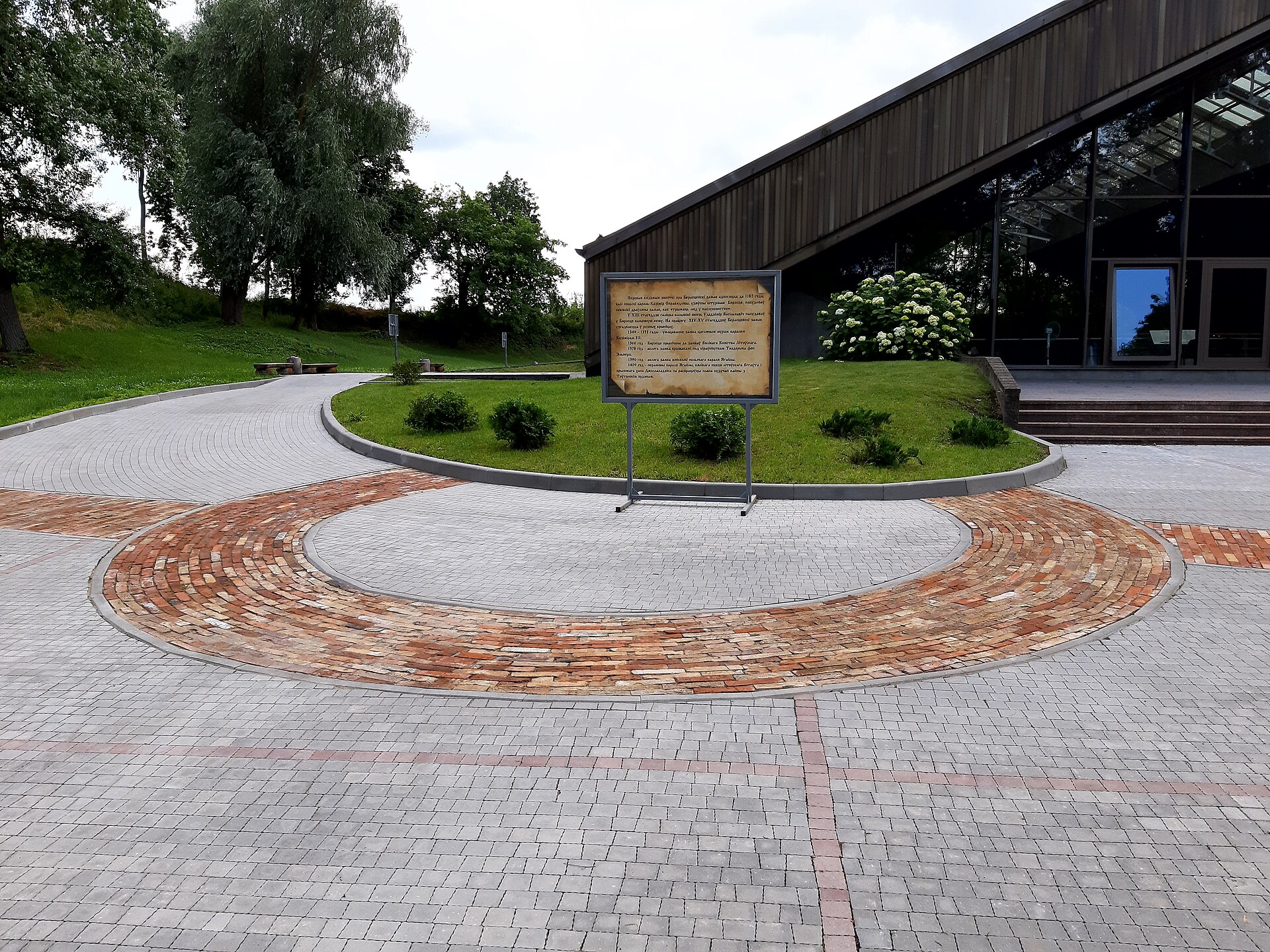
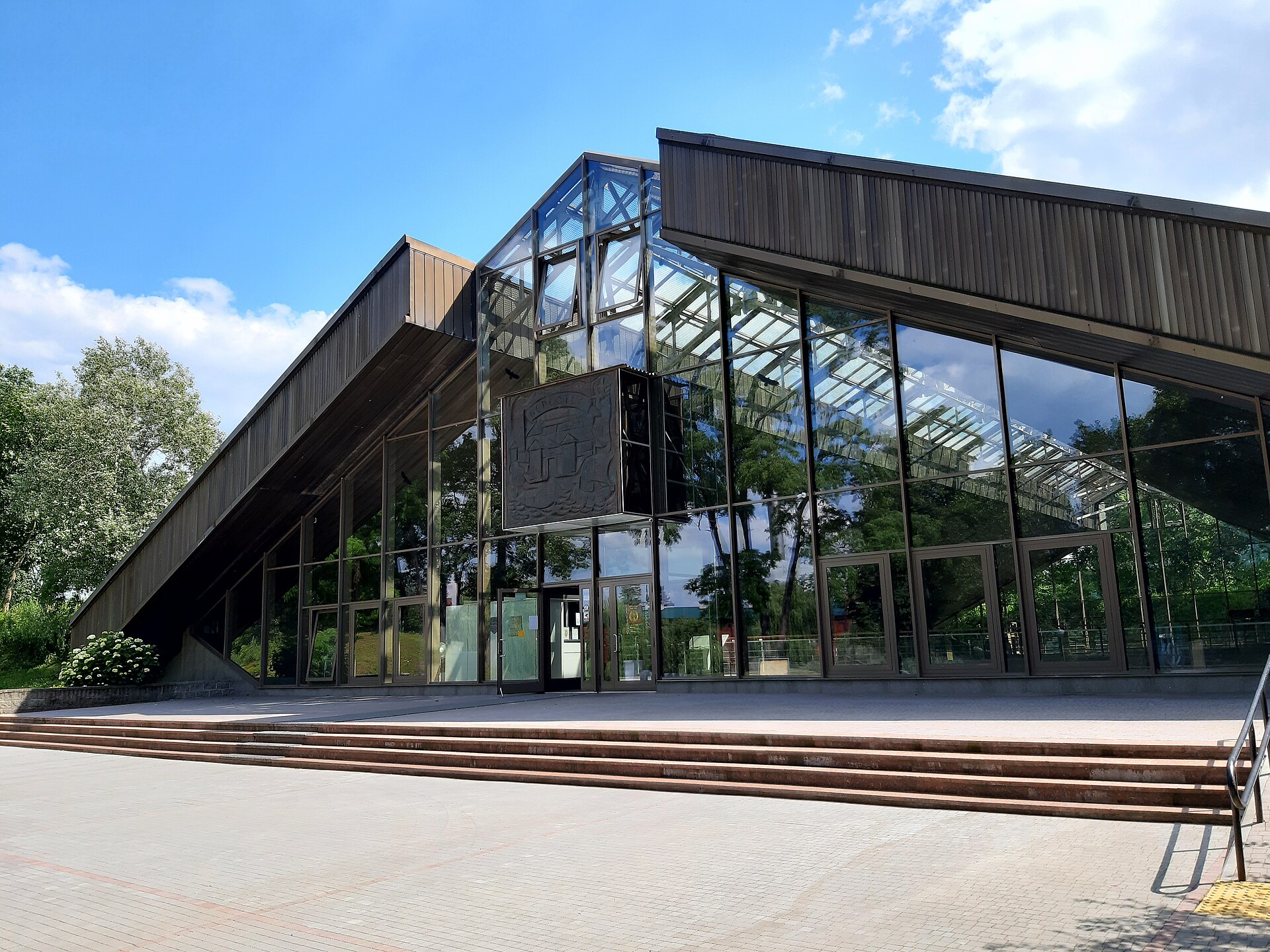
The Archaeological Museum Berestye is, by its own description and by every account that has looked closely at it, the only museum in the world built directly over a medieval East Slavic town: a working thirteenth-century craftsmen's quarter, excavated in place and then sealed under a purpose-built pavilion rather than lifted into cases. The pavilion itself, forty by sixty metres of concrete, glass and anodised aluminium under a pitched, gable roof lit by a central skylight running its length, was designed by the Belgosproekt architects V. V. Kramarenko, M. K. Vinogradov and V. I. Shcherbina to read, in the museum's own words, as something between an ancient dwelling and the exposed layers of earth that the excavation itself cut through. It opened to visitors on 2 March 1982, four years after the Council of Ministers of the Byelorussian SSR resolved on 18 January 1972 to create the museum and build it. According to published accounts of the project, funding and materials for a fairly ordinary museum building stalled for years until Pyotr Lysenko, the archaeologist whose own excavation the building exists to protect, appealed directly to Alexei Kosygin, then Chairman of the Council of Ministers of the USSR; the pavilion, designed as early as 1974, is reported to have gone up only after Kosygin's personal intervention cleared the obstacles that had stopped it. That detail does not appear on the museum's own current pages as fetched, and rests here on secondary, Russian-language accounts rather than the branch's own primary text, so it is carried with that qualification rather than as settled fact.
Decades looking for a city, then thirteen years digging one up
Locating the site at all took most of the twentieth century. Scholars had tried repeatedly to fix the original position of the chronicled town of Berestye, first recorded in the Primary Chronicle under the year 1019, without success, until researchers finally identified the ground in the second half of the 1960s, on the land between the Western Bug and the Mukhavets. Full excavation followed from 1969 to 1981 under Pyotr Fyodorovich Lysenko, a doctor of historical sciences and professor, who is credited on the museum's own pages as the project's director throughout. The dig eventually opened an area of more than 1,800 square metres, with more than 500 square metres carried all the way down to the undisturbed natural subsoil, and recovered more than 220 wooden structures of the eleventh to thirteenth centuries, three street pavements, palisade lines and a large body of everyday objects. The portion ultimately left in place and roofed over for permanent display, the craftsmen's quarter now inside the pavilion, covers 1,118 square metres of that total at a depth of about four metres.
Why the wood survived
What makes Berestye unusual among East Slavic sites of the period is not that a medieval town was found, but that its own building material lasted. The museum attributes the survival to the ground itself: water-retaining, largely airless soil under a cultural layer that in places reaches seven metres thick starved the buried timber of the oxygen that would otherwise have rotted it away within decades. The result is structures that, by the museum's own count, commonly survive to five or nine courses of logs and occasionally to twelve, standing walls rather than a scatter of collapsed and decayed beams. Keeping that wood stable once it was exposed to open air took a second, deliberate act of preservation: a team from the Belarusian Technological Institute named S. M. Kirov, made up of Y. V. Vikhrov, V. A. Borisov and S. Y. Kazanskaya, carried out early field conservation of the excavated timber by surface and deep impregnation with an aqueous solution of phenolic alcohols followed by heat treatment, a method developed by the institute's own rector, Professor V. Y. Vikhrov. Without that intervention the excavation the pavilion now protects would very likely not have survived to be roofed over at all.
What forty three thousand objects say about one quarter
The excavation produced more than 43,000 individual finds in total, a figure the museum breaks down as roughly 66 percent ceramic fragments, 21.5 percent an osteological, or bone, collection, and 12.5 percent individual small finds of every other kind. The strongest of those individual finds, several thousand of them, are arranged in 252 square metres of exhibition hall flanking the excavation on both sides, grouped by the craft that produced them: ironworking, non-ferrous metalworking, bone carving, leatherworking, spinning and weaving, and pottery and woodworking, alongside sections on farming, animal husbandry, hunting, fishing and trade. A handful of objects carry the collection's real weight. A boxwood comb carved with the Cyrillic alphabet on both faces is, in the museum's own words, the oldest and only surviving literacy primer found on the territory of modern Belarus. A bone chess king, one of only four figurative pieces among roughly seventy medieval chess pieces recovered anywhere in the country, shows a level of carving skill the museum singles out specifically. A billon temple pendant decorated with a sprouting grain motif, built to hold a scented cloth in its hollow interior, is named among the single most valuable objects the site produced. An oak ard, the simple hooked implement that broke soil ahead of the true plough, is claimed by the museum as the only surviving example of its kind and period from anywhere in Europe. And cowrie shells reaching Berestye from the Indian Ocean, reworked into jewellery or used as currency, are read as direct physical proof of a trade network stretching from the Dnieper basin and the Black Sea coast through the Caucasus to the Baltic and western Europe.
Recognition, and an archaeologist's own name over the door
The ancient settlement site of Berestye received formal legal protection on 29 December 1997, when it was granted the status of an immovable historical and cultural value of the Republic of Belarus. In January 2020 the museum's team was awarded the state prize For Spiritual Revival for its work preserving the site and building a renewed exhibition around it. Most recently, on 18 September 2026, the branch unveiled a memorial plaque to Pyotr Lysenko on what would have been his ninety fifth birthday, opening alongside it a temporary exhibition called The Discoverer, built from his own photographs, expedition documents and personal effects, including the motorcycle he used on his own field trips and a rare surviving thirteenth-century hat and mittens recovered during the original dig. Even the museum's basic visitor numbers carry a live discrepancy worth recording rather than smoothing over: the state tourism site Belarus.travel puts annual visits at about 60,000, while the state news agency BELTA, reporting on the September 2026 event, put the figure at about 100,000; nothing in the sources fetched for this record reconciles the two.
What visitors say
Visitors consistently single out the same thing: seeing real, eight-hundred-year-old timber buildings standing in place, at close range, rather than a reconstruction or a scale model. The elevated walkway around the excavation and the museum's own recommendation to watch a short orientation film before the walk are repeatedly mentioned as the right way to take in a site that is small enough to see quickly but dense enough to reward slowing down. Criticism, where it appears, is aimed less at the excavation than at the exhibition halls around it: a visit can be over in a quarter of an hour if a visitor skips the halls, and without the paid audio guide, the object labels in the cases are legible only in Belarusian and Russian.
What is praised, what is criticised
- Praised: the excavated log buildings themselves, described by visitors as extraordinarily well preserved for their age and unlike anything else they had seen
- Praised: the elevated walkway around the trench, giving several different vantage points onto the same excavation
- Praised: the short orientation film shown before the walk, which reviewers recommend watching rather than skipping
- Praised: the density of genuinely old, individually striking objects in the flanking halls once a visitor takes the time to look at them
- Criticised: one visitor rated the exhibition halls themselves as cold and sparse set against the drama of the excavation pit, describing a visit that, without a guide, was over in about fifteen minutes
- Criticised: object labels and explanatory panels in the halls are in Belarusian and Russian only, with no English signage, so a foreign visitor who skips the paid audio guide misses most of the context
Ratings on other platforms
TripAdvisor: 4.2 from 144 ratings, read 23 September 2026
A platform average is a tertiary source: it moves, it is not audited, and we quote no visitor's words.
Questions about Berestye Archaeological Museum
Where is Berestye Archaeological Museum?
Krepostnoy proezd 15, 224018 Brest, Belarus.
How much does it cost to visit?
Adult: BYN 8.45; Students (vocational, specialised-secondary and higher education): BYN 6.4; Schoolchildren: BYN 4.15; Thematic tour, "Hewn with an Axe" (Rubleno toporom): BYN 15.7; Thematic tour of the museum's grounds: BYN 21.4. As confirmed 23 September 2026.
When is it open?
Daily 11:00-19:00. Closed: No weekly closing day; open every day including Monday. Closes earlier, at 18:00, on the day before a public holiday. As confirmed 23 September 2026.
How do you get there?
On foot: The branch stands inside the Brest Fortress memorial grounds, next to the Kholm Gate, on the Fortress Passage (Krepostnoy proezd). It is reached on foot through the fortress grounds rather than from an ordinary city street.
What should you see first?
The Berestye boxwood comb (Unknown Berestye craftsman, 13th century); The figurative bone chess king (Unknown Berestye craftsman, 13th century); The billon kolt with a sprouting-grain motif (Unknown Berestye jeweller, early 13th century); The oak ard (Unknown Berestye craftsman, 13th century); The Indian Ocean cowrie shells (Traded object, 11th to 12th century); The excavated craftsmen's quarter itself (Berestye residents, 13th century).
What we could not confirm
- The museum's annual visitor count is stated as about 60,000 by the state tourism site Belarus.travel and about 100,000 by the state news agency BELTA in a 2026 report; no source fetched for this record reconciles the two figures or states which is current.
- The widely repeated account of Alexei Kosygin personally intervening to get the pavilion built, after Pyotr Lysenko appealed to him directly, is carried on secondary Russian-language accounts of the museum's history and is not stated on the branch's own current pages (brokm.by/berestye/) as fetched; it is presented in the narrative with that qualification rather than as a fact confirmed in the museum's own primary text.
- The museum's price list cites Article 164, paragraph 4 of the Belarus Code on Culture as the legal basis for free admission for certain visitor categories, without itemising which categories on the page as fetched; the specific exempt categories were not independently confirmed.
Images
Sources
- 1Brest Regional Museum of Local Lore, branch page for the Archaeological Museum Berestye: full excavation history, architects and construction of the pavilion, the 1,118 square metre excavation and its 28 log buildings, the 252 square metre exhibition halls and their thematic breakdown, the 43,000-object count and its ceramic/bone/individual-find split, and named highlight objects including the boxwood comb, the bone chess king, the billon kolt, the oak ard and the cowrie shells. Read as raw fetched page text, 23 September 2026. brokm.by/berestye/
- 2Brest Regional Museum of Local Lore, Visitors page: current opening hours and no weekly closing day for the Berestye branch, ticket office closing time, pre-holiday early closing, the institution-wide admission price list in BYN, Berestye-specific thematic tour prices, and the last-Wednesday discount and free-entry rules. Read as raw fetched page text, 23 September 2026. brokm.by/visitors/
- 3Brest Regional Museum of Local Lore, Contacts page: address, phone numbers and email for the Berestye branch and the parent institution's other branches. Read 23 September 2026. brokm.by/contacts/
- 4Wikidata, Berestye Archeological Museum (Q2499504): label, description, coordinates (52 degrees 4 minutes 47.86 seconds N, 23 degrees 39 minutes 17.09 seconds E), instance-of archaeological museum, part-of Brest Regional Homeland Museum, and inception date 2 March 1982. Used only to fix machine identity and cross-check coordinates against the museum's own address. Read 23 September 2026. wikidata.org/wiki/Q2499504
- 5Wikipedia, Berestye Archeological Museum: tertiary cross-check on excavation dates, excavation area and the 1968 to 1981 fieldwork under P. F. Lysenko. Read 23 September 2026. en.wikipedia.org/wiki/Berestye_Archeological_Museum
- 6Russian Wikipedia, Berestye (museum): tertiary account of the pavilion's design and construction, including the report that Alexei Kosygin's personal intervention was needed before the pavilion, designed in 1974, could be built, and the visitor-number and recognition history cross-checked against the museum's own pages. Read 23 September 2026. ru.wikipedia.org/wiki/%D0%91%D0%B5%D1%80%D0%B5%D1%81%D1%82%D1%8C%D0%B5_(%D0%BC%D1%83%D0%B7%D0%B5%D0%B9)
- 7Belarus.travel (official state tourism site), The Berestye Archaeological Museum, A Journey to a Medieval Town Founded by the Dregovichs: location next to the Kholm Gate of the Brest Fortress, founding and opening narrative, and a stated visitor figure of about 60,000 a year. Read 23 September 2026. en.belarus.travel/news/archaeological-museum-berestye
- 8Belarus.travel (Russian-language edition), Museum Berestye landmark page: description of the exhibition halls, the reconstructed dwelling and the pavilion's architectural concept. Read 23 September 2026. ru.belarus.travel/landmarks/muzei-bereste
- 9BELTA (Belarusian state news agency), report on the 18 September 2026 unveiling of a memorial plaque to archaeologist Pyotr Lysenko at the Berestye museum on his 95th birthday, and the accompanying exhibition The Discoverer of his photographs, expedition documents and personal effects including a 13th-century hat and mittens; states an annual visitor figure of about 100,000. Read 23 September 2026. belta.by/regions/view/pervootkryvatel-memorialnaja-doska-arheologu-lysenko-pojavilas-v-berestje-801761-2026
- 10TripAdvisor, Berestye Archeological Museum attraction page: aggregate rating of 4.2 out of 5 from 144 reviews. Cited as a tertiary aggregate datum only; no review prose reproduced. Read 23 September 2026. tripadvisor.com/Attraction_Review-g297308-d3337037-Reviews-Berestye_Archeological_Museum-Brest_Brest_District_Brest_Region.html
- 11TripAdvisor, individual review "WOW!!!" by ivijuliane (England), 5 stars, dated 3 June 2013, seen in raw page bytes: used only to characterise consensus tone, not quoted or reproduced as review prose. tripadvisor.com/ShowUserReviews-g297308-d3337037-r162884761-Berestye_Archeological_Museum-Brest_Brest_District_Brest_Region.html
- 12Wikimedia Commons, Category:Biarescie Archeological Museum, and the MediaWiki API imageinfo/extmetadata for each file used on this page (the numbered 2020 photo series by Chakhovich Uladzislau, and File:Berestye.jpg by the user Dimitrios). Every file's LicenseShortName, Artist and description were verified per file via the API and the image itself was downloaded and inspected by eye before use. Queried 23 September 2026. commons.wikimedia.org/wiki/Category:Biarescie_Archeological_Museum