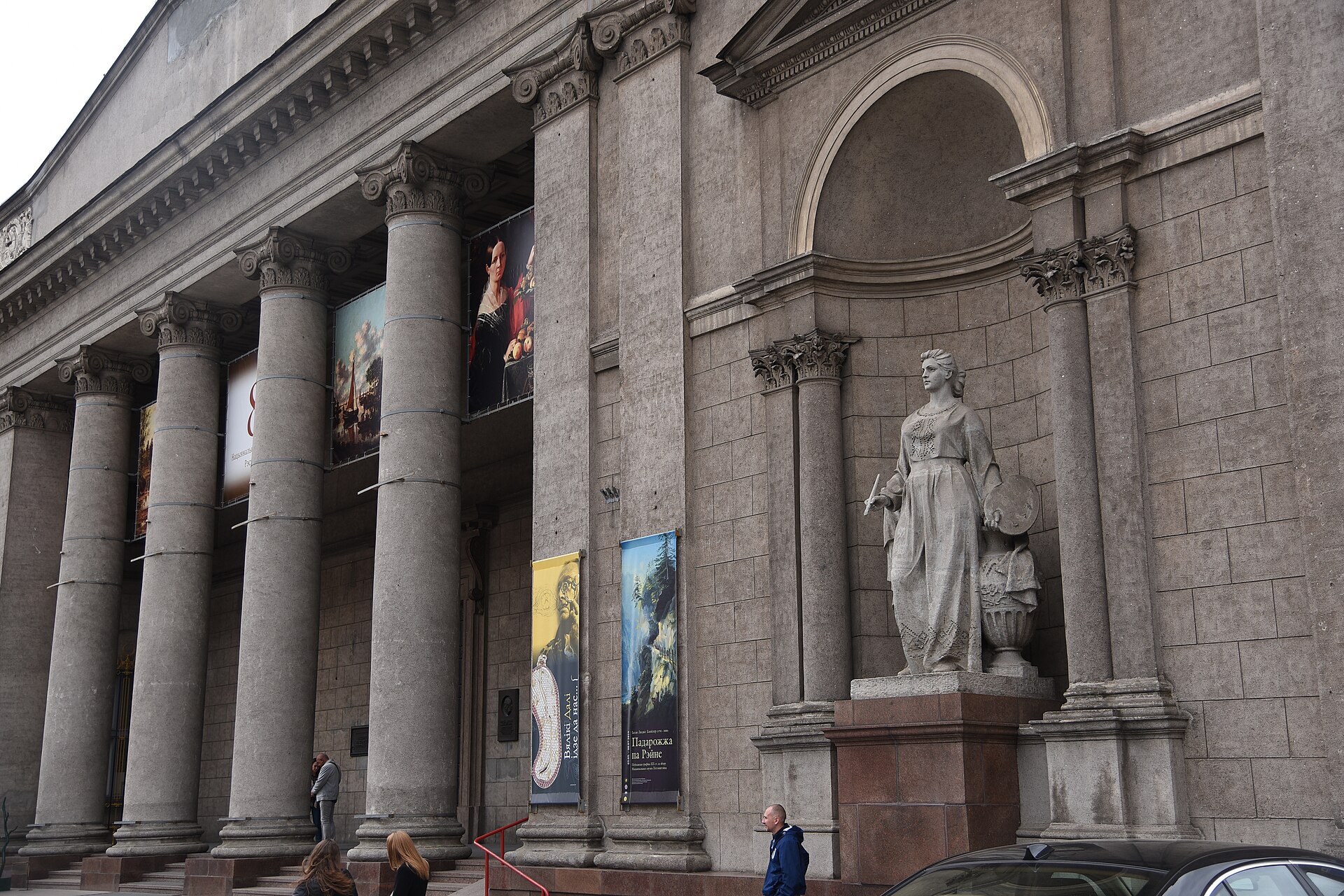
The colonnaded facade at 20 Lenin Street, Minsk, completed 1957 to a design by Mikhail Baklanov.
Rakoon · CC0National Art Museum of the Republic of Belarus
Museum · Nacyjanalny mastacki muziej Respubliki Bielarus · Founded 1939
Open, admission and hours confirmed 7 September 2026 · 16 sources
On this page 17 sections
ContentsClose
The museum's real strength is Belarusian: the 12th-18th century icon and church-art holdings, the 19th-20th century Belarusian painting rooms, and what remains of the Slutsk sash collection after the Radziwill Nesvizh nationalisation of 1939 and the wartime losses that followed it. Its Russian department carries individually strong paintings (Repin, Shishkin, Levitan, Aivazovsky, Klodt's bronze) rather than a systematic survey. Its European old-masters holdings are thin by comparison, a scarcity the museum itself acknowledges by foregrounding a single Troppa as unusual precisely because so little else of the kind survives here. It is not a Chagall or Belarusian-avant-garde collection; that material belongs to the separate Vitebsk museum, and this museum's link to it is occasional loan exhibitions rather than permanent holdings.
| Local name | Nacyjanalny mastacki muziej Respubliki Bielarus |
|---|---|
| Kind | Museum |
| Founded | 1939 |
| City and country |  Minsk, Belarus Minsk, Belarus |
| Address | 20 Lenin Street (vul. Lienina 20), Minsk 220030, Belarus |
| Website | artmuseum.by |
| Status | Open, confirmed |
| Record last verified |
Visiting
- Hours
- Mon, Wed, Fri-Sun11:00 to 19:00ticket office closes at 18:30
- Thu13:00 to 21:00ticket office closes at 20:30
- Closed
- Tuesday.
- Admission
- Main building, adultBYN 15permanent collection in the Lenin Street building
- Exhibition complex onlyBYN 10the adjoining temporary-exhibition wing, ticketed separately from the main building
- Guest Card, annualBYN 84unlimited entry to the permanent collection and temporary exhibitions for one year from purchase
Free entry: First Monday of the month: 50 percent discount for all categories of visitor (not a free day, a half-price day)- Tickets
- artmuseum.by/en/tickets The museum's own ticket page.
- Do I need to book?
- No for general admission (buy online or at the box office); tours and workshops are booked at the museum
- Address
- 20 Lenin Street (vul. Lienina 20), Minsk 220030, Belarus MapMetro Oktyabrskaya or Kupalauskaya station, then on foot
- Website
- artmuseum.by
- Telephone
- +375 17 393 98 44
- [email protected]
Before you go how long, access, photography, bags, eating, shop
- How long to allow
- Two to three hours for the permanent collection across four floors
- Access
- Museum states it welcomes all visitors; guide dogs admitted with a muzzle and documentation; a visually-impaired version of the website exists and inclusive programmes are offered
- Photography
- Amateur photography on a phone, without flash or additional equipment, is included in the admission ticket; wedding or yearbook shoots and portfolio/costume shoots require a separate paid permit
- Bags
- Cloakroom (wardrobe) on site, per visitor reports
- Eating
- Cafe on site at the entrance
- Shop
- Museum shop on site
Prices and hours change. We take them from the institution's own pages and print the day we read them, and you can check the current position at the source we used. Confirm before you travel.
What is inside
Belarusian art, 12th-18th centuries
Icon painting, wood sculpture and church plate from the medieval and early modern period, including the 17th-century golden age of Belarusian icon painting and a 17th-century crucifix from the Mstsislau Church Museum; the museum's Slutsk sashes, woven at the Radziwill manufactory in Slutsk and largely inherited from the nationalised Nesvizh palace collection in 1939
Belarusian art, 19th - early 20th centuries
Still-life and landscape painting including work by Ivan Khrutski, and Ferdynand Ruszczyc's Near Church (1899)
Belarusian art, 20th - early 21st centuries
Soviet and post-Soviet Belarusian painting, including Mikhail Savitsky's Partisan Madonna of Minsk (1978), a Sistine Madonna reworked around the memory of wartime partisan resistance
Russian art, 18th - early 20th centuries
Imperial and late-Romanov era Russian painting and sculpture: Ilya Repin's 1902 portrait of the interior minister Vyacheslav von Plehve, a version of Vasili Pukirev's Unequal Marriage, landscapes by Ivan Shishkin and Isaac Levitan, marines by Ivan Aivazovsky, and the equestrian bronze A Mare with a Colt (1854) by Pyotr Klodt
European art, 16th-20th centuries
Western European painting including Girolamo Troppa's The Musicians, described by the museum as the only known painting by Troppa on former Soviet territory, and Thomas Heeremans's Summer (1689)
Eastern art, 16th-20th centuries
Chinese, Japanese and Indian porcelain, textiles and sculpture, including a gilded White Tara statuette
What to see first
The building itself
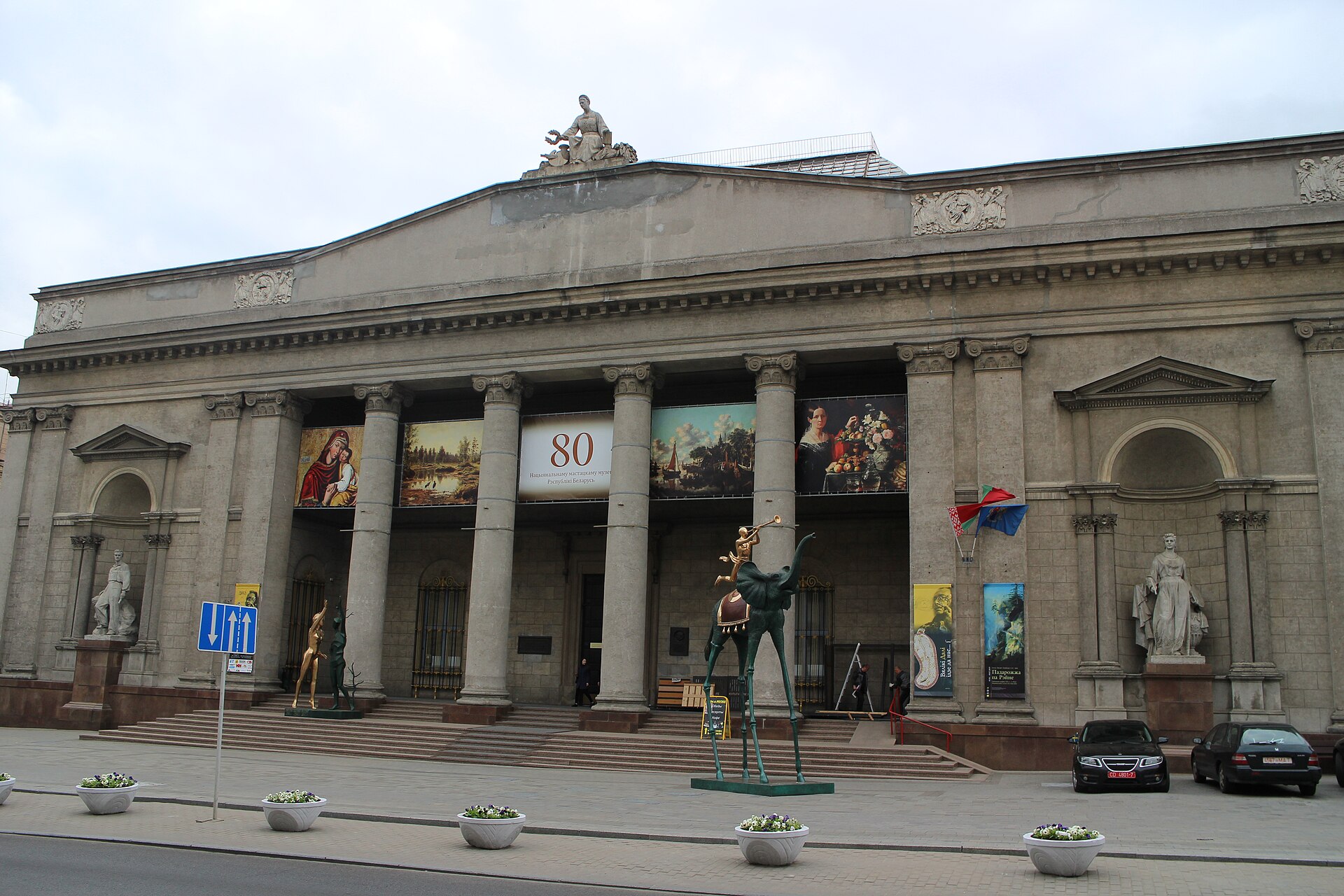
Mikhail Baklanov (architect)Completed 1957 in a neoclassical style with a colonnaded portico and allegorical sculptures titled Art, Sculpture and Fame on the pediment; the facade appeared on a Belarusian banknote2
Partisan Madonna of Minsk
Mikhail Savitsky1978 reworking of Raphael's Sistine Madonna around the memory of Soviet partisan resistance in occupied Belarus; widely rated among the best-known 20th-century Belarusian paintings and reproduced on a national postage stamp12
Portrait of Vyacheslav von Plehve
Ilya Repin1902 oil portrait of the Russian interior minister, in the Russian art department8
The Musicians
Girolamo TroppaThe museum states this is the only known painting by Troppa surviving on former Soviet territory9
A Mare with a Colt
Pyotr Klodt (Peter Clodt von Jurgensburg)1854 equestrian bronze by the sculptor best known for the horse groups on St Petersburg's Anichkov Bridge8
Slutsk sash, 1807-1818
Radziwill (Slutsk) manufactorySilk, silver and gilt-thread kontusz sash bearing the woven Cyrillic mark for the Radziwill princely Slutsk factory; acquired to extend the museum's chronological run of Slutsk sash weaving after most of the pre-war holdings were destroyed or lost in the Second World War10
Crucifix from the Mstsislau Church Museum
Unknown Belarusian carver, c. 17th centuryWood-carved crucifix representative of the museum's early Belarusian ecclesiastical art holdings8
A version of The Unequal Marriage
Vasili PukirevHeld in the Russian art department and catalogued by the museum on its own collection pages; the best-known version of this composition is in the Tretyakov Gallery in Moscow, so this is catalogued here as the museum's own version rather than presented as that painting16
White Tara statuette
Unknown, Eastern art departmentGilded devotional figure representing the museum's Chinese, Japanese and Indian holdings9
Exhibitions on now
- On now20 Aug to 25 Oct 2026Confirmed · check before you travel
Past exhibitions here
- Closed6 Aug to 20 Sep 2026Confirmed · check before you travel
A neoclassical hall raised for a museum that had already lost everything once
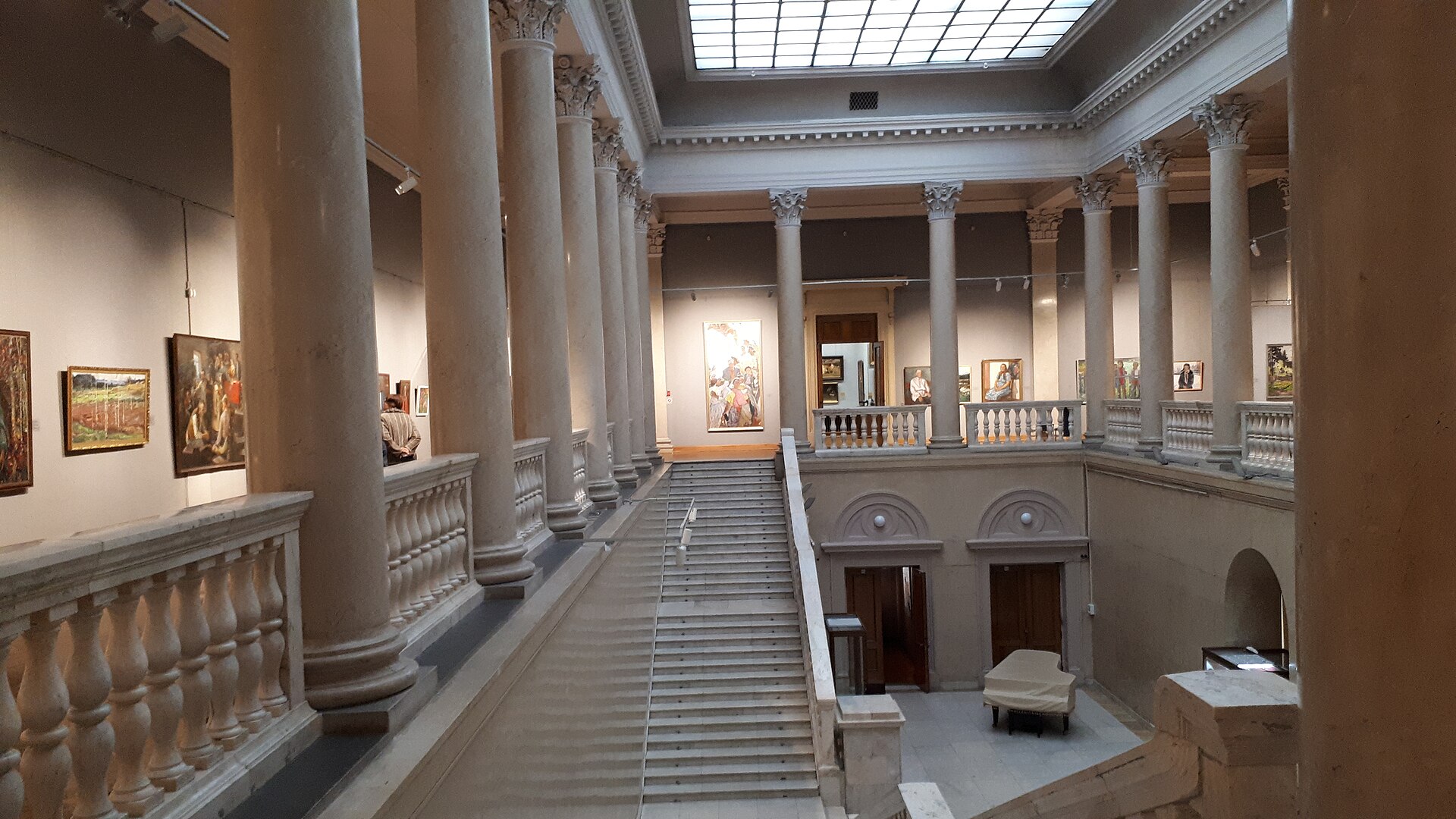
The museum occupies a purpose-built neoclassical building at 20 Lenin Street in central Minsk, designed by the architect Mikhail Baklanov and completed in 1957. The facade is a colonnaded portico under a pediment carrying three allegorical sculptures, named Art, Sculpture and Fame; the building has appeared on a Belarusian banknote. Inside, the ground and first floors are joined by a top-lit staircase hall ringed by a colonnade and a stone balustrade, with a glass roof standing in for a dome. It is the second home of an institution that, by the time this building opened, had already had to rebuild its entire collection once.
Founded 1939, emptied by 1941
The museum was established on 24 January 1939 as the State Art Gallery of the Byelorussian SSR, by resolution of the republic's Council of People's Commissars, under the painter-ceramist Nikolay Mikholap as its first director. It began in fifteen rooms of a former girls' gymnasium building. Over its first two years the gallery assembled roughly 2,711 works, drawn from regional museums in Vitebsk, Mogilev and Gomel, donations from the State Tretyakov Gallery, the Russian Museum and the Hermitage, and property nationalised from estates in what had been eastern Poland until the September 1939 annexation of western Belarus, including part of the Radziwill family's collection at Nesvizh Palace.
The German occupation from 1941 destroyed nearly all of it. Cultural-property officials working for the Nazi state, including Hitler's own art agent Hans Posse and the plunder administrator Kajetan Muhlmann, catalogued and removed the gallery's holdings; some paintings were kept to decorate German officers' clubs in occupied Minsk, the rest crated for onward transport. By the museum's own account, nearly the entire pre-war collection had been dispersed by September 1941, and only two heavy wooden sculptures and a marble Mercury, judged too cumbersome to move, remained in the building.
What came back, and what did not
After the war, Allied forces recovered over 1,500 caches of looted art and cultural property across Germany, and Soviet restitution requests eventually returned about 500 pieces to Minsk by October 1947 - roughly one-sixth of the pre-war collection of 2,711 works. The returned material included early Belarusian icons and carved cult objects from the 17th and 18th centuries, more than fifty Radziwill family portraits, paintings by Belarusian artists including Mikhail Filipovich and Vladimir Sukhoverkhov, Russian paintings, church plate, and applied-art pieces in furniture, porcelain and bronze. The museum states that only about fifty of the recovered works are on permanent display today, marked in the galleries with a small red star noting their return. Roughly 2,211 works from the pre-war collection remain unaccounted for; the museum has run its own research and exhibition project on this history, titled Returned Masterpieces, and does not claim the loss is resolved.
The rebuilding after 1944 was led by the director Elena (Alena) Aladova, working initially from the House of Trade Unions before the move into the new Baklanov building in 1957, by which point the collection had been brought back to roughly its pre-war size of about three thousand works. The institution took its current name, the National Art Museum of the Republic of Belarus, in 1993. It grew further under director Yury Karachun (1977-1997), who established branch museums at Mir Castle, Golshany, Raubichi and Mogilev, and under Vladimir Prokoptsov (1998-2023), who added a second exhibition building and pursued a wider museum-quarter plan for the site; Ganna Konanava became director in 2023.
Six departments, twelve centuries
The museum organises its permanent collection, now stated at more than 37,000 works, into six chronological and geographic departments: Belarusian art of the 12th-18th centuries; Belarusian art of the 19th - early 20th centuries; Belarusian art of the 20th - early 21st centuries; Russian art of the 18th - early 20th centuries; European art of the 16th-20th centuries; and Eastern art of the 16th-20th centuries, covering Chinese, Japanese and Indian material. The earliest Belarusian department is built around icon painting, wood sculpture and church plate, including a golden age of Belarusian icon painting identified with the 17th century and material such as a 17th-century crucifix from the Mstsislau Church Museum. The Russian department carries the museum's best-known single paintings, including Ilya Repin's 1902 portrait of the interior minister Vyacheslav von Plehve and a version of Vasili Pukirev's Unequal Marriage; the museum's own collection pages do not present its version as the better-known Tretyakov Gallery original, and this page follows that distinction. The European department is comparatively thin - the museum itself highlights Girolamo Troppa's The Musicians precisely because it says no other painting by Troppa survives on former Soviet territory, which is a marker of scarcity as much as of strength.
Icons, Slutsk sashes and the Nesvizh inheritance
Two threads of the early Belarusian department deserve separating out. The first is the icon collection, built from the material that survived or was recovered after the war, exhibited under headings such as the 2021 show The Golden Age of Belarusian Icon Painting: the 17th Century, and published in two museum catalogues, Belarus: the Boundary Between Heaven and Earth (2004) and Icon Painting and Altar Painting of Belarus in the 16th - Early 19th Centuries (2021). The icons have travelled to exhibitions at the Vatican, in Hungary, Italy, Spain, Liechtenstein, Russia and Ukraine.
The second is the Slutsk sash (kontusz sash) collection, woven at the Radziwill family's manufactory in Slutsk from the 18th century. The founding transfer came in 1939, when the unique Slutsk-belt holdings of the Radziwill Nesvizh Palace were nationalised into the new State Art Gallery along with 18th-century French tapestries and 16th-19th-century portraits, as part of the wider confiscation of estates across the territory annexed from Poland that September. The wartime losses fell especially hard here: of the museum's pre-war Slutsk-sash holdings, only fragments now remain. The museum has since rebuilt the collection through modern acquisition, including an early 19th-century sash from the Radziwill manufactory, woven in silk, silver and gilt thread between 1807 and 1818 and bearing the woven Cyrillic mark of the Radziwill Princely Slutsk Factory, bought specifically to extend the chronological run of the collection. Belarusian museums collectively hold around eleven complete or near-complete Slutsk sashes today, against production that once ran to thousands.
The museum's own account of both the 1939 nationalisation and the wartime loss is candid about the loss itself. It is less forthcoming about the nationalisation: neither the museum's history page nor its collection pages address whether the Radziwill family or its heirs (dispersed abroad after 1939, and now cooperating with the separate Nesvizh Castle Museum-Reserve on loans and joint exhibitions) have ever raised the 1939 confiscation as a restitution question specifically against the National Art Museum's holdings, as opposed to the Nesvizh estate itself. No such claim was found in the sources checked for this page; the point is recorded here as an open question rather than a settled one.
Chagall's homeland, not Chagall's museum
Marc Chagall was born near Vitebsk in what is now Belarus, and the city briefly hosted one of the most consequential episodes of the European avant-garde: the Vitebsk Museum of Modern Art and the Vitebsk People's Art School, where Chagall, Kazimir Malevich and El Lissitzky worked in overlapping and increasingly rival circles between 1918 and 1922, out of which Malevich's UNOVIS group emerged. That legacy is held and presented today by a separate institution, the Marc Chagall Museum and Art Centre in Vitebsk, roughly 270 kilometres from Minsk, which holds Chagall's own graphic works (etchings, woodcuts and lithographs, including a group Ida Chagall gave the museum in 1994) and a related collection of European avant-garde prints by Miro, Picasso and Leger.
The National Art Museum in Minsk is not that museum and does not hold a comparable core Chagall or avant-garde collection of its own; its 20th-century Belarusian department is built instead around Soviet-era and post-Soviet Belarusian painting, exemplified by Mikhail Savitsky's Partisan Madonna of Minsk. What it does host, from time to time, are loan exhibitions: in April-July 2026, the museum exhibited Chagall's The Promenade on loan from the State Russian Museum in St Petersburg, the middle panel of a triptych whose other two panels are in the Pompidou Centre and the Tretyakov Gallery - described by Belarus's culture minister as the first time the painting had been shown in Chagall's homeland. A reader coming to this museum expecting a Chagall or avant-garde collection to browse should look to Vitebsk instead; what Minsk offers is the occasional loan and the surrounding history.
Visiting: hours, tickets, and what past visitors say
The museum is open Monday, Wednesday and Friday to Sunday from 11:00 to 19:00, and Thursday from 13:00 to 21:00; it is closed on Tuesdays. Standard adult admission to the main building is 15 Belarusian rubles, with the separate exhibition complex ticketed at 10 rubles; an annual Guest Card at 84 rubles gives unlimited entry to both for a year. The first Monday of each month carries a 50 percent discount for all visitor categories. Amateur phone photography without flash is included in the ticket price; commercial, wedding and portfolio shoots require a separate paid permit. The museum is reachable on foot from the Oktyabrskaya or Kupalauskaya metro stations.
On Tripadvisor the museum holds 4.4 out of 5 from 343 reviews, and on Google 4.7 from 3,618 ratings (both read 7 September 2026). Recurring themes in the visitor reviews checked for this page are the depth of the Belarusian rooms relative to visitors' expectations, the quality and multilingual labelling of the displays, the top-lit staircase hall as a destination in its own right, and the on-site cafe. The most consistent practical complaint is the split between the main building and the separate exhibition complex, which some visitors found unclear when planning a single visit.
What visitors say
Visitors consistently describe a large, well-organised museum whose Belarusian collection is the reason to come: reviewers repeatedly single out the icon and 19th-20th century Belarusian rooms as the deepest and least familiar part of the visit, alongside the Russian masters (Repin, Levitan, Shishkin, Aivazovsky) on the same floors. The building's own architecture, inside and out, draws separate praise from the collection.
What is praised, what is criticised
- Praised: The breadth and organisation of the Belarusian art rooms, which visitors say gave them a fuller picture of Belarusian art history than expected
- Praised: The building's interior, in particular the top-lit colonnaded staircase hall
- Praised: Low admission price relative to the size of the collection, and a visit that comfortably fills half a day
- Praised: The on-site cafe and multilingual (Russian, English, Belarusian) labelling and audio guides
- Criticised: The museum is spread across several buildings (the main Lenin Street building and a separate exhibition complex, ticketed separately), which some visitors find confusing to navigate on a single visit
- Criticised: Coverage of Western European old masters is thin next to the Belarusian and Russian rooms; the museum itself flags the European room's single Troppa as unusual precisely because comparable material is otherwise scarce here
Ratings on other platforms
Tripadvisor: 4.4 from 343 ratings, read 7 September 2026
Google: 4.7 from 3,618 ratings, read 7 September 2026
A platform average is a tertiary source: it moves, it is not audited, and we quote no visitor's words.
Questions about National Art Museum of the Republic of Belarus
Where is National Art Museum of the Republic of Belarus?
20 Lenin Street (vul. Lienina 20), Minsk 220030, Belarus.
How much does it cost to visit?
Main building, adult: BYN 15; Exhibition complex only: BYN 10; Guest Card, annual: BYN 84. As confirmed 7 September 2026.
When is it open?
Mon, Wed, Fri-Sun 11:00-19:00; Thu 13:00-21:00. Closed: Tuesday. As confirmed 7 September 2026.
How do you get there?
Metro: Oktyabrskaya or Kupalauskaya station, then on foot.
What should you see first?
The building itself (Mikhail Baklanov (architect)); Partisan Madonna of Minsk (Mikhail Savitsky); Portrait of Vyacheslav von Plehve (Ilya Repin); The Musicians (Girolamo Troppa); A Mare with a Colt (Pyotr Klodt (Peter Clodt von Jurgensburg)); Slutsk sash, 1807-1818 (Radziwill (Slutsk) manufactory).
What we could not confirm
- Roughly 2,211 of the pre-war gallery's 2,711 works, seized by German occupation authorities in 1941, remain unaccounted for; the museum's own Returned Masterpieces project documents the loss but the works' current locations are unknown.
- The museum's founding collection included Slutsk sashes, tapestries and portraits nationalised from the Radziwill family's Nesvizh Palace in September 1939, after the Soviet annexation of western Belarus. Neither the museum's history pages nor its collection pages address whether this 1939 confiscation has ever been raised as a restitution question against the museum's own holdings specifically, separately from the Radziwill family's cooperation with the Nesvizh Castle Museum-Reserve over the former palace itself. No such claim was found in the sources checked for this page.
- The museum's own collection page lists a painting as Vasili Pukirev's The Unequal Marriage without stating whether it is a version, study or replica distinct from the better-known 1862 painting in the Tretyakov Gallery in Moscow; this page therefore describes it only as a version held here, not as that painting.
Images
Sources
- 1National Art Museum of the Republic of Belarus, homepage (address, phone, email, hours) artmuseum.by/en
- 2National Art Museum of the Republic of Belarus, "The Museum's History" artmuseum.by/en/history
- 3National Art Museum of the Republic of Belarus, "Prices for services" artmuseum.by/en/services
- 4National Art Museum of the Republic of Belarus, "Collection" artmuseum.by/en/collection
- 5National Art Museum of the Republic of Belarus, "Returned Masterpieces" project page artmuseum.by/en/online/praekt-vernutyia-shedeury
- 6National Art Museum of the Republic of Belarus, "For visitors" artmuseum.by/en/visitors
- 7National Art Museum of the Republic of Belarus, "About" artmuseum.by/en/about
- 8Wikipedia, "The National Art Museum of the Republic of Belarus" en.wikipedia.org/wiki/The_National_Art_Museum_of_the_Republic_of_Belarus
- 9Belarus Travel, "National Art Museum in Minsk: Masterpieces and History" en.belarus.travel/landmarks/the-national-art-museum-of-the-republic-of-belarus
- 10Belarus.by press release, "Authentic early 19th century Slutsk sash joins National Art Museum collection" belarus.by/en/press-center/press-release/authentic-early-19th-century-slutsk-sash-joins-national-art-museum-collection_i_0000213591.html
- 11Soyuz.by, "Presentation of Chagall's painting in Minsk hailed as historic event for Belarus" soyuz.by/en/society/presentation-of-chagall-s-painting-in-minsk-hailed-as-historic-event-for-belarus
- 12Wikipedia, "Partisan Madonna of Minsk" en.wikipedia.org/wiki/Partisan_Madonna_of_Minsk
- 13Tripadvisor, "The National Art Museum of the Republic of Belarus" (reviews and rating, read 2026-09-07) tripadvisor.com/Attraction_Review-g294448-d2385076-Reviews-The_National_Art_Museum_of_the_Republic_of_Belarus-Minsk_Minsk_Region.html
- 14Wikimedia Commons, Category:Building of the National Arts Museum of Belarus (image licensing) commons.wikimedia.org/wiki/Category:Building_of_the_National_Arts_Museum_of_Belarus
- 15Wikidata, Q2584571, Belarusian National Arts Museum (, identity and coordinates cross-check) wikidata.org/wiki/Q2584571
- 16National Art Museum of the Republic of Belarus, collection page for "Unequal Marriage" artmuseum.by/en/collection/russkae-mastatctva-xviii-pachatku-xx-v/niarouny-shliub