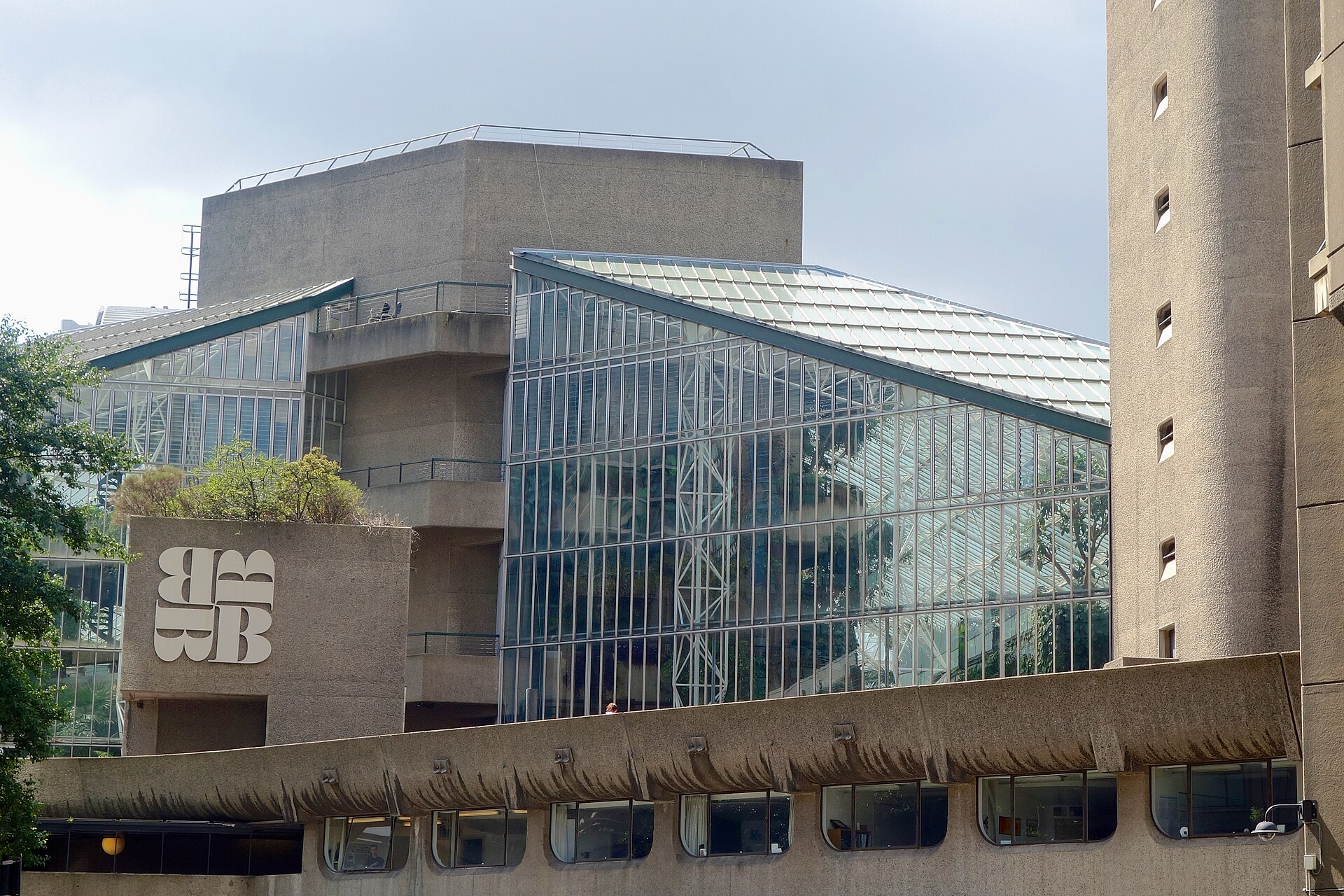
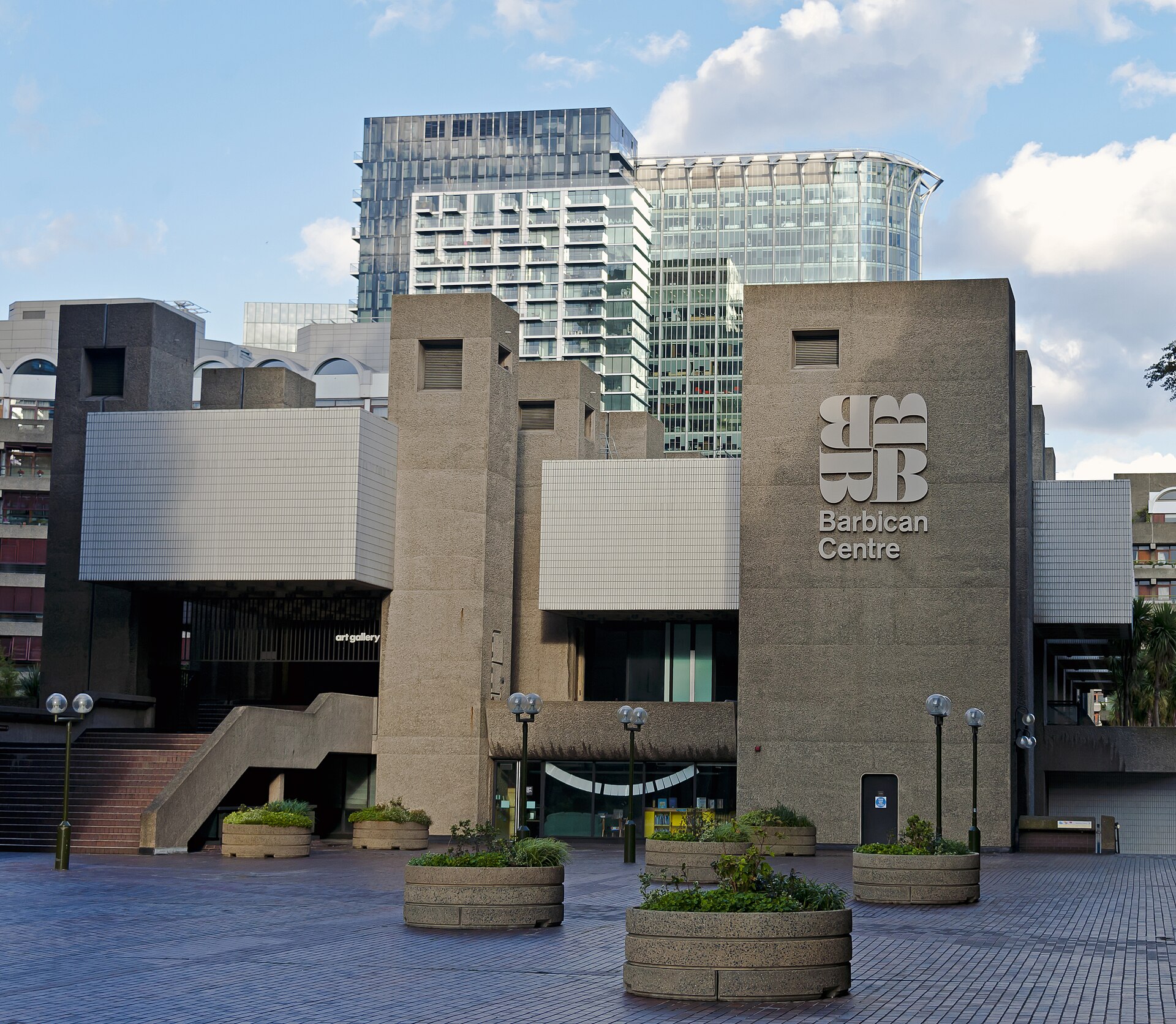
The Barbican Centre's Silk Street facade, showing the glazed conservatory roof above the concrete stalls foyer canopy and the Centre's logo sign.
Nachomaans · CC BY-SA 4.0Barbican Centre
Gallery · Founded 1982
Open, admission and hours confirmed 27 September 2026 · 20 sources
On this page 15 sections
ContentsClose
The Barbican holds no permanent art collection of its own in the way a museum does; it is a producing and presenting arts centre, not a collecting institution, and its Art Gallery and Curve programme are built entirely from temporary loan exhibitions and new artist commissions that travel on or are dismantled when a run ends. Its lasting holdings sit instead in Barbican Library, a full public lending library with a specialist Music Library and children's collection, and in the Centre's own architecture archive documenting the building and estate around it. The closest thing to a permanent collection on public view is the small group of site-specific artworks integrated into the architecture itself, among them Matthew Spender's 1994 sculpture The Barbican Muse near the Silk Street entrance and the Grade II listed Dolphin Fountain in Ben Jonson Place, both part of the fabric of the building rather than of any curated gallery display.
| Kind | Gallery |
|---|---|
| Founded | 1982 |
| City and country |  London, United Kingdom London, United Kingdom |
| Address | Silk Street, London, EC2Y 8DS, United Kingdom |
| Website | barbican.org.uk |
| Status | Open, confirmed |
| Record last verified |
Visiting
- Hours
- Mon-Fri08:00 to 23:00Building and foyers
- Sat-Sun09:00 to 23:00Building and foyers
- Bank Holidays11:00 to 23:00Building and foyers
- Mon-Sun10:00 to 19:30Box Office, Level G
- Mon, Wed, Fri09:30 to 17:30Barbican Library
- Tue, Thu09:30 to 19:30Barbican Library
- Sat09:30 to 16:00Barbican Library
- Closed
- Barbican Library: closed Sunday. Barbican Conservatory: open only on specific advertised dates, released about a month ahead, not a standing weekly schedule. Art Gallery and The Curve: follow the run dates of the current exhibition rather than the year-round building hours.
- Admission
- General building, foyers, highwalks and gardensFreeFree to enter and explore without a ticket
- Barbican ConservatoryFreeFree, but timed-entry tickets must be booked in advance; released one month ahead, and only for dates the Conservatory is advertised as open
- Architecture Tour, standardGBP 19.50Quoted online as GBP 18 plus a GBP 1.50 transaction fee; 90 minutes, meets outside the Barbican Shop on Level G. Members, Young Barbican, concessions and access rates also published
- Tickets
- barbican.org.uk/your-visit/general-info/box-o... The museum's own ticket page.
- Do I need to book?
- No for the building itself; yes for the Conservatory (free, timed slots released a month ahead) and for most performances, films and paid exhibitions
- Address
- Silk Street, London, EC2Y 8DS, United Kingdom MapUnderground Barbican station (Hammersmith and City, Metropolitan, Circle lines), 4 minutes walk
Underground Moorgate station (Hammersmith and City, Metropolitan, Circle, Northern lines, Elizabeth line), 7 minutes walk
Underground Farringdon station (Elizabeth line), 8 minutes walk
Rail Liverpool Street station, 11 minutes walk
Bus Route 153 to the Silk Street stop; routes 4 and 56 to Barbican station - Website
- barbican.org.uk
- Telephone
- +44 20 7870 2500
Before you go how long, access, photography, bags, eating, shop
- How long to allow
- An hour or two for the Conservatory and the public foyers; a half day for a gallery exhibition plus the Curve and the Library; a full day if a concert, film or play is added to the visit
- Access
- Step-free routes, an Access Guide covering every venue inside the complex, a dedicated accessible ticketing line, Blue Badge parking that can be booked ahead, and visual stories for the Hall, Theatre, the three cinemas, the Art Gallery and the Curve
- Photography
- Generally permitted in the public foyers and the Conservatory for personal use; restricted inside ticketed performances and some exhibitions, where individual show rules apply
- Bags
- A free cloakroom operates immediately before performances; large bags and luggage are discouraged on Architecture Tours, which run mostly outdoors and may not have cloakroom cover
- Eating
- Barbican Kitchen, the Barbican Bar and Grill, and the Martini Bar, plus foyer cafes across the levels
- Shop
- The Barbican Shop on Level G, next to the Architecture Tours meeting point
Prices and hours change. We take them from the institution's own pages and print the day we read them, and you can check the current position at the source we used. Confirm before you travel.
What is inside
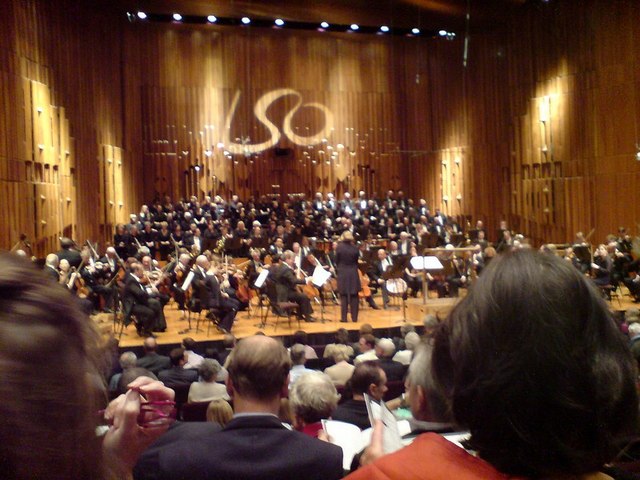
Photograph by RichTea · CC BY-SA 2.0 Barbican Hall
The Centre's 1,943-seat concert hall and the resident home of the London Symphony Orchestra since the building opened on 3 March 1982, when Claudio Abbado conducted the LSO for the Queen with Yo-Yo Ma and Vladimir Ashkenazy as soloists. The hall's acoustics were reworked in 1994 and again in 2001-02, when Caruso St John and the acoustician Kirkegaard Associates suspended a radial system of acid-etched stainless-steel reflectors inside the concrete ceiling to control echo and warmth without disturbing the listed interior.
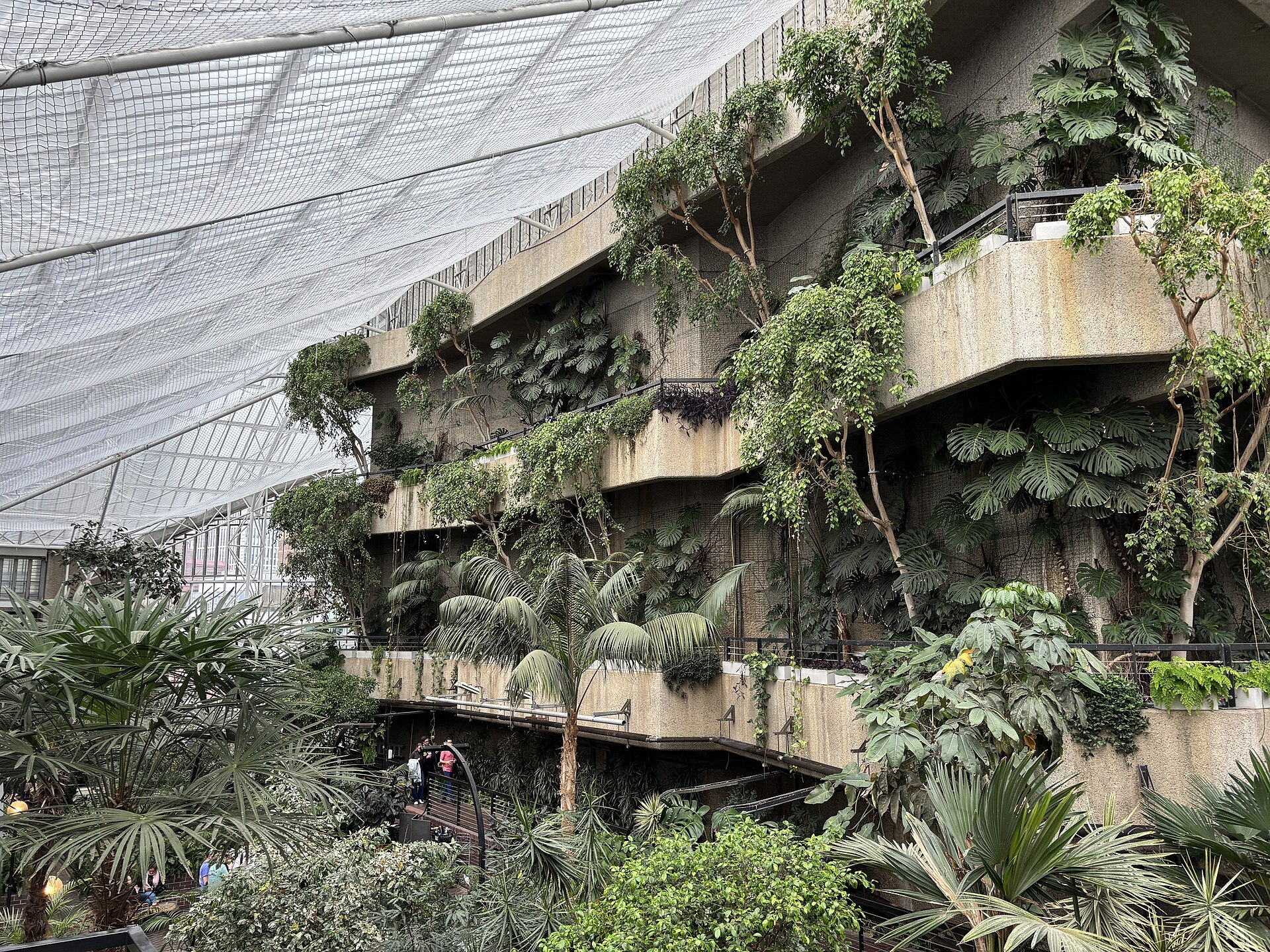
Photograph by Atreides83 · CC BY 4.0 Barbican Conservatory
A tropical glasshouse built over the flytower of the theatre below, opened in 1984 and usually described as the second largest conservatory in London after Kew Gardens. More than 1,500 species of tropical and subtropical plant grow across three levels of raised concrete walkways, alongside a pond of koi and terrapins. It is free but only opens on specific advertised dates and needs a booked, timed ticket.
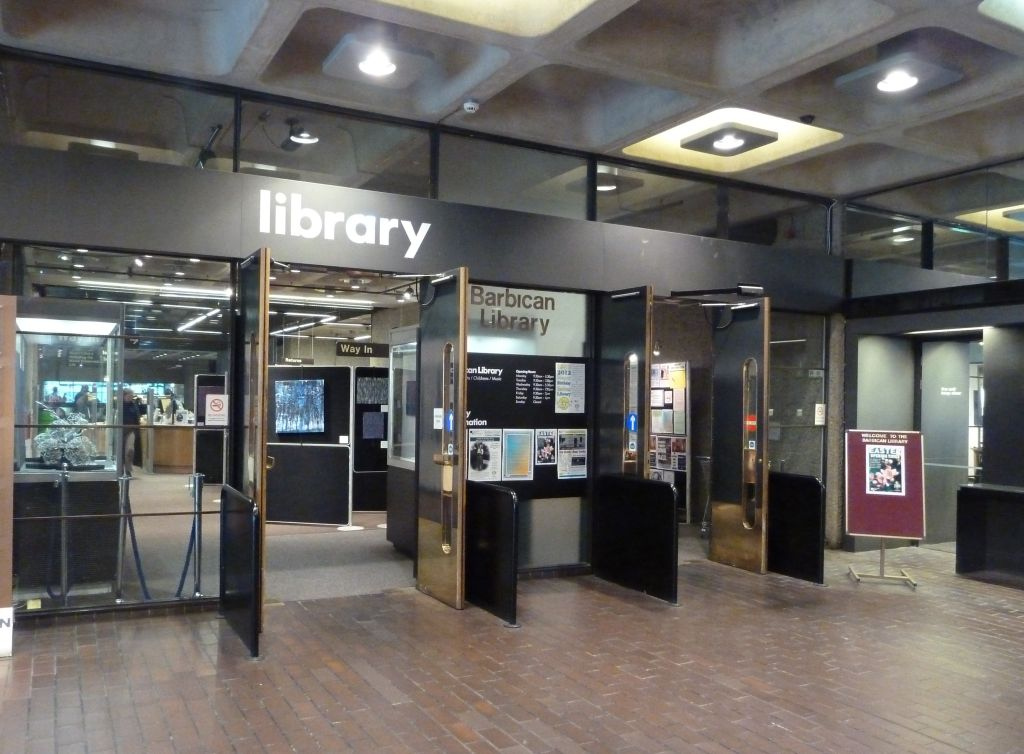
Photograph by JuliaC2006 from Rochester, UK · CC BY 2.0 Barbican Library
A large public lending library on Level 2, run by the City of London alongside the arts programme, with a dedicated Music Library, a Children's Library, and a general lending collection. In 2026 it was running a temporary display, '1996: 30 Years On', drawing on its own music archive, including stage costumes and memorabilia from that year's acts.
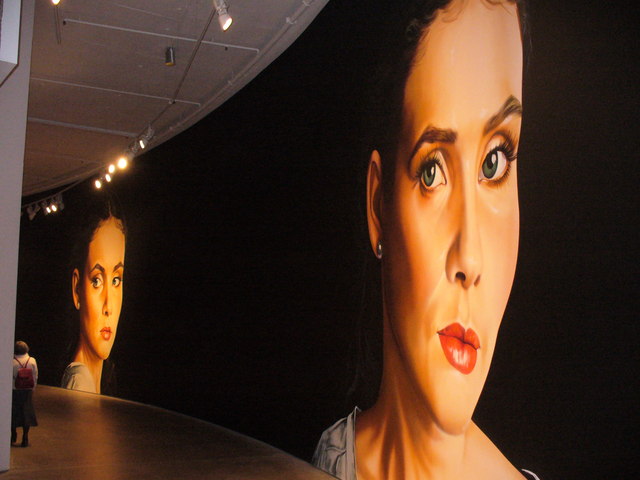
Photograph by Colin Smith · CC BY-SA 2.0 Art Gallery (Level 3)
The Centre's main temporary exhibition space, reached by lift or stairs from Level G or via the Sculpture Court, showing large loan exhibitions of modern and contemporary art, design, photography and fashion. Its most recent run, 'Project a Black Planet: The Art and Culture of Panafrica', closed on 6 September 2026 after a season co-organised with the Art Institute of Chicago, MACBA Barcelona and KANAL-Centre Pompidou Bruxelles, showing over 250 works by more than 90 artists including Chris Ofili, Marlene Dumas and Claudette Johnson.
The Curve
A 90-metre crescent-shaped gallery on Level G that wraps around the outside of the concert hall, used since 2006 for a single new commission at a time made specifically for its unusual shape. More than 40 artists have been invited to respond to the space, including Cory Arcangel, Thomas Saraceno, Yto Barrada, John Akomfrah and Bedwyr Williams; 2026 marks the programme's 20th year, with new commissions from Julia Phillips and Yuko Mohri. No free-licence photograph of the interior of The Curve itself has been located on Wikimedia Commons, so this entry carries no plate; the room should not be illustrated with a picture of the Art Gallery above, which is a different space.
Barbican Theatre, The Pit and Barbican Cinemas
The 1,156-seat Barbican Theatre and the smaller studio space, The Pit, were the London home of the Royal Shakespeare Company from the Centre's 1982 opening until 2002, when the RSC ended its permanent London residency to concentrate on Stratford-upon-Avon; the company has returned for guest seasons since, including a run marking its return to the Barbican after thirteen years away. Barbican Cinemas comprises three screens (288, 156 and 156 seats) below ground, showing first-run, repertory and festival programming. No free-licence interior photograph of the Theatre, the Pit or the cinemas has been located on Commons, so none is used here.
What to see first
Opening night, 3 March 1982
Claudio Abbado conducting the London Symphony OrchestraThe Barbican Centre opened with the LSO under its then principal conductor Claudio Abbado, Elgar's Cello Concerto played by Yo-Yo Ma and Beethoven's Piano Concerto No. 4 played by Vladimir Ashkenazy, with the Queen and the Duke of Edinburgh in the audience. She called it 'one of the wonders of the modern world'; the LSO has been resident orchestra of the City of London at the Barbican every year since.9
Barbican Hall's acoustic rebuild, 2001-02
Caruso St John Architects with Kirkegaard AssociatesA GBP 7.5 million refurbishment stripped out the original stage canopy and hung a radial system of acid-etched stainless-steel reflectors inside the hall's concrete ceiling, following an earlier 1994 acoustic rework by the same acoustic consultant. It is a rare case of a major, technically complex intervention inside a Grade II listed interior that both engineering and design press treat as a success, though some critics still describe the hall's sound as dry.10
The Curve, a gallery built to be curved
Barbican Art Gallery, commissioning programme since 2006Few galleries anywhere are shaped like this: a 90-metre crescent wrapped around the outside of the concert hall, used since 2006 for a single new work made specifically to respond to its geometry. Over more than 40 commissions across two decades it has become one of the Centre's clearest statements that the building's own strangeness can be a working asset rather than an obstacle.19
Barbican Conservatory
Built over the theatre flytower, opened 1984London's second largest conservatory after Kew, and one of the only tropical glasshouses anywhere built as a byproduct of hiding a theatre's stage machinery. More than 1,500 plant species grow across raised concrete terraces, an unlikely piece of jungle wedged into a Brutalist concrete drum.6
The Barbican Muse ('Zoe')
Matthew Spender, 1994A 6.1-metre gilded fibreglass figure holding masks of comedy and tragedy, mounted on the wall near the Silk Street entrance. Commissioned in 1993 by the architect Theo Crosby to 'float, glow and point the way' for visitors arriving on the walkway from Moorgate station, it is one of the few pieces of public art from the Centre's first refurbishment still in its original place; nine companion muses by Bernard Sindall, installed at the same time, were removed in 1997 and sold on.18
Grade II listing of the whole Barbican Estate, 2001
Chamberlin, Powell and Bon, with Ove Arup and Partners as engineersIn September 2001 Historic England listed the entire 35-acre Barbican Estate, arts centre included, at Grade II: 'estate of flats, maisonettes and terraced houses, hostel, girls' school, school of music and drama, and arts centre... designed 1955-59, arts centre element redesigned 1964-8; built with modifications in 1962-82'. It remains one of the largest single Grade II listings in England, protecting the poured-in-situ, pick-hammered concrete finish throughout.7
St Giles' Cripplegate
Medieval parish church, rebuilt after Blitz damageThe one substantial pre-war building left standing on the 16-hectare Cripplegate site after the Blitz reduced the area's population from a working neighbourhood to around 48 residents by 1951. Chamberlin, Powell and Bon built the entire estate and arts centre around the surviving church rather than clearing it, so a medieval parish church now sits inside a Brutalist concrete complex by design rather than accident.6
The Barbican Renewal Programme
Allies and Morrison with Asif Khan Studio, Buro Happold and Harris Bugg StudioA GBP 231 million first phase, approved by the City of London Corporation in March 2026 and due to start major works in 2027, will rebuild accessibility into the Conservatory and main foyer with two new lifts, retrofit the foyers and lakeside terrace, and overhaul wayfinding across the site, all without adding a single square metre to the listed building. Completion of Phase 1 is targeted for 2030, two years ahead of the Centre's 50th anniversary.11
Built from a bombed-out square mile
The Barbican Centre stands on ground that had almost nothing left standing on it. The 16-hectare Cripplegate area of the City of London, once a dense district of the textile trade, was devastated in the Blitz; by 1951 only around 48 residents remained in a landscape of rubble. The one substantial building to survive more or less intact was the medieval parish church of St Giles-without-Cripplegate, hit directly but not destroyed, and later worked into the middle of the new estate rather than cleared away.
The architects Chamberlin, Powell and Bon, who had already designed the nearby Golden Lane Estate, were formally appointed in May 1960 to turn the site into housing, and their brief grew over the decade into something much larger: a self-contained city district raised above street level, mixing homes with a school, a library, a lake, gardens and, eventually, an entire arts centre. Construction began in September 1963 in six phases and ran for almost two decades; the first residents moved into their flats in early 1969, more than a decade before the arts centre itself, the last and most complex piece, was finished.
In September 2001 Historic England listed the whole 35-acre estate, arts centre included, at Grade II, describing it as an estate of flats, maisonettes and terraced houses, a hostel, a girls' school, a school of music and drama, and an arts centre with a concert hall, theatre, studio theatre, cinemas, library, art gallery, conservatory, restaurants and offices, designed from 1955 and built with modifications through 1982. It remains one of the largest single listings in England, and it protects a very particular material: poured-in-situ reinforced concrete, its surfaces mostly pick-hammered by hand to expose the pale pink Pen Lee granite aggregate inside, a finish that took years of trial panels to get right and that gives the whole complex its rough, textured look rather than the smooth shuttered concrete more usual in Brutalist buildings.
What opened on 3 March 1982
The Barbican Centre itself, as distinct from the housing around it, opened on 3 March 1982, when the Queen and the Duke of Edinburgh attended a concert by the London Symphony Orchestra under Claudio Abbado, with Elgar's Cello Concerto played by Yo-Yo Ma and Beethoven's Piano Concerto No. 4 played by Vladimir Ashkenazy. The Queen's verdict, that it was 'one of the wonders of the modern world', has followed the building ever since, quoted as often by people mocking its scale as by people defending it.
What opened that night, and has grown since, is genuinely large: a 1,943-seat concert hall, a 1,156-seat theatre and a smaller studio theatre called The Pit, three cinemas seating 288, 156 and 156, an art gallery and a second gallery called The Curve, a large public lending library, a tropical conservatory, several restaurants and bars, and office space, all threaded together by foyers, highwalks and staircases that climb and drop between levels in a way that has confused visitors for over forty years. Historic England's listing counts seven conference halls and two exhibition halls in the wider complex on top of the performance venues. The City of London Corporation founded the Centre and remains its principal funder, a relationship that runs back to the same municipal decision, in the 1950s, to rebuild the bombed Cripplegate site as a City-run estate rather than sell it off.
Orchestras, a theatre company and a library nobody expects
The London Symphony Orchestra has been resident orchestra of the City of London at the Barbican from the opening concert onward, playing around 50 concerts a year in the Hall it has occupied longer than any other venue in its history; the orchestra's own account of its first seasons there describes musicians and staff alike still learning to navigate the building on opening night, before a yellow wayfinding line, inspired by the thread Ariadne gave Theseus in the labyrinth, was added to the floors. The BBC Symphony Orchestra also gives its London concert series in the Hall. The Royal Shakespeare Company made the Barbican Theatre and The Pit its London home from the 1982 opening, moving its metropolitan base there from the Aldwych Theatre, and stayed until 2002, when the company chose to concentrate its resources on Stratford-upon-Avon and ended the permanent residency; it has returned for guest seasons since, including a widely covered comeback production after thirteen years away.
Less expected, on a first-time visit looking for a concert hall or a gallery, is Barbican Library on Level 2: a full public lending library run by the City of London, with its own dedicated Music Library alongside general and children's collections. In 2026 the Music Library was running a temporary display drawing on its own archive, '1996: 30 Years On', built around stage costumes and other memorabilia from acts who were current that year. The library is free to enter and keeps its own, separate opening hours from the rest of the building, closed on Sundays and open latest on Tuesdays and Thursdays.
The Curve, the Conservatory, and forty years of commissions
Two of the Centre's most distinctive spaces exist because of decisions made to hide or route around the building's own machinery, rather than to showcase art or plants as a first purpose. The Curve, a 90-metre crescent-shaped gallery on Level G, wraps around the outside wall of the concert hall; since 2006 it has been given over entirely to a single new commission at a time, made specifically to answer its unusual shape, rather than to touring exhibitions. More than 40 artists have taken up the challenge across two decades, among them Cory Arcangel, Thomas Saraceno, Yto Barrada, John Akomfrah and Bedwyr Williams; 2026 is the programme's 20th anniversary year, marked by new commissions from Julia Phillips and Yuko Mohri.
The Barbican Conservatory, opened in 1984, sits over the theatre's flytower, the tall space needed above a stage to raise and lower scenery, and is usually described as the second largest conservatory in London after Kew Gardens. More than 1,500 species of tropical and subtropical plant grow across raised concrete walkways on three levels, with a pond stocked with koi and terrapins below. It is free, but visits are ticketed and timed, released about a month in advance and only on specific advertised open dates rather than a standing weekly schedule, which regularly catches out visitors who assume any large glasshouse simply opens every day.
The Art Gallery on Level 3, the Centre's main space for large loan exhibitions, most recently showed 'Project a Black Planet: The Art and Culture of Panafrica' until 6 September 2026, a co-organised international exhibition on the influence of Pan-Africanism on art and culture from the 1920s onward, with more than 250 works by artists including Chris Ofili, Marlene Dumas, Ernest Cole and Lynette Yiadom-Boakye. Like every temporary exhibition at the Barbican, it carried its own separate ticket price and its own opening hours, distinct from the free hours of the building around it.
A Brutalist reputation: admired, mocked, and hard to find your way round
The Barbican's concrete has never been neutral. In September 2003 an advertising agency, Grey London, polled around 1,000 Londoners for London Design Week and found the Barbican voted the capital's ugliest building, ahead of the BT Tower and the Millennium Dome; the poll ran only two years after Historic England had listed the same complex as a site of special architectural interest. Both readings persist side by side. The current wave of architecture criticism and heritage opinion treats the Barbican as one of the country's most important Brutalist survivals, and its guided Architecture Tours, walking visitors through the story of a site that runs from Roman city wall remains to a design that briefly considered a pyramid, are consistently among the best-reviewed things to do there.
The complaint that has never gone away, in professional criticism and in ordinary visitor reviews alike, is that the building is difficult to navigate: raised walkways, multiple entrances and level changes that do not obviously correspond to a single logical route have stranded visitors, staff and famous guests alike since 1982. The Centre's own current renewal programme includes a full redesign of signage and wayfinding, led by the design studios Assemble and Designers Unit working with an accessibility specialist, reported in late 2025 as a direct response to that decades-old problem rather than a cosmetic refresh. The concert hall's acoustics drew a related, narrower complaint: some listeners and critics found the sound too dry for large-scale orchestral works, prompting a GBP 500,000 acoustic rework in 1994 and a further, more radical GBP 7.5 million rebuild in 2001-02, in which the architects Caruso St John and the acoustician Kirkegaard Associates hung a radial system of acid-etched stainless-steel reflectors inside the hall's listed concrete ceiling. Some reviewers still describe the acoustic as dry today, even after both interventions.
A reckoning with its own working culture
Not every difficulty at the Barbican has been architectural. In June 2021 a collective of current and former staff, working under the name Barbican Stories, published a dossier of more than 100 accounts describing what contributors called an inherently racist working culture at the Centre, including claims that Black, Asian and minority ethnic staff were disproportionately placed in casual roles while white staff held permanent and senior positions. The City of London Corporation, as founder and principal funder, commissioned the law firm Lewis Silkin to carry out an external review. Sir Nicholas Kenyon, the Barbican's managing director for 14 years, announced he would step down that September; Will Gompertz and Sandeep Dwesar took up joint interim leadership, and the Centre brought in an interim director of equity, diversity and inclusion the same month as part of an accelerated anti-racism plan that had itself followed an earlier action plan published in June 2020. The Art Newspaper, reporting on the fallout in August 2021, described a wider staff reorganisation following the dossier's publication. This publication has not located a public account closing out every recommendation from the Lewis Silkin review; readers researching the Centre's current workplace culture should treat 2021-22 reporting as a starting point rather than a final word.
The Renewal Programme, and the fifty years ahead
The Barbican now faces its largest physical change since 1982. In March 2026 the City of London Corporation approved planning permission for Phase 1 of the Barbican Renewal Programme, a GBP 231 million project led by the architects Allies and Morrison working with Asif Khan Studio, the engineers Buro Happold and the landscape designers Harris Bugg Studio. The City Corporation has committed GBP 191 million of that figure, with the remainder to be raised through philanthropic and partnership support. The scheme is deliberately conservation-led: it adds two new lifts, to the Conservatory and the main foyer, described by the Centre's own chief operating officer as the most significant accessibility improvements in the building's history, alongside a new multi-faith room, increased toilet provision, and a sustainable retrofit of the foyers and lakeside terrace that aims to reuse existing materials rather than replace them. Historic England was formally involved in shaping the scheme given the Grade II listing, and its chair welcomed the close working relationship publicly when permission was granted.
Major construction is scheduled to begin in 2027, with an intensive closure period expected in 2028-29 and Phase 1 completion targeted for 2030, two years ahead of the Barbican's 50th anniversary in 2032. The programme is explicitly framed by its own architects and by the City Corporation as adding no additional square footage to a listed building that cannot simply be extended; instead it redistributes and reopens space that already exists, including, for the first time, public access to raised balconies inside the Conservatory. Whether the finished scheme resolves the wayfinding and toilet-queue complaints that have followed the building since 1982, rather than simply making them more comfortable to have, is one of the open questions this record will need to revisit once Phase 1 is actually built.
What visitors say
Visitors and critics consistently separate two different judgements: enthusiasm for what the Barbican puts on and shows, in a building widely agreed to be architecturally serious and quietly loved by people who spend time in it, against a running complaint that the same building is genuinely hard to find your way around. The Centre's own current renewal and wayfinding work is explicitly a response to that second point, not a dispute with it.
What is praised, what is criticised
- Praised: the range and quality of the concert, theatre, film, dance and exhibition programme under one roof
- Praised: the Conservatory as an unexpected, free green space inside a concrete complex
- Praised: Barbican Library, including its Music Library and its temporary music-history displays
- Praised: the Brutalist architecture itself, once visitors stop to search for an exit and look at it instead, and the guided Architecture Tours in particular
- Criticised: the confusing, multi-level layout and inconsistent signage, which strands even long-term Londoners and public figures, and which the Centre itself is now paying to redesign
- Criticised: queues for toilets and cramped circulation at busy performance intervals
- Criticised: concert-hall acoustics that some critics still describe as dry, even after two rounds of acoustic rework in 1994 and 2001-02
Ratings on other platforms
TripAdvisor: 4.2 from 1,719 ratings, read 27 September 2026
A platform average is a tertiary source: it moves, it is not audited, and we quote no visitor's words.
Questions about Barbican Centre
Where is Barbican Centre?
Silk Street, London, EC2Y 8DS, United Kingdom.
How much does it cost to visit?
General building, foyers, highwalks and gardens: free; Barbican Conservatory: free; Architecture Tour, standard: GBP 19.5. As confirmed 27 September 2026.
When is it open?
Mon-Fri 08:00-23:00; Sat-Sun 09:00-23:00; Bank Holidays 11:00-23:00; Mon-Sun 10:00-19:30; Mon, Wed, Fri 09:30-17:30; Tue, Thu 09:30-19:30; Sat 09:30-16:00. Closed: Barbican Library: closed Sunday. Barbican Conservatory: open only on specific advertised dates, released about a month ahead, not a standing weekly schedule. As confirmed 27 September 2026.
How do you get there?
Underground: Barbican station (Hammersmith and City, Metropolitan, Circle lines), 4 minutes walk; Underground: Moorgate station (Hammersmith and City, Metropolitan, Circle, Northern lines, Elizabeth line), 7 minutes walk; Underground: Farringdon station (Elizabeth line), 8 minutes walk; Rail: Liverpool Street station, 11 minutes walk.
What should you see first?
Opening night, 3 March 1982 (Claudio Abbado conducting the London Symphony Orchestra); Barbican Hall's acoustic rebuild, 2001-02 (Caruso St John Architects with Kirkegaard Associates); The Curve, a gallery built to be curved (Barbican Art Gallery, commissioning programme since 2006); Barbican Conservatory (Built over the theatre flytower, opened 1984); The Barbican Muse ('Zoe') (Matthew Spender, 1994); Grade II listing of the whole Barbican Estate, 2001 (Chamberlin, Powell and Bon, with Ove Arup and Partners as engineers).
What we could not confirm
- Whether the Barbican Renewal Programme, approved in March 2026 for construction from 2027, actually resolves the wayfinding and toilet-provision complaints that have followed the building since 1982, or only makes them more bearable, is not answerable until Phase 1 is complete and reopened around 2030.
- This record has not located a public, dated account closing out every recommendation of the 2021 Lewis Silkin review into workplace culture at the Barbican, commissioned by the City of London Corporation after the Barbican Stories dossier; later reporting on the Centre's diversity and inclusion record should be checked against this gap.
- No free-licence photograph of the interior of The Curve, the Barbican Theatre, The Pit, or the Barbican Cinemas has been located on Wikimedia Commons at the time of writing; these wings are described in text only and should be revisited if a verifiable interior photograph of any of them is later uploaded.
Images
Sources
- 1Barbican Centre, official website, homepage and current programming barbican.org.uk/
- 2Barbican Centre, 'Opening hours' barbican.org.uk/your-visit/general-info/opening-hours
- 3Barbican Centre, 'Contact us' barbican.org.uk/your-visit/general-info/contact-us
- 4Barbican Centre, 'Getting here' barbican.org.uk/your-visit/general-info/getting-here
- 5Barbican Centre, 'Our building' barbican.org.uk/our-story/architecture/our-building
- 6Historic England, 'Brutal and Beautiful: The Story of London's Barbican', Heritage Calling blog, 28 February 2022 heritagecalling.com/2022/02/28/brutal-and-beautiful-the-story-of-londons-barbican/
- 7Historic England, National Heritage List for England, list entry 1352667, 'Barbican' historicengland.org.uk/listing/the-list/list-entry/1352667
- 8Wikipedia, 'Barbican Centre' (, machine facts only) en.wikipedia.org/wiki/Barbican_Centre
- 9London Symphony Orchestra, 'The Barbican at 40' lso.co.uk/the-barbican-at-40/
- 10Caruso St John Architects, 'Barbican Concert Hall' project page carusostjohn.com/projects/barbican-concert-hall/
- 11City of London Corporation, 'Barbican Renewal plans approved to secure Europe's largest multi-arts centre for future generations' news.cityoflondon.gov.uk/barbican-renewal-plans-approved-to-secure-europes-largest-multi-arts-centre-for-future-generations/
- 12Time Out London, Frankie Lister-Fell, 'One of London's most confusing attractions is getting easier to navigate', 14 November 2025 timeout.com/london/news/one-of-londons-most-confusing-attractions-is-getting-easier-to-navigate-111425
- 13The Art Newspaper, 'London's Barbican shakes up staff following racism allegations published in tell-all book', 10 August 2021 theartnewspaper.com/2021/08/10/londons-barbican-shakes-up-staff-following-racism-allegations-published-in-tell-all-book
- 14Barbican Centre, 'Architecture Tours' event and ticket page barbican.org.uk/whats-on/2026/event/architecture-tours
- 15Barbican Centre, 'Visit the Conservatory' event page barbican.org.uk/whats-on/2026/event/visit-the-conservatory
- 16TripAdvisor, 'Barbican Centre - All You SHOULD Know Before Going', aggregate rating and visitor reviews, read 27 September 2026 tripadvisor.com/Attraction_Review-g186338-d553600-Reviews-Barbican_Centre-London_England.html
- 17Architects' Journal, 'Barbican "ugliest building"', 25 September 2003 architectsjournal.co.uk/archive/barbican-ugliest-building
- 18Wikipedia, 'The Barbican Muse' (, for sculpture facts and dimensions) en.wikipedia.org/wiki/The_Barbican_Muse
- 19Barbican Centre, 'Barbican celebrates 20 years of commissioning artists for The Curve', press release barbican.org.uk/our-story/press-room/barbican-celebrates-20-years-of-commissioning-artists-for-the-curve-with
- 20Barbican Centre, 'Project a Black Planet: The Art and Culture of Panafrica' exhibition page barbican.org.uk/whats-on/2026/event/project-a-black-planet-the-art-and-culture-of-panafrica