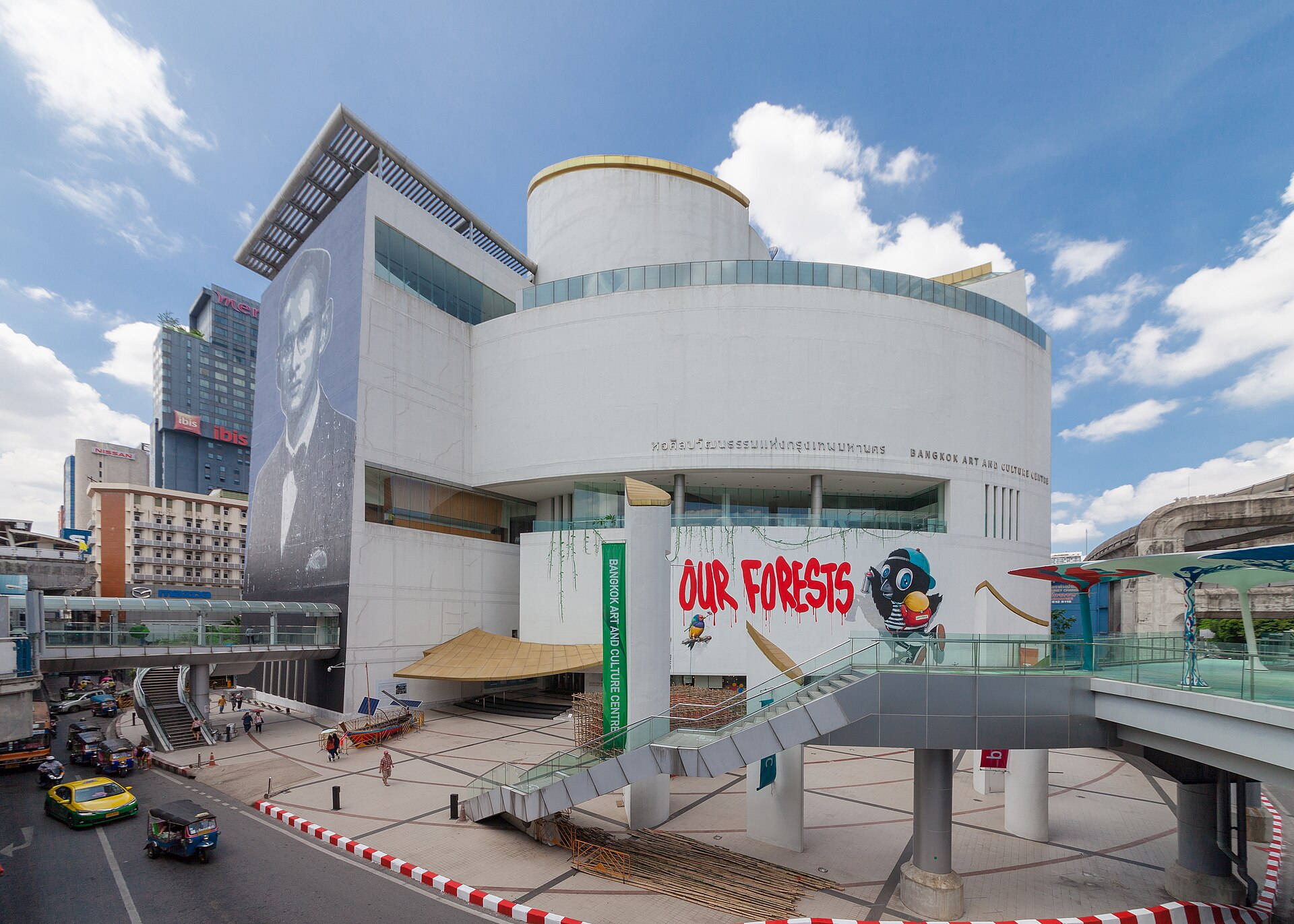
The building at the Pathumwan intersection, its circular gallery volume and Thai royal portrait mural visible above the main entrance banner.
Supanut Arunoprayote · CC BY 4.0Bangkok Art and Culture Centre
Museum · Founded 2008
Open, admission and hours confirmed 2 September 2026 · 13 sources
On this page 14 sections
ContentsClose
Bangkok Art and Culture Centre holds no permanent collection of its own. Its own floor-by-floor account of the building names nine levels and not one of them a gallery of works BACC owns and keeps on permanent view: the top floors rotate through temporary exhibitions, the People's Gallery rotates through community-proposed shows, and the remaining floors are offices, retail, a library and parking. What continuity the centre does carry runs through its exhibition history rather than through objects: the 1996 Art in the Reign of King Rama IX exhibition that seeded its founding foundation with 108 donated works, its role as flagship BACC venue for the Bangkok Art Biennale since 2018, and the Art Library's open holdings of contemporary art books, magazines and Thai exhibition catalogues. A reader looking for what BACC has to show should look at what is currently on, not at a permanent gallery.
| Kind | Museum |
|---|---|
| Founded | 2008 |
| City and country |  Bangkok, Thailand Bangkok, Thailand |
| Address | 939 Rama I Road, Wang Mai, Pathum Wan, Bangkok 10330, Thailand |
| Website | bacc.or.th/en |
| Status | Open, confirmed |
| Record last verified |
Visiting
- Hours
- Tue-Sun10:00 to 20:00
- Closed
- Monday. New Year holidays. Songkran holidays.
- Admission
- General admissionFreeFree entry to the exhibition floors. Special events, concerts and plays are charged separately and prices vary by event
- Do I need to book?
- No. Entry to the exhibition floors is free and unticketed; only concerts, plays and some special events require a paid ticket
- Address
- 939 Rama I Road, Wang Mai, Pathum Wan, Bangkok 10330, Thailand MapBTS Skytrain National Stadium station, about a 2-minute walk, with a direct skywalk connection into the building; the same walkway was used for a December 2006 press event on the centre's construction progress
Walking Facing MBK Center and Siam Discovery Centre at the Pathumwan intersection; reachable on foot from Siam BTS station through Siam Discovery - Website
- bacc.or.th/en
- Telephone
- +66 2 214 6630
- [email protected]
Before you go how long, access, photography, bags, eating, shop
- How long to allow
- Reviewers most often describe an hour to two hours, often folded into a longer day of shopping around the Pathumwan intersection; how much time is worth spending tracks closely with what happens to be on show, since the centre has no standing collection to fall back on between exhibitions
- Eating
- Cafes and food counters are spread through the artHUB@bacc retail floors, including Gallery Drip Coffee, mini oriental speedbar, Andy & Fine., and a Bangkok Art Biennale cafe during Biennale editions
- Shop
- artHUB@bacc occupies retail space worked through the building's exhibition floors: design and craft shops such as PARADAi, Bangkok Concept Store and CW Art, and the Southeast Asian-studies bookshop and gallery SEAJunction, alongside the bacc Shop on floor 5
Prices and hours change. We take them from the institution's own pages and print the day we read them, and you can check the current position at the source we used. Confirm before you travel.
What is inside
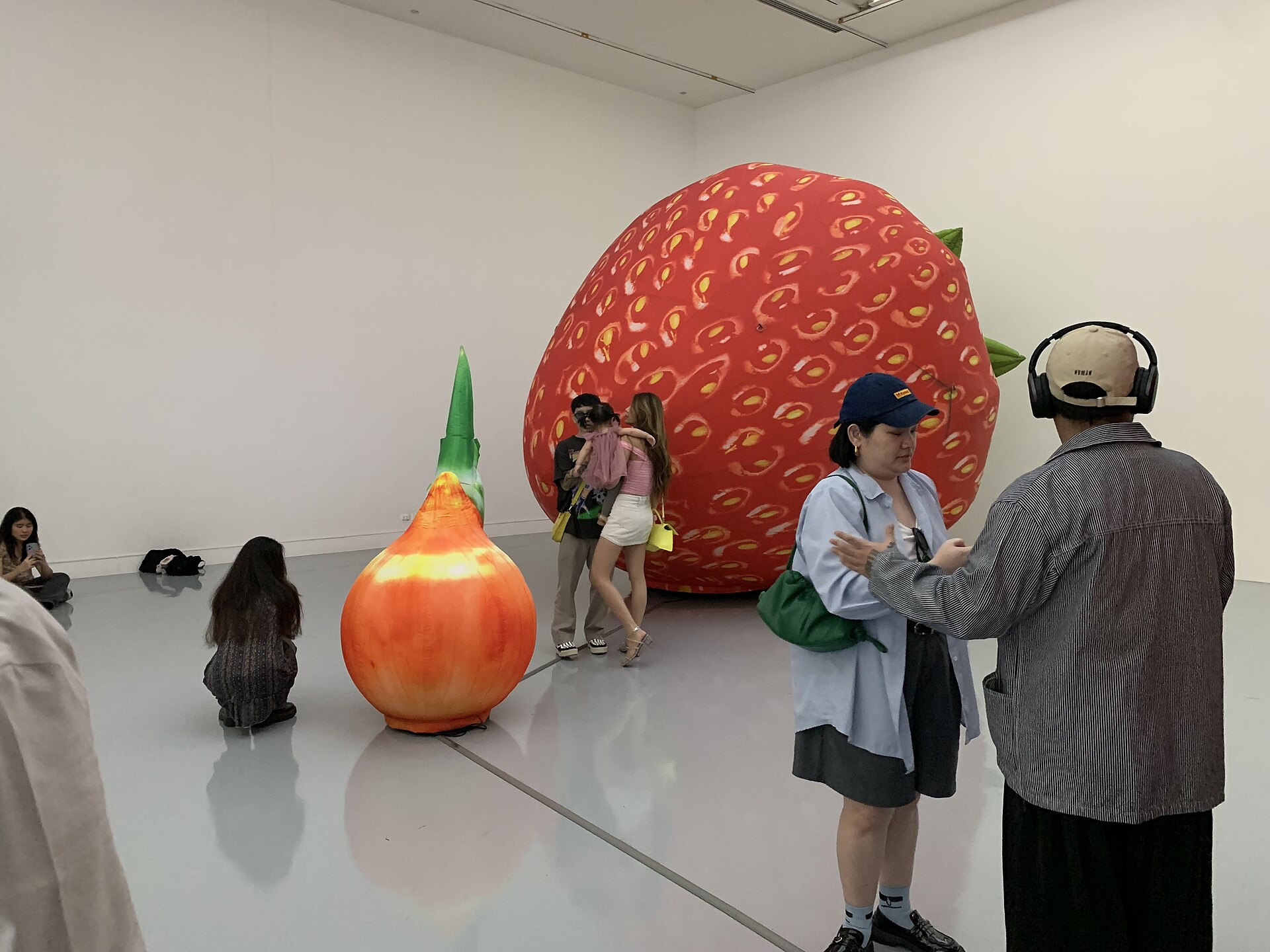
Photograph by Chainwit. · CC BY 4.0 Floors 7-9: Main Exhibition Galleries
The centre's principal exhibition floors, wrapped around the building's circular atrium at the top of the ramp. These are the floors the Bangkok Art Biennale has used as its main BACC venue in every edition since 2018, and where the centre's own headline shows run.
Floor 6: bacc Office and Friends of bacc room
The Foundation's administrative offices and a members' room for Friends of bacc, the centre's donor and patron scheme.
Floor 5: Auditorium, Information Counter, Meeting Room and bacc Shop
The centre's auditorium for talks, screenings and performances, the main visitor information counter, a meeting room, and the bacc Shop selling BACC-branded and curated design goods.
Floor 4: Studio, Meeting Room and artHUB shops
A studio space used for workshops and educational activities, a further meeting room, and artHUB retail units.
Floor 3: BTS entrance, Exhibition Gallery and artHUB shops
The floor where the direct skywalk from National Stadium BTS station enters the building, combined with an exhibition gallery and more artHUB retail.
Floor 2: People's Gallery (rooms P1-P3) and artHUB shops
Three rooms set aside for the People's Gallery programme, BACC's platform for exhibitions proposed by independent, emerging and community artists rather than curated top-down by the centre itself.
Floor 1: Multi-Function Room, Main Entrance, artHUB shops and Open Space
The ground-floor main entrance and an open public space that doubles as an events plaza, a multi-function room hired out for functions, and further artHUB retail.
Floor L: Art Library
A free public reading room holding contemporary art books and magazines, including Thai contemporary exhibition catalogues, with a co-working area and a Kid's Corner for children and families.
Floors B1-B2: Parking
Two below-ground levels of visitor parking, the only floors in the building not given over to galleries, offices, retail or the library.
What to see first
The central atrium and spiral ramp
Robert G. Boughey and AssociatesThe building's organising idea: a circular atrium crowned by a skylight, with a continuous circulation ramp that takes the same circular form and carries visitors up past every gallery floor. The architects designed it as the building's unifying public space, meant to let the centre's different activities be seen from within it rather than hidden behind corridors.2
Art in the Reign of King Rama IX (30 December 1996 - 8 January 1997)
The exhibition that gave the whole project its start: HRH Crown Prince Maha Vajiralongkorn opened it at the Queen Sirikit National Convention Centre on behalf of King Bhumibol Adulyadej, who lent 31 of his own paintings alongside more than 1,100 works by other artists. Proceeds and 108 donated works seeded the foundation that eventually built BACC.2
Bangkok Art Biennale, 2018 debut
BACC's first edition as a Biennale venue, showing more than 50 works across its outdoor spaces and floors 7 through 9, establishing the centre as the event's flagship Bangkok venue alongside temples, malls and public spaces around the city.8
Bangkok Art Biennale, 2020 edition
BACC hosted more than 86 artworks across floors 1, 7, 8 and 9, including durational performances staged in partnership with the Marina Abramovic Institute, on themes of migration and marginalisation.8
Bangkok Art Biennale, 2024 - Nurture Gaia
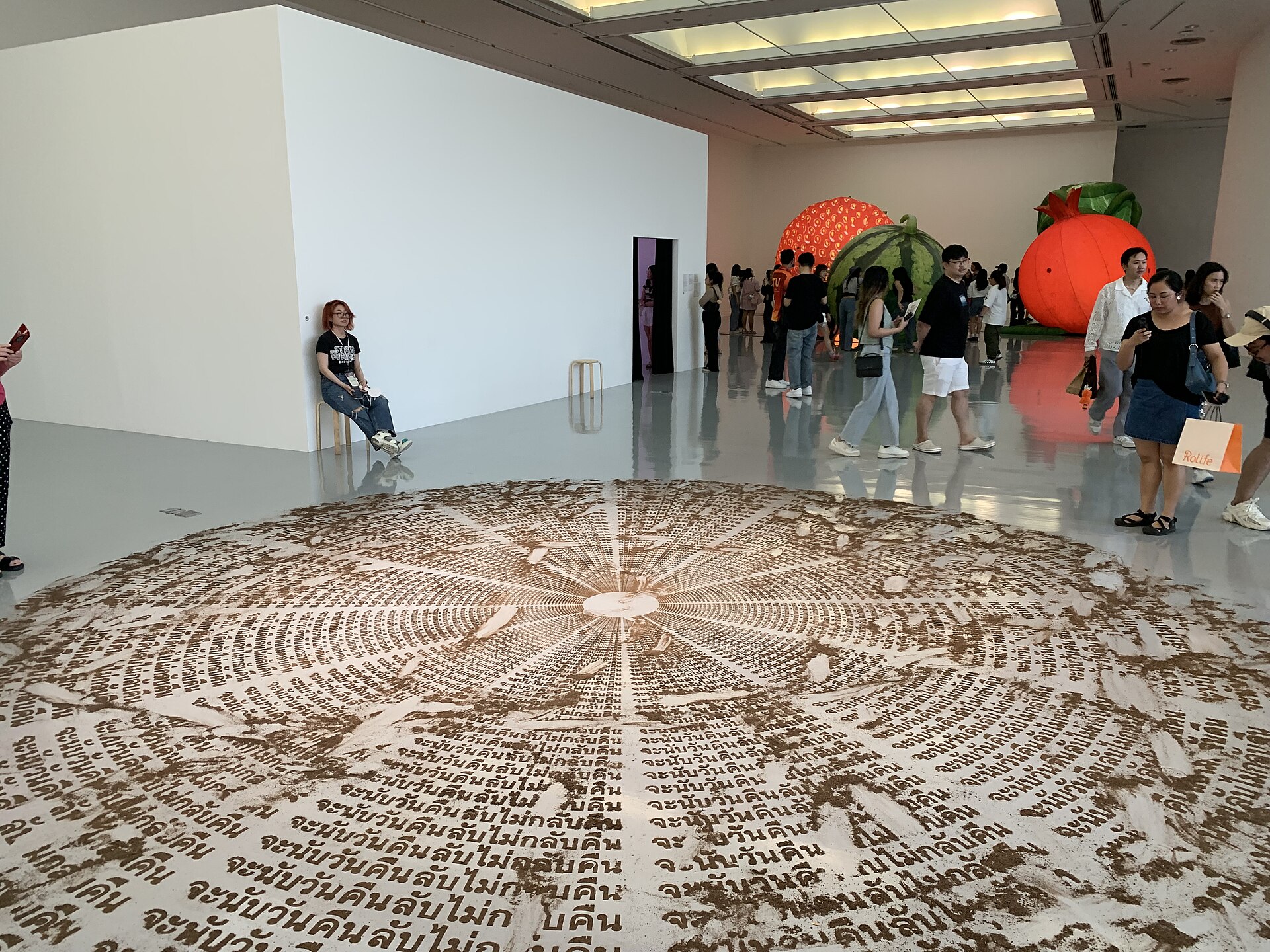
The most recent Biennale edition at BACC, running 24 October 2024 to 25 February 2025, wrapped a large banner around the building's facade and filled the galleries with installation work, documented in the photographs used on this page.9
Constellation of Complicity: Visualising the Global Machinery of Authoritarian Solidarity (2025)
An exhibition on authoritarian states, opened 24 July 2025 with work by artists from Myanmar, Iran, Russia, Syria and diaspora communities including Uyghur, Tibetan and Hong Kong artists. After a visit from Chinese Embassy officials, BACC blacked out or removed some artists' names and works addressing China's treatment of ethnic minorities, and the exhibition's co-curator subsequently left Thailand. It is the clearest instance on record of the centre's dependence on Bangkok City Hall funding shaping what it can show.7
People's Gallery
Three rooms on floor 2 (P1-P3) kept for exhibitions proposed by independent and community artists rather than programmed by BACC's own curators, functioning as the centre's open door for artists without an institutional route in.3
Art Library and Kid's Corner
A free reading room of contemporary art books, magazines and Thai exhibition catalogues on floor L, with a co-working area and a dedicated children's corner, run as a public service rather than a research archive with restricted access.3
artHUB@bacc and SEAJunction
The architects' original brief called for the commercial floors to support rather than compete with the galleries; artHUB@bacc, spread across several floors, now includes SEAJunction, a bookshop and gallery focused on Southeast Asian art, design and studies, realising that founding design idea two decades on.4
Past exhibitions here
A campaign that outlasted three governors
Bangkok Art and Culture Centre exists because a network of Thai artists spent close to fourteen years refusing to let the idea die. The centre traces its own beginning to October 1994, when the Artists' United Front of Thailand resolved to push for a contemporary art centre for its 20th anniversary, and to a 1996 exhibition, Art in the Reign of King Rama IX, at the Queen Sirikit National Convention Centre. King Bhumibol Adulyadej lent 31 of his own paintings to that show alongside more than 1,100 works by other artists; afterward, 108 works were donated to the foundation set up to carry the project forward, and proceeds from a related benefit concert, more than 4.1 million baht presided over by HRH Princess Chulabhorn, were later put toward establishing what became the Bangkok Art and Culture Centre Foundation.
The project nearly did not survive its own city hall. Bangkok Governor Dr Bhichit Rattakul agreed in 1996 to build a contemporary art centre at the Pathumwan junction, and in November 1998 the architectural firm Robert G. Boughey and Associates won a competition to design it. Rattakul laid the foundation stone in May 2000. Weeks later a newly elected governor reversed course, converting the site into a 30-year commercial development with the art centre reduced to a minor tenant. Thai artists, academics and the Council of Fine and Applied Arts Deans mounted a sustained public campaign against the change: petitions to the governor, a public forum at Silpakorn University, and on 3 November 2001 a parade that carried roughly 4,000 paintings stitched into five-work strings stretching four kilometres from Pathumwan junction to Bangkok City Hall, where they were laid out for an hour in front of the building. The Administrative Court of Thailand agreed in April 2002 to hear a public petition against the commercial redevelopment, and the shopping-centre plan was cancelled.
The campaign did not end there. In 2004 the Artists' Network founded the People's Network for the Bangkok Art and Culture Centre, held an 'Art Vote' rally that collected roughly 50,000 signatures, and lobbied every candidate in that year's mayoral election. Apirak Kosayodhin, elected governor in September 2004, approved the project on taking office. The Bangkok Metropolitan Administration signed a construction contract in September 2005, and after four years of building, the centre opened to the public on 29 July 2008, with an official opening a year later, on 19 August 2009. It now operates under the Bangkok Art and Culture Centre Foundation, chaired as of 2026 by Ms Kobkarn Wattanavrangkul, with the Bangkok Metropolitan Administration continuing to provide funding and sit on its advisory board, chaired by the sitting Governor of Bangkok.
A spiral atrium built to be climbed
Robert G. Boughey and Associates designed the building around four stated principles: flexible gallery spaces that could be arranged for art of different scale and character; a form that referenced Thai architecture without imitating it; tall interior volumes with a central space acting as the building's symbolic core; and galleries that could draw on natural, controlled daylight, concentrated on the upper floors where the main exhibition spaces sit. The result is organised around a circular atrium crowned by a skylight, with a continuous ramp that takes the same circular geometry as it climbs, so that a visitor moving between galleries can see much of the rest of the building's activity from the ramp itself. The architects describe this atrium as intended to become a public space in its own right, a meeting point between the art inside and the general public passing through, rather than simply a connector between floors.
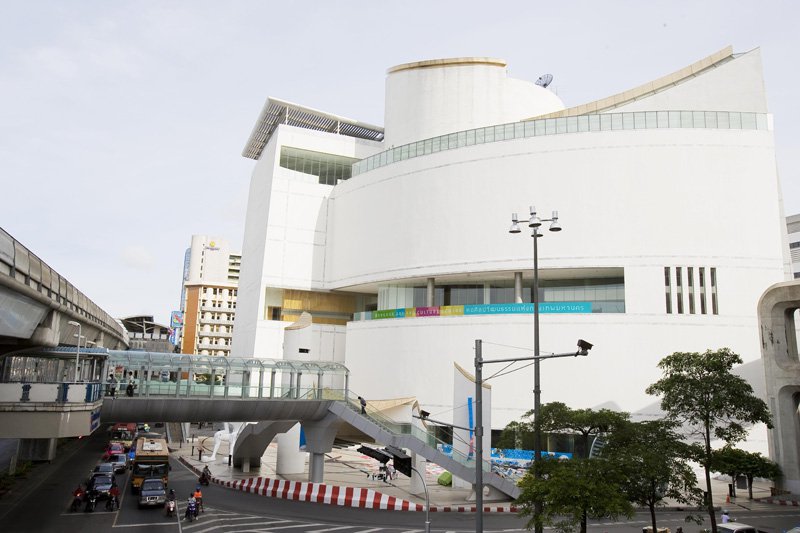
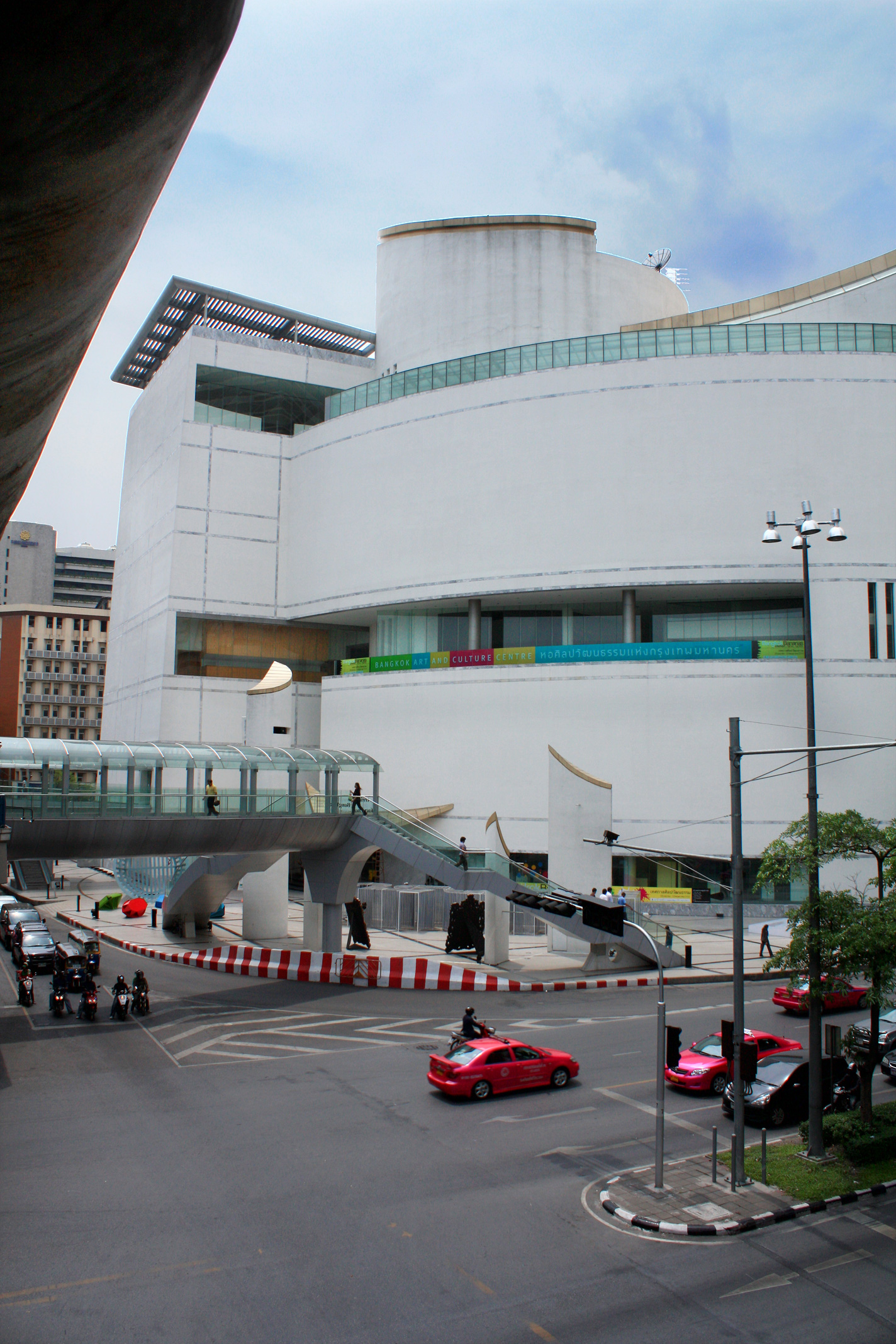
The exterior carries the same logic in a more literal way: slanted walls drawn from Thai architectural tradition, narrow window slits reinterpreted in a modern pattern, and curved roof and sunscreen profiles that reference the curves of Thai roof forms and traditional ware. Boughey's brief also treated the building's commercial floors as a support structure for the galleries rather than a separate business, on the reasoning that a purely commercial development would have needed to be far larger than the design allowed, and that shops chosen for their relevance to art could sustain the building alongside the exhibition spaces. That same commercial layer, run today as artHUB@bacc, occupies most of the lower and middle floors around the galleries.
Nine floors, no permanent collection
BACC's own floor guide lists nine levels, and not one of them is a gallery holding a collection the centre owns and keeps on permanent view. The top three floors, seven through nine, carry the main exhibition galleries; floor six holds the Foundation's offices and a Friends of bacc members' room; floor five combines an auditorium, the main visitor information counter, a meeting room and the bacc Shop; floor four has a studio and further meeting space; floor three, where the direct skywalk from National Stadium BTS station enters the building, combines another exhibition gallery with retail; floor two is given over to the People's Gallery, three rooms (P1 to P3) kept for shows proposed by independent and community artists rather than curated by BACC's own staff; floor one holds the main entrance, a multi-function room and an open public plaza; floor L is the Art Library; and two basement levels are parking.
That structure, and BACC's own description of its mission as supporting creative processes and acting as a public space for local and international art rather than as a custodian of works, is consistent with an institution built to show temporary exhibitions rather than to hold a collection. What continuity BACC does carry sits in the Art Library's catalogue holdings, in the works the 1996 Rama IX exhibition donated to its founding foundation, and in the record of what has been shown here rather than in objects on permanent display.
What has shown here
BACC has been the flagship Bangkok venue of the Bangkok Art Biennale in every edition since the event began. In 2018 the Biennale filled more than 50 works into the centre's outdoor spaces and floors seven through nine. By 2020 that had grown to more than 86 artworks across floors one, seven, eight and nine, including durational performances staged with the Marina Abramovic Institute addressing migration and marginalisation. The most recent edition, Nurture Gaia, ran from 24 October 2024 to 25 February 2025, wrapping the building's curved facade in a banner and filling its galleries with installation work, some of which is documented in the photographs on this page.
Outside the Biennale, BACC runs its own year-round calendar across Main Exhibitions, Educational Activities, Multidisciplinary Arts, activities organised through its Arts Network, the People's Gallery, Special Projects and an Art and Neighbouring Project, all searchable through its own online archive. The People's Gallery in particular functions as the centre's most direct link back to its founding campaign: a route into the building for artists without a curator's invitation, on the same floor where BACC's own retail and cafe tenants sit.
Underfunded, and in 2025, pressured
BACC was built with Bangkok Metropolitan Administration support and has depended on it ever since, and that dependence has twice become public. In 2018, the military-appointed city administration eliminated its annual budget allocation to BACC for the first time in the centre's first ten years of operation; that allocation, when paid, covered a large share of the centre's utility costs but still fell well short of its stated annual operating budget. BACC responded by cutting its opening hours from 10am-9pm to 11am-8pm, and director Pawit Mahasarinand told Coconuts Bangkok that, at the reduced funding level, the centre could only remain open into the middle of the following year. Around the same time, the Bangkok governor of the day proposed converting the building into a co-working space and having the city take over its operations directly from the non-profit BACC Foundation, a plan that drew public objections from Thai artists before it was dropped.
In 2025 the pressure took a different form. BACC opened Constellation of Complicity: Visualising the Global Machinery of Authoritarian Solidarity on 24 July, an exhibition on authoritarian states featuring artists from Myanmar, Iran, Russia, Syria and diaspora communities, including Uyghur filmmaker Mukaddas Mijit, Tibetan artist Tenzin Mingyur Paldron, and Hong Kong artists Clara Cheung and Gum Cheng Yee Man. Officials from the Chinese Embassy in Bangkok visited the show on 27 July; by the end of that month, BACC had blacked out or removed artist names and works addressing China's treatment of ethnic minorities, and the exhibition's co-curator subsequently left Thailand. China's Foreign Ministry denied direct involvement in the removals while accusing the organisers of distorting government policy. Thai artists and international human rights organisations condemned the redactions, and the episode is recorded on its own Wikipedia page as the Bangkok Art and Culture Centre censorship incident. Set against a governance structure in which the sitting Governor of Bangkok chairs BACC's own advisory board, the incident is the clearest documented instance of the centre's civic funding relationship shaping what it is able to show.
What visitors say
Visitors consistently describe BACC as a free, air-conditioned pause in the middle of Bangkok's shopping district, one where the spiral atrium and the building itself draw as much comment as whatever is on the walls. Praise clusters around the cost (free), the setting (a short walk from National Stadium BTS and Siam Discovery) and the mix of galleries with independent shops, cafes and a library. Complaints cluster around inconsistency: because BACC keeps no permanent collection, a visit between major shows can mean thin galleries and more retail than art, and reviewers who compare visits months apart report very different experiences of the same building. A smaller but pointed strand of criticism follows the 2025 censorship of the Constellation of Complicity exhibition, with at least one visitor explicitly naming it as a mark against the centre's independence.
What is praised, what is criticised
- Praised: Free admission and reliably cool, comfortable galleries as a break from Bangkok heat and crowds
- Praised: The building's architecture itself, especially the circular atrium and ramp, cited as often as the art on display
- Praised: The mix of small independent shops, cafes and a free art library alongside the galleries, giving a visit more to do than looking at exhibitions alone
- Praised: Direct, easy access from National Stadium BTS station
- Criticised: Exhibition quality and quantity vary sharply with the rotating programme; some visitors arriving between major shows report several floors given over mostly to shops and food rather than art
- Criticised: No permanent collection to anchor a visit, so the centre's worth depends entirely on timing a trip to a strong current exhibition
- Criticised: The 2025 redaction of artist names and work from the Constellation of Complicity exhibition, under pressure connected to the Chinese Embassy, drawn by at least one visitor as a direct criticism of the institution
- Criticised: Long-running underfunding by the Bangkok Metropolitan Administration, which cut BACC's hours in 2018 and has repeatedly left the centre short of its own operating budget
Ratings on other platforms
Google: 4.6 from 20,465 ratings, read 2 September 2026
Tripadvisor: 4.2 from 1,191 ratings, read 2 September 2026
A platform average is a tertiary source: it moves, it is not audited, and we quote no visitor's words.
Questions about Bangkok Art and Culture Centre
Where is Bangkok Art and Culture Centre?
939 Rama I Road, Wang Mai, Pathum Wan, Bangkok 10330, Thailand.
How much does it cost to visit?
General admission: free. As confirmed 2 September 2026.
When is it open?
Tue-Sun 10:00-20:00. Closed: Monday. New Year holidays. As confirmed 2 September 2026.
How do you get there?
BTS Skytrain: National Stadium station, about a 2-minute walk, with a direct skywalk connection into the building; the same walkway was used for a December 2006 press event on the centre's construction progress; Walking: Facing MBK Center and Siam Discovery Centre at the Pathumwan intersection; reachable on foot from Siam BTS station through Siam Discovery.
What should you see first?
The central atrium and spiral ramp (Robert G. Boughey and Associates); Art in the Reign of King Rama IX (30 December 1996 - 8 January 1997); Bangkok Art Biennale, 2018 debut; Bangkok Art Biennale, 2020 edition; Bangkok Art Biennale, 2024 - Nurture Gaia; Constellation of Complicity: Visualising the Global Machinery of Authoritarian Solidarity (2025).
What we could not confirm
- Whether BACC's funding relationship with the Bangkok Metropolitan Administration, strained since 2018 and tested again by the 2025 censorship episode, has since been placed on a stable multi-year footing has not been re-confirmed by a source dated later than the events themselves.
- BACC has not, as of this record, republished the full list of artist names and works redacted from the 2025 Constellation of Complicity exhibition.
- The 108 works donated to the founding foundation after the 1996 Art in the Reign of King Rama IX exhibition have not been traced to a current location or disposition in any source consulted for this record.
Images
Sources
- 1Wikidata, entity Q1130188, Bangkok Art and Culture Centre wikidata.org/wiki/Q1130188
- 2Bangkok Art and Culture Centre, About (mission, history, chronology, architecture, contact) bacc.or.th/en/about
- 3Bangkok Art and Culture Centre, Plan Your Visit (hours, admission, location, floor guide) bacc.or.th/en/plan-your-visit
- 4Bangkok Art and Culture Centre, artHUB@bacc directory bacc.or.th/en/directory
- 5Bangkok Art and Culture Centre, homepage bacc.or.th/en
- 6Coconuts Bangkok, Bangkok Art & Culture Centre cutting back hours after government funding cut off coconuts.co/bangkok/news/bangkok-art-culture-centre-cutting-back-hours-government-funding-cut-off/
- 7Wikipedia, Bangkok Art and Culture Centre censorship incident en.wikipedia.org/wiki/Bangkok_Art_and_Culture_Centre_censorship_incident
- 8Bangkok Art Biennale 2020, venue page for Bangkok Art and Culture Centre bab20.bkkartbiennale.com/venue/bangkok-art-and-culture-centre
- 9Wikimedia Commons, Category:Bangkok Art Biennale 2024 exhibitions at BACC commons.wikimedia.org/wiki/Category:Bangkok_Art_Biennale_2024_exhibitions_at_BACC
- 10Wikipedia, Bangkok Art and Culture Centre en.wikipedia.org/wiki/Bangkok_Art_and_Culture_Centre
- 11Tripadvisor, Bangkok Art & Culture Centre reviews tripadvisor.com/Attraction_Review-g293916-d1210675-Reviews-Bangkok_Art_Culture_Centre-Bangkok.html
- 12Google Maps listing, Bangkok Art & Culture Centre google.com/maps/search/Bangkok+Art+and+Culture+Centre
- 13Nation Thailand, A deal brewing with City Hall, BACC strives for sustainability nationthailand.com/in-focus/30350495