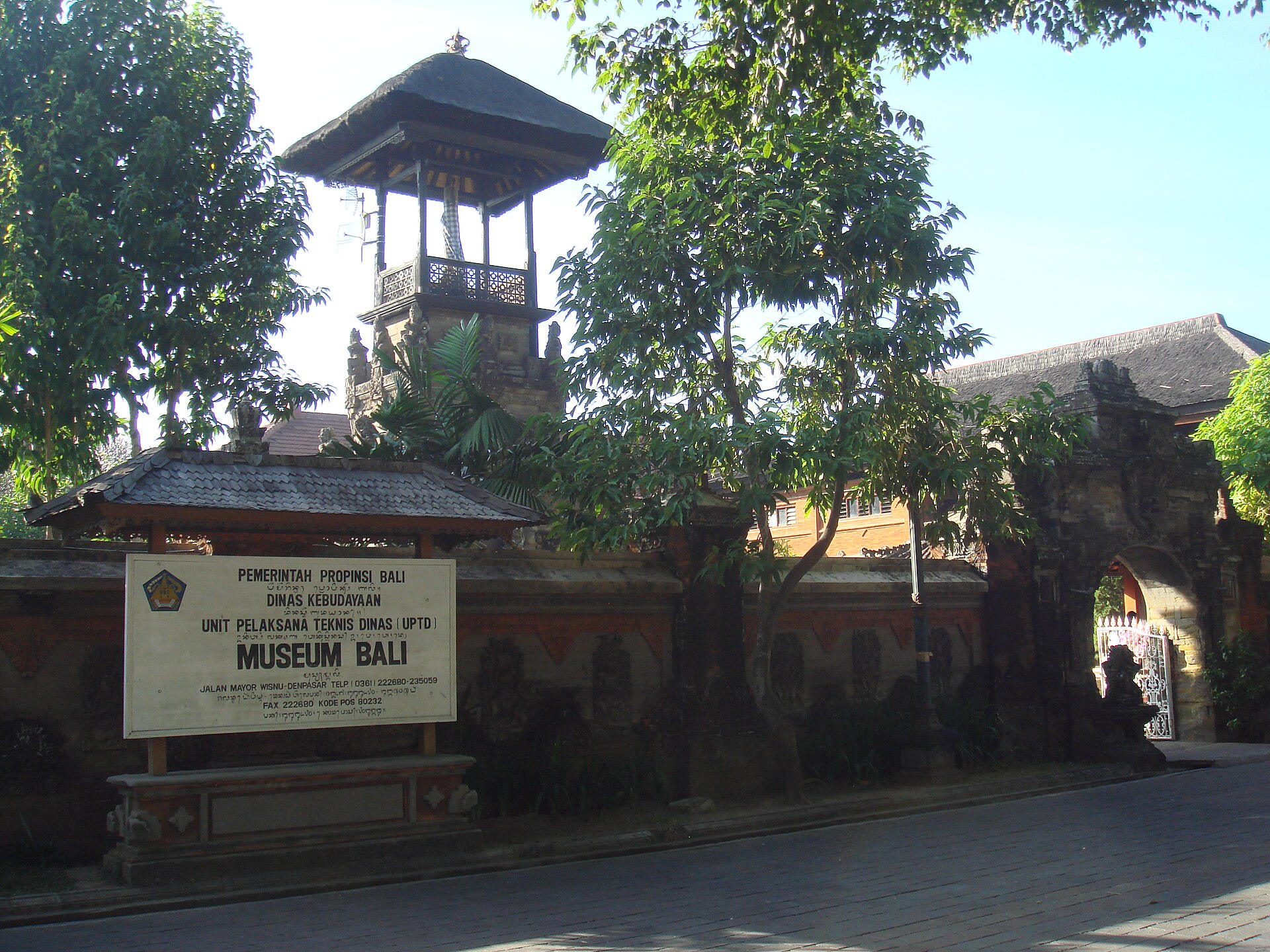
The Bali Museum's main courtyard facade, Denpasar, Bali
PHGCOM, CC BY-SA 3.0Bali Museum
Museum · Museum Negeri Propinsi Bali · Founded 1932
Open, admission and hours confirmed 12 September 2026 · 15 sources
On this page 14 sections
ContentsClose
The museum's declared strength is breadth across categories that Indonesian museology classifies separately - arkeologika (archaeological material, including Bronze Age nekara drums and stone sarcophagi), historika (historic coinage and colonial-period objects), etnografika (everyday and ceremonial ethnographic material, including textiles, masks and keris) and seni rupa (fine art) - held inside a single, architecturally coherent complex rather than spread across specialist institutions. Its greatest single asset for a researcher is arguably the building itself: a documented 1910-1932 construction with named Balinese and German architects and named royal patrons, standing on the site of a palace destroyed in the 1906 puputan, which makes the museum's courtyards and gates a primary architectural record in their own right, independent of the display cases inside them.
| Local name | Museum Negeri Propinsi Bali |
|---|---|
| Kind | Museum |
| Founded | 1932 |
| City and country | Denpasar, Indonesia |
| Address | Jalan Mayor Wisnu No. 1, Dangin Puri, Denpasar Timur, Denpasar, Bali, Indonesia |
| Website | disbud.baliprov.go.id/museum-bali |
| Status | Open, confirmed |
| Record last verified |
Visiting
- Hours
- Mon-Sun08:00 to 15:30Per Detik.com, Dec 2025, quoting current museum management; the national museum registry (Wikidata-cited) gives 07:30-15:30 and some tourist guides claim a shortened Friday session, which the two most recent primary-adjacent sources do not mention
- Closed
- Nyepi (Balinese Day of Silence). National public holidays.
- Admission
- Foreign adult visitorIDR 100,000Per Detik.com, Dec 2025, citing current museum management; some 2024-2025 tourism sources give lower figures (see notes)
- Domestic adult visitorIDR 30,000Figure most consistently repeated across 2025-2026 travel guides; not confirmed on a published price list from the museum itself
- Child / studentIDR 5,000Lower bound reported by Detik.com Dec 2025; other sources give figures up to Rp 20,000 for students
- Do I need to book?
- No. Individual visitors and small groups buy tickets at the entrance; the museum asks larger groups to arrange visits in advance through its Instagram account, @sahabatmuseumbali, because gallery space is limited
- Address
- Jalan Mayor Wisnu No. 1, Dangin Puri, Denpasar Timur, Denpasar, Bali, Indonesia MapCar/taxi Approximately 13 km, about 45 minutes from Ngurah Rai International Airport
On foot East side of Puputan Badung square (Taman Puputan), beside the Catur Muka statue and facing Pura Jagatnatha - Website
- disbud.baliprov.go.id/museum-bali
- Telephone
- +62 361 222680
- [email protected]
Before you go how long, access, photography, bags, eating, shop
- How long to allow
- Most visitors report 30-60 minutes to see the four pavilions unguided; hiring one of the guides who wait at the entrance stretches this to about an hour and is repeatedly recommended in reviews, though the terms of that guiding are informal (see below)
- Access
- Not published by the museum. The complex is arranged across three walled courtyards linked by stepped gates (candi bentar and candi kurung), which several visitor reviews describe navigating on foot; no wheelchair-access statement was found on the museum's own site
- Photography
- No photography restriction is stated on the museum's own site. Visitor photographs of the courtyards, gates and collections are common on travel-review platforms
- Bags
- Not published by the museum
- Eating
- Not published by the museum; no on-site cafe is described in any source checked
- Shop
- Not published by the museum. Multiple 2025 visitor reviews describe unofficial vendors at the entrance, separate from ticketing, pressing overpriced Balinese calendars and drawings on visitors; this is a recurring complaint, not a museum-run shop
Prices and hours change. We take them from the institution's own pages and print the day we read them, and you can check the current position at the source we used. Confirm before you travel.
What is inside
Gedung Tabanan (Tabanan Pavilion, north side of the complex)
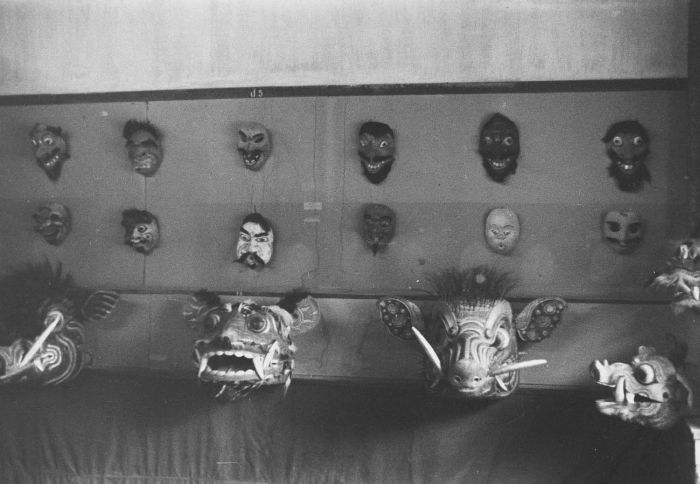
Dance equipment: costumes, the full range of masks used in masked dance-drama (topeng), wayang kulit shadow puppets, and keris used in performances of the Calonarang dance-drama, alongside a number of ancient statues. One secondary source instead describes this building as holding the museum's chronological keris collection 'from the Dutch colonial period to the present' - both accounts agree the pavilion centres on keris and performance objects, and disagree only on emphasis
Gedung Buleleng (Buleleng Pavilion, centre of the complex)
Built in the style of a north-Balinese temple (pura). The museum's own site describes its holdings as Balinese clothing and traditional fans; a separate tourism source instead describes this building's collection as historic kepeng (holed) coins from Majapahit, Banten, Palembang and China. The two accounts do not agree on contents, which is noted under Open questions rather than resolved by guesswork
Gedung Badung (Badung Pavilion, at the main entrance)
Positioned by the tall kulkul (wooden signal drum) tower at the main gate. Ground-floor cases hold prehistoric tools spanning the hunting-and-gathering, early agricultural and metal-working periods; the upper floor carries the museum's collection of Balinese fine art (painting and sculpture)
Gedung Karangasem (Karangasem Pavilion)
The fourth pavilion, opened alongside Tabanan and Buleleng at the museum's 1932 inauguration. The museum's own site describes its holdings only in general terms - prehistoric, historical and ethnographic objects including fine art. A separate tourism source instead states this pavilion is built around the Cili motif, a stylised rice-goddess fertility figure appearing across Balinese craft and ceremony from antiquity to the present; that specific claim could not be corroborated on the museum's own site
What to see first
Ceremonial keris for the Calonarang dance-drama
Balinese smiths, various datesThe museum's keris are kept and displayed as working ritual objects rather than as a static weapons case: several are specifically identified with the Calonarang dance-drama, in which a keris-wielding trance sequence is part of the performance itself, and one source describes the collection as arranged chronologically from the Dutch colonial period to the present1
Wayang kulit and topeng mask collection
Balinese carvers, various datesA working collection of shadow puppets and the full range of masks used in topeng masked dance, tied directly to Bali's living performance traditions rather than displayed as isolated craft objects1
Prehistoric stone sarcophagus (peti kubur batu)
Unknown, prehistoric BaliA megalithic stone sarcophagus is presented as the centrepiece of the museum's prehistoric holdings; one source describes accompanying small clay stupika (miniature stupas) carrying Buddhist devotional formulae, which it dates to around the 8th century CE, though this specific dating was not independently corroborated10
Geringsing and songket textiles
Weavers of Tenganan and elsewhere in BaliGeringsing is a double-ikat weave that can take years to complete and is considered the most technically demanding textile process practised in Bali; its inclusion alongside songket and prada cloth gives the museum one of the few public displays of these techniques together11
Bronze Age nekara (bronze ceremonial drums)
Unknown, Bronze-Iron Age BaliCast bronze kettledrums of the kind associated with the wider Dong Son bronze tradition of Southeast Asia; a national conservation report specifically on the museum's nekara collection indicates their condition has been a subject of institutional conservation work12
Historic kepeng (pierced) coins
Majapahit, Banten, Palembang and Chinese mintsA chronological currency display spanning roughly the 8th-9th centuries CE to more recent periods, illustrating Bali's long integration into wider Southeast Asian and Chinese trade networks well before Dutch colonial contact10
Cili fertility-figure motifs
Balinese craftspeople, various periodsThe stylised Cili rice-goddess figure recurs across Balinese basketry, offerings and textiles; one source describes an entire pavilion built around tracing this single motif from antiquity into contemporary ceremonial use, which would make it an unusually focused installation if confirmed on site10
A palace burned, a museum proposed
The museum stands on the east side of Puputan Badung square in Denpasar, a square named for the event that cleared the ground it occupies. In September 1906, as Dutch colonial forces advanced on Denpasar during the Dutch intervention in Bali, the royal house of Badung chose puputan - a ritual mass fight to the death - over surrender, and the royal palace (puri) that had stood on this site was destroyed. Four years later, in 1910, W.F.J. Kroon, the Dutch Assistant Resident for South Bali at Denpasar (in post 1909-1913), proposed building an ethnographic museum near the ruined palace grounds. The proposal was not disinterested colonial administration alone: Dutch artists then resident in Bali had grown concerned that foreign collectors were buying up Balinese carvings, jewellery, paintings and other craftwork and shipping them off the island, and feared this outflow would impoverish Bali's own material culture. Kroon's idea was to build a place to keep such objects in Bali. The first structure raised on the site, in 1910, was a single building called Gedung Arca (the Statuary Building) - the seed from which the present four-pavilion museum grew. Denpasar itself had been the seat of the Badung kingdom, one of several small Balinese kingdoms that had never been under direct Dutch rule until the 1906 campaign; the museum therefore sits on ground that changed hands, violently, only four years before its founding was first proposed, and the site's two histories - the destroyed puri and the museum built in its image - are inseparable in every account of the building consulted for this page.
Balinese builders, a German architect, four regencies
The museum was not a Dutch design imposed on Balinese labour; it was built by Balinese architects working alongside a Dutch-employed German architect. The museum's own history names I Gusti Gede Ketut Kandel, of banjar Abasan, and I Gusti Ketut Rai, of banjar Belong, as the architects, working together with Curt Grundler, a German architect active in the Dutch East Indies. Funding and building material came from four Balinese royal houses - Buleleng, Tabanan, Badung and Karangasem - whose rulers are credited as patrons of the project, and whose names the museum's four pavilions still carry today. Construction and the assembly of an ethnographic collection continued through the 1910s and 1920s; W.F. Stutterheim, then head of the colonial antiquities service (Oudheidkundige Dienst), is credited with pushing the museum's ethnographic holdings forward from 1930. A foundation (yayasan) was formed to manage the institution, chaired by H.R. Ha'ak, with G.J. Grader as secretary and G.M. Hendrikss as treasurer; its members included the scholar R. Goris, I Gusti Ngurah Alit (the raja of Badung), I Gusti Bagus Negara and the German-born artist Walter Spies, by then a fixture of Bali's colonial-era artistic circle. The foundation's charter was formalised on 8 December 1932, the same day the museum opened to the public, with the Tabanan, Karangasem and Buleleng buildings opening for permanent exhibition of prehistoric, historical and ethnographic material.
Puri and pura in one plan
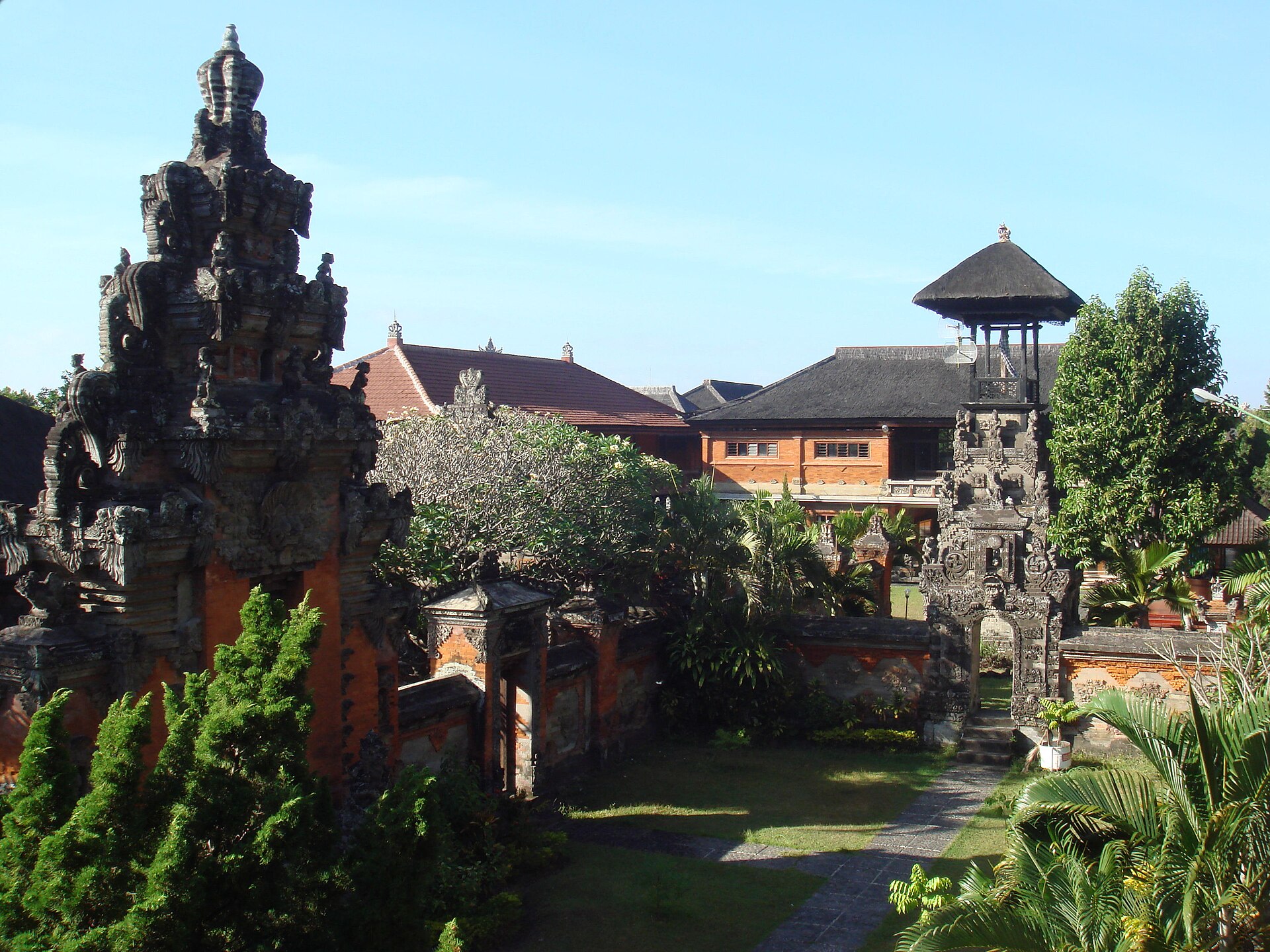
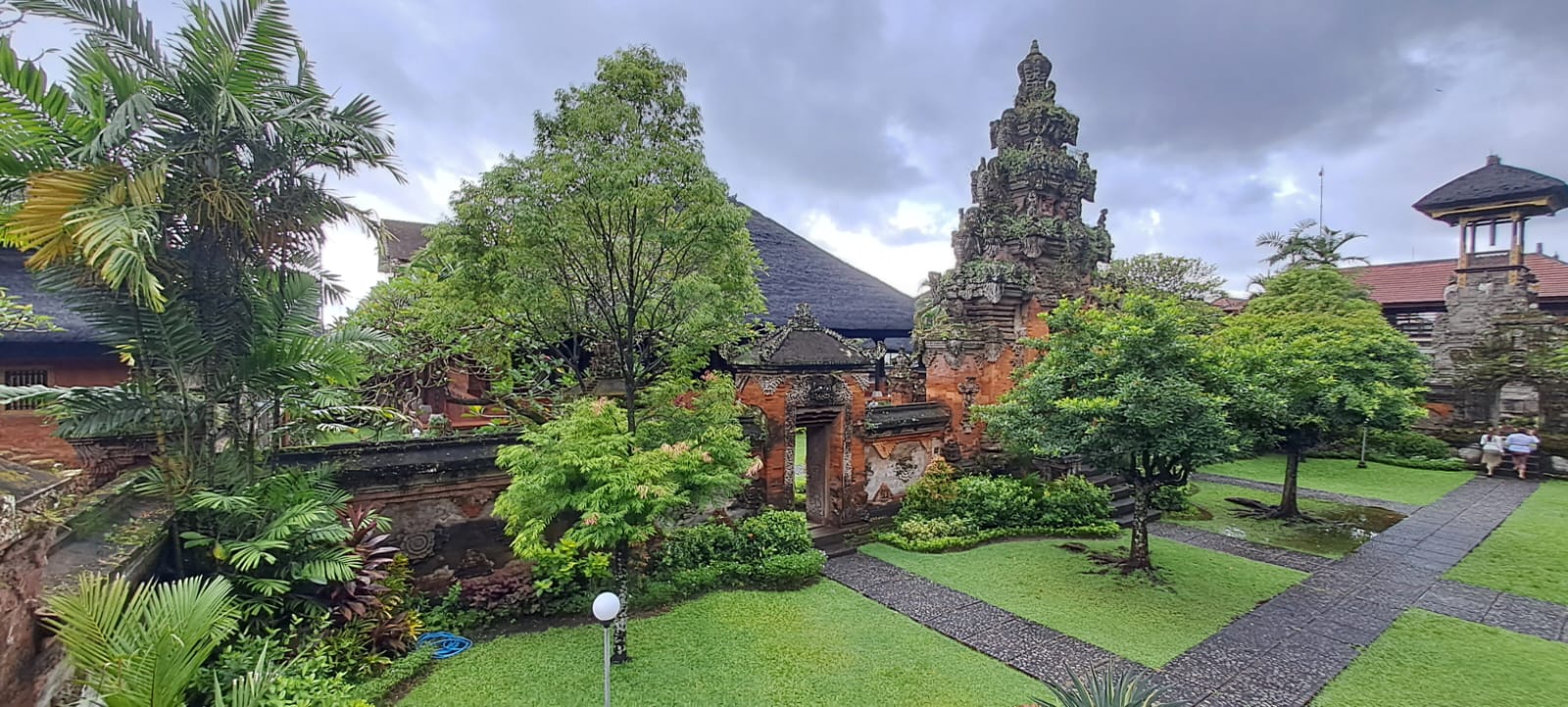
Architecturally, the museum deliberately borrows the layout of the palace it replaced. Its outer walls, courtyards and gateways are built in the style associated with a Balinese puri (a royal residence) as much as a pura (a temple), and the complex is organised, in the manner of both palace and temple compounds, into three successive walled courtyards: an outer courtyard (jaba), a middle courtyard (jaba tengah) and an inner sanctum (jeroan), each separated from the next by a wall and a gate. The gates themselves are built in the two classic Balinese forms - the split candi bentar gate, and the roofed candi kurung (or paduraksa) gate - and are, by visitor account and by the number of Commons photographs made of them, among the most photographed features of the site, independent of what is on display inside. The layout follows the compositional principles set out in the Lontar Asta Kosala Kosali, the traditional Balinese textual system governing the proportions and siting of buildings. A tall kulkul tower - a wooden watchtower housing a hollow-log signal drum traditionally struck to summon a village or announce an event - stands by the main gate near Gedung Badung, the same kind of structure that would have stood beside any Balinese puri or village meeting hall, and its presence at the museum's entrance is itself part of the building's argument that it continues, rather than merely displays, a Balinese architectural tradition.
From a colonial foundation to a state institution
The museum's governance has changed hands twice since 1932. It passed to Indonesian state management after independence, becoming, by one secondary account, a unit of the national Department of Education and Culture from 1965. Since 2000 it has operated as a UPTD (Unit Pelaksana Teknis Daerah, a technical implementation unit) of Bali's provincial Dinas Kebudayaan (Department of Culture), the arrangement that holds today. Alongside this administrative history the physical museum has grown well beyond its 1910 footprint: the complex has expanded from roughly 2,600 square metres to about 6,000 square metres, with a library, an auditorium, a conservation laboratory and administrative offices added around the original courtyards and pavilions. A fourth exhibition building, referred to in some sources as Gedung Timur (the East Building) and covering the museum's prehistoric material across two floors, appears to be a later addition to the three pavilions that opened in 1932, though the sources consulted for this page do not agree on how the modern building names map onto that construction history (see Open questions).
Four pavilions, one courtyard system
What a visitor encounters today is four named pavilions set within the three-courtyard plan described above. The museum's own account places Gedung Tabanan to the north, holding dance costumes, masks for topeng performance, wayang kulit shadow puppets and keris used in the Calonarang dance-drama, together with a number of ancient statues. Gedung Buleleng stands at the centre of the complex, built in a style associated with temples of north Bali, and is described by the museum as holding Balinese clothing and traditional fans. Gedung Badung sits by the main entrance, next to a tall kulkul signal-drum tower, and holds prehistoric tools from the hunting-gathering, early agricultural and metal-working periods on its ground floor, with Balinese fine art on the floor above. Gedung Karangasem, the fourth pavilion, opened alongside Tabanan and Buleleng in 1932 but is described by the museum only in general terms, as holding a mixed run of prehistoric, historical and ethnographic material including fine art. Independent tourism sources describe rather different contents for some of these same buildings - a coin collection in place of clothing, a keris collection in place of masks, a pavilion built around the Cili fertility motif - and this page has not been able to reconcile the two accounts; both are recorded rather than one being silently discarded.
A museum founded against the tide it was part of
There is a genuine tension built into the museum's founding story that is worth stating plainly rather than smoothing over. It was proposed by a Dutch colonial official, four years after Dutch forces had destroyed the palace that once stood on the same ground, explicitly to counter a drain of Balinese material culture that the same colonial-era contact with European collectors and tourists had itself created. That tension does not appear to be addressed on the museum's own site, which presents the 1910-1932 founding largely as an act of preservation. The museum today functions as Bali's oldest general museum and, on the evidence of the objects catalogued here, still holds working ritual and performance objects - keris, masks, shadow puppets - rather than a purely archival collection, alongside prehistoric material that predates any of the colonial-era history above. Even the textiles the museum keeps carry a version of the same argument: geringsing, the double-ikat weave held in the collection, is slow and labour-intensive enough that it was already a marker of status and ritual importance well before Dutch administration reached Bali, and its presence in a museum founded to stop such objects leaving the island gives the collection a coherence that the building's colonial paperwork, on its own, does not supply.
What visitors say
Visitors consistently value the museum as an inexpensive, unhurried introduction to Balinese history and material culture, and single out the walled courtyards and gates as worth the visit on their own. The same visitors just as consistently describe a tired physical plant - display cases in poor repair, dusty or water-damaged cabinets, thin object labelling with little contextual explanation - and a recurring, specific complaint about unofficial 'guides' who approach visitors after they have already paid admission, offer an impromptu tour, and then press a separate, escalating fee, sometimes followed by aggressive upselling of souvenir calendars or drawings
What is praised, what is criticised
- Praised: The three walled courtyards and carved gates (candi bentar, candi kurung) are atmospheric and photogenic in their own right, independent of the collection
- Praised: A guided visit - where the guide is a known quantity rather than an opportunistic one - is repeatedly called the best way to get value from the collection, since object labelling alone is thin
- Praised: Admission is very cheap by international museum standards, which several reviewers weigh against the museum's shortcomings as still worth the visit
- Criticised: Physical upkeep: multiple 2025 reviews describe moldy, water-damaged or dusty display cases and poor building maintenance in parts of the complex
- Criticised: Weak object interpretation: labels identify objects with little context, leaving several visitors to research on their own phones mid-visit
- Criticised: Unofficial guides and vendors at the entrance who impose themselves on visitors after payment and then demand additional, escalating fees for tours or souvenirs - a complaint repeated across reviews from multiple years and one the museum's own site does not address
- Criticised: Facilities: specific complaints about toilets (no toilet paper, poor condition) and no fans or airflow in warm weather
Ratings on other platforms
Tripadvisor: 3.3 from 189 ratings, read 12 September 2026
A platform average is a tertiary source: it moves, it is not audited, and we quote no visitor's words.
Questions about Bali Museum
Where is Bali Museum?
Jalan Mayor Wisnu No. 1, Dangin Puri, Denpasar Timur, Denpasar, Bali, Indonesia.
How much does it cost to visit?
Foreign adult visitor: IDR 100000; Domestic adult visitor: IDR 30000; Child / student: IDR 5000. As confirmed 12 September 2026.
When is it open?
Mon-Sun 08:00-15:30. Closed: Nyepi (Balinese Day of Silence). National public holidays. As confirmed 12 September 2026.
How do you get there?
Car/taxi: Approximately 13 km, about 45 minutes from Ngurah Rai International Airport; On foot: East side of Puputan Badung square (Taman Puputan), beside the Catur Muka statue and facing Pura Jagatnatha.
What should you see first?
Ceremonial keris for the Calonarang dance-drama (Balinese smiths, various dates); Wayang kulit and topeng mask collection (Balinese carvers, various dates); Prehistoric stone sarcophagus (peti kubur batu) (Unknown, prehistoric Bali); Geringsing and songket textiles (Weavers of Tenganan and elsewhere in Bali); Bronze Age nekara (bronze ceremonial drums) (Unknown, Bronze-Iron Age Bali); Historic kepeng (pierced) coins (Majapahit, Banten, Palembang and Chinese mints).
What we could not confirm
- Sources disagree substantially on which named pavilion (Tabanan, Buleleng, Badung/Timur, Karangasem) holds which category of object. The museum's own site (disbud.baliprov.go.id) gives one mapping (Tabanan: masks/wayang/keris; Buleleng: clothing/fans; Badung: prehistoric tools + upper-floor fine art; Karangasem: general); at least one independent tourism source gives a different mapping entirely (Timur: sarcophagus/stupika; Buleleng: coins; Karangasem: Cili motif; Tabanan: chronological keris). This page follows the museum's own mapping and records the conflicting secondary account rather than silently picking one.
- The relationship between 'Gedung Badung' (named in the museum's own account) and 'Gedung Timur' (the East Building, named in several independent sources) is unclear - they may be the same building under two names, or two different buildings, and this was not resolved from the sources checked.
- Exact current admission prices could not be pinned to a single figure: sources dated 2024-2026 give foreign-adult admission variously as Rp 50,000, Rp 100,000, domestic-adult as Rp 10,000, Rp 25,000 and Rp 30,000. The museum does not appear to publish its own price list online; figures here are the most recently and directly quoted (Detik.com, December 2025) with the range noted.
- The 8th-century CE dating given for the museum's stupika (miniature clay stupas) by one secondary source was not independently corroborated against an archaeological or museum-specialist publication.
- No source consulted addresses whether any objects in the ethnographic or fine-art collections carry unresolved acquisition or export-history questions from the colonial period during which the museum was founded, despite the founding narrative explicitly citing the export of Balinese cultural material to foreign collectors as the museum's reason for being.
Images
Sources
- 1UPTD. Museum Bali, Dinas Kebudayaan Provinsi Bali (official museum page) disbud.baliprov.go.id/museum-bali/
- 2Bali Museum, English Wikipedia en.wikipedia.org/wiki/Bali_Museum
- 3Museum Bali, Indonesian Wikipedia id.wikipedia.org/wiki/Museum_Bali
- 4Bali Museum, Wikidata Q1992789 wikidata.org/wiki/Q1992789
- 5Museum Bali, destinasi wisata edukatif di Denpasar dan program bioskop keliling, Detik.com, 14 December 2025 detik.com/bali/wisata/d-8259337/museum-bali-destinasi-wisata-edukatif-di-denpasar-dan-program-bioskop-keliling
- 6Category:Bali Museum, Wikimedia Commons commons.wikimedia.org/wiki/Category:Bali_Museum
- 7File:Bali Museum.jpg, Wikimedia Commons commons.wikimedia.org/wiki/File:Bali_Museum.jpg
- 8File:Bali Museum inside courtyards and gates.jpg, Wikimedia Commons commons.wikimedia.org/wiki/File:Bali_Museum_inside_courtyards_and_gates.jpg
- 9Bali Provincial State Museum (Negeri Propinsi Bali), visitor reviews, Tripadvisor, read 12 September 2026 tripadvisor.com/Attraction_Review-g297694-d531631-Reviews-Bali_Provincial_State_Museum_Negeri_Propinsi_Bali-Denpasar_Bali.html
- 10Museum Bali, Orami magazine orami.co.id/magazine/museum-bali
- 11Museum Bali, Rekaman Jejak Sejarah Perkembangan Budaya Pulau Dewata, Indonesia Kaya indonesiakaya.com/jelajah-indonesia/detail/museum-bali-rekaman-jejak-sejarah-perkembangan-budaya-pulau-dewata
- 12Setiawan, I Ketut and Megasuari, I.A., "Konservasi nekara perunggu koleksi Museum Bali", Jurnal Konservasi Benda Cagar Budaya Borobudur, 2012 (mirrored via CORE; the Kementerian Pendidikan dan Kebudayaan institutional-repository domain named on the item page, repositori.kemendikdasmen.go.id, refused connections on 2026-09-12 after retry over http and https, the in-app browser, and WebFetch - the ministry repository appears to have moved or gone offline after Indonesia's 2024 ministry split; CORE mirrors the same PDF). core.ac.uk/reader/227149158
- 134 Ruangan Koleksi Museum Bali Beserta Penjelasannya, Sejarah Lengkap sejarahlengkap.com/bangunan/koleksi-museum-bali/
- 14File:Museum Bali 1.jpg, Wikimedia Commons commons.wikimedia.org/wiki/File:Museum_Bali_1.jpg
- 15File:COLLECTIE TROPENMUSEUM Maskers in het Bali Museum TMnr 10029777.jpg, Wikimedia Commons commons.wikimedia.org/wiki/File:COLLECTIE_TROPENMUSEUM_Maskers_in_het_Bali_Museum_TMnr_10029777.jpg


