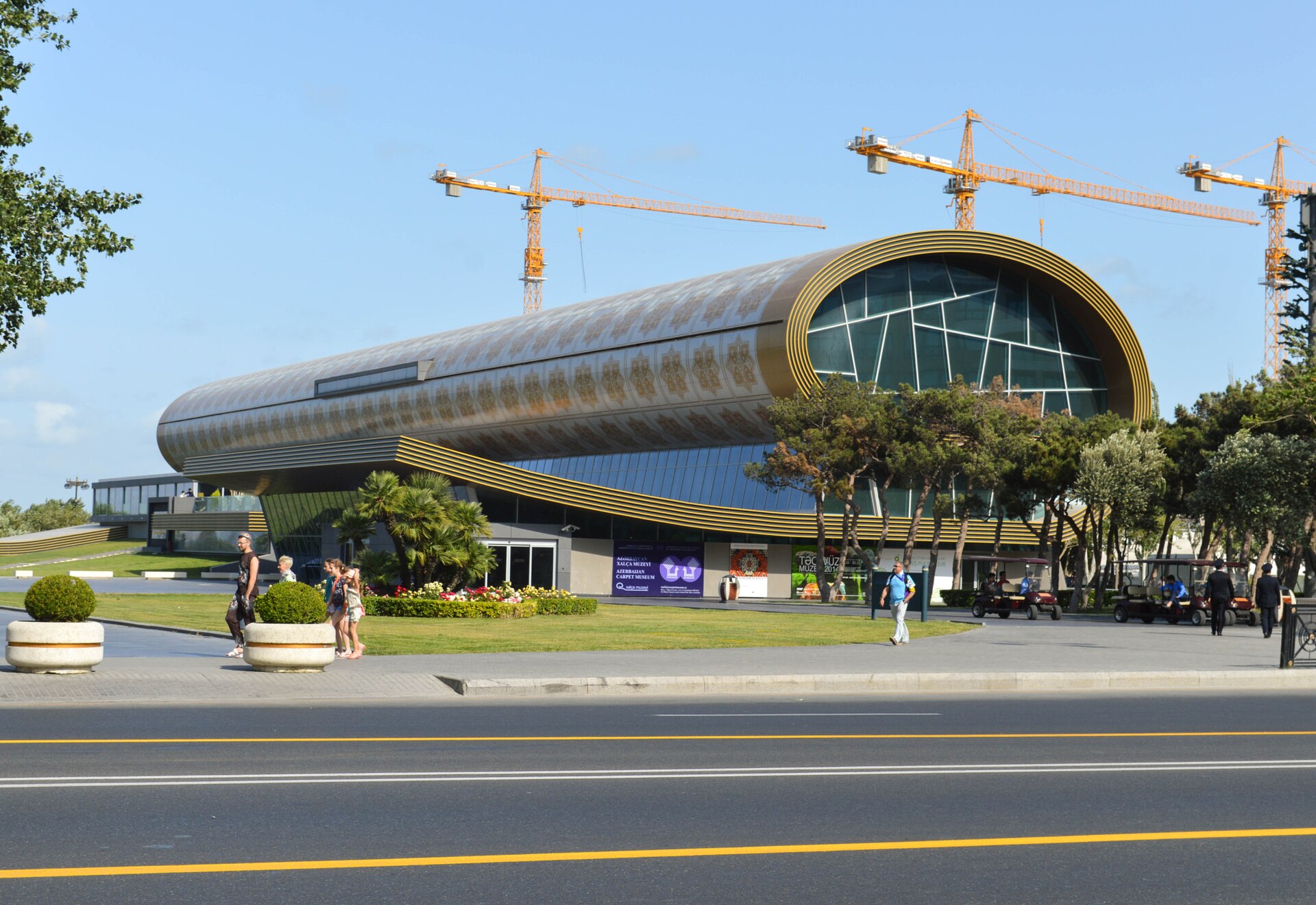
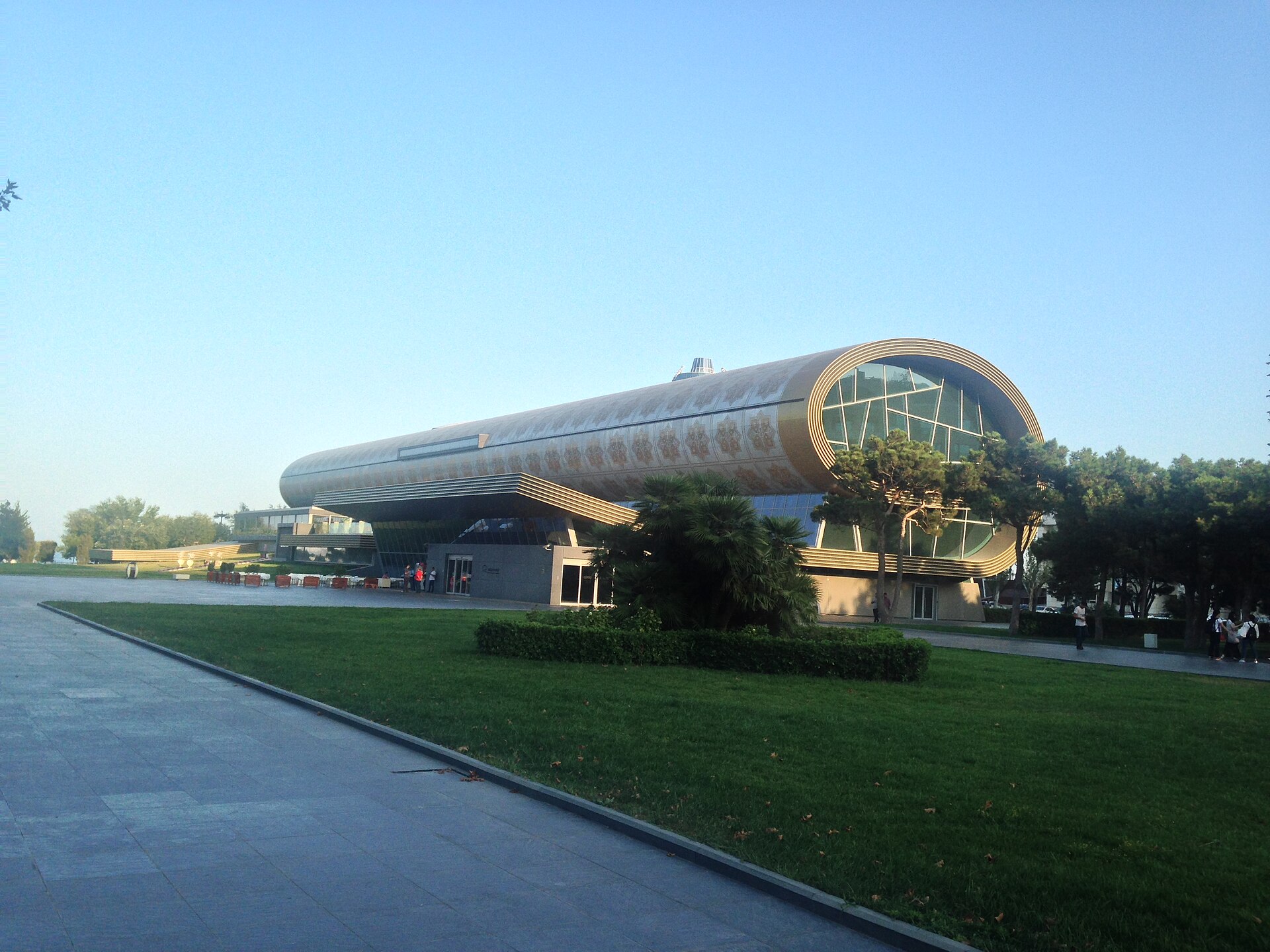
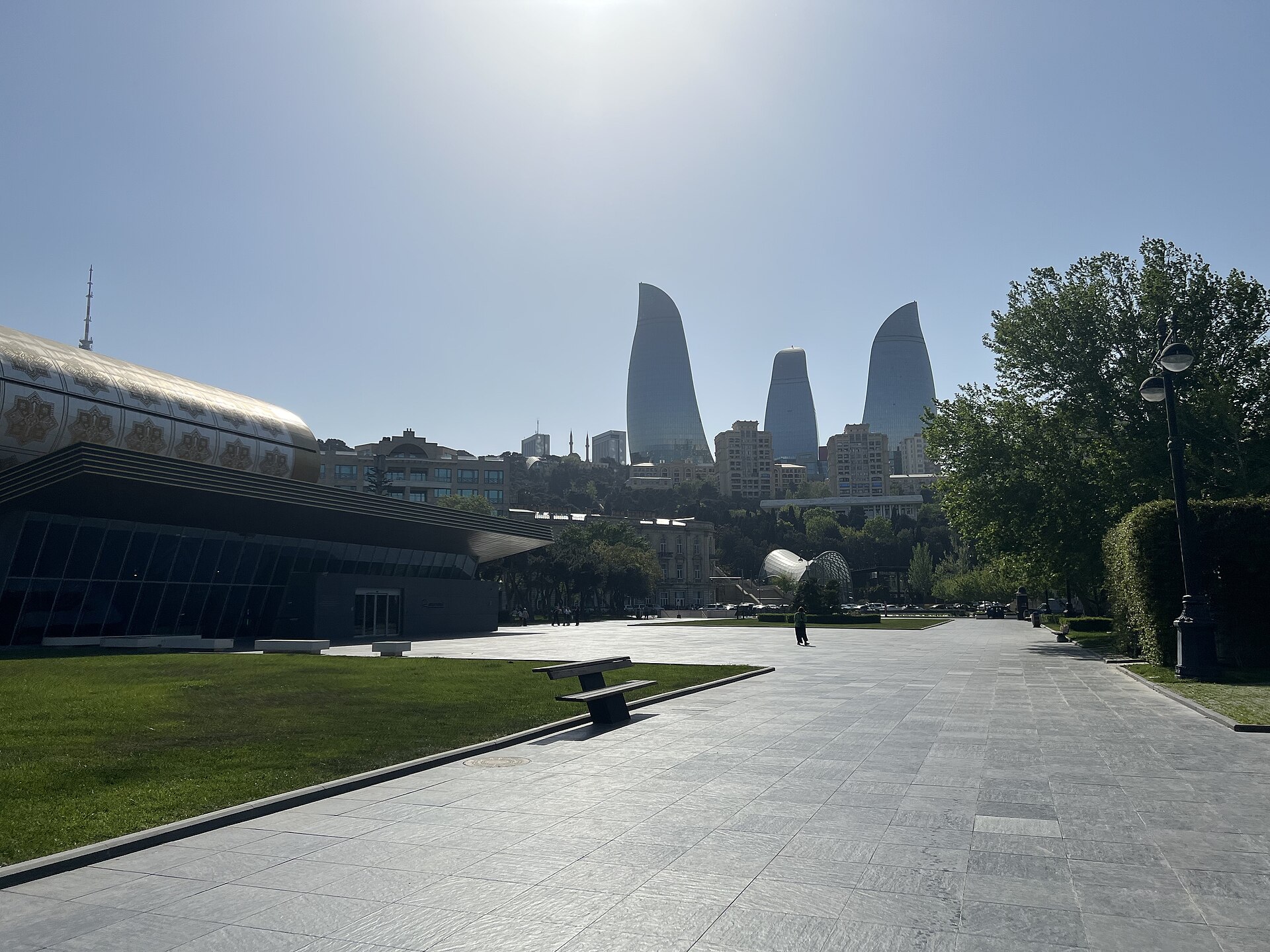
The museum's rolled-carpet building on the Baku seafront, with its own signage visible at the entrance
Photo: Francisco Anzola, CC BY 3.0Azerbaijan National Carpet Museum
Museum · Azerbaycan Milli Xalca Muzeyi · Founded 1967
Open, admission and hours confirmed 26 August 2026 · 10 sources
On this page 16 sections
ContentsClose
The museum holds the largest collection of Azerbaijani carpets in the world, more than 10,000 objects across seven collections, with its greatest depth in 17th to 20th-century pile and flat-woven carpets from the Guba-Shirvan, Ganja-Gazakh, Karabakh and Tabriz weaving traditions. Its secondary strengths are in jewelry and metalwork, including Bronze Age and 14th-century pieces, and in a small but growing group of pieces documenting Soviet-era and contemporary Azerbaijani carpet design.
| Local name | Azerbaycan Milli Xalca Muzeyi |
|---|---|
| Kind | Museum |
| Founded | 1967 |
| City and country |  Baku, Azerbaijan Baku, Azerbaijan |
| Address | Mikayil Huseynov Avenue 28, Baku, Azerbaijan |
| Website | azcarpetmuseum.az |
| Status | Open, confirmed |
| Record last verified |
Visiting
- Hours
- Tue-Fri10:00 to 19:00exhibition halls; the ticket office itself closes at 18:00
- Sat-Sun11:00 to 20:00exhibition halls; the ticket office itself closes at 19:00
- Closed
- Monday.
- Admission
- Adult, Azerbaijan residentAZN 7
- Adult, foreign visitorAZN 10
- Student or schoolchildAZN 3
- Group of 10+, residentAZN 5per person
- Group of 10+, foreignAZN 7per person
- Jewelry Collection supplementAZN 3separately ticketed section
- Tickets
- iticket.az/en/events/museum/azerbaijan-nation... The museum's own ticket page.
- Do I need to book?
- No advance booking needed for general admission; guided tours, audioguides and carpet-weaving masterclasses are booked through the museum's online ticketing partner
- Address
- Mikayil Huseynov Avenue 28, Baku, Azerbaijan MapMetro Icheri Sheher station, then a walk along the seafront park
Funicular Baku Funicular, upper station on the boulevard side - Website
- azcarpetmuseum.az
- Telephone
- +994 12 497 20 57
Before you go how long, access, photography, bags, eating, shop
- How long to allow
- One and a half to three hours; TripAdvisor's own listing estimates two to three hours, some visitors report covering it in under 90 minutes
- Access
- Since 2019 the museum has run an inclusion programme: descriptive labels in Braille, tactile carpet samples combining pile and flat weaving so visually impaired visitors can feel traditional ornament by hand, a virtual tour with sign-language interpretation for deaf visitors, wheelchair-height labels and touchscreens, and staff from the Traditional Technologies and Children's Museum departments running regular masterclasses for visitors with disabilities
- Shop
- A museum shop sells carpets, books on Azerbaijani carpet art and other crafts
Prices and hours change. We take them from the institution's own pages and print the day we read them, and you can check the current position at the source we used. Confirm before you travel.
What is inside
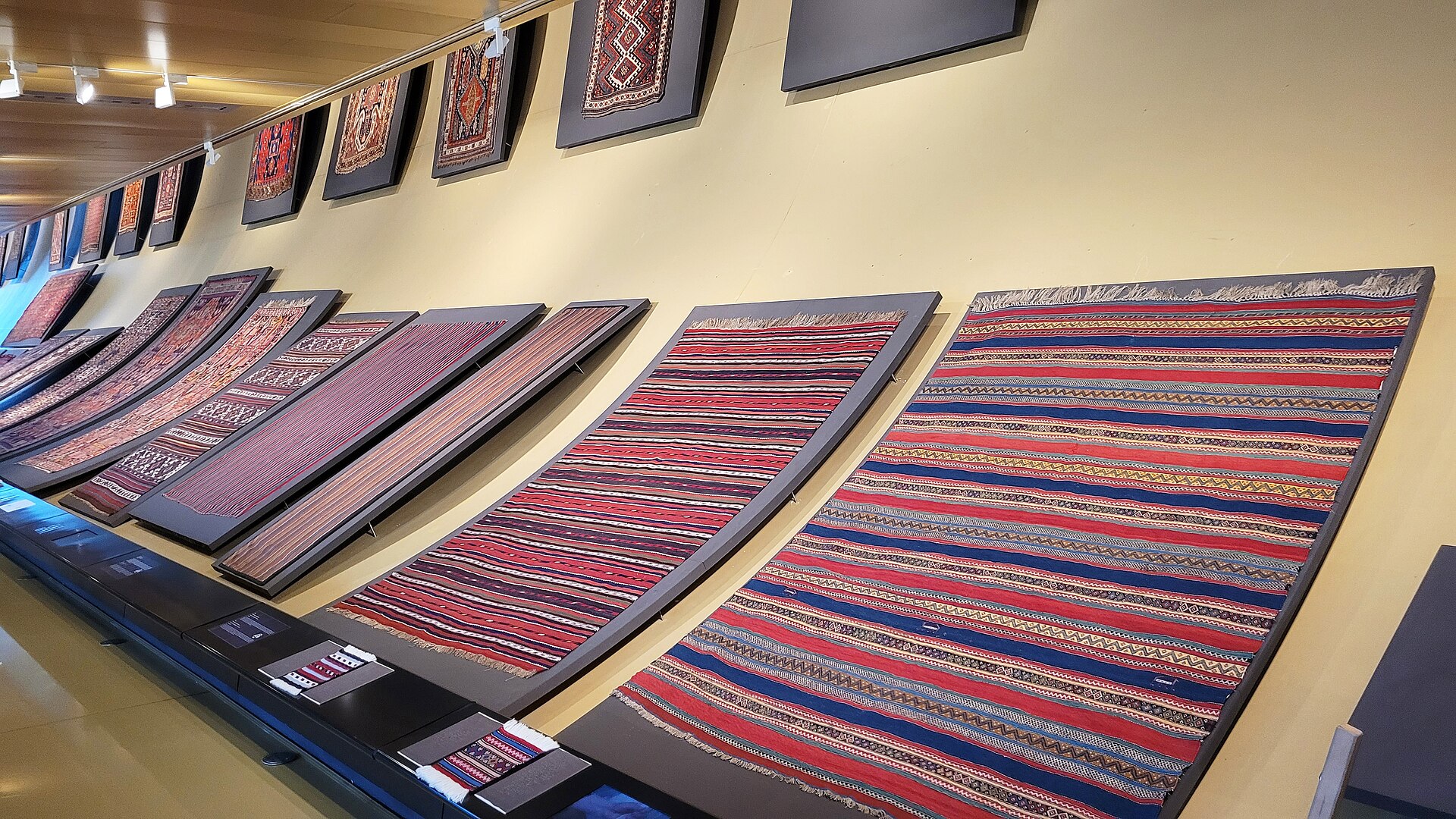
Photograph by Bgag · CC BY 4.0 Flat-woven carpets and the origins of weaving
The opening section of the permanent display, tracing flat-woven techniques (palas, jejim, kilim, varni, shadda, zili, sumakh) back to pastoralist origins and everyday use; the museum holds more than 600 flat-woven pieces from the 18th to 20th centuries
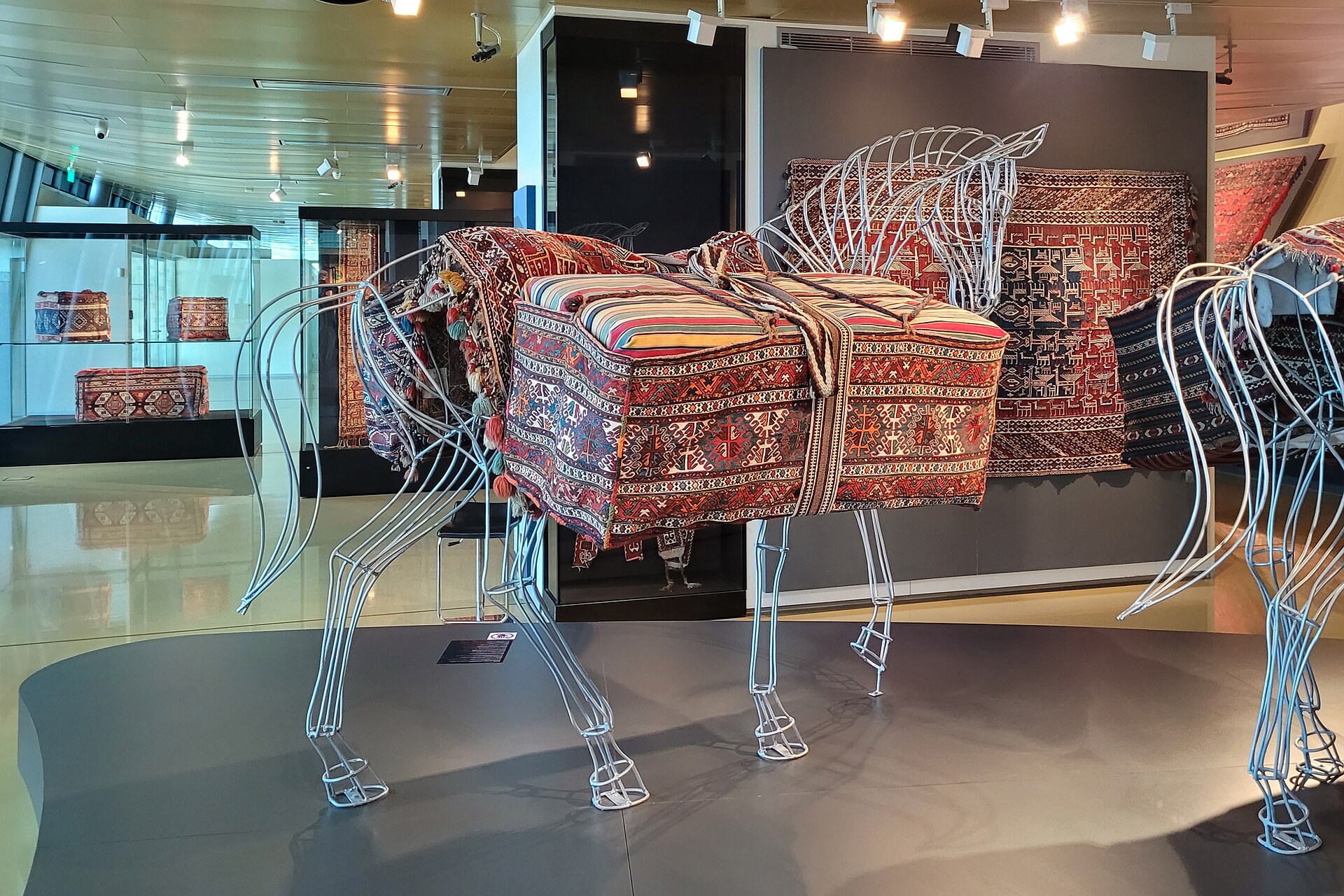
Photograph by Bgag · CC BY 4.0 Carpet in pastoral and everyday life
A display illustrating how carpets and carpet products were made and used outside the home, including woven saddlebags and trappings shown mounted on wireframe pack-animal figures alongside large-format pile carpets
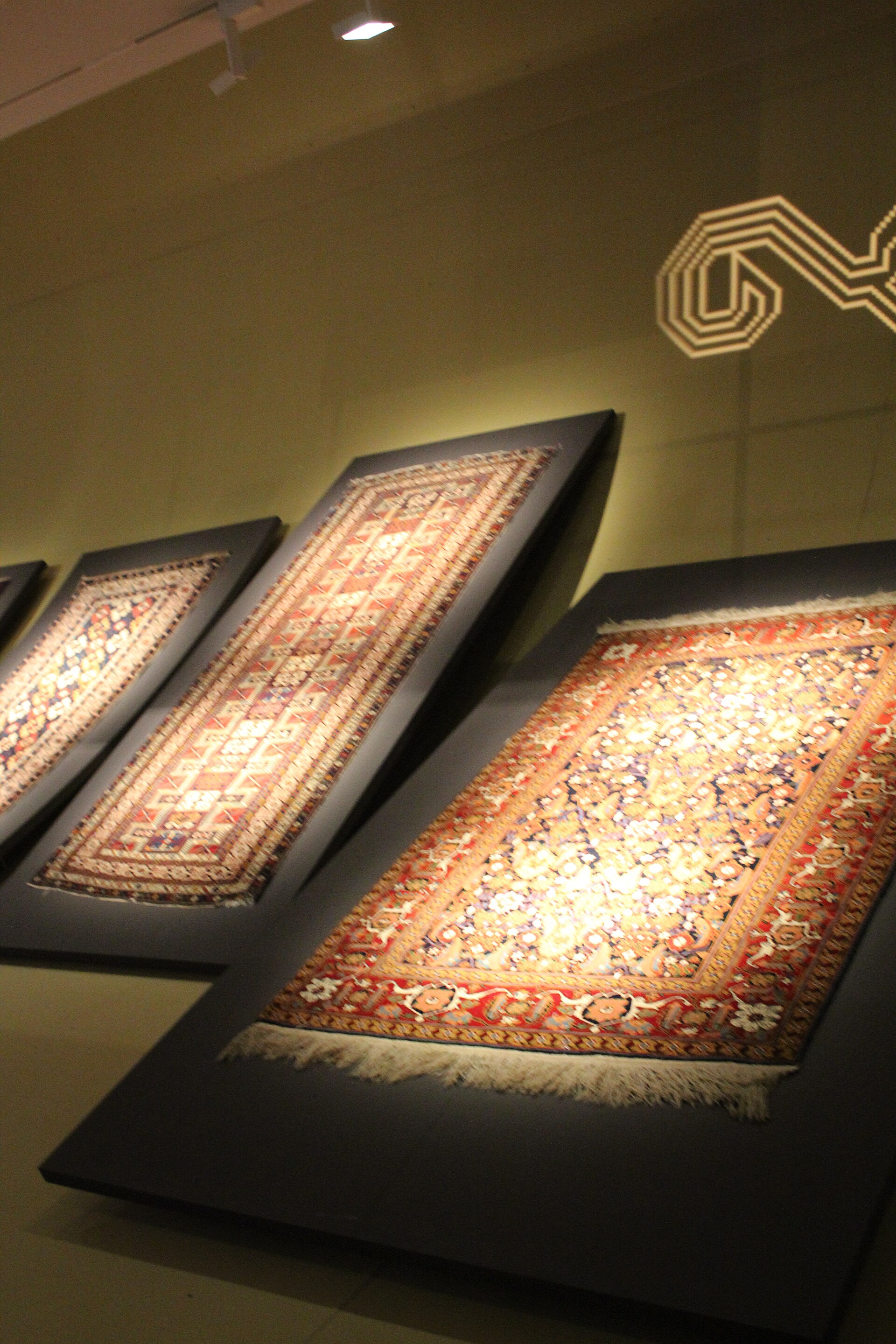
Photograph by Interfase · CC BY-SA 4.0 The regional weaving schools
The core of the collection: more than 2,300 pile carpets grouped by Latif Karimov's four regional divisions, Guba-Shirvan, Ganja-Gazakh, Karabakh and Tabriz, each with its own palette, medallion forms and motifs; this level also carries the woven piece that maps Karimov's classification across the wider region, described by scholars as the museum's most territorially charged single exhibit
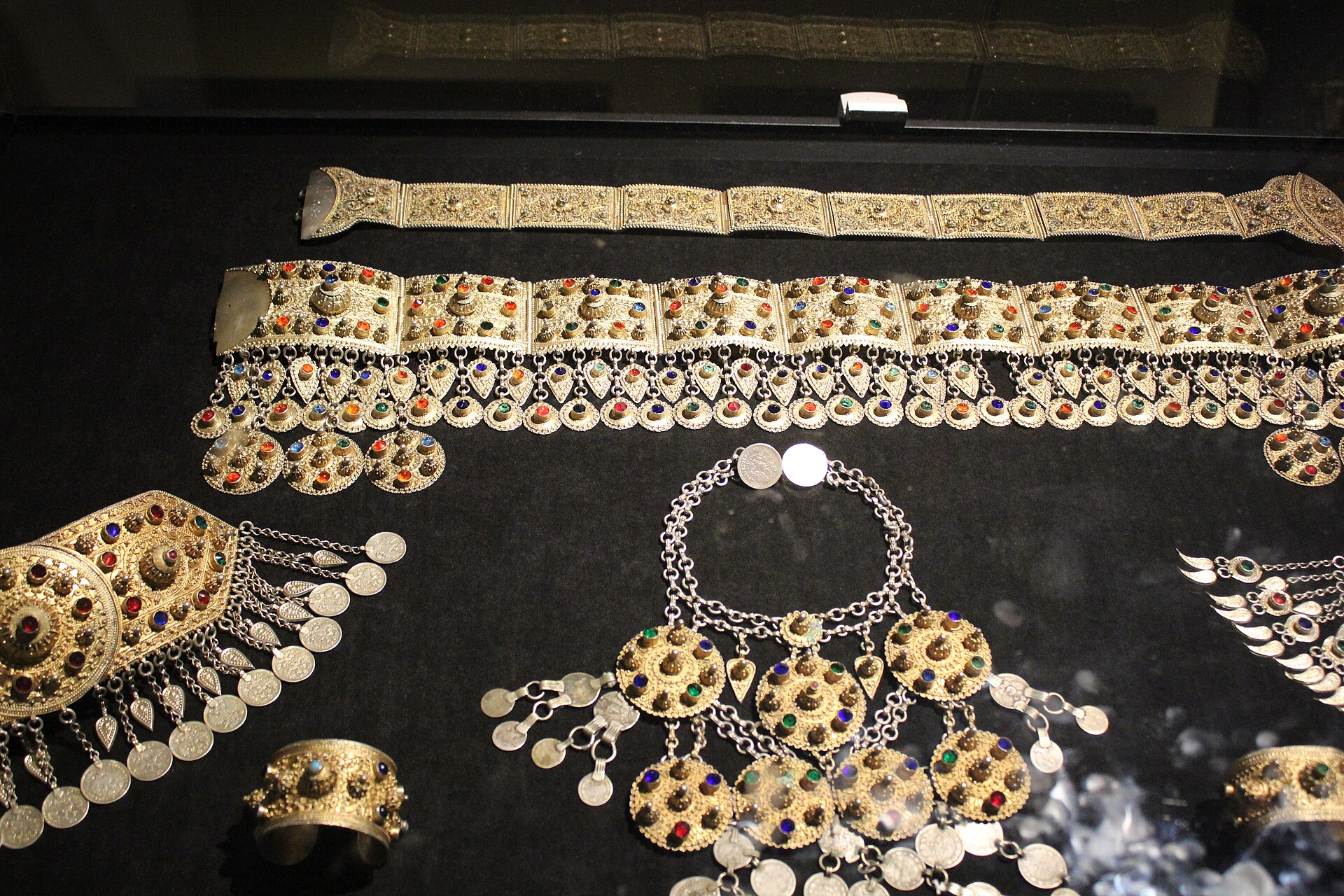
Photograph by Interfase · CC BY-SA 4.0 Jewelry and metalwork collection
Silver and gilt jewelry, belts, headdresses and vessels, including pieces dating to the Bronze Age and 14th-century metalwork acquired through the Academy of Sciences and, from 2019, two Qajar-period women's jewelry pieces bought at Sotheby's
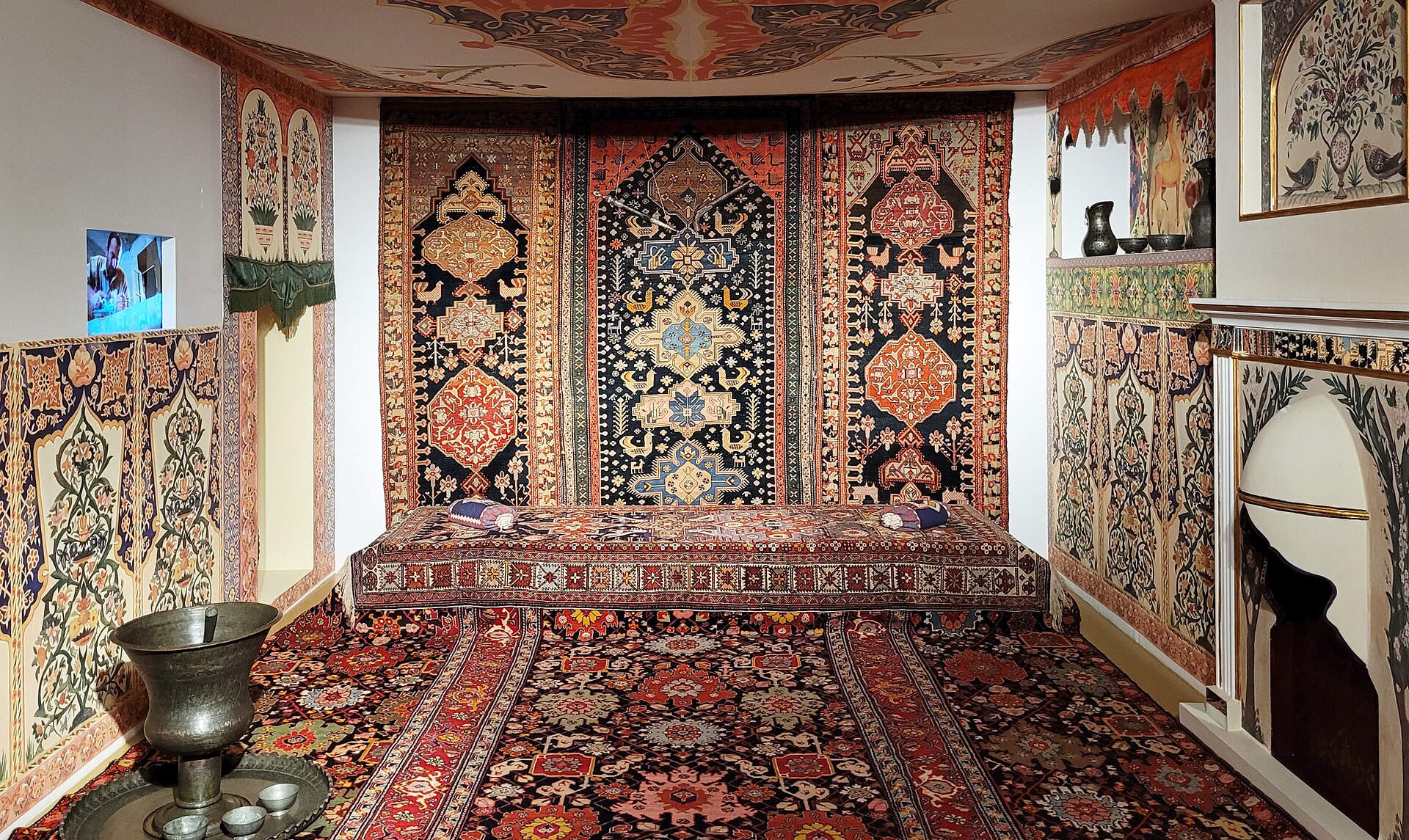
Photograph by Bgag · CC BY 4.0 A reconstructed traditional interior
A recreated period room lined floor, wall and ceiling in carpets and hangings, with brass vessels and painted panels, showing how carpets furnished domestic life rather than only how they were made
Karimov and the twentieth century
The top level, devoted to Latif Karimov and his students: submissions to national design competitions, Soviet-era commemorative carpets (including a portrait of Stalin and a design marking Soviet space technology), and archive photographs of Karimov teaching and travelling
Burned Culture: the Shusha rescue collection
A standing exhibition of carpets and objects from the Shusha Museum of History, part of roughly 600 pieces evacuated from Shusha before the city was captured by Armenian forces in February 1992; the Shusha branch itself, in a restored 19th-century mansion, reopened to visitors in May 2023 after Azerbaijan regained control of the city
What to see first
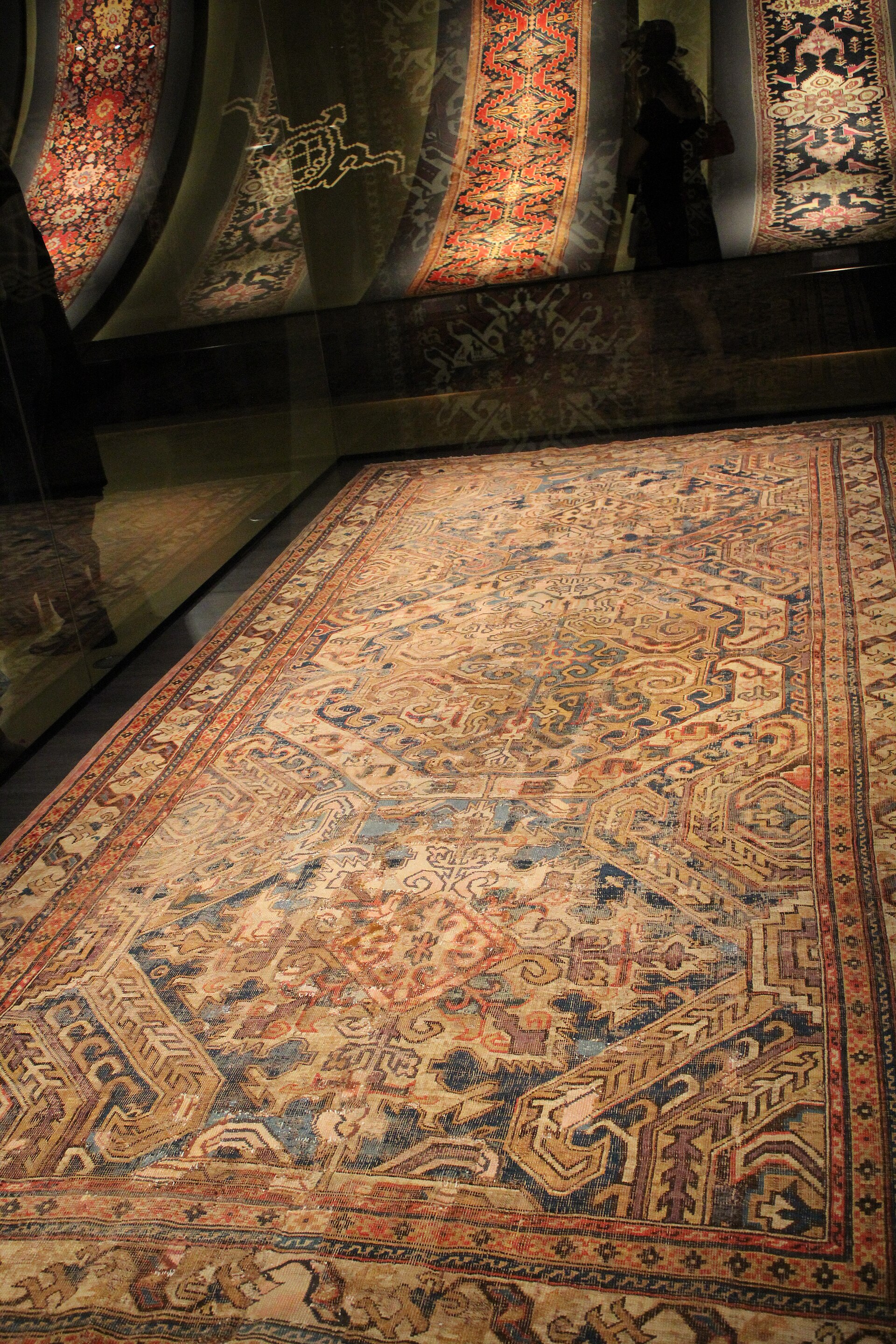
Ajdahali (Dragon carpet)
Karabakh weaving schoolA late 17th-century pile carpet in the angular dragon-medallion style typical of early Karabakh weaving; donated in 2013 by Beverly Schiltz, widow of the Chicago Oriental Rug and Textile Society member Grover Schiltz2
Khatai and Nakhchivan carpets
Unknown, 17th centuryDonated in 2018 by the Heydar Aliyev Foundation and described by the museum as among the most valuable pieces in its holdings2
Sor-sor carpet
Shirvan weaving schoolWoven in 1811 and donated in 2020 by the Italian collector Erminio Bottini, one of the collection's few precisely dated 19th-century Shirvan pieces2
Salyan Khilasi carpet
Shirvan weaving schoolA 19th-century carpet donated alongside the Ajdahali in the 2013 Schiltz gift2
Baghchada Gullar (Flowers in the Garden)
Karabakh weaving schoolBought at auction and donated in 2017 by Elshad Tahirov, a US citizen of Azerbaijani origin2
Hajigayib carpet
Guba weaving schoolA 19th-century carpet donated in 2018 by the Italian collector Mirco Cattai2
Garagoyunlu carpet
UnknownAdded to the collection in 2020; one of the more recent acquisitions to enter the permanent display2
The classification carpet
Woven for the museum after Latif Karimov's taxonomyA woven map of carpet motifs and regional groupings on the second level, singled out by Mozaffari and Barry (2022) as the exhibit that most directly presses Azerbaijani territorial claims, since it groups motifs shared with Iran and Armenia under the single heading of Azerbaijani carpet3
Carpet depicting Iranian Constitutional Revolution heroes
UnknownNames its subjects, many of them from Iranian Azerbaijan, without stating their national origin; cited by the same academic study as an example of how the museum's captioning steers visitors toward a nationalist reading3
A building shaped like its own subject
The Azerbaijan National Carpet Museum stands on the Baku seafront in a building designed to read, from the outside, as a single carpet caught in the act of being unrolled. The Austrian architect Franz Janz drew the structure as a long cylindrical form clad in a repeating gold medallion pattern, curling open at one end into a glazed drum that lights the entry hall. Construction took more than six years; the building opened on 26 August 2014 in the seafront park on Mikayil Huseynov Avenue, on a site that had previously held a structure of its own historical standing, cleared to make way for the new museum.
The design is not simply decorative. A museum whose entire subject is a textile chose to make its own envelope legible as that textile from across the boulevard, before a visitor has bought a ticket. It sits within a run of contemporary Baku landmarks built in the same decade, the Flame Towers and Zaha Hadid's Heydar Aliyev Centre among them, that together mark the city's turn toward architecture as a form of public diplomacy funded by oil income.
From a decommissioned mosque to a national landmark
The museum was established by decree of the Council of Ministers of the Azerbaijan SSR on 13 March 1967, as the Azerbaijan State Museum of Carpet and Folk Applied Arts. Its first exhibition opened in 1972 inside the Juma Mosque in Icheri Sheher, the Old City, a mosque built in the 15th century and renovated in the 19th, decommissioned for museum use under Soviet rule. The collection grew from carpets, jewellery and copper vessels bought from the population and gathered on research expeditions into the regions, work led by the scholar, collector and master weaver Latif Karimov, after whom the museum was later renamed.
After the collapse of the Soviet Union the collection moved in 1992 to the second floor of the former Lenin Museum, now the Baku Museum Center. Plans for a purpose-built home began in 2010, with an opening originally targeted for late 2012; President Ilham Aliyev inspected the construction site in September 2013 before the museum opened under the shorter name Azerbaijan Carpet Museum in August 2014. On 15 July 2019 the Cabinet of Ministers granted it National status for its work protecting and promoting carpet art, and it has carried the name Azerbaijan National Carpet Museum since.
Latif Karimov and the shape of the collection
Latif Karimov began building a systematic taxonomy of Azerbaijani carpets in 1949, publishing a three-volume catalogue between 1961 and 1983 that sorted 144 named types into four regional groups, Guba-Shirvan, Ganja-Gazakh, Karabakh and Tabriz. His research took him beyond Soviet Azerbaijan, including years spent in Iran, and his classification remains the framework the museum still exhibits by. The permanent display runs across three levels above the entry hall: the first traces the origins of weaving among pastoralist communities and the everyday uses of flat-woven carpets; the second groups the pile-carpet collection by Karimov's four regions and includes a large woven piece mapping his classification across the wider Caucasus and Iran; the third is dedicated to Karimov himself, his students, and carpet weaving in the Soviet and post-Soviet periods.
What is inside
The museum holds more than 10,000 objects across seven collections: pile and flat-woven carpets, carpet products, artistic metalwork, textiles, costume and embroidery, ceramics, glass, wood and paper, and jewelry. Most of the carpet holdings date from the 17th to 20th centuries, but the vault also keeps rarer material, ceramic and bronze finds and jewelry reaching back to the Bronze Age and the early Middle Ages, supplied over the years by the Azerbaijan National Academy of Sciences. The pile-carpet collection alone runs to more than 2,300 pieces; the flat-woven holdings, including palas, kilim, shadda, zili and sumakh weaves, number more than 600.
Named pieces on display include the late 17th-century Ajdahali, or Dragon, carpet from Karabakh; the Khatai and Nakhchivan carpets of the same century, which the museum considers among its most valuable holdings; and the 1811 Sor-sor carpet from the Shirvan group. A separate jewelry gallery, ticketed apart from the main collection, shows gilt and silver belts, headdresses and pendant ornaments alongside two Qajar-period pieces bought at Sotheby's in 2019, the museum's first purchase from that house.
Building the collection
Since independence, the collection has grown largely through donation rather than acquisition. The Heydar Aliyev Foundation and the Ministry of Culture of Azerbaijan have both given carpets directly, but a striking share of the notable pieces came from the Azerbaijani diaspora and from foreign collectors buying at Western auction houses and giving what they bought to Baku: Beverly Schiltz, widow of a member of the Chicago Oriental Rug and Textile Society, donated the Salyan Khilasi and Ajdahali carpets in 2013; Elshad Tahirov, a US citizen of Azerbaijani descent, bought the Baghchada Gullar carpet at auction and gave it to the museum in 2017, the same year the museum bought a late 17th or early 18th-century Shamakhi carpet from the Austria Auction Company, its first such purchase; the Italian collector Mirco Cattai gave the Hajigayib carpet from Guba in 2018; the US citizens Hillary-Dumas Jones and Jay Jones donated a 19th-century Gonagkend carpet in 2019; and the Italian collector Erminio Bottini gave the 1811 Sor-sor carpet in 2020. In 2024 three more donors, from Turkey, Italy and Germany, gave a further group of late 19th and early 20th-century kilims and carpets from the Shirvan, Gazakh and Karabakh groups.
The Shusha carpets and a museum built on a fault line
Not all of the collection's history is a story of gift and acquisition. The museum keeps a standing exhibition, Burned Culture, of carpets and objects that once belonged to the Shusha Museum of History, part of roughly 600 pieces evacuated from Shusha in February 1992 before the city was taken by Armenian forces during the First Karabakh War. Those objects were displayed in Baku for three decades while Shusha itself was outside Azerbaijani control.
The Shusha branch of the carpet museum, which had first opened in 1987 in a 19th-century mansion once owned by General Samad Bey Mehmandarov, reopened to visitors in May 2023, after restoration led by the Heydar Aliyev Foundation from 2021 following Azerbaijan's recapture of the city. It now shows around 115 objects. The Baku museum's own website, as checked for this record, still lists the Shusha branch under the Baku street address, an unresolved error in its own listings rather than a claim this record repeats.
A contested classification
The museum's arrangement is not a neutral inheritance from Karimov's scholarship alone. Writing in the International Journal of Heritage Studies in 2022, the researchers Ali Mozaffari and James Barry trace the regional groupings back to a specific moment of Soviet Azerbaijani cultural policy in the 1950s, when the Communist Party promoted Azerbaijani history and language partly in response to Armenian and Georgian language reforms, and partly because many of the party's own members had worked in Iranian Azerbaijan during the wartime Soviet occupation and believed it historically part of their nation. Their study argues that the museum's second-level exhibits, and in particular a woven piece mapping Karimov's classification across the region, group motifs shared with Iran and Armenia under the single banner of Azerbaijani carpet, and that a carpet naming heroes of the Iranian Constitutional Revolution is captioned without stating that many of those figures were from Iranian Azerbaijan. Their conclusion is that the museum functions, alongside its role as a collection and a tourist landmark, as an instrument of heritage diplomacy in Azerbaijan's territorial dispute with Armenia over Karabakh. The museum's own published materials do not address this reading.
Visiting today
Visitor numbers grew through the museum's first years in its new building: about 60,000 in 2016, over 85,000 in 2017, 110,000 in 2018 and a record 122,143 in 2019, making it Azerbaijan's most visited museum that year. The pandemic cut attendance to 14,398 in 2021 before it recovered to 70,608 in 2022. From 2019 the museum built an inclusion programme, Braille labelling, tactile carpet samples, sign-language video tours and wheelchair-height displays, that it has presented to the International Council of Museums and the Network of European Museum Organisations. It has received TripAdvisor's Certificate of Excellence in multiple years between 2017 and 2023, an ICOM CIDOC award for best experience in intangible-heritage documentation in 2018, and a nomination for the European Museum of the Year Award the same year.
The museum continues to host temporary exhibitions and events on top of its permanent collection: as of August 2026 it was showing a solo exhibition of the contemporary Azerbaijani artist Elchin Shamilli, a show titled Natural Intelligence, and Toxunmus xatiraler (Woven Memories), and it had just taken part in the 40th International Folk Art Festival in Budapest. The building has also hosted events with no direct connection to carpets, including the Battle of Champions chess tournament in April 2025, a sign of how far its role now extends beyond the collection it was built to hold.
What visitors say
Visitors consistently single out the building itself, the rolled-carpet silhouette on the Baku seafront is repeatedly called one of the city's most striking modern landmarks, and the range of the collection inside, from a fragile 17th-century pile carpet to Soviet-era commemorative weavings and contemporary carpet art. Live weaving demonstrations and, where booked, English-language guides are called out favourably. A recurring qualification is that the museum is compact enough to see well inside two to three hours, and a few visitors find the admission price and the shop's carpet prices high for what is a fairly short visit.
What is praised, what is criticised
- Praised: The rolled-carpet building on the Baku seafront, widely described as one of the city's most distinctive modern landmarks
- Praised: The range and condition of the carpets on display, from a 17th-century silk piece to Soviet-era and contemporary weavings
- Praised: Live carpet-weaving demonstrations by working weavers
- Praised: Guided tours in English and other languages, when booked in advance
- Criticised: Some visitors find the entrance fee and the museum shop's carpet prices steep set against a visit most complete in two to three hours
- Criticised: Writing in the International Journal of Heritage Studies (2022), Ali Mozaffari and James Barry argue that the museum's regional classification, inherited from Latif Karimov's Soviet-era taxonomy, is used to press implicit territorial claims over Iranian Azerbaijan and Karabakh, most visibly in a second-level woven piece that maps carpet motifs shared with Iran and Armenia under the single heading of Azerbaijani carpet, and in a carpet naming Iranian Constitutional Revolution heroes without stating their national origin
Ratings on other platforms
TripAdvisor: 4.4 from 1,123 ratings, read 26 August 2026
A platform average is a tertiary source: it moves, it is not audited, and we quote no visitor's words.
Questions about Azerbaijan National Carpet Museum
Where is Azerbaijan National Carpet Museum?
Mikayil Huseynov Avenue 28, Baku, Azerbaijan.
How much does it cost to visit?
Adult, Azerbaijan resident: AZN 7; Adult, foreign visitor: AZN 10; Student or schoolchild: AZN 3; Group of 10+, resident: AZN 5; Group of 10+, foreign: AZN 7. As confirmed 26 August 2026.
When is it open?
Tue-Fri 10:00-19:00; Sat-Sun 11:00-20:00. Closed: Monday. As confirmed 26 August 2026.
How do you get there?
Metro: Icheri Sheher station, then a walk along the seafront park; Funicular: Baku Funicular, upper station on the boulevard side.
What should you see first?
Ajdahali (Dragon carpet) (Karabakh weaving school); Khatai and Nakhchivan carpets (Unknown, 17th century); Sor-sor carpet (Shirvan weaving school); Salyan Khilasi carpet (Shirvan weaving school); Baghchada Gullar (Flowers in the Garden) (Karabakh weaving school); Hajigayib carpet (Guba weaving school).
What we could not confirm
- The museum's regional classification is characterised by peer-reviewed scholarship (Mozaffari and Barry, International Journal of Heritage Studies, 2022) as advancing Azerbaijani territorial claims over Iranian Azerbaijan and Karabakh; the museum's own published materials do not engage with that critique.
- The museum's own website, checked for this record on 26 August 2026, lists an identical Baku street address for both the Baku museum and its Shusha branch, and its ticket-purchase links did not resolve to a working page; this record does not repeat either as fact.
Images
Sources
- 1Azerbaijan National Carpet Museum, official website, home page and Plan your visit page azcarpetmuseum.az/
- 2Azerbaijan Carpet Museum, Wikipedia (fetched in full 2026-08-26) en.wikipedia.org/wiki/Azerbaijan_Carpet_Museum
- 3Ali Mozaffari and James Barry, Heritage and territorial disputes in the Armenia-Azerbaijan conflict: a comparative analysis of the carpet museums of Baku and Shusha, International Journal of Heritage Studies, 28(3), 2022, pp. 318-340 tandfonline.com/doi/full/10.1080/13527258.2021.1993965
- 4Azerbaijan National Carpet Museum ticket and pricing page, iTicket.AZ iticket.az/en/events/museum/azerbaijan-national-carpet-museum
- 5Azerbaijan Carpet Museum, Baku, Advantour advantour.com/azerbaijan/baku/carpet-museum.htm
- 6Azerbaijan Carpet Museum, Asian Art Newspaper asianartnewspaper.com/azerbaijan-carpet-museum/
- 7Azerbaijan National Carpet Museum, Azerbaijan Travel (official tourism board) azerbaijan.travel/visit-bakus-carpet-museum-cant-be-missed
- 8Azerbaijan National Carpet Museum, Baku - reviews and rating, TripAdvisor tripadvisor.com/Attraction_Review-g293934-d3641288-Reviews-Azerbaijan_National_Carpet_Museum-Baku_Absheron_Region.html
- 9Wikimedia Commons API, file and licence data for images used on this record commons.wikimedia.org/wiki/Category:Azerbaijan_National_Carpet_Museum
- 10Shusha branch of Azerbaijan National Carpet Museum reopened after 31 years, AzerNews azernews.az/nation/209710.html