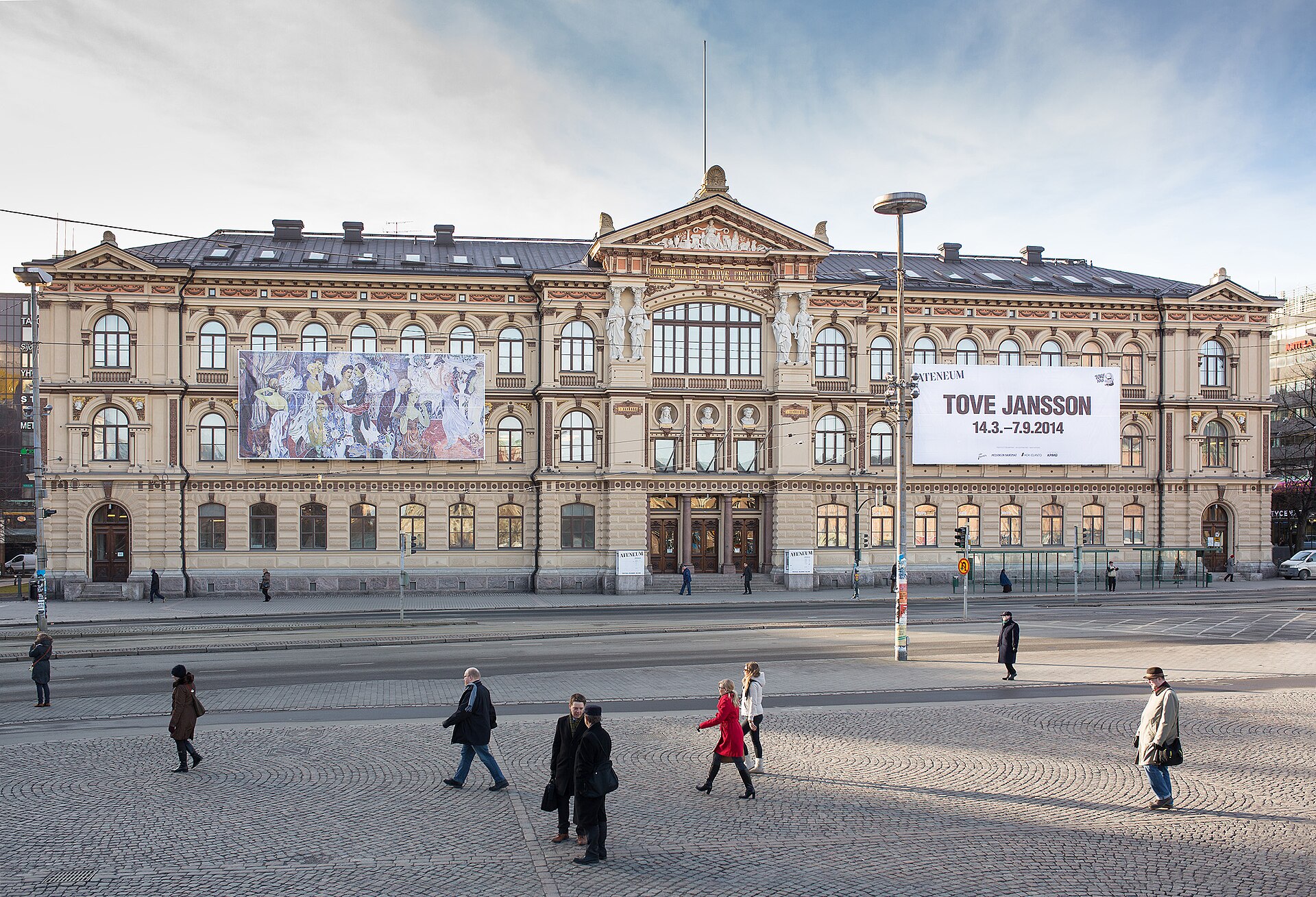
The Ateneum's 1887 facade on Kaivokatu, photographed in 2014 the day before a Tove Jansson exhibition opened; the building's Latin motto Concordia res parvae crescunt is visible on the pediment.
Finnish National Gallery / Yehia Eweis, CC BY-SA 4.0Ateneum
Museum · Ateneumin taidemuseo · Founded 1887
Open, admission and hours confirmed 22 August 2026 · 16 sources
On this page 17 sections
ContentsClose
The Ateneum's strength is depth in Finnish painting and sculpture from the 1750s through artists who began working in the 1950s - roughly 4,300 paintings and 750 sculptures at the core, inside a Finnish National Gallery holding of more than 40,000 works overall - combined with a small but genuinely significant seam of 19th and early 20th century international painting (van Gogh, Munch, Cezanne, Modigliani) bought at a point when Finnish taste in Helsinki was ahead of, rather than following, wider European market opinion on some of those names.
| Local name | Ateneumin taidemuseo |
|---|---|
| Kind | Museum |
| Founded | 1887 |
| City and country |  Helsinki, Finland Helsinki, Finland |
| Address | Kaivokatu 2, 00100 Helsinki, Finland |
| Website | ateneum.fi/en |
| Status | Open, confirmed |
| Record last verified |
Visiting
- Hours
- Monday11:00 to 17:00in July and August only; closed Mondays the rest of the year per hours_closed_days
- Tuesday10:00 to 18:00
- Wednesday-Thursday10:00 to 20:00
- Friday10:00 to 18:00
- Saturday-Sunday10:00 to 17:00
- Closed
- Monday, except in July and August when the museum opens 11:00-17:00.
- Admission
- Adult (online)EUR 21
- Adult (ticket office)EUR 23
- Discounted (18-24, students, pensioners, unemployed, conscripts)EUR 13
- Under 18Freefree
- Museum Card holdersFreefree entry; card itself costs EUR 86 new / EUR 79 renewal per year, sold separately
Free entry: 20 February 2026. 10 April 2026. 20 August 2026. 6 November 2026. 11 December 2026. Ateneum Late, 13 November 2026, students and under-25s only- Tickets
- ateneum.fi/en/opening-hours-and-tickets The museum's own ticket page.
- Do I need to book?
- No, but ticket sales end 30 minutes before closing and online tickets are recommended in the summer season
- Address
- Kaivokatu 2, 00100 Helsinki, Finland MapMetro Rautatientori station, beneath Helsinki Central Station, about 200 metres away
Train Helsinki Central Station is directly opposite the museum on Kaivokatu
Bicycle Racks in the parks on both sides of the building; no museum car park, nearest paid parking is P-WTC - Website
- ateneum.fi/en
- Telephone
- +358 294 500 401
- [email protected]
Before you go how long, access, photography, bags, eating, shop
- How long to allow
- One to two hours for the permanent collection; visitors report the layout is easy to lose a sense of direction in across its half-floors
- Access
- Accessible entrance on the Ateneuminkuja side with a lift to all floors; gender-neutral accessible toilet with a childcare space and quiet rest area on the first floor; assistive devices including a hearing induction loop, a magnifying glass and hidden-disabilities sunflower lanyards can be borrowed at the information desk; folding chairs are placed through the galleries; the museum names itself an autism-friendly destination with a dedicated contact person
- Photography
- Generally allowed without flash; some temporary exhibitions prohibit it entirely
- Bags
- Outdoor clothing, backpacks, large bags and umbrellas must go in the free cloakroom or lockers
- Eating
- Ateneum Bistro on the ground floor, open without a museum ticket; Cafe Hoijer on the third floor with table service; visitors may eat their own food in the atrium
- Shop
- Museum shop on the ground floor
Prices and hours change. We take them from the institution's own pages and print the day we read them, and you can check the current position at the source we used. Confirm before you travel.
What is inside
The Age of Nature (second floor)
One of the three thematic sections of the permanent collection display A Question of Time, unveiled at the 2023 reopening. Looks at how Finnish landscape and nature painting recorded a changing relationship with the natural world, from 19th-century wilderness views to later environmental anxiety.
Images of a People (second floor)
The section of the permanent collection built around how Finnish art constructed a national identity in the run-up to and after independence in 1917 - portraiture, folk subjects and Kalevala-derived mythological painting, including Akseli Gallen-Kallela's Aino myth cycle.
Modern Life (second floor)
The third section of the permanent collection, tracing artistic responses to urbanisation, industry and technological change through the 20th century up to works by artists who began their careers in the 1950s.
Temporary exhibition halls (third floor)
The museum's changing-exhibition programme - major loan shows and monographic exhibitions run here on rotation, separate from the permanent collection below.
Ground floor - atrium, shop and Ateneum Bistro
The entrance level: ticketing and information desk, the museum shop, the Ateneum Bistro cafe-restaurant (open to non-ticket-holders), and the glazed atrium (the museum's light court) where visitors may eat their own food.
What to see first
Street in Auvers-sur-Oise
Vincent van Gogh, 1890Bought by the Finnish Art Society in 1903, this was the first painting by van Gogh to enter any museum's permanent collection anywhere - a purchase made a decade before van Gogh's reputation in most of Europe caught up with the price the Ateneum had already paid.6
The Wounded Angel (Haavoittunut enkeli)
Hugo Simberg, 1903Two boys carry a blindfolded, bleeding angel on a stretcher across a bleak shoreline. Simberg never explained the image and refused to fix its meaning. Voted Finland's national painting in a public poll in 2006, it is the single work most visitors ask for by name.7
Under the Yoke (Burning the Brushwood) - Raatajat rahanalaiset
Eero Jarnefelt, 1893A field of Karelian farm labourers stooped in smoke and ash, painted in the same decade as Jarnefelt's Realist canvases of physical labour. Read on its own terms it is a landscape of exhausted people; read against Kalevala-era myth-painting elsewhere in the same rooms, it is the deliberately unheroic counterweight.6
Aino myth triptych
Akseli Gallen-Kallela, 1891Gallen-Kallela's first major treatment of the Kalevala's Aino story, painted the year before his Paris-trained Naturalism turned toward the flat, symbolic style that would define Finnish National Romanticism. A cornerstone of the Images of a People section.6
The Convalescent (Toipilas)
Helene Schjerfbeck, 1888A child recovering from illness holds a sprig of greenery toward the light; painted while Schjerfbeck was working in France under the influence of Jules Bastien-Lepage. It is the picture most often used to introduce Schjerfbeck's early, French-inflected naturalism before her later, radically pared-back style.6
Bathing Men (Badende menn)
Edvard Munch, 1907-1908One of the museum's rare Nordic works from outside Finland, bought while Munch was still a controversial rather than canonical figure. It sits in the collection as evidence of how early and how directly the Ateneum's buyers looked past national boundaries when they judged a picture worth having.6
The Road Bridge at L'Estaque
Paul Cezanne, c. 1879-1882One of a handful of Cezannes in Finland and the clearest single marker, alongside the van Gogh, of how far the 19th-century Finnish Art Society's buying reached beyond a purely national brief.6
Women Outside the Church at Ruokolahti
Albert Edelfelt, 1887Edelfelt's large genre scene of Karelian churchgoers, painted the year the Ateneum building itself opened; one of the works that established the Finnish Art Society's taste for large-scale realist genre painting alongside its portrait commissions.6
Exhibitions on now
- Opening soon23 Oct 2026 to 28 Feb 2027Confirmed , 7 weeks ago
Past exhibitions here
The building and what it was built to hold
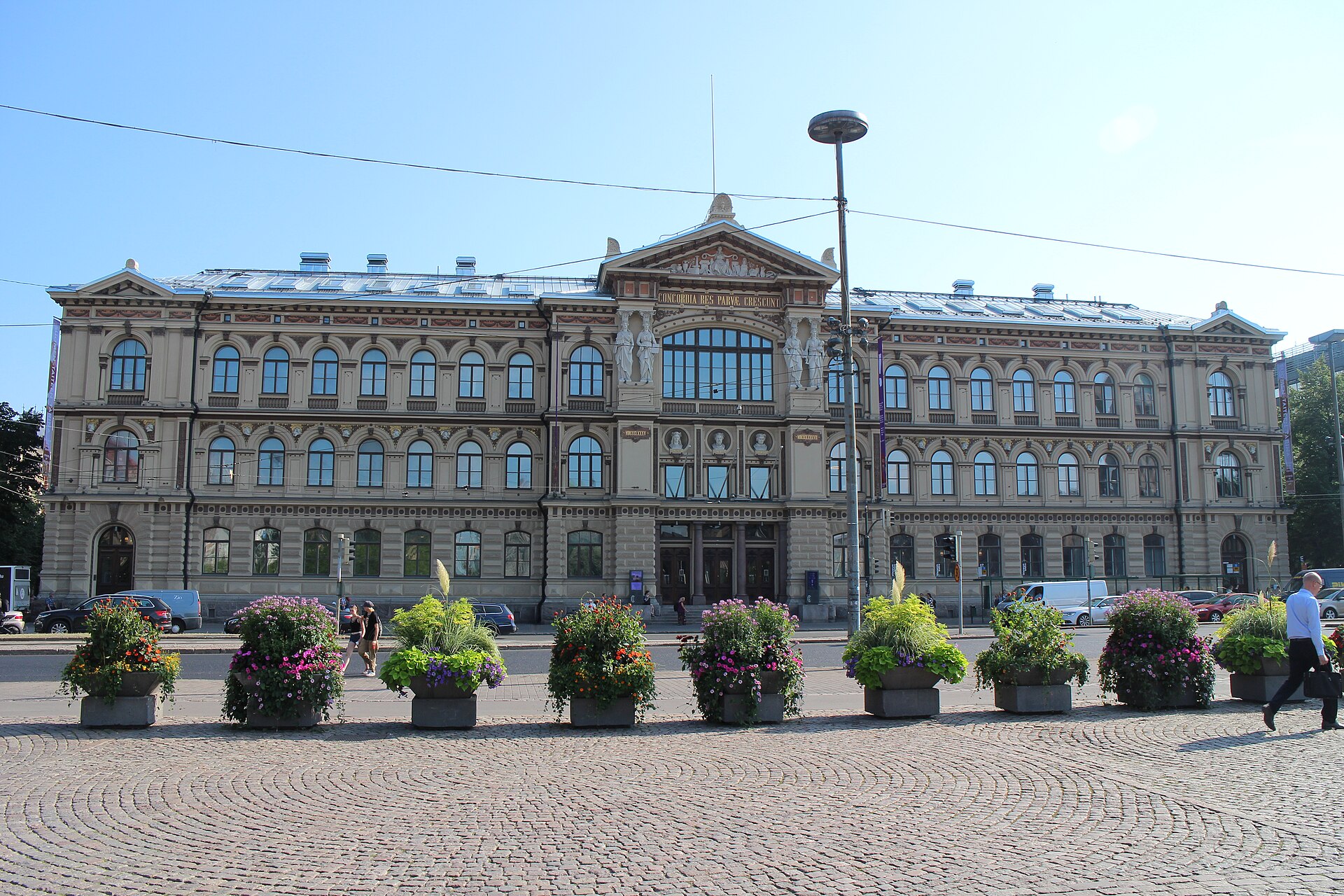
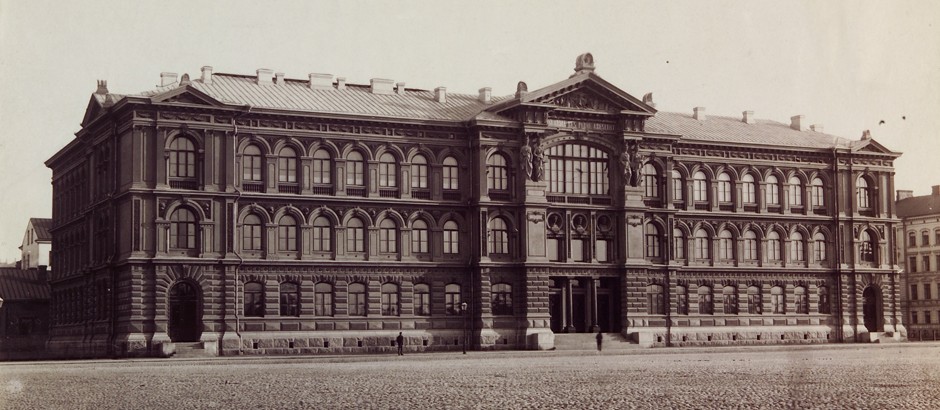
The Ateneum occupies a neo-Renaissance palace on Kaivokatu, directly opposite Helsinki Central Station, designed by the architect Theodor Hoijer and completed in 1887. The facade carries its own manifesto in stone: busts of Bramante, Raphael and Phidias look down over the entrance, four caryatids personify sculpture, painting, geometry and architecture, and a pediment inscription reads Concordia res parvae crescunt - with concord, small things grow. The building was not built for painting alone. Until 1991 it also housed the Finnish Academy of Fine Arts and what became the University of Art and Design Helsinki, so for over a century the people who made the art crossing the street each morning were training in the same building that collected and showed it.
The building is protected by government decree and has been protected under the Helsinki city plan since 1992. A long ventilation and building-services renovation ran from 2019 to 2023, closing the museum to the public for roughly nine months from March 2022. The work brought the climate control in the exhibition spaces up to modern international loan standards and updated the building's energy systems; one casualty was permanent, in that the ground-floor galleries that had shown modern art were closed for good once the renovation finished, folding that display into the reorganised upper floors instead.
From a private society's collection to a national gallery
The collection inside the building is older than the building itself. It grew out of the Finnish Art Society, founded in 1846 to promote Finnish art at a time when Finland was a Grand Duchy of the Russian Empire with no museum of its own for painting. The society bought contemporary Finnish work and, as funds allowed, a small number of foreign pictures, and by the 1880s that collection needed a purpose-built home - which is what the 1887 building on Kaivokatu was raised to provide. For most of the 20th century the collection remained under the Art Society's management even as it functioned as a public national gallery in practice.
On 1 January 2014 the arrangement was formalised: the Ateneum became one of three sibling museums making up the Finnish National Gallery, alongside the contemporary art museum Kiasma and the Sinebrychoff Art Museum, which holds the old-master and portrait miniature collections. The building itself is owned by the Finnish state through Senate Properties, with the National Gallery as the operating tenant. That three-way split matters for anyone trying to place a specific object: a painting attributed loosely to "the Finnish National Gallery" in an older text or auction catalogue could in principle be held by any of the three, and the Ateneum specifically is where the classical and modern Finnish collection - broadly 18th century to the 1950s - lives, not the contemporary programme at Kiasma or the European old masters at Sinebrychoff.
What is inside: the 2023 rehang
The museum reopened in April 2023 with an entirely new permanent-collection display called A Question of Time, replacing a long-standing chronological hang with a thematic one spread across three sections on the second floor: The Age of Nature, on humanity's changing relationship with the natural world; Images of a People, on how Finnish art built and rehearsed a national identity through portraiture, folk subjects and Kalevala mythology; and Modern Life, tracing urbanisation and technological change through the 20th century. Works on paper in the display are rotated roughly every three months because of light sensitivity, so the specific prints and drawings on view at any visit are not fixed. The museum's own account of its total holdings, inherited through the wider Finnish National Gallery, runs past 40,000 works; the Ateneum's own share, spanning painting, sculpture, prints and drawings from the 1750s to artists who began their careers in the 1950s, is usually put at more than 20,000 works, with roughly 4,300 paintings and 750 sculptures.
Temporary, ticketed loan exhibitions run separately on the third floor and change on their own schedule - a Eero Nelimarkka retrospective was on show there in 2026 - so a repeat visitor should expect the top floor, not the permanent collection below it, to be the part of the museum that is different each time.
The pieces worth crossing the room for
The single work most requested by name is Hugo Simberg's The Wounded Angel of 1903, voted Finland's national painting in a 2006 public poll and, by Simberg's own choice, left without any explanation of what the blindfolded, injured angel being carried by two boys is meant to represent. Vincent van Gogh's Street in Auvers-sur-Oise, bought in 1903, has the narrower distinction of having been the first van Gogh painting acquired by any museum anywhere, at a point when his market reputation in most of the rest of Europe had not yet caught up with the Finnish Art Society's judgment. Akseli Gallen-Kallela's Aino myth triptych and Eero Jarnefelt's Under the Yoke sit at the centre of the Images of a People rehang, one painting Finland's founding myth, the other refusing to paint labour as anything other than exhausting. Helene Schjerfbeck's early Convalescent, from her French period before she developed the radically stripped-back style she is now best known for, and a small run of pictures that reach well outside Finland - Edvard Munch's Bathing Men, Paul Cezanne's The Road Bridge at L'Estaque - are the clearest evidence that the 19th-century Art Society was not buying a purely national collection even while it was building one.
The 2023 rehang: a mixed reception
Reviewing the reopening for Apollo Magazine, Millie Walton found real strengths in the new thematic hang - particularly Images of a People's handling of how Finnish visual culture constructed national identity, and a pointed pairing of childhood scenes by Schjerfbeck and Gallen-Kallela - but judged the Art and Power section disconnected from the rehang's own ambitions, given that the building itself trained generations of artists and that history is largely absent from the display. She also noted a genuine gap in the collection's modernist story: Cubism is essentially unrepresented at the Ateneum, because Finnish critics and buyers of the period did not take to it, which the rehang does not disguise or explain away. The timing of the reopening, in the same window as Finland's NATO accession and a rise in far-right politics across Europe, made the museum's own choice to foreground questions of Finnish identity a deliberately live one rather than a safe historical exercise.
What the museum does not resolve
The Ateneum publishes its own list of works in its foreign-art holdings whose ownership history between 1933 and 1945 has not yet been fully traced - a formal acknowledgment, on its own initiative, that some pictures on its walls could in principle carry an unresolved Nazi-era ownership gap. The Finnish National Gallery states that, as of the most recent published account, no claim has actually been filed against any work in its collection on those grounds, and that the Ateneum's own exposure is comparatively small next to its sibling institution the Sinebrychoff Art Museum, whose European old-master holdings are larger and were assembled with less consistent record-keeping. That gap being open and published, rather than resolved, is itself the honest position: it is a live list, not a closed file.
Visiting
The museum sits directly opposite Helsinki Central Station on Kaivokatu, with the Rautatientori metro stop beneath the station about 200 metres away and most of the city's tram lines passing within the same short walk; there is no museum car park. The accessible entrance is on the Ateneuminkuja side, with a lift serving every floor, an accessible toilet with a childcare space on the first floor, and borrowable aids including a hearing induction loop and sunflower lanyards for hidden disabilities. A ground-floor cafe-restaurant is open to people without a museum ticket, a second cafe with table service sits on the third floor, and visitors are permitted to eat their own food in the glazed atrium. Photography without flash is generally allowed in the permanent collection, though individual loan exhibitions sometimes prohibit it outright, and large bags and outdoor clothing have to go into the free cloakroom or lockers before the galleries.
What visitors say
Visitors consistently rate the Ateneum among the two or three museums in Helsinki not to skip, and describe the building itself, not only the collection, as part of the reason. The most repeated single complaint is the price of a ticket set against how compact the permanent display is, and the second most repeated is disorientation inside the building's half-floors and connecting staircases.
What is praised, what is criticised
- Praised: The breadth of the Finnish art overview in one visit - visitors specifically name being introduced to painters they had not heard of alongside the internationally famous names like van Gogh and Munch
- Praised: The 1887 building itself: the facade, the top-lit galleries and the atrium are repeatedly called out as being as much the attraction as any single painting
- Praised: Practical comfort - visitors note good lighting that avoids glare on the paintings, seating placed through most rooms, and a well-regarded museum shop and cafe
- Criticised: Ticket price relative to the size of the collection on view - one Tripadvisor review is titled outright 'Scandalous entry fee for so little'
- Criticised: The building's layout, with visitors describing it as a labyrinth of half-floors and stairways that is easy to lose orientation in without following the signed route
- Criticised: Apollo Magazine's review of the 2023 rehang found its Art and Power section disconnected from the exhibition's own stated ambitions, and noted Cubism is essentially unrepresented in the collection because Finnish critics of the day did not buy into it - a real gap in the modernist story the museum otherwise tells
Ratings on other platforms
Tripadvisor: 4.3 from 1,165 ratings, read 22 August 2026
A platform average is a tertiary source: it moves, it is not audited, and we quote no visitor's words.
Questions about Ateneum
Where is Ateneum?
Kaivokatu 2, 00100 Helsinki, Finland.
How much does it cost to visit?
Adult (online): EUR 21; Adult (ticket office): EUR 23; Discounted (18-24, students, pensioners, unemployed, conscripts): EUR 13; Under 18: free; Museum Card holders: free. As confirmed 22 August 2026.
When is it open?
Monday 11:00-17:00; Tuesday 10:00-18:00; Wednesday-Thursday 10:00-20:00; Friday 10:00-18:00; Saturday-Sunday 10:00-17:00. Closed: Monday, except in July and August when the museum opens 11:00-17:00. As confirmed 22 August 2026.
How do you get there?
Metro: Rautatientori station, beneath Helsinki Central Station, about 200 metres away; Train: Helsinki Central Station is directly opposite the museum on Kaivokatu; Bicycle: Racks in the parks on both sides of the building; no museum car park, nearest paid parking is P-WTC.
What should you see first?
Street in Auvers-sur-Oise (Vincent van Gogh, 1890); The Wounded Angel (Haavoittunut enkeli) (Hugo Simberg, 1903); Under the Yoke (Burning the Brushwood) - Raatajat rahanalaiset (Eero Jarnefelt, 1893); Aino myth triptych (Akseli Gallen-Kallela, 1891); The Convalescent (Toipilas) (Helene Schjerfbeck, 1888); Bathing Men (Badende menn) (Edvard Munch, 1907-1908).
What we could not confirm
- The Finnish National Gallery has not published a resolution, only an ongoing list, for the works in the Ateneum's foreign-art holdings whose 1933-1945 provenance is not fully traced; no claim is recorded as filed against any of them.
- Cubism is effectively absent from the permanent collection's account of 20th-century modernism, a gap Apollo Magazine's review of the 2023 rehang attributes to how Finnish critics and buyers of the period received the movement, and which the museum's own new display does not editorially address.
Images
Sources
- 1Ateneum Art Museum, official site, home page, confirming today's opening hours and open status ateneum.fi/en/
- 2Ateneum Art Museum, opening hours and tickets page ateneum.fi/en/opening-hours-and-tickets/
- 3Ateneum Art Museum, permanent collection overview page ateneum.fi/en/exhibitions/collections/
- 4Ateneum Art Museum, A Question of Time collection exhibition page ateneum.fi/en/exhibitions/a-question-of-time/
- 5Ateneum Art Museum, floor plans page ateneum.fi/en/kartat/
- 6Wikipedia, 'Ateneum' article en.wikipedia.org/wiki/Ateneum
- 7Wikipedia, 'The Wounded Angel' article en.wikipedia.org/wiki/The_Wounded_Angel
- 8Wikidata, item Q754507 (Ateneum) wikidata.org/wiki/Q754507
- 9Millie Walton, 'Finnish lines - a new look for the Ateneum in Helsinki', Apollo Magazine, 14 April 2023 apollo-magazine.com/ateneum-art-museum-helsinki-reopening/
- 10Tripadvisor, 'Ateneum Art Museum' listing, rating and review pages, read 22 August 2026 tripadvisor.com/Attraction_Review-g189934-d265549-Reviews-Ateneum_Art_Museum-Helsinki_Uusimaa.html
- 11Google Arts & Culture, Ateneum Art Museum partner page artsandculture.google.com/partner/ateneum-art-museum
- 12Ateneum Art Museum, arrival and accessibility page ateneum.fi/en/arrival-and-accessibility/
- 13lootedart.com, 'Provenance Research in Finnish Museums', summarising the Finnish National Gallery's published list of foreign-art works with 1933-1945 provenance gaps lootedart.com/OKBYV8385561
- 14Wikimedia Commons, file page for the lead image commons.wikimedia.org/wiki/File:Art_museum_Ateneum_in_Kluuvi,_Helsinki,_Finland,_2014.jpg
- 15Wikimedia Commons, file page for the 2018 exterior image commons.wikimedia.org/wiki/File:Ateneum_20180801.jpg
- 16Wikimedia Commons, file page for the 1890 historical exterior image commons.wikimedia.org/wiki/File:Ateneum_1890_Daniel_Nyblin.jpg


