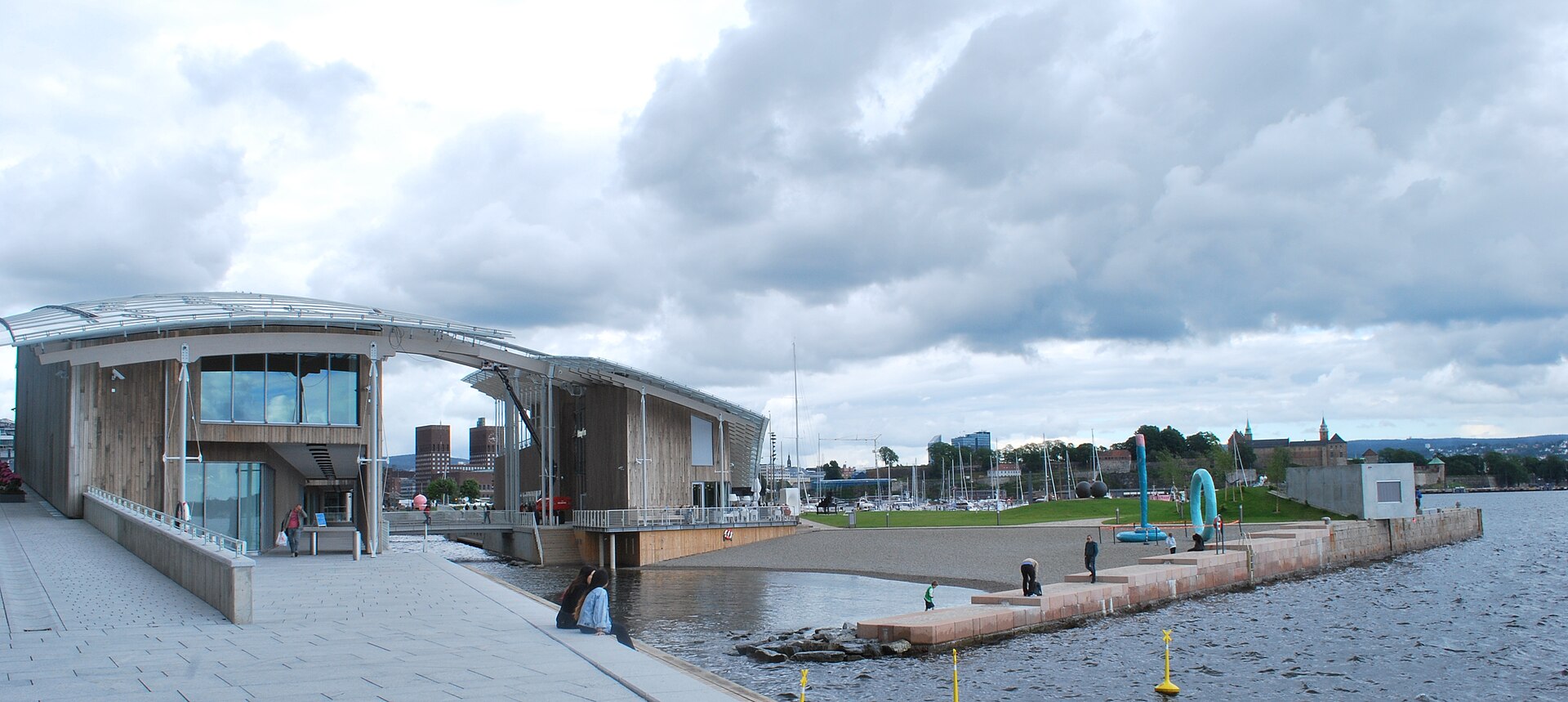
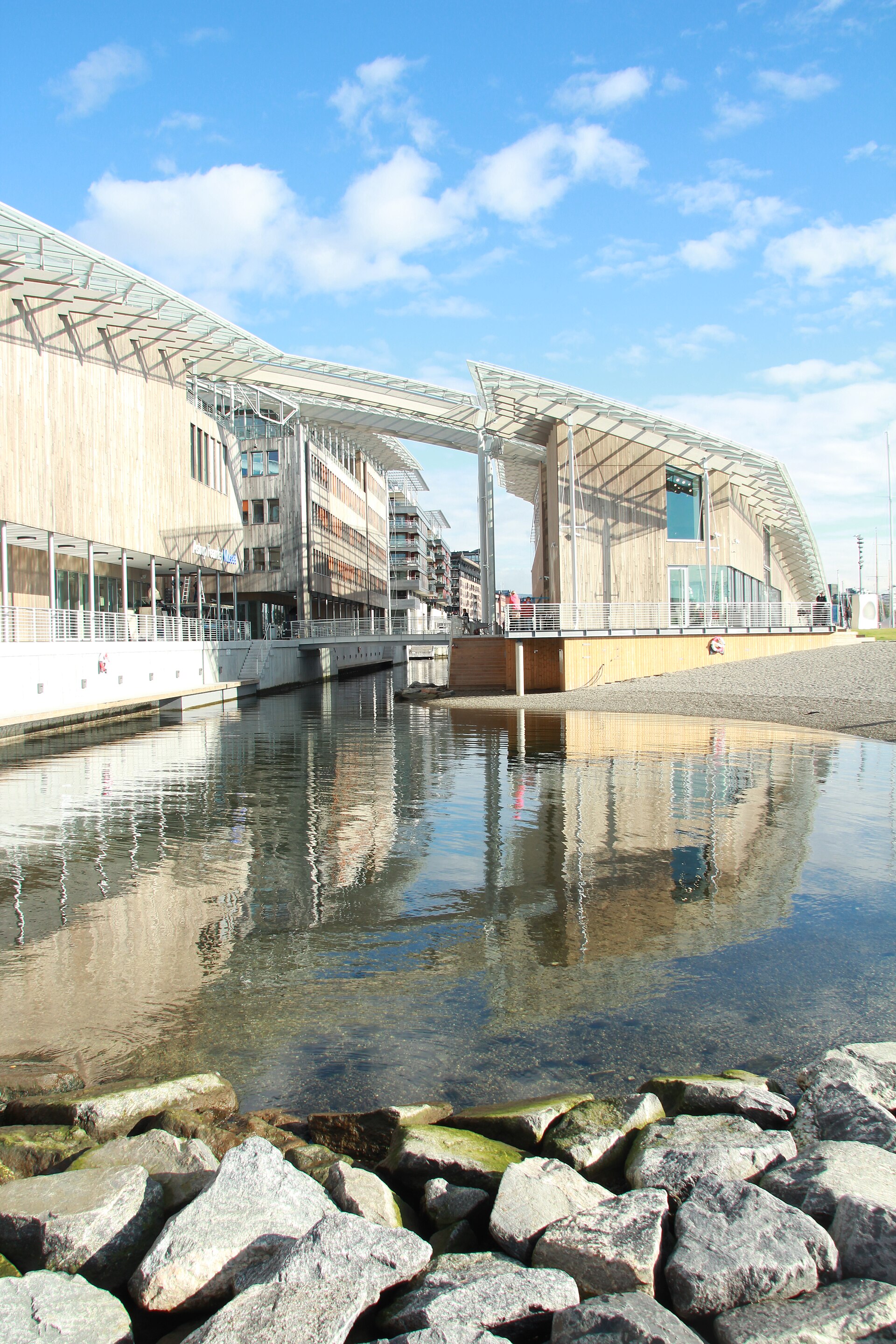
The Astrup Fearnley Museum's canal-side buildings and glass roof, seen from the public beach beside them on Tjuvholmen, with Oslo City Hall visible behind and Akershus Fortress to the right.
Helge Hoifodt · Photograph by Helge Høifødt · CC BY-SA 3.0Astrup Fearnley Museum of Modern Art
Museum · Astrup Fearnley Museet · Founded 1993
Open, admission and hours confirmed 27 August 2026 · 19 sources
On this page 15 sections
ContentsClose
The museum's real strength is depth rather than breadth: rather than attempting to survey the whole of contemporary art since 1960, the Astrup Fearnley Collection concentrates on two connected generations - 1980s American appropriation art and the 1990s Young British Artists - bought early and in quantity by a single private collector, which gives it a coherence and a set of iconic single objects (the Koons Michael Jackson, the Hirst Mother and Child Divided) that a more encyclopaedic institution assembled by committee rarely achieves. Its earlier and later holdings, from a 1962 Hockney to recent Kiefer and Mehretu paintings, are comparatively thin bookends around that concentrated core rather than a comprehensive survey in their own right.
| Local name | Astrup Fearnley Museet |
|---|---|
| Kind | Museum |
| Founded | 1993 |
| City and country |  Oslo, Norway Oslo, Norway |
| Address | Strandpromenaden 2, 0252 Oslo, Norway |
| Website | afmuseet.no |
| Status | Open, confirmed |
| Record last verified |
Visiting
- Hours
- Mon-Wed12:00 to 17:00Open on Mondays only in July and August; closed Mondays the rest of the year
- Thu12:00 to 19:00Late evening opening
- Fri12:00 to 17:00
- Sat-Sun11:00 to 17:00
- Closed
- Monday, except in July and August when the museum opens 12:00-17:00.
- Admission
- AdultNOK 180Full-price single ticket
- Student / SeniorNOK 100
- Children under 20FreeFree, including with members
- Adult, reduced (during exhibition changes)NOK 130Reduced rate applies while the museum is between exhibitions
- Student / Senior, reduced (during exhibition changes)NOK 80
- Oslo Pass holdersFreeFree entry with a valid Oslo Pass
- Tickets
- afmuseet.no/en/visit The museum's own ticket page.
- Do I need to book?
- No advance booking required for individual visitors; private groups can book in advance
- Address
- Strandpromenaden 2, 0252 Oslo, Norway MapFoot About 15-20 minutes along the waterfront promenade from Aker Brygge, or roughly 20 minutes from central Oslo
Bus/tram Ruter city bus and tram lines serve Aker Brygge; the last stretch onto Tjuvholmen is on foot along the boardwalk - Website
- afmuseet.no
- Telephone
- +47 22 93 60 60
- [email protected]
Before you go how long, access, photography, bags, eating, shop
- How long to allow
- One and a half to two hours to see the permanent collection display and one temporary exhibition
- Access
- Not detailed on the museum's public visit pages at the time of research; contact the museum directly to confirm step-free access across the three linked buildings
- Photography
- Not stated on the museum's public visit pages at the time of research
- Bags
- Not stated on the museum's public visit pages at the time of research
- Eating
- VentiVenti, an Italian restaurant and cafe on site with a fjord view
- Shop
- The Astrup Fearnley Shop, on site
Prices and hours change. We take them from the institution's own pages and print the day we read them, and you can check the current position at the source we used. Confirm before you travel.
What is inside
North building - the Astrup Fearnley Collection
The museum's permanent collection galleries, on the north side of the canal that cuts through the site, spread over two levels. This is where the core of Hans Rasmus Astrup's holdings hangs in rotation - contemporary art from the 1960s onward, with a concentration of American appropriation artists from the 1980s and Young British Artists from the 1990s: Jeff Koons, Cindy Sherman, Richard Prince, Damien Hirst and others, shown in an organic, non-chronological hang grouped by artist and body of work rather than by movement.
South building - temporary exhibitions
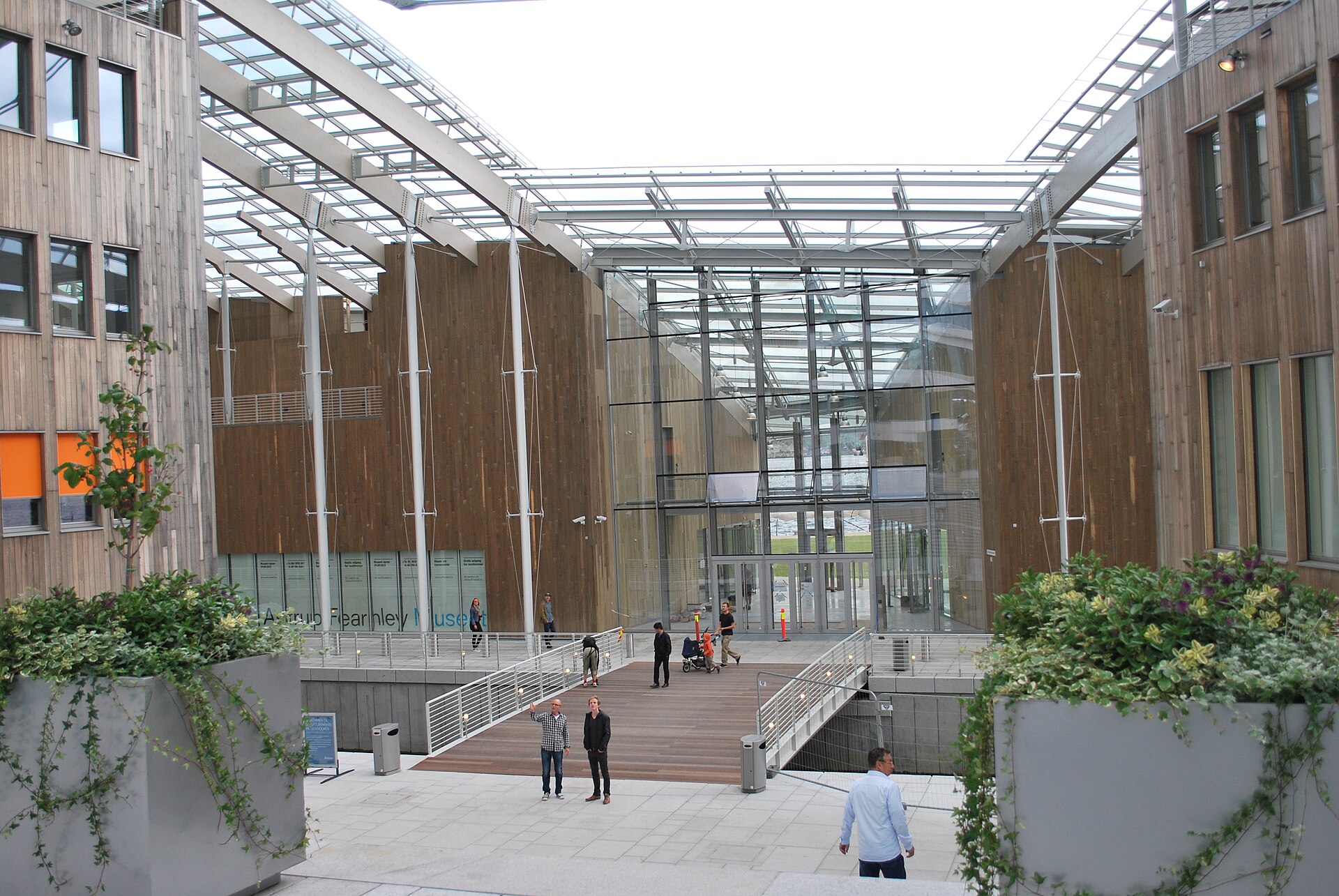
Reached across a footbridge over the canal, the museum's changing-exhibitions wing. Visitors enter a double-height space lit from a skylight in the sloping glass roof, then move level by level through smaller galleries linked by an internal bridge; the sequence is timed to run six to seven temporary exhibitions a year, borrowed and organised internationally, plus a second-floor roof terrace used as additional space for sculpture.
Office building ground floor - the Selvaag private collection
The four-storey office building adjoining the museum, arranged around a day-lit central atrium, connects to the collection building at ground level; its ground floor displays a privately held art collection (the Selvaag collection) as part of the same architectural ensemble, though it is a separate holding from the Astrup Fearnley Collection itself.
Tjuvholmen Sculpture Park and canal grounds
The Renzo Piano-designed public landscape around the three buildings: canals, footbridges and lawns carrying outdoor sculpture (including further pieces from the Selvaag collection), a piazza, a public swimming beach and a waterfront promenade linking Tjuvholmen back to Aker Brygge and the city centre - free to enter and open beyond museum hours.
What to see first
Michael Jackson and Bubbles
Jeff Koons (1988)A life-size porcelain sculpture of the singer reclining with his chimpanzee Bubbles; Sotheby's records the museum's purchase of it at auction as being for more than triple the previous auction record for a work made after 1985, and the museum's own catalogue gives its dimensions as 107 x 179 x 83 cm. It is the single work most associated with the museum internationally.6
Mother and Child Divided
Damien Hirst (1993)Four glass-walled tanks holding the bisected halves of a cow and a calf in formaldehyde, shown at the 1993 Venice Biennale and again as the centrepiece of Hirst's 1995 Turner Prize win at Tate Britain before entering the Astrup Fearnley Collection; regarded as one of the canonical works of the Young British Artists.15
Triptych Inspired by the Oresteia of Aeschylus
Francis Bacon (1981)Acquired years before Bacon's late work was widely recognised by the market; Sotheby's cites an estimate exceeding 60 million US dollars for the subject, illustrating the collection's reputation for buying ahead of critical consensus.15
Cleaning Teeth, Early Evening (10 pm) W11
David Hockney (1962)An early Hockney oil painting representing the collection's post-war British holdings, from before the artist's move to America and his best-known Los Angeles pool paintings.15
Untitled #216
Cindy ShermanOne of Sherman's constructed self-portraits, from her Old Master-referencing series, and one of the works most cited when writers describe the museum's depth in 1980s American appropriation photography.10
Uncertain States of America, 2005
Group exhibition organised with Serpentine Gallery and Astrup FearnleyA touring survey of younger American artists co-organised by the museum that Sotheby's names as an example of the collection's prescience - it included Josh Smith and Jordan Wolfson before either had wide recognition, and both are now cited as validating the museum's early acquisitions.15
Works by Anselm Kiefer and Julie Mehretu
Anselm Kiefer; Julie MehretuLater additions to the collection that Sotheby's highlights as evidence the museum's buying has continued to track significant painters after the founding generation of 1980s appropriation artists.15
The glass roof and canal
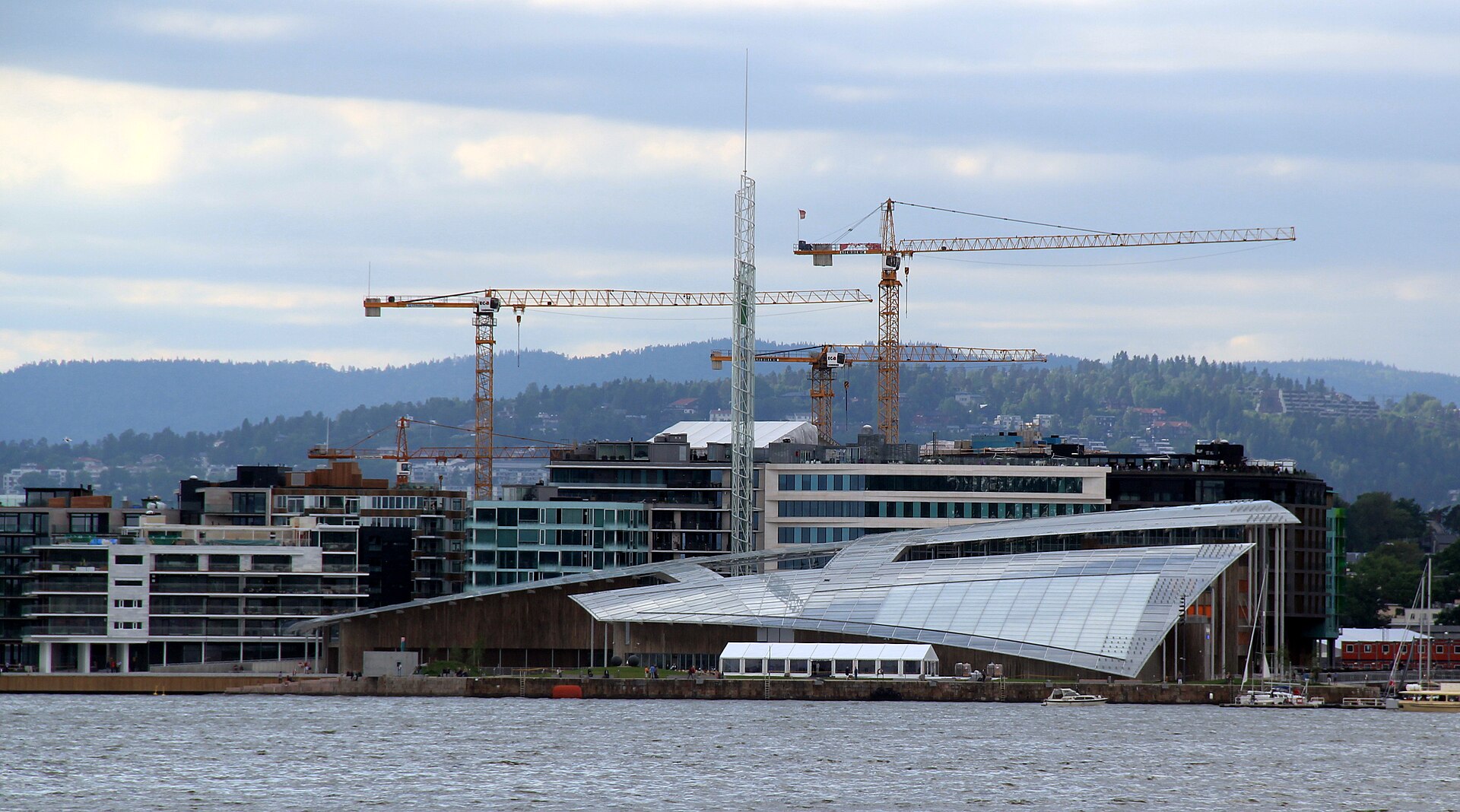
Renzo Piano Building Workshop, with Narud-Stokke-Wiig (2006-2012)The building itself is treated by critics and visitors alike as a work to be seen in its own right: a single curved glass-and-laminated-timber roof, held up on slender steel columns reinforced with cable rigging recalling a sailboat's rigging, spanning the canal to link the three timber-clad pavilions.8
Exhibitions on now
Past exhibitions here
The building and what it was built to hold
The Astrup Fearnley Museum of Modern Art occupies a site at the tip of Tjuvholmen, a former shipyard quarter on Oslo's waterfront redeveloped into housing, offices and public space between 2006 and 2012. The museum building, designed by Renzo Piano Building Workshop in collaboration with the Norwegian firm Narud-Stokke-Wiig, opened here on 29 September 2012, replacing the museum's original premises on Revierstredet in the city centre, where it had operated since 1993. The two buildings are different institutions in every sense that matters to a visitor: the Revierstredet building, by the Norwegian firm LPO arkitekter, is no longer the museum's home and has not been since 2012; anything about the Astrup Fearnley Museum published before that date, or any photograph from before it, describes a different address and a different building.
Piano's design is organised as three separate volumes joined under one continuous roof. On the north side of a canal that runs through the middle of the plot stands the building holding the permanent collection; a four-storey office building, arranged around a day-lit atrium, adjoins it at ground level and shows a privately held collection of its own on that floor. Across a footbridge on the south side of the canal is the museum's space for temporary exhibitions, its galleries stacked over two levels beneath the curve of the roof and lit through a large skylight. The roof itself is the building's signature: a single sweeping form in laminated timber beams, glazed in low-iron glass on the facades and in a white ceramic-fritted glass over the galleries that cuts transmitted light by around 40 per cent to protect the art beneath it, carried on slender steel columns braced with cable rigging that is meant to recall the masts and rigging of the sailing boats that still use the harbour outside. Piano has described the whole complex as a single large shelter for art, built into the landscape at the point where the city meets the fjord.
The scale is modest for what has become one of the more discussed buildings raised in Oslo this century: the two museum buildings together, including the office building's public ground floor, cover roughly 7,000 square metres, built for a reported cost of around 90 million euros. Around the buildings, Piano also laid out the surrounding public realm - a sculpture park threaded with canals, bridges and lawns, a piazza, a public swimming beach and a waterfront promenade connecting Tjuvholmen back to the older harbourfront quarter of Aker Brygge and the rest of the city centre. None of that outdoor landscape requires a ticket; the museum's own site sits inside a larger public park that Piano designed at the same time.
From Revierstredet to Tjuvholmen: how the museum came to exist
The Astrup Fearnley Museum traces its origin to two family philanthropic foundations descended from a Norwegian shipping fortune: the Thomas Fearnley Foundation, established in 1939 by the shipowner Thomas Fearnley, and the Heddy and Nils Astrup Foundation. It was the collector Hans Rasmus Astrup, a descendant of that shipping family, who from the 1960s built the art collection that gives the museum its name and its core holdings - now numbering more than 1,500 works. Before the museum opened in 1993, Norway had no institution dedicated solely to contemporary art; the Astrup Fearnley Museum's first building, on Revierstredet in central Oslo, filled that gap for nearly two decades, with roughly 2,500 square metres of gallery space across two floors of varying height.
By the mid-2000s the museum had outgrown that building, and the move to a purpose-built home on Tjuvholmen was planned alongside the wider redevelopment of the peninsula from working shipyard into a mixed cultural and residential quarter. The museum is privately funded and privately run rather than a state institution, a distinction that matters for how it operates: it sets its own acquisitions policy, its own admission prices and its own sponsorship relationships, none of which are subject to the same public accountability as Norway's National Museum in the same city. That independence has cut both ways in the museum's history, discussed further below.
The collection: contemporary art from the 1960s, weighted toward the 1980s and 1990s
The Astrup Fearnley Collection is organised around artists and their bodies of work rather than around period or movement, and the museum's own description of its hang emphasises an organic, non-chronological arrangement rather than a historical survey. Its strongest holdings sit in two overlapping generations: American appropriation art of the 1980s - Jeff Koons, Cindy Sherman, Richard Prince and their contemporaries, artists who worked with the imagery of advertising, celebrity and consumer culture rather than inventing new forms - and the Young British Artists who came to prominence around the 1990s, chiefly represented by Damien Hirst. The collection's most recognisable single object, Koons' porcelain sculpture Michael Jackson and Bubbles, was bought at auction for a price Sotheby's describes as more than triple the previous auction record for any work made after 1985; Hirst's bisected cow and calf, Mother and Child Divided, entered the collection after being the centrepiece of his Turner Prize win in 1995.
The collection also reaches earlier and later than that core. It holds a 1962 Hockney oil from before the artist's move to Los Angeles, and a 1981 Francis Bacon triptych that Astrup is said to have bought years before Bacon's late paintings were widely re-evaluated by the market - the kind of early, contrarian purchase that gives a private collection its reputation among specialists, whatever it does for a general visitor. More recently the museum has continued to add painters working today, including Anselm Kiefer and Julie Mehretu, and in 2005 it co-organised Uncertain States of America with London's Serpentine Gallery, a survey exhibition of younger American artists that included Josh Smith and Jordan Wolfson before either had significant institutional recognition - a show now cited, after the fact, as evidence that the collection's buying has stayed ahead of consensus rather than following it.
The museum runs six to seven temporary exhibitions a year in its south building, drawing on loans and international co-productions rather than showing only its own holdings; recent programming has included a monographic show of the Colombian artist Beatriz Gonzalez. The permanent collection display itself is not static either - the museum describes regularly rehanging it, placing works in new groupings rather than leaving a fixed installation in place for years at a time.
Reception: admired building, contested interior, and a sponsorship the museum eventually walked away from
Coverage of the Tjuvholmen building splits fairly cleanly between how it reads from outside and how it is experienced from inside. As a piece of waterfront architecture and as a public amenity - the canal, the roof line visible from across the fjord, the sculpture park and beach around it - it is widely treated as one of the more significant buildings to go up in Oslo this century, and it draws favourable comment even from visitors who came primarily for the art. The architectural press has been considerably less generous about the galleries themselves. Writing in ICON Magazine in January 2013, shortly after the building opened, the critic Owen Pritchard praised the roof as an impressive piece of engineering and Piano's timber detailing as impeccable, but described the exhibition spaces - polished concrete floors, white walls - as a sanitised space for contemporary art, precisely the kind of white-box gallery Piano has said he wanted to avoid. Pritchard judged the interior sequence to lack spatial dynamism, called the overall design a tired and familiar formula, and argued the building lacked the substance to justify its prominence on the waterfront, comparing it unfavourably to Snohetta's Opera House a short distance away. That is a minority position among the volume of coverage the building has received, but it is a considered one from a named architecture critic, not a stray complaint, and it belongs on the record alongside the more common praise.
The museum's other significant point of controversy has nothing to do with the building. In 2012, the same year it opened on Tjuvholmen, the museum entered a sponsorship agreement with the Norwegian branch of the Swedish oil company Lundin Petroleum. At the time the deal was signed, Lundin was under criminal investigation in Sweden over the conduct of its earlier subsidiary, Lundin Oil, which had operated in what is now South Sudan between 1997 and 2003 during a period of civil war; the investigation concerned alleged complicity in war crimes connected to that operation. Norwegian critics were sharply critical of the arrangement at the time - the editor of Kunstkritikk, the country's leading art-criticism publication, characterised the sponsorship as an effort by Lundin to launder the reputation of a company that had, in the editor's words, exploited resources in the developing world since the 1970s, and at least one invited speaker cancelled a museum lecture in protest. The museum did not end the sponsorship immediately; the agreement ran its course and was allowed to lapse, unrenewed, at the end of December 2019, with the museum's board chairman describing the decision as unremarkable rather than a response to the criticism, and the incoming director undertaking to review the museum's sponsorship arrangements as a whole the following year. It is a matter of public record that the museum accepted, and for the better part of a decade kept, funding from a company under investigation for war crimes; it is equally a matter of record that the arrangement ended and has not been renewed since.
Visiting today
The museum keeps shorter hours than many state-run institutions in the same city: midday openings on most days, a single late evening on Thursdays, and - outside July and August - a closed day on Mondays that only lifts during the summer season. A standard adult ticket costs 180 Norwegian kroner, with reduced rates for students and seniors and free entry for children under 20, for museum members, and for holders of the Oslo Pass; the museum also runs a lower reduced-price tier during the changeover between temporary exhibitions, when the south building's galleries are only partly hung. None of this requires advance booking for an individual visitor - only private groups need to arrange a time in advance - which is unusual for a museum with this much international press attention and suggests it does not yet see itself constrained by crowding in the way the largest state museums are.
A visit built around both buildings and the grounds around them - the permanent collection in the north building, a temporary show across the footbridge in the south building, and a walk through the sculpture park and along the canal - reasonably takes an hour and a half to two hours. VentiVenti, an Italian restaurant and cafe on site with a view over the fjord, and the museum's own shop, are both inside the complex. The wider Tjuvholmen sculpture park, its swimming beach and its waterfront promenade back toward Aker Brygge and central Oslo are open to the public without a ticket at any time, which means the site rewards a visit even outside the museum's own opening hours - a distinction from most museum waterfronts, where the building's closing time is also the site's.
What visitors say
Visitors consistently single out the building itself as the draw as much as any single work inside it - the curved glass roof over the canal, the fjord views from the galleries and the sculpture park outside are mentioned as often as the art. Architectural critics have taken a harder line than the visiting public: several find the exterior more convincing than the galleries it shelters, and one named review calls the interior sanitised rather than dramatic. The museum's decade-long sponsorship arrangement with the oil company Lundin Petroleum, entered the same year the Tjuvholmen building opened, drew sustained criticism from Norwegian art critics before it lapsed unrenewed in 2019.
What is praised, what is criticised
- Praised: The building and its setting: the curved glass roof, the canal running through the site, and the fjord views from Tjuvholmen, repeatedly named as reasons to visit even by reviewers less interested in the art
- Praised: The depth and quality of the permanent collection's holdings in 1980s American appropriation art and the Young British Artists, with Koons' Michael Jackson and Bubbles and Hirst's Mother and Child Divided named specifically
- Praised: The free public sculpture park, canal walkways and beach around the museum, usable without a ticket and praised as an addition to Oslo's waterfront rather than a private enclosure
- Criticised: ICON Magazine's Owen Pritchard called the gallery interiors, with their polished concrete floors and white walls, a "sanitised space for contemporary art" despite Piano's stated intention to avoid a white-box gallery, and judged the building overall "a tired and familiar formula" that "lacks substance" to justify its site, contrasting it unfavourably with Snohetta's nearby Opera House
- Criticised: The museum's sponsorship agreement with the Norwegian arm of Lundin Petroleum, signed in 2012 while the company was under Swedish investigation over its earlier operations in South Sudan, was condemned by Kunstkritikk's editor as an effort to launder the company's image; the deal ran until it lapsed, unrenewed, at the end of 2019
Ratings on other platforms
Tripadvisor: 4.2 from 1,248 ratings, read 27 August 2026
A platform average is a tertiary source: it moves, it is not audited, and we quote no visitor's words.
Questions about Astrup Fearnley Museum of Modern Art
Where is Astrup Fearnley Museum of Modern Art?
Strandpromenaden 2, 0252 Oslo, Norway.
How much does it cost to visit?
Adult: NOK 180; Student / Senior: NOK 100; Children under 20: free; Adult, reduced (during exhibition changes): NOK 130; Student / Senior, reduced (during exhibition changes): NOK 80. As confirmed 27 August 2026.
When is it open?
Mon-Wed 12:00-17:00; Thu 12:00-19:00; Fri 12:00-17:00; Sat-Sun 11:00-17:00. Closed: Monday, except in July and August when the museum opens 12:00-17:00. As confirmed 27 August 2026.
How do you get there?
Foot: About 15-20 minutes along the waterfront promenade from Aker Brygge, or roughly 20 minutes from central Oslo; Bus/tram: Ruter city bus and tram lines serve Aker Brygge; the last stretch onto Tjuvholmen is on foot along the boardwalk.
What should you see first?
Michael Jackson and Bubbles (Jeff Koons (1988)); Mother and Child Divided (Damien Hirst (1993)); Triptych Inspired by the Oresteia of Aeschylus (Francis Bacon (1981)); Cleaning Teeth, Early Evening (10 pm) W11 (David Hockney (1962)); Untitled #216 (Cindy Sherman); Uncertain States of America, 2005 (Group exhibition organised with Serpentine Gallery and Astrup Fearnley).
What we could not confirm
- The museum's public visit pages do not state an explicit photography or bag-check policy, or detail step-free accessibility across the three linked buildings; this should be confirmed directly with the museum before publishing accessibility guidance to readers.
- The exact 2001/2002 purchase price and hammer-versus-premium breakdown for Michael Jackson and Bubbles is given inconsistently across secondary sources (a flat 5.1 million US dollars in some accounts, 'more than triple the previous record' in Sotheby's own account); this record has not been reconciled against a primary auction-house source and should not be stated as a single hard figure until it is.
Images
Sources
- 1Astrup Fearnley Museet, home page (English) afmuseet.no/en
- 2Astrup Fearnley Museet, Visit (hours, admission, contact, cafe, shop) afmuseet.no/en/visit
- 3Astrup Fearnley Museet, The museum building afmuseet.no/en/the-museum-building/
- 4Astrup Fearnley Museet, About the Astrup Fearnley Museet afmuseet.no/en/about-the-astrup-fearnley-museet/
- 5Astrup Fearnley Museet, The Astrup Fearnley Collection (exhibition page) afmuseet.no/en/exhibitions/the-astrup-fearnley-collection/
- 6Astrup Fearnley Museet, artwork page: Michael Jackson and Bubbles afmuseet.no/en/artwork/michael-jackson-and-bubbles/
- 7Wikipedia, Astrup Fearnley Museum of Modern Art en.wikipedia.org/wiki/Astrup_Fearnley_Museum_of_Modern_Art
- 8Renzo Piano Building Workshop, project page: Astrup Fearnley Museum of Modern Art rpbw.com/project/astrup-fearnley-museum-of-modern-art
- 9ArchDaily, Astrup Fearnley Museet / Renzo Piano Building Workshop archdaily.com/282370/astrup-fearnley-museet-renzo-piano-building-workshop
- 10ITSLIQUID Group, Astrup Fearnley Museum of Modern Art itsliquid.com/astrupfearnley-museumofmodernart.html
- 11Owen Pritchard, 'Astrup Fearnley Museet by Renzo Piano', ICON Magazine, 29 January 2013 iconeye.com/architecture/astrup-fearnley-museet-by-renzo-piano
- 12Kunstkritikk, 'Controversial Sponsorship Agreement Ends' kunstkritikk.com/controversial-sponsorship-agreement-ends/
- 13Tripadvisor, Astrup Fearnley Museet (reviews and rating) tripadvisor.com/Attraction_Review-g190479-d640690-Reviews-Astrup_Fearnley_Museet-Oslo_Eastern_Norway.html
- 14Wikidata, Q761048 (Astrup Fearnley Museum of Modern Art) wikidata.org/wiki/Q761048
- 15Sotheby's, 'The Astrup Fearnley Museet and a Legacy of Masterful Collecting' sothebys.com/en/articles/the-astrup-fearnley-museet-and-a-legacy-of-masterful-collecting
- 16Wikimedia Commons, File:Tjuvholmen Astrup Fearnley Museum of Modern Art and the beach.JPG (Helge Hoifodt, CC BY-SA 3.0) commons.wikimedia.org/wiki/File:Tjuvholmen_Astrup_Fearnley_Museum_of_Modern_Art_and_the_beach.JPG
- 17Wikimedia Commons, File:Astrup Fearnley Museum of Modern Art entrance Skjaeret.JPG (Helge Hoifodt, CC BY-SA 3.0) commons.wikimedia.org/wiki/File:Astrup_Fearnley_Museum_of_Modern_Art_entrance_Skj%C3%A6ret.JPG
- 18Wikimedia Commons, File:2013-06 Astrup Fearnley Tjuvholmen.jpg (Chell Hill, CC BY-SA 3.0) commons.wikimedia.org/wiki/File:2013-06_Astrup_Fearnley_Tjuvholmen.jpg
- 19Wikimedia Commons, File:Astrup Fearnley 006.JPG (Vidar Iversen, CC BY-SA 3.0) commons.wikimedia.org/wiki/File:Astrup_Fearnley_006.JPG


