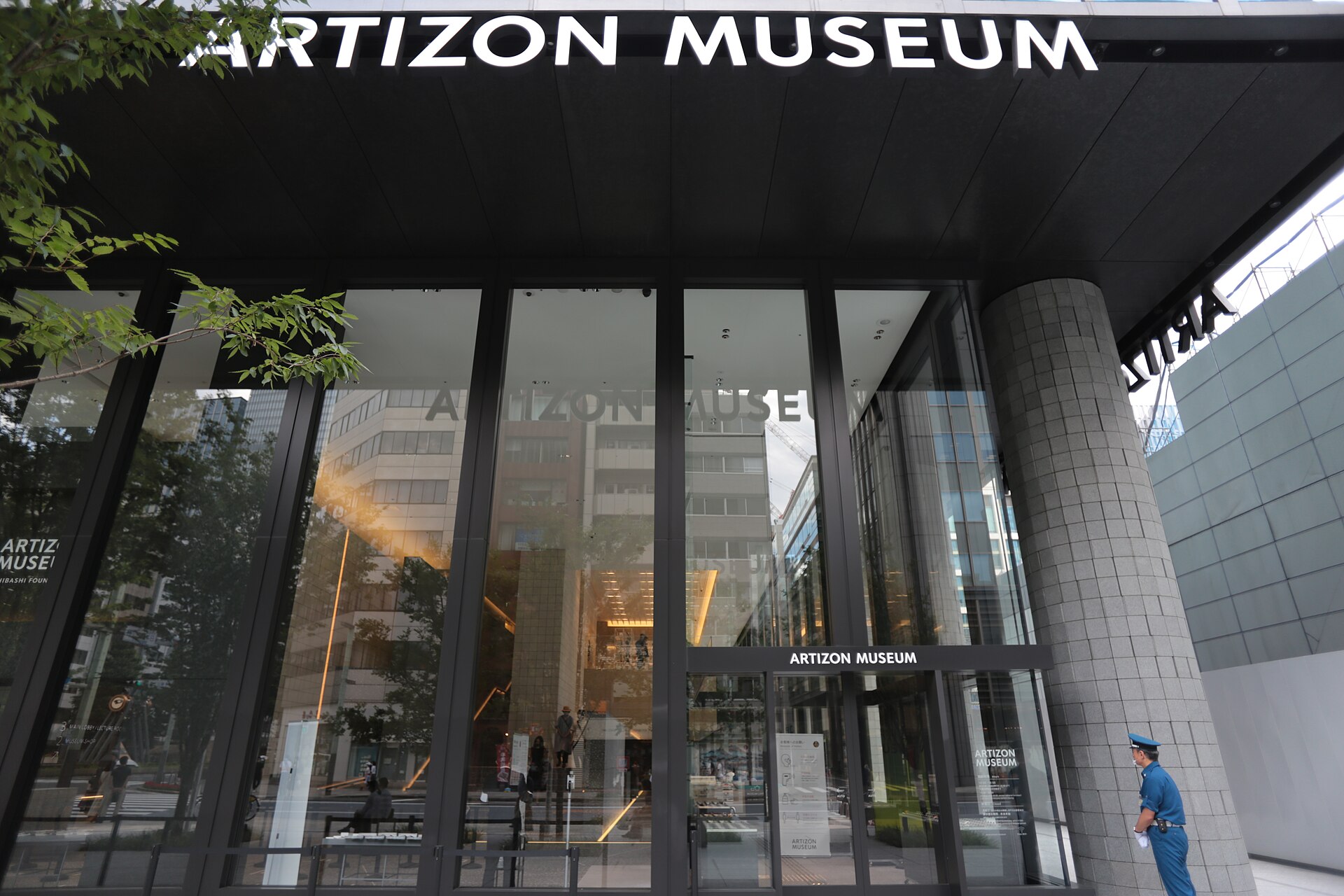
The glass entrance of the Artizon Museum in Kyobashi, under the museum's name sign, photographed on 12 July 2020.
pcs34560, public domainArtizon Museum
Museum · Artizon Bijutsukan · Founded 1952
Open, admission and hours confirmed 17 November 2026 · 17 sources
On this page 16 sections
ContentsClose
The strengths, in the museum's own account, are Impressionism and the Post-Impressionists, twentieth-century European and American art, modern Japanese Western-style painting and a notable group of Japanese Important Cultural Properties, alongside ancient Greek ceramics and Asian antiques. The museum holds more than 60 works each by Fujishima Takeji and Koga Harue according to the reviews read here.
| Local name | Artizon Bijutsukan |
|---|---|
| Kind | Museum |
| Founded | 1952 |
| City and country |  Tokyo, Japan |
| Address | 1-7-2 Kyobashi, Chuo-ku, Tokyo 104-0031, Japan |
| Website | artizon.museum/en |
| Status | Open, confirmed |
| Record last verified |
Visiting
- Hours
- Tue-Thu and Sat-Sun10:00 to 18:00Last entry 30 minutes before closing; timed entry slots
- Fri10:00 to 20:00Except national holidays; an extra 18:00 to 19:30 entry slot runs on non-holiday Fridays
- Closed
- Mondays (open on 23 Nov 2026 and 11 Jan 2027); the following weekday when a Monday is a national holiday. 24 November 2026 and 12 January 2027. New Year closure: the museum's home page gives 28 Dec to 4 Jan and the exhibition listing gives 29 Dec to 3 Jan; check before travelling. Exhibition changeover periods.
- Admission
- General, web reservationJPY 1,200Price shown for the Etrangers exhibition (24 Oct 2026 to 31 Jan 2027); one fee covers all concurrent exhibitions. Fees vary by exhibition.
- General, bought at the museum windowJPY 1,500Same exhibition; only if the timed slot is not full
- University, vocational and high school studentsFreeFree but a web reservation is required; bring a student ID or handbook; eligibility conditions apply
- Junior high school and youngerFreeFree, no reservation
- Disability certificate holder plus one companionFreeFree, no reservation; bring the certificate
- Exhibition Passport 2026 (smartphone)JPY 5,000The ticket page says sales have ended; shown for reference only
- Tickets
- artizon.museum/en/ticket The museum's own ticket page.
- Do I need to book?
- Yes for general admission and for high school and university students: timed slots booked on the website, closing 10 minutes before each slot ends. Tickets can also be bought at the museum desk if the slot is not full. Phone reservations are not accepted, confirmed bookings cannot be cancelled and the date or time can be changed twice. Junior high students and younger need no booking.
- Address
- 1-7-2 Kyobashi, Chuo-ku, Tokyo 104-0031, Japan MapJR Tokyo Station, Yaesu Central Exit, about 5 minutes on foot
Tokyo Metro Ginza Line Kyobashi Station, Exit 6 or 7
Tokyo Metro Ginza and Tozai Lines, Toei Asakusa Line Nihombashi Station, Exit B1
Bicycle and car 12 bicycle lots on the east side of the building at 100 yen per 2 hours; no museum car park, nearby paid parking only - Website
- artizon.museum/en
- Telephone
- +81 50 5541 8600
Before you go how long, access, photography, bags, eating, shop
- How long to allow
- A few hours, according to one visitor guide; staff suggest starting on the top floor and working down.
- Access
- The museum's own site carries an Accessibility Information page; its content was not readable in the pages fetched, so only the free admission for disability certificate holders and one companion is confirmed here.
- Photography
- Not stated on the museum pages fetched. A review aggregator reports that no-photo placards are small and easy to miss, so ask at the desk.
- Bags
- Not stated on the pages fetched.
- Eating
- A Museum Cafe is listed on the museum's visit pages; hours and menu were not available in the pages fetched.
- Shop
- A Museum Shop and an online shop are listed on the museum's visit pages.
Prices and hours change. We take them from the institution's own pages and print the day we read them, and you can check the current position at the source we used. Confirm before you travel.
What is inside
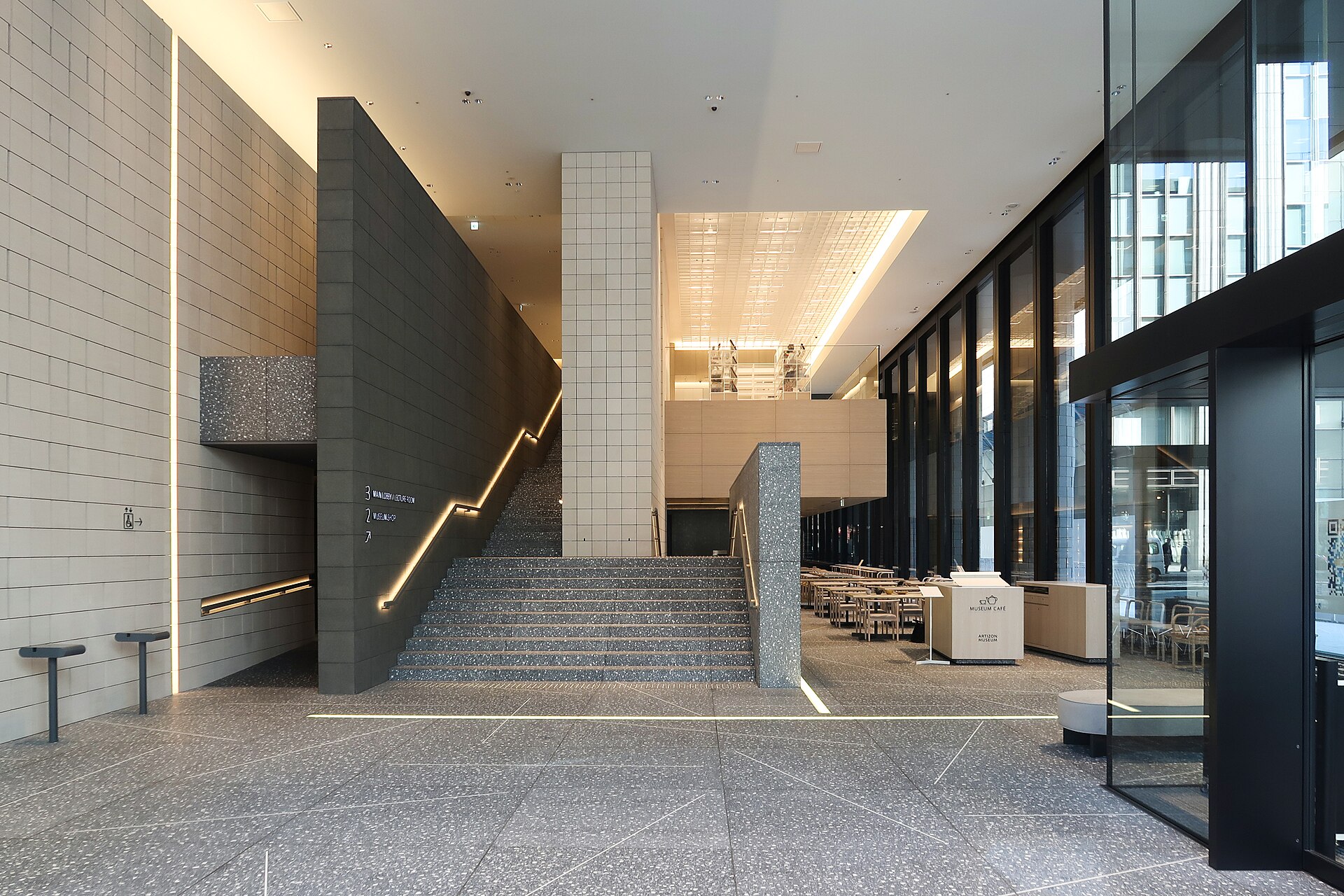
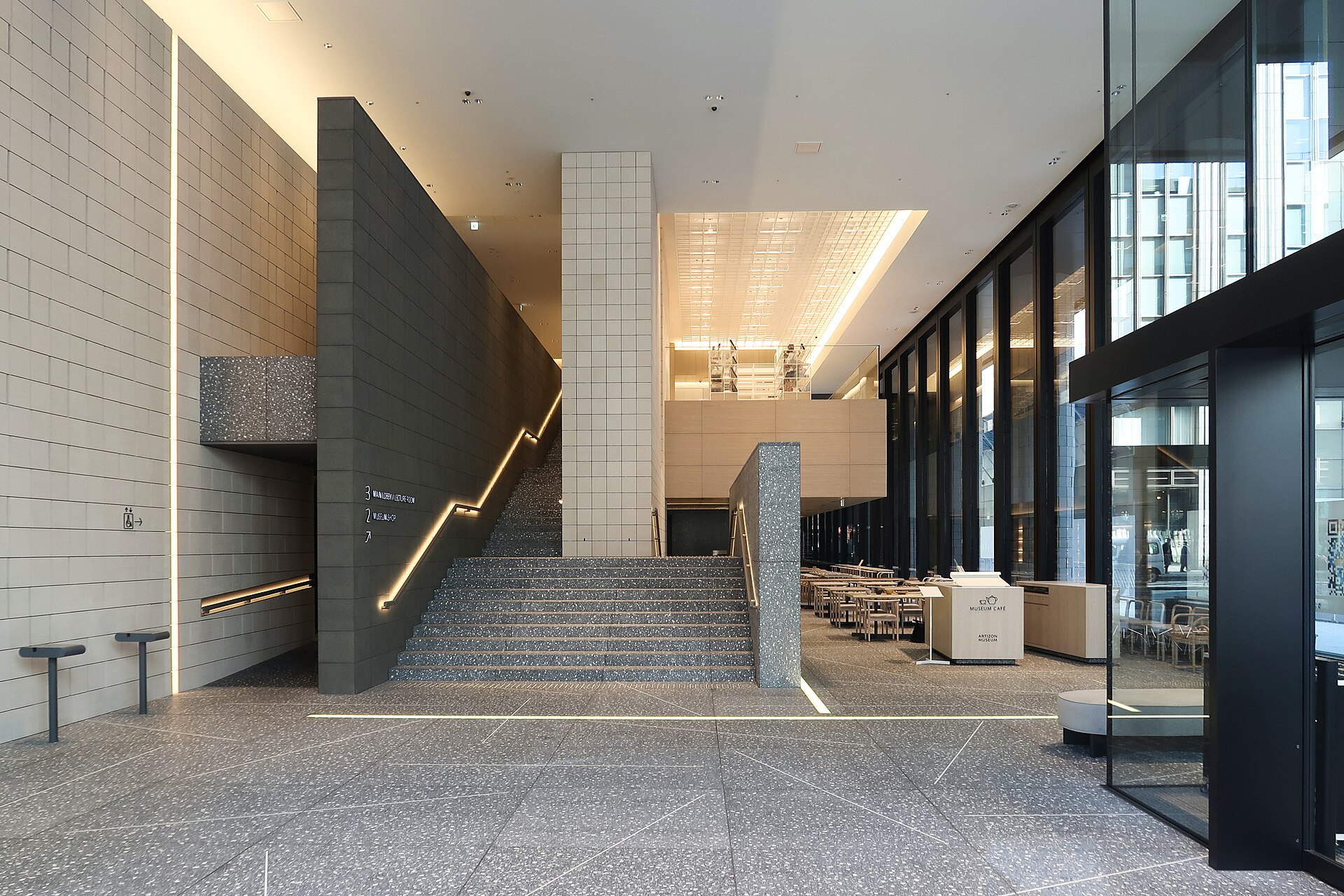
Photograph by Wpcpey · CC BY 4.0 Ground-floor lobby and Museum Cafe
The street-level entrance under the museum's name sign leads into a stone-floored lobby with a broad stair and a seating area; the Museum Cafe and Museum Shop are listed on the museum's visit pages. The building is Museum Tower Kyobashi, designed by Nikken Sekkei, with the museum interior by TONERICO.
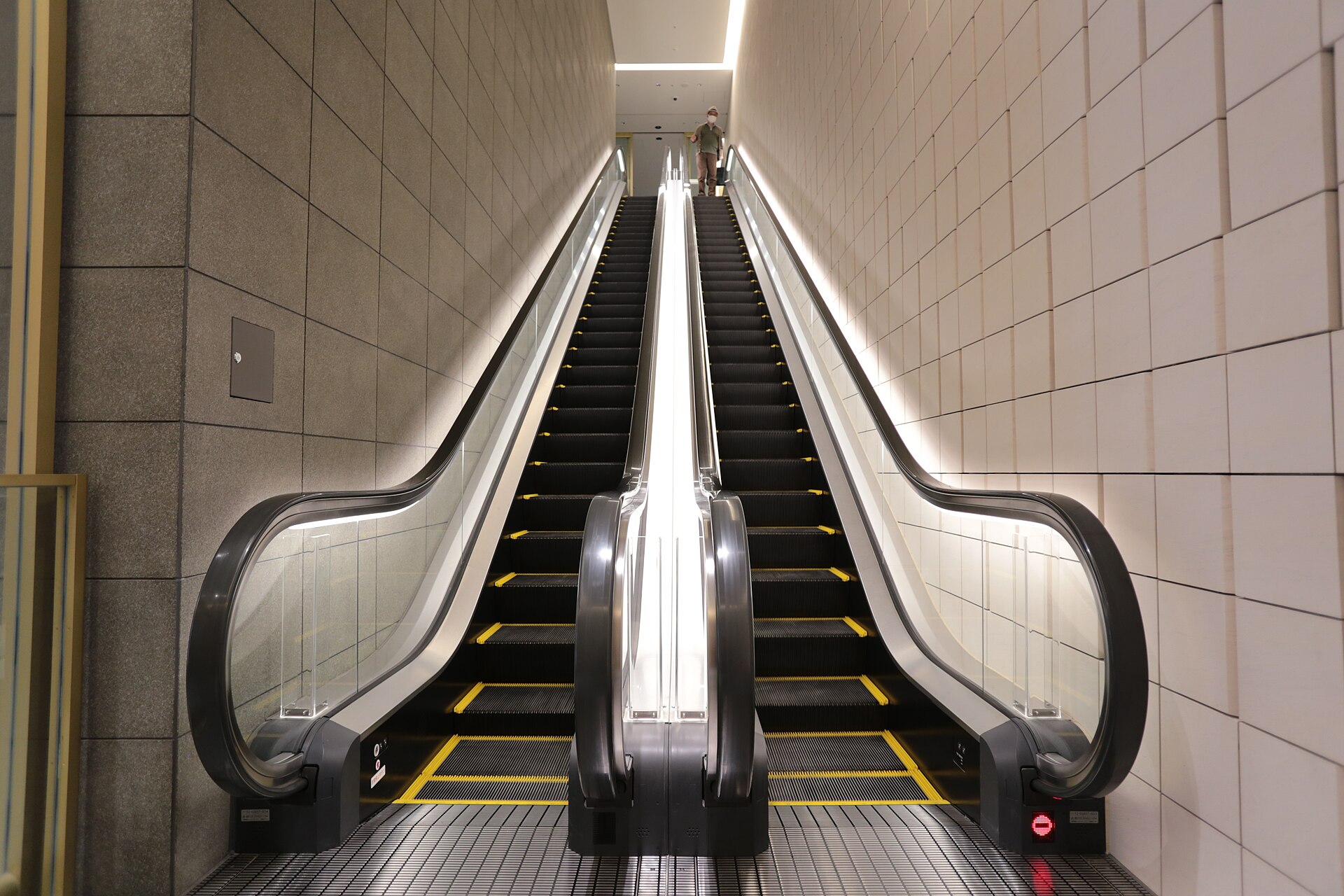
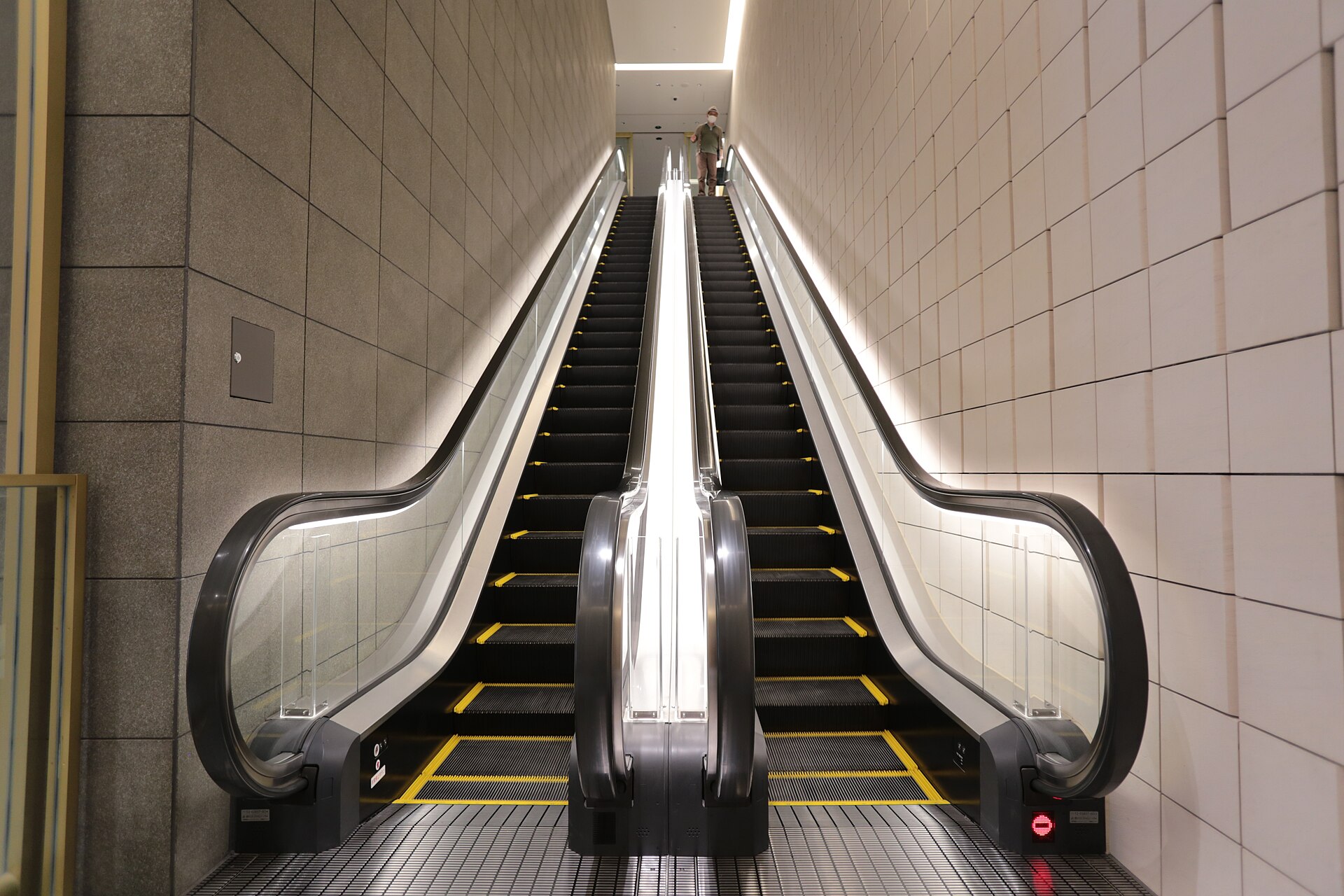
Public domain Escalators and the third-floor gate
Escalators link the floors, and the 3rd-floor gate is where Exhibition Passport holders scan their QR code; this is where the timed-entry visit begins.
4th and 5th floors
In the autumn 2026 programme, the Etrangers exhibition occupies the 5th and 4th floors, drawing on the Ishibashi Foundation collection for works made in Europe by Kuroda Seiki, Fujishima Takeji, Yasui Sotaro and Foujita Tsuguharu. A visitor guide written near the reopening describes the 4th floor as holding selections from the Ishibashi Collection and special sections, including one on women Impressionists.
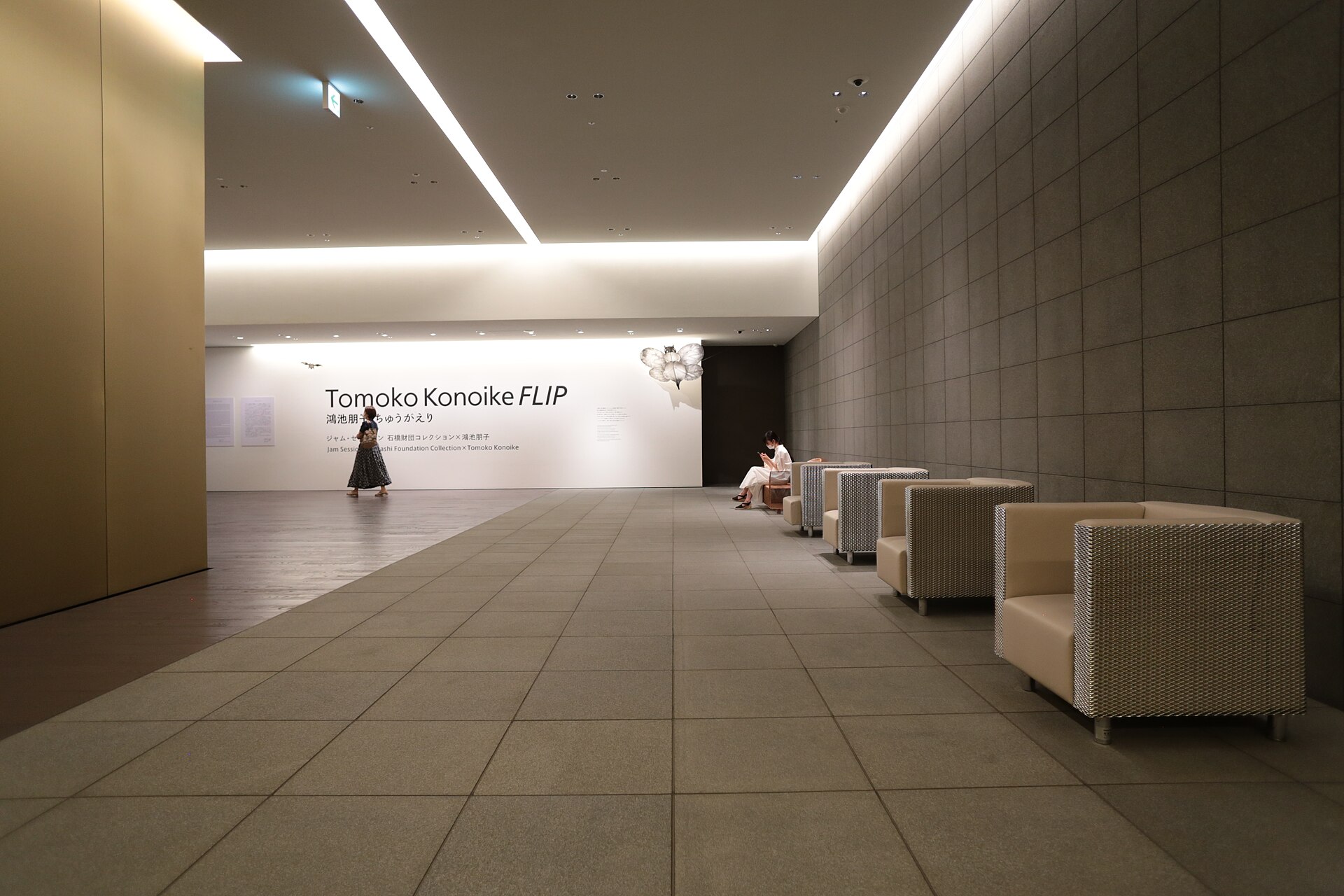
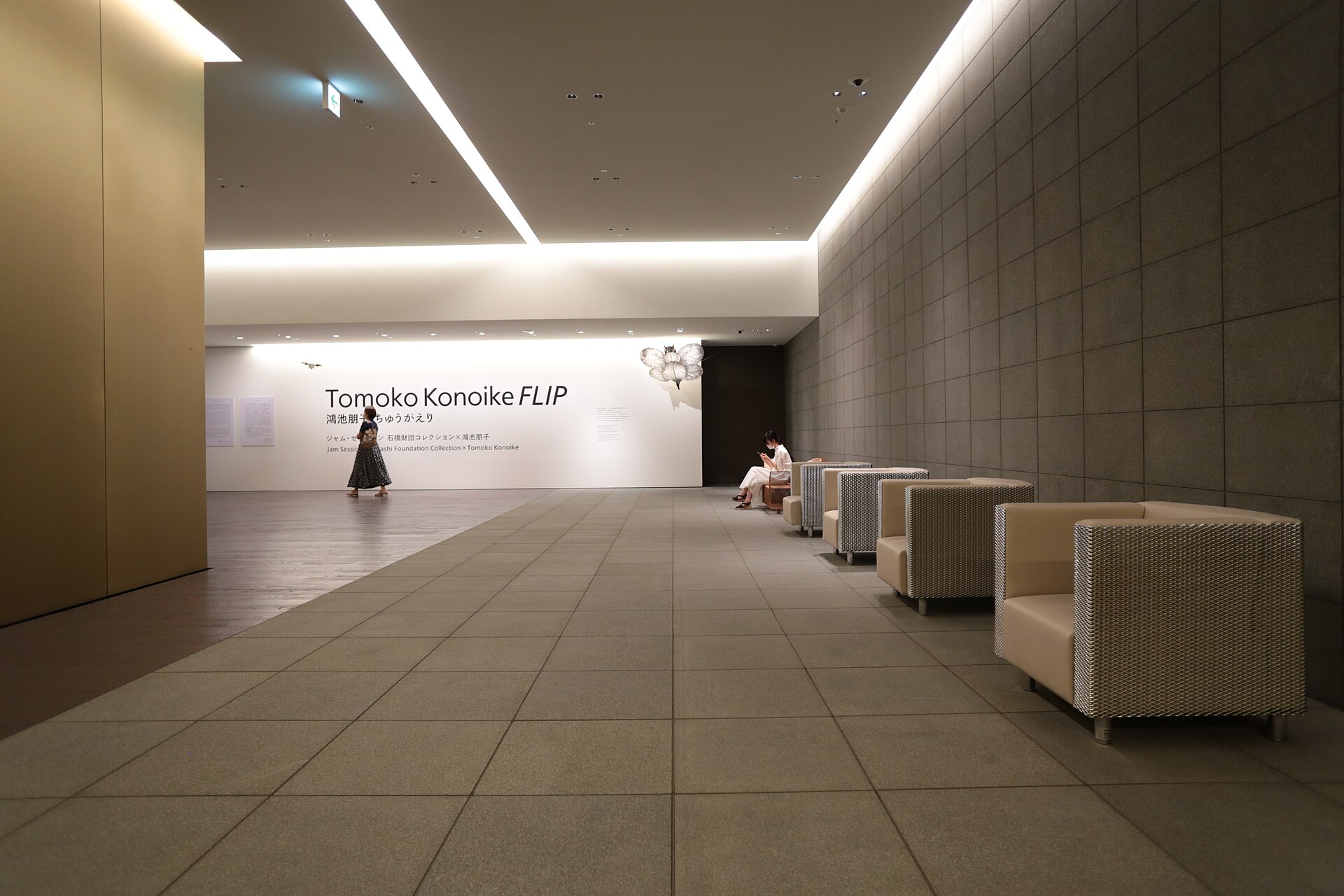
Public domain 6th floor, Jam Session gallery
The 6th floor hosts the Jam Session series, in which collection works are paired with a contemporary artist; the current show, running 24 October 2026 to 31 January 2027, pairs the Ishibashi Foundation Collection with the artist Hikaru Fujii under the title WHOSE LIGHT?
What to see first
Mont Sainte-Victoire and Chateau Noir (1904-06)
Paul CezanneOne of the two European works the Japanese Wikipedia article names first among the museum's Western holdings; it anchors the Post-Impressionist core of the founder's collection.8
Seated Acrobat with Arms Crossed (1923)
Pablo PicassoThe second work named in that article, it shows the collection reaching from Impressionism into twentieth-century European modernism.8
Black Fan (1908-09)
Fujishima TakejiListed as an Important Cultural Property of Japan; the museum holds more than 60 works by Fujishima, which makes it one of the places to study this Japanese Western-style painter.8
A Gift of the Sea (1904)
Aoki ShigeruListed as an Important Cultural Property, and part of a cluster of Meiji-era Western-style painting that the museum has collected since the founder's day.8
Landscape of the Four Seasons (15th century)
SesshuListed as an Important Cultural Property; it shows that the collection reaches back beyond Western painting to the Japanese ink tradition.8
Young Man Playing the Piano
Gustave CaillebotteNamed in English Wikipedia as one of the museum's best-known Impressionist pictures.12
Still Life (Flowers, Fruits, Wineglass, and Tea Cup) (1865)
Henri Fantin-LatourTokyo Art Beat calls it one of the oldest pieces on display in its 2022 review, noted for its direct approach to still life.9
Nude in the Studio (1899)
Henri MatisseAn early Pointillist work with strong red-green contrast, according to the same review.9
Innocent Moonlit Night (1929)
Koga HarueA Japanese Surrealist canvas; the review states that the museum holds about 60 works by Koga.9
Fusuma-e (2020)
Tomoko KonoikeAn 18-panel sliding-door installation made for the reopened museum's Jam Session series, praised by a visitor guide as playful and thought-provoking.10
Exhibitions on now
- On now24 Oct 2026 to 31 Jan 2027Confirmed
From a tyre maker's gallery to a tower in Kyobashi
The museum began in 1952, when Ishibashi Shojiro, the founder of Bridgestone, opened an art museum on the second floor of the Bridgestone Building in Kyobashi to show the works he had bought himself. In 1956 the Ishibashi Foundation was set up to run it as a permanent institution. For six decades it was the Bridgestone Museum of Art, a company-founder's gallery in the middle of Tokyo's commercial district.
The old building closed on 18 May 2015 and, according to English Wikipedia, was demolished that year. The Japanese Wikipedia article records the rest of the sequence: a rename from Bridgestone Museum of Art to Artizon Museum on 1 July 2019, and a reopening on 18 January 2020 in the newly completed Museum Tower Kyobashi. The museum's own listing on the Japan Association of Museums site describes the gap as about four and a half years of rebuilding. The name combines the words art and horizon, and the stated concept is experiencing creativity.
This is therefore a new building on the old site's neighbourhood and not the old Bridgestone Museum of Art building, which no longer stands. Readers who remember the earlier museum should not look for it at this address.
The building
The museum sits in the lower section of Museum Tower Kyobashi, a tower that English Wikipedia counts at 25 floors and the museum's own pages at 23. Nikken Sekkei designed the whole building according to the Japanese Wikipedia article; the museum interior is by TONERICO and the signage by Hiromura Design Office. The same article gives a total floor area of 6,715 square metres and says the museum occupies floors 1 to 6, while the museum's own page says its galleries occupy the 4th to 6th floors. The two accounts differ and this page does not resolve them.
The museum says the galleries cover roughly twice the area of the former museum and use the latest lighting and air conditioning. A visitor guide compares the interior to a modern cathedral. The ground-floor lobby, photographed for this page, is a stone-floored hall with a wide stair and a seating area, which fits that description better than a conventional white-cube entrance. Visitors move between floors by escalator, and the 3rd-floor gate is where holders of the annual passport scan in.
What the collection is
The collection is held by the Ishibashi Foundation and, by the museum's own count, numbers about 3,000 works. It grew from Ishibashi Shojiro's personal purchases over about fifty years and has since been widened to antiquities, Impressionism, modern Japanese Western-style painting, twentieth-century art, contemporary art, design and artist portraits. The collection page divides it into seven areas: Western Art and Postwar Art, Japanese Western-style Art and Postwar Art, Contemporary Art, Asian Antiques, Oriental and Greece-Rome Art, Design and Portrait of the Artist.
Tokyo Art Beat's 2022 review explains the logic of the layers. Ishibashi Shojiro began with Western-style paintings by European and Japanese artists, and his son Kanichiro later added abstract art, especially from postwar France. That review counts about 2,800 items in the collection, a figure that sits below the museum's own 'about 3,000' and the difference is probably a matter of when and what was counted. About 170 artworks and documents were on show at the time of that review, so a visitor sees a small part of the whole.
The foundation's reach into Japanese painting is the real distinction. The Japanese Wikipedia article lists several Important Cultural Properties held by the museum, among them Fujishima Takeji's Black Fan and Tenpyo no Omokage and Aoki Shigeru's A Gift of the Sea and Paradise under the Sea, together with Sesshu's Landscape of the Four Seasons, a Kokinshu fragment and a Yuan celadon vase. It also lists a Chan sketch by Inda as a National Treasure. Several of these are said to come from the Kuroda family of the Fukuoka Domain.
What is worth your two hours
Start at the top. The museum's own staff, according to one visitor guide, suggest beginning on the highest floor and working down, which suits a visit that runs to a few hours. In autumn 2026 the 6th floor holds Jam Session, the collection-meets-contemporary-art series, this time with the artist Hikaru Fujii, and the 4th and 5th floors hold Etrangers, which examines how Japanese painters who studied in Europe after the Meiji era took in European masterworks and contemporary trends. The title draws on an essay by Shimazaki Toson about the painters' experience as outsiders abroad, and the show focuses on works made in Europe by Kuroda Seiki, Fujishima Takeji, Yasui Sotaro and Foujita Tsuguharu. One ticket covers both exhibitions.
The permanent holdings are shown in rotation, so the Cezanne, Picasso, Monet or Matisse that a visitor hopes to see may be in storage on a given day. The museum does not publish a fixed list of what is on the wall, so anyone travelling for one picture should check the current exhibition page first.
Tickets, booking and the practical edges
Entry is by timed slot. Ordinary slots run from 10:00 to 17:30 and, on non-holiday Fridays, a further slot runs to 19:30. A visitor may enter at any time within the slot and stay until closing. General tickets and tickets for high school and university students must be booked on the website; booking closes 10 minutes before each slot ends, and tickets can be bought at the desk only if the slot is not full.
For the autumn 2026 exhibitions the museum's listing gives 1,200 yen for a web ticket and 1,500 yen at the window, and says fees vary by exhibition. University, vocational and high school students enter free but must reserve online, and junior high school students and younger, plus holders of a disability certificate and one companion, enter free without booking. The museum states that there is no group or senior discount, that phone reservations are not accepted, and that a confirmed reservation cannot be cancelled, though the date or time can be changed twice. An annual Exhibition Passport existed for 2026 at 5,000 yen on a smartphone or 5,200 yen as a card, but the ticket page says sales have ended.
Opening hours are 10:00 to 18:00 and until 20:00 on Fridays, with last entry 30 minutes before closing. The museum is closed on Mondays and over the New Year. The two official sources disagree by a day on the New Year dates, so confirm before a December or January trip.
Getting there
The museum is about five minutes on foot from the Yaesu Central Exit of Tokyo Station, from Exit 6 or 7 of Kyobashi Station on the Ginza Line and from Exit B1 of Nihombashi Station. There is no museum car park and visitors are told to use nearby paid parking. Twelve bicycle spaces stand on the east side of the building at 100 yen for two hours.
Contact is a little untidy. The museum's FAQ and the Japan Association of Museums listing both give 050 5541 8600 as the general line, but the contact page of the museum's English site gives 047 316 2772 for the same Hello Dial service. This page prints the first; either way, tickets cannot be bought by phone.
What visitors say, and what the museum does not tell you
Aggregated visitor ratings are strong: 4.5 out of 5 on Google from 3,382 reviews and 4.2 from 209 on Tripadvisor, read through a review aggregator on 17 November 2026 and labelled tertiary. The reviews that aggregator surfaced were dated from June 2025 to April 2026. Visitors praise the calm, the light and the way classic and modern works are mixed; they complain about crowds at the Monet exhibition and about no-photo notices that are small and easy to overlook.
The three named publications read for this page are all favourable, and none of them raises a critical question about the institution. English Wikipedia and the Japanese article say nothing about controversies, and no source read here addresses the provenance of individual works or any restitution claim. That absence is a limit of this research and not a finding that none exists.
What visitors say
The visitor reviews summarised on the Wanderlog listing (not read in full here, so this is a thin sample) mention a calm, well-lit building and a collection that mixes European classics with Japanese modern painting, with easy QR-code entry and English labels. What they say they wish they had known: popular shows are crowded and can sell out, so a booked slot on a weekday is the safer plan, and the no-photo rules are posted on small placards that are easy to miss. The museum's own ticket rules add the practical edges: no senior or group discount, no phone booking and no cancellation.
What is praised, what is criticised
- Praised: A peaceful atmosphere in which it is easy to concentrate on the paintings
- Praised: A strong mix of classic and modern works, and a modern building with plenty of natural light
- Praised: Friendly staff, English descriptions, audio tours and easy online ticketing with QR entry
- Praised: Impressionist holdings described by one travel guide as the best collection of Impressionist painting in Asia (promotional language, not an independent assessment)
- Criticised: Crowds during the Monet exhibition made it hard to enjoy the paintings
- Criticised: Small no-photo placards are easy to miss, so visitors sometimes photograph restricted works
- Criticised: Popular exhibitions can sell out, and the museum states that confirmed bookings cannot be cancelled and that there are no group or senior discounts
- Criticised: The galleries are small for a collection of about 3,000 works: only floors 4 to 6 hold exhibitions, so most of the holdings are out of view at any one time
Ratings on other platforms
Google: 4.5 from 3,382 ratings, read 17 November 2026
Tripadvisor: 4.2 from 209 ratings, read 17 November 2026
A platform average is a tertiary source: it moves, it is not audited, and we quote no visitor's words.
Questions about Artizon Museum
Where is Artizon Museum?
1-7-2 Kyobashi, Chuo-ku, Tokyo 104-0031, Japan.
How much does it cost to visit?
General, web reservation: JPY 1200; General, bought at the museum window: JPY 1500; University, vocational and high school students: free; Junior high school and younger: free; Disability certificate holder plus one companion: free. As confirmed 17 November 2026.
When is it open?
Tue-Thu and Sat-Sun 10:00-18:00; Fri 10:00-20:00. Closed: Mondays (open on 23 Nov 2026 and 11 Jan 2027); the following weekday when a Monday is a national holiday. 24 November 2026 and 12 January 2027. As confirmed 17 November 2026.
How do you get there?
JR: Tokyo Station, Yaesu Central Exit, about 5 minutes on foot; Tokyo Metro Ginza Line: Kyobashi Station, Exit 6 or 7; Tokyo Metro Ginza and Tozai Lines, Toei Asakusa Line: Nihombashi Station, Exit B1; Bicycle and car: 12 bicycle lots on the east side of the building at 100 yen per 2 hours; no museum car park, nearby paid parking only.
What should you see first?
Mont Sainte-Victoire and Chateau Noir (1904-06) (Paul Cezanne); Seated Acrobat with Arms Crossed (1923) (Pablo Picasso); Black Fan (1908-09) (Fujishima Takeji); A Gift of the Sea (1904) (Aoki Shigeru); Landscape of the Four Seasons (15th century) (Sesshu); Young Man Playing the Piano (Gustave Caillebotte).
What we could not confirm
- The museum pages fetched give no photography, locker or accessibility detail; the Accessibility Information page was not readable.
- Two phone numbers appear for the museum's Hello Dial service (050 5541 8600 and 047 316 2772); the general line was taken from the FAQ and the museum association listing.
- The New Year closure is given as 28 December to 4 January on the museum's home page and 29 December to 3 January in the exhibition listing.
- No source read addresses the provenance of the collection, wartime acquisitions or any restitution claim; this has not been researched in depth.
- Collection size is given as about 3,000 by the museum and about 2,800 by two secondary sources.
Images
Sources
- 1Artizon Museum, User Guide and Access (hours, closed days, address, transport) artizon.museum/en/user-guide/
- 2Artizon Museum, Tickets (English) artizon.museum/en/ticket/
- 3Artizon Museum, Tickets (Japanese; free categories, slots, passport) artizon.museum/ticket/
- 4Artizon Museum, About (history, floors, concept) artizon.museum/en/about/
- 5Artizon Museum, The Collection artizon.museum/en/collection/
- 6Japan Association of Museums listing for Etrangers (fees, hours, closed days, phone) museum.or.jp/event/123096
- 7Japan Association of Museums listing for Artizon Museum (phone, slots, about 3,000 works) museum.or.jp/museum/2583
- 8Japanese Wikipedia, Artizon Museum (architect, dates, floors, cultural properties); ja.wikipedia.org/wiki/%E3%82%A2%E3%83%BC%E3%83%86%E3%82%A3%E3%82%BE%E3%83%B3%E7%BE%8E%E8%A1%93%E9%A4%A8
- 9Alma Reyes, Chasing the Horizon 1952-2022, Tokyo Art Beat tokyoartbeat.com/en/articles/-/chasing-the-horizon-1952-2022
- 10Japan Journeys, Artizon Museum japanjourneys.jp/tokyo/attractions/museum/artizon-museum
- 11Wanderlog, Artizon Museum (aggregated Google and Tripadvisor ratings; ) wanderlog.com/place/details/749959/artizon-museum
- 12English Wikipedia, Artizon Museum; en.wikipedia.org/wiki/Artizon_Museum
- 13Artizon Museum, FAQ hours and directions (phone) artizon.museum/de/faq/9-2
- 14Artizon Museum, Contact (second phone number) artizon.museum/en/contact/
- 15Artizon Museum, home page (current exhibitions, hours, closed days) artizon.museum/en/
- 16Time Out Tokyo, Artizon Museum timeout.com/tokyo/art/artizon-museum
- 17Wikimedia Commons, Category:Artizon Museum (photographs; licence checked per file: public domain and CC BY 4.0) commons.wikimedia.org/wiki/Category:Artizon_Museum