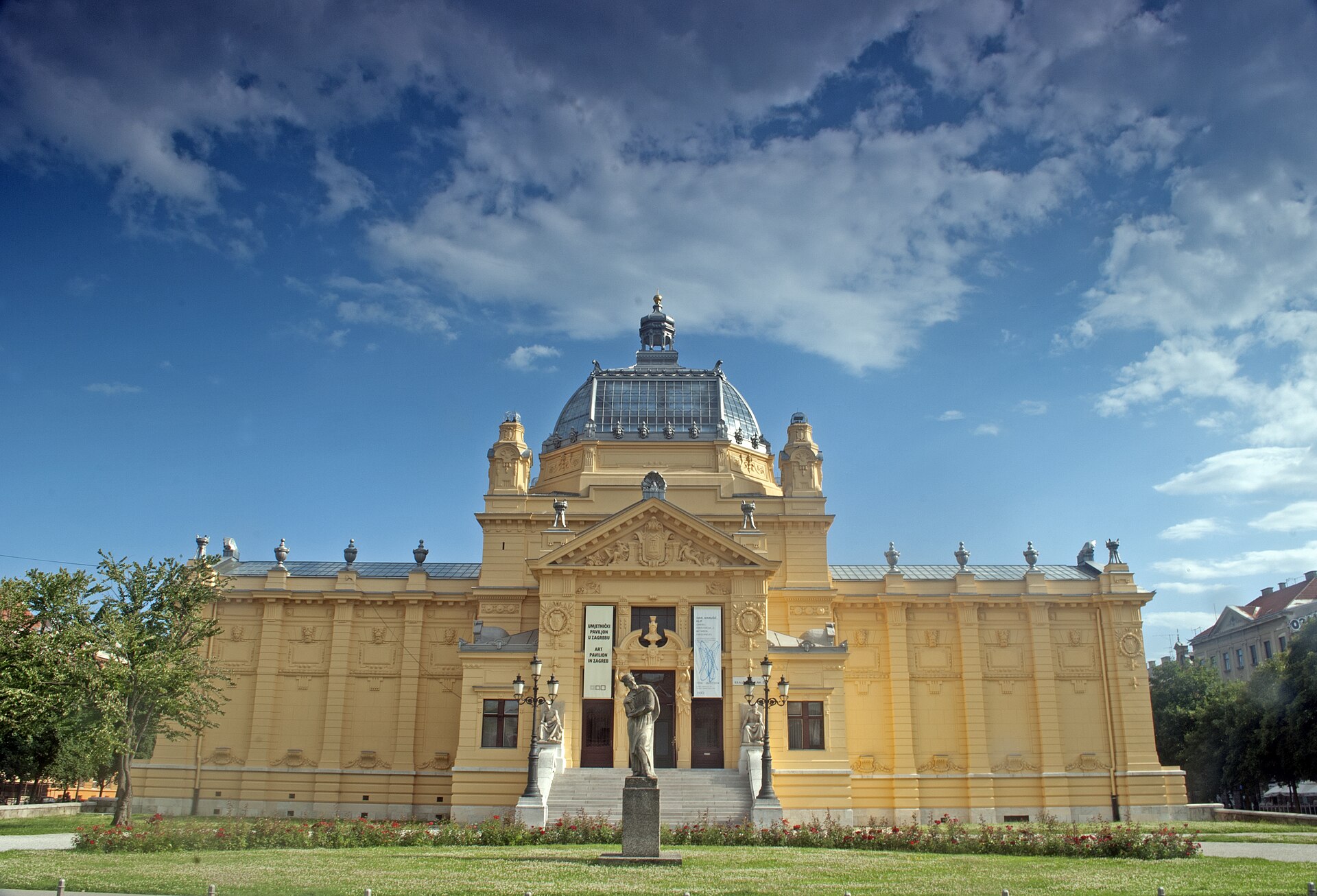
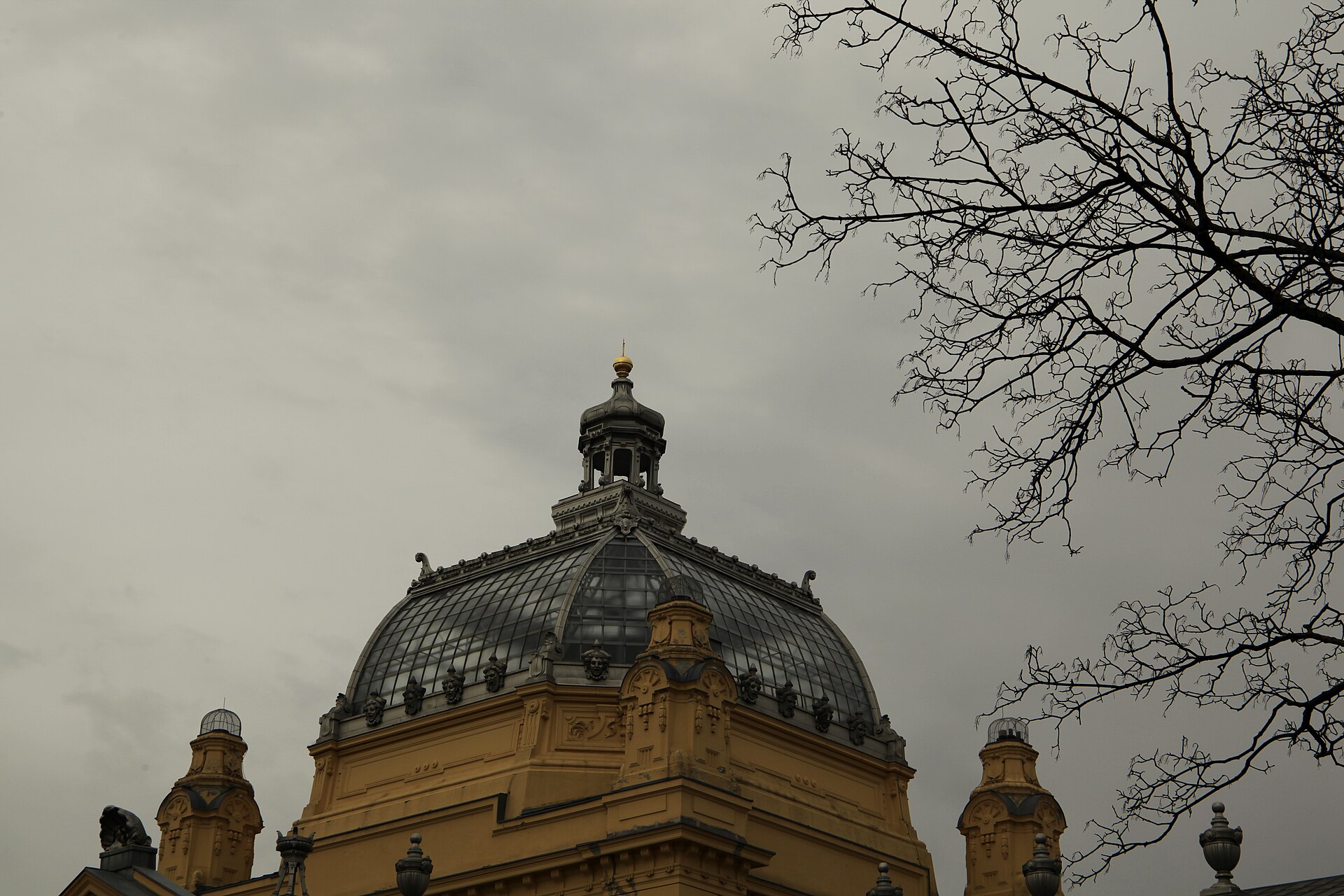
The pavilion's symmetrical yellow facade and central glass dome, photographed from the square, King Tomislav statue and gardens in the foreground. Taken for Wiki Loves Monuments 2017.
Rangan Datta Wiki, CC BY-SA 4.0Art Pavilion in Zagreb
Museum · Umjetnički paviljon u Zagrebu · Founded 1898
Closure confirmed 5 September 2026 · 15 sources
Closed to visitors - not permanently
Art Pavilion in Zagreb is currently closed. Not open and not permanently closed. The institution's own renovation project page states the works run from 24 September 2020 to 31 July 2026, funded through the EU Solidarity Fund, the EU's NextGenerationEU programme and the Croatian state budget. The institution's own homepage, read the same day, lists every current exhibition and event as taking place at other Zagreb venues or at a temporary space rather than at Trg kralja Tomislava, and its banner for the 3-6 September 2026 Zagrebacki muzejski vikend (Zagreb Museum Weekend) advertises only free entry and guided tours of the building, not normal visiting hours. The Zagreb Museum Weekend's own page for the pavilion, read the same day, states directly that the main building remains closed for restoration after the 2020 earthquake, that its current programming runs from a temporary exhibition space at Tomasiceva 12, and that guided tours of the building are offered only as a special event during the museum weekend. This follows severe damage in the March 2020 Zagreb earthquake.
Expected to reopen: end of 2026 · a target, not yet confirmed
Closure confirmed from the institution's own page. We re-check this page on a schedule and will update it, from the institution's own announcement, the moment it reopens.
On this page 15 sections
ContentsClose
The Art Pavilion holds no permanent collection and never has: it is a kunsthalle in the strict sense, built and used since 1898 for temporary exhibitions on rotation rather than a standing display. Its historical strength lies in continuity of use rather than in a room of masterpieces to visit - on the order of 700 exhibitions staged here since the doors opened, spanning the inaugural 1898 Croatian Salon of secession-influenced painters, several decades as the regular home of the Zagreb Salon through the 1930s, a six-decade run as venue for the Association of Croatian Architects' own Zagreb Salon of Architecture and Urbanism, and, on English Wikipedia's tertiary summary of the institution's own account, later loan exhibitions naming Auguste Rodin, Henry Moore, George Grosz and Andy Warhol among the international artists shown here. None of that material belongs to the pavilion itself; it travelled in and out again exhibition by exhibition, which is exactly why this page describes landmark past exhibitions and the building's own architectural and institutional history rather than an inventory of objects on view, and why the archive's own holdings drawn from records.json are not expected to be populated against this venue in the way they would be for a collecting museum.
| Local name | Umjetnički paviljon u Zagrebu |
|---|---|
| Kind | Museum |
| Founded | Inaugurated 15 December 1898 in a prefabricated iron-framed pavilion built in 1896 for the Millennium Exhibition in Budapest and moved to Zagreb the following year |
| City and country |  Zagreb, Croatia Zagreb, Croatia |
| Address | Trg kralja Tomislava 22, 10000 Zagreb, Croatia |
| Website | umjetnicki-paviljon.hr |
| Status | Closed temporarily, confirmed |
| Record last verified |
Visiting
- Hours (pre-closure)
- Tuesday-Thursday (pre-closure schedule)11:00 to 22:00Pre-closure hours published by the Zagreb tourist board. Not currently in effect; see open_status above.
- Friday (pre-closure schedule)11:00 to 21:00Pre-closure hours published by the Zagreb tourist board. Not currently in effect.
- Saturday-Sunday (pre-closure schedule)11:00 to 20:00Pre-closure hours published by the Zagreb tourist board. Not currently in effect.
- Monday (pre-closure schedule)Closed, in the pre-closure schedule, as is standard for Croatian museums.
- Closed
- Monday, in the pre-closure schedule, and during exhibition changeovers. Currently closed every day to regular visitors during reconstruction: the institution's own project page and the Zagreb Museum Weekend's own 2026 page for the pavilion both describe the main building as still shut, with only occasional guided tours and a temporary exhibition space at Tomasiceva 12 standing in for normal opening hours..
- Admission (pre-closure)
- Standard admission, low end of the range (pre-closure figure)HRK 40Recorded by the Zagreb tourist board as the lower end of a 40-100 kuna range that varied by exhibition. Not a current, payable price: the building has been closed to regular visitors since the 2020 earthquake, and Croatia has since adopted the euro.
- Standard admission, high end for larger exhibitions (pre-closure figure)HRK 100The upper end of the same pre-closure range published by the Zagreb tourist board; ticketing varied by the exhibition on show rather than by one fixed price.
- Single ticket reported by a visitor (pre-closure figure)HRK 60A specific pre-closure ticket price, roughly 8 euro at the pre-2023 exchange rate, reported in a Tripadvisor review of an indoor exhibition. Kept as a separate data point alongside the tourist board's range rather than averaged into it.
Free entry: No free-admission day is published in the sources read for this record; the museum's 3-6 September 2026 Zagreb Museum Weekend participation offers free entry to its temporary programme, but that is a dated one-off event rather than a standing policy- Do I need to book?
- Not applicable while the building is closed. Before the 2020 closure, exhibitions were walk-in, on the tourist board's own description.
- Address
- Trg kralja Tomislava 22, 10000 Zagreb, Croatia MapRail Zagreb's Glavni kolodvor (Main Station) sits directly across Trg kralja Tomislava from the pavilion, at the southern end of the same square.
Tram Zagreb Electric Tram (ZET) lines serving the Glavni kolodvor stop at the square's southern edge include lines 6, 13, 31 and 34, which continue west toward Zrinjevac park and Ban Jelacic Square. - Website
- umjetnicki-paviljon.hr
- Telephone
- +385 1 4876 487
- [email protected]
Before you go how long, access, photography, bags, eating, shop
- How long to allow
- Not applicable while closed. Before the earthquake, one Tripadvisor reviewer described the gallery itself as a small space of essentially one long room, suggesting a visit measured in well under an hour once inside; the building's own grounds and facade were, on the same reviews, treated as worth the stop on their own.
- Access
- Not published in the sources read for this record.
- Photography
- Not published in the sources read for this record.
- Bags
- Not published in the sources read for this record.
- Eating
- Croatian Wikipedia's own account states the ground floor held a cafe-exhibition space through the first half of the twentieth century, closing after the Second World War, after which the ground floor was used for temporary exhibitions and storage instead. Nothing in the sources read here states whether a cafe operates today or is planned for the rebuilt pavilion.
- Shop
- Not published in the sources read for this record.
The museum is closed (see above). These are the figures published before the closure, kept here for a visitor planning ahead rather than presented as bookable today, and you can check the current position at the source we used. We will re-confirm them once it reopens.
What is inside
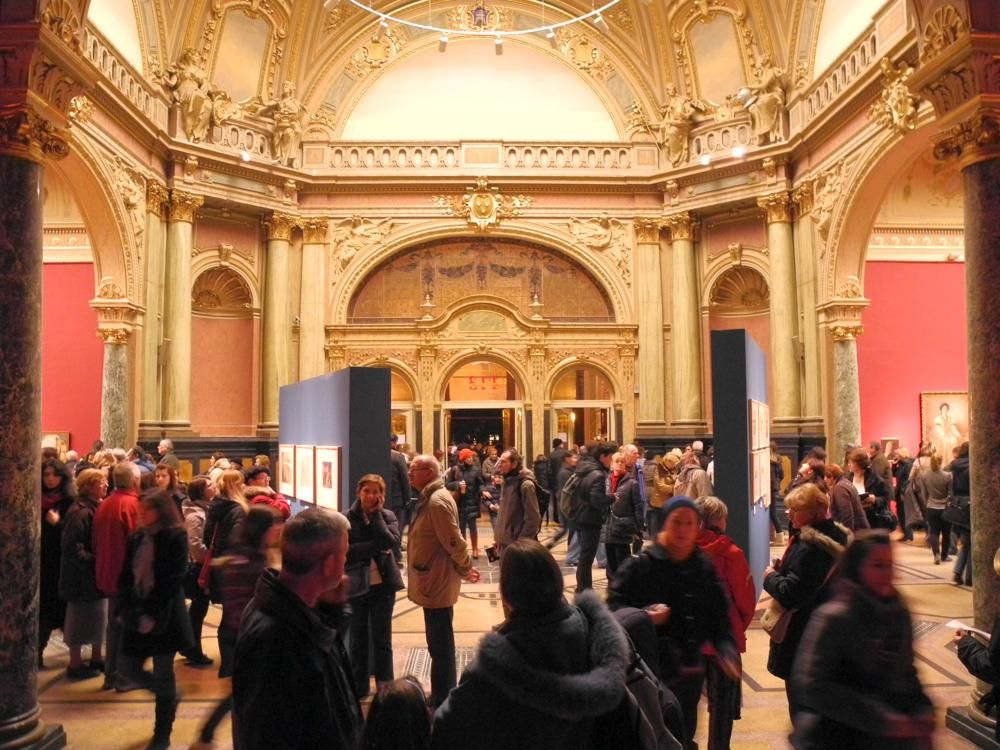
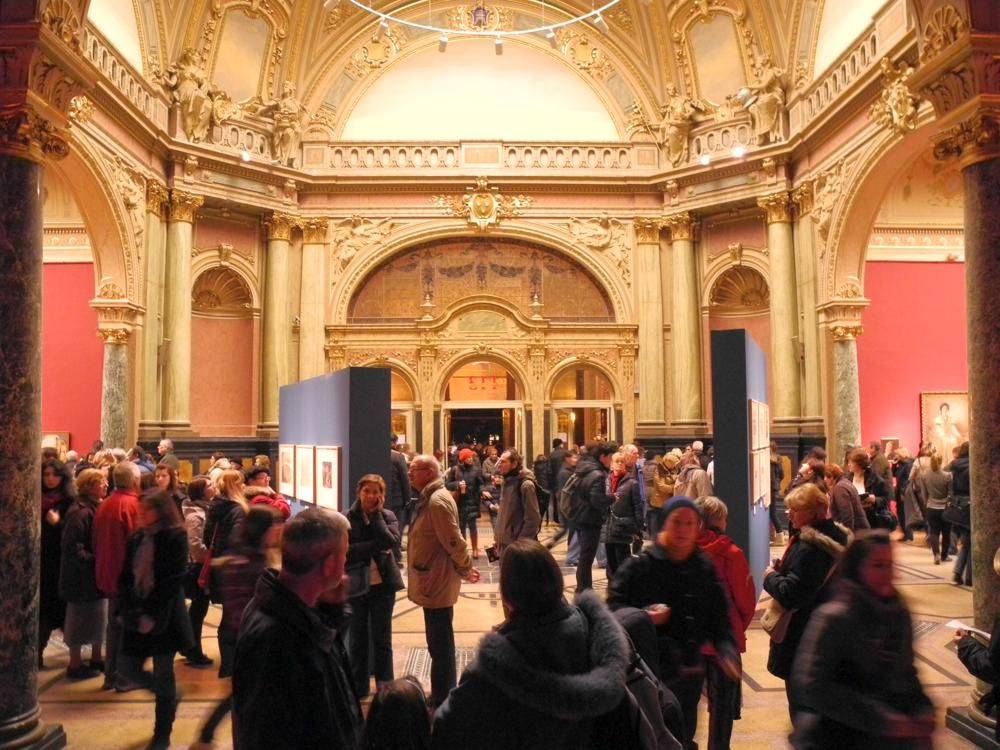
Photograph by Roberta F. · CC BY-SA 3.0 Main exhibition hall, under the central dome
The pavilion's principal hall, roofed by the building's 31-metre glass and steel dome, has hosted the large loan and group exhibitions the institution is built around since the 1898 opening show, the Croatian Salon. A 2012 photograph taken during Zagreb's Night of Museums shows the hall's arched, gilded architecture and a temporary exhibition installed inside it, crowded with visitors on the late-opening night.
East hall
One of two halls flanking the central dome, connected to it by the roof structure the 2020s reconstruction has been reinforcing with new steel framing and gable walls. The building's east facade, above this wing, carries sculpted busts of the painters Giulio Clovio, Andrea Schiavone and Vittore Carpaccio. No free-licence photograph of this hall's interior was located on Wikimedia Commons.
West hall
The second of the two flanking halls, beneath a west facade carrying sculpted busts of Michelangelo, Raphael and Titian. Together with the east hall it gave the pavilion the additional floor area that let it host the Zagreb Salon through the 1930s and, later, large touring exhibitions. No free-licence photograph of this hall's interior was located on Wikimedia Commons.
Ground floor and basement level
The ground floor held a cafe-exhibition space through the first half of the twentieth century before that catering use ended after the Second World War, leaving the space for temporary exhibitions and storage. The basement beneath it had never been open to the public at all until December 2024, when it was used, mid-reconstruction, for a one-off exhibition tied to the Zagreb Salon of Architecture and Urbanism; reporting on that opening states part of the space will become office use once the rebuild is finished, so it will not return to public view in the same form. No free-licence photograph of either space was located on Wikimedia Commons.
What to see first
The Croatian Salon, 15 December 1898
Organised by the Society of Croatian Artists, led by the painter Vlaho BukovacThe pavilion's inaugural exhibition, marking the opening of the building on its permanent site, drew a reported 10,000 visitors at a time when Zagreb's total population was about 60,000, and represented the public debut of a younger, secession-influenced generation of Croatian painters who had just split from the older Society of Arts.9
A pavilion built twice, in two countries
Architects Floris Korb and Kalman Giergl (Budapest, 1896); redesigned for Zagreb by Ferdinand Fellner and Hermann HelmerThe building began as a prefabricated iron-skeleton structure built in Budapest for the 1896 Millennium Exhibition, fabricated by the Danubius shipyard, at Vlaho Bukovac's urging that it be built so it could later be dismantled and shipped to Zagreb. Its steel frame was then redressed in Renaissance-revival stone dress by different architects for its permanent site.11
The facade sculpture programme
Unattributed academic sculpture, installed with the 1897-1898 constructionBusts of six Renaissance-era painters flank the building's two long facades: Giulio Clovio, Andrea Schiavone and Vittore Carpaccio to the east, Michelangelo, Raphael and Titian to the west, tying a building holding no old-master collection of its own to the wider European painting tradition by name alone.9
Continuous host of the Zagreb Salon of Architecture and Urbanism
Association of Croatian ArchitectsThe pavilion hosted the first Zagreb Salon of Architecture and Urbanism roughly six decades ago and was still its venue for the 59th edition in December 2024, held mid-reconstruction in the building's never-before-opened basement precisely because the main halls remained shut.7
Around 700 exhibitions and no permanent collection
Various, 1898 to the presentOn English Wikipedia's tertiary summary of the institution's own account, the pavilion has staged on the order of 700 exhibitions since 1898, including work by Auguste Rodin, Henry Moore, George Grosz and Andy Warhol among others, while never holding a standing display of its own; every exhibition arrived and left again.9
Listed as an individually protected Cultural Good of Croatia
Register of Cultural Goods of the Republic of Croatia, entry Z-222The building carries individual heritage protection under Croatian law, entry Z-222, recorded on its own Wikimedia Commons file descriptions and cited in its Wikidata record, which is part of why its post-earthquake repair is being carried out as a full conservation project rather than a simple structural patch.1
The 2020 earthquake and the largest rebuild in the pavilion's history
Reconstruction contracted through Croatia's Ministry of Culture and MediaThe March 2020 Zagreb earthquake damaged the building badly enough to close it outright; the Ministry of Culture and Media has since contracted 22.46 million euro for its repair, funded through the state budget and the National Recovery and Resilience Plan, of which 5.9 million euro covered structural stabilisation alone, described by the ministry's own officials as the most complete restoration the building has had since 1898.4
A pavilion built for one city and moved to another
The Art Pavilion did not begin as a Zagreb building at all. In 1895 the painter Vlaho Bukovac persuaded Croatian artists and officials to take part in the following year's Millennium Exhibition in Budapest, marking a thousand years of Hungarian statehood, and to insist on one condition: that whatever pavilion Croatia built there should have an iron skeleton light enough to be dismantled afterward and shipped home. A public competition selected the Hungarian architects Floris Korb and Kalman Giergl, and the Danubius shipyard in Budapest fabricated the steel frame, its dome rising some 31 metres.
After the Budapest exhibition closed, the frame travelled to Zagreb, where the Vienna-based architectural firm of Ferdinand Fellner and Hermann Helmer, already responsible for the Croatian National Theatre, redesigned it for a permanent site on what is now Trg kralja Tomislava, with construction carried out by the contractors Hoenigsberg and Deutsch under the city's own building supervision. The pavilion opened in its finished, permanent form on 15 December 1898, with an inaugural exhibition called the Croatian Salon that showcased a younger, secession-influenced generation of painters around Bukovac, who had just broken away from the older Society of Arts to found the Society of Croatian Artists. A reported 10,000 people came to see it, in a city of roughly 60,000.
An iron skeleton dressed as a Renaissance-revival hall
What visitors saw in 1898, and what stands on the square today, is a building whose engineering and whose decoration come from two different projects entirely. Under the historicist stonework and the glass-and-steel dome is still the prefabricated iron frame built for Budapest; over it sits a design that dresses that frame in the vocabulary of academic European architecture, complete with sculpted busts naming six Renaissance-era painters across its two long facades - Giulio Clovio, Andrea Schiavone and Vittore Carpaccio to the east, Michelangelo, Raphael and Titian to the west. The building is entered symmetrically from the square, its dome the tallest and most photographed part of the composition, visible above the surrounding trees of the Lenuci Horseshoe park system that Zagreb's planners laid out around the city's inner ring of squares.
The pavilion is registered as an individually protected Cultural Good of the Republic of Croatia under entry Z-222, a designation that treats the building as historically significant in its own right rather than only as a container for whatever exhibition happens to be inside it. That status is part of why its post-earthquake repair, discussed further below, has been budgeted and carried out as a full conservation project rather than a simple structural patch.
A hall built for exhibitions, never for a collection
From its first day the pavilion was designed to hold temporary exhibitions on rotation rather than a standing display, and it has never departed from that model. On the tertiary summary given by English Wikipedia, drawing on the institution's own account of itself, the building has staged on the order of 700 exhibitions since 1898 across a display area of about 600 square metres, hosting Croatian artists alongside international names that the same summary lists as including Auguste Rodin, Henry Moore, George Grosz and Andy Warhol. None of that material belongs to the pavilion; every exhibition arrived from elsewhere and left again once its run ended, which is the entire logic of a kunsthalle as distinct from a collecting museum.
That same rotating-exhibition role extended beyond painting and sculpture. The pavilion became the regular home of the Zagreb Salon through the 1930s, and, in a much longer-running arrangement, has hosted the Association of Croatian Architects' own Zagreb Salon of Architecture and Urbanism for roughly six decades, an association durable enough that when the 59th edition of that architecture salon needed a venue in December 2024, it was held here even though the building's main halls were still shut for post-earthquake reconstruction - organisers used the pavilion's basement instead, opened to the public for the first time in the building's history for exactly that purpose.
Between exhibitions: a cafe, a storeroom, and newer rivals
Croatian Wikipedia's own account of the building's history describes a more workaday life running alongside its exhibition calendar. Through the first half of the twentieth century the ground floor doubled as a cafe and informal exhibition space; that catering use ended after the Second World War, after which the ground floor served temporary exhibitions and object storage rather than food service. The building also stopped being Zagreb's only serious exhibition venue well before the war finished the century out: the Home of Croatian Fine Artists, a separate, later building on Trg zrtava fasizma with its own famous domed hall, and, much later, the Museum of Contemporary Art and the Klovicevi dvori Gallery in the Upper Town, all opened as competing spaces in their own right. Each of those three is a distinct institution from the Art Pavilion described on this page, occupying a different building with its own history.
That competition did not retire the pavilion; it simply changed what kind of shows it was best suited to host, favouring the large-scale loan and group exhibitions its single main hall and two flanking wings could accommodate, rather than a standing modern-art collection of the kind the newer venues were built to hold.
A seven-year refit finished in 2013, undone by an earthquake in 2020
The most recent full-scale renovation before the current one ran from 2006 to 2013, replacing the building's glass roof and lighting systems in a project English Wikipedia's summary describes as taking seven years to complete. That work meant the pavilion entered the 2010s in its best physical condition in decades, hosting its ordinary programme of touring exhibitions through the rest of that decade.
The March 2020 Zagreb earthquake ended that. The pavilion suffered damage severe enough to force an outright closure, and further seismic activity in the Petrinja area later the same year compounded it; the Ministry of Culture and Media's own account, given by its director general of cultural heritage at a September 2025 site visit, describes both the Art Pavilion and the nearby Mimara Museum, a separate institution, as having suffered comparably serious structural damage in the same sequence of earthquakes. Where the 2006-2013 project had been a voluntary upgrade, what followed 2020 was a forced, structural rebuild with no exhibition programme running inside the building at all.
Rebuilding under EU funding, on a target that has already moved once
The institution's own renovation project page states the work runs from 24 September 2020 to 31 July 2026, financed through the European Union's Solidarity Fund, the EU's NextGenerationEU programme and the Croatian state budget. The Ministry of Culture and Media has separately confirmed contracting 22.46 million euro for the project, of which 5.9 million euro covered structural stabilisation on its own: reinforcing masonry walls by injection and an FRCM fibre system, building new steel structures inside both towers, tying the roofs of the east and west halls into the central structure with new steel framing, and underpinning the foundations.
Timelines given along the way have moved. Zagreb's city government said in August 2024 that the structural phase alone was targeted for completion that October. In September 2025 the culture minister told reporters the Art Pavilion's works should be finished in January, as part of an announcement that both the pavilion and the Mimara Museum were targeted for completion during 2026. By September 2026, the Zagreb Museum Weekend's own current page for the pavilion still described the main building as closed for restoration, its programme running instead from a temporary exhibition space at Tomasiceva 12, with only guided tours of the building itself on offer as a dated special event rather than as regular visiting hours, and reopening now put at the end of 2026 rather than the January date given a year earlier. This page treats that end-of-2026 figure as a target rather than a confirmed date, in keeping with a timeline that has already slipped more than once.
Visiting, before the closure
The figures a visitor would have used to plan a trip here before 2020 still exist on record, even though none of them can be acted on today. Zagreb's own tourist board listed hours of 11:00 to 22:00 Tuesday to Thursday, 11:00 to 21:00 on Friday, and 11:00 to 20:00 on Saturday and Sunday, closed Mondays, with admission running 40 to 100 kuna depending on the exhibition on show; a Tripadvisor reviewer separately recalled paying 60 kuna, then roughly 8 euro, for a specific indoor exhibition. Both figures predate Croatia's adoption of the euro on 1 January 2023, which happened while the building was already closed, so neither has ever been charged in the currency Croatia now uses.
Visitor reviews from that period rated the pavilion 4.1 out of 5 across 147 Tripadvisor reviews, praising the building and its gardens far more consistently than any single exhibition, and occasionally noting that the gallery itself, once inside, was a modest single hall rather than a sprawling museum. That reception sits alongside a newer and simpler complaint, recorded directly by at least one visitor since 2020: that there was nothing to see because the building was shut.
What visitors say
Before the 2020 earthquake, Tripadvisor visitors rated the Art Pavilion 4.1 out of 5 across 147 reviews. The consistent praise is for the building itself rather than for any single exhibition: the yellow Art Nouveau facade, the glass dome, the sculpted busts of Renaissance painters, and the fountain and gardens of Trg kralja Tomislava in front of it. Reviews that did catch an exhibition inside generally rated the experience well, though a few found the single main hall a small return on the ticket price. Since the earthquake, the one consistent complaint has shifted entirely: visitors arriving to find the building shut, with nothing to see beyond the closed doors.
What is praised, what is criticised
- Praised: the Art Nouveau and historicist exterior, its yellow facade, glass dome and sculpted busts of Renaissance painters, repeatedly singled out as one of Zagreb's most photogenic buildings
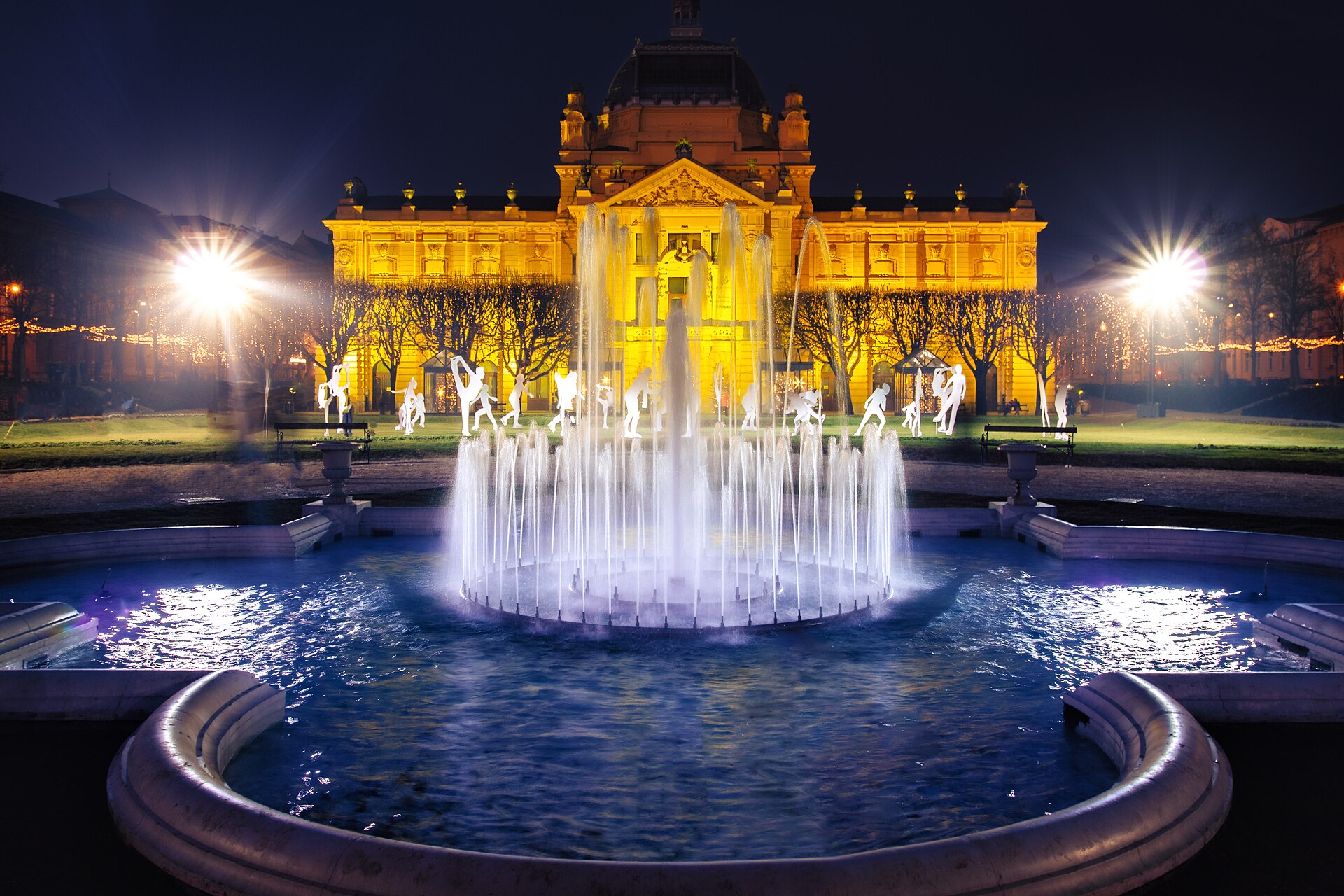
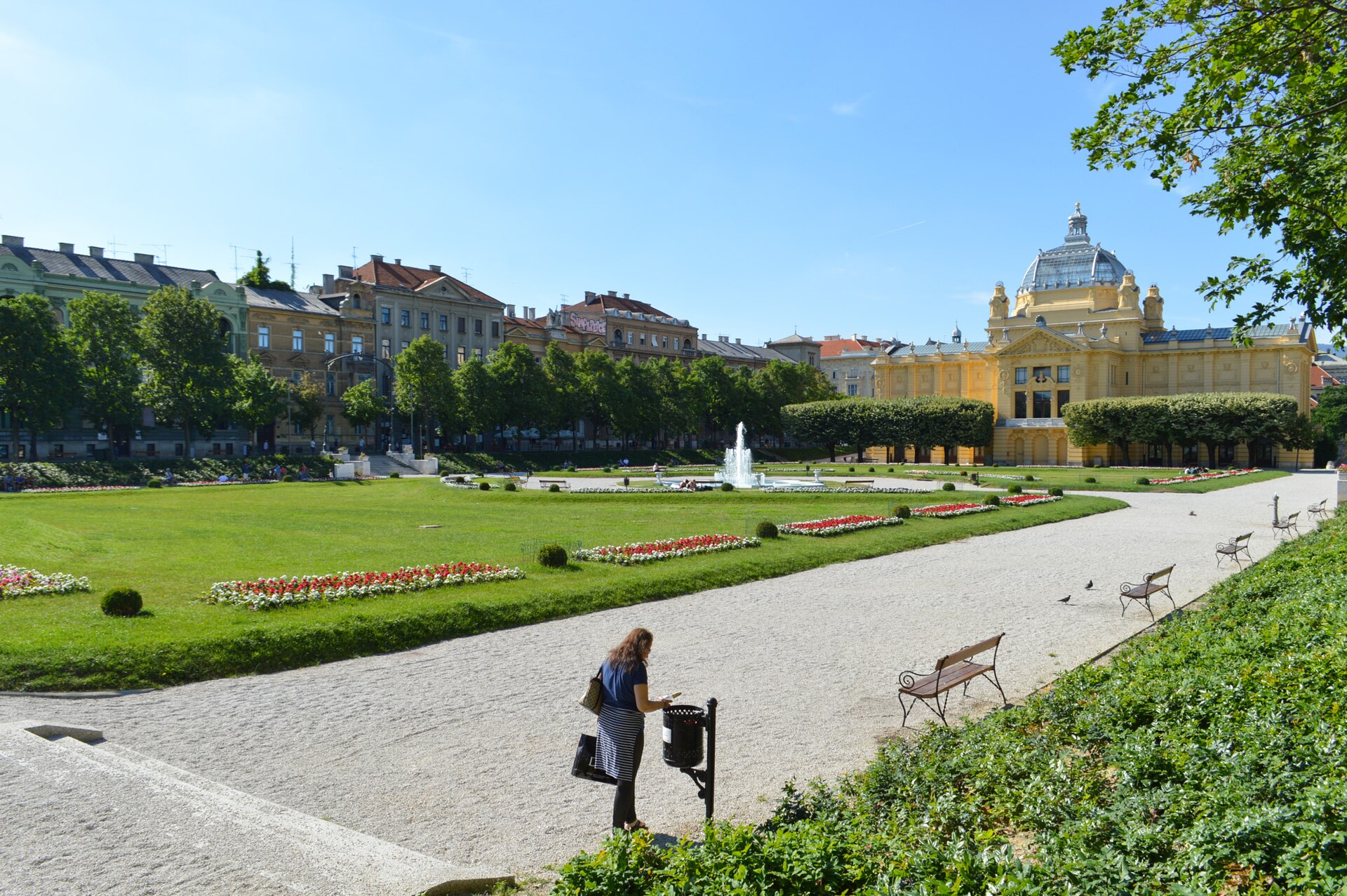
- Praised: the formal gardens, fountain and lawns of Trg kralja Tomislava directly in front of the pavilion, praised on their own terms independent of whether the building itself is open
- Praised: the exhibitions themselves, where reviewers caught one before the closure, with several visitors naming specific loan shows they found worth the ticket
- Criticised: the closure itself, called out directly by at least one visitor: "it is a shame that it is temporarily closed"
- Criticised: the modest scale of the exhibition space relative to the grandeur of the facade, with one visitor describing the gallery as essentially one long room
Ratings on other platforms
Tripadvisor: 4.1 from 147 ratings, read 5 September 2026
A platform average is a tertiary source: it moves, it is not audited, and we quote no visitor's words.
Questions about Art Pavilion in Zagreb
Where is Art Pavilion in Zagreb?
Trg kralja Tomislava 22, 10000 Zagreb, Croatia.
How much does it cost to visit?
Standard admission, low end of the range (pre-closure figure): HRK 40; Standard admission, high end for larger exhibitions (pre-closure figure): HRK 100; Single ticket reported by a visitor (pre-closure figure): HRK 60. As confirmed 5 September 2026.
When is it open?
Tuesday-Thursday (pre-closure schedule) 11:00-22:00; Friday (pre-closure schedule) 11:00-21:00; Saturday-Sunday (pre-closure schedule) 11:00-20:00; Monday (pre-closure schedule) closed. Closed: Monday, in the pre-closure schedule, and during exhibition changeovers. Currently closed every day to regular visitors during reconstruction: the institution's own project page and the Zagreb Museum Weekend's own 2026 page for the pavilion both describe the main building as still shut, with only occasional guided tours and a temporary exhibition space at Tomasiceva 12 standing in for normal opening hours. As confirmed 5 September 2026.
How do you get there?
Rail: Zagreb's Glavni kolodvor (Main Station) sits directly across Trg kralja Tomislava from the pavilion, at the southern end of the same square; Tram: Zagreb Electric Tram (ZET) lines serving the Glavni kolodvor stop at the square's southern edge include lines 6, 13, 31 and 34, which continue west toward Zrinjevac park and Ban Jelacic Square.
What should you see first?
The Croatian Salon, 15 December 1898 (Organised by the Society of Croatian Artists, led by the painter Vlaho Bukovac); A pavilion built twice, in two countries (Architects Floris Korb and Kalman Giergl (Budapest, 1896); redesigned for Zagreb by Ferdinand Fellner and Hermann Helmer); The facade sculpture programme (Unattributed academic sculpture, installed with the 1897-1898 construction); Continuous host of the Zagreb Salon of Architecture and Urbanism (Association of Croatian Architects); Around 700 exhibitions and no permanent collection (Various, 1898 to the present); Listed as an individually protected Cultural Good of Croatia (Register of Cultural Goods of the Republic of Croatia, entry Z-222).
What we could not confirm
- The reopening date has moved at least twice in the sources read for this record: a structural-phase target of October 2024 (Zagreb city government, August 2024), a January completion target for the full works (the culture minister, September 2025), and an end-of-2026 estimate still current on the Zagreb Museum Weekend's own page in September 2026. This page treats end-of-2026 as the operative but unconfirmed estimate and flags the earlier slippage explicitly rather than presenting any of these dates as settled.
- The named international artists said to have exhibited here (Rodin, Moore, Grosz, Warhol) are sourced only to English Wikipedia's tertiary summary of the institution's own account. No primary exhibition record, catalogue or dated press account confirming any specific show among these names was located in the sources read for this record.
- The 40-100 kuna and 60-kuna admission figures recorded here are the last pre-closure figures located in the sources read for this record, but neither source dates the figure to a specific year within the pre-2020 period, and both are denominated in Croatian kuna, the currency in use before Croatia adopted the euro on 1 January 2023.
- Sources read for this record do not state whether a cafe or shop is planned for the rebuilt pavilion, nor whether the pre-closure absence of published accessibility, photography or bag-policy information reflects a real gap in the institution's own published material or simply a gap in what this desk was able to locate.
Images
Sources
- 1Wikidata, Art Pavilion in Zagreb (Q391613). Verified by label match and by claims: inception 15 December 1898, coordinates 45.80722 / 15.97861, architects Floris Korb and Kalman Giergl, heritage registration Z-222 in the Register of Cultural Goods of Croatia, official website and telephone numbers. wikidata.org/wiki/Q391613
- 2Umjetnicki paviljon u Zagrebu, institution's own homepage. Read 5 September 2026: every listed current exhibition and event (Muzej grada Zagreba, Arheoloski muzej u Zagrebu, Taichung Art Museum, Drustvo arhitekata Zagreba) is hosted at another venue rather than at Trg kralja Tomislava; the homepage's own featured banner advertises the pavilion's participation in the 3-6 September 2026 Zagreb Museum Weekend with free entry, not standing visiting hours. umjetnicki-paviljon.hr
- 3Umjetnicki paviljon u Zagrebu, 'Obnova umjetnickog paviljona' (Renovation of the Art Pavilion), the institution's own project page. States the project name, contract number 74-0017-21, an implementation period of 24 September 2020 to 31 July 2026, and funding from the EU Solidarity Fund, EU NextGenerationEU and the Croatian state budget. umjetnicki-paviljon.hr/obnova-umjetnickog-paviljona/
- 4Ministarstvo kulture i medija Republike Hrvatske, 'Za 2026. najavljen zavrsetak radova obnove Muzeja Mimara i Umjetnickog paviljona u Zagrebu', published 23 September 2025. The minister's site visit, the 22.46 million euro contracted for the Art Pavilion's renovation (5.9 million euro of it for structural work alone), the scope of structural interventions, and the minister's statement that Art Pavilion works should be finished in January, as part of a 2026 completion announcement for both the Art Pavilion and the separate Mimara Museum. min-kulture.gov.hr/vijesti-8/za-2026-najavljen-zavrsetak-radova-obnove-muzeja-mimara-i-umjetnickog-paviljona-u-zagrebu/28582
- 5Grad Zagreb, 'Konstrukcijska obnova Umjetnickog paviljona u zavrsnoj fazi', published 9 August 2024. The deputy mayor's site visit, a stated target of late October 2024 for completion of the structural renovation phase, the phases still to follow (comprehensive renovation, interior fit-out, exhibition preparation), and city-wide earthquake-recovery context (207 municipal buildings addressed, 180 completed at the time of publication). zagreb.hr/konstrukcijska-obnova-umjetnickog-paviljona-u-zavr/200452
- 6Journal.hr, 'Sneak peek u Umjetnicki paviljon koji je jos pod obnovom. Znamo kada cete ga moci posjetiti', published 22 October 2024. The pavilion's use as the opening venue of the second Open House Zagreb festival, director Irena Bekic's remarks on the building's structural steel and its history of temporariness, a City of Zagreb announcement that the pavilion should officially reopen in 2026, and confirmation that the 59th Zagreb Salon of Architecture and Urbanism was scheduled to run in the building in December 2024 despite the closure. journal.hr/kultura/umjetnost-i-dizajn/umjetnicki-paviljon-zagreb-obnova/
- 7Haus.hr, 'Od potresa ne mozemo u Umjetnicki paviljon u Zagrebu; sada se nakratko dio otvara'. Confirms closure since the 2020 earthquake with the main exhibition spaces inaccessible, and describes the December 2024 one-off opening of the pavilion's basement, never previously open to the public, for the Association of Croatian Architects' 'Dialogues/Monologues' exhibition (15-31 December 2024) tied to the 59th Zagreb Salon of Architecture and Urbanism, noting part of the basement will become office space once the rebuild is complete. haus.hr/od-potresa-ne-mozemo-u-umjetnicki-paviljon-sad-se-otvara/
- 8Zagrebacki muzejski vikend (Zagreb Museum Weekend), the pavilion's own listing page, read 5 September 2026. States the main building at Trg kralja Tomislava 22 remains closed for restoration after the 2020 earthquake with reopening expected for late 2026, that current programming runs from a temporary exhibition space at Tomasiceva 12, and that the 3-6 September 2026 weekend includes guided tours of the closed building (11:00-12:00) as a dated special event rather than standing visiting hours, plus the contact email [email protected]. zg-muv.hr/muzeji/umjetnicki-paviljon-u-zagrebu/
- 9English Wikipedia, 'Art Pavilion, Zagreb'. The Bukovac-initiated 1896 Budapest pavilion, architects Floris Korb and Kalman Giergl, the Danubius-built iron skeleton, the Fellner and Helmer redesign for Zagreb, the 15 December 1898 opening with the Croatian Salon and its reported 10,000 visitors, the building's 600-square-metre display area and lack of a permanent collection, a figure of about 700 exhibitions including work by Auguste Rodin, Henry Moore, George Grosz and Andy Warhol, the 2006-2013 renovation of the glass roof and lighting, the 2020 earthquake damage, and the Z-222 heritage registration. en.wikipedia.org/wiki/Art_Pavilion,_Zagreb
- 10Open House Zagreb, programme page for the Umjetnicki paviljon. Corroborates the architects Floris Korb and Kalman Giergl, the iron-skeleton construction method, the 15 December 1898 inauguration, and the building's status as a protected cultural asset. openhousezagreb.org/program-ohz/umjetnicki-paviljon/
- 11Croatian Wikipedia, 'Umjetnicki paviljon'. Detail on the 3 December 1895 invitation to participate in the Budapest exhibition, the 1896 architectural competition, the Danubius shipyard construction and 31-metre dome height, the Vienna architects Fellner and Helmer adapting the structure with Bergman directing construction under the city planner Lenuci, the 15 December 1898 opening with the Hrvatski salon, the ground floor's use as a cafe-exhibition space through the first half of the 20th century, the post-war end of that catering use and the ground floor's subsequent use for temporary exhibitions and storage, and the building's role hosting the Zagreb Salon through the 1930s until newer Zagreb exhibition venues opened. hr.wikipedia.org/wiki/Umjetni%C4%8Dki_paviljon
- 12Tripadvisor, Art Pavilion (Umjetnicki Paviljon) attraction page and reviews, Zagreb, Croatia. An aggregate rating of 4.1 out of 5 from 147 reviews, read 5 September 2026; visitor praise for the Art Nouveau exterior, dome and surrounding gardens and fountain; a visitor-reported single-exhibition ticket price of about 60 kuna; visitor criticism including a direct complaint about the temporary closure and a description of the gallery's interior as a small, single-room space. tripadvisor.com/Attraction_Review-g294454-d549759-Reviews-Art_Pavilion_Umjetnicki_Paviljon-Zagreb_Central_Croatia.html
- 13Visit Zagreb, official Zagreb tourist board page for the Art Pavilion. Address, a pre-closure opening-hours schedule (Tuesday-Thursday 11:00-22:00, Friday 11:00-21:00, Saturday-Sunday 11:00-20:00, closed Monday), a pre-closure admission range of 40-100 kuna varying by exhibition, telephone +385 1 4876 487, and email [email protected]. Read 5 September 2026; the page's own description does not reflect the post-2020 closure, so its visiting figures are used here explicitly as last-known pre-closure data rather than as current information. visitzagreb.hr/hr/zagreb/art-pavilion-zagreb/
- 14Croatian Wikipedia, 'Trg kralja Tomislava (Zagreb)'. Confirms the square is bordered on its south side by Zagreb's Glavni kolodvor (Main Station), names the Art Pavilion and the Zagreb Puppet Theatre as the square's other notable buildings, and lists Zagreb Electric Tram (ZET) lines 6, 13, 31 and 34 among those serving the Glavni kolodvor tram stop at the square's southern edge. hr.wikipedia.org/wiki/Trg_kralja_Tomislava_(Zagreb)
- 15Wikimedia Commons, the file pages of the plates shown here (author and licence of each). commons.wikimedia.org/wiki/Category:Art_Pavillon_(Zagreb)