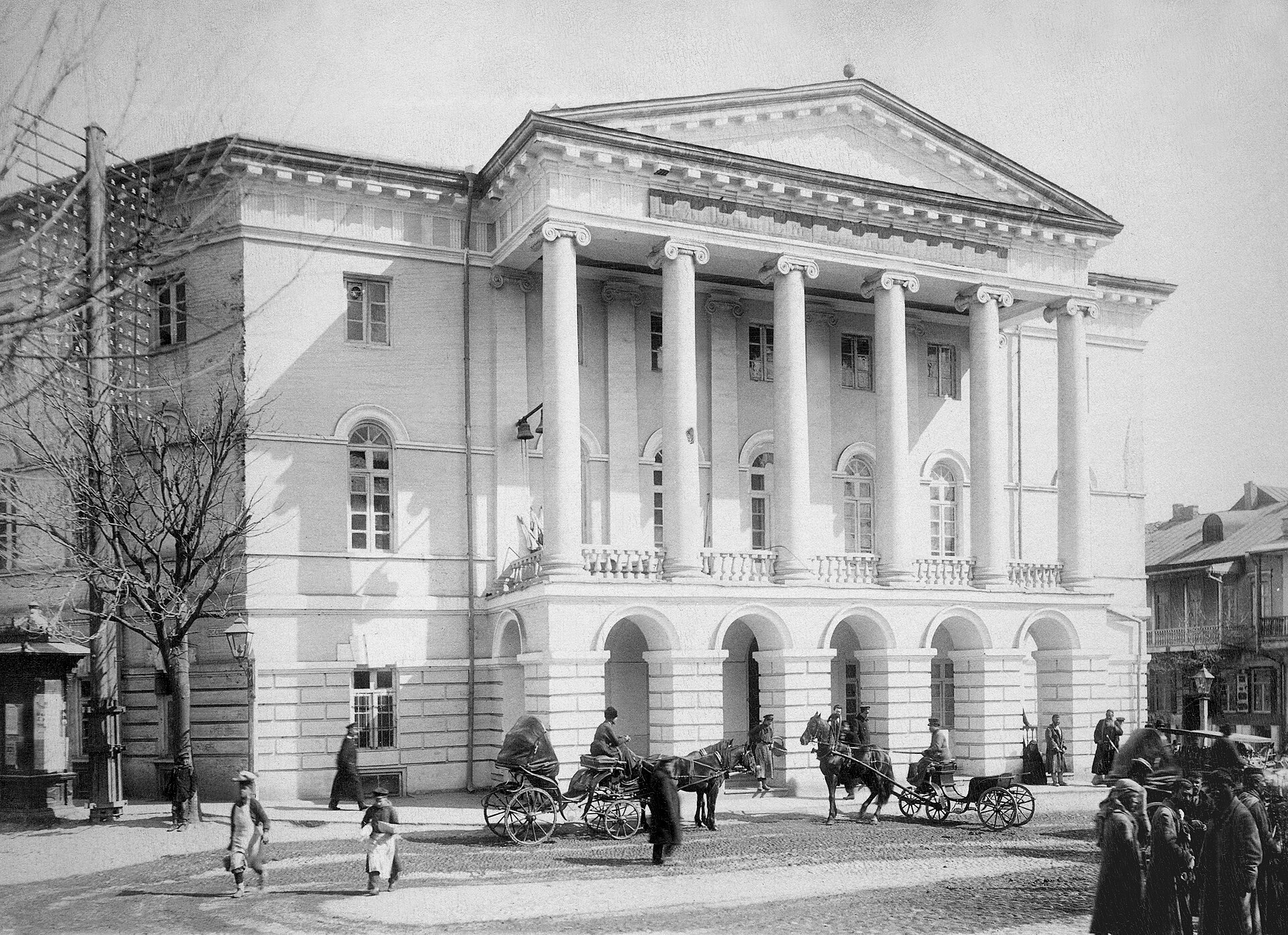
The same building the Art Museum of Georgia occupies today, photographed by Dmitri Yermakov in the late nineteenth century when it still housed the Tiflis Theological Seminary. The museum did not take over the building until 1950; the colonnade and pediment are unchanged.
Public domainArt Museum of Georgia
Museum · საქართველოს ხელოვნების მუზეუმი · Founded 1920
Open, admission and hours confirmed 20 August 2026 · 14 sources
On this page 14 sections
ContentsClose
Georgian medieval metalwork and icon painting is the museum's deepest holding by any measure, anchored by the Treasury and objects like the Ancha Icon. Its Niko Pirosmani rooms and its survey of Georgian painting from 1900 to 1930 are the collection most visitors come for. Its Dutch and Flemish department, built up since 1954, and its Qajar-period Persian holdings are large enough, by outside description, to rank among the more significant such collections in the region, even though neither is the reason most visitors walk in the door.
| Local name | საქართველოს ხელოვნების მუზეუმი |
|---|---|
| Kind | Museum |
| Founded | 1920 |
| City and country |  Tbilisi, Georgia Tbilisi, Georgia |
| Address | 1 Lado Gudiashvili Street, 0105 Tbilisi, Georgia |
| Website | museum.ge/index.php?m=350&museum=45 |
| Status | Open, confirmed |
| Record last verified |
Visiting
- Hours
- Tue-Sun10:00 to 18:00
- Closed
- Monday.
- Admission
- AdultGEL 40Price reported by Wander-Lush in a May 2026 update, after the October 2024 reopening. The museum's own ticket-price page (museum.ge) still displays a much older tariff (3 GEL adult, 0.5 GEL concessions) that predates the renovation and could not be confirmed current during this research pass; see notes_for_editor.
- Tickets
- biletebi.ge The museum's own ticket page.
- Do I need to book?
- No standing-ticket booking reported; the museum's own visit page asks that guided tours for the Treasury be booked by email or phone at least three days ahead
- Address
- 1 Lado Gudiashvili Street, 0105 Tbilisi, Georgia Map
- Website
- museum.ge/index.php?m=350&museum=45
- Telephone
- +995 32 299 99 09
- [email protected]
Before you go how long, access, photography, bags, eating, shop
- How long to allow
- Not stated by the museum; the collection spans medieval Georgian metalwork, a four-room Pirosmani hang, a separate hall of medieval relief sculpture, and European Old Master galleries, which is more ground than a single hour covers
- Access
- Not confirmed in this research pass
- Photography
- The museum's own visitor rules allow personal, non-flash, non-tripod photography in the building and in the permanent displays; photography and video are not permitted in temporary exhibitions, and any recording that may show a staff member needs the museum's consent
- Bags
- A free cloakroom takes coats, umbrellas, large bags and rucksacks, motorcycle helmets and musical instruments; cash, documents, chequebooks, cards and valuables may not be left there, and the museum accepts no liability for items left against that rule
- Eating
- The museum's own site does not describe a cafe for this address
- Shop
- A museum shop sells souvenirs, books, exhibition catalogues, jewellery and accessories, per the museum's own visit page
Prices and hours change. We take them from the institution's own pages and print the day we read them, and you can check the current position at the source we used. Confirm before you travel.
What is inside
The Treasury
The museum's gold fund: repousse and enamelled Georgian icons, cloisonne enamel work, jewellery, and rare embroidered and woven textiles, entered under separate rules and only by pre-booked guided tour. It holds the Ancha Icon of the Savior, a medieval Georgian triptych whose silver-gilt casing was made by the goldsmith Beka Opizari.
Medieval Georgian Relief Sculpture
A hall opened with the October 2024 relaunch, in the rebuilt secondary building: carved stone church facades and altar screens of the tenth and eleventh centuries, shown in dark rooms under dramatic lighting that reviewers single out as the strongest part of the new galleries.
Georgian Art, 1900-1930
Painting and sculpture by Niko Pirosmani, Lado Gudiashvili, David Kakabadze, Elene Akhvlediani and their contemporaries, including newly restored canvases. The Pirosmani rooms alone hold 54 works across four rooms, among them Actress Margarita and Giraffe.
European art, 14th to 20th century
A survey exhibition titled by the museum "From Paolo Veneziano to Wassily Kandinsky", running from the fourteenth century to the 1930s, built around the museum's long-standing Dutch and Flemish holdings: landscapes by Jacob van Ruisdael and Aelbert Cuyp, figures by Dirck Hals, battle scenes by Philips Wouwerman, and still lifes by Jan Davidsz de Heem and Melchior d'Hondecoeter, alongside Italian, Russian and other European painting.
Oriental art
Qajar-period Persian painting and miniatures, among the largest such holdings in any post-Soviet collection, gathered with other art of Iran, Azerbaijan and neighbouring regions.
What to see first
Actress Margarita
Niko PirosmaniOne of the best-known paintings in the museum's four-room Pirosmani hang, and one of the works travel press singles out from the reopened galleries.6
Giraffe
Niko PirosmaniNamed alongside Actress Margarita as one of the 54 Pirosmani works on permanent view since the 2024 reopening.6
Medieval Georgian church relief carvings and altar screens
Unrecorded medieval Georgian stonemasons, 10th-11th centuryThe centrepiece of the museum's newest permanent hall, moved indoors from church facades and shown under lighting designed for it; named by reviewers as the exhibition that most justifies the ticket.5
Ancha Icon of the Savior
Original encaustic panel 6th-7th century; silver-gilt riza by the goldsmith Beka Opizari, 12th centuryA triptych of Georgian goldsmith's work built around an icon medieval sources identified with the Keramidion, the imprint of Christ's face said to have passed by contact from the Image of Edessa. Brought to Tbilisi in 1664 for the church now called Anchiskhati after it, and moved to the museum's Treasury in the 1920s; the Georgian Orthodox Church has repeatedly asked for its return to church use.9
Dutch and Flemish paintings, 17th-20th century
Jacob van Ruisdael, Aelbert Cuyp, Dirck Hals, Philips Wouwerman, Jan Davidsz de Heem, Melchior d'Hondecoeter and othersA department founded in 1954 that has grown through acquisition and donation into one of the museum's strongest holdings outside Georgian art, spanning landscape, genre, battle scene and still life.10
"Georgian Art, 1900-1930"
Lado Gudiashvili, Elene Akhvlediani, David Kakabadze and contemporariesThe exhibition that opened the rebuilt building in October 2024, including canvases restored for the relaunch and tactile copies made for visually impaired visitors.4
Qajar-period Persian miniatures
Various Iranian court painters, Qajar dynastyWikipedia describes the museum's Oriental holdings, built around this material, as among the largest in any post-Soviet country's collections.8
Georgian cloisonne enamel and repousse icons
Various medieval Georgian goldsmithsThe core of the Treasury display, described on the museum's own history page as drawing particular attention alongside the museum's old Georgian wall painting.1
A seminary before it was a museum
The building on Lado Gudiashvili Street that now houses the Art Museum of Georgia was not built for art. It went up in 1838 as a Russian Empire-style structure with a columned portico and a heavy pediment, and for most of the nineteenth century it was the Tiflis Theological Seminary, one of the Russian administration's principal schools in the city. A photograph taken by Dmitri Yermakov in the late nineteenth century, now in the museum's own Commons category, shows exactly this facade: the six-column portico, the arcaded ground floor, carriages waiting in the square in front of it.
The museum did not take the building over until 1950, more than a century after it was built and thirty years after the institution that would become the Art Museum of Georgia had first opened its doors somewhere else entirely. The seminary years are why the facade reads as civic rather than museological: nothing about the colonnade was designed to hang paintings behind it, and the galleries inside have always had to work with rooms built for a different purpose.
From the National Gallery to the State Museum
The institution's own history, published on its site, dates its founding to 1920, when the painter Dimitri Shevardnadze led the opening of a National Gallery in Tbilisi. Georgian society at the time received it enthusiastically, and that early support shaped what came after: by 1932 a government decree reorganised the National Gallery into a Museum of Fine Arts, absorbing the art collections of the Georgian Historical-Ethnographic Society, the Society for the Spread of Literacy Among Georgians, and Tbilisi University's holdings of early Georgian art. The museum was given a building near the thirteenth-century Metekhi church in 1933, and for years afterward was known locally simply as the Metekhi museum. Shevardnadze served as its first director.
The next major event was not architectural but a repatriation. In 1921 the Menshevik government, in the last weeks before Georgia's Sovietisation, took a body of national treasures out of the country to France. It was largely through the efforts of the historian Ekvtime Taqaishvili that those objects were returned to Georgia in 1945, and a substantial part of what came back was handed to the Museum of Fine Arts. Only in 1950 did the museum take the seminary building on Lado Gudiashvili Street that it still occupies, and adopt the name it used for the rest of the twentieth century: the State Museum of Art. The museum's later growth is tied, by its own account, to the long directorship of the art historian and academician Shalva Amiranashvili, whose name the museum still carries.
Absorption into the Georgian National Museum, and a decade dark
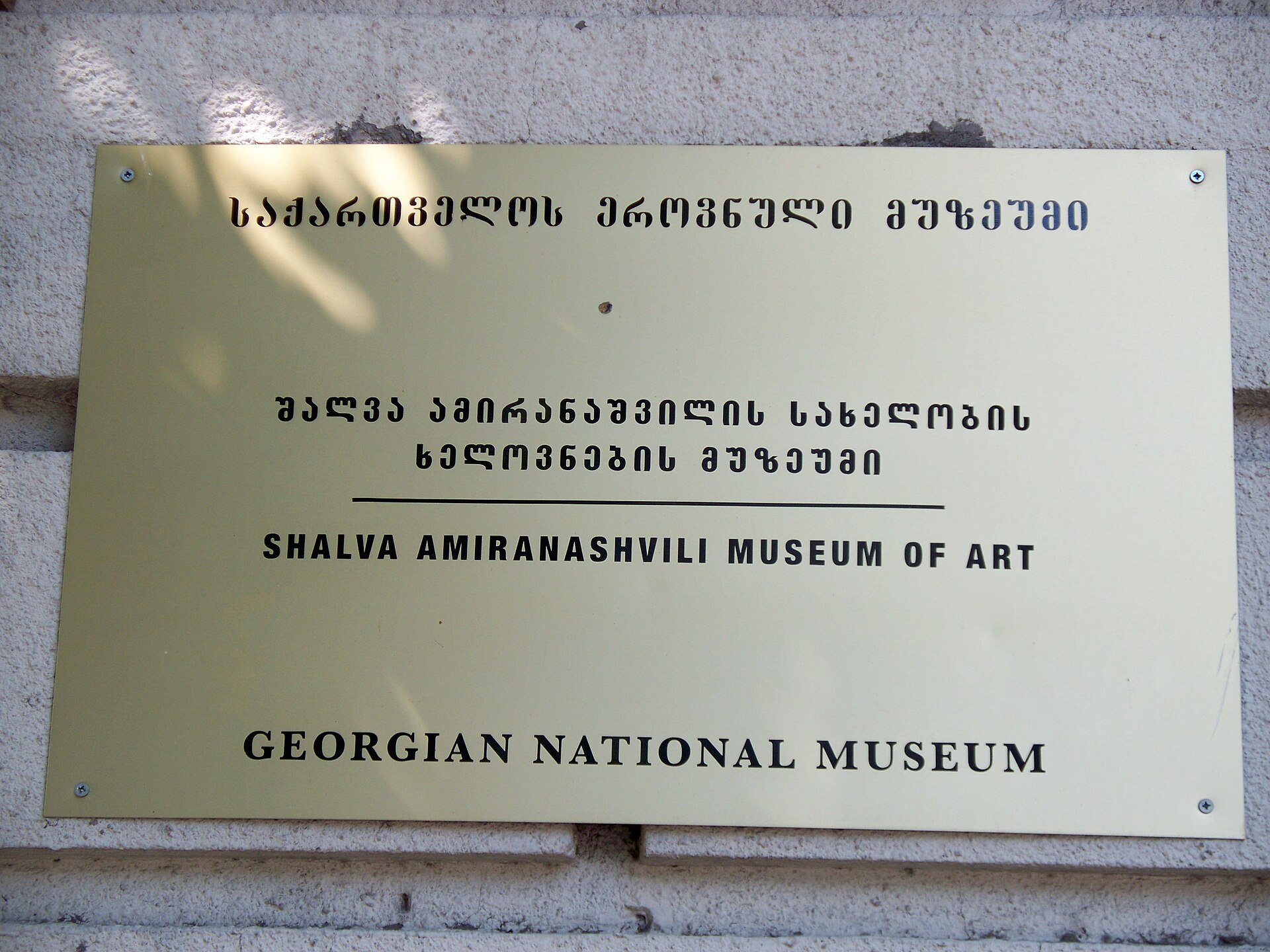
Since 2004 the Shalva Amiranashvili Art Museum has been one of ten museums, a National Gallery, four house-museums and two research centres brought together under the Georgian National Museum, a state agency formed that year to run Georgia's major collections jointly rather than as separate institutions. The Art Museum of Georgia is a department of that umbrella body, not a standalone one, which is why its own website sits inside museum.ge rather than at a dedicated address, and why press coverage sometimes refers to it by the National Museum's name rather than its own.
The seminary building's age eventually caught up with it. Travel coverage of the 2024 reopening describes the museum as having been closed to visitors for close to a decade while its historic main building needed structural rehabilitation. Rather than wait years for that work to finish, Georgia's Ministry of Culture backed a different plan: rebuild the museum's secondary building instead. That project ran from 2021 to 2024 and renovated roughly 6,000 square metres, adding workspaces, conference rooms, storage and new exhibition halls, and it is this rebuilt secondary building, not the 1838 seminary structure itself, that reopened to the public on 8 October 2024 with four new exhibitions.
What the collection actually spans
The museum's own figures put its holdings at around 140,000 objects, and the range is wide even by the standards of a national collection. At one end sits the Treasury: Georgian repousse and enamelled icons, cloisonne enamel work, jewellery and textiles, entered separately from the main galleries and only by prior arrangement, because the objects are gold, silver and centuries old. The Ancha Icon of the Savior belongs here, an icon whose core panel medieval writers identified with a miraculous imprint of Christ's face, later given a silver-gilt casing by the twelfth-century goldsmith Beka Opizari and moved into the museum's care in the 1920s after two and a half centuries in the Tbilisi church that took its name from the icon.
At the other end sits an active, growing survey of European painting built up since a dedicated Western department was formed in 1954: Dutch and Flemish work from the seventeenth to the twentieth century, with landscapes by Jacob van Ruisdael and Aelbert Cuyp, genre painting by Dirck Hals, battle scenes by Philips Wouwerman and still lifes by Jan Davidsz de Heem and Melchior d'Hondecoeter, shown since 2024 as part of a survey the museum itself titles "From Paolo Veneziano to Wassily Kandinsky". Between those two ends sit the collections that draw the largest crowds: four rooms given over to Niko Pirosmani, including Actress Margarita and Giraffe, alongside Lado Gudiashvili, David Kakabadze and Elene Akhvlediani in a gallery devoted to Georgian art of 1900 to 1930; a new hall of tenth- and eleventh-century relief-carved church stonework, moved indoors and lit for effect; and an Oriental department built substantially around Qajar-period Persian miniatures, which Wikipedia's summary of the collection describes as among the largest such holdings anywhere in the former Soviet Union.
Visiting the museum today
The rebuilt museum keeps to Tuesday-to-Sunday hours, ten in the morning to six in the evening, closed Mondays, according to the most recent travel-press account of a visit, published in May 2026. Admission for that visit was 40 Georgian lari, noticeably higher than the roughly 15 lari a visitor reported paying before the renovation closed the building. The museum's own ticket-price page, by contrast, still lists a tariff of 3 lari for an adult and 0.5 lari for students, pensioners and schoolchildren, a page that this research could not confirm has been updated since before the 2021-2024 rebuild; it should be treated as unreliable until the museum republishes it. Enter from Lado Gudiashvili Street, off Pushkin Park, a short walk from Freedom Square. A free cloakroom takes coats, bags, umbrellas and motorcycle helmets; the museum's own visitor rules forbid eating or drinking outside its cafe and courtyard terrace, ban flash and tripod photography, and forbid photography entirely in temporary exhibitions.
What the reopening changed, and what it did not
The 2024 relaunch was reported, and reviewed, as a genuine change in what the museum offers: a new relief-sculpture hall built and lit specifically for its contents, restored canvases in the Georgian-art galleries, tactile copies of some works made for visually impaired visitors, and, according to the same coverage, Georgia's first dedicated museum research and restoration laboratory. The criticism that has followed is correspondingly specific rather than general: lighting in the older galleries is judged weaker than at the neighbouring National Gallery, and the price of admission has risen well beyond what the museum charged before the closure, a change visible on the museum's own site only by the fact that its published tariff has not caught up with what visitors are actually being charged.
A separate and older question sits alongside the architecture and the ticket price. The Ancha Icon of the Savior spent roughly two hundred and fifty years as a working object in an Orthodox church before it entered the museum's Treasury in the 1920s, during the Soviet period, and the Georgian Orthodox Church has repeatedly asked for it to be returned to religious use. The museum's own materials describe the icon as a highlight of its holdings; they do not address the church's claim.
What visitors say
Travel coverage of the October 2024 reopening is positive about scope and design, and openly mixed about detail. The new Medieval Georgian Relief Sculpture hall, staged in dark rooms with deliberate lighting, is repeatedly named as the strongest new space. The same coverage is more guarded about the older wings, where the lighting is judged weaker than at the Georgian National Gallery nearby, and about price, which rose sharply once the rebuilt building opened.
What is praised, what is criticised
- Praised: the Medieval Georgian Relief Sculpture hall and its staging, called worth the ticket on its own
- Praised: the scale of what reopened: four rooms of Pirosmani, a new European survey running from Paolo Veneziano to Kandinsky, and a research and restoration laboratory described as the first of its kind in Georgia
- Criticised: lighting in the galleries outside the new relief-sculpture hall, judged weaker than the National Gallery a short walk away
- Criticised: admission, which travel press describes as markedly more expensive since the 2024 relaunch than the museum's pre-renovation prices
Questions about Art Museum of Georgia
Where is Art Museum of Georgia?
1 Lado Gudiashvili Street, 0105 Tbilisi, Georgia.
How much does it cost to visit?
Adult: GEL 40. As confirmed 20 August 2026.
When is it open?
Tue-Sun 10:00-18:00. Closed: Monday. As confirmed 20 August 2026.
What should you see first?
Actress Margarita (Niko Pirosmani); Giraffe (Niko Pirosmani); Medieval Georgian church relief carvings and altar screens (Unrecorded medieval Georgian stonemasons, 10th-11th century); Ancha Icon of the Savior (Original encaustic panel 6th-7th century; silver-gilt riza by the goldsmith Beka Opizari, 12th century); Dutch and Flemish paintings, 17th-20th century (Jacob van Ruisdael, Aelbert Cuyp, Dirck Hals, Philips Wouwerman, Jan Davidsz de Heem, Melchior d'Hondecoeter and others); "Georgian Art, 1900-1930" (Lado Gudiashvili, Elene Akhvlediani, David Kakabadze and contemporaries).
What we could not confirm
- Whether the museum's own published ticket prices (3 GEL adult, 0.5 GEL concessions) are current or a stale legacy page; travel press reports 40 GEL as of May 2026, a large enough gap that it needs re-checking directly against the museum once its own prices page is confirmed updated.
- Whether or when the 1838 seminary building itself, as opposed to the rebuilt secondary building that reopened in October 2024, will be structurally rehabilitated.
- The Georgian Orthodox Church's repeated requests for the return of the Ancha Icon of the Savior to church use, which the museum's own published materials do not address.
Images
Sources
- 1Art Museum of Georgia, own visit/history/contact page, museum.ge museum.ge/index.php?m=350&museum=45
- 2Georgian National Museum, press releases archive, museum.ge museum.ge/index.php?m=297
- 3Georgian National Museum, current exhibitions listing, museum.ge museum.ge/index.php?m=326
- 4Georgian Ministry of Culture, "Opening of the Shalva Amiranashvili State Museum of Fine Arts of Georgia", art.gov.ge art.gov.ge/en/event/opening-of-the-shalva-amiranashvili-state-museum-of-fine-arts-of-georgia/
- 5Wikipedia, "Art Museum of Georgia" (, used for institutional history only) en.wikipedia.org/wiki/Art_Museum_of_Georgia
- 6Emily Lush, "17 Best Tbilisi Museums & Galleries", Wander-Lush, updated 12 May 2026 wander-lush.org/best-tbilisi-museums-galleries/
- 7Wikidata, Q2028327, Art Museum of Georgia (, identity and coordinates only) wikidata.org/wiki/Q2028327
- 8Wikipedia, "Art Museum of Georgia", collection summary () en.wikipedia.org/wiki/Art_Museum_of_Georgia
- 9Wikipedia, "Ancha icon" () en.wikipedia.org/wiki/Ancha_icon
- 10CODART, "Shalva Amiranashvili Art Museum of the National Museum of Georgia" codart.nl/guide/museums/shalva-amiranashvili-art-museum-of-the-national-museum-of-georgia/
- 11Wikipedia, "Georgian Museum of Fine Arts" (used only to confirm this is a separate institution, not this venue) en.wikipedia.org/wiki/Georgian_Museum_of_Fine_Arts
- 12Wikimedia Commons, File:Image-Tbilisi XIXc 05.jpg, (licence and authorship) commons.wikimedia.org/wiki/File:Image-Tbilisi_XIXc_05.jpg
- 13Wikimedia Commons, File:Tbilisi, Georgia (27786031074).jpg, (licence and authorship) commons.wikimedia.org/wiki/File:Tbilisi,_Georgia_(27786031074).jpg
- 14Wikimedia Commons, Category:Art Museum of Georgia, category listing commons.wikimedia.org/wiki/Category:Art_Museum_of_Georgia

.jpg)