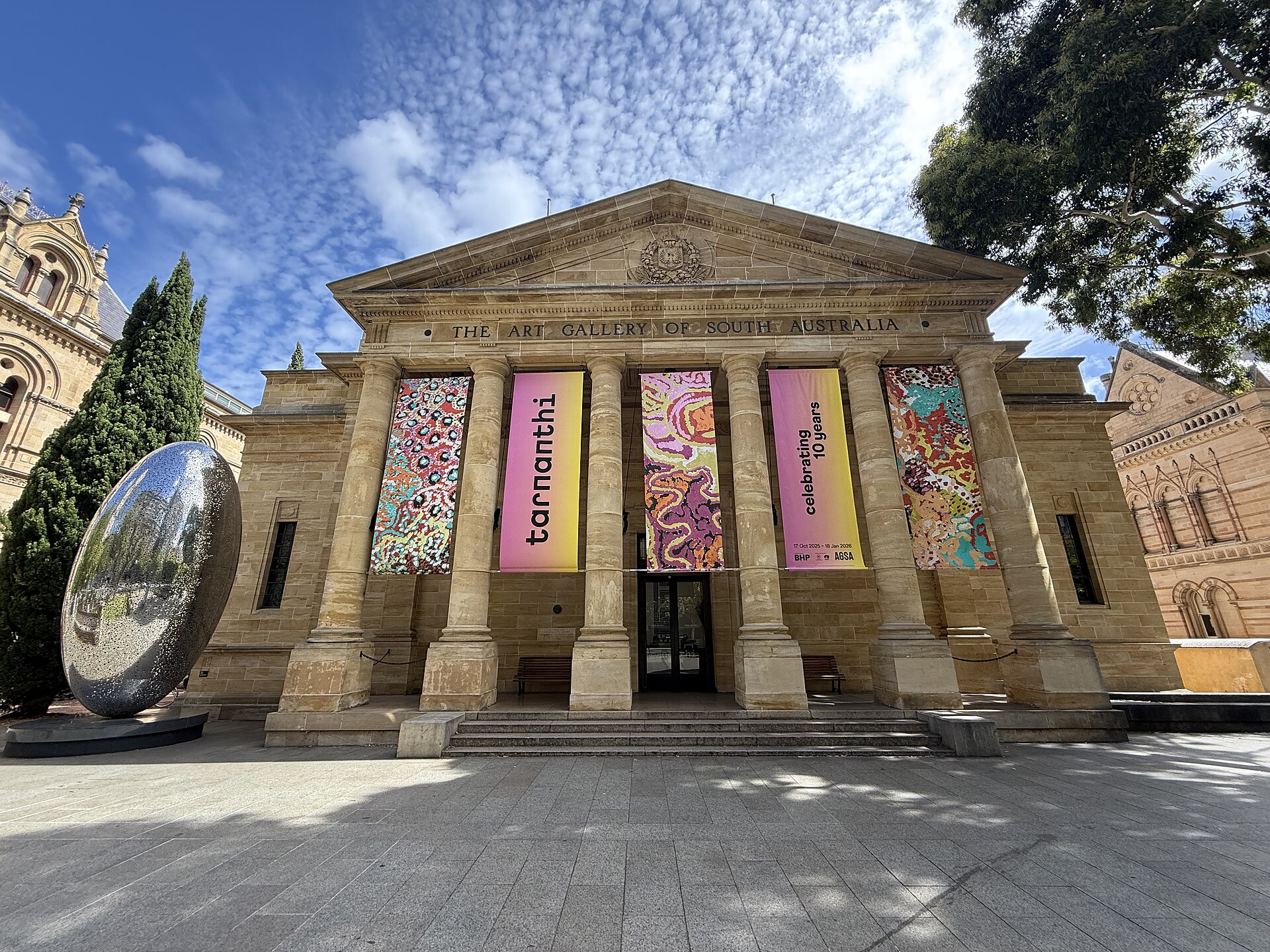
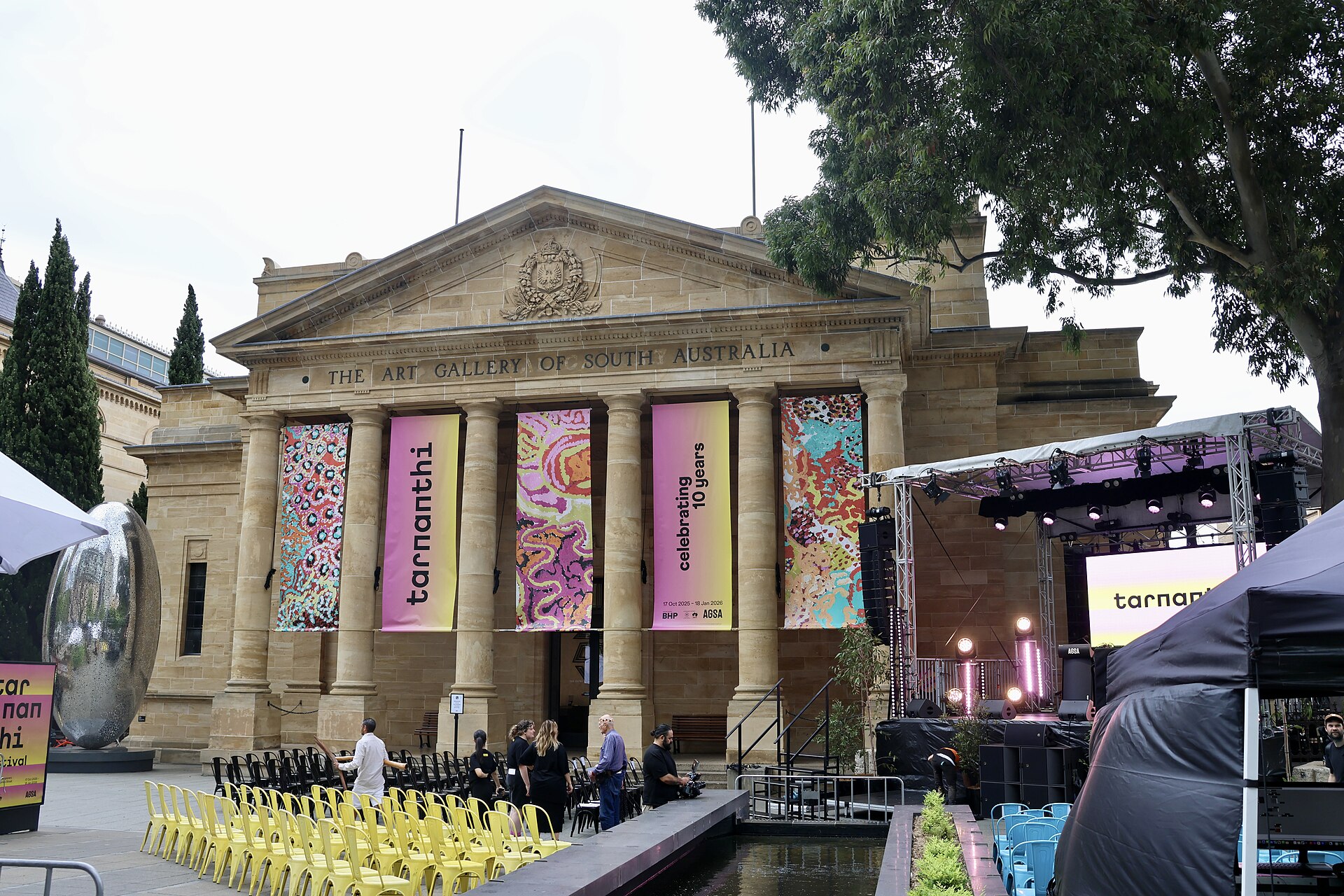
The neoclassical North Terrace facade of the Art Gallery of South Australia, photographed in January 2026.
Photograph by DaHuzyBru, CC BY-SA 4.0, via Wikimedia CommonsArt Gallery of South Australia
Museum · Founded 1881
Open, admission and hours confirmed 27 September 2026 · 15 sources
On this page 15 sections
ContentsClose
AGSA's real strength is breadth held at genuine depth in four places at once: a free, comprehensive run of Australian art from the colonial period through the Heidelberg School to contemporary Aboriginal and Torres Strait Islander practice; a European and North American Old Masters and modern British collection deep enough to include the largest body of Rodin bronzes in the Southern Hemisphere; a century-old Asian art collection built around Australia's only permanent Islamic art display; and an active, self-critical provenance research programme that most galleries of its size do not publish at all.
| Kind | Museum |
|---|---|
| Founded | 1881 |
| City and country |  Adelaide, Australia Adelaide, Australia |
| Address | North Terrace, Adelaide, South Australia 5000, Australia |
| Website | agsa.sa.gov.au |
| Status | Open, confirmed |
| Record last verified |
Visiting
- Hours
- Every day10:00 to 17:00Galleries. Closed 25 December.
- First Friday of the month10:00 to 21:00AGSA_eat restaurant stays open until 9pm; some ticketed exhibitions have also run extended Friday evening hours, so check the current exhibition page before planning an evening visit.
- Closed
- 25 December (Christmas Day).
- Admission
- General admission (permanent collection)FreeFree every day. AGSA does not publish one blanket special-exhibition price; ticketed shows such as Monet to Matisse: Defying Tradition and the Adelaide Biennial of Australian Art are priced separately on their own pages.
Free entry: Every day, for the permanent collection- Do I need to book?
- No booking needed for general admission. Free daily collection tours meet at the front-entrance Vestibule; bespoke group tours can be arranged in advance.
- Address
- North Terrace, Adelaide, South Australia 5000, Australia MapTram Adelaide tram, Art Gallery or University of Adelaide stops on North Terrace, then a walk of about 125 metres
Bus Numerous North Terrace routes (including 97, 98, 99, 170-178, 281, 286-288, 613, 626, 630) stop directly outside the Gallery
Car Wilson Parking on North Terrace, opposite the Gallery, and U-Park on Gawler Place about 300 metres away; a small number of free disability-permit spaces at the University of Adelaide - Website
- agsa.sa.gov.au
- Telephone
- +61 8 7085 1500
- [email protected]
Before you go how long, access, photography, bags, eating, shop
- How long to allow
- Two to three hours to see the permanent collection at a walking pace; visitors who add a ticketed exhibition or the restaurant regularly report a half day.
- Access
- All areas and public spaces are step-free in intent, though some routes need a ramp, lift or dedicated gallery wheelchair lift. Free wheelchairs and walkers can be borrowed on arrival (call ahead to reserve). Programming includes Auslan-interpreted and Deaf-led tours, an audio-described and plain-English self-guided tour of the permanent collection, large-print labels for selected shows, and quiet-session programming. Guide and assistance dogs are welcome.
- Photography
- Personal, hand-held photography is allowed in most galleries; tripods, flash, additional lighting and filming need the Gallery's permission, and some exhibitions restrict photography entirely, signed at the entrance.
- Bags
- Large bags, backpacks and umbrellas cannot be carried into the galleries; free cloakrooms sit near both main entrances.
- Eating
- AGSA_eat, an all-day restaurant with an outdoor terrace, open the same hours as the galleries (extended on the first Friday of the month).
- Shop
- The Gallery Store sells art books, gifts and locally made pieces, in person and online, and keeps the same hours as the restaurant.
Prices and hours change. We take them from the institution's own pages and print the day we read them, and you can check the current position at the source we used. Confirm before you travel.
What is inside
Elder Wing of Australian Art
The original 1900 building, funded by Sir Thomas Elder's bequest, now holds the survey of Australian art from about 1800 to the present: colonial painting and silver, the Heidelberg School and Australian Impressionism, twentieth-century Modernism with a strong showing of women artists, and the Aboriginal and Torres Strait Islander collection displayed within the same historical rooms rather than set apart. Around 2,000 Hans Heysen drawings and much of the gallery's colonial-era furniture are drawn from here for rotating display. Reopened after refurbishment in 2011.
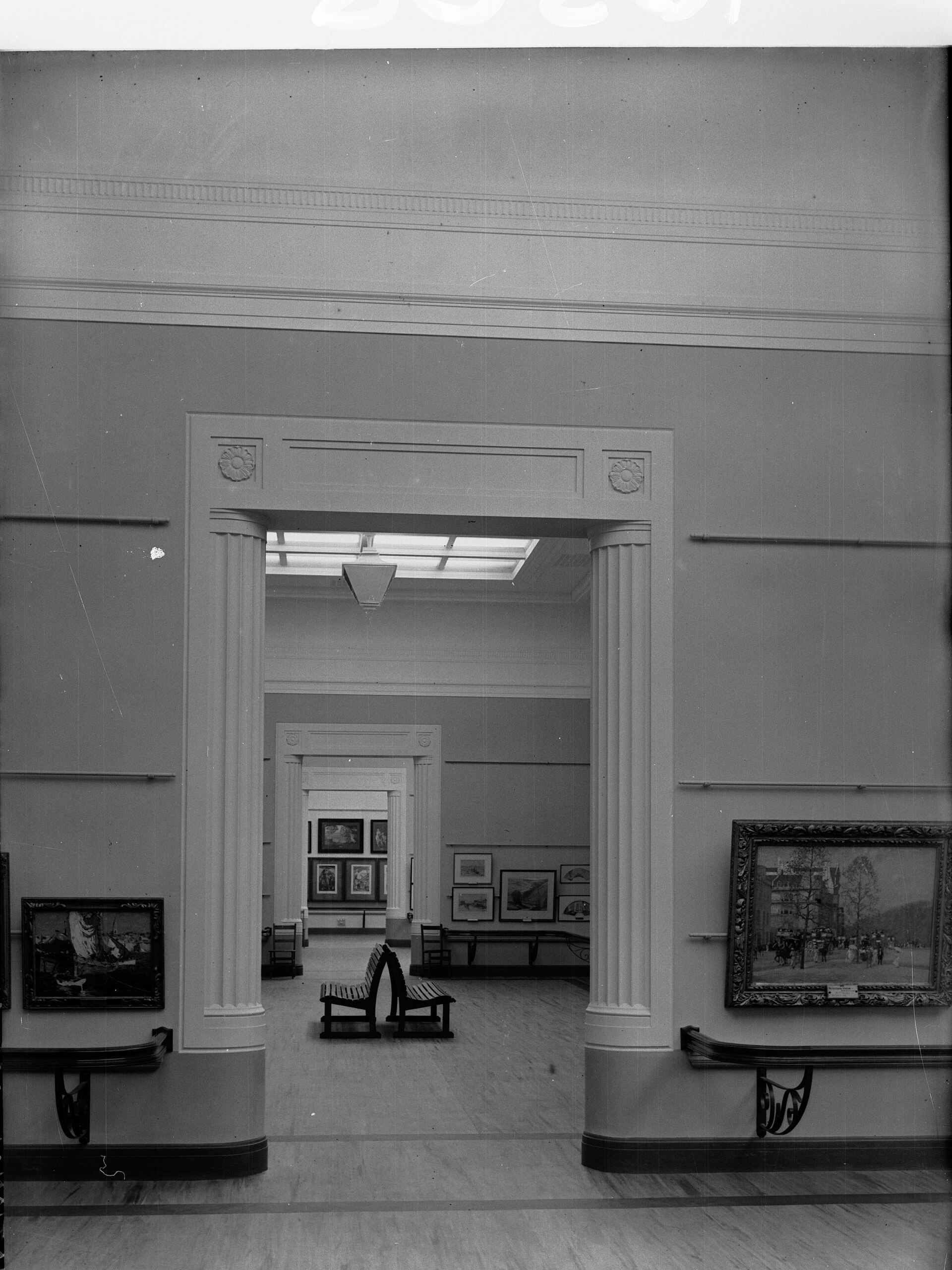
CC0 Melrose Wing of International Art
Built in 1937 behind the neoclassical Doric portico added the same year, funded by a gift from Alexander Melrose matched by the state government, and reopened after refurbishment in 2013. It holds the international collection: more than 3,000 European Old Master paintings and prints, an encyclopaedic run of modern British painting, twenty bronzes by Auguste Rodin (the largest holding of his sculpture in the Southern Hemisphere), and decorative arts including Elizabethan silver gilt and Chelsea porcelain.
Asian and Islamic art galleries
A collection begun in 1904 covering the pre-modern art of Japan, Southeast Asia, India and the Middle East, and Australia's only permanent Islamic art display. Holdings include Japanese textiles and tea-ceremony ceramics (among them a named seventeenth-century tea bowl, Akebono, the only known named example in an Australian public collection), a fifteenth-century Vietnamese phoenix-shaped ewer, nineteenth-century Moroccan carved doors and a Turkish talismanic shirt.
West Wing contemporary and temporary galleries
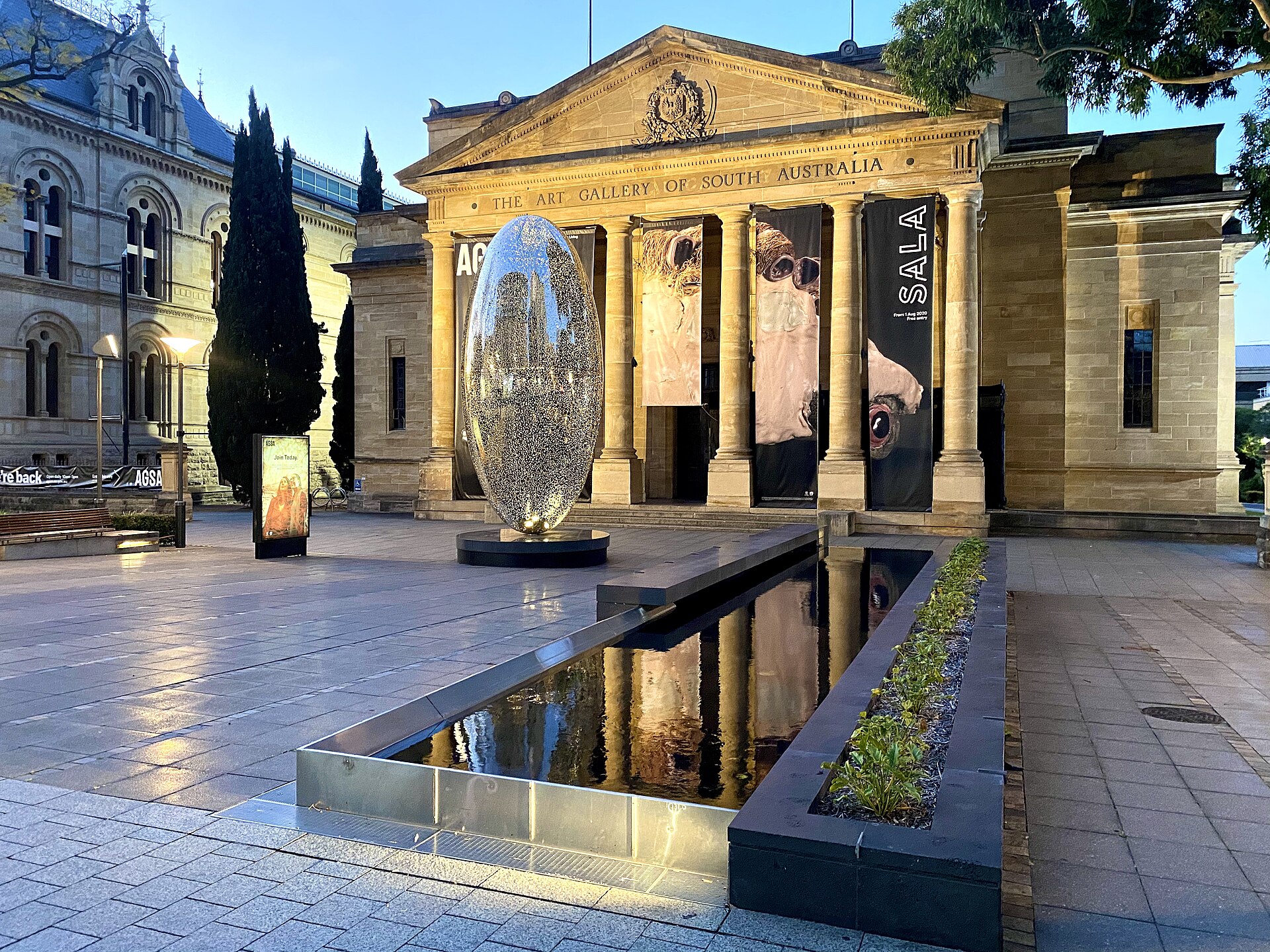
Opened in 1996 to roughly double the building's size, this wing carries the Gallery's temporary exhibitions and its contemporary international and Australian art, including large-scale installations such as Chiharu Shiota's string-and-thread Absence Embodied and Berlinde de Bruyckere's We are all Flesh. AGSA_eat and the Gallery Store also open off this wing, and Lindy Lee's six-metre perforated sculpture The Life of Stars stands at the forecourt where this wing meets North Terrace.
Prints, Drawings and Photographs
A study collection rather than a single gallery: roughly 2,000 Hans Heysen drawings, about 6,000 early South Australian photographs, and thousands of European Old Master prints, none of which can be shown in full at once because of light sensitivity, and which rotate through changing displays across the other wings.
What to see first
Circe Invidiosa
John William Waterhouse, 1892One of AGSA's most reproduced and recognisable paintings today, though a hostile Adelaide press greeted its purchase in 1892; the Gallery's own record for the work quotes the Daily Telegraph of 1893 as writing that it repelled rather than attracted the average visitor.8
A holiday at Mentone
Charles Conder, 1888Painted within weeks of the twenty-year-old Conder's arrival in Melbourne, it is one of the founding pictures of Australian Impressionism and among the first Australian paintings to render the local light's bleaching, blinding quality; its jetty line and upturned parasol also carry a direct debt to Japanese ukiyo-e prints.5
A break away!
Tom Roberts, 1891A Heidelberg School painting of a drover fighting to hold a stampeding mob of sheep from a dry dam, ranked among the small set of paintings that shaped how Australians pictured their own outback at federation.9
Twenty bronzes by Auguste Rodin
Auguste Rodin, acquired 1996AGSA describes this as the finest body of Rodin sculpture in the Southern Hemisphere, anchoring the Melrose Wing's modernist sculpture holdings.6
Haasts Bluff - Illum-baura
Albert Namatjira, 1939Namatjira's first sale to a public gallery, and by AGSA's own account the first work by an Aboriginal artist acquired by any Australian art museum; it was later reproduced in C. P. Mountford's 1944 book The Art of Albert Namatjira.14
The Life of Stars
Lindy LeeA six-metre perforated sculpture standing at the Gallery's North Terrace entrance, its surface pierced in concentric patterns that scatter dappled light and reference the web-of-connections metaphor of Indra's net in Mahayana Buddhism; it is the work most visitors pass under before they have bought a ticket.5
Kulata Tjuta
Anangu artists of the APY LandsA large collaborative installation of hundreds of ceremonial spears (kulata), made by senior Anangu men from communities in the far north of the state, and one of the Gallery's key statements that its Aboriginal and Torres Strait Islander collecting is contemporary as well as historical.5
A gallery built from bequests, on North Terrace
The Art Gallery of South Australia traces itself to the South Australian Society of Arts, founded by the painter Charles Hill in 1856, and was established as the National Gallery of South Australia in June 1881 after the colonial parliament voted 2,000 pounds for a founding purchase. The first acquisitions were twenty-two works bought at the Melbourne International Exhibition, together with loans from Queen Victoria and British collectors, and the collection opened to the public in two rooms of a library before Prince Albert Victor and Prince George formally inaugurated it.
The gallery did not have a purpose-built home until the pastoralist Sir Thomas Elder left it 25,000 pounds on his death in 1897, the first major bequest made to an Australian art gallery. That gift paid for the Classical Revival building on North Terrace designed by C. E. Owen Smyth, which opened in 1900 and is now known as the Elder Wing. An east wing for decorative arts followed in 1915, funded by a further bequest from Dr Morgan Thomas and by David Murray's gift of a print collection. In 1935 the pastoralist Alexander Melrose gave 10,000 pounds toward a further extension, matched by the state government, which added the neoclassical Doric portico and the Melrose Wing of International Art in 1937. A north wing for touring exhibitions opened in 1962, and in 1996 a west wing doubled the building's size again, adding the contemporary and temporary exhibition galleries, the restaurant and the shop that visitors use today. The Elder and Melrose wings were each closed for refurbishment and reopened in 2011 and 2013. The building sits on South Australia's Heritage Register and now carries rooftop solar and battery storage.
What the building holds
AGSA now holds close to 45,000 works, the second-largest state art collection in Australia after the National Gallery of Victoria, spanning roughly two thousand years and every medium from oil painting and bronze to textiles, photography and video. The collection is organised in practice into four broad areas that map onto the wings described below: Australian art, including Aboriginal and Torres Strait Islander art, from around 1800 to the present; international art running from ancient Rome to contemporary practice, with particular depth in European Old Masters and modern British painting; Asian art centred on Japan, Southeast Asia, India and the Middle East; and a large study collection of prints, drawings and photographs that is rotated rather than permanently displayed. A long series of nineteenth- and twentieth-century benefactions, from Elder and Melrose through to the M.J.M. Carter bequest of more than 900 objects from 1966 onward and the James and Diana Ramsay Fund announced in 2019, built most of what the Gallery now shows; very little of the collection was bought outright from government funding alone.
Australian art and the Aboriginal and Torres Strait Islander collection
The Elder Wing carries the Gallery's account of Australian art from the colonial period through the Heidelberg School and Australian Impressionism to twentieth-century Modernism, with a deliberately strong showing of women artists and of South Australian painters. Charles Conder's A holiday at Mentone (1888) and Tom Roberts' A break away! (1891) sit among the works most closely associated with how Australians of that generation pictured their own coastline and outback, and the wing also holds around 2,000 drawings by the Adelaide Hills painter Hans Heysen.
AGSA states that it was the first Australian art museum to acquire a work by an Aboriginal artist, in 1939, when Albert Namatjira sold his watercolour Haasts Bluff - Illum-baura to the Gallery, his first sale to any public collection; the South Australian Museum's own provenance record confirms the sale and its later reproduction in C. P. Mountford's 1944 book on Namatjira. That collecting has continued into the present rather than stopping at a single acquisition: the Aboriginal and Torres Strait Islander galleries now show large collaborative desert paintings, Hermannsburg watercolours, bark paintings, photography, video and textiles, alongside contemporary artists including Tracey Moffatt, Vernon Ah Kee, Judy Watson and Ali Gumillya Baker. The collaborative spear installation Kulata Tjuta, made by senior Anangu men from the APY Lands in the state's far north, and Lindy Lee's entrance sculpture The Life of Stars, are both presented by the Gallery as core statements that this collecting is contemporary as well as historical. AGSA also presents Tarnanthi, Australia's largest annual festival of contemporary Aboriginal and Torres Strait Islander art, in partnership with the state government; the festival marked its tenth edition in 2025 with an exhibition surveying its own decade.
International art: Old Masters to Rodin
The Melrose Wing holds the international collection, more than 3,000 European Old Master paintings and prints and what AGSA calls an encyclopaedic array of modern British painting, alongside decorative arts including Elizabethan silver gilt and eighteenth-century Chelsea porcelain. Its best-known single painting is probably John William Waterhouse's Circe Invidiosa (1892), bought the year it was painted to a hostile Adelaide press notice and now one of the Gallery's most reproduced images; Waterhouse's earlier The Favourites of the Emperor Honorius (1883) and a charcoal study for Circe Invidiosa, given by the artist in 1899, are also in the collection. Twenty bronzes by Auguste Rodin, acquired in 1996, form what the Gallery describes as the largest holding of his sculpture in the Southern Hemisphere. Contemporary international art extends this wing and the west wing beyond painting and bronze: Chiharu Shiota's woven-thread installation Absence Embodied, Berlinde de Bruyckere's sculptural We are all Flesh, and moving-image work by the Russian collective AES+F and Japan's teamLab all sit within a collection that otherwise reads as a conventional Old Masters survey.
Asian and Islamic art
AGSA's Asian art collection began in 1904 and now centres on the pre-modern art of Japan, Southeast Asia, India and the Middle East, including what the Gallery describes as Australia's only permanent Islamic art display. Recent acquisitions include a late eighteenth-century Japanese summer robe patterned with hollyhock and chrysanthemum, a tea bowl from 1650 to 1700 named Akebono (Morning Light), which AGSA states is the only known named example of its kind in an Australian public collection, a nineteenth or twentieth-century Japanese Girls' Day festival set in lacquer and precious metal, a fifteenth-century Vietnamese phoenix-shaped ewer, and Islamic material including nineteenth-century Moroccan carved doors and a Turkish talismanic shirt. Contemporary textiles by the Indonesian artist Eko Nugroho extend the collection into the present rather than stopping at the pre-modern material that gives it its core strength.
What the Gallery does not resolve
AGSA publishes an active provenance research programme rather than a settled account of its own collection's history, and says so plainly. Its own provenance pages state that the Gallery investigates Asian works from Southeast Asia, South Asia and the Middle East that lack a documented route out of their country of production, with particular attention to material that may have left its country of origin in the final three decades of the twentieth century, and that it has adopted a standing policy against acquiring major historical artworks from Pakistan, Afghanistan, Cambodia and south India on exactly those grounds. A parallel line of research covers European works made before 1945 and acquired after 1932, concentrating on the Nazi period of 1933 to 1945, when Jewish-owned collections were systematically looted, confiscated or sold under duress. AGSA is careful to state that incomplete provenance does not by itself mean a work was looted or stolen, only that its full ownership history cannot currently be reconstructed, and the Gallery does not name specific unresolved works on its public pages; it instead invites the public to bring forward information. That leaves an honest gap on the record rather than a resolved one: which objects in a 45,000-work collection carry an undocumented gap of this kind is not something AGSA discloses object by object.
The Gallery today
Annual visitor numbers rose from around 480,000 in 2010 to about 780,000 in 2019 under the directorship of Nick Mitzevich (2010 to 2018), who also began the Gallery's formal provenance research work; Rhana Devenport led the Gallery from 2018 to 2024, and Jason Smith became director in February 2025. AGSA now runs a full annual calendar built around its own collection and two recurring signature events: the Adelaide Biennial of Australian Art, staged as part of the Adelaide Festival and built around new commissions from Australian artists, and Tarnanthi, the Aboriginal and Torres Strait Islander art festival described above. Its 2026 programme adds an international loan exhibition, Monet to Matisse: Defying Tradition, alongside the Biennial's latest edition; both are ticketed, in the ordinary way AGSA prices visiting exhibitions separately from the free permanent collection that fills the rest of the building on any given day.
What visitors say
Visitors consistently describe the Gallery as a genuine highlight of a trip to Adelaide, prized above all for the fact that a collection of this depth, from Australian Impressionism to European Old Masters and a strong Aboriginal and Torres Strait Islander display, costs nothing to see. Recent comment clusters around the free guided tours, the calm and well air-conditioned galleries, and the restaurant's outdoor terrace. A smaller, recurring thread of criticism is aimed not at the permanent collection but at temporary contemporary installations that some visitors feel sit oddly against the Gallery's nineteenth-century architecture.
What is praised, what is criticised
- Praised: the range and quality of the free permanent collection, spanning Australian colonial and Impressionist painting, European Old Masters, Rodin and the Aboriginal and Torres Strait Islander galleries
- Praised: the free daily guided tours, with several visitors singling out individual guides by name for pointing out works they would otherwise have walked past
- Praised: the building itself and the AGSA_eat terrace, described repeatedly as a pleasant place to sit after a couple of hours in the galleries
- Criticised: a minority of visitors find some of the avant-garde temporary and contemporary installations (past Adelaide Biennial commissions among them) jarring against the historic architecture and not what they came to see, and a few describe the building's overall footprint as smaller than they expected for a state gallery
Ratings on other platforms
Tripadvisor: 4.5 from 1,922 ratings, read 27 September 2026
A platform average is a tertiary source: it moves, it is not audited, and we quote no visitor's words.
Questions about Art Gallery of South Australia
Where is Art Gallery of South Australia?
North Terrace, Adelaide, South Australia 5000, Australia.
How much does it cost to visit?
General admission (permanent collection): free. As confirmed 27 September 2026.
When is it open?
Every day 10:00-17:00; First Friday of the month 10:00-21:00. Closed: 25 December (Christmas Day). As confirmed 27 September 2026.
How do you get there?
Tram: Adelaide tram, Art Gallery or University of Adelaide stops on North Terrace, then a walk of about 125 metres; Bus: Numerous North Terrace routes (including 97, 98, 99, 170-178, 281, 286-288, 613, 626, 630) stop directly outside the Gallery; Car: Wilson Parking on North Terrace, opposite the Gallery, and U-Park on Gawler Place about 300 metres away; a small number of free disability-permit spaces at the University of Adelaide.
What should you see first?
Circe Invidiosa (John William Waterhouse, 1892); A holiday at Mentone (Charles Conder, 1888); A break away! (Tom Roberts, 1891); Twenty bronzes by Auguste Rodin (Auguste Rodin, acquired 1996); Haasts Bluff - Illum-baura (Albert Namatjira, 1939); The Life of Stars (Lindy Lee).
What we could not confirm
- AGSA does not name, on its public pages, which specific objects in its Asian or pre-1945 European holdings carry the incomplete provenance its own research programme is built to investigate.
- No single published source gives a current, dated price list for AGSA's ticketed visiting exhibitions (for example Monet to Matisse: Defying Tradition); each show is priced on its own page rather than in one visit-planning document.
Images
Sources
- 1Art Gallery of South Australia, Visit agsa.sa.gov.au/visit/
- 2Art Gallery of South Australia, Plan your visit agsa.sa.gov.au/visit/plan-your-visit/
- 3Art Gallery of South Australia, Access agsa.sa.gov.au/visit/access/
- 4Art Gallery of South Australia, Our History: Timeline agsa.sa.gov.au/about/our-history/timeline/
- 5Art Gallery of South Australia, About the Collection: Australian Art agsa.sa.gov.au/collection-publications/about/australian-art/
- 6Art Gallery of South Australia, About the Collection: International Art agsa.sa.gov.au/collection-publications/about/international-art/
- 7Art Gallery of South Australia, About the Collection: Asian Art agsa.sa.gov.au/collection-publications/about/asian-art/
- 8Art Gallery of South Australia, collection record for J. W. Waterhouse, Circe Invidiosa, 1892 agsa.sa.gov.au/collection-publications/collection/works/circe-invidiosa/24983/
- 9Wikipedia, Art Gallery of South Australia () en.wikipedia.org/wiki/Art_Gallery_of_South_Australia
- 10Wikidata, Q705557 () wikidata.org/wiki/Special:EntityData/Q705557.json
- 11Tripadvisor, Art Gallery of South Australia, aggregate rating and reviews () tripadvisor.com/Attraction_Review-g255093-d256349-Reviews-Art_Gallery_of_South_Australia-Adelaide_Greater_Adelaide_South_Australia.html
- 12Tripadvisor, "House wreck and dead horse, no thanks!", review dated May 2014 () tripadvisor.com/ShowUserReviews-g255093-d256349-r205447764-Art_Gallery_of_South_Australia-Adelaide_Greater_Adelaide_South_Australia.html
- 13Wikimedia Commons, Category:Art Gallery of South Australia commons.wikimedia.org/wiki/Category:Art_Gallery_of_South_Australia
- 14South Australian Museum, Provenance Archives, record AA229 (Albert Namatjira) samuseum.sa.gov.au/collection/archives/provenances/aa229
- 15Art Gallery of South Australia, About the Collection: Provenance Research agsa.sa.gov.au/collection-publications/about/provenance-research/