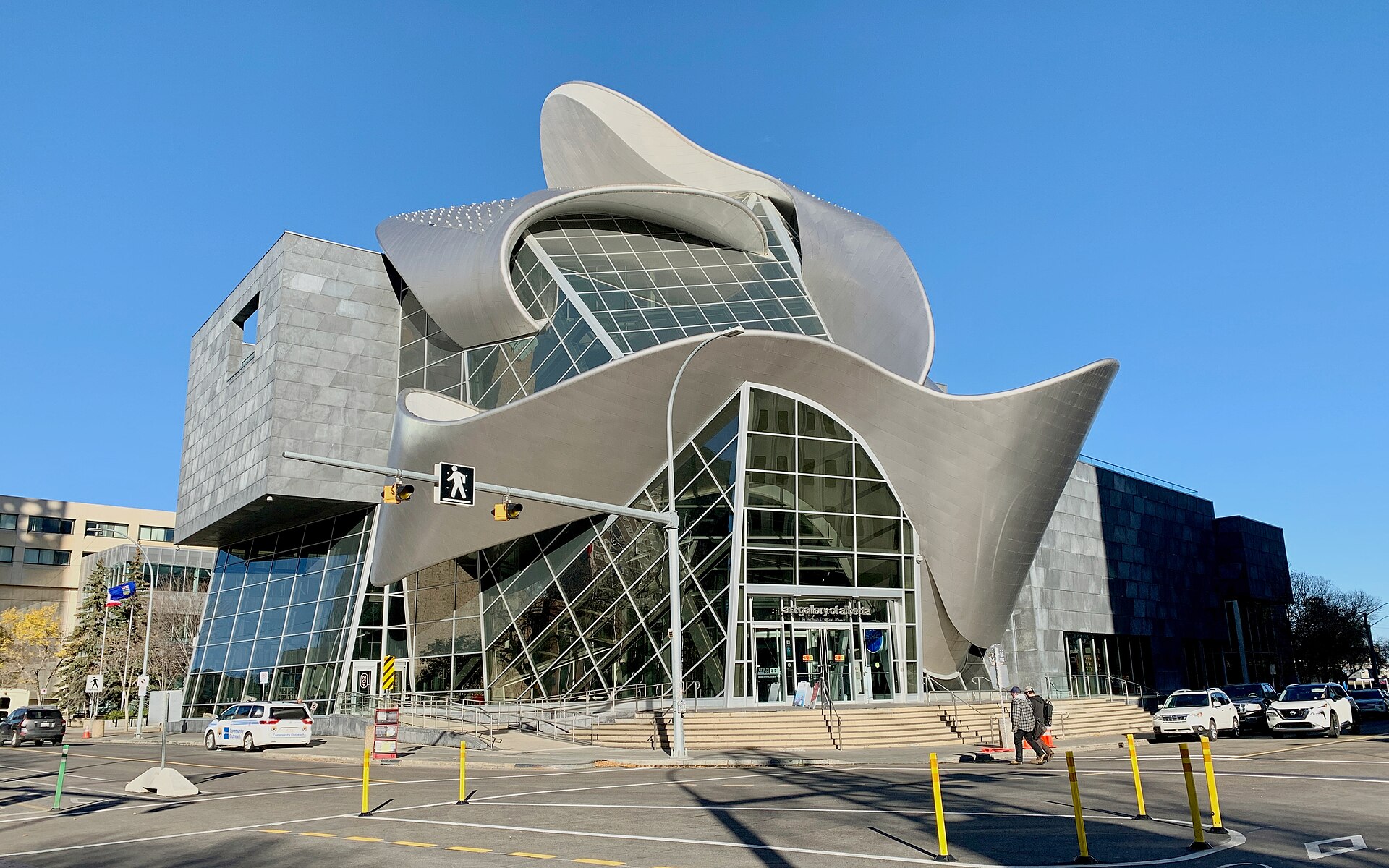
The Art Gallery of Alberta seen from Churchill Square, Edmonton, October 2022.
TagaSanPedroAko, CC BY-SA 4.0Art Gallery of Alberta
Museum · Founded 1924
Open, admission and hours confirmed 9 September 2026 · 15 sources
On this page 15 sections
ContentsClose
Strongest in Canadian art since 1950, in Alberta and western Canadian painting and sculpture, and in two deep specialist holdings that sit outside that regional mandate: more than 1,500 photographic works acquired since 1977, and more than 850 eighteenth-century engraved prints by Thomas Bewick. Historical Canadian painting before 1950, including the gallery's Emily Carr and Group of Seven-associated material, rests almost entirely on the single 1976 gift of nearly 100 works from the Ernest E. Poole Foundation.
| Kind | Museum |
|---|---|
| Founded | 1924 |
| City and country |  Edmonton, Canada Edmonton, Canada |
| Address | 2 Sir Winston Churchill Square, Edmonton, AB T5J 2C1, Canada |
| Website | youraga.ca |
| Status | Open, confirmed |
| Record last verified |
Visiting
- Hours
- Wednesday11:00 to 17:00
- Thursday11:00 to 19:00
- Friday11:00 to 17:00
- Saturday11:00 to 17:00
- Sunday11:00 to 17:00
- Closed
- Monday. Tuesday.
- Admission
- AdultCAD 17plus GST
- Senior (65+)CAD 12plus GST
- Student (18+, with ID)CAD 12plus GST
- Youth (17 and under)Freefree; a paying adult must accompany children under 12, maximum five children per adult
- Partner rate (Edmonton Public Library, ETS, Citadel Theatre card-holders)CAD 14plus GST
- Companion of a visitor with a disabilityFreefree
Free entry: Last Thursday of the month, 4pm to 7pm- Tickets
- youraga.ca/visit/hours-and-admissions The museum's own ticket page.
- Do I need to book?
- No, walk-in general admission; timed entry is not required
- Address
- 2 Sir Winston Churchill Square, Edmonton, AB T5J 2C1, Canada MapLRT Churchill LRT station, on the Capital and Metro lines, adjoins Churchill Square
- Website
- youraga.ca
- Telephone
- 780-422-6223
- [email protected]
Before you go how long, access, photography, bags, eating, shop
- How long to allow
- Visitors commonly report the galleries can be seen in around two hours, since the AGA does not keep a large permanent collection on permanent display and rotates temporary exhibitions instead
- Access
- Step-free main entrance with a ramp, wheelchair and stroller friendly throughout; complimentary wheelchairs, folding stools and ear plugs available on request at Guest Services; companion aides of visitors with disabilities are admitted free
- Photography
- Non-flash photography and filming are permitted for personal use unless a gallery is marked otherwise; flash, tripods, monopods and selfie sticks are not allowed, and photography is not permitted in the stairwells; professional or commercial photography needs prior approval
- Bags
- Large bags, backpacks and umbrellas must be checked or left in lockers for the safety of the artworks; coats are checked as well
- Eating
- Zinc, a licensed restaurant, sits off the main atrium (Manning Hall); shopAGA also sells light refreshments; food and drink are not permitted inside the gallery spaces themselves
- Shop
- shopAGA, the gallery's retail shop, on the ground floor near the main entrance
Prices and hours change. We take them from the institution's own pages and print the day we read them, and you can check the current position at the source we used. Confirm before you travel.
What is inside
Ernest E. Manning Hall
The five-storey glazed atrium that forms the building's public heart, rising through the full height of the Randall Stout building; the ribboned zinc form is visible from inside as well as out, and Zinc, the gallery's restaurant, opens directly off it.
Main exhibition galleries
Roughly 3,000 square metres of climate-controlled gallery space across three levels, used for the rotating programme of Canadian, Albertan and international temporary exhibitions that make up most of what a visitor sees; the AGA does not keep a large standing display of its permanent collection.
Singhmar Centre for Art Education
The gallery's education wing, built into the 2010 expansion, with studio and workshop space used for school programmes, summer art camps, the Youth Council, family drop-in activities such as Tours for Tots, and adult and community workshops.
150-seat theatre
A dedicated theatre inside the Singhmar Centre for Art Education used for film screenings, lectures, artist talks and live performance tied to the exhibition programme.
Borealis Room
An upper-level function room, named for the aurora reference in Stout's design, used for rentals, receptions and members' events; its cantilevered position gives it a sense of floating over Churchill Square.
shopAGA
The gallery's retail shop on the ground floor, selling art books, prints and locally made craft and design objects alongside exhibition-tied merchandise.
What to see first
Gift of nearly 100 Canadian paintings and sculptures
The Ernest E. Poole FoundationThe single gift that gave the gallery's historical Canadian holdings their depth, in 1976, bringing in works by Cornelius Krieghoff, Paul Peel, James Wilson Morrice and Emily Carr and setting the collection's later shape.5
Holdings by Emily Carr
Emily CarrOne of the best-known painters of the Canadian west coast and among the historical Canadian names the AGA collection is built around, chiefly through the Poole Foundation gift.5
Paintings associated with the Group of Seven
Group of Seven and associated painters, including works catalogued as by Tom ThomsonThe AGA's early-20th-century Canadian landscape holdings sit alongside the Poole gift as the historical core of the collection; titles recorded for the gallery's Thomson-attributed works include Frazer's Ridge (1915) and Autumn Foliage (1916).6
Historical Canadian photography collection
Various Canadian and international photographersMore than 1,500 photographic works acquired since 1977 make photography one of the gallery's deepest and least publicly visible collecting strengths.7
18th-century British prints
Thomas BewickA holding of more than 850 wood-engraved prints by the English engraver, an unusual depth of pre-Canadian material inside a gallery whose mandate is chiefly regional.7
Contemporary Indigenous and Albertan art
Jane Ash Poitras, Alex Janvier, George Littlechild and othersPart of the gallery's active late-20th and 21st-century Alberta collecting, and the area the 2017 federal acquisition grant for Indigenous, Inuit and Metis contemporary art was aimed at strengthening.7
Works by Brian Jungen and Janet Cardiff
Brian Jungen; Janet CardiffThe two contemporary Canadian artists most consistently named as the gallery's strongest holdings among nationally and internationally recognised living artists.6
The Randall Stout building itself
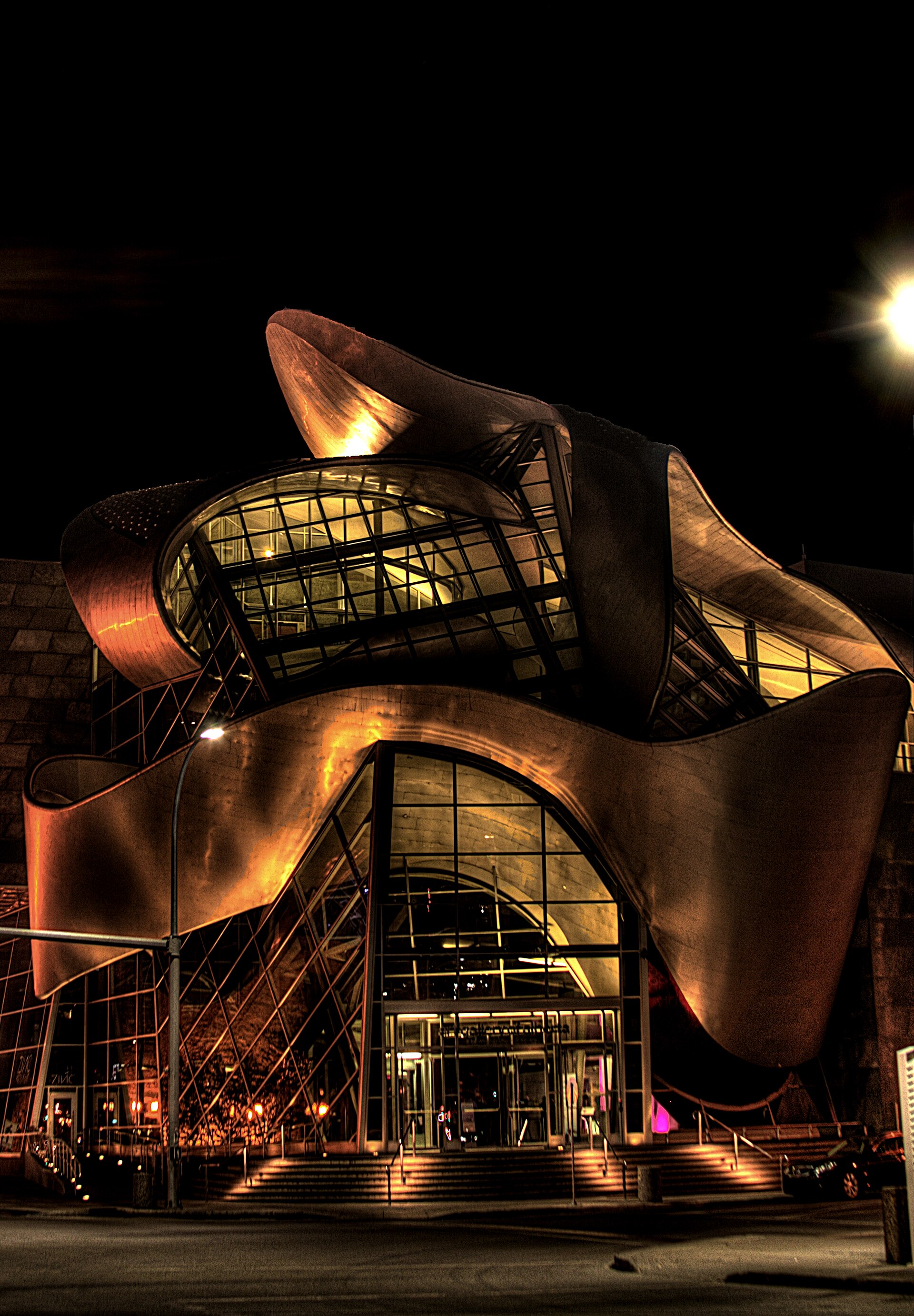
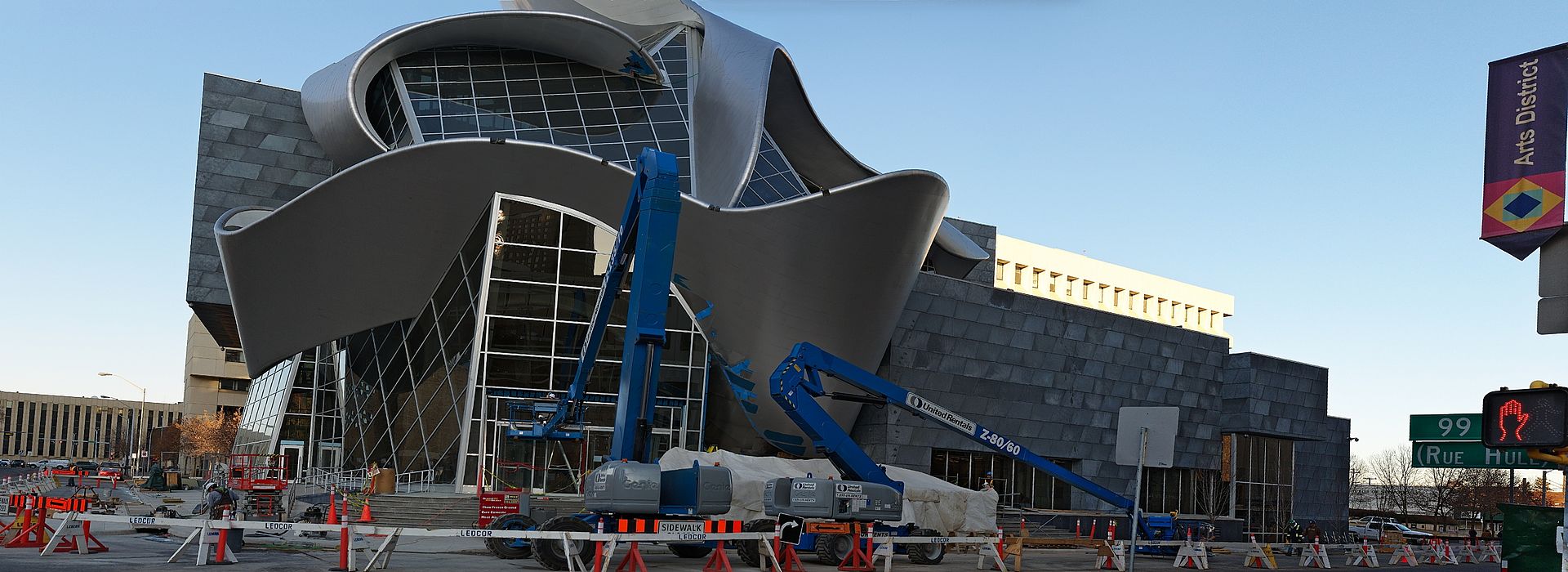
Randall Stout Architects (Los Angeles)The building that opened in January 2010 is itself the gallery's best-known object: an 85,000-square-foot steel, zinc and glass structure whose winding stainless-steel ribbon, read by the architect as the North Saskatchewan River and the aurora borealis, made it Alberta's first major public art-museum building in decades and the subject of national architectural debate on its own terms.8
Exhibitions on now
- Opening soon31 Oct 2026 to 24 Jan 2027Confirmed , 6 weeks ago
Past exhibitions here
- Closed20 Jun to 11 Oct 2026Confirmed · check before you travel
A century-old institution, a building only fifteen years old
The Art Gallery of Alberta traces its founding to 1924, when it opened as the Edmonton Museum of Arts under founding director Maud Bowman, with the backing of the Edmonton Art Club and local business figures. Its first exhibition was a loan show of 24 works borrowed from the National Gallery of Canada, hung in the Hotel Macdonald because the young institution had no building of its own. It moved through a series of temporary homes over the following decades, including the Edmonton Public Library, the Civic Block and the Edmonton Motors Building, before settling in 1952 into the Richard Secord House, a historic riverside mansion, and taking the name Edmonton Art Gallery in 1956.
The gallery's first purpose-built home opened in 1969 on Sir Winston Churchill Square, designed by the Edmonton architects Donald G. Bittorf and B. James Wensley and funded by a bequest of about 600,000 dollars from Abigail (Mrs A. E.) Condell. That modernist building was well suited to the abstract and contemporary Canadian work the gallery was collecting, and an east-wing addition followed in 1977 or 1978 as the collection kept growing. By the early 2000s the 1969 structure had aged out of the job: its mechanical systems and climate control could no longer meet the standards international lenders required, and storage for a collection that had passed 6,000 objects was inadequate. In 2005, the same year it renamed itself the Art Gallery of Alberta to reflect a provincial rather than purely civic mandate, the institution ran an international design competition for a replacement.
The Randall Stout building
Los Angeles architect Randall Stout, who had spent seven years working alongside Frank Gehry before opening his own practice, won the competition in 2005 by presenting his design in person and tying it explicitly to Edmonton's own geography: the North Saskatchewan River, which loops through the city's gridded downtown, and the aurora borealis, visible from Edmonton on clear winter nights. The resulting building, built between 2007 and January 2010 at a cost Wikipedia's own account puts at roughly 88 million Canadian dollars, wraps a winding, 190-metre stainless-steel and patinated-zinc ribbon around and through the retained shell of the 1969 structure, of which about two-thirds survives inside the new envelope. The finished building measures close to 8,000 square metres over five levels, with about 3,000 square metres of climate-controlled gallery space, and it reopened to the public on 31 January 2010.
The design was controversial before a single wall went up. Architecture critics, including Lisa Rochon writing in The Globe and Mail at the time of the 2005 competition result, called the winning scheme derivative of Gehry's own titanium-clad buildings and mocked Stout's stated inspirations as an overworked metaphor. Reviewing the finished building in February 2010, the critic Diana Sherlock in Canadian Art repeated the Gehry comparison but also praised the soaring, top-lit Ernest Manning Hall atrium and the clarity with which Stout had separated the building's different functions, while warning that a building built partly to attract visitors risked turning the museum experience into a consumable spectacle rather than a place for looking closely at art. Whatever critics made of the metaphor, the building gave Edmonton its first major purpose-built visual-arts landmark in decades and remains the most visually recognisable structure on Churchill Square.
What the collection holds, and what it does not show at once
The AGA's permanent collection runs to more than 6,000 works, the great majority acquired since 1970 and dating from after 1950, with a stated emphasis on Canadian abstract painting and sculpture read in both a regional Alberta and a national context. Its historical depth comes chiefly from a single gift: in 1976 the Ernest E. Poole Foundation donated close to 100 Canadian paintings and sculptures, bringing in Cornelius Krieghoff, Paul Peel, James Wilson Morrice and Emily Carr, along with material connected to the Group of Seven. Alongside the paintings the gallery holds two large and less publicly visible collections: more than 1,500 photographic works acquired since 1977, and more than 850 eighteenth-century wood-engraved prints by the English engraver Thomas Bewick, an unusual holding for an institution whose primary mandate is regional Canadian art.
The contemporary collection includes work by nationally recognised Canadian artists such as Brian Jungen and Janet Cardiff, and by Alberta-based Indigenous artists including Jane Ash Poitras, Alex Janvier and George Littlechild; the gallery has continued to deepen its Indigenous, Inuit and Metis contemporary holdings in recent years. What the AGA does not do, by design, is keep most of this on permanent view: it runs a programme of rotating temporary exhibitions rather than a fixed permanent-collection hang, which is the single most repeated observation in visitor reviews: the building can be seen in an afternoon, and what a visitor finds inside on any given week depends on the current show rather than a standing display of the collection's depth.
Inside the building today
The public heart of the building is the Ernest Manning Hall, a five-storey glazed atrium that rises through the centre of the plan and gives visitors their first view of Stout's zinc ribbon from indoors. Zinc, the gallery's licensed restaurant, opens directly off the hall, and shopAGA, the retail shop, sits near the main entrance. Roughly 3,000 square metres of climate-controlled gallery space is spread over three levels for the changing exhibition programme. The Singhmar Centre for Art Education, added in the 2010 rebuild, houses studio space for the gallery's school, family and community programmes and a dedicated 150-seat theatre used for lectures, artist talks and film screenings tied to current shows. An upper-level function space, the Borealis Room, takes its name from the same aurora reference as the exterior ribbon and is used for private and members' events, its cantilevered form giving it the sense of floating above Churchill Square.
Visiting, admission and how it is used
The AGA is open Wednesday through Sunday, closed Monday and Tuesday, with extended hours to 7pm on Thursday; admission is accepted up to thirty minutes before closing. Adult admission is 17 Canadian dollars plus tax, with reduced rates for seniors and students, free entry for anyone 17 or under, and free entry for everyone on the last Thursday of the month between 4pm and 7pm. The building sits directly on the Churchill LRT station, at the centre of Edmonton's downtown civic square alongside the Stanley A. Milner Library and City Hall, and it has no dedicated on-site parking of its own. Visitor reviews describe the gallery as a popular wedding and event venue as well as an exhibition space, reflecting the deliberate mix of gallery, restaurant, theatre and rentable hall space that was part of Stout's brief from the outset, and the same mix that architecture critics argued gave over too much of the building to hospitality at the expense of gallery square footage.
What visitors say
Visitors consistently single out the building itself, designed by Randall Stout and opened in 2010, as the gallery's most striking feature and a genuine Edmonton landmark, and rate the rotating exhibition programme as generally worth the visit. The most repeated complaint is that the AGA does not keep a large permanent collection on permanent display, so a visit is short and its content depends entirely on which temporary shows happen to be up; some visitors have also noted the absence of Alberta Indigenous or textile work in particular exhibitions they saw.
What is praised, what is criticised
- Praised: The Randall Stout building and its zinc-ribbon facade, widely described as visually striking and a landmark on Churchill Square
- Praised: The rotating exhibition programme, which reviewers on aggregator sites describe as usually worth seeing even on a repeat visit
- Praised: The gallery's use as an event and wedding venue, cited favourably in visitor reviews
- Criticised: No large permanent collection is kept on display, so the galleries can be seen in as little as two hours and the content depends entirely on the current temporary exhibitions
- Criticised: At least one visitor review noted a specific current exhibition omitted Alberta Indigenous and textile work they had hoped to see
- Criticised: Architecture critics at the building's 2005-2010 unveiling described Randall Stout's design as derivative of his former employer Frank Gehry, and criticised his framing of the design around inukshuks and the aurora borealis as an overworked metaphor
Ratings on other platforms
TripAdvisor: 4 from 1,819 ratings, read 9 September 2026
Google: 4.3 from 334 ratings, read 9 September 2026
A platform average is a tertiary source: it moves, it is not audited, and we quote no visitor's words.
Questions about Art Gallery of Alberta
Where is Art Gallery of Alberta?
2 Sir Winston Churchill Square, Edmonton, AB T5J 2C1, Canada.
How much does it cost to visit?
Adult: CAD 17; Senior (65+): CAD 12; Student (18+, with ID): CAD 12; Youth (17 and under): free; Partner rate (Edmonton Public Library, ETS, Citadel Theatre card-holders): CAD 14. As confirmed 9 September 2026.
When is it open?
Wednesday 11:00-17:00; Thursday 11:00-19:00; Friday 11:00-17:00; Saturday 11:00-17:00; Sunday 11:00-17:00. Closed: Monday. Tuesday. As confirmed 9 September 2026.
How do you get there?
LRT: Churchill LRT station, on the Capital and Metro lines, adjoins Churchill Square.
What should you see first?
Gift of nearly 100 Canadian paintings and sculptures (The Ernest E. Poole Foundation); Holdings by Emily Carr (Emily Carr); Paintings associated with the Group of Seven (Group of Seven and associated painters, including works catalogued as by Tom Thomson); Historical Canadian photography collection (Various Canadian and international photographers); 18th-century British prints (Thomas Bewick); Contemporary Indigenous and Albertan art (Jane Ash Poitras, Alex Janvier, George Littlechild and others).
What we could not confirm
- The gallery's own published collection material does not give a current, dated total value or a full public catalogue of the Poole Foundation gift's 100 works; only artist names and approximate counts are stated.
- No source located in this research states how many of the collection's 6,000-plus works are currently on any kind of rotating permanent-collection view versus held in storage between loans.
Images
Sources
- 1Art Gallery of Alberta, Hours, Tickets and Admission Prices youraga.ca/visit/hours-and-admissions
- 2Art Gallery of Alberta, Visitor Guidelines youraga.ca/visit/visitor-guidelines
- 3Art Gallery of Alberta, About: Building youraga.ca/about/building
- 4Art Gallery of Alberta, About youraga.ca/about
- 5Canadian Encyclopedia, Art Gallery of Alberta thecanadianencyclopedia.ca/en/article/art-gallery-of-alberta
- 6Wikipedia, Art Gallery of Alberta en.wikipedia.org/wiki/Art_Gallery_of_Alberta
- 7Art Gallery of Alberta, About: Collection youraga.ca/about/collection
- 8AGA 100, The Art Gallery of Alberta's Building History 100.youraga.ca/the-art-gallery-of-albertas-building-history/
- 9The Globe and Mail, Lisa Rochon, 'A Gehry knock-off, but still needed', 2005-10-20 theglobeandmail.com/arts/a-gehry-knock-off-but-still-needed/article739621/
- 10Canadian Art, Diana Sherlock, 'The New Art Gallery of Alberta: Honour, Horror and High, High Ceilings', 2010-02-11 canadianart.ca/reviews/art-gallery-of-alberta/
- 11Wikidata, Q705545 wikidata.org/wiki/Q705545
- 12TripAdvisor, Art Gallery of Alberta reviews tripadvisor.com/Attraction_Review-g154914-d311336-Reviews-Art_Gallery_of_Alberta-Edmonton_Alberta.html
- 13Wikimedia Commons, File:Art Gallery of Alberta Front, Churchill Square 10-20-2022.jpg commons.wikimedia.org/wiki/File:Art_Gallery_of_Alberta_Front,_Churchill_Square_10-20-2022.jpg
- 14Wikimedia Commons, File:Art-Gallery-of-Alberta-Edmonton-Alberta-Canada-01A.jpg commons.wikimedia.org/wiki/File:Art-Gallery-of-Alberta-Edmonton-Alberta-Canada-01A.jpg
- 15Wikimedia Commons, File:Art Gallery of Alberta Panorama.jpg commons.wikimedia.org/wiki/File:Art_Gallery_of_Alberta_Panorama.jpg


