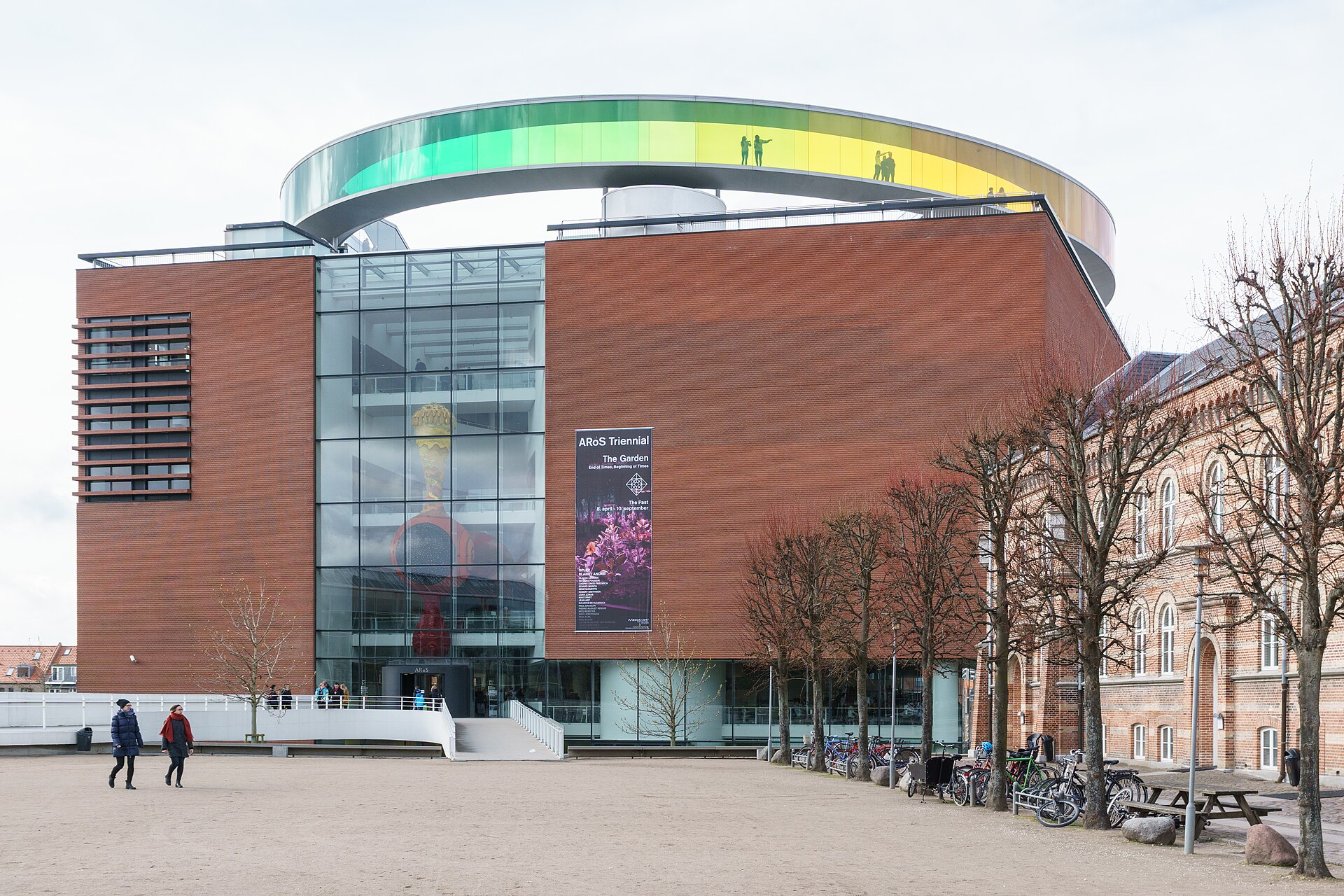
ARoS Aarhus Kunstmuseum, with Olafur Eliasson's Your Rainbow Panorama visible on the roof, photographed 12 April 2017.
Photo: Colin, Wikimedia Commons, CC BY-SA 4.0ARoS Aarhus Kunstmuseum
Museum · Founded 1859
Open, admission and hours confirmed 5 September 2026 · 17 sources
On this page 15 sections
ContentsClose
ARoS's deepest holding is Danish painting from the Golden Age through Cobra-era abstraction, more than a century of material built up since 1859. Its public identity, however, rests on a small number of large permanent artworks built into the architecture itself, Eliasson's Rainbow Panorama and, since 2026, Turrell's underground Skyspace, which place the museum among a short list of institutions whose building and collection cannot be meaningfully separated.
| Kind | Museum |
|---|---|
| Founded | 1859 |
| City and country |  Aarhus, Denmark Aarhus, Denmark |
| Address | Aros Alle 2, 8000 Aarhus C, Denmark |
| Website | aros.dk |
| Status | Open, confirmed |
| Record last verified |
Visiting
- Hours
- Mon-Fri (1 Jun - 30 Sep)09:00 to 20:00summer schedule
- Sat-Sun (1 Jun - 30 Sep)09:00 to 17:00summer schedule
- Tue-Fri (1 Oct - 31 May)10:00 to 20:00off-season schedule
- Sat-Sun (1 Oct - 31 May)09:00 to 17:00off-season schedule
- Closed
- Monday, except Mondays in June, July and August, and except some public holidays.
- Admission
- AdultDKK 200
- Under 31 / studentDKK 150valid student ID or proof of age required
- Group (20+ people)DKK 180per person
- Under 18Freefree
- Cafe and shopFreefree to enter without a museum ticket
- Tickets
- shop.aros.dk The museum's own ticket page.
- Do I need to book?
- No fixed timed-entry requirement is stated for individual visitors; tickets can be bought online in advance at a 10 percent discount or at the door.
- Address
- Aros Alle 2, 8000 Aarhus C, Denmark MapParking 79 public parking spaces on Aros Alle. No dedicated coach parking; groups arriving by bus are asked to arrange this with the museum at least a week ahead.
Walking The museum sits in central Aarhus, at postcode 8000 Aarhus C, the city's centrum district. - Website
- aros.dk
- Telephone
- +45 61 90 49 00
- [email protected]
Before you go how long, access, photography, bags, eating, shop
- How long to allow
- Visitor guidance and published reviews commonly suggest at least three hours to take in the galleries, the Nine Spaces and the rooftop.
- Access
- Lifts run from street level beneath the stairs on Aros Alle up to the entrance and to every exhibition gallery. Accessible toilets are on levels 3, 4, 8 and 9. Wheelchairs can be borrowed on request at the Information Centre. Free disabled parking is available with a valid badge. Service dogs are permitted.
- Photography
- Photography of the exhibitions, artworks and architecture is allowed for private, non-commercial use, including sharing to personal social media. Tripods and drones are not permitted. Commercial photography needs prior approval from the museum.
- Bags
- A staffed cloakroom with lockable lockers sits on level 4. A locker token costs DKK 20; lockers come in a small size (40 x 36 x 36 cm) and a large size (85 x 36 x 52 cm). Staff decide case by case whether a bag can be carried into the galleries. Strollers can be brought or borrowed.
- Eating
- ARoS Cafe and Orangery serves a light lunch, coffee, tea and organic snacks, and is open to the public without a museum ticket.
- Shop
- The ARoS Shop sells art books, design objects and museum-branded gifts, and does not require a museum ticket to enter.
Prices and hours change. We take them from the institution's own pages and print the day we read them, and you can check the current position at the source we used. Confirm before you travel.
What is inside
The ARoS Collection: Danish Golden Age to Danish Modernism
The historical core of the collection, built up since 1859 and covering roughly 300 years of Danish painting. It holds nineteenth-century Golden Age painters Christoffer Wilhelm Eckersberg, Christen Kobke, Johan Th. Lundbye, Jorgen Roed, Martinus C. W. Rorbye, Wilhelm Marstrand and P. C. Skovgaard, and continues into early-twentieth-century Danish modernism with Harald Giersing, Edvard Weie, Olaf Rude, Vilhelm Lundstrom, and abstraction through Richard Mortensen, Robert Jacobsen, Asger Jorn and the other Cobra painters.
ARoS Collection: contemporary and international installation art
The museum's contemporary holdings, including Ron Mueck's Boy (1999), Jenny Holzer's For ARoS (2022, three marble benches paired with a vertical LED text sign), Jonah Freeman and Justin Lowe's Colony Howl (2020), and works by Miwa Yanagi, Carsten Hoeller, Tony Oursler and Bill Viola.
The Nine Spaces (De 9 Rum)
A sequence of nine black-painted rooms in the building's lower level, reserved for light, video and installation art, its number a reference to the nine circles of Dante's Inferno. It has held work by James Turrell, Shirin Neshat, Bill Viola and Anri Sala, plus a permanent Olafur Eliasson piece, Omgivelser, a small mirrored room and glass-grid bridge that the artist describes as building a fictive infinity around ideas of gravity, and that puts the visitor's own presence into the work.
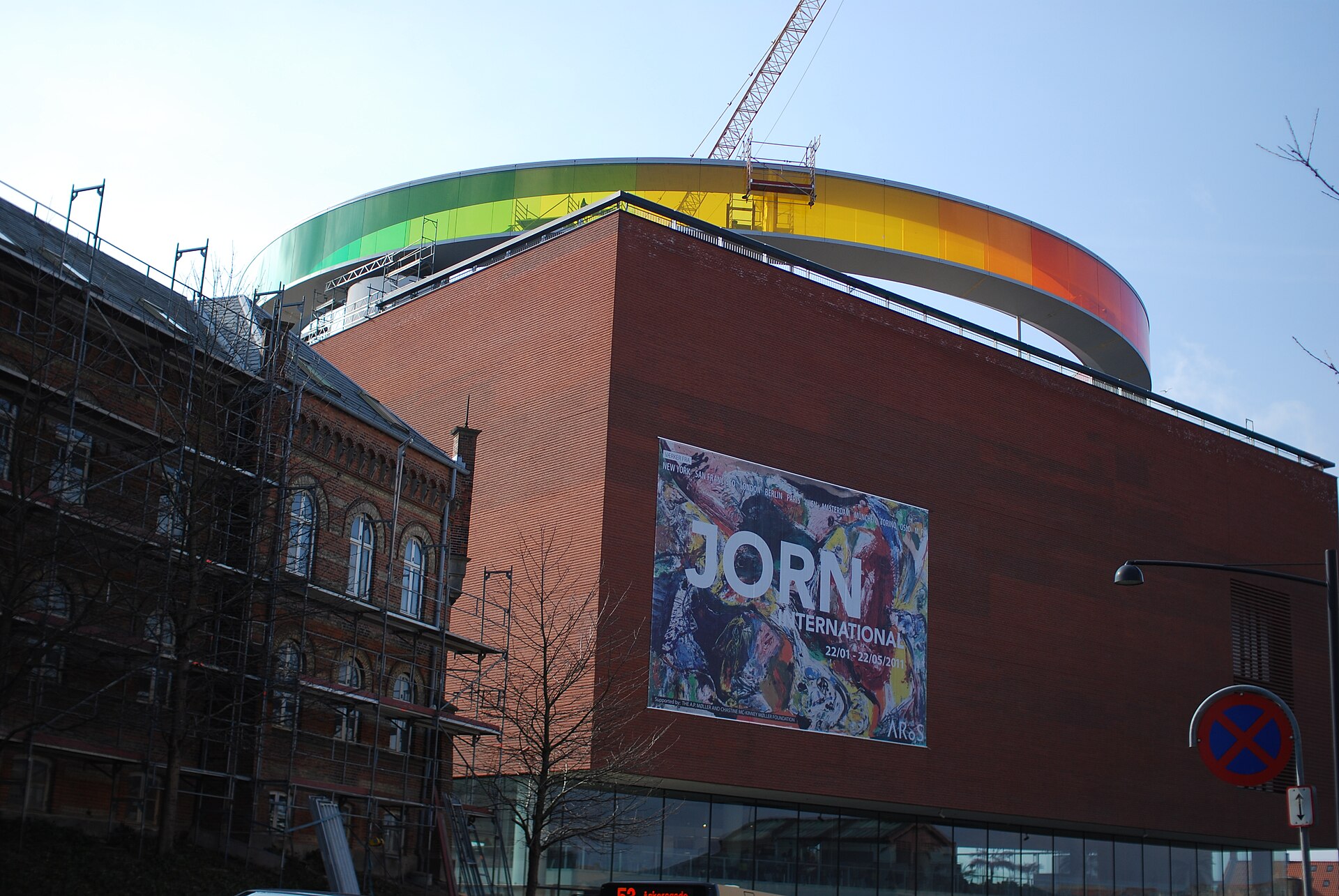
Photograph by Thomas Angermann · CC BY-SA 2.0 Your Rainbow Panorama
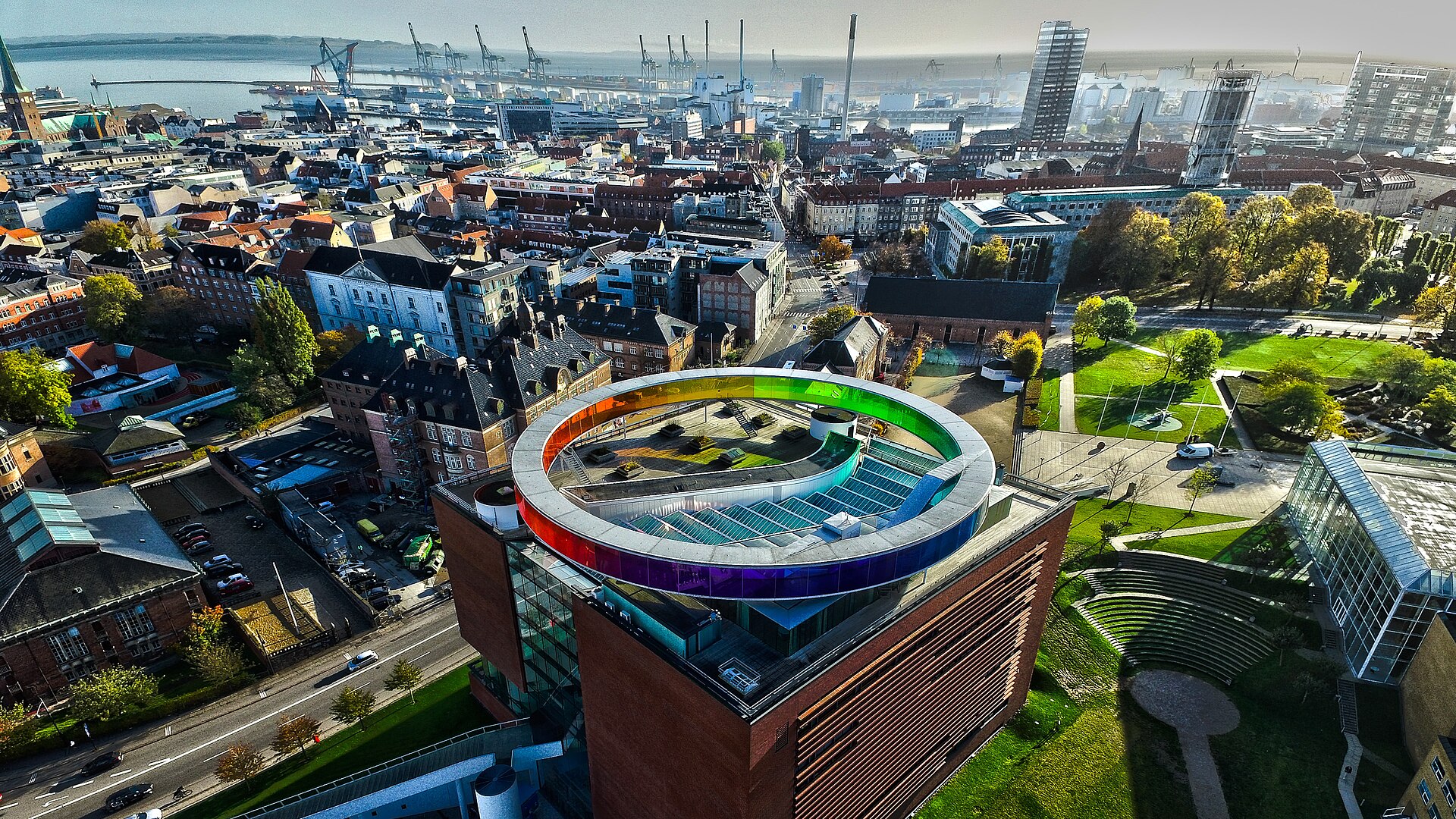
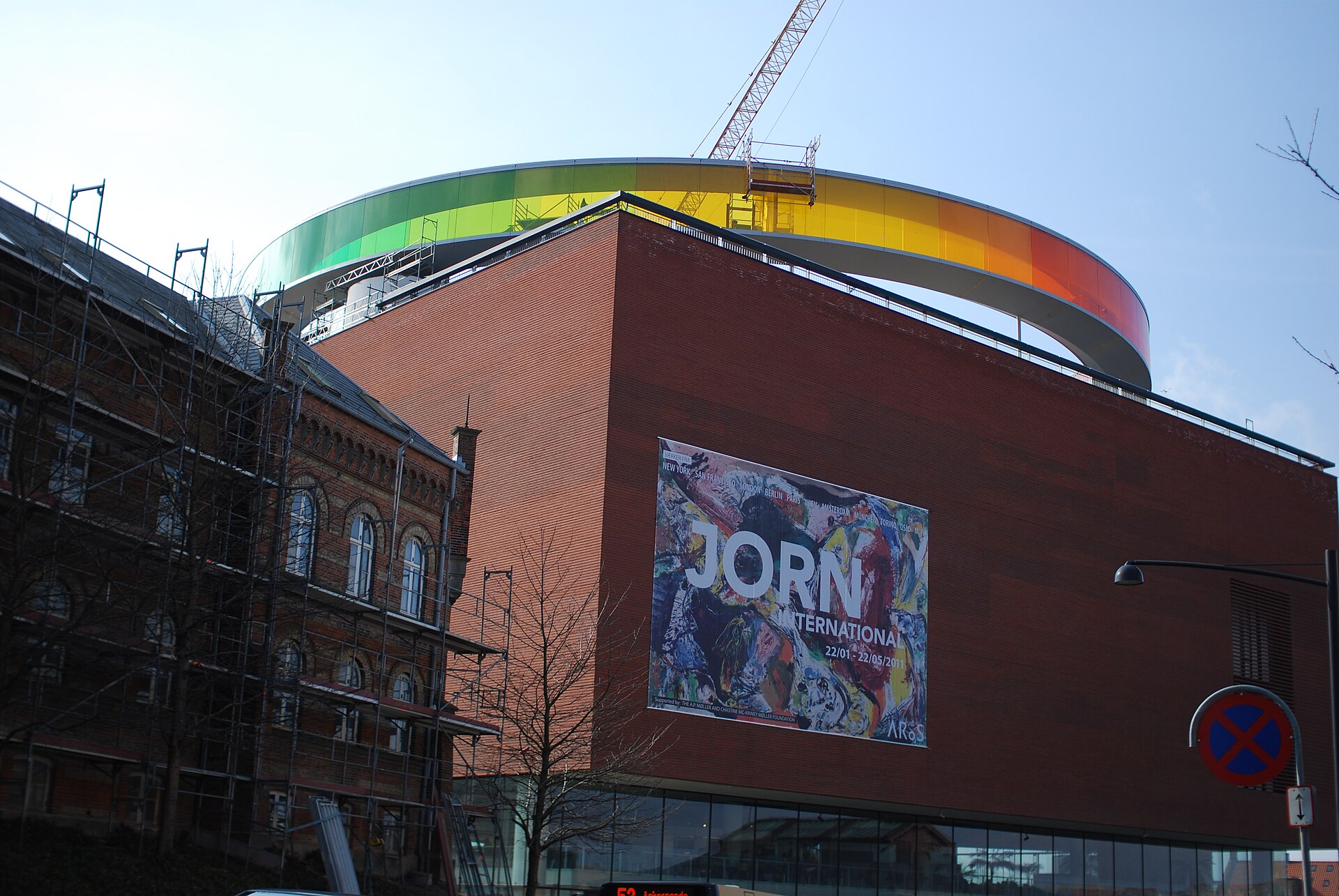
Olafur Eliasson's permanent, walk-through rooftop installation: a circular skywalk 150 metres long and 3 metres wide, 52 metres in diameter, raised 3.5 metres above the roof on slender columns and glazed floor to ceiling in every colour of the visible spectrum. It opened in May 2011 after Eliasson's studio won an invited competition in 2007, was built in collaboration with the architects Schmidt Hammer Lassen, and cost roughly DKK 60 million, funded by the Realdania foundation. The adjoining Roof Pavilion, about 310 square metres, holds an information point, the Sky Room and the Sunset Lounge, where Eliasson's Your Condensation (2013) is shown.
As Seen Below - The Dome, a Skyspace (The Next Level)
A permanent James Turrell Skyspace opened 19 June 2026 as the centrepiece of The Next Level, a roughly 4,000-square-metre underground expansion beneath the redesigned Musikhusparken next to the museum. Visitors reach it along a subterranean, light-filled passage into a domed chamber 16 metres high and 40 metres across, with a 100-square-metre movable roof section that varies the light falling through the apex onto the sky above. Turrell and Schmidt Hammer Lassen developed the artwork and the architecture together over more than a decade; ARoS describes it as the largest Skyspace built inside a museum context to date.
What to see first
Your rainbow panorama (2011)
Olafur EliassonThe circular rainbow-glass rooftop walkway that has become the museum's public image and a driver of its visitor numbers since 2011.3
Boy (1999)
Ron MueckA 4.5-metre, hyperrealist glass-fibre figure of a crouching boy, bought by ARoS in 2001 and on permanent display since 2004; as of this research it is on loan to Museum Voorlinden until it returns to ARoS around March 2027.4
As Seen Below - The Dome, a Skyspace (2026)
James TurrellThe museum's second major architectural artwork after the Rainbow Panorama, and, on ARoS's own description, the largest Skyspace realised inside a museum to date.4
For ARoS (2022)
Jenny HolzerThree white marble benches paired with a vertical LED text sign nearly 3.5 metres tall, a permanent addition to the contemporary collection.4
Colony Howl (2020)
Jonah Freeman and Justin LoweA large-scale immersive installation forming part of the museum's contemporary holdings.4
Omgivelser
Olafur EliassonA permanent mirrored room and glass bridge inside The Nine Spaces, built around the idea of a fictive infinity and treating the visitor's presence as part of the work.11
Danish Golden Age paintings
Christoffer Wilhelm Eckersberg, Christen Kobke, Johan Th. Lundbye and othersThe historical anchor of the collection, representative nineteenth-century works by the generation that defined the Danish Golden Age.12
Cobra-era abstraction
Asger Jorn and other Cobra paintersMid-twentieth-century Danish abstraction that bridges the museum's historical and modern holdings.12
Exhibitions on now
The rainbow on the roof
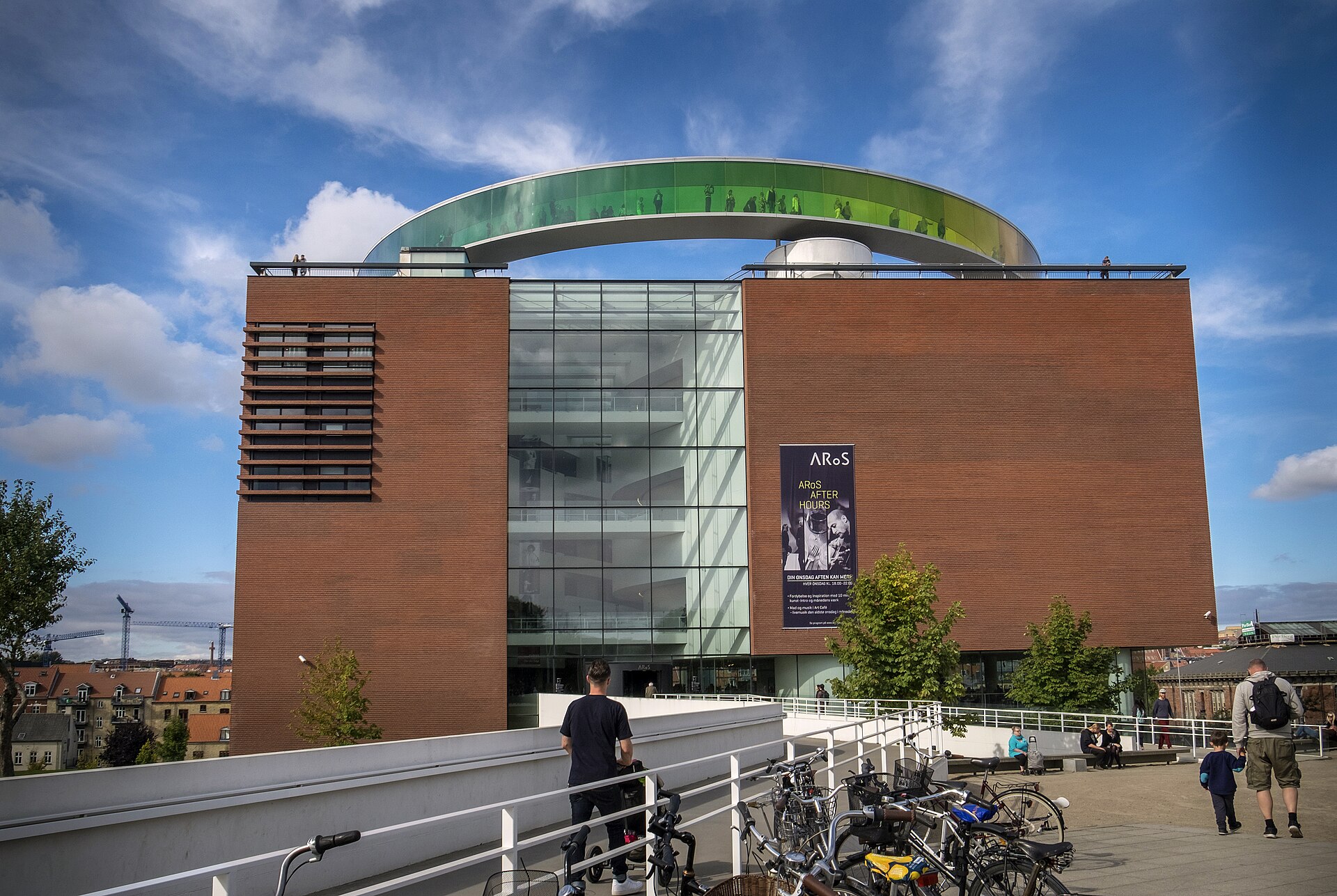
ARoS Aarhus Kunstmuseum occupies a ten-storey cube of roughly 20,700 square metres at Aros Alle 2, in the centre of Aarhus, Denmark's second city. The building opened on 7 April 2004, designed by the Danish practice Schmidt Hammer Lassen, and replaced an earlier home the museum had outgrown. For its first seven years the building was a striking but largely self-contained piece of architecture; what turned it into one of the most photographed museums in Scandinavia arrived in May 2011, when Olafur Eliasson's Your Rainbow Panorama opened on the roof.
The panorama is a circular glass walkway, 150 metres long and 3 metres wide, forming a ring 52 metres across and raised 3.5 metres above the roof deck on slender columns. Every pane is glazed in a different colour of the visible spectrum, so a visitor walking its full circumference sees the city of Aarhus and the bay beyond it shift through the entire rainbow. Eliasson's studio won the commission in an invited competition in 2007 and developed the work with Schmidt Hammer Lassen over the following four years; the roughly DKK 60 million cost was met by the Realdania foundation. Eliasson has described the effect as one that blurs the line between inside and outside, encouraging visitors to notice their own presence in the work rather than simply look through it. The adjoining Roof Pavilion, about 310 square metres, holds an information point, the Sky Room, and the Sunset Lounge, home to Eliasson's later piece Your Condensation (2013). Visitor numbers rose sharply after the panorama opened, and it remains the image most associated with the museum.
From a citizens' collection to a landmark building
The museum's history predates its current building by nearly a century and a half. The Aarhus Art Association formed on 24 March 1847, the first body of its kind outside Copenhagen, and began acquiring works for a permanent collection in 1854. In January 1859 the association mounted Denmark's first museum exhibition outside the capital, at Aarhus City Hall, the point the museum now marks as its founding. A dedicated building, Aarhus Museum, opened to the public in 1877 on Vester Alle. As the collection grew, the museum moved again in 1967 into a three-winged yellow-brick building in Vennelystparken designed by the architect C. F. Moller.
The move to the current Aros Alle building in April 2004 gave the museum its present name, ARoS, and nine floors of gallery space for Danish and international art. The museum marked twenty years in the building in 2024 with special programming, the same year it opened Salling Gallery, a roughly 1,000-square-metre exhibition space, as an early phase of a larger expansion that would culminate in 2026 with an underground extension and a second major permanent artwork.
Hell to heaven: the Nine Spaces and the vertical museum
The building's layout follows a loose narrative built into its section: the main entrance sits partway up the structure, and a visitor can either descend toward a set of black-painted basement galleries known as The Nine Spaces, or De 9 Rum, or ascend through the collection floors toward the light and colour of the roof. The number nine is a reference to the nine circles of Dante's Inferno, and the basement rooms, kept dark in contrast to the museum's white exterior, are reserved for light, video and installation art rather than paintings. Artists shown there have included James Turrell, Shirin Neshat, Bill Viola and Anri Sala.
A permanent Olafur Eliasson piece, Omgivelser, occupies one of the Nine Spaces: a small room built around mirrors and a glass-grid bridge that the artist has described as generating a fictive sense of infinity around ideas of gravity and boundlessness, in which the visitor's own body and movement become part of what is on display. The contrast between the darkness of the basement and the coloured light of the rooftop panorama gives the building, end to end, the character of a single deliberate journey rather than a stack of unrelated floors.
The collection: Golden Age to contemporary
ARoS holds more than 8,000 works and describes itself as Denmark's largest art collection outside Copenhagen, spanning roughly 300 years of Danish art alongside a substantial international contemporary wing. Its historical core is the nineteenth-century Danish Golden Age, represented by Christoffer Wilhelm Eckersberg, Christen Kobke, Johan Th. Lundbye, Jorgen Roed, Martinus C. W. Rorbye, Wilhelm Marstrand and P. C. Skovgaard, painters whose landscapes, portraits and domestic scenes are closely tied to the formation of a modern Danish national identity. The collection continues into early-twentieth-century modernism with Harald Giersing, Edvard Weie, Olaf Rude and Vilhelm Lundstrom, and into postwar abstraction through Richard Mortensen, Robert Jacobsen, Asger Jorn and the other Cobra painters.
The contemporary and international side of the collection includes Ron Mueck's hyperrealist sculpture Boy, bought in 2001 and on display at ARoS since 2004; Jenny Holzer's For ARoS (2022), pairing marble benches with a tall vertical LED text sign; Jonah Freeman and Justin Lowe's large-scale installation Colony Howl (2020); and work by Miwa Yanagi, Carsten Hoeller, Tony Oursler and Bill Viola. As of this research, Boy is on loan to Museum Voorlinden in the Netherlands and is expected back at ARoS around March 2027, a detail worth checking before planning a visit specifically to see it.
The Next Level: a second landmark underground
Ground was broken in 2022 on The Next Level, a roughly 4,000-square-metre underground expansion built beneath the redesigned Musikhusparken next to the museum, developed once again with Schmidt Hammer Lassen. Its centrepiece, James Turrell's As Seen Below - The Dome, a Skyspace, opened to the public on 19 June 2026. Visitors reach it through a subterranean, light-filled passage that opens into a domed chamber 16 metres high and 40 metres in diameter, with an oculus at its apex framing the sky; a 100-square-metre movable roof section lets the museum vary the light and weather effects visible through the opening. ARoS describes it as the largest Skyspace realised inside a museum context anywhere to date, and Turrell and the architects developed the art and the building together over more than a decade rather than adding the artwork to a finished structure.
Where the Rainbow Panorama sends visitors up and out onto the roof, the Turrell dome sends them down and inward, giving the museum, fifteen years after the panorama's debut, a second permanent large-scale artwork built directly into its architecture.
Visiting today
ARoS is a full-day option for a visitor with time to spare in Aarhus, and several published reviews and visitor guides suggest budgeting at least three hours to cover the collection floors, the Nine Spaces and the rooftop panorama. The museum is close to the city centre at postcode 8000 Aarhus C, with 79 public parking spaces on Aros Alle itself and no dedicated coach parking, so groups arriving by bus are asked to arrange this with the museum in advance. Lifts run from street level up to the entrance and to every gallery floor, accessible toilets are located on levels 3, 4, 8 and 9, and wheelchairs can be borrowed at the Information Centre; visitor reviews flag lift waiting times at busy periods as the museum's main accessibility friction point in practice.
Photography for private use is allowed throughout the galleries and the architecture, tripods and drones excepted, and a staffed cloakroom on level 4 offers lockers for a DKK 20 token. The ARoS Cafe and Orangery and the ARoS Shop are both open to the public without a museum ticket. The museum runs a changing programme of temporary exhibitions alongside its permanent collection and installations, so the specific mix of works on view varies through the year even where the building's fixed landmarks, the Rainbow Panorama, the Nine Spaces and the Turrell dome, do not.
What visitors say
Visitors consistently single out the building itself, and above all the Rainbow Panorama and, since 2026, the Turrell Skyspace, as reasons to visit independent of any given exhibition; several reviewers compare the quality of the contemporary collection favourably to major international museums. The most common complaints are practical rather than curatorial: long waits for the lifts at busy times, which visitors also flag as an accessibility concern, and the price of admission.
What is praised, what is criticised
- Praised: The Rainbow Panorama and its 360-degree coloured views of Aarhus, repeatedly named the highlight of a visit
- Praised: The Turrell Skyspace, described by reviewers as an immersive, meditative experience
- Praised: The scale and quality of the contemporary collection, with one reviewer comparing it to MOMA
- Praised: The building's architecture as a destination in its own right
- Praised: Interactive and accessible elements that make the museum work well for families
- Criticised: Long waits for the lifts between floors at peak times, raised specifically as an accessibility problem for wheelchair users
- Criticised: The admission price, which some visitors consider high for the length of a typical visit
Ratings on other platforms
Tripadvisor: 4.5 from 2,912 ratings, read 5 September 2026
A platform average is a tertiary source: it moves, it is not audited, and we quote no visitor's words.
Questions about ARoS Aarhus Kunstmuseum
Where is ARoS Aarhus Kunstmuseum?
Aros Alle 2, 8000 Aarhus C, Denmark.
How much does it cost to visit?
Adult: DKK 200; Under 31 / student: DKK 150; Group (20+ people): DKK 180; Under 18: free; Cafe and shop: free. As confirmed 5 September 2026.
When is it open?
Mon-Fri (1 Jun - 30 Sep) 09:00-20:00; Sat-Sun (1 Jun - 30 Sep) 09:00-17:00; Tue-Fri (1 Oct - 31 May) 10:00-20:00; Sat-Sun (1 Oct - 31 May) 09:00-17:00. Closed: Monday, except Mondays in June, July and August, and except some public holidays. As confirmed 5 September 2026.
How do you get there?
Parking: 79 public parking spaces on Aros Alle. No dedicated coach parking; groups arriving by bus are asked to arrange this with the museum at least a week ahead; Walking: The museum sits in central Aarhus, at postcode 8000 Aarhus C, the city's centrum district.
What should you see first?
Your rainbow panorama (2011) (Olafur Eliasson); Boy (1999) (Ron Mueck); As Seen Below - The Dome, a Skyspace (2026) (James Turrell); For ARoS (2022) (Jenny Holzer); Colony Howl (2020) (Jonah Freeman and Justin Lowe); Omgivelser (Olafur Eliasson).
What we could not confirm
- Ron Mueck's Boy, one of the collection's best-known works, is on loan to Museum Voorlinden and not on view at ARoS; sources give its expected return as around March 2027, but this should be reconfirmed by a visitor planning a trip specifically to see it.
- ARoS's own pages do not state a fixed timed-entry requirement for individual visitors, unlike some comparable European museums; this is worth reconfirming directly before a peak-season visit.
Images
Sources
- 1ARoS Aarhus Kunstmuseum, Opening hours and prices aros.dk/en/visit/opening-hours-and-prices/
- 2ARoS Aarhus Kunstmuseum, Practical information aros.dk/en/visit/practical-information/
- 3ARoS Aarhus Kunstmuseum, Olafur Eliasson - Your rainbow panorama (2011) aros.dk/en/aros-collection/olafur-eliasson-your-rainbow-panorama-2011/
- 4ARoS Aarhus Kunstmuseum, ARoS Collection aros.dk/en/aros-collection/
- 5ARoS Aarhus Kunstmuseum, Timeline 1847-2024 aros.dk/en/about-aros/aros-history/
- 6ARoS Aarhus Kunstmuseum, About ARoS aros.dk/en/about-aros/
- 7Wikipedia, ARoS Aarhus Kunstmuseum () en.wikipedia.org/wiki/ARoS_Aarhus_Kunstmuseum
- 8Wikidata, Q296962, ARoS Aarhus Kunstmuseum () wikidata.org/wiki/Q296962
- 9Tripadvisor, Aros Aarhus Kunstmuseum reviews () tripadvisor.com/Attraction_Review-g189530-d243845-Reviews-Aros-Aarhus_East_Jutland_Jutland.html
- 10ArchDaily, Schmidt Hammer Lassen Completes ARoS Expansion with James Turrell's As Seen Below - The Dome archdaily.com/1042584/schmidt-hammer-lassen-completes-aros-expansion-with-james-turrells-as-seen-below-the-dome
- 11Art Matter, Olafur Eliassons rum i rummet paa ARoS artmatter.dk/journal/olafur-eliassons-rum-i-rummet-paa-aros/
- 12ARoS Aarhus Kunstmuseum, About the Collection aros.dk/en/art/the-collection/about-the-collection/
- 13VisitAarhus, ARoS Aarhus Art Museum visitaarhus.com/aarhus-region/plan-your-trip/aros-aarhus-art-museum-gdk1077501
- 14Wikimedia Commons, File:ARoS Aarhus Kunstmuseum, Aarhus, 2017-04-12.jpg commons.wikimedia.org/wiki/File:ARoS_Aarhus_Kunstmuseum,_Aarhus,_2017-04-12.jpg
- 15Wikimedia Commons, File:Your rainbow panorama.jpg commons.wikimedia.org/wiki/File:Your_rainbow_panorama.jpg
- 16Wikimedia Commons, File:20160917 ARoS Aarhus 0189 (29690500021).jpg commons.wikimedia.org/wiki/File:20160917_ARoS_Aarhus_0189_(29690500021).jpg
- 17Wikimedia Commons, File:ARoS Aarhus Art Museum photographed from air.jpg commons.wikimedia.org/wiki/File:ARoS_Aarhus_Art_Museum_photographed_from_air.jpg


.jpg)
