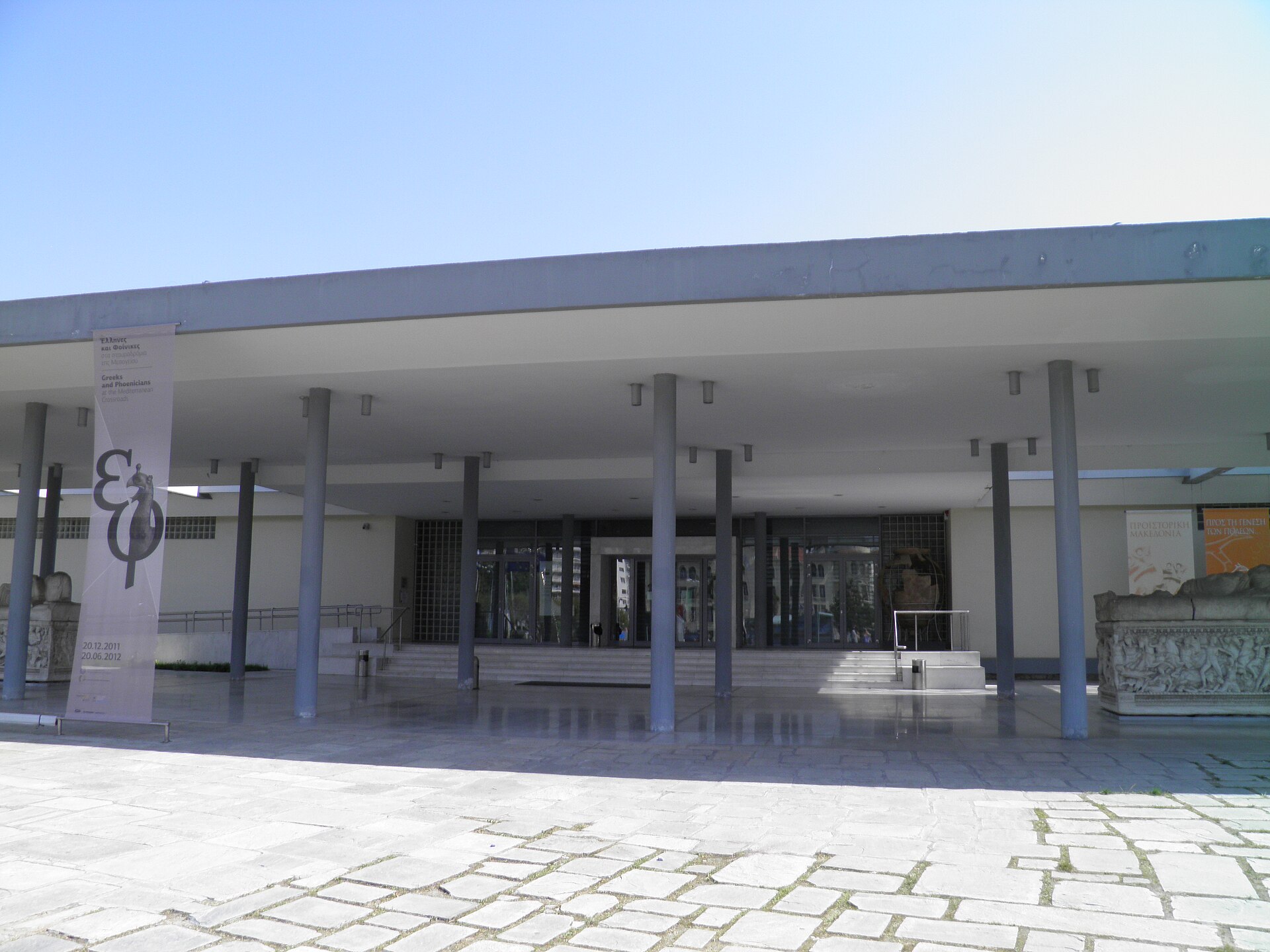
The main entrance portico, its columns shading a row of ancient sarcophagi displayed against the glass facade, photographed in 2012.
Carole Raddato · Photograph by Carole Raddato from FRANKFURT, Germany · CC BY-SA 2.0Archaeological Museum of Thessaloniki
Museum · Αρχαιολογικό Μουσείο Θεσσαλονίκης · Founded 1962
Open, admission and hours confirmed 10 September 2026 · 16 sources
On this page 15 sections
ContentsClose
What distinguishes this collection is that it was built almost entirely from the ground up rather than assembled by purchase or princely inheritance: a state Ephorate opened in 1912 and the Derveni krater, the Derveni papyrus, the Sindos gold and the rest arrived through more than a century of excavation across one specific region, Macedonia, rather than through the encyclopaedic collecting that shaped older European museums. That regional depth, prehistoric settlement through Roman Thessaloniki, told through material recovered close to where it is displayed, is the museum's real strength, and it is why the Vergina royal tombs, spectacular as they are, were eventually given a museum of their own near the find-site rather than kept here.
| Local name | Αρχαιολογικό Μουσείο Θεσσαλονίκης |
|---|---|
| Kind | Museum |
| Founded | 1962 (present building opened); the collection itself traces to the Ephorate of Antiquities of Macedonia, established November 1912 |
| City and country |  Thessaloniki, Greece Thessaloniki, Greece |
| Address | 6 Manoli Andronikou Street, 546 21 Thessaloniki, Greece |
| Website | amth.gr |
| Status | Open, confirmed |
| Record last verified |
Visiting
- Hours
- 1 April to 31 October, daily09:00 to 17:00Extended to 22:00 on the first Thursday of May, June, July, August and September
- 1 November to 31 March, Wednesday to Monday09:00 to 17:00
- 1 November to 31 March, TuesdayClosed
- Good Friday12:00 to 17:00
- Holy Saturday08:30 to 15:30
- Closed
- 25-26 December, 1 January, 25 March and 1 May, every year. Easter Sunday. Entry begins 15 minutes after the posted opening time and last admission is 20 minutes before closing.
- Admission
- StandardEUR 10
- ReducedEUR 5EU citizens aged 65 and over (1 October to 31 May, with ID); parents accompanying a primary-school educational visit; non-EU teachers on an educational visit
Free entry: First and third Sunday of the month, 1 November to 31 March. 6 March, 18 April and 18 May. Last weekend of September (European Heritage Days). 28 October. Standing free categories year-round: EU citizens and residents under 25 with ID, students of Greek universities and the Athens/Thessaloniki Schools of Fine Arts, people with disabilities and one accompanying companion, refugees and asylum seekers, journalists on assignment with press credentials, and ICOM/ICOMOS members and museum professionals- Do I need to book?
- No pre-booking is required for individual visitors; tickets are sold at the door for same-day entry
- Address
- 6 Manoli Andronikou Street, 546 21 Thessaloniki, Greece MapBus Lines 7, 10, 11, 12, 31, 39, 58 and the cultural line 50 all stop near the museum, per OASTH
On foot About 15 minutes' walk from Aristotelous Square in the city centre
Car No dedicated museum car park; the museum's own directions point visitors to the City Hall, International Fair Grounds and YMCA public car parks nearby - Website
- amth.gr
- Telephone
- +30 2313 310201
- [email protected]
Before you go how long, access, photography, bags, eating, shop
- How long to allow
- The museum's own guide flags a one-hour route for a short visit; TripAdvisor's aggregate listing gives two to three hours, and a visitor covering all eight permanent exhibitions plus the open-air garden should plan for the longer end of that
- Access
- A ramp from Stratou Avenue reaches the main entrance, roughly 120 metres from the nearest drop-off; lifts connect the two exhibition levels, wheelchairs are lent on request, corridors exceed the standard 1.5-metre accessible width, and accessible toilets and a defibrillator are on site. Deaf and hard-of-hearing visitors can use the free SignGuide app in Greek Sign Language; blind and partially sighted visitors can arrange a touch tour; separate visiting guides exist for visitors on the autism spectrum
- Photography
- Not stated on the museum's own visitor-services pages as read on 2026-08-12; not confirmed for this file
- Bags
- Not stated on the museum's own visitor-services pages as read on 2026-08-12; not confirmed for this file
- Eating
- Mouseio Cafe, run by the Brothers in Law team, in the museum's garden; Monday to Thursday 09:00 to midnight, Friday to Sunday 09:00 to 02:00, serving wine, cocktails and Greek cheese and cold-meat boards rather than a standard museum snack counter
- Shop
- A museum shop operates during museum hours; ring +30 2313 310257 to confirm before a visit
Prices and hours change. We take them from the institution's own pages and print the day we read them, and you can check the current position at the source we used. Confirm before you travel.
What is inside
Prehistoric Macedonia
The region's Neolithic through Bronze Age settlements, spanning roughly 200,000 to 5,000 years ago, told through the tools, pottery and domestic remains that survive from a period with almost no written record at all.
Towards the Birth of Cities
The Early Iron Age, roughly 1100 to 700 BC, tracing how scattered communities between Mount Athos and Mount Olympus consolidated into the organised settlements that would grow into the historical cities of Macedonia.
In the Kingdom of Macedonia
The long span from the Macedonian kingdom's founding in the 7th century BC to Late Antiquity, the museum's broadest chronological gallery and the one that carries the material of the Argead and Antigonid periods before Rome absorbed the region.
Thessaloniki, the Metropolis of Macedonia
The city's own antiquities and monuments once it became, after its founding in 315 BC by Cassander, the province's leading city: civic sculpture, inscriptions and remains connected to Thessaloniki itself rather than to the wider Macedonian countryside.
The Gold of Macedon
The museum's largest collection of gold wreaths, jewellery, coins and funerary gold, drawn from the cemeteries of Sindos, Agia Paraskevi, Nea Filadelfia, Makrygialos, Derveni, Lete, Serres and Evzonoi, and the section most visitors and reviewers name first.
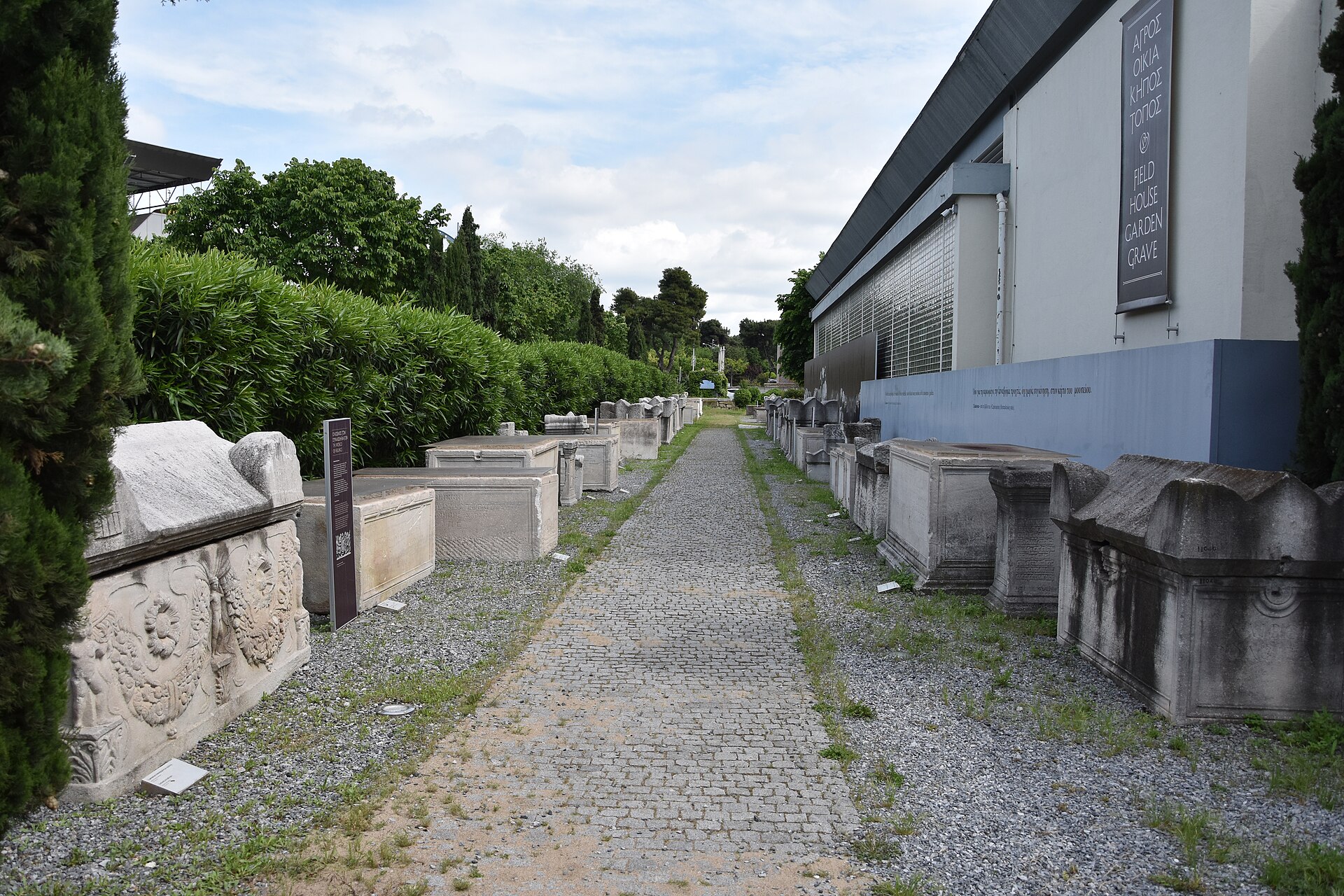
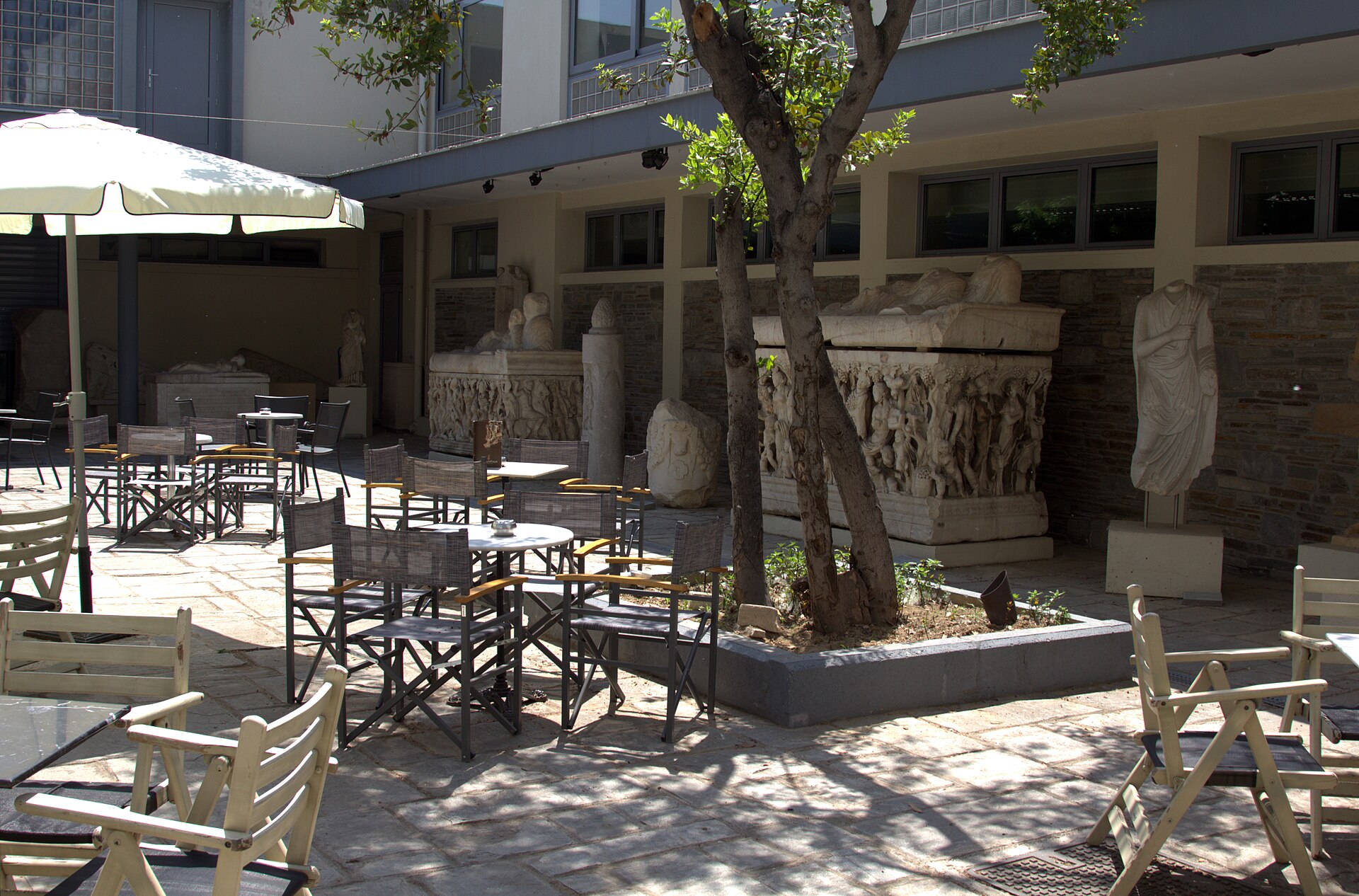
Photograph by Phyrexian · CC BY-SA 4.0 Field, House, Garden, Grave
An open-air exhibition in the museum's own garden, laying out funerary stelae, sarcophagi and architectural fragments recovered from Macedonian cemeteries and rural settlements, displayed outdoors among trees rather than under gallery lighting.
Memory in Stone
A second open-air gallery devoted to the city's inscribed and carved stone monuments, from grave markers to public dedications, read here as a record of how Thessaloniki wrote its own history into its buildings and cemeteries.
Macedonia: From Fragments to Pixels
An interactive digital wing, described by the museum as internationally unique, using touchscreens and reconstructions to let visitors handle and reassemble the region's archaeological record in ways the physical objects themselves cannot allow.
What to see first
The Derveni Krater
Bronze and tin alloy volute krater, Macedonian workshop, late 4th century BCA 90cm, 40kg funerary vessel for a Thessalian aristocrat, its bronze-tin alloy giving a golden sheen without any gold at all, and its relief frieze of Dionysos and his retinue is called the museum's own masterpiece.7
The Derveni Papyrus
Charred papyrus roll, copied 340-320 BC from a text of around 420-410 BCSurvived only because it was burned on the same funeral pyre as the krater; it is Europe's oldest surviving book, the first Greek entry on UNESCO's Memory of the World register, and its 266 fragments carry a commentary on an Orphic poem.7
The gold wreaths of the Macedonian cemeteries
Gold, Archaic to Hellenistic period, Sindos and related cemeteriesThe museum's own largest collection of precious grave goods, and the single section named most often by visitors as the reason to come, gold funerary wreaths and jewellery pulled from cemeteries across the region rather than assembled by purchase.6
The plaster-cast replicas of Las Incantadas
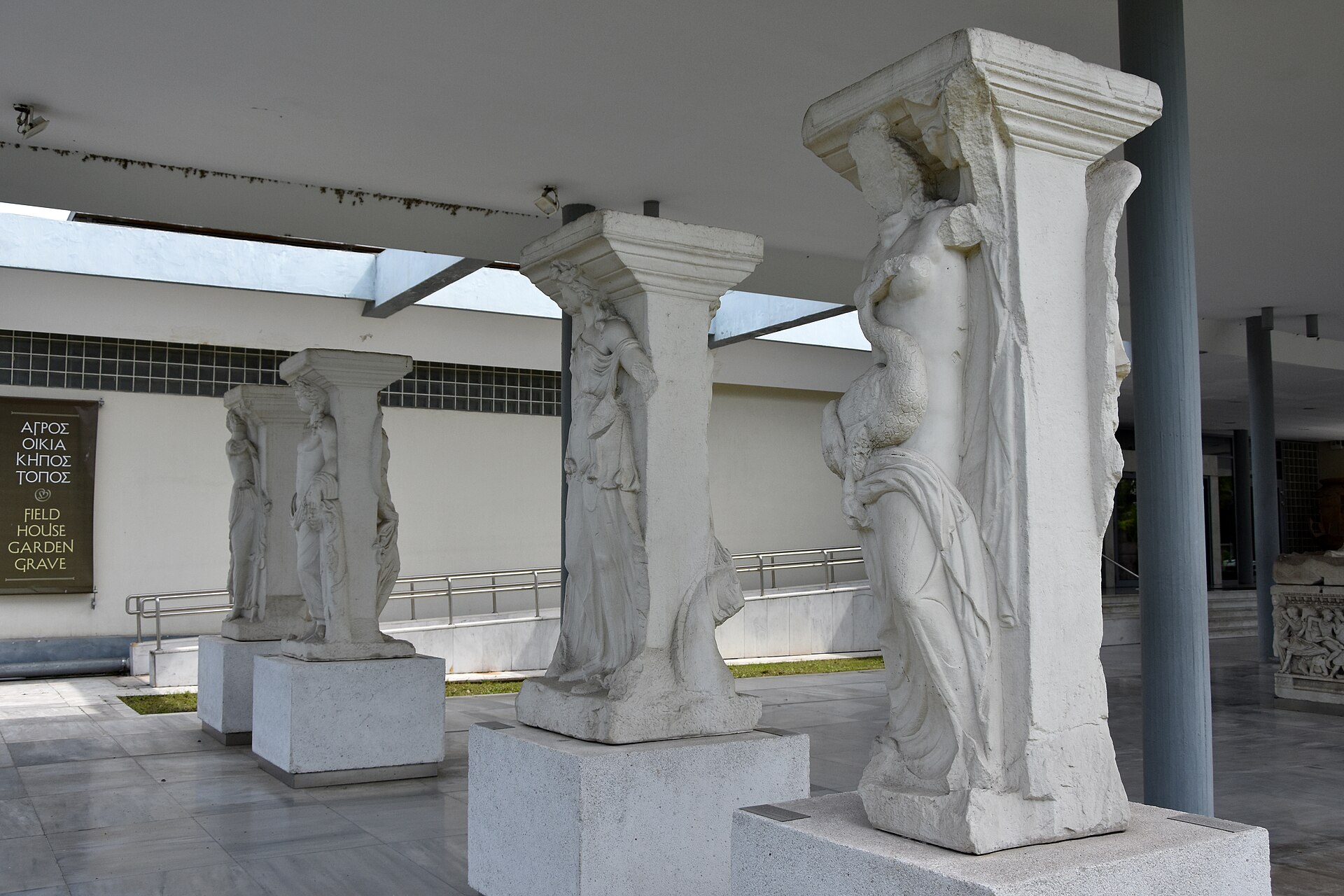
2015 casts, moulded at the Louvre from the 2nd-century AD originalsThe originals, four sculpted pillars from a Roman-era portico in Thessaloniki's forum, were shipped to the Louvre by the French paleologist Emmanuel Miller in 1864; a 1997 Greek request for their return went nowhere, and these exact-mould replicas, unveiled in the museum's own portico in 2017, are the closest the city has to them back.10
The Aravissos hoard
Gold, Final Neolithic, roughly 4500-3200 BCSix gold objects, including ring pendants and a disc, found near Pella and among the earliest evidence anywhere in the region that Neolithic communities were already working precious metal into objects of personal and funerary display.7
The Petralona hoard
Bronze, Early Bronze Age, 3rd millennium BCForty chisels and four axes found near Petralona in Chalkidice, a hoard whose scale points to organised bronze-working and to exchange networks already running between Macedonia and the wider Aegean and Balkan world.7
The bronze statue recovered in 2010
Bronze, Hellenistic, tentatively linked to the sculptor LysipposSeized from looters in 2010 and possibly the first securely attributable work by Alexander the Great's own court sculptor to survive, it has been undergoing conservation and authentication at the museum's laboratory rather than sitting finished on display.9
Past exhibitions here
A modernist building on Chanth Square
The museum's building was not inherited from an older institution. It was built for the purpose, going up between 1960 and 1962 on Chanth Square, close to the International Trade Fair grounds, to a design by the modernist Greek architect Patroklos Karantinos. The low, flat-roofed, colonnaded structure is now itself a listed monument, an example of postwar Greek public architecture rather than a converted palace or barracks of the kind that houses many of Europe's older archaeological collections. A second wing followed in 1980, built specifically to hold the spectacular royal-tomb finds from Vergina; those objects stayed in Thessaloniki until 1997, when they were moved to the purpose-built museum at Vergina itself, close to where they were excavated, leaving the 1980 wing to be redeployed for other collections.
The building was substantially renovated between 2001 and 2004, ahead of the Athens Olympics that summer, reorganising the permanent galleries into the sequence that broadly still stands and modernising visitor facilities that had not changed much since the 1960s. A reader walking in today is walking through a building whose own architectural history, plain concrete and glass rather than columns and pediments, is part of what distinguishes it from the neoclassical museum buildings common elsewhere in Greece.
From a wartime Ephorate to a national collection
The institutional root of the museum predates the building by half a century. The Ephorate of Antiquities of Macedonia was established in November 1912, within weeks of Greece taking control of Thessaloniki during the First Balkan War, and it was this office, not a single founding donation or royal collection, that began gathering the region's excavated antiquities under state protection. That origin shapes the collection's character: almost everything in the museum came out of the ground in Macedonia itself, through more than a century of excavation at sites across the region, rather than through purchase, princely inheritance or colonial-era removal from somewhere else.
The collection grew steadily through the 20th century as excavation activity across Macedonia expanded, most dramatically after 1962, when a single road-widening dig at Derveni, a small site outside the city, produced both the bronze krater and the papyrus that remain the museum's two most famous single objects. Donated antiquities added further to the holdings, but the great majority of what is on display was recovered by archaeologists working for the same Ephorate that opened the file in 1912.
Derveni: a krater and Europe's oldest surviving book, from the same grave
The 1962 excavation at Derveni is unusual in archaeology for producing two internationally significant objects from adjoining graves in the same small cemetery. Cist grave B held the Derveni Krater, a 90cm bronze-and-tin volute krater made for mixing wine at ritual or festive gatherings, its surface a golden alloy achieved without any gold, decorated in relief with Dionysos and his mythological retinue and inscribed with the name of the Thessalian aristocrat, Astiouneios son of Anaxagoras, whose funerary urn it became. Cist grave A, close by, held a papyrus roll that had been placed on the same funeral pyre and survived precisely because it was charred rather than burned to nothing.
That papyrus, now known simply as the Derveni Papyrus, is Europe's oldest surviving book, copied around 340-320 BC from a philosophical and theological text a few decades older, an allegorical commentary on an Orphic poem concerned with the fate of the soul after death. Its 266 fragments were the first Greek item entered on UNESCO's Memory of the World register. Both objects are presented today in the museum's controlled micro-environment galleries, a single grave-robbery-era road project having handed the museum, in one dig, both its most visually spectacular object and its most textually important one.
The Gold of Macedon
Of the museum's eight named permanent exhibitions, the one visitors name first, without prompting, is the gold. The gallery draws on cemeteries across the region, Sindos, Agia Paraskevi, Nea Filadelfia, Makrygialos, Derveni, Lete, Serres and Evzonoi among them, to lay out what funerary gold looked like for Macedonian elites from the Archaic period through the Hellenistic age that followed Alexander: gold wreaths modelled as oak or myrtle leaves, gold mouth-and-eye coverings placed directly on the dead, coin hoards, and jewellery buried with its owners rather than passed down. The wreaths in particular, worked thin enough to be funerary rather than wearable, are frequently the single image visitors leave with.
The gallery matters beyond its visual impact because it is regional rather than royal: unlike the Vergina material, which documents one specific dynasty's tombs and now lives in its own museum near where it was found, the Sindos and related finds document how gold funerary custom was practised more broadly across Macedonian society in the centuries before and after Philip II and Alexander, giving a wider social picture than a single royal tomb could.
Las Incantadas: what the Louvre still holds
Not every object connected to this museum is inside it. In the second century AD, a sculpted portico stood in Thessaloniki's Roman forum, five Corinthian columns, four of them carved on both faces with figures from Greek and Roman myth, Nike, Dionysus, Ariadne, Leda and Ganymede among them. Thessaloniki knew it as Las Incantadas, the enchanted ones. In October and November 1864 the French paleologist Emmanuel Miller, sailing in on a French warship with permission from the Ottoman authorities in Constantinople, removed the four sculpted pillars and their capitals over local objection and shipped them to Paris, leaving the rest of the structure to collapse; Miller himself later called the removal an act of vandalism. The pillars have been in the Louvre ever since.
When Thessaloniki held the title of European Capital of Culture in 1997, the city formally requested the sculptures' return. The request went nowhere, and it has not been renewed with any more success since. What the museum has instead, since 2017, is a set of faithful plaster casts, moulded at the Louvre's own workshops in 2015 at a cost of roughly 150,000 euros and installed permanently in the museum's covered portico, the first time in over 150 years Thessaloniki has had any version of the sculptures to see. The museum did not create the dispute and does not conceal it either, having hosted its own conference on the Incantadas monument, but the fact remains that the originals a visitor sees here are exact copies of objects the city has been asking for back since before this museum's own website existed.
Visiting today
A visit now moves through the eight permanent exhibitions in roughly chronological order, from Prehistoric Macedonia through the Iron Age galleries and into the Hellenistic and Roman material, with the Gold of Macedon and the interactive Macedonia: From Fragments to Pixels wing as the two departures from a straight chronological walk. Outside, in the museum's own garden, Field, House, Garden, Grave and Memory in Stone lay funerary and architectural stonework out among trees rather than under gallery glass, an unusually informal way to end a visit that started in climate-controlled cases.
The practicalities have modernised along with the displays: a free Greek Sign Language app, touch tours for blind and partially sighted visitors, autism-friendly visiting guides, and step-free access from Stratou Avenue all sit alongside a garden cafe, now run under the Mouseio Cafe name, that keeps bar hours running well past the museum's own closing time. A reader planning two hours should budget closer to three if the gold gallery and the outdoor stonework both make the itinerary, and should not expect the museum shop's hours to match the galleries exactly without a phone call first.
What visitors say
Visitors consistently describe the collection itself as the reason to come and rate the bilingual Greek-and-English labelling and the clarity of the room-by-room narrative highly; the Gold of Macedon section in particular is named unprompted, over and over, as the section not to skip. Where opinion splits is on the building and the technology around the objects: some call the 1962 galleries themselves old-fashioned even while praising how the displays inside them are organised, and more than one visitor found the video presentations under-served by their own audio.
What is praised, what is criticised
- Praised: The bilingual Greek/English labelling throughout, repeatedly singled out as making the museum fully legible to a visitor with no Greek at all
- Praised: The Gold of Macedon gallery, named first and most often across independent reviews as the highlight of a visit
- Criticised: The audio on the video and multimedia presentations is frequently reported as too quiet, with no headphones offered, so the films are harder to follow than the object labels are to read
- Criticised: Multiple 2025-2026 visitors reported staff at the information points unable to answer specific historical questions in any depth, and one described the front desk refusing valid press credentials that a comparable museum nearby accepted without issue
Ratings on other platforms
TripAdvisor: 4.6 from 1,554 ratings, read 12 August 2026
A platform average is a tertiary source: it moves, it is not audited, and we quote no visitor's words.
Questions about Archaeological Museum of Thessaloniki
Where is Archaeological Museum of Thessaloniki?
6 Manoli Andronikou Street, 546 21 Thessaloniki, Greece.
How much does it cost to visit?
Standard: EUR 10; Reduced: EUR 5. As confirmed 10 September 2026.
When is it open?
1 April to 31 October, daily 09:00-17:00; 1 November to 31 March, Wednesday to Monday 09:00-17:00; 1 November to 31 March, Tuesday closed; Good Friday 12:00-17:00; Holy Saturday 08:30-15:30. Closed: 25-26 December, 1 January, 25 March and 1 May, every year. Easter Sunday. As confirmed 10 September 2026.
How do you get there?
Bus: Lines 7, 10, 11, 12, 31, 39, 58 and the cultural line 50 all stop near the museum, per OASTH; On foot: About 15 minutes' walk from Aristotelous Square in the city centre; Car: No dedicated museum car park; the museum's own directions point visitors to the City Hall, International Fair Grounds and YMCA public car parks nearby.
What should you see first?
The Derveni Krater (Bronze and tin alloy volute krater, Macedonian workshop, late 4th century BC); The Derveni Papyrus (Charred papyrus roll, copied 340-320 BC from a text of around 420-410 BC); The gold wreaths of the Macedonian cemeteries (Gold, Archaic to Hellenistic period, Sindos and related cemeteries); The plaster-cast replicas of Las Incantadas (2015 casts, moulded at the Louvre from the 2nd-century AD originals); The Aravissos hoard (Gold, Final Neolithic, roughly 4500-3200 BC); The Petralona hoard (Bronze, Early Bronze Age, 3rd millennium BC).
What we could not confirm
- The bronze statue recovered from looters in 2010 and tentatively linked to the sculptor Lysippos was, as of the sources used for this file, still described as undergoing conservation and authentication rather than confirmed and permanently displayed; its current gallery status was not independently verified beyond the museum's own account.
- The museum's own visitor-services pages, as read on 2026-08-12, did not state a photography policy or a bag policy in the sections fetched for this file; a visitor should confirm both at the entrance desk rather than assume either from this page.
Images
Sources
- 1Archaeological Museum of Thessaloniki, homepage (museum's own site) amth.gr/
- 2AMTH, Ticket prices and visiting hours (museum's own site) amth.gr/en/visit/hours-and-tickets
- 3AMTH, How to find us / directions (museum's own site) amth.gr/en/visit/how-to-find-us
- 4AMTH, Accessibility (museum's own site) amth.gr/en/visit/accessibility
- 5AMTH, The story of AMTH (museum's own site, history and building) amth.gr/en/museum/the-story-of-amth
- 6AMTH, Permanent exhibitions (museum's own site) amth.gr/en/exhibitions/permanent-exhibitions
- 7AMTH, Our highlights (museum's own site) amth.gr/en/exhibitions/highlights
- 8AMTH, Cafe (museum's own site) amth.gr/en/cafe-archaeological-museum-thessaloniki
- 9Wikipedia, Archaeological Museum of Thessaloniki () en.wikipedia.org/wiki/Archaeological_Museum_of_Thessaloniki
- 10Wikipedia, Las Incantadas () en.wikipedia.org/wiki/Las_Incantadas
- 11TripAdvisor, Archaeological Museum of Thessaloniki, aggregate rating and visitor reviews, read 12 August 2026 () tripadvisor.com/Attraction_Review-g189473-d243223-Reviews-Archaeological_Museum_of_Thessaloniki-Thessaloniki_Thessaloniki_Region_Central_Mac.html
- 12Wikidata Q2658285, Archaeological Museum of Thessaloniki (, identity and coordinates) wikidata.org/wiki/Q2658285
- 13AMTH, Ticket prices and visiting hours, re-confirmed 10 September 2026 (museum's own site) amth.gr/en/visit/hours-and-tickets
- 14AMTH, How to find us / directions, re-confirmed 10 September 2026 (museum's own site) amth.gr/en/visit/how-to-find-us
- 15AMTH, Our highlights, re-confirmed 10 September 2026 (museum's own site) amth.gr/en/exhibitions/highlights
- 16AMTH, homepage, re-confirmed open with same-day posted hours 10 September 2026 (museum's own site) amth.gr/