Archaeological Museum of North Macedonia
Museum · Arheoloski muzej na Republika Severna Makedonija · Founded 1924
Open, admission and hours confirmed 18 September 2026 · 20 sources
On this page 14 sections
ContentsClose
The collection's real depth is in material excavated and published by the museum's own curators from named North Macedonian sites rather than acquired on the market: the Palaeolithic assemblage from Golema Pesht, the Bronze Age necropolis of Dimov Grob, the Iron Age Macedonian-Paionian bronzes, the Classical-period gold from Ohrid, the Hellenistic terracottas of Isar-Marvinci, and the Late Antique finds from Vinica and Debar. The numismatic collection, run chronologically from a Derronian coin of 500-480 BC to the reign of the Byzantine emperor Zeno, is the gallery both the museum and its visitors point to most consistently.
| Local name | Arheoloski muzej na Republika Severna Makedonija |
|---|---|
| Kind | Museum |
| Founded | 1924, as the Historical-Archaeological Museum with a Lapidarium; the present riverside building opened in 2014 |
| City and country | Skopje, North Macedonia |
| Address | Kej Dimitar Vlahov b.b., 1000 Skopje, North Macedonia |
| Website | amm.org.mk |
| Status | Open, confirmed 18 September 2026 |
| Record last verified | 18 September 2026 |
Visiting
- Hours
- Tue-Sun10:00 to 18:00Last tickets sold by 17:00
- Closed
- Monday.
- Admission
- North Macedonia citizen, individualMKD 200
- North Macedonia citizen, family (parents with children)MKD 350
- North Macedonia citizen, group of 6+, pensioner, pupil or studentMKD 100
- Foreign visitor, individualMKD 400
- Foreign visitor, student with ISIC or Euro26 cardMKD 200
- Foreign visitor, familyMKD 700
- Foreign visitor, group of 6+, or through a licensed travel agency or guideMKD 200
- Children under 7, orphans, persons with disabilities, other socially vulnerable visitorsFreefree, museum's own categories
Free entry: First Saturday of every month, free for all visitor categories. Every Thursday, free for students. Every Wednesday, free for high school pupils- Tickets
- amm.org.mk/en/plan-your-visit The museum's own ticket page.
- Do I need to book?
- No, guided tours are included in the ticket price rather than sold separately
- Address
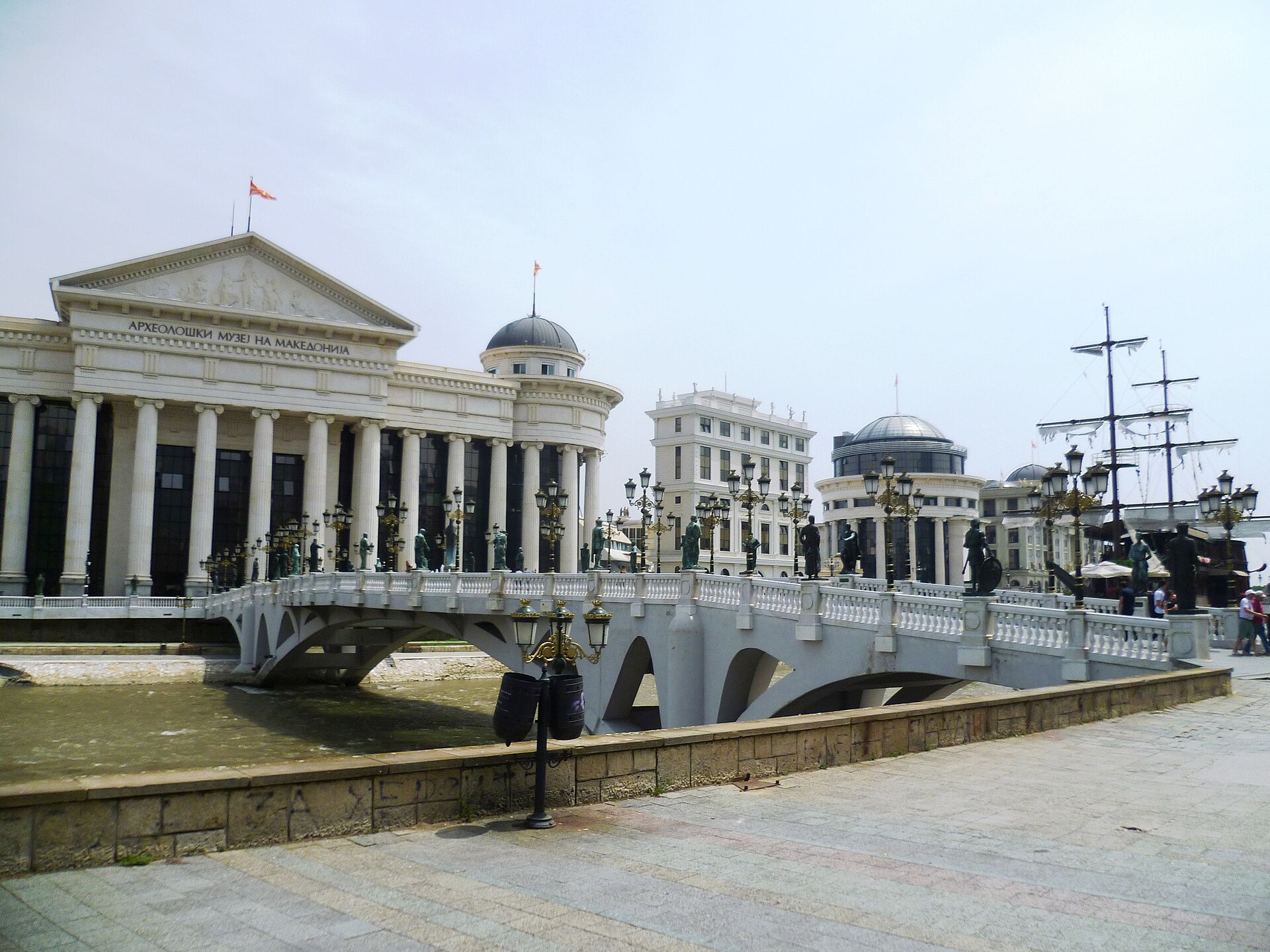
- Kej Dimitar Vlahov b.b., 1000 Skopje, North Macedonia MapWalking On the left bank of the Vardar river, beside the Stone Bridge and reached by the pedestrian Bridge of Civilizations from Macedonia Square, in the museum and government quarter built under the Skopje 2014 programme. Easily walkable from central Skopje hotels.
- Website
- amm.org.mk
- Telephone
- +389 2 3233 999
- [email protected]
Before you go how long, access, photography, bags, eating, shop
- How long to allow
- Around two hours to cover the chronological sweep across the museum's public floors, based on visitor reports
- Access
- The museum states it accommodates visitors with disabilities and runs creative workshops adapted to their needs, with staff trained to address specific requirements. No further detail on step-free routes or tactile provision was found on the pages checked for this record.
- Photography
- The museum's own visitor page states no formal photography policy. Visitors report that low gallery lighting, kept for conservation, makes photography difficult in parts of the museum.
Prices and hours change. We take them from the institution's own pages and print the day we read them, and you can check the current position at the source we used. Confirm before you travel.
What is inside
Prehistoric Archaeology
Old Stone Age through Early Stone Age, Copper Age, Bronze Age and Iron Age material, built substantially on excavation at named sites. The Palaeolithic display draws on the cave sites of Makarovec near Veles and Golema Pesht in Gorno Poreche; the Bronze Age gallery centres on the Dimov Grob necropolis at Ulanci near Gradsko; the Iron Age gallery holds what the museum describes as the only comprehensive cross-section of Iron Age material culture from the whole of North Macedonia, including the Macedonian-Paionian bronzes.
Antiquity
Archaic, Classical, Hellenistic, Roman and Late Antique periods. Highlights include gold jewellery from the Gorna Porta necropolis at Ohrid, a red-figure hydria from Demir Kapija, Hellenistic material from Isar-Marvinci and the ancient site of Lihnid at Ohrid, and Late Antique finds from Debar, Stobi and the fortress of Vinica.
Medieval Archaeology and the Ottoman Period
The sequence continues through the Early, Mature and Late Middle Ages into Ottoman rule, covering the centuries between the end of the ancient collections and the modern era.
Numismatics
Ancient and medieval coin collections shown chronologically from a Derronian coin of the Paionians, struck 500-480 BC, the oldest object in the permanent exhibition, through Macedonian royal coinage, city mints and Roman provincial issues, down to the reign of the Byzantine emperor Zeno in the late fifth century AD. Repeatedly singled out by visitors as the strongest single gallery.
Anthropology
Established in 1983, this department holds more than 15,000 skeletons from hundreds of sites across North Macedonia, spanning prehistoric, ancient and medieval periods, studied through osteology and palaeopathology to reconstruct the health and physical characteristics of past populations. A 2004 exhibition presented two and three-dimensional facial reconstructions of thirteen individuals ranging from the Neolithic to the medieval period, alongside reconstructed clothing and weapons.
Epigraphy and Stone Sculptures (Lapidarium)
Not shown in the riverside building. This collection occupies the restored stable block of Kurshumli An, the museum's original 1924 home in Skopje's old town, and holds funerary and votive monuments in Greek and Latin spanning the twelfth century BC to the fourth century AD, grave stelae of Roman legionary veterans, and sculpture from the Roman colony of Stobi and the site of Stybera, excavated in 1953.
What to see first
Derronian coin of the Paionians
Paionian mint, DerronesStruck 500-480 BC, this is the oldest object in the permanent exhibition and opens the museum's chronological coin sequence.10
Gold assemblage from graves 127 and 132, Gorna Porta necropolis, Ohrid
Local Classical-period goldsmiths104 gold objects worked in filigree and granulation, the centrepiece of the Classical-period gallery.8
Macedonian-Paionian bronzes
Local Iron Age workshopsHollow-cast bronze cult jewellery, including bird pendants, poppy-shaped cups and miniature jugs, that the museum's curators read as evidence of a sun-worshipping priesthood rather than ordinary ornament.7
Glass cage cup (vas diatretum) from Debar
Late Roman glassworkerRecovered from a fourth-century burial near Debar alongside gold fibulae and silver vessels, a rare survival of one of the most technically demanding forms of Roman glasswork.11
Terracotta icons from Vinica fortress
5th-6th century workshop, VinicaMoulded terracotta icons of saints and biblical scenes, among the earliest Christian icon-making known from the region.11
Red-figure hydria from Demir Kapija
Attributed to an Athenian or Hellenic workshopA red-figure vessel painted with the cult of Dionysus, part of the Classical-period ceramics from Demir Kapija and Isar-Marvinci.8
Portrait busts of Titus Flavius Orestes and Philoxenos, Stybera
Roman-period sculptor, StyberaExcavated at the ancient site of Stybera in 1953, these portrait busts of a father and son are shown in the Kurshumli An lapidarium alongside statues of Asclepius and Dionysus from the same site.12
Palaeolithic assemblage from Golema Pesht
Middle Palaeolithic (Mousterian) toolmakers473 lithic objects and faunal remains from a cave excavated from 1999 onward, dated to the late Middle Palaeolithic, more than 47,000 years old and associated with Neanderthal-period activity.5
The building and what it was built to hold
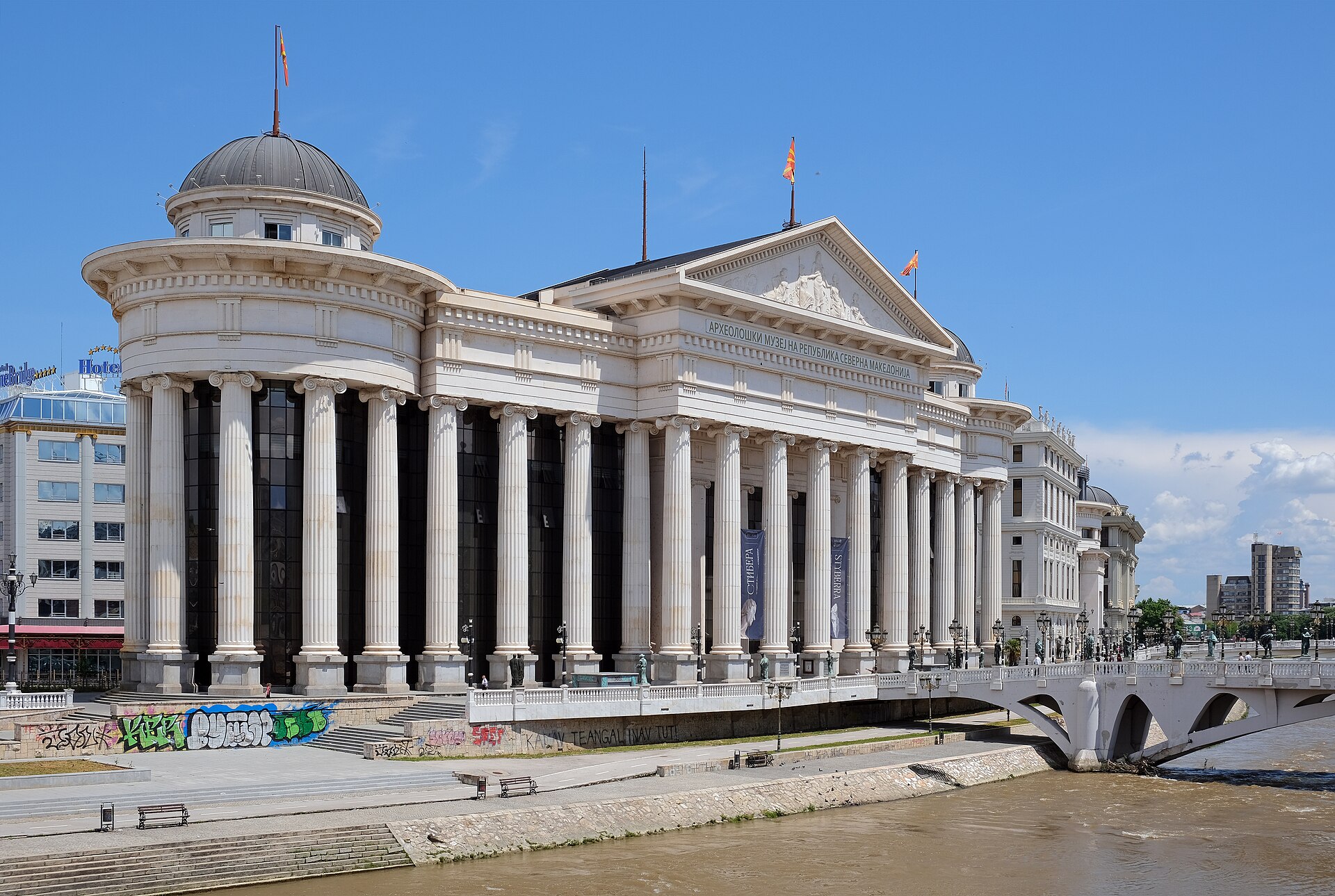
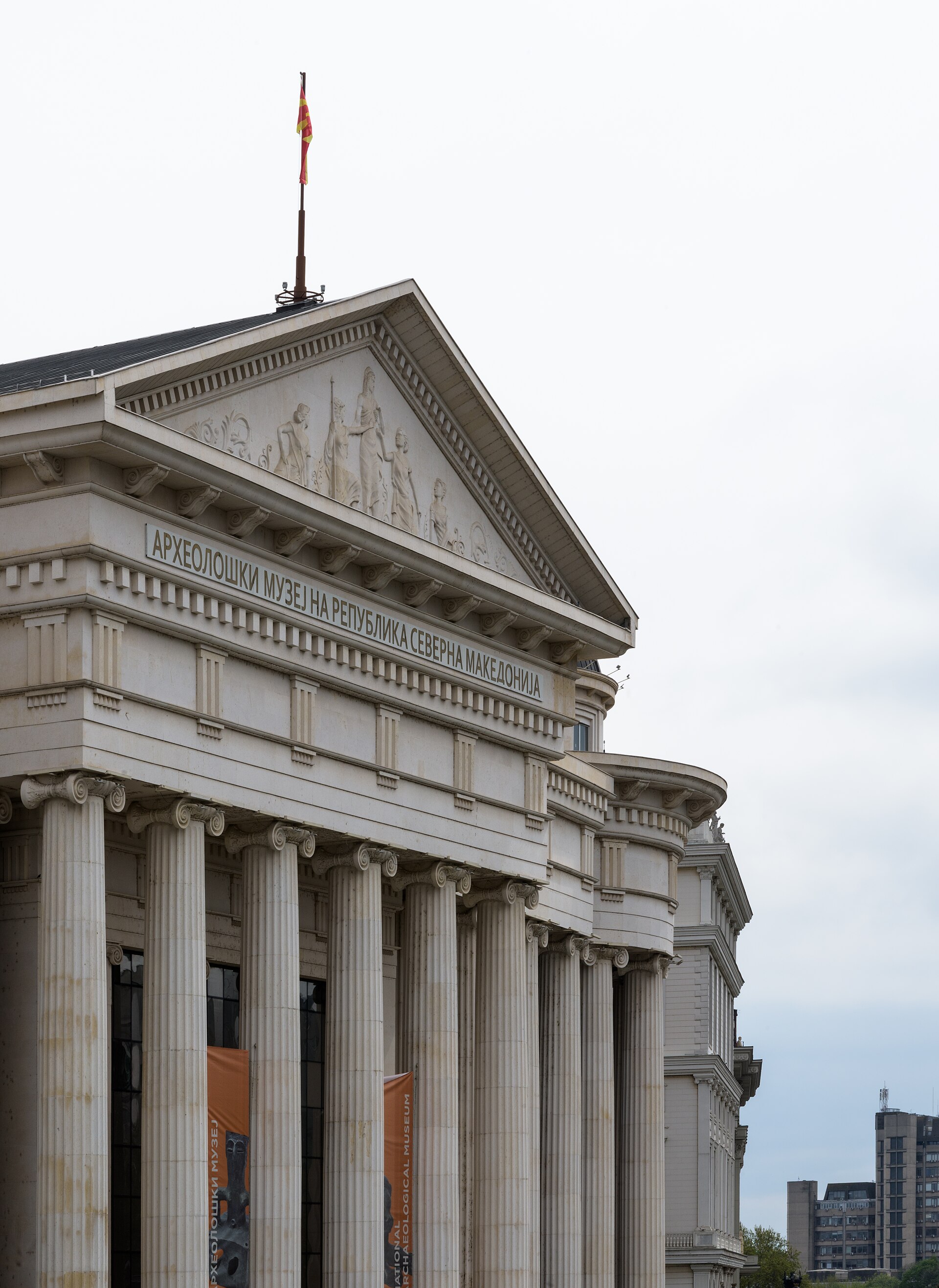
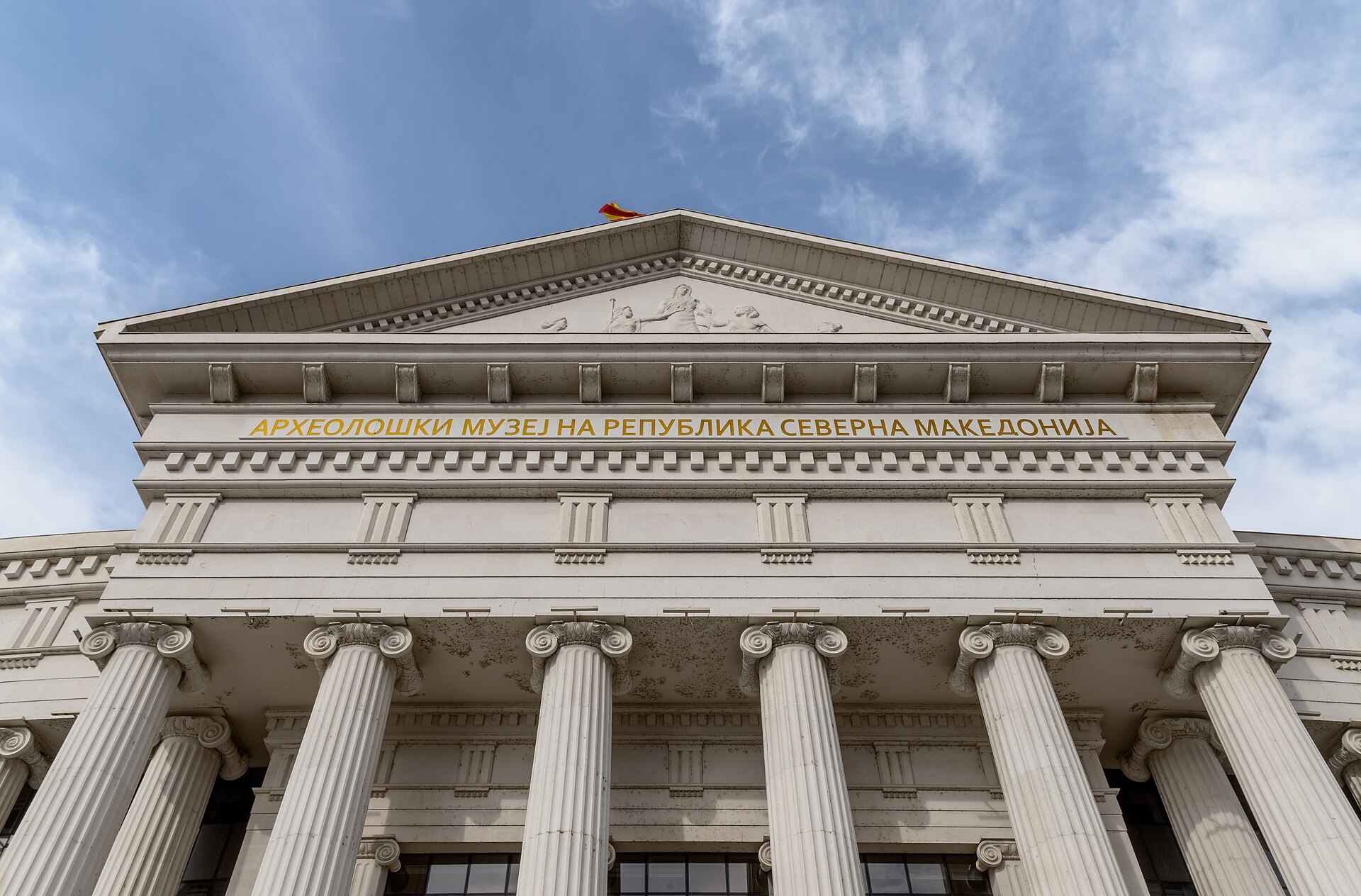
The Archaeological Museum of the Republic of North Macedonia stands on the left bank of the Vardar river in central Skopje, a neo-classical block of columns and glass reached by crossing the pedestrian Bridge of Civilizations from Macedonia Square. The building opened in 2014, replacing a museum complex the institution had occupied since 1977, and it shares its structure with two other state bodies, the Constitutional Court and the National Archive of North Macedonia.
The building was built as part of Skopje 2014, the ruling VMRO-DPMNE party's programme to remake the capital's centre with monumental, classically styled architecture and dozens of new statues. Construction began in 2009 and the ruling party's own figures put the museum building's budget at 436,000,000 denars. An investigation by the Balkan Investigative Reporting Network, published in Balkan Insight in July 2015, found that the shared building housing the museum, the Constitutional Court and the State Archive was the single most expensive structure in the whole programme, at more than 42 million euros. The same investigation traced the cost of Skopje 2014 as a whole from an announced 80 million euros in 2010 to roughly 560 million euros by 2015, against an official government figure of 207 million euros given at a 2013 press conference, a gap BIRN documented from the government's own contracts and invoices.
The programme's declared purpose was to give Skopje a more classical appeal while replacing earthquake-damaged buildings from the Communist era, but critics inside North Macedonia and beyond read it as a nation-building exercise, one that became known as antiquisation: an attempt to assert an unbroken line from ancient Macedon to the present state, made at a moment when that same claim sat at the centre of a long-running naming dispute with Greece. Zoran Zaev, later prime minister, called it an idiotic project while in opposition. Wikipedia's account of the programme, drawing on contemporary press coverage, records international ridicule alongside domestic anger over the spending, in years that also saw high unemployment and constrained public services.
The museum has not escaped that history simply by being the most photogenic building the programme produced. Reporting by Lossi36 in September 2022 found that the National Archive, housed on the two upper floors of the same building and holding more than 56,000 historic documents, suffers from construction problems that produce flooding and leakage whenever it rains, putting the archive's holdings at risk of decay. The same reporting argued that Skopje 2014 spending drew resources away from the ordinary funding that museums across the city need simply to operate. The museum is a tenant of the building's politics as much as its architecture, and a record of it that left that out would be a thinner one.
A museum older than its building
The institution is a century older than the address it currently occupies. Its first archaeological collection was assembled in 1920 inside the Faculty of Philosophy in Skopje, and in 1924 it was formally organised as the Historical-Archaeological Museum with a Lapidarium, based at Kurshumli An, a large Ottoman-era caravanserai in Skopje's old town that still belongs to the museum today. The museum was reorganised after the Second World War, splitting in 1945 into archaeological, ethnographical and medieval departments, and for the following eighteen years it operated out of military barracks inside Skopje's hilltop fortress, Kale.
The earthquake that levelled much of Skopje on 26 July 1963 forced another move, back to Kurshumli An, where the museum remained until 1977, when it relocated to a purpose-built museum complex it would occupy for the following thirty-seven years. That building gave way to the current riverside structure in 2014. Kurshumli An itself was not abandoned. Since 2017 and 2018 the museum has been moving its stone monuments into the former stable block there, completing a lapidarium the institution first opened, in a more limited form, on the same site in 1955.
The museum states on its own site that in 2015, the year after the move to the new building, the European Museum Academy placed it seventh among the fifteen best museums in Europe. That ranking is recorded here as the museum's own claim, taken from its about page, and has not been checked independently against the Academy's own archive.
Six departments, one chronological sweep
The permanent exhibition is organised into six departments, laid out to walk a visitor from the Old Stone Age to the Ottoman period across three public floors: Prehistoric Archaeology, Antiquity, Medieval Archaeology and the Ottoman Period, Numismatics, Anthropology, and the lapidarium of Epigraphy and Stone Sculptures. The museum's own figures put the number of objects on display at over 7,000, drawn, in its words, from finds across the whole of North Macedonia and, for part of the lapidarium's stone monuments, from Kosovo too.
Prehistoric Archaeology runs from the Old Stone Age through the Early Stone Age, the Copper Age, the Bronze Age and the Iron Age, built substantially on excavation at named sites rather than acquired material. The Palaeolithic display leans on the cave sites of Makarovec near Veles and Golema Pesht in Gorno Poreche; the Bronze Age gallery on the Dimov Grob necropolis at Ulanci near Gradsko; the Iron Age gallery on six decades of excavation supplemented, the museum says, by gifts and by material confiscated from illegal digging. Antiquity covers the Archaic, Classical, Hellenistic, Roman and Late Antique periods, and Medieval Archaeology and the Ottoman Period carries the sequence on through the Early, Mature and Late Middle Ages into Ottoman rule. Numismatics is split into ancient and medieval coin collections and is the gallery visitors single out most often; Anthropology holds human remains and related material. The lapidarium is the one department not shown in the riverside building at all. It occupies the restored stable block of Kurshumli An, a short distance away in the old town, so a visitor who wants the collection's full chronological sweep, stone monuments included, needs to plan for both sites.
What the collection actually holds
The oldest object in the permanent exhibition is numismatic rather than prehistoric: a Derronian coin of the Paionians, struck between 500 and 480 BC, opens a coin sequence that the museum runs chronologically through the reigns of Macedonian kings from Alexander I Philhellene to Perseus, city coinages from Amphipolis, Thessalonica and Pella, and Roman provincial issues from mints including Stobi, down to the reign of the Byzantine emperor Zeno in the late fifth century AD.
The Classical-period gallery centres on an assemblage of 104 gold objects, worked in filigree and granulation, recovered from two graves, numbered 127 and 132, in the Gorna Porta necropolis at Ohrid, alongside a red-figure hydria from Demir Kapija painted with the cult of Dionysus. The Iron Age gallery holds what the museum describes as the only comprehensive cross-section of Iron Age material culture from the whole of North Macedonia, and within it the Macedonian-Paionian bronzes: hollow-cast bronze cult jewellery, among them bird pendants, poppy-shaped cups and miniature jugs, made by local workshops and read by the museum's own curators as evidence of a sun-worshipping priesthood rather than ordinary personal ornament.
Late Antiquity, chronologically the last stop before the medieval galleries, holds two of the museum's most distinctive single objects: a glass cage cup, a vas diatretum, recovered from a fourth-century burial near Debar alongside gold fibulae and silver vessels, and a group of terracotta icons from the hilltop fortress at Vinica, moulded with images of saints and biblical scenes and dated to the fifth and sixth centuries, among the earliest Christian icon-making known from the region. The lapidarium at Kurshumli An adds the stone side of the same period and the ones before it: funerary and votive monuments in Greek and Latin spanning the twelfth century BC to the fourth century AD, grave stelae of Roman legionary veterans, and sculpture recovered from the Roman colony of Stobi and the site of Stybera, excavated in 1953, which gave the museum portrait busts of Titus Flavius Orestes and his son Philoxenos alongside statues of Asclepius and Dionysus.
Recognition and what visitors say
Aggregated visitor opinion sits in the middle of the range. TripAdvisor recorded a rating of 3.7 out of 5 across 354 reviews as read for this record. What visitors consistently praise is the building's own modern fit-out, the English-language labelling that runs alongside the Macedonian, and above all the numismatic collection, which comes up repeatedly as the strongest single gallery. What they consistently push back on is a mismatch some feel between the ticket price and the depth of context on offer, captions that name an object without saying much about it, and gallery lighting kept low enough, for conservation reasons the museum does not spell out on its visitor page, to frustrate anyone hoping to photograph what is on display.
None of that undoes the museum's own account of outside recognition. Its about page states that in 2015 the European Museum Academy placed it seventh among the fifteen best museums in Europe, a ranking that sits awkwardly, on the evidence gathered here, alongside visitors who call the same galleries thin on context nine years later. Both can be true of the same institution at different points in its life, and this record keeps both rather than choosing between them.
Visiting
The museum keeps the same hours all year: Tuesday to Sunday, 10:00 to 18:00, with the last ticket sold by 17:00, and it is closed on Mondays. Citizens of North Macedonia pay 200 denars individually, 350 denars for a family of parents and children, and 100 denars as part of a group of six or more, as a pensioner, or as a pupil or student. Foreign visitors pay 400 denars individually, 200 denars as a student with an ISIC or Euro26 card, 700 denars as a family and 200 denars in a group of six or more or through a licensed travel agency or guide. Admission is free for children under seven, for orphans, for people with disabilities and for other socially vulnerable visitors under the museum's own categories, and free for everyone on the first Saturday of every month. Students get in free every Thursday and high school pupils every Wednesday. Guided tours are included in the ticket price rather than sold separately.
The museum states that it accommodates visitors with disabilities and runs creative workshops adapted to their needs, with staff trained to address specific requirements, though it gives no further detail on step-free routes or tactile provision on the pages checked for this record. The address is Kej Dimitar Vlahov b.b., 1000 Skopje, on the left bank of the Vardar beside the Stone Bridge and across the river from Macedonia Square. The museum can be reached by phone on +389 2 3233 999 or, for visit bookings specifically, +389 70 366 096, and by email at [email protected] or [email protected].
What visitors say
Aggregated visitor opinion sits in the middle of the range. What visitors consistently praise is the building's own modern fit-out, the English-language labelling that runs alongside the Macedonian, and above all the numismatic collection, which comes up repeatedly as the strongest single gallery. What they consistently push back on is a mismatch some feel between the ticket price and the depth of context on offer, captions that name an object without saying much about it, and gallery lighting kept low enough, for conservation reasons the museum does not spell out on its visitor page, to frustrate anyone hoping to photograph what is on display.
What is praised, what is criticised
- Praised: The modern layout, clean display cases and English-language labelling alongside the Macedonian
- Praised: The numismatic collection, repeatedly singled out as the strongest single gallery
- Praised: The building itself and the approach across the Bridge of Civilizations from Macedonia Square
- Criticised: Some visitors find the ticket price steep relative to the depth of context given for individual objects, and say captions name a piece without explaining it
- Criticised: Gallery lighting is kept low, which visitors say frustrates photography even where it is allowed
- Criticised: Some visitors describe labelling as inconsistent from gallery to gallery
Ratings on other platforms
TripAdvisor: 3.7 from 354 ratings, read 18 September 2026
A platform average is a tertiary source: it moves, it is not audited, and we quote no visitor's words.
Questions about Archaeological Museum of North Macedonia
Where is Archaeological Museum of North Macedonia?
Kej Dimitar Vlahov b.b., 1000 Skopje, North Macedonia.
How much does it cost to visit?
North Macedonia citizen, individual: MKD 200; North Macedonia citizen, family (parents with children): MKD 350; North Macedonia citizen, group of 6+, pensioner, pupil or student: MKD 100; Foreign visitor, individual: MKD 400; Foreign visitor, student with ISIC or Euro26 card: MKD 200. As confirmed 18 September 2026.
When is it open?
Tue-Sun 10:00-18:00. Closed: Monday. As confirmed 18 September 2026.
How do you get there?
Walking: On the left bank of the Vardar river, beside the Stone Bridge and reached by the pedestrian Bridge of Civilizations from Macedonia Square, in the museum and government quarter built under the Skopje 2014 programme. Easily walkable from central Skopje hotels.
What should you see first?
Derronian coin of the Paionians (Paionian mint, Derrones); Gold assemblage from graves 127 and 132, Gorna Porta necropolis, Ohrid (Local Classical-period goldsmiths); Macedonian-Paionian bronzes (Local Iron Age workshops); Glass cage cup (vas diatretum) from Debar (Late Roman glassworker); Terracotta icons from Vinica fortress (5th-6th century workshop, Vinica); Red-figure hydria from Demir Kapija (Attributed to an Athenian or Hellenic workshop).
What we could not confirm
- No architect is publicly credited for the riverside building in the sources checked for this record; design credit for the Skopje 2014 building sits with the wider state programme rather than a named practice.
- The museum's claim to have been placed seventh among the fifteen best museums in Europe by the European Museum Academy in 2015 is sourced only to the museum's own about page here; the Academy's own award archive was not checked line by line against it.
- Whether the National Archive's reported flooding and leakage problems, documented in 2022, have since been repaired was not established from any source fetched for this record.
Images
Sources
- 1Archaeological Museum of the Republic of North Macedonia, About the Museum amm.org.mk/en/about-archaeological-museum-of-the-republic-of-north-macedonia/
- 2Archaeological Museum of the Republic of North Macedonia, homepage amm.org.mk/en/
- 3Archaeological Museum of the Republic of North Macedonia, Plan your visit amm.org.mk/en/plan-your-visit/
- 4Archaeological Museum of the Republic of North Macedonia, Permanent exhibit amm.org.mk/en/permanent-exhibit/
- 5Archaeological Museum of the Republic of North Macedonia, Old stone age amm.org.mk/en/old-stone-age/
- 6Archaeological Museum of the Republic of North Macedonia, Bronze age amm.org.mk/en/bronze-age/
- 7Archaeological Museum of the Republic of North Macedonia, Iron age amm.org.mk/en/iron-age/
- 8Archaeological Museum of the Republic of North Macedonia, Classical period amm.org.mk/en/classical-period/
- 9Archaeological Museum of the Republic of North Macedonia, Hellenistic period amm.org.mk/en/hellenistic-period/
- 10Archaeological Museum of the Republic of North Macedonia, Ancient numismatic collection amm.org.mk/en/ancient-numismatic-collection/
- 11Archaeological Museum of the Republic of North Macedonia, Late antiquity amm.org.mk/en/late-antiquity/
- 12Archaeological Museum of the Republic of North Macedonia, Epigraphy and stone sculptures amm.org.mk/en/epigraphy-and-stone-sculptures/
- 13Archaeological Museum of the Republic of North Macedonia, Kurshumli An amm.org.mk/en/kurshumli-han/
- 14Wikidata, Archaeological Museum of North Macedonia (Q65295584) wikidata.org/wiki/Q65295584
- 15BIRN, True Cost of Skopje 2014 Revealed, Balkan Insight, 27 July 2015 balkaninsight.com/2015/07/27/true-cost-of-skopje-2014-revealed/
- 16Wikipedia, Skopje 2014 en.wikipedia.org/wiki/Skopje_2014
- 17Lossi36, In Skopje, Museums Languish While Pseudo-Historical Monuments Thrive, 14 September 2022 lossi36.com/2022/09/14/in-skopje-museums-languish-while-pseudo-historical-monuments-thrive/
- 18TripAdvisor, Archaeological Museum of Macedonia, Skopje, reviews tripadvisor.com/Attraction_Review-g295110-d5289326-Reviews-Archaeological_Museum_of_Macedonia-Skopje_Skopje_Region.html
- 19In Your Pocket, Skopje's top 10 museums inyourpocket.com/skopje/skopjes-top-10-museums_75492f
- 20Archaeological Museum of the Republic of North Macedonia, Anthropology amm.org.mk/en/anthropology/