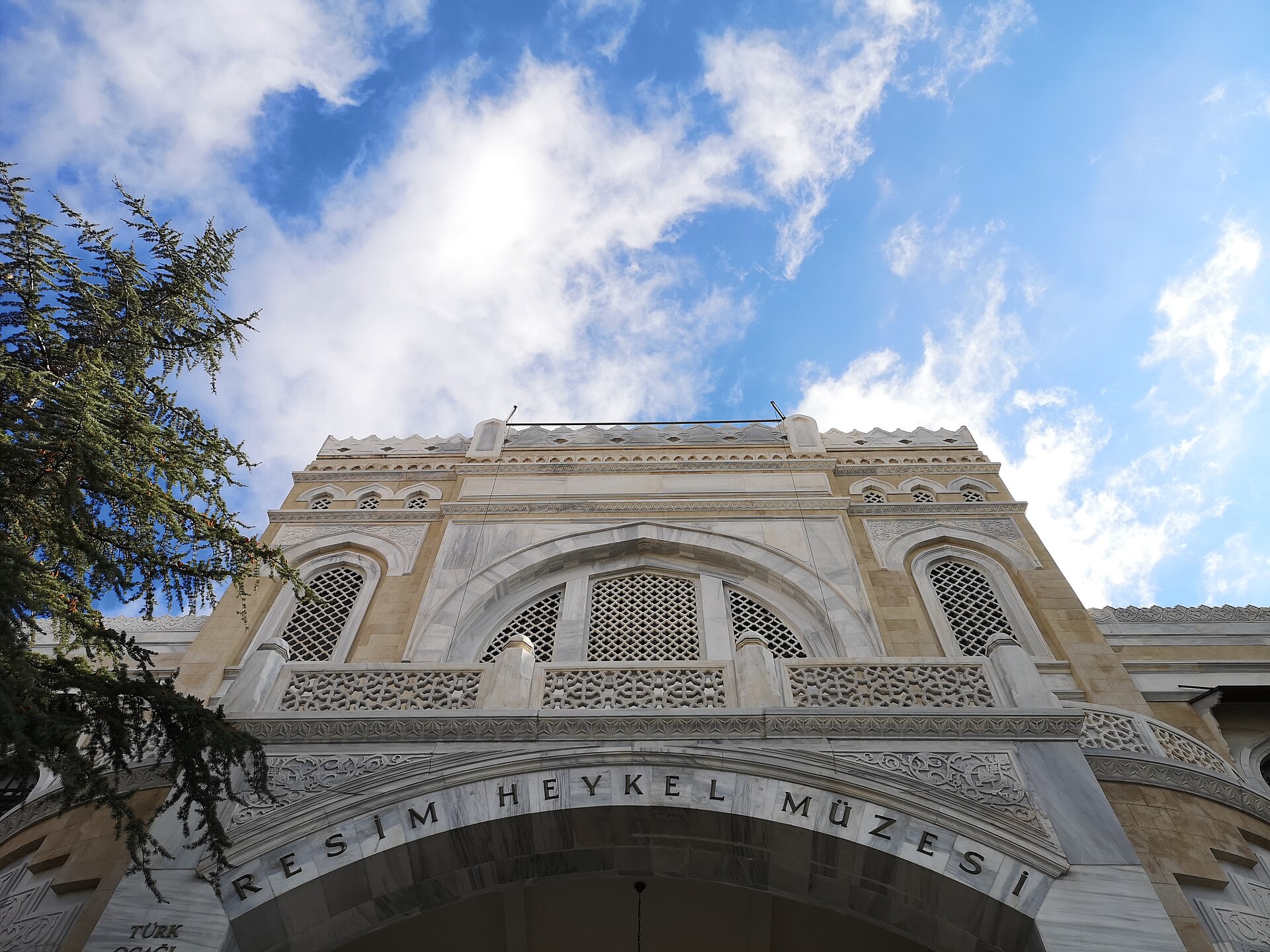
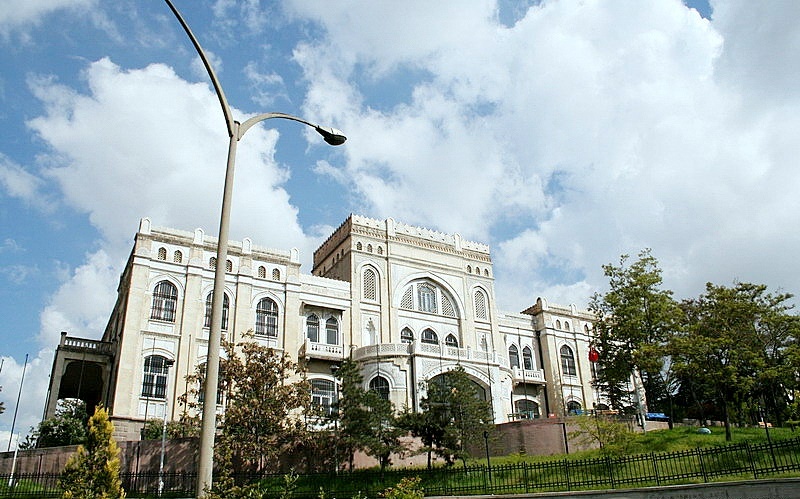
The Ankara Painting and Sculpture Museum's exterior, photographed in November 2022. The building was completed in 1930 to a design by Arif Hikmet Koyunoglu as the headquarters of the Turkish Hearths movement.
Gorkem Yavuz (Gargarapalvin), CC BY 4.0Ankara Painting and Sculpture Museum
Museum · Ankara Resim ve Heykel Muzesi · Founded 1980
Open, admission and hours confirmed 28 September 2026 · 20 sources
On this page 14 sections
ContentsClose
The museum's real strength is depth of coverage rather than any single canonical masterpiece: a near-continuous run of Turkish painting and sculpture from the late Ottoman academic and Orientalist generation, through the pioneering Republic-era artists trained partly in Europe, to later 20th-century Turkish modernism, gathered under one roof largely through state purchase, inter-institutional transfer and donation rather than a single founding collection. It is also, unusually for an art museum, a primary architectural document in its own right: the building is one of the most complete surviving examples of the First National Architecture style, and its own interior decoration, especially the Eastern Hall, is original fabric from its 1927-1930 construction as the Turkish Hearths headquarters rather than a later museum fit-out.
| Local name | Ankara Resim ve Heykel Muzesi |
|---|---|
| Kind | Museum |
| Founded | 1980 |
| City and country |  Ankara, Turkey Ankara, Turkey |
| Address | Hacettepe Mahallesi, Talatpasa Bulvari, Turk Ocagi Sokak No:1, Ulus, Altindag, Ankara |
| Website | arhm.ktb.gov.tr |
| Status | Open, confirmed |
| Record last verified |
Visiting
- Hours
- Tuesday-Sunday09:00 to 17:30Ticket window closes at 17:00. One source dated November 2025 (source 19) instead describes a midday break, 09:00-12:00 and 13:00-17:00; this could not be reconciled against the continuous 09:00-17:30 given by every other source checked, so it is flagged here rather than silently dropped.
- Closed
- Monday.
- Admission
- Turkish citizen, adultTRY 200Figure from a third-party state-museums guide, not the museum's own prices page, which this research could not reach directly - see notes_for_editor. Muzekart (the Turkish national museum pass) is accepted for free entry.
- Turkish citizen, ages 8-18, 65 and over, and archaeology/art-history studentsFreeFree entry
- Foreign visitor, adultEUR 4Figure from the same third-party guide; not independently confirmed on an official page
- Do I need to book?
- No advance booking found required; walk-in with a ticket or a valid Muzekart
- Address
- Hacettepe Mahallesi, Talatpasa Bulvari, Turk Ocagi Sokak No:1, Ulus, Altindag, Ankara MapMetro Ankara Metro M1 line, Sihhiye station, then a short walk toward Ulus/Opera
Bus Several EGO city bus routes from Kizilay (including lines 145, 183, 185, 186, 154, 203 and 413) run to the Opera stop a short walk from the museum - Website
- arhm.ktb.gov.tr
- Telephone
- +90 312 310 20 94
- [email protected]
Before you go how long, access, photography, bags, eating, shop
- Access
- Not established by any source checked in this research
- Photography
- Permitted without flash, per a third-party visitor guide (source 12)
- Bags
- Not established by any source checked in this research
- Eating
- An on-site cafeteria is mentioned by the governor's-office listing (source 17) and Wikipedia
- Shop
- An on-site gift shop is mentioned by the governor's-office listing (source 17)
Prices and hours change. We take them from the institution's own pages and print the day we read them, and you can check the current position at the source we used. Confirm before you travel.
What is inside
Permanent collection galleries
Six permanent galleries arranged chronologically and thematically, holding the core of the museum's roughly 3,600-3,700-item collection of Turkish painting and sculpture from the late Ottoman period to the present, including academic and Orientalist painting of the 1880s-1900s, the pioneering Republic-era generation, and later 20th-century Turkish modernism.
The Eastern Hall (Sark Salonu)
A ceremonial room surviving from the building's 1927-1930 life as the Turkish Hearths headquarters, with hand-carved wooden ceiling and wall ornament in Seljuk and Ottoman decorative idiom, cited as one of the building's own showpieces rather than a space built to hang paintings.
The concert and theatre hall
A roughly 400-seat auditorium with an orchestra pit, used from 1932 to 1952 as the performance hall of the Ankara Halkevi (People's House), where sources describe some of the Turkish Republic's first staged operas and ballets taking place; it still hosts concerts and recitals.
Temporary and contemporary exhibition galleries
Three further galleries, separate from the permanent hang, used for rotating exhibitions of contemporary Turkish and international work.
Restoration workshops and artists' archive
Painting, sculpture and ceramic restoration workshops and a research archive on Turkish artists, run as a working conservation department rather than a visitor space, mentioned by the Ankara governor's office listing (source 17) and the Ministry's own fine-arts page (source 7).
What to see first
Silah Taciri (The Arms Dealer / The Weapons Merchant)
Osman Hamdi BeyA major Orientalist-realist canvas by the founder of the modern Turkish museum system and the Istanbul Archaeology Museums, repeatedly named as one of the collection's signature paintings by the local sources consulted for this page.18
Zeybekler (Zeybeks)
Ibrahim CalliCited by Turkish-language sources as capturing the spirit of the independence struggle years and as representative of Calli's place among the pioneering Republic-era Turkish painters whose work anchors the permanent collection.18
Timur'un Mezari Basinda (At the Tomb of Timur)
Vasily VereshchaginA large-scale history painting by a leading 19th-century Russian war and Orientalist painter, named in more than one visitor guide as a standout foreign work inside a collection otherwise devoted to Turkish art.11
Paintings by Sultan Abdulmecid II (Abdulmecid Efendi)
Abdulmecid IIWorks by the last Ottoman Caliph, who painted seriously and is described by multiple sources as the only member of the Ottoman dynasty to have practised as a painter; his canvases sit in the collection alongside the professional artists of his own court.10
Court paintings by Fausto Zonaro
Fausto ZonaroWorks by the Italian painter who served as official court painter to Sultan Abdulhamid II, representing the late-Ottoman court's direct patronage of European academic painting.19
Paintings by Fikret Mualla
Fikret MuallaWork by one of the best-known modern Turkish painters of the diaspora generation, cited among the collection's holdings by more than one visitor guide.11
Works by Abidin Dino
Abidin DinoWork by a major modern Turkish painter, sculptor and filmmaker, again named among the collection's later 20th-century holdings.11
Paintings by Sefik Bursali
Sefik BursaliNamed by Turkish Wikipedia among the museum's core represented artists as part of the pioneering generation of Republic-era Turkish painting.9
A cultural hall built for a movement, not a museum
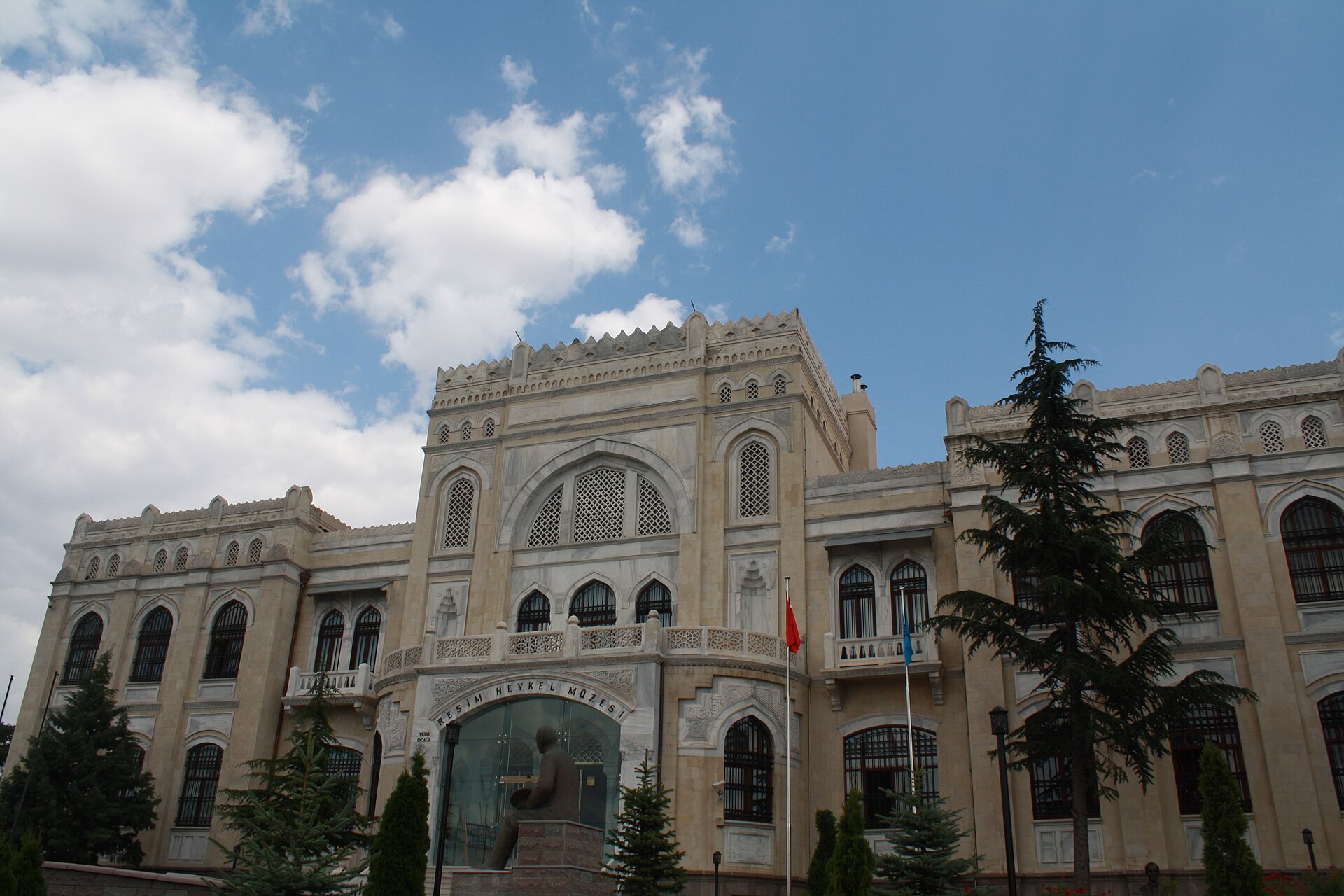
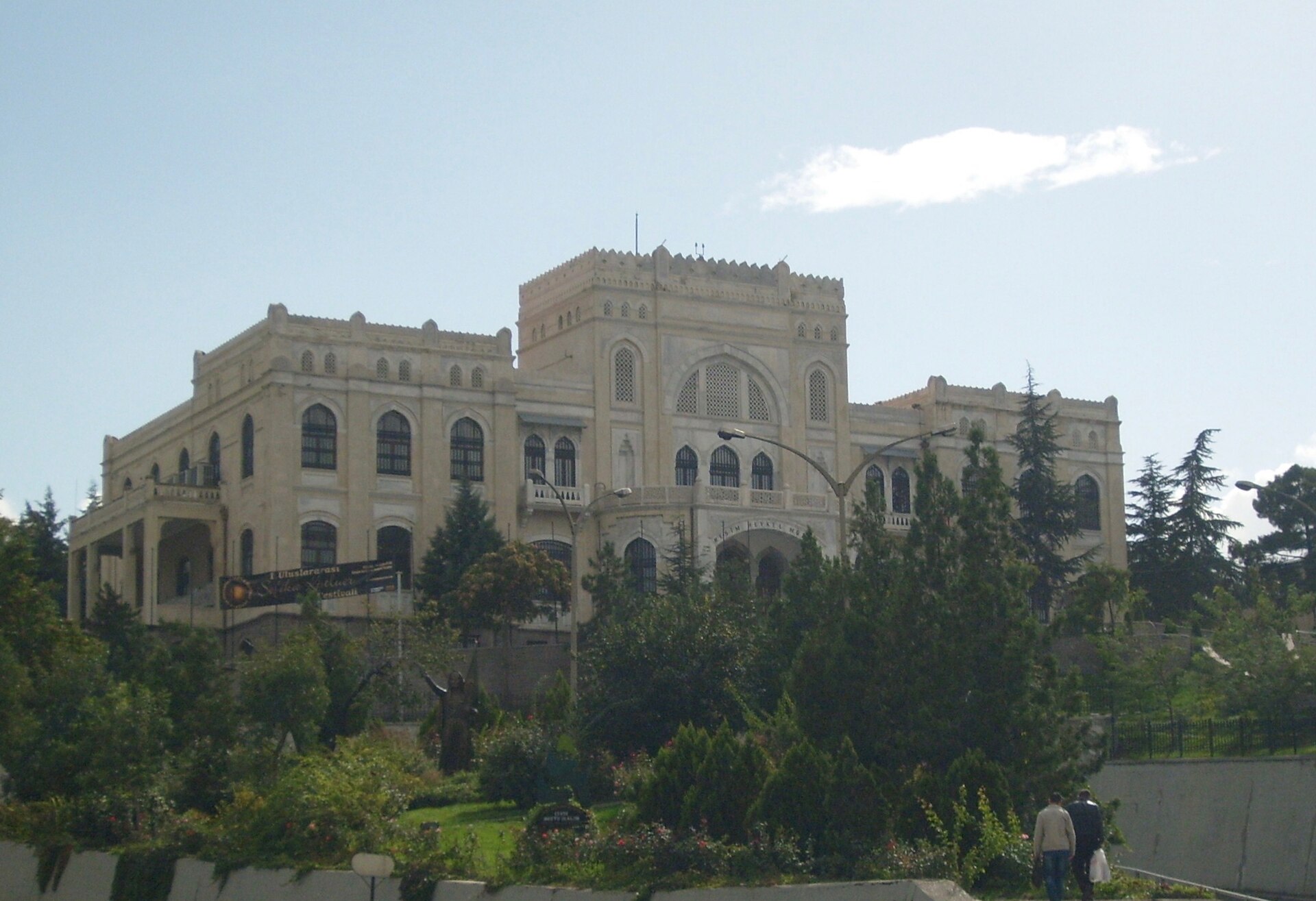
The building the museum occupies was not designed to hold paintings. It was commissioned as the headquarters of the Turkish Hearths (Turk Ocaklari), the nationalist cultural and educational movement of the early Republic, and built between 1927 and 1930 to a design by the architect Arif Hikmet Koyunoglu, chosen after a design competition. Mustafa Kemal Ataturk himself took a direct interest in the project, reportedly insisting on Turkish decorative motifs and Turkish labour throughout construction. The result is counted among the finest surviving examples of the First National Architecture movement (Birinci Ulusal Mimarlik Uslubu), the style that fused Seljuk and Ottoman decorative vocabulary with a modern institutional building programme, and it remains one of Ankara's architectural landmarks independent of what is now displayed inside it.
From Turk Ocagi headquarters to People's House to state museum
The Turkish Hearths organisation was dissolved by the single-party government in 1931, and its purpose-built Ankara headquarters passed to a sequence of other uses before it became a museum at all. From 1932 to 1952 the building served as the Ankara Halkevi (People's House), the state's local cultural and educational institution under the same government, and multiple sources describe its concert-theatre hall hosting some of the Turkish Republic's first staged opera and ballet performances, as well as major language and history congresses of the period. After the People's Houses were closed down in 1951-1952, the building passed through further government-agency use until December 1975, when it was formally transferred to the Ministry of Culture. Restoration followed, reportedly with support from the Haci Omer Sabanci Foundation, and the building opened to the public as a dedicated painting and sculpture museum on 2 April 1980 - exactly fifty years, by coincidence, after construction of the original Turkish Hearths building had begun in 1927.
What the collection actually holds
Sources checked for this page put the collection at roughly 3,600 to 3,700 individual works, spanning Turkish painting, sculpture, ceramics, original prints, decorative art and photography from the late 19th century to the present day, built up through state exhibition purchases, inter-institutional transfers and donations rather than a single founding gift. The permanent display runs across six galleries arranged chronologically and thematically, moving from late Ottoman academic and Orientalist painting - the milieu of Osman Hamdi Bey and the European court painters patronised by the late Sultans - through the first Republic-era generation of Turkish painters and sculptors trained partly in Europe, and on into later 20th-century Turkish modernism. Three further galleries are kept for rotating exhibitions of contemporary Turkish and international work, separate from the permanent hang, alongside restoration workshops for painting, sculpture and ceramics and an archive intended to support researchers working on Turkish artists.
The thefts, the forgeries, and two different tallies
The museum's own storerooms turned out to hold one of modern Turkey's larger museum-theft scandals. In 2009, staff discovered that thirteen charcoal sketches on display had been swapped for forgeries, and the finding triggered a wider review of the collection built on two counting commissions that had already worked in 2007 and 2008. Reporting on the affair does not agree on a single figure. Turkish-language sources summarising the 2007-2008 commissions' findings give 256 works recorded as missing, a further 14 recorded as missing and replaced by photocopies of the originals, and 32 confirmed as forged; a widely cited news account instead gives 302 works missing and 46 confirmed forgeries, with a further 27 of works held as being of serious doubtful authenticity, drawn from the same two commissions. Neither figure has been reconciled against the other in any source checked here, and both are given rather than silently picked between.
Named reporting on the case, published in November 2014, described an organised ring alleged to have operated inside the museum between 2005 and 2008, removing original Ottoman-era paintings from storage, substituting convincing forgeries, and selling the originals on through dealers and auction houses in Istanbul to a circle that reportedly included prominent businessmen, in some instances reportedly for as little as 10,000 Turkish lira a canvas. Eighteen people were detained in the resulting investigation; the museum's then director was named in that reporting only by initials. A later, separate review by the Ministry's own Inspection Board, conducted between 2010 and 2015, arrived at a lower missing-works count of 101, of which a subsequent recovery effort returned 66 paintings to the museum; other summaries put the total works recovered by 2014 at approximately 61. This publication has not located a single authoritative reconciliation of the 2007-2008 commission counts, the 2014 reporting, and the 2010-2015 Inspection Board figure, and states all three as reported rather than resolving them into one number.
Closed for renovation, reopened in the pandemic
The building underwent a further round of renovation beginning in December 2019 and reopened to the public on 28 December 2020, according to the Ministry of Culture and Tourism's own regional fine-arts page. An earlier, smaller round of work in 2011 is separately described as having expanded exhibition space, restored the roof and improved security systems. No source checked in this research describes any closure of the museum since the December 2020 reopening, and multiple independently dated pages from 2025 and 2026 describe it operating on its normal weekly schedule, closed only on Mondays.
What a visit involves today
The museum sits in Ulus, Ankara's old administrative quarter, close to the Ethnography Museum on the same stretch of Talatpasa Bulvari, and is reachable on foot from the Sihhiye stop of the Ankara Metro's M1 line or by several city bus routes from Kizilay to the nearby Opera stop. Entry is free for Turkish citizens under the state Muzekart scheme and for several exempt categories (children and teenagers, the over-65s, and archaeology or art-history students); a modest fee is reported for adult Turkish citizens without a Muzekart and for foreign visitors. A cafeteria and a small gift shop are mentioned in the governor's-office listing for the building, and photography without flash is described as permitted by a third-party visitor guide. The building's own decorative interior, and in particular the surviving Eastern Hall from its Turkish Hearths years, is repeatedly flagged by visitors as being as much a part of the visit as the collection on the walls.
What visitors say
Visitors consistently describe the museum as an essential, comprehensive survey of Turkish painting and sculpture from the late Ottoman period to the present, worth visiting as much for the 1927-1930 Turkish Hearths building itself, a landmark of the First National Architecture movement, as for the collection inside it. The most repeated complaint is a lack of English-language labelling and interpretation for international visitors, alongside a sense that display standards and interpretive material feel dated next to major Western museums.
What is praised, what is criticised
- Praised: The building's own architecture and decorative interior (the Eastern Hall in particular) as a First National Architecture landmark in its own right
- Praised: The breadth of the collection as a single-site survey of Turkish visual art from the late Ottoman period through the Republic to the present
- Praised: Free or low-cost admission for Turkish citizens and Muzekart holders
- Criticised: Limited English-language labelling and information for international visitors
- Criticised: Restrictive viewing distances and security rules around the artworks
- Criticised: A sense among some international reviewers that presentation and facilities feel dated compared with major Western museums, and that the collection is inward-looking with little internationally recognised work on display
Ratings on other platforms
Yandex Maps: 5 from 12 ratings, read 28 September 2026
A platform average is a tertiary source: it moves, it is not audited, and we quote no visitor's words.
Questions about Ankara Painting and Sculpture Museum
Where is Ankara Painting and Sculpture Museum?
Hacettepe Mahallesi, Talatpasa Bulvari, Turk Ocagi Sokak No:1, Ulus, Altindag, Ankara.
How much does it cost to visit?
Turkish citizen, adult: TRY 200; Turkish citizen, ages 8-18, 65 and over, and archaeology/art-history students: free; Foreign visitor, adult: EUR 4. As confirmed 28 September 2026.
When is it open?
Tuesday-Sunday 09:00-17:30. Closed: Monday. As confirmed 28 September 2026.
How do you get there?
Metro: Ankara Metro M1 line, Sihhiye station, then a short walk toward Ulus/Opera; Bus: Several EGO city bus routes from Kizilay (including lines 145, 183, 185, 186, 154, 203 and 413) run to the Opera stop a short walk from the museum.
What should you see first?
Silah Taciri (The Arms Dealer / The Weapons Merchant) (Osman Hamdi Bey); Zeybekler (Zeybeks) (Ibrahim Calli); Timur'un Mezari Basinda (At the Tomb of Timur) (Vasily Vereshchagin); Paintings by Sultan Abdulmecid II (Abdulmecid Efendi) (Abdulmecid II); Court paintings by Fausto Zonaro (Fausto Zonaro); Paintings by Fikret Mualla (Fikret Mualla).
What we could not confirm
- The museum's own current website, arhm.ktb.gov.tr, could not be reached during this research despite repeated attempts by direct fetch, alternate user agents, the in-app browser, and an independent headless-browser proxy, all of which timed out or were rejected; every fact that would normally be sourced to it here instead relies on the Ministry's kulturportali.gov.tr and guzelsanatlar.ktb.gov.tr pages and on third-party guides, and should be re-checked against the museum's own site once it can be reached.
- The true scale of the 2007-2008 theft and forgery scandal is reported inconsistently across sources checked here (256 versus 302 works missing; 32 versus 46 confirmed forgeries), and this publication has not found a source that reconciles the two counting commissions' figures with the later 2010-2015 Inspection Board figure of 101 missing works.
- It is not established from any source checked here whether all works confirmed stolen in the 2005-2008 period have since been recovered, or how many remain unaccounted for as of this writing.
- Whether the museum's opening hours include a midday break (as one November 2025 source states) or run continuously from 09:00 to 17:30 (as every other source checked here states) is unresolved; see the note on the hours field.
Images
Sources
- 1Wikidata, entry Q4818221, Ankara Painting and Sculpture Museum wikidata.org/wiki/Q4818221
- 2Wikimedia Commons, Category:Ankara Painting and Sculpture Museum commons.wikimedia.org/wiki/Category:Ankara_Painting_and_Sculpture_Museum
- 3Wikimedia Commons, Category:Exterior of Ankara Painting and Sculpture Museum commons.wikimedia.org/wiki/Category:Exterior_of_Ankara_Painting_and_Sculpture_Museum
- 4Wikimedia Commons API, imageinfo/ for File:AnkaraDRHM.jpg, File:Devlet Resim ve Heykel Muzesi.JPG, File:State Painting and Sculpture Museum of Ankara.jpg, File:Ankara Resim ve Heykel Muzesi, 2022 32.jpg commons.wikimedia.org/w/api.php?action=query&titles=File:Ankara%20Resim%20ve%20Heykel%20M%C3%BCzesi,%202022%2032.jpg&prop=imageinfo&iiprop=extmetadata
- 5T.C. Kultur ve Turizm Bakanligi, Kultur Portali - Ankara Resim ve Heykel Muzesi kulturportali.gov.tr/turkiye/ankara/gezilecekyer/ankara-resm-ve-heykel-muzes
- 6T.C. Kultur ve Turizm Bakanligi, Guzel Sanatlar Genel Mudurlugu - Ankara Resim ve Heykel Muzesi guzelsanatlar.ktb.gov.tr/TR-338365/ankara-resim-ve-heykel-muzesi.html
- 7Wikipedia (English), State Art and Sculpture Museum en.wikipedia.org/wiki/State_Art_and_Sculpture_Museum
- 8Vikipedi (Turkish), Ankara Resim ve Heykel Muzesi tr.wikipedia.org/wiki/Ankara_Resim_ve_Heykel_M%C3%BCzesi
- 9Vikipedi (Turkish), Ankara Resim ve Heykel Muzesi (metro access, artists represented) tr.wikipedia.org/wiki/Ankara_Resim_ve_Heykel_M%C3%BCzesi
- 10Sabah, "Ankara Resim ve Heykel Muzesi Nerede, Nasil Gidilir?" sabah.com.tr/egitim/ankara-resim-ve-heykel-muzesi-nerede-nasil-gidilir-ankara-resim-heykel-muzesi-giris-ucreti-ve-yol-tarifi-e1-7032339
- 11Gezilecek Tarihi Yerler, "Ankara Resim ve Heykel Muzesi" gezilecektarihiyerler.com/ankara-resim-ve-heykel-muzesi/
- 12FumeFly Blog, "Ankara Resim ve Heykel Muzesi Gezi Rehberi" fumefly.com/blog/yazi/ankara-resim-ve-heykel-muzesi-gezi-rehberi/
- 13Turkish Museums, museum detail page for Ankara Resim ve Heykel Muzesi turkishmuseums.com/museum/detail/22305-ankara-resim-ve-heykel-muzesi/22305/1
- 14WhichMuseum, State Art and Sculpture Museum (Altindag) whichmuseum.com/museum/state-art-and-sculpture-museum-altindag-24120
- 15Yandex Maps, reviews for Ankara Devlet Resim ve Heykel Muzesi yandex.com.tr/maps/org/ankara_devlet_resim_ve_heykel_muzesi/1045603155/reviews/
- 16Diken, "Ankara Devlet Resim Heykel Muzesi'ndeki skandalin ardindan organize suc orgutu cikti", 11 November 2014 diken.com.tr/ankara-devlet-resim-heykel-muzesindeki-skandalin-ardindan-organize-suc-orgutu-cikti/
- 17T.C. Ankara Valiligi (Ankara Governor's Office), Devlet Resim ve Heykel Muzesi listing ankara.gov.tr/devlet-resim-ve-heykel-muzesi
- 18Muzeler.org, Ankara Resim ve Heykel Muzesi muzeler.org/muze/resim-heykel-muzesi/
- 19Ankara Masasi, "Ankara Resim ve Heykel Muzesi Nerede? Muze Ziyaret Bilgileri Ne, Ne Zaman Acik?", 1 November 2025 ankaramasasi.com.tr/haber/2199993/ankara-resim-ve-heykel-muzesi-nerede-muze-ziyaret-bilgileri-ne-ne-zaman-acik
- 20Kamudevlet.com, Resim Heykel Muzesi listing kamudevlet.com/resim-heykel-muzesi/
