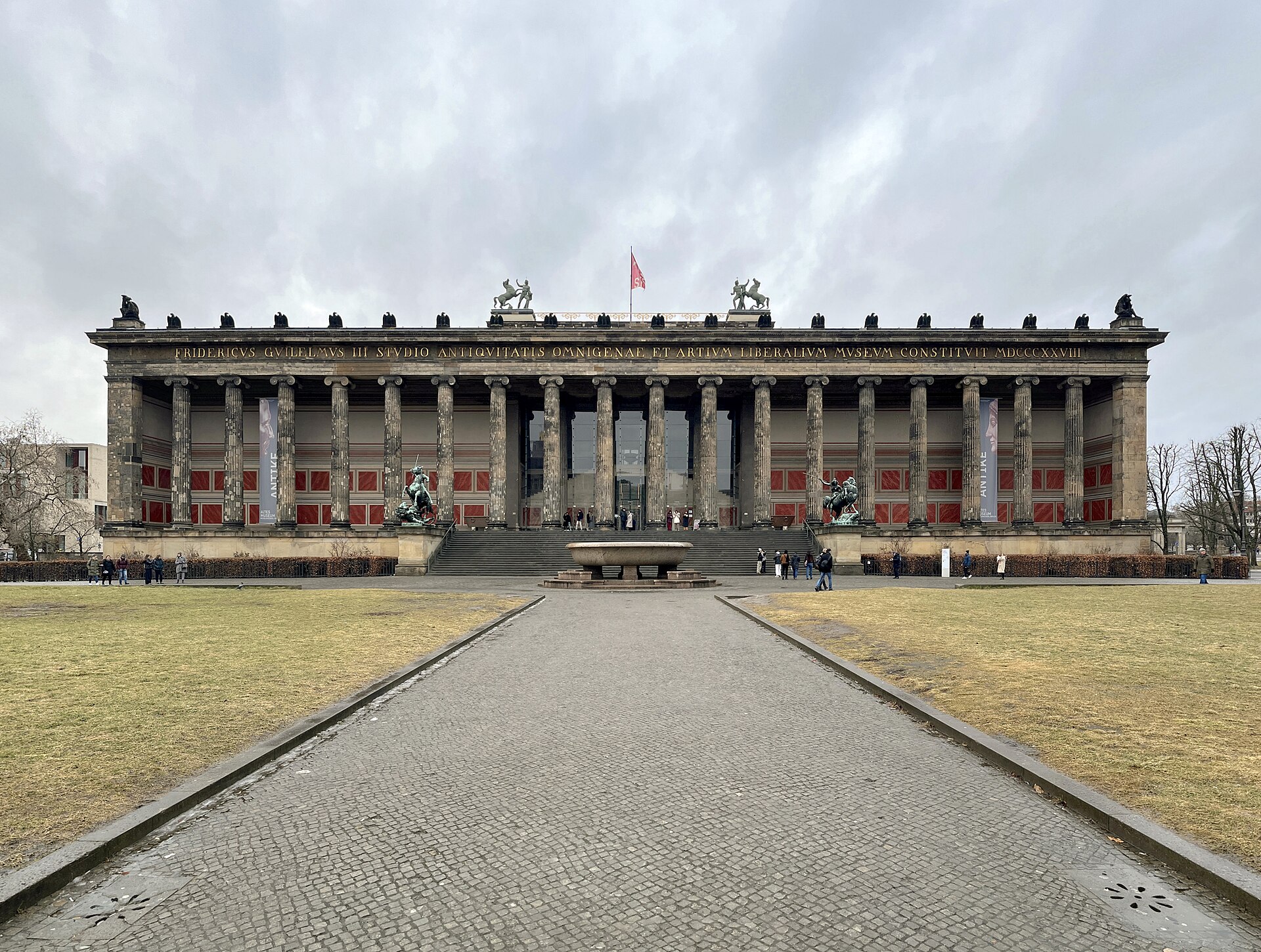
Schinkel's eighteen-column Ionic colonnade, seen from across the Lustgarten, the approach the building was designed to be read from.
Photograph by Gunnar Klack, released CC BY-SA 4.0On this page 14 sections
ContentsClose
The Altes Museum's strength is depth in Greek and Etruscan material inside a building that is itself one of the primary Neoclassical monuments in Germany, so that the architecture and the collection argue the same case: that classical antiquity is a coherent, legible system rather than a cabinet of curiosities. Its Etruscan holdings in particular are rarely matched outside Italy.
| Kind | Museum |
|---|---|
| Founded | 1830 |
| City and country |  Berlin, Germany Berlin, Germany |
| Address | Am Lustgarten, 10178 Berlin, Germany |
| Website | smb.museum/en/museums-institutions/altes-museum/home |
| Status | Open, confirmed |
| Record last verified |
Visiting
- Hours
- MonClosed
- Tue10:00 to 17:00
- Wed10:00 to 17:00
- Thu10:00 to 17:00
- Fri10:00 to 17:00
- Sat10:00 to 18:00
- Sun10:00 to 18:00
- Closed
- Monday.
- Admission
- AdultEUR 14Single-museum ticket for the Altes Museum
- ConcessionsEUR 7
- Museum Island day ticket, adultEUR 24Covers Alte Nationalgalerie, Altes Museum, Bode-Museum, Neues Museum and Pergamonmuseum. Das Panorama on one day
- Museum Island day ticket, concessionsEUR 12
- Museum Pass Berlin, 3 days, permanent exhibitionsEUR 32Concessions 16.00 EUR
- Under 18, school classes, enrolled studentsFreeFree
- Tickets
- tickets.smb.museum The museum's own ticket page.
- Do I need to book?
- Not required; online timed tickets recommended, bookable up to four weeks ahead
- Address
- Am Lustgarten, 10178 Berlin, Germany MapU-Bahn Museumsinsel
S-Bahn Friedrichstrasse, Hackescher Markt
Tram Am Kupfergraben, Hackescher Markt
Bus U Museumsinsel - Website
- smb.museum/en/museums-institutions/altes-museum/home
- Telephone
- +49 30 266424242
Before you go how long, access, photography, bags, eating, shop
- How long to allow
- One and a half to two hours
- Access
- Not detailed in the sources consulted for this page
- Photography
- Not detailed in the sources consulted for this page
- Bags
- Not detailed in the sources consulted for this page
- Eating
- Not detailed in the sources consulted for this page
- Shop
- Museum shop, on site
Prices and hours change. We take them from the institution's own pages and print the day we read them, and you can check the current position at the source we used. Confirm before you travel.
What is inside
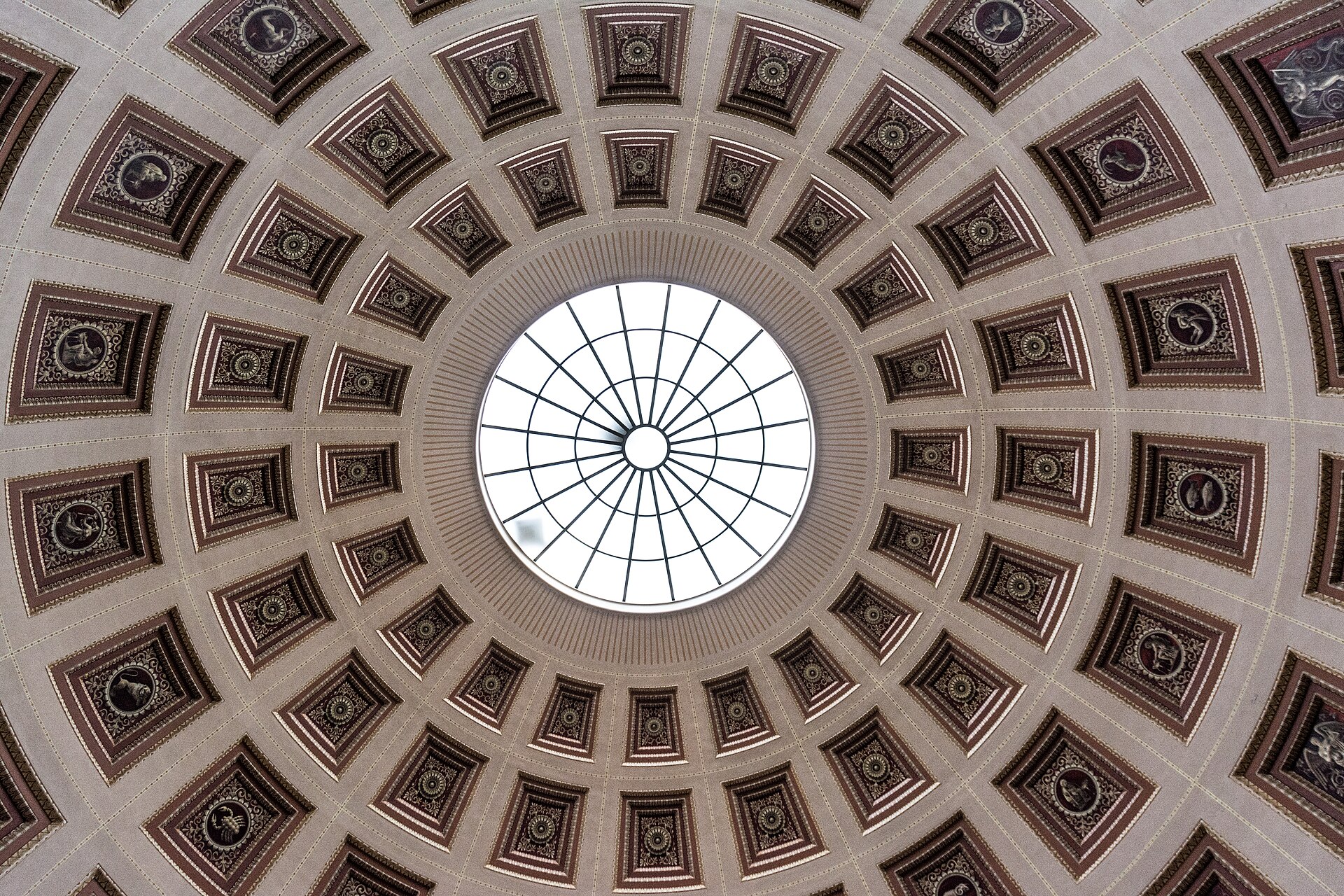
Photograph by Dr. Zeltsam · CC BY-SA 4.0 The Rotunda
The domed rotunda at the centre of the building is lined on two levels with marble statues of ancient gods, an explicit, acknowledged reference to the Pantheon in Rome. Karl Friedrich Schinkel designed it as the emotional centre of the museum, a place to pause between the ground-floor Greek galleries and the staircases either side.
Ground floor - Greek art, 10th to 1st century BC
A chronological run through Greek sculpture, vases and jewellery from the Geometric period to the Hellenistic age, arranged around the rotunda. Its best-known object is the bronze Praying Boy; the archaic Berlin Goddess and a Classical-period enthroned goddess associated with the Greek colonies of southern Italy are also on this floor.
Upper floor - Etruscan and Roman art
One of the largest Etruscan collections outside Italy, together with Roman portrait busts and the Hildesheim silver find, a hoard of Roman tableware discovered in Lower Saxony in 1868 and among the most complete sets of ancient domestic silver to survive.
Muenzkabinett display - the coin cabinet's Altes Museum selection
A dedicated room, referred to by the museum itself as the blue chamber, showing a curated run of more than 1,300 coins from the 7th century BC to the late 3rd century AD, drawn from the Muenzkabinett's much larger holdings, most of which are physically kept and displayed at the Bode-Museum.
What to see first
Praying Boy (Betender Knabe)
Greek, early Hellenistic, about 300 BCDescribed by the museum itself as the most popular ancient sculpture in the Antikensammlung's collection, a bronze youth standing with arms raised that has been copied, cast and referenced across European sculpture since its rediscovery.6
Berlin Goddess
Greek, Attic, about 580-560 BCA monumental archaic grave statue of a standing goddess, one of the largest and best-preserved Attic korai to survive, and a fixed point for dating the development of archaic Greek sculpture.6
Hildesheim Silver Find
Roman, 1st century BC to 1st century ADA hoard of some 70 pieces of Roman silver tableware, dug up by soldiers in Hildesheim in 1868 and one of the most complete surviving sets of ancient domestic silver, giving a rare view of how a wealthy Roman household actually ate.14
Portrait bust identified as Cleopatra VII
Roman, 1st century BCA marble portrait head catalogued as the Egyptian queen Cleopatra VII, one of a small group of idealised, non-Egyptian-style portraits proposed to depict her, and a standing point of comparison whenever a new claimed Cleopatra portrait surfaces on the market.7
Antinous, Sk 364
Roman, after AD 130A marble figure of Antinous, the favourite of the emperor Hadrian who drowned in the Nile in AD 130 and was deified afterwards, becoming one of the most widely copied male figures of the Roman world; the Altes Museum's version is one of many surviving variants.7
Goddess enthroned, Magna Graecia
Greek colonial, southern Italy, about 475-450 BCA terracotta goddess seated on a throne from the Greek colonies of southern Italy, representing a strand of Greek art the Altes Museum's ground floor treats on equal terms with mainland Attic and Ionian work rather than as a footnote to it.6
Exhibitions on now
Berlin's first museum
The Altes Museum was Berlin's first purpose-built public museum, and Karl Friedrich Schinkel's design, completed in 1830, is still counted among the defining buildings of European Neoclassicism. Its facade, an eighteen-column Ionic colonnade running the full width of the building, was conceived to be read from the Lustgarten as a temple front, and its dedication, cut into the entablature, states its purpose without qualification: Friedrich Wilhelm III dedicated the museum to the study of all antiquities and the free arts, in 1828, two years before it opened. The rotunda at the centre of the building, lined with sculpture and modelled explicitly on the Pantheon in Rome, was Schinkel's answer to the question of what a museum building was even for: not a warehouse for objects, but a space designed to produce a particular experience of encountering the ancient world.
Burned out, rebuilt twice
The Altes Museum came close to being lost twice in the 20th century, once to fire and once to neglect. Shortly before the end of the Second World War the building burned out almost completely, and its collections, evacuated in advance to sites away from Berlin, survived only because they were not inside it when the fire took hold. Reconstruction began in 1951, making it the first building on Museum Island to be rebuilt after the war, and East German restorers worked close to Schinkel's original designs; the rotunda's decorative scheme was not fully reinstated until 1966, and further work following Schinkel's drawings continued as late as 1982.
For most of the Cold War the rebuilt museum did not show antiquities at all. Up to German reunification in 1990, the building was used to display contemporary art of the German Democratic Republic, while the Antikensammlung's own holdings sat split between institutions on either side of the Berlin Wall: part in West Berlin's Charlottenburg museums, part in the Pergamonmuseum in the east. Only after 1990 did the collection begin moving back into the building Schinkel designed for it, a process that continued for years rather than happening at once; the Antiquarium, the collection's minor-arts holdings, did not rejoin the main galleries at the Altes Museum until 1998.
What the two floors hold
The ground floor, wrapped around the rotunda, carries Greek art from the 10th to the 1st century BC in roughly chronological order, from the geometric abstraction of the earliest vases through archaic grave statues such as the Berlin Goddess to the naturalism of the Hellenistic period and the museum's best-known single object, the bronze Praying Boy. The upper floor holds the Etruscan and Roman collections: one of the largest Etruscan holdings outside Italy itself, Roman portrait busts spanning the empire, and the Hildesheim silver find, a hoard of Roman domestic tableware unearthed by soldiers in 1868 that remains one of the most complete sets of ancient silver plate to survive anywhere. A dedicated room the museum calls the blue chamber shows a rotating selection of more than 1,300 coins on loan from the Muenzkabinett, whose main holdings and building are at the Bode-Museum at the other end of Museum Island.
A dinner service dug up on a shooting range
The Hildesheim silver find, the single largest holding of Roman silver ever recovered outside the empire's frontiers, was not excavated by archaeologists at all. On 17 October 1868, Prussian soldiers levelling ground on the Galgenberg hill for a shooting range struck buried metal about two metres down and unearthed roughly seventy pieces of Roman table silver: bowls, cups, a tripod, a large krater, all dated mainly to the 1st century AD. Who buried it, and why, is still argued over rather than settled. The traditional theory ties the hoard to Publius Quinctilius Varus, the Roman commander whose three legions were destroyed by Germanic forces at the Teutoburg Forest in AD 9, and imagines it as his personal dinner service, hidden or lost in the chaos of that defeat or a later Roman campaign into Germania; other scholars read it instead as loot taken in a raid, buried for safekeeping and never reclaimed. The most recent technical study of the metal favours workshops in the Roman provinces along the Rhine rather than Rome itself, which does not settle the ownership question but does narrow where the silver was actually made.
Whichever account is right, the find answers a question written sources cannot: what a wealthy Roman household's table actually looked like, assembled as a single, unstaged group rather than reconstructed piece by piece from scattered fragments. It has been part of the Antikensammlung's Berlin holdings, and displayed at the Altes Museum, since shortly after its discovery.
A museum built to be one stop among five
The Altes Museum's ticketing reflects a decision the whole island shares: no single museum on Museum Island sells itself as a full day out. A ticket for the Altes Museum alone costs 14 euros and admits only to that building; the Museum Island day ticket, at 24 euros, adds the Alte Nationalgalerie, the Bode-Museum, the Neues Museum and Pergamonmuseum. Das Panorama, the temporary exhibition space standing in for the Pergamonmuseum's main building while it remains closed for renovation until 2027. The distinction matters to a visitor planning a single day: buying the single ticket at the door and discovering later that three other museums were a few hundred metres away is one of the most common avoidable disappointments on the island, and the museums' own price list makes the difference explicit rather than assuming a visitor already knows it.
The Altes Museum's own entrance fee rose from 12 to 14 euros in June 2025, the same month the museum restored Tuesday opening after more than a year of a shortened, budget-driven Monday-and-Tuesday closure that had applied to it and the Bode-Museum alike - a small, dated fact that says something about how the Staatliche Museen zu Berlin's operating budget, not just its collections, shapes what a visitor actually finds open on any given day.
What visitors say
Visitors consistently describe the Altes Museum as calmer and less crowded than the Pergamonmuseum or the Neues Museum, and frequently mention the rotunda and Schinkel's colonnaded facade as highlights in their own right, separate from the collection. The Greek vase and sculpture galleries draw more comment than the Etruscan and Roman upper floor.
What is praised, what is criticised
- Praised: Schinkel's building and the rotunda specifically, called out as an attraction independent of the objects on display
- Praised: the quality and condition of the Greek sculpture and vase collection
- Praised: shorter queues and lower crowding than the other Museum Island venues
- Criticised: some visitors find the collection modest in scale for a full Museum Island day and finish faster than they expected
- Criticised: labelling and object information are reported as thinner on the upper Etruscan and Roman floor than on the ground floor
Ratings on other platforms
Tripadvisor: 4.1 from 297 ratings, read 7 August 2026
A platform average is a tertiary source: it moves, it is not audited, and we quote no visitor's words.
Questions about Altes Museum
Where is Altes Museum?
Am Lustgarten, 10178 Berlin, Germany.
How much does it cost to visit?
Adult: EUR 14; Concessions: EUR 7; Museum Island day ticket, adult: EUR 24; Museum Island day ticket, concessions: EUR 12; Museum Pass Berlin, 3 days, permanent exhibitions: EUR 32. As confirmed 20 August 2026.
When is it open?
Mon closed; Tue 10:00-17:00; Wed 10:00-17:00; Thu 10:00-17:00; Fri 10:00-17:00; Sat 10:00-18:00; Sun 10:00-18:00. Closed: Monday. As confirmed 20 August 2026.
How do you get there?
U-Bahn: Museumsinsel; S-Bahn: Friedrichstrasse, Hackescher Markt; Tram: Am Kupfergraben, Hackescher Markt; Bus: U Museumsinsel.
What should you see first?
Praying Boy (Betender Knabe) (Greek, early Hellenistic, about 300 BC); Berlin Goddess (Greek, Attic, about 580-560 BC); Hildesheim Silver Find (Roman, 1st century BC to 1st century AD); Portrait bust identified as Cleopatra VII (Roman, 1st century BC); Antinous, Sk 364 (Roman, after AD 130); Goddess enthroned, Magna Graecia (Greek colonial, southern Italy, about 475-450 BC).
What we could not confirm
- The sources consulted for this page do not fully account for every stage of the Antikensammlung's post-1990 reunification; the Antiquarium's 1998 return to the Altes Museum is documented, but a complete object-by-object account of what moved when, and from which East or West Berlin site, was not found.
- Labelling and interpretive depth on the Etruscan and Roman upper floor is reported by visitors as thinner than on the Greek ground floor; whether this reflects a genuine gap in interpretation or simply less crowd-favourite material was not resolved by the sources consulted.
Images
Sources
- 1Staatliche Museen zu Berlin, Altes Museum, Plan Your Visit - Opening Hours smb.museum/en/museums-institutions/altes-museum/plan-your-visit/opening-hours/
- 2Staatliche Museen zu Berlin, Altes Museum, Tickets & Admission smb.museum/en/museums-institutions/altes-museum/plan-your-visit/prices-tickets/
- 3Staatliche Museen zu Berlin, Altes Museum, Contact smb.museum/en/museums-institutions/altes-museum/plan-your-visit/contact/
- 4Staatliche Museen zu Berlin, Altes Museum, Address smb.museum/en/museums-institutions/altes-museum/plan-your-visit/address/
- 5Staatliche Museen zu Berlin, Altes Museum, Collections smb.museum/en/museums-institutions/altes-museum/collection-research/collections/
- 6Staatliche Museen zu Berlin, Antikensammlung, Collection smb.museum/en/museums-institutions/antikensammlung/collection-research/collection/
- 7Wikimedia Commons categories, Bust of Cleopatra VII in the Altes Museum Berlin; Antinous (Sk 364), Altes Museum, Berlin commons.wikimedia.org/wiki/Category:Altes_Museum_(Berlin)
- 8Staatliche Museen zu Berlin, Altes Museum, Profile smb.museum/en/museums-institutions/altes-museum/about-us/profile/
- 9Staatliche Museen zu Berlin, Museumsinsel Berlin, Plan Your Visit (Museum Island day ticket) smb.museum/en/museums-institutions/museumsinsel-berlin/plan-your-visit/
- 10Staatliche Museen zu Berlin, Neue Oeffnungszeiten fuer Altes Museum und Bode-Museum (Tuesday reopening and price change, June 2025) smb.museum/en/whats-new/detail/new-opening-hours-the-altes-museum-and-the-bode-museum-are-open-tuesdays-from-3-june-2025/
- 11Museumsinsel Berlin, Altes Museum (building history: WWII fire, GDR contemporary art use, post-1990 return of the Antikensammlung) museumsinsel-berlin.de/en/buildings/altes-museum/
- 12Wikidata, Altes Museum (Q156722) wikidata.org/wiki/Q156722
- 13Tripadvisor, Altes Museum, Berlin, overall rating and review count, read 7 August 2026 tripadvisor.com/Attraction_Review-g187323-d11838582-Reviews-Altes_Museum-Berlin.html
- 14Wikipedia, Hildesheim Treasure (discovery in 1868, the Varus theory, current location) en.wikipedia.org/wiki/Hildesheim_Treasure