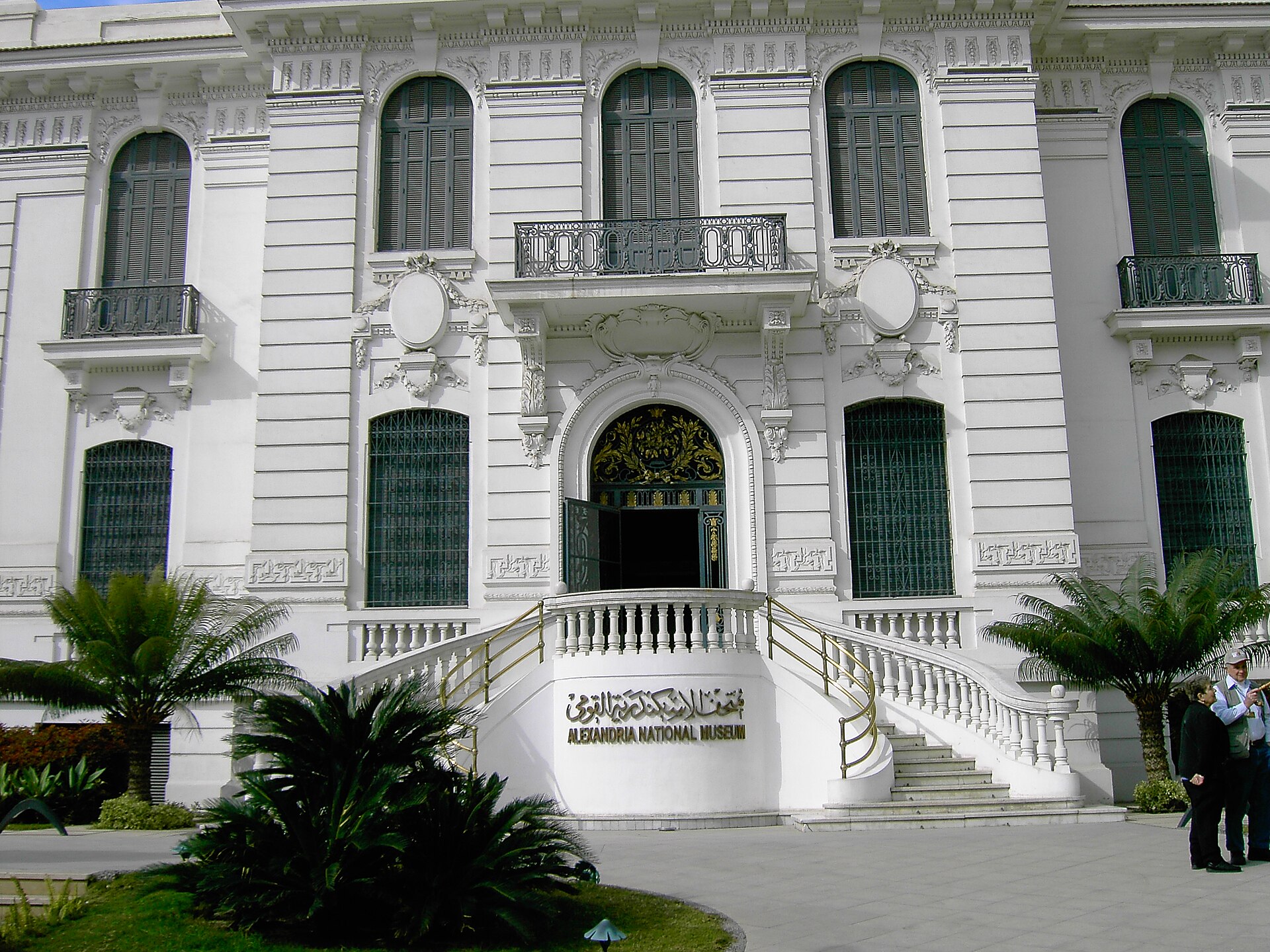
The restored 1926 Italianate villa of Assaad Basili Pasha, photographed from the garden with the museum's Arabic and English name plate over the entrance stair.
Papillus · CC BY-SA 3.0Alexandria National Museum
Museum · Founded 2003
Open, admission and hours confirmed 17 August 2026 · 7 sources
On this page 13 sections
ContentsClose
About 1,800 objects arranged as a single chronological walk through Alexandria and Egypt, from Predynastic material to the mid-twentieth century, inside a restored merchant's villa rather than a purpose-built museum. Its distinguishing feature next to Cairo's larger collections is compression: three floors carry Pharaonic, Graeco-Roman, Coptic and Islamic Egypt under one roof at a scale a visitor can cover in an afternoon, with the city's own Hellenistic and Roman material - the Alexander head, the Caracalla statue, the harbour finds - as its centre of gravity.
| Kind | Museum |
|---|---|
| Founded | 2003, in a 1926 villa |
| City and country |  Alexandria, Egypt Alexandria, Egypt |
| Address | 110 Tariq al-Horreya (Al-Hurriya Road), Raml Station, Alexandria 5423004, Egypt |
| Website | egymonuments.com/locations/details/AlexandriaNationalMuseum |
| Status | Open, confirmed |
| Record last verified |
Visiting
- Hours
- Daily09:00 to 17:00ticket window closes at 16:00
- Daily, during Ramadan09:00 to 15:00ticket window closes at 14:00
- Admission
- Foreign adultEGP 220
- Foreign studentEGP 110
- Egyptian adultEGP 20
- Egyptian studentEGP 5confirmed directly on egymonuments.com's own booking page (Egyptian tab, clicked live in a browser session on 2026-08-17); previously carried from the Ministry page only because the museum's own booking site would not hold the Egyptian tab open long enough to confirm during the 2026-08-07 research pass
Free entry: Children under 6. Egyptians with special needs. Egyptians aged 60 and over. Orphaned children. Government and Al-Azhar school trips booked in advance through the Rehla platform- Tickets
- egymonuments.com/locations/details/Alexandria... The museum's own ticket page.
- Do I need to book?
- No, tickets are sold at the gate and also bookable online through the Ministry's egymonuments.com portal
- Address
- 110 Tariq al-Horreya (Al-Hurriya Road), Raml Station, Alexandria 5423004, Egypt MapOn foot In the Raml Station district on Tariq al-Horreya, close to the tram terminus at Raml Station and within walking distance of the Corniche
- Website
- egymonuments.com/locations/details/AlexandriaNationalMuseum
- Telephone
- 0-19654
- [email protected]
Before you go how long, access, photography, bags, eating, shop
- How long to allow
- Reviewers who have been through all three floors describe it as a compact walk-through, well under the half-day a visitor sets aside for the Graeco-Roman Museum or the Bibliotheca
- Access
- Not published on the museum's own pages at the time of research
- Photography
- Photography with a mobile phone is free of charge; the free-entry and photography rules are stated on the Ministry's booking page
- Bags
- Not published on the museum's own pages at the time of research
- Eating
- Not published on the museum's own pages at the time of research
- Shop
- Not published on the museum's own pages at the time of research
Prices and hours change. We take them from the institution's own pages and print the day we read them, and you can check the current position at the source we used. Confirm before you travel.
What is inside
Basement: Prehistoric and Pharaonic Egypt
The lowest level, cut into the villa's original cellar, opens the chronology with Predynastic material and runs through the Pharaonic periods: wooden statues and limestone group sculpture of Old Kingdom date, funerary amulets, kohl applicators and bronze mirrors from daily and burial use. Visitors on Tripadvisor single this floor out as the darkest in the building, since it was not built to hold display cases.
First floor: Graeco-Roman Alexandria
The middle level covers the city's Hellenistic and Roman centuries: a head from a statue of Alexander, the city's and the museum's namesake, a granite statue of the emperor Caracalla, marble sculpture of Ptolemaic queens, a statue of Serapis, the syncretic god invented for Ptolemaic Alexandria, and Medusa-head mosaic and terracotta work recovered in the city.
Second floor: the Coptic collection
Around 200 Coptic pieces: painted icons of the Virgin and of Christ, tomb stelae that mix Egyptian, Greek and Christian imagery in the same carved panel, textiles, and gold, silver and iron equipment made for church use in daily Coptic life.
Second floor: the Islamic collection, and the modern coda
Roughly 300 Islamic-period pieces share the top floor with the Coptic material: a 162-piece coin collection, weaponry and material on the defensive architecture of Muslim Alexandria, ceramics and glass. The same floor carries a small selection of gold, silver and jewellery from Muhammad Ali Pasha's family, and closes with items from King Farouk's reign, including a gold medal struck for the 1943 opening of the University of Alexandria.
What to see first
Head from a statue of Alexander the Great
Hellenistic EgyptThe closest the museum comes to a founding relic: a portrait head of the man the city and the museum both take their name from, on the Graeco-Roman floor.3
Granite statue of Caracalla
Roman EgyptA full-length granite portrait of the emperor whose 215 AD visit to Alexandria the ancient sources record as a massacre of the city's young men; the statue is exhibited on the same floor as the underwater material.5
Group statue of Mersuankh
Old Kingdom EgyptShows the same person modelled at different ages in one composition, a device visitors flag as one of the more legible pieces on the Pharaonic floor.6
Underwater finds from Alexandria's harbour
Ptolemaic and Roman EgyptObjects raised in excavations off the Alexandria coast are shown on the Coptic and Islamic floor rather than with the Graeco-Roman material, the museum's own placement decision.3
Gold, silver and jewellery of the Muhammad Ali family
19th and early 20th centuryA small selection distinct from the much larger holdings across town at the Royal Jewellery Museum in Zizinya; bejewelled awards, crystal glassware and gold-plated accessories that belonged to Egypt's last royal dynasty.3
Coptic tomb stelae
Late antique AlexandriaCarved panels the museum's own literature describes as mixing Egyptian, Greek and Christian iconography in a single stone, physical evidence of the religious transition the Coptic floor covers.6
King Farouk's gold medal, University of Alexandria, 1943
Kingdom of EgyptThe latest object in the chronological run, closing the museum's walk from Predynastic Egypt to the twentieth century on one specific, dated occasion.6
A wood merchant's villa, not a museum
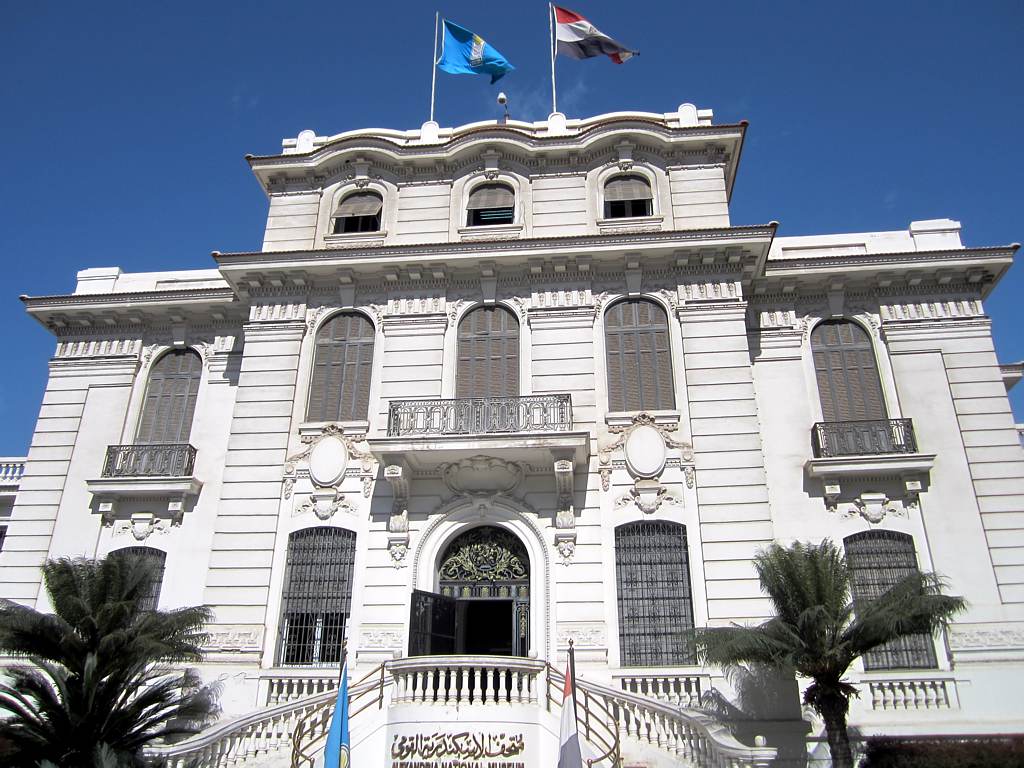
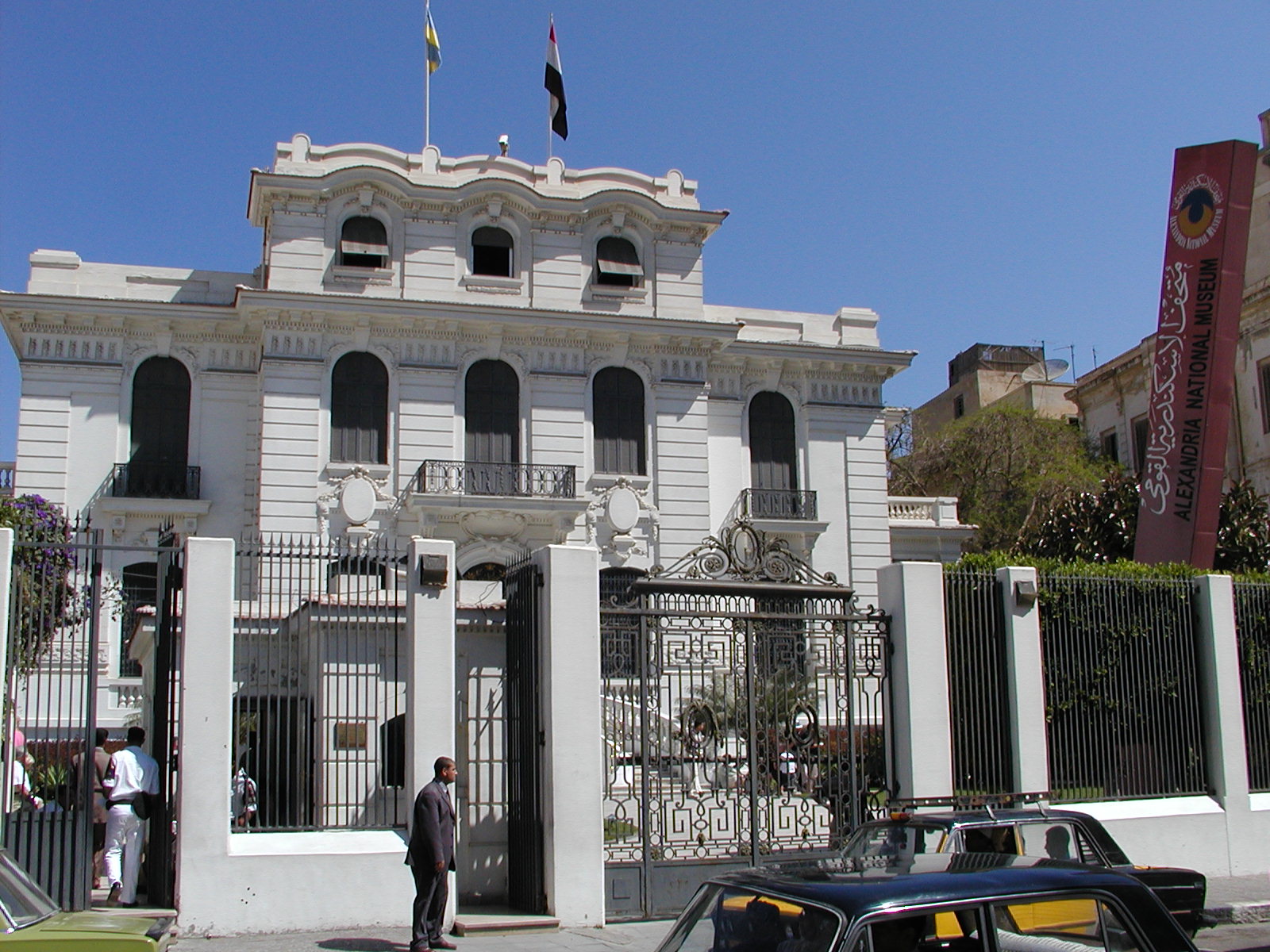
The building the collection now occupies was not designed to hold it. It was built in 1926 as a private residence for Assaad Basili Pasha, a wealthy Alexandria wood merchant, in the Italianate style favoured by the city's mercantile elite in the interwar years, on a plot the Ministry gives as roughly 3,480 square metres. Basili lived there until 1953, when he sold the house to the government of the United States for use as its consulate; it served that purpose for four decades. In 1996 the Supreme Council of Antiquities acquired the building from the American government, converted it into a museum over the following years, and opened it to the public on 31 December 2003 as the Alexandria National Museum. That sequence, private palace to consulate to antiquities museum, is why the galleries sit inside panelled reception rooms and a converted cellar rather than a hall designed for cases and sightlines, and it is the reason reviewers who admire the collection also single out the basement as dim: the space was a wine cellar and service floor, not an exhibition floor, before 2003.
Why Alexandria needed a second museum
Alexandria's older Graeco-Roman Museum, founded in 1892, had been the city's primary antiquities collection for a century by the time this museum opened, and it closed for a long renovation in the 2000s that kept much of its material off view for years. The National Museum was conceived to give the city a second, smaller institution that could tell Alexandria's whole story end to end rather than concentrating on the Graeco-Roman period alone, and to give a public home to material recovered from the city's own harbour as underwater archaeology in Alexandria's Eastern Harbour and at Abu Qir Bay intensified from the 1990s onward. The museum's own description of its layout places that underwater material on the top floor, beside the Coptic and Islamic collections, rather than with the Graeco-Roman galleries on the floor below - a curatorial choice that groups it with the city's post-classical history rather than its classical one.
Three floors, one chronology
The museum's own account of itself, repeated on the Ministry's booking platform and confirmed by visitors who have walked it, is a single chronological descent-to-ascent: the basement for Prehistoric and Pharaonic Egypt, the first floor for the Graeco-Roman period, and the second floor for the Coptic and Islamic centuries through to the twentieth. Around 1,800 objects are distributed across the three levels. The basement holds Old Kingdom wood and limestone sculpture, funerary amulets and cosmetic tools; the first floor carries the museum's classical centre of gravity, headed by a portrait head of Alexander the Great and a granite statue of the emperor Caracalla; the second floor divides roughly 200 Coptic pieces from around 300 Islamic pieces, and closes with a small display of Muhammad Ali-dynasty jewellery and a gold medal from King Farouk's reign, struck in 1943 for the opening of the University of Alexandria.
A smaller, separate royal collection from the one across town
The gold, silver and jewellery on the top floor here belonged to the Muhammad Ali dynasty, Egypt's ruling family from 1805 to 1952, and it is worth being precise about what it is not: it is not the Royal Jewellery Museum, a much larger, dedicated institution in Alexandria's Zizinya district holding more than 11,000 pieces in a former royal palace. The two collections share a source - the same dynasty's possessions - but are held by different institutions in different buildings, and a reader planning a visit to see royal jewellery in depth wants the Zizinya museum, not this one. What this museum holds is a small selection integrated into its own top-floor display alongside the Islamic-period material, not a dedicated royal wing.
What the reviews actually say
The museum runs at 4.2 out of 5 on Tripadvisor across 300 reviews, and the pattern in the reviews themselves is consistent rather than mixed. Visitors who have walked all three floors describe a museum that succeeds at what it sets out to do - a compact, logically ordered introduction to the full span of Alexandria's and Egypt's history - while flagging the same limitation the building's own history explains: exhibit lighting in the converted cellar is poor, and object labelling is described as inconsistent rather than absent. More than one reviewer recommends a guide for exactly this reason, to supply the context the labels do not always carry. None of this amounts to a complaint about the collection; it is a complaint about a nineteenth-century villa doing a purpose-built museum's job, which is precisely what the building is.
What visitors say
We publish no visitor review prose and cite no single platform score as fact; what follows is our own reading of the pattern across published reviews. Visitors consistently value the museum as a compact, chronological introduction to Alexandria housed in a genuinely handsome former merchant's villa, and just as consistently note that the building was not designed to be a museum: the basement galleries in particular are dark, and object labelling is described as inconsistent rather than absent.
What is praised, what is criticised
- Praised: the logical floor-by-floor chronology, prehistoric and pharaonic in the basement rising to the modern era at the top
- Praised: the building itself, a restored 1926 Italianate villa that visitors rate as an attraction alongside the collection
- Praised: its compact size next to the Graeco-Roman Museum and the Bibliotheca, workable in an hour or two rather than a half day
- Criticised: dim lighting in the basement galleries, which were adapted from the villa's cellar rather than built for display
- Criticised: labelling that reviewers describe as not comprehensive, leaving some objects under-explained without a guide
Ratings on other platforms
Tripadvisor: 4.2 from 300 ratings, read 7 August 2026
A platform average is a tertiary source: it moves, it is not audited, and we quote no visitor's words.
Questions about Alexandria National Museum
Where is Alexandria National Museum?
110 Tariq al-Horreya (Al-Hurriya Road), Raml Station, Alexandria 5423004, Egypt.
How much does it cost to visit?
Foreign adult: EGP 220; Foreign student: EGP 110; Egyptian adult: EGP 20; Egyptian student: EGP 5. As confirmed 17 August 2026.
When is it open?
Daily 09:00-17:00; Daily, during Ramadan 09:00-15:00. As confirmed 17 August 2026.
How do you get there?
On foot: In the Raml Station district on Tariq al-Horreya, close to the tram terminus at Raml Station and within walking distance of the Corniche.
What should you see first?
Head from a statue of Alexander the Great (Hellenistic Egypt); Granite statue of Caracalla (Roman Egypt); Group statue of Mersuankh (Old Kingdom Egypt); Underwater finds from Alexandria's harbour (Ptolemaic and Roman Egypt); Gold, silver and jewellery of the Muhammad Ali family (19th and early 20th century); Coptic tomb stelae (Late antique Alexandria).
What we could not confirm
- No accessibility, bag-storage or cafe information is published on the museum's own pages at the time of writing; a converted early-20th-century villa with a basement gallery is a live question for wheelchair access that the museum does not address online.
- The exact relationship in holdings between this museum's small Muhammad Ali-family display and the much larger Royal Jewellery Museum collection - whether either institution states how the two selections were divided - is not addressed on either museum's own pages.
Images
Sources
- 1egymonuments.com, Alexandria National Museum ticket and visit page: ticket prices by nationality, opening hours in summer, winter and Ramadan, and the free-entry policy. Read in the in-app browser on 7 August 2026; the site's certificate fails standard verification from an automated fetcher. egymonuments.com/locations/details/AlexandriaNationalMuseum
- 2Ministry of Tourism and Antiquities, Discover Egypt's Monuments: Alexandria National Museum - building history from Assaad Basili Pasha's 1926 villa through the 1996 acquisition to the 2003 opening, collection description, hours and prices. egymonuments.gov.eg/en/museums/alexandria-national-museum
- 3Tripadvisor, Alexandria National Museum - All You Should Know Before Going: the museum's own 'About' text on the three-floor chronology, current rating and review count, and the museum's street address. Read directly in the in-app browser, including individual review text, on 7 August 2026. tripadvisor.com/Attraction_Review-g295398-d459902-Reviews-Alexandria_National_Museum-Alexandria_Alexandria_Governorate.html
- 4Ministry of Tourism and Antiquities, Contact Us: the Ministry's central phone, hotline and email used for museums that do not publish a direct line of their own. egymonuments.gov.eg/en/contact-us
- 5mainlymuseums.com, Alexandria National Museum: floor-by-floor account naming the Old Kingdom basement sculpture, the Serapis and Caracalla statues and Medusa mosaics on the Graeco-Roman floor, the Coptic tomb stelae and Islamic-period weaponry, and King Farouk's 1943 medal. mainlymuseums.com/post/754/alexandria-national-museum/
- 6cairotoptours.com and connected Egypt travel-guide pages on the Alexandria National Museum's Coptic and Islamic collections (approximate object counts by period) and on the Royal Jewellery Museum in Zizinya as a separate institution, used only for the machine facts of collection size and to confirm the two royal collections are held by different museums. cairotoptours.com/Egypt-Travel-Guide/Alexandria-Attractions/Alexandria-National-Museum
- 7Wikidata, Alexandria National Museum (Q201383): label, description and coordinates, cross-checked against the museum's own address before use. wikidata.org/wiki/Q201383