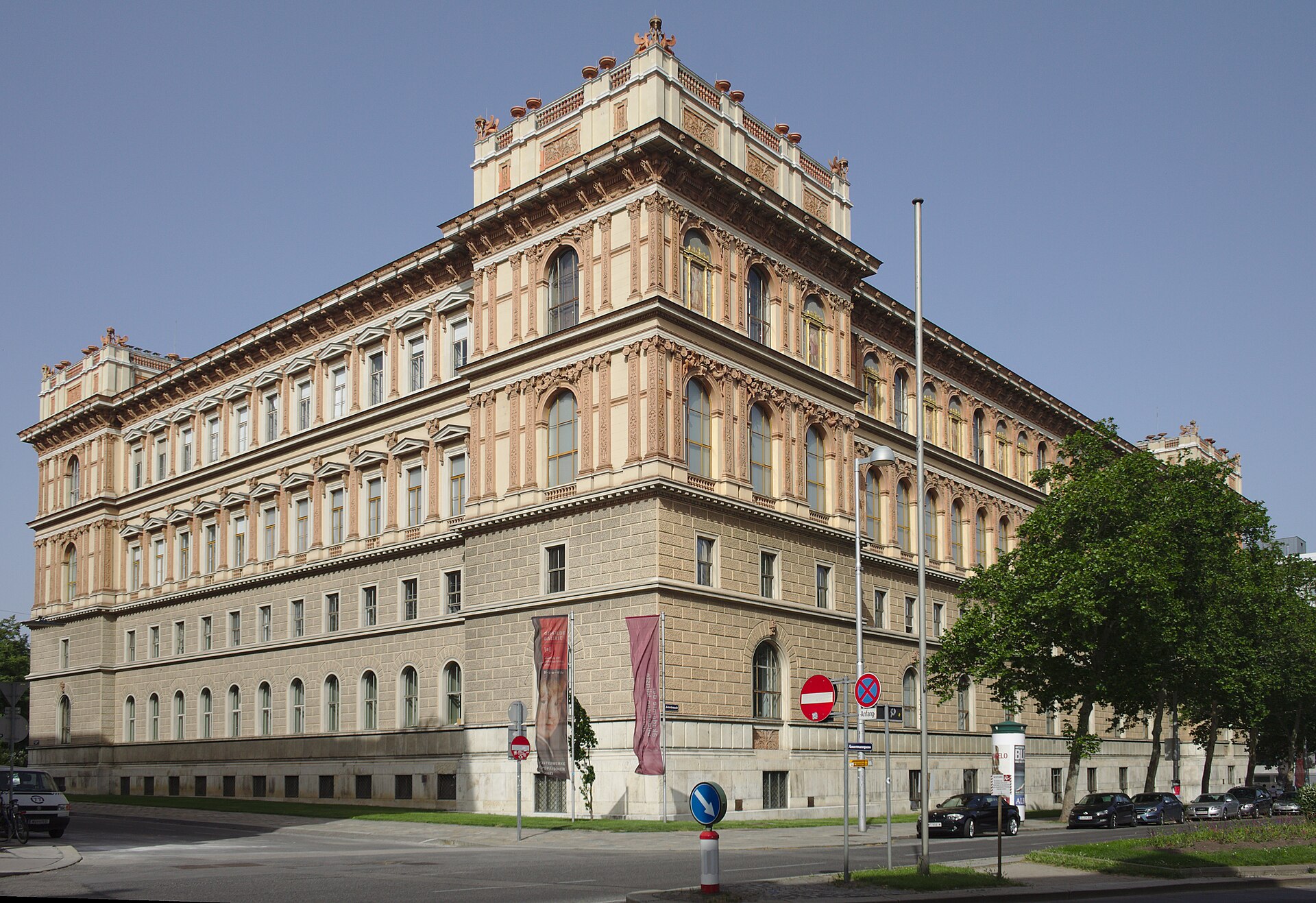
The Academy of Fine Arts Vienna on Schillerplatz, built 1872-1877 to designs by Theophil Hansen; the Paintings Gallery occupies historic rooms on the first floor.
CC0Academy of Fine Arts Vienna, Paintings Gallery
Museum · Gemaeldegalerie der Akademie der bildenden Kuenste Wien · Founded 1822
Open, admission and hours confirmed 5 September 2026 · 14 sources
On this page 15 sections
ContentsClose
A university collection built from a single 1822 bequest of about 800 paintings, now grown to roughly 1,600 catalogued works spanning the fourteenth to the twenty-first century. Its reputation rests on one object, Bosch's Last Judgement Triptych, but its actual depth is broader: Flemish and Dutch seventeenth-century painting (Rubens, Van Dyck, Rembrandt, Ruisdael, de Hooch), an unmatched-in-Austria run of fourteenth- and fifteenth-century Italian gold-ground panels formed under Liechtenstein patronage (Botticelli, Antonio da Fabriano), the early Netherlandish and German schools (Cranach, Bouts), and a strand found nowhere else: the Academy's own teaching history in Austrian painting of the eighteenth and nineteenth centuries, anchored by Heinrich Friedrich Fueger.
| Local name | Gemaeldegalerie der Akademie der bildenden Kuenste Wien |
|---|---|
| Kind | Museum |
| Founded | 1822 (Paintings Gallery); Academy founded 1692; Schillerplatz building opened 1877 |
| City and country |  Vienna, Austria Vienna, Austria |
| Address | Schillerplatz 3, 1010 Vienna, Austria |
| Website | kunstsammlungenakademie.at/en |
| Status | Open, confirmed |
| Record last verified |
Visiting
- Hours
- Tue-Sun10:00 to 18:00Paintings Gallery, Schillerplatz 3, 1st floor
- Closed
- Monday, all year. 1-30 September 2026, for exhibition changeover (an annual pattern tied to the gallery's rotating Considering the Collection displays); the gallery reopens 1-2 October 2026 with the new insert The Great Michelangelo Is Dead! Avant-Garde and Academicism.
- Admission
- AdultEUR 12
- Reduced (65+, O1 Club and companion, Vienna City Card, Kulturlots_innen, Tiroler Kuenstlerschaft, GOD)EUR 8
- Reduced (students under 25 with ID; persons with special needs, incl. carer)EUR 7
- Group (10+ people, per person)EUR 8
- Annual passEUR 27
- Annual pass, reducedEUR 22
- Under 19 / young adultsFreeAlso free: Academy students and a companion, unemployed with AMS card, Kulturpass holders, press, ICOM/AIAP members, Austrian tour guides, and several named professional associations
- Open guided tour, per personEUR 5In addition to the entry ticket
- Do I need to book?
- No advance booking. Tickets are sold only on-site at the gallery's own ticket office; online sale is not offered
- Address
- Schillerplatz 3, 1010 Vienna, Austria MapU-Bahn U1, U2 and U4 to Karlsplatz, then a short walk up Operngasse/Friedrichstrasse to Schillerplatz
- Website
- kunstsammlungenakademie.at/en
- Telephone
- +43 1 588 16 2201
- [email protected]
Before you go how long, access, photography, bags, eating, shop
- How long to allow
- One to two hours. Visitors consistently describe the collection as small enough to see properly in a single visit, built around one signature work
- Access
- Step-free entrance at Makartgasse 2 with a lift to the first-floor galleries; the main Schillerplatz staircase entrance is not step-free. Barrier-free toilets and wheelchair-accessible lift controls are provided in the building
- Photography
- The Academy's public FAQ addresses only professional filming and photography, which requires a completed permit form; it does not publish a separate policy for visitors' personal photography in the galleries
- Bags
- Lockers are available for gallery visitors at the ticket office; the Academy does not offer general luggage storage
- Eating
- A university cafeteria operates in the Schillerplatz building, Monday-Friday 08:30-16:00, i.e. it is not open on the gallery's own Saturday-Sunday visiting days
- Shop
- No dedicated museum shop is described in the Academy's own visitor information
Prices and hours change. We take them from the institution's own pages and print the day we read them, and you can check the current position at the source we used. Confirm before you travel.
What is inside
Paintings Gallery, main rooms (Schillerplatz, first floor)
The historic exhibition rooms Theophil Hansen built into the palace for the collection, restored and reopened in 2021. A rotating selection of around 180 of the roughly 1,600 catalogued paintings is shown here in the Considering the Collection format (running since 2022), spanning European painting from the fourteenth to the twenty-first century, plus themed loan exhibitions.
The Bosch room
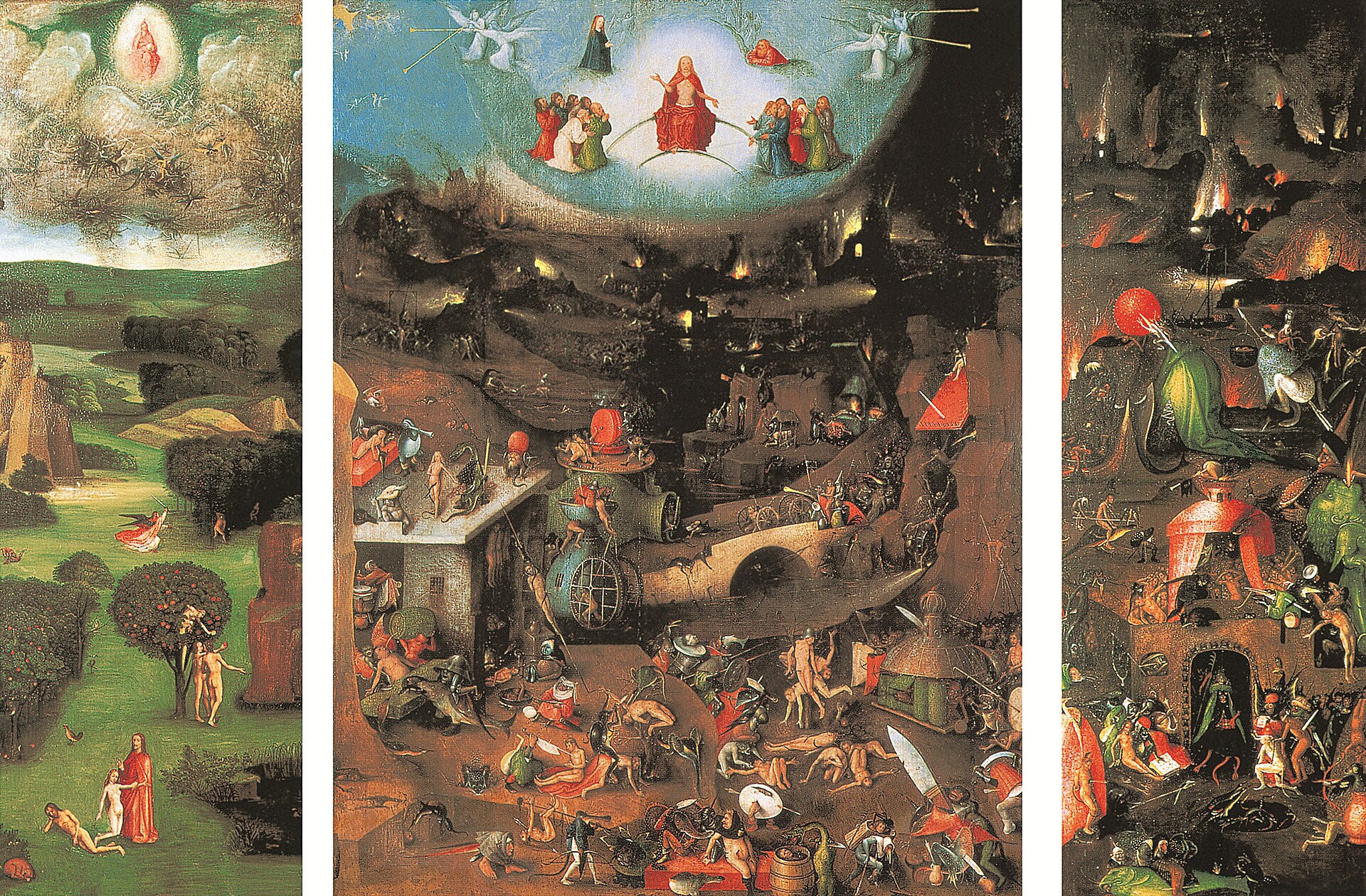
A dedicated room built around Hieronymus Bosch's Last Judgement Triptych, on permanent display and, on the gallery's own account, its single biggest draw. The triptych is normally kept open so both the coloured inner panels and the grisaille outer wings can be read together.
Graphic Collection (Kupferstichkabinett), study hall
In the building's basement: over 100,000 drawings, prints and photographs from the fourteenth to the twenty-first century, including around 170 Rembrandt etchings. It functions as a study room rather than a gallery and is open Monday-Friday 09:00-16:00 by prior registration only, not on general admission.
Plaster Cast Collection (Glyptothek)
About 450 surviving plaster casts after antique and later sculpture, founded for study purposes in the late seventeenth century and administratively folded into the Art Collections in 1988. It is housed at the Academy's Atelierhaus on Lehargasse, a separate address from Schillerplatz, and can only be seen on a guided tour booked in advance.
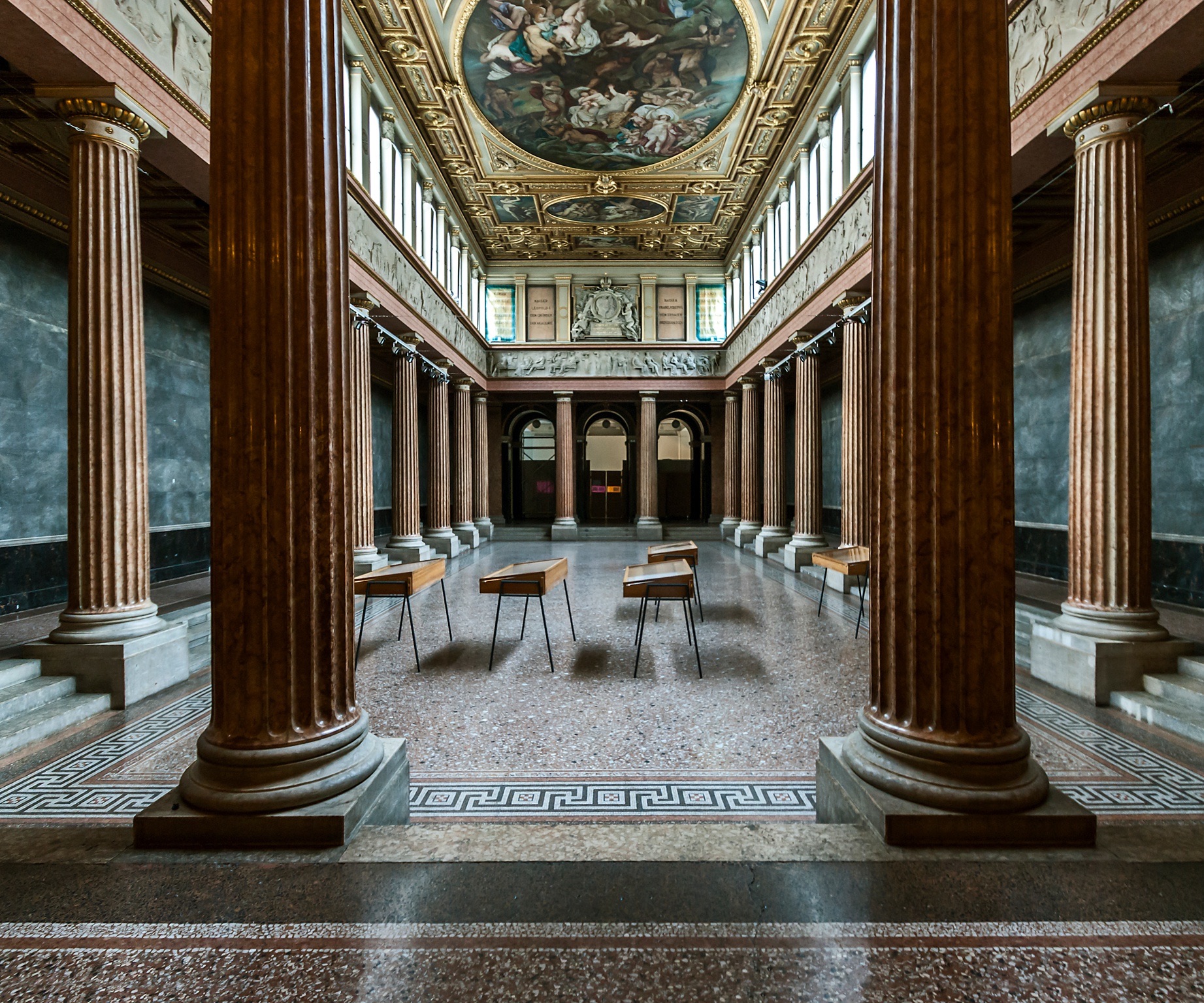
Photograph by Alexbartek · CC BY-SA 4.0 The Aula (entrance hall)
The building's grand columned entrance hall, its coffered ceiling painted by Anselm Feuerbach between 1874 and his death in 1880, completed by others by 1892. Until November 2025 it also held Josef Muellner's 1925 war memorial to fallen Academy artists, removed after years of controversy over Muellner's Nazi-era record (see Open questions).
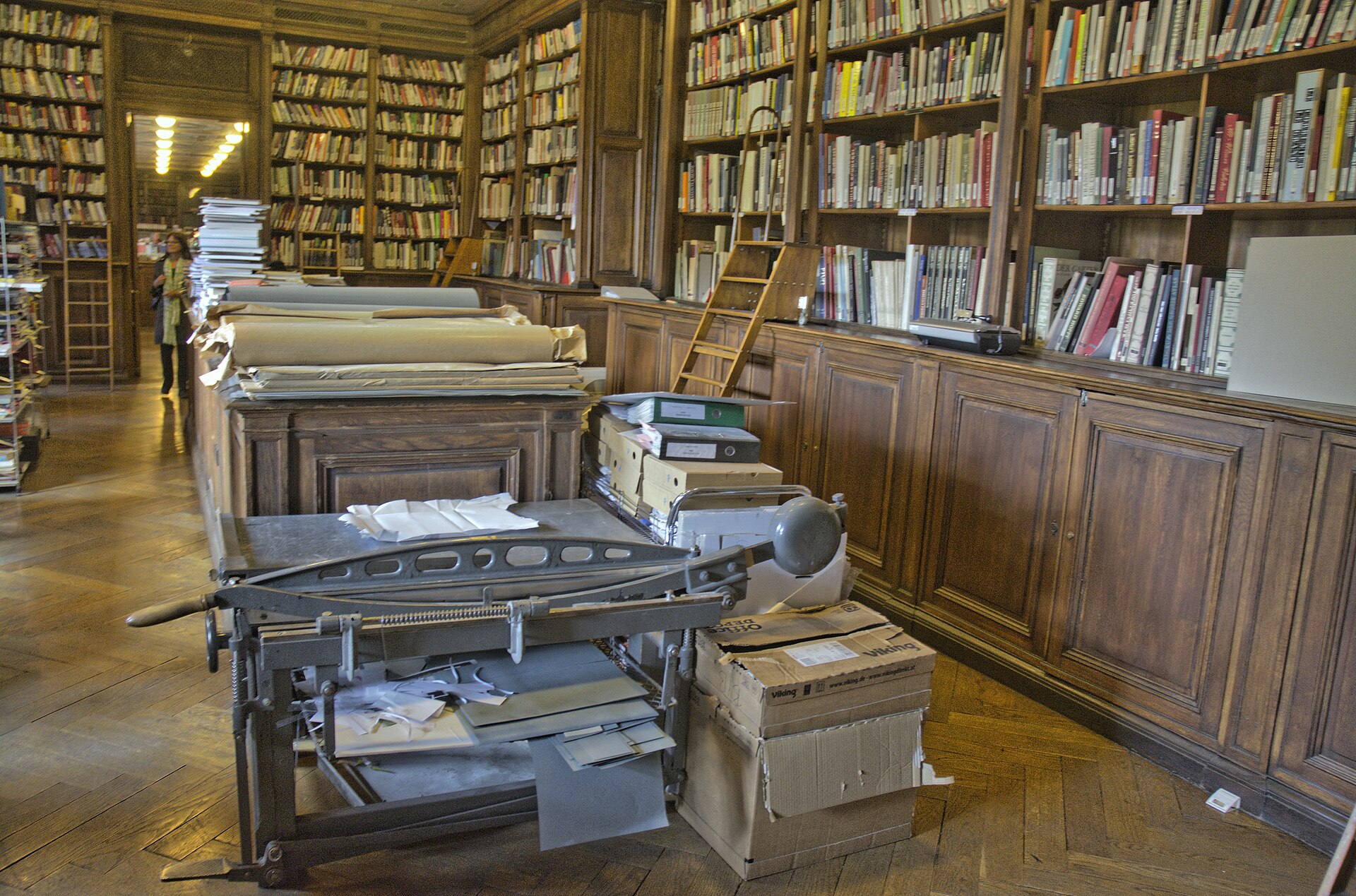
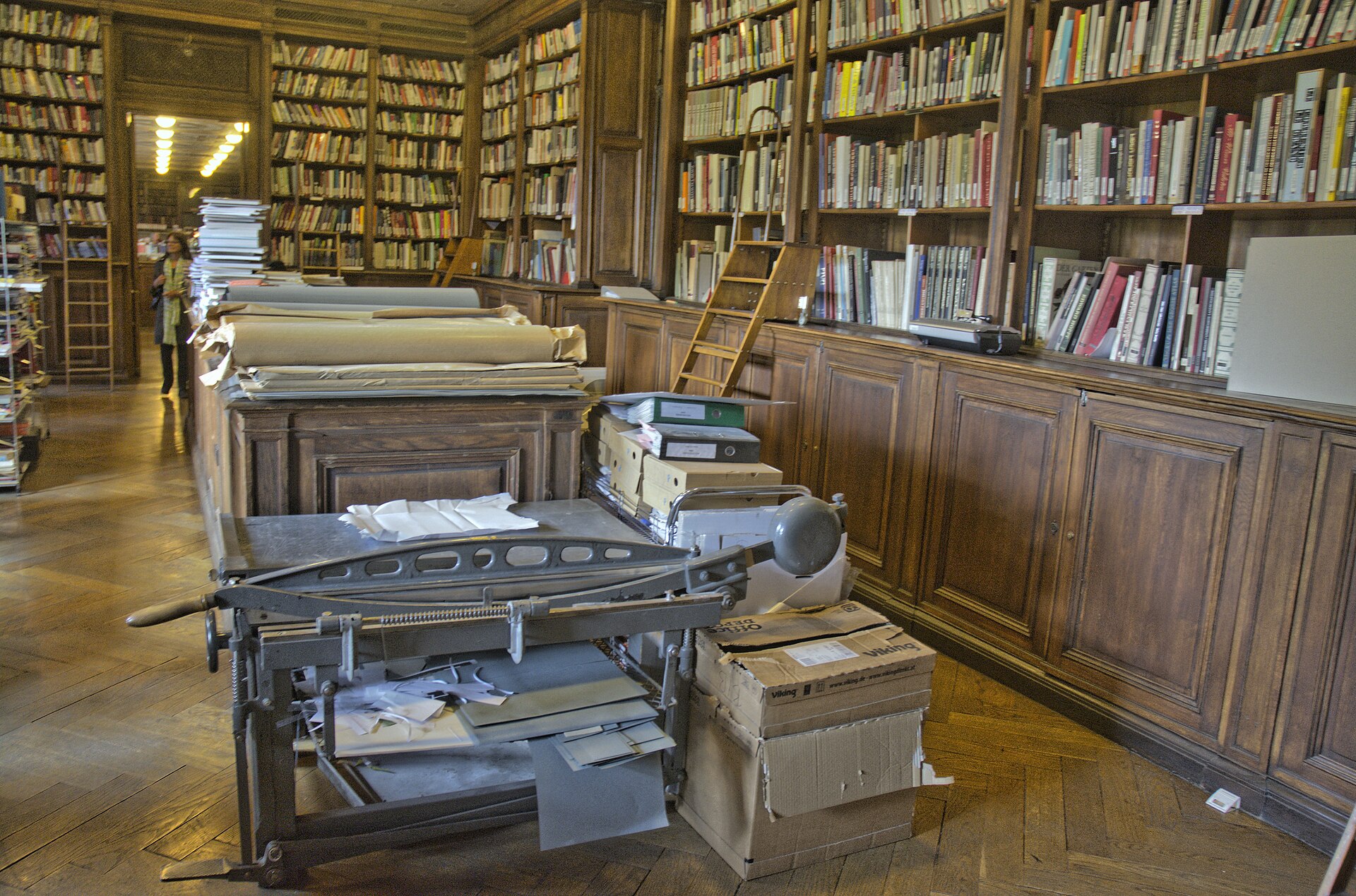
Photograph by ThomasW01 · CC BY-SA 4.0 University Library
The Academy's working library, first recorded in 1773, with much of its historic furniture still in place under monument protection. It is a research space for staff and students rather than a stop on a gallery visit, and is not covered by a Paintings Gallery ticket.
What to see first
Last Judgement Triptych
Hieronymus BoschThe collection's centrepiece and, alongside the Garden of Earthly Delights in Madrid, one of Bosch's largest and most densely populated surviving works. First documented in 1659 in the collection of Archduke Leopold Wilhelm; it came to the Academy in 1822 through Count Lamberg-Sprinzenstein's bequest. Whether it was made for a church, and the identity of the saint on its right outer wing, remain open questions.3
Madonna with Child and Two Angels (tondo)
Sandro BotticelliPart of the group of Italian panel paintings that the gallery says is unmatched in an Austrian collection, formed through the patronage of Johann II, Prince of Liechtenstein.4
Coronation of the Virgin
Antonio da FabrianoA gold-ground altarpiece from the same Liechtenstein-formed group of fourteenth- and fifteenth-century Italian panels the gallery holds.4
Coronation of the Virgin
Dirc BoutsNamed by the gallery's own collection page as one of its handful of standout works, representing the early Netherlandish school alongside Bosch.6
Lucretia
Lucas Cranach the ElderA signed and dated 1532 panel (the serpent device and date are inscribed lower left), documented in the Cranach Digital Archive with the same 1821-22 Lamberg-Sprinzenstein provenance as the Bosch triptych.10
Self-portrait
Anthony van DyckPainted around 1613-14 when Van Dyck was about fifteen and still working for Hendrick van Balen, shortly before he joined Rubens's studio; his earliest surviving self-portrait.13
Portrait of an Unknown Young Woman
RembrandtAn early Amsterdam-period display portrait of the kind prosperous urban patrons commissioned; shown by the Academy's Paintings Gallery and Graphic Collection together in a 2019 exhibition marking Rembrandt's 350th anniversary. Not to be confused with other Rembrandt paintings of similar title in other collections, including one now in Allentown, Pennsylvania.14
Portrait of the artist's son, Heinrich Adam Fueger, aged four
Heinrich Friedrich FuegerFueger's paintings, bequeathed to the Academy by his son in 1878, document his role in bringing Neoclassicism to Vienna around 1800 and anchor the gallery's Austrian collection.6
Exhibitions on now
- On now2 Oct 2026 to 22 Aug 2027Confirmed , 6 weeks ago
A teaching academy that became one of Vienna's first public museums
The Academy of Fine Arts Vienna traces itself to 1688, when the court painter Peter Strudel opened a private academy that received imperial recognition by 1692, making it one of the oldest art academies in the German-speaking world. For over a century its only pictures were teaching material: the admission pieces new members submitted and the prize works students won in annual competitions, kept as models for lessons rather than as a public collection.
That changed in 1822. Count Anton Lamberg-Sprinzenstein, a Habsburg diplomat who had served in Turin and Naples, bequeathed his internationally known collection of roughly 800 paintings to the Academy on one condition: that the pictures be shown publicly. The Academy's Paintings Gallery, then still housed in the former St. Anna convent near Kaerntnerstrasse, became Vienna's first art museum inside a public institution as a direct result of that condition. The bequest still forms the core of what hangs in the galleries today.
The Academy moved to its present address in 1877, into a purpose-built palace on Schillerplatz designed by Theophil Hansen, the architect also responsible for Vienna's Parliament building and the Musikverein. Anselm Feuerbach was commissioned to decorate its interior, work that continued until 1892, four years after his death. The Paintings Gallery occupies historic rooms on the building's first floor, alongside the studios and lecture halls of a working art university; the whole building underwent a general renovation from 2017 and reopened for the 2021 winter semester, with the gallery itself relocated to Vienna's Theater Museum for the duration.
Ownership, and who the collection actually belongs to
Lamberg-Sprinzenstein's bequest passed to the Academy under the protection of the sovereign, and when the Austro-Hungarian monarchy fell and the First Republic was founded in 1918, all of the Academy's collections became the property of the Austrian state. That status was reaffirmed with the Second Republic in 1945 and was not altered when the 2002 Universities Act turned the Academy into an autonomous, privately governed university: the Paintings Gallery, now grouped with the Graphic Collection and the Plaster Cast Collection as the Academy's Art Collections, is organisationally part of a private-law university while its holdings remain state property.
The nineteenth and twentieth centuries added substantially to the founding bequest. State purchases and donations from aristocrats and citizens expanded the collection through the 1800s; Heinrich Friedrich Fueger's own paintings came to the Academy from his son in 1878; Johann II, Prince of Liechtenstein, gave 58 paintings between 1879 and 1925, including the group of gold-ground Italian panels that gives the gallery its Botticelli and Antonio da Fabriano; and twentieth-century bequests from Oskar Kutschera-Woborsky, from Johanna and August Ritter von Albrecht Hoenigschmied, and from Wolfgang von Wurzbach-Tannenberg, along with support from the Academy's own Association of Friends of Fine Arts, brought the catalogue to its present count of around 1,600 entries. The Plaster Cast Collection, founded for study purposes in the late seventeenth century, was folded into the same administrative unit in 1988.
The triptych the gallery is built around
Hieronymus Bosch's Last Judgement Triptych, painted around 1490-1505, is what the gallery calls its centrepiece and what nearly every visitor account names as the reason to come. Along with the Garden of Earthly Delights in Madrid it is one of Bosch's largest and most densely populated surviving works: a moralising programme running from the Fall of Man on the left wing, through Christ enthroned as Judge of the World above a burning, demon-filled landscape on the central panel, to the continuing torments of the damned on the right. The outer wings, kept closed on ordinary days in the altarpiece's original liturgical use, are painted in grisaille and show two saints, traditionally read as James the Greater and either Bavo or Hippolytus.
Its early history is only partly resolved. The triptych is first documented in 1659 in the Brussels collection of the art-loving Archduke Leopold Wilhelm, Habsburg governor of the Netherlands; whether it was originally made for a church or a private chapel is not known. Count Lamberg-Sprinzenstein had acquired it from the imperial collection around 1787 and it passed to the Academy with the rest of his bequest in 1822. The gallery's own account leaves open which of the two candidate saints appears on the right wing, and by extension whether the altarpiece's possible patron was Hippolyte de Berthoz, a chamberlain at the Burgundian court of Charles the Bold: the identification has not been settled.
Old Masters beyond Bosch
The Lamberg-Sprinzenstein bequest and the donations that followed it gave the gallery real depth in several schools rather than a single showpiece. Flemish and Dutch painting is represented by Peter Paul Rubens, Anthony van Dyck, Rembrandt, Jacob van Ruisdael and Pieter de Hooch; the gallery singles out Van Dyck's own self-portrait, painted around 1613-14 when the artist was about fifteen and still apprenticed to Hendrick van Balen, shortly before he joined Rubens's workshop -- it is his earliest known self-portrait. Rembrandt is present with a Portrait of an Unknown Young Woman from his early Amsterdam years, shown alongside the Academy's own holding of around 170 Rembrandt etchings in a 2019 exhibition marking the 350th anniversary of his death; the painting should not be confused with other Rembrandt portraits of similar description held elsewhere, including one now in the United States.
The early German and Netherlandish schools are represented by Lucas Cranach the Elder, whose signed and dated 1532 panel Lucretia carries the same Lamberg-Sprinzenstein provenance as the Bosch triptych, and by Dirc Bouts. Italian painting runs from the fourteenth-century gold-ground panels formed under Prince Johann II von Liechtenstein's patronage, including Antonio da Fabriano's Coronation of the Virgin and a tondo of the Madonna by Sandro Botticelli, through to Titian, Giambattista Tiepolo and Francesco Guardi in the gallery's own account of its holdings; individual titles for those later Italian works were not established in this research pass and are flagged in Open questions rather than guessed at.
A collection still shaped by its own academy
Because the gallery grew out of a working art school rather than a royal or civic collection, it kept a strand no comparable museum has: Austrian painting made by and for the Academy itself. Its holdings include prize-winning student works, admission pieces submitted by artists seeking membership, and portraits of the Academy's own patrons, among them an image the gallery calls iconic of Maria Theresa as Queen of Hungary. Heinrich Friedrich Fueger, whose paintings came to the Academy from his son in 1878, is presented as the pivotal figure in bringing Neoclassicism to Vienna around 1800, and the collection continues into the twentieth century with Austrian painters including Herbert Boeckl, Albert Paris Guetersloh, Brigitta Malche, Max Weiler and Markus Prachensky.
That closeness to the Academy also means the building carries the Academy's own institutional history, not always a comfortable one. Immediately after Austria's 1938 annexation by Germany, teaching and administrative staff were purged and students were expelled; classes resumed in the war-damaged Schillerplatz building only in April 1945. More recently, in November 2025, the Academy removed a 1925 war memorial by the sculptor Josef Muellner from the building's Aula, a sculpture that had been shrouded by a student initiative since 2021. Muellner was an Academy professor and, from 1948, an honorary member of the Academy; he was also a Nazi Party member from 1940, made a bust of Hitler for the Academy's main hall that year, and was named among the Nazi regime's officially favoured artists in 1944. His honorary membership was revoked in 2023. The Academy's own account of the removal describes it as intended to open a discussion about how to handle such memorials, and as also readable as a protest -- the question of what, if anything, replaces the work is unresolved.
Visiting today
The Paintings Gallery keeps modest, predictable hours -- Tuesday to Sunday, 10:00 to 18:00, closed Monday -- and sells tickets only at its own on-site desk; there is no online booking. Around 180 of the roughly 1,600 catalogued paintings are on view at any one time in the rotating Considering the Collection format the gallery has run since 2022, which pairs historic works with contemporary curatorial inserts and themed loan shows, so the exact hang changes through the year even though the Bosch triptych stays on permanent display. The Graphic Collection's study hall and the Plaster Cast Collection at the Academy's separate Atelierhaus building are both visit-by-appointment only and are not covered by a standard gallery ticket.
The gallery closes every September for a few weeks to change over its display -- in 2026 that is 1 to 30 September, with the next rotation, The Great Michelangelo Is Dead! Avant-Garde and Academicism, opening 2 October. Step-free access to the building is via a separate entrance on Makartgasse rather than the main Schillerplatz staircase. Visitors consistently describe the whole visit as short -- one to two hours is enough to see the collection properly -- and as far less crowded than the major museums a few streets away on the Ringstrasse, a contrast several reviewers draw explicitly with the Kunsthistorisches Museum.
What visitors say
Visitors consistently describe a small, easy-to-walk-past collection that outperforms its modest footprint: a grand Ringstrasse-era building with an unassuming entrance, galleries that stay uncrowded even a few streets from the Kunsthistorisches Museum, and a visit that turns out to be worth far more than the half hour some allow for it. Nearly every account centres on the same reason to come: the Bosch triptych.
What is praised, what is criticised
- Praised: The Bosch Last Judgement Triptych, repeatedly singled out as reason enough on its own to visit
- Praised: The unexpected depth of names for such a small institution: Botticelli, Cranach, Rubens, Van Dyck and Rembrandt among them
- Praised: The calm, uncrowded galleries, a contrast visitors draw explicitly with the nearby Kunsthistorisches Museum
- Praised: The building's own architecture and photo opportunities
- Criticised: A plain street entrance with little exterior signage, which has led some visitors to walk past the building or think they have the wrong address
- Criticised: Repeated renovation-driven disruption: the collection was relocated to the Theater Museum during the 2017-2021 main-building renovation, and a 2025 window renovation closed further rooms and cut ticket prices while it lasted
- Criticised: For visitors expecting something on the scale of the Kunsthistorisches Museum next door, the collection's small scope disappoints
Ratings on other platforms
Tripadvisor: 4.3 from 170 ratings, read 5 September 2026
A platform average is a tertiary source: it moves, it is not audited, and we quote no visitor's words.
Questions about Academy of Fine Arts Vienna, Paintings Gallery
Where is Academy of Fine Arts Vienna, Paintings Gallery?
Schillerplatz 3, 1010 Vienna, Austria.
How much does it cost to visit?
Adult: EUR 12; Reduced (65+, O1 Club and companion, Vienna City Card, Kulturlots_innen, Tiroler Kuenstlerschaft, GOD): EUR 8; Reduced (students under 25 with ID; persons with special needs, incl. carer): EUR 7; Group (10+ people, per person): EUR 8; Annual pass: EUR 27. As confirmed 5 September 2026.
When is it open?
Tue-Sun 10:00-18:00. Closed: Monday, all year. 1-30 September 2026, for exhibition changeover (an annual pattern tied to the gallery's rotating Considering the Collection displays); the gallery reopens 1-2 October 2026 with the new insert The Great Michelangelo Is Dead! Avant-Garde and Academicism. As confirmed 5 September 2026.
How do you get there?
U-Bahn: U1, U2 and U4 to Karlsplatz, then a short walk up Operngasse/Friedrichstrasse to Schillerplatz.
What should you see first?
Last Judgement Triptych (Hieronymus Bosch); Madonna with Child and Two Angels (tondo) (Sandro Botticelli); Coronation of the Virgin (Antonio da Fabriano); Coronation of the Virgin (Dirc Bouts); Lucretia (Lucas Cranach the Elder); Self-portrait (Anthony van Dyck).
What we could not confirm
- The identity of the saint on the Bosch triptych's right outer wing is disputed between Saint Bavo and Saint Hippolytus, and with it the identity of the altarpiece's possible patron, Hippolyte de Berthoz; the gallery's own materials describe this as unresolved.
- In November 2025 the Academy removed Josef Muellner's 1925 war memorial from the Aula. Muellner, an Academy professor and NSDAP member from 1940 whose honorary Academy membership was revoked in 2023, made a bust of Hitler for the Academy's main hall in 1940 whose current location is unknown. What, if anything, will occupy the memorial's place, and how the Academy will present this history to visitors, is not yet settled on the Academy's own account.
- The Academy's own overview names Titian, Guardi and Tiepolo among the gallery's Italian holdings and Rubens, Ruisdael and de Hooch among its Dutch and Flemish ones, but individual work titles for these were not confirmed in this research pass; a future update should identify the specific paintings rather than the artist names alone.
Images
Sources
- 1Kunstsammlungen der Akademie der bildenden Kuenste Wien, 'Locations / Opening hours / Contact' kunstsammlungenakademie.at/en/information/locations-opening-hours-contact/
- 2Kunstsammlungen der Akademie der bildenden Kuenste Wien, 'Admission / Fees' kunstsammlungenakademie.at/en/information/admission-fees/
- 3Kunstsammlungen der Akademie der bildenden Kuenste Wien, 'The Last Judgement Triptych by Hieronymus Bosch' kunstsammlungenakademie.at/en/paintings-gallery/boschs-last-judgement-triptych/
- 4Kunstsammlungen der Akademie der bildenden Kuenste Wien, 'About the Paintings Gallery' kunstsammlungenakademie.at/en/paintings-gallery/about/
- 5Kunstsammlungen der Akademie der bildenden Kuenste Wien, 'History of the Paintings Gallery' kunstsammlungenakademie.at/en/paintings-gallery/history/
- 6Kunstsammlungen der Akademie der bildenden Kuenste Wien, 'Collection holdings' kunstsammlungenakademie.at/en/paintings-gallery/collection-holdings/
- 7Kunstsammlungen der Akademie der bildenden Kuenste Wien, 'The Academy of Fine Arts Vienna' (history timeline) kunstsammlungenakademie.at/en/about-us/the-academy/
- 8Academy of Fine Arts Vienna, 'Gemaeldegalerie | Kupferstichkabinett | Glyptothek' akbild.ac.at/de/museum-und-ausstellungen/kunstsammlungen/gemaeldegalerie-kupferstichkabinett-glyptothek
- 9Academy of Fine Arts Vienna, 'FAQs / Frequently Asked Questions' akbild.ac.at/en/faqs-frequently-asked-questions
- 10Cranach Digital Archive, 'Lucretia' (AT_AKBILD_557) lucascranach.org/de/AT_AKBILD_557/
- 11Wikimedia Commons, 'File:Titanensturz Anselm Feuerbach Akademie Wien.jpg' (identifies the Aula as the painting's collection location) commons.wikimedia.org/wiki/File:Titanensturz_Anselm_Feuerbach_Akademie_Wien.jpg
- 12Tripadvisor, 'Akademie der bildenden Kunste' visitor reviews and rating tripadvisor.com/Attraction_Review-g190454-d191397-Reviews-Akademie_der_bildenden_Kunste-Vienna.html
- 13Wikipedia, 'Self-portrait (van Dyck, Vienna)' en.wikipedia.org/wiki/Self-portrait_(van_Dyck,_Vienna)
- 14CODART, 'Lifelines - Rembrandt in the Art Collections of the Academy of Fine Arts Vienna' codart.nl/guide/agenda/lifelines-rembrandt-in-the-art-collections-of-the-academy-of-fine-arts-vienna/
