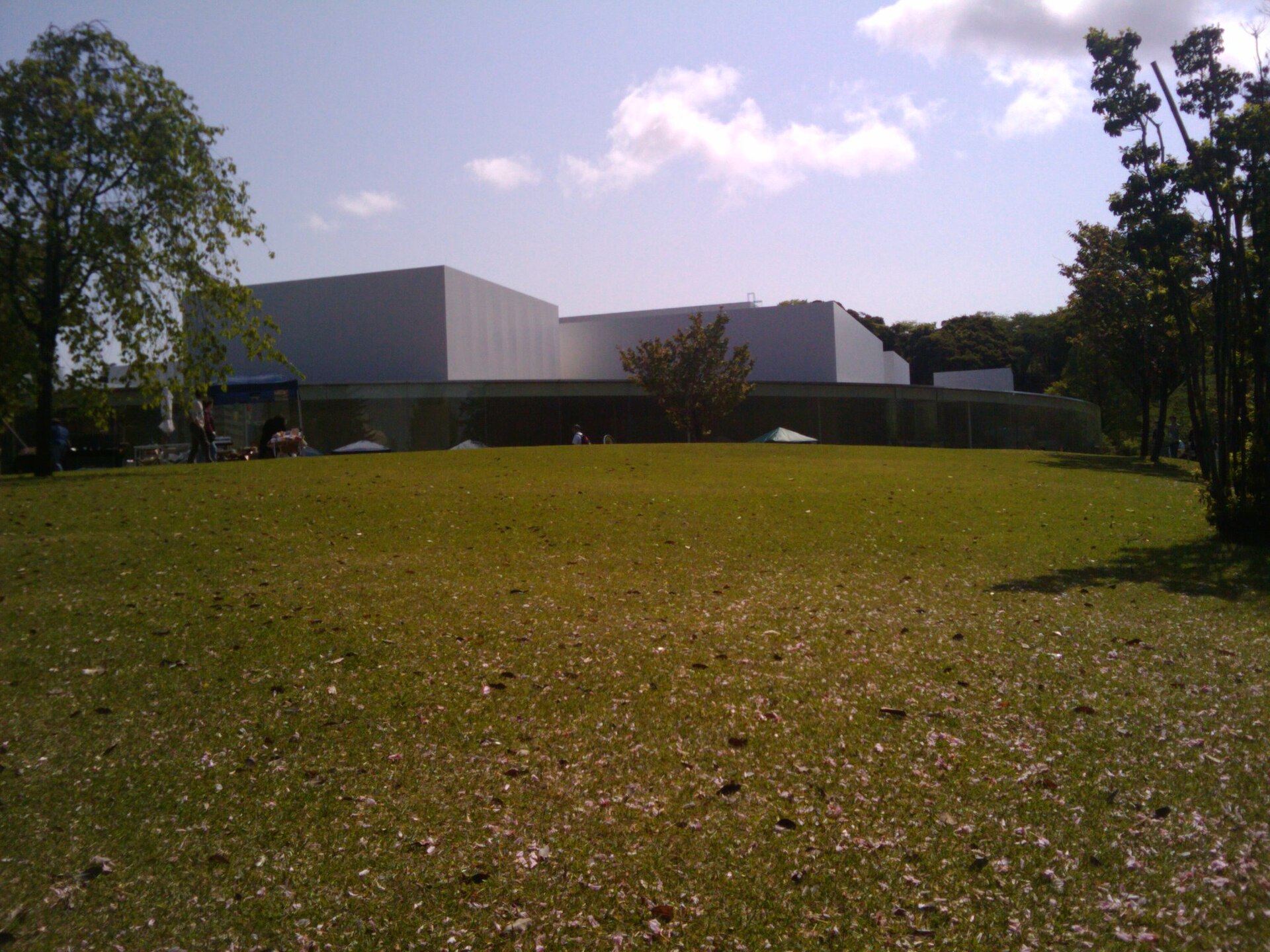
The low glass ring of the 21st Century Museum of Contemporary Art, Kanazawa, with the white gallery boxes behind it, seen across the lawn.
Saigawasakurabashi, CC BY-SA 3.0, via Wikimedia Commons21st Century Museum of Contemporary Art, Kanazawa
Museum · 金沢21世紀美術館 · Founded 2004
Open, admission and hours confirmed 19 November 2026 · 14 sources
On this page 16 sections
ContentsClose
Contemporary art from 1980, with design and architecture strength from the Kiyoshi Awazu bequest of more than 2,900 works (2006), site-specific and participatory installations built into the building, and a craft-linked Kanazawa strand.
| Local name | 金沢21世紀美術館 |
|---|---|
| Kind | Museum |
| Founded | Opened 9 October 2004; competition 1999 |
| City and country |  Kanazawa, Japan |
| Address | 1-2-1 Hirosaka, Kanazawa City, Ishikawa, Japan 920-8509 |
| Website | kanazawa21.jp |
| Status | Open, confirmed |
| Record last verified |
Visiting
- Hours
- Tuesday to Thursday and Sunday10:00 to 18:00Exhibition Zone
- Friday and Saturday10:00 to 20:00Exhibition Zone
- Daily (Public Zone, each facility keeps its own hours)09:00 to 22:00Public Zone
- Closed
- Exhibition Zone closed on Mondays; when Monday is a national holiday it closes the following weekday instead. Fully closed 29 December 2026 to 1 January 2027 (New Year holidays). Special 2026-27 dates on the museum's page: open Monday 26 October 2026, closed Tuesday 27 October 2026; open Saturday 2 and Sunday 3 January 2027. Planned long closure for major repairs from 6 May 2027 to March 2028 (planned), announced 8 June 2026.
- Admission
- Adult, ticketed exhibition 'From Today to Tomorrow: On the Stewardship of a Work' (31 Oct 2026 to 18 Apr 2027)JPY 1,200The museum's table shows a second, lower figure in brackets beside each price (1,000 yen beside the adult price) which the page text does not label; we do not interpret it. Prices are per exhibition and change with each show.
- University studentsJPY 800Bracketed figure on the museum's page: 600 yen, unlabelled
- Students (the museum's own category name)JPY 400Bracketed figure on the museum's page: 300 yen, unlabelled
- Aged 65 and overJPY 1,000No bracketed figure shown
Free entry: Two of the three current exhibitions (the Noto series show by Hitoshi Ushijima and Hiraki Sawa, and NEUTRAL COLORS NEW CIRCUIT) are marked free on the museum's home page, read 19 Nov 2026. Kanazawa residents: 'Promote the Arts Day' (collection exhibitions only, monthly) and 'Kanazawa Citizens Free Art Day' on 3 November (special and collection exhibitions), with proof of residency; the museum's page lists the dates only up to March 2026. Ticket sales end half an hour before closing- Tickets
- kanazawa21.jp/ticket The museum's own ticket page.
- Do I need to book?
- Exhibitions are ticketed at the museum. The museum's site carries a separate button for reserving Swimming Pool viewing, and review aggregators say the pool is timed and can sell out; check the reservation button before you travel.
- Address
- 1-2-1 Hirosaka, Kanazawa City, Ishikawa, Japan 920-8509 MapBus (local, from Kanazawa Station East Exit) Hokutetsu local buses from terminals 3 and 8, get off at Hirosaka / 21st Century Museum, then about a one-minute walk. Buses from terminals 8-10, get off at Korinbo (Atrio-mae), then about five minutes on foot (about a 10-minute ride).
Bus (Kanazawa Loop Bus) From terminal 7 at the East Exit to Hirosaka / 21st Century Museum (Ishiura Jinja-mae), about 20 minutes, then a one-minute walk. A Shopping bus also runs on weekends and holidays only.
Taxi About 10 minutes from the East Exit taxi stand at Kanazawa Station
Air From Komatsu Airport about 40 minutes by airport limousine bus to the Kanazawa Station west gate, then change to a local bus
Car City Hall / museum underground car park between City Hall and the museum, 319 vehicles, open 8:30 to 23:00. No charge for the first 30 minutes, then 150 yen per 30 minutes; the museum asks you to validate your ticket inside for the weekday-evening and weekend reductions. Large buses must use public car parks. - Website
- kanazawa21.jp
- Telephone
- +81-76-220-2800
Before you go how long, access, photography, bags, eating, shop
- How long to allow
- Aggregator reviewers range from about an hour to half a day; two of the three current shows are free, which makes a short visit easy
- Access
- The museum describes itself as completely barrier-free. Two disabled parking spaces (basement 1 and 2, museum side); assistance dogs allowed; wheelchairs and baby strollers at three points (general information, City Hall entrance, basement entrance); a nursing room; two multipurpose toilets; free Wi-Fi in the exchange zone.
- Photography
- The museum page we read gives no single rule; an aggregator notes the rules differ between galleries, so ask at the desk.
- Bags
- Four coin lockers (100 yen, returned after use) and umbrella stands at each entrance (100 yen, returned); large luggage may be kept at the general information ticket counter if lockers are full.
- Eating
- Cafe restaurant Fusion21, 10:00 to 20:00 (may be unavailable when taken by a large group)
- Shop
- Museum shop 10:00 to 18:30 (to 20:30 on Fridays and Saturdays); the museum runs two shops
Prices and hours change. We take them from the institution's own pages and print the day we read them, and you can check the current position at the source we used. Confirm before you travel.
What is inside
Exhibition Zone
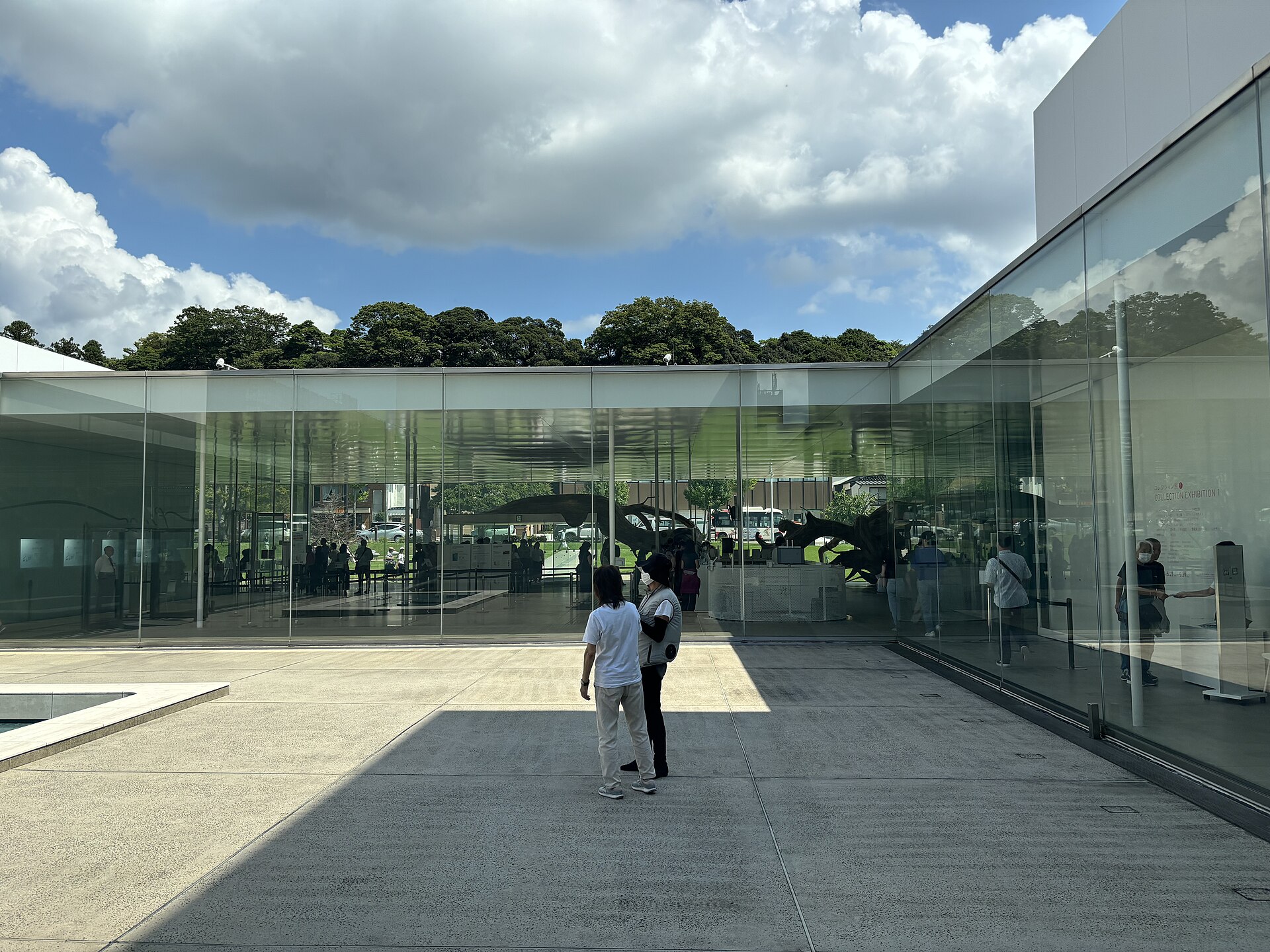
The ticketed galleries: rectangular boxes of differing area, opacity and height, about 4 to 12 metres, set inside the glass circle and reached by corridors, courtyards and gardens. Temporary exhibitions change several times a year; on 19 Nov 2026 three were running, one paid and two free. A special basement exhibition space is reached by a transparent elevator.
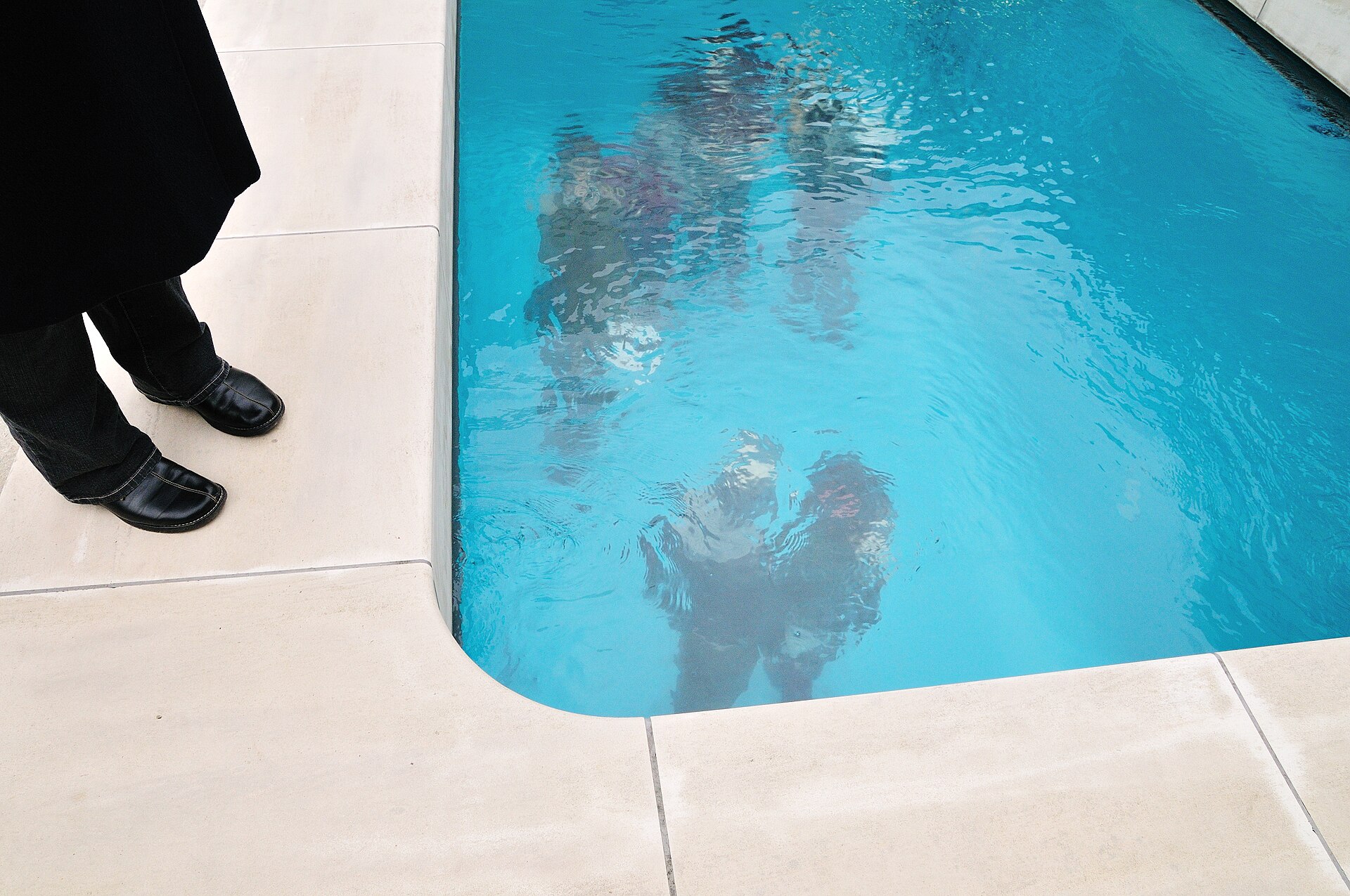
Photograph by ajari from Japan · CC BY 2.0 The Swimming Pool courtyard
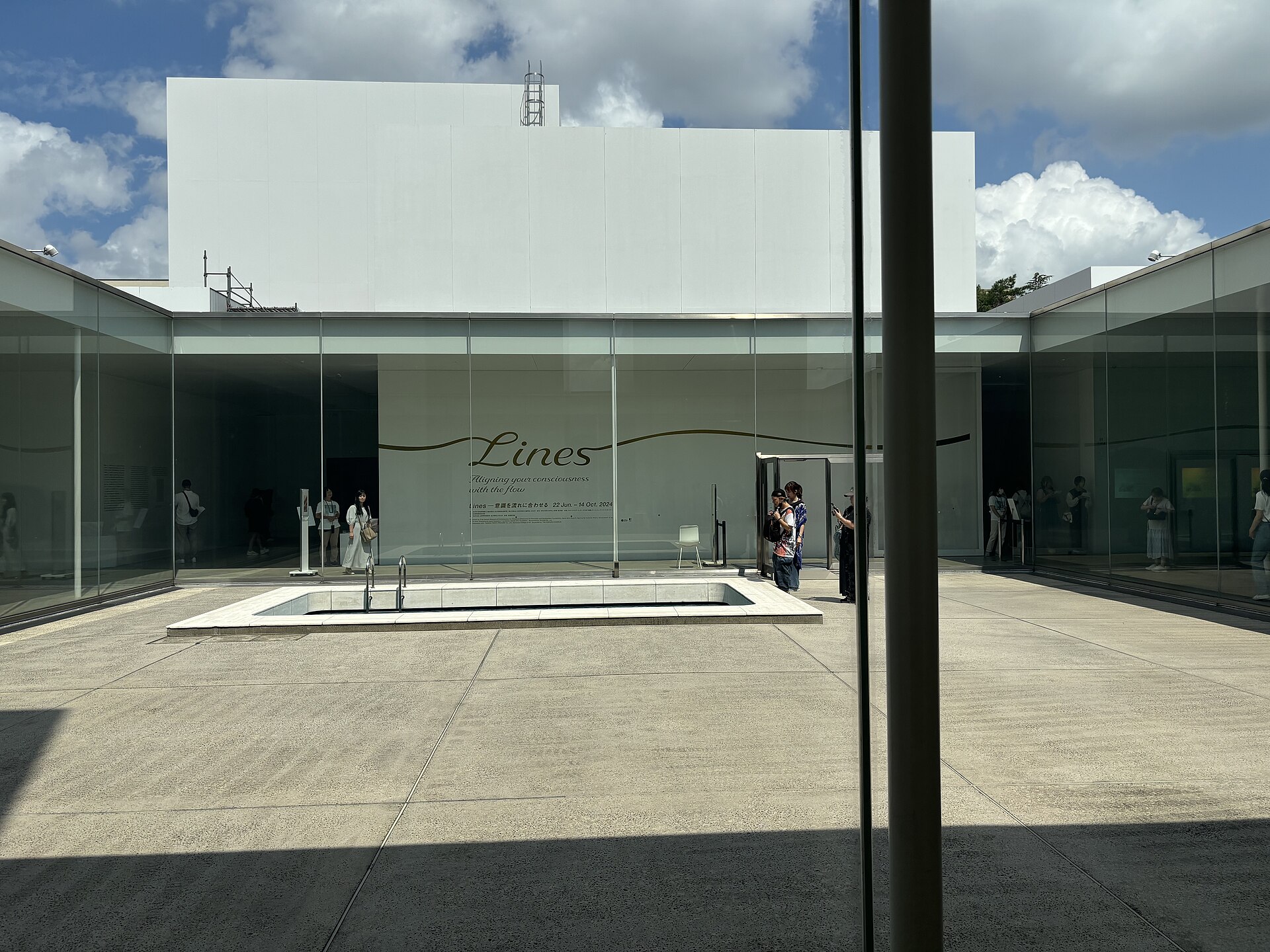
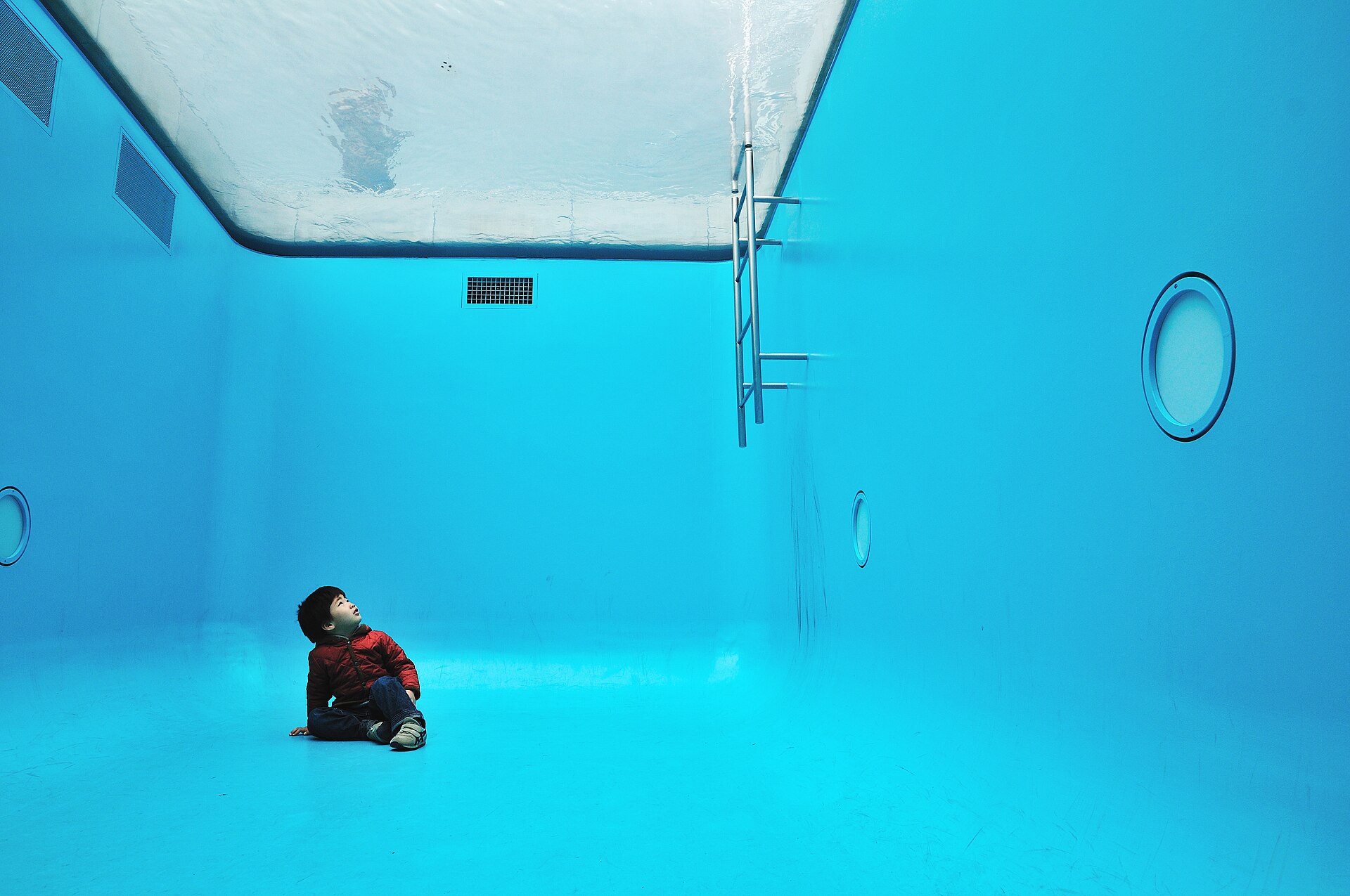
Leandro Erlich's Swimming Pool (2004): in one courtyard a limestone-edged pool looks deep, but only about 10 centimetres of water lies on a sheet of glass over a blue room that visitors can enter. The museum closes the ground-level part in rain.
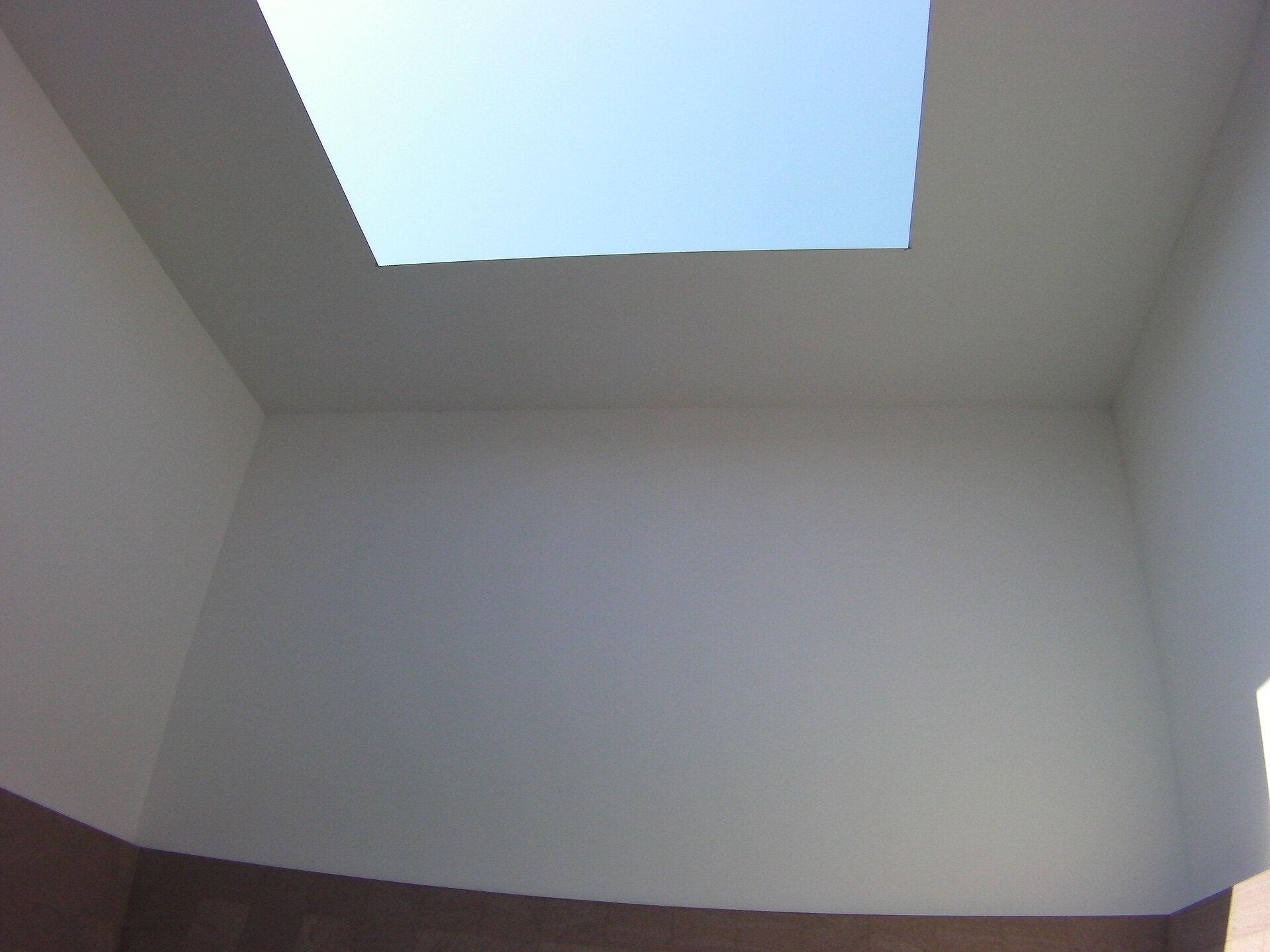
Photograph by SSimon · CC BY-SA 3.0 Blue Planet Sky
James Turrell's room (2004): a square opening cut in the ceiling frames a square of sky, and the work follows the light from morning to night through the seasons.
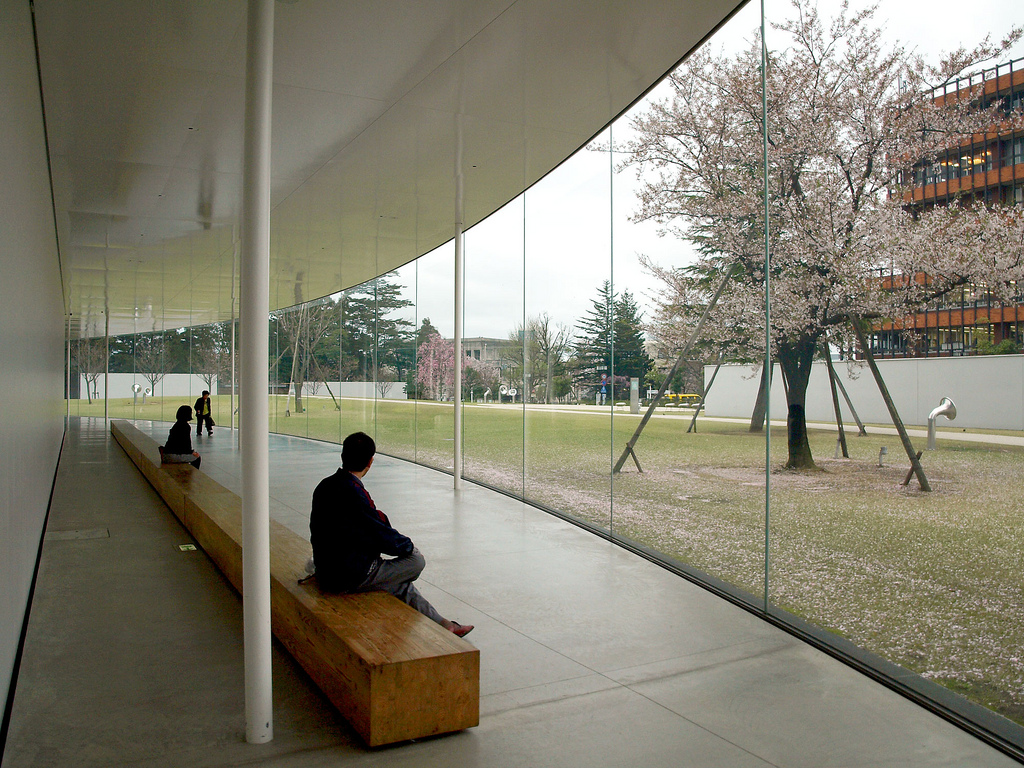
Photograph by pat_ong from Perth · CC BY 2.0 Public Zone and the glass ring
The open, free-to-enter circulation around the building, 9:00 to 22:00, linking the library, Kids Studio, nursery, shops, cafe, People's Gallery, Theater 21 (156 movable seats) and the courtyards, with works placed inside such as Pipilotti Rist's You Renew You in a restroom and Patrick Blanc's Green Bridge planted across a glass corridor.
Photograph by Mikkabie · CC BY-SA 4.0 Lawn, pavilions and tea rooms
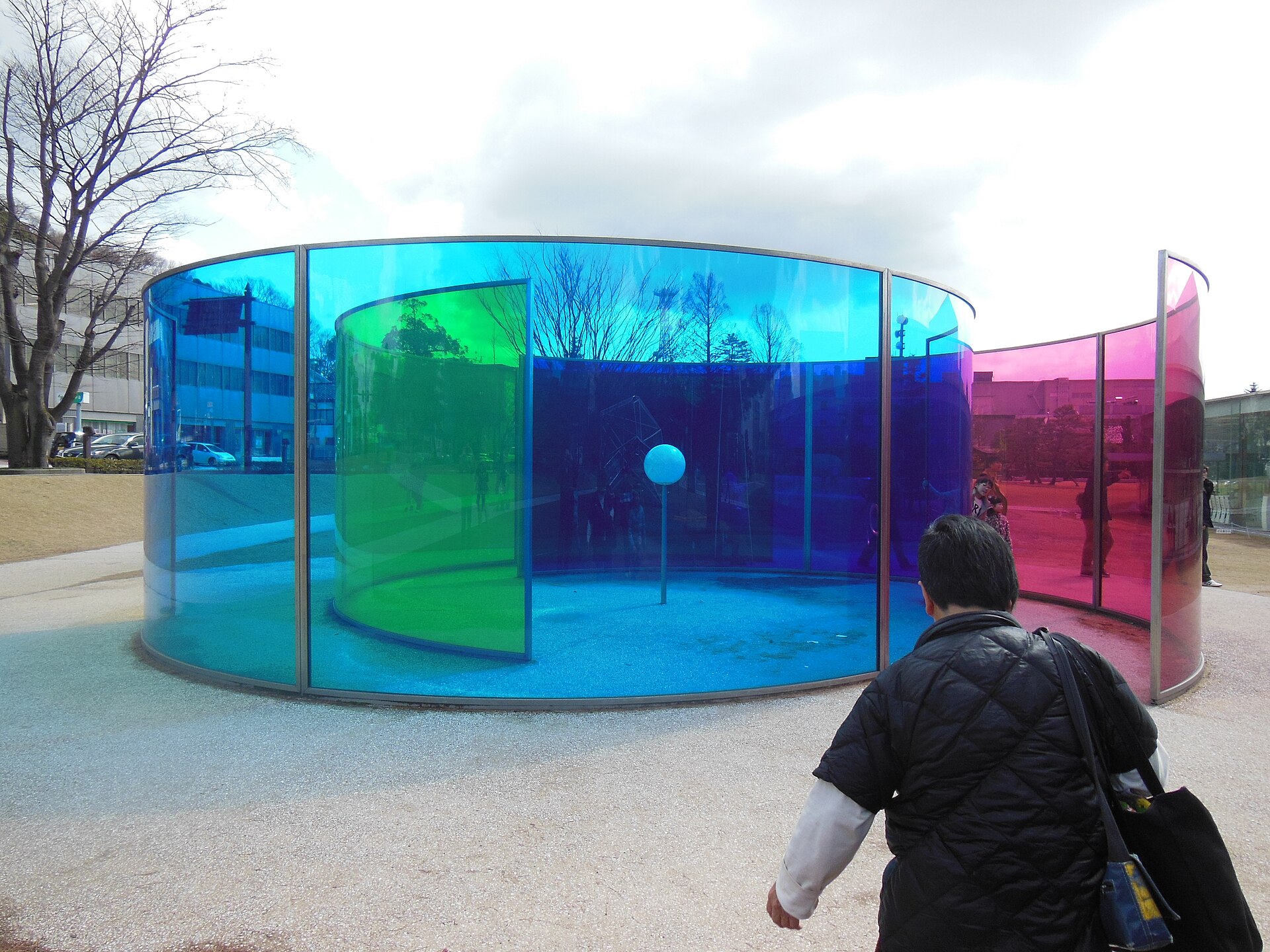
Around the circle: Olafur Eliasson's Colour activity house (2010), Florian Claar's twelve-horn Klangfeld Nr.3 fuer Alina, LAR / Fernando Romero's play pavilion Wrapping (2005), and two tea rooms in the gardens.
Art Library, Kids Studio and nursery
A library of art catalogues, artist books and picture books covering fashion, design, music, dance, photography and film; an open studio for children; and an hourly-rate nursery beside it. Library, nursery and the others follow the exhibition zone's hours (10:00 to 18:00, to 20:00 on Fridays and Saturdays).
What to see first
Swimming Pool (2004)
Leandro ErlichThe museum's best-known work: an illusion of a deep pool that visitors can walk beneath. The museum itself notes that people on both sides watch each other, which turns the piece into a shared experience.14
Blue Planet Sky (2004)
James TurrellA quiet room whose single square of sky changes with the hour and season; the museum describes it as working on perception rather than on an object.14
Colour activity house (2010)
Olafur EliassonThree curved glass walls in cyan, magenta and yellow form a spiral pavilion around a central lamp that glows from sunset to dawn; colours mix as you move.14
Green Bridge (2004)
Patrick BlancA vertical garden of about 100 plant species on a wall only 14 centimetres thick, spanning a glass corridor and changing with each season.14
L'Origine du monde (2004)
Anish KapoorA black oval on a slanted concrete wall that reads as flat and as a hollow at the same time; the title refers to Courbet's painting of the same name.14
The Man Who Measures the Clouds (1998)
Jan FabreDrawn from a film about a prisoner who became an ornithologist; the figure is cast from the artist's own body and made in memory of his brother.6
You Renew You (2004)
Pipilotti RistA restroom turned into a shrine with a small altar, projected video and a mixed soundtrack, so that an ordinary place becomes a sanctuary.6
Klangfeld Nr.3 fuer Alina
Florian ClaarTwelve horn-like tubes on the lawn connected underground in pairs, so a voice speaks into one and emerges from another elsewhere.14
Past exhibitions here
A museum built as a town square
The 21st Century Museum of Contemporary Art, Kanazawa opened on 9 October 2004 in the middle of the city, across from City Hall and close to the old castle grounds and Kenrokuen garden. The museum describes its own mission in four parts: to move in step with contemporary society, to be a participation-oriented museum made with citizens, to be open to the world while connecting regional traditional arts with the future, and to grow in spirit along with children. The stated purpose at founding was to generate new culture and to revitalise the community, and the building was designed to match. The museum calls it a museum open to the city like a park, where anyone can drop in at any time, and its architects gave it a shop and restaurant that stay open into the evening. That ambition shows in the numbers kept on the public record: Wikipedia, citing an annual survey by The Art Newspaper, gives about 1,570,000 visitors in the first twelve months and 971,256 in 2020, a pandemic year in which it still ranked tenth among the most visited art museums in the world. We treat those as tertiary figures and have not been able to confirm them against the primary survey.
The circle with no front
The building is by Kazuyo Sejima and Ryue Nishizawa of SANAA. The competition was held in 1999 and the building completed in 2004. It is inscribed in a circle 112.5 metres across, on a site of 26,009 square metres with 17,363 square metres of floor area, according to the Czech architecture site archiweb. The site is surrounded by three streets, and the museum explains that the circle was chosen so that people can come in from any direction: there is no front and no back. The museum states three principles. The circle means multiple directions; horizontality means that the galleries, restaurant and library are laid out side by side like the buildings of a small town; and transparency means that glass walls, inside and out, let visitors sense each other's presence. Inside the glass skin sit rectangular boxes of different area, height and opacity, roughly 4 to 12 metres tall, around four courtyards, with a single opaque cylinder set off the grid. Metalocus compared the arrangement to a cluster of box-like galleries unified by a circular shell, and passed on SANAA's own image of an archipelago of islands. Walking the ring corridor you pass the galleries, the library, the nursery, the shops and the cafe in turn, and you can step into a courtyard at several points.
Awards and the architects
SANAA won the Golden Lion at the 2004 Venice Biennale international architecture exhibition for this building, according to the museum's own architecture page, and the practice went on to win the Pritzker Architecture Prize in 2010. The Pritzker site records the 2010 ceremony on Ellis Island on 17 May and names this museum with the O-Museum in Nagano among their Japanese projects. The museum's page also lists the Rolex Learning Center in Lausanne, the Glass Pavilion at the Toledo Museum of Art, the New Museum in New York and the Serpentine Pavilion in London among the studio's other work. Sejima was born in 1956 in Ibaraki Prefecture and Nishizawa in 1966 in Tokyo; they founded SANAA together in 1995. The graphic identity was drawn by Taku Satoh, who simply used the aerial plan of the building as the logo, because a circle with no front is already its own sign.
What the collection collects
The collection policy has three strands: works made since 1980 that propose new values, works since 1900 that influenced them or help place them in art history, and strongly creative works closely tied to Kanazawa. The museum says it adopted six guiding ideas for the post-1980 core: displacement and crossover between cultures, immateriality, collaboration and participation, natural generation and organism, everydayness and individuation, and the quotation and reproduction of information. More than 2,900 works by the designer and artist Kiyoshi Awazu were bequeathed to the museum in 2006, which gives the collection particular strength in design and architecture. Crafts matter in Kanazawa's cultural policy, and the museum has featured craft artists trained at the Kanazawa College of Art. Wikipedia lists among artists in the collection Francis Alys, Matthew Barney, Olafur Eliasson, Leandro Erlich, Isa Genzken, Gordon Matta-Clark, Giuseppe Penone, Gerhard Richter, Atsuko Tanaka and James Turrell; we have not checked that list against the museum's collection search and give it as tertiary.
The permanent works that make the visit
A number of works are permanent and woven into the building. Leandro Erlich's Swimming Pool (2004) sits in a courtyard: seen from the deck the pool looks deep, but it is a thin skin of water on glass over a blue room that visitors can enter, so people above and below look at each other. James Turrell's Blue Planet Sky (2004) frames a square of sky in a ceiling. Olafur Eliasson's Colour activity house (2010) is a spiral of cyan, magenta and yellow glass on the lawn that glows after dark. Patrick Blanc's Green Bridge plants about a hundred species on a wall 14 centimetres thick over a glass corridor. Anish Kapoor's L'Origine du monde, Jan Fabre's The Man Who Measures the Clouds, Pipilotti Rist's You Renew You in a restroom, and the lawn pieces by Florian Claar and LAR / Fernando Romero make up the rest of the museum's own list of permanent exhibits. Because the museum's public zone is open from 9:00 to 22:00, many of these can be met without crossing a gallery threshold; which individual works need a ticket is a question the museum's pages answer work by work, and visitors should check before travelling, especially for the Swimming Pool, whose viewing is reserved through its own button on the museum's site.
Seeing it now, and the closure ahead
On 19 November 2026 the museum's home page showed three exhibitions as running, all until 18 April 2027: the paid show titled From Today to Tomorrow, On the Stewardship of a Work (from 31 October 2026), and two free shows, a Noto series presentation by Hitoshi Ushijima and Hiraki Sawa (from 8 September) and NEUTRAL COLORS NEW CIRCUIT (from 15 September). Events listed alongside them include a how-to-experience programme for Turrell's Gasworks. The adult price on the museum's table for the paid show is 1,200 yen. The date that matters most for a trip is a different one. On 8 June 2026 the museum announced that it expects to close for major repairs from 6 May 2027 until March 2028, with details of what happens during the closure to follow, and a Kanazawa city festival planned to run through the town in that time. The museum's visitor page extends the validity of its Museum Link Pass by 11 months because of the closure. Anyone planning around the museum should treat 18 April 2027 as effectively the end of this run of shows and look for the museum's reopening notice before booking for 2028.
What the criticism actually is
There is no scandal here to report, and we found no restitution or provenance dispute attached to the museum. The criticism that exists is of two kinds. The first is architectural and comes from the building's own history: according to Wikipedia, the architects wanted windows in the separate galleries so that rooms could be sensed from one another, and the curators vetoed that because they wanted the galleries to be more autonomous. We could not read the primary interview behind this, so we give it as tertiary and attributed. The result is a transparent ring wrapped around opaque boxes. The second kind is visitor feeling, which aggregators summarise as a confusing layout, a modest display for the ticket price, contemporary art that some find hard to read, and a Swimming Pool that has to be booked and can sell out. Aggregate scores are mixed on the big platforms (3.8 for Google and 3.7 for Tripadvisor as shown by Wanderlog, read 19 November 2026) and higher on Trip.com (4.6 from 111), which fits a building that is admired more than its collection is discussed.
What visitors say
Visitors consistently put the building first: the glass circle with no front door, the light and the several entrances. Among works, the Swimming Pool is the one most often named. The recurring complaints are practical: the plan can feel confusing, the pool needs a timed reservation and can sell out or queue, the paid galleries hold less than some people expected, and some find the contemporary work hard to read. Opinions on how long to spend range from about an hour to half a day, and two of the three current exhibitions being free helps a short visit.
What is praised, what is criticised
- Praised: The open circular glass building, its light and its many entrances
- Praised: The Swimming Pool and other participatory works, and children's workshops
- Praised: Free-to-enter public areas and reasonable admission to the galleries
- Criticised: A layout that some visitors find confusing and disorienting
- Criticised: Swimming Pool access needs advance timed reservation, can sell out and can queue
- Criticised: A modest collection display: some visitors expected more art; contemporary work can be hard to read
- Criticised: Galleries are opaque boxes: the architects wanted windows between rooms, and the curators vetoed that, according to Wikipedia, so the transparent ring and the closed galleries sit apart
Ratings on other platforms
Google (as shown by the Wanderlog aggregator): 3.8 from 18,774 ratings, read 19 November 2026
Tripadvisor (as shown by the Wanderlog aggregator): 3.7 from 2,235 ratings, read 19 November 2026
Trip.com: 4.6 from 111 ratings, read 19 November 2026
A platform average is a tertiary source: it moves, it is not audited, and we quote no visitor's words.
Questions about 21st Century Museum of Contemporary Art, Kanazawa
Where is 21st Century Museum of Contemporary Art, Kanazawa?
1-2-1 Hirosaka, Kanazawa City, Ishikawa, Japan 920-8509.
How much does it cost to visit?
Adult, ticketed exhibition 'From Today to Tomorrow: On the Stewardship of a Work' (31 Oct 2026 to 18 Apr 2027): JPY 1200; University students: JPY 800; Students (the museum's own category name): JPY 400; Aged 65 and over: JPY 1000. As confirmed 19 November 2026.
When is it open?
Tuesday to Thursday and Sunday 10:00-18:00; Friday and Saturday 10:00-20:00; Daily (Public Zone, each facility keeps its own hours) 09:00-22:00. Closed: Exhibition Zone closed on Mondays; when Monday is a national holiday it closes the following weekday instead. Fully closed 29 December 2026 to 1 January 2027 (New Year holidays). As confirmed 19 November 2026.
How do you get there?
Bus (local, from Kanazawa Station East Exit): Hokutetsu local buses from terminals 3 and 8, get off at Hirosaka / 21st Century Museum, then about a one-minute walk. Buses from terminals 8-10, get off at Korinbo (Atrio-mae), then about five minutes on foot (about a 10-minute ride); Bus (Kanazawa Loop Bus): From terminal 7 at the East Exit to Hirosaka / 21st Century Museum (Ishiura Jinja-mae), about 20 minutes, then a one-minute walk. A Shopping bus also runs on weekends and holidays only; Taxi: About 10 minutes from the East Exit taxi stand at Kanazawa Station; Air: From Komatsu Airport about 40 minutes by airport limousine bus to the Kanazawa Station west gate, then change to a local bus.
What should you see first?
Swimming Pool (2004) (Leandro Erlich); Blue Planet Sky (2004) (James Turrell); Colour activity house (2010) (Olafur Eliasson); Green Bridge (2004) (Patrick Blanc); L'Origine du monde (2004) (Anish Kapoor); The Man Who Measures the Clouds (1998) (Jan Fabre).
What we could not confirm
- What the planned 6 May 2027 to March 2028 closure for major repairs will cover, and whether the permanent works will remain accessible during it: the museum says details will follow
- What the bracketed second price on the museum's ticket table means (the page text does not label it)
- Which permanent works need a ticket and which are free to the public zone, work by work
- The exact photography rules by gallery
- Primary confirmation of the curators' veto of gallery windows (Wikipedia only) and of the visitor figures (Art Newspaper survey via Wikipedia)
Images
Sources
- 121st Century Museum of Contemporary Art, Kanazawa, Visitor Information (hours, closed dates, access, parking, tickets, Museum Link Pass), read 19 Nov 2026 kanazawa21.jp/data_list.php?g=7&d=5
- 221st Century Museum of Contemporary Art, Kanazawa, home page with exhibitions running, read 19 Nov 2026 kanazawa21.jp/en/
- 321st Century Museum of Contemporary Art, Kanazawa, notice of closure for major repairs, 8 June 2026 (Japanese) kanazawa21.jp/data_list.php?g=61&d=503
- 421st Century Museum of Contemporary Art, Kanazawa, Concept and Architectural Data kanazawa21.jp/data_list.php?g=11&d=2
- 521st Century Museum of Contemporary Art, Kanazawa, Collection (acquisition policy) kanazawa21.jp/data_list.php?g=159&d=1&lng=e
- 621st Century Museum of Contemporary Art, Kanazawa, Permanent Exhibits list and facilities kanazawa21.jp/data_list.php?g=9&lng=e
- 721st Century Museum of Contemporary Art, Kanazawa, Facilities (opening hours of cafe, shop, library; accessibility; lockers) kanazawa21.jp/data_list.php?g=10&lng=e
- 8Wikipedia, 21st Century Museum of Contemporary Art, Kanazawa (: visitor figures, artists list, gallery-window dispute) en.wikipedia.org/wiki/21st_Century_Museum_of_Contemporary_Art,_Kanazawa
- 9archiweb.cz, 21st Century Museum of Contemporary Art Kanazawa (dimensions, areas) archiweb.cz/en/b/21st-century-museum-of-contemporary-art-kanazawa
- 10Metalocus, Jose Juan Barba, 21st Century Museum of Contemporary Art metalocus.es/en/news/21st-century-museum-contemporary-art
- 11The Pritzker Architecture Prize, 2010 laureates SANAA pritzkerprize.com/laureates/2010
- 12Wanderlog, Kanazawa 21st Century Museum of Contemporary Art (aggregate Google and Tripadvisor ratings; ) wanderlog.com/place/details/21692
- 13Trip.com, 21st Century Museum of Contemporary Art, Kanazawa review page (aggregate rating; ) trip.com/review/21st-century-museum-of-contemporary-art-kanazawa-18699805-177694966/
- 1421st Century Museum of Contemporary Art, Kanazawa, permanent work pages: Swimming Pool, Blue Planet Sky, Colour activity house, Green Bridge, L'Origine du monde (Japanese) kanazawa21.jp/data_list.php?g=30&d=7