The Amber Room
The Prussian court amber workshop, Berlin and Danzig · 1701 to 1713 in Berlin, enlarged at Tsarskoye Selo 1755 to 1770
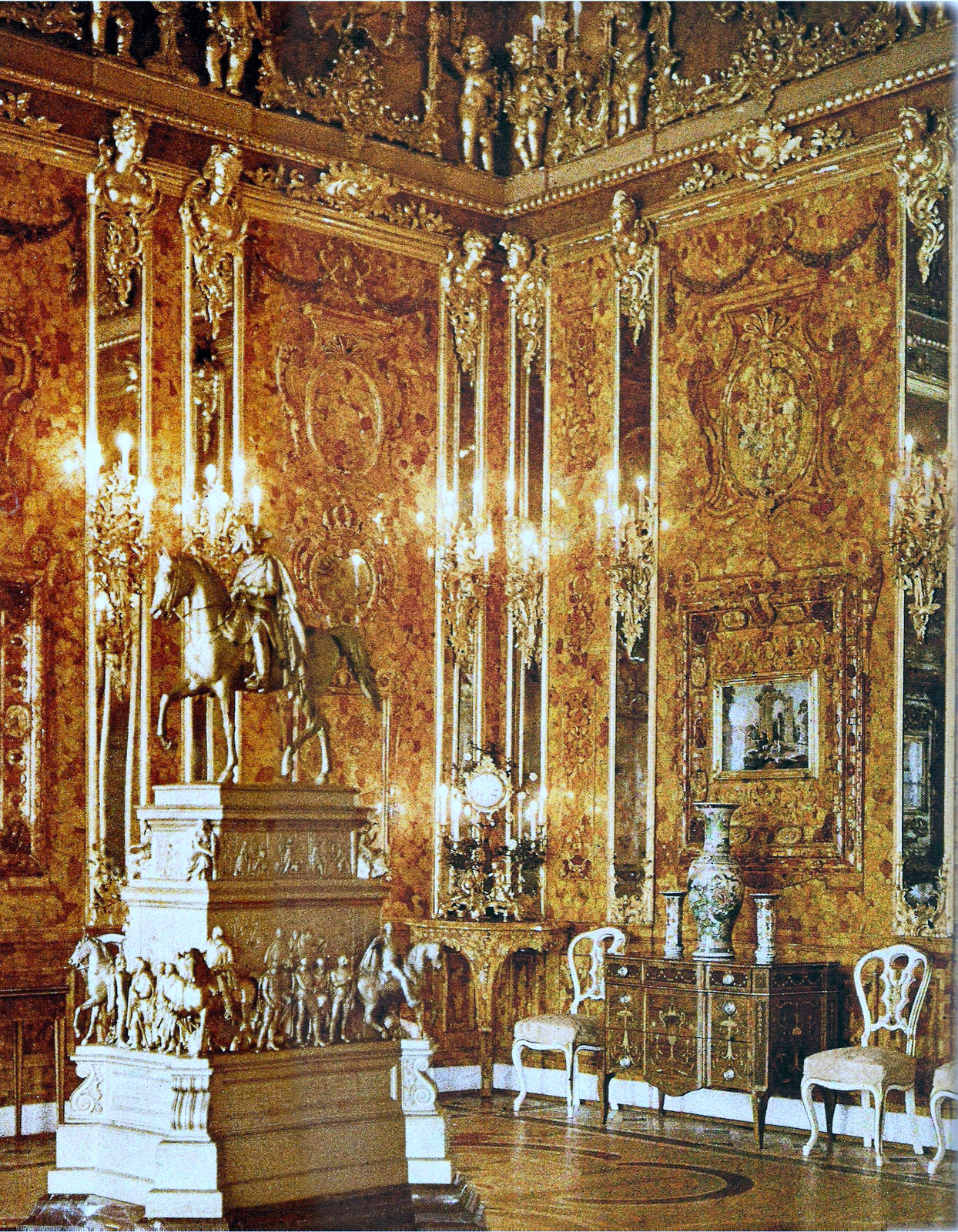
The original room, photographed in colour from life. The Commons file page records that Andrei Andreyevich Zeest made his autochromes of the Tsarskoye Selo interiors between June and August 1917, for the commission on the Tsarskoye Selo palaces chaired by G. K. Lukomsky under the Provisional Government, and that a model of a monument to Frederick the Great stood in the room at the time. This is the object described in this record, twenty-four years before it was taken.
| Artist | The Prussian court amber workshop, Berlin and Danzig |
|---|---|
| Date | 1701 to 1713 in Berlin, enlarged at Tsarskoye Selo 1755 to 1770 |
| Medium | Baltic amber sawn into strips about 5 mm thick and set as mosaic on bronze foil over oak carcass panels, fixed with a pine resin and beeswax adhesive, with carved amber, gilded wood carving, mirror glass in the pilasters and four Florentine hardstone mosaics in coloured stones. Where amber ran short at Tsarskoye Selo the museum records that the wall was canvas painted in imitation of the stone by Ivan Belsky. |
| Dimensions | Figures for this object and for the 2003 reconstruction are routinely quoted as if they were the same, and they are not. For the original: Gems and Gemology gives the Berlin cabinet room as measuring more than 74.25 square metres and standing about 5 metres from floor to ceiling, with the design calling for the finished amber to cover 80 per cent of the wall surface, and 12 main panels over 3.5 metres high with most of them close to 56 cm wide. 74.25 is the room, not the amber. The Tsarskoye Selo museum gives the hall that received the panels in 1755 a floor area of 96 square metres; Gems and Gemology gives the wall space of that room as approximately 216 square metres, nearly three times the Berlin cabinet, and the 12 amber panels there as covering 68.5 square metres with a further 5.57 square metres of other elements. Those two figures together are the sharpest way to see what this object was: amber over roughly 74 of 216 square metres of wall, against a reconstruction that covers more than 150 of the same walls. The much repeated figures of six tonnes of amber, 100,000 pieces and more than 150 square metres of wall describe the RECONSTRUCTION, not this object. The only weight of amber documented for the original is the 450 kg the museum records as used between 1763 and 1767 for Catherine II's lower tier. |
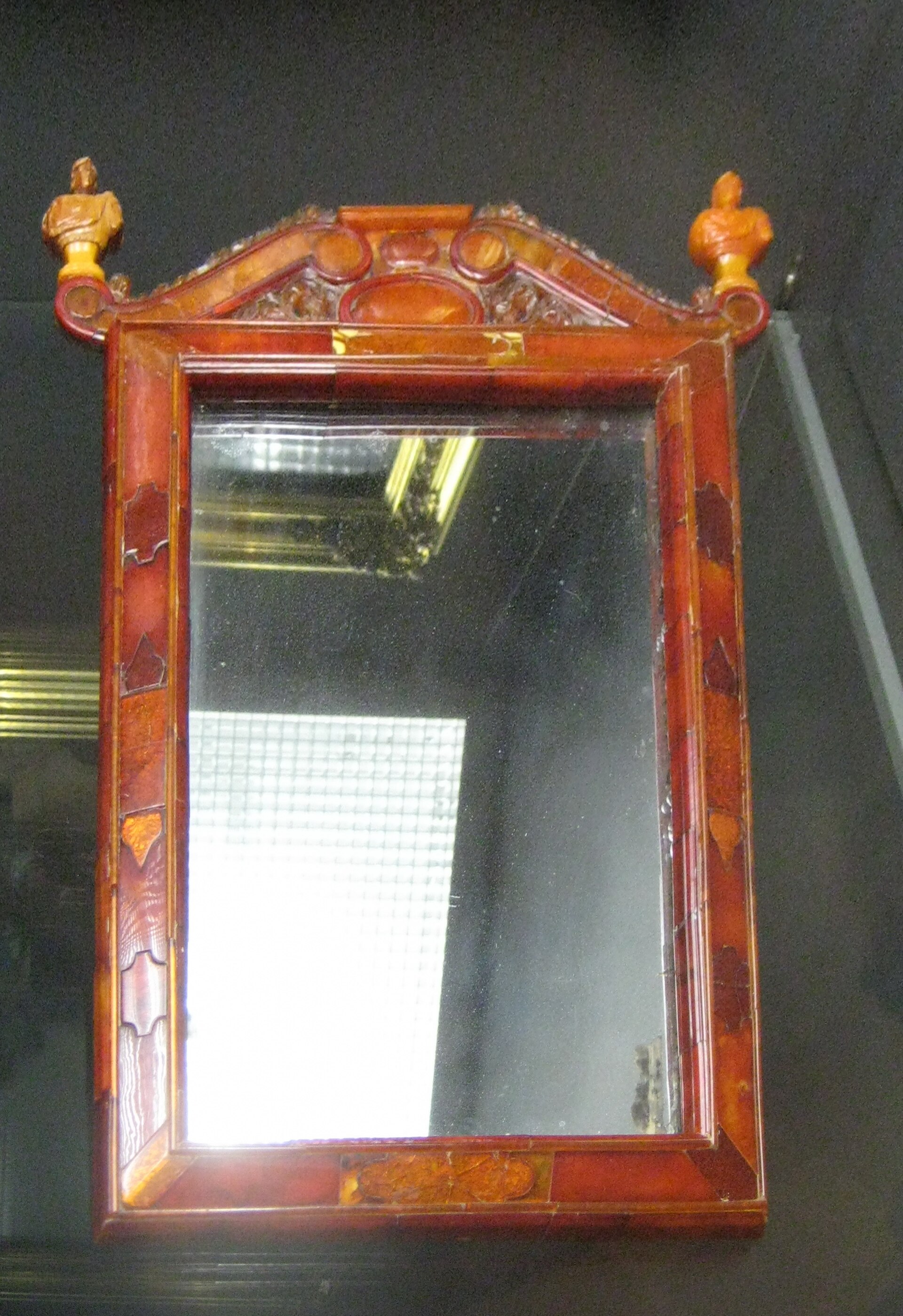
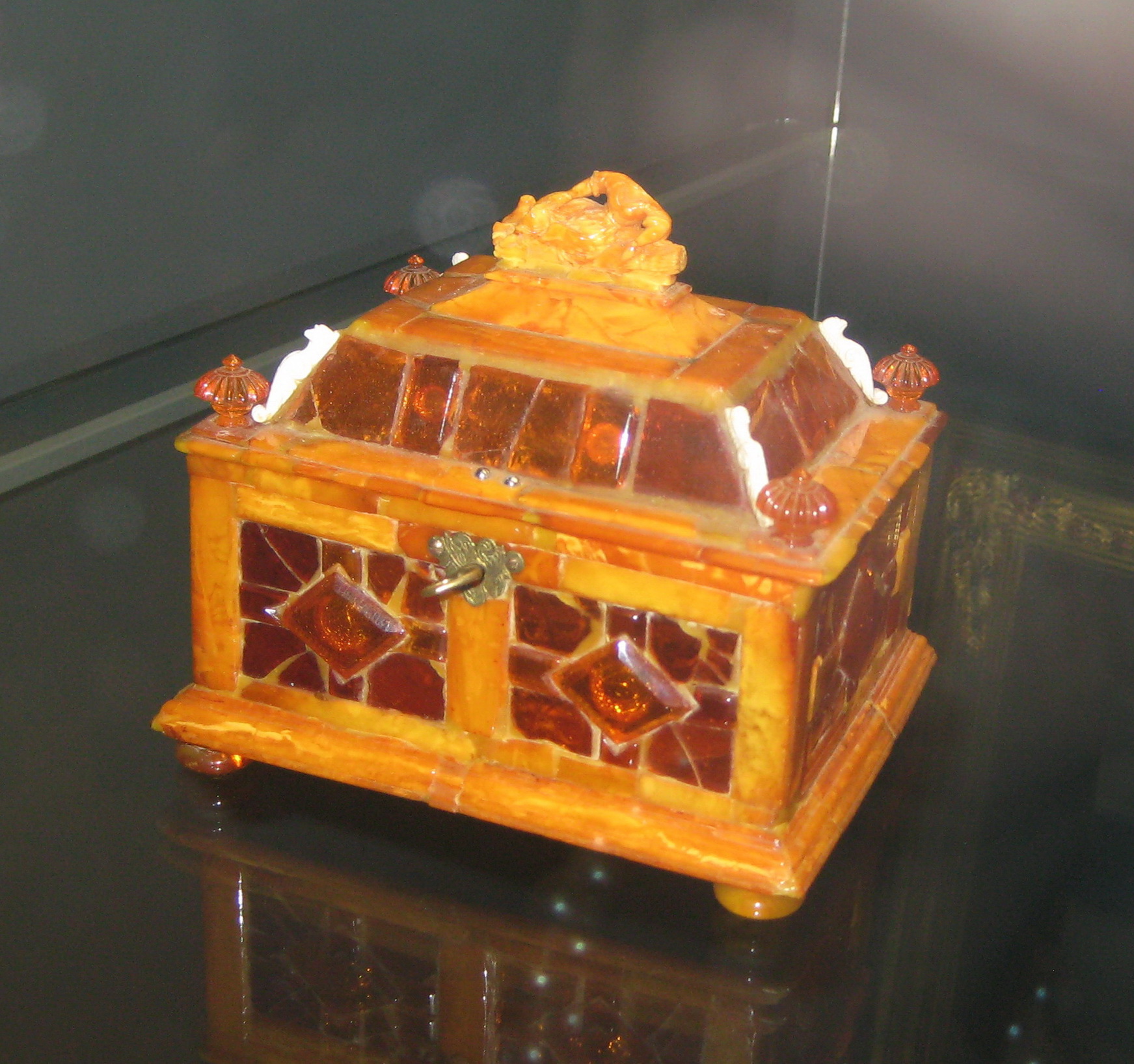
| Where it is now | Lost. The panelling has not been seen since it was crated inside Koenigsberg Castle in 1944 and no institution holds it. One element has come back: the Florentine mosaic Touch and Smell, seized in Bremen in 1997, which the Tsarskoye Selo museum states was returned to the museum preserve in April 2000 together with a Russian marquetry chest of drawers from the room. The room open to visitors in the Catherine Palace at Pushkin is the reconstruction completed in 2003 and is a different object. The amber casket and amber mirror in the State Hermitage that are widely captioned as remains of the Amber Room are, on the Hermitage's own account, separate gifts made to Peter the Great on the same occasion in 1716 and not parts of this room.last confirmed |
| Inventory number | None. The Amber Room was architecture inside an inventoried palace rather than a single numbered movable, and no current inventory number exists because the object exists nowhere. Its last recorded entry anywhere is item 200 in the Koenigsberg museum Gift Book, 1941. |
| Attribution | WorkshopNo single maker. Full note |
| Object type | Furniture |
| Period | Prussian and Russian, eighteenth century |
| Cases | Has a provenance gap · Restituted or repatriated · Seized, looted or confiscated |
| Inscriptions | No inscription is recorded on the amber work. The one identifying entry the object is known to have carried is an accession line, not a mark on the thing: the Tsarskoye Selo museum states that the Gift Book of the Koenigsberg museum recorded the arrival of the Amber Room as item 200, a present from the Third Reich administration of palaces and gardens. |
| Owners on record | 13 links10 documented, 3 unknown |
| Sources | 23 cited |
About this record Last verified · 23 sources cited · Change log
On this page 11 sections
ContentsClose
Amber panelling begun for Frederick I of Prussia in 1701, given to Peter the Great in 1716 to seal an alliance, enlarged by Rastrelli at the Catherine Palace between 1755 and 1770, removed by German forces in 1941 on accounts that differ over the month and the unit, displayed at Koenigsberg Castle, crated there in 1944 and never seen since. No object lost in the Second World War has been searched for longer or by more people, and it has never been found.
The record separates the original from the full-size reconstruction completed at the Catherine Palace in 2003, which is what almost every published photograph of the Amber Room actually shows, and from which most of the quoted figures for amber weight and wall area are taken. One element of the original has come back: the Florentine mosaic Touch and Smell, seized by police in Bremen on 13 May 1997 and handed over at Pushkin on 29 April 2000. The amber casket and mirror in the Hermitage usually captioned as survivals are, on the Hermitage's own account, separate gifts of 1716 that never entered the room.
Two Soviet investigations reached opposite conclusions within a year of each other. The first, on the ground in Koenigsberg in June 1945, recorded that the room had burned; that diary was suppressed for forty-five years and its author was summoned to withdraw it in 1949. The second found that the panels had left the city and must survive, and eighty years of searching has been built on it. This record gives both, names who holds each and does not arbitrate.
The theft
Still missing
The Tsarskoye Selo museum records that German units removed the amber panelling from the Catherine Palace in 1941 and dispatched it to Koenigsberg, that its trail is lost from 1944 and that every search since has been fruitless.
- 1701Made Gems and Gemology records that Frederick I began the amber cabinet in 1701, appointing Andreas Schlueter to design it and the Danish carver Gottfried Wolfram to build it, and that an inventory of 1713 found most of the panels complete.2
- 1716-11Donated The Tsarskoye Selo museum records that Frederick William I gave the amber study to Peter the Great in November 1716 to mark an alliance between Russia and Prussia, and quotes Peter's letter describing the present to Empress Catherine.1
- 1755-07Owned The museum records that Empress Elizabeth ordered Rastrelli to create a new Amber Room in the Great Palace at Tsarskoye Selo in July 1755, and that the work was finished under Catherine II in 1770.1
- 1941Looted The Frankfurter Personenlexikon states that one of the first acts of Ernstotto Graf zu Solms-Laubach as art protection officer of the 18th Army, appointed 1 October 1941, was the removal of the Amber Room from the Catherine Palace at Pushkin. The month and the unit are disputed: the German account of the room dates the dismantling from 14 October 1941, gives 36 hours and 28 crates and places it under the Einsatzstab Reichsleiter Rosenberg; Gems and Gemology gives September 1941, 36 hours and 27 crates; the Kulturstiftung der Laender gives October 1941 and the Wehrmacht.23410
- 1941-11-13Exhibited The museum at Tsarskoye Selo records that the arrival was entered in the Gift Book of the Koenigsberg museum as item 200, a present from the Third Reich administration of palaces and gardens, and that the panels were shown in a castle hall; the German account records the Koenigsberger Allgemeine Zeitung reporting the display on 13 November 1941 with one Florentine mosaic already missing.110
- 1944-03Hidden The German account states that the room was dismantled again by March 1944 and packed into 28 crates against the risk of bombing, and Gems and Gemology dates Alfred Rohde's last recorded note to 12 January 1945, saying the panels were being crated and would then be evacuated to Wechselberg near Rochlitz in Saxony. That is the last documented handling of the object.210
- 1945Lost No account places the crates anywhere after this. The Tsarskoye Selo museum states that in 1944 the panels were dismounted and dispatched to an unknown destination, that from that moment the trail of the Amber Room is lost and that all searches up to now have been fruitless. The Berliner Zeitung records the Soviet investigator Alexander Jakowlewitsch Brjussow writing on 10 June 1945 that inspection of the castle's Great Hall showed that both the Amber Room and the Keyserling furniture had burned, a finding he was summoned in December 1949 to withdraw. The Art Newspaper records Kuchumov finding the burnt Florentine mosaics in the same ruins as late as 1946, and states that he remained convinced that at least some parts of the room had left the city.156
Provenance
Each link is graded. Documented: a cited source supports it. Disputed: the identification is argued but not established. Unknown: no owner for that span, and the gap is not smoothed into a narrative. The grades in the glossary.
- 1701 - 1713Frederick I, King in Prussiadocumented
Begun 1701 for the Prussian court. Designed by Andreas Schlueter on the account of Gems and Gemology and by Johann Friedrich Eosander on the German account. Built by Gottfried Wolfram to 1707, then by Gottfried Turau and Ernst Schacht after Eosander von Goethe dismissed him. An inventory of 1713 records most carvings, four of twelve pilasters and most panels complete. Frederick I died in 1713 and his successor stopped the work. The panels stood as a cabinet in the Berlin palace.210
- 1716-11 - 1717Peter I of Russiadocumented
Given by Frederick William I to Peter the Great at their meeting of November 1716, sealing a Russo-Prussian alliance. Peter's letter to Catherine of that date records the gift. Two years later Peter sent 55 grenadiers of gigantic stature and an ivory goblet he had turned himself. Shipped by way of Memel and Riga. The Tsarskoye Selo museum records eighteen large and small crates including unused amber; Gems and Gemology records eight crates packed on 13 January 1717.12
- 1717 - 1743Unknownunknown
The holding museum states in terms that there is no evidence about where Peter ordered the panels installed, or whether he did so at all, and that speculation about their use in his Winter Palace is unfounded. For about twenty-six years the object has no recorded location beyond its crates.1
- 1743 - 1755Empress Elizabeth of Russiadocumented
Elizabeth ordered the panels installed in 1743. The room was assembled in 1746 and used for official receptions. The continuing rebuilding of the Winter Palace meant it was moved more than once. Redesign work at this stage is associated with the Italian stucco master Alexander Martelli on the German account.110
- 1755-07 - 1770Empress Elizabeth, then Catherine IIdocumented
Elizabeth ordered Rastrelli to create a new Amber Room in the Great Palace at Tsarskoye Selo in July 1755; a detachment carried the crates by hand from the capital. The hall had a floor area of 96 square metres. Rastrelli added mirrored pilasters and gilded carving, and Ivan Belsky painted canvas in imitation of amber where the material ran short. Catherine II ordered the painted wall replaced in 1763; 450 kg of amber went into the work and the room was complete in 1770.1
- 1770 - 1941The Russian imperial house, then the Soviet state museum at Detskoye Selo and Pushkindocumented
Refurbished in 1833, 1865 and 1893 to 1897; minor renovation 1933 to 1935 by the sculptor I. V. Krestovsky; a major restoration scheduled for 1941. Photographed in colour by Andrei Zeest between June and August 1917 for the Provisional Government commission. Conserved in place in June 1941 under paper, gauze, cotton wool and boards because the amber was judged too fragile to dismount.118
- 1941-10 - 1941-11Removed by German forcesdocumented
The Tsarskoye Selo museum records that German units at Pushkin were followed by specialists of the Nazi art-plundering team, that the panels were removed and that they were sent to Koenigsberg. The Frankfurter Personenlexikon records the removal as one of the first acts of Ernstotto Graf zu Solms-Laubach as art protection officer of the 18th Army, appointed 1 October 1941, with Georg Poensgen. The German account dates the dismantling from 14 October 1941, 36 hours, 28 crates; Gems and Gemology gives September 1941, 36 hours, 27 crates.12310
- 1941-11 - 1944-03Koenigsberg castle museum, director Alfred Rohdedocumented
Entered in the Gift Book of the Koenigsberg museum as item 200, a present from the Third Reich administration of palaces and gardens, and shown with the carved and gilded doors in a castle hall that already housed an amber museum. The Koenigsberger Allgemeine Zeitung reported the display on 13 November 1941 and one Florentine mosaic was already missing from it. Rohde wrote in 1942 that the room, returned to its homeland, was Koenigsberg's finest adornment.110
- 1944-03 - 1945-01Koenigsberg castle museumdocumented
Taken down again and packed into 28 crates against the risk of bombing. RAF Bomber Command attacked the city twice at the end of August 1944, on the nights of 26 to 27 and 29 to 30 August; the German account of the raids records 174 Lancasters on the first night, 189 Lancasters and 480 tonnes of bombs on the second, and the castle among the historic buildings destroyed. Gems and Gemology dates Rohde's last recorded note to 12 January 1945: the panels were being crated and he would then evacuate them to Wechselberg near Rochlitz in Saxony. This is the last documented handling of the object.21022
- 1945 -Unknownunknown
Two findings, never reconciled. The Soviet investigator Brjussow, in Koenigsberg from late May 1945, recorded on 10 June 1945 that in the Great Hall both the Amber Room and the Keyserling furniture had burned and that a fire started by Soviet soldiers had probably caused it; his diary was suppressed, archived in the Lenin Library in 1974 and found there in 1990, and he was summoned in December 1949 to withdraw it. The curator Anatoly Kuchumov searched the same ruins as late as 1946. The Art Newspaper, which gives his forename as Alexander, records that he found the burnt Florentine pietre dure at the entrance to the north wing, in tiny fragments rendered colourless by heat and still stuck to their ground, that he took one corner to Leningrad and lost it, and that he nonetheless remained convinced that at least some parts of the room had left Koenigsberg. Gems and Gemology records that the investigators sent to the castle found furniture from the Catherine Palace in an intact tower and, the following year, the ruins of three of Zocchi's mosaics. Soviet forces at the castle in 1945 and 1946 found door hinges from the room, iron plates with screws and charred remains, and specialists objected that amber melts rather than chars. Rohde died on 7 December 1945. No later evidence has settled it.2561011
- 1967 - 1984Not applicabledocumented
A Soviet state commission searched repositories in the USSR and Germany for the panels from 1967 and was wound up in 1984 without result. Private and East German searches ran alongside it: Georg Stein from 1958 until his death in 1987, and Paul Enke's East German special commission, which spent two and a half million marks in the Aue district and found nothing.2617
- 1997-05-13 - 2000-04-29One Florentine mosaic only, not the roomdocumented
This link concerns one panel and nothing else. Police seized the Florentine mosaic Touch and Smell, 55 by 70 cm, in central Bremen on 13 May 1997 during an undercover operation, after it was offered at 2.5 million US dollars. Its holder was a Bremen pensioner whose father, a Wehrmacht lieutenant colonel, is said to have taken it in 1941 during the transport to Koenigsberg. The lawyer who offered it was fined 90,000 marks for attempted fraud after the federal court raised the Bremen sentence. Bernd Hockemeyer bought the panel from the family for 200,000 marks and on 29 April 2000 the mayor Henning Scherf and the culture minister Michael Naumann presented it at the Catherine Palace, with 101 works returning to the Bremen Kunsthalle. The Tsarskoye Selo museum records the mosaic and a Russian marquetry chest of drawers arriving in April 2000. The panelling itself was not part of this and did not come back.178
- 1945 - 2026-09-27No holderunknown
The amber panelling has not been located. Searched on 27 September 2026, the German Lost Art Database returned no entry under Bernsteinzimmer, Bernsteinkabinett or Amber Room, and the public search of the Russian Ministry of Culture's consolidated catalogue of wartime losses returned nothing under the Russian words for amber. Interpol's database is not publicly searchable, so an entry there can be neither confirmed nor excluded. The room open at the Catherine Palace is the reconstruction completed in 2003.11415
Prices realised
This object has never been offered at auction and cannot be. It was a diplomatic gift in 1716, it was crown and then state property until 1941 and it has been missing since 1944. No hammer price exists for it and none of the prices below is a price for the room.
The only figures the market has produced concern one Florentine mosaic panel, given as 55 by 70 cm framed by the Weser-Kurier and as 61 by 45 cm by the Kulturstiftung der Laender. It was offered privately in Bremen at 2.5 million US dollars in 1997 and seized by police on 13 May that year; no sale took place and the asking price was never tested. The panel then changed hands once for 200,000 German marks in a private purchase by Bernd Hockemeyer from the holder's family, made to head off a civil dispute rather than as a market transaction, and was presented to Russia on 29 April 2000. Bremen received 101 works from Russia in the exchange. The two figures differ by a factor of about twenty-two and neither is a valuation.
Technical evidence
| Attribution note | No single maker. Gems and Gemology states that Frederick I appointed Andreas Schlueter to design the room in 1701 and that the Danish master amber and ivory carver Gottfried Wolfram, recommended to the king that year, built it; that Schlueter was dismissed in 1707 and replaced by the captain of the guards, Eosander von Goethe, who then dismissed Wolfram over a payment dispute and had the finished amber removed from his workshops; and that Eosander kept Schlueter's design and hired Gottfried Turau and Ernst Schacht to finish it. The German account of the room gives the designer instead as Johann Friedrich Eosander throughout, which is the same man under his other name and a different claim about whose design it was. The dispute is unresolved and is recorded here as unresolved. Everything added after 1743 is Russian and Italian work under Bartolomeo Francesco Rastrelli, so the object taken in 1941 was the product of at least four workshops in three countries over seventy years. |
|---|---|
| Carcass | Oak panels, lined with bronze foil before the amber was laid, because Wolfram had found that the small movement of wood with temperature and humidity cracked amber fixed directly to it.2 |
| Amber | Baltic amber sawn into strips roughly 5 mm thick and set as a mosaic onto the bronze foil, in milky, honey and near transparent grades used against one another for tone.218 |
| Adhesive | A mixture of pine resin and beeswax with a low melting point, chosen so the work could be reheated and reset rather than for permanence.2 |
| Main panels | The count is not settled. The Tsarskoye Selo museum describes the finished room as amber in two tiers on three walls with eight large upright panels in the middle tier. Gems and Gemology describes 12 amber panels covering 68.5 square metres in the same room, and 12 main panels over 3.5 metres high and most of them close to 56 cm wide in the Berlin design, with the finished amber intended to cover 80 per cent of the wall surface. Whether the twelve are the eight plus four of something else, or a different count of the same wall, is not resolved by either source.12 |
| Hardstone panels | Four Florentine mosaics of coloured stone, allegories of the senses designed by Giuseppe Zocchi and made in Florence in the 1750s: Sight, Taste and Hearing, with Touch and Smell paired in one field. The recovered Touch and Smell is given as 55 by 70 cm by the Weser-Kurier, which is describing the seized object in its gilt sheet-metal frame set with semi-precious stones, and as 61 by 45 cm and dated 1755 by the Kulturstiftung der Laender. The two are probably the framed and the unframed measurement and no source consulted here states which.147 |
| Pilasters and carving | Tall mirrored pilasters between the main panels, with gilded wood carving filling the wall area that amber could not cover after Rastrelli enlarged the scheme in 1755.1 |
| Painted substitute | From 1755 part of the lower wall was canvas painted in imitation of the stone by Ivan Belsky, because there was not enough amber for the larger room. Catherine II ordered it replaced with real amber in 1763.1 |
| Amber added 1763 to 1767 | 450 kg, used for eight flat mosaic-patterned panels in the lower tier, eight pedestals for the pilasters, an overdoor for the middle door and carved cornice elements that incorporated original Berlin pieces. This is the only weight of amber documented for the original room.1 |
| Contents | Russian marquetry chests of drawers, Chinese porcelain, a small amber console table in the south-west corner and glazed cases holding one of the most significant European collections of seventeenth and eighteenth century amber objects. A model of a monument to Frederick the Great stood in the centre of the room in 1917.118 |
| Condition history | The amber suffered from temperature swings, stove heating and draughts. The museum records refurbishment in 1833, 1865 and 1893 to 1897, minor renovation in 1933 to 1935 by the sculptor I. V. Krestovsky, and a major restoration scheduled for 1941 that never happened.1 |
| 1941 protective treatment | Judged too fragile to dismount for evacuation. Paper was pasted over the panels, then gauze, then cotton wool, then wooden boards. The panels were still on the wall when German units reached Pushkin.1 |
| Colour record | The only colour record of the room from life is the set of autochromes made by Andrei Andreyevich Zeest between June and August 1917 for the Provisional Government commission chaired by G. K. Lukomsky. Everything else is black and white photography, which is why the reconstruction had to reason its way to the colour.218 |
| Not this object | The figures of six tonnes of amber, 100,000 pieces and more than 150 square metres of wall, and the figure of 6,000 kg of best quality amber for about 86 square metres, all describe the reconstruction built between 1979 and 2003. They are routinely printed as the original's.210 |
Images
The record in full
Chapter 1The object in this record does not exist anywhere
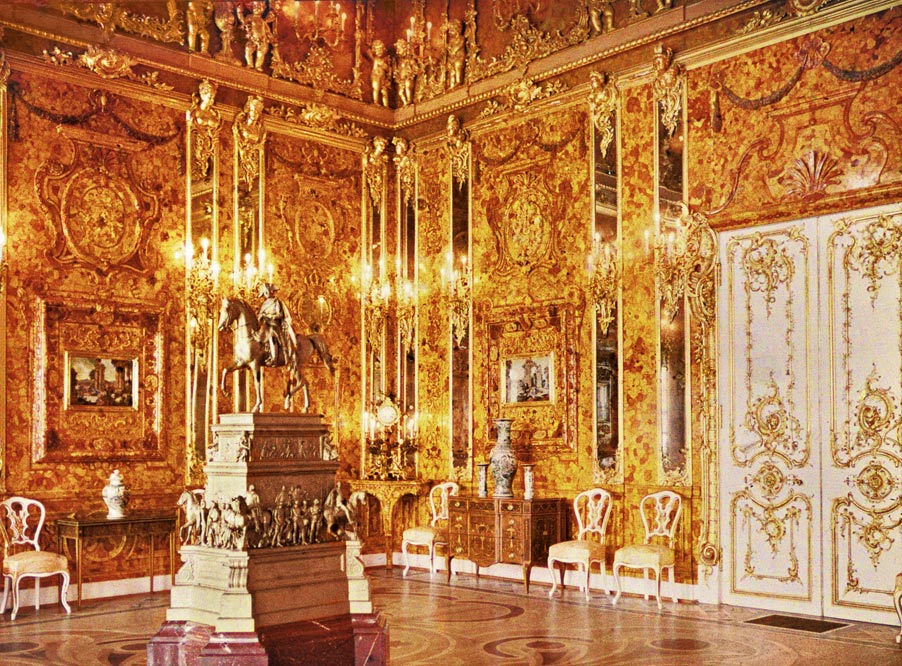
Almost every photograph published under the title Amber Room shows a room built between 1979 and 2003.
Almost every photograph published under the title Amber Room shows a room built between 1979 and 2003. That room is in the Catherine Palace at Pushkin, it is open to visitors and it is not the object described here. The Tsarskoye Selo museum is exact about this and calls its own creation the ninth wonder of the world, recreated by Russian craftsmen, to distinguish it from the eighth.
The object described here is the amber panelling begun for the Prussian court in Berlin in 1701, given to Peter the Great in 1716, enlarged at Tsarskoye Selo between 1755 and 1770, removed by German forces in October 1941 and last handled inside Koenigsberg Castle in 1944. The museum's own words on what followed are that the panels were dispatched to an unknown destination, that from that moment the trail is lost and that all searches up to now have been fruitless.
Most of what circulates about its materials and its size is also the reconstruction's. Six tonnes of amber, 100,000 pieces, more than 150 square metres of wall: those are the figures for the room built after 1979. They are quoted as the original's constantly. Separating the two is the first thing a reader needs and the last thing most accounts do.
Chapter 2What it actually was
It was not a set of objects in a room. It was the room: three walls faced in amber, arranged in two tiers, according to the Tsarskoye Selo museum's description of the finished state reached in 1770.
It was not a set of objects in a room. It was the room: three walls faced in amber, arranged in two tiers, according to the Tsarskoye Selo museum's description of the finished state reached in 1770. The middle tier, the main one, held eight large upright panels. Four of those eight framed pictures made in Florence out of coloured stones. Between the panels ran tall mirror pilasters. The lower tier was rectangular amber panels. In the south-west corner stood a small amber console table on a curving leg. It is filed on this site under furniture because it was panelling and fittings rather than a building, and because no closer category exists here.
The amber itself was not one colour. Gems and Gemology describes 12 main panels over 3.5 metres high, most of them close to 56 cm wide, designed so that finished amber work would cover 80 per cent of the wall surface in the Berlin original. The autochrome plates Andrei Zeest made in the summer of 1917, the only colour record of the room from life, show the tonal range that black and white photography destroys: milky, honey, cognac and near transparent amber set side by side, with the gilded carving and the mirrors reading as a second, brighter system laid over it.
The room held more than its walls. The museum records marquetry chests of drawers made in Russia, Chinese porcelain and glazed display cases holding one of the most significant European collections of seventeenth and eighteenth century amber objects by German, Polish and Russian craftsmen. The Commons file page for the 1917 autochrome records that a model of a monument to Frederick the Great stood in the centre of the room at that date. None of this is in the reconstruction's inventory and almost none of it survived the war either.
Chapter 3How amber was persuaded to behave like a wall
Amber is fossil resin. It is brittle, it will not span, it crazes and it moves with heat and damp at a different rate from the wood behind it.
Amber is fossil resin. It is brittle, it will not span, it crazes and it moves with heat and damp at a different rate from the wood behind it. A wall of it is a structural problem before it is a decorative one, and the solution the Berlin workshop found is the most interesting technical fact about the object.
Gems and Gemology describes the method. Wolfram lined oak carcass panels with bronze foil, having learnt while making amber furniture that the small expansion and contraction of wood with temperature and humidity cracked the amber above it. The amber was sawn into strips roughly 5 mm thick and set as a mosaic onto that foil. The adhesive was a mixture of pine resin and beeswax with a low melting point, which is to say a glue chosen to fail gently and be reworked rather than one chosen to hold forever.
The foil did two jobs. It isolated the amber from the oak, and it threw light back through the translucent strips, which is why the room read as lit from inside rather than lit from the windows. The choice was made for the material's behaviour, and the effect everyone wrote about afterwards was a by-product of a joinery decision.
The method also explains why the room could not be evacuated in 1941. The museum records that in the first days after the invasion in June 1941 the staff judged the panels too fragile to dismount and conserved them where they stood: paper pasted over the amber, then gauze, then cotton wool, then wooden boards. Two hundred and forty years of Russian winters, stoves and draughts had made a surface that could survive being looked at but not being moved. A major restoration had been scheduled for 1941.
Chapter 4A Prussian project that outlived the man who ordered it
Frederick I wanted an amber room because amber was the one luxury material his territory produced and no one else could match.
Frederick I wanted an amber room because amber was the one luxury material his territory produced and no one else could match. The Baltic coast his house had just made into a kingdom held the world's supply, and turning it into a wall was a statement about what Prussia was for.
Gems and Gemology dates the start to 1701, with Andreas Schlueter appointed to design it and Gottfried Wolfram, a Danish master amber and ivory carver, appointed to make it. After six years Wolfram's shop had finished a quarter of the panels, frames and carvings. In 1707 Schlueter fell out of favour and was dismissed, and the captain of the guards, Eosander von Goethe, took his place. Eosander dismissed Wolfram over money and had the guards remove the finished amber from his workshops. Wolfram spent years trying to recover his workshop and his payment and eventually fled to Copenhagen under threat of arrest.
Eosander kept Schlueter's design and hired Gottfried Turau and Ernst Schacht, both from Danzig, to finish the work. An inventory of 1713 shows them with most of the carvings done, four of the twelve pilasters and most of the panels. Frederick I died that year. His son stopped the work.
The German account of the room attributes the design to Johann Friedrich Eosander rather than to Schlueter, which is a real disagreement and not a naming variant, because Eosander and Eosander von Goethe are the same person and the question is whether the room as built was Schlueter's idea or his successor's. No document settles it here.
Chapter 5A gift that bought an alliance, and fifty-five very tall men
Frederick William I had no use for an amber room and a great deal of use for an alliance against Sweden.
Frederick William I had no use for an amber room and a great deal of use for an alliance against Sweden. Peter the Great, who had seen the panels in Berlin, had wanted them for years.
The Tsarskoye Selo museum records the meeting of November 1716 at which the king gave the emperor gifts that included the Amber Study, and quotes Peter's letter to Catherine written at the time: the king, he wrote, had made him the elegant present of a yacht finely decorated in Potsdam and the amber study which he had long desired. Two years later Peter sent back 55 grenadiers of gigantic stature and an ivory goblet he had turned himself on the lathe.
The grenadiers are usually told as a joke about a king who collected tall soldiers. They were also the price, and both sides understood the exchange as the seal on a treaty rather than as a present. The museum records that the dismantled study travelled to St Petersburg by way of Memel and Riga in eighteen large and small crates, which held unused amber fragments as well as the finished panels. Gems and Gemology gives eight crates and a packing date of 13 January 1717. The two counts have never been reconciled and both are printed as fact.
What happened next is the first gap in the chain. The museum states plainly that there is no evidence about where Peter ordered the panels installed, or whether he did so at all, and that speculation about their use in his Winter Palace is unfounded. For roughly a quarter of a century the most famous room in Europe was a stack of boxes.
Chapter 6Rastrelli made it six times larger, and some of it was paint
Peter's daughter Elizabeth found a use for it.
Peter's daughter Elizabeth found a use for it. The museum records that she ordered the panels installed in 1743 in the third Winter Palace, that the Amber Room assembled there in 1746 served for official receptions, and that the rebuilding of the palace meant it was moved more than once.
In July 1755 Elizabeth ordered Bartolomeo Francesco Rastrelli to create a new Amber Room in the Great Palace at Tsarskoye Selo. A detachment of men was sent from the palace and carried the crates by hand from the capital to the suburban residence. The hall they were carrying them to had a floor area of 96 square metres, a great deal more than the Berlin cabinet had covered.
Rastrelli's solution was to place the panels symmetrically on the middle level of the walls and separate them with mirrored pilasters, then fill what was left with gilded wood carving. Where there was still not enough amber, the museum records that areas of wall were covered with canvas and painted in imitation of the stone by the artist Ivan Belsky. For eight years part of the most famous amber interior in the world was a painting of amber.
In 1763 Catherine II ordered the painted canvas on the lower wall replaced with real amber. The museum records eight flat mosaic-patterned panels for the lower tier, eight pedestals for the pilasters, an overdoor for the middle door and carved cornice elements that incorporated old Berlin pieces. Four hundred and fifty kilogrammes of amber went into that work over four years, and by 1770 the room had the appearance it kept until 1941.
Chapter 7Four pictures made out of stone
The four panels that were not amber are the reason a fragment of this object can be held in the hand today.
The four panels that were not amber are the reason a fragment of this object can be held in the hand today. The Tsarskoye Selo museum records that four of the eight large upright panels held compositions made in Florence in the 1750s from coloured stones in the Florentine mosaic technique, allegories of the senses designed by Giuseppe Zocchi: Sight, Taste and Hearing, with Touch and Smell paired in a single field.
Zocchi is not a marginal figure brought in for decoration. The Thyssen-Bornemisza records that he was born probably at Fiesole in 1716 or 1717, that he worked with the grand-ducal hardstone workshop in Florence, the Galleria dei lavori di pietre dure, from 1750 onwards and that from 1754 until his death on 22 June 1767 he was salaried as its official engraver, supplying the designs and models the stonecutters worked from. The Amber Room mosaics belong to exactly the years of that appointment, which is as close as the documentation comes to placing the commission inside the grand-ducal workshop rather than with a jobbing painter.
Pairing Touch with Smell in one panel, while Sight, Taste and Hearing each get their own, is the kind of decision that looks like a mistake and is not. The five senses were a standard programme and the standard programme has five parts. Compressing two of them into one field is a decision about how many large panels the amber scheme could spare, which is to say that the iconography was fitted to the joinery rather than the other way round.
Chapter 8What the room was for
Amber in the Baltic was a regalian material.
Amber in the Baltic was a regalian material. It washed up on a coast the state controlled and the state controlled who could pick it up, which made a wall of it a statement about sovereignty in a way a wall of marble could not be. Frederick I had been king for exactly as long as the room had been in build. The two facts are the same fact.
Its later function was diplomatic rather than devotional. It was given to seal a treaty, it was reassembled for official receptions in the Winter Palace, and the museum records that it was enlarged at Tsarskoye Selo as the culminating room of a ceremonial suite. A visitor reached it through the Portrait Hall and left it for the Picture Hall. It was a place to be received in and to be impressed in, and everything about the way it was built served that: the foil behind the amber so the walls glowed, the mirrors so the glow multiplied, the gilding so the candles had something to catch.
There is no hidden programme in it and it is worth saying so plainly. The senses cycle in the Florentine panels is the ordinary learned decoration of an eighteenth century state room. The model of a monument to Frederick the Great that the 1917 record shows standing in the centre is the Prussian origin of the room being politely acknowledged inside a Russian palace. What the room meant is what it was for, and it was for showing that the house that owned it could command a material nobody else had.
Chapter 9September and October 1941
German units reached Pushkin in September 1941.
German units reached Pushkin in September 1941. The Tsarskoye Selo museum records that they were followed by specialists of the Nazi team engaged in plundering works of art, that the amber panels were removed and that they were dispatched to Koenigsberg.
The two officers named in the German record are art protection officers of the army rather than party functionaries. The Frankfurter Personenlexikon states that Ernstotto Graf zu Solms-Laubach was appointed art protection officer of the 18th Army on 1 October 1941 and transferred to the staff of Army Group North on 1 December, and that one of his first acts in the post was the removal of the Amber Room from the Catherine Palace at Pushkin, which was afterwards brought to Koenigsberg and installed in the castle there, where it vanished without trace at the end of the war. The German account of the room pairs him with Hauptmann Georg Poensgen.
The German account of the room dates the dismantling from 14 October 1941, gives 36 hours as the time it took and 28 crates as the result, and places the operation under the Einsatzstab Reichsleiter Rosenberg. Gems and Gemology gives September 1941, 36 hours and 27 crates. The Kulturstiftung der Laender gives October 1941 and the Wehrmacht. The crate count, the month and the unit are all three in dispute, and any account that gives one figure without the others is choosing rather than reporting.
What is not in dispute is the speed. A surface too fragile to dismount for its own protection in June was off the walls and in boxes inside two days in October. The record says nothing about how much of it survived that.
Chapter 10Koenigsberg, and the man who knew most about it
The room went to a city that considered it its own.
The room went to a city that considered it its own. Koenigsberg was the centre of the Baltic amber trade and the castle held an amber museum, and the Tsarskoye Selo museum records that the arrival was entered in the Gift Book as item 200, a present from the Third Reich administration of palaces and gardens. The panels were put up with the carved and gilded doors in one of the castle halls. The German account records the Koenigsberger Allgemeine Zeitung reporting the display on 13 November 1941, and notes that one of the Florentine mosaics was already missing from it.
The man who received it was Alfred Rohde. The German biographical account gives him as born in Hamburg on 24 January 1892, curator at the Hamburg museum of art and craft under Max Sauerlandt, director of the Koenigsberg city art collections in the south wing of the castle from 1 October 1927, author of Bernstein, ein deutscher Werkstoff in 1937 and Das Buch vom Bernstein in 1941, and the author of two scholarly articles on the Amber Room in 1941 and 1942. The same account states that probably nobody knew more about the room than he did. The Tsarskoye Selo museum records that he wrote in 1942 that the Amber Room, returned to its homeland, was Koenigsberg's finest adornment.
RAF Bomber Command attacked Koenigsberg twice at the end of August 1944. The German account of the raids gives the first as the night of 26 to 27 August, flown by 174 Avro Lancasters of No. 5 Group, and the second as the night of 29 to 30 August, 189 Lancasters dropping 480 tonnes of bombs, and states that the castle was among the historic buildings destroyed with their irreplaceable fittings. The German account states that the room had already been dismantled and put back into 28 crates by March 1944 against the risk of bombing, and that after the August raids the trail vanishes. Gems and Gemology dates Rohde's last recorded note to 12 January 1945 and gives its substance as that the amber panels were being crated and that as soon as it was done he would evacuate them to Wechselberg near Rochlitz in Saxony.
Rohde did not leave. The German biographical account states that he had Parkinson's disease, that he stayed in his flat with his wife through the battle for the city and that he died on 7 December 1945 at the age of 53 in the Koenigsberg epidemic hospital in the Yorckstrasse. The Art Newspaper states that in December 1945 Rohde and his wife died of typhoid fever and starvation, like so many of the people of Koenigsberg. Whatever he knew went with him, and the fact that the one expert witness was dead within eight months of the city's fall is the single reason the question has stayed open for eighty years.
Chapter 11Two Soviet investigations reached opposite conclusions a year apart
On the Berliner Zeitung's account of his diary, the first Soviet investigator on the ground recorded that the room had burned, and was summoned in December 1949 to withdraw it.
On the Berliner Zeitung's account of his diary, the first Soviet investigator on the ground recorded that the room had burned, and was summoned in December 1949 to withdraw it. The Art Newspaper records that the man who searched the same ruins the following year found the burnt remains of three of its Florentine mosaics, and that he nonetheless held, forty-five years afterwards, that at least some of the room had left Koenigsberg. It is that second position that Soviet and then Russian policy followed, and the whole of the search since rests on it.
The Berliner Zeitung, reporting the diary, names the investigator Alexander Jakowlewitsch Brjussow, a professor of early history aged 59 who had been put quickly into the uniform of a lieutenant colonel, and states that he reached Koenigsberg at the end of May 1945. It gives his entry of 10 June 1945: that after some argument Rohde gave up and suddenly declared that the room had stood in the north wing, in the Great Hall; that inspection of the Great Hall showed that unfortunately both the Amber Room and the Keyserling furniture had burned; and that the fire started by Soviet soldiers was probably the cause. The Art Newspaper gives the arrival as 28 May 1945 and the same conclusion by 10 June, but calls him Victor Briussov. The surname is the same man under two transliterations. The forename in The Art Newspaper appears to be an error, and it is not the only one in that article.
The diary was not published. The Berliner Zeitung states that it was deposited in the archive of the Lenin Library in Moscow in 1974, that the Munich writer Philip Remy found it there in 1990, and that its author had been summoned in December 1949 to withdraw his original account. The Art Newspaper states that it was kept secret for forty-five years and that Soviet authorities published contradictory accounts in Kaliningradskaya Pravda under a pseudonymous officer.
The physical evidence cuts both ways and is rarely assembled in one place. The Art Newspaper quotes the Soviet report of the castle search: hinges of the doors to the Amber Room, iron plates with screws by which the parts had been attached to the walls of the crates, and charred remains of the Amber Room. Against that the same article records the objection that amber melts rather than chars. Gems and Gemology records that the investigators sent to the ruins located several items of furniture from the Catherine Palace in an intact tower and, the following year, discovered the ruins of three of Giuseppe Zocchi's Florentine mosaics from the room. The Art Newspaper gives the finder of those mosaics as Kuchumov himself, at the entrance to the north wing, which is exactly where the Berliner Zeitung records Rohde telling Brjussow the room had stood.
The man who found them is also the reason the search went on. The Art Newspaper states that Remy found in Russia a second witness who could confirm that the Amber Room had been destroyed in the palace at Koenigsberg, and names him Alexander Kuchumov, director of the museum at Tsarskoye Selo; that as late as 1946 he had searched the Koenigsberg ruins for remnants of the room and by chance, he says, found the Florentine pietre dure at the entrance to the north wing; that in the darkness he recognised a ruin, figures, all in tiny fragments rendered colourless by the heat, still stuck to their ground; and that he took one small corner of the mosaic with him to Leningrad and then lost it somewhere. The same article puts the contradiction plainly, asking why, if he knew it was destroyed, Kuchumov spent years helping the special East German commission search for it, and recording that he was even then convinced that at least some parts of the room had left Koenigsberg. Gems and Gemology and the German account of the room both give his forename as Anatoly, which is the second forename The Art Newspaper appears to have wrong in this story.
His own papers were later turned against his position. The German account of the room states that the British writers Adrian Levy and Catherine Scott-Clark, working from Kuchumov's archive, argued in their book of 2004 that the room had been completely destroyed in a fire set by Soviet soldiers at Koenigsberg Castle in 1946, and that Soviet propaganda covered an internal disaster. Their book is subtitled the untold story of the greatest hoax of the twentieth century, which is a claim about the search rather than about the Germans. A fire in 1946 is a year after the war ended and is a different claim from a room burnt in the fighting of April 1945. The two are often reported as one.
The Art Newspaper also records the counter-argument that Rohde's statements shifted and may have been meant to mislead. The Berliner Zeitung records the same suspicion, attributed to the art expert Awenir Owsjanow and the writer Waleri Birjukow, and the counter to it, that a man with Parkinson's disease under Soviet occupation had good reason to fear what would happen if he admitted the thing had burned.
Nobody has produced the amber, and nobody has produced a body of ash that can be proved to be it. What has been produced is one panel that never reached Koenigsberg and, on two accounts, burnt fragments of three more that were not kept.
Chapter 12Eighty years of searching, and what each search produced
The list is long and the result is uniform.
The list is long and the result is uniform. The Art Newspaper's survey of the first forty-five years is the best single account of how much effort has gone into this and how little has come out.
Georg Stein, 1923 to 1987, born in Koenigsberg, a former soldier of the Engineers Corps and a prisoner of war in Russia until 1947, read about the room in 1958 and spent the rest of his life on it, often financed by Baron Eduard von Falz-Fein, pursuing a theory of overland transport to salt mines in Baden and Alsace. He lost his farm to it. The Art Newspaper states he took his own life in 1987. His searching did turn up something real: the Pechory monastery treasure, found at Recklinghausen.
Paul Enke headed the East German special commission on the room with the resources of a state behind him, argued for a February 1945 rail convoy from Potsdam to Thuringia carrying Hindenburg's coffins, Prussian royal remains and possibly the panels, sold 50,000 copies of his Bernsteinzimmer-Report, spent two and a half million marks on searches in the Aue district and found nothing. The Art Newspaper states that he died of heart failure in 1987, the same year as Stein, and gives no birth year for him.
The sites are their own catalogue. The Art Newspaper records the Karl Marx Platz bunkers at Weimar, excavated after Boris Yeltsin asked in November 1991 for permission to dig in western Germany, and found empty. It records the Volpriehausen potash mine, 660 metres down, where Koenigsberg University had deposited collections including amber in the autumn of 1944 and where twenty to twenty-five thousand tonnes of ammunition exploded on 28 and 29 September 1945, reducing the storage area to about a metre of whitish grey ash. It records three abandoned lorries near Pojerstieten carrying crates marked for the Koenigsberg palace administration, deposited in the church vault at Heiligenkreuz, the church then destroyed by shellfire and the vault reported empty when the Soviet authorities were asked in 1958. It records the Ringel telegrams of 1959, five variant texts of supposed coded radio messages which specialists found had no addressee and showed signs of double retranslation from English through Russian into German.
The searching did not stop when the survey was written. Baltictech, the Polish diving group, identified the wreck of the steamer Karlsruhe at 88 metres in the Baltic in April 2020 and wrote that the discovery could provide groundbreaking information on the disappearance of the room, because Koenigsberg was where it was last seen. Fourteen divers spent thirty hours each in the water over an expedition beginning 4 September 2021, checked the chests already damaged and open and found personal effects, spare parts, porcelain, tools and military equipment. They opened nothing new and left the wreck undisturbed. The Jerusalem Post reports a Polish team using ground-penetrating radar at a former SS training ground at Dziemiany in the Koscierzyna district in August 2025, where an unmapped brick-lined underground store was found and results were pending.
Every one of these was reported at the time as a promising lead. None of them produced the room.
Chapter 13What has actually come back, and what has not
One panel. The Weser-Kurier's account of the case gives the detail: on 13 May 1997 police from Potsdam ran an undercover operation in central Bremen, the police director Peter Schultheiss posing as a...
One panel. The Weser-Kurier's account of the case gives the detail: on 13 May 1997 police from Potsdam ran an undercover operation in central Bremen, the police director Peter Schultheiss posing as a collector meeting a lawyer about a stone mosaic 55 by 70 cm in a gilt sheet-metal frame set with semi-precious stones, showing two couples before an Italian garden landscape, offered at 2.5 million US dollars. The Kulturstiftung der Laender gives the mosaic itself as 61 by 45 cm and dates it 1755. The two figures are probably the framed and the unframed measurement, and no source consulted here says which is which. When the expert Dr Goeres had examined it on the floor and confirmed it, the officers identified themselves and seized it.
The Weser-Kurier reports that the previous owner was a Bremen pensioner whose father, a Wehrmacht lieutenant colonel, is said to have obtained the panel in 1941 during the transport to Koenigsberg, that the father died in 1978 and that the son said he found it in his attic around 1990 after a television programme about the room. The son died in the summer of 1998 before any final judgment. The lawyer was prosecuted; the report of the Bundesgerichtshof decision states that a Bremen court had imposed a warning with a conditional fine of 40,000 marks and a penalty of 50,000, and that the federal court removed the conditional part and set the fine at 90,000 marks for attempted fraud, on the reasoning that any lawyer should have recognised where the thing had come from.
The return was bought rather than ordered. The Weser-Kurier reports that Bernd Hockemeyer, president of the Bremen chamber of commerce, purchased the mosaic from the dead man's daughter for 200,000 marks to head off a civil dispute, that the mayor Henning Scherf negotiated an exchange, and that on 29 April 2000 Scherf and the culture minister Michael Naumann presented it at the Catherine Palace, with 101 works returning from Russia to the Bremen Kunsthalle. The Tsarskoye Selo museum confirms the arrival from its own side: in April 2000 the late eighteenth century Russian marquetry chest of drawers and the Florentine mosaic Touch and Smell, elements of the original room found in Germany, were returned to the museum preserve.
That is the whole of it. One of four Florentine panels and one piece of furniture, out of a room. The Kulturstiftung der Laender describes Touch and Smell as the only original part of the Amber Room still known. The other three panels are not simply missing: Gems and Gemology records that Soviet investigators discovered the ruins of three of Zocchi's Florentine mosaics in the castle in the year after the war, and The Art Newspaper gives Kuchumov as the finder of burnt fragments at the entrance to the north wing, of which he took one corner to Leningrad and lost it. Nothing from those fragments has been produced since, and every square centimetre of the amber is unaccounted for.
Two objects in the State Hermitage are frequently offered as further survivals and should not be. An amber casket from Danzig and an amber mirror from Koenigsberg of 1700 to 1705, 44 by 27 cm, inventory ERS-2222, are published on Wikimedia Commons under the heading original items from the lost Amber Room. The Hermitage's own account of the two pieces says something different: that they were given by Frederick William I to Peter the Great in 1716 as gifts separate from the amber study given on the same occasion, that they passed to the Kunstkamera with Peter's personal effects after his death, and that they reached the Hermitage from the ethnography museum in the mid twentieth century. On the museum's own telling they were never in the room at Tsarskoye Selo and never went to Koenigsberg. They are companions to this object, not remnants of it.
Chapter 14The room at the Catherine Palace today, and what it cost to build
The decision to rebuild was taken while the search was still running.
The decision to rebuild was taken while the search was still running. The Tsarskoye Selo museum records that in July 1979 the Council of Ministers of the Russian Soviet Federal Socialist Republic decided the amber panels should be recreated, and that work began in 1983 to a project by the architect Alexander Kedrinsky. The Art Newspaper's 1992 survey records the search commission still active at that date; the two ran in parallel for years.
Gems and Gemology dates the mandate to April 1979, research from 1979 to 1982 and the formation in 1982 of the Restavrator team that did the work, headed by Boris Igdalov with Marina Trutanova, and gives the material requirement as 6,000 kg of best quality amber. The Tsarskoye Selo museum records a ceiling painting, an upper tier painted in imitation of amber and a patterned parquet floor in place by 1984, with cloth hung where the amber would go; the first lower panels and the corner table installed in 1994; and the first Florentine mosaic, Sight, finished in 1996.
The money ran out. Gems and Gemology states that by 1991 the Soviet state had spent the equivalent of 7.85 million US dollars, largely on wages because the amber came from state reserves, and that in 1999 the German energy company Ruhrgas gave a further 3.5 million US dollars against an April 2003 deadline. Smithsonian Magazine gives the total as 11 million dollars over 25 years, which is consistent with those two figures.
The reconstruction opened in May 2003 for the three hundredth anniversary of St Petersburg. The German account gives the date as 31 May 2003 and the dedication by Vladimir Putin and Gerhard Schroeder. The museum gives the recreation as twenty-four years of work, against twelve years for the Berlin original and fifteen from Elizabeth's order of July 1755 to the completion of the Russian enlargement in 1770.
It is a serious piece of work and it is a copy. It was built from black and white photographs and one colour record, and the recovered Touch and Smell panel improved its accuracy after 2000 precisely because the copyists could finally see an original. Nothing in it is the object this record describes.
Chapter 15Why this one is unlikely to be found
Objects come back when somebody who has one tries to sell it.
Objects come back when somebody who has one tries to sell it. That is how the Florentine panel surfaced: a family with an inheritable, portable, saleable picture went to a lawyer. The amber panelling has none of those properties. It is a wall, it is brittle, it is unmistakable and there is no market in which a piece of it could be offered without the offer itself becoming the news.
The registers offer nothing either. Searched on 27 September 2026, the Lost Art Database of the German Lost Art Foundation returned no entry under Bernsteinzimmer, Bernsteinkabinett or Amber Room. The Russian Ministry of Culture's consolidated catalogue of cultural property lost in the Second World War, which records that the Catherine Palace Museum at Pushkin had 42,172 objects on its inventories and lost 30,151 of them, returned nothing through its public search under the Russian words for amber. Interpol's stolen works of art database has no public search and needs an approved application, so no entry there can be either confirmed or excluded. An object this famous is not on the lists, because the lists are built for things that might be recognised in a saleroom.
That leaves the two positions of 1945 and 1946, unchanged in eighty years. Either it burned in Koenigsberg Castle, which is what the first Soviet investigator on the site wrote in his diary on 10 June 1945, attributing the fire to Soviet soldiers, and what Levy and Scott-Clark argued from Kuchumov's own papers in 2004, dating the fire that destroyed it to 1946. Or it left the castle before the city fell, which is what the second Soviet investigation concluded, what the Tsarskoye Selo museum still states when it says the panels were dispatched to an unknown destination, and what every search since has assumed.
This publication does not arbitrate between them. It records that the first finding was made by the man who stood in the ruins, that it was suppressed, that the suppression is documented and that the finding which replaced it has been tested for eighty years by people with state resources and has produced one panel which, on the Weser-Kurier's account and the German record alike, is only said to have been taken before the transport reached Koenigsberg.
The artist
The Prussian court amber workshop, Berlin and Danzig, with later Russian and Florentine work
There is no single maker, and pretending otherwise is how most accounts of this object start going wrong. The Amber Room was made by at least four workshops in three countries across seventy years, and the man whose name is usually attached to it, Andreas Schlueter, was dismissed six years into the job and may not have designed it at all.
The through-line is not a personality. It is the Baltic amber trade and the state that controlled it. Every hand in the chain, Danish, Danzig, Prussian and later Russian, was working the same regalian material under the same kind of court patronage, which is why the additions of 1763 sit beside the work of 1707 without a visible seam.
Related works
| Work | Relation | Where it is |
|---|---|---|
| Touch and Smell Giuseppe Zocchi, designer; the Florentine hardstone workshops | The one surviving element of this object One of the four Florentine mosaics from the room, and on the Kulturstiftung der Laender's account the only original part of the Amber Room still known. Seized by police in Bremen on 13 May 1997 and returned to the museum preserve in April 2000. Burnt fragments of the other three were reported found in the Koenigsberg castle ruins in the year after the war, by Kuchumov on The Art Newspaper's account, and nothing has been produced from them since. | Tsarskoe Selo State Museum and Heritage Site, Pushkin |
| Russian marquetry chest of drawers, late eighteenth century Unrecorded Russian cabinetmaker | Furniture from this room, returned with the mosaic Returned from Germany with the Touch and Smell panel in April 2000, on the museum's own account of the restitution. | Tsarskoe Selo State Museum and Heritage Site, Pushkin |
| Amber mirror, Koenigsberg, 1700 to 1705 Koenigsberg amber workshop | Frequently mistaken for a fragment of this room; it is not one 44 by 27 cm. Published on Wikimedia Commons as an original item from the lost Amber Room. The Hermitage's own account describes it as a separate gift made to Peter the Great in 1716 alongside the amber study, kept afterwards in his Cabinet at the Kunstkamera. It never went to Tsarskoye Selo and never went to Koenigsberg. | State Hermitage Museum, St Petersburg, inventory ERS-2222 |
| Amber casket, Danzig Danzig amber workshop | Companion gift of 1716, also miscaptioned as a remnant Amber plates in cross-shaped compositions, an engraved landscape in the base, a pyramidal lid with a reclining female figure and four griffins at the corners. Same provenance as the mirror and the same correction applies. | State Hermitage Museum, St Petersburg |
| The reconstructed Amber Room, 1979 to 2003 Alexander Kedrinsky, architect; the Restavrator workshop under Boris Igdalov | The object almost every published photograph of the Amber Room actually shows Twenty-four years, roughly 11 million US dollars including 3.5 million from Ruhrgas AG in 1999, dedicated in May 2003. A serious reconstruction and a different object. | Catherine Palace, Pushkin |
| The autochromes of Tsarskoye Selo, June to August 1917 Andrei Andreyevich Zeest | The only colour record of this object from life Made for the Provisional Government's commission on the Tsarskoye Selo palaces, chaired by G. K. Lukomsky. Without them the reconstruction would have had to guess the colour of every panel. | Published; two plates of the Amber Room are on Wikimedia Commons |
Open questions
- Whose design was built? Gems and Gemology gives Andreas Schlueter, appointed 1701 and dismissed 1707, with Eosander von Goethe keeping his drawing. The German account gives Johann Friedrich Eosander as the designer outright. No document produced so far settles which man's scheme reached Russia.
- How many crates left Berlin in 1717, and how many left Pushkin in 1941? The Tsarskoye Selo museum says eighteen large and small crates in 1717; Gems and Gemology says eight, packed on 13 January 1717. For 1941 the German account gives 28 crates from 14 October, Gems and Gemology gives 27 from September. Both sets of figures circulate as fact.
- How much amber was in the original? No source gives a weight for the whole room. The only documented figure is the 450 kg used between 1763 and 1767. The six tonnes universally quoted is the reconstruction's material requirement and has migrated backwards onto the original.
- What became of the burnt fragments of the other three Florentine mosaics? Gems and Gemology records that Soviet investigators discovered the ruins of three of Zocchi's mosaics in the castle in the year after the war, and The Art Newspaper gives Kuchumov as the finder, describing fragments rendered colourless by heat and still stuck to their ground, of which he took one corner to Leningrad and lost it. No source consulted here establishes whether anything of those three panels is held anywhere today, or where the corner went.
- Did anything leave Koenigsberg Castle after March 1944? Rohde's last recorded note of 12 January 1945 states an intention to evacuate the crates to Wechselberg near Rochlitz. No source establishes that the move happened, and the whole eighty-year search rests on the assumption that it did.
- What became of Rohde's own scholarly file? He published two articles on the room in 1941 and 1942 and, on the German account, knew more about it than anybody. No source consulted here establishes what happened to his notes, his correspondence or the museum's own records when the castle fell.
- Why is the object on no register? Neither the German Lost Art Database nor the public search of the Russian consolidated catalogue of wartime losses returns an entry for it, checked 27 September 2026. Whether that is an omission or a deliberate judgment that a destroyed or unsaleable object does not belong on a recovery register is not established here.
- How many main panels were there? The Tsarskoye Selo museum describes the middle tier of the finished room as eight large upright panels. Gems and Gemology describes 12 amber panels covering 68.5 square metres in the same room. Whether the twelve are the eight plus four of something else, or a different count of the same wall, is not resolved by either source.
- What do the Hermitage's own collection records say about the amber casket and the amber mirror? The correction in this record rests on an article published by the museum on its own social account rather than on a catalogue entry. The collection-database entries for inventory ERS-2222 and ERRz-3036 would settle whether either piece was ever part of the room, and neither could be reached here.
Questions about this object
What is The Amber Room?
The Amber Room is a furniture, dated 1701 to 1713 in Berlin, enlarged at Tsarskoye Selo 1755 to 1770. Medium: Baltic amber sawn into strips about 5 mm thick and set as mosaic on bronze foil over oak carcass panels, fixed with a pine resin and beeswax adhesive, with carved amber, gilded wood carving, mirror glass in the pilasters and four Florentine hardstone mosaics in coloured stones. Where amber ran short at Tsarskoye Selo the museum records that the wall was canvas painted in imitation of the stone by Ivan Belsky.
Who made The Amber Room, and is the attribution settled?
The attribution to The Prussian court amber workshop, Berlin and Danzig is recorded here as workshop. No single maker. Gems and Gemology states that Frederick I appointed Andreas Schlueter to design the room in 1701 and that the Danish master amber and ivory carver Gottfried Wolfram, recommended to the king that year, built it; that Schlueter was dismissed in 1707 and replaced by the captain of the guards, Eosander von Goethe, who then dismissed Wolfram over a payment dispute and had the finished amber removed from his workshops; and that Eosander kept Schlueter's design and hired Gottfried Turau and Ernst Schacht to finish it. The German account of the room gives the designer instead as Johann Friedrich Eosander throughout, which is the same man under his other name and a different claim about whose design it was. The dispute is unresolved and is recorded here as unresolved. Everything added after 1743 is Russian and Italian work under Bartolomeo Francesco Rastrelli, so the object taken in 1941 was the product of at least four workshops in three countries over seventy years.
Where is The Amber Room now?
Lost. The panelling has not been seen since it was crated inside Koenigsberg Castle in 1944 and no institution holds it. One element has come back: the Florentine mosaic Touch and Smell, seized in Bremen in 1997, which the Tsarskoye Selo museum states was returned to the museum preserve in April 2000 together with a Russian marquetry chest of drawers from the room. The room open to visitors in the Catherine Palace at Pushkin is the reconstruction completed in 2003 and is a different object. The amber casket and amber mirror in the State Hermitage that are widely captioned as remains of the Amber Room are, on the Hermitage's own account, separate gifts made to Peter the Great on the same occasion in 1716 and not parts of this room. Inventory number None. The Amber Room was architecture inside an inventoried palace rather than a single numbered movable, and no current inventory number exists because the object exists nowhere. Its last recorded entry anywhere is item 200 in the Koenigsberg museum Gift Book, 1941.. Last confirmed 27 September 2026. The holding museum's own published account of the loss, checked against the German Lost Art Database and the Russian Ministry of Culture's register of wartime losses on 27 September 2026. Neither register returned an entry for the room.
What is still unknown about The Amber Room?
Whose design was built? Gems and Gemology gives Andreas Schlueter, appointed 1701 and dismissed 1707, with Eosander von Goethe keeping his drawing. The German account gives Johann Friedrich Eosander as the designer outright. No document produced so far settles which man's scheme reached Russia.
Sources
- 1Tsarskoe Selo State Museum and Heritage Site, 'Amber Room'. The holding museum's own account of the original, its enlargement, the 1941 removal, the loss and the reconstruction. tzar.ru/en/...
- 2Gems and Gemology (Gemological Institute of America), Winter 2018, 'The History and Reconstruction of the Amber Room'. The fullest technical account in English of how the panels were made. gia.edu/gems-gemology/...
- 3Frankfurter Personenlexikon, 'Solms-Laubach, Ernstotto Graf zu'. Scholarly biographical dictionary; the entry for the officer who removed the room. frankfurter-personenlexikon.de/node/...
- 4Kulturstiftung der Laender, 'NS-Raub in der Sowjetunion'. Institutional survey of German cultural plunder in the Soviet Union. kulturstiftung.de/ns-raub-in-der-sowjetunion
- 5Berliner Zeitung, 'Tagebuecher des Historikers Brjussow: Das Bernsteinzimmer ist im Koenigsberger Schloss verbrannt'. Report on the suppressed 1945 diary of the first Soviet investigator. berliner-zeitung.de/article/...
- 6The Art Newspaper, January 1992, 'Forty-five years later and they're still hunting for the legendary Amber Room'. The most detailed published survey of the search, its sites and its searchers. theartnewspaper.com/1992/...
- 7Weser-Kurier, 'True Crime: Wie ein Teil des Bernsteinzimmers nach Bremen kam'. Local reporting on the 1997 seizure, the family, the prosecution and the 2000 handover. weser-kurier.de/bremen/...
- 8123recht.de, 'BGH erhoeht Geldstrafe im Verfahren um Bernsteinzimmer-Mosaik'. 123recht.de/BGH-erhoeht-Geldstrafe-im-Verfahren-um-Bernst...
- 9State Hermitage Museum, 'Larets i zerkalo iz solnechnogo yantarya', an article published by the museum on its own VKontakte account at m.vk.ru. It is the museum's own voice but it is not a catalogue entry; the collection-database records for inventory ERS-2222 and ERRz-3036 should replace it. m.vk.ru/@hermitage_museum-larec-i-zerkalo-iz-solnechnogo-...
- 10Wikipedia (German), 'Bernsteinzimmer'. Replace with Wulf D. Wagner on Koenigsberg Castle and with Levy and Scott-Clark directly. de.wikipedia.org/wiki/...
- 11Wikipedia (German), 'Alfred Rohde (Kunsthistoriker)'. Wagner (2011) and Guenther Haase (2008). Used for Rohde's posts, publications and death. de.wikipedia.org/wiki/...
- 12Smithsonian Magazine, 'A Brief History of the Amber Room'. Used for the reconstruction's total cost and its dedication. smithsonianmag.com/history/...
- 13Museo Nacional Thyssen-Bornemisza, artist entry for Giuseppe Zocchi. museothyssen.org/en/...
- 14German Lost Art Foundation, Lost Art Database search interface. Searched 27 September 2026 under Bernsteinzimmer, Bernsteinkabinett and Amber Room; no entry returned. lostart.de/en/...
- 15Ministry of Culture of the Russian Federation, 'Cultural Valuables - Victims of War', consolidated catalogue of Russian wartime losses. Source of the Catherine Palace inventory and loss figures; its public search returned no Amber Room entry on 27 September 2026. lostart.ru/ru/...
- 16Baltictech, 'Karlsruhe wreck research IX 2021'. The diving group's own report of what it found and did not find on the wreck. baltictech.com/karlsruhe-wreck-research-ix2021,303,en
- 17The Jerusalem Post, 'New Clues in Poland's Search for the Eighth Wonder'. Report of the 2025 Dziemiany excavation. jpost.com/archaeology/...
- 18Wikimedia Commons, file page for 'Andrey Zeest - Amber Room (autochrome).jpg'. Source of the 1917 dating, the Lukomsky commission and the Frederick the Great model. commons.wikimedia.org/wiki/...
- 19Wikimedia Commons, file page for 'Original Amber Room's remains - mirror (1700-5., Hermitage) 01 by shakko.JPG'. Source of the mirror's dimensions, inventory number and the uploader's Amber Room attribution. commons.wikimedia.org/wiki/...
- 20Federal Foreign Office of Germany, germania-online, 'Yantarnoe chudo: tri stoletiya istorii, zagadok i tain'. German state cultural portal; used for the 2003 opening and the survival of the mosaic and the commode. germania-online.diplo.de/ru-dz-ru/...
- 21Tagesspiegel, 'Teil I: Reise des Bernsteinmosaiks'. Contemporary reporting from January 2000 on the mosaic case and the pending return. tagesspiegel.de/kultur/...
- 22Wikipedia (German), 'Luftangriffe auf Koenigsberg'. de.wikipedia.org/wiki/...
- 23Wikipedia (English), 'Andreas Schlueter'. en.wikipedia.org/wiki/...
.jpg)
_01_by_shakko.JPG)
Last verified · Published
Change log
27 September 2026 - Record created at the house standard: researched narrative, technical evidence, maker dossier, graded provenance chain, prices with hammer and premium separated, related works, open questions and sources.