Codex Gigas (the Devil's Bible)
Herman the Recluse (attributed scribe), Benedictine monastery of Podlazice · 1204-1230 (catalogue); entries end 1229 or 1222 by source
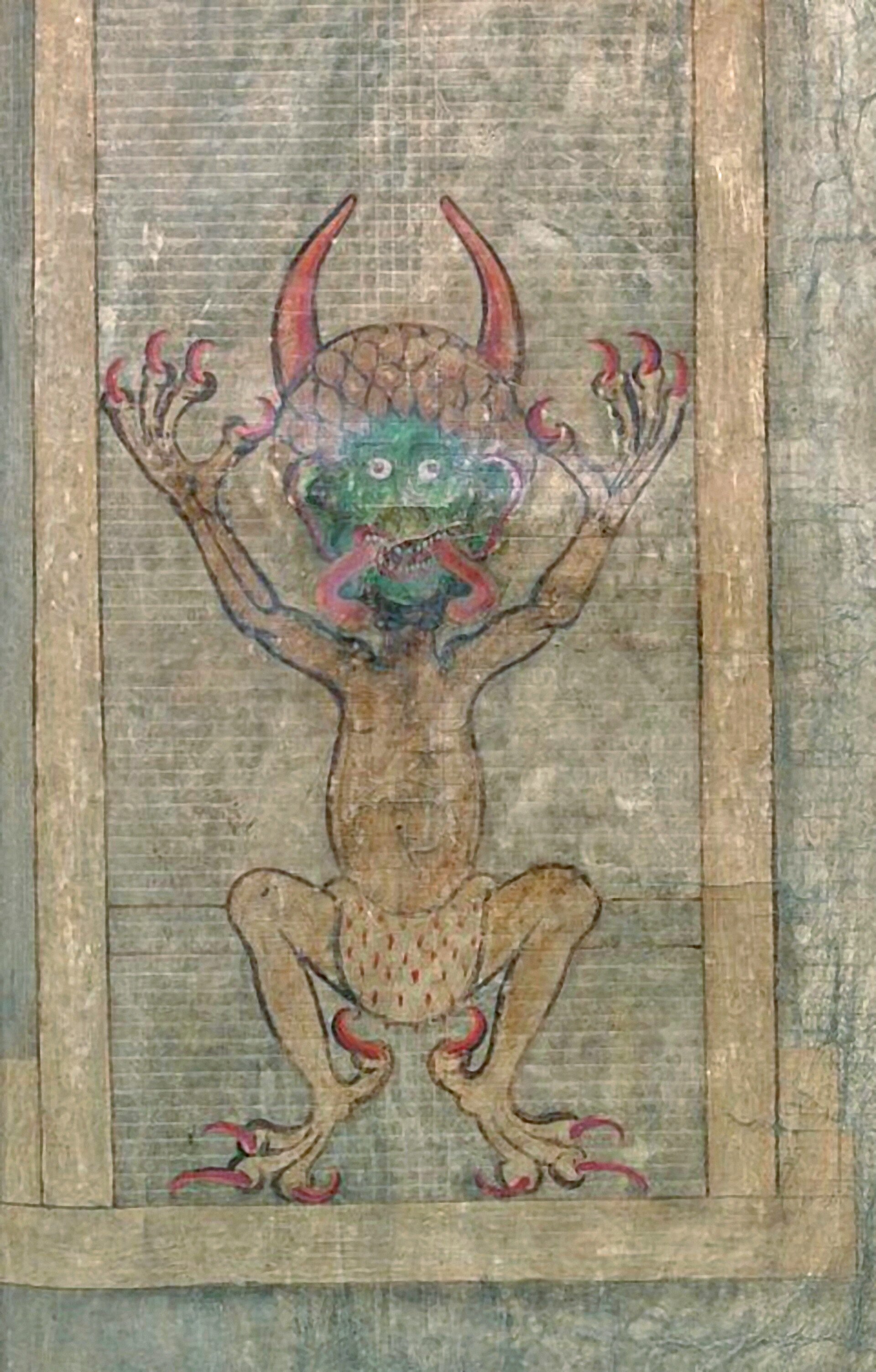
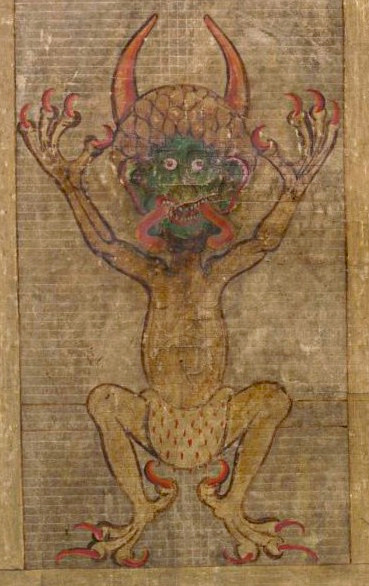
The full-page Devil of the Codex Gigas, A 148, folio 290r. This is a colour-balanced and enlarged digital version (1924 x 3012) of a photograph of the page, released as CC0, and I confirmed by eye that it shows the genuine page. The unaltered version is the next plate.
| Artist | Herman the Recluse (attributed scribe), Benedictine monastery of Podlazice |
|---|---|
| Date | 1204-1230 (catalogue); entries end 1229 or 1222 by source |
| Medium | Ink and pigments on parchment, wooden boards covered in leather |
| Dimensions | Leaf 890 x 490 mm; boards 920 x 505 x 220 mm; about 75 kg |
| Where it is now | National Library of Sweden (Kungliga biblioteket), Stockholmlast confirmed |
| Inventory number | A 148 |
| Attribution | DisputedWritten at the Benedictine monastery of Podlazice in Bohemia. Full note |
| Object type | Manuscript |
| Period | Bohemian, early thirteenth century |
| Cases | Disputed attribution · Seized, looted or confiscated |
| Inscriptions | Latin text; a provenance note and Church Slavic and Glagolitic alphabets on ff. 1va-1vb; no signature confirmed in the catalogue consulted. |
| Owners on record | 8 links5 documented, 3 disputed |
| Sources | 11 cited |
About this record Last verified · 11 sources cited · Change log
On this page 9 sections
ContentsClose
The largest known medieval manuscript, a Bohemian Benedictine compendium of the Bible, Josephus, Isidore, medicine and the Chronica Boemorum, written at Podlazice in the early thirteenth century and best known for a full-page Devil on folio 290 recto. After a documented delivery to Rudolf II in Prague in 1594 it was taken by the Swedish army in 1648 and has been in Stockholm since 1649.
It was lent to the National Library of the Czech Republic in the Klementinum from September 2007 into March 2008, with more than 61,000 visitors. The Czech side called it a loan, and no formal restitution claim specific to the book was found. The monastery chain before 1594, the scribe's name, the count of missing leaves and the effect of the 1697 fire are all disputed in print and are graded as such.
Provenance
Each link is graded. Documented: a cited source supports it. Disputed: the identification is argued but not established. Unknown: no owner for that span, and the gap is not smoothed into a narrative. The grades in the glossary.
- c. 1204-1230 -Benedictine monastery of Podlazice, Bohemiadocumented
Written at Podlazice. The catalogue gives the date range and lists Podlazice first among the early owners from the provenance note on f. 1v.123
- Sedlec monastery, then Brevnov monasterydisputed
The catalogue names Sedlec and Brevnov as early owners without dates. One source says the Benedictines pawned the book to Sedlec soon after writing and that it stayed about 70 years; another gives 1245 for Sedlec and a purchase for Brevnov in 1295. Neither set of dates is in the catalogue.123
- 1420 or 1477 - 1593 or 1594Broumov monasterydisputed
The catalogue gives 1420 for Broumov (citing Dudik 1852); other sources give 1477. The end date is given as 1593 or 1594.12310
- 1594 - 1648Rudolf II, Kunst- und Schatzkammer, Praguedocumented
Delivered in 1594 per a note on f. 306r. Whether it was a loan or another kind of transfer is disputed and not settled by the sources consulted. Inventories of c. 1621, 1635, 1647 and 1648 record it in the collection.13210
- 1648 - 1649Swedish army, as war bootydocumented
Taken in 1648 with Rudolf's collection at the end of the Thirty Years' War. AFP names the general Koenigsmark. The Czech Wikipedia describes a surprise attack on Prague. The 1648 entry in Wrangel's archive is in the catalogue.1352
- 1649 - presentRoyal Library, Stockholm (now the National Library of Sweden)documented
Acquired by the Royal Library in 1649 as war booty, per the catalogue. It is in Queen Christina's catalogue and the 1697 catalogue. Popular sources say it was given to Queen Christina; the catalogue consulted records only the catalogue entry.12
- 7 May 1697 -Tre Kronor fire, Stockholmdisputed
The book is said to have been thrown from a window and damaged. Loss of leaves in this fire is stated by popular sources and is not established; other sources give no date for the loss.2310
- 20 September 2007 - March 2008Loan to the National Library of the Czech Republic, Klementinumdocumented
Shown after an absence of 359 years from Prague; the first closing date was 6 January 2008 and the display was extended to March 2008. The book returned to Stockholm.6783
Technical evidence
| Attribution note | Written at the Benedictine monastery of Podlazice in Bohemia. A single scribe called Herman the Recluse is named in popular and tertiary sources; the library's catalogue and the Czech Wikipedia name no author, so the name is unconfirmed. |
|---|---|
| Shelfmark | National Library of Sweden (Kungliga biblioteket), A 148. Libris ID 19091448.1 |
| Date | Between 1204 and 1230 (catalogue). Entries end in 1229 per the Czech and Swedish Wikipedia pages and 1222 per the English one.1234 |
| Origin | Benedictine monastery of Podlazice, Bohemia.123 |
| Support | Parchment, said to be from about 160 donkey or mule skins; the figure is a curator's estimate.135 |
| Leaf size | 890 x 490 mm.1 |
| Boards and weight | Boards 920 x 505 x 220 mm and 75 kg (Czech Wikipedia); 92 x 50 x 22 cm and 74.8 kg (English Wikipedia).23 |
| Leaves | 309 listed in the catalogue; 310 in the English Wikipedia; originally 320. Between eight and twelve leaves are lost depending on the source.123 |
| Language and script | Latin; Carolingian minuscule with illuminated initials per the Swedish Wikipedia.14 |
| Binding | Wooden boards covered in light leather with metal fittings (Czech Wikipedia).310 |
| Digital copy | manuscripta.se/ms/100500, IIIF manifest, images CC BY 4.0 (photographer Per B. Adolphson).1 |
Images
The record in full
Chapter 1A book the size of a lectern
The Codex Gigas, shelfmark A 148 in the National Library of Sweden (Kungliga biblioteket), is generally described as the largest known medieval manuscript.
The Codex Gigas, shelfmark A 148 in the National Library of Sweden (Kungliga biblioteket), is generally described as the largest known medieval manuscript. The library's catalogue on manuscripta.se gives the leaf as 890 by 490 millimetres, on parchment, in Latin. The Czech Wikipedia gives the wooden boards as 920 by 505 by 220 millimetres and the weight as 75 kilograms; the English Wikipedia gives 92 by 50 by 22 centimetres and 74.8 kilograms. The size is the reason for the name: Codex Gigas is Latin for the great book.
The parchment is said to come from about 160 donkey or mule skins. That figure is repeated by the Czech National Library curator Miroslava Hejnova (quoted by AFP in 2005) and by the Czech Wikipedia, and the English Wikipedia adds that it may be calfskin. It is a curator's estimate, not a measured count, and this record treats it as one.
The book is not a single text. It is a library bound as one object, and the way it was assembled is the first clue to why it exists.
Chapter 2What is in it: a library in one binding
The manuscripta.se catalogue, by the main cataloguer Anna Wolodarski, lists the contents folio by folio.
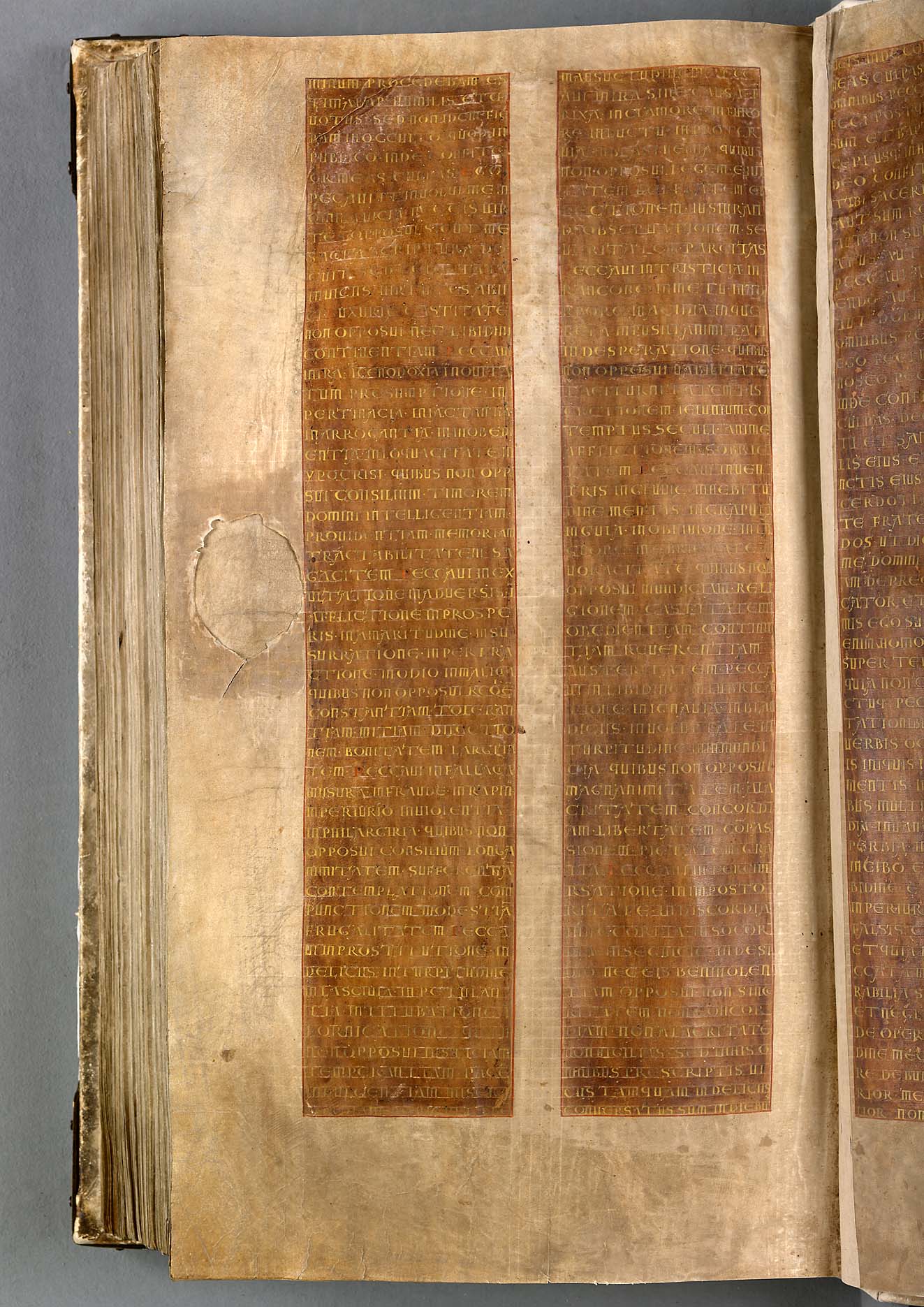
The manuscripta.se catalogue, by the main cataloguer Anna Wolodarski, lists the contents folio by folio. The Old Testament runs from folio 1vb to 118ra. It is followed by Josephus, Antiquitates Iudaicae (ff. 118rb-178va) and De bello Iudaico (ff. 178va-200va), then the Etymologiae of Isidore of Seville (ff. 201ra-239ra). Medical texts follow (ff. 240ra-252ra): an Ars medicinae and three works by Constantinus Africanus, the Practica, the Liber graduum and the Liber de oculis. The New Testament comes next (ff. 253ra-286rb), and in it Acts and the Apocalypse are in the Old Latin version rather than the Vulgate.
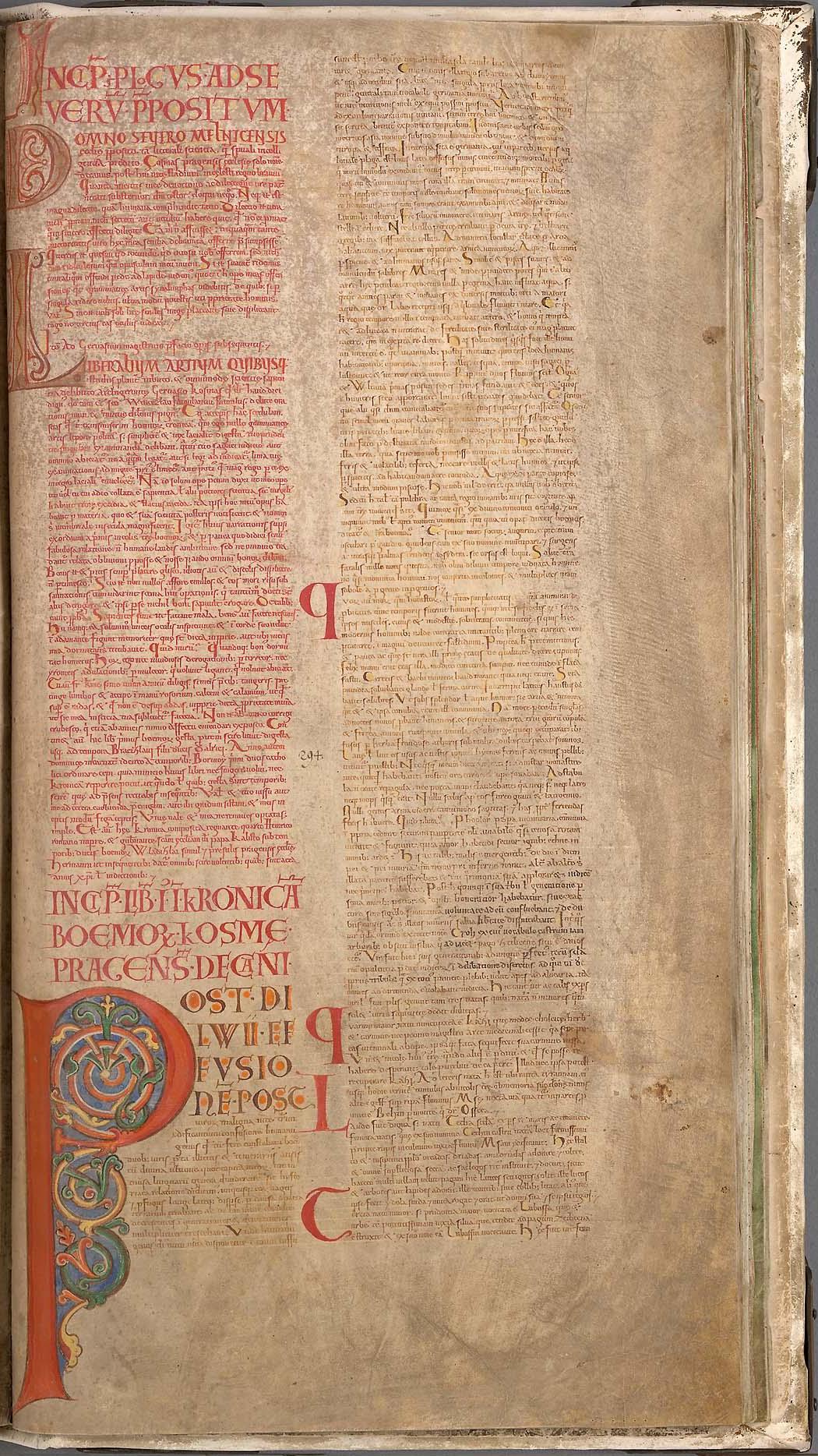
After the New Testament the book changes character. A Confessio peccatorum (ff. 286va-288vb) is followed by two full-page miniatures, the Heavenly City of Jerusalem on folio 289v and the Devil on folio 290r, and then by a text the catalogue calls Conjurations (ff. 290va-291rb). Cosmas of Prague's Chronica Boemorum, books 1 to 3, follows (ff. 294ra-304rb). The last gatherings hold a schedule of people connected with the monastery of Podlazice (f. 305r), a calendar with a necrology (ff. 305v-311r), a list of Easter feasts and a computistical text.
The Associated Press, relaying the Czech National Library specialist Zdenek Uhlir in 2007, described the whole as a sum of the Benedictine order's knowledge of the time. That is a modern summary of the contents, not a statement of the commissioner's intention, which no source consulted records. What the catalogue does document is the local layer: the Podlazice schedule, the necrology and the Bohemian chronicle tie a universal compendium to one Bohemian house.
Chapter 3One hand, and how long it took
The uniform script suggests a single scribe.
The uniform script suggests a single scribe. The Czech Wikipedia says a writing workshop cannot be fully excluded. Estimates of the time needed vary widely: Uhlir put it at 10 to 12 years (AP, 2007), the English Wikipedia reports 20 to 30 years, and a popular account in The Collector says more than 25. These are estimates from the evenness of the writing, not a documented figure, and they cannot all be right.
The scribe's name is a contested point. The English Wikipedia and the Commons file records give the scribe as Herman the Recluse (Hermannus inclusus), and The Collector says the codex is signed with that name and notes that the Latin word inclusus could mean either punishment or voluntary seclusion. The Czech Wikipedia, by contrast, states that the book gives no information about its author or origin, and the manuscripta.se catalogue consulted names no scribe. This record therefore gives the name as attributed in popular and tertiary sources and not confirmed in the catalogue; see the open questions.
Chapter 4The two facing pages and the legend
Folio 289v shows the Heavenly City of Jerusalem and folio 290r shows the Devil, the only two full-page miniatures in the catalogue's list of contents.
Folio 289v shows the Heavenly City of Jerusalem and folio 290r shows the Devil, the only two full-page miniatures in the catalogue's list of contents. The Devil is about 50 centimetres tall (Hejnova, AFP 2005). He crouches between uprights with his arms raised, red horns, red claws and a long forked tongue. The English Wikipedia describes two forked tongues, four-fingered hands and feet and a crouching pose; The Collector adds an ermine-patterned loincloth and reads it as a sign of rank. The sequence on the page is documented: a confession of sins, the Heavenly City, the Devil, and a text of conjurations. What the sequence meant to its maker is not stated in any source consulted, and no named scholar's argument was available to this record. It is left as an open question, not filled with a modern reading.
The legend is a later layer and is kept separate. As the English Wikipedia tells it, a monk who had broken his vows was sentenced to be walled up alive; he promised to make a book in one night that would glorify his monastery, prayed to Lucifer for help in exchange for his soul, and added the Devil's portrait as a tribute. Uhlir and the AP describe a version in which the monk was to atone for his sins. The date at which the story first appears was not established in the sources consulted. The nickname Devil's Bible comes from the picture, and the physical evidence of a single steady hand over years is the reason the one-night story is a legend and not a record.
Chapter 5From Podlazice to Prague: a chain that the sources do not agree on
The place of origin is the Benedictine monastery of Podlazice in Bohemia.
The place of origin is the Benedictine monastery of Podlazice in Bohemia. The English Wikipedia puts it near Chrast, the Czech Wikipedia near Chrudim and the AP about 65 miles east of Prague. The date range in the manuscripta.se catalogue is 1204 to 1230; the Czech and Swedish Wikipedia pages say the entries stop in 1229, while the English page says 1222. Podlazice itself was destroyed in the fifteenth century (AFP and the English Wikipedia attribute this to the Hussite wars).
The catalogue's own provenance note, on folio 1v, names three early owners: Podlazice, Sedlec and Brevnov. The order and dates of the next steps differ by source. The English Wikipedia says the Benedictines pawned the book to the Cistercians of Sedlec soon after it was written, that it stayed there about 70 years, and that Brevnov reclaimed it around the end of the thirteenth century. The Czech Wikipedia gives 1245 for Sedlec and says Pavel Bavor of Necin bought it for Brevnov in 1295. The catalogue records it at Broumov in 1420 (citing Dudik, 1852); the Czech Wikipedia gives 1477 to 1593 for Broumov; the English Wikipedia says from 1477. The Collector says Podlazice sold it in 1477, which conflicts with the other accounts. These are graded in the provenance and none of the later monastery dates is treated here as settled.
Chapter 61594: Rudolf II and the Kunstkammer
The catalogue records that the codex was delivered in 1594 to the Prague Kunst- und Schatzkammer of Rudolf II, citing a note on folio 306r.
The catalogue records that the codex was delivered in 1594 to the Prague Kunst- und Schatzkammer of Rudolf II, citing a note on folio 306r. That much is documented in the book itself. What kind of transfer it was is not. The Czech Wikipedia and the Swedish-language page say Rudolf borrowed it in 1594 and never returned it; the English Wikipedia says only that it was taken to Prague into his personal collection; The Collector, a popular source, dates a loan to 1593 and says the book was never given back. A loan, a forced exchange and a sale cannot be told apart from the sources consulted.
Inventories of the Kunstkammer then record it: probably about 1621, in 1635, and in 1647 and 1648, the last two in the archive of the Swedish general Carl Gustaf Wrangel (the 1648 entry is in the 1650 volume), per the catalogue. These inventories are the strongest evidence that the book was in Prague immediately before the Swedish attack.
Chapter 71648: war booty
The Swedish army took Rudolf's collection from Prague at the end of the Thirty Years' War in 1648.
The Swedish army took Rudolf's collection from Prague at the end of the Thirty Years' War in 1648. The AFP report of 2005 says the soldiers were under the Swedish general Koenigsmark; the Czech Wikipedia describes the Swedish attack on Prague as a surprise attack. The AP, citing the Czech National Library, says the book was taken from Prague Castle. The Czech Wikipedia records that Czech attempts to recover it have repeatedly failed.
The catalogue states that it was acquired by the Royal Library in 1649 as war booty and that it appears in Queen Christina's catalogue (KB, U 202:1) and in the library's 1697 catalogue (U 122). The Collector and several popular sources also say the book was given to Queen Christina; the catalogue consulted records only the catalogue entry, so the exact manner of its passage to the library is graded below as documented in outline and not in detail.
Chapter 8Stockholm and the fire of 1697
On 7 May 1697 a fire destroyed much of the Tre Kronor castle in Stockholm and with it a large part of the Royal Library.
On 7 May 1697 a fire destroyed much of the Tre Kronor castle in Stockholm and with it a large part of the Royal Library. The English Wikipedia says the codex was saved by being thrown from a window, and that, according to the vicar Johann Erichsons, it landed on a bystander and injured him. The Collector says the chief librarian ordered books thrown from windows and that a trial three days later sentenced the chief fire watcher and his two men to death. Popular accounts say that ten leaves were torn out in the rescue. That claim does not survive comparison with the other sources: the Czech Wikipedia says eight leaves were cut out at an unknown time by an unknown person and probably held Benedictine rules, and the English Wikipedia says twelve were removed. Counts of eight, ten and twelve are all in print, the date of loss is not fixed by any source consulted, and the fire is therefore a possible but unproven cause.
Chapter 9Condition and binding
The codex now has 309 leaves in the manuscripta.se count and 310 in the English Wikipedia, against an original 320 (640 pages) given in the English and Czech Wikipedia pages.
The codex now has 309 leaves in the manuscripta.se count and 310 in the English Wikipedia, against an original 320 (640 pages) given in the English and Czech Wikipedia pages. The loss is therefore between eight and twelve leaves depending on the source and the way leaves are counted. The binding is described as wooden boards covered in light leather with metal fittings (Czech Wikipedia); The Collector says leather with ornamental metal. A search summary of the National Library's own page credits a Stockholm binder, Samuel Sandman, with the present binding in 1819, and says the boards may be from the original binding; the library page could not be retrieved for this record, so that statement is not repeated as established. No conservation treatment of the book is documented in the sources consulted.
Chapter 102007-2008: the loan to Prague
In November 2005 AFP reported that the Royal Library in Stockholm had agreed to lend the book, which it called exceptional, and that the Czech Prime Minister Jiri Paroubek had raised the temporary...
In November 2005 AFP reported that the Royal Library in Stockholm had agreed to lend the book, which it called exceptional, and that the Czech Prime Minister Jiri Paroubek had raised the temporary return during a visit to Sweden at the start of October 2005, taking care to say that it was a loan and not a return. The Czech National Library director Vlastimil Jezek hoped for at least 50,000 visitors.
Radio Prague reported in April 2007 that the National Library had been allowed to borrow the book for an exhibition in the Klementinum Gallery from 20 September to 6 January. The AP reported on 25 September 2007 that it had been absent from Prague for 359 years, that years of negotiation between Czech and Swedish diplomats had made the loan possible (Katerina Novakova, National Library spokeswoman), that it was shown under high security in an unbreakable case with 60 people an hour admitted to an air-conditioned room for a ten-minute viewing, and that the exhibition was fully booked. Radio Prague wrote on 9 March 2008 of the last Sunday, with several hundred visitors and more than 61,000 in all, so the display was extended beyond the first January closing date; the Czech Wikipedia likewise gives September 2007 to March 2008. Only two pages could be shown at a time (AFP 2005). It had left Sweden only twice before in the modern era: for the Metropolitan Museum of Art in New York in 1970 and for Berlin about eight years before 2005 (AFP).
Chapter 11The return question
The positions on record are narrow. Czech officials framed the 2007 event as a temporary loan, as Paroubek did in 2005.
The positions on record are narrow. Czech officials framed the 2007 event as a temporary loan, as Paroubek did in 2005. In the early 1990s the former Czech president Vaclav Havel tried without success to persuade Stockholm to return objects historically linked with Bohemia, and Jezek said that the request had no legal basis and that if Havel did not succeed no one would (AFP 2005). The AP did not report a Swedish statement of ownership or any permanent claim. A Swedish library page quoted in a search summary states the legal principle that an act is judged by the law of its time, but that page was not retrievable and the statement is not relied on here.
No formal restitution claim, court case or government demand specific to the codex was found in the sources consulted. The 1648 transfer is described by every source as war booty, and the library's catalogue lists the book as acquired by the Royal Library in 1649 on that basis.
Chapter 12Seeing it now
The full manuscript is on manuscripta.se with a IIIF manifest, photographs by Per B.
The full manuscript is on manuscripta.se with a IIIF manifest, photographs by Per B. Adolphson licensed CC BY 4.0, and a catalogue funded by Riksbankens jubileumsfond; the page was last revised on 27 November 2020. The Czech Wikipedia also points to Manuscriptorium and the World Digital Library. A 2007 blog post, itself reliable only for what it quotes, says Stockholm completed a large digitisation project before the Prague loan and put the codex on its own website. A 2016 digitisation could not be confirmed in any source consulted, and this record does not assert one.
A modern replica by the bookbinder Jiri Fogl is mentioned by the Czech Wikipedia. It is a copy, not another manuscript, and the Prague display of 2007 was the same book lent, not a second one.
The artist
Herman the Recluse (attributed), Benedictine monastery of Podlazice
The maker is a house and not a signed individual. A single scribe called Herman the Recluse is named in popular and tertiary sources, but the library's own catalogue consulted here names nobody, and the Czech Wikipedia says the book carries no information about its author. The sources that do name him say little more than that name. This record reads the maker as the Podlazice scribe, attributed, with the name unconfirmed in a catalogue.
Related works
| Work | Relation | Where it is |
|---|---|---|
| Chronica Boemorum Cosmas of Prague | Text copied in the codex, books 1 to 3, ff. 294ra-304rb The oldest Czech chronicle written in Latin per Radio Prague; Commons shows its opening page from this manuscript. | Within A 148 |
| Replica of the Codex Gigas Jiri Fogl (bookbinder) | A modern copy, not another manuscript Mentioned by the Czech Wikipedia without detail. Not the Commons file named Codex Gigas facsimile, which is a CC BY photograph of a modern object and was deliberately not used here. | Czech sources only |
| The Prague display of 2007-2008 National Library of the Czech Republic, Klementinum | An event, not a second object The same A 148 lent from Stockholm. | Klementinum Gallery, Prague |
| The Prague Kunstkammer of Rudolf II Rudolf II | The collection the codex entered in 1594 and left in 1648 Its inventories of 1635, 1647 and 1648 are the evidence that the book was there. | Dispersed; part in Stockholm |
Open questions
- Who wrote it? The name Hermannus inclusus appears in tertiary and popular sources, while the catalogue and the Czech Wikipedia name no scribe. Which line of the manuscript, if any, carries the name?
- What did the pairing of Confessio peccatorum, the Heavenly City, the Devil and the Conjurations mean to its maker? No named scholar's argument was available to this record.
- What happened to the missing leaves, and when? Counts of eight, ten and twelve are all in print, and the date of loss is not fixed. The usual guess that they held the Benedictine rule is a guess.
- Which monastery held the book when? The Sedlec and Brevnov dates (about 1245 and 1295 in one source) and the Broumov dates (1420 in the catalogue, 1477 in others) cannot be reconciled from the sources consulted.
- Was the 1594 transfer to Rudolf II a loan, a sale or a seizure? The catalogue records only the delivery.
- Is there any Czech claim in law or diplomacy for the return? None specific to the codex was found beyond the 1990s Havel approach and the loan framing in 2005 and 2007.
- What conservation has the book had, and when was the present binding made? A date of 1819 is reported in a search summary of the library's own site that could not be retrieved.
- Was there a 2016 digitisation? None was found in the sources consulted; only the manuscripta.se digitisation, revised in 2020, and a pre-2007 project reported by a blog.
Questions about this object
What is Codex Gigas (the Devil's Bible)?
Codex Gigas (the Devil's Bible) is a manuscript, dated 1204-1230 (catalogue); entries end 1229 or 1222 by source. Medium: Ink and pigments on parchment, wooden boards covered in leather.
Who made Codex Gigas (the Devil's Bible), and is the attribution settled?
The attribution to Herman the Recluse (attributed scribe), Benedictine monastery of Podlazice is recorded here as disputed. Written at the Benedictine monastery of Podlazice in Bohemia. A single scribe called Herman the Recluse is named in popular and tertiary sources; the library's catalogue and the Czech Wikipedia name no author, so the name is unconfirmed.
Where is Codex Gigas (the Devil's Bible) now?
National Library of Sweden (Kungliga biblioteket), Stockholm. Inventory number A 148. Last confirmed 16 November 2026. Acquired by the Royal Library in 1649 as war booty; catalogue on manuscripta.se.
What is still unknown about Codex Gigas (the Devil's Bible)?
Who wrote it? The name Hermannus inclusus appears in tertiary and popular sources, while the catalogue and the Czech Wikipedia name no scribe. Which line of the manuscript, if any, carries the name?
Sources
- 1National Library of Sweden, manuscripta.se catalogue record A 148, Codex Gigas ('Devil's Bible'), cataloguer Anna Wolodarski, last revised 2020-11-27. manuscripta.se/ms/...
- 2Wikipedia, 'Codex Gigas' (English). en.wikipedia.org/wiki/...
- 3Wikipedia, 'Codex gigas' (Czech). cs.wikipedia.org/wiki/...
- 4Wikipedia, 'Codex Gigas' (Swedish). sv.wikipedia.org/wiki/...
- 5AFP, 'Medieval eighth wonder to go on display in Prague', Taipei Times, 19 November 2005. taipeitimes.com/News/...
- 6Radio Prague International, 'Devil's Bible returns home but only for few months', 20 April 2007. english.radio.cz/node/...
- 7Radio Prague International, 'Devil's Bible to return to Sweden', by Daniela Lazarova, 9 March 2008. english.radio.cz/node/...
- 8Associated Press, 'Devil's Bible returns for exhibit in Prague', HeraldNet, 25 September 2007. heraldnet.com/life/...
- 9Evangelical Textual Criticism blog, 'Devil's Bible returns to Prague', September 2007. Blog, cited only for what it quotes. evangelicaltextualcriticism.blogspot.com/2007/...
- 10The Collector, 'Codex Gigas: Myths Surrounding the Medieval Manuscript'. Popular source, cited with caution and to be replaced. thecollector.com/codex-gigas-medieval-manuscript
- 11Wikimedia Commons file records for Codex Gigas f286v, Chronica Boemorum, Codex-Gigas-Devil-enhanced (CC0) and Codex Gigas devil (public domain), via the Commons API. commons.wikimedia.org/wiki/...
Last verified · Published
Change log
16 November 2026 - Record created at the house standard: researched narrative, technical evidence, maker dossier, graded provenance chain, prices with hammer and premium separated, related works, open questions and sources.