Wells Cathedral Clock
Peter Lightfoot (traditional attribution, disputed) · Traditional and widely repeated: 1392. Securely attested only that a clock existed at Wells by 1392-1394 (a keeper's payment of 1392-1393; Chapter Roll references from 1394); the wider bracket of c.1386-1392 rests on comparison with the independently dated Salisbury Cathedral clock and on Bishop Ralph Erghum's move from Salisbury to Wells in 1388, not on a surviving Wells building record.
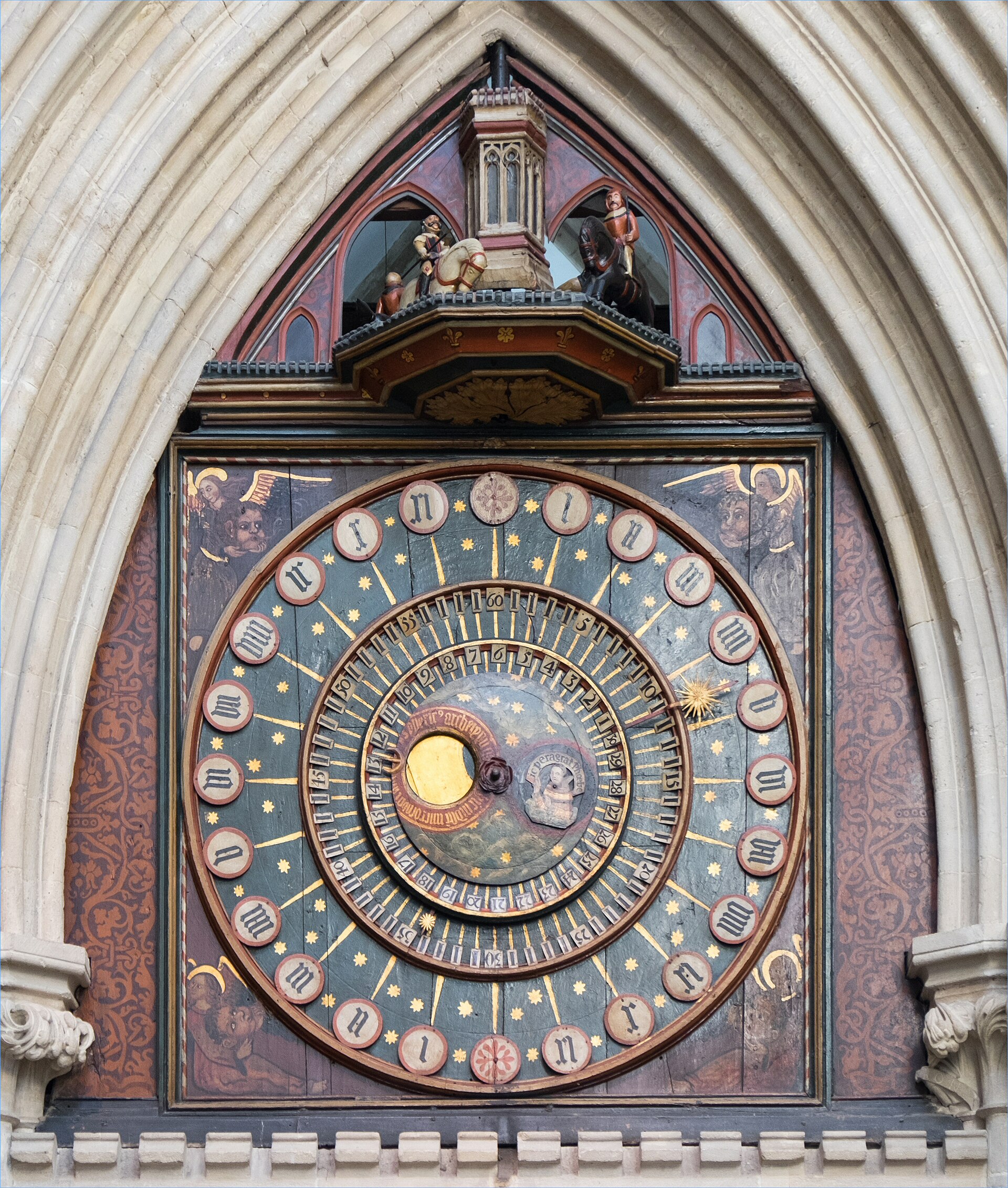
The interior dial in the north transept, showing the geocentric universe: Earth at the centre, the gilded Sun on the outer ring, the Moon phase disc within it. This dial and the automata around it are original in-situ fixtures of the cathedral, driven since 1884 by a Victorian replacement movement, not by the medieval mechanism now in London.
Photograph by DeFacto, via Wikimedia Commons · CC BY-SA 4.0| Artist | Peter Lightfoot (traditional attribution, disputed) |
|---|---|
| Date | Traditional and widely repeated: 1392. Securely attested only that a clock existed at Wells by 1392-1394 (a keeper's payment of 1392-1393; Chapter Roll references from 1394); the wider bracket of c.1386-1392 rests on comparison with the independently dated Salisbury Cathedral clock and on Bishop Ralph Erghum's move from Salisbury to Wells in 1388, not on a surviving Wells building record. |
| Medium | Iron-framed, weight-driven turret clock movement (the medieval mechanism, Science Museum, London); painted and gilded wood, iron and stone dial and automata figures at Wells Cathedral, driven since 1884 by a separate cast-iron and steel Victorian movement. |
| Dimensions | Medieval movement (Science Museum, object 1884-77 Pt1): approx. 2400 x 4000 x 2200 mm, approx. 2000 kg. A related components entry in the same online catalogue gives approx. 4330 x 2500 mm footprint and approx. 3400 kg; the discrepancy between the two catalogue records is not resolved in the sources consulted. Dial and automata at Wells: in situ in the north transept; no independent dimensions were found published in the sources consulted for this record. |
| Where it is now | Dial, automata and the current (1884) movement: Wells Cathedral, north transept, Somerset, England, in situ. The original medieval movement: Science Museum, London (Science Museum Group), on loan from the Dean and Chapter of Wells Cathedral.last confirmed |
| Inventory number | Science Museum Group object no. 1884-77 Pt1 (medieval movement); a related components record in the same online catalogue was not separately numbered in the sources consulted. |
| Attribution | DisputedThe mid-16th century antiquary John Leland recorded an inscription naming the monk Peter Lightfoot as maker of a clock at Glastonbury Abbey, not at Wells. Full note |
| Object type | Clocks and instruments |
| Period | English, late 14th century (the medieval movement); the north transept exterior dial is a separate later addition, variously dated 14th-15th century in general accounts and about 1475 in one specialist account; the movement now driving both dials and the automata at Wells is Victorian, installed 1884. |
| Cases | Disputed attribution |
| Inscriptions | Interior dial: sphericus archetypum globus hic monstrat microcosmum (this spherical globe here shows the archetypal microcosm); sic peragrat Phebe (so progresses Phoebe), beside a painted image of the Moon. Exterior dial: NEQUID PEREAT (let nothing perish). An inscription reported by John Leland, Horologium Petrus Lightfote Monachus fecit hoc opus (a clock which the monk Peter Lightfoot made), describes the related clock at Glastonbury Abbey, not the clock at Wells. |
| Owners on record | 11 links9 documented, 2 disputed |
| Sources | 15 cited |
About this record Last verified · 15 sources cited · Change log
On this page 10 sections
ContentsClose
The name Wells Cathedral clock is usually used for two different surviving objects. One is the painted astronomical dial and its automata, the jousting knights and the quarter-jack figure called Jack Blandifer, which have stood in the north transept of Wells Cathedral since around 1390 and have been driven since 1884 by a Victorian replacement movement. The other is the actual medieval mechanism those figures were originally built to run from, removed from the cathedral and now on permanent display, still working, at the Science Museum in London, on loan from the Dean and Chapter.
The clock's traditional attribution to Peter Lightfoot, a monk of Glastonbury Abbey, rests on a 16th century antiquarian's account of a different clock at Glastonbury itself, and a once-popular legend that the Glastonbury clock was physically moved to Wells at the Dissolution is directly contradicted by Wells's own Chapter Rolls, which record a clock there from 1394, well before 1539. The clock's construction date, usually given flatly as 1392, is secured only by a keeper's payment of 1392-1393 and by comparison with the independently dated clock at Salisbury Cathedral, itself a genuinely contested date among specialists.
What is not contested is the ambition of the thing itself: a geocentric model of the universe, gilded Sun and painted Moon turning around a fixed Earth, four winds in the corners, knights jousting every quarter hour and a small seated man striking the bells with his own heels, built for a cathedral in Somerset six centuries ago and, in two different buildings 200 kilometres apart, still running.
Provenance
Each link is graded. Documented: a cited source supports it. Disputed: the identification is argued but not established. Unknown: no owner for that span, and the gap is not smoothed into a narrative. The grades in the glossary.
- 1386-1394 -Wells Cathedral (Dean and Chapter)documented
A clock existed at Wells and was being maintained by a paid keeper by 1392-1393, and is independently attested in the Wells Chapter Rolls from 1394. The wider construction bracket of 1386-1392 is a reasonable inference from the clock's close structural resemblance to the independently dated 1386 Salisbury clock and from Bishop Ralph Erghum's move from Salisbury to Wells in 1388, not a documented Wells-specific building date.161112
- Attributed maker: Peter Lightfoot, monk of Glastonbury Abbey, or a workshop associated with himdisputed
John Leland's mid-16th century inscription names Lightfoot as maker of a clock at Glastonbury Abbey, not Wells. A 19th century legend that the Glastonbury clock was physically moved to Wells at the Dissolution in 1539 is contradicted by the Wells Chapter Rolls' own evidence of a clock at Wells from 1394. Howgrave-Graham's 1922 study proposes instead that Lightfoot's workshop built a separate clock for Wells, while noting Lightfoot would have been about 89 years old by the earliest secure Wells date and that no feature of the surviving fabric can be safely dated earlier than 1394.16
- 17th century -Wells Cathedral (Dean and Chapter)documented
The medieval movement was converted from a foliot-and-verge escapement to a pendulum-and-anchor escapement, the standard upgrade made to English turret clocks of this era. Some sources also place a replacement or repainting of the Jack Blandifer figure in this period, though this is disputed against an alternative reading that the figure is substantially 1390s work.110
- early 18th century -Wells Cathedral (Dean and Chapter)documented
A minute hand, a small star on an inner ring, was added to the interior dial.1
- 19th century -Wells Cathedral (Dean and Chapter)documented
The exterior north transept dial was converted from a 24-hour to a 12-hour face and given gilt Roman numerals.78
- unresolved (popularly given as 1835 or 1837; only 1884 is independently corroborated) - 1884South Kensington Museum, administratively linked to the Patent Office Museum; predecessor of the Science Museum, Londondisputed
The medieval movement was withdrawn from active service at Wells and replaced by a new mechanism, still in use today, driving both dials and the automata. The Science Museum Group's own catalogue and its accession number, 1884-77, corroborate 1884 as the year the medieval movement reached the museum. Several popular sources give 1835 or 1837 for the replacement itself without a documentary citation; no source consulted for this record traces either earlier date to a Chapter or Fabric record, and the exact year of physical removal at Wells, as distinct from the year of museum accession, is recorded here as unresolved.124
- 1909 -Science Museum, London (formally separated from the South Kensington Museum)documented
The Science Museum was formally established as a separate institution in 1909; the medieval movement had already been part of the South Kensington collections since 1884, prior to this formal separation.2
- 2010 -Wells Cathedral (Dean and Chapter)documented
Paul Fisher, Keeper of the Great Clock of Wells, a post his family had held for close to a hundred years, announced his retirement in August 2010. The Cathedral fitted an electric winder to the Victorian movement, ending the practice of winding it by hand.110
- 2017 -Science Museum, Londondocumented
The medieval movement was re-displayed for closer visitor viewing, at the time in the Museum's Making the Modern World gallery.5
- 2022 - 2023Wells Cathedral (Dean and Chapter), with Cliveden Conservation and named specialist contractorsdocumented
The exterior north transept dial, its motion, bells, timber jacks and counterweights were cleaned, repaired and repainted, based on paint analysis of historic decorative schemes including one applied in 1959.78
- present -Dial, automata and current movement: Dean and Chapter of Wells Cathedral, in situ. Medieval movement: Science Museum Group, London, on loan from the Dean and Chapterdocumented
Two physically separated components of the historic clock remain in active public display and, in both locations, in working order.249
Technical evidence
| Attribution note | The mid-16th century antiquary John Leland recorded an inscription naming the monk Peter Lightfoot as maker of a clock at Glastonbury Abbey, not at Wells. No document consulted for this record ties Lightfoot's name to Wells itself. The clockmaker and historian R. P. Howgrave-Graham argued in 1922 that Lightfoot, or a workshop tradition associated with him, was probably engaged to build a separate clock for Wells after the Glastonbury commission, while noting that Lightfoot would have been about 89 years old by the earliest secure Wells date and that no surviving feature can be safely dated earlier than 1394. The name functions in the record as the traditional label for a workshop and a period, not as a documented individual builder. |
|---|---|
| Division of the surviving fabric | The dial faces, the jousting knights automaton and the seated quarter-jack figure known as Jack Blandifer remain in place in the north transept of Wells Cathedral, Somerset, where they have been driven since 1884 by a replacement Victorian movement. The medieval movement they were originally built to run from was removed from active service and is now displayed and kept running at the Science Museum, London, on loan from the Dean and Chapter of Wells Cathedral. These are two physically separate objects in two separate places, not one undivided artefact.1245 |
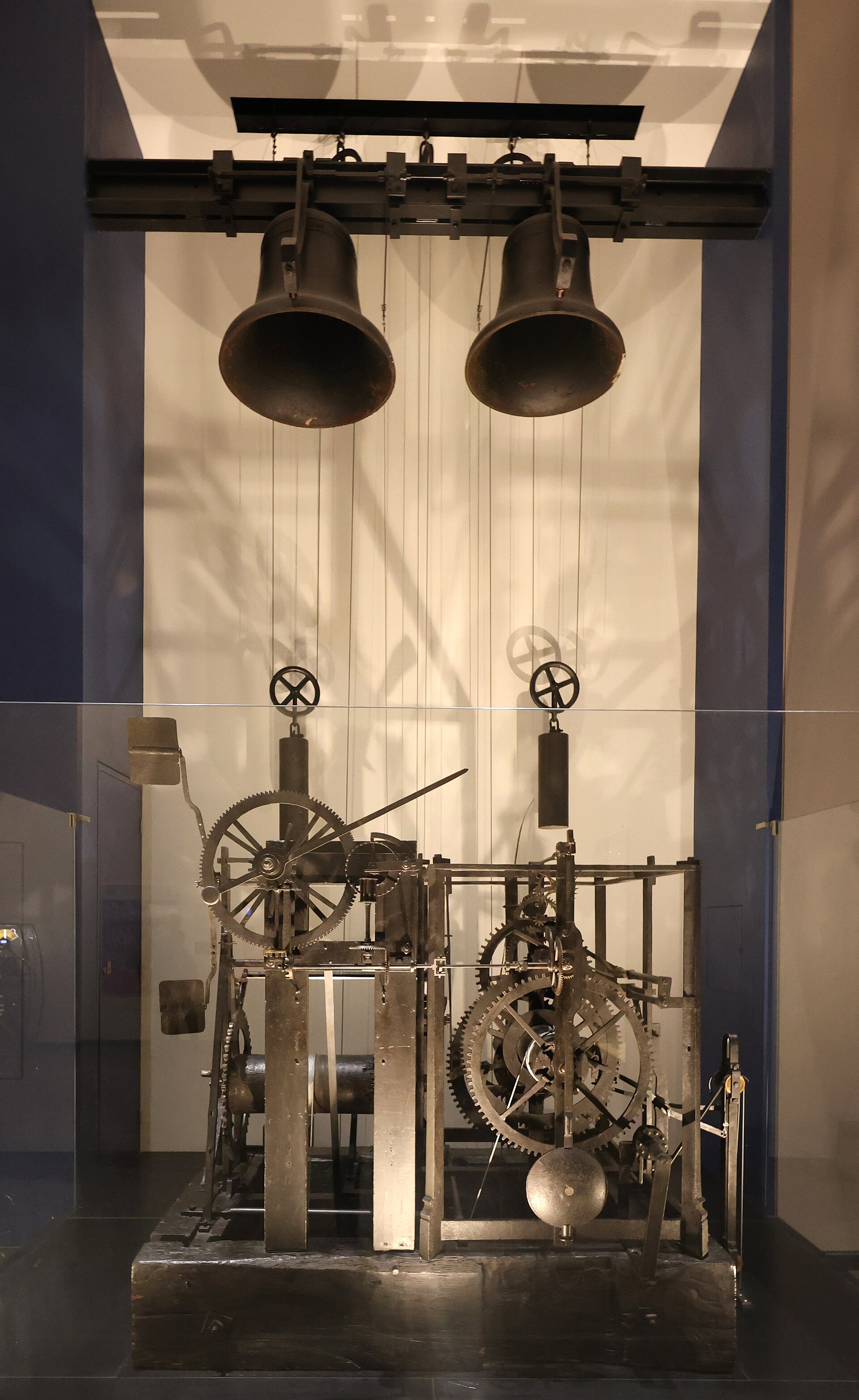
| The medieval movement (Science Museum, London) | Weight-driven turret clock movement, Science Museum Group object number 1884-77 Pt1. Cast iron, steel and oak. Approximately 2400 mm high by 4000 mm wide by 2200 mm deep, estimated weight about 2000 kg. A related catalogue entry for accompanying components (two bells, small parts, a lantern pinion and an original fly from a quarter striking train) gives a differing footprint of 4330 by 2500 mm and a weight of about 3400 kg; the Museum's own online catalogue carries both records and the discrepancy between them is not resolved in the sources consulted.23 |
| Escapement history of the medieval movement | Originally regulated by a foliot balance and verge escapement, standard for the period. Converted to pendulum and anchor escapement in the 17th century, the common upgrade made to English turret clocks of this age. It is wound by hand daily at the Science Museum, in three separate gear trains, one each for the dials, the hour strike and the quarter strike, a process taking up to half an hour.14 |
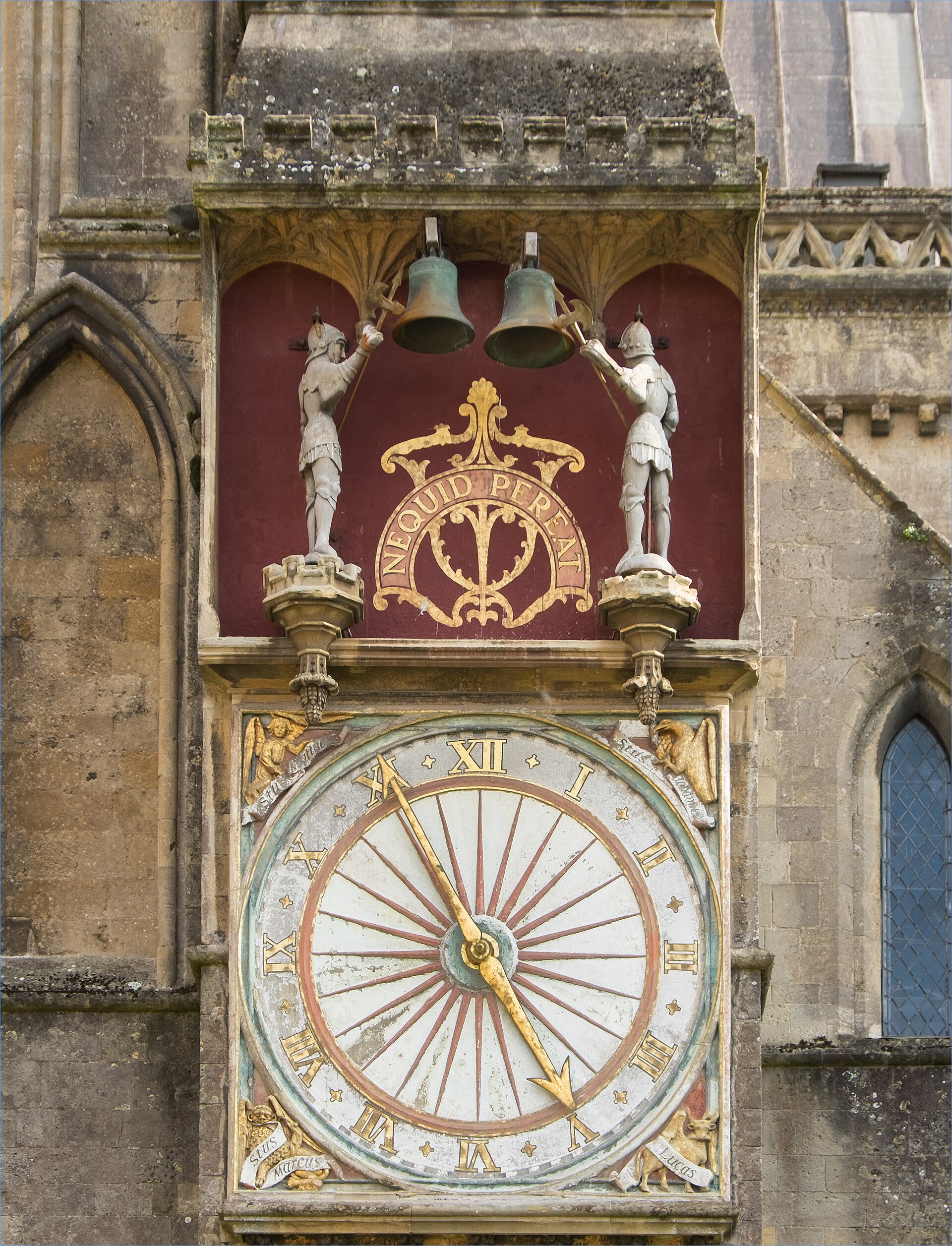
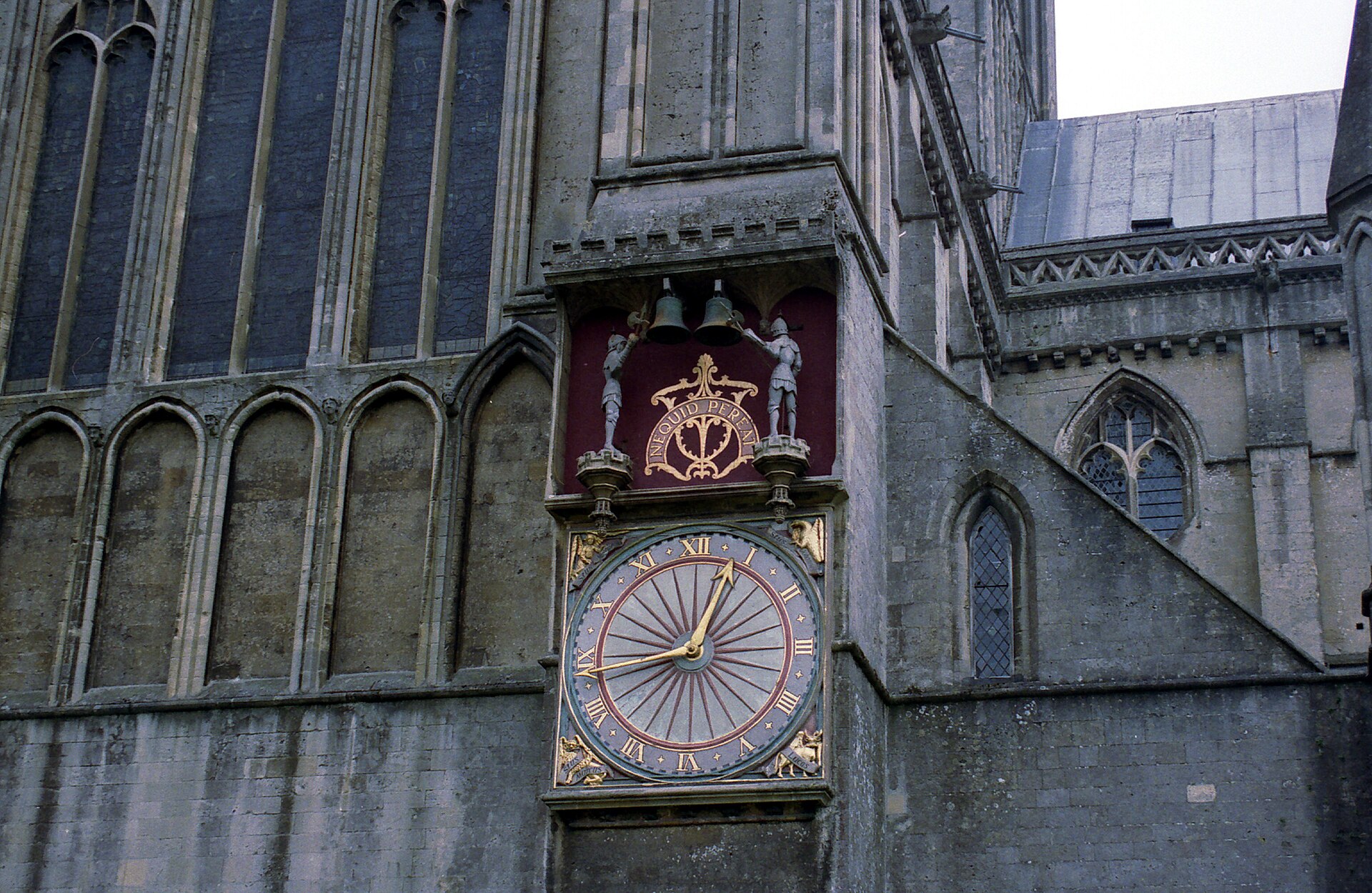
| The exterior (north transept) dial | A conventional dial mounted on the outside wall of the north transept, driven from the same replacement movement as the interior dial. Sources differ on its original date, giving the 14th or 15th century in general, the 1400s specifically, or about 1475; all agree it is a later addition to the clock rather than part of the original c.1390s installation. During the 19th century it was converted from a 24-hour to a 12-hour face and given gilt Roman numerals. It carries the motto NEQUID PEREAT, let nothing perish. Four evangelist symbols occupy its corners and are gilded, apparently continuously since first painted, so far as can be determined.1789 |
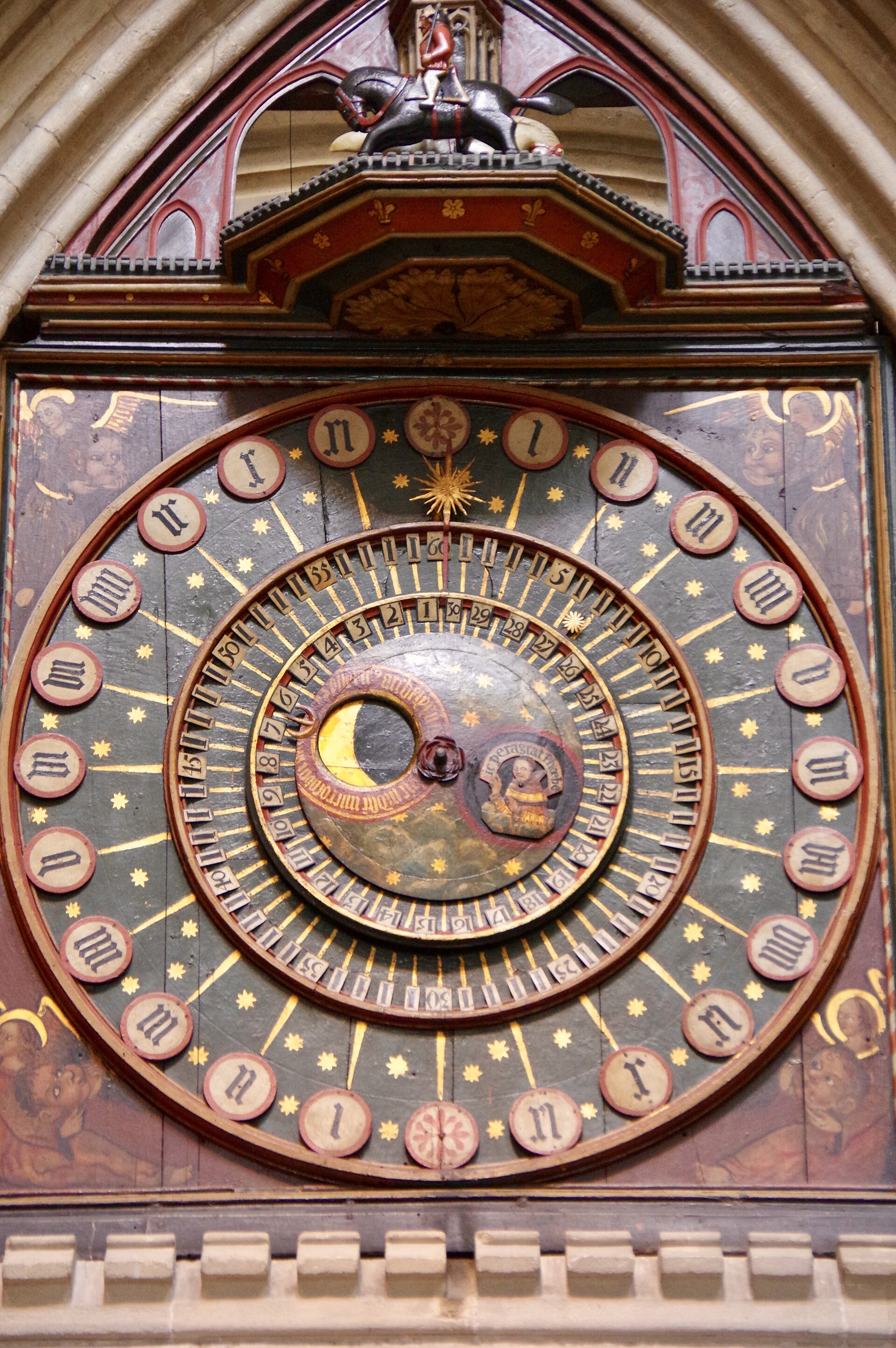
| The interior (triforium) dial | A 24-hour dial proposing a geocentric universe, the Earth fixed at the centre and the stars, Sun and Moon revolving around it. A large gilded star on the outer ring represents the Sun and rotates once every 24 hours, indicating the hour against two sequences of Roman numerals I to XII, noon at the top of the dial. A smaller star on an inner ring, added in the early 18th century, indicates the minutes. A moon-phase mechanism combines a moon back plate, rotating once every 24 hours, with a moon plate rotating slightly slower on an approximately 24 hour 49 minute cycle, so that a circular window in the moon plate reveals the phase of the moon against the back plate over a lunar month. Four angels occupy the corners of the dial, holding the four cardinal winds. Latin inscriptions read sphericus archetypum globus hic monstrat microcosmum and, beside a small painting of Phebe representing the Moon, sic peragrat Phebe.1 |
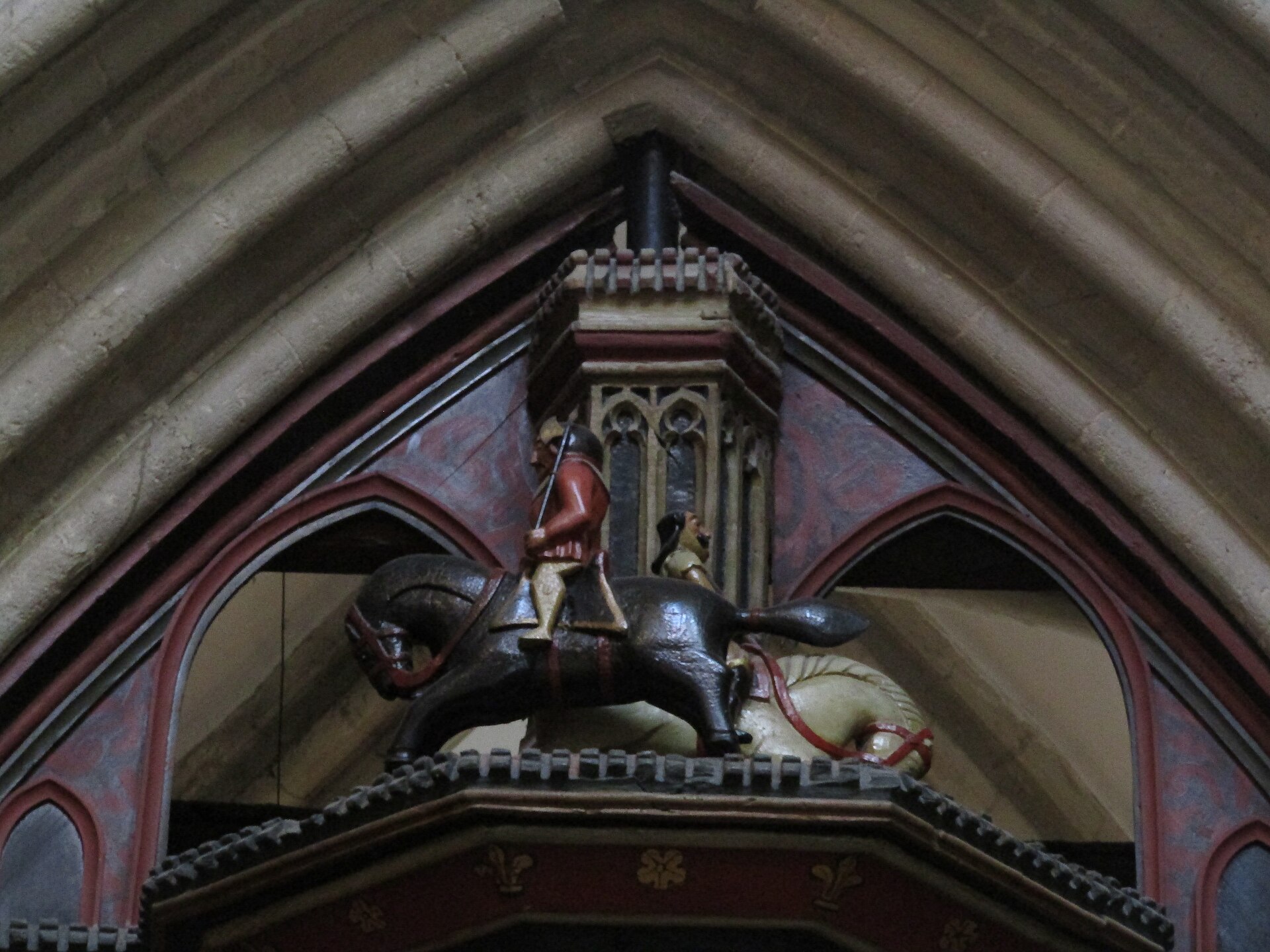
| Jousting knights automaton | Four wooden knights in armour of a late 14th century style, mounted above the dial, who circle in opposite directions and clash every 15 minutes; one is unhorsed at every encounter. The figures were removed to Swan Farm Studio for repair and repainting during the 2022-2023 conservation campaign, described by conservators as a challenge because of their multi-part timber construction.17910 |
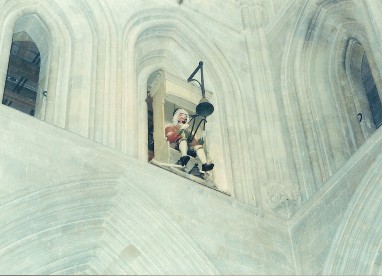
| Jack Blandifer, the quarter jack | A seated figure above and to the right of the interior dial who strikes a bell in front of him with a hammer for the hours and two bells beneath him with his heels for the quarters. Sources disagree on the age of the figure now in place: one account gives it as possibly late 14th century but repainted in the 17th century, another states plainly that the present figure dates from the 17th century and replaces the 1390s original. No source consulted resolves the disagreement with published technical or documentary evidence. The name is of uncertain origin: Jack probably from the same root as the steeplejack's jacke, a tool of the tower-building trade, and Blandifer possibly the surname of a maker, rendered Bland or Blandiver.1610 |
| 2022-2023 conservation campaign | A programme of cleaning, repair and repainting of the exterior dial, its motion, bells, timber jacks and counterweights, contracted at the end of 2022 and completed by April 2023. Led by Cliveden Conservation with the Cathedral Architect Nick Cox, under the oversight of the Chapter, the Cathedral Fabric Commission for England and Historic England; clock motion work by Timsbury Clocks, timber jack repair and repainting at Swan Farm Studio, and bell cleaning by Matthew Higby and Company. Paint analysis identified several historic decorative schemes, the most recent applied in 1959; the new scheme was based on the earlier, original-design evidence rather than the 1959 interpretation, and large amounts of surviving historic paint were found and conserved rather than stripped.78 |
| Construction-date evidence | The date given almost everywhere in print, 1392, rests on a documented payment for the keeper of the clock in 1392-1393 and on Chapter Roll references to a clock at Wells from 1394; neither is a building contract or a completion record for the mechanism itself. The wider bracket of 1386 to 1392 rests on the close structural resemblance between the Wells movement and the movement of Salisbury Cathedral, independently dated to about 1386, and on the historical fact that Bishop Ralph Erghum, who had commissioned the Salisbury clock, moved from Salisbury to Wells in 1388 and could have brought his clockmakers with him. This is a reasonable inference from comparative design, not a documented date for Wells specifically.161112 |
Images
The record in full
Chapter 1Two objects wearing one name
Ask for the Wells Cathedral clock and, without noticing it, you are usually asking for two different things at once.
Ask for the Wells Cathedral clock and, without noticing it, you are usually asking for two different things at once. The first is the astronomical dial and its automata: the painted face in the north transept showing a geocentric universe, the four wooden knights who joust above it every quarter hour, and the seated figure called Jack Blandifer who strikes the bells with hammer and heels. All of this remains exactly where it has stood since the clock was built, and all of it has been driven since 1884 by a Victorian replacement movement, not by the medieval mechanism the dial was originally built to run from. The second object is that medieval mechanism itself: the iron-framed movement of the 1390s, removed from the cathedral and now on public display, still running, at the Science Museum in London, on loan from the Dean and Chapter of Wells Cathedral.
Popular writing about Wells collapses these into a single one of the oldest clocks in the world story, and the collapse is not harmless. A visitor standing in the north transept today is looking at a face and a set of figures built around 1390, powered by a mechanism built five hundred years later. A visitor at the Science Museum is looking at the reverse: a genuinely medieval mechanism, disconnected from the dial, knights and quarter jack it once turned. Both halves are real and both are remarkable. Neither is the whole clock, and no photograph of one belongs captioned as though it showed the other.
Chapter 2What the interior dial actually shows
The interior dial, mounted in the north transept and visible from the crossing, presents a geocentric model of the universe: a fixed Earth at the centre, with the stars, Sun and Moon shown revolving...
The interior dial, mounted in the north transept and visible from the crossing, presents a geocentric model of the universe: a fixed Earth at the centre, with the stars, Sun and Moon shown revolving around it. A large gilded star on the outer ring stands for the Sun and completes one rotation every 24 hours, pointing to the hour against two consecutive runs of Roman numerals from I to XII, so that the top of the dial reads noon, the position the Sun holds in the sky at that hour. A smaller star on an inner ring, added in the early 18th century, indicates the minutes, a refinement the original design did not carry.
The Moon is tracked by a genuinely ingenious pair of discs. A moon back plate, numbered one to thirty for the days of the lunar month, turns once every 24 hours; in front of it a moon plate turns slightly slower, completing its own cycle in about 24 hours and 49 minutes. The difference between the two rotations accumulates over a lunar month, and a circular window cut in the moon plate reveals progressively more or less of the black and gold surface of the plate behind it, showing the Moon waxing and waning. A small painted image of Phebe, the Moon, sits beside the window with the inscription sic peragrat Phebe, so progresses Phoebe. Around the window itself runs a second inscription, sphericus archetypum globus hic monstrat microcosmum, this spherical globe here shows the archetypal microcosm, wording one 20th century writer connected to a similar Latin tag in the Cosmati pavement at Westminster Abbey, though the Westminster inscription is now too worn for its own exact reading to be certain. Four painted angels occupy the corners of the dial, holding the four cardinal winds.
Wikipedia's own summary of the clock calls this presentation of the pre-Copernican, Ptolemaic universe possibly unique among surviving clock dials. This record has not independently verified that claim against the wider surviving corpus of medieval astronomical clocks and records it as a claim, not as an established fact. No source consulted for this record describes the dial as showing sidereal time as distinct from this solar and lunar display; the programme is a working model of Sun, Moon and Earth, not a separate star-time indication.
Chapter 3The jousting knights
Above the dial, four wooden knights in armour styled on the late 14th century circle in opposite directions every 15 minutes, and at every pass one of them is struck and unhorsed.
Above the dial, four wooden knights in armour styled on the late 14th century circle in opposite directions every 15 minutes, and at every pass one of them is struck and unhorsed. It is pure theatre bolted onto a timekeeping mechanism, in exactly the spirit John of Glaston's chronicle used to describe the related clock at Glastonbury Abbey: a great clock distinguished by shows and figures in motion. The knights are driven today by the same Victorian movement that turns the dial, not by the medieval mechanism now in London, and they were taken apart, repaired and repainted at Swan Farm Studio during the exterior dial's 2022-2023 conservation campaign, a job conservators singled out as difficult because of how many small timber parts each figure is built from.
Chapter 4Jack Blandifer
Seated above and to the right of the dial, Jack Blandifer strikes a bell in front of him with a hammer to mark the hours and two bells beneath him with his own heels to mark the quarters.
Seated above and to the right of the dial, Jack Blandifer strikes a bell in front of him with a hammer to mark the hours and two bells beneath him with his own heels to mark the quarters. Accounts of how old the figure now in place actually is do not agree: one source calls it possibly late 14th century but repainted in the 17th century, another states without qualification that the present figure is a 17th century replacement of a 1390s original. Neither position is backed, in the sources gathered for this record, by a published technical examination of the timber or the paint layers, and the disagreement is recorded here as a disagreement rather than resolved in either direction.
The name itself is folklore rather than record. Jack is generally read as coming from the same root as jacke, a tool associated with the steeplejacks who built and maintained church towers, which is also the accepted origin of jack as a generic name for a mechanical quarter-striking figure on English turret clocks. Blandifer has been guessed, without much confidence, to preserve the surname of a maker, rendered as Bland or Blandiver. No documentary source consulted for this record ties either half of the name to a real recorded individual.
Chapter 5The exterior dial, and why the clock was built at all
A second, plainer dial faces outward from the north transept wall, a conventional clock face with Roman numerals, driven from the same movement as the interior dial and struck by two more knights at...
A second, plainer dial faces outward from the north transept wall, a conventional clock face with Roman numerals, driven from the same movement as the interior dial and struck by two more knights at the quarter hour. It is not part of the clock's original installation: sources place its addition anywhere from the 14th or 15th century in general terms to, more specifically, about 1475, and agree only that it came after the dial inside. It carries the motto NEQUID PEREAT, let nothing perish, and its four corner evangelist symbols are gilded, apparently continuously since they were first painted, so far as conservators have been able to establish. During the 19th century the face itself was converted from a 24-hour to a 12-hour dial and given gilt Roman numerals, a change that brought its numbering into line with ordinary domestic clock faces of the period rather than the unusual double run of twelve still used on the interior dial today.
One trade body's account of the exterior dial's restoration states that it was installed to prompt the Vicars Choral to attend services punctually, tying the clock directly to the ordinary liturgical discipline of a medieval cathedral: the canonical hours had to be kept, and a public striking clock on the transept wall was a plain, functional way of keeping the vicars on time for them. Reading the motto let nothing perish as an extension of that same discipline, a reminder that time not given to the offices is time wasted, is a natural interpretation; no source consulted for this record makes that interpretive link explicitly, so it is offered here as a reasonable reading rather than a documented one.
Chapter 6How old is it, really
The date printed almost everywhere, 1392, is real but thinner than it looks.
The date printed almost everywhere, 1392, is real but thinner than it looks. What survives in the documentary record is a payment made for the keeper of the clock in 1392-1393, and Chapter Roll references to a clock at Wells from 1394 onward. Neither of those is a building contract, a completion record, or any other document that names a date on which construction began or finished; they establish only that a working clock existed at Wells by the early 1390s and that someone was already being paid to look after it.
The wider bracket usually given, 1386 to 1392, is an inference built on comparison rather than a Wells-specific record. Salisbury Cathedral's clock is independently dated to about 1386, commissioned under Bishop Ralph Erghum while he held the see of Salisbury. Erghum moved to Wells in 1388, and the Wells movement is close enough in construction to the Salisbury one, sharing design features while improving on some of them, that it is reasonable to think Erghum brought the same clockmakers with him. That is a sound argument from engineering resemblance and career timing. It is not a document that says when the Wells clock was built, and this record treats the 1386-1392 bracket accordingly: probable, not proven.
Chapter 7Peter Lightfoot: a name for a tradition
The attribution repeated in almost every piece of tourist literature about Wells is that the clock was made by Peter Lightfoot, a monk of Glastonbury Abbey.
The attribution repeated in almost every piece of tourist literature about Wells is that the clock was made by Peter Lightfoot, a monk of Glastonbury Abbey. The origin of that claim is a mid-16th century note by the antiquary John Leland, who recorded a Latin inscription, Horologium Petrus Lightfote Monachus fecit hoc opus, a clock which the monk Peter Lightfoot made. Leland's inscription describes a clock at Glastonbury Abbey, not the clock at Wells. The monastic chronicler John of Glaston independently describes the Glastonbury clock as a great clock distinguished by shows and figures in motion, a description that at least confirms Glastonbury had an automaton-driven clock of the same general kind as the Wells one, without confirming that the two were the same physical object or that Lightfoot personally built either the Glastonbury or the Wells mechanism.
The clockmaker and historian R. P. Howgrave-Graham, who examined the question in a 1922 study written partly as a poem with an illustrated account of the clock attached, concluded that Lightfoot, or a workshop associated with him at Glastonbury, was probably engaged to build a clock specifically for Wells following the Glastonbury commission, rather than that a single clock was later moved between the two sites. He flagged his own problem with a literal, single-handed attribution: on the earliest secure date for the Wells clock, Lightfoot himself would have been about 89 years old, and Howgrave-Graham states plainly that no single feature of the surviving evidence can be safely dated earlier than 1394. Read closely, Peter Lightfoot built the Wells clock is less a documented fact than a name attached to a workshop tradition, repeated by antiquarians because it was the only name on offer, and it should be read that way.
The same name was attached, with the same thinness of evidence, to two other West Country clocks: Wimborne Minster's astronomical clock, where the modern source consulted for this record describes the attribution only as suggested, and Exeter Cathedral's clock, where Lightfoot is described as merely reputed to have been the maker. Ottery St Mary's astronomical clock, sometimes folded into the same Lightfoot legend in casual writing, is in fact consistently attributed by the sources consulted for this record to Bishop John de Grandisson of Exeter, not to Lightfoot at all; conflating Ottery St Mary with the Lightfoot tradition is itself a small piece of the same pattern of unexamined repetition this record is trying to correct.
Chapter 8The legend of the move from Glastonbury, and why it is wrong
A second, more specific legend grew up alongside the Lightfoot name: that the actual clock built at Glastonbury Abbey was physically removed and reinstalled at Wells Cathedral at the Dissolution.
A second, more specific legend grew up alongside the Lightfoot name: that the actual clock built at Glastonbury Abbey was physically removed and reinstalled at Wells Cathedral at the Dissolution. An 1828 account states flatly that at the Reformation this clock was removed from Glastonbury Abbey to its present situation in Wells Cathedral, dating the Glastonbury clock itself to the abbacy of Walter de Sodbury, 1322 to 1335, and giving 1539 as the year of the move.
Howgrave-Graham's 1922 study rejects this directly, calling it an old theory that recent knowledge completely disposes of. His evidence is the Wells Chapter Rolls, which independently attest to a clock at Wells from 1394, a century and a half before the Dissolution supposedly delivered one from Glastonbury. A clock already existed and was already being maintained at Wells long before 1539; nothing physically arrived at the Dissolution because Wells already had its own. The transfer legend survives in casual retellings because it is a better story than two related clocks were probably built by the same craftsmen in the same decade, but the documentary evidence available does not support it.
Chapter 9Salisbury, and a contested superlative
Wells is routinely called one of the oldest working clock mechanisms in the world, and just as routinely ranked second to Salisbury Cathedral's clock, dated to about 1386, roughly five years earlier.
Wells is routinely called one of the oldest working clock mechanisms in the world, and just as routinely ranked second to Salisbury Cathedral's clock, dated to about 1386, roughly five years earlier. The ranking is not as settled as either superlative implies. Salisbury's clock has no dial and was never designed to show the time visually; it exists to strike a bell, and its claim to be the oldest rests on a documentary connection to Bishop Erghum's commission there rather than on a securely dated inscription on the mechanism itself. In 1993 the Antiquarian Horological Society, under Christopher McKay, ran a structured assessment of whether the Salisbury movement really was the original 1386 clock; roughly seventy percent of the specialists involved concluded that it was, and roughly thirty percent thought the surviving mechanism was later work, a minority substantial enough that the 1386 date cannot be called uncontested even among the specialists who study exactly this question.
Wells has its own history of being re-dated by comparison rather than by independent evidence. Before Salisbury's clock was rediscovered, having stood disused in a bell tower for decades after that tower's demolition, and put on public display, the Wells movement had at times been thought to date from as late as the 16th century; the two movements were only reassigned to the 1380s and 1390s together, on the strength of their shared construction details, after Salisbury's rediscovery gave scholars a second data point to compare against. That history is worth stating plainly: the oldest surviving clock claim for either building is a comparative argument between two objects, each partly dated by reference to the other, not an independent absolute date for either one. This record treats the superlative as a live scholarly contest, not a settled fact, and declines to award it to either cathedral. It also notes, for the avoidance of doubt, that the Salisbury clock is a separate, independently documented mechanism, held at Salisbury Cathedral and never illustrated in this record, and that nothing in this record's images or captions should be read as showing it.
Chapter 101884: a movement retires to a museum
The medieval movement was withdrawn from active service at Wells and replaced by the mechanism still driving both dials and the automata today.
The medieval movement was withdrawn from active service at Wells and replaced by the mechanism still driving both dials and the automata today. The Science Museum Group's own catalogue records the medieval mechanism under object number 1884-77, and its published history states that the original mechanism was installed in the Science Museum in London in 1884, at what was then the South Kensington Museum, administratively linked to the older Patent Office Museum before the Science Museum was formally established as a separate institution in 1909. Several popular sources circulate an earlier date for the replacement itself, 1835 or 1837, without citing a Chapter or Fabric record to support it; none of the sources gathered for this record traces that earlier date to a document, and the one figure that is independently corroborated, by the object's own accession number, is 1884. This record treats the exact year the medieval movement stopped driving the dials at Wells, as distinct from the year it was catalogued into the museum's collection, as unresolved rather than settled at 1835.
The medieval movement has since been shown in more than one Science Museum gallery: re-displayed in 2017 in what was then the Museum's Making the Modern World gallery specifically so that visitors could watch the mechanism strike the quarters and the hours at closer range, and recorded in the Museum's current online catalogue as on display in its collection at South Kensington. It remains the property of the Dean and Chapter of Wells Cathedral, on loan to the Museum rather than transferred outright, a distinction the Museum's own credit line makes explicit.
Chapter 11Winding, by hand, until 2010
At Wells itself, the Victorian replacement movement that now drives the dials and automata was, for well over a century, wound by hand, a task that took close to an hour and involved raising three...
At Wells itself, the Victorian replacement movement that now drives the dials and automata was, for well over a century, wound by hand, a task that took close to an hour and involved raising three weights of roughly three-quarters of a tonne between them with a heavy iron crank requiring around 800 turns. The post of Keeper of the Great Clock of Wells had been held by the same family for close to a hundred years by the time its last holder, the horologist and jeweller Paul Fisher, announced his retirement in August 2010. The Cathedral responded by fitting an electric winder, ending the practice of hand-winding the Wells movement, though the separate medieval movement at the Science Museum in London continues to be wound by hand by museum staff, in three separate gear trains for the two dials, the hour strike and the quarter strike, as part of its ordinary care.
Chapter 12Restoring the exterior dial, 2022-2023
At the end of 2022 the Cathedral contracted a conservation programme covering the exterior north transept dial, its motion, its bells, its timber jacks and its counterweights, prompted by flaking...
At the end of 2022 the Cathedral contracted a conservation programme covering the exterior north transept dial, its motion, its bells, its timber jacks and its counterweights, prompted by flaking paint and cracking stone on the dial face itself. Cliveden Conservation led the work under the Cathedral Architect, Nick Cox, with the Chapter, the Cathedral Fabric Commission for England and Historic England overseeing it; Timsbury Clocks handled the clock motion, Swan Farm Studio the timber jacks and Matthew Higby and Company the bells. Paint analysis carried out before any repainting began identified several historic decorative schemes beneath the surface, the most recent applied in 1959; the Cathedral chose to base the new scheme on the earlier, more historically informed evidence rather than repeat the 1959 interpretation. A significant amount of surviving historic paint was found intact during cleaning and was conserved rather than removed. The Worshipful Company of Clockmakers contributed 1,000 pounds toward the appeal that funded the work, alongside other donors, and the Chapter's own account of the completed project frames it as securing that the clock will be seen and heard by generations to come.
Chapter 13What is not known
Set against how much has been established about the clock's engineering, several ordinary questions about it remain open.
Set against how much has been established about the clock's engineering, several ordinary questions about it remain open. No source consulted for this record fixes the exact year the medieval movement stopped driving the dials at Wells, only the year, 1884, by which it had reached the museum that now holds it. No source resolves whether the Jack Blandifer figure now in place is substantially medieval work under later paint or a wholesale 17th century replacement. No source names a single document that ties Peter Lightfoot personally to the Wells clock rather than to the separate, and separately attested, clock at Glastonbury Abbey. Each of these gaps is recorded here as a gap, because the alternative, smoothing them into a single confident story, is exactly the kind of retelling that produced the transfer legend this record has already had to correct.
The artist
Peter Lightfoot, called a monk of Glastonbury Abbey
Peter Lightfoot is a name attached, with varying degrees of confidence, to at least four West Country clocks: Glastonbury, Wells, Wimborne and Exeter. Only the Glastonbury attribution has anything resembling a contemporary source behind it, an inscription recorded by an antiquary decades after the fact, and even that source describes a clock that no longer survives to be examined. Nothing physical, signed or documented ties Lightfoot's own hand to the Wells clock. What follows sets out exactly what is claimed, by whom, and how thin the supporting evidence actually is, because the alternative, repeating the attribution as settled fact, is the single most common error in writing about this clock.
Exhibited
- 1884Permanent display of the medieval movementSouth Kensington Museum, administratively linked to the Patent Office Museum, predecessor of the Science Museum, London
- 2017Re-display of the medieval movement for closer visitor viewingMaking the Modern World gallery, Science Museum, London
Related works
| Work | Relation | Where it is |
|---|---|---|
| Salisbury Cathedral clock Unknown clockmakers, associated with Bishop Ralph Erghum | Closely related in construction; probably built by the same or an overlapping team of craftsmen shortly before the Wells clock Dated to about 1386. Has no dial; struck a bell only. Removed from a bell tower demolished in the 19th century, left inactive for decades, then rediscovered and restored in the 20th century. Its own 1386 date was reassessed by a 1993 Antiquarian Horological Society symposium, at which roughly 30 percent of specialists present favoured a later date for the surviving mechanism. This record does not illustrate the Salisbury clock and treats it strictly as a separate, independently documented object. | Salisbury Cathedral, Wiltshire |
| Ottery St Mary astronomical clock Associated with Bishop John de Grandisson of Exeter | A contemporary West Country astronomical clock sometimes wrongly folded into the Peter Lightfoot tradition in casual writing The sources consulted for this record attribute it to Grandisson, not to Lightfoot; it is included here specifically to correct that conflation. | St Mary's Church, Ottery St Mary, Devon |
| Wimborne Minster astronomical clock Traditionally, tentatively, Peter Lightfoot | Shares the same weakly evidenced Lightfoot attribution as Wells A modern source describes the Lightfoot attribution here only as suggested, the same evidentiary caution this record applies to Wells. | Wimborne Minster, Dorset |
| Exeter Cathedral astronomical clock Traditionally, tentatively, Peter Lightfoot | Shares the same weakly evidenced Lightfoot attribution as Wells Described in the sources consulted only as a clock Lightfoot was reputed to have made, not one documented as his. | Exeter Cathedral, Devon |
Open questions
- What is the actual secure date of construction? The 1386-1392 bracket rests on comparison with the Salisbury clock and on Bishop Erghum's career move, plus a 1392-1393 keeper's payment and 1394 Chapter Roll references; no Wells-specific building contract or completion record was found in the sources consulted.
- Did Peter Lightfoot build the Wells clock at all, personally or through a workshop? Leland's inscription names the Glastonbury clock, not Wells; Howgrave-Graham's own 1922 study flags that Lightfoot would have been about 89 years old by the earliest secure Wells date.
- Exactly when and why was the medieval movement withdrawn from service at Wells? Popular sources circulate 1835 and 1837 without a documentary citation; the only figure corroborated in the sources consulted is 1884, the Science Museum's own accession year, which may not be the same year the movement actually stopped turning the dials at Wells.
- Does the current Jack Blandifer figure date substantially from the 1390s under later paint, or is it a 17th century replacement? Sources disagree and no published technical study resolving the question was located.
- Is the Wells or the Salisbury mechanism really the world's oldest surviving clock? The claim is contested even among specialists; a 1993 Antiquarian Horological Society review found roughly 30 percent of participants doubted Salisbury's 1386 date, and Wells was itself once thought as late as the 16th century before Salisbury's rediscovery reset the comparison.
- What is the relationship between the Science Museum's two catalogue entries for the Wells movement and its components, which give different dimensions and weights for what appears to be the same or directly related material? No source consulted resolves this cataloguing discrepancy.
- What are the exact terms of the loan under which the Science Museum displays the medieval movement? The Museum's own credit line states it is on loan from the Dean and Chapter of Wells Cathedral, but no source consulted for this record publishes the loan agreement's date or terms.
Questions about this object
What is Wells Cathedral Clock?
Wells Cathedral Clock is a clocks and instruments, dated traditional and widely repeated: 1392. Securely attested only that a clock existed at Wells by 1392-1394 (a keeper's payment of 1392-1393; Chapter Roll references from 1394); the wider bracket of c.1386-1392 rests on comparison with the independently dated Salisbury Cathedral clock and on Bishop Ralph Erghum's move from Salisbury to Wells in 1388, not on a surviving Wells building record.. Medium: Iron-framed, weight-driven turret clock movement (the medieval mechanism, Science Museum, London); painted and gilded wood, iron and stone dial and automata figures at Wells Cathedral, driven since 1884 by a separate cast-iron and steel Victorian movement.
Who made Wells Cathedral Clock, and is the attribution settled?
The attribution to Peter Lightfoot (traditional attribution, disputed) is recorded here as disputed. The mid-16th century antiquary John Leland recorded an inscription naming the monk Peter Lightfoot as maker of a clock at Glastonbury Abbey, not at Wells. No document consulted for this record ties Lightfoot's name to Wells itself. The clockmaker and historian R. P. Howgrave-Graham argued in 1922 that Lightfoot, or a workshop tradition associated with him, was probably engaged to build a separate clock for Wells after the Glastonbury commission, while noting that Lightfoot would have been about 89 years old by the earliest secure Wells date and that no surviving feature can be safely dated earlier than 1394. The name functions in the record as the traditional label for a workshop and a period, not as a documented individual builder.
Where is Wells Cathedral Clock now?
Dial, automata and the current (1884) movement: Wells Cathedral, north transept, Somerset, England, in situ. The original medieval movement: Science Museum, London (Science Museum Group), on loan from the Dean and Chapter of Wells Cathedral. Inventory number Science Museum Group object no. 1884-77 Pt1 (medieval movement); a related components record in the same online catalogue was not separately numbered in the sources consulted.. Last confirmed 26 September 2026. Continuous in-situ presence of the dial and automata at Wells, confirmed by the Cathedral's own 2022-2023 conservation announcements; museum display and loan credit for the medieval movement, confirmed via the Science Museum Group's own online catalogue and blog.
What is still unknown about Wells Cathedral Clock?
What is the actual secure date of construction? The 1386-1392 bracket rests on comparison with the Salisbury clock and on Bishop Erghum's career move, plus a 1392-1393 keeper's payment and 1394 Chapter Roll references; no Wells-specific building contract or completion record was found in the sources consulted.
Sources
- 1Wikipedia, 'Wells Cathedral clock'. en.wikipedia.org/wiki/...
- 2Science Museum Group Collection, 'Wells Cathedral clock, 1392' (object co1347, object number 1884-77 Pt1). collection.sciencemuseumgroup.org.uk/objects/...
- 3Science Museum Group Collection, 'Wells Cathedral clock, with components' (object co121). collection.sciencemuseumgroup.org.uk/objects/...
- 4Science Museum Group, 'Winding The Wells', Science Museum Blog. blog.sciencemuseum.org.uk/winding-the-wells
- 5Science Museum Group, 'Step back in time: two historical clocks are re-displayed', Science Museum Blog, 2017. blog.sciencemuseum.org.uk/step-back-time-two-historical-c...
- 6R. P. Howgrave-Graham, 'Peter Lightfoot, Monk of Glastonbury, and the Old Clock at Wells: A Poem with an Illustrated Account of the Clock' (Glastonbury: Avalon Press, 1922). Full text consulted via the Internet Archive's digitised copy. archive.org/stream/...
- 7Institute of Conservation (Icon), 'Wells Cathedral's famous medieval clock has been restored', 3 April 2023. icon.org.uk/resource/...
- 8The Worshipful Company of Clockmakers, 'Wells Cathedral', news item on the exterior dial conservation appeal, June 2022. clockmakers.org/news-events/...
- 9Association of English Cathedrals, 'Astronomical clock - Wells Cathedral'. englishcathedrals.co.uk/latest-news/...
- 10Horologica, 'Oldest working clock with a dial - Wells'. horologica.co.uk/horology/...
- 11Horologica, 'Salisbury Cathedral and the oldest working clock?'. horologica.co.uk/horology/...
- 12Wikipedia, 'Salisbury Cathedral clock'. en.wikipedia.org/wiki/...
- 13Wikipedia, 'Ottery St Mary astronomical clock'. en.wikipedia.org/wiki/...
- 14Wikipedia, 'Wimborne Minster astronomical clock'. en.wikipedia.org/wiki/...
- 15Historic England, List Entry 1382901, 'Cathedral Church of St Andrew, Wells'. historicengland.org.uk/listing/...
Last verified · Published
Change log
27 September 2026 - Record created at the house standard: researched narrative, technical evidence, maker dossier, graded provenance chain, prices with hammer and premium separated, related works, open questions and sources.