The Pazyryk Carpet
Unknown weavers (Hither Asian or Altai workshop, unresolved) · 5th to 4th century BC (buried c. 240 BC)
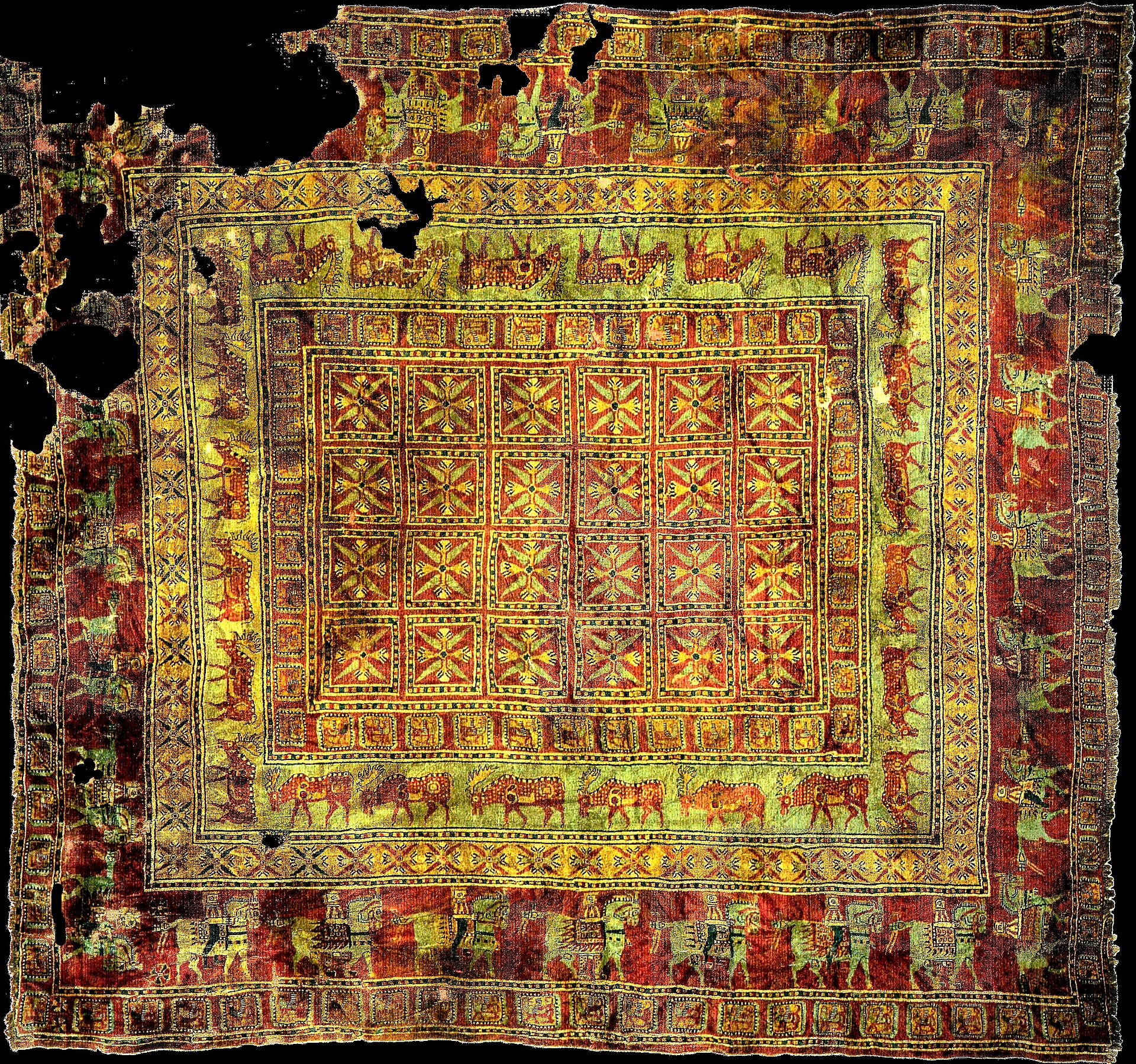
The pile carpet from Pazyryk barrow 5, in the Hermitage. A colour-corrected reproduction of a two-dimensional public-domain artwork; hues differ from other reproductions and should not be read as measurements. The uploader states it as own work and does not name the original photograph.
| Artist | Unknown weavers (Hither Asian or Altai workshop, unresolved) |
|---|---|
| Date | 5th to 4th century BC (buried c. 240 BC) |
| Medium | Wool, knotted pile on a wool warp, sheared |
| Dimensions | About 183 x 200 cm (1.89 x 2.0 m in the excavator's report) |
| Where it is now | State Hermitage Museum, St Petersburglast confirmed |
| Inventory number | 1687/93 (reported in a secondary source, not verified) |
| Attribution | DisputedNo document names the workshop. Full note |
| Object type | Textile |
| Period | Early Iron Age, Altai (findspot); Achaemenid sphere or Altai (workshop unresolved) |
| Cases | Disputed attribution · Has a provenance gap |
| Inscriptions | None |
| Owners on record | 5 links3 documented, 1 disputed, 1 unknown |
| Sources | 17 cited |
About this record Last verified · 17 sources cited · Change log
On this page 9 sections
ContentsClose
A knotted-pile carpet of about 1.2 million knots, woven in wool and buried in a frozen Altai tomb in about 240 BC, found by Sergei Rudenko in 1949 in the horse burial of the fifth Pazyryk barrow and held since in the Hermitage. Its excavator saw it as an Achaemenid Persian import; others have claimed it for Armenia or the Altai itself.
The barrow has since been tree-ring dated to about 240 BC, two centuries after Rudenko's estimate, and the carpet has never been dated on its own fibres. A 2021 X-ray study showed its wool was fermented before dyeing. No document names its weavers, and the question of where it was made is still open.
Provenance
Each link is graded. Documented: a cited source supports it. Disputed: the identification is argued but not established. Unknown: no owner for that span, and the gap is not smoothed into a narrative. The grades in the glossary.
- 5th to 4th century BC (unresolved) -Unknown weavers and first ownersdisputed
Place and date of weaving are not documented. Rudenko read the carpet as Hither Asian and Achaemenid in manner and dated it to the fifth century BC; the barrow itself is later. Armenian and local Altai origins are also argued.146
- - c. 240 BCUnknown, between weaving and burialunknown
Nothing records who owned or used the carpet before it was placed in the Pazyryk barrow, how long it had existed, or by what route it reached the Altai. Heavy fibre abrasion is recorded by the 2021 authors without interpretation.5
- c. 240 BC - 1949Buried in the horse burial of Pazyryk barrow 5, Altaidocumented
Placed with nine horses and a carriage in the northern shaft, behind the double wall of the burial chamber. The chamber was robbed in antiquity; the horse burial was left untouched. Tree-ring dating gives barrow 5 as the latest of the Pazyryk tombs, about 240 BC. The ice lens that preserved the contents formed after the barrow was built and arose by accident.16
- 1949 - 1949S. I. Rudenko and the Institute of the History of Material Culture, with the Hermitagedocumented
Excavated in 1949. A secondary source says 1947; Rudenko's own sequence puts barrow 5 in 1949.15
- 1949 - presentState Hermitage Museum, St Petersburgdocumented
Rudenko states that all Pazyryk material was deposited in the Hermitage. The carpet is described as in the Hermitage in all modern sources consulted. The inventory number could not be verified.125
Technical evidence
| Attribution note | No document names the workshop. Rudenko classed it as a Hither Asian import in Achaemenid manner; Schurmann and Gantzhorn have argued an Armenian origin; a local Altai origin is also argued. None is established. |
|---|---|
| Object | Woollen knotted-pile carpet, sheared pile15 |
| Dimensions | About 183 x 200 cm in Hermitage-derived summaries; 1.89 m by 2 m in the excavator's own report. The two figures are not reconciled in the sources consulted152 |
| Thickness | About 2 mm after the pile was sheared; fringe of 1 to 1.5 cm where the warp was cut1 |
| Knot density | 3,600 knots per square decimetre, about 1,250,000 in the whole carpet; knots tied on two warp threads1 |
| Warp and weft | About 120 warp threads per decimetre; the fixing weft passes over three or in places four knots after each knot row; outer two warp threads bound with wool1 |
| Design | Field of 24 framed cross-flower squares (6 by 4); five friezes: griffins, grazing fallow deer, stars, riders, griffins; colours dark red, light blue, greenish, bright yellow, orange1 |
| Dyeing | Red fibres of a loose carpet fragment show an aluminium distribution typical of fermented wool dyed with a madder and alum recipe in the authors' comparison5 |
| Date of the tomb | Barrow 5 construction at about 240 BC by tree-ring chronology; Rudenko's fifth-century date superseded for the barrow61 |
| Date of the carpet | Not independently dated. About 400 BC is a convention; no primary radiocarbon or tree-ring date of the carpet was found52 |
| Findspot | Pazyryk valley, Ulagan highlands, Altai Republic, Russia; barrow 5, horse burial in the north part of the shaft1 |
| Find | Excavated 1949 by S. I. Rudenko for the Institute of the History of Material Culture, with the Hermitage1 |
| Inventory number | Reported as 1687/93 in one secondary source that could not be opened; the Hermitage's series 1687 is the Pazyryk barrow 5 group (for instance 1687-100 for a shabrack). Not verified12 |
Images
The record in full
Chapter 1A sheared pile carpet 2,400 years old, saved because the horses were left alone
The Pazyryk carpet is a wool knotted-pile carpet that came out of the fifth great barrow of the Pazyryk valley in the Altai mountains of southern Siberia, where it had lain frozen since the barrow...
The Pazyryk carpet is a wool knotted-pile carpet that came out of the fifth great barrow of the Pazyryk valley in the Altai mountains of southern Siberia, where it had lain frozen since the barrow was closed. It is in the State Hermitage Museum in St Petersburg. It measures roughly 1.83 by 2.00 metres on the figures that circulate from the Hermitage side (its excavator gave 1.89 by 2 metres), carries about 3,600 knots to the square decimetre, and is usually called the oldest surviving knotted-pile carpet in the world. Its subject is a geometrical field of 24 framed cross-flower squares, a frieze of griffins, a frieze of grazing spotted deer, a border of stars and a wide border of riders and led horses, all in dark red, blue, green, yellow and orange.
Almost everything that is argued about it comes down to one question the excavator did not settle and nobody since has: who made it, and where. Sergei Rudenko, who dug the barrow in 1949, classed it in his own inventory as a pile carpet from Hither Asia and read its animals and riders as Achaemenid Persian in manner. Others have argued for an Armenian workshop, for a Persian one, and for a local Altai product. No document, workshop mark or inscription exists to decide between them. The record below keeps the object, the evidence and the three claims apart.
Chapter 2What the object is, thread by thread
Rudenko, who had the carpet in his hands, describes it as rectangular and slightly elongated, a sheared pile carpet in which the wool is knotted onto the warp row by row and then clipped level.
Rudenko, who had the carpet in his hands, describes it as rectangular and slightly elongated, a sheared pile carpet in which the wool is knotted onto the warp row by row and then clipped level. The warp ran at about 120 threads to the decimetre. After each row of knots a fixing weft passed over three or in places four knots. The knots were tied on two warp threads, the arrangement drawn in his figure 146, and the wool for the knots was only lightly twisted. The outer two warp threads were bound with wool to form the edge, with no taffeta finish of the kind found on later carpets. When the pile had been sheared the whole carpet was barely 2 millimetres thick, and where it was cut from its loom the warps left a fringe 1 to 1.5 centimetres wide.
His count was 3,600 knots to the square decimetre, which gives about 1,250,000 for the whole carpet. The figure of about 360,000 knots to the square metre that appears in modern summaries is the same density restated. The knot type is described in modern secondary literature as symmetrical, and as the Armenian double knot by those who argue an Armenian origin; the two names are used for the same structure and the choice of name carries an argument with it.
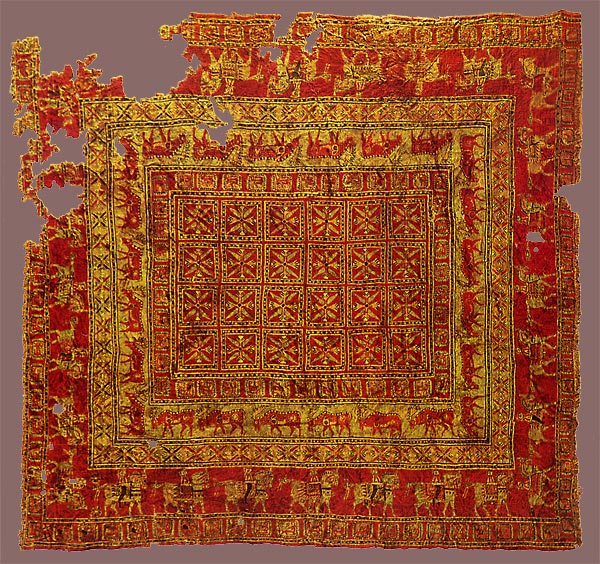
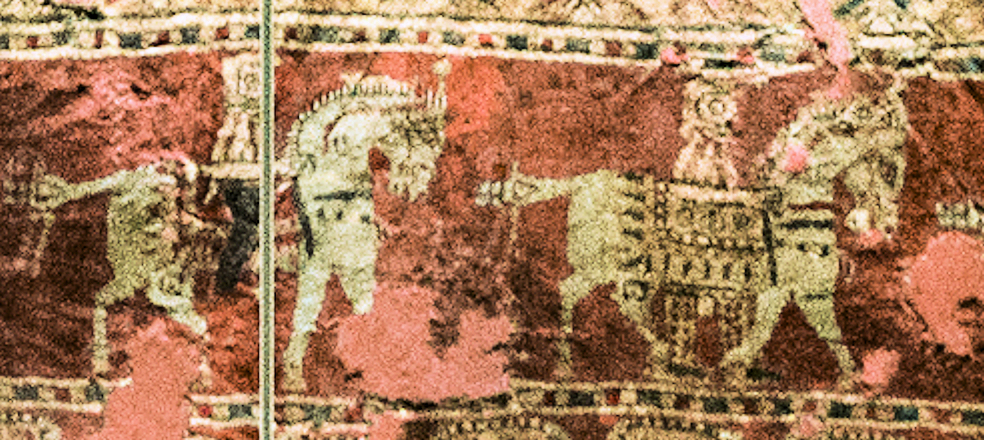
The field has six squares along its length and four across, each square holding a four-rayed star over a cross of four flowers with a square at the centre. A row of griffins with raised wing and turned-back head encloses the field. Beyond them walks a clockwise file of browsing spotted deer. A border of the star-and-flower pattern follows, then a wide frieze of hurrying riders travelling the opposite way, then an outer line of larger griffins facing the other way again. Five friezes in all, each held between rectangular strips. The palette Rudenko lists is dark red, light blue, greenish, bright yellow and orange, with soft tones predominating.
Today the carpet is incomplete. Its outer edges, especially at the top and the upper left, are lost in ragged patches, and photographs show the red of the borders much stronger than the field, where the yellows and greens have faded or shifted. Photographs of it differ in colour balance by a wide margin, and a reader comparing two plates should not treat either as a colour measurement.
Chapter 3How it was made, and what the dye work shows
Rudenko worked out labour from the knot count.
Rudenko worked out labour from the knot count. An experienced craftswoman in Central Asia or Asia Minor, he reckoned, tying 2,000 or 3,000 knots a day and working alone, would have needed eighteen months to finish a carpet this fine. That is an estimate by an excavator on a stated assumption about daily output, and it is the only published labour figure in the sources consulted.
The one scientific study of the carpet's fibres is Andreas Spath and colleagues, published in Scientific Reports in 2021, with Ludmilla Barkova of the Hermitage among the authors. They examined a loose fragment of the carpet supplied by the Hermitage for study, taking red fibres, and mapped the distribution of aluminium across single fibres with X-ray fluorescence imaging at the Paul Scherrer Institute in Switzerland. They compared the result with an eighteenth-century carpet from Konya, sampled with permission from the Museum for Islamic Art in Berlin, and with modern wool that they dyed with madder and alum, once after fermenting the wool in sourdough and wheat bran and once without. In the fermented wool the aluminium reached deep into the fibre; in the unfermented control it stayed in the outer cuticle. The Pazyryk and Konya fibres both showed the deep gradient, and the authors concluded that both were made from wool fermented before dyeing, a technique they note had been documented for Eastern Anatolia and was here shown to be older and wider than that.
Two limits belong beside that result. The authors took one fragment from one carpet and one sample from Konya; and the heavy abrasion of the Pazyryk fibres, stronger than on seventeenth and eighteenth century specimens they compared, removed the cuticle scales that would have shown fermentation directly, so the inference runs through the aluminium map alone. The study reports no radiocarbon date for the carpet and no inventory number.
A separate paper, by G. G. Balakina, V. G. Vasiliev, E. V. Karpova and V. I. Mamatyuk in Dyes and Pigments in 2006, analysed red dye from Pazyryk cloth dated to about 500 to 200 BC by liquid chromatography and spectroscopy and identified both plant colourants (alizarin and purpurin, from madder) and insect colourants (carminic acid and kermesic acid). The abstract in the source consulted does not say which Pazyryk textile or textiles were sampled, so it cannot be read as a finding about the carpet's reds.
Chapter 4Where it lay: the fifth barrow and its horse burial
The Pazyryk valley holds about forty structures, of which five are large barrows with stone cairns over timber burial shafts and nine are small ones.
The Pazyryk valley holds about forty structures, of which five are large barrows with stone cairns over timber burial shafts and nine are small ones. Rudenko's own count: the first large barrow was dug in 1929, the second in 1947 and 1948, the third and fourth in 1948 and the fifth in 1949. In the last season three small barrows were also opened. Rudenko had dug a stone enclosure in the valley himself as early as 1924 and found no burial in it.
Barrow 5 was the largest. The cairn was 42 metres across and 3.75 metres high with a deep hollow where robbers had dug in antiquity, ringed by an outer circle of standing stones. Beneath it a shaft 6.65 by 8.25 metres and 4 metres deep held a log burial chamber of 2.3 by 5.2 metres, 1.4 metres high, under three layers of logs, about sixty boulders and five more tiers of logs. Rudenko reckoned about two hundred and fifty logs and nearly a hundred large boulders in the filling, two of them 2.8 and 3.2 tonnes over the horse burial. When the two ceilings were taken off, the chamber was full of ice.
The chamber had been robbed. In every large barrow except the second, Rudenko writes, the thieves found the chambers free of ice and carried off clothing, felt wall hangings and household gear, down in barrow 3 to the arrowheads from their shafts. What survived did so by accident. The horse burials were different. They lay in the northern third of the shaft and behind the chamber wall, and the plunderers had never disturbed them. Rudenko supposes the robbers already knew what a horse burial held, saddlery and a few thin gold plates, and recognised that clearing a solidly frozen mass of horse bodies from behind a double wall beneath hundreds of tonnes of overburden was beyond a small gang. In barrow 1 they chopped a window toward one and gave up.
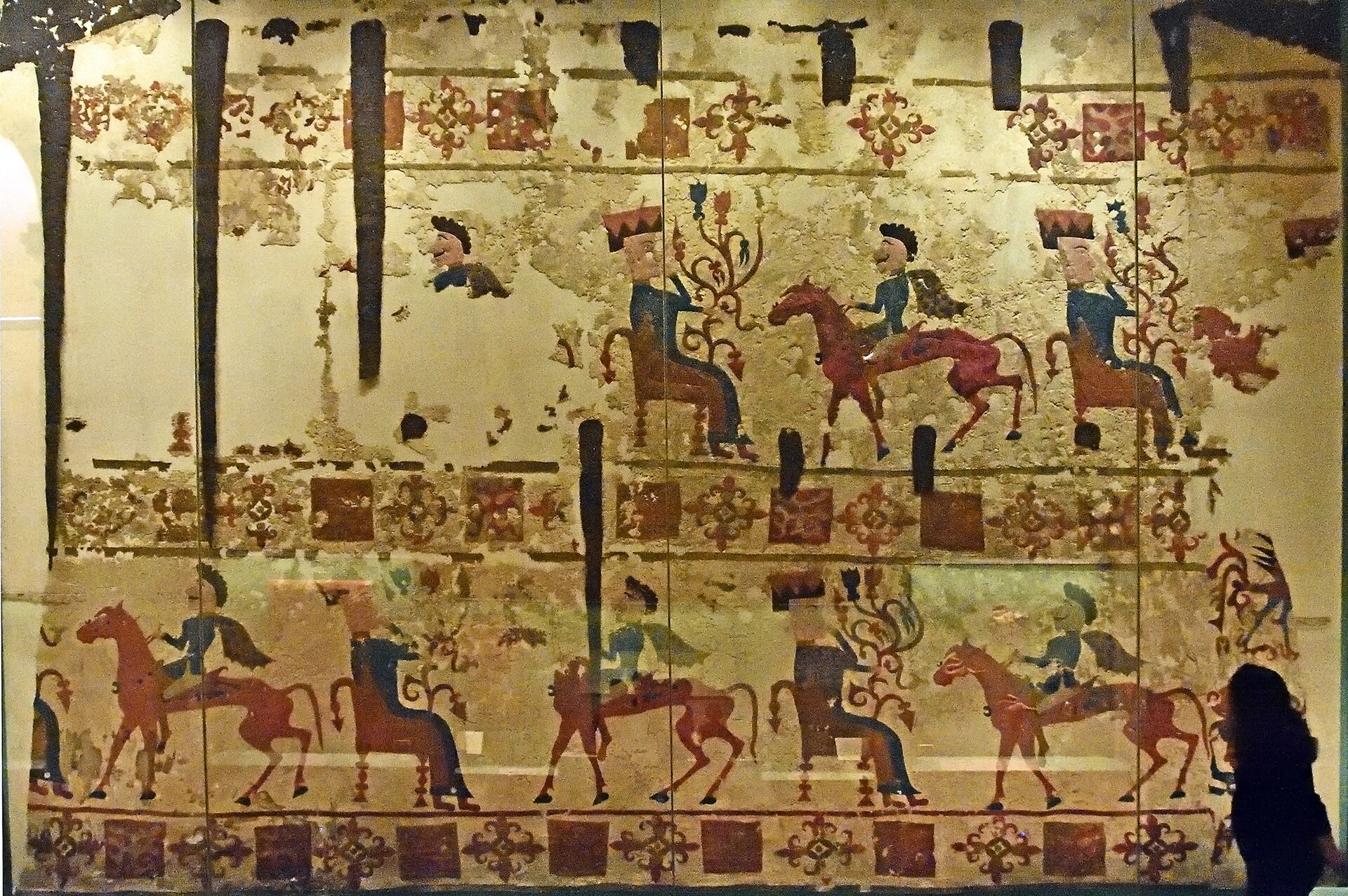
That is how the carpet came through. His inventory of the fifth barrow lists, in the horses' burial, nine horse bodies, five riding outfits, four draught-horse bridles, a four-wheeled carriage with a canopy of felt and twigs carrying sculptural felt swans, a large felt carpet or wall hanging showing a seated goddess and a rider, the pile carpet, and maral antler. A diagram of the north part of the shaft puts the pile carpet in the layer beside the carriage and the horse tails. Rudenko's text says that in the horse burial of barrow 5 there were two carpets, one pile and one felt, and the inventory gives the pile carpet as 'from Hither Asia'. How it was folded or laid is not described in the sections consulted.
Why the ice formed is also in Rudenko. The frozen ground took the shape of a lens beneath the barrow. The cairn of stones insulated the ground from the short summer thaw and, in winter, drew heat away faster than bare ground would, so each year's thaw was delayed and weakened. The builders had no intention of creating a refrigerator; it arose by accident. Burial shafts had been dug in unfrozen ground and the freezing came afterwards. Rudenko is explicit that permafrost does not normally exist in the Pazyryk valley.
Chapter 5The excavation of 1949 and the move to the Hermitage
Excavation at Pazyryk took place in 1929 under Mikhail Griaznov and from 1947 under the Institute of the History of Material Culture of the USSR Academy of Sciences, with the Hermitage taking part...
Excavation at Pazyryk took place in 1929 under Mikhail Griaznov and from 1947 under the Institute of the History of Material Culture of the USSR Academy of Sciences, with the Hermitage taking part from 1948. Rudenko states that all the material from Pazyryk was deposited in the Hermitage. That sentence is the whole documented ownership history of the carpet from its discovery to now: found by a state expedition, held by the state museum.
Thawing frozen tombs was a method, not a formality. Rudenko writes that Radlov, who opened the first two frozen Altai barrows in 1865, lit a fire on top of the ice; Griaznov and those after him applied hot water, bucket by bucket, which meant the whole excavation had to proceed slowly. In barrow 2 he saw a stool or pillow in the robbers' passage and wooden tables locked into the ice by their legs. The carpet was removed from its place in the northern shaft, taken off the stand, and, in Rudenko's words in the sections consulted, its warps cut to leave a fringe.
Sources disagree about the date of the find. Rudenko's own account puts the fifth barrow in 1949. The 2021 Scientific Reports paper says the carpet was found by Russian archaeologists in 1947, and a Wikipedia-derived account gives the excavation as 1949. The 1947 date is probably the start of the Altai campaign (barrows 2 to 4 were dug in 1947 and 1948) and not the carpet's own date; the paper does not say so. The record uses 1949.
Chapter 6Dating: a fifth-century carpet in a third-century tomb
Rudenko dated the Pazyryk barrows to the fifth century BC.
Rudenko dated the Pazyryk barrows to the fifth century BC. For the carpet he argued from its pictures: the riders' tails tied into a knot and the plumed forelocks that he found on the Persepolis reliefs, on the handle of a Persian sword from the Chertomlyk barrow and on the silver disc of the Oxus treasure, where a man walks beside a horse in a carpet-like shabrack just as on the carpet; the broad chest band, a form typical of Assyria but here handled in later Persian manner; the fallow deer with the comma and disc on the foreleg and a disc on the hind leg, details he called characteristic of Hither Asian animals in Achaemenid times; and the griffins, with a half horseshoe on the croup. Regardless of the workmanship, Median, Parthian or Persian, he concluded, the date of the carpet was in all probability the fifth century BC.
That date has not held for the barrow. Irina Panyushkina and colleagues, in Radiocarbon in 2007, built a composite 486-year larch tree-ring chronology from timbers of Altai tombs covering about 720 to 240 BC, and placed the earliest Pazyryk culture tomb construction at about 320 BC for the ordinary tombs and the latest at 240 BC, the date given for Pazyryk noble tomb number 5. Secondary accounts say the barrows are now dated to the fourth and third centuries BC, and that Rudenko's fifth-century date was revised. A dated tomb gives a terminus: the carpet was in the ground in or soon before 240 BC.
The tomb's date is not the carpet's date. A carpet buried in 240 BC may have been woven in 240, in 340 or earlier, and nothing in the barrow separates the possibilities. The carpet itself has no published radiocarbon or tree-ring date in anything fetched. Several popular and encyclopaedic accounts say radiocarbon testing placed it in the fifth century; no primary report of that test was found, and the one specialist paper on its fibres reports none. The figure about 400 BC that circulates is a convention. The record carries it as such.
Chapter 7Whose carpet? The three attributions
The origin of the carpet has three live attributions, each with a named proponent and a type of evidence.
The origin of the carpet has three live attributions, each with a named proponent and a type of evidence. None is documentary.
The first is Achaemenid Persian, or Hither Asian in the wider sense. It is Rudenko's. His reasoning is entirely iconographic and is set out above; he lists the carpet, together with a piece of woollen cloth with a lion design, among the Persian imports of barrow 5 that point, in his words, more definitely to fifth-century Achaemenid Persia. He does not name a city or workshop. He also compares it with a second, finer pile-carpet fragment from the earlier Bash-Adar barrow 2, used as a saddle cover, which has about 7,000 knots to the square decimetre and a different technique, and which he calls undoubtedly of Central or Hither Asian origin. Alois Riegl, cited in a Wikipedia summary, is named there as another who regarded it as an imported Persian work on the strength of its decoration; that citation was not checked against Riegl.
The second is Armenian. The German carpet scholar Ulrich Schurmann wrote in 1982, in a passage quoted in the English Wikipedia article on Armenian carpets, that he was convinced the Pazyryk carpet was a funeral accessory and most likely a masterpiece of Armenian workmanship. Volkmar Gantzhorn, in his 1998 Taschen book, agrees and adds that the horse design matches the Armenian delegation on a Persepolis relief. Support in that article is attributed to a 2013 study by Ashkhunj Poghosyan, deposited on Wikimedia Commons in English and Armenian (37 pages), and a 1987 Soviet conference paper by Gavrilenko, Rumyantseva and Glebovskaya on the dyes. Neither the Poghosyan text nor the 1987 paper was read for this record; their claims are reported only as the encyclopaedia reports them, and the article itself names no rival camp. Barbara Brend, in 1991, is cited there for naming Armenia as a possible origin and not for asserting it.
The third is local. The Pazyryk people were Saka horse nomads of the Altai, and Rudenko himself wrote, of the great felt wall hanging from the same barrow, that it was of local manufacture. The deer and the riders, an argument goes, are quintessentially Scythian. Against a local origin stands Rudenko's own reading of the carpet and the fact that the Altai culture left no settlements: the English Wikipedia article on the culture says none have been found.
The strongest reading of the state of play is the one Wikipedia gives: whether it was made where it was found or in Achaemenid workshops remains debated. A rug-retailer blog fetched for this record says its true origin is unknown, and no scholarly source fetched claims to have settled it.
Chapter 8Reading the pictures: what is documented and what is argued
Rudenko treats the carpet's imagery as evidence of place and date and not as a text.
Rudenko treats the carpet's imagery as evidence of place and date and not as a text. That is a documented position of the excavator and it needs no embellishment. The deer are fallow deer, not elk, as the spots, the muzzle and the build show, and Hither Asian fallow deer of Achaemenid date carry the same palmation of the antlers, the comma and disc, and a strip across the belly. The griffins are eagle-headed, large-eared, with tongue out and curled tail, a type he traces from neo-Assyrian art into Achaemenid. The riders canter on stallions without saddles, in carpet-like shabracks with chest bands, with their tails knotted and manes trimmed. On the Persepolis reliefs and on the Oxus disc a man walks at the left side of a horse with his right hand on its neck; the carpet shows the same pairing.
What the pictures meant to the weavers or to the people who used the carpet is not recorded in any source consulted. Rudenko does not offer a reading of the star-and-flower squares or of the cycle of deer, griffins and riders beyond their place in a Hither Asian repertoire. The Achaemenid court, he reports from Xenophon, used sheared carpets, and the city of Sardis was proud of its own, on which only the king was permitted to walk. That tells us what sheared carpets were at the Persian court; it does not tell us what this one was for.
The absence of a documented programme is a finding. Any statement about a royal procession, a tribute scene or a funerary rite on the carpet would come from a modern reader. The Armenian reading by Schurmann, that it was a funeral accessory, is one such statement and is argued, not documented; he attached it to the carpet's find in a tomb and not to any inscription. The felt wall hanging from the same barrow, with its seated figure holding a flowering branch and a rider before her, is another matter. Rudenko identified the figure with the Scythian goddess Tabiti or Apia from Herodotus. That reading is about the felt hanging, not the carpet, and is not carried across to it here.
Chapter 9What it cost: the money of the ancient carpet trade
No price for the Pazyryk carpet exists, and no sale or gift.
No price for the Pazyryk carpet exists, and no sale or gift. For scale Rudenko cites two Roman purchases of Babylonian dining-couch coverings from the classical authors: 800,000 sesterces paid by Metellus Scipio, which he converts to 62,000 roubles, and 4,000,000 sesterces paid by Nero, 315,000 roubles. These are his conversions at an unstated rate and period, they concern a different object type in the first century BC and first century AD, three or four centuries after the carpet was buried, and they are given here only to show that the best Hither Asian textiles could reach very large sums. No modern equivalent is offered.
Chapter 10Wear, loss and what survives
The carpet survives in a state its excavator describes as polychrome with soft tones, and with its design complete enough to read.
The carpet survives in a state its excavator describes as polychrome with soft tones, and with its design complete enough to read. Large outer areas are gone. Scientific Reports says the fibres show heavy surface abrasion with the cuticle scales missing in places, more than on carpets of the seventeenth and eighteenth centuries. The authors use scanning transmission X-ray microscopy on the carbon K-edge to check that the ancient fibres' chemistry had not shifted with age; they report no change that would invalidate the aluminium map. The same paper describes the carpet as still showing red and yellow.
The conservation history of the carpet in the Hermitage, any treatment, mounting or lighting regime, and the dates of any restorations are not in the sources consulted and are not stated here.
Chapter 11Copies, pictures and the carpet in public
The carpet is known above all through photographs, and the two most widely used Commons images of it differ visibly in colour.
The carpet is known above all through photographs, and the two most widely used Commons images of it differ visibly in colour. A published digital reconstruction by a rug retailer fills the lost corners to show a complete rectangle; its method is not described. Two replicas appear on Wikimedia Commons: one in the Carpet Museum of Iran, photographed on 22 March 2013, and one described as a restored sample made by the Armenian Megerian Carpet company, photographed on 12 December 2022. The existence of copies in Tehran and in Armenia is not evidence for either claim to the original; it shows only that both countries display the carpet as part of their own carpet history.
A further piece of the printed record is Karen Rubinson's 1990 article in Expedition, 'The textiles from Pazyryk: A study in the transfer and transformation of artistic motifs', which is cited by Leiden's Textile Research Centre and was not read for this record.
Chapter 12What is open now
Konstantinov and colleagues returned to the fifth barrow seventy years after Rudenko: a preliminary report in 2018 on the burial structure, and a 2022 paper in Archaeological Research in Asia on the...
Konstantinov and colleagues returned to the fifth barrow seventy years after Rudenko: a preliminary report in 2018 on the burial structure, and a 2022 paper in Archaeological Research in Asia on the frozen tomb. Neither could be opened for this record, and what they say about the carpet, if anything, is not known here. The Ukok Plateau, where the Ice Maiden was found in 1993, is a separate site; the legal and local objections to excavation there concern human remains, and no source fetched ties them to the carpet or to the Hermitage.
What would settle the origin is a second analysis the carpet has not had on the published record: a fibre and dye survey of several sampled points, tied to a radiocarbon date of the wool and to a comparative base of securely provenanced Achaemenid and Altai textiles. Until then the three attributions stay three.
The artist
Unknown weavers (Hither Asian or Altai workshop, unresolved)
The weavers are not known. The carpet is anonymous, undated by any method applied to the carpet itself, and unlocated: the three proposed homes are an Achaemenid workshop, an Armenian one and a local Altai one. What can be said about its makers is what can be read in the carpet: a loom with about 120 warps to the decimetre, a fine and uniform knot count, a pile sheared to 2 millimetres, an organised repertoire of friezes and a dye process that, on the 2021 evidence, included fermenting the wool. This is the work of a long-established craft and not of a first attempt, which is also the inference the 2021 authors draw.
Rudenko, who found it, is the man whose reading shaped the carpet's reputation. Born in Kharkov in 1885 and dead in Leningrad in 1969, he taught at Leningrad University from 1921 to 1954 and led the Pazyryk excavations of 1947 to 1950 and 1954. He gave the Pazyryk finds their culture's name and left the carpet an excavator's classification: from Hither Asia.
Related works
| Work | Relation | Where it is |
|---|---|---|
| Large felt wall hanging with a seated figure and a rider Local Altai felt workers (Rudenko) | Same barrow and same horse burial; different object Easily mistaken for the pile carpet, and mislabelled as the carpet on some Commons files. Rudenko calls it of local manufacture. | State Hermitage Museum, St Petersburg |
| Pile carpet fragment from Bash-Adar barrow 2 Unknown, Central or Hither Asian per Rudenko | Earlier pile carpet in the Altai; finer technique About 7,000 knots per square decimetre against 3,600; used as a saddle cover; sixth century BC by Rudenko. | Hermitage (Pazyryk material) |
| Woollen Hither Asian cloth with lions, shabrack cover Unknown | Another Persian import in barrow 5 Rudenko pairs the cloth and the carpet as pointing to fifth-century Achaemenid Persia. | State Hermitage Museum |
| Chinese embroidered silk on a shabrack, barrow 5 Unknown, Chinese | Evidence of trade contacts from the other direction Chain-stitch phoenix embroidery; Rudenko compares the type with Noin-Ula cloth. | State Hermitage Museum |
| Persepolis relief of foreign delegations Achaemenid court workshops | Comparison for the horse and walking-man pairing Cited by Rudenko for the knotted tail and plumed forelock and by Gantzhorn for an Armenian delegation; the two readings are not reconciled. | Persepolis, Iran |
| Eighteenth-century carpet from Konya Unknown, Anatolian | Comparison sample in the 2021 dye study Shows the same fermentation signature. | Museum fur Islamische Kunst, Berlin |
Open questions
- Where was the carpet made? Three attributions stand (Achaemenid, Armenian, local Altai) and no document, mark or analysis of the carpet itself decides between them.
- How old was the carpet when it was buried in or about 240 BC? Rudenko's fifth-century estimate rested on iconography, the tomb is later, and the carpet has no published radiocarbon or tree-ring date.
- How did it reach the Altai: gift, trade, tribute or an Altai-based workshop? No fetched source documents the route.
- Which red dye is on the carpet itself? Madder is demonstrated on the fragment studied in 2021, the 2006 chromatography found insect dyes on Pazyryk cloth, and the cochineal claim attached to the Armenian attribution rests on a 1987 paper not read.
- What is the correct Hermitage inventory number, and the exact current dimensions? The record has 1687/93 only from an unopened secondary source and two differing size figures.
- What did Konstantinov and colleagues' 2018 to 2022 re-examination of barrow 5 conclude about the horse burial where the carpet lay?
- Does the conservation file of the Hermitage record earlier restorations, and could a complete radiocarbon and fibre campaign be run on the carpet itself?
Questions about this object
What is The Pazyryk Carpet?
The Pazyryk Carpet is a textile, dated 5th to 4th century BC (buried c. 240 BC). Medium: Wool, knotted pile on a wool warp, sheared.
Who made The Pazyryk Carpet, and is the attribution settled?
The attribution to Unknown weavers (Hither Asian or Altai workshop, unresolved) is recorded here as disputed. No document names the workshop. Rudenko classed it as a Hither Asian import in Achaemenid manner; Schurmann and Gantzhorn have argued an Armenian origin; a local Altai origin is also argued. None is established.
Where is The Pazyryk Carpet now?
State Hermitage Museum, St Petersburg. Inventory number 1687/93 (reported in a secondary source, not verified). Last confirmed 2 August 2026. Deposited with the Hermitage after excavation in 1949; held there in all modern sources consulted.
What is still unknown about The Pazyryk Carpet?
Where was the carpet made? Three attributions stand (Achaemenid, Armenian, local Altai) and no document, mark or analysis of the carpet itself decides between them.
Sources
- 1Sergei I. Rudenko, Frozen Tombs of Siberia: The Pazyryk Burials of Iron Age Horsemen, translated by M. W. Thompson, University of California Press, 1970 (full text on the Internet Archive). Primary excavator's report. archive.org/details/...
- 2Wikipedia, 'Pazyryk carpet' (; Hermitage catalogue entry and a scholarly survey). en.wikipedia.org/wiki/...
- 3Wikipedia, 'Pazyryk burials' (; replace with Pankova and Simpson, Scythians, 2017). en.wikipedia.org/wiki/...
- 4Wikipedia, 'Armenian carpet' (; reports Schurmann 1982, Gantzhorn 1998, Poghosyan 2013; original publications). en.wikipedia.org/wiki/...
- 5Andreas Spath and others, 'X-ray microscopy reveals the outstanding craftsmanship of Siberian Iron Age textile dyers', Scientific Reports 11 (2021), article 5141, doi 10.1038/s41598-021-84747-z. pmc.ncbi.nlm.nih.gov/articles/...
- 6Irina Panyushkina, Igor Sljusarenko, Nikolai Bikov and Egor Bogdanov, 'Floating larch tree-ring chronologies from archaeological timbers in the Russian Altai between about 800 BC and AD 800', Radiocarbon 49(2), 2007, pp. 693-702 (abstract). cambridge.org/core/...
- 7G. G. Balakina, V. G. Vasiliev, E. V. Karpova and V. I. Mamatyuk, 'HPLC and molecular spectroscopic investigations of the red dye obtained from an ancient Pazyryk textile', Dyes and Pigments 71(1), 2006, pp. 54-60 (record and abstract at the Novosibirsk Institute of Organic Chemistry). sciact.nioch.nsc.ru/public/...
- 8Wikipedia, 'Persian carpet' (; the Achaemenid origin view and Rudenko's attribution). en.wikipedia.org/wiki/...
- 9Wikipedia, 'Pazyryk culture' (). en.wikipedia.org/wiki/...
- 10Textile Research Centre Leiden, 'Pazyryk Needlework' (cites Rubinson 1990, Expedition 32(1), pp. 49-61). trc-leiden.nl/trc-needles/...
- 11Paul Scherrer Institute, 'High-resolution XRF imaging yields insights into the dyeing' (news item, 8 March 2021). psi.ch/en/...
- 12Pushkin State Museum of Fine Arts, 'The woven splendour', page 'The origin of tapestry weaving' (gives Hermitage inventory number 1687-100 for a Pazyryk barrow shabrack, showing the 1687 series). conservation.pushkinmuseum.art/data/...
- 13Wikipedia, 'Sergei Rudenko' ( biography). en.wikipedia.org/wiki/...
- 14Wikimedia Commons file pages: File:Pazyryk.jpg and File:Pazyryk carpet.jpg (licence and source statements). commons.wikimedia.org/wiki/...
- 15Wikimedia Commons file pages for the replicas of the carpet: Carpet Museum of Iran (photograph 22 March 2013) and Megerian Carpet company sample (photograph 12 December 2022). commons.wikimedia.org/wiki/...
- 16Bakhtiyar (rug retailer blog), 'The Oldest Pile Carpet in Existence: Digitally Reconstructed' (commercial source; used only for the existence of the reconstruction). bakhtiyar.com/blog/...
- 17The History Blog, 'Fermented wool is the answer' type report on the 2021 study, 7 March 2021 (secondary). thehistoryblog.com


Last verified · Published
Change log
18 November 2026 - Record created at the house standard: researched narrative, technical evidence, maker dossier, graded provenance chain, prices with hammer and premium separated, related works, open questions and sources.