Coronation Mantle of Roger II
Royal Workshop of the Norman Court, Palermo (the khizana / dar al-tiraz) · 1133/34 CE (Hijri year 528)
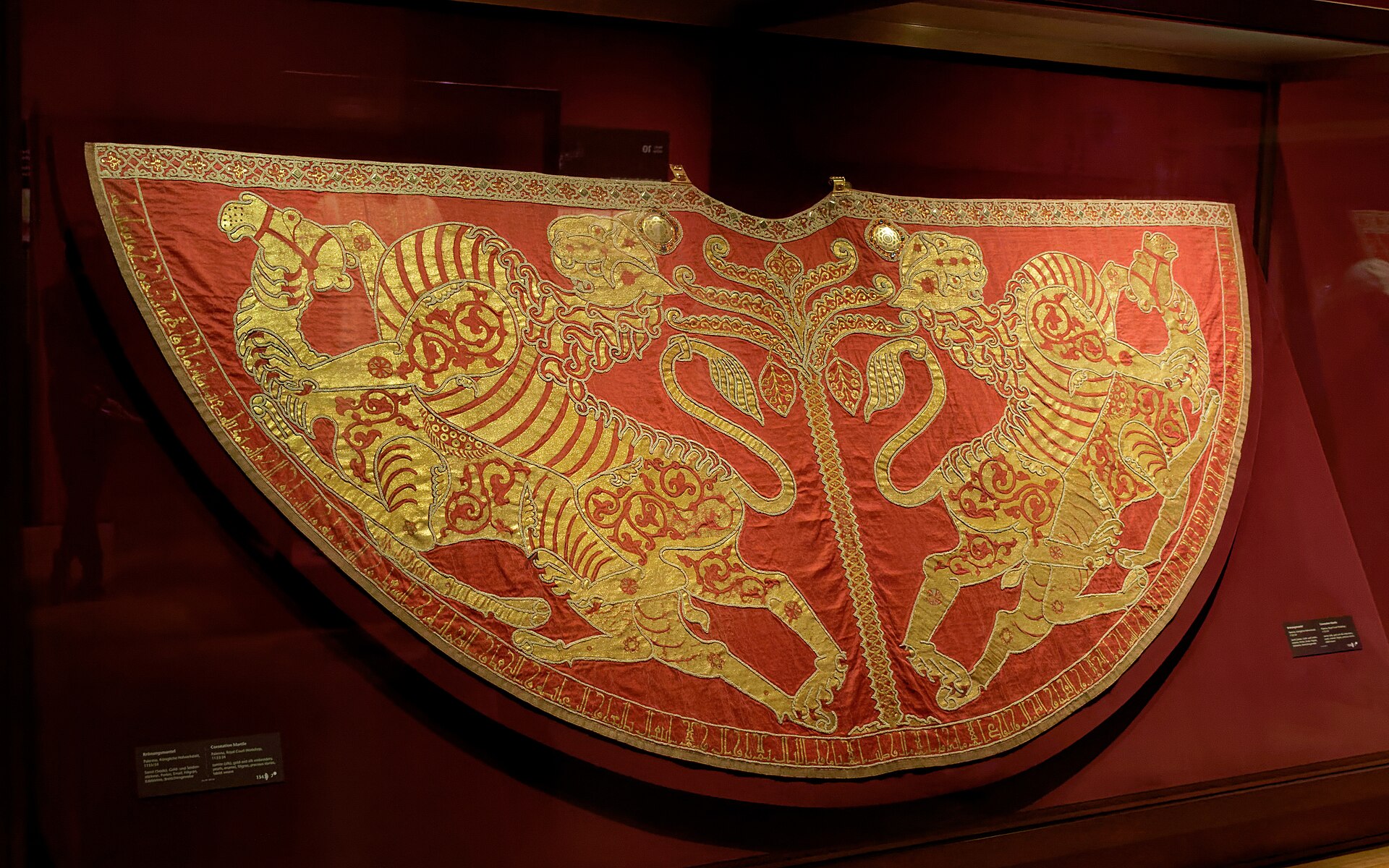
The mantle in full, showing the palm tree flanked by lions bringing down camels and the Kufic inscription along the hem. Photographed in the Weltliche Schatzkammer, Vienna.
Photo Markus Luttenberger, own work, Wikimedia Commons, CC BY-SA 4.0 · Photograph by Hlu1001| Artist | Royal Workshop of the Norman Court, Palermo (the khizana / dar al-tiraz) |
|---|---|
| Date | 1133/34 CE (Hijri year 528) |
| Medium | Red silk samite dyed with kermes, embroidered with gold thread (couched, brick-pattern) and coloured silk floss in chain stitch, set with pearls, gold cloisonne enamel plaques and gemstones |
| Dimensions | 345 cm across the straight edge by 146 cm to the curved hem (a semicircle). Reported weight varies sharply between sources, from about 11 kg to about 50 kg; the discrepancy is unresolved, see notes_for_editor. |
| Where it is now | Kunsthistorisches Museum Vienna, Weltliche Schatzkammer (Imperial Treasury), Hofburglast confirmed |
| Inventory number | WS XIII 14 |
| Attribution | AcceptedAttributed to the royal workshop (Arabic khizana, read by Isabelle Dolezalek as 'treasury' and by Jeremy Johns as 'wardrobe') inside the Palermo royal palace, on the evidence of the mantle's own Kufic inscription, which states it was made in that workshop in the capital of Sicily in the Hijri year 528 (1133/34 CE). Full note |
| Object type | Textile |
| Period | Norman Sicily, twelfth century (Hauteville dynasty) |
| Cases | Has a provenance gap · Seized, looted or confiscated · Restituted or repatriated |
| Inscriptions | A Kufic Arabic tiraz band embroidered along the curved hem. Carla Vernon's 2018 translation: 'This was made in the most royal, flourishing wardrobe, with good fortune, magnificence, splendour, perfection, might, superiority, generosity, prosperity, propitious fate, dignity, glory, beauty, attainment of desires and hopes, pleasure of days and nights without end or removal, with power, declaration of faith, vigilance, protection, good fortune, security, victory and capability, in the city of Sicily, in the year five-hundred and twenty-eight [1133-4 CE].' Other published translations vary in wording (rhyming Arabic prose, saj, does not translate uniquely) but agree on the workshop attribution and the date. |
| Owners on record | 10 links9 documented, 1 unknown |
| Sources | 12 cited |
About this record Last verified · 12 sources cited · Change log
On this page 9 sections
ContentsClose
A semicircle of red silk, embroidered with gold, pearls, enamel and gems, made in the royal workshop of Palermo in 1133/34 for Roger II of Sicily. Its Kufic Arabic inscription names the workshop and gives the date; its central image is a stylised tree of life flanked by two lions each bringing down a camel. The mantle was made by Muslim craftsmen for a Christian Norman king, and within a century it had become coronation regalia carried north through the Hohenstaufen inheritance to become, for nearly six hundred years, the garment in which Holy Roman Emperors were crowned.
It survived the dissolution of the Empire in 1806, a forced move to Nazi Nuremberg in 1938, and returned to Vienna's Imperial Treasury in 1946, where it remains on permanent display. It is one of the best-preserved large medieval textiles in existence and one of the clearest surviving objects to record the working relationship between Roger II's Latin Christian court and the Muslim artisans who staffed it.
Provenance
Each link is graded. Documented: a cited source supports it. Disputed: the identification is argued but not established. Unknown: no owner for that span, and the gap is not smoothed into a narrative. The grades in the glossary.
- 1133/34 -Roger II of Sicilydocumented
Made in the royal workshop in Palermo, per the mantle's own Kufic inscription, dated Hijri 528 (1133-4 CE).12
- 1133/34 - 1194The Sicilian royal treasury, Palermo (Roger II and his Hauteville successors)documented
Kept as crown property through Roger II's reign and those of William I, William II and Tancred. Carla Vernon has argued, on the basis of the ceremonies Roger conducted for his sons' investitures in 1134-5, that the mantle was made and used for that specific ceremonial purpose; this specific ceremonial use is argued, not documented by a direct record.1
- 1194 -Henry VI, Holy Roman Emperor, in right of his wife Constance (Roger II's daughter)documented
Henry VI, married to Constance since 27 January 1186, invaded Sicily after the Hauteville male line ended with Tancred's death, entered Palermo on 20 November 1194 and was crowned king of Sicily there on Christmas Day. Their son, the future Frederick II, was born the next day, 26 December 1194, at Iesi.67
- 1194 - 1246Unknownunknown
The mantle's specific custody in this period is not documented in the sources consulted for this record. A widely repeated but only tertiary-sourced account holds that Sicilian regalia were carried to Trifels Castle in Germany around 1194; the mantle is not securely attested in writing until a Trifels inventory of 1246. This gap is recorded as a gap.5
- 1246 - 14th centuryHoly Roman imperial regalia, Trifels Castle then Karlstejn Castle (Prague) under Charles IV, then Hersfeld Abbeydocumented
Sourced to a tertiary account (Wikipedia) and flagged for replacement with a primary chronicle or the KHM's own institutional history where one can be obtained.5
- 1423 - 1796Free Imperial City of Nuremberg, kept at the Church of the Holy Spirit (Heilig-Geist-Spital)documented
Displayed annually to the public at the Heiltumsweisung. This was the mantle's longest continuous single-location custody. In 1520, ahead of Charles V's Aachen coronation, the mantle was relined, reportedly at a Nuremberg convent of Poor Clares.35
- 1796 - 1800In transit: Regensburg, then Viennadocumented
Moved from Nuremberg to Regensburg in 1796 ahead of advancing French Revolutionary forces, then on to Vienna by 1800, where the Nuremberg regalia (including this mantle) were reunited with the separately evacuated Aachen regalia.5
- 1800 - 1938Imperial, then Austrian state, treasury, Viennadocumented
The Holy Roman Empire was dissolved in 1806 when Francis II renounced the title; the regalia, physically in Vienna at that moment, passed to Austria as the empire's legal successor.5
- 1938 - 1946Removed to Nuremberg by Nazi Germanydocumented
Taken from Vienna to Nuremberg in August 1938 on the initiative of Nuremberg mayor Willy Liebel, with Hitler's approval, following the Anschluss. Displayed at Nuremberg's town hall on 5 September 1938 and at subsequent party rallies; the imperial crown was placed in the Historischer Kunstbunker during the war, though this record could not verify the mantle shared that specific location.5
- 1946 - presentRepublic of Austria, Kunsthistorisches Museum Vienna, Weltliche Schatzkammerdocumented
Returned to Vienna by the American military government after the Second World War. On continuous public display since.25
Technical evidence
| Attribution note | Attributed to the royal workshop (Arabic khizana, read by Isabelle Dolezalek as 'treasury' and by Jeremy Johns as 'wardrobe') inside the Palermo royal palace, on the evidence of the mantle's own Kufic inscription, which states it was made in that workshop in the capital of Sicily in the Hijri year 528 (1133/34 CE). No individual maker is named. The use of the Islamic calendar in the inscription implies the embroiderers were Muslim, but this is an inference, not a record; Oleg Grabar's claim that the embroiderers were women has no supporting evidence and is not accepted by later specialists. |
|---|---|
| Base fabric | Red silk samite, a strong, heavy, glossy weave, dyed with kermes. Not woven in Sicily; almost certainly imported, most likely from the Byzantine weaving centres of Constantinople or Thebes.13 |
| Dimensions | 345 cm across the straight edge, 146 cm to the curved hem; a full semicircle.23 |
| Reported weight | Sources conflict sharply: about 11 kg (Wikipedia, tertiary), about 50 kg (Vernon 2018, peer-reviewed), about 54 kg (FUNCI). Not resolved here; flagged for the editor.145 |
| Embroidery technique | Couched gold thread worked in pairs in a brickwork pattern, with figural and inscriptional details picked out in floss silk chain stitch.3 |
| Gold thread composition | Metallurgical analysis by Marta Jaro found the thread to be 96 percent gold and 4 percent silver, markedly purer than later Sicilian-made additions to the regalia, which Jaro takes as evidence the thread was imported ready-made rather than produced in Sicily.1 |
| Pearls | Several thousand pearls of roughly uniform size and colour, sourced ultimately from Persian Gulf fisheries (Bahrain, Oman) according to the court geographer al-Idrisi's own account of the pearl trade, written at Roger's court in the early 1150s.1 |
| Enamels and gemstones | Gold cloisonne enamel plaques, probably made in the royal palace's own enamel workshop (compare the stauroteca of Robert Guiscard and the Bari ciborium plaque of Roger II), set alongside rubies, sapphires, spinels, garnets and glass.13 |
| Inscription | Kufic Arabic tiraz band along the curved hem, giving the workshop, the place of manufacture and the Hijri date 528 (1133-4 CE). Stylistically closer to Sicilian and Ifriqiyan epigraphy than to contemporary Fatimid tiraz.1 |
| Lining | Four fabrics of two dates: three from the 1130s (the fabric of the birds, the fabric of the dragons, the fabric of the tree of life, two Palermo-attributed and one traced to Khurasan), plus a semicircular lampas lining added in the early sixteenth century ahead of Charles V's 1520 coronation, reportedly worked at a Poor Clares convent in Nuremberg.12 |
| Condition | Exceptionally well preserved for a large twelfth-century silk textile; specialists working on it in person describe it as still arresting and impressive despite its age.1 |
Images
The record in full
Chapter 1A red silk semicircle, not a robe
The mantle is a single semicircle of red silk samite, 345 cm along its straight edge and 146 cm from that edge to the curved hem, fastened at the neck with a clasp set in precious stones and enamel.
The mantle is a single semicircle of red silk samite, 345 cm along its straight edge and 146 cm from that edge to the curved hem, fastened at the neck with a clasp set in precious stones and enamel. It is not cut or sewn into sleeves or a body; it is draped over the shoulders and falls open in a fan, which is the point of the shape. When worn, the entire surface of embroidery, gemstones and inscription is thrown outward and downward for an audience to see, rather than wrapped around a body the way a coat is.
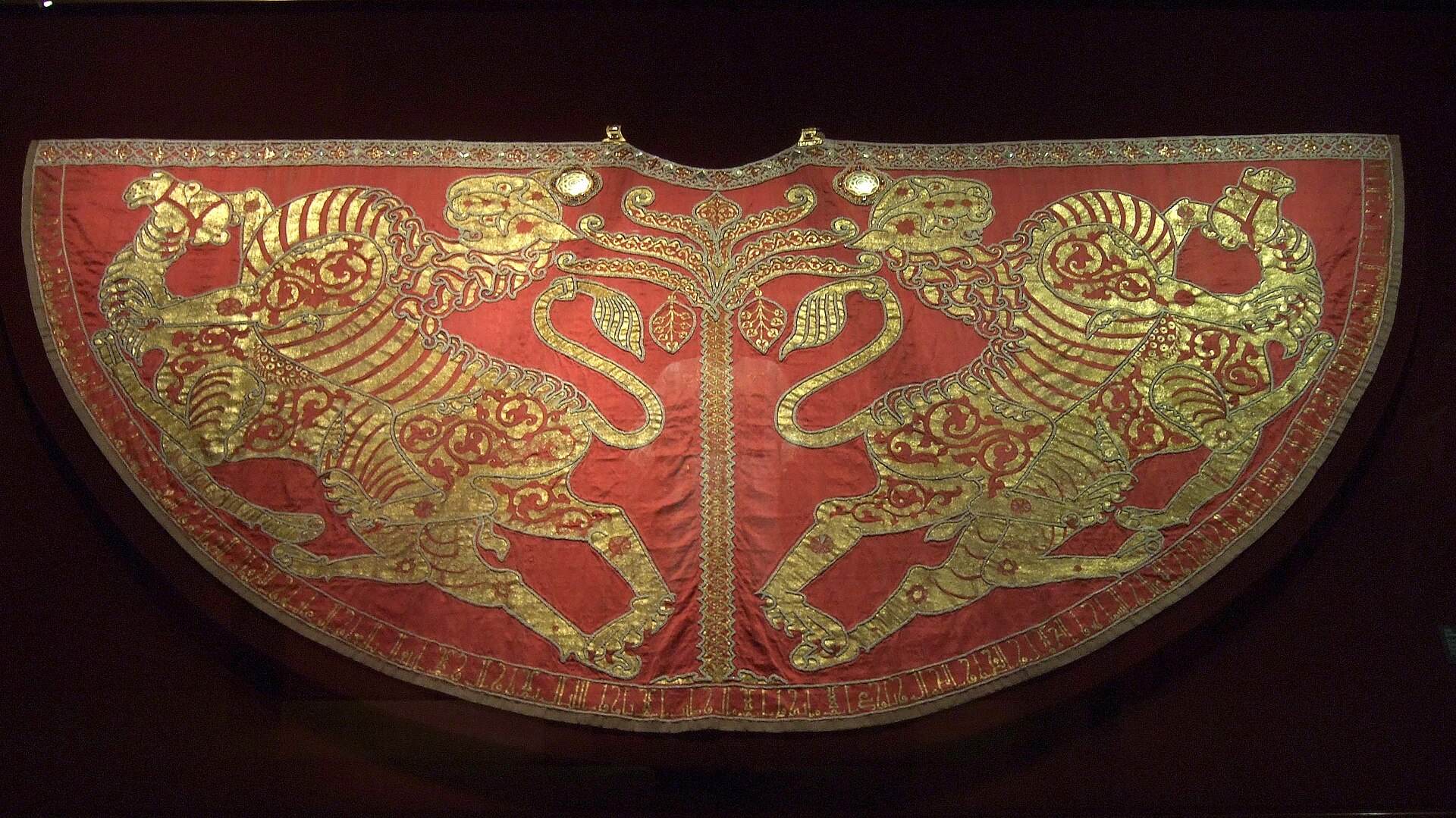
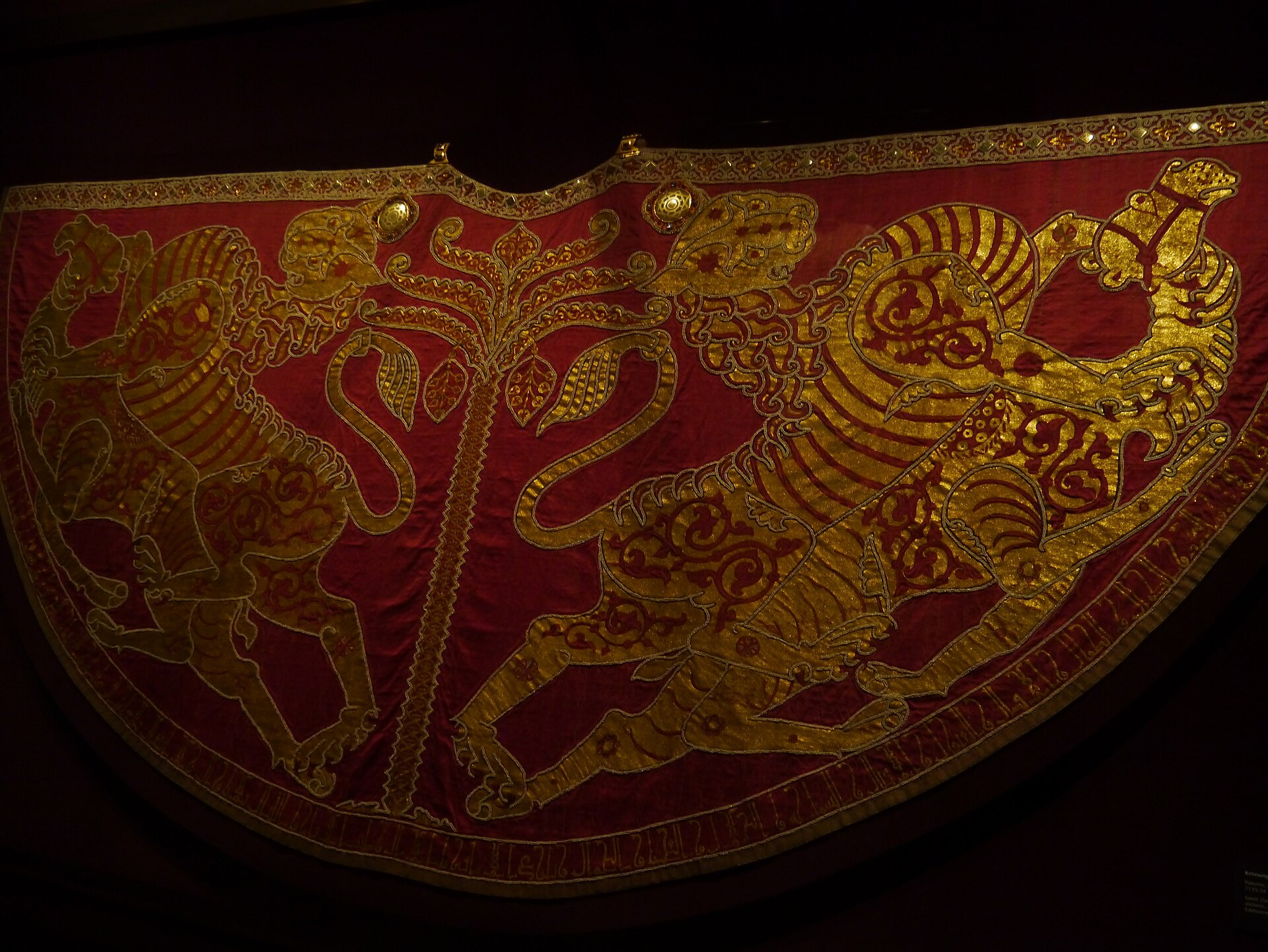
Dominating the centre is a stylised palm tree, the tree of life, flanked by two mirrored lions, each standing over a fallen camel. The design is worked in couched gold thread laid in a brickwork pattern, with details picked out in coloured silk floss in chain stitch, and it is set with pearls, gold cloisonne enamel plaques and gemstones including rubies, sapphires, spinels and garnets. A band of Kufic Arabic script runs along the curved hem.
Chapter 2What the inscription says
The inscription is not decorative filler.
The inscription is not decorative filler. It is a formal statement of manufacture, in rhyming Arabic prose (saj), naming the workshop and giving the date. In Carla Vernon's 2018 translation it reads: 'This was made in the most royal, flourishing wardrobe, with good fortune, magnificence, splendour, perfection, might, superiority, generosity, prosperity, propitious fate, dignity, glory, beauty, attainment of desires and hopes, pleasure of days and nights without end or removal, with power, declaration of faith, vigilance, protection, good fortune, security, victory and capability, in the city of Sicily, in the year five-hundred and twenty-eight.' Five-hundred and twenty-eight is a Hijri year, and it converts to 1133-4 CE. Other published translations differ in the exact string of honorifics, because saj does not translate into English uniquely, but every version agrees on the workshop, the place (the capital of Sicily, meaning Palermo) and the date.
The Arabic word for the place of manufacture is khizana. Isabelle Dolezalek, whose 2017 book Arabic Script on Christian Kings is the fullest study of the inscription's place within Islamic tiraz tradition, translates it as treasury; Jeremy Johns, who has mapped the Arabic dimension of Roger's court as a coordinated and coherent programme rather than an ornamental borrowing, translates it as wardrobe. Either way it names a workshop inside the royal palace precinct, not an independent commercial atelier. Dolezalek has also shown that the form of the inscription does not match contemporary tiraz bands from the Fatimid court in Cairo; stylistically it sits closer to epigraphy from Sicily and Ifriqiya (present-day Tunisia), which argues for a local Sicilian scribal tradition rather than an imported Egyptian one.
Chapter 3Whose lion, whose camel
The lion-over-camel image has drawn more scholarly attention than any other feature of the mantle, and the range of readings is wide.
The lion-over-camel image has drawn more scholarly attention than any other feature of the mantle, and the range of readings is wide. The oldest and most repeated reading treats it as a straightforward discourse of dominance and submission: the lion as the Christian king Roger, the camel as his defeated Muslim subjects. Carla Vernon's 2018 survey of the literature notes the problem with this directly: there is no evidence that the camel functioned as a symbol of Islam or of Muslims in any contemporary source. It is a reading built backward from the conqueror's identity, not forward from period evidence.
William Tronzo, in a 2001 essay on the mantle, argued instead that the lion and camel stand for noble and disgraced rulership as general categories, not for Christian and Muslim as religious categories, and that the image works together with the inscription to present Roger's kingdom as a blessed place to live under a legitimate king. Oleg Grabar has read the same image as a depiction of the heavens, an astrological rather than a political statement, though this reading has attracted less sustained argument than Tronzo's. Vernon herself, without discarding the iconographic question, argues that too much attention has gone to the images and too little to the materials: worn and moving, draped over a shoulder, the embroidered scene would have been largely illegible to onlookers, while the glitter of gold, pearls and enamel in motion was visible from across a hall or a procession route. On her reading, the iconography mattered to the court and to close viewers; the impact on a wider audience came from the materials themselves, and from what acquiring them at that scale said about the reach of the king's merchants and his diplomacy.
No scholar cited here treats the design as a piece of unthinking luxury borrowed wholesale from a shared Mediterranean pattern book. All read it as meaningful. They disagree, precisely and on record, about what the meaning was.
Chapter 4A coronation mantle made after the coronation
The garment is generally called a coronation mantle, but Roger II was crowned king of Sicily on Christmas Day 1130, and the inscription dates the mantle's manufacture to 1133-4, three to four years...
The garment is generally called a coronation mantle, but Roger II was crowned king of Sicily on Christmas Day 1130, and the inscription dates the mantle's manufacture to 1133-4, three to four years later. Rotraud Bauer, cataloguing the piece for the 2006 Palermo exhibition Nobiles Officinae, concluded that there was no important court ceremony at that specific moment and that the mantle was made simply for the pleasure Roger took in the imagery, with no ceremonial function attached.
Vernon's 2018 article argues the opposite, on internal evidence from Roger's own reign. In 1133-5, Roger II was consolidating the succession of his three eldest sons, investing Roger III as Duke of Apulia, Tancred as Prince of Bari, and Alfonso as Prince of Capua, in ceremonies documented by the contemporary chronicler Alexander of Telese. Investiture ceremonies elsewhere in this period, such as the 1172 investiture of Richard the Lionheart as Duke of Aquitaine, involved formal robing; a thirteenth-century commentary on the Aquitaine ordo states that dukes were given a silk mantle and a small crown in emulation of Holy Roman imperial ritual. Vernon proposes that the Sicilian mantle functioned as a version of the Byzantine chlamys, the semicircular cloak that in Byzantine court protocol marked the rank of nobilissimus, the highest rank a person outside the imperial family could hold, a title that had passed through Robert Guiscard to the dukes of Apulia and so, potentially, to Roger III. On this argument the mantle was made for the investiture of Roger's own heir, not for his own coronation, and 'coronation mantle' is a later, imprecise label attached once the garment had a different career in a different court. This is an argued case built on documented court ceremonies and Byzantine protocol, not a settled fact; it is presented here as the strongest published account of the mantle's original occasion, against Bauer's contrary and equally published view that it had none.
Chapter 5How the materials reached Palermo
Sicily in the 1130s had no tradition of weaving high-quality silk; the samite base fabric was imported, almost certainly from Byzantine territory, with Constantinople and Thebes as the two major...
Sicily in the 1130s had no tradition of weaving high-quality silk; the samite base fabric was imported, almost certainly from Byzantine territory, with Constantinople and Thebes as the two major twelfth-century centres of samite production and Thebes the more likely single source. Byzantine silk export was tightly controlled by imperial authority even as a private industry developed through the century, and Italian merchants from Venice, Amalfi, Gaeta, Bari and Genoa traded in it; only Venetians are recorded trading specifically at Thebes in this period. Obtaining a piece of samite at this scale and quality was a demonstration of commercial and diplomatic reach as much as of wealth.
The pearls, several thousand of them and needed in a roughly uniform size and colour, came from further away again. There were no pearl fisheries in the Mediterranean. The Muslim geographer al-Idrisi, who wrote his Geography at Roger's own court in the early 1150s, describes the Persian Gulf as the centre of the pearling industry, naming Sohar, Bahrain, Muscat and Julfar as the major fisheries and stating in his own words that 'it is in the Persian Gulf that nearly all the pearl fisheries exist... the fisheries of the Gulf are richer and more productive than those in the seas of India and Yemen.' Roger's merchants would have obtained the pearls either directly from Gulf fisheries or through the intermediate markets of Cairo or Constantinople; the vast quantity needed for the mantle, and the fact that this appears to be the first pearl-encrusted garment made at Roger's court, suggests a purpose-built purchase rather than a draw against an existing hoard, involving a year or more of planning and new commercial relationships.
Metallurgical analysis by Marta Jaro found the gold thread to be 96 per cent gold and 4 per cent silver, a notably higher gold content than later Sicilian-made additions to the same royal regalia, which Jaro reads as evidence that this thread, too, was imported ready-made rather than produced locally; the closest technical parallel is the roughly contemporary coronation mantle of the kings of Hungary, and the likeliest common source for both is a gold-thread workshop in Constantinople. The enamel plaques were probably made closer to home, in the royal palace's own enamel workshop, the same workshop credited with the so-called stauroteca of Robert Guiscard and the ciborium plaque at San Nicola in Bari showing Roger II crowned by the saint.
Chapter 6The lining under the lining
The mantle carries four separate lining fabrics, of two different dates.
The mantle carries four separate lining fabrics, of two different dates. Three belong to the 1130s and are contemporary with the mantle itself: silk tapestries known from their motifs as the fabric of the birds, the fabric of the dragons and the fabric of the tree of life. Two are stylistically close to a corpus of textiles otherwise attributed to Palermo workshops from the tenth century onward, blending Coptic-derived iconography with figures dressed in Byzantine manner; the third is thought to have come from Khurasan, in Central Asia. Isabelle Dolezalek reads the deliberate use of these older fabrics and older epigraphic conventions as an 'intentional display of political continuity with a legitimising function,' tying the new mantle to a stock of textiles already in the palace treasury, some acquired as diplomatic gifts, some inherited from earlier rulers, some taken as war booty.
The fourth lining, a semicircular lampas weave, was added later, in the early sixteenth century, ahead of Charles V's 1520 coronation at Aachen; the relining work is reported to have been carried out at a convent of Poor Clares in Nuremberg, where the regalia were then kept. The medieval linings survive underneath it and remain visible, decorated with dragons, birds, human figures and gold flowers on a gold ground.
Chapter 7From a Muslim workshop to a Christian imperial rite
The mechanism by which a garment made by Muslim craftsmen in a Norman Sicilian palace became, within a century, the coronation vestment of the Holy Roman Emperors runs through one marriage.
The mechanism by which a garment made by Muslim craftsmen in a Norman Sicilian palace became, within a century, the coronation vestment of the Holy Roman Emperors runs through one marriage. Roger II's posthumous daughter Constance, born to his third wife Beatrice of Rethel, married the future Emperor Henry VI on 27 January 1186 in Milan. When the male Hauteville line failed with the death of Tancred of Lecce in February 1194, Henry VI invaded Sicily in his wife's right, entered Palermo on 20 November 1194 and was crowned king of Sicily there on Christmas Day. Constance gave birth to their son the following day, 26 December 1194, at Iesi near Ancona; that child, christened Constantine and later known as Frederick-Roger, became the Emperor Frederick II, Roger II's grandson through his mother.
What happened to the Sicilian royal treasury, and to this mantle specifically, in the immediate aftermath of the 1194 conquest is not established by any source consulted for this record to the standard the rest of this record holds itself to. General accounts state that Henry VI's forces took possession of Norman Sicily's royal treasures at Palermo; a widely repeated but only tertiary-sourced account holds that the regalia were carried north to Trifels Castle in Germany around 1194, but the mantle is not securely documented in writing until an inventory of Trifels made in 1246, half a century later. This gap is recorded as a gap, not bridged with a guess: the object's whereabouts and custody between the fall of Norman Sicily and 1246 are not documented in the sources this record could verify.
A further, genuinely disputed question sits inside this transmission: whether Frederick II personally wore this exact mantle at his imperial coronation in Rome in 1220. At least one account holds that he did not, and that the garment associated with that specific ceremony was a different Sicilian-workshop piece; this record treats the question as open rather than settled in either direction, because the only sources found making a specific claim are not of a standard this record can rely on alone. What is not in dispute is that Sicilian royal regalia, including gloves made in the same royal workshops for Frederick II bearing the nimbed single-headed eagle of Hohenstaufen heraldry, entered Holy Roman imperial use in this generation, and that this mantle was established as part of that regalia by the time it is next securely documented.
Chapter 8Six centuries in Nuremberg and Prague
Once inside Holy Roman imperial custody, the regalia including this mantle moved with the Empire's own shifting centres of gravity.
Once inside Holy Roman imperial custody, the regalia including this mantle moved with the Empire's own shifting centres of gravity. Accounts consistent with the museum's own record place the collection at Karlstejn Castle near Prague under Charles IV in the fourteenth century, and at the Imperial Abbey of Hersfeld, before Nuremberg secured the regalia in 1423 and held them, with brief exceptions, for the following three and a half centuries. In Nuremberg the regalia were kept at the Church of the Holy Spirit (Heilig-Geist-Spital) and brought out for annual public display at the Heiltumsweisung, a ceremony showing the relics and regalia to crowds of pilgrims and citizens. This was the mantle's longest single period of continuous custody in one place.
Chapter 9Dissolution, Vienna, and the Empire that outlived itself by name only
The French Revolutionary Wars ended Nuremberg's custody.
The French Revolutionary Wars ended Nuremberg's custody. In 1796, with French troops advancing, the Nuremberg regalia were evacuated to Regensburg, and in 1800 they were moved on to Vienna, where they were reunited with the separate Aachen regalia (moved from Aachen in 1794 for the same reason) after an interim stop at Hildesheim. The Holy Roman Empire itself was dissolved in 1806, when the last emperor, Francis II, renounced the title under pressure from Napoleon. At that moment the regalia were physically in Vienna, and under the ordinary rule that an ownerless estate passes to the state where it is physically located, they became the property of the Austrian Empire that Francis had already founded in 1804 as a fallback title for himself. The mantle has been Austrian state property, not the property of any restored or continuing empire, since that year.
Chapter 10Nuremberg again, briefly, under different management
In August 1938, months after the Anschluss annexation of Austria, the imperial regalia including this mantle were removed from Vienna and transported back to Nuremberg on the personal initiative of...
In August 1938, months after the Anschluss annexation of Austria, the imperial regalia including this mantle were removed from Vienna and transported back to Nuremberg on the personal initiative of the city's Nazi mayor, Willy Liebel, and with Hitler's approval, to draw a symbolic line between the medieval Reich and the self-styled Greater German Reich. The regalia were shown publicly in Nuremberg's town hall on 5 September 1938, guarded by SS men, to mark Hitler's reception for that year's Nuremberg Rally, then kept in St Catherine's Church and displayed again at subsequent party rallies in the NSDAP Congress building. During the war the crown itself was moved into the Historischer Kunstbunker, an underground vault beneath Nuremberg Castle; whether the mantle specifically shared that particular vault or was stored elsewhere in the city's wartime arrangements is not established in the sources consulted here.
After the war, the American military government arranged for the regalia to be returned to Austria. Since 1946 the mantle has been back in Vienna, on continuous public display in the Imperial Treasury of the Hofburg, now the Weltliche Schatzkammer of the Kunsthistorisches Museum.
Chapter 11The rest of the ensemble, and why this record stops at the mantle
The mantle is the largest and best-known piece of a wider set of Sicilian-workshop garments that make up the historic coronation vestments of the Holy Roman Emperors, all now in the same Weltliche...
The mantle is the largest and best-known piece of a wider set of Sicilian-workshop garments that make up the historic coronation vestments of the Holy Roman Emperors, all now in the same Weltliche Schatzkammer in Vienna: an alb (tunicle) of Sicilian work dated 1181, worn under the mantle; a pair of gloves of thirteenth-century Sicilian work, bearing the nimbed eagle associated with Frederick II; and a pair of knee-high stockings of twelfth-century Sicilian work, catalogued as WS XIII 12. A separate object entirely, the Coronation Evangeliary (Kroenungsevangeliar, WS XIII 18), a Carolingian-period gospel book used for the emperor's coronation oath, is sometimes discussed alongside the vestments because it was part of the same ceremony, though it has no connection to the Sicilian workshop or to Roger II. These objects share a display room, a royal workshop of origin (in the case of the alb, gloves and stockings) and a coronation function with the mantle, and are noted here for that relationship; none of them is this record's subject, and none of their facts should be read onto this one.
The artist
The Royal Workshop of the Norman Court, Palermo (khizana / dar al-tiraz)
No individual is named on the mantle or in any surviving document as its maker. What is documented is the institution: a royal workshop inside the Palermo palace precinct, referred to in the mantle's own inscription by the Arabic word khizana, staffed at least in part by Muslim craftsmen under a Christian Norman king, and responsible for a small, identifiable group of surviving luxury objects that together give the fullest picture available of court production under Roger II.
Related works
| Work | Relation | Where it is |
|---|---|---|
| Coronation gloves Royal workshop, Palermo | Sibling piece of the same Holy Roman coronation regalia set; same royal Sicilian workshop tradition, made for Frederick II and bearing the Hohenstaufen nimbed eagle 13th-century Sicilian work; not the subject of this record. | Kunsthistorisches Museum Vienna, Weltliche Schatzkammer |
| Coronation alb (tunicle) Royal workshop, Palermo | Sibling regalia piece, worn under the mantle in the coronation rite Dated 1181 by its own inscription. | Kunsthistorisches Museum Vienna, Weltliche Schatzkammer |
| Coronation stockings (Die Struempfe) Royal workshop, Palermo | Sibling regalia piece, same Sicilian workshop tradition 12th-century Sicilian work, inventory WS XIII 12. | Kunsthistorisches Museum Vienna, Weltliche Schatzkammer |
| Coronation Evangeliary (Kroenungsevangeliar) Carolingian-period scriptorium (not the Palermo workshop) | Used in the same imperial coronation rite, displayed in the same Schatzkammer, but a wholly separate object with no connection to Roger II or Sicily Inventory WS XIII 18. Included here only to prevent confusion; it is not Sicilian and not related in origin. | Kunsthistorisches Museum Vienna, Weltliche Schatzkammer |
| Stauroteca of Robert Guiscard Royal enamel workshop, Palermo (attributed) | Comparanda for the mantle's enamel plaques; despite its name, made long after Guiscard's death Cited by Vernon 2018 as evidence for the palace's own enamel production. | Museo Diocesano, Palermo (per Nobiles Officinae catalogue) |
| Ciborium plaque of Roger II crowned by St Nicholas Royal enamel workshop, Palermo (attributed) | Enamel comparanda, and a rare contemporary image of Roger II himself in a devotional context Cited by Vernon 2018. | Basilica di San Nicola, Bari |
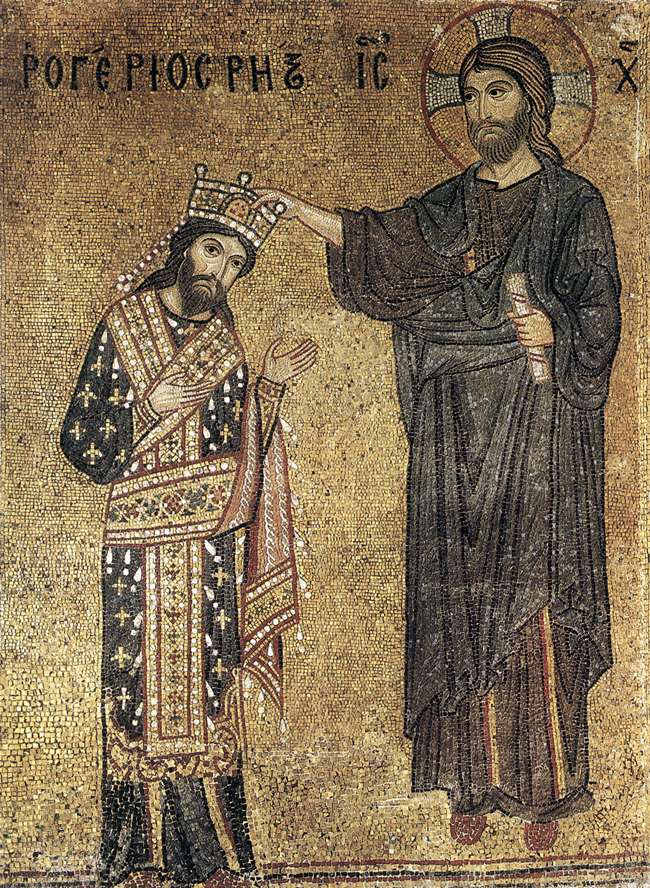
| Christ Crowning Roger II, mosaic Unknown mosaicist, Norman Sicilian court workshop | Contemporary image of Roger II in Byzantine court dress (the loros), used by William Vernon and others to argue Roger's court understood and emulated Byzantine ceremonial dress conventions This is a wall mosaic, not the mantle and not a textile object; included strictly as iconographic comparanda. It shows Roger II, not this garment. | La Martorana (Santa Maria dell'Ammiraglio), Palermo |
Open questions
- Was the mantle made for a specific ceremony at all? Vernon (2018) argues it was made for the investiture of Roger II's sons around 1134-5; Bauer (2006) concluded there was no ceremony and it was made purely for the pleasure of the imagery. Both are published, specialist positions and they contradict each other directly.
- Did Frederick II personally wear this exact mantle at his imperial coronation in Rome in 1220, or a different Sicilian-workshop garment? At least one source claims the latter; this record could not verify the claim to its own standard and records the question as open rather than resolved.
- What did the mantle weigh? Published figures range from about 11 kg to about 50 kg, a difference too large to be rounding, and no source consulted here reconciles the two figures or explains the method behind either.
- Where and in whose custody was the mantle between the fall of Norman Sicily in 1194 and its first secure documentary appearance, in a 1246 inventory at Trifels Castle? No source consulted here documents this half-century.
- Who actually embroidered it? The Islamic calendar in the inscription implies Muslim craftsmen; Oleg Grabar's specific claim that they were women is unsupported and not accepted here. No names or workshop personnel records survive.
- Was the mantle among the objects Henry VI's forces are generally said to have taken from the Sicilian royal treasury after the 1194 conquest, or did it reach the Hohenstaufen court by some other, undocumented route? The general seizure of Sicily's treasury is documented; this specific object's presence in it is not.
- Did the mantle share the Historischer Kunstbunker vault beneath Nuremberg Castle with the imperial crown during the Second World War, or was it stored elsewhere in the city between 1938 and 1945? Sources consulted here document the crown's wartime location but not the mantle's specifically.
Questions about this object
What is Coronation Mantle of Roger II?
Coronation Mantle of Roger II is a textile, dated 1133/34 CE (Hijri year 528). Medium: Red silk samite dyed with kermes, embroidered with gold thread (couched, brick-pattern) and coloured silk floss in chain stitch, set with pearls, gold cloisonne enamel plaques and gemstones.
Who made Coronation Mantle of Roger II, and is the attribution settled?
The attribution to Royal Workshop of the Norman Court, Palermo (the khizana / dar al-tiraz) is recorded here as accepted. Attributed to the royal workshop (Arabic khizana, read by Isabelle Dolezalek as 'treasury' and by Jeremy Johns as 'wardrobe') inside the Palermo royal palace, on the evidence of the mantle's own Kufic inscription, which states it was made in that workshop in the capital of Sicily in the Hijri year 528 (1133/34 CE). No individual maker is named. The use of the Islamic calendar in the inscription implies the embroiderers were Muslim, but this is an inference, not a record; Oleg Grabar's claim that the embroiderers were women has no supporting evidence and is not accepted by later specialists.
Where is Coronation Mantle of Roger II now?
Kunsthistorisches Museum Vienna, Weltliche Schatzkammer (Imperial Treasury), Hofburg. Inventory number WS XIII 14. Last confirmed 27 August 2026. Continuous institutional custody of the former Holy Roman imperial regalia, now Austrian state property, on permanent public display in the Weltliche Schatzkammer.
What is still unknown about Coronation Mantle of Roger II?
Was the mantle made for a specific ceremony at all? Vernon (2018) argues it was made for the investiture of Roger II's sons around 1134-5; Bauer (2006) concluded there was no ceremony and it was made purely for the pleasure of the imagery. Both are published, specialist positions and they contradict each other directly.
Sources
- 1Carla Vernon, 'Dressing for Succession in Norman Italy: The Mantle of King Roger II', Al-Masaq: Journal of the Medieval Mediterranean (2018). Peer-reviewed article; author's accepted manuscript consulted. eprints.bbk.ac.uk/id/...
- 2Kunsthistorisches Museum Vienna, official object database, 'Der Kroenungsmantel', inventory WS XIII 14. khm.at/en/...
- 3Textile Research Centre Leiden, 'Mantle of Roger II of Sicily'. trc-leiden.nl/trc-needles/...
- 4FUNCI (Fundacion de Cultura Islamica), 'The mantle of Roger II: the legacy of a multicultural society'. funci.org/the-mantle-of-roger-ii-the-legacy-of-a-multicul...
- 5Wikipedia, 'Coronation cloak'. en.wikipedia.org/wiki/...
- 6Wikipedia, 'Henry VI, Holy Roman Emperor'. en.wikipedia.org/wiki/...
- 7Wikipedia, 'Constance I of Sicily'. en.wikipedia.org/wiki/...
- 8Wikimedia Commons, File:Coronation Mantle of the Holy Roman Empire.jpg, (licence and photographer verification, checked via the Commons API on 2026-08-27). commons.wikimedia.org/wiki/...
- 9Wikimedia Commons, File:Kroenungsmantel HRR detail.jpg, . commons.wikimedia.org/wiki/...
- 10Wikimedia Commons, File:Kroenungsmantel.JPG, . commons.wikimedia.org/wiki/...
- 11Wikimedia Commons, File:Wien Hofburg Schatzkammer Ornat 1.JPG, . commons.wikimedia.org/wiki/...
- 12Wikimedia Commons, File:Unknown artist - Christ Crowning Roger II - WGA16269.jpg, (Web Gallery of Art source, PD-old). commons.wikimedia.org/wiki/...


Last verified · Published
Change log
27 August 2026 - Record created at the house standard: researched narrative, technical evidence, maker dossier, graded provenance chain, prices with hammer and premium separated, related works, open questions and sources.