The Resolute Desk
Morant, Boyd and Blanford, designers, with William Evenden, joiner, Royal Naval Dockyard, Chatham · 1880
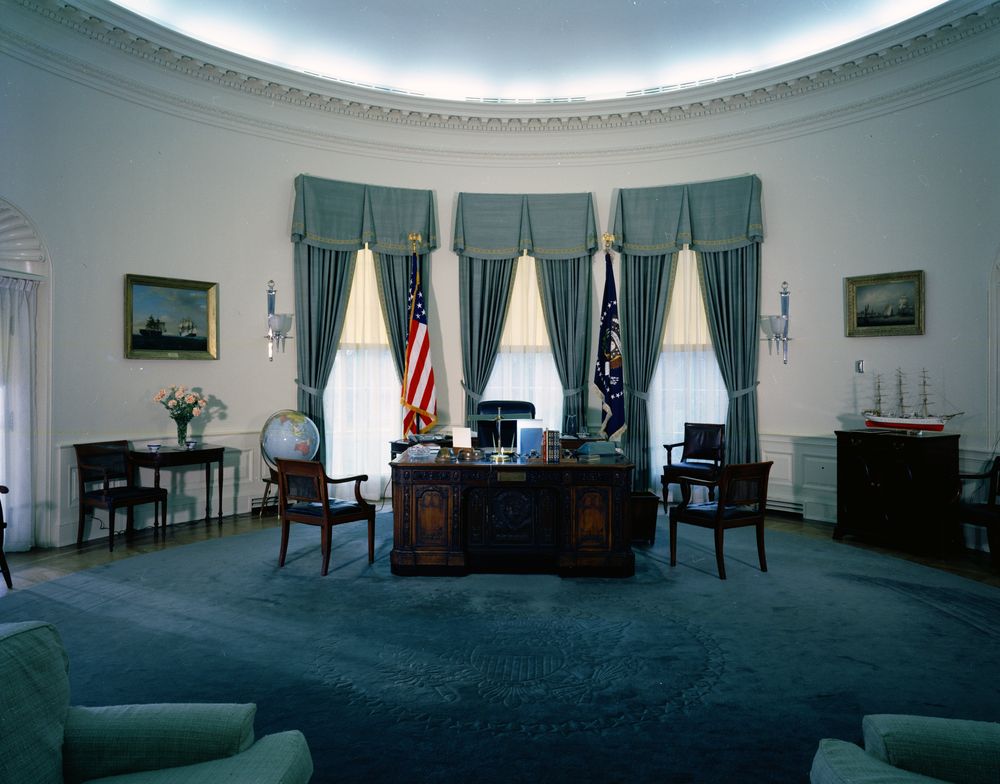
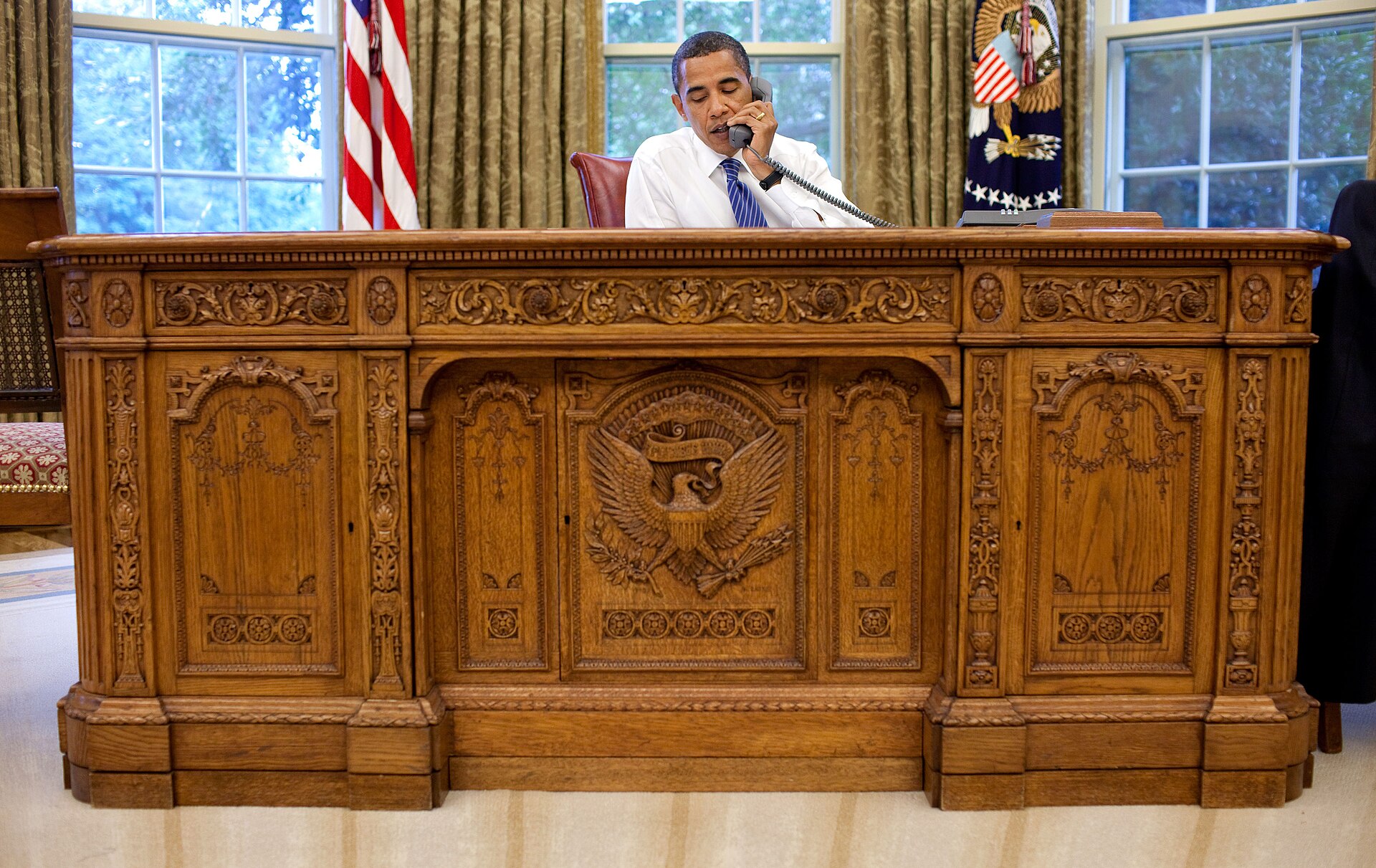
The desk photographed alone in the Oval Office on 24 May 1961, the year Jacqueline Kennedy first brought it up from ground-floor storage into the room. A clean, unobstructed view of the desk itself, not to be confused with the later, more famous photograph of John F. Kennedy Jr. peering from its kneehole.
| Artist | Morant, Boyd and Blanford, designers, with William Evenden, joiner, Royal Naval Dockyard, Chatham |
|---|---|
| Date | 1880 |
| Medium | Oak (with, per the White House Historical Association, some mahogany) timbers from the retired Arctic exploration ship HMS Resolute; tooled leather writing surface; a hinged kneehole panel of carved oak bearing the Presidential coat of arms was added in 1945 |
| Dimensions | Approximately 72 x 48 x 32.5 in (183 x 122 x 83 cm); weight reported at approximately 1,300 lb (590 kg) |
| Where it is now | The Oval Office, The White House, Washington, D.C.last confirmed |
| Inventory number | White House Collection (no public accession number located in the sources reviewed) |
| Attribution | AcceptedThe design is documented as the work of the London decorating and cabinet-making firm Morant, Boyd and Blanford of 91 New Bond Street, upholsterers and decorators to Queen Victoria; the original design drawing survives at the National Maritime Museum, Greenwich. Full note |
| Object type | Furniture |
| Period | British, Victorian, 1880 |
| Inscriptions | A brass plate on the desk reads, transcribed here in plain text: 'The H.M.S. Resolute, forming part of the expedition sent in search of Sir John Franklin in 1852, was abandoned in Latitude 74 degrees 41 minutes N. Longitude 101 degrees 22 minutes W. on 15th May 1854. She was discovered and extricated in September 1855, in Latitude 67 degrees N. by Captain Buddington of the United States Whaler George Henry. The ship was purchased, fitted out and sent to England, as a gift to Her Majesty Queen Victoria by the President and People of the United States, as a token of goodwill and friendship. This table was made from her timbers when she was broken up, and is presented by the Queen of Great Britain and Ireland, to the President of the United States, as a memorial of the courtesy and loving kindness which dictated the offer of the gift of the Resolute.' |
| Owners on record | 10 links10 documented |
| Sources | 17 cited |
About this record Last verified · 17 sources cited · Change log
On this page 9 sections
ContentsClose
A double-pedestal partners' desk built in 1880 from the oak of HMS Resolute, a Royal Navy Arctic ship abandoned in the ice in 1854, salvaged by an American whaling captain, and returned to Britain by Congress as a gesture of goodwill. When the ship was finally broken up in 1879, Queen Victoria had part of her timber made into a desk and sent it back to Washington as an answering gift, presented to President Rutherford B. Hayes in November 1880.
For eighty years afterward it was not the Oval Office desk at all; that room did not yet exist, and once it did, other desks served it. Jacqueline Kennedy brought the Resolute desk up from ground-floor storage in 1961, and its now-famous 1945 kneehole panel, and the myth that Franklin Roosevelt ordered it to hide his wheelchair, both belong to a story the White House Historical Association has since corrected in its own archives. The desk left the Oval Office again after Kennedy's assassination, spent over a decade touring and on loan to the Smithsonian, and came back only because Jimmy Carter asked for it in January 1977.
It has been the working Oval Office desk for every president since, with one term's exception under George H. W. Bush, through a brief 2025 removal for refinishing and back. It has never been sold; its entire history since 1880 is a single unbroken line of government and royal custody, which this record treats as the finding it is rather than leaving unexplained.
Provenance
Each link is graded. Documented: a cited source supports it. Disputed: the identification is argued but not established. Unknown: no owner for that span, and the gap is not smoothed into a narrative. The grades in the glossary.
- 1850 - 1854Royal Navy (HMS Resolute)documented
HMS Resolute, purchased and fitted out for Arctic service in 1850, served in the search for Sir John Franklin's lost expedition of 1845 and was abandoned, frozen in ice, on the orders of Sir Edward Belcher, by her captain Henry Kellett, on 15 May 1854, at the position later engraved on the desk itself. This is not custody of the desk, which did not yet exist, but the origin of the material it was later built from.56
- 1854 - 1856George Henry (American whaler, Captain James Buddington) and, following purchase, the United States Congressdocumented
The abandoned Resolute drifted nearly 1,200 miles before being found still largely intact by the whaler George Henry off Baffin Island in September 1855. Congress purchased her for $40,000, had her refitted, and returned her to Queen Victoria as a gift of goodwill, presented at East Cowes on 13 December 1856.56
- 1856 - 1879Royal Navydocumented
Resolute remained in Royal Navy hands for a further two decades before being paid off and broken up at the Royal Naval Dockyard, Chatham, in 1879, at which point her timbers became available for the gift furniture.86
- 1879 - 1880Commissioned by Queen Victoria; designed by Morant, Boyd and Blanford; built by William Evenden, Chathamdocumented
The desk was designed by the London firm Morant, Boyd and Blanford, upholsterers and decorators to the Queen, and physically constructed from the ship's salvaged oak by the joiner William Evenden at Chatham.8910
- 23 November 1880 - 1961White House / United States federal governmentdocumented
Presented by Queen Victoria to President Rutherford B. Hayes; arrived at the White House on 23 November 1880. The desk remained White House property throughout this period but was not the Oval Office desk, since the room itself did not exist until 1909 and was served by other desks (the Theodore Roosevelt Desk, then the Hoover Desk) through 1961; the desk's own location within the White House across most of these eight decades is only partially documented (see open questions), though Franklin Roosevelt's use of it in his private second-floor study during his own term is specifically recorded.12367
- 1961 - 1963White House (Oval Office use begins)documented
Brought up from a ground-floor storage room and installed in the Oval Office for President John F. Kennedy by First Lady Jacqueline Kennedy and decorator Sister Parish during the 1961 redecoration, the desk's first use in that room in its eighty-one year history.1413
- 1963 - 1977White House storage, then Kennedy Library traveling exhibition (1964-65), then Smithsonian Institution (1966-1977)documented
Following Kennedy's assassination, President Johnson chose his own desk instead; Nixon and Ford, after him, used a different desk still. The Resolute desk itself was lent to a Kennedy Library traveling exhibition in 1964-65 and then to the Smithsonian Institution, where it was displayed at the National Museum of American History from 1966 to 1977.127
- January 1977 - 1989White House (Oval Office)documented
President Jimmy Carter requested the desk's return to the White House and to Oval Office use in January 1977; President Reagan continued to use it from 1981.12
- 1989 - 1993White House storage (desk not in the Oval Office)documented
President George H. W. Bush used his own long-favored C and O desk in the Oval Office instead for the whole of his single term; where the Resolute desk itself was kept during these years is not documented in the sources reviewed.17
- 1993 - presentWhite House (Oval Office)documented
Returned to the Oval Office by President Clinton in 1993 and used since by every president through the current administration, aside from a brief removal for refinishing reported in February-March 2025.1715
Technical evidence
| Attribution note | The design is documented as the work of the London decorating and cabinet-making firm Morant, Boyd and Blanford of 91 New Bond Street, upholsterers and decorators to Queen Victoria; the original design drawing survives at the National Maritime Museum, Greenwich. The physical construction is documented as the work of William Evenden, a joiner at the Royal Naval Dockyard, Chatham, where HMS Resolute was broken up. Both attributions are corroborated across the White House Historical Association and Chatham Historic Dockyard Trust, which holds local institutional memory of Evenden's yard, and are not disputed in any source consulted. |
|---|---|
| Materials | Oak timbers salvaged from HMS Resolute, broken up at Chatham in 1879; the White House Historical Association's own account also specifies some mahogany.1 |
| Form | A double-pedestal partners' (kneehole) desk, carved with moldings and floral swag decoration.108 |
| Dimensions | Approximately 72 in wide by 48 in deep by 32.5 in high (183 x 122 x 83 cm).610 |
| Weight | Reported at approximately 1,300 lb (590 kg).10 |
| Writing surface | A single hide of tooled leather set into the desktop; published descriptions of its exact color are inconsistent and are not resolved in this record.6 |
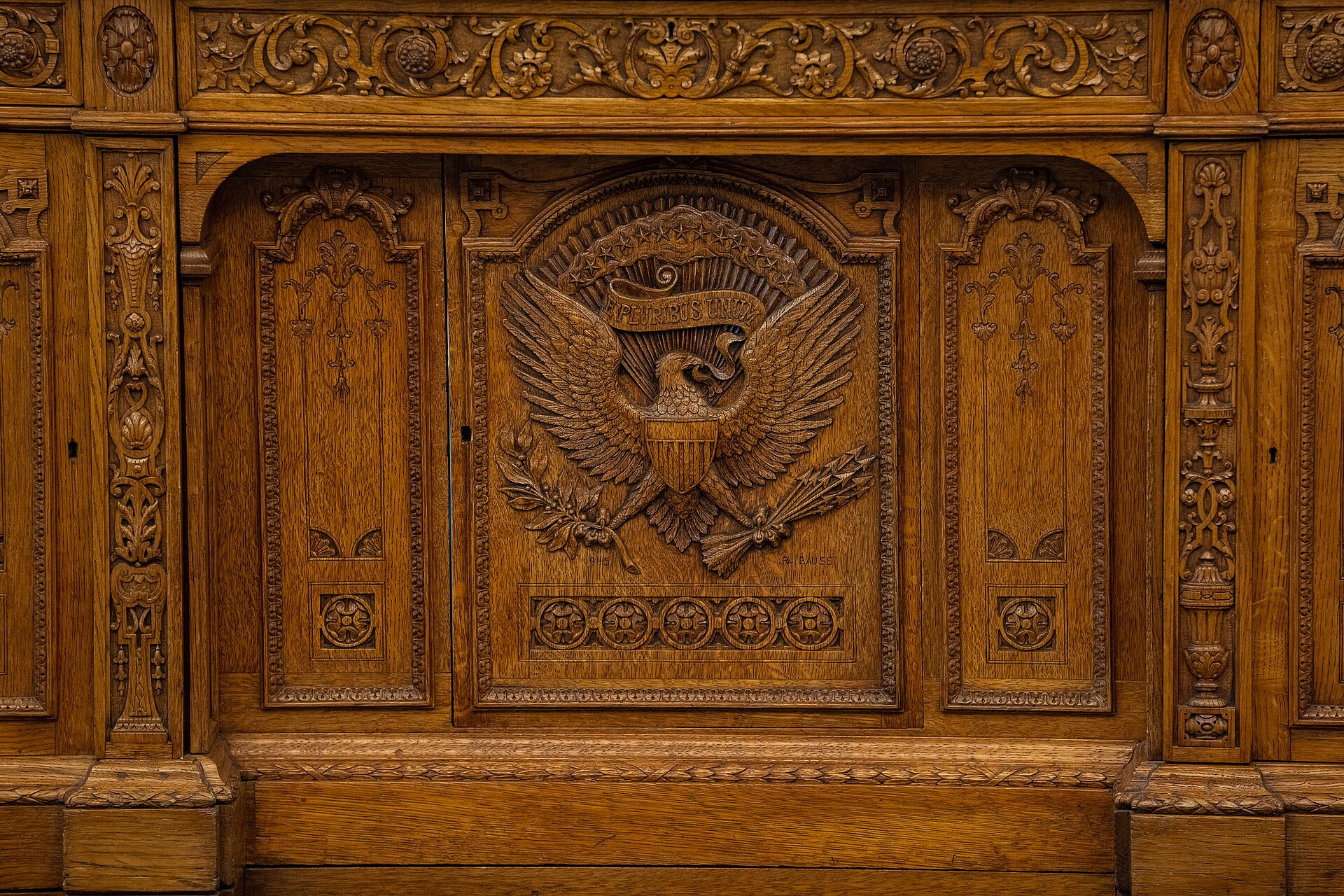
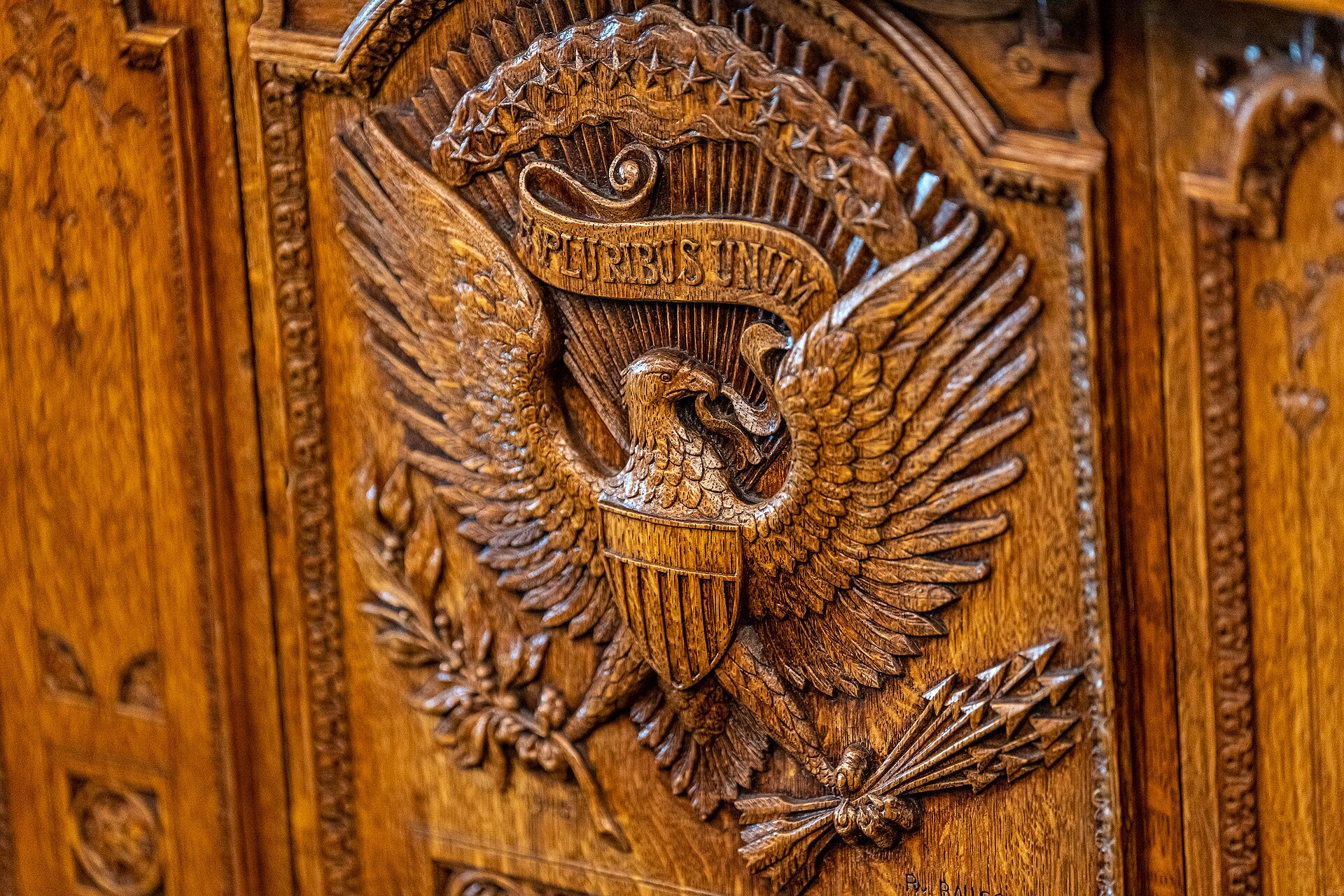
| Kneehole panel | A hinged oak panel carved with the Presidential coat of arms, closing the front kneehole. Designed by White House architect Lorenzo Winslow (drawings dated 13 June 1945) and carved by Rudolph Bauss of the National Park Service; installed by August 1945. Not part of the desk's original 1880 construction.3 |
| Inscription | An engraved brass plate on the desk records HMS Resolute's abandonment position and date, her 1855 recovery, and the terms of the 1880 gift; see Inscriptions above for the full transcription.610 |
| Plinth | A low plinth beneath the desk's legs, adding roughly two inches of height, is documented in photographs but its installation date is reported inconsistently across sources (variously 1961, or a later Reagan- or Clinton-era change); not resolved here.6 |
Images
The record in full
Chapter 1What it is
A large double-pedestal partners' desk, roughly six feet wide, built in 1880 from the oak timbers of a decommissioned Royal Navy Arctic exploration ship.
A large double-pedestal partners' desk, roughly six feet wide, built in 1880 from the oak timbers of a decommissioned Royal Navy Arctic exploration ship. It is a kneehole desk in the English partners' tradition, with a leather-topped writing surface and, since 1945, a hinged front panel carved with the Presidential coat of arms closing the kneehole from view. It has stood in the Oval Office, on and off, since 1961, and is the desk most Americans alive today picture when they picture the presidency.
It is not a unique survival. Two related pieces were made from the same broken-up ship at the same time: a smaller writing table for Queen Victoria herself and a desk given to the widow of the expedition's chief American backer. This record concerns the one built for the President of the United States, now in the White House.
Chapter 2How it was made, and by whom
The design is credited to Morant, Boyd and Blanford, a London decorating and cabinet-making firm at 91 New Bond Street that held the royal warrant as upholsterers and decorators to Queen Victoria.
The design is credited to Morant, Boyd and Blanford, a London decorating and cabinet-making firm at 91 New Bond Street that held the royal warrant as upholsterers and decorators to Queen Victoria. Kelly's London Post Office Directory of 1871 describes the firm as 'interior decorators, painters, upholsterers, estate and housing managers, carvers, gilders and cabinet makers,' and its clients over the decades had included Thomas Lawrence, Robert Peel, and the Dukes of Sussex, Cambridge, and Sutherland. Its original design drawing for the desk, showing plan, elevation and section, survives at the National Maritime Museum in Greenwich.
The design was one thing; building it from salvaged ship's timber was another, and that work was carried out at the Royal Naval Dockyard at Chatham, Kent, by a joiner named William Evenden after HMS Resolute was broken up there in 1879. Evenden built at least three pieces from the ship's oak: the presidential desk, the desk for Henry Grinnell's widow, and Queen Victoria's own writing table. Chatham Historic Dockyard Trust, which holds the institutional memory of its own Joiners' Shop, is the source for Evenden's name and role; no biographical detail about him beyond his post at the yard has turned up in the sources consulted.
Chapter 3The ship the desk came from
HMS Resolute was a barque-rigged Royal Navy vessel, built as the merchant ship Ptarmigan and purchased and renamed for Arctic service in 1850.
HMS Resolute was a barque-rigged Royal Navy vessel, built as the merchant ship Ptarmigan and purchased and renamed for Arctic service in 1850. She was sent north as part of the long British search for Sir John Franklin's lost expedition of 1845, which had vanished attempting the Northwest Passage. Under Commander Horatio Austin in 1850-51 she served as flagship of a four-ship squadron that found the expedition's first winter camp on Beechey Island, though not Franklin himself. She returned north in 1852 under Sir Edward Belcher's larger search expedition.
In the winter of 1853-54 Resolute froze fast in the ice. On Belcher's orders, her captain, Henry Kellett, abandoned her in May 1854 at the position later engraved on the desk's own plaque, and her crew hauled across the ice to safety. Left to drift, the empty ship carried nearly 1,200 miles east on her own before an American whaler, the George Henry out of New London, Connecticut, under Captain James Buddington, came upon her still afloat and largely intact off Baffin Island in September 1855. Her decks were found essentially as her crew had left them: a teapot standing on a table, a family Bible, glasses and decanters of liquor undisturbed, by one 1856 newspaper account.
Chapter 4A ship returned, and a desk made from her bones
The recovery put the United States Congress in an unusual position: an intact British naval vessel, salvaged by a private American whaling captain, sitting in an American port.
The recovery put the United States Congress in an unusual position: an intact British naval vessel, salvaged by a private American whaling captain, sitting in an American port. Senator James Mason of Virginia moved that Congress buy the ship, restore her, and return her to Britain as a gesture of what he called national courtesy. Congress paid $40,000 for her, had her refitted, and sent her back across the Atlantic under Commander Henry J. Hartstene, who presented her to Queen Victoria at East Cowes on 13 December 1856.
Resolute served a further two decades in British hands before she was finally paid off and broken up at Chatham in 1879. Rather than let the timber simply be scrapped, the Admiralty had it worked into the three pieces described above, an answering gift for an answering gift: Britain had lost a ship, an American captain had found it, Congress had sent it home, and the Queen now sent a piece of it back. The desk built for the American president is the most visible survivor of that exchange and, by extension, of the 1850s Franklin search itself; there is no evidence Franklin's expedition or its fate is otherwise commemorated on it, but the desk exists because of the search for him.
Chapter 5Presented to Hayes, November 1880
Queen Victoria presented the finished desk to President Rutherford B.
Queen Victoria presented the finished desk to President Rutherford B. Hayes in 1880; it reached the White House on 23 November 1880, and Hayes is recorded as writing his first note at it that same day, to the historian George Bancroft. This was two decades after the ship itself had been handed back to Britain, a gap explained by Resolute's continued Royal Navy service until 1879.
The gift arrived as a piece of diplomatic theater with real substance behind it: a monarch returning wood from a ship her own navy had lost and an American whaler had saved, worked by a royal warrant holder into a piece of furniture for the head of a republic. Nothing in the sources reviewed suggests it was read cynically at the time; it was treated, then and since, as exactly what its own brass plaque calls it, a memorial of courtesy and loving kindness.
Chapter 6Eighty years without an Oval Office to sit in
The gift and the desk's current fame are separated by most of a century, and it is worth being precise about why.
The gift and the desk's current fame are separated by most of a century, and it is worth being precise about why. The Oval Office as an architectural space did not exist in 1880; it was built in 1909 under William Howard Taft's West Wing, and its desk from the start was a different piece, the Theodore Roosevelt Desk, commissioned in 1903 and used by Taft, Wilson, Harding, Coolidge and Hoover. A Christmas Eve fire gutted the West Wing offices in 1929, after which a new Hoover Desk served Hoover and then Franklin Roosevelt through 1945; the Theodore Roosevelt Desk then returned to service for Truman, Eisenhower and the first months of Kennedy's term.
Through all of this the Resolute desk remained White House property but not the Oval Office desk. The White House Historical Association's own historian records that Franklin Roosevelt kept and used it privately in his second-floor study, away from the public rooms where his wheelchair and leg braces would have been seen by people who did not already know about them. By the early 1950s it had been moved down again, this time to a ground-floor room used for radio broadcasting, where, according to an account of Jacqueline Kennedy's 1961 restoration research, it sat for roughly eight years under a sheet of green baize held down with cellophane tape, its condition beneath the covering intact.
Chapter 7Jacqueline Kennedy brings it upstairs
It was Jacqueline Kennedy, working with the decorator Sister Parish on her first redecoration of the Oval Office in early 1961, who had the desk brought up from the ground floor and installed in the...
It was Jacqueline Kennedy, working with the decorator Sister Parish on her first redecoration of the Oval Office in early 1961, who had the desk brought up from the ground floor and installed in the Oval Office itself for the first time in its eighty-year history. The White House Historical Association credits her directly: for that first redecoration, she and Parish 'had the desk relocated from the Ground Floor to a place of prominence in the Oval Office.' It replaced the Theodore Roosevelt Desk, briefly still in use at the start of Kennedy's term.
The choice was not incidental. Kennedy's own interest in naval and maritime history, and the desk's carved ship's-timber pedigree, suited each other, and the move is the hinge on which the desk's modern identity turns: before 1961 it was a minor curiosity moved between storage rooms; after 1961 it became, within a few years, the most photographed piece of furniture in American government.
Chapter 8The kneehole panel: what is documented, and what is myth
The desk's most distinctive later feature is not original to 1880.
The desk's most distinctive later feature is not original to 1880. In 1945, the open kneehole at the front of the desk was fitted with a hinged wooden panel carved with the Presidential coat of arms, designed by White House architect Lorenzo Winslow and carved by Rudolph Bauss, a National Park Service model-maker, with the work finished in August 1945. Harry Truman, not Franklin Roosevelt, was the first president to use the desk with the panel in place.
A durable popular story holds that Roosevelt himself ordered the panel to hide his leg braces and wheelchair from visitors. The White House Historical Association's own historian, Sarah Fling, has published a direct rebuttal of this. Roosevelt died on 12 April 1945; Winslow's designs for the panel are dated 13 June 1945, two months later, under Truman. Roosevelt, moreover, used the desk in his private second-floor study rather than in a public-facing office, wore his leg braces beneath his trousers where they were not readily visible, and transferred from his wheelchair to an ordinary chair once seated, none of which required a concealing panel. Fling traces the myth to a single January 1962 telephone conversation with Bauss himself, recorded in the White House Office of the Curator's files, in which Bauss recalled being told the panel was wanted to hide the president's braces and also to hide a safe: an account given nearly seventeen years after the fact, by the one person with an interest in making his own work sound more consequential than a plain decorative commission. This record follows Fling's account and treats the wheelchair story as an unproven, and probably false, legend, not as fact.
Chapter 9The photograph that made it famous
The desk's real leap into public affection has a precise date.
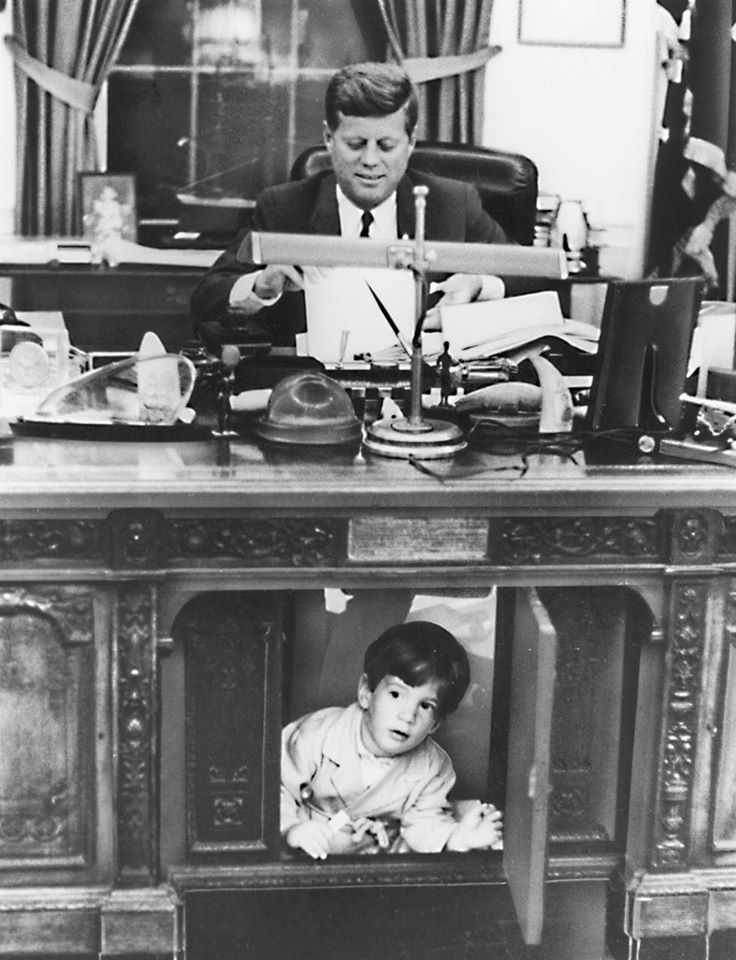
The desk's real leap into public affection has a precise date. On 2 October 1963, the photographer Stanley Tretick, on assignment for Look magazine, caught John F. Kennedy Jr., not yet three years old, peering out from the open kneehole while his father worked at the desk above him. The panel was normally kept closed during official business; this was an informal, unguarded moment inside the family's own working day, not a staged appearance. Kennedy was assassinated seven weeks later, and the photograph, already before the public, became inseparable from the desk's image and from the memory of the Kennedy presidency generally. It is a separate photograph from the clean, unpeopled 1961 view of the desk used as this record's lead plate, and the two should not be confused with one another.
Chapter 10Exile again, and Carter's request
The desk's second period out of the Oval Office followed directly on Kennedy's death.
The desk's second period out of the Oval Office followed directly on Kennedy's death. Lyndon Johnson brought in his own desk, used since his Senate days, and kept it through 1969; Richard Nixon and then Gerald Ford used a different piece that Nixon mistakenly believed had belonged to Woodrow Wilson. The Resolute desk, meanwhile, went on the road: lent first to a Kennedy Library traveling exhibition in 1964-65 that visited dozens of American and European cities, then to the Smithsonian Institution, where it was displayed at the National Museum of American History from 1966 to 1977.
It was Jimmy Carter, in January 1977, who asked for it back. The White House Historical Association records the request plainly: it was the Resolute desk Carter wanted for his own Oval Office, ending an eleven-year absence from the White House and marking the point after which, with one further exception, it has stayed.
Chapter 11Reagan, one interruption, and the desk since
Ronald Reagan kept the desk Carter had returned, and Bill Clinton, George W.
Ronald Reagan kept the desk Carter had returned, and Bill Clinton, George W. Bush, Barack Obama, Donald Trump and Joe Biden have all used it since, in each case as their own working Oval Office desk rather than as decor. The one interruption in this run came immediately after Reagan: George H. W. Bush, taking office in 1989, had his own long-favored piece, the so-called C and O desk, built around 1920 for officers of the Chesapeake and Ohio Railway, brought into the Oval Office instead, and used it for the whole of his single term. Clinton restored the Resolute desk on entering office in 1993, and it has remained in continuous Oval Office use since, aside from its brief 2025 removal for refinishing described below.
Chapter 12Two siblings made from the same wood
The presidential desk was not the only object cut from Resolute's timbers.
The presidential desk was not the only object cut from Resolute's timbers. A smaller writing table without drawers was made for Queen Victoria's own use, reportedly for the royal yacht Victoria and Albert, and is now held by what is today the National Museum of the Royal Navy in Portsmouth. A second desk was presented in 1880 to the widow of Henry Grinnell, the New Bedford-connected American merchant whose personal wealth had substantially funded the private and semi-official American side of the Franklin search; that desk passed eventually into the collection of the New Bedford Whaling Museum in Massachusetts, where it remains. Both pieces confirm that the timber ran short and had to be used carefully; one source notes the maker struggled to find enough sound wood left in the old ship's hull to complete even the smaller Queen's table.
Chapter 13What the gift meant, and what it still means
The desk sits inside a specific piece of nineteenth-century diplomacy rather than any older iconographic tradition, and its meaning was stated in advance by the people who made it: a British ship...
The desk sits inside a specific piece of nineteenth-century diplomacy rather than any older iconographic tradition, and its meaning was stated in advance by the people who made it: a British ship lost in the ice, an American captain's find, an act of Congressional generosity in sending her home, and a returning gift built from her own broken-up hull, worked by the Queen's own upholsterers. Every clause of that exchange is spelled out, almost defensively, on the desk's own brass plate, as if the makers wanted no room left for the meaning to be missed or contested.
Its later political use is a separate, twentieth-century layer, and an accidental one. No president commissioned the desk's symbolism; Kennedy's widow, not Kennedy, brought it into the Oval Office, and its most famous photograph is an unposed accident of a toddler's curiosity. What has made it durable as a symbol since is precisely that lack of a single author: because it belongs to the office rather than to any one occupant, incoming and outgoing presidents have been able to treat working at it, or choosing not to, as a small, legible signal of continuity or of independence, without anyone needing to explain what it stands for. It has become, in practice if not by design, an emblem of the presidency's continuity across administrations of every party, precisely because nothing about its origin ties it to any one of them.
Chapter 14Condition, refinishing, and the present tense
The desk's material history includes at least two identifiable interventions beyond the 1945 kneehole panel: sources disagree, without resolution in the material reviewed, on when a low plinth of...
The desk's material history includes at least two identifiable interventions beyond the 1945 kneehole panel: sources disagree, without resolution in the material reviewed, on when a low plinth of roughly two inches was added beneath its feet to raise its working height, with some accounts crediting the Kennedy administration in 1961 and others crediting a later Reagan- or Clinton-era change; this record notes the modification without asserting a firm date for it.
Most recently, in February 2025, the desk was removed from the Oval Office for what President Trump, announcing the move himself, called light refinishing, with the C and O desk brought back in as a temporary stand-in. Trump's own public description was that the Resolute desk 'needs to be refurbished' and that the work was 'a vital job.' Reporting from the following weeks indicates it was back in place within roughly a month. As of this writing it remains the working desk in the Oval Office, now inside a Trump-era Oval Office redecorated with substantial gold ornament, though no source reviewed suggests the desk itself was altered beyond the reported light refinishing.
The artist
Morant, Boyd and Blanford (London decorators and cabinet-makers); construction by William Evenden, Royal Naval Dockyard, Chatham
The desk has no single named artist in the way a painting does; it was designed by a London decorating firm working under royal warrant and physically built by a naval dockyard joiner whose own biography is otherwise unrecorded in the sources consulted. The firm's history, unusually for a furnishing house of this kind, is well documented through trade directories and auction-house cataloguing of its later domestic work, which lets this dossier describe the maker with more confidence than most anonymous or workshop attributions on this site allow.
Related works
| Work | Relation | Where it is |
|---|---|---|
| Queen Victoria's Writing Table Morant, Boyd and Blanford / William Evenden, Chatham | Made from the same batch of HMS Resolute timber in 1879-1880, a smaller drawerless writing table kept for the Queen's own use, reportedly aboard the royal yacht Victoria and Albert One source states the maker struggled to find enough sound wood left in the ship to complete even this smaller piece, after the larger presidential desk had taken the best of it. | National Museum of the Royal Navy, Portsmouth, England |
| The Grinnell Desk Morant, Boyd and Blanford / William Evenden, Chatham | A second desk from the same timbers, presented in 1880 to the widow of Henry Grinnell, the American merchant whose funding substantially supported the private American search efforts for Franklin Given to the museum in 1983. | New Bedford Whaling Museum, New Bedford, Massachusetts |
| Theodore Roosevelt Desk Designed by Charles Follen McKim of McKim, Mead and White | The Oval Office's own desk from the room's creation in 1909 until 1961, used by Taft, Wilson, Harding, Coolidge, Hoover (until 1929), and again by Truman, Eisenhower and briefly Kennedy after 1945; not made from Resolute timber and unrelated to it except by later occupying the same room Its two periods of Oval Office use (1909-1929 and 1945-1961) bracket the years the Resolute desk itself spent out of the room. | Office of the Vice President, Eisenhower Executive Office Building, Washington, D.C. |
| Johnson Desk and Wilson Desk Not established in sources reviewed | The two desks that occupied the Oval Office during the Resolute desk's second absence: Lyndon Johnson's own long-used desk (1963-1969), followed by a desk Richard Nixon mistakenly believed had belonged to Woodrow Wilson, used by Nixon and then Gerald Ford (1969-1977) Their presence in the room marks precisely the years, 1963 to 1977, that this desk was elsewhere. | Lyndon Baines Johnson Library and Museum, Austin, Texas (Johnson Desk); Vice President's Room, United States Capitol (Wilson Desk) |
| C and O Desk Rorimer-Brooks, for the Chesapeake and Ohio Railway, circa 1920 | The desk George H. W. Bush chose to bring into the Oval Office instead of the Resolute desk for the whole of his 1989-1993 term, the desk's one interruption since Carter's 1977 return A walnut reproduction of an eighteenth-century Chippendale partners' desk, originally built for the C and O Railway's own officers rather than for any government use. | White House collection |
Open questions
- Precisely where in the White House the desk was kept and used between its 1880 arrival and Franklin Roosevelt's documented use of it in his second-floor study in the 1930s and early 1940s is not established in the sources reviewed.
- Exactly when, and by whose decision, the desk moved from Roosevelt's second-floor study down to the ground-floor broadcasting room where it sat through most of the 1950s is not documented in the sources reviewed; only that it had been there roughly eight years by 1961.
- Whether Franklin Roosevelt himself ever requested or even knew of the 1945 kneehole panel is disputed. The White House Historical Association's own historian argues the wheelchair-concealment story is very likely a later myth traced to a single 1962 recollection recorded seventeen years after the fact, but no source reviewed offers a confirmed alternative explanation for why the panel was added at all.
- When, and under which president, the low plinth beneath the desk's legs was actually added is reported inconsistently across sources (1961 in some, a later Reagan- or Clinton-era change in others) and is not resolved in this record.
- Whether the carved eagle on the 1945 kneehole panel was ever updated to match the Truman-era 1945 revision of the Presidential seal, which turned the eagle's head from the arrows toward the olive branch, or still shows the earlier orientation, is asserted in one lower-confidence source but not confirmed by the White House Historical Association material consulted.
- Where the desk itself, as opposed to the substitute C and O desk, was kept or displayed during George H. W. Bush's 1989-1993 term is not documented in the sources reviewed.
- What the February-March 2025 refinishing actually involved (materials used, conservator or firm engaged, scope of work) is not detailed in any source reviewed beyond President Trump's own public description of it as light refinishing.
Questions about this object
What is The Resolute Desk?
The Resolute Desk is a furniture, dated 1880. Medium: Oak (with, per the White House Historical Association, some mahogany) timbers from the retired Arctic exploration ship HMS Resolute; tooled leather writing surface; a hinged kneehole panel of carved oak bearing the Presidential coat of arms was added in 1945.
Who made The Resolute Desk, and is the attribution settled?
The attribution to Morant, Boyd and Blanford, designers, with William Evenden, joiner, Royal Naval Dockyard, Chatham is recorded here as accepted. The design is documented as the work of the London decorating and cabinet-making firm Morant, Boyd and Blanford of 91 New Bond Street, upholsterers and decorators to Queen Victoria; the original design drawing survives at the National Maritime Museum, Greenwich. The physical construction is documented as the work of William Evenden, a joiner at the Royal Naval Dockyard, Chatham, where HMS Resolute was broken up. Both attributions are corroborated across the White House Historical Association and Chatham Historic Dockyard Trust, which holds local institutional memory of Evenden's yard, and are not disputed in any source consulted.
Where is The Resolute Desk now?
The Oval Office, The White House, Washington, D.C. Inventory number White House Collection (no public accession number located in the sources reviewed). Last confirmed 25 September 2026. In continuous use as the president's Oval Office desk since January 1977, with a single-term interruption in 1989-1993 and a brief removal for refinishing reported in February-March 2025; confirmed by White House Historical Association institutional records and by contemporaneous reporting of the 2025 refinishing and return.
What is still unknown about The Resolute Desk?
Precisely where in the White House the desk was kept and used between its 1880 arrival and Franklin Roosevelt's documented use of it in his second-floor study in the 1930s and early 1940s is not established in the sources reviewed.
Sources
- 1White House Historical Association, 'What is the Resolute Desk? And Where Did it Come From?' whitehousehistory.org/questions/...
- 2White House Historical Association, 'Treasures of the White House: Resolute Desk' whitehousehistory.org/photos/...
- 3Sarah Fling for the White House Historical Association, 'A Resolute Myth: Debunking the Resolute Desk Panel' whitehousehistory.org/a-resolute-myth-debunking-the-resol...
- 4White House Historical Association, photo caption page, 'President Kennedy at the Resolute Desk' whitehousehistory.org/photos/...
- 5Wikipedia, 'HMS Resolute (1850)'. en.wikipedia.org/wiki/...
- 6Wikipedia, 'Resolute desk'. en.wikipedia.org/wiki/...
- 7Wikipedia, 'List of Oval Office desks'. en.wikipedia.org/wiki/...
- 8Chatham Historic Dockyard Trust, 'Will Joe Biden choose the Resolute Desk?' thedockyard.co.uk/news/...
- 9British and Irish Furniture Makers Online (Furniture History Society), entry for 'Morant and Co.; Morant and Boyd; Morant, Boyd and Morant; Morant, Boyd and Blandford (sometimes Blanford)', including its quotation of Kelly's London Post Office Directory, 1871. bifmo.furniturehistorysociety.org/entry/...
- 10Kent Online, 'The moment to look out for which links Kent to Joe Biden's inauguration' kentonline.co.uk/medway/...
- 11Anglo-American Almanac (blog), 'These twins stand resolute: the Anglo-American history of the Resolute Desk'. angloamericanalmanac.wordpress.com/2021/...
- 12HMS-Resolute.co.uk, 'The Resolute Desks'. hms-resolute.co.uk/hms-resolute-in-images/...
- 13Biography.com (A&E Television Networks), 'Jacqueline Kennedy's White House Restoration Preserved More Than Just a Building'. biography.com/political-figures/...
- 14National Archives, Herbert Hoover Presidential Library blog, 'The Oval Office Roasting on a 1929 Christmas Fire' hoover.blogs.archives.gov/2017/...
- 15Yahoo News, 'Trump reveals he has removed the Resolute Desk used by Biden and Obama from the Oval Office', quoting President Trump's own Truth Social statement on the February 2025 refinishing. yahoo.com/news/...
- 16Wikimedia Commons, file and extended-metadata record for 'File:Stanley Tretick photo of John F. Kennedy Jr. in desk.jpg', consulted directly via the Commons API to confirm date, photographer and public-domain status before use. commons.wikimedia.org/wiki/...
- 17Wikimedia Commons, file and extended-metadata records for the six White House and John F. Kennedy Presidential Library photographs used as plates in this record, consulted directly via the Commons API for licensing, photographer credit and date. commons.wikimedia.org/wiki/...

Last verified · Published
Change log
25 September 2026 - Record created at the house standard: researched narrative, technical evidence, maker dossier, graded provenance chain, prices with hammer and premium separated, related works, open questions and sources.