The Behaim Globe (Erdapfel)
Martin Behaim, with Georg Glockendon the Elder and workshop · 1492-1494 (commissioned by the Nuremberg city council from 1490; the brass horizon ring was added around 1510)
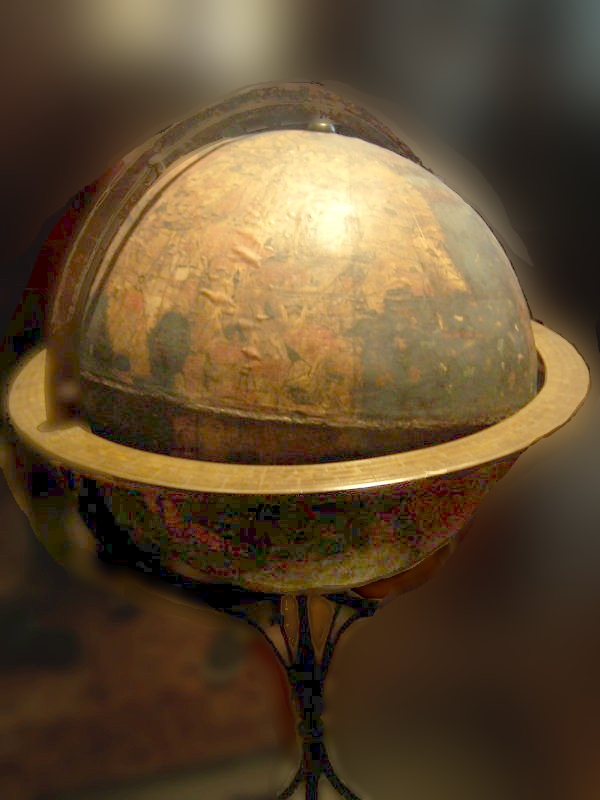
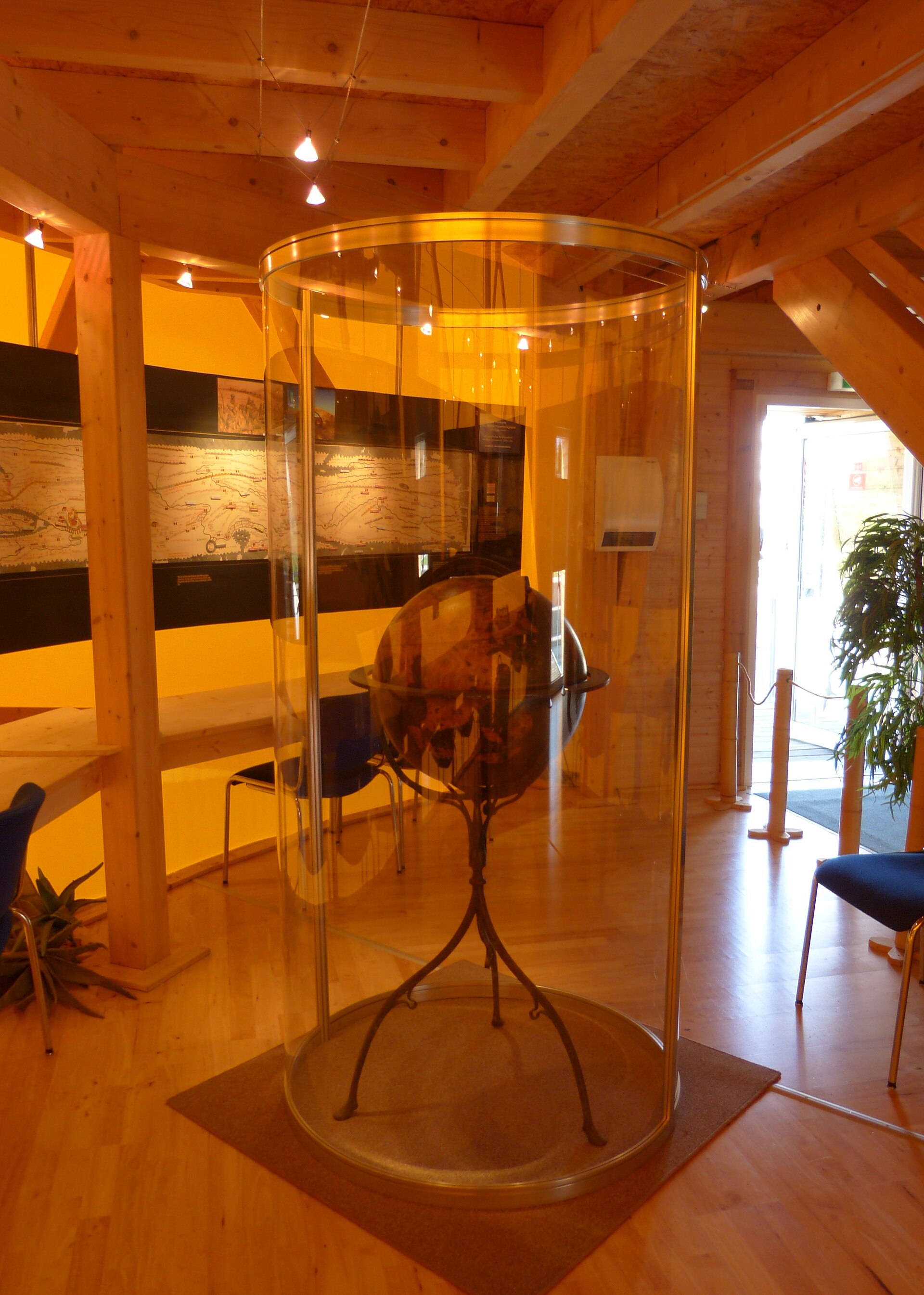
The original Erdapfel on display at the Germanisches Nationalmuseum, Nuremberg. Verified as a photograph of the actual object, in Category:Erdapfel on Wikimedia Commons; this edited version is credited to Denis Barthel.
Germanisches Nationalmuseum, Nuremberg; photograph reworked by Denis Barthel · Photograph by Martin Behaim / Georg Glockendon · CC BY-SA 2.0 de| Artist | Martin Behaim, with Georg Glockendon the Elder and workshop |
|---|---|
| Date | 1492-1494 (commissioned by the Nuremberg city council from 1490; the brass horizon ring was added around 1510) |
| Medium | Two clay-moulded hemispheres laminated in linen, reinforced with wood, then overlaid with parchment and paper gores in tempera paint; wrought-iron meridian stand; engraved and punched brass horizon ring |
| Dimensions | 51 cm diameter (globe); 133 cm total height on its stand |
| Where it is now | Germanisches Nationalmuseum, Nuremberg, Germanylast confirmed |
| Inventory number | WI 1826 |
| Attribution | AcceptedThe globe is attributed to Martin Behaim as the Nuremberg patrician who conceived, directed and supplied the geographical content for the commission, on the basis of contemporary Nuremberg city records naming him. Full note |
| Object type | Clocks and instruments |
| Period | German, late fifteenth century |
| Inscriptions | Approximately 2,000 place names, around 200 painted symbols and pictorial miniatures (rulers, ships, animals, flags), and more than 50 written legends describing regions, resources and travel routes, lettered by Petrus Gagenhart |
| Owners on record | 4 links4 documented |
| Sources | 16 cited |
About this record Last verified · 16 sources cited · Change log
On this page 9 sections
ContentsClose
A 51-centimetre painted sphere finished in Nuremberg in the winter of 1492, the Erdapfel is the oldest terrestrial globe to survive anywhere. It was made by a named team of craftsmen working from a design supplied by the merchant-patrician Martin Behaim, who had spent the preceding six years in Portugal and at its Atlantic outpost of Faial claiming, on evidence that a century of scholarship has largely failed to confirm, a place at the elbow of King John II.
Because the globe was finished the same year Columbus sailed and before any word of his landfall reached Europe, it shows an Atlantic that runs directly into an oversized Asia, with no Americas at all. It has been read ever since as a snapshot of the exact moment the old geography ran out, and it has just as often been mistaken for something Columbus consulted, which the surviving chronology makes impossible.
Bought for the city that made it in 1937 in a transaction jointly financed by the mayor and the German head of state, and rarely if ever removed from its case since, it has been examined, restored, darkened by an old varnish, digitally scanned twice, and in 2023 inscribed on UNESCO's Memory of the World register.
Provenance
Each link is graded. Documented: a cited source supports it. Disputed: the identification is argued but not established. Unknown: no owner for that span, and the gap is not smoothed into a narrative. The grades in the glossary.
- 1492 - early 17th centuryCity of Nurembergdocumented
Displayed in reception rooms of Nuremberg's town hall (successively the Ratskanzlei and the Obere Regimentsstube) from its completion until the early seventeenth century.67
- early 17th century - 1906/1907The Behaim familydocumented
Custody passed to the Behaim family. Storage over this long period was imperfect; the globe's condition record attributes at least one dent to inadequate handling during family ownership. In 1927 the family moved to sell the globe to a buyer in America; the object was listed as nationally valuable German cultural property in 1929, which functioned as a bar on export and set up the eventual sale to the museum.78
- 1906/1907 - 1937Behaim family (on loan to the Germanisches Nationalmuseum)documented
Loaned to the Germanisches Nationalmuseum, Nuremberg; sources consulted differ on the exact year, giving either 1906 or 1907.7
- 1937 - presentGermanisches Nationalmuseum, Nurembergdocumented
Purchased for the museum after the 1929 export-preventing listing and subsequent negotiation. The purchase price was raised jointly by Nuremberg's mayor Willy Liebel and Adolf Hitler, then head of the German state. No source consulted here publishes the sum paid or its division between the two.78
Technical evidence
| Attribution note | The globe is attributed to Martin Behaim as the Nuremberg patrician who conceived, directed and supplied the geographical content for the commission, on the basis of contemporary Nuremberg city records naming him. The physical object was made by a documented team: Hans Glockengiesser cast the two clay hemispheres used as a mould, Ruprecht Kolberger applied the linen, parchment and paper layers, Georg Glockendon the Elder and, per the Germanisches Nationalmuseum's own catalogue, his unnamed wife painted the gores, and Petrus Gagenhart is credited with the lettering. Behaim supplied the design and the geography; he did not paint or construct the object himself. |
|---|---|
| Core and lamination | Two clay hemispheres, cast by the bell-founder Hans Glockengiesser and used as a mould; linen laminated over the core, then parchment and paper gores pasted over that, then split and rejoined.67 |
| Dimensions | 51 cm diameter (the sphere itself); 133 cm total height as mounted on its stand.6 |
| Paint layer | Tempera on the parchment and paper gores, painted by Georg Glockendon the Elder and, per the museum's own catalogue, his unnamed wife.6 |
| Lettering | Approximately 2,000 place names and more than 50 written legends, credited to the scribe Petrus Gagenhart.610 |
| Pictorial content | Roughly 200 painted symbols and miniatures (rulers, cities, ships, animals, flags); the FAU/GNM research portal catalogues around 110 miniatures specifically, a narrower count than the museum's general figure.610 |
| Mount | Wrought-iron stand with a meridian ring; a separate brass horizon ring, cast, engraved and punched with zodiac signs, was added around 1510.67 |
| Inventory number | WI 1826, Germanisches Nationalmuseum, Nuremberg.6 |
| Condition | Surface substantially darkened, probably by a linseed-oil varnish applied in the 19th century; obscured in places by later retouching; the southern hemisphere's laminated surface has warped. Treated as light-sensitive and fragile.678 |
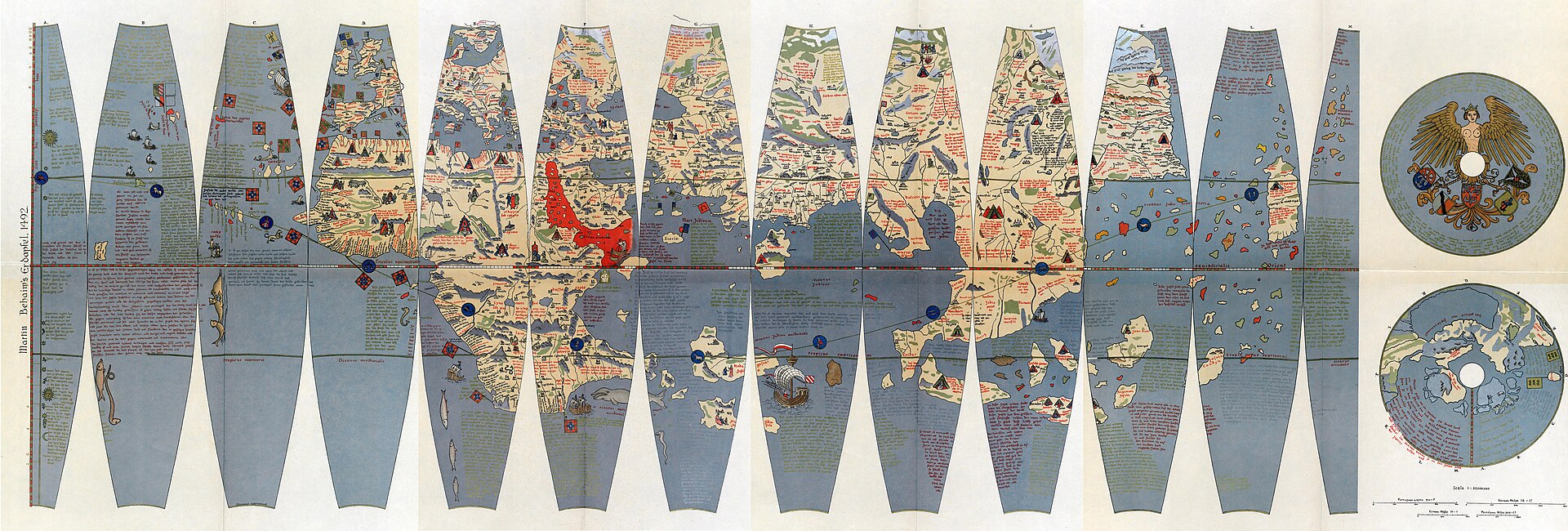
| Geographic omission | No Americas: the Atlantic is shown running directly to an oversized Asia. Cipangu (Japan) appears greatly enlarged and well south of its true position; an invented peninsula appears east of the Malay peninsula, following Henricus Martellus.611 |
| Documented cartographic sources | Ptolemy's Geography for overall frame and scale; Marco Polo's account for Asian land distances; contemporary Portuguese portolan information, including detail reflecting Bartolomeu Dias's 1488 rounding of the Cape of Good Hope, for the African and Atlantic coasts.714 |
Images
The record in full
Chapter 1What it is
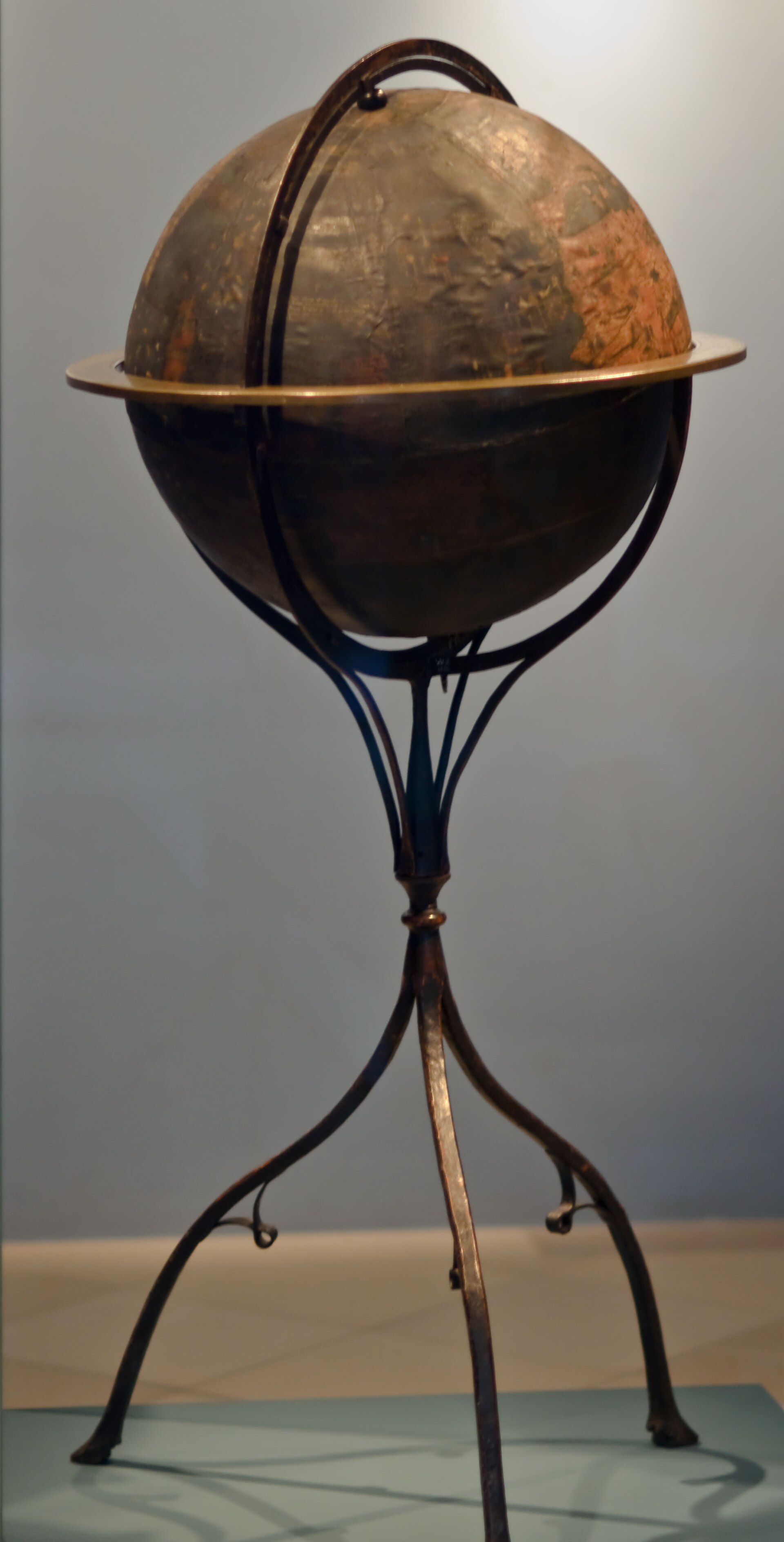
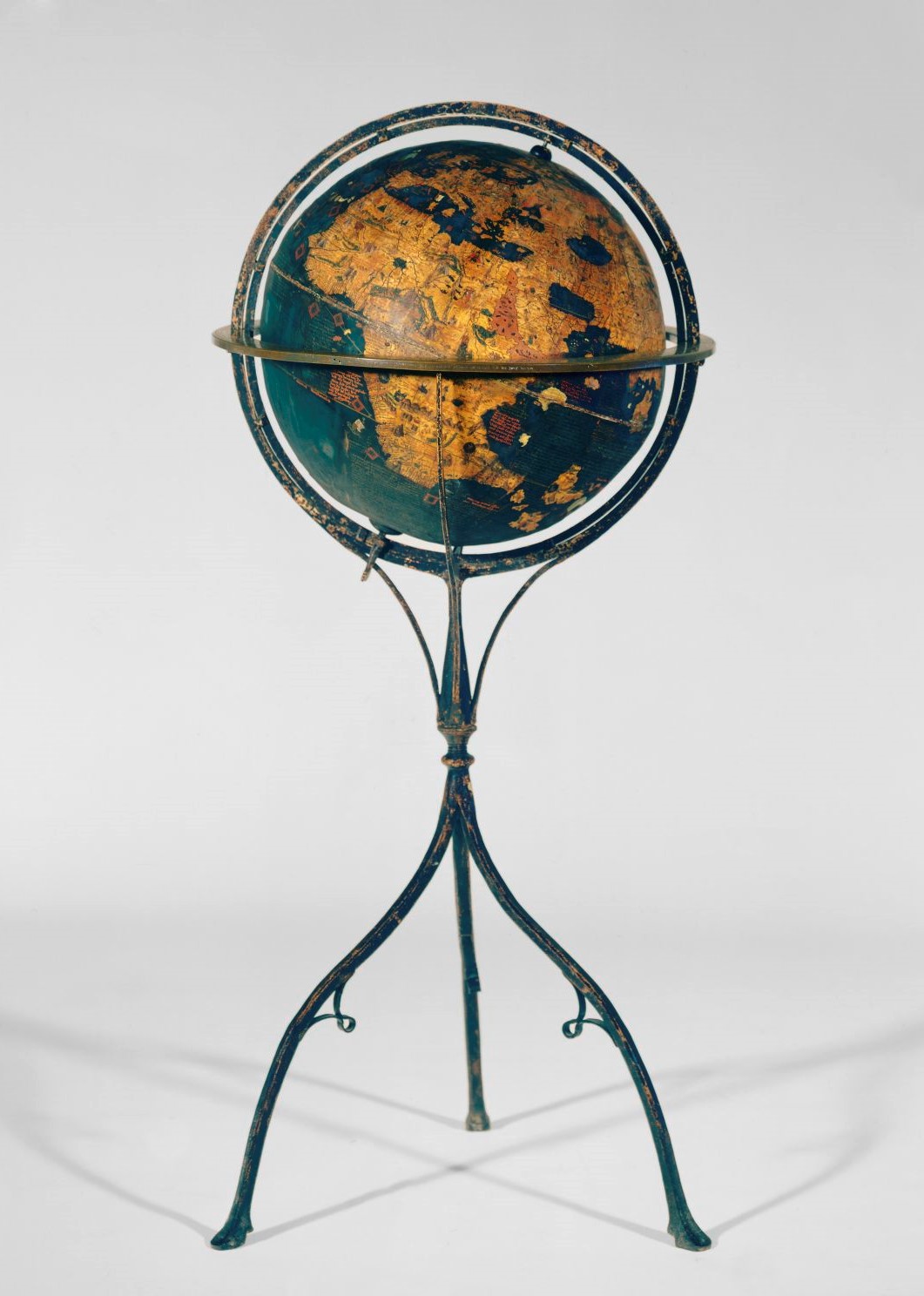
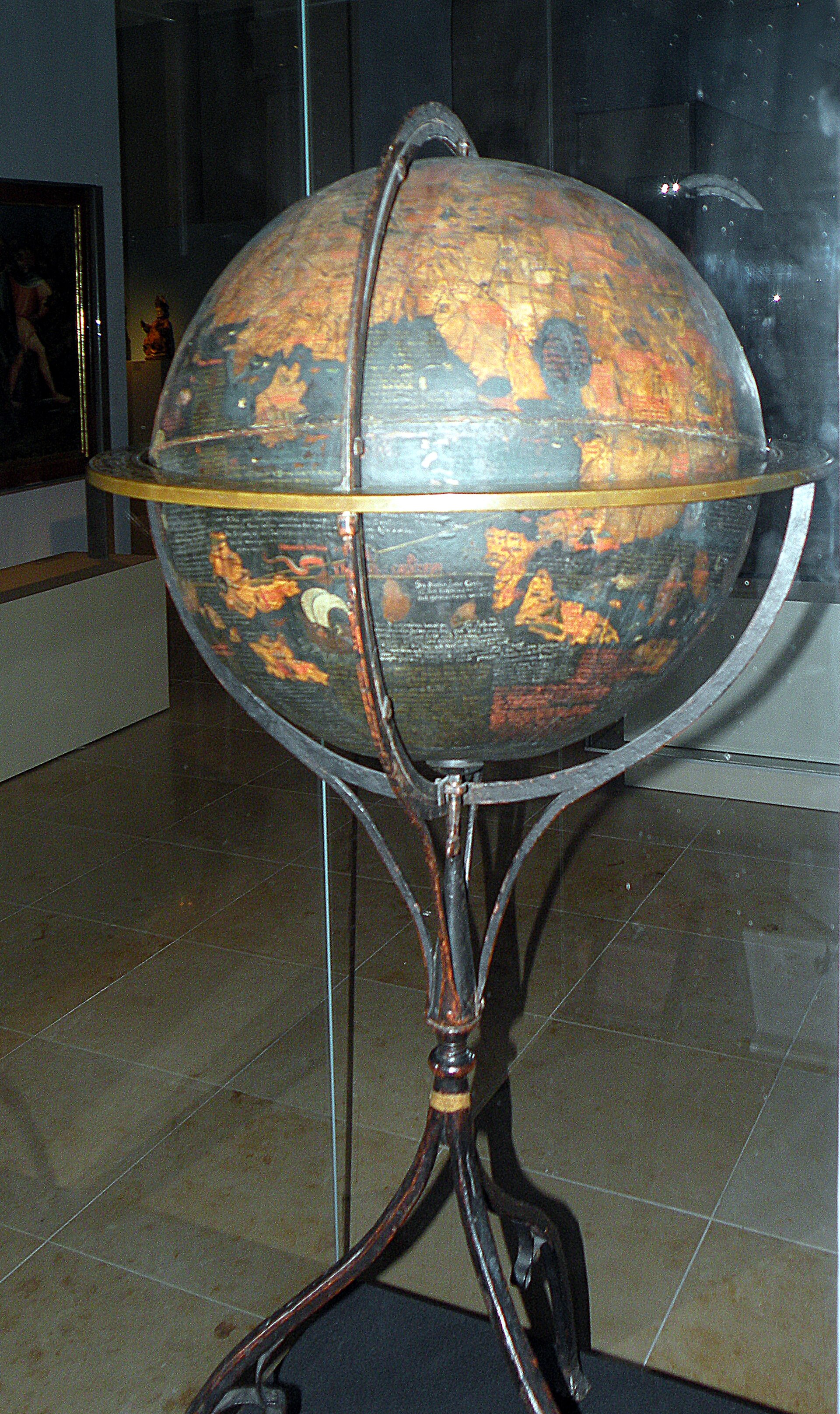
The Erdapfel is a sphere 51 centimetres in diameter, standing 133 centimetres tall on its wrought-iron mount.
The Erdapfel is a sphere 51 centimetres in diameter, standing 133 centimetres tall on its wrought-iron mount. Its core is two clay hemispheres used as a casting mould; over that core its makers laminated layers of linen, then pasted on parchment and paper gores painted in tempera, then split the finished ball in two and rejoined it. A brass horizon ring, engraved and punched with the signs of the zodiac, was added to the stand around 1510, after the globe itself was finished.
Painted onto its surface are roughly 2,000 place names, about 200 pictorial symbols and miniatures showing rulers, cities, ships and animals, and more than fifty written legends describing regions, resources and sea routes. It is, in effect, an encyclopaedia of what a well-connected Nuremberg merchant believed about the shape and contents of the earth in the winter before Columbus returned.
Chapter 2Who actually made it
The name attached to the globe is Behaim's, and it was Behaim who supplied its geography and directed its content.
The name attached to the globe is Behaim's, and it was Behaim who supplied its geography and directed its content. He did not build it. The Germanisches Nationalmuseum's own object catalogue, drawing on the city's contemporary records, names the actual craftsmen: Hans Glockengiesser, a bell-founder, cast the clay hemispheres that gave the sphere its shape; Ruprecht Kolberger applied the linen, parchment and paper layers over that core; Georg Glockendon the Elder, a Nuremberg illuminator and printer, painted the finished gores; and Petrus Gagenhart is credited with lettering the inscriptions.
The same catalogue entry records that Glockendon's wife also painted on the globe, without giving her name. She is not the only such figure in the workshop record of this object: Glockendon's own later fame rests on sons who took over his business, Albrecht and Nikolaus Glockendon, while the woman who worked beside him at the globe itself is identified only by her relationship to him. The globe most people have heard of by one name was made by at least five people, only one of whom is generally credited.
Chapter 3The world it shows
The globe's cartography draws on Ptolemy's second-century Geography for its overall frame, on Marco Polo's account for its land distances across Asia, and on contemporary Portuguese portolan...
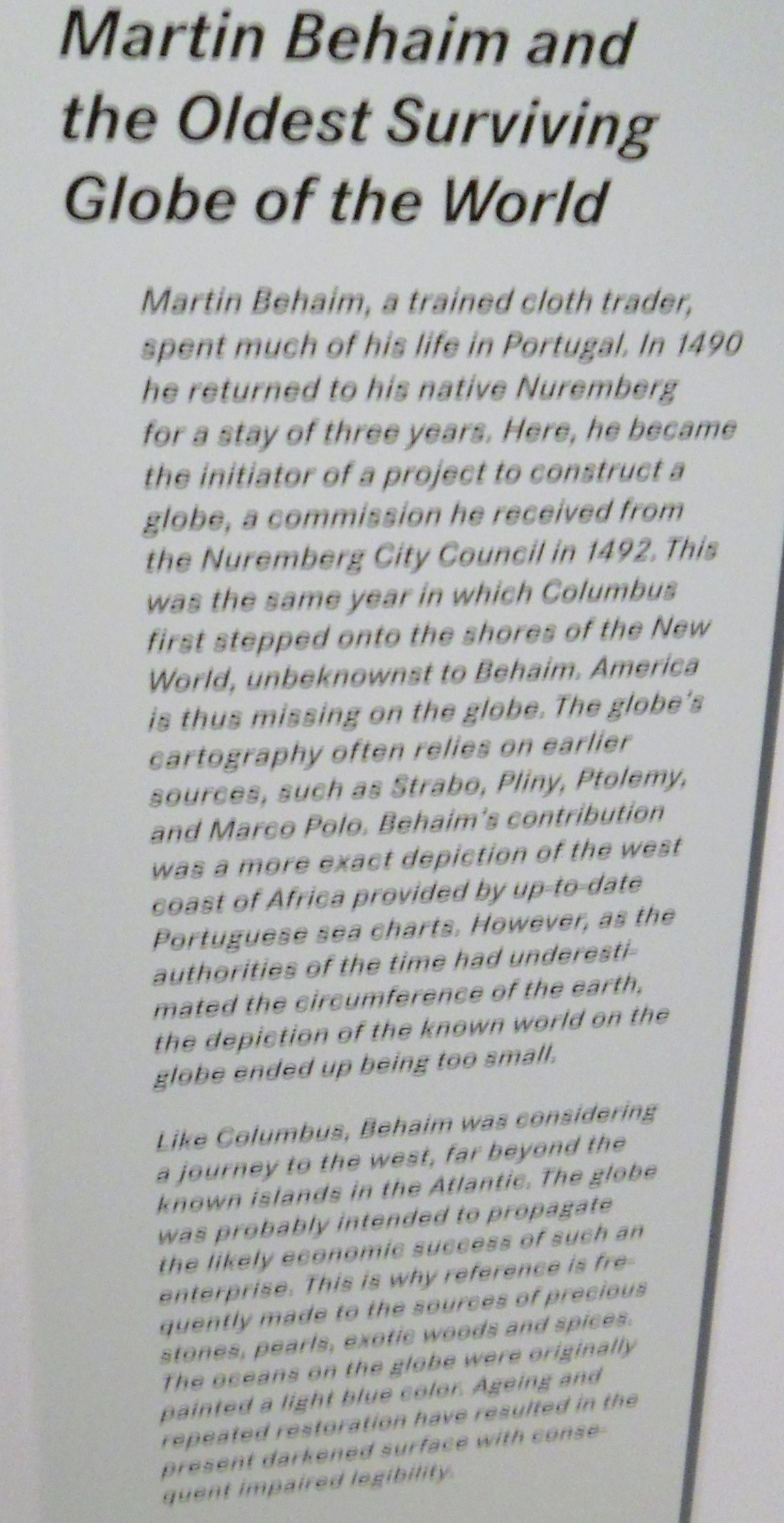
The globe's cartography draws on Ptolemy's second-century Geography for its overall frame, on Marco Polo's account for its land distances across Asia, and on contemporary Portuguese portolan information for the African and Atlantic coastlines, including detail that reflects Bartolomeu Dias's 1488 rounding of the Cape of Good Hope. It also follows the Florentine cartographer Henricus Martellus in giving the region east of the Malay peninsula an invented, oversized landmass, and it places the island of Cipangu, meaning Japan, far south of its true position and greatly enlarged, in the tradition that had grown up around Marco Polo's account of it.
Applying Marco Polo's land distances to Ptolemy's underestimate of the earth's circumference produces the same error that pushed Asia far enough east, and the Atlantic far enough narrow, to make a westward crossing look shorter than it is. Behaim was not alone in reaching that figure: the same combination of Ptolemy and Polo is the one usually credited with encouraging Columbus, independently and by the same route, to think the crossing was survivable. The two men were not comparing notes. They had read the same books.
The globe's inscriptions also carry the standard furniture of late medieval geography: legendary islands such as Saint Brendan's, and notes on the distant peoples believed to inhabit the edges of the known world, a stock of material Behaim would have drawn from Marco Polo and from Sir John Mandeville's widely circulated Travels rather than from anything he saw. Reading the globe's more fantastic notations as reportage mistakes what they are: an inherited literary geography, copied onto a genuinely novel object.
Chapter 4The commission
Behaim returned to Nuremberg in 1490 after six years in Portugal and the Azores.
Behaim returned to Nuremberg in 1490 after six years in Portugal and the Azores. Members of the city council financed the globe's construction, beginning that year and finishing the sphere itself in 1492, with the stand's horizon ring added around 1510. It was made for the city, not for Behaim personally, and it was installed in a reception room of Nuremberg's town hall, where it remained on public view for over a century.
Nuremberg in this period was a trading city with direct commercial and intellectual ties to Portugal's Atlantic and African expansion, and a council-financed globe of the known world served that interest directly: it was a piece of civic self-presentation, advertising the city's access to the newest geographical intelligence coming out of Lisbon, as much as it was a scientific object.
Chapter 5Behaim's Portugal years: what is documented
Behaim moved to Lisbon in 1484 after a decade as a cloth merchant's apprentice and factor in Mechelen and Antwerp.
Behaim moved to Lisbon in 1484 after a decade as a cloth merchant's apprentice and factor in Mechelen and Antwerp. What is documented from an archival memorandum is a genuine knighting ceremony performed by King John II at Alcacovas on 18 February 1485. What is not documented, on the most thorough search of the surviving record, is most of what Behaim and his early biographers subsequently built on top of that fact.
He is not mentioned by name in any surviving Portuguese source from his own lifetime. The sole authority for his claimed appointment to King John's council of navigational experts, the so-called Junta dos Mathematicos, is a single sentence written more than fifty years later by the historian Joao de Barros, who records that the king referred a technical question to Master Rodrigo, Master Josepe, and one Martin of Bohemia, who boasted of having been a pupil of the astronomer known as Regiomontanus. Every later biographer who placed Behaim on that council did so by copying Barros, not by finding independent confirmation.
Chapter 6Ravenstein's verdict, and the case against it
The scholar who examined this claim most exhaustively is E.G.
The scholar who examined this claim most exhaustively is E.G. Ravenstein, whose 1908 biography remains the foundational English-language study of Behaim. Ravenstein searched the Nuremberg family archive and the Torre do Tombo in Lisbon and found the documentary record for Behaim's Portuguese career, in his own words, very fragmentary; he found no corroboration for the Junta membership beyond Barros, and no evidence that any of Behaim's contemporaries at the Portuguese court regarded him as the scientific authority his later reputation assumed.
Ravenstein went further, using the globe itself as evidence against its maker's competence. He points out that Behaim's own globe places the mouth of the Congo at 24 degrees south, when its true latitude is close to 6 degrees south, an error he treats as incompatible with real skill in the navigational astronomy Behaim claimed to have taught the Portuguese. Of Behaim's own account of having studied under Regiomontanus, Ravenstein writes plainly: "We doubt, however, whether Behaim was justified when he spoke of himself as a 'disciple' of the great master." He allows that even if some instruction took place, Behaim, on the evidence of his own subsequent work, profited little from it.
Ravenstein does accept the 1485 knighthood as real, while dismantling a further claim built on top of it: that Behaim was received into the Order of Christ, the crusading order that also controlled Portugal's overseas exploration. He notes that no portrait of Behaim shows the order's gold-and-red enamel cross, and that Order of Christ knights in 1485 were still bound by vows of poverty, chastity and obedience, a condition incompatible with the marriage Behaim contracted the following year. The archival memorandum documents an ordinary knighthood. It does not document membership of the order, and no other source fills the gap.
Modern reference accounts of Behaim, including the profile compiled by the historian of exploration John Noble Wilford, treat the pattern the same way: not as isolated errors but as a man who, arriving at a foreign court with no scientific credentials to speak of, appears to have overstated or invented a technical role for himself, and whose later biographers then took that self-presentation at face value for four centuries.
Chapter 7The African voyage, and other unverified claims
Behaim also claimed to have sailed on Diogo Cao's expedition down the West African coast around 1485 to 1486.
Behaim also claimed to have sailed on Diogo Cao's expedition down the West African coast around 1485 to 1486. Cartographic inaccuracies along that stretch of the globe's African coastline are cited by modern scholarship as evidence against his having travelled it himself; a more likely candidate, on the surviving evidence, is a separate Guinea trading voyage led by Joao Afonso de Aveiro. Behaim later claimed to have discovered the Antilles before Columbus, a claim no historian now defends. Taken together, the documented record supports a merchant of Nuremberg who married well into the governing family of a Portuguese Atlantic island, was knighted once by the king, and returned home to direct a globe project; it does not support the navigator-scientist he presented himself as.
Chapter 8Marriage, and the return home
In 1486 Behaim married Joana de Macedo, daughter of Jobst van Huerter, the governor of the Azorean island of Faial, and the couple settled there.
In 1486 Behaim married Joana de Macedo, daughter of Jobst van Huerter, the governor of the Azorean island of Faial, and the couple settled there. He returned to Nuremberg in 1490, apparently to settle family business, and stayed to direct the globe commission before going back to Portugal, where he died on 29 July 1507 in the hospice of Saint Bartholomew in Lisbon while there on business. He never lived in Nuremberg again after the globe was finished, and the object that carries his name and made him famous in his own city was, for the rest of his life, a possession of a city he no longer lived in.
Chapter 9In the town hall, then the family, then almost to America
The globe stood in the reception rooms of Nuremberg's town hall from its completion until the early seventeenth century, when custody passed to the Behaim family.
The globe stood in the reception rooms of Nuremberg's town hall from its completion until the early seventeenth century, when custody passed to the Behaim family. The family's stewardship was imperfect: sources describing the object's condition attribute at least one dent to inadequate storage during this period, and the globe was displayed privately rather than in a controlled setting for roughly three hundred years.
In 1927 the family moved to sell the globe to a buyer in America. It was placed on Germany's list of nationally valuable cultural property in 1929, a listing that functioned, in effect, as an export bar and gave the city and the museum time to negotiate. The globe itself had already gone to the Germanisches Nationalmuseum on loan, in either 1906 or 1907 depending on the source consulted; the purchase that finally transferred ownership was completed in 1937.
That purchase deserves to be stated plainly rather than passed over. The price was raised jointly by Nuremberg's mayor at the time, Willy Liebel, and Adolf Hitler, then head of the German state, and the globe was presented to the museum as a result. The object's transfer into public, institutional custody, where it has remained since, took place through a Nazi-era transaction, four years into the regime and two years before the war. No source consulted here records the sum paid.
Chapter 10Condition, and what restoration did to it
The globe's painted surface has darkened substantially, most likely from a coat of linseed-oil varnish applied in the nineteenth century, and it has been restored more than once in the twentieth...
The globe's painted surface has darkened substantially, most likely from a coat of linseed-oil varnish applied in the nineteenth century, and it has been restored more than once in the twentieth century, including further work in the 1930s. Those interventions have not been kind: retouching and varnish have obscured original text and imagery in places, and the laminated surface of the southern hemisphere has warped over time. The object is now treated as light-sensitive and fragile, kept under controlled display conditions, and is not a thing the museum removes from its case for casual inspection.
Two separate digitisation efforts have been made to recover and preserve what the surface still shows without further physical handling: the globe travelled to the Vienna University of Technology in 1992 for high-resolution scanning under the Behaim Digital Globe Project, and the Germanisches Nationalmuseum began a second digitisation in 2011, since built out into a public research portal jointly run with the Friedrich-Alexander-Universitat Erlangen-Nurnberg that catalogues the globe's roughly 2,000 place names and around 110 to 200 miniatures, sources differing on the exact count, with stable citation links for scholars.
Chapter 11The Columbus myth, and what actually happened
The Erdapfel is regularly mistaken for something Columbus consulted, or something that showed him a route to Asia.
The Erdapfel is regularly mistaken for something Columbus consulted, or something that showed him a route to Asia. Neither claim survives contact with the calendar. Columbus sailed from Spain in August 1492; the globe was still being painted and lettered in Nuremberg into 1493 and 1494, and did not return to Spain until March 1493 with news of his landfall, after which the Americas were simply left off a globe already largely finished. There is no route by which Behaim's physical object could have reached Columbus before his first voyage, and Columbus never mentions Behaim in any surviving letter or log.
What the two men shared was not contact but a common intellectual inheritance: both combined Marco Polo's land distances with Ptolemy's undersized earth to conclude that Asia lay within reach of a westward crossing, most likely transmitted through the same current of geographical opinion associated with the Florentine cosmographer Paolo Toscanelli, whose proposal for a short Atlantic route had reached the Portuguese court by 1474. Behaim's globe and Columbus's voyage are two separate expressions of the same error, arrived at along parallel lines, not one inspiring the other. As early as 1778 the Nuremberg antiquarian Christoph Gottlieb von Murr made a facsimile of the globe expressly to demonstrate this, arguing that the object itself, correctly read, disproves any claim that Behaim guided or anticipated Columbus.
Chapter 12Public memory, and the present day
In the nineteenth century the Nuremberg librarian Friedrich Wilhelm Ghillany promoted a reading of Behaim as a key figure behind Portugal's navigational success, a reading that fit comfortably with a...
In the nineteenth century the Nuremberg librarian Friedrich Wilhelm Ghillany promoted a reading of Behaim as a key figure behind Portugal's navigational success, a reading that fit comfortably with a nationalist appetite for a German contribution to the age of discovery. Modern scholarship, following Ravenstein, treats that reading as considerably overstated; the globe's real historical weight rests on what it documents about European geographical belief on the eve of 1492, not on any special expertise of its credited maker.
The globe was included in UNESCO's Memory of the World register in 2023, nominated by Germany in 2018, recognised there as the outstanding compendium it is of both the closing medieval world picture and the first stirrings of the new one. It remains on permanent display at the Germanisches Nationalmuseum in Nuremberg, the only public presentation the fragile original object receives; what scholars now work from for close study is chiefly the two digital surrogates the museum and its partners have built, rather than the darkened, restoration-scarred surface itself.
The artist
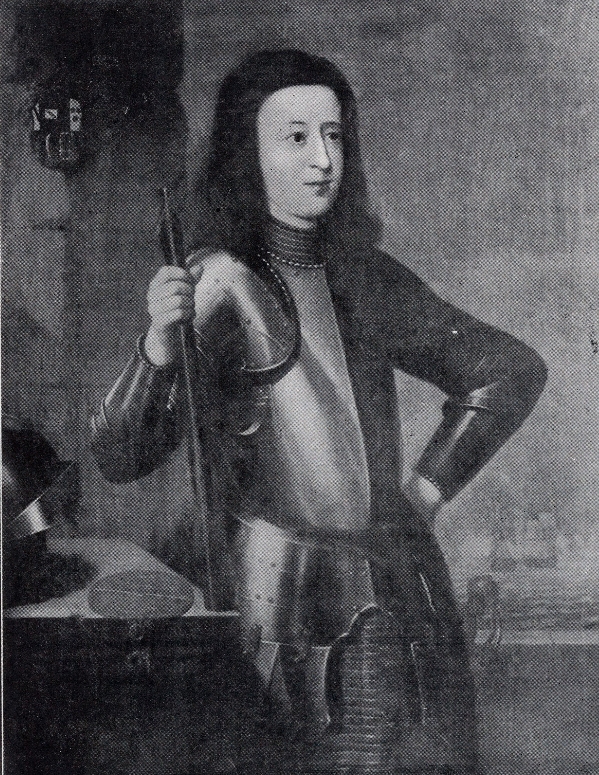
Martin Behaim von Schwarzbach
Martin Behaim is famous for an object he did not build. He supplied its geography and directed its content, and the Nuremberg city records that survive credit him as its author, but the physical globe was cast, laminated, painted and lettered by a named team of other Nuremberg craftsmen. That gap between credit and labour is only the first of several between what Behaim claimed about himself and what the surviving record actually supports. The most thorough study of his life, E.G. Ravenstein's 1908 biography, is substantially an exercise in closing that gap, chapter by chapter.
Related works
| Work | Relation | Where it is |
|---|---|---|
| Hunt-Lenox Globe Unknown maker | The next-oldest surviving terrestrial globe after the Erdapfel, made roughly a decade later A small copper globe of around 1510, notable as the earliest surviving globe to show any part of the Americas, in contrast to the Erdapfel's total omission of them. | New York Public Library, New York |
| Johannes Schoner's globe of 1515 Johannes Schoner | Made in the same city one generation later, and the first printed globe to name the new continent Schoner, working in Nuremberg, was the first globe-maker to apply the name America, following Martin Waldseemuller's 1507 map, to the coastline Amerigo Vespucci had charted. | Various institutional collections; example at the History of Science Museum, Oxford |
| Facsimile of the Behaim Globe E.G. Ravenstein, printed by W. Griggs | The standard scholarly facsimile of the original, published with Ravenstein's 1908 biography A colour lithographic reproduction of the globe's gores and polar calottes, still the reference facsimile cited by later cataloguers alongside modern digital scans. | Held in research libraries; digital copy on Wikimedia Commons |
| Der Behaim-Globus digital research portal Germanisches Nationalmuseum and Friedrich-Alexander-Universitat Erlangen-Nurnberg | The current scholarly surrogate for the fragile original, built from the 1992 and 2011 digitisation campaigns Catalogues the globe's place names, miniatures and inscriptions with stable citation links, and is now the primary tool scholars use to read text the darkened original can no longer show clearly in person. | Online (behaim.wisski.data.fau.de) |
Open questions
- Whether Behaim actually sailed on Diogo Cao's African expedition of 1485-86, or invented the claim afterward; the globe's own coastal inaccuracies are cited against his direct participation, but no independent record settles it either way.
- What, if anything, Behaim actually contributed to King John II's Junta dos Mathematicos beyond Joao de Barros's single secondhand sentence written more than fifty years later; no corroborating Portuguese source has been found.
- The identity of Georg Glockendon's wife, credited by the Germanisches Nationalmuseum's own catalogue with painting on the globe alongside her husband but named nowhere in the sources consulted here.
- The exact year the globe was first loaned to the Germanisches Nationalmuseum; sources consulted give 1906 and 1907 without reconciling the discrepancy.
- What price the museum paid in 1937, and what portion came from the city versus from Hitler personally; no source consulted here publishes the figure.
- Why Joao de Barros, writing in 1539, singled out Behaim by name among the Junta's members when no other contemporary source mentions him at all.
- The total cost the Nuremberg city council paid for the globe's manufacture in 1492; Ravenstein's biography references a Statement of Expenses as an appendix, but the figures within it were not recovered from the sources consulted for this record.
Questions about this object
What is The Behaim Globe (Erdapfel)?
The Behaim Globe (Erdapfel) is a clocks and instruments, dated 1492-1494 (commissioned by the Nuremberg city council from 1490; the brass horizon ring was added around 1510). Medium: Two clay-moulded hemispheres laminated in linen, reinforced with wood, then overlaid with parchment and paper gores in tempera paint; wrought-iron meridian stand; engraved and punched brass horizon ring.
Who made The Behaim Globe (Erdapfel), and is the attribution settled?
The attribution to Martin Behaim, with Georg Glockendon the Elder and workshop is recorded here as accepted. The globe is attributed to Martin Behaim as the Nuremberg patrician who conceived, directed and supplied the geographical content for the commission, on the basis of contemporary Nuremberg city records naming him. The physical object was made by a documented team: Hans Glockengiesser cast the two clay hemispheres used as a mould, Ruprecht Kolberger applied the linen, parchment and paper layers, Georg Glockendon the Elder and, per the Germanisches Nationalmuseum's own catalogue, his unnamed wife painted the gores, and Petrus Gagenhart is credited with the lettering. Behaim supplied the design and the geography; he did not paint or construct the object himself.
Where is The Behaim Globe (Erdapfel) now?
Germanisches Nationalmuseum, Nuremberg, Germany. Inventory number WI 1826. Last confirmed 25 August 2026. Purchased for the museum in 1937 after being on loan from the Behaim family since 1906/1907; sources consulted differ by a year on the exact loan date.
What is still unknown about The Behaim Globe (Erdapfel)?
Whether Behaim actually sailed on Diogo Cao's African expedition of 1485-86, or invented the claim afterward; the globe's own coastal inaccuracies are cited against his direct participation, but no independent record settles it either way.
Sources
- 1E.G. Ravenstein, Martin Behaim: His Life and His Globe (London: George Philip and Son, 1908), full text. archive.org/details/...
- 2E.G. Ravenstein, Martin Behaim: His Life and His Globe (1908), Introduction, hosted transcription. behaim.wisski.data.fau.de/sites/...
- 3E.G. Ravenstein, Martin Behaim: His Life and His Globe (1908), Chapter VI, on the Junta dos Mathematicos claim, hosted transcription. behaim.wisski.data.fau.de/sites/...
- 4E.G. Ravenstein, Martin Behaim: His Life and His Globe (1908), Chapter VIII, 'Behaim's Knighthood, 1485', hosted transcription. behaim.wisski.data.fau.de/sites/...
- 5Germanisches Nationalmuseum, 'Behaim Globe', collection page. gnm.de/your-museum-in-nuremberg/...
- 6Germanisches Nationalmuseum, Objektkatalog, 'Erdglobus, sogenannter Behaim-Globus' (WI1826). objektkatalog.gnm.de/objekt/...
- 7Historisches Lexikon Bayerns, 'Globus des Martin Behaim'. historisches-lexikon-bayerns.de/Lexikon/...
- 8Deutsche UNESCO-Kommission, 'Behaim-Globus'. unesco.de/staette/...
- 9UNESCO, Memory of the World Register, 'Behaim Globe'. unesco.org/en/...
- 10Der Behaim-Globus / The Behaim Globe, digital research portal, Germanisches Nationalmuseum and Friedrich-Alexander-Universitat Erlangen-Nurnberg. behaim.wisski.data.fau.de
- 11Wikipedia, 'Erdapfel' (the article is also reached via the title 'Behaim Globe'). en.wikipedia.org/wiki/...
- 12Wikipedia, 'Martin Behaim'. en.wikipedia.org/wiki/...
- 13Wikipedia, 'Georg Glockendon'. en.wikipedia.org/wiki/...
- 14Encyclopedia.com, 'Martin Behaim', summarising the assessment of the historian John Noble Wilford. encyclopedia.com/people/...
- 15Wikipedia, 'Hunt-Lenox Globe'. en.wikipedia.org/wiki/...
- 16Wikipedia, 'Johannes Schoner globe'. en.wikipedia.org/wiki/...
Last verified · Published
Change log
25 August 2026 - Record created at the house standard: researched narrative, technical evidence, maker dossier, graded provenance chain, prices with hammer and premium separated, related works, open questions and sources.