Orrery made by John Rowley for the Earl of Orrery
John Rowley · 1712-1713
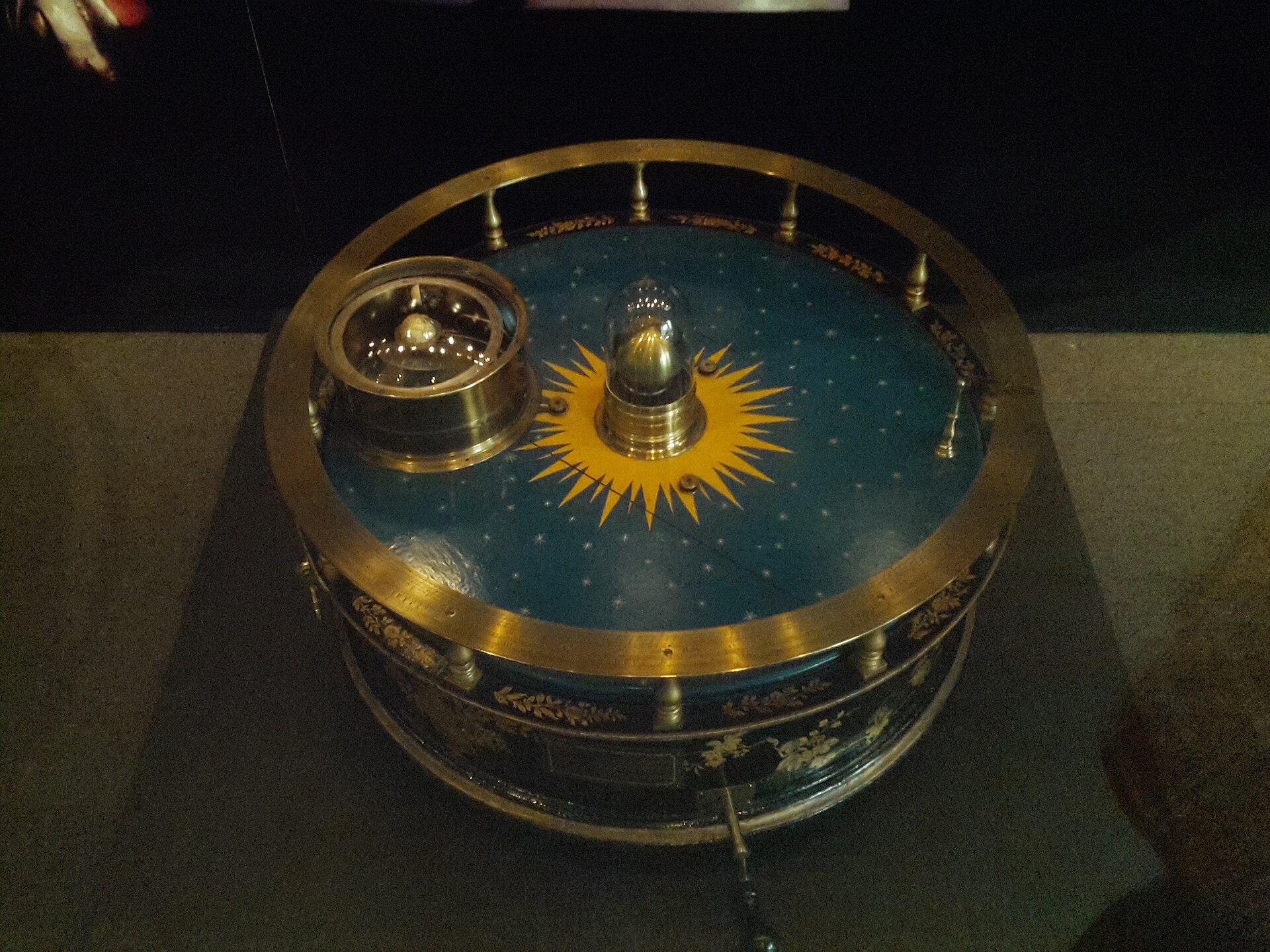
The instrument itself, photographed at the Science Museum, London. Licence and photographer verified directly against the Wikimedia Commons file's own metadata: Creative Commons Attribution-ShareAlike 3.0, photographer credited as Kinkreet. The file's embedded GPS coordinates place it at the Science Museum's South Kensington site, consistent with the file description's own identification of the subject as John Rowley's 1712 orrery.
Photograph by Kinkreet, via Wikimedia Commons, CC BY-SA 3.0| Artist | John Rowley |
|---|---|
| Date | 1712-1713 |
| Medium | Wood, brass, steel, ivory and glass |
| Dimensions | 500 x 900 mm (overall, estimate, per the Science Museum Group's own catalogue) |
| Where it is now | Science Museum, London (on display, Science Museum: Science City)last confirmed 18 September 2026 |
| Inventory number | 1952-73 |
| Attribution | DisputedCatalogued by the Science Museum Group as the work of the instrument-maker John Rowley, who built it in Fleet Street, London, in 1712-1713. Full note |
| Object type | Clocks and instruments |
| Period | British, early eighteenth century (reign of Queen Anne) |
| Cases | Disputed attribution · Has a provenance gap |
| Inscriptions | A brass plaque on the instrument reads, per the transcription given in secondary literature: 'Orrery invented by Graham 1700. Improved by Rowley, and presented by him to John [sic] Earl of Orrery, after whom it was named at the suggestion of Richard Steele.' The date 1700 on the plaque does not match the c.1704-1710 date range given for Graham's mechanism by other sources consulted, and the claim that Steele suggested the name is itself contradicted by Steele's own 1713 essay, which credits the name to Rowley rather than to himself. |
| Owners on record | 4 links3 documented, 1 unknown |
| Sources | 18 cited |
About this record Last verified 18 September 2026 · 18 sources cited · Change log
On this page 9 sections
ContentsClose
A hand-turned demonstration instrument built in 1712-13 by the London instrument-maker John Rowley for his patron Charles Boyle, the fourth Earl of Orrery, showing the Earth and Moon in motion around the Sun. It is the object that gave the entire class of mechanical planetary model its English name, and it is also a small, self-contained case study in how credit moves: the working mechanism it copies was built earlier by the clockmaker George Graham, who is named as inventor on the instrument's own plaque yet is absent from the word history remembers.
The Science Museum's own record of this object is honest about what it does not know. It hedges on how Graham's design reached Rowley, and it does not explain where the orrery spent the 239 years between its completion and its arrival in the museum's collection in 1952. This record follows that same honesty rather than smoothing the gaps over: it names the open questions plainly, including a tension between Boyle's recorded bequest of his instruments to Christ Church, Oxford, and this instrument's quite different, and quite undocumented, route to South Kensington.
What is certain is simpler and, in its way, more interesting than a clean chain of ownership would be. A clockmaker built a machine. An instrument-maker copied and improved it for at least two patrons. An essayist wrote it up and, in doing so, got even the story of his own role wrong on the very label meant to set the record straight. The object survives; the credit did not travel with it cleanly; and the record here tries to put both back in view.
Provenance
Each link is graded. Documented: a cited source supports it. Disputed: the identification is argued but not established. Unknown: no owner for that span, and the gap is not smoothed into a narrative. The grades in the glossary.
- c. 1700-1710 -George Graham (and, in his working partnership, Thomas Tompion)documented
Graham is credited as the source of the underlying mechanism both by the Science Museum Group's own catalogue entry for this object and by the object's own plaque, which reads in part 'Orrery invented by Graham.' The exact date is disputed across sources (1700 on the plaque; c.1704 or c.1710 elsewhere), and the mechanism by which Graham's design or machine reached Rowley is stated cautiously by the Science Museum ('may have been inspired by') rather than as a documented handover.1356
- 1712 - 1713John Rowley (maker), for Charles Boyle, 4th Earl of Orrery (patron)documented
Rowley built this specific instrument for Boyle in this period. The Science Museum Group's own title for the object, 'Orrery made by John Rowley for the Earl of Orrery,' and its object number 1952-73 identify it as the Boyle commission specifically, distinct from the copy Rowley is separately recorded as having made for Prince Eugene of Savoy.18
- 1713 - 1952Not documented; presumed within the family holding the Earl of Orrery, later Earl of Cork and Orrery, titleunknown
No source consulted for this record documents an owner, location or transaction for this instrument across this 239-year span. The Science Museum's 1952 credit line, 'Earl of Cork and Orrery' (the title the Orrery earldom merged into in 1753), implies the object remained with the family, but no specific individual, place or event bridges the gap. Charles Boyle is separately recorded as having left his library and scientific instruments to Christ Church, Oxford, on his death in 1731; this object's appearance instead via the Cork and Orrery family line in 1952 is not reconciled with that bequest by any source consulted.18
- 1952 - presentScience Museum, London (Science Museum Group)documented
The object entered the Science Museum's collection in 1952, given object number 1952-73 and credited to the Earl of Cork and Orrery. Whether the transfer was a gift, purchase or bequest, and the name of the individual Earl involved, is not stated in the Science Museum Group's own published catalogue record and is not established by any other source consulted.1
Technical evidence
| Attribution note | Catalogued by the Science Museum Group as the work of the instrument-maker John Rowley, who built it in Fleet Street, London, in 1712-1713. But the working mechanism it copies was built earlier by the clockmaker George Graham, and the Science Museum's own object record hedges rather than asserts a clean transfer, stating only that Rowley's orrery 'may have been inspired by an earlier example made by the London clock maker, George Graham.' The object's own brass plaque, transcribed in later scholarship, names Graham as inventor and Rowley as improver. Whether Rowley's contribution amounted to a straight copy or to genuine mechanical improvement of his own is not settled by any source consulted for this record. |
|---|---|
| Materials | Wood, brass, steel, ivory and glass.1 |
| Dimensions | 500 x 900 mm overall (Science Museum Group's own estimate).1 |
| Date made | 1712-1713, per the Science Museum Group's own catalogue date range.1 |
| Function | A hand-operated demonstration mechanism showing the motions of the Earth and Moon around the Sun. In modern terminology this makes it a tellurium rather than a full multi-planet orrery, though the word orrery was coined for devices of exactly this simpler kind before the narrower vocabulary existed.15 |
| Plaque inscription | Transcribed in secondary literature as: 'Orrery invented by Graham 1700. Improved by Rowley, and presented by him to John [sic] Earl of Orrery, after whom it was named at the suggestion of Richard Steele.' The Steele clause is contradicted by Steele's own 1713 essay, which credits Rowley, not himself, with the name.5 |
| Object number and credit line | Science Museum Group object number 1952-73; credit line 'Earl of Cork and Orrery.'1 |
| Classification | Catalogued by the Science Museum Group under Astronomy, and within the object type 'Demonstration models, orreries, planetaria (models).' Catalogued on this site under the live facet Clocks and instruments.1 |
Images
The record in full
Chapter 1What it is
A demonstration instrument in wood, brass, steel, ivory and glass, about 500 by 900 millimetres overall, built to be turned by hand so that a viewer can watch the Earth and Moon move around a central...
A demonstration instrument in wood, brass, steel, ivory and glass, about 500 by 900 millimetres overall, built to be turned by hand so that a viewer can watch the Earth and Moon move around a central Sun. In the vocabulary that later grew up to describe machines of this kind, it is strictly a tellurium, a device that shows only the Sun, Earth and Moon, rather than a full orrery modelling every known planet. The distinction did not exist when this object was made. The word 'orrery' was coined for it, or for one very like it, before anyone needed a narrower word for the simpler version.
The Science Museum Group catalogues it as made in cabinet form, consistent with George Graham's own planetarium work, which a near-contemporary account describes as built 'in cabinet form, at the desire of Charles Boyle, 4th Earl of Orrery.' It was made to be looked at up close by one or a few people at a time, in a room, not from across a hall, which is the same intimacy of scale that let it survive three centuries without being melted down for its brass or broken up for parts.
Chapter 2The word this object gave away
'Orrery' now names an entire class of mechanical solar system model, from tabletop teaching aids to museum showpieces with a dozen moving planets.
'Orrery' now names an entire class of mechanical solar system model, from tabletop teaching aids to museum showpieces with a dozen moving planets. All of that usage traces back to this specific commission, or to the pair of instruments Rowley built alongside it. The Science Museum Group's own account of the name is cautious: it records that the device was 'reportedly named orrery after its owner,' and offers the alternative explanation that the word may be wordplay on 'horary,' meaning of the hours, rather than a straightforward tribute.
Whichever reading is right, the effect was the same. An aristocratic patron's title became the common noun for the genre, while the clockmaker whose mechanism made the whole thing possible did not get a word named after him at all.
Chapter 3Before Rowley: a European tradition of mechanical planets
Mechanically demonstrating the motion of the planets did not begin in Fleet Street.
Mechanically demonstrating the motion of the planets did not begin in Fleet Street. In Paris in 1678-79, the Danish astronomer Ole Romer designed a planetarium to show the planets orbiting the Sun and a companion instrument, an eclipsarium, to calculate the Moon's orbit and predict eclipses. Both were built to his design by the royal clockmaker Isaac Thuret and presented to the French Academy of Sciences and to Louis XIV in 1680; copies were later sent as diplomatic gifts to the Chinese emperor and the king of Siam. This account comes from a tertiary encyclopaedia source and is flagged here for replacement with a primary catalogue record from the Royal Danish Collection at Rosenborg Castle, which holds Romer's own instruments.
Separately, and on the English side of the story, the Dutch scientist Christiaan Huygens published details in 1703 of a heliocentric planetary machine he had built while living in Paris between 1665 and 1681, complete with the gear ratios needed to represent a 365.242-day year.
No source consulted for this record documents that George Graham had specifically seen or heard of Romer's Paris instruments. That link, though plausible given how small and interconnected the community of European instrument-makers and astronomers was, is not established here and should not be read into what follows. What is documented is that England had its own, independently credited starting point: a working demonstration machine built by Graham, in the circle of the clockmaker Thomas Tompion, in the first decade of the eighteenth century.
Chapter 4Graham and Tompion's machine
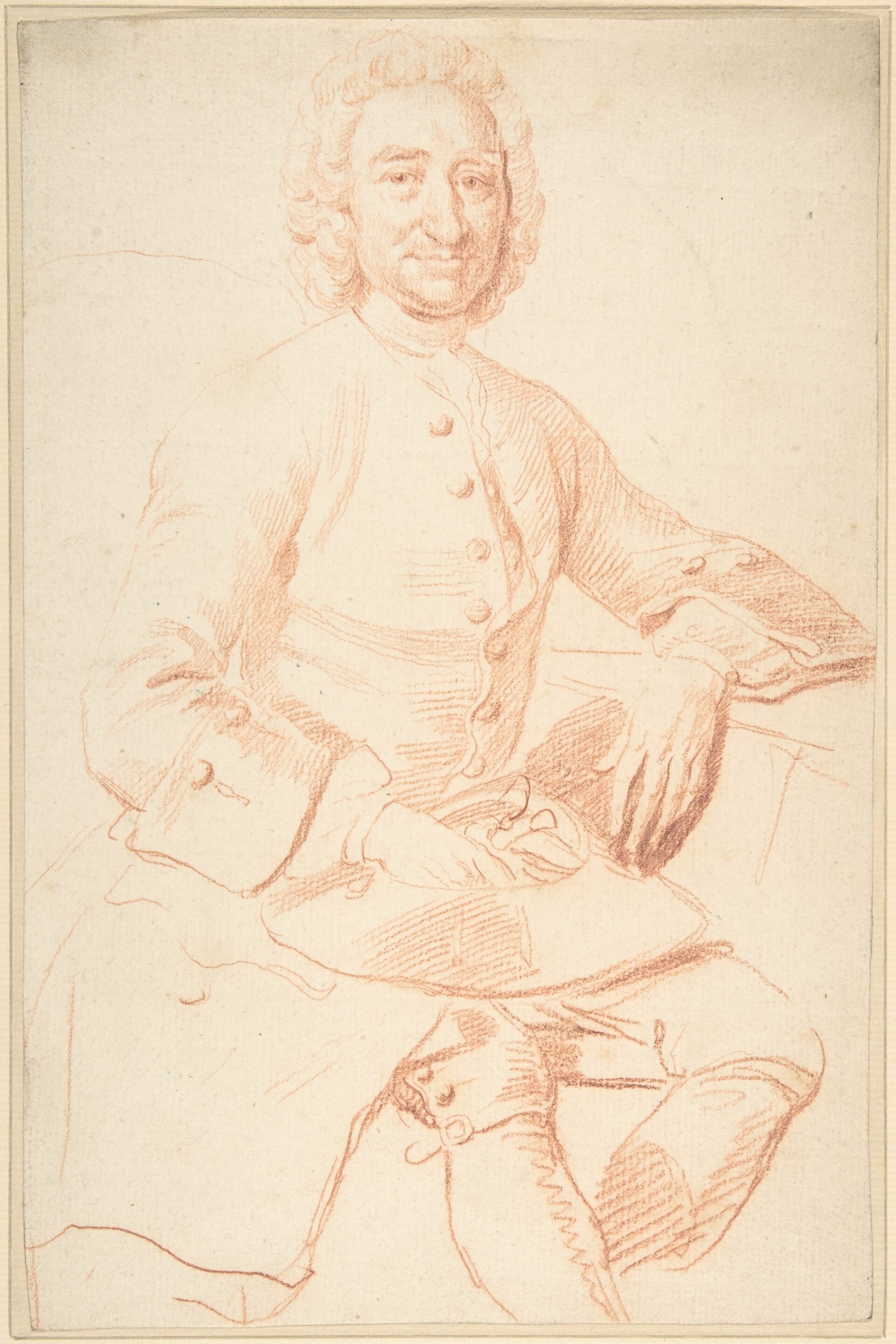
George Graham trained under, and later partnered, Thomas Tompion, the clockmaker regarded as the father of English precision horology.
George Graham trained under, and later partnered, Thomas Tompion, the clockmaker regarded as the father of English precision horology. Graham married Tompion's niece, Elizabeth, and took over the business on Tompion's death in 1713. A machine attributed jointly to Tompion and Graham and dated to around 1710 is catalogued today at the Museum of the History of Science in Oxford as 'Orrery, by Thomas Tompion and George Graham, London, c. 1710' (inventory number 97810). Other sources place the pair's first planetarium as early as 1704. The discrepancy between 1700 (the date on Rowley's own plaque), c.1704, and c.1710 is not resolved in the sources consulted and is recorded here as an open question rather than smoothed into a single date.
Graham built, in Rowley's later words on the plaque, the instrument that was 'invented by Graham.' What he did with it next is the point where the story of this specific object begins.
Chapter 5From Graham's workshop to Rowley's
According to an account given by Chetham's Library, John Rowley saw one of Graham's machines while it was awaiting shipment to Prince Eugene of Savoy, the Austrian field marshal and celebrated...
According to an account given by Chetham's Library, John Rowley saw one of Graham's machines while it was awaiting shipment to Prince Eugene of Savoy, the Austrian field marshal and celebrated collector, and went on to build his own enhanced version of it around 1712. The Science Museum Group's own catalogue entry for this object is more cautious than that: it states only that Rowley's orrery 'may have been inspired by an earlier example made by the London clock maker, George Graham,' without asserting a documented handover of a design or a machine.
Both readings agree on the outcome. Rowley, a mathematical-instrument maker with a workshop at the Sign of the Globe under St Dunstan's Church in Fleet Street, produced his own version of Graham's mechanism in the years around 1712-13, and did so for at least two different patrons.
Chapter 6Two copies, one commission each
Rowley is recorded as having built at least two instruments of this design in this period: one made for Prince Eugene of Savoy, and a second, this one, made for his own patron, Charles Boyle, the...
Rowley is recorded as having built at least two instruments of this design in this period: one made for Prince Eugene of Savoy, and a second, this one, made for his own patron, Charles Boyle, the fourth Earl of Orrery. The Science Museum Group's title for the present object, 'Orrery made by John Rowley for the Earl of Orrery,' and its credit line, 'Earl of Cork and Orrery,' identify object 1952-73 specifically as the Boyle copy.
The Savoy copy's present location is not established in any source consulted for this record. It is not claimed here to survive, nor claimed to be lost; it is simply not found, and that absence is recorded as an open question rather than resolved by assumption. Readers should not confuse either the Savoy copy or any of the later, larger 'grand orreries' that followed with this specific object.
Chapter 7Made for the Earl of Orrery
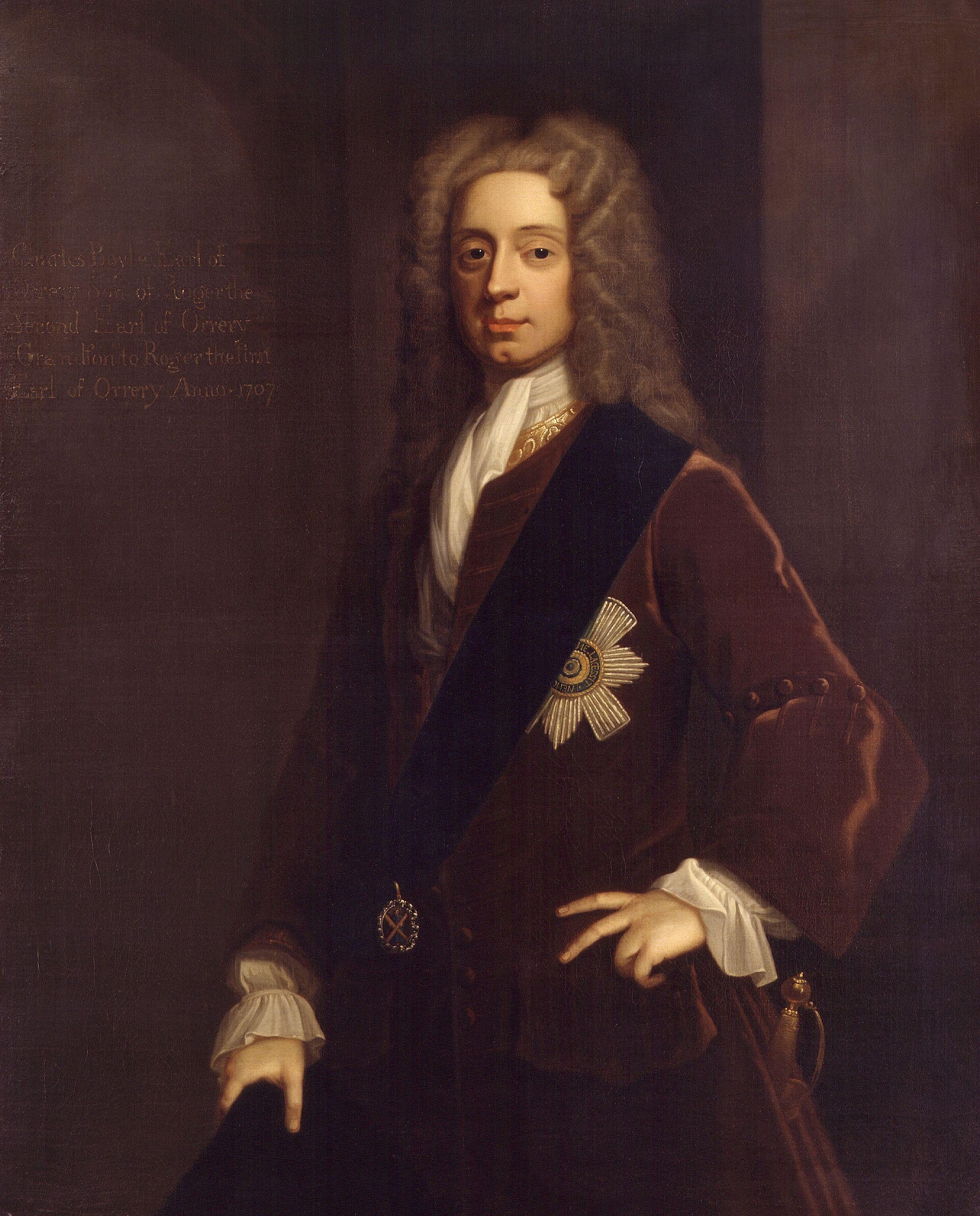
Charles Boyle, born in 1674, became the fourth Earl of Orrery in 1703 on the death of his elder brother.
Charles Boyle, born in 1674, became the fourth Earl of Orrery in 1703 on the death of his elder brother. He was educated at Christ Church, Oxford, where his edition of the letters of Phalaris drew him into a celebrated scholarly quarrel with the classicist Richard Bentley. He sat in the Irish and then the English parliaments, rose to major general by 1709, was elected a Fellow of the Royal Society in 1706, and was sworn of the Privy Council in 1711. In 1722 he was imprisoned in the Tower of London for six months on suspicion of involvement in the Jacobite Atterbury Plot, and later discharged. He died in 1731 and was buried in Westminster Abbey.
Multiple sources state that Boyle bequeathed his library and scientific instruments to Christ Church, Oxford, on his death. This particular orrery, however, is not recorded in the sources consulted as having passed to Christ Church; it instead resurfaces in 1952 credited to the 'Earl of Cork and Orrery,' the title into which the Orrery earldom merged in 1753. Whether the orrery was deliberately kept out of the Christ Church bequest, held by a different branch of the family, or simply omitted from the sources describing that bequest is not established here, and is recorded as an open question.
Chapter 8How it got its name, and how the plaque got its own history wrong
Richard Steele, the essayist and co-founder of The Guardian, wrote about Rowley's instrument in that periodical in 1713 and is widely credited with naming the device an orrery in honour of Boyle.
Richard Steele, the essayist and co-founder of The Guardian, wrote about Rowley's instrument in that periodical in 1713 and is widely credited with naming the device an orrery in honour of Boyle. The plaque on the instrument itself, as transcribed in later scholarship, states that it was 'presented by him to John [sic] Earl of Orrery, after whom it was named at the suggestion of Richard Steele.'
That clause has itself been shown to be wrong. Steele's own 1713 article on the subject credits the name to Rowley, not to himself. The plaque, in other words, preserves exactly the kind of small, confident misattribution this record exists to catch, on the very object whose real history is otherwise the subject of a much larger one. It is worth sitting with the irony: the same plaque that correctly names Graham as inventor gets the story of its own naming wrong.
Chapter 9Reading the erasure
Graham designed or built the working mechanism.
Graham designed or built the working mechanism. Rowley made this specific instrument and at least one other. Steele wrote the essay that made the word public. Boyle's name is the one that stuck. No source consulted for this record identifies a named historian arguing in print that this sequence was a deliberate erasure of Graham's role, as opposed to an unremarkable feature of a period convention in which instruments and rooms and even diseases were routinely named for a patron or owner rather than for the craftsman who built or discovered them. That absence of a citable argument is itself worth recording rather than papering over: this record does not know of a scholar who has made the deliberate-erasure case in print, and does not attribute that case to one.
What can be said plainly is that the naming outcome and the credit imbalance are real and documented, whatever the cause. Graham is not a footnote by accident of evidence; he built the machine. He is a footnote in the object's popular name by the plain fact of what English polite society in 1713 chose to celebrate about a new toy for a drawing room: not the man who solved the gear ratios, but the lord who owned the copy.
Chapter 10What this object is not
Several distinct things carry the name 'orrery' or are closely tied to this history, and none of them should be mistaken for object 1952-73.
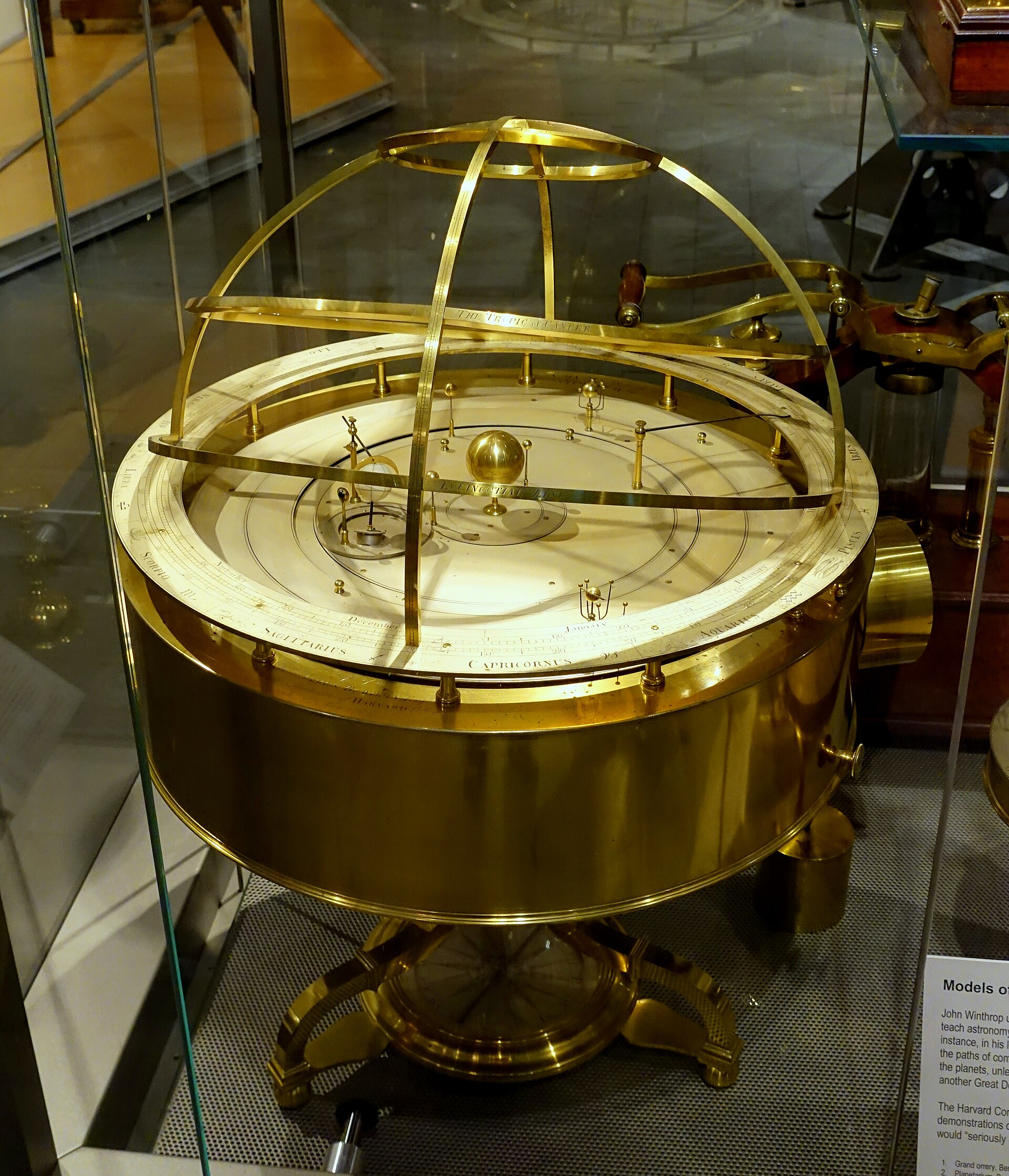
Several distinct things carry the name 'orrery' or are closely tied to this history, and none of them should be mistaken for object 1952-73. The Tompion and Graham machine of around 1710 is a separate, earlier instrument, held at the Museum of the History of Science, Oxford. An engraving in the Science Museum Group's own collection, 'The Grand Orrery by Rowley' (object 1898-33/2), is dated 1715-1728, after this instrument was made, and depicts what its own cataloguing calls a grand orrery, a larger and later design; it should not be read as a picture of the Boyle orrery. Rowley's own apprentice, Thomas Wright, went on to build grand orreries of his own once he took over the Fleet Street workshop, and later instrument-makers across the eighteenth century, including Benjamin Martin and George Adams, built and sold their own orreries as the genre became a staple of the scientific-instrument trade. None of that later, larger, commercially proliferated tradition is this object. This is the one made in 1712-13 for Charles Boyle.
Chapter 11The 1952 gap
Between the instrument's completion in 1712-13 and its entry into the Science Museum's collection in 1952, no source consulted for this record documents where it was kept, who held it, or how it...
Between the instrument's completion in 1712-13 and its entry into the Science Museum's collection in 1952, no source consulted for this record documents where it was kept, who held it, or how it moved. The museum's own credit line, 'Earl of Cork and Orrery,' names the family line rather than a specific individual or transaction, and the museum's published catalogue record does not state whether the object came in as a gift, a purchase or a bequest. A gap of 239 years in a documented ownership chain is a real gap, not a detail to be assumed away, and it is recorded here as such rather than bridged with a plausible-sounding line of family descent that no source actually establishes.
The artist
John Rowley
John Rowley is the maker of record on this object, and the dossier below is built around him. But his name on the catalogue card is itself part of what this record is about: the working mechanism he copied and improved was not his own invention, and the man who built that mechanism, George Graham, appears in several of the facts below because leaving him out would misrepresent exactly the history this object is evidence for.
Related works
| Work | Relation | Where it is |
|---|---|---|
| Orrery, by Thomas Tompion and George Graham Thomas Tompion and George Graham | The earlier mechanism, c. 1710, from which Rowley's Boyle orrery descends or was inspired by Catalogued separately by the Oxford museum under Tompion and Graham's own names, not Rowley's. This is the documented English starting point of the design tradition, not this object. | Museum of the History of Science, Oxford (inventory 97810) |
| Orrery made for Prince Eugene of Savoy John Rowley | The other instrument Rowley is recorded as building to this design, around 1712-13, for a different patron Its present survival and location are unknown to this record. It should not be assumed lost, nor assumed to survive; it is simply unlocated. | Not established in sources consulted |
| Engraving of 'The Grand Orrery' by Rowley John Rowley | A print in the Science Museum Group's own collection, dated later than this object Dated 1715-1728, after the Boyle orrery was completed, and described by its own cataloguing as a grand orrery, a larger and later design. Not a picture of object 1952-73. | Science Museum Group Collection, object 1898-33/2 |
| Grand orrery Benjamin Martin | A later instrument by an unrelated maker, showing the mature eighteenth-century commercial genre that Rowley's naming touched off Made in London in 1767, more than fifty years after the Boyle orrery, by a different instrument-maker with no documented connection to Rowley or Graham beyond building instruments of the same class. | Harvard University, Putnam Gallery |
Open questions
- Where was this orrery kept between 1712-13 and its entry into the Science Museum's collection in 1952? No intermediate owner, location or transaction is documented in the sources consulted.
- Was the 1952 transfer to the Science Museum a gift, a purchase or a bequest, and from which individual holding the title Earl of Cork and Orrery? The museum's own record gives a credit line but not a mechanism.
- Does the copy Rowley made for Prince Eugene of Savoy survive, and if so, where? No source consulted for this record locates it today.
- Charles Boyle is recorded as having bequeathed his library and scientific instruments to Christ Church, Oxford, on his death in 1731. Why does this orrery appear instead in the Earl of Cork and Orrery's family credit line in 1952, rather than in a Christ Church provenance? The relationship between the two accounts is not resolved by the sources consulted.
- Was the naming of the device after Boyle, and the corresponding near-erasure of Graham from its popular name, the product of any deliberate choice by Rowley, Boyle or Steele, or simply a period convention of naming instruments for owners rather than makers? No named historian's published argument on this specific question was located in the sources consulted.
- The plaque on the instrument dates Graham's invention to 1700, while other sources place Graham and Tompion's planetarium work at c. 1704 or c. 1710. Which date, if any of these, is correct has not been established here.
Questions about this object
What is Orrery made by John Rowley for the Earl of Orrery?
Orrery made by John Rowley for the Earl of Orrery is a clocks and instruments, dated 1712-1713. Medium: Wood, brass, steel, ivory and glass.
Who made Orrery made by John Rowley for the Earl of Orrery, and is the attribution settled?
The attribution to John Rowley is recorded here as disputed. Catalogued by the Science Museum Group as the work of the instrument-maker John Rowley, who built it in Fleet Street, London, in 1712-1713. But the working mechanism it copies was built earlier by the clockmaker George Graham, and the Science Museum's own object record hedges rather than asserts a clean transfer, stating only that Rowley's orrery 'may have been inspired by an earlier example made by the London clock maker, George Graham.' The object's own brass plaque, transcribed in later scholarship, names Graham as inventor and Rowley as improver. Whether Rowley's contribution amounted to a straight copy or to genuine mechanical improvement of his own is not settled by any source consulted for this record.
Where is Orrery made by John Rowley for the Earl of Orrery now?
Science Museum, London (on display, Science Museum: Science City). Inventory number 1952-73. Last confirmed 18 September 2026. Science Museum Group's own object catalogue record.
What is still unknown about Orrery made by John Rowley for the Earl of Orrery?
Where was this orrery kept between 1712-13 and its entry into the Science Museum's collection in 1952? No intermediate owner, location or transaction is documented in the sources consulted.
Sources
- 1Science Museum Group Collection, object 1952-73, 'Orrery made by John Rowley for the Earl of Orrery.' collection.sciencemuseumgroup.org.uk/objects/...
- 2Science Museum Group Collection, person record, 'John Rowley 1668-1728.' collection.sciencemuseumgroup.org.uk/people/...
- 3Science Museum Group Collection, person record, 'George Graham 1673-1751.' collection.sciencemuseumgroup.org.uk/people/...
- 4Science Museum Group Collection, object 1898-33/2, 'Engraving of "The Grand Orrery" by Rowley.' collection.sciencemuseumgroup.org.uk/objects/...
- 5Wikipedia, 'Orrery.' Consulted for the plaque transcription, the Steele naming correction, the Huygens planetary machine, and the Tompion/Graham dating. Flagged as a tertiary source for replacement with the Science Museum's own curatorial file and a peer-reviewed history-of-science account. en.wikipedia.org/wiki/...
- 6Wikipedia, 'George Graham (clockmaker).' en.wikipedia.org/wiki/...
- 7Wikipedia, 'Thomas Tompion.' en.wikipedia.org/wiki/...
- 8Wikipedia, 'Charles Boyle, 4th Earl of Orrery.' en.wikipedia.org/wiki/...
- 9Wikipedia, 'The Guardian (1713).' Consulted to verify the periodical and date of Steele's essay; this article's own text does not itself cover the orrery essay in the version consulted. en.wikipedia.org/wiki/...
- 10British Map Engravers, biographical entry, 'John Rowley,' drawing on the Oxford Dictionary of National Biography and other standard reference works. britishmapengravers.net/entries/...
- 11Chetham's Library, 'Two Libraries and an Orrery...' (blog post). library.chethams.com/blog/...
- 12BBC Sky at Night Magazine, 'Orrery history and definition.' skyatnightmagazine.com/space-science/...
- 13Wikimedia Commons, File:The Original Orrery.jpg, file description page and extmetadata (licence and photographer verification). commons.wikimedia.org/wiki/...
- 14Ewing, Jack, 'Ole Christensen Romer,' Research Starters, EBSCOhost, 2024. Tertiary encyclopaedia entry, flagged for replacement with a primary catalogue record from the Royal Danish Collection (Rosenborg Castle), which holds Romer's own planetarium and eclipsarium. ebsco.com/research-starters/...
- 15Museum of the History of Science, Oxford, collection record, 'Orrery, by Thomas Tompion and George Graham, London, c. 1710' (inventory 97810, IRN 9536). mhs.ox.ac.uk/collections/...
- 16Wikimedia Commons, File:Charles Boyle, 4th Earl of Orrery by Charles Jervas.jpg. commons.wikimedia.org/wiki/...
- 17Wikimedia Commons, File:Portrait of George Graham MET DP804442.jpg. commons.wikimedia.org/wiki/...
- 18Wikimedia Commons, File:Grand orrery by Benjamin Martin, London, 1767 - Putnam Gallery - Harvard University - DSC07953.jpg. commons.wikimedia.org/wiki/...


Last verified 18 September 2026 · Published 18 September 2026
Change log
18 September 2026 - Record created at the house standard: researched narrative, technical evidence, maker dossier, graded provenance chain, prices with hammer and premium separated, related works, open questions and sources.