The Complutensian Polyglot Bible
Arnao Guillen de Brocar · 1514-1517 (printed); papal license 1520; first sale c. 1521-1522
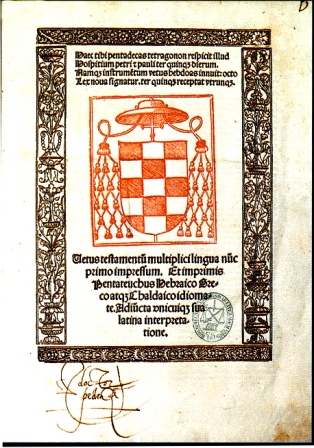
This set. The Universidad Complutense de Madrid's own copy, held by its Biblioteca Historica under the shelfmarks BH FOA 194 and 102-106.
| Artist | Arnao Guillen de Brocar |
|---|---|
| Date | 1514-1517 (printed); papal license 1520; first sale c. 1521-1522 |
| Medium | Letterpress printing on paper, gothic and roman and Greek and Hebrew type, six volumes bound in pasteboard with gilt tooling and the superlibro of Cardinal Cisneros |
| Dimensions | Six volumes, folio format (approx. 36 x 25 cm per volume, untrimmed) |
| Where it is now | Biblioteca Historica Marques de Valdecilla, Universidad Complutense de Madrid, Spainlast confirmed |
| Inventory number | BH FOA 194 (vol. I), BH FOA 102-106 (vols. II-VI) |
| Attribution | AcceptedThe printing is securely documented as the work of Arnao Guillen de Brocar's shop at Alcala de Henares, commissioned and financed by Cardinal Francisco Jimenez de Cisneros. Full note |
| Object type | Printed book |
| Period | Spanish Renaissance, early sixteenth century |
| Inscriptions | Each volume's binding carries the gilt-stamped heraldic superlibro (personal binding device) of Cardinal Francisco Jimenez de Cisneros. Volume I carries, in its preliminaries, the papal printing license of Leo X addressed to Fray Francisco Ruiz, Bishop of Avila, and Francisco de Mendoza y Bobadilla, archdeacon of Pedroche, dated Rome, 22 March 1520. |
| Owners on record | 5 links5 documented |
| Sources | 18 cited |
About this record Last verified · 18 sources cited · Change log
On this page 11 sections
ContentsClose
This is one specific surviving set of the first printed polyglot Bible: six folio volumes produced at Alcala de Henares between 1514 and 1517 under the patronage of Cardinal Francisco Jimenez de Cisneros, printed by Arnao Guillen de Brocar, and held without interruption by the library of the University Cisneros himself founded. All six volumes carry his own gilt-stamped superlibro on their bindings. That university became, after an 1836 royal order moved it to the capital, the Universidad Complutense de Madrid, whose Biblioteca Historica still catalogues this set today under the shelfmarks BH FOA 194 and 102-106.
The edition set Hebrew, Greek Septuagint, the Latin Vulgate and, in the Pentateuch, Aramaic Targum Onkelos side by side on the page for the first time in print, on the strength of manuscripts Cisneros bought, borrowed from the Vatican Library and the library of St Mark's in Venice, and commissioned from his own scholars. Cisneros died in November 1517, five months after the printing was finished, without ever seeing a copy sold: a papal license and a four-year rival privilege granted to Erasmus's rushed Greek New Testament held the edition off the market until around 1521-1522.
This record treats the widely repeated print-run and survival figures with the caution the evidence supports, separates a documented university tradition from a later scholar's disputed correction of it, and keeps this one library's five-century custody of its own set distinct from what is true only of a different institution's copy.
Provenance
Each link is graded. Documented: a cited source supports it. Disputed: the identification is argued but not established. Unknown: no owner for that span, and the gap is not smoothed into a narrative. The grades in the glossary.
- 1514-1517 - 1517Printed at the press of Arnao Guillen de Brocar, Alcala de Henares, for the library of the University of Alcaladocumented
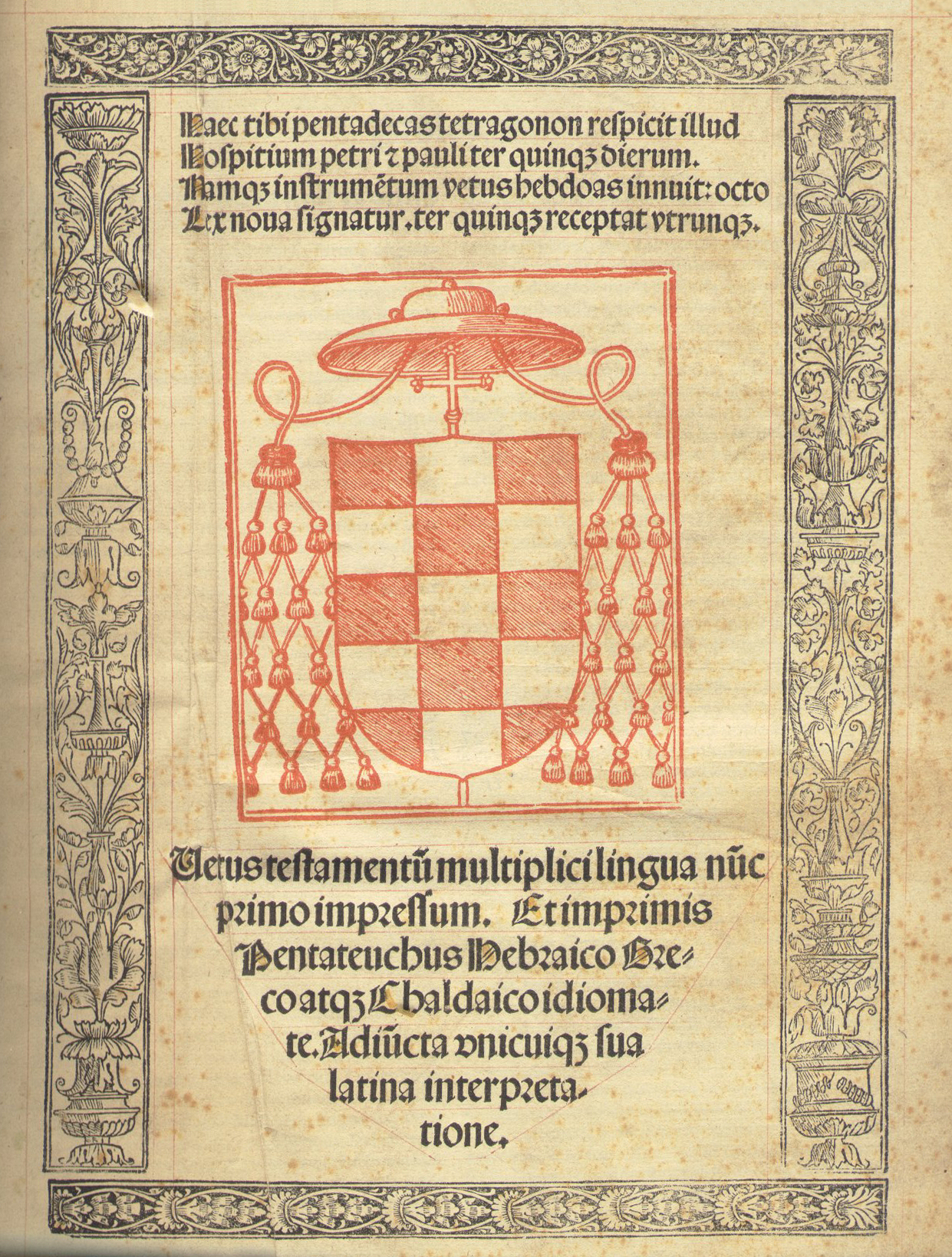
This six-volume set was printed for, and bound for, the public library of the University Cisneros founded in Alcala de Henares in 1499. All six volumes are bound uniformly in pasteboard with gilt tooling and the personal heraldic superlibro of Cardinal Cisneros, which the holding library's own catalogue records volume by volume: BH FOA 194 (vol. I, Pentateuch, 1517), BH FOA 102 (vol. II, 1517), BH FOA 103 (vol. III, 1517), BH FOA 104 (vol. IV, 1517), BH FOA 105 (vol. V, New Testament, 1514) and BH FOA 106 (vol. VI, vocabulary and grammar, 1515).12
- 1517 - 1836Library of the Colegio Mayor de San Ildefonso, University of Alcala de Henaresdocumented
Cisneros's own prologue describes depositing the project's working copies in 'the Public Library of our University Complutense', and the printed Bible was produced for that same library. The holding institution states that some of the manuscripts Cisneros assembled for the edition remain there today, which corroborates continuous institutional custody of the University's own core collection through this period, though no item-by-item register naming this exact six-volume set in every intervening decade has been located in the sources consulted.23
- 1836 - 1841Universidad Central, Madrid (the University of Alcala under its new name and location)documented
A Royal Order of 29 October 1836, issued during the regency of Maria Cristina de Borbon, ordered the progressive transfer of the University of Alcala's faculties to Madrid; the University's library followed in 1841. The old library was first housed in a room at the Salesas Nuevas convent, since the Alcala collection had by then been reduced to some 3,000 surviving volumes of Cisneros's original foundation.5
- 1841 - 1999Universidad Central, later (from 1970) Universidad Complutense de Madriddocumented
The University's old holdings moved again to the former Jesuit Novitiate building on Calle San Bernardo in Madrid between 1842 and 1848-1849, and the institution took the name Universidad Complutense de Madrid in 1970. The Bible remained part of the University's historic fondo antiguo (old holdings) throughout, administered as part of the general library rather than as a separately tracked treasure until the modern Biblioteca Historica was organised.5
- 1999 - presentBiblioteca Historica Marques de Valdecilla, Universidad Complutense de Madriddocumented
In 1999 the University's dispersed old holdings were consolidated into the remodelled Valdecilla pavilion, forming the Biblioteca Historica Marques de Valdecilla, which now catalogues and digitises this set under BH FOA 194 and 102-106 and states its provenance from the University's own Cisneros-era foundation.125
Prices realised
| Date | Sale | Estimate | Result | Note |
|---|---|---|---|---|
| 5 December 2016 | Sotheby's The Bible Collection of Dr. Charles Caldwell Ryrie, New York (N09539), lot 148, lot 148 | USD 80,000 - 120,000 | Hammer Not established in the sources consulted With premium Not established in the sources consulted USD | This is NOT the set described in this record. It is a different, privately owned six-volume Complutensian Polyglot (five volumes in eighteenth-century tree calf, the Vocabularium in eighteenth-century mottled calf, with an inscription tracing the Vocabularium volume to the College of Saint Ambrose, Valladolid), included here only as market comparanda for the edition as a whole. The UCM set has never been sold: it has been institutional property since it left Brocar's press. |
| 2018 | Sotheby's Fine Books and Manuscripts Including Americana, online sale (N09885), lot 176, lot 176 | USD 70,000 - 100,000 | Hammer Not established in the sources consulted With premium Not established in the sources consulted USD | Same provenance description (College of Saint Ambrose, Valladolid, Vocabularium volume) and matching binding and condition notes as the 2016 Ryrie-sale lot above, indicating this is very probably the same physical set re-offered rather than a second example. Included as further market comparanda only; it is not the UCM set and not evidence of any sale of the object described in this record. |
Hammer is the price at which the bidding stopped; with premium adds the fee the house charges the buyer on top. Hammer price and buyer's premium in the glossary.
Technical evidence
| Attribution note | The printing is securely documented as the work of Arnao Guillen de Brocar's shop at Alcala de Henares, commissioned and financed by Cardinal Francisco Jimenez de Cisneros. There is no attribution dispute over the printer or the patron; what is genuinely uncertain, and treated as such throughout this record, is the identity of several of the manuscript sources the editorial team worked from. |
|---|---|
| Format | Six volumes, folio, printed on paper (this set); the edition also included six vellum sets.12 |
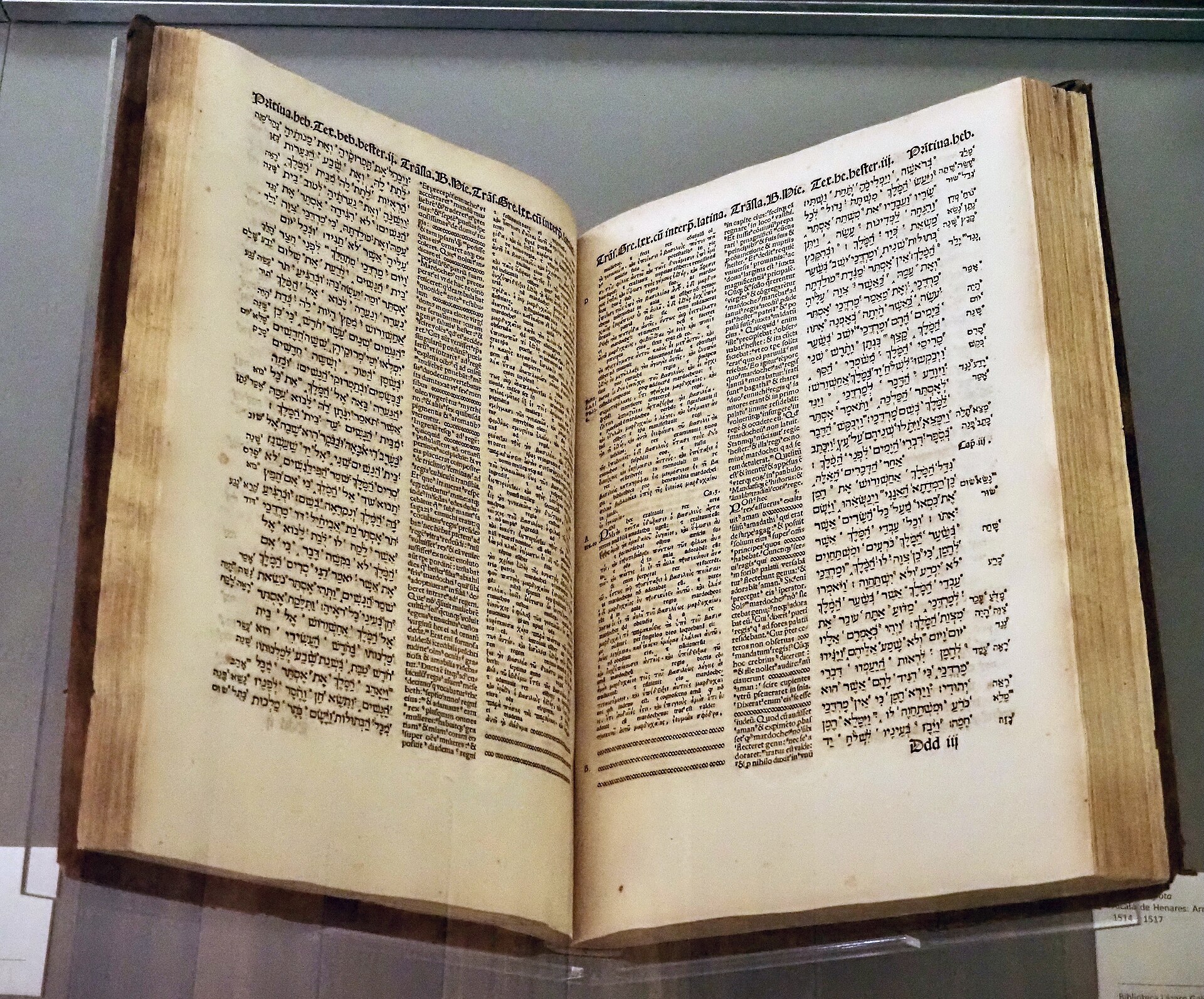
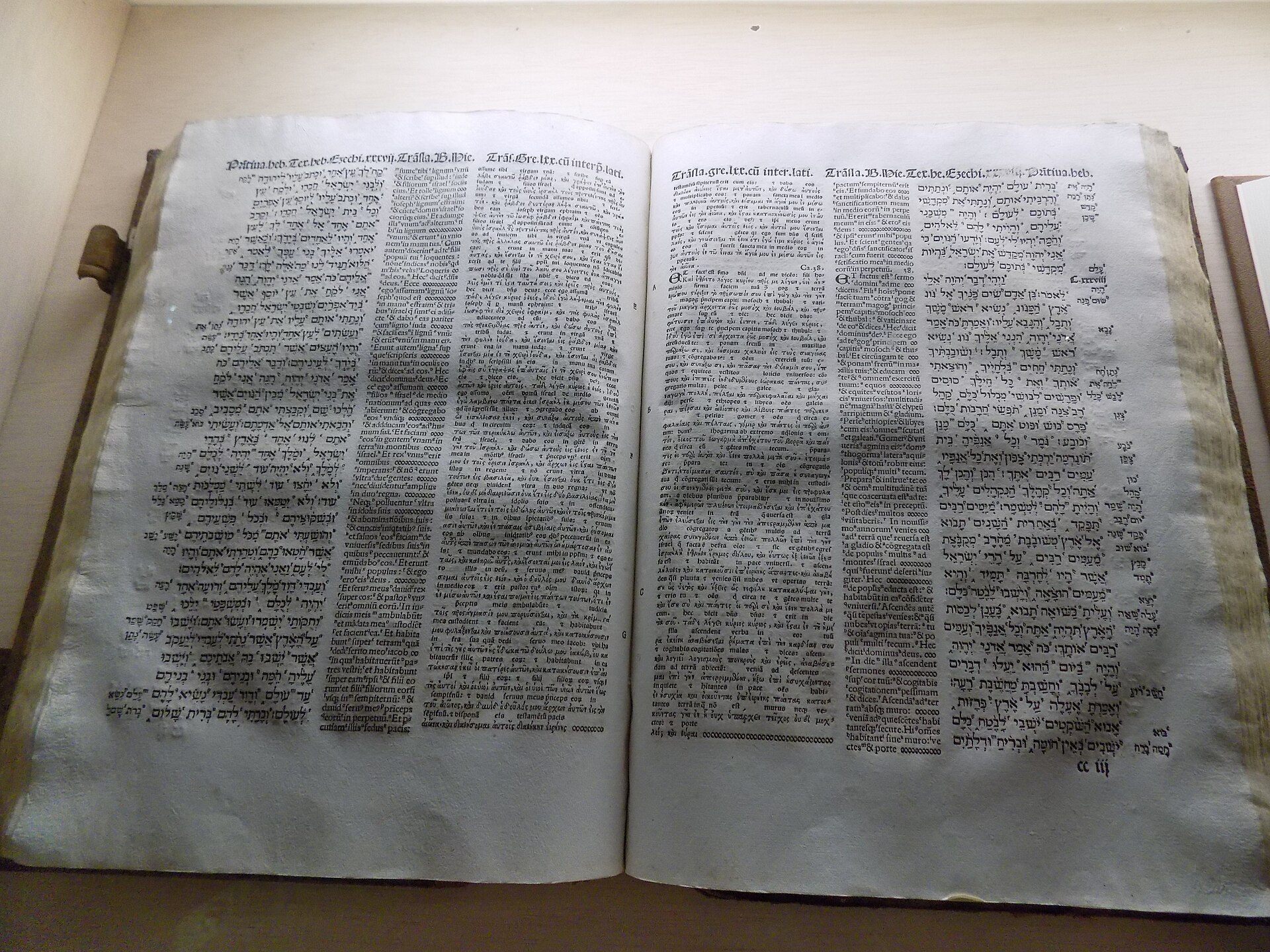
| Languages and layout | Volumes I-IV (Old Testament): Hebrew and Greek Septuagint (with interlinear Latin translation) in outer columns, the Latin Vulgate in a narrow center column; the Pentateuch volume also carries the Aramaic Targum Onkelos with its own Latin translation at the foot of the page. Volume V (New Testament): parallel Greek and Latin Vulgate columns. Volume VI: Hebrew-Aramaic vocabulary, a Latin-Hebrew-Greek index of proper names, and a short Hebrew grammar.12 |
| Printer and type | Printed by Arnao Guillen de Brocar. The Greek type was cut new for the edition but followed the design Brocar had used earlier at Logrono: a deliberately archaic minuscule without accents or breathing marks, chosen, according to the library's own account, so that the New Testament's Greek text (believed to have been dictated by the Holy Spirit) would appear free of any suspicion of reformist innovation in its lettering.2 |
| Vulgate text basis | First printed critical edition of Jerome's Vulgate, based on three Latin manuscripts described as gotico (Visigothic/Mozarabic script), two acquired by Cisneros and one donated by Hernan Nunez de Guzman; revised by Bartolome de Castro after Antonio de Nebrija resigned from the project when Cisneros declined to let him emend the text further.2 |
| Greek Old Testament sources | Includes two manuscripts lent from the Vatican Library by Pope Leo X, identified in a 1518 inventory of his library as Vaticanus graecus 330 and Vaticanus graecus 346, both later returned; a manuscript associated with Cardinal Bessarion sent from the library of St Mark's, Venice, by the Venetian Senate; and other manuscripts not securely identified.2 |
| Papal license | Printed among the preliminaries of volume I: license of Pope Leo X for the edition's publication, addressed to Fray Francisco Ruiz, Bishop of Avila, and Francisco de Mendoza y Bobadilla, archdeacon of Pedroche, dated Rome, 22 March 1520.2 |
| This set's binding | All six volumes bound uniformly in pasteboard with gilt tooling and the personal heraldic superlibro of Cardinal Francisco Jimenez de Cisneros.2 |
| Shelfmarks | BH FOA 194 (vol. I); BH FOA 102, 103, 104 (vols. II-IV); BH FOA 105 (vol. V); BH FOA 106 (vol. VI). The library's own general landing page for the edition abbreviates this same set as 'BH FOA 194-198', a simplification this record has not adopted in favour of the volume-by-volume shelfmarks given in the library's own detailed catalogue entry.12 |
| Print run and first sale price | 600 copies printed on paper and 6 on vellum, per the holding library's own account; sale began around 1521 at six and a half gold ducats per set.1 |
Images
The record in full
Chapter 1One set, not the whole edition
What sits on the shelf at the Biblioteca Historica Marques de Valdecilla under the marks BH FOA 194 and 102-106 is one specific six-volume set of the Complutensian Polyglot Bible: printed paper...
What sits on the shelf at the Biblioteca Historica Marques de Valdecilla under the marks BH FOA 194 and 102-106 is one specific six-volume set of the Complutensian Polyglot Bible: printed paper, bound in pasteboard with gilt tooling, and stamped on every cover with the personal heraldic device, the superlibro, of Cardinal Francisco Jimenez de Cisneros. It is not a symbol of the edition in general. It is one physical object with one physical history, and that history is the subject of this record.
The edition itself was printed in an unknown but bounded number of copies at Alcala de Henares between 1514 and 1517: six hundred on paper and six on vellum, according to the library that holds this set, though as later sections make clear that oft-repeated figure deserves more scrutiny than it usually gets. This particular set was made for, and has never left, the library of the university that commissioned it.
Chapter 2Why Cisneros wanted it made
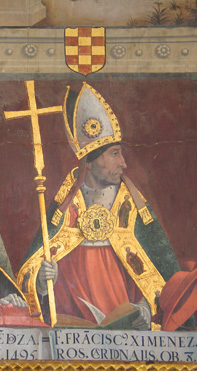
Francisco Jimenez de Cisneros founded the University of Alcala de Henares in 1499 as the flagship of a broader programme of religious and educational reform in Castile.
Francisco Jimenez de Cisneros founded the University of Alcala de Henares in 1499 as the flagship of a broader programme of religious and educational reform in Castile. The Polyglot Bible was conceived as that programme's central intellectual monument: a printed edition that would set the Hebrew Old Testament, the Greek Septuagint, the Latin Vulgate and, for the Pentateuch, the Aramaic Targum Onkelos side by side on the same page, so that scholars could compare the textual traditions of scripture directly rather than through report.
Spain's own translation culture made the project plausible. Centuries of work moving religious and legal texts between Arabic, Hebrew, Latin and the vernacular had built up, on the Iberian peninsula, an unusually sophisticated body of thinking about what a faithful translation actually required and where authority to judge one lay. The polyglot format was one answer that generation gave to that question: instead of arbitrating between competing translations, print all of the source traditions next to each other and let the reader see the evidence directly.
Cisneros himself put it plainly in his prologue to the reader, printed at the head of volume I of this very set: nothing gave him more satisfaction, for which his readers ought to congratulate him all the more warmly, than this edition of the Bible.
Chapter 3The scholars and the printer
Cisneros assembled a working team of specialists rather than relying on a single translator.
Cisneros assembled a working team of specialists rather than relying on a single translator. Diego Lopez de Zuniga is generally credited as chief editor, fluent in Latin, Aramaic and Arabic. Alfonso de Zamora, a converted Jewish scholar and an expert in Talmudic studies who spoke Hebrew as his first language, worked alongside Pablo Coronel and Alfonso de Alcala on the Hebrew and Aramaic sections; conversos were specifically sought for this work because of their fluency in the source languages and cultures. Demetrio Ducas, a scholar from Crete who had worked as a compositor in Aldus Manutius's Greek printing house in Venice, joined Hernan Nunez de Guzman (known as El Pinciano) and Diego Lopez de Zuniga on the Greek New Testament. Antonio de Nebrija, already Spain's most celebrated Latinist, was called in for the Vulgate.
The printing itself was entrusted to Arnao Guillen de Brocar, whose workshop's technical command of the project (clean and legible type, careful pagination that had to align three and sometimes four scripts across a single opening, exact proofing and a dense, even black ink) is what let the edition succeed as a physical object and not only as a scholarly plan. Every volume of this set opens with a two-colour title page bearing Cisneros's coat of arms inside a Renaissance border, and the workshop's discipline shows on every page that follows.
Chapter 4The manuscript sources: what is solid and what is not
For the Greek Old Testament, the Complutensian editors used, among other manuscripts, two codices lent from the Vatican Library by Pope Leo X himself: an inventory of Leo's own library made in 1518...
For the Greek Old Testament, the Complutensian editors used, among other manuscripts, two codices lent from the Vatican Library by Pope Leo X himself: an inventory of Leo's own library made in 1518 identifies the two volumes lent to Spain for the Polyglot's preparation and later returned as Vaticanus graecus 330 (Genesis to an incomplete Tobit) and Vaticanus graecus 346 (the wisdom books to Judith). A further manuscript came from the library of St Mark's in Venice, by way of a copy of a codex associated with Cardinal Bessarion, sent by the Venetian Senate; other manuscripts used remain unidentified. The Complutensian Septuagint text is regarded by modern scholarship as an important witness to the Lucianic recension, and, in Max Margolis's classification of the Greek recensions, to the Palestinian text associated with Origen as transmitted by Eusebius according to Jerome.
The Hebrew text is harder to pin down. Paul Kahle argued that its distinctive system of vocalisation and accentuation pointed to Babylonian-tradition manuscripts, on the reasoning that the Sephardic Jewish textual tradition leaned more Babylonian than Palestinian; the Biblioteca Historica's own published account treats this as plausible but insufficiently proven, and notes instead that the Hebrew manuscripts actually handled by Alfonso de Zamora, several of which the library still holds and displays, are late Spanish Hebrew codices within the Tiberian tradition, with certain variants. Which manuscripts most directly fixed the printed Hebrew text therefore remains, in the library's own words, only partly resolved by research to date.
For the Vulgate, the edition claims to be the first printed critical edition of Jerome's Latin text: it was based on three manuscripts described as gotico (in Visigothic or Mozarabic script), two of them acquired by Cisneros and the third donated by Hernan Nunez de Guzman, revised by the university lecturer Bartolome de Castro. For the Greek New Testament, the library's own account is candid that little can be said with confidence about which manuscripts were used, beyond references to loans from the Vatican and from the Biblioteca Marciana in Venice; it notes that the principal codex used, later apparently consulted again by Benito Arias Montano for the Antwerp Polyglot, is believed to have perished in the 1671 fire at the Escorial library, which means its relationship to any particular manuscript family (a hypothesised Syriac-tradition family among them) can no longer be confirmed by direct examination.
Chapter 5The manuscripts afterward: a documented survival and a disputed loss
Two different fates are documented for the source manuscripts, and this record keeps them separate rather than letting one stand in for the other.The first is a genuine, verifiable survival.
Two different fates are documented for the source manuscripts, and this record keeps them separate rather than letting one stand in for the other.
The first is a genuine, verifiable survival. Twenty-one Hebrew manuscript codices assembled by Cisneros specifically for the Polyglot project entered the library of the Colegio Mayor de San Ildefonso at Alcala in the early sixteenth century and remain there today, now catalogued as BH MSS 1 through BH MSS 21 in the Universidad Complutense's Biblioteca Historica; most carry Cisneros's own coat of arms on their bindings. The two manuscript copies of the Targum Onkelos with its Latin translation that Cisneros's team prepared for the edition also survive, dated 27 July 1517 and 8 April 1517 respectively.
The second is a widely repeated but genuinely disputed loss. A well-known story holds that old Hebrew and Greek parchments and papers from the same Colegio Mayor library were sold off in 1746, for a trivial sum, to an Alcala fireworks-maker named Torija, to be cut up for rocket cases; a professor, Antonio Martinez de Quesada, is said to have visited Torija's workshop and rescued roughly two hundred loose leaves, which have since themselves disappeared from record. Contemporary description of the sale did call the material Hebrew and Greek. But the nineteenth-century scholar Vicente de la Fuente, examining the library's own inventories, concluded that the approximately seventy-four codices actually sold to Torija were Arabic manuscripts rather than Hebrew or Greek ones, since the Arabic works are the ones that can be shown to be missing from the library's holdings for that period, and proposed that some may have originated in Cisneros's own mass burning of Arabic-language books in Granada rather than in his Bible project at all. This record treats the fireworks story as disputed folklore about which manuscripts, if any, were actually destroyed, not as an established loss from the Polyglot's own working library, which is independently documented still to hold twenty-one of its original Hebrew codices.
Chapter 6Finished, but not for sale: 1517-1520
Printing began in January 1514 with volume V, the New Testament, so that the Greek text so central to the project's ambitions would be ready first; the four Old Testament volumes and the sixth...
Printing began in January 1514 with volume V, the New Testament, so that the Greek text so central to the project's ambitions would be ready first; the four Old Testament volumes and the sixth, miscellaneous volume followed, and the whole six-volume edition was finished at the press in July 1517. Cardinal Cisneros died a few months later, on 8 November 1517, at Roa in the province of Burgos, while travelling to meet the young King Charles (the future Emperor Charles V). He never saw a single set of his Bible offered for sale.
The finished sheets could not simply go on the market. Church practice required papal approval for a new edition of scripture, and that approval, in the form of a license from Pope Leo X, was not issued until 1520; the license itself, addressed to Fray Francisco Ruiz, Bishop of Avila, and to Francisco de Mendoza y Bobadilla, archdeacon of Pedroche, and dated at Rome on 22 March 1520, is printed among the preliminaries of volume I of this very set. Even with the license granted, sale did not begin at once: 1520 was also the year the Revolt of the Comuneros broke out in Castile, a civil war that disrupted ordinary commercial and institutional life across the kingdom Cisneros had governed as regent. The library's own account dates the actual start of sales, at six and a half gold ducats per set, to 1521, with wider distribution generally placed around 1522.
Chapter 7The race Cisneros did not know he was running
While the Complutensian New Testament sat printed but unsold, a Dutch humanist Cisneros had never met was racing a rival edition into print.
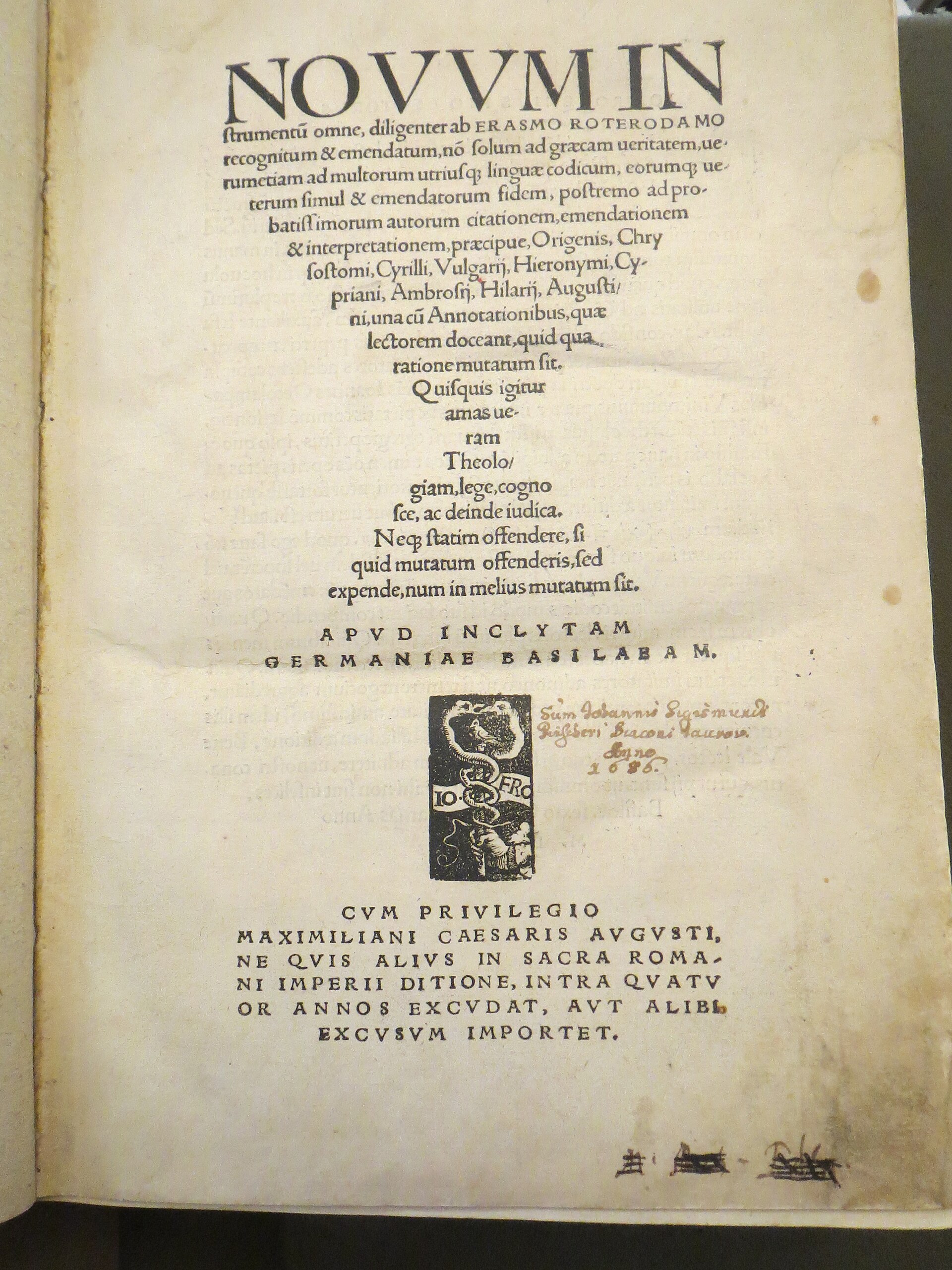
While the Complutensian New Testament sat printed but unsold, a Dutch humanist Cisneros had never met was racing a rival edition into print. Desiderius Erasmus, working with the Basel printer Johann Froben, rushed his own Greek and Latin New Testament, the Novum Instrumentum omne, through the press and published it in March 1516, two years after the Complutensian New Testament had already been printed but four to six years before the Complutensian edition would actually reach readers. Erasmus and Froben also secured a four-year publication privilege from Leo X intended to keep other printers from copying the work, a privilege some accounts of the period link to the further delay in releasing the Spanish edition, since the Complutensian's own New Testament covered the same market.
The haste showed. Erasmus later admitted of his own first edition that it had been precipitated rather than edited, praecipitatum verius quam editum, and it was riddled with transcription and typographical errors that took further editions to correct. None of that mattered for priority: because Erasmus's book reached buyers first, it, not the more carefully prepared and more accurately printed Complutensian text, became the working Greek New Testament of the early Reformation, feeding through Robert Estienne's later editions into the Textus Receptus that underlies Luther's German New Testament, Tyndale's English New Testament and ultimately the King James Version.
When Cisneros learned, by a letter from the abbot Garcia de Bobadilla, that a Dutch scholar had beaten his own long-prepared edition into print, he is reported to have shown no irritation at all. He responded instead by inviting Erasmus to Spain to join the Alcala biblical project directly; Erasmus did not take up the invitation, but he did use the Complutensian Septuagint and its apparatus in his own later editions, most explicitly the 1527 Novum Testamentum, and the Aldine Press's 1518 Aldine Bible paired the Complutensian's Old Testament Septuagint directly with a New Testament based in part on Erasmus's text. The two projects, born of the same decade's Christian humanist ambition, ended up feeding each other rather than simply competing.
Chapter 8The center column and the two thieves
The most quoted line about the Complutensian Polyglot's physical design is not a hostile critic's jibe, although it is very often retold as one.
The most quoted line about the Complutensian Polyglot's physical design is not a hostile critic's jibe, although it is very often retold as one. In the second volume's prologue to the reader, the editors explain their own choice to set the Latin Vulgate in a narrow central column between the wider Hebrew and Greek columns as a deliberate theological statement: we have placed the Latin translation of the blessed Jerome, they wrote, as though between the Synagogue and the Eastern Church, setting them like the two thieves, one on each side, and Jesus, that is the Roman or Latin Church, between them.
Read in context, this is Cisneros's own team claiming triumphant centrality for the Roman church and its Latin scripture, not a rival mocking the layout from outside. The line has nonetheless been retold for centuries, in English-language popular writing especially, as though it were an outsider's sneer at an awkward design choice; this record follows the reading given in the modern scholarship consulted (principally as summarised by Bart Ehrman and by Erika Rummel), which locates the sentence squarely inside the edition's own prefatory material and its own triumphalist self-understanding, not in any documented external criticism.
The same prologue, notably, does not treat every part of the polyglot layout with equal confidence. Its authors state plainly that the Aramaic Targum, outside the Pentateuch, is corrupted in places and mixed with fable and rabbinic simplicity unworthy of inclusion among the sacred books; Cisneros nonetheless ordered the rest of the Targum translated into Latin and deposited in the University's public library, on the grounds that, where it was literal and uncorrupted, it favoured Christian doctrine. That is a project willing to grade its own sources rather than present them all as equally authoritative, a habit this record has tried to match.
Chapter 9From Alcala to Madrid: how this exact set survived
The volumes now marked BH FOA 194 and 102-106 never had to survive a sale, a shipwreck, a war or a private collector's shifting taste, because they never left institutional hands.
The volumes now marked BH FOA 194 and 102-106 never had to survive a sale, a shipwreck, a war or a private collector's shifting taste, because they never left institutional hands. They were made for the University of Alcala's own library, and they stayed there through nearly three and a half centuries in which the University's teaching declined, was reformed under Charles III, declined again, and was finally judged, in the political climate of the 1830s, no longer sustainable at Alcala at all.
The end came by Royal Order of 29 October 1836, issued during the regency of Maria Cristina de Borbon, which directed the University's faculties to move to Madrid progressively, beginning with Jurisprudence. The library itself followed in 1841, already reduced to a few thousand surviving volumes of Cisneros's original foundation, first to a room at the Salesas Nuevas convent and then, once the university settled into the former Jesuit Novitiate on Calle San Bernardo between 1842 and 1848-1849, to purpose-made quarters there. The Universidad Central de Madrid took the name Universidad Complutense de Madrid only in 1970, and it was not until 1999 that its scattered old holdings were finally consolidated, in the remodelled Valdecilla pavilion, into the single Biblioteca Historica Marques de Valdecilla that catalogues this set today.
What this record cannot do is name every hand the six volumes passed through, or every shelf they sat on, in the gap between 1517 and the modern library's own published account. The library states the set's origin at the University of Alcala and its current location and shelfmark; it does not publish an intervening chain of librarians, inventories or condition reports naming this exact set year by year. This record grades the institutional-level history as documented, because Spanish administrative and library-history sources independently confirm every stage of the University's own move, and grades the item-level continuity as probable but not independently verified link by link, which is the honest position given what has actually been consulted.
Chapter 10How many were printed, and how many still exist
The Biblioteca Historica's own published account states that six hundred sets were printed on paper and six on vellum, sold from 1521 at six and a half gold ducats per set.
The Biblioteca Historica's own published account states that six hundred sets were printed on paper and six on vellum, sold from 1521 at six and a half gold ducats per set. That institutional figure is the most authoritative source this record has located for the print run, since it comes from the very library whose founding collection the edition was printed for, and it is repeated consistently across the secondary literature consulted.
The number of complete sets that survive today is a different matter, and far less settled than the confident round figures circulating in popular accounts suggest. Figures of about 120, of 123, and of up to 150 (the higher number apparently counting incomplete or fragmentary sets as well as complete ones) all appear across the sources consulted, without any of them citing a named, checkable modern census of institutions holding the edition. Wikipedia's own claim of exactly 123 surviving sets carries no footnote to a specific bibliographic study in the version consulted for this record. This record therefore reports the 600-copy print run as reasonably well attested, and treats the frequently repeated 123-surviving-copies figure as unverified: a number in wide circulation without a traceable scholarly source, rather than a settled fact. What can be said with confidence is only that multiple copies survive in named institutions, several of them in Spain alone: this set at the Universidad Complutense de Madrid (in fact three complete sets plus two further individual volumes, by the library's own account), a copy at the Biblioteca Lazaro Galdiano in Madrid, a copy at the Biblioteca Nacional de Espana, and a copy at Siguenza Cathedral, among others recorded elsewhere.
A separate and better documented loss concerns copies in transit rather than copies destroyed at home. According to a later letter of King Philip II of Spain, cited in the modern scholarly literature, a significant number of copies were lost in a shipwreck en route to Italy around 1521, which is credited with limiting the edition's immediate circulation and influence outside Spain in its first years on the market. No source consulted for this record gives a specific number of copies lost in that wreck; a widely circulated figure of 450 copies lost at sea could not be traced to any citable source and is not repeated here as fact.
Chapter 11What the edition changed
Despite its own delayed and troubled release, the Complutensian's texts fed directly into the biblical scholarship of the following century and a half.
Despite its own delayed and troubled release, the Complutensian's texts fed directly into the biblical scholarship of the following century and a half. Its Hebrew Old Testament text was drawn on, to varying degrees, for the Antwerp Polyglot of 1568-1573, for Vatable's edition (Heidelberg, 1586), and for the later Paris and London polyglots, as well as for Tyndale's English translation, for Buxtorf's 1611 Basel edition, and for the 1618 Basel Rabbinic Bible, in each case cross-checked against the Hebrew text established by Jacob ben Hayyim's Venice Rabbinic Bible of 1524-1525. Its Septuagint text left traces in the Antwerp, Heidelberg, Hamburg, Nuremberg and Paris polyglots and in Plantin's 1584 Antwerp Psalter, and its own Latin retranslation of the Septuagint was reprinted, with modifications, in Basel editions of 1526, 1550 and 1582 and in the Antwerp Polyglot itself. The Latin translation of the Targum Onkelos likewise passed into the Antwerp, Nuremberg and Paris polyglots.
The edition's most consequential rival, Erasmus's Greek New Testament, was itself corrected in its 1527 edition using the Complutensian text, which is a pointed reminder that the two projects, so often told as a race with a single winner, ended up as collaborators across a decade, each correcting the other's readings in the editions that followed.
Chapter 12What is still unresolved
Two questions matter most for anyone using this record as a reference rather than a story.
Two questions matter most for anyone using this record as a reference rather than a story. First, exactly how many complete sets of this edition survive today, in which institutions, has not been settled by any source consulted here, and the commonly quoted figure of 123 should be treated as unverified until a named modern census can be cited. Second, whether any of the manuscripts sold to the fireworks-maker Torija in 1746 were genuinely part of the Hebrew and Greek working library assembled for this edition, or were in fact unrelated Arabic manuscripts as later scholarship argued, remains a live disagreement in the sources consulted rather than a settled fact in either direction.
The artist
Arnao Guillen de Brocar (printer) and Cardinal Francisco Jimenez de Cisneros (patron)
A printed book of this kind has two makers worth treating in full: the patron who conceived, financed and staffed the project, and the printer whose workshop actually turned the plan into a physical object that could be read, compared and trusted. Neither man's role is disputed in the sources consulted; what follows separates their documented careers rather than folding one into the other.
Exhibited
- 2014-2015V Centenario de la Biblia Poliglota Complutense: La Universidad del Renacimiento y el Renacimiento de la UniversidadBiblioteca Historica Marques de Valdecilla, Universidad Complutense de Madrid (29 October 2014 - 27 March 2015, curated by Elisa Ruiz Garcia)
Related works
| Work | Relation | Where it is |
|---|---|---|
| Complutensian Polyglot Bible (complete set) Arnao Guillen de Brocar, printer | Same edition, different surviving copy A privately assembled collector's copy, later than this set's own history, now held by the foundation library of the collector Jose Lazaro Galdiano (1862-1947). This record does not describe that copy's own custody history. | Biblioteca Lazaro Galdiano, Madrid (inv. 1170-1174) |
| Complutensian Polyglot Bible (complete set) Arnao Guillen de Brocar, printer | Same edition, different surviving copy A separate surviving set, digitised by the Biblioteca Nacional de Espana under its own reference (bdh0000013439). | Biblioteca Nacional de Espana, Madrid |
| Complutensian Polyglot Bible (copy) Arnao Guillen de Brocar, printer | Same edition, different surviving copy A further documented surviving copy, outside the university and national-library holdings discussed in this record. | Siguenza Cathedral, Spain |
| Novum Instrumentum omne Desiderius Erasmus, edited; printed by Johann Froben | Rival first-published Greek New Testament, Basel, 1516 Printed two years after the Complutensian New Testament but released to the market four to six years earlier; corrected in its 1527 edition using the Complutensian text. | Multiple institutional copies, e.g. John Work Garrett Library |
| Biblia Regia (Antwerp Polyglot) Benito Arias Montano, editor; Christophe Plantin, printer | Later, separate polyglot Bible drawing on the Complutensian text Printed at Antwerp, 1568-1573; a distinct later edition, not to be confused with the Complutensian Polyglot described in this record. | Multiple institutional copies |
| Paris Polyglot Guy Michel Lejay, editor | Later, separate polyglot Bible in the same tradition Printed at Paris, 1628-1645; a distinct later edition. | Multiple institutional copies |
| London Polyglot Brian Walton, editor | Later, separate polyglot Bible in the same tradition Printed at London, 1653-1657; a distinct later edition. | Multiple institutional copies |
| Hebrew manuscripts assembled by Cisneros for the Polyglot (BH MSS 1-21) Various Spanish (chiefly Toledan) scribes, 13th-16th centuries | Surviving source manuscripts for this edition, held by the same institution as this set Twenty-one Hebrew codices, most bearing Cisneros's own coat of arms on their bindings, including the biblical manuscript BH MSS 1, a thirteenth-century Toledan Bible in three columns with rich masoretic decoration. | Biblioteca Historica Marques de Valdecilla, Universidad Complutense de Madrid |
Open questions
- How many complete sets of the Complutensian Polyglot actually survive today. Figures of about 120, 123 and up to 150 all circulate, but no source consulted for this record cites a named, checkable modern census of holding institutions; the frequently repeated figure of 123 has no traceable footnote in the version of its most common source consulted here.
- Whether any of the manuscripts sold to the fireworks-maker Torija in 1746 were genuinely part of the Hebrew and Greek working library assembled for this edition, as the contemporary description claimed, or were unrelated Arabic manuscripts, as Vicente de la Fuente's later examination of the library's own inventories argued.
- Whether this exact six-volume set can be traced through a continuous, item-level custody record between 1517 and the modern library's own published account, rather than only through the documented institutional history of the University as a whole.
- Which manuscript, or manuscript family, actually underlay the Complutensian Greek New Testament text: the library's own account states that the presumed principal codex, later apparently used again for the Antwerp Polyglot, is believed to have perished in the 1671 Escorial fire, which forecloses direct re-examination.
- Whether any documentary record survives of an actual buyer paying the stated six-and-a-half-gold-ducat price for a set at the 1521-1522 first sale, as opposed to the price simply being recorded as the asking price.
- How many copies were genuinely lost in the shipwreck en route to Italy around 1521 referenced in King Philip II's later letter; no source consulted gives a specific, sourced number, and a widely circulated figure of 450 could not be traced to any citable source.
Questions about this object
What is The Complutensian Polyglot Bible?
The Complutensian Polyglot Bible is a printed book, dated 1514-1517 (printed); papal license 1520; first sale c. 1521-1522. Medium: Letterpress printing on paper, gothic and roman and Greek and Hebrew type, six volumes bound in pasteboard with gilt tooling and the superlibro of Cardinal Cisneros.
Who made The Complutensian Polyglot Bible, and is the attribution settled?
The attribution to Arnao Guillen de Brocar is recorded here as accepted. The printing is securely documented as the work of Arnao Guillen de Brocar's shop at Alcala de Henares, commissioned and financed by Cardinal Francisco Jimenez de Cisneros. There is no attribution dispute over the printer or the patron; what is genuinely uncertain, and treated as such throughout this record, is the identity of several of the manuscript sources the editorial team worked from.
Where is The Complutensian Polyglot Bible now?
Biblioteca Historica Marques de Valdecilla, Universidad Complutense de Madrid, Spain. Inventory number BH FOA 194 (vol. I), BH FOA 102-106 (vols. II-VI). Last confirmed 26 September 2026. Continuously held by the library of the University founded by Cisneros at Alcala de Henares since the volumes were printed and bound for it in 1514-1517; the University itself was transferred to Madrid by Royal Order of 29 October 1836, with its library following in 1841. The set is currently catalogued and digitised on the Universidad Complutense de Madrid's own Biblioteca Historica website under these shelfmarks.
What has The Complutensian Polyglot Bible sold for?
Hammer Not established in the sources consulted; with premium, Not established in the sources consulted. Sotheby's, 2016-12-05.
What is still unknown about The Complutensian Polyglot Bible?
How many complete sets of the Complutensian Polyglot actually survive today. Figures of about 120, 123 and up to 150 all circulate, but no source consulted for this record cites a named, checkable modern census of holding institutions; the frequently repeated figure of 123 has no traceable footnote in the version of its most common source consulted here.
Sources
- 1Biblioteca Historica Marques de Valdecilla, Universidad Complutense de Madrid, 'Biblia Poliglota Complutense' (Tesoros de la Biblioteca Historica). biblioteca.ucm.es/historica/...
- 2Biblioteca Historica Marques de Valdecilla, Universidad Complutense de Madrid, 'La Biblia Poliglota Complutense: un monumento cultural y tipografico' (volume-by-volume catalogue entries giving shelfmarks BH FOA 194 and 102-106, binding description, papal license text and manuscript-source discussion, signed JLGS-M). biblioteca.ucm.es/historica/...
- 3Biblioteca Historica Marques de Valdecilla, Universidad Complutense de Madrid, 'Manuscritos hebreos' (describes the 21 surviving Hebrew codices assembled by Cisneros for the Polyglot project, still held by the library). biblioteca.ucm.es/historica/...
- 4Biblioteca Universidad Complutense de Madrid, Folio Complutense blog, on the 1746 sale of old Hebrew and Greek papers and parchments from the Colegio Mayor de San Ildefonso library to the Alcala fireworks-maker Torija, the rescue attempt by Antonio Martinez de Quesada, and Vicente de la Fuente's later argument that the codices actually sold were Arabic, not Hebrew or Greek. webs.ucm.es/BUCM/...
- 5Biblioteca Historica Marques de Valdecilla, Universidad Complutense de Madrid, 'Traslado de la Universidad Complutense a Madrid' (institutional history of the 1836 Royal Order and the library's move). biblioteca.ucm.es/historica/...
- 6Wikipedia, 'Complutensian Polyglot Bible'. en.wikipedia.org/wiki/...
- 7Wikipedia, 'Novum Instrumentum omne'. en.wikipedia.org/wiki/...
- 8Dream Alcala / Espana en la Historia, on the date and place of Cardinal Cisneros's death (Roa, 8 November 1517), corroborated by multiple independent Spanish institutional and historical sources consulted. dream-alcala.com/8-noviembre-1517-fallece-cardenal-cisneros
- 9Sotheby's, 'The Bible Collection of Dr. Charles Caldwell Ryrie', New York, 5 December 2016, lot 148. sothebys.com/en/...
- 10Sotheby's, 'Fine Books and Manuscripts Including Americana', online sale, 2018, lot 176. sothebys.com/en/...
- 11Wikimedia Commons, File:Biblia Poliglota Complutense.jpg (photograph of the Universidad Complutense de Madrid's own copy, CC0, uploaded by Aella87). commons.wikimedia.org/wiki/...
- 12Wikimedia Commons, File:Biblia poliglota complutense - Biblioteca Lazaro Galdiano.jpg (CC0, photographed during the exhibition 'Thirty Masterpieces from the Lazaro Galdiano Library', uploaded by Laci3). commons.wikimedia.org/wiki/...
- 13Wikimedia Commons, File:Cisneros' original complutensian polyglot Bible -1.jpg (depicts the Biblioteca Nacional de Espana's copy, per BNE digital reference bdh0000013439; Public Domain Mark). commons.wikimedia.org/wiki/...
- 14Wikimedia Commons, File:Biblia Poliglota Complutense (Catedral de Siguenza).jpg (depicts the Siguenza Cathedral copy, CC BY-SA 4.0, photographed by Tiberioclaudio99). commons.wikimedia.org/wiki/...
- 15Wikimedia Commons, File:Cardenal cisneros.jpg (fresco portrait of Cisneros by Juan de Borgona, c. 1514, Chapter House, Toledo Cathedral; Public Domain Mark). commons.wikimedia.org/wiki/...
- 16Wikimedia Commons, File:Erasmus 1516 title page.JPG (title page of Erasmus's Novum Instrumentum omne, Basel 1516, John Work Garrett Library copy; CC BY-SA 3.0, photographed by Wikimedia Commons user Concord). commons.wikimedia.org/wiki/...
- 17Wikipedia (Spanish), 'Biblia poliglota complutense'. es.wikipedia.org/wiki/...
- 18Wikipedia (Spanish), 'Arnao Guillen de Brocar', for the printer's biography. es.wikipedia.org/wiki/...


.jpg)


Last verified · Published
Change log
27 September 2026 - Record created at the house standard: researched narrative, technical evidence, maker dossier, graded provenance chain, prices with hammer and premium separated, related works, open questions and sources.