The Franks Casket
Unknown Northumbrian monastic workshop · First half of the 8th century AD, most commonly given as c. 700-750
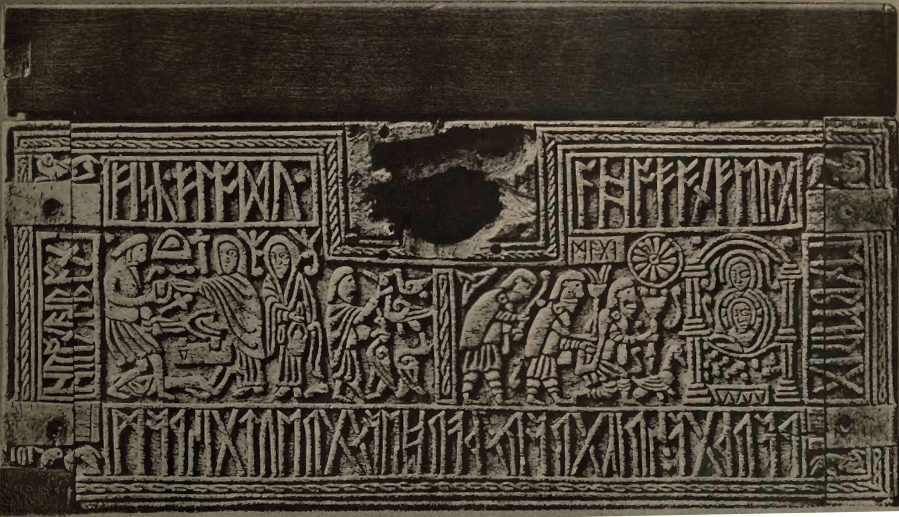
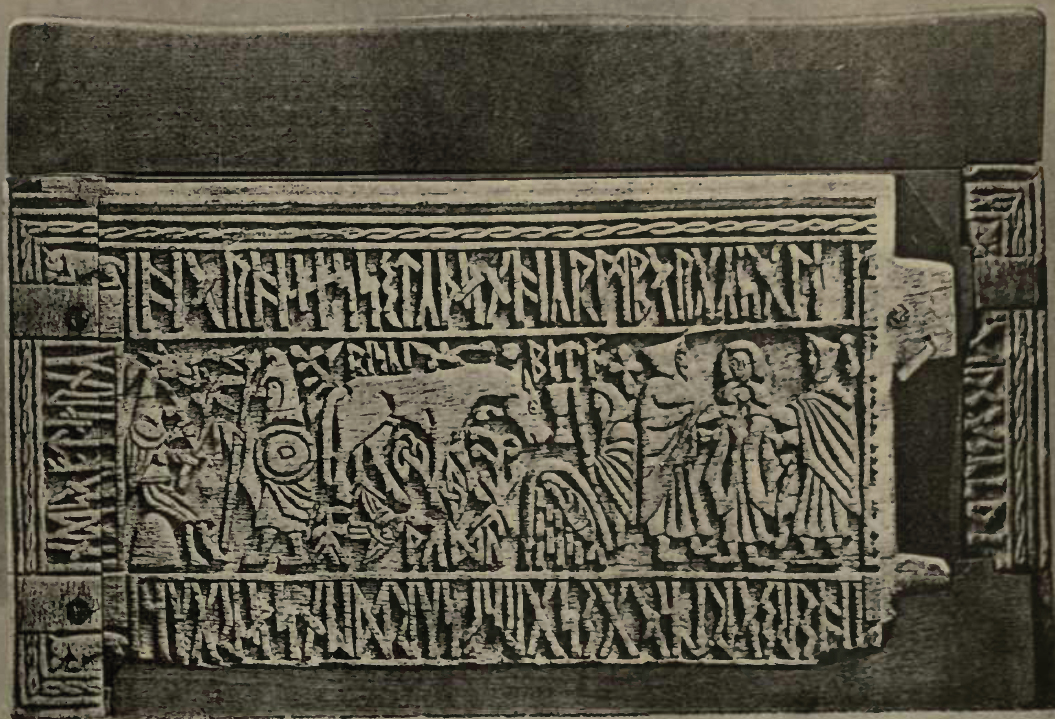
The front panel of the casket, held by the British Museum: Weland the Smith's forge and revenge at left, the Adoration of the Magi at right, carved at the same scale with no visual hierarchy between the pagan and Christian scenes. Photographic plate published by Wilhelm Vietor in 1901.
| Artist | Unknown Northumbrian monastic workshop |
|---|---|
| Date | First half of the 8th century AD, most commonly given as c. 700-750 |
| Medium | Carved whale bone (whale ivory), knife-cut in flat low relief; originally fitted with silver hinges, clasps, a lock and a carrying handle, all now lost |
| Dimensions | 22.9 x 19 x 10.9 cm (British Museum's own published figures for length, width and height). One frequently reproduced secondary figure instead gives 12.9 x 22.9 x 19.1 cm for the same three axes in a different order; this record follows the British Museum's own figures and flags the variant rather than silently picking one. |
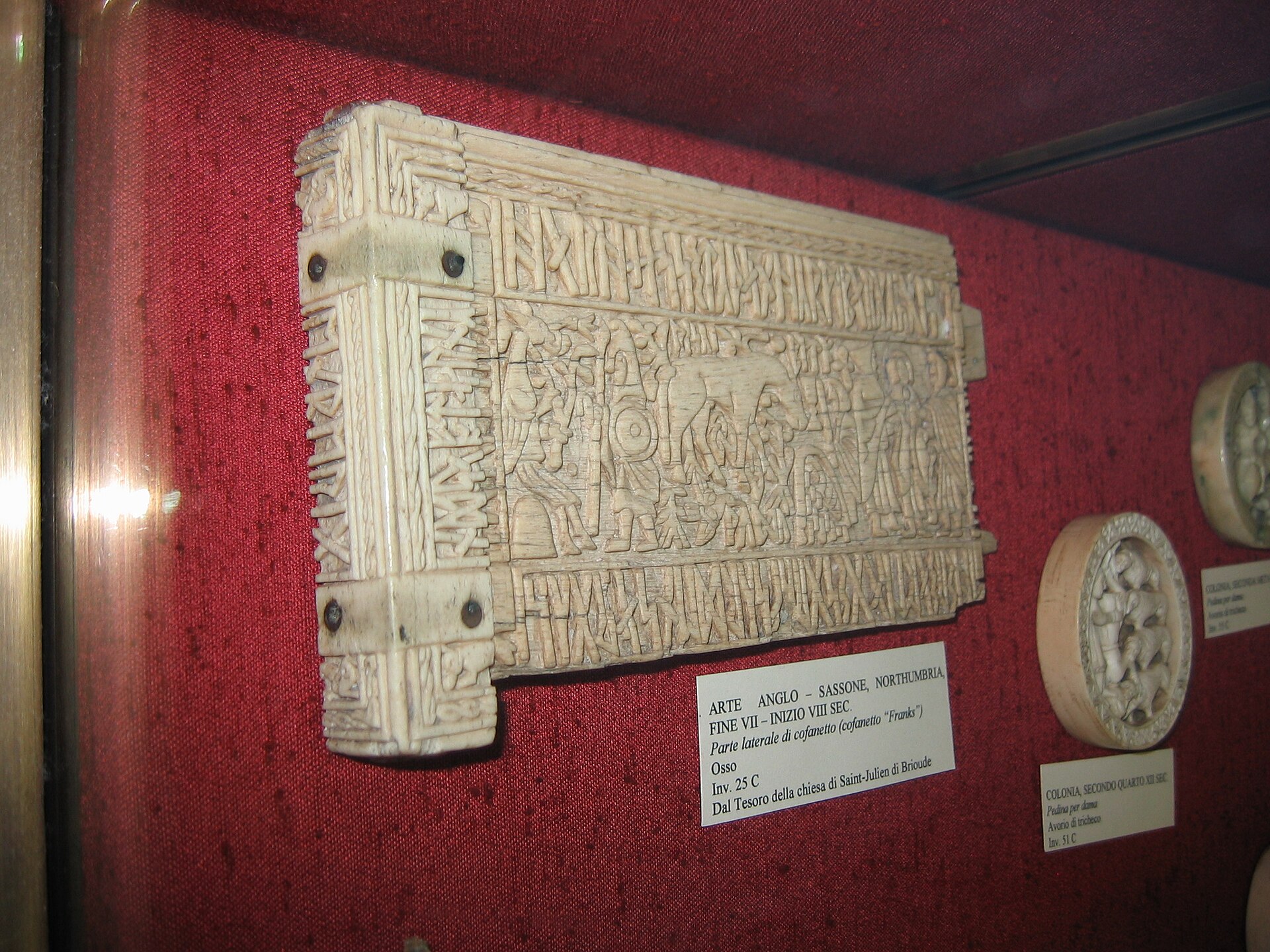
| Where it is now | The lid and four of the five carved faces (front, back, left side, and the reconstructed casket as a whole, displayed with a modern cast standing in for the missing fifth face) are held by the British Museum, London. The original right-hand end panel is a separate object in separate custody: it is held by the Museo Nazionale del Bargello, Florence, and does not travel with the British Museum's holding.last confirmed |
| Inventory number | British Museum: registration 1867,0120.1 (Department of Britain, Europe and Prehistory), gift of Sir Augustus Wollaston Franks, on display in Room 41. Bargello panel: Museo Nazionale del Bargello, Florence, Carrand Collection, catalogued there as Carrand no. 25. |
| Attribution | UnknownNo maker is named, signed or otherwise recorded anywhere on the casket. Full note |
| Object type | Antiquity |
| Period | Anglo-Saxon, early 8th century, Northumbria |
| Cases | Has a provenance gap · Rediscovered |
| Inscriptions | Old English in Anglo-Saxon runic futhorc on every face, switching at points into the Latin language and into Roman capitals, including one passage written in runes that spells Latin words and another written backwards or upside down; see Technical and the narrative sections below for the panel-by-panel content. |
| Owners on record | 12 links11 documented, 1 disputed |
| Sources | 10 cited |
About this record Last verified · 10 sources cited · Change log
On this page 9 sections
ContentsClose
A small Anglo-Saxon box carved from whale bone in Northumbria in the early eighth century, covered on every face with narrative scenes and inscribed in a mixture of runes, Old English, Latin and Roman capitals, including a riddle on its own front panel that names the material it is made from. Its imagery mixes the Christian Adoration of the Magi with the Germanic legend of Weland the Smith's revenge, the Roman foundation story of Romulus and Remus, the Roman emperor Titus's capture of Jerusalem in AD 70, and, on its right-hand end, a scene that has resisted every attempt at a settled reading for more than a century.
That right-hand panel is also the key to the object's modern history, because it is not in the same museum as the rest of the box. The casket served for generations as a family sewing box in the French village of Auzon, in the Haute-Loire, and had already lost its silver fittings and fallen apart before it reached the antiquities trade; Sir Augustus Wollaston Franks bought the surviving lid, front, back and two long sides in Paris in 1857 and gave them to the British Museum in 1867. The right end had already gone missing by then. It surfaced separately, passed through a Lyon collector's estate, and entered the Museo Nazionale del Bargello in Florence, where it was identified in 1890 as the casket's lost fifth face. The British Museum has displayed a cast of it ever since; the only ancient original is in Florence.
Nothing about the casket's maker, patron or exact place of manufacture is documented. Everything known rests on the language of its own inscriptions and on a hundred and fifty years of runological argument that remains, on its hardest question, unresolved.
Provenance
Each link is graded. Documented: a cited source supports it. Disputed: the identification is argued but not established. Unknown: no owner for that span, and the gap is not smoothed into a narrative. The grades in the glossary.
- early 8th century AD -Unknown Northumbrian monastic workshop and its original patron or recipientdocumented
Manufacture in a Northumbrian monastic milieu is the scholarly consensus, established from the language of the inscriptions and comparison with Northumbrian manuscript art; the specific house, patron and recipient are not documented and remain disputed or unknown.15
- Possibly the church of Saint-Julien, Brioude, Haute-Loire, Francedisputed
W.H.J. Weale proposed that the casket had belonged to this church and may have been removed during the French Revolution. No source consulted confirms or documents this link, and this record treats it as a proposed, unproven possibility rather than an established stage in the object's history.1
- - by the mid-19th centuryA family in Auzon, Haute-Loire, Francedocumented
The casket, already missing its right-hand end panel, was in the possession of a family in Auzon, where it served as a household sewing or work box. No record establishes when or how it reached this family.178
- mid-19th century - mid-19th centuryA family in Auzon, Haute-Loire, Francedocumented
A son of the family traded the casket's silver hinges and fittings for a silver ring; without the metal fittings, the casket's carved plaques came apart from one another.178
- c. 1850s - c. 1850sProfessor Mathieu, Clermont-Ferranddocumented
The disassembled pieces (excluding the already-separated right panel) were shown to a Professor Mathieu, from nearby Clermont-Ferrand, who passed them on to the Paris antiquities trade.178
- c. 1850s - 1857An unnamed antiquities dealer, Parisdocumented
The pieces were sold into a Paris antique shop; no source consulted names the dealer.178
- 1857 - 1867Sir Augustus Wollaston Franksdocumented
Franks bought the surviving lid, front, back and both long sides in Paris in 1857, recognising the pieces as Anglo-Saxon. No source consulted records the price paid.178
- 1867 - presentBritish Museum, Londondocumented
Franks gave the four faces and lid to the British Museum in 1867; registered 1867,0120.1. This is the origin of the object's modern name. The Museum has since displayed the group with a modern cast standing in for the missing right panel.25
- The Auzon family (again)documented
Separately from the 1857 sale, the original right-hand panel was found afterward, still with the Auzon family, in a drawer. No source consulted gives an exact date for this find.178
- Louis Carrand, Lyondocumented
The rediscovered right panel passed to the Lyon-based collector Louis Carrand. No source consulted gives the date or price of this transaction.78
- - 1890Museo Nazionale del Bargello, Florencedocumented
On Carrand's death his collection, including the panel, passed to the Bargello, where it is catalogued as Carrand no. 25.78
- 1890 - presentMuseo Nazionale del Bargello, Florencedocumented
The Swedish scholar Sigurd Soderberg published the identification of the Bargello panel as the Franks Casket's missing right end in 1890, proposing an initial reading of its central scene. The panel has remained in the Bargello, physically separate from the British Museum's four pieces, ever since.3
Technical evidence
| Attribution note | No maker is named, signed or otherwise recorded anywhere on the casket. The attribution to a Northumbrian monastic workshop rests on the language of the inscriptions (a Northumbrian dialect of Old English, current in the early eighth century) and on stylistic parallels with Northumbrian manuscript art of the same period, not on any document naming a craftsman, house or patron. A specific attribution to Wilfrid's monastic foundation at Ripon has been proposed and is disputed; a minority argument for East Anglia instead of Northumbria has also been made and has not displaced the consensus. |
|---|---|
| Material | Whale bone (whale ivory), identified by the front panel's own inscribed riddle rather than by a published modern zooarchaeological species test; no species-level scientific identification has been located in the sources consulted.13 |
| Dimensions | 22.9 x 19 x 10.9 cm (height x width x length as the British Museum states them: height 10.90 cm, length 22.90 cm, width 19 cm), confirmed directly against the Museum's own collection database. A secondary source's differing figure (12.9 cm for the height axis) does not match the Museum's own published dimensions and is not followed.2510 |
| Construction | Five carved bone plaques (four vertical faces and a lid) joined by tongue-and-groove construction into four rectangular corner elements, secured with dowels and originally with silver hinges, a lock, clasps and a carrying handle, all now lost.7 |
| Losses | All metal fittings (hinges, lock, clasps, handle) are lost, traded away for a silver ring while the casket was in use as a family sewing box at Auzon; the lid retains only one generally accepted original carved element, its surrounding frame elements treated in the literature as later replacement or repair work.18 |
| Script and language | Anglo-Saxon runic futhorc throughout, in Old English, with passages shifting into the Roman alphabet and into the Latin language, including text carved reversed or inverted relative to its panel; the right panel additionally substitutes five invented cipher symbols for standard vowel runes.16 |
| Registration | British Museum: 1867,0120.1, Department of Britain, Europe and Prehistory, gift of Sir Augustus Wollaston Franks, 1867. Bargello right panel: Museo Nazionale del Bargello, Florence, Carrand Collection, catalogued as Carrand no. 25. Confirmed directly against the British Museum's own collection database, which also states the piece is on permanent display in Room 41 (Europe AD 300-1100), Section 2, Display Case 2, and its own condition note reads: 'The right-hand side is a replica; the original is in the Museo Nazionale del Bargello, Florence (Carrand Coll. no. 25)' - independently corroborating the custody split researched from secondary sources.2510 |
| Digital encoding | The right panel's five cryptogrammic vowel runes required dedicated new characters in the Unicode 7.0 standard (released June 2014) before the inscription could be represented in ordinary digital text.6 |
| Custody | Lid, front, back, left side and a modern cast of the right side: British Museum, London, Room 41. Original right side: Museo Nazionale del Bargello, Florence. The two pieces have never been physically reunited.1210 |
Images
The record in full
Chapter 1What it is
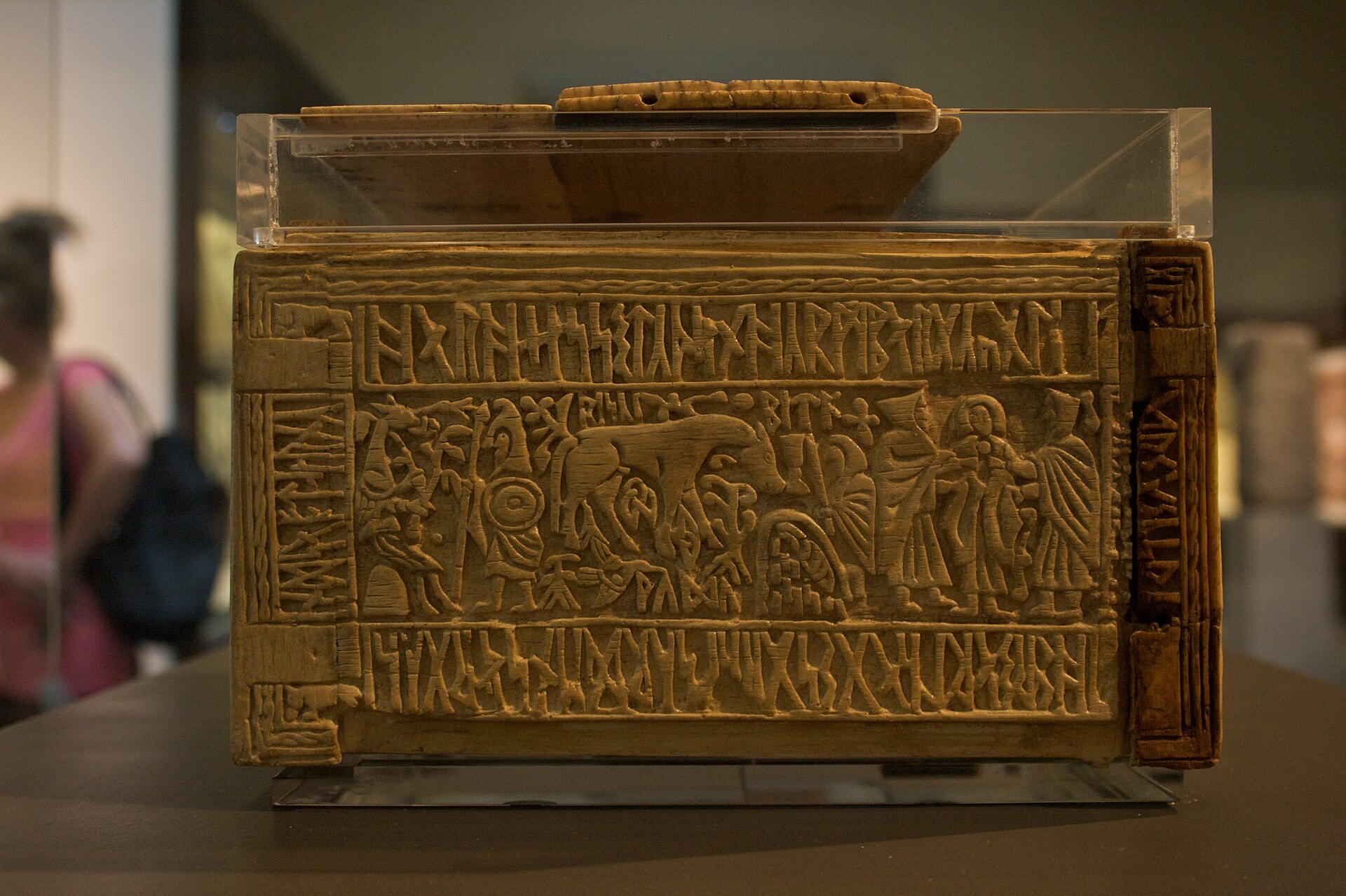
The Franks Casket is a small closed box, 22.9 by 19 by 10.9 centimetres by the British Museum's own published measurements, carved from whale bone rather than any land animal's ivory, and covered on...
The Franks Casket is a small closed box, 22.9 by 19 by 10.9 centimetres by the British Museum's own published measurements, carved from whale bone rather than any land animal's ivory, and covered on all five external faces, lid included, with knife-cut narrative scenes in flat, two-dimensional low relief. It is not a large object. It sits comfortably in two hands, and every one of its scenes was made to be looked at closely, by one or two people at a time, not displayed at a distance.
The box was originally built from five carved bone plaques joined by tongue-and-groove construction into four rectangular corner elements, held together with dowels and, originally, silver hinges, a lock, clasps and a carrying handle. None of the metal fittings survive. Their loss is not a mystery: it is the documented reason the casket fell apart in the first place, addressed below in its post-medieval history.
Every face carries both image and text, and the text is not incidental captioning; it is worked into the design at the same density as the pictures, in bands, borders and fields that read as fluently as they are meant to be looked at. The maker, whoever they were, treated inscription as ornament and ornament as argument, a combination that is one reason this small object has generated a disproportionate body of scholarship.
Chapter 2One object, two museums
The single most important fact for identifying any picture of this object correctly is that it is not, physically, in one place.
The single most important fact for identifying any picture of this object correctly is that it is not, physically, in one place. The lid, the front, the back and both long sides are held by the British Museum in London, under registration 1867,0120.1, the gift of Sir Augustus Wollaston Franks in 1867. The right-hand end panel, the fifth carved face, is a separate physical object in separate custody: it belongs to the Museo Nazionale del Bargello in Florence, part of that museum's Carrand Collection, and it has never been reunited with the rest of the casket.
The British Museum's own display reconstructs the whole box using a modern cast in place of the missing original right panel. That cast is a faithful copy, not a forgery or a fake, and the museum does not misrepresent it; but any photograph of the British Museum's right-hand face, including the 1901 photographic plate used in this record's gallery, shows the cast, not the ancient carving. The ancient original can currently only be seen in Florence, or in photographs taken there.
This record states which institution holds which physical piece at every point where the distinction matters, and captions every image of the right-hand panel according to whether it shows the Bargello original or the British Museum's cast. Conflating the two is the single most consequential factual error this kind of record can make about this particular object.
Chapter 3Whale bone, and its own riddle
The front panel carries a runic inscription that is, itself, a riddle about the material the casket is carved from: translated, it reads approximately as "the flood lifted up the fish onto the...
The front panel carries a runic inscription that is, itself, a riddle about the material the casket is carved from: translated, it reads approximately as "the flood lifted up the fish onto the cliff-bank; the whale became sad, where he swam on the shingle," followed by the words "whale's bone." The riddle describes a whale stranding on a shore and being reduced, by that stranding, to the raw material the box itself is made of. It is the casket telling the viewer what it is made from, in verse, rather than a modern label doing the job.
The material identification as whale bone rather than the tusk ivory of a walrus or narwhal is treated as settled in the scholarship consulted for this record. No source consulted reports a modern zooarchaeological or proteomic species-level identification of exactly which whale the bone came from; this record does not assert one, because none has been found, and treats the species question as open rather than filling it with a plausible guess.
Whale strandings on the coasts of early medieval Britain were opportunistic sources of a valuable raw material, and a beached whale's bone becoming royal or ecclesiastical treasure is not a poetic fiction invented for this object; it reflects an ordinary economic reality of the period, in which stranded whales were a resource significant enough to be regulated by later Anglo-Saxon law. The riddle's wit works precisely because the audience already knew that.
Chapter 4The front panel: Weland's revenge beside the Adoration of the Magi
The front panel is divided into two scenes read side by side, one Germanic and pagan, one Christian, with no visual boundary marking a difference in status between them.
The front panel is divided into two scenes read side by side, one Germanic and pagan, one Christian, with no visual boundary marking a difference in status between them. On the left is the legend of Weland the Smith, enslaved and hamstrung by King Nithhad; the scene shows Weland at his forge, having already killed the king's son, whose skull he is shown fashioning into a drinking cup as part of his revenge, with a female figure, usually read as the king's daughter, also present in the scene. On the right, identified by its own runic caption spelling out the word "magi," the three Magi approach the enthroned Madonna and Child beneath a large guiding star, bearing their traditional gifts.
The two scenes are carved at the same scale, in the same technique, framed by the same running border, with no hierarchy of size or placement to tell a viewer that one register is more important than the other. A Northumbrian audience literate enough to follow both the runes and the imagery was expected to hold a pagan revenge narrative and the Nativity in the same field of vision without the object taking a visible side on how they relate. What that juxtaposition was understood to mean is treated separately below, since it is argued rather than simply described.
Chapter 5The lid: an archer named Egil
The lid survives in a more damaged state than the four vertical faces; only one of its decorative elements is generally accepted as an original eighth-century carved panel, with the surrounding frame...
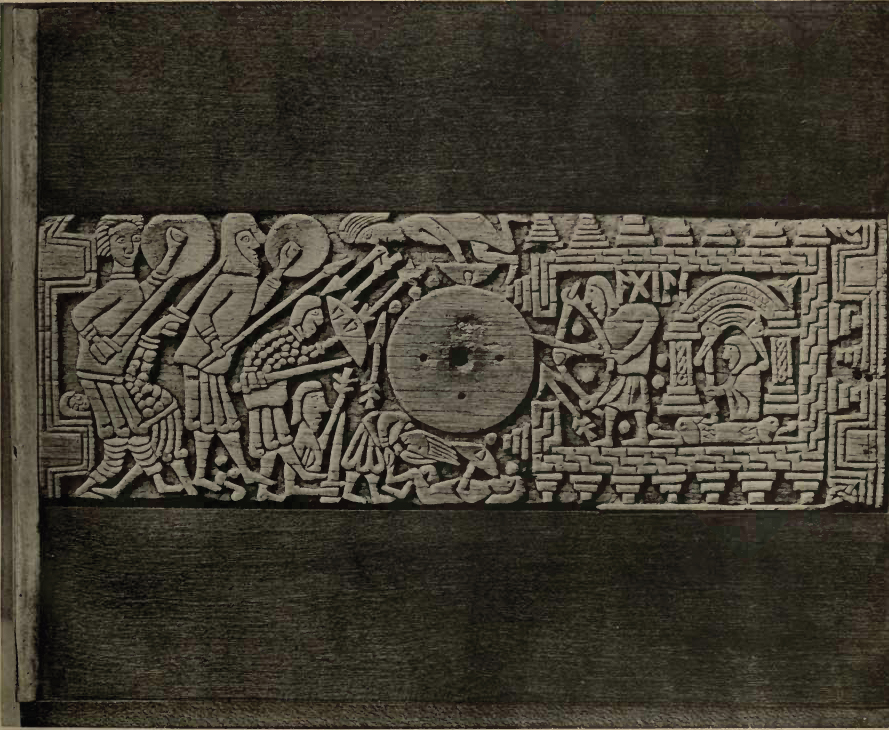
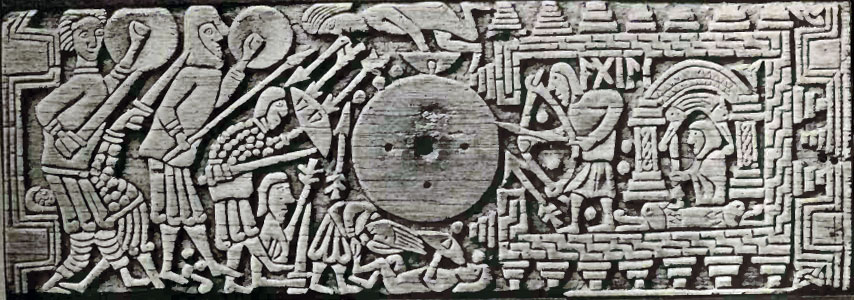
The lid survives in a more damaged state than the four vertical faces; only one of its decorative elements is generally accepted as an original eighth-century carved panel, with the surrounding frame elements treated in the literature as later replacement pieces rather than part of the original scheme. What remains shows a single archer, defending a fortified position single-handed against a troop of attackers who, drawn at a larger scale than the archer, may represent giants or simply a visually exaggerated threat. A runic caption beside the figure names him, transliterated as AEGILI, which scholars read as a form of the name Egil.
This Egil is not the Egil Skallagrimsson of the later Icelandic sagas. In the Germanic legend cycle to which the front panel's Weland scene also belongs, Egil is Weland's brother, a supernaturally skilled archer; the story alluded to on the lid is generally connected to a lost tale in which Egil is forced, in a scene recalling the later William Tell legend, to shoot an object from close to a family member's body to prove his skill, though the surviving lid fragment shows the siege-defence scene rather than that specific test. Some readings instead connect the archer to the Trojan War and to Achilles, a minority position that has not displaced the Egil identification as the more widely held one.
A 2026 article by the runologist J. Huston McCulloch, published in the journal Anglia, proposes a further, more specific claim: that the casket's intended recipient was, or was intended to be, a real historical figure also called Egil (given in Latin sources as Eigil or Aeigil), the fourth abbot of the monastery of Fulda. This is a recent proposal, not yet a settled consensus, and this record presents it as an argued claim by a named scholar rather than as established fact.
Chapter 6The left panel: Romulus and Remus, far from their native land
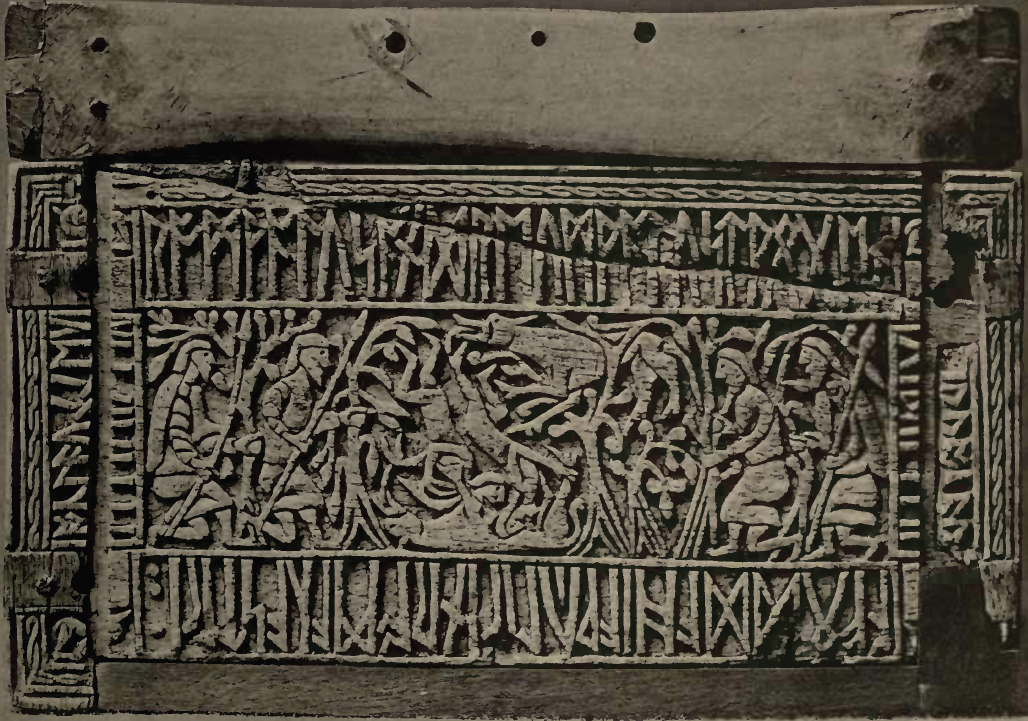
The left side shows Romulus and Remus, the legendary founders of Rome, lying on their backs beneath a she-wolf who suckles them, with additional shepherd figures and wolves added around the central...
The left side shows Romulus and Remus, the legendary founders of Rome, lying on their backs beneath a she-wolf who suckles them, with additional shepherd figures and wolves added around the central group, apparently for compositional symmetry rather than narrative necessity. The runic inscription names the scene directly: translated, it states that Romulus and Remus, two brothers, were fed by a she-wolf in the city of Rome, far from their native land.
The scholar Carol Neuman de Vegvar has argued that an Anglo-Saxon audience is likely to have read this Roman foundation story alongside their own foundation legend of the brothers Hengist and Horsa, whose arrival in Britain was central to Anglo-Saxon origin narratives current in the period; on this argued reading, the panel invites a parallel between Rome's founding brothers and England's, both suckled on a story of destined rulership arriving from elsewhere. This is a proposed interpretive parallel, not a documented statement of the maker's intention, and is presented here as an argued reading with its author named.
Chapter 7The back panel: Titus and the fall of Jerusalem
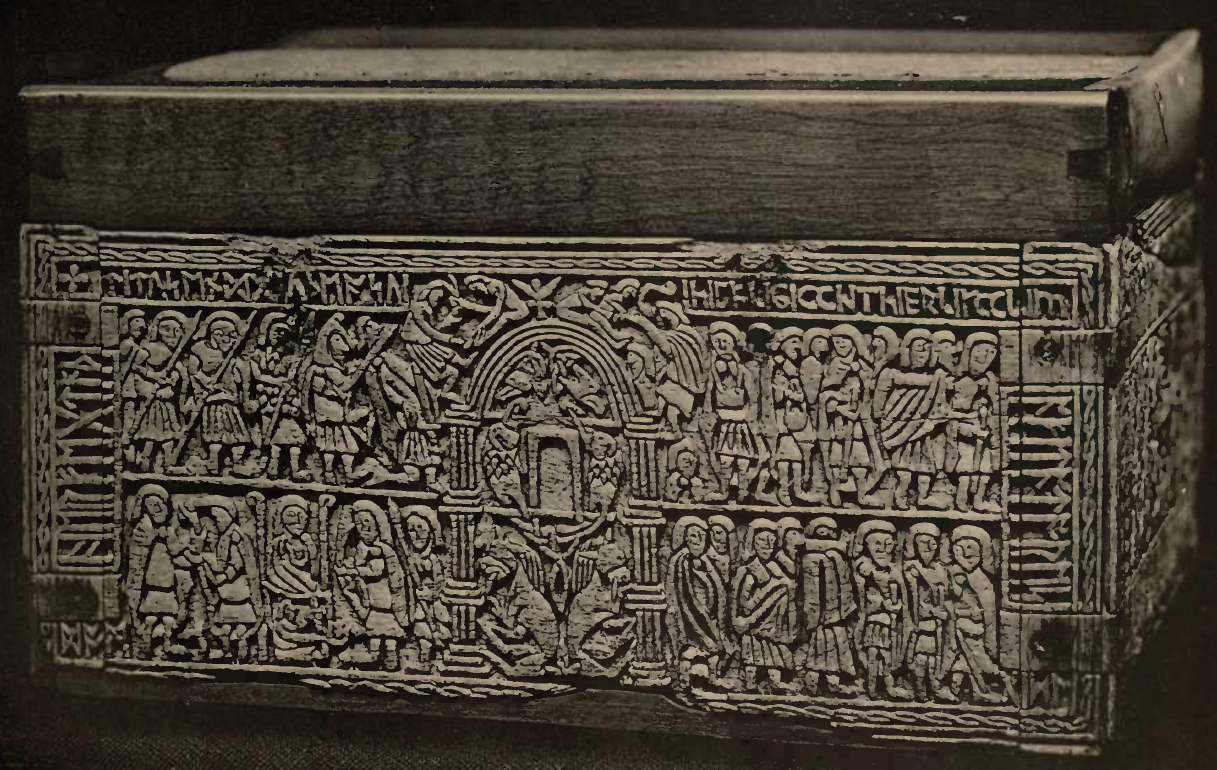
The back panel depicts the Roman emperor Titus's capture and sack of Jerusalem in AD 70, during the First Jewish-Roman War, in a composition divided into quadrants around a central architectural...
The back panel depicts the Roman emperor Titus's capture and sack of Jerusalem in AD 70, during the First Jewish-Roman War, in a composition divided into quadrants around a central architectural feature read as the Temple. Roman soldiers attack at upper left, the city's inhabitants flee at upper right, judgement is passed on the defeated at lower left, and captives are led away into slavery at lower right. Latin and Old English runic captions run around and across the scene, including the words "dom" (judgement) and "gisl" (hostage) at the lower corners, alongside a longer runic caption reading, in translation, "here fight Titus and the Jews" and a Latin phrase describing the inhabitants fleeing Jerusalem.
Compared with the casket's other panels, this scene makes more use of overlapping figures and modelled drapery, a vestige of an antique illusionistic tradition that the rest of the casket's flatter, more abstracted carving style does not otherwise draw on as heavily. A conquered temple, a defeated people and a redistributed set of captives and spoils sits inside the same object as Weland's stolen treasure and the Magi's offered gifts, a recurrence of the theme of treasure changing hands under force or under grace that runs through the whole box.
Chapter 8The right panel: the unsolved scene
The original right-hand end panel, held by the Museo Nazionale del Bargello in Florence, carries the casket's most heavily disputed image and its most heavily disputed text, and no reading of either...
The original right-hand end panel, held by the Museo Nazionale del Bargello in Florence, carries the casket's most heavily disputed image and its most heavily disputed text, and no reading of either has achieved general acceptance in the scholarship consulted. The scene, as generally described, shows at left a seated animal figure on a small mound, confronted by an armed and helmeted warrior; in the centre, a standing animal usually read as a horse faces a figure holding a stick or sword who stands over something marked by a curved line, often read as a burial mound; at right, three human figures stand together, the two outer ones apparently restraining or supporting the one between them.
The panel was first identified as belonging to the Franks Casket in 1890, when the Swedish scholar Sigurd Soderberg published the discovery that the piece then held in the Bargello was the casket's missing right end, and proposed reading its central scene as an illustration of the death of the Norse hero Sigurd, mourned by his horse Grani. Elis Wadstein developed a fuller version of the Sigurd reading in 1900. Arthur Napier, in his own influential 1901 study of the casket's language, responded directly to this: "I remain entirely unconvinced by the reasons [Wadstein] puts forward, and believe that the true explanation of the picture has still to be found." The literary scholar Eleanor Clark nonetheless found the horse-and-grave image compelling on its own terms in 1930, writing that no one seeing a horse bending over a man's tomb could fail to recall the relevant Norse verses.
Later scholarship has proposed a wide range of alternative readings, none of them dominant. C.A. Bouman (1965) and S.R.T.O. d'Ardenne (1966) argued for the Anglo-Saxon foundation legend of Hengist and Horsa, with the horse representing Hengist mourning his brother and a female figure as Hengist's daughter Renwein. Wolfgang Krause (1959) and Alfred Becker (1973) read the scene instead as depicting a sacred grove and its guardian deity, drawing on comparisons with Sleipnir and the hall of the slain in Norse myth. Leo Peeters (1996) proposed an illustration of the madness of Nebuchadnezzar from the Book of Daniel. David Howlett (1997) argued for the death of the god Balder as told by the medieval Danish historian Saxo Grammaticus. Ute Schwab (2008), following a suggestion by Heiner Eichner (1991), proposed the Welsh legend of Rhiannon's penance from the Mabinogion. Austin Simmons (2010) argued instead for a scene connected to Satan and to the apocryphal Harrowing of Hell narrative linked to the Nativity.
The runologist Raymond Page, whose 1999 study remains a standard modern reference on the casket's inscriptions, summarised the state of the question without endorsing any of these readings: "What the scenes represent I do not know. Excited and imaginative scholars have put forward numbers of suggestions but none convinces." Most recently, Marijane Osborn and Terry Gunnell, writing in 2025 in the journal Early Medieval England and its Neighbours, argued that the central horse-and-figure image should be read as a female drink-bearer performing a mortuary ritual, comparing the scene's distinctive triple-looped triquetra motif, which the authors state appears otherwise only on two Gotland memorial stones, to Swedish picture-stone iconography of a psychopomp horse carrying the dead to the afterlife. This is presented in this record as the most recent contribution to an active, unresolved debate, not as its resolution.
This scene must not be confused with the lid's archer, Egil: the sources consulted for this record attach the name Egil specifically to the lid's siege-defence image, not to the right panel's disputed scene, and this record does not adopt a reading that has not been found independently in the scholarship consulted.
Chapter 9Runes, Latin, and a deliberate cipher
The casket's inscriptions are carved mostly in Anglo-Saxon runic futhorc, in the Old English language, but they do not stay in one script or one language throughout.
The casket's inscriptions are carved mostly in Anglo-Saxon runic futhorc, in the Old English language, but they do not stay in one script or one language throughout. At points the text shifts into the Roman alphabet while remaining Old English; at other points it shifts into the Latin language while still using runes to write it; some words are carved reversed or upside down relative to the rest of a panel's text. This is read in the scholarship not as carelessness but as deliberate virtuosity, a display of the carver's command of more than one writing system and more than one language on a single small object.
The right-hand panel goes further still: five of its vowel sounds are represented not by ordinary runes but by invented cipher symbols unique to this inscription, substituted for the standard vowel runes. Page notes that even the two symbols apparently standing for the vowels a and ae are not always clearly distinguished from each other in the carving, raising the possibility that the carver was not applying the cipher with full consistency. These five cryptogrammic vowel runes were enough of a special case that they required dedicated encoding in the Unicode 7.0 standard, released in 2014, before the inscription could be rendered in ordinary digital text at all.
Chapter 10A hundred and fifty years of decipherment
The first detailed scholarly account of the casket's runic inscriptions appeared in George Stephens's "The Old-Northern Runic Monuments," published in 1866-1867, drawing in part on information...
The first detailed scholarly account of the casket's runic inscriptions appeared in George Stephens's "The Old-Northern Runic Monuments," published in 1866-1867, drawing in part on information supplied by Augustus Wollaston Franks himself, who had acquired the object only a few years earlier. The Norwegian philologist Sophus Bugge corresponded with Stephens on the decipherment in the same period and offered the first serious explanation of the Weland scene.
Arthur Napier's 1901 linguistic study became the reference point for the casket's dating and dialect, concluding that the language was unmistakably Anglian and, more specifically, Northumbrian, and placing the early eighth century as the most likely date on linguistic grounds; the same year, Wilhelm Vietor published a set of five phototype photographic plates of the casket with explanatory text, the plates this record draws several of its images from. Raymond Page's 1999 study brought modern runological method to bear on the whole inscription set, including the vowel cipher on the right panel, without claiming to have resolved every reading. Leslie Webster, Keeper Emerita of the British Museum's own early medieval collections, published a concise synthesising monograph on the casket in 2012 in the museum's Objects in Focus series, treating its maker as someone who "clearly possessed great learning and ingenuity, to construct an object which is so visually and intellectually complex." Alfred Becker has argued since 1973, most recently in an extended personal research publication, for a numerological structure underlying the inscriptions: seventy-two runic signs on the front and left panels combined, and two hundred and eighty-eight across the whole casket, both multiples of twenty-four, the number of runes in the elder futhark. The literary scholar Marijane Osborn has offered a competing explanation for the same count of seventy-two, connecting it instead to the number of nations among the Gentiles associated by Bede with Christ's appointment of seventy-two missionary disciples. Neither numerological argument is presented here as proven; both are attributed to their named proponents.
Chapter 11A mixed programme: Rome, Christ, and the Germanic gods
The casket sets a Christian Nativity scene, a Roman civic foundation myth, a Roman emperor's conquest of a subject people, and at least two Germanic legendary narratives beside one another on a...
The casket sets a Christian Nativity scene, a Roman civic foundation myth, a Roman emperor's conquest of a subject people, and at least two Germanic legendary narratives beside one another on a single small object, without any visible marker of rank between them. Some scholars, including Leslie Webster, have argued that this combination reflects a coherent, deliberate programme, in which the Church's own concept of universal history, running from pagan antiquity through Roman history to Christian revelation, gave a learned Northumbrian monastic maker a genuine intellectual framework for placing Weland, Romulus and Titus in typological relation to the Adoration of the Magi. Other readings in the literature are more skeptical, treating the casket's range of subjects as closer to an eclectic assemblage of prestige narratives than a worked-out theological argument.
This record does not arbitrate between those positions. What is documented, rather than argued, is the object's function as evidence of what its makers and audience found available to think with: a Northumbrian monastic milieu, literate in Latin and in Old English, carrying Germanic heroic legend, Roman history and Christian scripture in the same institutional memory and treating them as compatible material for a single small luxury object.
Chapter 12Date and place: consensus and dissent
The scholarly consensus, based on the Northumbrian or north Mercian dialect of the inscriptions and on stylistic parallels with Northumbrian manuscript art of the same period (a comparison developed...
The scholarly consensus, based on the Northumbrian or north Mercian dialect of the inscriptions and on stylistic parallels with Northumbrian manuscript art of the same period (a comparison developed by Leslie Webster in a 1982 study), places the casket's manufacture in the first half of the eighth century in Northumbria. A monastic origin is generally accepted, on the view that the object was made in a religious house, perhaps for presentation to an important secular figure. Ian Wood has tentatively proposed Wilfrid's monastic foundation at Ripon as the specific place of manufacture; this suggestion has been described in the literature as ingenious and attractive but also as discounting too readily the possibility of other major Northumbrian centres of learning, among them Lindisfarne and Monkwearmouth-Jarrow, either of which remains an equally live candidate on current evidence.
A minority argument, made by Diana Ellis in a paper hosted by the University of Victoria's Humanities Computing and Media Centre, questions the Northumbrian attribution altogether and proposes East Anglia, under the Wuffing dynasty, as an alternative place of manufacture, citing East Anglian trade contacts with Scandinavia, East Anglian coin and casket-fragment depictions of Romulus and Remus from Larling in Norfolk, the casket's lack of any Celtic decorative element, and iconographic parallels with Gotland picture stones. This record records the argument and names its author without adopting it in place of the Northumbrian consensus, which remains the position taken by the British Museum's own catalogue and by the majority of the specialist literature consulted.
Chapter 13From a sewing box in Auzon to the British Museum
The casket's history before the nineteenth century is not documented in any source consulted for this record.
The casket's history before the nineteenth century is not documented in any source consulted for this record. One possible earlier link has been proposed: the nineteenth-century art historian and bibliographer W.H.J. Weale suggested that the casket had belonged to the church of Saint-Julien at Brioude, in the Haute-Loire, and that it might have been removed from the church, possibly during the French Revolution. This record treats that link as disputed and unproven rather than as an established stage in the object's history; no source consulted establishes how, or whether, the casket travelled from Brioude to the neighbouring village where it is first documented in modern hands.
What is documented is that by some point in the nineteenth century the casket, already missing its right-hand end, was in the possession of a family in Auzon, a village in the Haute-Loire, where it served as a household sewing or work box. At some point a son of the family traded the box's silver hinges and fittings for a silver ring; without the metal fittings holding its plaques together, the casket fell apart into its separate carved faces. The disassembled pieces were shown to a Professor Mathieu, of nearby Clermont-Ferrand, who sold them on to an antiques dealer in Paris. There, in 1857, they were bought by Sir Augustus Wollaston Franks, already an active collector and later Keeper of British and Medieval Antiquities at the British Museum, who recognised the pieces as Anglo-Saxon work. No source consulted records the price Franks paid in Paris in 1857. Franks gave the pieces to the British Museum in 1867, where they were registered as 1867,0120.1 and where he was by then serving as Keeper of the relevant department.
Chapter 14The panel that got away: Carrand and the Bargello
The right-hand end panel had already left the rest of the group by the time Franks bought the remaining pieces in Paris in 1857; its own path to a public collection ran separately and later.
The right-hand end panel had already left the rest of the group by the time Franks bought the remaining pieces in Paris in 1857; its own path to a public collection ran separately and later. According to the sources consulted, the panel was found afterwards, still in the possession of the Auzon family, in a drawer, and passed into the hands of Louis Carrand, a collector based in Lyon. On Carrand's death his collection, including the panel, passed to the Museo Nazionale del Bargello in Florence, where it is catalogued today as Carrand no. 25.
For some years afterward, the panel's connection to the casket already in London went unrecognised. That changed in 1890, when the Swedish scholar Sigurd Soderberg published the identification of the Florence panel as the casket's missing right end, reuniting the object in scholarship even though it has never been physically reunited in one museum. Because of this history, the casket is occasionally referred to in older literature as the Carrand Casket, a name that properly belongs to the separated panel's own collection history rather than to the object as a whole.
The British Museum has, since some point after 1890, displayed a cast of the Bargello panel alongside its four genuine pieces, so that a visitor in London sees the complete design of the box while the only ancient original of the fifth face remains, as it has since Carrand's collection entered the museum, on display in Florence.
Chapter 15Condition, losses, and a market history that never happened
Beyond the loss of the silver hinges, lock, clasps and handle already described, the casket shows scars from the fittings that once attached to it, and the lid in particular is understood to preserve...
Beyond the loss of the silver hinges, lock, clasps and handle already described, the casket shows scars from the fittings that once attached to it, and the lid in particular is understood to preserve only one original eighth-century carved element, with its surrounding frame pieces treated in the literature as later repair or replacement work rather than part of the original scheme. No source consulted for this record reports surviving traces of paint or pigment on the carved surfaces; this record does not assert that the casket was originally coloured, though the possibility has been raised elsewhere and remains unconfirmed by any source consulted here.
No auction sale of any part of the casket is recorded after Franks's 1857 purchase of the main group in Paris and his 1867 gift of it to the British Museum, and none is recorded for the right-hand panel after it entered the Carrand collection and passed, on Carrand's death, into the Bargello. Both pieces have been institutional property, without any subsequent market appearance, for well over a century; this record states that plainly rather than inventing an auction history where none exists in the sources consulted. No export licence dispute, restitution claim or litigation involving either piece has been identified in the sources consulted.
The artist
Unknown Northumbrian monastic workshop (no maker's name is recorded)
Nothing about the individual or workshop that carved this object is documented. There is no signature, no colophon, no dedication naming a craftsman, and no external record identifying a patron. What can be said rests entirely on internal evidence: the language and dialect of the inscriptions, the style of the carving as compared with other surviving Northumbrian art, and the intellectual range the object itself displays. Treating the maker as a reconstructed profile built from that evidence, rather than as a documented individual, is the honest way to describe this workshop, and this record follows that approach throughout.
Related works
| Work | Relation | Where it is |
|---|---|---|
| Ruthwell Cross Unknown Northumbrian workshop | Contemporary Northumbrian monument carrying a runic inscription (lines related to The Dream of the Rood) studied by the same generation of runologists, including Napier and Page, as evidence for the same dialect and period A stone cross, not a portable object, but the closest large-scale Northumbrian runic comparandum for dating and dialect. | Ruthwell Parish Church, Dumfriesshire, Scotland |
| Bewcastle Cross Unknown Northumbrian workshop | Another Northumbrian runic monument of comparable date, used alongside the Ruthwell Cross and the Franks Casket as evidence for Northumbrian art and language of the period Its runic inscription is more damaged and more disputed than the Ruthwell Cross's. | St Cuthbert's Church, Bewcastle, Cumbria, England |
| Gandersheim Casket Unknown Anglo-Saxon workshop | A small carved Anglo-Saxon casket of similar date and comparable technique in a different material (walrus ivory rather than whale bone), the closest surviving object-type comparandum Its programme is entirely secular/decorative rather than carrying the Franks Casket's mixed Christian-Germanic-Roman scheme. | Herzog Anton Ulrich-Museum, Brunswick, Germany |
| Ardre VIII picture stone Unknown Gotlandic workshop | Cited by Osborn and Gunnell (2025) as the closest surviving iconographic parallel for the Franks Casket right panel's horse-and-figure scene and its triquetra motif One of several Gotland memorial stones invoked in the drink-bearer/psychopomp reading of the disputed right panel; not a claim that the two objects share a maker or origin. | Swedish History Museum, Stockholm, Sweden |
Open questions
- What does the Bargello right panel actually depict? At least eight distinct scholarly readings (Sigurd's death, Hengist and Horsa, a sacred grove and its deity, Nebuchadnezzar's madness, the death of Balder, Rhiannon's penance, a Satan/Nativity scene, and a female drink-bearer performing a mortuary ritual) have been proposed since 1890, and Raymond Page's verdict that 'none convinces' has not been overturned by any single reading achieving consensus.
- What was the casket's original function? Proposed answers range from a secular treasure box to a container for relics or precious objects; no source consulted establishes which, if either, is correct.
- Exactly where in Northumbria was it made, and for or by whom? Ripon, Lindisfarne and Monkwearmouth-Jarrow have all been proposed as candidate monastic centres, with no single site confirmed, and a minority view argues for East Anglia instead of Northumbria altogether.
- Did the casket belong to the church of Saint-Julien at Brioude before reaching Auzon, as W.H.J. Weale proposed, and was it removed during the French Revolution? No source consulted resolves this; it remains a disputed, unconfirmed link in the object's history.
- How and when did the casket travel from wherever it was made in Northumbria to nineteenth-century France? No source consulted documents any stage of this journey; the centuries between manufacture and the nineteenth-century Auzon household are simply undocumented.
- Did the casket originally carry paint or other colour on its carved surfaces? No source consulted for this record reports surviving pigment evidence either way.
- Was the casket's intended recipient the historical Abbot Eigil of Fulda, as J. Huston McCulloch has recently proposed? This is a new argument, not yet adopted or rebutted by the wider field at the time of writing.
Questions about this object
What is The Franks Casket?
The Franks Casket is an antiquity, dated first half of the 8th century AD, most commonly given as c. 700-750. Medium: Carved whale bone (whale ivory), knife-cut in flat low relief; originally fitted with silver hinges, clasps, a lock and a carrying handle, all now lost.
Who made The Franks Casket, and is the attribution settled?
The attribution to Unknown Northumbrian monastic workshop is recorded here as unknown. No maker is named, signed or otherwise recorded anywhere on the casket. The attribution to a Northumbrian monastic workshop rests on the language of the inscriptions (a Northumbrian dialect of Old English, current in the early eighth century) and on stylistic parallels with Northumbrian manuscript art of the same period, not on any document naming a craftsman, house or patron. A specific attribution to Wilfrid's monastic foundation at Ripon has been proposed and is disputed; a minority argument for East Anglia instead of Northumbria has also been made and has not displaced the consensus.
Where is The Franks Casket now?
The lid and four of the five carved faces (front, back, left side, and the reconstructed casket as a whole, displayed with a modern cast standing in for the missing fifth face) are held by the British Museum, London. The original right-hand end panel is a separate object in separate custody: it is held by the Museo Nazionale del Bargello, Florence, and does not travel with the British Museum's holding. Inventory number British Museum: registration 1867,0120.1 (Department of Britain, Europe and Prehistory), gift of Sir Augustus Wollaston Franks, on display in Room 41. Bargello panel: Museo Nazionale del Bargello, Florence, Carrand Collection, catalogued there as Carrand no. 25.. Last confirmed 26 September 2026. British Museum registration record and published catalogue caption (accession 1867,0120.1, gift of A.W. Franks, 1867); the Bargello panel's identity and inventory number are established in the scholarship following Sigurd Soderberg's 1890 identification of the Florence panel as the casket's missing right end.
What is still unknown about The Franks Casket?
What does the Bargello right panel actually depict? At least eight distinct scholarly readings (Sigurd's death, Hengist and Horsa, a sacred grove and its deity, Nebuchadnezzar's madness, the death of Balder, Rhiannon's penance, a Satan/Nativity scene, and a female drink-bearer performing a mortuary ritual) have been proposed since 1890, and Raymond Page's verdict that 'none convinces' has not been overturned by any single reading achieving consensus.
Sources
- 1Wikipedia, 'Franks Casket', consolidating panel descriptions, inscriptions, the decipherment history and the Auzon/Bargello provenance chain. en.wikipedia.org/wiki/...
- 2The British Museum Images, catalogue caption for the Franks Casket (accession 1867,0120.1), giving material, dimensions and provenance summary. bmimages.com/preview.asp
- 3Marijane Osborn and Terry Gunnell, 'Swedish Iconography of Drink-Bearer and Horse on the Northumbrian Franks Casket', Early Medieval England and its Neighbours, vol. 51, e12 (14 May 2025), DOI 10.1017/ean.2025.6. cambridge.org/core/...
- 4J. Huston McCulloch, 'The Franks Casket: A Celebration of the Founding and Destiny of Anglo-Saxon England', personal research page hosting the author's own 2004 photograph of the Bargello original panel and citing his article in Anglia 144.2 (2026): 203-232. asc.ohio-state.edu/mcculloch.2/...
- 5Diana Ellis, 'The Franks Casket', University of Victoria Humanities Computing and Media Centre, Electronic Introduction to Old English reference page, arguing (against the Northumbrian consensus it also documents) for an East Anglian origin. hcmc.uvic.ca/eol/...
- 6Andrew West, 'Franks Casket', BabelStone, giving panel-by-panel runic transliteration and translation and noting the Unicode 7.0 encoding of the right panel's cipher vowels. babelstone.co.uk/Fonts/...
- 7Alfred Becker, 'Franks Casket' (franks-casket.de), covering construction, the Auzon find, Franks's acquisition and the Bargello panel's route via Louis Carrand of Lyon. franks-casket.de/english/...
- 8Tha Engliscan Gesithas, 'The Franks Casket', overview of the object's discovery, Auzon history and acquisition by the British Museum. Secondary/enthusiast-society source, used only for details independently corroborated elsewhere in this record's sources. tha-engliscan-gesithas.org.uk/archaeology-and-important-f...
- 9Wikimedia Commons, Category:Franks Casket, and the individual file pages cited in each gallery entry's credit, consulted for licence and photographer verification. commons.wikimedia.org/wiki/...
- 10The British Museum, collection online, object 1867,0120.1 'The Franks Casket' / 'The Auzon Casket' - fetched directly via browser this run after the bot-block the research agent hit; confirms museum number, dimensions (10.90 x 22.90 x 19 cm), Room 41 Case 2 display location, and states in its own condition note: 'The right-hand side is a replica; the original is in the Museo Nazionale del Bargello, Florence (Carrand Coll. no. 25).' britishmuseum.org/collection/...
Last verified · Published
Change log
27 September 2026 - Record created at the house standard: researched narrative, technical evidence, maker dossier, graded provenance chain, prices with hammer and premium separated, related works, open questions and sources.