Harpsichord, called the "Ruckers-Taskin"
Anonymous French maker, c. 1695; fraudulent Ruckers rose attributed to the workshop of Antoine Vater, c. 1750; ravalement by Pascal Taskin, 1774 · c. 1695 (original construction); fraudulent Ruckers rose and signature added c. 1750; enlarged and rebuilt (ravalement) by Pascal Taskin, 1774
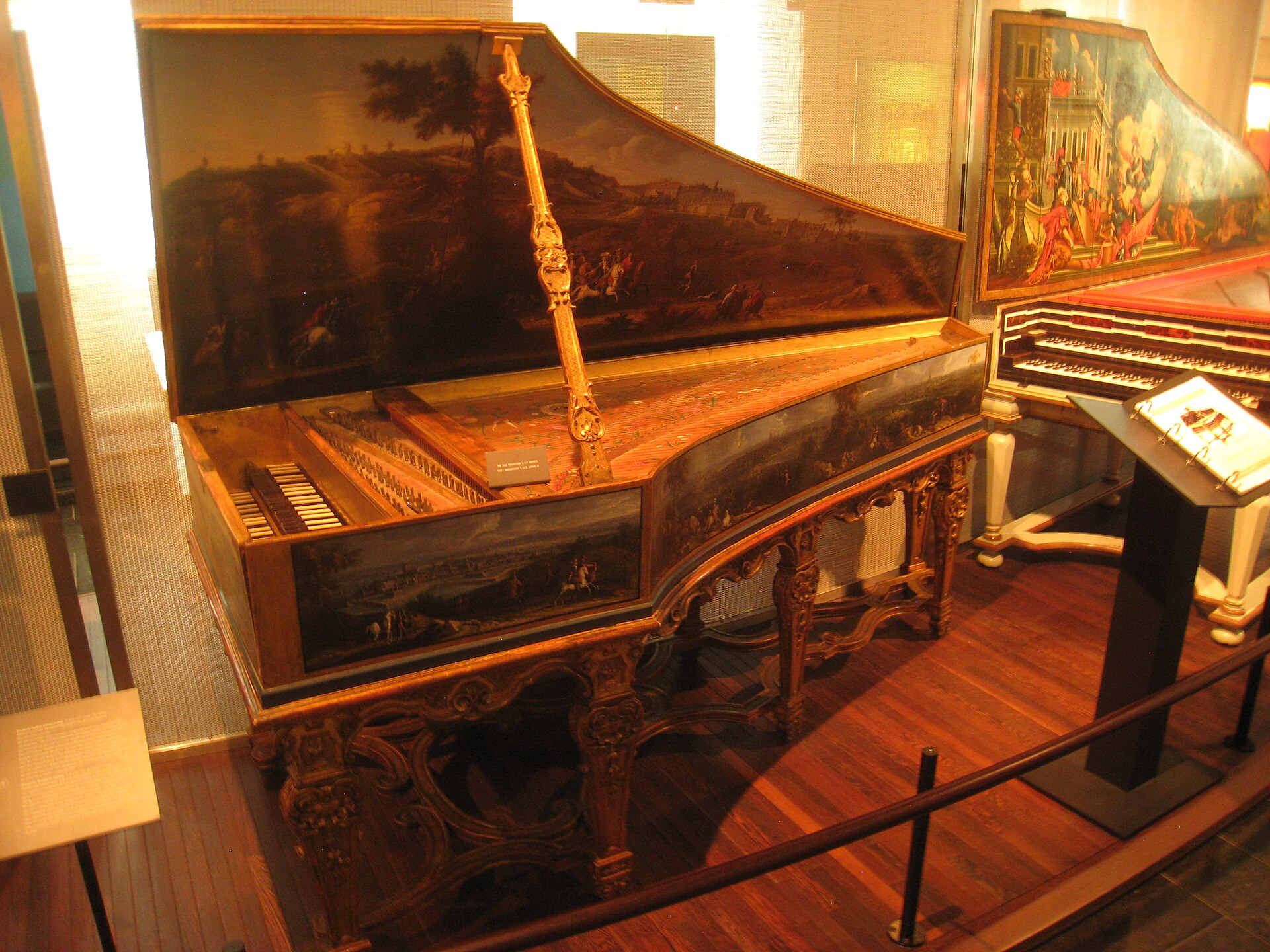
The instrument as displayed at the Musical Instruments Museum, Brussels, inv. 3848. Photographed in 2010, before the 2013-2016 research project established that the case is anonymous French work of c. 1695 carrying a fraudulent Ruckers rose added c. 1750, genuinely enlarged by Pascal Taskin in 1774.
| Artist | Anonymous French maker, c. 1695; fraudulent Ruckers rose attributed to the workshop of Antoine Vater, c. 1750; ravalement by Pascal Taskin, 1774 |
|---|---|
| Date | c. 1695 (original construction); fraudulent Ruckers rose and signature added c. 1750; enlarged and rebuilt (ravalement) by Pascal Taskin, 1774 |
| Medium | Wood case and soundboard, painted or grained decoration, gilt-paper or parchment rose (the added, fraudulent rose), iron and brass strings, quill (later possibly leather) plectra, double manual |
| Dimensions | Not published in the sources consulted |
| Where it is now | Musical Instruments Museum (MIM), Brusselslast confirmed |
| Inventory number | 3848 |
| Attribution | DisputedCatalogued for most of its documented existence as a genuine Ruckers instrument reworked by Pascal Taskin. Full note |
| Object type | Musical instrument |
| Period | French, late seventeenth to late eighteenth century (original construction c. 1695; forged embellishment c. 1750; classical-period rebuild 1774) |
| Cases | Disputed attribution · Has a provenance gap |
| Inscriptions | A soundboard rose and maker's signature in imitation of Ruckers workshop practice, added c. 1750 and long read as a genuine Ioannes or Andreas Ruckers mark; now established as counterfeit. Any inscription left by the anonymous original maker, and any mark or label left by Taskin's 1774 workshop, are not recorded in the sources consulted. |
| Owners on record | 8 links4 documented, 4 unknown |
| Sources | 14 cited |
About this record Last verified · 14 sources cited · Change log
On this page 11 sections
ContentsClose
For most of its documented life this double-manual harpsichord in Brussels was catalogued as a genuine instrument by the Ruckers workshop of Antwerp, later enlarged by the celebrated royal maker Pascal Taskin. Archaeometric research published in 2023 overturned that account. The case and soundboard are now attributed to an anonymous French workshop of about 1695; the Ruckers-style rose and signature that gave the instrument its name and its market prestige were added fraudulently around 1750, an act the research attributes to the workshop of the Paris maker Antoine Vater; and Taskin's 1774 rebuild, the one part of the old story that survives scrutiny, was performed on an instrument that was already a fake.
The case belongs to a real and well-documented eighteenth-century French phenomenon: Flemish Ruckers harpsichords commanded prices no French maker's own name could reach, and forging or exaggerating a Ruckers attribution was a known way to profit from an old or ordinary instrument. This record sets out what the evidence actually shows, what it does not, and where the object's own history, before 1750 and again between 1774 and its entry into the Brussels collection, remains undocumented.
Provenance
Each link is graded. Documented: a cited source supports it. Disputed: the identification is argued but not established. Unknown: no owner for that span, and the gap is not smoothed into a narrative. The grades in the glossary.
- c. 1695 -Anonymous French workshopdocumented
The case and soundboard are attributed by archaeometric and dendrochronological analysis, published by Pascale Vandervellen in 2023, to an anonymous French maker working around 1695. No maker's name is recorded for this original construction; the attribution to a French rather than Flemish origin is the technical finding that overturned the instrument's traditional identity.1
- c. 1695 - c. 1750Unknownunknown
No owner, dealer or location is documented for the instrument's first half-century. How and where it was used or kept before it was given a false Ruckers identity is not recorded in the sources consulted.1
- c. 1750 - c. 1750Workshop of Antoine Vater (attributed)unknown
Vandervellen's 2023 case study attributes the addition of the fake Ruckers rose and signature to the workshop of Antoine Vater, keeper of the royal harpsichord collection at Versailles and an established Paris maker in his own right. This record treats the attribution as the argued conclusion of a named, citable study rather than as an eyewitness-documented act, since the mechanism by which the attribution to Vater specifically (rather than to another Paris dealer or maker of the period) was established has not been verified against the full published text.1
- c. 1750 - 1774Unknownunknown
No owner is documented between the forged attribution and the instrument's arrival in Pascal Taskin's workshop in 1774. Whether it changed hands once, several times, or not at all in this quarter-century is not recorded in the sources consulted.1
- 1774 - 1774Workshop of Pascal Taskin, Parisdocumented
Taskin became facteur de clavecins du roi (royal harpsichord maker) in 1774, the same year in which he is documented as having reworked this instrument. The ravalement itself is genuine Taskin work; what it was performed on was not a genuine Ruckers.19
- 1774 -Unknownunknown
No owner, dealer, sale or bequest is documented between Taskin's 1774 workshop and the instrument's presence in the Brussels collection. The Brussels Conservatory's instrument collection, out of which the MIM grew, was founded in 1877 under Victor-Charles Mahillon, who built it through purchases, donations and diplomatic channels; whether this instrument reached Brussels through Mahillon's own acquisitions, an earlier Conservatory holding, or a later donation has not been established in the sources consulted.6
- - presentBrussels Conservatory collection, later the Musical Instruments Museum (MIM), Brusselsdocumented
The instrument's presence in the MIM collection under inventory number 3848 is documented by the museum's own research programme and publications. The specific date and mechanism of acquisition into the collection are not documented in the sources consulted and are recorded here as a gap, not bridged by inference.15
- 2013 - 2016Musical Instruments Museum, Brusselsdocumented
Led by Pascale Vandervellen with more than thirty specialists across organology, musicology, art history, conservation and acoustics, the project examined every Ruckers-attributed instrument in the collection by CT scan or X-ray, dendrochronological and dendrological analysis, documentation of rose composition, and pigment and paper sampling. The findings for this instrument were published as a dedicated case study in 2023 and as part of the project's 2017 edited volume.125
Technical evidence
| Attribution note | Catalogued for most of its documented existence as a genuine Ruckers instrument reworked by Pascal Taskin. Archaeometric and dendrochronological research published by Pascale Vandervellen in 2023, as part of the Musical Instruments Museum's 2013-2016 study of its eighteen Ruckers-attributed instruments, established that the case and soundboard are the work of an anonymous French maker of about 1695, that the Ruckers-style rose and signature were added fraudulently around 1750 in an act attributed to the workshop of Antoine Vater, and that the instrument was genuinely enlarged (ravalement) by Pascal Taskin in 1774. It is therefore neither a Ruckers nor, in its original construction, a Taskin; Taskin's documented contribution is the 1774 rebuild, not the carcase. |
|---|---|
| Inventory number | MIM, Brussels, inv. 3848.1 |
| Original construction | Case and soundboard attributed by dendrochronological and dendrological analysis to an anonymous French workshop, c. 1695.1 |
| Fraudulent attribution | A soundboard rose and signature imitating Ruckers workshop practice were added c. 1750, an act the 2023 case study attributes to the workshop of Antoine Vater; the rose's composition and construction were documented and compared against genuine Ruckers rose-making practice as part of the same study.1 |
| 1774 ravalement | The instrument was genuinely enlarged and rebuilt by Pascal Taskin in 1774, the year he became facteur de clavecins du roi. Ravalement of this kind typically widened the case to extend the keyboard compass to the fuller range demanded by later eighteenth-century French repertoire; the exact compass adopted for this specific instrument is not published in the sources consulted.19 |
| Investigative methodology | Established as part of the MIM's 2013-2016 study of its eighteen Ruckers-attributed instruments: CT scanning or X-radiography, dendrochronological and dendrological analysis of the wood, first documentation of rose composition, and pigment and paper sampling and analysis, applied across the group of eighteen instruments.25 |
| Taskin's general ravalement practice | Taskin continued the established French practice of rebuilding valued Flemish Ruckers and Couchet harpsichords; he is on record, in tertiary sources, as having on occasion sold instruments under the Ruckers name with very few original parts or none at all, a general market practice rather than a claim specific to this instrument.9 |
| Dimensions and keyboard compass | Not published in the sources consulted for this record.1 |
| Wood species | Not specified beyond the general dendrological finding of French origin in the sources consulted; the full case study, which may give species-level detail, could not be retrieved in full.1 |
| Wider project findings | Independent reviews of the 2017 Golden Age volume record that, with only two exceptions, every one of the museum's eighteen Ruckers-attributed instruments was found to have been altered after its original acquisition, a pattern of routine intervention this instrument's own forged rose and genuine 1774 ravalement both fit.234 |
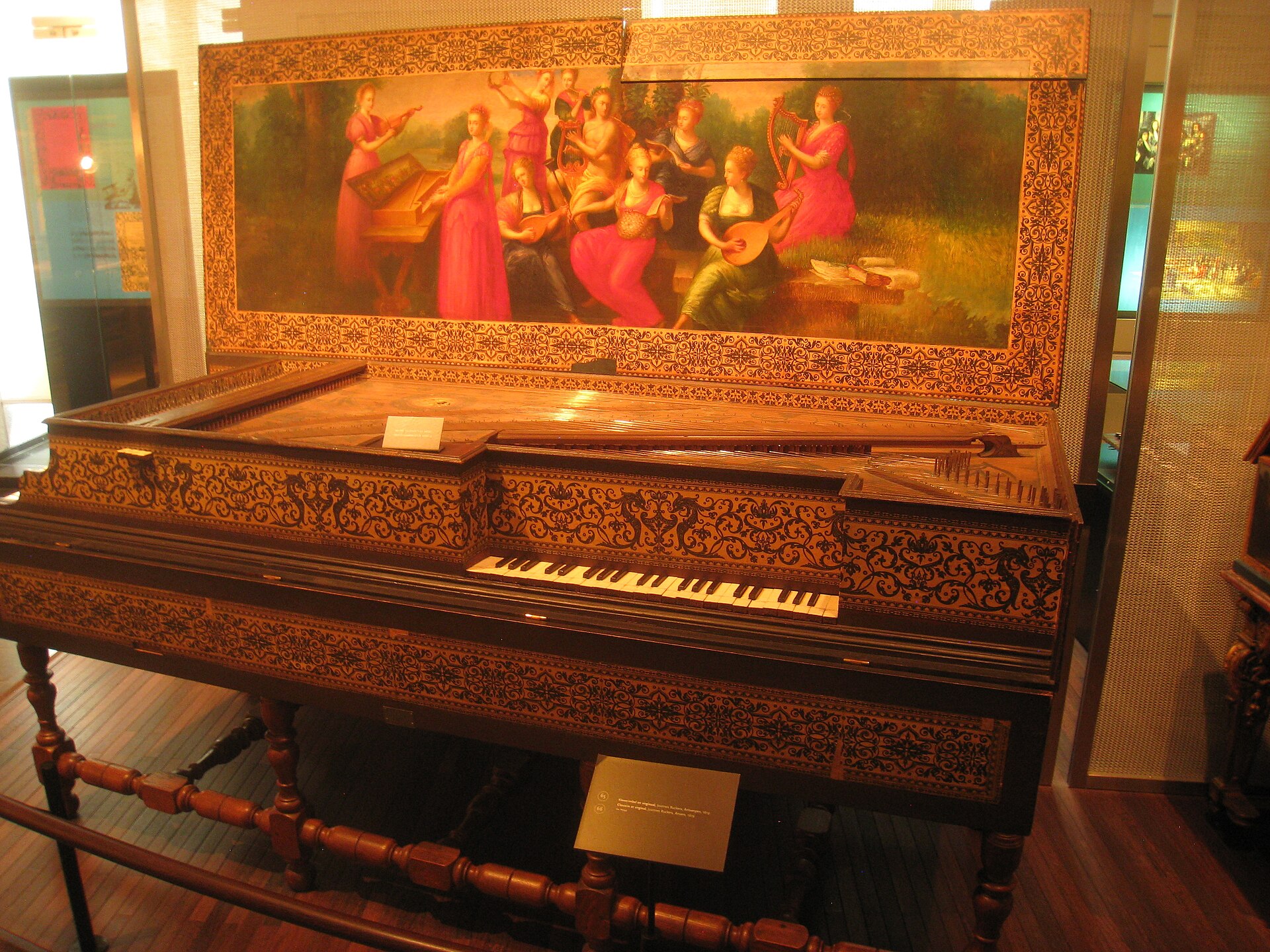
| Comparanda in the same collection | The museum holds a genuine, uncontested Ruckers-workshop instrument, a harpsichord combined with a small virginal signed by Joannes Ruckers and dated 1619, under the separate inventory number 2935, offering a direct baseline for authentic construction within the same institution.7 |
| The workshop being imitated | The Ruckers workshop that the c. 1750 forger sought to imitate was founded in Antwerp by Hans Ruckers, who joined the city's Guild of Saint Luke in 1579, and was carried on across roughly four generations by his sons and grandson into the mid-seventeenth century, prized for its tone and credited with helping establish the two-manual harpsichord.10 |
| Photographic record | This instrument and the genuine 1619 Joannes Ruckers instrument in the same collection (inv. 2935) were photographed on the same day in 2010 by the same photographer, Daderot, providing a directly comparable image pair despite predating the 2013-2016 research project by several years.1112 |
| Distinct namesake instrument | A separate, genuine "Clavecin Ruckers/Taskin" survives at the Musee de la musique in Paris (inv. E.979.2.1), built by Andreas II Ruckers in 1646 and reworked by Taskin in 1780; it is unrelated to the Brussels instrument beyond the shared naming convention and must not be confused with it.1314 |
Images
The record in full
Chapter 1What it is
A French double-manual harpsichord, its case, soundboard and mechanism built by an unidentified maker working around 1695.
A French double-manual harpsichord, its case, soundboard and mechanism built by an unidentified maker working around 1695. At some point near the middle of the eighteenth century it was given a soundboard rose and a signature in the style of the Antwerp Ruckers workshop, an addition intended to be read as authentic. In 1774 it passed through the Paris workshop of Pascal Taskin, who genuinely enlarged and rebuilt it, a routine and prestigious operation known as ravalement. The instrument is now in the Musical Instruments Museum in Brussels under inventory number 3848.
For roughly two and a half centuries the accepted account ran the other way: a real Ruckers instrument, expanded by a real Taskin, hence the working name "Ruckers-Taskin" that the instrument still carries and that this record keeps, because it is how the object is catalogued and searched for, while stating plainly in the same breath that the name records a fiction. Archaeometric research published by the MIM's own research staff in 2023 reversed the reading of every element except the last: Taskin's 1774 intervention is genuine; everything the name implies about the instrument's origin and its first eighty years is not.
Chapter 2The name and what it used to mean
"Ruckers-Taskin" is a compound name of a kind common in harpsichord catalogues, describing an instrument in two stages: who built it, and who later reworked it to extend its keyboard compass or...
"Ruckers-Taskin" is a compound name of a kind common in harpsichord catalogues, describing an instrument in two stages: who built it, and who later reworked it to extend its keyboard compass or updated its case to suit later eighteenth-century French taste and repertoire. Under the traditional reading, a Ruckers-Taskin was a genuine piece of Flemish Golden Age craftsmanship, made valuable twice over, once by the original Antwerp workshop and again by a documented royal maker's later attention.
That combination, real seventeenth-century Ruckers construction plus a documented eighteenth-century French ravalement, does exist elsewhere and is not itself suspicious. A harpsichord built by Andreas II Ruckers in Antwerp in 1646 and reworked by Taskin in Paris in 1780 survives today in the Musee de la musique in Paris (inventory E.979.2.1), and it carries the same descriptive compound name for the same reason. That Paris instrument is a different, separately catalogued object with no connection to the Brussels harpsichord beyond sharing a naming convention and, by coincidence, a nickname; the two must not be confused, and this record treats them as entirely distinct throughout.
Chapter 3The forgery: what was added, and when
The element of the Brussels instrument that made the traditional attribution possible was its soundboard rose and an accompanying signature, executed in a style meant to read as the mark of the...
The element of the Brussels instrument that made the traditional attribution possible was its soundboard rose and an accompanying signature, executed in a style meant to read as the mark of the Ruckers workshop. Vandervellen's 2023 case study, drawing on the MIM's 2013-2016 technical study of its Ruckers-attributed instruments, dates this addition to around 1750, roughly fifty-five years after the instrument's actual construction and more than a century after the death of the last Ruckers-family maker active under that name.
The study attributes the fraudulent addition to the workshop of Antoine Vater, a Paris-based maker who at the time held the position of guardian of the royal harpsichords at Versailles. This record grades that specific attribution as argued rather than flatly documented, because the mechanism by which the case for Vater's workshop, rather than another Paris maker or dealer of the period, was established has not been verified against the complete published text of the study, which could not be retrieved in full for this record. The broader conclusion, that the rose and signature are not genuine Ruckers work and were added roughly half a century after the instrument was built, is treated here as documented, resting on the archaeometric and dendrochronological findings themselves rather than on connoisseurship alone.
Chapter 4Why fake a Ruckers: the market that made it worth doing
Faking or embellishing a Ruckers attribution was not an isolated act of one dishonest workshop; it was a recognized feature of the eighteenth-century French instrument trade, driven by a...
Faking or embellishing a Ruckers attribution was not an isolated act of one dishonest workshop; it was a recognized feature of the eighteenth-century French instrument trade, driven by a straightforward economic fact. Ruckers and Couchet harpsichords, built in Antwerp between the late sixteenth century and the mid-seventeenth, were prized in France for their tone, and French makers and dealers had a strong financial incentive to attach that name to instruments that did not deserve it. Reworking, or claiming to rework, an old Flemish harpsichord commanded a price no French maker could charge for an instrument sold under his own name, and it was recognized at the time that in some instruments catalogued as Ruckers ravalements, only the soundboard, or nothing at all, was actually of Ruckers origin.
Pascal Taskin himself, whose own 1774 work on the Brussels instrument is not in question, is on record as having sold "Ruckers" harpsichords with very few original parts or none, a practice general knowledge among specialists rather than a secret; his contemporary Jean Germain II dealt substantially in the same trade of Flemish-attributed ravalements. This context does not implicate Taskin in the Brussels instrument's specific forgery, which the technical evidence dates to roughly twenty-four years before he touched it, but it explains why an instrument already carrying a false Ruckers rose by 1750 was worth the investment of a full ravalement in 1774: the market rewarded the name regardless of what stood behind it, and a customer or dealer commissioning the 1774 rebuild had every reason to believe, or at least to represent, that they were paying to modernize a real Ruckers.
Chapter 5Antoine Vater
Antoine Vater was born in Hanover in 1689 into a family of harpsichord and organ builders and emigrated to Paris in 1715, where he built a reputation as one of the city's finest harpsichord makers.
Antoine Vater was born in Hanover in 1689 into a family of harpsichord and organ builders and emigrated to Paris in 1715, where he built a reputation as one of the city's finest harpsichord makers. He rose to the position of guardian of the royal harpsichords, responsible for maintaining the substantial collection kept at Versailles, a post that placed him at the center of French court instrument culture rather than at its margins. He was also a friend of the composer Georg Philipp Telemann, who lodged with Vater in Paris during 1737 and 1738. The Mercure de France recorded in July 1759 that Vater was retiring from the trade and offering his stock of harpsichords for sale; he died that year.
Only three instruments built new under Vater's own name are known to survive, dated 1732, 1737 and 1738 and now dispersed between a Paris collection and private hands in England and Ireland. The Brussels harpsichord is not a fourth: on the technical evidence, Vater did not build it. His documented connection to it, on Vandervellen's reading, is narrower and more damaging to his reputation than authorship would be: attaching a false identity to somebody else's fifty-five-year-old instrument. Whether this was an isolated act or part of a wider, repeated practice on Vater's part is not established in the biographical literature available for this record, which documents his genuine output and his royal position but is silent on any pattern of forged attributions beyond this single case; that silence is recorded here as a finding, not resolved by assumption in either direction.
Chapter 6Pascal Taskin and the 1774 ravalement
Pascal-Joseph Taskin was born in 1723 in Theux, in the prince-bishopric of Liege, and died in 1793 in Versailles.
Pascal-Joseph Taskin was born in 1723 in Theux, in the prince-bishopric of Liege, and died in 1793 in Versailles. He trained under Francois-Etienne Blanchet II in Paris, inherited the Blanchet workshop on Blanchet's death in 1766 by marrying his widow, and became a master harpsichord maker that same year. He inherited the royal title in stages, becoming keeper of Louis XV's instruments in 1770 and fully assuming the position of facteur de clavecins du roi, royal harpsichord maker, in 1774 on Louis XVI's accession, the same year in which he is documented as having reworked the Brussels instrument. He went on to introduce genuine technical advances, including knee-operated stop levers and, in 1768, the peau de buffle register using soft buff-leather plectra in place of quill, and later moved into fortepiano production alongside harpsichord making.
A ravalement was a substantial, skilled operation, not a repair: it meant widening or rebuilding the case to extend the keyboard compass beyond what a seventeenth-century instrument offered, so that an old harpsichord could play the fuller range of notes that later eighteenth-century French repertoire required. It was routinely performed on genuine Flemish instruments precisely because their tone was worth preserving through an upgrade their original compass could not support. Commissioning that work in 1774 on an instrument already carrying a fake Ruckers identity since around 1750 is consistent with everything known about the market: whoever paid Taskin for the rebuild was investing in an instrument they had every reason to believe, or to present, as genuinely Flemish, and the investment made commercial sense only because the false rose had already done its work a generation earlier.
Chapter 7How the fraud was found: the MIM's 2013-2016 project
Between 2013 and 2016 the Musical Instruments Museum undertook a coordinated study and conservation programme covering all eighteen instruments in its collection that had been considered, at the time...
Between 2013 and 2016 the Musical Instruments Museum undertook a coordinated study and conservation programme covering all eighteen instruments in its collection that had been considered, at the time of their acquisition, to be Ruckers or Ruckers-workshop instruments. More than thirty specialists took part, spanning organology, musicology, art history, conservation science and acoustics, based in institutions from Brussels to Paris. Every instrument in the group was measured and redrawn, subjected to a CT scan or X-radiography, and analyzed dendrologically and dendrochronologically for the first time; the composition of each soundboard rose was documented, and pigments and papers were sampled and studied for the first time across the collection.
The project's findings were published in two forms: a 420-page edited volume, The Golden Age of Flemish Harpsichord Making, issued by the museum in 2017 and awarded the Nicholas Bessaraboff Prize by the American Musical Instrument Society in 2019, and, specifically for this instrument, a dedicated case study by Vandervellen in the journal De musica disserenda in 2023. The case study's own description of its subject is precise about what the instrument is not: an instrument that is neither a Ruckers nor a Taskin but a French instrument of about 1695, falsified around 1750 by Antoine Vater and genuinely ravaled by Pascal Taskin in 1774.
Chapter 8What the evidence actually showed
The methodology applied to this instrument, and to the group of eighteen as a whole, combined imaging with material science.
The methodology applied to this instrument, and to the group of eighteen as a whole, combined imaging with material science. CT scanning and X-radiography allowed the internal construction of the case and soundboard to be examined without disassembly. Dendrochronological analysis, dating the wood by its growth-ring pattern, and dendrological analysis, identifying the species and likely regional source of the timber, together placed the instrument's construction around 1695 and pointed to a French rather than Flemish origin, contradicting the wood evidence expected of a genuine Antwerp Ruckers build. The rose's composition and construction were documented and compared against the workshop's own record of genuine Ruckers rose-making, rather than against style alone, a distinction the earlier, purely connoisseurial attribution had not been able to draw on.
This record has not been able to verify the specific dendrochronological date ranges, wood species, or the precise comparative rose analysis reported in the full text of Vandervellen's 2023 case study, which could not be retrieved beyond its published abstract and summary during research for this entry. The general conclusion, French origin around 1695 rather than Flemish origin in the seventeenth century, and a rose added roughly half a century later, is treated here as the documented finding of a named, citable, peer-reviewed study; the granular scientific data behind it is flagged in the open questions below as unverified at first hand and worth confirming against the primary publication.
Chapter 9From Taskin's workshop to Brussels: an undocumented chain
Nothing in the sources consulted for this record establishes how the instrument moved from Taskin's Paris workshop in 1774 to the Brussels collection in which it now sits.
Nothing in the sources consulted for this record establishes how the instrument moved from Taskin's Paris workshop in 1774 to the Brussels collection in which it now sits. The Brussels institution that became the Musical Instruments Museum began life in 1877 as the instrument collection of the Brussels Royal Conservatory, built initially around two founding gifts, the musicologist Francois-Joseph Fetis's collection, purchased by the Belgian state in 1872, and around one hundred Indian instruments given to King Leopold II in 1876 by the Rajah Sourindro Mohun Tagore. Victor-Charles Mahillon, the collection's first curator from 1877 to 1924, expanded it enormously through purchase, diplomacy and cultivated donors, taking it from these founding gifts to some 3,666 objects by his death.
Whether this harpsichord entered the collection through one of Mahillon's own acquisitions, through an earlier, undocumented Conservatory holding, or through a later donation after his tenure is not established in any source located for this record. A century of ownership between the 1774 ravalement and the instrument's documented presence in the MIM's own inventory is, on present evidence, simply unrecorded, and this record states that gap plainly rather than filling it with a plausible-sounding but unsupported guess.
Chapter 10What happened after the discovery
The museum's own account of the 2013-2016 project states that, since restoration, the instruments involved are displayed on rotation in the permanent exhibition galleries, a normal...
The museum's own account of the 2013-2016 project states that, since restoration, the instruments involved are displayed on rotation in the permanent exhibition galleries, a normal conservation-driven practice for fragile keyboard instruments rather than a response specific to this instrument's reattribution. Beyond that general statement, this record has not located a published account of how the MIM's physical object label or printed catalogue entry for inventory 3848 was worded before 2016 and how it reads now, and it does not assume that a label change occurred simply because the scholarship changed; museums vary in how quickly gallery text catches up with published research, and no source consulted confirms the timing or content of any relabeling for this specific object. What is documented is the scholarly outcome: a peer-reviewed case study naming the instrument's true construction date, its forger, and its genuine restorer, publicly attached to its correct inventory number, superseding the earlier catalogue tradition in the academic record even where the exact state of the museum's own current gallery text has not been separately verified here.
Chapter 11The other seventeen: what the wider project found
The 2013-2016 project did not examine this instrument in isolation.
The 2013-2016 project did not examine this instrument in isolation. It covered all eighteen instruments in the MIM collection considered, at the time each was acquired, to have been made in the Ruckers workshop, the largest such group in any single collection worldwide. A contemporary review of the resulting 2017 volume records that, with only two exceptions, every instrument in this group of eighteen was altered after its original acquisition by the museum, underscoring how routinely these instruments were reworked, relabeled, or partially rebuilt across their long working lives, independent of whether their original core construction was genuinely Flemish. One documented case from the same project concerns an Ioannes Ruckers mother-and-child muselaar virginal of 1610 (inventory 0275), which underwent two nineteenth-century ravalements and now carries eight layers of paint obscuring the original decorated case, a different problem from outright forgery but part of the same pattern of accumulated, undocumented intervention that the project set out to unpick instrument by instrument.
This record has not located a published, collection-wide tally stating how many of the eighteen are now considered fully genuine Ruckers-workshop construction, how many are later fakes comparable to inventory 3848, and how many fall into an intermediate category of genuine Ruckers material heavily altered by later ravalement. That overall count, if it exists in the full 2017 volume, has not been verified for this record and is recorded as an open question rather than estimated.
Chapter 12The genuine article: what a forger in 1750 was imitating
The Ruckers workshop was founded in Antwerp by Hans Ruckers, who joined the city's Guild of Saint Luke in 1579 and built a business later carried on by his sons Joannes and Andreas I and by Andreas...
The Ruckers workshop was founded in Antwerp by Hans Ruckers, who joined the city's Guild of Saint Luke in 1579 and built a business later carried on by his sons Joannes and Andreas I and by Andreas I's own son Andreas II, spanning roughly four generations of activity into the mid-seventeenth century. The workshop's instruments were valued for a resonant, balanced tone achieved through disciplined design and construction, and the family is credited with helping establish the two-manual harpsichord as a serious instrument type, an innovation that shaped keyboard building well beyond Antwerp. By the following century the Ruckers name had acquired a reputation comparable, in the world of stringed and keyboard instruments, to that of the great Cremonese violin makers: a guarantee of quality valuable enough to be worth stealing.
The Musical Instruments Museum holds a genuine, uncontested example of this workshop's output in the same building as the Brussels forgery: a harpsichord combined with a small virginal, signed by Joannes Ruckers and dated 1619, catalogued under the separate inventory number 2935. That instrument's lid painting, added later and copying a work by Maarten de Vos now in Belgium's Royal Museums of Fine Arts, is itself a documented later addition, but the instrument's core construction and its Ruckers attribution are not in dispute in the sources consulted. It is offered here strictly as a comparison object, illustrating what a genuine mid-workshop Ruckers instrument in the same collection looks like, and it must not be read as connected in any other way to inventory 3848.
Chapter 13What remains unresolved
Two long stretches of this instrument's history, from its construction around 1695 to the forged attribution around 1750, and from Taskin's 1774 workshop to its documented presence in the Brussels...
Two long stretches of this instrument's history, from its construction around 1695 to the forged attribution around 1750, and from Taskin's 1774 workshop to its documented presence in the Brussels collection, carry no named owner, dealer or location in any source located for this record. The specific evidentiary basis for attributing the c. 1750 forgery to Antoine Vater's workshop in particular, rather than to another Paris maker or dealer of the period, rests on a study this record could not verify beyond its published summary. Whether Vater's involvement here, if correctly attributed, reflects an isolated lapse or a broader pattern in his practice is not addressed in the biographical sources available. And the wider question the 2013-2016 project set out to answer for the whole group, how many of the museum's eighteen Ruckers-attributed instruments are genuine, how many are later fakes, and how many are authentic cores under heavy later rework, has not yielded, in the sources consulted, a single published tally that would let this instrument's case be weighed against the full pattern of the collection it belongs to.
What is not in doubt is the shape of the story: an ordinary French harpsichord, given a false and profitable identity within a well-documented market for exactly that kind of deception, later improved by a royal maker who had no reason to doubt the identity he was building on, and only unmasked more than two and a half centuries later by wood, X-rays and the composition of a rose that was never what it claimed to be.
The artist
No named maker for the original c. 1695 construction; Antoine Vater (attributed forger of the c. 1750 rose); Pascal-Joseph Taskin (genuine 1774 ravalement)
This instrument has no single author in the ordinary sense, and that absence of a clean answer is the actual subject of its scholarship. An anonymous French workshop built it around 1695. An unnamed hand, attributed by the MIM's own 2023 research to the workshop of Antoine Vater, gave it a false identity around 1750. A well-documented royal maker, Pascal Taskin, genuinely rebuilt it in 1774, in good faith or otherwise, on the strength of a lie that was already a generation old. This dossier covers all three, because understanding the object requires understanding what each of them actually did, and did not do.
Exhibited
- 2013-2016Study and conservation of the MIM's Ruckers instruments (research and restoration project, not a public exhibition)Musical Instruments Museum, Brussels
- ongoing since restorationPermanent collection, shown in rotation with the museum's other Ruckers-attributed instrumentsMusical Instruments Museum, Brussels
Literature
- Pascale Vandervellen, "Counterfeit Ruckers Instruments in the MIM Collection: A Case Study of the So-Called 'Ruckers-Taskin' Harpsichord," De musica disserenda, vol. 19, no. 1 (2023).
- Pascale Vandervellen, ed., The Golden Age of Flemish Harpsichord Making: A Study of the MIM's Ruckers Instruments (Brussels: Musical Instruments Museum, 2017).
Related works
| Work | Relation | Where it is |
|---|---|---|
| Harpsichord with virginal Joannes Ruckers | Genuine, uncontested Ruckers-workshop instrument in the same museum Signed and dated 1619. Held in the same institution as inv. 3848 but a separate, unrelated object with no shared history beyond common ownership by the museum; offered here purely as a baseline for what genuine Ruckers-workshop construction looks like. Not to be confused with the Ruckers-Taskin harpsichord that is the subject of this record. | Musical Instruments Museum, Brussels, inv. 2935 |
| Clavecin Ruckers/Taskin Andreas II Ruckers (built 1646); ravalement by Pascal Taskin (1780) | A different instrument bearing the same descriptive naming convention and a similar nickname Genuinely built by a Ruckers-family maker in Antwerp in 1646 and genuinely reworked by Taskin in Paris in 1780. Unrelated to the Brussels instrument beyond the coincidence of a similar working name; this record flags the distinction explicitly to prevent the two objects being conflated. | Musee de la musique, Paris, inv. E.979.2.1 |
| Harpsichord, 1732 Antoine Vater | A genuine, documented new-build under Vater's own name, illustrating his authentic output as against the fraudulent attribution he is linked to on the Brussels instrument One of only three instruments known to survive bearing Vater's own, undisputed authorship. | Private/institutional collection, Paris (reported location among three surviving Vater instruments) |
| The other Ruckers-attributed instruments studied 2013-2016 Various, including genuine Ruckers-workshop makers and later reworkers | The comparanda group: the full set of eighteen instruments examined in the same MIM research and conservation project Includes an Ioannes Ruckers mother-and-child muselaar virginal of 1610 (inv. 0275), which underwent two nineteenth-century ravalements and now carries eight paint layers over its original decoration, illustrating a different but related pattern of accumulated alteration within the same collection. | Musical Instruments Museum, Brussels |
| Genuine Ruckers-family output generally Hans Ruckers, Joannes Ruckers, Andreas Ruckers I and II | The Antwerp workshop and reputation that the c. 1750 forgery was designed to imitate Active across roughly four generations from 1579 into the mid-seventeenth century; their reputation for tone and their role in establishing the two-manual harpsichord is the market value the forger on the Brussels instrument was attempting to counterfeit. | Dispersed across international collections |
Open questions
- What are the specific dendrochronological date ranges, wood species identifications, and comparative rose-composition data reported in the full text of Vandervellen's 2023 case study? Only the study's published summary and abstract could be retrieved for this record.
- How and when did the instrument pass from Pascal Taskin's Paris workshop in 1774 into the Brussels Conservatory or MIM collection? No intermediate owner, dealer, sale or donation is documented in the sources consulted.
- Was the fraudulent Ruckers attribution, if correctly linked to Antoine Vater's workshop, an isolated act or part of a wider, repeated practice on his part? The general biographical literature on Vater documents his genuine output and his royal position but is silent on any pattern of forged attributions.
- Of the MIM's eighteen Ruckers-attributed instruments studied between 2013 and 2016, how many are now considered genuine Ruckers-workshop construction, how many are later fakes comparable to this instrument, and how many are authentic cores under heavy later rework? No published collection-wide tally was located.
- What are this instrument's exact dimensions, keyboard compass after the 1774 ravalement, and wood species? None are published in the sources consulted.
- Did the MIM change its physical gallery label or printed catalogue text specifically for inventory 3848 after the 2016 findings, and if so, when and how was it worded? Only a general statement that restored instruments are displayed in rotation was located; no source confirms relabeling timing or content for this specific object.
Questions about this object
What is Harpsichord, called the "Ruckers-Taskin"?
Harpsichord, called the "Ruckers-Taskin" is a musical instrument, dated c. 1695 (original construction); fraudulent Ruckers rose and signature added c. 1750; enlarged and rebuilt (ravalement) by Pascal Taskin, 1774. Medium: Wood case and soundboard, painted or grained decoration, gilt-paper or parchment rose (the added, fraudulent rose), iron and brass strings, quill (later possibly leather) plectra, double manual.
Who made Harpsichord, called the "Ruckers-Taskin", and is the attribution settled?
The attribution to Anonymous French maker, c. 1695; fraudulent Ruckers rose attributed to the workshop of Antoine Vater, c. 1750; ravalement by Pascal Taskin, 1774 is recorded here as disputed. Catalogued for most of its documented existence as a genuine Ruckers instrument reworked by Pascal Taskin. Archaeometric and dendrochronological research published by Pascale Vandervellen in 2023, as part of the Musical Instruments Museum's 2013-2016 study of its eighteen Ruckers-attributed instruments, established that the case and soundboard are the work of an anonymous French maker of about 1695, that the Ruckers-style rose and signature were added fraudulently around 1750 in an act attributed to the workshop of Antoine Vater, and that the instrument was genuinely enlarged (ravalement) by Pascal Taskin in 1774. It is therefore neither a Ruckers nor, in its original construction, a Taskin; Taskin's documented contribution is the 1774 rebuild, not the carcase.
Where is Harpsichord, called the "Ruckers-Taskin" now?
Musical Instruments Museum (MIM), Brussels. Inventory number 3848. Last confirmed 3 September 2026. Held in the MIM collection, successor to the Brussels Conservatory instrument collection founded in 1877; the date and circumstances by which this specific instrument entered that collection are not established in the sources consulted.
What is still unknown about Harpsichord, called the "Ruckers-Taskin"?
What are the specific dendrochronological date ranges, wood species identifications, and comparative rose-composition data reported in the full text of Vandervellen's 2023 case study? Only the study's published summary and abstract could be retrieved for this record.
Sources
- 1Pascale Vandervellen, "Counterfeit Ruckers Instruments in the MIM Collection: A Case Study of the So-Called 'Ruckers-Taskin' Harpsichord," De musica disserenda, vol. 19, no. 1 (2023). Full text not retrieved beyond the published abstract and summary; findings cited here are limited to what that summary states. researchgate.net/publication/...
- 2Pascale Vandervellen, ed., The Golden Age of Flemish Harpsichord Making: A Study of the MIM's Ruckers Instruments (Brussels: Musical Instruments Museum, 2017), 420 pp., ISBN 978-90-90-10838-4. mim.be/en/...
- 3Review of The Golden Age of Flemish Harpsichord Making, Journal of Seventeenth-Century Music, vol. 26, no. 1. sscm-jscm.org/jscm-issues/...
- 4Thomas Strange, review of The Golden Age of Flemish Harpsichord Making, Galpin Society Journal, vol. 72 (March 2019), pp. 242-245. proquest.com/openview/...
- 5Musical Instruments Museum, "Study and conservation of the Ruckers instruments of the MIM." mim.be/en/...
- 6Musical Instruments Museum, "History of the MIM" (founding in 1877, the Fetis and Tagore collections, Victor-Charles Mahillon as first curator). mim.be/en/...
- 7Musical Instruments Museum, collection page for "Harpsichord with virginal" (Joannes Ruckers, Antwerp, 1619, inv. 2935). mim.be/en/...
- 8Wikipedia, "Antoine Vater" (biography, Versailles royal position, Telemann connection, surviving instruments). en.wikipedia.org/wiki/...
- 9Wikipedia, "Pascal Taskin" (biography, royal appointments, ravalement practice, technical innovations). en.wikipedia.org/wiki/...
- 10Wikipedia, "Ruckers" (family workshop history, dates, reputation, general note on the existence of counterfeiting). en.wikipedia.org/wiki/...
- 11Wikimedia Commons, File:Ruckers-Taskin, France?, end of 17th century - clavecin - IMG 3889.JPG, photograph by Daderot, 28 September 2010, public domain. commons.wikimedia.org/wiki/...
- 12Wikimedia Commons, File:Joannes Ruckers, Antwerp, 1619 - clavecin and virginal - IMG 3885.JPG, photograph by Daderot, 28 September 2010, public domain. commons.wikimedia.org/wiki/...
- 13Musee de la musique, Philharmonie de Paris, collection page for "Clavecin Ruckers/Taskin," inv. E.979.2.1 (Andreas II Ruckers, 1646, ravalement by Pascal Taskin, 1780). Cited specifically to distinguish this separate Paris instrument from the Brussels harpsichord that is the subject of this record. collectionsdumusee.philharmoniedeparis.fr/0162260-claveci...
- 14Bibliotheque nationale de France, Gallica, catalogue entry "Clavecin de 1646 et modifie en 1780 / Andreas II Ruckers ; [modifie par] Pascal Taskin," confirming the identity and date of the separate Paris instrument. gallica.bnf.fr/ark:/...


Last verified · Published
Change log
3 September 2026 - Record created at the house standard: researched narrative, technical evidence, maker dossier, graded provenance chain, prices with hammer and premium separated, related works, open questions and sources.