Painted Glass Goblet from the Begram Hoard
Unknown Alexandrian glass workshop · 1st century CE
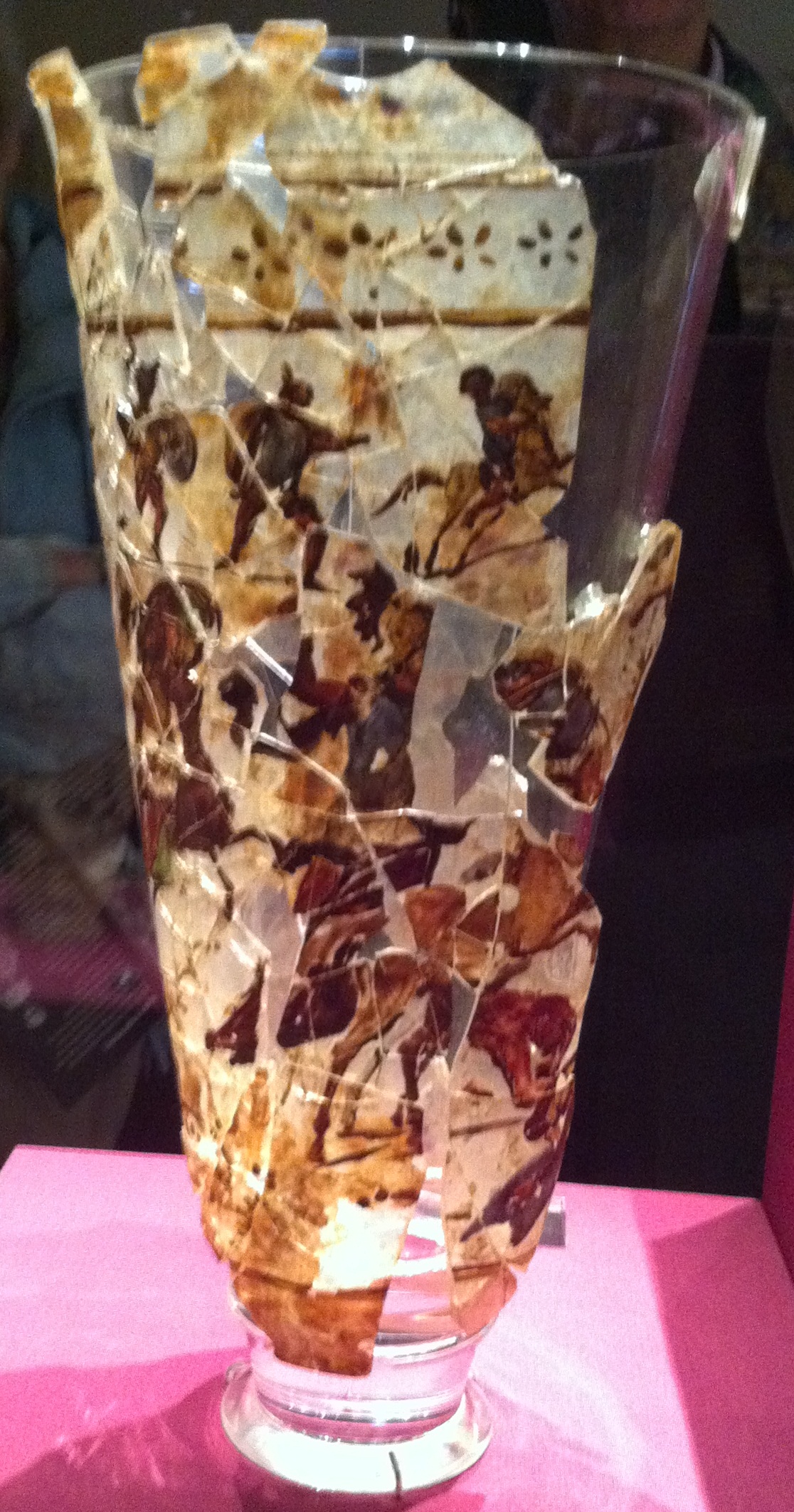
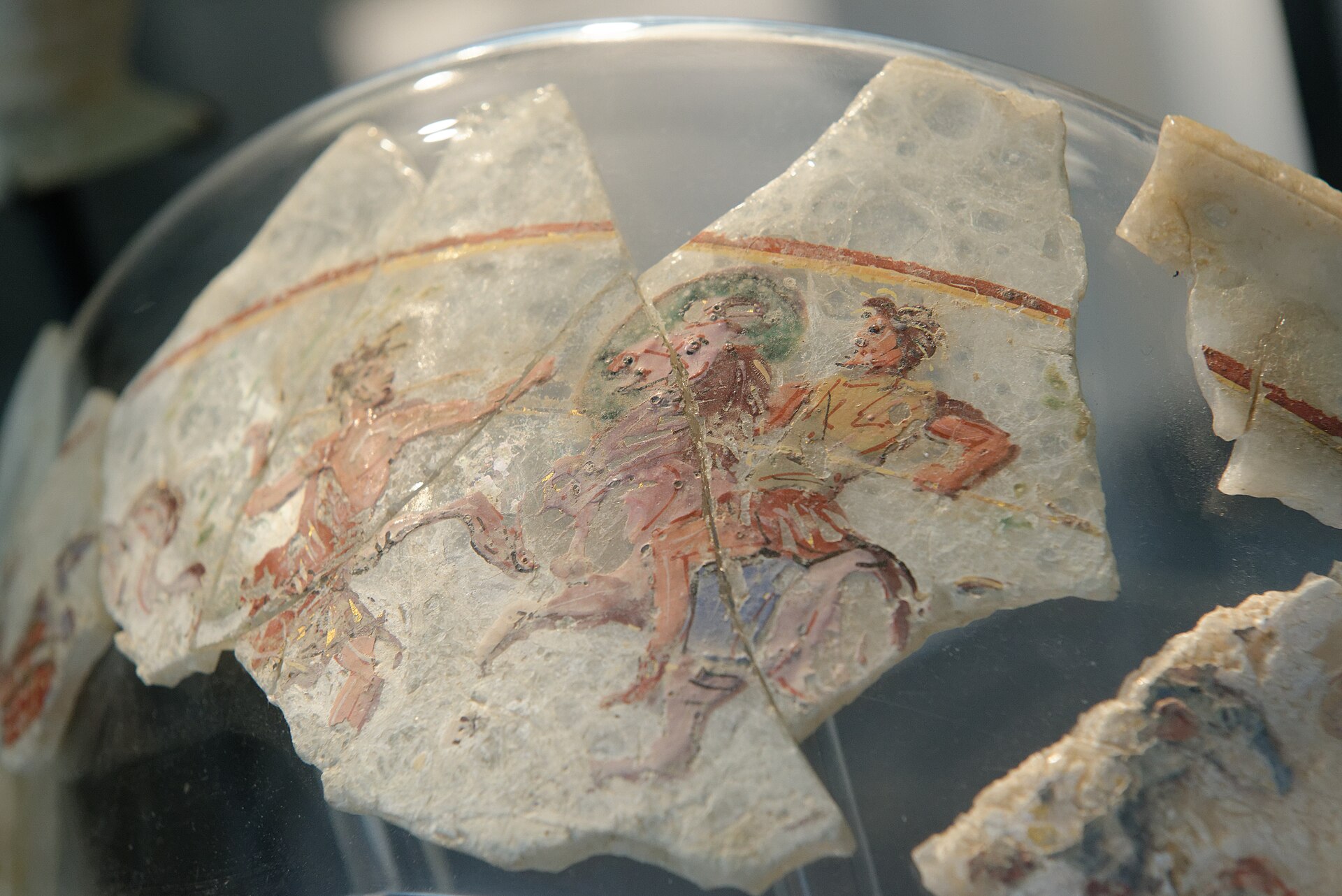
The record subject. Photographed on loan at the British Museum, London, on 2 June 2011, during the Afghanistan: Crossroads of the Ancient World exhibition, not in Kabul. The goblet's own painted subject is not identified in the file description or in the other sources consulted for this record.
National Museum of Afghanistan; photograph by Wikimedia contributor Artacoana, CC BY-SA 3.0| Artist | Unknown Alexandrian glass workshop |
|---|---|
| Date | 1st century CE |
| Medium | Colourless blown glass, decorated in opaque polychrome pigment fired onto the surface (painted, or enamelled, glass) |
| Dimensions | Not published in the sources consulted for this record |
| Where it is now | National Museum of Afghanistan, Kabullast confirmed |
| Inventory number | Not published in the sources consulted for this record |
| Attribution | AcceptedAttributed on stylistic and technical grounds to a workshop in Roman Egypt, most likely Alexandria, following the standard classification of the Begram painted-glass group by David Whitehouse and Michael Menninger. Full note |
| Object type | Glass |
| Period | Kushan-era Afghanistan, 1st century CE (Roman import) |
| Cases | Has a provenance gap · Restituted or repatriated |
| Inscriptions | None documented in the sources consulted |
| Owners on record | 10 links6 documented, 1 disputed, 3 unknown |
| Sources | 12 cited |
About this record Last verified · 12 sources cited · Change log
On this page 9 sections
ContentsClose
A painted glass goblet from Room 13 of the Begram hoard, one of hundreds of objects sealed into two locked storerooms at Begram, north of Kabul, and excavated by a French mission led by Joseph and Ria Hackin between 1937 and 1939. Made by blowing colourless glass and firing polychrome pigment onto its surface, the goblet belongs to a class of painted vessels attributed to a workshop in Roman Egypt, most likely Alexandria, and is one of roughly fifteen such goblets among a wider hoard of some 180 glass vessels, alongside Indian ivories, Chinese lacquer and Roman bronzes.
What the sealed rooms actually were remains disputed: the Hackins read them as a Kushan royal treasury, Sanjyot Mehendale has argued for a merchant's warehouse of trading stock, and Lauren Morris's more recent research questions the ritual-versus-utilitarian framing behind both readings. The goblet's own modern survival is equally dramatic. While the wider museum collection was devastated during Afghanistan's civil war, a portion of the treasure, hidden in a Central Bank vault from 1989, was found intact in April 2004 and later exhibited internationally, including a run at the British Museum in 2011, before returning to Kabul.
This record covers only this one goblet. The Begram hoard's other glass, its ivories, lacquer and bronzes are separate objects with separate histories, and no image of them should be mistaken for this piece.
Provenance
Each link is graded. Documented: a cited source supports it. Disputed: the identification is argued but not established. Unknown: no owner for that span, and the gap is not smoothed into a narrative. The grades in the glossary.
- 1st century CE -Unknown Alexandrian (Roman Egyptian) glass workshopunknown
Attributed on stylistic and technical grounds to a workshop in Roman Egypt, most likely Alexandria, following Whitehouse's and Menninger's classification of the Begram glass corpus. No maker is named or documented. Graded unknown: no maker or workshop is documented by name; the Alexandrian attribution is a scholarly stylistic argument, not a documented fact.710
- 1st century CE - 1937-1939Unknown; reached Begram via long-distance tradedisputed
How and why the goblet came to be sealed in Room 13 is the central unresolved question about the whole hoard. The excavators, Joseph and Ria Hackin, read the sealed rooms as a Kushan royal treasury concealed around the mid-3rd century CE against a Sasanian threat. Sanjyot Mehendale has argued instead that the rooms held merchant's trading stock that reached Begram by sea to Indian ports and then overland by caravan. Lauren Morris's 2021 dissertation questions the ritual-versus-utilitarian framing shared by both earlier readings and proposes the material could have been deposited later, in the late 3rd or early 4th century CE. No consensus exists.289
- 1939 - 1939Delegation Archeologique Francaise en Afghanistan (excavators Joseph and Ria Hackin)documented
Room 10 was opened in 1937 and Room 13 in 1939 during the DAFA mission directed by Joseph Hackin, with Ria Hackin leading the on-site excavation of the sealed rooms. This goblet's recorded findspot is Room 13.12
- 1922 (agreement) / 1939 (find) - 1979National Museum of Afghanistan, Kabuldocumented
Under the 1922 agreement, Begram finds were divided between the Musee Guimet, Paris, and the National Museum of Afghanistan, with Afghanistan retaining the unique and exceptional pieces. This goblet remained part of the Kabul collection; comparable painted goblets from the same excavation are held by the Guimet under the French share.2
- 1979 - 1996National Museum of Afghanistan, Kabuldocumented
The museum's public operations were disrupted by the Soviet-Afghan war of the 1980s. Once civil war reached Kabul in the early 1990s, the wider national collection suffered catastrophic losses: an estimated 70 percent of the museum's roughly 100,000 objects were looted or destroyed by 1994, the building was damaged by rocket fire and later used as a military position, and surviving material was moved to the Kabul Hotel for safekeeping. This is the documented contrast against which the Begram hoard's own survival stands.5
- 1989 - 2004National Museum of Afghanistan, held in a Central Bank of Afghanistan vaultdocumented
In 1989, before the worst of the fighting, museum staff removed a portion of the treasure, described in the sources as the Bactrian hoard and other artifacts, to an underground vault at the Central Bank, an operation supervised by museum director Omara Khan Masoudi. The vault, six safes in total, was opened intact in April 2004 by a team of about 30 archaeologists and officials; roughly 2,000 objects were inventoried undamaged. Begram glass goblets are recorded among the recovered material.3
- 1989 - 2004National Museum of Afghanistan, held in a Central Bank of Afghanistan vaultunknown
The sources consulted do not confirm that this specific goblet, as opposed to the Begram glass corpus generally, followed this exact 1989-2004 hidden-vault custody route rather than some other wartime safekeeping arrangement.3
- 2004 - 2011National Museum of Afghanistan, Kabuldocumented
Afghan national collection material, including Begram objects, toured internationally after 2004 as Afghanistan: Hidden Treasures from the National Museum, Kabul (National Gallery of Art, Washington DC, May-September 2008; Metropolitan Museum of Art, New York, June-September 2009; also shown at the Asian Art Museum, San Francisco, and the Museum of Fine Arts, Houston) and, retitled Afghanistan: Crossroads of the Ancient World, at the British Museum, London, March-July 2011. This goblet is specifically documented at the British Museum leg, photographed there on 2 June 2011.1
- 2011 - presentNational Museum of Afghanistan, Kabuldocumented
The object is understood to be back in the custody of the National Museum of Afghanistan, Kabul, as part of the returned international-tour loan group. The museum closed briefly around the August 2021 change of government and reopened on 25 November 2021 under Taliban-provided security; no source consulted reports damage to Begram material since that reopening.456
- 2011 - presentNational Museum of Afghanistan, Kabulunknown
The sources consulted do not give an exact return date or confirm whether the object travelled to further venues into 2012 or 2013 before its return.456
Technical evidence
| Attribution note | Attributed on stylistic and technical grounds to a workshop in Roman Egypt, most likely Alexandria, following the standard classification of the Begram painted-glass group by David Whitehouse and Michael Menninger. No maker is named or documented; the attribution is to a place and class of production, not to an individual hand, and no signature or workshop mark survives on glass of this type. |
|---|---|
| Material and technique | Colourless blown glass, decorated in opaque polychrome pigment fired onto the surface (painted, or enamelled, glass). No maker's mark survives.710 |
| Findspot | Begram, Room 13, one of the hoard's two sealed strongrooms, excavated by the DAFA mission under Joseph and Ria Hackin.12 |
| Attributed workshop and date | Attributed on stylistic and technical grounds to a workshop in Roman Egypt, most likely Alexandria; conventionally dated to the 1st century CE.7 |
| Corpus context | One of roughly 15 painted or enamelled goblets among approximately 180 glass vessels recovered from the two Begram rooms, sorted by Michael Menninger (1996) into 13 typological groups.7 |
| Depicted subject | Not identified in the sources consulted for this record. Other Begram painted goblets carry named mythological, combat and genre scenes (see Related works), but this example's own decoration is described in the available documentation only as a large painted goblet.1 |
| Dimensions | Not published in the sources consulted for this record.1 |
| Current location and display history | National Museum of Afghanistan, Kabul; recorded on loan and photographed at the British Museum, London, during the Afghanistan: Crossroads of the Ancient World exhibition, 2 June 2011.1 |
Images
The record in full
Chapter 1One goblet from a hoard of hundreds
This record covers a single painted glass goblet from the Begram hoard (also called the Begram Treasure), held by the National Museum of Afghanistan in Kabul.
This record covers a single painted glass goblet from the Begram hoard (also called the Begram Treasure), held by the National Museum of Afghanistan in Kabul. The hoard itself runs to hundreds of objects in several materials: Indian ivories and bone carvings, Chinese lacquerware, Roman and Alexandrian bronzes, plaster medallions, and roughly 180 glass vessels of many types. This page describes one specific object within that glass group, recorded with the findspot Room 13. It is not a record of the hoard as a whole, and no photograph of another Begram object, glass or otherwise, should be read as showing this piece.
The goblet is a blown glass vessel decorated in fired polychrome paint, a technique associated with workshops in Roman Egypt. It survives, along with the rest of the Begram hoard, as one of the most extraordinary and most contested archaeological finds from Kushan-era Afghanistan: extraordinary for what it says about first-century trade between Rome, India, China and Central Asia, and contested because scholars still disagree about why it was sealed into a locked room and never retrieved in antiquity.
Chapter 2How a painted goblet like this was made
The Begram painted goblets, of which this is one, were made by blowing a vessel in colourless glass and then decorating the surface with pigment, most likely powdered coloured glass suspended in a...
The Begram painted goblets, of which this is one, were made by blowing a vessel in colourless glass and then decorating the surface with pigment, most likely powdered coloured glass suspended in a flux, which was fused to the body by a second, lower-temperature firing. The technique produced durable, brightly coloured figural scenes on a transparent ground, a specialism closely associated with Roman Egypt and, in particular, with Alexandria.
Alexandria's reputation for inventive glasswork was noted by writers in antiquity. The Greek author Athenaeus, writing around 200 CE, records that the people of Alexandria worked glass into many varied shapes of cups, copying the shape of every kind of pottery imported to the city from elsewhere. The passage is a general statement about the industry's virtuosity and its habit of imitation across materials; it does not describe this goblet, and it is not evidence for what this particular vessel depicts, but it is contemporary testimony to the reputation of the workshops now credited with producing the Begram painted-glass group.
Chapter 3The find: two sealed rooms at Begram
Begram lies north of Kabul, on the site of ancient Kapisa, also known in the Hellenistic and Kushan periods as Alexandria ad Caucasum.
Begram lies north of Kabul, on the site of ancient Kapisa, also known in the Hellenistic and Kushan periods as Alexandria ad Caucasum. Between 1936 and 1940 the Delegation Archeologique Francaise en Afghanistan (DAFA), directed by Joseph Hackin, excavated the site. Within a building on Begram's Site II, the mission's excavators, led on the ground by Ria Hackin, uncovered two rooms that had been bricked up and sealed in antiquity: Room 10, opened in 1937, and Room 13, opened in 1939.
Inside were hundreds of luxury objects packed together: Indian ivory and bone furniture fittings, Chinese lacquer bowls, Graeco-Roman bronze statuettes and plaster medallions, and glassware from Alexandria and the eastern Mediterranean coast, including the painted goblets. This object is recorded as coming from Room 13, the later of the two sealed chambers to be opened.
Chapter 4What the rooms were: a dispute that has never closed
Joseph and Ria Hackin, who found the rooms, read them as a royal storeroom, proposing that Begram served as a summer residence of the Kushan kings and that the two chambers held a royal treasury...
Joseph and Ria Hackin, who found the rooms, read them as a royal storeroom, proposing that Begram served as a summer residence of the Kushan kings and that the two chambers held a royal treasury, sealed up, in their reading, to protect it from the Sasanian Persian army that threatened the region in the mid-third century CE. For most of the twentieth century this was the standard account of the hoard.
Sanjyot Mehendale, whose doctoral research and subsequent publications reassessed the Begram ivories, has argued instead that the two rooms are better explained as a merchant's shop or warehouse of trading stock rather than a royal treasury. On this reading the glass, bronze and other Mediterranean goods travelled by sea from Roman Egypt and the Levant to ports on the western Indian coast, then overland by caravan to Begram, a node on the routes now loosely grouped under the label Silk Road; the ivories, in turn, were plausibly worked by itinerant Indian craftsmen conversant with several regional carving traditions rather than accumulated as royal gifts.
A third position complicates both readings rather than choosing between them. Lauren Morris, in a 2021 doctoral dissertation on the Begram hoard and a subsequent public lecture, has questioned the underlying assumption, shared by the Hackins and by Mehendale, that a sealed deposit of valuables must be read as either a pragmatic, utilitarian concealment or a ritual, votive one. Morris argues the categories themselves are not as clean as the debate assumes, and proposes that the hoard's deposition could postdate the mid-third-century Sasanian threat invoked by the Hackins, extending as late as the end of the third or the start of the fourth century CE. No consensus exists among these three positions, and this record does not adjudicate between them.
Chapter 5This goblet within the wider Begram glass corpus
The glass historian David Whitehouse, reviewing Michael Menninger's 1996 monograph on the Begram glass, put the surviving corpus at roughly 180 vessels, many represented only by fragments, sorted by...
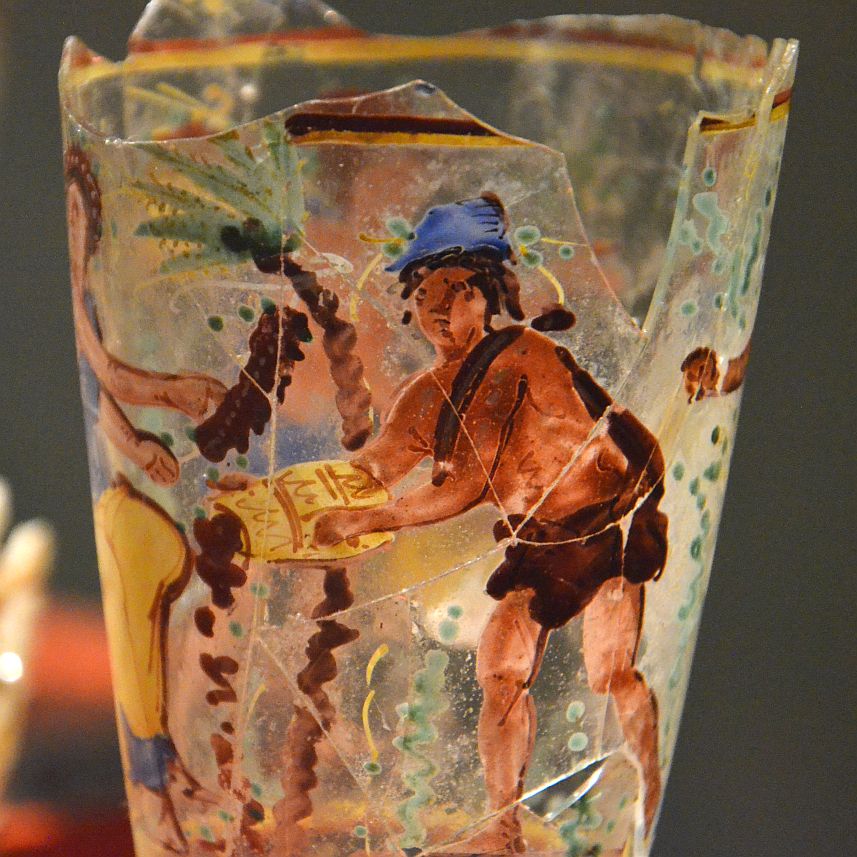
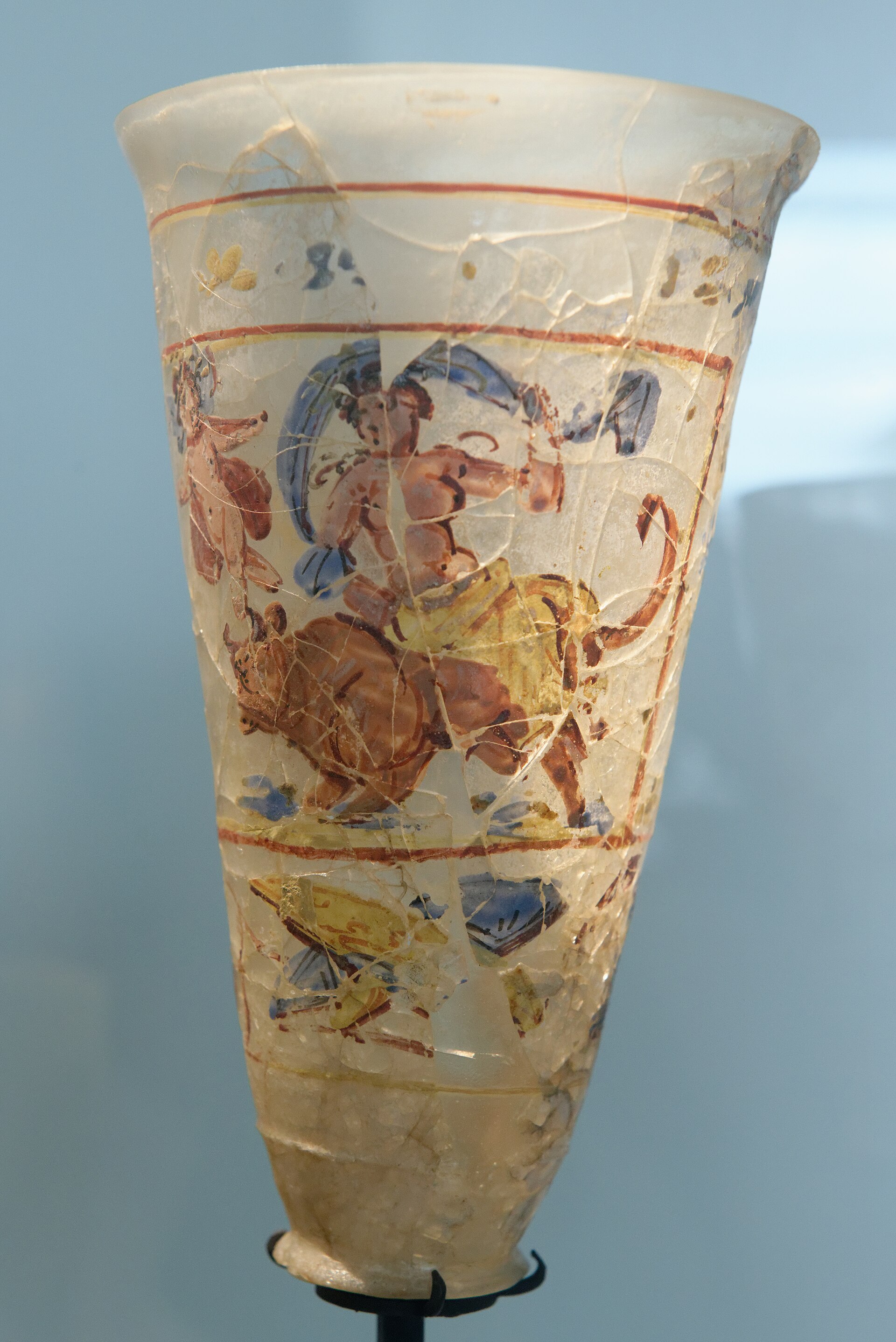
The glass historian David Whitehouse, reviewing Michael Menninger's 1996 monograph on the Begram glass, put the surviving corpus at roughly 180 vessels, many represented only by fragments, sorted by Menninger into thirteen typological groups. Painted, or enamelled, goblets of the kind catalogued here form one recognisable class within that corpus: figural scenes documented on other examples from the same hoard include the abduction of Europa, Zeus and Ganymede, gladiators in combat, a hoplite, and figures harvesting dates, alongside cut and relief glass in other groups entirely.
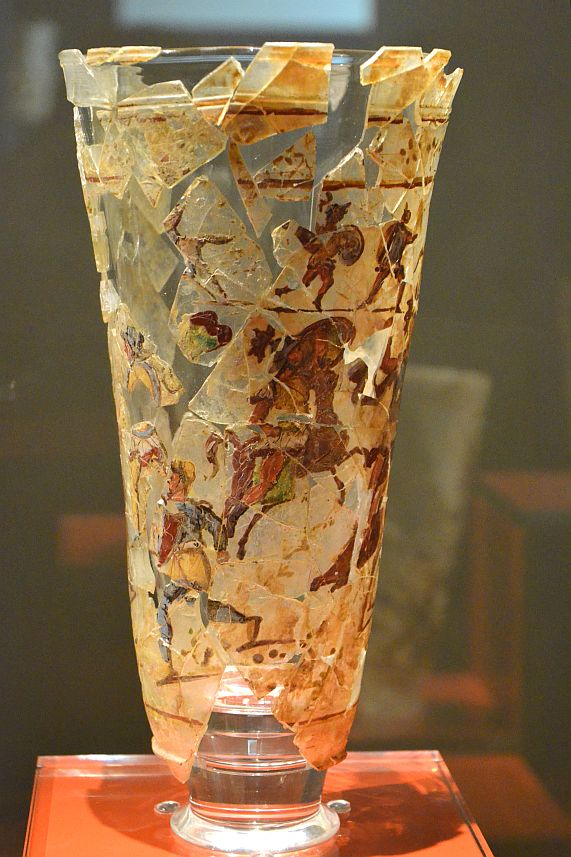
What this specific goblet depicts is not identified in the sources consulted for this record. Where other Begram goblets are individually named for their subject in museum and photographic documentation, the surviving record for this piece, tied to a single 2011 photograph taken during its loan to the British Museum, describes it only as a large painted goblet from Room 13. That is recorded here as a gap, not filled with a guess.
Chapter 6How Roman glass reached a Kushan trading post
Whichever interpretation of the sealed rooms is correct, the presence of Alexandrian glass, Chinese lacquer, Indian ivory and Roman bronze in the same building is itself evidence of Begram's position...
Whichever interpretation of the sealed rooms is correct, the presence of Alexandrian glass, Chinese lacquer, Indian ivory and Roman bronze in the same building is itself evidence of Begram's position on a long-distance exchange network linking the Mediterranean, South Asia and East Asia in the first centuries CE. Mehendale's reconstruction of the glass and bronze's route, sea carriage from Roman Egypt and the Levant to ports near the modern coasts of Pakistan and western India, then overland by caravan, is argued rather than documented at the level of an individual shipment, but it accounts for the physical evidence: Mediterranean luxury goods arriving intact and in quantity at a Central Asian city with no glass industry of its own.
A single painted goblet is a small, portable, high-value object exactly suited to that kind of trade: light enough to carry a long distance, valuable enough to be worth the journey, and durable enough, unlike many contemporary trade goods, to survive nearly two thousand years intact.
Chapter 9Rediscovery, April 2004
In April 2004 a team of roughly thirty archaeologists and Afghan cultural officials assembled at the Central Bank to open the vault.
In April 2004 a team of roughly thirty archaeologists and Afghan cultural officials assembled at the Central Bank to open the vault. Six safes had been sealed since 1989, and the keys were missing; a locksmith cut one open with a circular saw in about fifteen minutes. The American archaeologist Fredrik Hiebert, present that day, later recalled the tension of the moment: I could just imagine opening the safe to find a big, hot lump of melted gold. Roughly 2,000 objects were inventoried, and none had been damaged in the years underground.
Chapter 10Back on display: the international tour
Objects from the rediscovered Afghan national collection, including material from Begram, subsequently toured internationally under the title Afghanistan: Hidden Treasures from the National Museum...
Objects from the rediscovered Afghan national collection, including material from Begram, subsequently toured internationally under the title Afghanistan: Hidden Treasures from the National Museum, Kabul. In the United States the exhibition opened at the National Gallery of Art, Washington DC, in May 2008 and closed there in September 2008, and was shown at the Metropolitan Museum of Art, New York, from June to September 2009, with further American venues at the Asian Art Museum, San Francisco, and the Museum of Fine Arts, Houston.
Renamed Afghanistan: Crossroads of the Ancient World for its British showing, the exhibition appeared at the British Museum, London, from March to July 2011. This goblet is specifically documented at that venue: it was photographed there by a museum visitor on 2 June 2011, the image now held on Wikimedia Commons and used as the lead plate for this record. The sources consulted do not establish a precise date for the object's return to Kabul after the exhibition closed, nor a full list of any further cities the loan group visited into 2012 or 2013; that gap is recorded in the open questions below rather than filled with an assumed itinerary. This loan tour is a separate matter from the unrelated 2012 restitution to Kabul of a group of looted Begram ivories that had been illicitly trafficked out of Afghanistan and recovered by UK authorities; nothing in the sources consulted links this glass goblet to that theft-and-restitution case.
Chapter 11The museum today
When the Taliban retook Kabul in August 2021, the National Museum of Afghanistan's director, Mohammad Fahim Rahimi, moved quickly to secure the building, enlisting Taliban fighters as guards; the...
When the Taliban retook Kabul in August 2021, the National Museum of Afghanistan's director, Mohammad Fahim Rahimi, moved quickly to secure the building, enlisting Taliban fighters as guards; the museum reopened to visitors on 25 November 2021. Rahimi and his staff, including women, kept their positions but went unpaid in the months after the takeover, and the museum reported frequent power outages.
International cultural bodies responded publicly to the change in circumstances rather than offering a verdict on any individual's conduct. UNESCO's Director-General, Audrey Azoulay, said the organisation was committed to exercising all possible efforts to safeguard Afghanistan's cultural heritage. The International Council of Museums' president, Alberto Garlandini, warned of a very real risk to the personal safety of Afghan heritage experts and of the danger of robberies and looting at heritage sites where security had broken down. Greece's culture minister, Lina Mendoni, said publicly that no one could, at that point, guarantee the safety of collections in Kabul, and the archaeologist Ute Franke reported hearing of attacks on heritage sites at Bamiyan. The United Nations Special Rapporteur on cultural rights, Karima Bennoune, called protecting Afghan lives and cultural heritage the top priority and urged safe passage for cultural workers. None of the sources consulted for this record reports damage to the Begram material specifically since the museum's 2021 reopening.
The artist
Unknown Alexandrian glass workshop
No maker is named for this goblet, and none could be: painted glass of this class from Roman Egypt is never signed, and the Begram find, sealed away in antiquity and excavated only in 1939, carries no documentation of who made any individual piece. What can be reconstructed is the workshop tradition it belongs to, the technique that tradition used, and the trade network that carried its products roughly six thousand kilometres from Alexandria to a locked room in Kushan-era Afghanistan.
Related works
| Work | Relation | Where it is |
|---|---|---|
| Goblet depicting figures harvesting dates Unknown Alexandrian workshop | A different painted goblet from the same hoard, recorded findspot Room 10 Illustrates the harvest and genre-scene register of the Begram painted-glass group; not the object described in this record. | National Museum of Afghanistan, Kabul |
| Goblet depicting battle scenes Unknown Alexandrian workshop | A different painted goblet from the same hoard, recorded findspot Room 10 Illustrates the combat-scene register of the group; not the object described in this record. | National Museum of Afghanistan, Kabul |
| Goblet depicting the Abduction of Europa Unknown Alexandrian workshop | Companion piece from the same 1937-1939 excavation Held under the French share of the 1922 partage agreement; illustrates the mythological register of the corpus and the split of the hoard between Paris and Kabul. | Musee Guimet, Paris |
| Bowl fragments with combat scenes Unknown Roman-period workshop | Glass from the same hoard, different technique (cut or relief rather than painted) Shows the range of glassworking techniques represented in the Begram find beyond painted goblets. | Musee Guimet, Paris |
| Begram ivories and bone furniture fittings Attributed to itinerant Indian workshops (disputed) | Non-glass material from the same two sealed rooms The other major class of material in the same find; illustrates the range of imported luxury goods packed alongside the glass, and is the subject of Sanjyot Mehendale's warehouse reassessment of the hoard. | National Museum of Afghanistan, Kabul, and Musee Guimet, Paris |
Open questions
- What figural scene, if any, is painted on this specific goblet? The documentation available for this record identifies it only as a large painted goblet from Room 13, unlike several other Begram goblets whose subjects are individually named.
- Was this goblet part of the material moved to the Central Bank vault in 1989 and rediscovered in April 2004, or did it survive by a different, undocumented route through the museum's 1979-2001 disruption? The sources consulted document Begram glass goblets among the vaulted recoveries as a class, not this piece individually.
- What is the goblet's Kabul museum inventory or accession number, and what was its original DAFA field or excavation number from the 1939 opening of Room 13? Neither is given in the sources consulted.
- Exactly when did this goblet return to Kabul after the 2011 British Museum exhibition, and did it travel to any further cities on the tour before or after that leg? Not established in the sources consulted.
- Could Lauren Morris's proposed later deposition date for the Begram hoard, potentially as late as the end of the 3rd or start of the 4th century CE, affect the dating of this vessel's context, as distinct from its likely 1st-century manufacture? The two dates, manufacture and deposition, are not the same question, and the sources consulted do not resolve how the later deposition argument bears on individual objects.
- Which of the two reported closing dates for the British Museum's 2011 exhibition, 3 July or 17 July, is correct? Sources consulted disagree and this record does not resolve the discrepancy.
Questions about this object
What is Painted Glass Goblet from the Begram Hoard?
Painted Glass Goblet from the Begram Hoard is a glass, dated 1st century CE. Medium: Colourless blown glass, decorated in opaque polychrome pigment fired onto the surface (painted, or enamelled, glass).
Who made Painted Glass Goblet from the Begram Hoard, and is the attribution settled?
The attribution to Unknown Alexandrian glass workshop is recorded here as accepted. Attributed on stylistic and technical grounds to a workshop in Roman Egypt, most likely Alexandria, following the standard classification of the Begram painted-glass group by David Whitehouse and Michael Menninger. No maker is named or documented; the attribution is to a place and class of production, not to an individual hand, and no signature or workshop mark survives on glass of this type.
Where is Painted Glass Goblet from the Begram Hoard now?
National Museum of Afghanistan, Kabul. Inventory number Not published in the sources consulted for this record. Last confirmed 25 August 2026. Excavated in Room 13 of the Begram strongrooms by the Delegation Archeologique Francaise en Afghanistan (DAFA); retained in the Afghan national collection under the 1922 France-Afghanistan partage agreement; recorded on loan and photographed at the British Museum, London, in 2011 during the international tour, after which it is understood to have returned to Kabul with the rest of the loan group.
What is still unknown about Painted Glass Goblet from the Begram Hoard?
What figural scene, if any, is painted on this specific goblet? The documentation available for this record identifies it only as a large painted goblet from Room 13, unlike several other Begram goblets whose subjects are individually named.
Sources
- 1Wikimedia Commons, File:BegramGoblet.jpg, description page and file metadata (photographer Artacoana, CC BY-SA 3.0; image description records findspot Room 13, National Museum of Afghanistan, photographed at the British Museum, 2 June 2011). commons.wikimedia.org/wiki/...
- 2Musee Guimet, official collections page, 'Two female figures under a portico (Begram treasure)' (1922 partage agreement, 1937 and 1939 excavation dates, Joseph and Ria Hackin). guimet.fr/en/...
- 3Smithsonian Magazine, 'Lost & Found' (hiding of the treasure in the Central Bank vault under Omara Khan Masoudi, the April 2004 rediscovery, Fredrik Hiebert's account, Begram glass goblets among the recovered objects). smithsonianmag.com/arts-culture/...
- 4The Art Newspaper, 'National Museum of Afghanistan reopens - but staff are unpaid and Taliban are guarding the treasures' (10 December 2021). theartnewspaper.com/2021/...
- 5Wikipedia, 'National Museum of Afghanistan' (civil war losses, 1989 vaulting of the Bactrian hoard and other artifacts, 2021 reopening). en.wikipedia.org/wiki/...
- 6Museums Association, 'Urgent calls to protect Afghan cultural workers and safeguard heritage' (August 2021), with statements from UNESCO Director-General Audrey Azoulay, ICOM President Alberto Garlandini, Greek Culture Minister Lina Mendoni, archaeologist Ute Franke and UN Special Rapporteur Karima Bennoune. museumsassociation.org/museums-journal/...
- 7David Whitehouse, 'Begram: The Glass', Topoi Orient-Occident, vol. 11, no. 1 (2001), reviewing Michael Menninger's 1996 catalogue of the Begram glass corpus (approximately 180 vessels in 13 typological groups). persee.fr/doc/...
- 8Impart (Archaeology and Prehistory), 'Begram Ivories' (the Hackins' royal-treasury interpretation and Sanjyot Mehendale's merchant-warehouse and trade-route reassessment). imp-art.org/articles/...
- 9University of Oxford Podcasts, 'Treasure and archaeology: reflections on the Begram hoard and the interpretation of deposits of valuable objects' (Oxford Treasure Seminar Series), Lauren Morris. podcasts.ox.ac.uk/treasure-and-archaeology-reflections-be...
- 10Athenaeus, Deipnosophistae, Book 11, section 28, C.D. Yonge translation, via Attalus.org (ancient testimony on the Alexandrian glass industry). attalus.org/old/...
- 11Wikipedia, 'Treasure of Begram' (general overview of the hoard; approximately 180 glass fragments/vessels noted). en.wikipedia.org/wiki/...
- 12Wikimedia Commons, Category:Enamelled glass in the Begram Hoard, category listing and individual file metadata (comparanda images, findspots and licences for related Begram goblets and fragments). commons.wikimedia.org/wiki/...

Last verified · Published
Change log
25 August 2026 - Record created at the house standard: researched narrative, technical evidence, maker dossier, graded provenance chain, prices with hammer and premium separated, related works, open questions and sources.