Marianne North
 English · 1830-1890
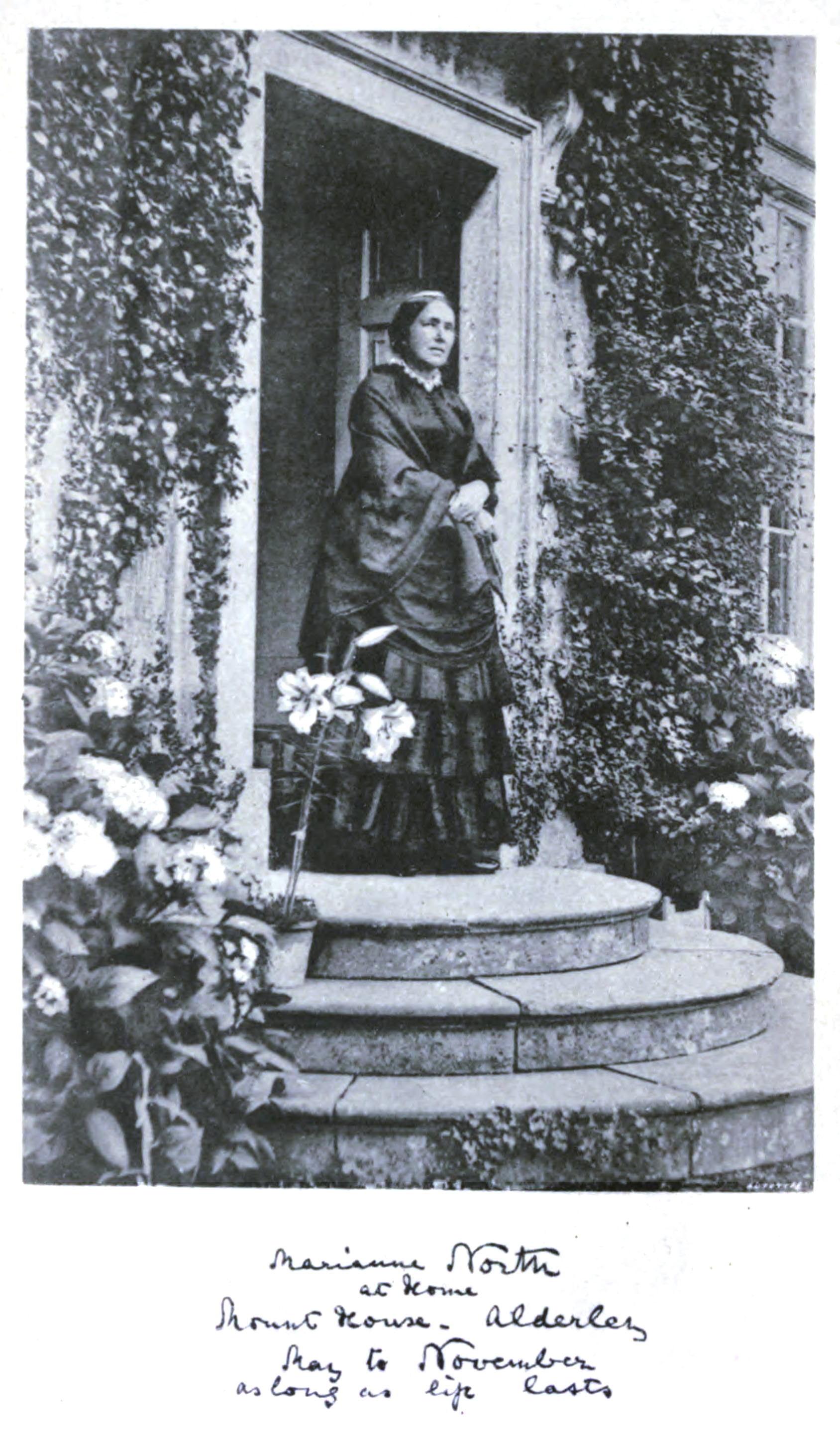
Photograph of North on the doorstep of Mount House, Alderley, taken by a neighbour, Mrs Hodgson, soon after she moved there in 1886 per her sister's preface; reproduced as the frontispiece of volume 2 of Recollections of a Happy Life, with her handwritten inscription 'Marianne North at home, Mount House, Alderley, May to November as long as life lasts'. The identification rests on that inscription and the preface; Commons describes it as taken c. 1869 (date field 1894), which conflicts with the preface.
Photograph by Mrs Hodgson, 1886 or soon after (public domain, Commons)| Worked as | Botanical and landscape painter, Traveller, Benefactor of the Royal Botanic Gardens, Kew |
|---|---|
| Born | 24 October 1830 · Hastings, England |
| Died | 30 August 1890 · Alderley, Gloucestershire, England |
| Nationality | English |
| Movement | Victorian travel painting |
| Sources | 20 cited |
| Last verified |
About this page Last verified · 20 sources cited
On this page 13 sections
ContentsClose
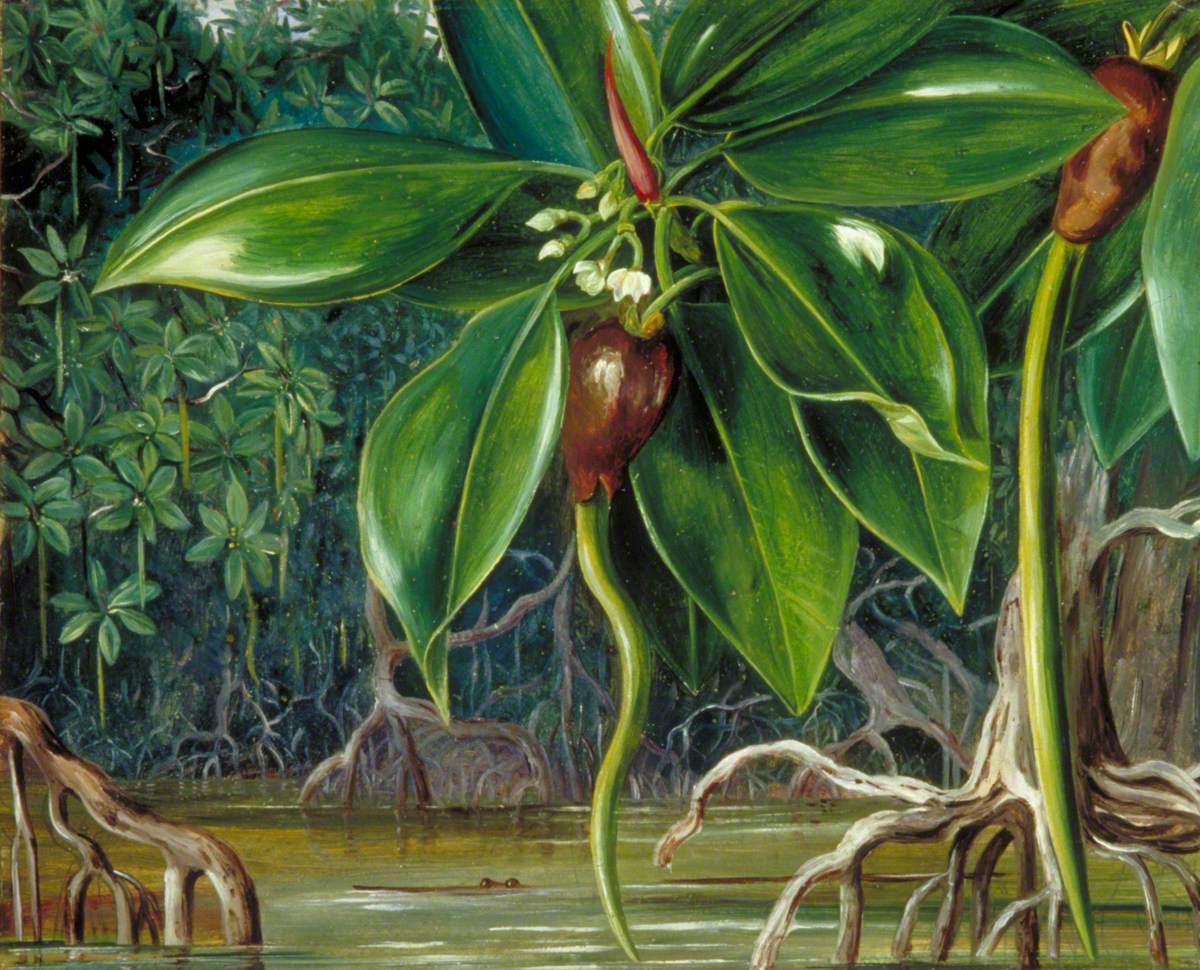
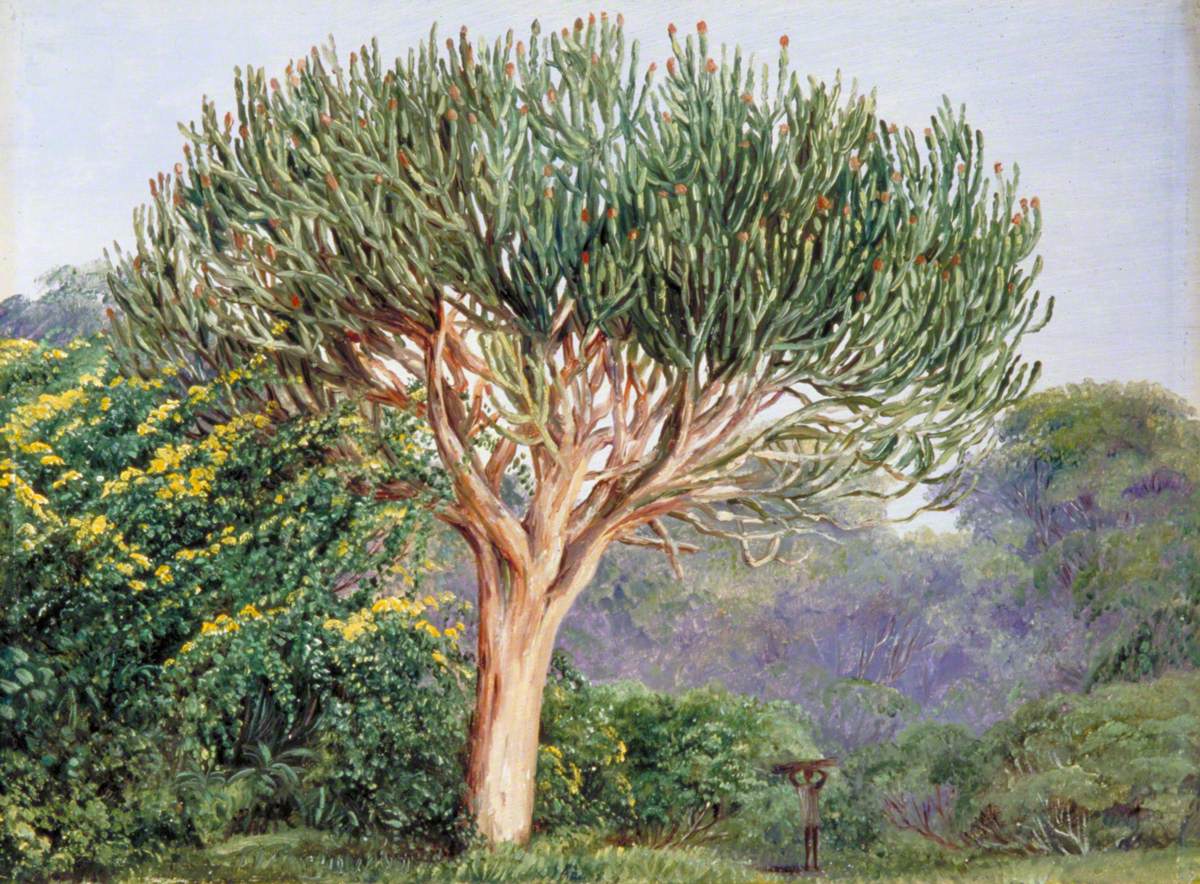
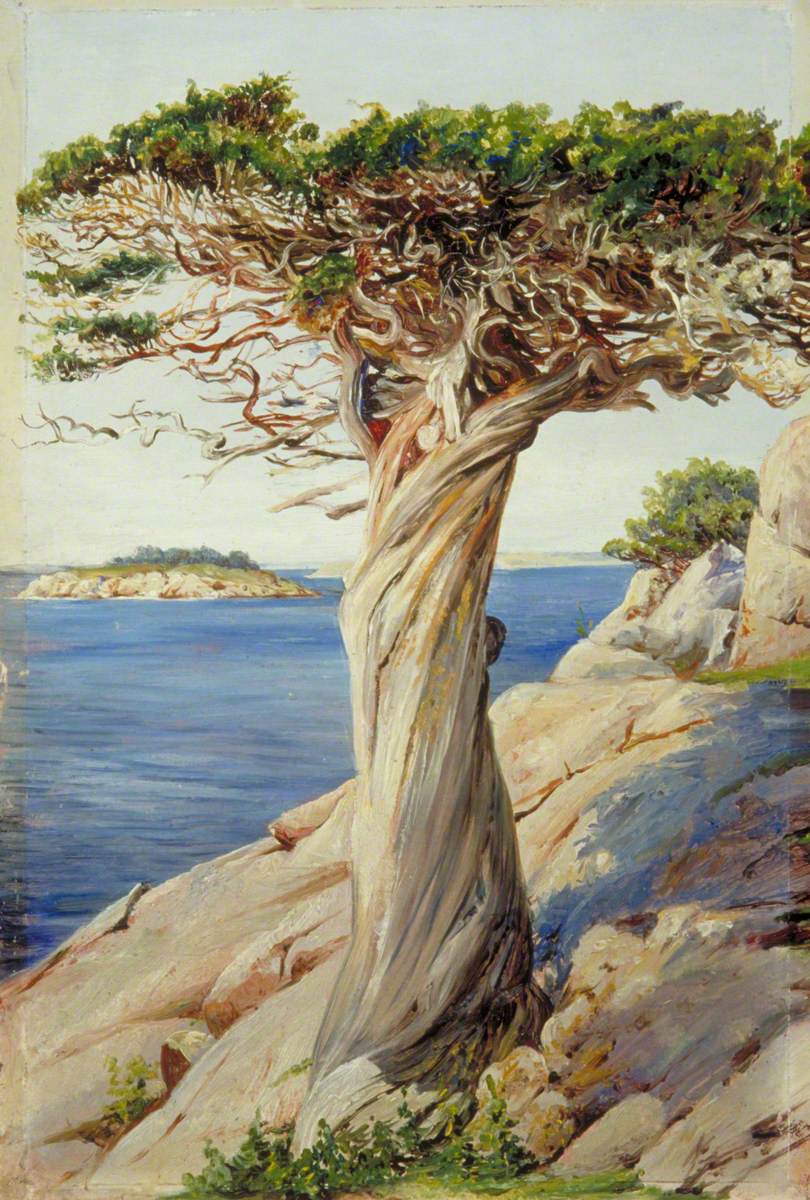
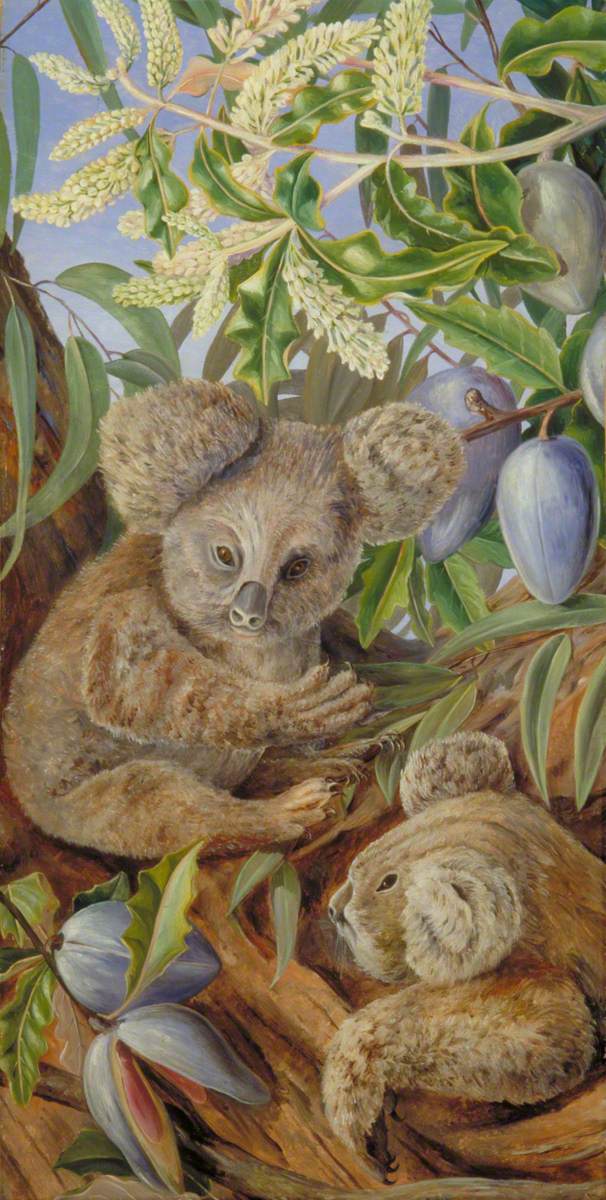
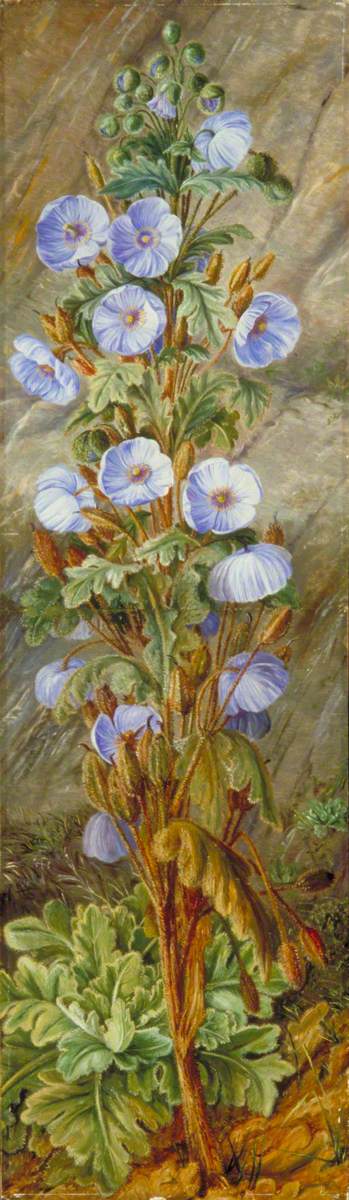
Marianne North painted for fourteen years, from 1871 to 1885, in oil on paper, on the spot, in some sixteen countries, and gave the result to the Royal Botanic Gardens at Kew together with a building she commissioned and paid for. The gallery was opened in 1882 and is still hung the way she hung it: frame touching frame from a dado of timber samples up to the clerestory, arranged by country, not by plant family [1][5][9]. She sold none of these pictures, and the market in her work is a handful of stray lots; that is the first thing a collector or a student needs to know.
The second is that there is no agreed number. Kew's own pages say 832 paintings representing over 900 species [4][5]. Historic England's list entry says 848 [9]. A 2009 account of the reopening gives 833 [12]. The main gallery first held about 620 pictures and was then extended eastwards [9]. The numbers in Commons titles that carry Kew's own references run past 832 to at least MN863, and a separate MNS series, held by Kew's Library, Art and Archives, sits alongside them [20]. This page gives each figure with its owner and does not choose between them.
Her own account, Recollections of a Happy Life, was edited and cut by her sister Mrs John Addington Symonds and published after her death in 1892 [1][2][3]. It is a first-hand source for who paid, who housed her and what she saw, and it records, in her own words, her view of slavery in Brazil, which this page reports without softening. Her sister wrote that she was no botanist in the technical sense [1]. Her diaries were nonetheless read in proof for botanical errors by a member of Kew's herbarium staff and some of the plants she painted were new to science [1][3][4].
Images
Chronology
- 1830
Born at Hastings on 24 October, eldest daughter of Frederick North, elected MP for Hastings the same year.13
- 1855
Her mother dies on 17 January; her father makes her his constant companion on tours.13
- 1869
Her father dies on 29 October after an election petition had broken his health.13
- 1871
Joins a friend at Liverpool on 12 July and sails next day for North America; visits the painter Church at his home on the Hudson and sees his tropical studies; first of the world journeys.14
- 1872
Leaves for Brazil later in the year; returns in September 1873 after months in the interior, including the Morro Velho mines.13
- 1875
Tenerife from New Year's Day; from August a journey round the world through California, Japan, Borneo, Java and Ceylon.13
- 1876
Stays in Singapore with the Governor, then at the Rajah of Sarawak's palace at Kuching.1
- 1877
Reaches England in March per the DNB. Her own text has her leaving Southampton for India on 10 September 1877 and landing home on 21 March 1879; the DNB gives the sailing as September 1878.123
- 1879
July and August: Conduit Street exhibition; offers her pictures and a gallery to Kew via Hooker.234
- 1880
Sails in April for Borneo, Australia and New Zealand after Darwin's advice.23
- 1881
Home from Australia; Darwin writes to her on 2 August after seeing her Australian pictures.210
- 1882
Gallery opened to the public; her text says 7 June, the DNB 9 July. Hooker writes on 13 April about a misunderstanding over the building and criticises the Treasury's handling (catalogue summary only).2317
- 1883
Back from South Africa in June; a room is added to the gallery; Seychelles that winter.35
- 1884
Chile, 1884-85; Queen's Private Secretary writes that no public honour can be recommended.23
- 1886
- 1890
Dies on 30 August and is buried at Alderley.3
- 1892
Recollections of a Happy Life published in two volumes, edited by her sister; Further Recollections follows in 1893.3
- 1893
Conrad Dressler is commissioned to make the marble bust, presented to the gallery in 1894 by her sister.9
- 1950
Gallery first listed on 10 January; Grade II*.9
- 1953
Sixteen damaged paintings removed from the clerestory area of the gallery.6
- 2008
Heritage Lottery Fund funding and donations launch the restoration of the building and paintings.812
- 2009
Gallery reopens in October with facsimile prints while the originals are conserved.12
- 2011
Conservation Management Plan produced; Historic England listing text amended in 2012.9
- 2023
Payne's Marianne North's Travel Writing published by Kew.16
- 2024
Howarth-Gladston's Marianne North: A Victorian Painter for the 21st Century published with Kew.15
- 2025
Kew shows Woodlands and Forests in the gallery, listed as open 24 April 2025 to 25 April 2026.8
The market
The market for her hand is thin and low. LotSearch lists 16 lots by her name with eight prices and a top price of GBP 4,600 for an album at Dreweatts in 2008; the one oil sheet I can tie to a result made GBP 240 at Christie's in 2006 against an estimate of GBP 300-500 [13][14]. Neither source separates hammer from premium. The reasons are structural: the corpus is donated and held by Kew under a condition that it stay together [7], the strays are a few lots, and most things bearing her name are books or 20th-century reproductions such as Coalport plaques [13]. Attributed and in-the-manner lots appear as well and should be treated as not hers [13].
| Date | Sale | Work | Result | Note |
|---|---|---|---|---|
| 19 July 2006 | Christie's | Wormia, excelsior and henna, oil on paper laid on board, 25.4 x 34.9 cm (lot 1946) | Hammer Not separated at source With premium Not separated at source; single price realised GBP 240 GBP | Estimate GBP 300-500. Tertiary database record; Christie's own page not opened. |
| 24 April 2008 | Dreweatts and Bloomsbury Auctions | North (Marianne), an album comprising two botanical studies in oil and gouache on paper, each c. 345 x 250 mm, plus views (lot 352) | Hammer Not separated at source With premium Not separated at source; single price realised GBP 4,600 GBP | Estimate GBP 3,000-5,000. Lot description truncated in the database. |
| 19 February 2014 | Wotton Auction Rooms | Set of eight limited-edition Coalport ceramic plaques with printed decoration reproducing her paintings (lot 765) | Hammer Not separated at source With premium Not separated at source; single price realised GBP 130 GBP | A reproduction, not her work; estimate GBP 30-40. |
Hammer is the price at which the bidding stopped; with premium adds the fee the house charges the buyer on top. Hammer price and buyer's premium in the glossary.
Where to see the work
| Institution | City | Holdings | Note |
|---|---|---|---|
| Marianne North Gallery, Royal Botanic Gardens, Kew | Richmond, London | The paintings she gave (832 per Kew, 848 per Historic England), the painted door panels and 16 gold-leaf still lifes, the dado of woods and the Dressler bust. | Entry is included with Kew Gardens admission; nearest gate Victoria Gate. Kew's page still lists a Woodlands and Forests exhibition to 25 April 2026. |
| Royal Botanic Gardens, Kew, Library, Art and Archives | Richmond, London | Papers RM 2, drawings, letters to the Shaen family, to Dr Burnell and to her maid Annie; the MNS sketch series. | Reference RM 2. |
| Somerville College, Oxford | Oxford | 41 letters (1871-84) to Amelia Edwards with a travel diary. | NRA 9474 Edwards. |
| McGill University Archives | Montreal | Correspondence and papers. | Listed in the Union list of MSS in Canadian repositories, 1975. |
Forgeries and misattributions
- No forgery of her work is recorded in any source opened.
- The hazards are attribution and reproduction. In 2015 Toovey's offered 'Fern Walk, Jamaica', oil sketch on board, as attributed to her; in 2018 Heliers offered a pair of Victorian botanical oils on canvas in the manner of her [13]. Neither result is shown. Compare any stray with the Kew pictures: Kew's are oil on paper with a pen-and-ink underdrawing, and a canvas is a different support [6][9]. Inscriptions on the back and Kew numbering are the next check; no source gives a pigment study for authentication.6913
- Reproductions sold as hers
- 20th-century limited-edition Coalport plaques printed from her Kew originals [13][14]. Printed decoration, edition certificates and ceramic supports.1314
- A person mistaken for another, and doubt that one woman painted it all
- She was often taken for Miss Gordon Cumming, another large woman sketcher. A stranger at the gallery asked whether it was true all the paintings were by one woman and, told yes, said she would have been burnt as a witch two hundred years earlier [2]. Not a forgery; recorded because it concerned the question of authorship in her lifetime.2
The essay
Chapter 1832, 833 or 848: the count belongs to Kew, and Kew's sources do not agree
Kew's page on North states there are 832 paintings, all completed in 13 years of travel, and its page on the gallery says the 1883 extension brought the total to 832 representing over 900 species of...
Kew's page on North states there are 832 paintings, all completed in 13 years of travel, and its page on the gallery says the 1883 extension brought the total to 832 representing over 900 species of plants [4][5]. The old Kew restoration page repeats 832 and calls the online catalogue a gallery of over 800 [7]. Kew's current visitor page says only more than 800 [8].
Historic England's Grade II* entry, first listed 10 January 1950 and amended 18 October 2012, says the building houses 848 flower paintings executed between 1872 and 1885, and that the main gallery first accommodated some 620 paintings before it was extended eastwards to a capacity of 848 [9]. Its bibliography lists a Kew Conservation Management Plan of June 2011, which I did not see, and that plan may be the source of the higher figure, though the entry does not say so [9]. A blog post on the 2009 reopening, quoting Kew material, gives 833 paintings [12]. The Historic England date range, 1872 to 1885, also differs from Kew's 1871 start, the year of her first journey [4][9].
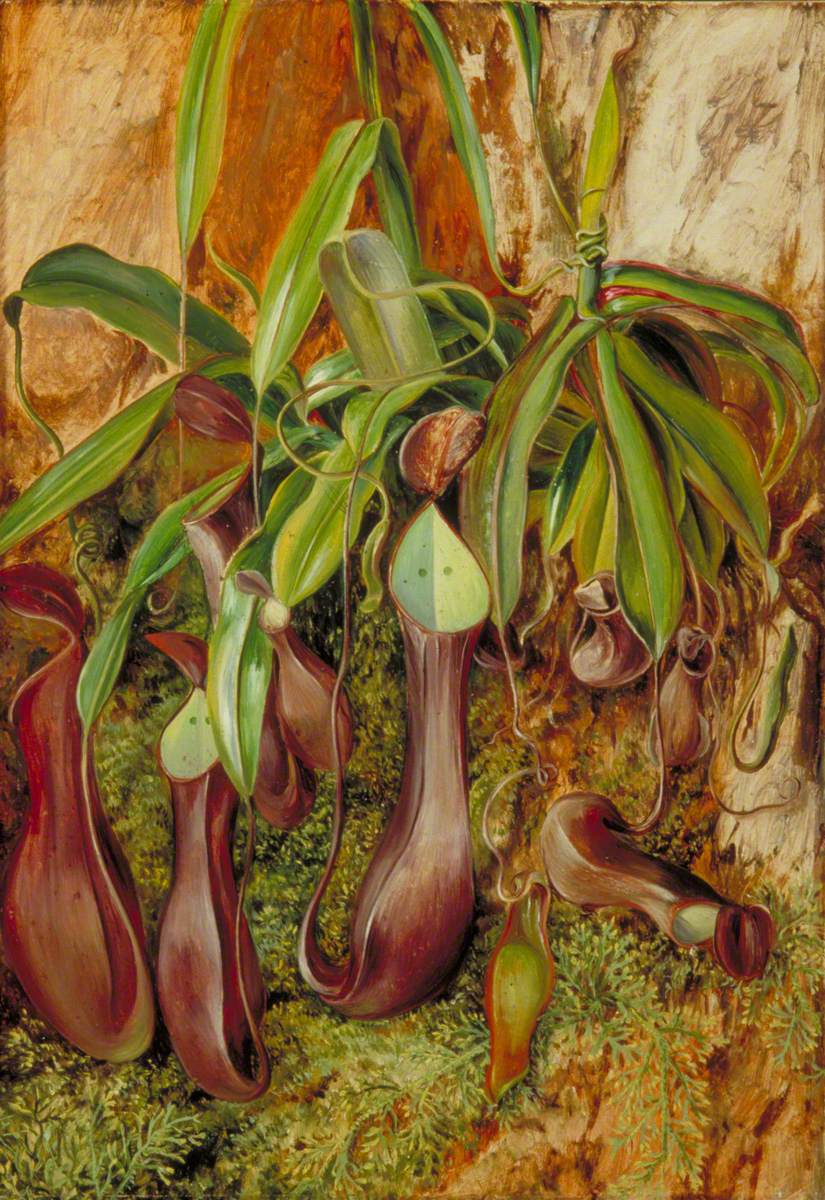
The Kew numbers add a further puzzle. Wikimedia Commons titles carry MN numbers that appear to be Kew's gallery numbers, for example MN555 for the Bornean pitcher plant, and they run past 832: MN852 appears, for a climbing plant with purple flowers on a black background, and the listing I opened runs to MN863 [20]. A second series, MNS47, MNS48, MNS112 and MNS113, is credited to Kew's Library, Art and Archives and includes a Tasmanian banksia and a view of the cedar path in her Alderley garden [20]. I found no Kew text that explains the two series or says whether the highest MN number equals the count. Treat any single figure as the figure of whichever Kew document you are reading, and quote the document.
Chapter 2A Hastings MP's daughter, and the one fixed point of her life
The Dictionary of National Biography gives her birth at Hastings on 24 October 1830 as the eldest daughter of Frederick North of Rougham, Norfolk, member for Hastings, and of Janet Marjoribanks...
The Dictionary of National Biography gives her birth at Hastings on 24 October 1830 as the eldest daughter of Frederick North of Rougham, Norfolk, member for Hastings, and of Janet Marjoribanks, widow of Robert Shuttleworth of Gawthorpe Hall, Lancashire [3]. In her own telling the line began with Roger North, the lawyer and biographer, and one descendant ordered the old Rougham hall blown up with gunpowder [1]. Her father, born in 1800, was elected for Hastings in 1830 by ten freemen, one of them himself, and voted for the Reform Bill [1]. She called him the one idol and friend of her life [1][3].
She had no regular schooling to speak of. The DNB says she was for a time at a school in Norwich and was not over-educated, that she was trained in singing by Madame Sainton-Dolby until the failure of a fine voice turned her wholly to painting, and that she took lessons in flower-painting from a Miss van Fowinkel and from Valentine Bartholomew [3]. Her own text names Bartholomew and says the one master she longed for, William Hunt, would not teach [1]. She records that her mother died on 17 January 1855 [1]. The DNB says her father then took her on continental tours and, after 1865, to Syria and Egypt [3]. Historic England says she learned watercolour first and later oils [9]. No source I opened says when she began in oils or from whom; that is a recorded gap.
He died on 29 October 1869. A petition against his 1868 election was dismissed in April 1869, and she says the implication of corrupt practices broke his heart; his death left her, in her words, alone [1]. Kew reads the death as the turning point, because until then all life had centred on him [4]. The trips round the world began two years later.
Chapter 31871: Church's studio, Kingsley's letters, and a plan to paint the tropics on the spot
She joined a friend at Liverpool on 12 July 1871 and sailed for the United States the next day, framing the voyage as a first step to somewhere hotter, since average people at home confused North and...
She joined a friend at Liverpool on 12 July 1871 and sailed for the United States the next day, framing the voyage as a first step to somewhere hotter, since average people at home confused North and South America [1]. She says she asked Charles Kingsley and others for letters to Brazil and the West Indies, his book At Last having added fuel to her rage for the tropics [1]. Her stated aim reads in the 1894 printing of the book: I had long had the dream of going to some tropical country to paint its peculiar vegetation on the spot in natural abundant luxuriance; Kew prints the sentence with slightly different wording [1][4].
Near Hudson, New York, she stayed with the painter Church, in the old cottage-farm below the house he was building to a Damascus pattern, and saw in his studio a picture in progress of Chimborazo and other tropical studies, which, she says, made her more anxious than ever to go to those countries [1]. The text calls him Mr. Church; Lynne Howarth-Gladston names him as Frederic Edwin Church and argues that North emulated the Hudson River School, the Pre-Raphaelites and Edward Lear in composition [1][15]. That influence is argued by a named modern author and is not documented by anything North wrote; the visit itself is documented [1].
Her path then ran through Canada, the United States and Jamaica between July 1871 and June 1872, Brazil from later in 1872 to September 1873 and Tenerife in 1875. From August 1875 came a journey round the world through California, Japan, Borneo, Java and Ceylon that ended in England in March 1877 [3]. Kew's page gives the full list of 16 countries between 1871 and 1885 [4].
Chapter 4Oil on paper from the tube: what the back of the sheet shows
Historic England stresses that the pictures are unusual for work done in the field in being executed in oil on paper, hung in gilded mounts and black wood frames, and that the close-hanging was the...
Historic England stresses that the pictures are unusual for work done in the field in being executed in oil on paper, hung in gilded mounts and black wood frames, and that the close-hanging was the device and labour of the artist herself [9]. Kew's conservation surveyor Eleanor Hasler adds the working method: a rough sketch in pen and ink on the prepared paper, then colours squeezed straight from the tubes, by an artist she describes as apparently intolerant of rules [6]. The paper was of medium thickness [6]. Conservation staff found on the back of one painting detailed notes about a sloth, including how long North watched it and what it ate, and she stuck extra paper to some sheets and extended the painting over it to fill the space she wanted in her hanging scheme [6].
During the 2008 to 2010 project a conservator found a painting that had been hidden behind another for over 120 years [8][12]. The paper conservator Rachael Smith found it on her first day on the project and needed 16 hours to uncover half of the image, a slow pace because the painting was never varnished and its paint layers are fragile [12]. Beneath the view of Chilean palms in the valley of Salto the team found an unknown sketch of the landscape annotated with colour words such as bluish and light grey, which suggests, the same account says, that she planned to paint the image away from the actual scene [12]. The picture of Chilean palms is catalogued as MN8 [20]. That reading is the project's inference, reported second-hand, and it deserves checking against Kew's conservation record.
The paint now suffers from the supports. The sheets were fixed to card to stop them sagging, and that card was acidic [6]. Kew's restorer page says this happened ten years after the gallery opened, which would be about 1892, two years after her death [6]. Kew's current visitor page and the 2009 account speak instead of North covering the hidden painting with a backing board and sticking a board to every oil painting [8][12]. Kew's own pages therefore disagree on whether she or someone after her applied the boards, and I could not settle it. Fluctuating humidity distorted the paper and loosened flakes, which conservators re-laid under the microscope [12].
Chapter 5Who housed her and who carried the easel: the imperial travel network
She was not a lone naturalist. Kew's biography says she was well connected through her father's political circle, stayed with the Rajah and Rani of Sarawak and was invited to dine with the President...
She was not a lone naturalist. Kew's biography says she was well connected through her father's political circle, stayed with the Rajah and Rani of Sarawak and was invited to dine with the President of the United States and with Longfellow [4]. Historic England says the building she later commissioned might externally resemble a colonial governor's house [9]. Her own text confirms the pattern. After a fortnight at Government House in Singapore she was given letters by Sir William Jervois to the Rajah and Rani of Sarawak and travelled by the weekly steamer to Kuching, where she was lodged in the palace [1]. In Chile she wrote that the government had given her a free pass on all railways, as in Australia and Africa, and had assigned three dragoons as an escort she considered unnecessary [2].
Local labour made her work possible and she says so: at Sarawak she wrote that everyone collected for her as usual and that orchids and pitcher plants were pulled for her most ruthlessly [1]. Her sister's preface says she could never bear to see flowers uselessly gathered [1]. The two statements sit side by side in the book and the book does not reconcile them. Michelle Payne's Kew and University of Chicago Press collection of her letters and writing explicitly considers what her paintings and writings may suggest about her attitudes to empire and colonialism; I have not read it beyond the publisher's description [16].
Historic England says only that the building might externally resemble a colonial governor's house. Howarth-Gladston describes the iron verandah of the gallery as part of British colonial architecture and calls the autobiography a record of the colonialism present throughout North's lifetime [15]. Those are an author's characterisations, not findings of fact about her intent.
Chapter 6Slavery in her own words, Brazil 1872-73
In Rio she wrote that almost all the menial work was done by slaves, hired out by their owners, and put the rate for a good working man at not less than 30 pounds a year and a house girl at 15 pounds...
In Rio she wrote that almost all the menial work was done by slaves, hired out by their owners, and put the rate for a good working man at not less than 30 pounds a year and a house girl at 15 pounds and two suits of clothes [1]. She wrote that it was a mistake to suppose slaves were not well treated, as she had seen them petted as people pet animals [1]. She called the idea of a man and a brother absurd and said she would like the good housewives at home who believed in this dogma to try the dear creatures as their only servants [1].
In the highlands she went to the mines of the St John d'el Rey Mining Company at Morro Velho, which she says was an English colony that possessed slaves, the company having existed before the slave laws and been made exceptional [1]. She was a guest of a household at the mine and was brought coffee each morning by a girl who, she says, had bought two-thirds of herself from her own father, from whom Mrs. G. hired her [1]. She says that after five o'clock the girl's time was her own and she embroidered to complete her emancipation fund [1]. In a town on the road she saw a dealer's room of boys over twelve being bought for the Rio market and wrote that they looked very happy and as if they enjoyed the process of being fatted up [1]. Of the enslaved people at the mine she wrote that she could not see much discontent and did not believe them capable of ambition or of much thought for the morrow [1].
These passages are in the volume her sister prepared. The preface says her earlier European and Near Eastern journeys were cut and the first chapters compressed, and that the later journeys remain as she left them apart from revised minor points [1]. I found no source that records the original manuscript on these pages or whether the sister softened or kept them.
Chapter 7Science: Hooker, Darwin, Galton and the plants named for her
Her father took her to Kew while Sir William Hooker was director; he once gave her a hanging bunch of the Amherstia nobilis, the first to bloom in England, which, she says, made her long more to see...
Her father took her to Kew while Sir William Hooker was director; he once gave her a hanging bunch of the Amherstia nobilis, the first to bloom in England, which, she says, made her long more to see the tropics [1]. The DNB says five species were named for her, four of which she first made known in Europe [3]. Kew's page says one genus and four species were named in her honour and that some of her plants proved new to science [4]. The two counts differ and I could not reconcile them. Her own book records one case: Veitch's nursery showed her Nepenthes northiana, for which a traveller had been sent to Borneo after seeing her painting at Kensington [2].
Charles Darwin is a documented thread. In her account, Darwin, whom she calls the greatest man living, asked to meet her through his daughter Mrs Litchfield, and said she should not attempt a representation of the vegetation of the world before she had seen and painted the Australian; she took it as a royal command and left in April 1880 for Singapore and Sarawak on the way [2]. The Darwin Correspondence Project dates a visit to Down House to 1881, to show the Darwins her Australian paintings, and holds his letter to her of 2 August 1881 thanking her for a shrub called Australian Sheep, Raoulia eximia, and saying he was pleased to have seen her Australian pictures [10]. The project hedges that Darwin is supposed to have recommended Australia; her own book is the first-hand source for the advice [2][10].
Her friends were a scientific circle: Francis Galton, whom the editor calls her oldest friend, had the Javanese names checked at the Royal Geographical Society; Botting Hemsley of the Kew herbarium revised the botanical content of the diaries and corrected her gallery catalogue [1][2]. Alfred Russel Wallace received her when she asked him about a plant-geography map [2]. The editor adds that she was no botanist in the technical sense but felt for plants the way people feel for human friends [1].
Chapter 81879 to 1882: Conduit Street, a newspaper hint and a letter written while waiting for a train
She came home on 21 March 1879 and found the perpetual task of showing her Indian sketches wearisome, so she hired a room in Conduit Street for July and August with General MacMurdo's help [2].
She came home on 21 March 1879 and found the perpetual task of showing her Indian sketches wearisome, so she hired a room in Conduit Street for July and August with General MacMurdo's help [2]. The shillings at the door paid two thirds of the expenses, she says [2]. Among the criticisms was one in the Pall Mall Gazette suggesting the botanical subjects should find their home at Kew [2]. Having missed a train at Shrewsbury, she wrote to Sir Joseph Hooker offering to give the pictures and build a gallery with a guardian's house; Hooker accepted the first part at once and declined her proposed refreshment room, noting the difficulty of keeping the British public in order on a bank holiday when 77,000 people might arrive [2]. Kew dates the offer to 1879; the DNB places it after the Conduit Street show and says James Fergusson prepared the designs [3][4].
Kew says she gave the collection on condition that the gallery and paintings remain together, and that this leaves the building and its listed hanging system with little room for change [7]. The Treasury was involved, and the one trace is a calendar summary of a letter Hooker wrote to his deputy William Thiselton-Dyer on 13 April 1882 about a misunderstanding over the vestibule, veranda and water supply of the building by Lessels and Fergusson, in which he also criticises the Treasury's handling [17]. I have read only the summary and not the letter.
She chose the site herself, away from the main gates, reasoning that those who cared enough for plants to walk through all the houses needed a rest place more than promenaders did; she also asked leave to build a studio for any artist to paint flowers in quiet [2]. The gift was recorded in an inscription on the front: this gallery containing studies from nature painted by her in many lands was given in 1882 to these gardens by Marianne North [9].
Chapter 9The building as part of the work: Fergusson's light, Owen Jones's colour and a ceiling that was never painted
The gallery is T-shaped, red brick with a verandah, and naturally lit by clerestory windows [9].
The gallery is T-shaped, red brick with a verandah, and naturally lit by clerestory windows [9]. Historic England says the lighting drew on James Fergusson's argument, in an 1883 essay on the Parthenon, that Greek temples were lit by openings in the roof, and that the colour scheme and decoration were influenced by Owen Jones's published work, though it is not known whether Fergusson or North chose the deep polychromatic interior [9]. Fergusson had made his fortune in the Indian indigo trade before turning to architectural history [9]. Kew says the verandah mirrored her feelings for India [5]. These are documented design sources; no source I opened says the layout stands for anything beyond a way to light and house the pictures.
The hang is hers. Pictures are grouped by country and labelled in gilded lettering on the frieze, running clockwise from Chile through Brazil, Jamaica, America, Ceylon and India, past a section titled Sacred Plants of the Hindus, to Singapore, Borneo, Japan, Java, New Zealand and Australia [9]. Below them is a dado of 246 vertical strips of timbers from around the world [5]. In her words she spent a year fitting and framing, patching and sorting; she found only half the wood samples arrived with names and half were lost [2]. She also painted 16 still lifes of plants on gold leaf for the spaces between the clerestory windows, and the painted door panels, according to Historic England [9]. Her catalogue cards under each painting were corrected and extended by Hemsley, who then put his name to the publication [2]. By 1885 electric lighting had been installed, an early use in a gallery [9].
She had wanted a ceiling map of the world coloured by plant geography, a fruit index on the cornice by herself and twelve typical trees between the windows. Every one was against it except Fergusson; Galton's contour lines were useless at that scale; Wallace sent her to Trelawney Saunders, whose hand-shaded map cost her 120 pounds and was not what she wanted, so she gave up the scheme and left the ceiling [2]. This is the nearest thing to a stated intellectual programme in the whole project: a map of where plants grow. Howarth-Gladston argues the interior resonates with the nineteenth-century idea of a complete artwork and says separately that North was concerned with the environmental issues of her day, which are arguments for modern readers; the documents show a woman who wanted to show plants in their homes and a gardener's lodge beside the pictures [2][15].
Chapter 10Opening day, the Queen's photograph and the sale of the catalogue
Her own text says the gallery was opened to the public on 7 June 1882 [2].
Her own text says the gallery was opened to the public on 7 June 1882 [2]. The DNB, whose text is the nearest thing to a contemporary reference, says 9 July 1882 and adds that two thousand copies of the catalogue were sold within a month [3]. Kew says only 1882 [4][5]. A source that gives June is her own, and I follow the primary account but record the dispute. The DNB also carries a plain slip: it says she returned from Australia by California in the summer of 1886 when the gallery was ready, whereas her own text says she first came home in 1881 [2][3].
Within months she was off again: South Africa, returning in June 1883, when a room was added to the gallery, then the Seychelles in the winter of 1883-84 and Chile in 1884-85 to paint araucarias [3]. Kew says the extension was built in 1883 and brought the total to 832 [5]. Howarth-Gladston dates the extension 1884-5 with a reopening in 1886, which conflicts with Kew, the DNB and Historic England on the date and I have not followed it [3][5][9][15]. During the Australian leg a boy had asked whether the Queen would knight her; a footnote in the book says four years later the Queen's Private Secretary wrote that the government had no power of recommending any public recognition of her generous gift, and the Queen sent her own photograph instead [2].
Chapter 11Alderley, the editors and the posthumous portrait problem
In the summer of 1886 she rented an old grey stone house at Alderley in Gloucestershire from General Hale, laid out a terraced garden and filled it with plants sent from Kew and from friends...
In the summer of 1886 she rented an old grey stone house at Alderley in Gloucestershire from General Hale, laid out a terraced garden and filled it with plants sent from Kew and from friends including Miss Jekyll and Canon Ellacombe, according to her sister [2]. She died there on 30 August 1890 of a disease the DNB says came from her exposure to unhealthy climates, and was buried at Alderley [3]. The memoir had been written in her first two years there, handed to Hooker, who negotiated with Macmillan; the publisher agreed on condition of retrenchments she was too ill to make, and the manuscript was put by until her death [1].
A photograph shows her on the doorstep at Mount House, taken by a neighbour, Mrs Hodgson, on her first arrival at Alderley, and sent to old friends as a standing invitation; it carries her signature and the inscription that she was at home there May to November as long as life lasts [1]. Commons describes it as taken c. 1869 (its date field gives 1894, the reproduction), which conflicts with the preface: it says the photograph was taken on her first arrival at Alderley, and her move there was in 1886 [1][18]. The preface names a vignette by Williams at the age of thirty-four as the best likeness; I did not find it as a free image [1].
A marble bust by the potter and sculptor Conrad Dressler, commissioned in 1893 and presented to the gallery in 1894 by her sister, stands in the entrance; Historic England records that it is said to be based on her niece, who closely resembled her [9]. It is a memorial image, not a likeness from the sitter.
Chapter 12What happened to the pictures after her: boards, removals and a gallery hung with facsimiles
Ten years after the gallery opened the sheets were fixed to card [6].
Ten years after the gallery opened the sheets were fixed to card [6]. Sixteen paintings were removed from the gallery in 1953 after damage to the clerestory area and, on Kew's restorer page, had not been seen by the public since [6]. The decorative richness of the interior was lost from the 1930s on, a terrazzo floor replaced the original tiles in the 1950s, and the metalwork was repainted white late in the twentieth century [5]. Kew warned that if left unchecked the building's problems, including mould and damp, could lead to closure, and that the listed building and the donor's condition limited its options [7].
The restoration ran roughly 2008 to 2010. Kew says a Heritage Lottery Fund grant of 1.8 million pounds and further donations paid for it; a 2009 account gives the grant as 1.7 million against a 3.7 million pound project [8][12]. The gallery reopened in October 2009 with the walls hung with high-quality facsimile prints, because the originals were being treated in a conservation studio at the rate of about ten a week until July 2010, with prints replaced gradually by conserved paintings through 2010 [12]. The roofs were repaired in new slate and lead, replacing a copper covering, the stencils and tile floor were renewed and a new hanging system now holds the paintings off the wall face [5]. Historic England dates the restoration 2010-11, a later window than the 2009 reopening; I found no date for the return of the last originals [9].
She gave the pictures and sold none; the gift carried no price, and the only official reply she records is the Queen's secretary's letter [2].
Chapter 13A reputation: DNB praise, the Kew revival and the books on her
The DNB judged her paintings valuable for artistic merit but still more for the fidelity with which they record vegetation now often disappearing, and noted her singular charm of character [3].
The DNB judged her paintings valuable for artistic merit but still more for the fidelity with which they record vegetation now often disappearing, and noted her singular charm of character [3]. Kew's visitor text calls her an unsung pioneer who challenged Victorian flower painting by painting plants in their natural settings [8]. Historic England writes that she stands alongside other pioneering Victorian women and influenced travellers such as Freya Stark [9].
The standard modern works named in the listing are the 1980 Kew volume A Vision of Eden, L. Ponsonby's Marianne North at Kew Gardens (1990) and M. Payne's Marianne North: A Very Intrepid Painter (2011), none of which I opened [9]. Payne's Marianne North's Travel Writing: Every Step a Fresh Picture (2023, 256 pages, 95 colour paintings) draws on her letters and autobiography [16]. Lynne Howarth-Gladston's Marianne North: A Victorian Painter for the 21st Century (Lund Humphries with Kew, 2024) argues she merges botanical and fine-art conventions; the publisher's blog summary dates her inheritance to 1871, two years after the death her own book dates to 1869, and gives the extension dates noted above [1][15].
Archives are split. Kew's Library and Archives holds her papers (RM 2) from 1875, drawings, letters of 1875-84 to the Shaen family, a letter to her maid Annie from Tenerife and letters to Dr Burnell; Somerville College, Oxford holds 41 letters (1871-84) to Amelia Edwards with a travel diary; McGill University Archives holds correspondence and papers [11].
Chapter 14The market: one oil at Christie's, an album at Dreweatts and a world of reproductions
Because nearly all her oils are inside a donated gallery, the market consists of strays.
Because nearly all her oils are inside a donated gallery, the market consists of strays. LotSearch's price database lists 16 lots under her name, eight with a price, and none above GBP 4,600 [13]. The one single oil I can tie to a result is Christie's lot 1946 of 19 July 2006, Wormia, excelsior and henna, oil on paper laid on board, 25.4 x 34.9 cm, estimate GBP 300-500, price realised GBP 240 [13][14]. The top result, Dreweatts and Bloomsbury Auctions, 24 April 2008, lot 352, an album of two botanical studies in oil and gouache on paper, each about 345 x 250 mm, plus further views, estimate GBP 3,000-5,000, realised GBP 4,600 [13]. Neither source states whether those figures include the buyer's premium.
Everything else near the name is something other than her hand. LotSearch lists Toovey's 3 November 2015 offer of 'Fern Walk, Jamaica', oil sketch on board, catalogued as attributed to her, at an estimate of GBP 60-100 with no result shown, and Heliers, 14 September 2018, a pair of Victorian botanical oils on canvas described as in the manner of her at GBP 300-400 [13]. There are 20th-century Coalport limited-edition plaques printed from her Kew originals, a set of eight selling at Wotton on 19 February 2014 for GBP 130 and similar sets at Batemans and Henry Aldridge without results [13][14]. Her books fetch less: a 1980 copy of A Vision of Eden at GBP 10 [13].
Nothing in the sources gives me the frame, tax or export history of any stray, the dealer behind them or the underbidder, so I have no basis to say who owns them. I have not searched Christie's own archive.
What is documented
Technique
The surviving work
- What is accepted
- No attribution count exists because no one disputes the pictures; the count is of items. Kew: 832 paintings representing over 900 species. Historic England: 848. A 2009 blog: 833. The Kew numbering seen in Commons titles reaches MN863, with a separate MNS series [4][5][9][12][20].
- What is contested
- The number, not the hand. Her extended sheets, the hidden painting and the different dating of the extension (1883 per Kew, the DNB and Historic England; 1884-5 per Howarth-Gladston) are the live issues [5][9][15][12].
- Who rules on attribution
- Kew, as owner and custodian: its Library, Art and Archives and conservation staff. There is no authentication board and no dispute over authorship of the gallery paintings; the open issues are the count, the extended sheets and the condition record [4][6][9].
Catalogue raisonne
- Official Guide to the North Gallery, Kew (catalogue built from her own cards and corrected by J. Botting Hemsley). Her own text says she wrote the catalogue on cards under the pictures and Hemsley corrected and extended it and put his name to the publication; the DNB says two thousand copies sold within a month and mentions a fifth edition with a biographical notice. Not opened.23
- Kew online gallery, browsable by plant group, country and category. Over 800 paintings per Kew; the pages I opened are the older static site.7
- Marianne North Gallery Conservation Management Plan, Royal Botanic Gardens Kew, June 2011. Cited by Historic England as providing a detailed history, description and analysis of building and contents. Not opened.9
- Laura Ponsonby, Marianne North at Kew Gardens, 1990; Michelle Payne, Marianne North: A Very Intrepid Painter, 2011; A Vision of Eden, Kew, 1980. Listed by Historic England. Not opened.9
Questions about Marianne North
Who was Marianne North?
Botanical and landscape painter; Traveller; Benefactor of the Royal Botanic Gardens, Kew. 1830-1890.
When did Marianne North live?
Born 24 October 1830, Hastings, England; died 30 August 1890, Alderley, Gloucestershire, England.
How are fakes and misattributions of Marianne North detected?
No forgery of her work is recorded in any source opened. The hazards are attribution and reproduction. In 2015 Toovey's offered 'Fern Walk, Jamaica', oil sketch on board, as attributed to her; in 2018 Heliers offered a pair of Victorian botanical oils on canvas in the manner of her [13].
Where can you see work by Marianne North?
Marianne North Gallery, Royal Botanic Gardens, Kew (Richmond, London); Royal Botanic Gardens, Kew, Library, Art and Archives (Richmond, London); Somerville College, Oxford (Oxford); McGill University Archives (Montreal).
What does the market for Marianne North look like?
The market for her hand is thin and low. LotSearch lists 16 lots by her name with eight prices and a top price of GBP 4,600 for an album at Dreweatts in 2008; the one oil sheet I can tie to a result made GBP 240 at Christie's in 2006 against an estimate of GBP 300-500 [13][14].
What is still unresolved about Marianne North?
What is the true count: 832, 833 or 848, and what does the Kew numbering past MN832 and the MNS series represent?
Open questions
- What is the true count: 832, 833 or 848, and what does the Kew numbering past MN832 and the MNS series represent?
- Who fixed the paintings to acidic card: North herself, as Kew's current page and the 2009 account imply, or staff about 1892, as Kew's restorer page says?
- When did she begin painting in oils and from whom did she learn the method? No source I opened says.
- What did the building cost and what was the Treasury dispute of 1882? Only a calendar summary of Hooker's letter of 13 April 1882 is read.
- Did her sister cut or soften her remarks on slavery and empire in 1892? The preface says only that earlier European journeys were cut and the first chapters compressed.
- Which of the 16 paintings removed in 1953 survive, where are they now and have they returned to display?
- What is hanging in the gallery now that Kew's Woodlands and Forests exhibition has passed its listed end date of 25 April 2026?
Sources
- 1Marianne North, Recollections of a Happy Life, vol. 1, ed. Mrs John Addington Symonds (Macmillan; copy from University of Toronto, title page 1894). Opened and read in the Internet Archive text. Primary, edited and cut by her sister. archive.org/details/...
- 2Marianne North, Recollections of a Happy Life, vol. 2 (same edition). Opened and read in the Internet Archive text; includes the Kew chapters and the Queen's secretary's footnote. archive.org/details/...
- 3Leslie Stephen, 'North, Marianne', Dictionary of National Biography, vol. 41, 1895, on Wikisource. Opened and read. Secondary, contemporary. en.wikisource.org/wiki/...
- 4Royal Botanic Gardens, Kew, 'Marianne North (1830-1890)', Marianne North Gallery pages (static1.kew.org). Opened and read. Institutional. static1.kew.org/mng/...
- 5Royal Botanic Gardens, Kew, 'The Marianne North Gallery' (static1.kew.org). Opened and read. Institutional. static1.kew.org/mng/...
- 6Royal Botanic Gardens, Kew, 'Restoring the paintings', with Eleanor Hasler (static1.kew.org). Opened and read. Institutional, undated. static1.kew.org/mng/...
- 7Royal Botanic Gardens, Kew, 'Restoring the gallery' (static1.kew.org). Opened and read; pre-restoration text. static1.kew.org/mng/...
- 8Royal Botanic Gardens, Kew, 'Marianne North Gallery' visitor page. Opened and read on 17 November 2026 in the in-app browser (the site blocks plain GET). kew.org/kew-gardens/...
- 9Historic England, National Heritage List for England, list entry 1251787, Marianne North Gallery, Grade II*. Opened and read. historicengland.org.uk/listing/...
- 10Darwin Correspondence Project, 'Marianne North' (University of Cambridge). Opened and read. darwinproject.ac.uk/marianne-north
- 11The National Archives, Discovery, record creator summary 'North, Marianne (1830-1890)'. Opened and read. discovery.nationalarchives.gov.uk/details/...
- 12Making A Mark (blog), 'Marianne North Gallery reopens at Kew Gardens', 12 November 2009. Opened and read. makingamark.blogspot.com/2009/...
- 13LotSearch, Marianne North, 16 lots in the price database. Opened and read. lotsearch.net/artist/...
- 14Invaluable, Marianne North sold-at-auction listing (Christie's lot, July 2006). Opened and read. invaluable.com/artist/...
- 15Lynne Howarth-Gladston, 'Introducing Marianne North - A Victorian Painter for the 21st Century', Lund Humphries blog. Opened and read. Publisher blog; an author's summary with factual slips. lundhumphries.com/blogs/...
- 16University of Chicago Press, Michelle Payne, Marianne North's Travel Writing: Every Step a Fresh Picture (Kew, 2023). Opened and read; publisher description only. press.uchicago.edu/ucp/...
- 17Epsilon, The Joseph Dalton Hooker Collection, JHC438: Hooker to W. T. Thiselton-Dyer, 13 April 1882. Opened and read; catalogue summary only. epsilon.ac.uk/view/...
- 18Wikimedia Commons, File:Marianne North Hodgson.jpg, wikitext (source, PD-1923, description). Opened and read. commons.wikimedia.org/wiki/...
- 19Wikimedia Commons, File:Marianne North in Mrs Cameron's house in Ceylon, by Julia Margaret Cameron.jpg, wikitext. Opened and read. commons.wikimedia.org/wiki/...
- 20Wikimedia Commons, Category:Paintings by Marianne North, file listing (titles carry Kew MN and MNS numbers). Opened and read. commons.wikimedia.org/wiki/...


Last verified