John James Audubon
 1785-1851
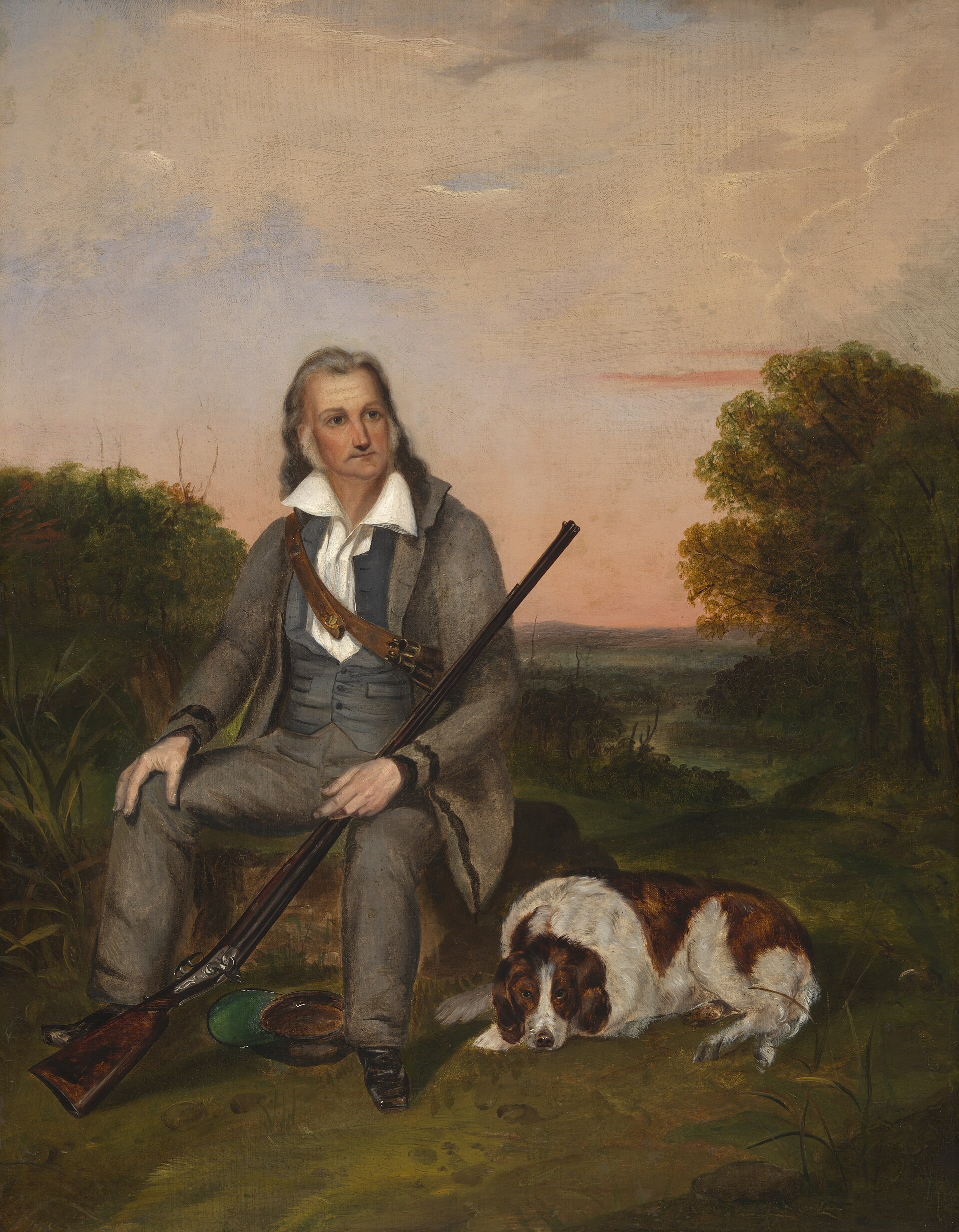
Audubon about a decade before his death, painted by an unidentified artist as a copy after an original portrait by his own son, John Woodhouse Audubon. This page deliberately does not use the so-called Self-Portrait in a Red Coat sometimes reproduced as Audubon's likeness: a 2019-2020 study by Matthew R. Halley argues that picture is itself a copy after another artist's hand, with the identification of both painter and sitter contested. The sitter's identity as Audubon in this National Portrait Gallery painting is not disputed in the sources consulted; that it is a copy after his son's work, not an autograph original, is stated plainly rather than left ambiguous.
National Portrait Gallery, Smithsonian Institution| Full name | Jean-Jacques Audubon, known in the United States as John James Audubon |
|---|---|
| Worked as | Naturalist, Artist, Publisher |
| Born | April 26, 1785 · Les Cayes, Saint-Domingue (now Haiti) |
| Died | January 27, 1851 · New York City, New York |
| Nationality | American (born in the French colony of Saint-Domingue |
| Sources | 30 cited |
| Last verified |
About this page Last verified · 30 sources cited
On this page 13 sections
ContentsClose
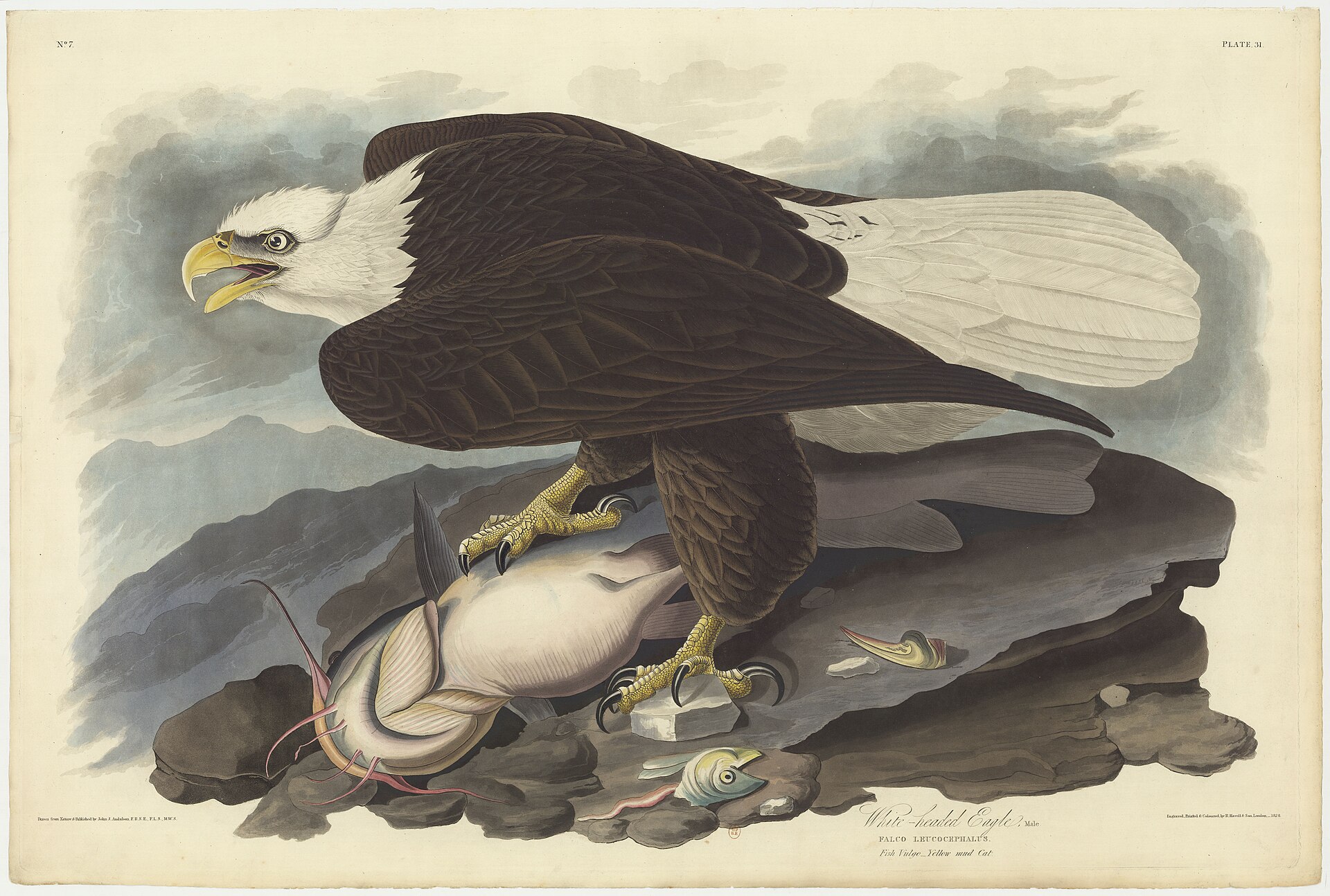
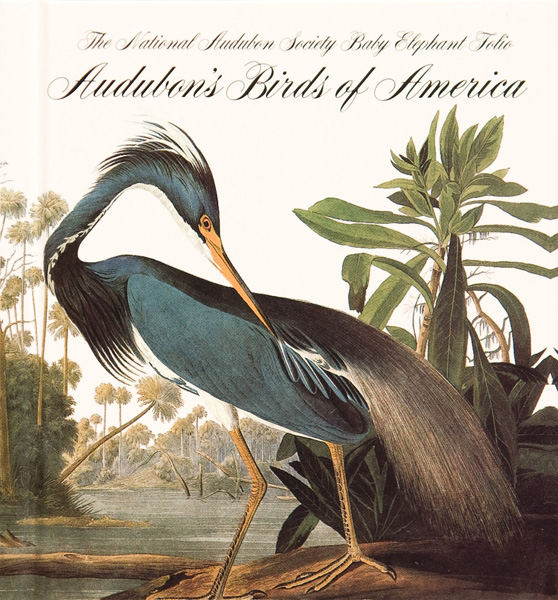
John James Audubon designed the birds. He did not engrave them, print most of them, or apply most of the colour that reaches the paper on a finished plate, and for two decades after his death the copper plates that carried his drawings into print were treated as scrap metal rather than as an artist's estate. The Birds of America, the double elephant folio issued in eighty-seven subscription numbers between 1827 and 1838, is the reason his name survives at all: a naturalist who had failed at business more than once financed the most ambitious natural-history print project of the nineteenth century by getting two kings to subscribe, then spent eleven years watching a London workshop turn his drawings into four hundred and thirty-five hand-coloured aquatints, most of them life-size.
What his name now carries is larger, and more contested, than the birds themselves. It carries an invented eagle species that helped sell the project to its first aristocratic subscribers. It carries a corpus of somewhere between 175 and 200 original sets, of which a commonly cited figure of about 119 to 120 survive complete today, tracked by a census that auction houses still cite before every sale. It carries the labour of an engraver's workshop, a botanical illustrator, a Charleston naturalist, and at least one enslaved man whose specimen work entered the supply chain without his name ever reaching a plate. And it carries the documented fact that the man who drew the birds also bought, held and sold enslaved people, a fact the organization that later took his name spent a formal, year-long review considering in 2022 and 2023 before voting, controversially, to keep the name.
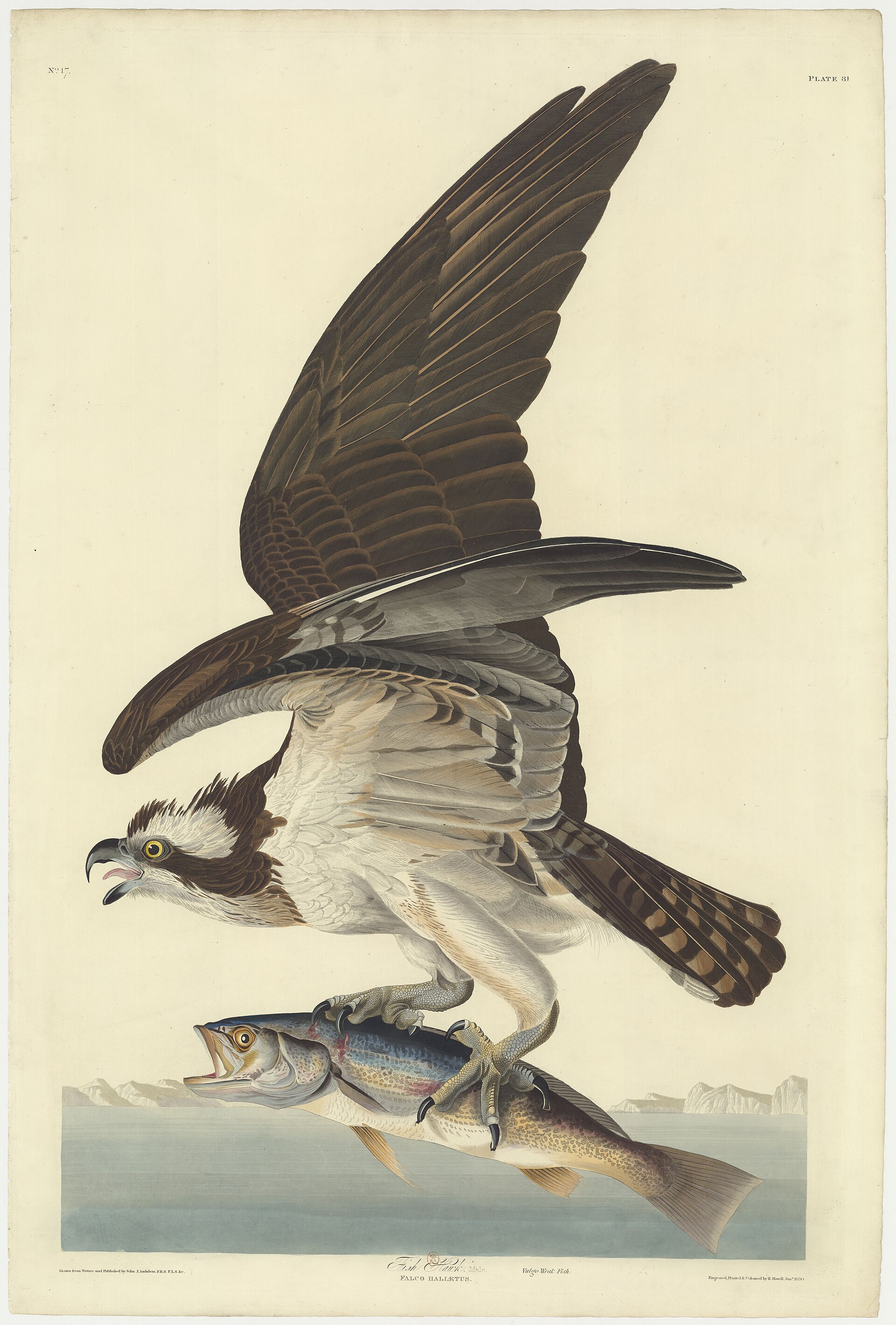
None of this diminishes what the plates themselves accomplished: birds shown fighting, hunting and feeding young, mounted from freshly killed specimens into lifelike active poses rather than the stiff profile convention that came before him, printed at a scale nobody had sustained across an entire national avifauna. It is why the book still sets auction records for printed matter, and why an unbroken, complete set of it is now scarcer than most of what it depicts.
Images
Chronology
- 1785
Born April 26 in Les Cayes, in the French colony of Saint-Domingue, now Haiti, the illegitimate son of the French naval officer and plantation owner Jean Audubon and his mistress Jeanne Rabine.3
- 1803
Emigrated to the United States, reportedly in part to avoid conscription into the Napoleonic wars.3
- 1808
Married Lucy Bakewell at her family's Pennsylvania estate.3
- 1812
Became a naturalized United States citizen.3
- 1819
Kentucky business ventures, including a lumber mill at Henderson, collapsed; briefly jailed for debt the same year.3
- 1826
Sailed for Britain with a portfolio of drawings to find an engraver and subscribers, financed in part by Lucy Bakewell's income as a teacher and governess.13
- 1826-1827
William Home Lizars of Edinburgh engraved the first ten plates before his colourists went on strike; the project moved to London and the Havell workshop.12223
- 1827-1838
The Birds of America issued in 87 subscription numbers of five plates each, 435 plates in total, engraved and hand-coloured by Robert Havell Sr. and Jr. in London.12
- 1831-1839
Ornithological Biography, the five-volume descriptive text accompanying the plates, published separately with technical assistance from William MacGillivray.1
- 1840-1844
Smaller royal octavo edition of Birds of America issued in 100 parts, 500 lithographic plates by John T. Bowen of Philadelphia.18
- 1845
Plates of The Viviparous Quadrupeds of North America began to appear, worked on jointly with his son John Woodhouse Audubon and, for the text, John Bachman.3
- 1851
Died January 27 at his family home in what is now northern Manhattan, New York, thirteen years after the folio's completion.3
- 1870-1871
Lucy Audubon advertised 350 of the original copper plates for sale; the New York Times reported they were sold for their scrap value as copper.30
- 1873
Charles Cowles kept intervening to pull further plates aside at his father's copper refinery, beyond the first he had already rescued himself, before they could be melted; the source consulted for this record gives no count of how many.30
- 1905
The National Audubon Society founded, more than half a century after Audubon's death.4
- 2010-12-07
The Lord Hesketh copy of Birds of America sold at Sotheby's London, hammer 6.5 million pounds, total 7,321,250 pounds with premium, a world record for any printed book sold at auction at the time.111213
- 2020
Matthew R. Halley's peer-reviewed study concluding the Bird of Washington was an invented species published in the Bulletin of the British Ornithologists' Club.7
- 2022-2023
National Audubon Society conducted a year-long internal review of Audubon's record as an enslaver and voted in March 2023 to keep his name, prompting resignations and chapter name changes.4
The market
A complete, unbroken set of the Havell-edition Birds of America is one of the most consistently valuable categories of printed matter at auction, and the market has a clean current record: 7,321,250 pounds, roughly 11.5 million US dollars, paid at Sotheby's London in December 2010 for the copy from the collection of Frederick, 2nd Lord Hesketh, against a pre-sale estimate of only 4 to 6 million; no source consulted publishes the hammer separately from the total, though this record's own arithmetic against the period's typical premium schedule puts it near 6.5 million. That sale set a world record for any printed book sold at auction, a record the Audubon later lost to the Bay Psalm Book, but it remains, on the sources consulted, the record for any work of natural-history publishing. Individual complete-set sales this century have otherwise clustered between roughly 3.5 million and 9.65 million dollars, with the same set, the Portland or Knobloch copy, appearing twice, in 2012 and again in 2018, at two different prices eight years apart.
| Date | Sale | Work | Result | Note |
|---|---|---|---|---|
| 2000 | Christie's | Birds of America, complete set | With premium USD 8,802,500 USD | Total price reported; hammer and premium not separately reported in the sources consulted. |
| 2005 | Birds of America, complete set | With premium USD 5,616,000 USD | Total price reported in a later summary article; house and hammer/premium split not found in the sources consulted. | |
| 7 December 2010 | Sotheby's | Birds of America, complete set (the Lord Hesketh copy) | Hammer GBP 6,500,000 With premium GBP 7,321,250 total (approx. USD 11,542,683) GBP | World record for any printed book sold at auction at the time; buyer Michael Tollemache, London dealer; against a pre-sale estimate of GBP 4-6 million. |
| 20 January 2012 | Christie's New York | Birds of America, complete set (the Portland/Knobloch copy) | With premium USD 7,922,500 USD | From the heirs of the 4th Duke of Portland; bought by the American collector Carl W. Knobloch Jr. Hammer/premium not separately reported. |
| 1 April 2014 | Sotheby's New York | Birds of America, complete set (Indiana Historical Society copy) | Hammer USD 3,525,000 USD | Sold within the USD 3-5 million estimate range; reported as hammer price. |
| 14 June 2018 | Christie's New York | Birds of America, complete set (the Portland/Knobloch copy, resold) | With premium USD 9,650,000 USD | Sold to an anonymous buyer after Knobloch's 2016 death, from the family foundation he had given the set to; described by Christie's as one of only 13 complete sets then thought to remain in private hands. |
Hammer is the price at which the bidding stopped; with premium adds the fee the house charges the buyer on top. Hammer price and buyer's premium in the glossary.
Where to see the work
| Institution | City | Holdings | Note |
|---|---|---|---|
| Transylvania University, Special Collections and Archives (Farris Rare Book Room) | Lexington, Kentucky | One complete Havell-edition set (the Clara S. Peck copy) | Subject of a December 2004 armed robbery attempt, already recorded on this site under its own record. |
| University of Pittsburgh, Digital Research Library and Special Collections | Pittsburgh, Pennsylvania | One complete Havell-edition set | Fully digitized plate by plate in 2007, published online, one of the few open facsimiles of a complete set. |
| Field Museum | Chicago, Illinois | One complete Havell-edition set with the composite corrective plates (formerly Dr. Benjamin Phillips's copy) | One of only three sets known to carry Audubon's thirteen late corrective composite plates. |
| Stark Museum of Art | Orange, Texas | Audubon's own personal set, with the composite corrective plates | The second of the three sets known to carry the composite plates. |
| Peabody Museum (Yale University) | New Haven, Connecticut | Five surviving original copper printing plates, including the Black Vulture plate rescued from scrapping in 1873 | Donated by Edwin Vare Jr. in 1955; part of the roughly 78 of the original 435 plates known to survive. |
Forgeries and misattributions
- The Edward Harris composite-plate copy, never bound
- Of the three complete sets known to carry Audubon's thirteen late corrective composite plates, the third, promised to his friend and expedition companion Edward Harris, is understood never to have been bound as a set at all. It was broken up and dispersed instead, meaning the physical object Harris was promised does not exist intact anywhere today. Documented by the Field Museum's own research into the composite-plate group, comparing the three sets against each other and against surviving loose sheets.15
- Reproduction restrikes carrying false or misleading plate marks
- Later reproduction print series, including the mid-twentieth-century Ariel Press editions, were issued with an impressed plate-mark meant to resemble an original copperplate engraving's, without the dated Whatman or Turkey Mill watermark every genuine 1827-1838 sheet carries. The antiquarian print trade's standard three-part check: the watermark held to light, the plate mark's differential paper-smoothing (present only inside the impression on a genuine pull), and, under magnification, the regular dot pattern of photomechanical reproduction against the irregular texture of hand engraving and hand colouring. No specific named court case of Birds of America forgery was located for this page; the existence of this authentication apparatus is itself evidence that misattribution has been a live problem for buyers, even where a documented prosecution is not on record.26
The essay
Chapter 1What the double elephant folio actually is
The Birds of America is four bound volumes holding 435 hand-coloured plates, depicting some 1,055 individual birds across roughly 489 species, printed on sheets of about 39 1/2 by 26 1/2 inches, the...
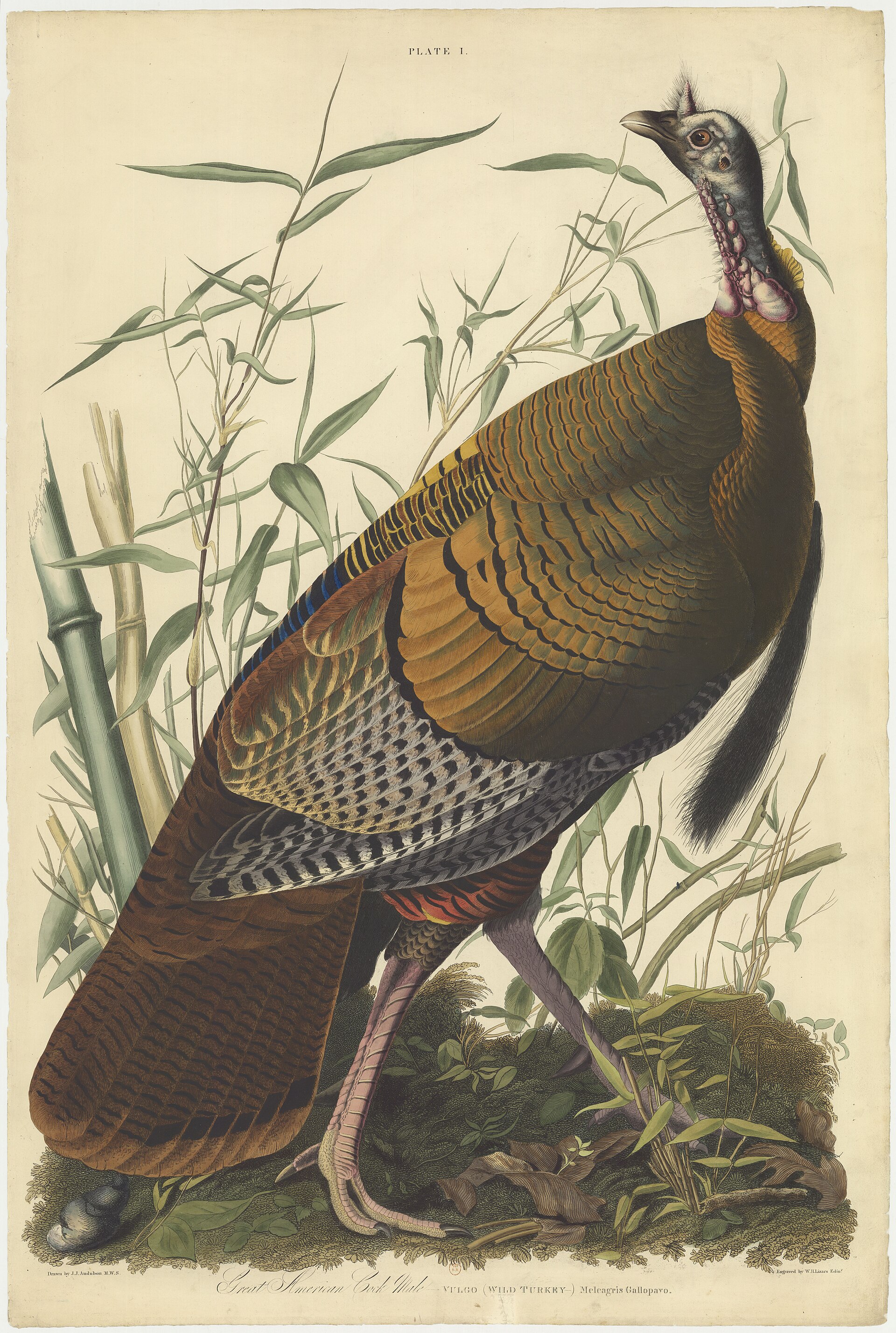
The Birds of America is four bound volumes holding 435 hand-coloured plates, depicting some 1,055 individual birds across roughly 489 species, printed on sheets of about 39 1/2 by 26 1/2 inches, the paper size the trade calls double elephant. Audubon insisted on that scale for a specific reason: so that every bird in the book, a wild turkey included, could be shown at life size. Smaller species share a sheet with the plants or prey Audubon associated with them; the largest, herons and eagles, occupy a full sheet alone, wings and necks pushed to the paper's edge.
The plates were produced by aquatint over etched and engraved lines, printed in black from copper plates roughly 1016 by 678 millimetres, then hand-coloured by a workshop of colourists working from a master pattern plate. Individual sheets carry dated Whatman watermarks, which let scholars establish an earliest-possible print date for a given impression; because sheets were pulled as subscriber orders arrived across more than a decade, a single plate design can carry watermark dates several years apart on different surviving sets. The book was sold by subscription and delivered five plates at a time, rolled in a tin tube, as each number was completed.
Chapter 2Whose hands actually made it
Audubon drew the birds. He did not engrave a single plate.
Audubon drew the birds. He did not engrave a single plate. William Home Lizars of Edinburgh engraved the first ten before his colourists went on strike partway through 1827; Audubon then moved the project to London, where the engraver and aquatinter Robert Havell, first the father, Robert Havell Sr., then almost immediately his son Robert Havell Jr., took over and completed the remaining 425 plates over the following eleven years. The hand-colouring itself was never Audubon's or the Havells' alone: it was applied by a workshop of colourists working in an assembly-line method from Havell's own pattern plate, which functioned as the colour standard for every pull of a given design.
Two collaborators whose names do not appear on the plates were essential to what those plates show. Maria Martin, later the second wife of the naturalist John Bachman and at the time his sister-in-law, painted the botanical and insect backgrounds for roughly thirty plates, unsigned. Bachman himself, a Charleston naturalist and Lutheran minister, supplied specimens and field observations, and his own correspondence documents that his household included an enslaved man named Thomas, described in Bachman's letters as a skilled taxidermist who prepared specimens that entered Audubon's supply chain. The American Philosophical Society, drawing on that correspondence for a recent exhibition on Audubon's collaborators, states plainly that surviving records do not allow any specific plate to be traced to Thomas's work; that he existed, was enslaved by Bachman, and did skilled taxidermy that fed into this project is documented, and which particular birds passed through his hands is not, and this page records that as unresolved rather than assumed.
Chapter 3Selling a book almost nobody could afford
Eighty-seven numbers at two guineas each comes to roughly 174 guineas, about 183 pounds sterling, for a complete set of plates alone, before the cost of the companion text.
Eighty-seven numbers at two guineas each comes to roughly 174 guineas, about 183 pounds sterling, for a complete set of plates alone, before the cost of the companion text. Audubon needed subscribers who would not blink at that, and early in the project he secured two of the best available: King George IV of the United Kingdom and King Charles X of France both subscribed after Audubon showed them sample plates, an endorsement he then used deliberately to recruit the aristocratic and institutional buyers who actually paid for the run.
The descriptive text that made the plates useful to a working naturalist was published separately, as the five-volume Ornithological Biography (1831 to 1839), written with technical help from the Scottish ornithologist William MacGillivray. That split between image and text was not simply editorial. British copyright-deposit law at the time required a free copy to be lodged with a list of copyright libraries for any book containing letterpress text, an expense Audubon would have owed on every one of his roughly two hundred sets had the folio carried its own text. A book of plates with no letterpress escaped the requirement entirely.
Chapter 4The eagle that was not there
Among the plates Audubon showed prospective British subscribers in the late 1820s was a bird he called the Bird of Washington, a supposedly new eagle species, larger and more magnificent than the...
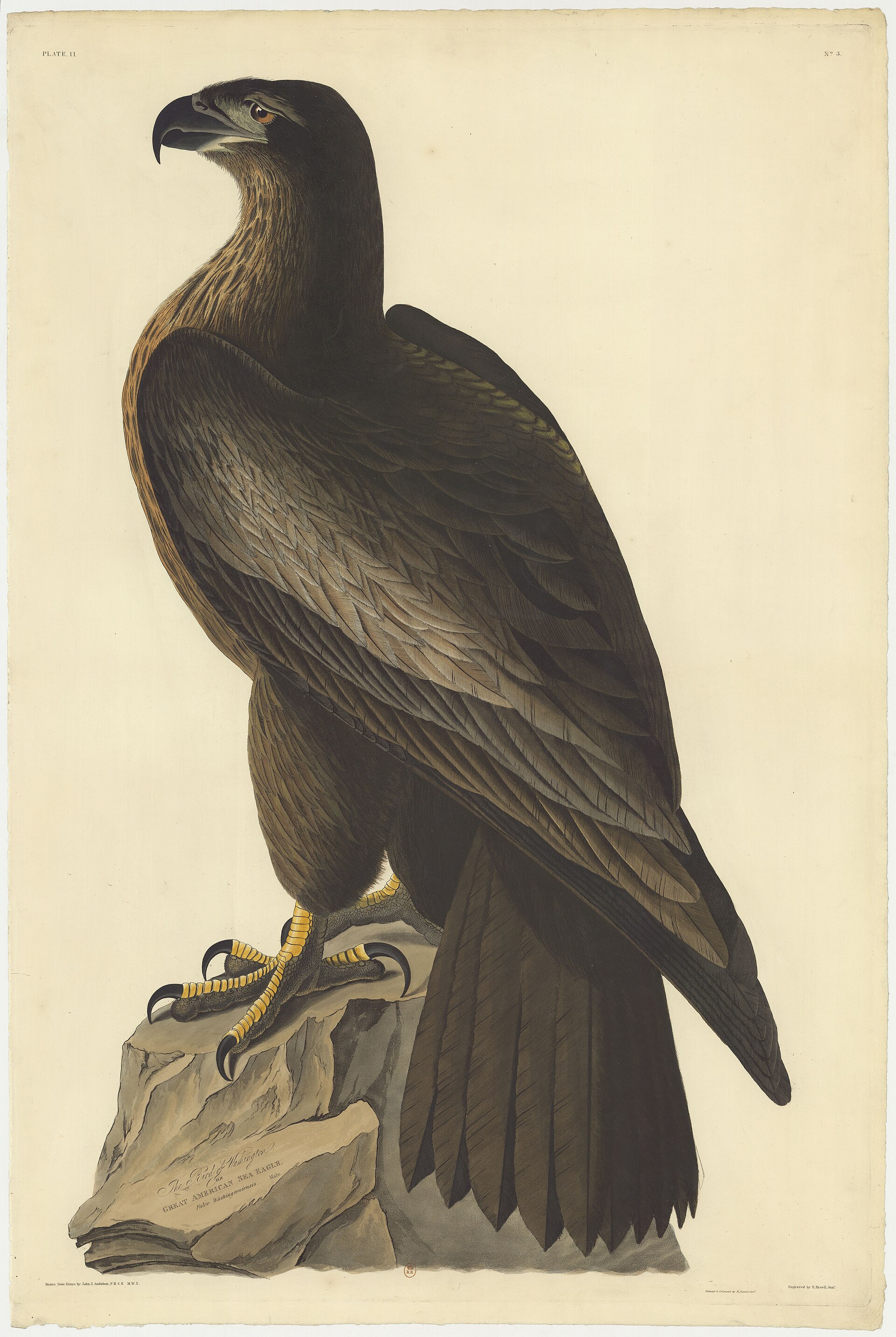
Among the plates Audubon showed prospective British subscribers in the late 1820s was a bird he called the Bird of Washington, a supposedly new eagle species, larger and more magnificent than the bald eagle, which he claimed to have observed on the Mississippi. No specimen matching his description has ever been found by any naturalist before or since.
A 2020 peer-reviewed study by the ornithologist and historian Matthew R. Halley, published in the Bulletin of the British Ornithologists' Club, argues that the Bird of Washington was invented: that Audubon based the plate on an existing published image of a bald eagle, altered its proportions, and then presented the discrepancies he had himself introduced as proof of a new species, at the exact moment he most needed to impress the titled subscribers who would fund the folio. This is Halley's argued conclusion, made under his own name in a specialist peer-reviewed journal, not a settled consensus with no dissent on record, but it belongs in any honest account of how this book found its first buyers. Robert Havell Jr. duly engraved it as Plate 11, invented eagle and all, and it appears in every complete set of Birds of America.
Chapter 5A rivalry that ran in both directions
Audubon was not the first person attempting a complete illustrated American ornithology.
Audubon was not the first person attempting a complete illustrated American ornithology. Alexander Wilson, a Scottish-born poet and schoolteacher, had been publishing his own American Ornithology since 1808, and the two men met once, in Louisville, Kentucky, in circumstances neither later described the same way. After Wilson's death in 1813, the dispute over originality ran in both directions and has never fully settled. Audubon claimed Wilson borrowed drawings from him at that Louisville meeting and used them, unattributed, in American Ornithology, centred on a disputed Small-headed Flycatcher image. Later historians, working from Audubon's own record of fabricating other observations and priority claims to be seen as first to record a species, conclude that at least some plagiarism ran the other way, from Wilson's published work into Audubon's. George Ord, Wilson's defender and literary executor, spent decades afterward attacking Audubon's credibility in print. Neither man's estate settled the argument, and no cited scholarly source consulted for this page treats it as resolved either way.
Chapter 6How many complete sets survive, and who counts them
The standing reference for this question is Waldemar H.
The standing reference for this question is Waldemar H. Fries's The Double Elephant Folio: The Story of Audubon's Birds of America, first published in 1973 and revised in 2005, a full census of subscribers, sets sold outside subscription, and surviving copies. Fries's own published conclusion was that the evidence supports a figure certainly under 200 and most likely between 175 and 200 original sets, built by cross-checking Audubon's published subscriber list of 161 against sets known to have changed hands without being recorded as subscriptions, plus fifteen complete sets that remained unsold when printing finished in 1838.
How many of those survive complete today is reported less consistently across sources than the production figure is. The number most frequently cited by auction houses and in press coverage of individual sales, including at the time of the December 2010 Sotheby's record described below, is that only 119 complete copies are known to exist, of which about 108 are held by museums and libraries rather than private owners; a Guinness World Records entry citing the same sale rounds this to under 120 complete sets with 13 in private hands. An older figure published by the University of Illinois Library puts the intact total at 134. This page has not been able to reconcile those counts from the sources consulted, and records the spread, 119 to 134 depending on date and source, as a real feature of how this census is maintained rather than smoothing it into one number. What an open facsimile of one complete set actually looks like is not in dispute: a separate set held by the University of Pittsburgh was fully digitized, plate by plate, in 2007 and remains published online, one of the few complete sets a reader can examine leaf by leaf without visiting a library.
Chapter 7What happened to the original copper plates
Audubon's widow, Lucy Bakewell Audubon, outlived him by twenty-three years and ended her life in financial difficulty.
Audubon's widow, Lucy Bakewell Audubon, outlived him by twenty-three years and ended her life in financial difficulty. In 1870 she advertised 350 of the original copper plates for sale. The following year, the New York Times reported that they had been sold for their value as old copper, after having, in the paper's words, vainly sought a purchaser on their artistic merits: most of the 435 plates were melted down for scrap value rather than preserved as printing matrices or as art objects.
In 1873 a teenager named Charles Cowles, whose father ran a copper refinery, noticed a worker about to feed a tarnished copper sheet into the furnace. He rescued it, cleaned it with acid, and found the image of a vulture beneath the tarnish: one of Audubon's plates. He received no encouragement from the refinery's management but kept intervening to pull further plates aside before they could be melted; the source consulted for this record gives no count of how many. A 1974 cataloguing found approximately 78 of the original 435 plates still in existence, scattered across museums and private hands; the Peabody Museum holds five of them, including the Black Vulture plate Cowles rescued, donated by Edwin Vare Jr. in 1955.
Chapter 8Breaking, married copies, and the shadow trade in single plates
A complete set is worth dramatically more intact than broken, and individual plates of famous birds, a bald eagle, a wild turkey, a great blue heron, command real prices from buyers who want one...
A complete set is worth dramatically more intact than broken, and individual plates of famous birds, a bald eagle, a wild turkey, a great blue heron, command real prices from buyers who want one striking image rather than a four-volume library object. That arithmetic has driven what the antiquarian trade calls breaking, cutting a complete set apart to sell its plates individually, for close to two centuries, and it is the direct reason so few intact sets remain against how many loose, unattached Audubon plates circulate in institutional and private hands and on Wikimedia Commons.
Audubon's own late corrections to the plates left a smaller, more specific complication. Toward the end of production he wanted to fix identification errors on already-printed sheets, and had thirteen extra corrective images overprinted from separate copper plates onto the originals, a set of composite plates included in only three complete copies: Audubon's own set, now at the Stark Museum of Art in Texas; a set belonging to his friend and physician Dr. Benjamin Phillips, now at the Field Museum in Chicago; and a third promised to his friend and expedition companion Edward Harris, which the Field Museum's own research holds was never actually bound as a set at all, and was broken up and dispersed instead. A version of Birds of America carrying those thirteen composite plates is a different physical object from the ordinary Havell edition, and a dealer or collector unaware of the distinction is exactly the kind of confusion version safety exists to prevent.
Separately, later reproduction print series have complicated the picture from the other direction: some, such as the Ariel Press restrikes sold from the mid twentieth century onward, carry an impressed plate-mark meant to resemble an original engraving's, without the dated Whatman or Turkey Mill watermark that every genuine 1827-1838 sheet carries. The trade's standard authentication of an individual plate now rests on three checks: the watermark held to light, the plate mark's differential smoothing of the paper (present only inside the impression on a genuine copperplate pull), and, under magnification, the regular dot pattern of photomechanical reproduction against the irregular texture of hand engraving and hand colouring. No single documented court case of Birds of America forgery specifically was located for this page; what is documented is the authentication apparatus the trade built because sheets without it are hard to tell apart, which is itself evidence that the risk is real even where a named prosecution is not on record.
Chapter 9What a complete set is worth
The clearest market record belongs to the copy from the collection of Frederick, 2nd Lord Hesketh, sold at Sotheby's London on December 7, 2010.
The clearest market record belongs to the copy from the collection of Frederick, 2nd Lord Hesketh, sold at Sotheby's London on December 7, 2010. The total with buyer's premium came to 7,321,250 pounds (the hammer, not separately published by any source consulted, was approximately 6.5 million pounds on this record's own arithmetic against the period's typical premium schedule), reported at the time as approximately 11.5 million US dollars. The sale, against a pre-sale estimate of 4 to 6 million pounds, set a new world record for any printed book sold at auction, a record the book held until the Bay Psalm Book of 1640 sold for 14,165,000 dollars in 2013; it remains, so far as the sources consulted for this page establish, the record for any work of natural-history publishing. The buyer was the London dealer Michael Tollemache, bidding in the room.
Other complete-set sales in the same two decades show the range beneath that record. A set sold at Christie's New York for 8,802,500 dollars in 2000. A different set brought 5,616,000 dollars in 2005. The Portland, or Knobloch, set, from the heirs of the 4th Duke of Portland, sold at Christie's New York for 7,922,500 dollars in January 2012 to the American collector Carl W. Knobloch Jr., then again, after Knobloch's 2016 death, for 9,650,000 dollars at Christie's New York on June 14, 2018, described by the house at the time as one of only thirteen complete sets then thought to remain in private hands. A set belonging to the Indiana Historical Society sold at Sotheby's New York for 3,525,000 dollars in April 2014, within its 3 to 5 million dollar estimate. Across all of these, hammer and premium are reported inconsistently in the press, and this page separates them wherever a source actually gives both figures rather than repeating a single headline number as if it were the whole answer.
Chapter 10The economy the book was made inside
Audubon was, at several points in his adult life, an enslaver.
Audubon was, at several points in his adult life, an enslaver. Historical accounts document enslaved people working in his Kentucky household in the 1800s, sold off when his businesses failed, and further enslaved people bought and later sold again when he relocated to England to publish this book. His father's own fortune, which financed Audubon's education and early support, was built substantially on a sugar plantation in Saint-Domingue and on the trafficking of enslaved people. Audubon was not simply a passive beneficiary of that economy as an adult: in an 1834 letter to his wife Lucy, he criticized the British government for having, in his own words, acted imprudently and too precipitously in emancipating enslaved people in its West Indian colonies.
This is reported here as documented biographical fact about the man whose name is on this book's title page, not as commentary on the birds themselves. Gregory Nobles's 2017 biography, John James Audubon: The Nature of the American Woodsman, and his 2020 essay The Myth of John James Audubon lay out this record in detail and argue explicitly that Audubon was not simply a man of his time on the question, given how many of his contemporaries publicly opposed slavery; a scholarly review of that same biography has noted that even Nobles's own account develops the material relatively briefly rather than fully reckoning with what it means for Audubon's public reputation as the American Woodsman. The organization that eventually took his name, the National Audubon Society, did not exist in his lifetime; its own reckoning with that name is later institutional history, recorded separately below.
Chapter 11A record of a world that was vanishing as it was drawn
Audubon's technical innovation was as much about method as about scale.
Audubon's technical innovation was as much about method as about scale. Rather than working from museum skins in the static, profile convention that preceded him, he shot birds himself, then wired the freshly killed specimens into lifelike, active poses, fighting, hunting, feeding young, before drawing them. The birds in Birds of America are dead animals staged to look alive, a fact the book's own visual drama depends on and rarely states about itself.
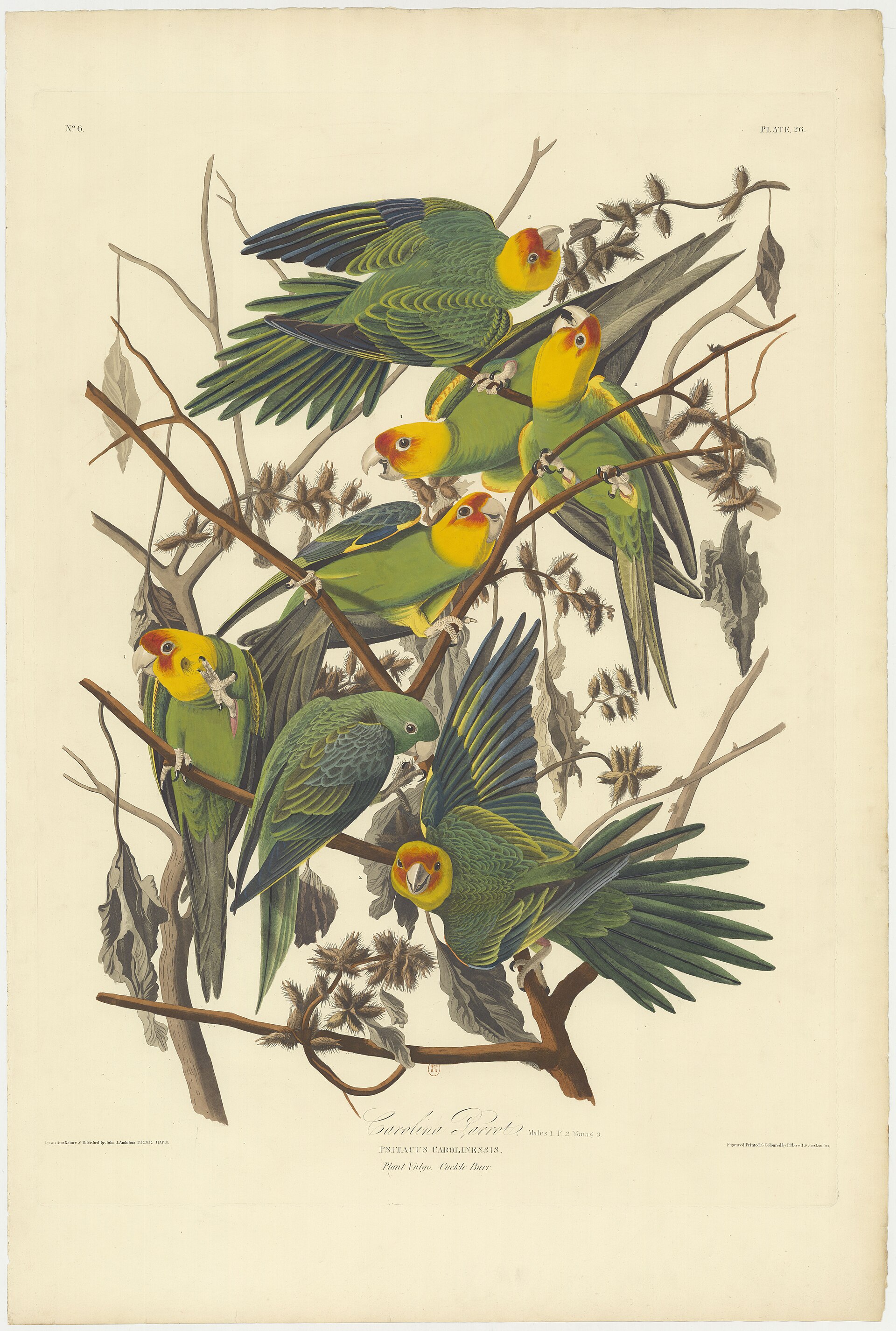
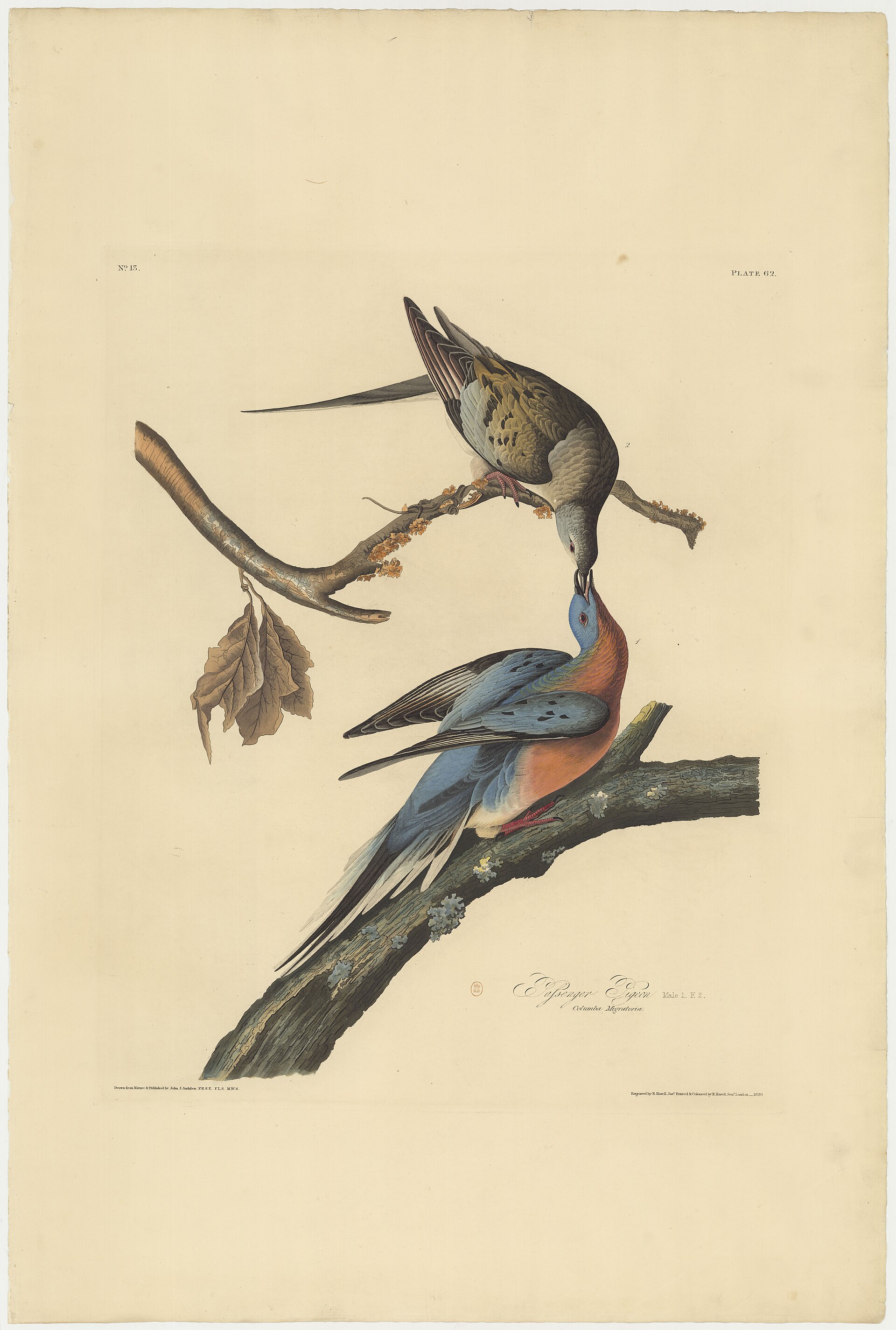
At least three species in the book are now extinct, and Audubon's own century watched it happen. The Carolina Parakeet, Plate 26, was declared extinct with the death of the last known individual, a male named Incas, at the Cincinnati Zoo on February 21, 1918. The Passenger Pigeon, Plate 62, once numbered in the billions across eastern North America and was declared extinct when Martha, the last known individual, died at the same Cincinnati Zoo on September 1, 1914, in the very aviary where the last Carolina Parakeets would die four years later. The Labrador Duck, which Audubon also painted, is generally reckoned extinct by around 1878. None of these extinctions is attributed in the sources consulted to Audubon's own specimen collecting specifically; all three are attributed to nineteenth and early twentieth century hunting, habitat loss and, for the pigeon, the sheer industrial scale of market shooting. What is documented plainly is that the book which first gave millions of readers a life-sized, intimate look at these birds was completed while the pressures that erased them from the wild were already underway, and that Audubon's own working method, killing the specimen to draw it accurately, sat inside that same broader relationship between nineteenth-century naturalism and the wildlife it studied.
Chapter 12The smaller edition, and the second natural-history project
Once the double elephant folio was complete, Audubon and his sons produced a smaller, cheaper edition aimed at a wider buying public: the royal octavo Birds of America, issued in 100 parts between...
Once the double elephant folio was complete, Audubon and his sons produced a smaller, cheaper edition aimed at a wider buying public: the royal octavo Birds of America, issued in 100 parts between 1840 and 1844, seven volumes and 500 hand-coloured lithographs, each about 6 1/2 by 10 1/4 inches. The Philadelphia lithographer John T. Bowen produced the plates by projecting a reversed, reduced image of each folio original onto the lithographic stone using a camera lucida, and the octavo edition folded in text from the Ornithological Biography alongside the images rather than issuing it separately, since the copyright-deposit concern that had driven the folio's split between plates and text did not apply the same way to a work published in America.
Audubon's last major natural-history project was The Viviparous Quadrupeds of North America, plates issued from 1845, covering mammals rather than birds, worked on jointly with his son John Woodhouse Audubon and, for the accompanying text, with John Bachman; Audubon's declining health in his final years meant his sons carried an increasing share of the later plates. It remains a smaller and less studied body of work than Birds of America, and this page has not researched it to the same depth; it is recorded here as part of the corpus a reader should know exists, not as a fully worked section.
Chapter 13The portrait problem
Version safety applies to a maker's own likeness as much as to a picture he painted.
Version safety applies to a maker's own likeness as much as to a picture he painted. The image most often reproduced as an Audubon self-portrait, Self-Portrait in a Red Coat, is itself contested: a 2019-2020 study by Matthew R. Halley, published in Cassinia, the journal of the Delaware Valley Ornithological Club, argues on stylistic and documentary grounds that the painting is not an autograph self-portrait at all but a copy after another artist's hand, and the picture's own Wikipedia entry and the Audubon magazine's own reporting on it both record open authentication questions about whether it shows Audubon by his own hand or was painted by an unidentified Philadelphia portraitist. Given that dispute, this page does not use that picture.
The portrait used here instead is explicitly a copy: painted by an unidentified artist after an original by Audubon's own son, John Woodhouse Audubon, around 1841, a decade before Audubon's death, and held by the National Portrait Gallery, Smithsonian Institution. The sitter's identity as Audubon is not disputed in the sources consulted for this page; what is a copy is stated as a copy, not presented as autograph, which is the more modest and more defensible claim available for this maker's likeness.
Chapter 14The name after the man
The National Audubon Society was founded in 1905, fifty-four years after Audubon's death, and took its name from his reputation as America's foundational bird artist rather than from any role he...
The National Audubon Society was founded in 1905, fifty-four years after Audubon's death, and took its name from his reputation as America's foundational bird artist rather than from any role he played in founding it. In 2022 the organization opened a formal, year-long internal review of Audubon's record as an enslaver, prompted by the broader racial reckoning following 2020, and in March 2023 its board voted to keep the name. The decision was controversial inside the organization itself: it prompted staff resignations and led at least five local Audubon chapters in different states to drop the name from their own, choosing new identities rather than continue operating under it. That vote is a later institutional decision about how to carry a nineteenth-century reputation forward, separate from anything Audubon himself did or said, and this page treats it that way rather than folding it back into an account of the man.
What is documented
Technique
The surviving work
- What is accepted
- 435 plates depicting some 1,055 individual birds of about 489 species, issued as the Havell-edition Birds of America (1827-1838). Authorship of the drawings is not in dispute.
- What is contested
- The live question for this corpus is not which drawings are Audubon's; it is which physical sets are complete, unbroken and of the genuine Havell edition. Waldemar Fries's 1973 census, revised 2005, put original production at somewhere between 175 and 200 sets. How many survive complete today is reported inconsistently: a figure of about 119 complete sets, with roughly 108 held by museums and libraries, is the one most frequently cited around the December 2010 Sotheby's record sale; an older published figure from the University of Illinois Library puts the intact total at 134. This page has not reconciled the discrepancy from the sources consulted.
- Who rules on attribution
- No single authentication board rules on Birds of America the way a painter's catalogue raisonne committee rules on contested attributions, because the drawings' authorship has never been in serious dispute. What functions as authority instead is bibliographic and technical: the Fries census for which physical sets exist and where, and the antiquarian print trade's own authentication apparatus, watermark, plate mark and colour register, for whether an individual sheet is a genuine period pull rather than a later reproduction.
Catalogue raisonne
- Waldemar H. Fries, The Double Elephant Folio: The Story of Audubon's Birds of America (American Library Association, 1973; revised edition, Zenaida Publishing, 2005) The standard census of subscribers, sets sold outside subscription, and surviving copies. Not directly consulted for this page; the figures used here are drawn from secondary summaries of Fries's published conclusions and are flagged as such.17
Questions about John James Audubon
Who was John James Audubon?
Naturalist; Artist; Publisher. 1785-1851.
When did John James Audubon live?
Born April 26, 1785, Les Cayes, Saint-Domingue (now Haiti); died January 27, 1851, New York City, New York.
How are fakes and misattributions of John James Audubon detected?
The Edward Harris composite-plate copy, never bound. Of the three complete sets known to carry Audubon's thirteen late corrective composite plates, the third, promised to his friend and expedition companion Edward Harris, is understood never to have been bound as a set at all. It was broken up and dispersed instead, meaning the physical object Harris was promised does not exist intact anywhere today.
Where can you see work by John James Audubon?
Transylvania University, Special Collections and Archives (Farris Rare Book Room) (Lexington, Kentucky); University of Pittsburgh, Digital Research Library and Special Collections (Pittsburgh, Pennsylvania); Field Museum (Chicago, Illinois); Stark Museum of Art (Orange, Texas); Peabody Museum (Yale University) (New Haven, Connecticut).
What does the market for John James Audubon look like?
A complete, unbroken set of the Havell-edition Birds of America is one of the most consistently valuable categories of printed matter at auction, and the market has a clean current record: 7,321,250 pounds, roughly 11.5 million US dollars, paid at Sotheby's London in December 2010 for the copy from the collection of Frederick, 2nd Lord Hesketh, against a pre-sale estimate of only 4 to 6 million; no source consulted publishes the hammer separately from the total, though this record's own arithmetic against the period's typical premium schedule puts it near 6.5 million. That sale set a world record for any printed book sold at auction, a record the Audubon later lost to the Bay Psalm Book, but it remains, on the sources consulted, the record for any work of natural-history publishing.
What is still unresolved about John James Audubon?
How many complete Havell-edition sets survive today: sources consulted for this page give figures from 119 to 134 depending on date and publication, and this page has not been able to reconcile them against a primary check of Fries's revised 2005 census.
Open questions
- How many complete Havell-edition sets survive today: sources consulted for this page give figures from 119 to 134 depending on date and publication, and this page has not been able to reconcile them against a primary check of Fries's revised 2005 census.
- What the exact, unrounded hammer price was at the December 2010 Sotheby's sale: the sources consulted for this record report only the total with premium, 7,321,250 pounds; a hammer of approximately 6.5 million pounds is this record's own arithmetic against Sotheby's typical buyer's-premium schedule for the period, not a figure any source states directly, and no source consulted publishes an unrounded hammer figure.
- Whether any documented court case or formal dispute over a forged or misrepresented Birds of America plate exists: the trade's authentication apparatus (watermark, plate mark, dot pattern) implies real incidents, but no specific named case was located in the sources consulted for this page.
- Where the roughly 73 surviving original copper plates outside the Peabody Museum's five are now held, and whether they have been catalogued individually.
- Whether Audubon received any formal art training in France as a young man, including the frequently repeated claim of study under Jacques-Louis David: this page found the claim repeated widely but could not trace it to a source it could cite with confidence, and has recorded the claim as unverified rather than including it as fact.
Sources
- 1Sotheby's, 'John James Audubon & The Double Elephant Folio'. sothebys.com/en/...
- 2Beinecke Rare Book & Manuscript Library, Yale University, 'Birds of America: Paper Size and Watermarks'. beineckeaudubon.yale.edu/birds-americapaper-size-and-wate...
- 3Wikipedia, 'John James Audubon'. Rhodes, John James Audubon: The Making of an American, 2004; or Nobles, John James Audubon: The Nature of the American Woodsman, 2017) for any claim load-bearing enough to need a primary or peer-reviewed cite. en.wikipedia.org/wiki/...
- 4Smithsonian Magazine, 'National Audubon Society Votes to Keep the Name of an Enslaver'. smithsonianmag.com/smart-news/...
- 5American Philosophical Society, 'John James Audubon: The Universe of America' (exhibition page, Sketching Splendor: American Natural History, 1750-1850). amphilsoc.org/museum/...
- 6American Philosophical Society, 'Unearthing Stories: Sketching Splendor Spotlight, Part II'. amphilsoc.org/news/...
- 7Matthew R. Halley, 'Audubon's Bird of Washington: unravelling the fraud that launched The Birds of America', Bulletin of the British Ornithologists' Club, vol. 140, no. 2 (2020). bioone.org/journals/...
- 8British Ornithologists' Union, 'The fable of Audubon the scientist' (discussing Halley's 2020 findings). bou.org.uk/blog-halley-audubon
- 9D-Lib Magazine, 'Featured Collection: Audubon's Birds of America at the University of Pittsburgh', July/August 2008. dlib.org/dlib/...
- 10University of Illinois Library, Special Collections, 'Audubon Folio'. library.illinois.edu/collections/...
- 11History News Network, 'Birds of America sets 7m sales record at Sotheby's'. historynewsnetwork.org/article/...
- 12Spear's Magazine, 'Sotheby's: Audubon sells for record 7.3m'. spearswms.com/wealth/...
- 13NBC News / TODAY, 'Rare Birds of America book sells for $11.5M, breaks record'. nbcnews.com/id/...
- 14Guinness World Records, 'Most expensive natural-history book sold at auction'. guinnessworldrecords.de/world-records/...
- 15Field Museum Library, LibGuides, 'Composite Plates - Audubon's Birds of America'. libguides.fieldmuseum.org/c.php
- 16Rare Book Hub, 'Tracking the Most Expensive Book: A Copy of Audubon's Birds of America is Sold'. rarebookhub.com/articles/...
- 17Waldemar H. Fries, The Double Elephant Folio: The Story of Audubon's Birds of America (Chicago: American Library Association, 1973; rev. ed. Amherst, MA: The Zenaida Press, 2006), the standard census of surviving complete and broken sets; discussed secondarily in Fine Books and Collections' 'Book Censuses Are Great', the source actually fetched for this page. finebooksmagazine.com/blog/...
- 18Louisiana State University Libraries, Research Guide, 'Audubon's Works' (on the 1840-1844 royal octavo edition). guides.lib.lsu.edu/c.php
- 19National Audubon Society / Audubon magazine, 'The Myth of John James Audubon' by Gregory Nobles. audubon.org/magazine/...
- 20Matthew R. Halley, 'The Self-Portrait of John James Audubon Is a Copy', Cassinia, no. 78 (2019-2020). dvoc.org/wp/...
- 21Audubon magazine, 'The Mystery of the Missing John James Audubon Self-Portrait'. audubon.org/magazine/...
- 22Wikipedia, 'William Home Lizars'. en.wikipedia.org/wiki/...
- 23Linda Hall Library, 'Robert Havell, Jr.' (Scientist of the Day). lindahall.org/about/...
- 24Today in Conservation, 'February 21: Carolina Parakeet Goes Extinct (1918)'. todayinconservation.com/2018/...
- 25Smithsonian, National Museum of Natural History, 'Martha, Last Passenger Pigeon'. naturalhistory.si.edu/research/...
- 26Princeton Audubon Prints / Signature Documents LLC, 'Authenticate Audubon Originals'. princetonaudubonprints.com/pages/...
- 28Rare Book Hub, 'Audubon's Birds of America Takes in $7.9 million at Auction'. rarebookhub.com/articles/...
- 29Fine Books & Collections, 'The Portland Audubon Sells for $9.65 Million'. finebooksmagazine.com/blog/...
- 30Beinecke Rare Book & Manuscript Library, Yale University, 'Audubon Copper Plates at Peabody Museum'. beineckeaudubon.yale.edu/news/...
- 31Project Gutenberg, Ornithological Biography by John James Audubon (Introductory Address, primary text). gutenberg.org/cache/...
Last verified