3 August 2026 · The Provenance Record
Iconotheca
The Provenance Record
The imperial kilns at Jingdezhen, Chenghua reign
A kiln has no portrait. It has a signature, and this is it: the underside of a Chenghua dish, showing the six-character mark in underglaze blue within a double circle, reading top to bottom and right to left, <em>Da Ming Chenghua nian zhi</em>, made in the Chenghua reign of the Great Ming. The dish is painted with lotus and fish and glazed turquoise over the blue; it is in the Shanghai Museum, and the file is geolocated to that building. This is what every claim about a Chenghua porcelain finally rests on, and it is also the most copied inscription in the history of Chinese ceramics. The characters are thick, squat and unbalanced against painting of the highest accomplishment on the other side of the same pot, and that mismatch is one of the marks of the reign.Shanghai Museum; photograph by Alexey Yakovlev, released CC0 via Wikimedia Commons
Workshop

The imperial kilns at Jingdezhen, Chenghua reign

Imperial kiln factory founded 1369; Chenghua reign 1465-1487 · Chinese, Jiangxi province

Full name
The imperial kiln factory (yuqichang) at Zhushan, Jingdezhen, Jiangxi province, under the Chenghua Emperor Zhu Jianshen; founded at the start of the Ming dynasty in 1369 and administered directly by the court
Movement
Ming imperial porcelain; the doucai palette
Worked as
Imperial porcelain factory, Blue and white kiln, Doucai enamelling workshop, Monochrome glaze kiln, Song-revival imitator, Court supply contractor
Born
1369, the second year of the Ming dynasty · Zhushan, Pearl Hill, in the centre of Jingdezhen, Jiangxi province. Twelve imperial kilns were operating at Jingdezhen by 1402
Died
Production at the imperial kilns halted around 1485, two years before the Chenghua Emperor died on 9 September 1487. The factory itself continued under later reigns; the phase this page describes did not · Zhushan, Jingdezhen. The site was excavated from the 1970s onward and now lies under the Jingdezhen Imperial Kiln Museum
In this archive
1 record

Almost everything a buyer needs to know about a Chenghua porcelain is decided by six characters on the underside, and those six characters prove nothing. Da Ming Chenghua nian zhi, made in the Chenghua reign of the Great Ming, is one of the two most frequently copied inscriptions in the history of ceramics. Kangxi, Yongzheng and Qianlong potters wrote it on their finest work as homage. Nineteenth-century workshops wrote it out of habit. Twentieth and twenty-first century forgers write it because it is the cheapest feature of the object to imitate. No source consulted for this page will put a figure on how much marked Chinese porcelain carries a mark that does not match its date, and the compiler of the standard open reference on Chinese porcelain marks does not need one: his rule is that marks are helpful but, as a general rule, the last thing you should trust in dating a piece. So the first working rule of this field is the opposite of what a collector expects. The mark is what you look at last.

What replaced the mark as evidence came out of the ground. From the late 1970s the Jingdezhen Institute of Ceramic Archaeology, working the Ming imperial kiln site at Zhushan under Liu Xinyuan, recovered a quantity of broken porcelain that is now given at more than twenty million pieces. Those sherds are not debris. The imperial factory destroyed on site everything it would not send north, so what was buried at Zhushan is a stratified record of exactly what the kilns attempted in each reign, in the reign itself, with no possibility of a later hand having added anything. A Chenghua stratum with a half-finished doucai cup in it, outlined in cobalt and never enamelled, establishes the type in the reign more securely than any whole cup in any collection. The Palace Museum in Beijing built six exhibitions out of that principle between 2015 and 2019, setting excavated rejects beside imperial survivors reign by reign; the Chenghua edition opened on 25 October 2016 with more than 180 pieces.

The third thing to know is the scale, because it is the reason the prices are what they are. This is not a long production run of a famous ware. The palace bowls belong to roughly the decade before 1485, and Regina Krahl records that Chenghua fragments recovered at the kiln site amount to less than half the volume recovered from the much shorter Xuande reign. Around two dozen Chenghua pieces of mark and period, of any design, are recorded in private hands anywhere. The National Palace Museum in Taipei holds more than ninety per cent of the world's Chenghua doucai. Everything else is a museum object, a sherd, or a copy.

Records in this archive

A factory, a decade, and six characters

There is no artist on this page and there was never meant to be one. The imperial kiln factory at Zhushan in Jingdezhen was established in 1369, at the start of the Ming, and was administered directly by the court rather than through the commercial kilns that surrounded it. Production was controlled by a ministry in the capital, by then Beijing, roughly seven hundred miles to the north. Court artists supplied drawn or woodblock printed designs. Work at the kilns was divided into specialities to increase efficiency and consistency, which is the exact opposite of the conditions under which a personal hand becomes visible. The man who threw a Chenghua wine cup did not paint it, and the man who drew the blue outlines did not lay in the enamels.

So an attribution here is not to a person. It is to a place, a factory and a decade, and it is made from the body, the glaze, the palette, the drawing, the foot and the mark taken together. Every one of those can be imitated and several of them have been imitated well. That is why a page about the Chenghua kilns has to be organised around evidence rather than around a life: the mark and what it does and does not prove, the excavated material and what it settles, the technique in enough detail to be diagnostic, the administrative system that produced and destroyed, the corpus and who counts it, and the money.

One consequence should be stated at the front because it governs everything that follows. Iconotheca's record of the Meiyintang chicken cup, sold at Sotheby's Hong Kong on 8 April 2014 for a hammer price of HKD 250 million and HKD 281.24 million with the buyer's premium, covers that single object: its chain of owners, its census, its sale and what its buyer did with it afterwards. This page does not repeat any of that. It describes the manufactory that made it, and the great majority of what follows applies to several hundred surviving objects rather than to one.

Da Ming Chenghua nian zhi, and how to read it

The standard imperial mark of the reign is six characters in underglaze cobalt blue, written on the base in regular script, arranged in two vertical columns of three and read from the top of the right-hand column downward and then the left. The first pair names the dynasty, Da Ming, Great Ming. The second pair names the reign era, Chenghua. The last pair, nian zhi, means made in the period. Vertical, right to left is the ordinary convention for Chinese text and derives from the bamboo strips on which it was originally written; where a mark runs in a single horizontal row on a rim or a foot it is still read right to left.

The characters sit inside a frame. Chenghua marks are found within a double circle and within a double square, and the framing device is itself a dating tool. The double square is an innovation of the late Chenghua phase and is characteristic of the doucai wares; the double circle is the form on the blue and white palace bowls, and a Chenghua palace bowl offered at Sotheby's in 2016 carried its six characters within a double circle. Neither frame is decoration. Each narrows a date within a reign that lasted twenty-three years and whose imperial production was concentrated in the last ten.

What the mark looks like is the part that matters and the part that is hardest to find written down. It is not elegant. The Chenghua reign mark is thick, often unbalanced, and immature, and that impression is consistent enough across genuine examples to be diagnostic. Jan-Erik Nilsson, who has published the standard open reference on Chinese porcelain marks for a quarter of a century, sets out seven characteristics of a mark true to the period. On the first character, meaning great, the beginning of the second stroke seldom extends much beyond the first stroke, so that it looks stubby, and where it does extend the beginning is fat, while the third and final stroke ends thickly. On the third character, cheng, the third descending stroke is not curved but straight and vertical. The fifth character, nian, is unusually squat and square. On the last character, zhi, the ninth stroke does not extend beyond the standing knife radical. The final tails on most characters are abrupt and sharp, like fish hooks. Where the surround is square it is thick with ink at each right angle. And the mark in general is faintly obscured, as if covered with a thin haze.

A researcher working from the National Palace Museum's own Chenghua holdings reaches the same conclusion by a different route, describing the brushwork rather than the shapes: the genuine marks lack the lifting-up and the wrapping of the brush tip that a trained calligrapher uses to close a stroke, and the four stages of a stroke, starting, connecting, turning and closing, are visibly incomplete. That writer draws the contrast that makes the whole thing memorable. The painting on a Chenghua doucai cup is among the most accomplished ever executed on porcelain. The six characters underneath it are not accomplished at all, and the gap between them is one of the marks of the reign.

Whose handwriting is it

Two explanations are on offer for why the mark looks the way it does, and neither has been proved.

The first is that a single calligrapher wrote all the marks on all the official porcelain of the reign. That is plausible on general grounds. The number of hands entrusted to write the imperial mark at the imperial kilns was small in any period, small enough that an individual handwriting can often be recognised, which is one of the few structural advantages the authenticator has over the forger. It is not, however, established for Chenghua by any document consulted here.

The second explanation belongs to Liu Xinyuan, the archaeologist who directed the excavations at the Jingdezhen imperial kiln site. His view, reported both in the Sotheby's catalogue note on the Meiyintang cup and, first hand, by Nilsson from a conversation at the excavations in the early 1990s, is that the distinctive and somewhat naive calligraphy of the Chenghua reign mark is the hand of the young emperor himself, written when his handwriting was not yet good and then copied thereafter. Zhu Jianshen came to the throne on 23 February 1464 at the age of sixteen. If Liu is right, the one trace of an individual person anywhere in the output of an anonymous state factory is six clumsy characters on the underside of a wine cup.

This record does not adopt that reading and does not dismiss it. It is a proposal by the man who dug the site, made without a document to support it, and it has never been tested against the marks themselves in any published study reachable here. Nilsson, who heard it directly, records it and immediately adds that he is not sure the single-calligrapher assumption can be made either. Both positions are set down because the honest state of the question is that nobody knows who wrote the Chenghua mark, and the entire market for the reign rests on being able to recognise it.

The apocryphal mark, and why it is usually not a forgery

The Chenghua mark is, with Xuande, the most copied reign mark in Chinese ceramics, and the reason is a compliment. Imperial porcelain of the Chenghua period was considered the highest quality ever produced, and later potters signed their best work with the earlier name as an act of reverence. A vast number of Kangxi pieces carry Chenghua marks for exactly that reason. The trade word for the practice is apocryphal, and it appears constantly in auction catalogue descriptions; what it means is that the mark records an intention and an homage rather than a date.

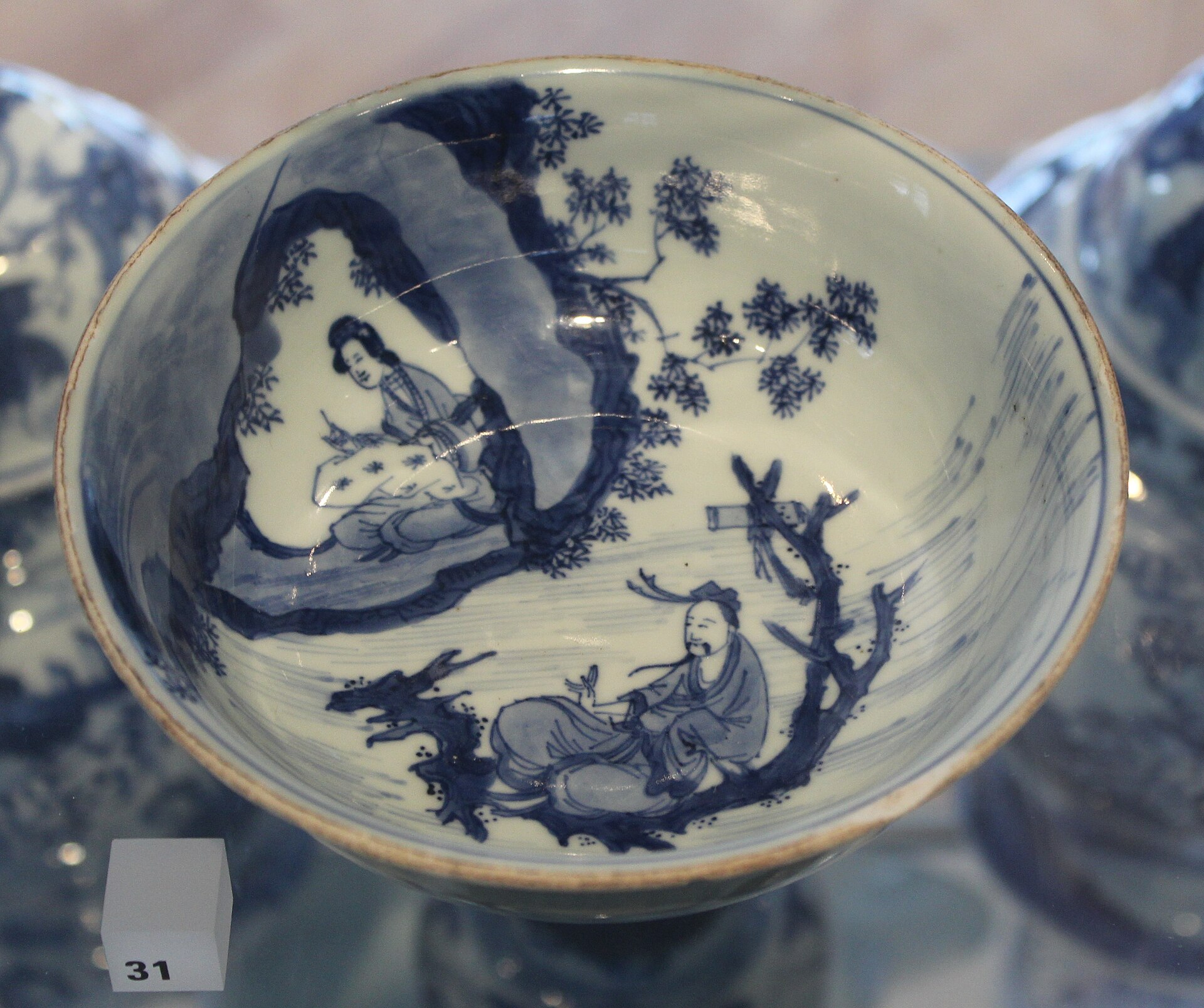
Two museum-catalogued cases show the practice being handled honestly. The Cleveland Museum of Art holds a pair of famille verte bowls with Xiwangmu and attendants, accession 1964.218, made in the Kangxi reign between 1662 and 1722 and carrying Chenghua marks from two centuries earlier; Cleveland catalogues them by what they are, giving the culture line as Qing dynasty, Kangxi reign, but Chenghua mark. That pair is discussed in the Iconotheca record on the Meiyintang cup and is the reference case for the whole class. The Victoria and Albert Museum in London holds a second, less well known example: a Kangxi period dish painted with a river scene, two figures under a rock and a pine, which carries a spurious Chenghua mark on its underside. The mark is not visible in a view of the interior, which is itself the point. A specialist looks at the drawing, the palette and the glaze first and turns the piece over last.

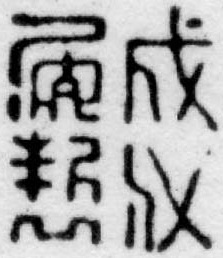
Fraud is a separate and continuing category and it converges on the first over time. An honest homage piece loses its context, acquires an owner who does not know what it is, then a dealer who suspects, and eventually a description that omits the word apocryphal. Meanwhile marks continue to be applied to new objects for the antique markets. A four-character version, Chenghua nian zhi, written in archaising seal script rather than the six-character regular-script form of the reign, circulates widely on much later porcelain and is one of the commoner tells; the reign-period wares do not use it.

The practical rule follows and it is unglamorous. A mark is a terminus for an intention, not for an object. The date is established from the porcelain body and its translucency, the character and surface of the glaze, the range and quality of the enamels, the tone of the underglaze blue, the drawing, and the finish of the foot. Kate Hunt of Christie's Chinese works of art department puts the same test in one sentence a collector can apply without a laboratory: read the mark in conjunction with the quality of the work of art, because an imperial mark on an object that is not of imperial quality is a problem, while a crude mark on a piece of ordinary minyao or people's ware is perfectly consistent with itself.

The waster heaps at Zhushan

The single most important body of evidence about this workshop is not in any collection. It is the broken porcelain the factory itself buried.

Imperial quality control at Jingdezhen was absolute and the disposal of failures was part of it. Pieces with the smallest flaw, and pieces surplus to an imperial order, were destroyed on site so that they could not reach the market. Sotheby's own history of Chinese imperial porcelain states it flatly: quality control by the court was so strict that any vessels with even the most minor flaws, and any surplus to imperial orders, were discarded and destroyed. The consequence for the archaeology is that the ground at Zhushan holds a dated, stratified, uncontaminated sample of what the kilns made in each reign, including everything they made and rejected.

Systematic recovery began in the 1970s under Liu Xinyuan and the institute that is now the Jingdezhen Imperial Kiln Institute, with extensive excavation from 1982. The Institute now gives the total recovered since the late 1970s as more than twenty million kiln relics, running from the late Tang to the Republic. A further joint season with the School of Archaeology and Museology at Peking University and other bodies ran from 2002 to 2004 and produced the site's architecture as well as its contents: the enclosure and courtyard wall on the north of the site, groups of gourd-shaped kiln furnaces facing steamed-bread-shaped stoves at the southern foot of Zhushan hill, and, crucially, small pits and piles of sherds and imperfect wares that had failed selection for the court and been dealt with centrally, with others scattered anywhere nearby. Quan Kuishan's report notes that most of the excavated wares are imperfect in colour and glaze and that several types were discovered there for the first time.

What this settles that a whole vessel cannot is a matter of logic rather than of connoisseurship. A complete cup in a collection has a history; a sherd in a sealed layer at the factory has a manufacture. Sherds of an unfinished doucai chicken cup, painted in underglaze blue only and still lacking its enamels, were recovered from the third and last Chenghua stratum, datable to the final years of the reign. That fragment does three separate jobs at once. It fixes the type to the reign independently of every surviving cup. It proves the sequence of the doucai process directly, because the piece was caught in the middle of it. And it shows that the complete design was drawn onto the body in pale underglaze blue before firing, even where the outlines would later be hidden under the enamels, which is the technical definition that separates doucai from wucai.

The material is not confined to Jingdezhen. Liu Xinyuan's survey of the Chenghua kiln site and its finds was published in A Legacy of Chenghua: Imperial Porcelain of the Chenghua Reign Excavated from Zhushan, Jingdezhen, the catalogue of a 1993 exhibition mounted by the Jingdezhen Institute of Ceramic Archaeology with the Tsui Museum of Art in Hong Kong; that catalogue is still the reference cited by auction houses when a piece is matched to an excavated fragment. The institute had already shown excavated material with the Fung Ping Shan Museum at the University of Hong Kong in 1992. In 2013 a selection of 118 pieces and sets of excavated and restored Chenghua imperial porcelain travelled to the Civic and Municipal Affairs Bureau gallery in Macau, arranged in four categories: doucai, blue and white, monochrome and coloured glazes, and imitations of Song dynasty wares.

Setting the rejects beside the survivors

Between 2015 and 2019 the Palace Museum in Beijing ran a series of six exhibitions built on a single curatorial idea: put the pieces the emperor received next to the pieces the same kilns made and threw away in the same year. The Chenghua edition, The Ming Imperial Porcelain: A Comparative Exhibition of Archaeological Findings at the Imperial Kiln Site in Jingdezhen and Chenghua Period Porcelain in the Collection of the Palace Museum, ran from 25 October 2016 to 26 February 2017 with more than 180 porcelains. The sixth and final edition, covering the Jiajing, Longqing and Wanli reigns, ran from 6 November 2018 to 22 February 2019 with 298 exhibits drawn from the palace collection and from the Jingdezhen excavations.

The exhibitions are worth citing not as events but as method. They put on public record why individual pieces failed, and the reasons are specific rather than aesthetic: deformity, incorrect inscription, wrong painting. One Chenghua blue and white dish with dragons and phoenixes was rejected because the painter had given one dragon six claws and another four. The imperial standard was five. Nothing was wrong with the potting, the glaze or the blue. A drawing error in a claw count was enough to have the object smashed and buried, and it stayed buried for roughly five hundred and thirty years until an archaeologist reassembled it.

Two conclusions follow that bear directly on any provenance. The first is that survival rate is not production rate. The number of Chenghua pieces in the world is a function of what the factory allowed out, not of what it made, and the factory was the first and harshest editor in the chain. The second is that the excavated corpus and the transmitted corpus overlap only partially, so a design known from sherds and unknown from whole vessels is not a fake type, and a design known from whole vessels and absent from the sherds is not thereby suspect either. Both statements sound obvious and both are routinely got wrong by people describing objects for sale.

Doucai: two firings and the arithmetic of loss

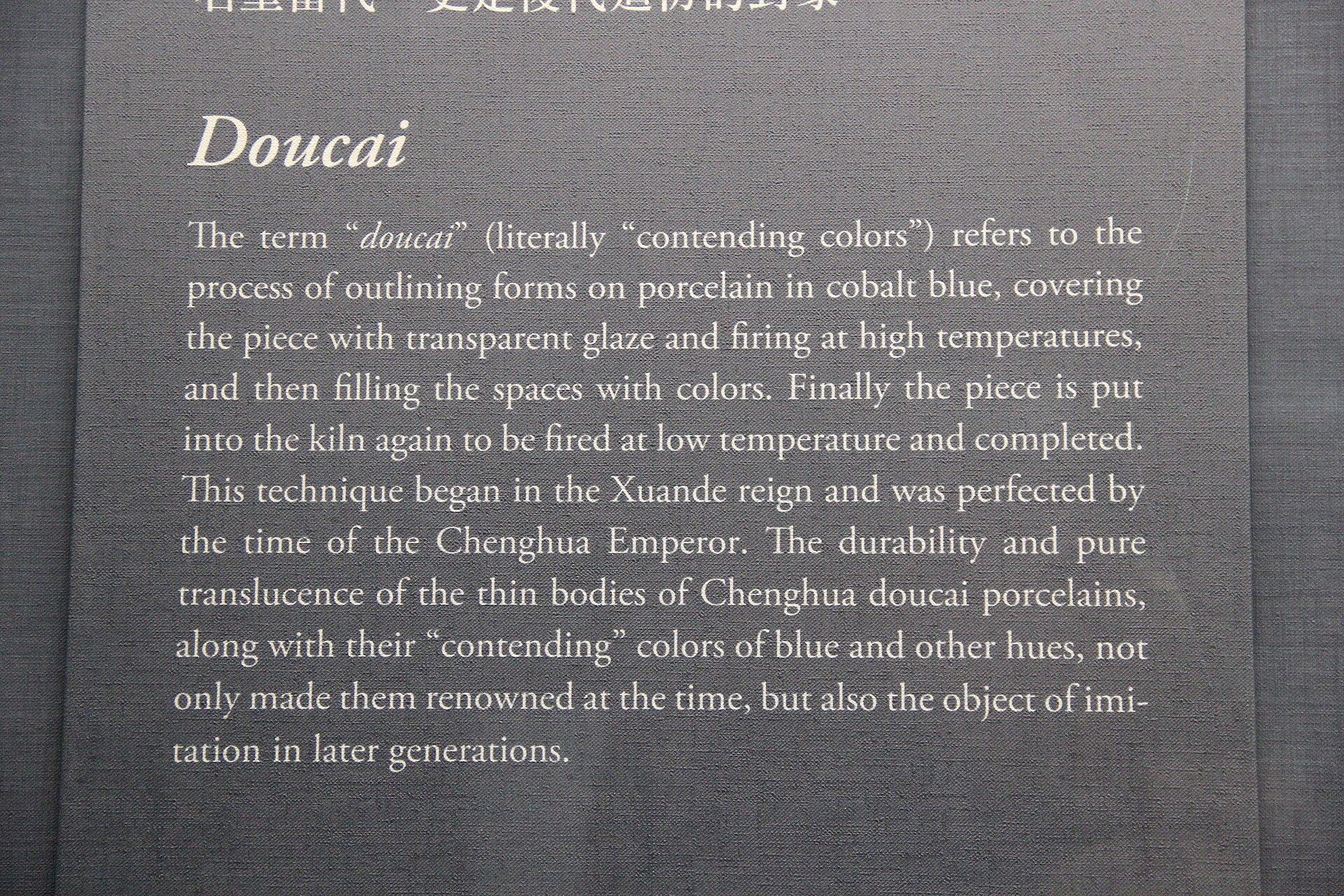
Doucai has been translated as contrasted colours, contending colours, fitted colours, colours which fit together and dovetailed colours. The National Palace Museum in Taipei, on the gallery label in its own pottery and porcelain rooms, gives it as contending colours and then describes the whole procedure in four clauses: outlining forms on porcelain in cobalt blue, covering the piece with transparent glaze and firing at high temperature, then filling the spaces with colours, then putting the piece into the kiln again to be fired at low temperature and completed.

The temperatures are what make it difficult. The first firing is a full porcelain firing. The second, which fixes the overglaze enamels, runs at roughly 850 to 900 degrees, and every colour that will not sit beside another in the same pass requires a further trip through the muffle kiln. On the chicken cups several enamels were superimposed to build the variegated plumage, and each superimposition meant another firing. The palette of the reign is iron red in more than one tone, greens ranging from a bright to a dark olive, yellow, and a transparent aubergine which can be laid over other colours and which therefore costs an extra firing wherever it appears, all of it sitting inside a shaded, pale underglaze blue.

The consequence is arithmetical rather than mystical, and Sotheby's states it plainly: the repeat firings necessary for the process would naturally have reduced the number of successfully completed examples. Scarcity in this ware begins inside the kiln, before any question of five centuries of breakage, and before the inspectors got anywhere near it. A Chenghua doucai cup that survives has passed the first firing, two or more enamel firings, the imperial inspection, and then five hundred years of handling. Each of those is a filter and only the last of them is chance.

The technique did not begin in the reign. A doucai dish with red and green enamels was excavated at the Jingdezhen kilns from the Xuande period, 1426 to 1435, and Xuande doucai was only recognised as a category at all once the Zhushan fragments made the comparison possible. What Chenghua did was perfect it. The Taipei label puts the sequence exactly: the technique began in the Xuande reign and was perfected by the time of the Chenghua Emperor, and the durability and pure translucence of the thin bodies, together with the contending colours, made these wares renowned at the time and the object of imitation in later generations. Cleveland's description of its own Chenghua doucai wine cup with children at play, accession 1957.61 and only four point eight centimetres high, is the same account written from the object: free, spontaneous drawing, perfect compositional balance over a very small surface, and a porcelain body that is thin, translucent and light in the hand.

The blue is domestic, and that is the point

The softness that specialists praise in Chenghua underglaze blue is a raw material fact before it is an aesthetic one, and it is one of the strongest dating arguments available.

Early Ming imperial blue and white was painted with imported cobalt, the ore the Chinese sources call sumaliqing, brought from the Middle East and used for the Yongle and Xuande wares. It is strong, saturated, and prone to run and to throw dark iron spots where it pools. From the middle and late Xuande period domestic ore came into use alongside it, and by the Chenghua reign the domestic material had taken the leading position. The ore is pingdengqing, also called pitangqing, mined at Leping in Jiangxi, close to Jingdezhen itself. It is higher in manganese and lower in iron than the imported ore, it diffuses much less in the glaze, and it fires to a quieter, greyer, more even tone. It is the standard cobalt of the Chenghua and Hongzhi reigns.

Nicolas Chow, describing a Chenghua palace bowl for Sotheby's, calls the result a very soft, watery cobalt blue and treats it as a deliberate break from the early fifteenth century, when the cobalt was imported and very strong and punchy. That is the right way round. The quiet blue was not a limitation that the Chenghua potters were unable to overcome; it was the effect they wanted, and it is inseparable from the other thing the reign did with its blue and white, which was to leave a great deal of the porcelain white. Where the Yongle and Xuande painters filled the surface, the Chenghua painters set a single scrolling stem against an open field and stopped.

The material argument has since been tested instrumentally. Collaborative research between the Jingdezhen Imperial Kiln Institute and Peking University, reported in 2025, confirmed the coexistence of imported and domestic raw materials from the Xuande period onward, which is exactly the transition the connoisseurial account describes. That is the useful shape of evidence in this field: a proposition arrived at by eye in the nineteenth and twentieth centuries and then confirmed by composition in the twenty-first, using sherds from the factory floor as the reference set.

How an order reached Jingdezhen

A Ming imperial porcelain begins as a document in Beijing and ends as a crate on a river. The intervening machinery is the reason this page describes a manufactory rather than a workshop.

The imperial kiln factory was established at Zhushan in 1369, in the second year of the dynasty, and by 1402 there were twelve imperial kilns at Jingdezhen. Production was controlled by a ministry in the capital, far to the north, and supervised locally by officials delegated to Jingdezhen from the imperial workshops at court. Court artists supplied the designs, drawn or printed from woodblocks, so that the pattern on a Chenghua dish was fixed in Beijing and executed in Jiangxi by men who had never seen the room the object was going to.

The quantities are the part that surprises people who know the reign only through eight-centimetre wine cups. A single palace order in 1433 called for 443,500 pieces, all with dragon and phoenix designs. In 1459 the court sent an order to the supervisors at Jingdezhen for 133,000 pieces, later reduced to 80,000 because the resources to make them were not there. Imperial wares were not only for the emperor's table: they went to the provincial courts of Ming princes and out of the empire as diplomatic gifts, which is one reason a fifteenth-century Jingdezhen stem cup can be found today in the ceramics gallery of the Tibet Museum in Lhasa.

The labour was industrial and specialised. Production employed hundreds and probably thousands of workers whose tasks were divided into separate trades to increase efficiency and consistency: chopping the firewood, purifying the clay, grinding the cobalt. By the sixteenth century there were hundreds of kilns at Jingdezhen with thousands of workers. The environmental cost is recorded too: mountains stripped bare for firewood and fern ash, hillsides quarried for clay, and the sky over the town dark with smoke. None of the people who did any of this is named. What we call a Chenghua chicken cup is the output of an administrative system operating to a specification, and the correct object of study is that system.

What the factory did to its failures, and why a provenance depends on it

The imperial factory operated regardless of cost and prioritised quality over commercial return, which is a sentence about accounting rather than about art. It could afford to destroy because it was not selling. Defective pieces, and pieces beyond the number ordered, were smashed on site and buried so that they could not enter the market. The practice ran until 1566, after which seconds were handled differently.

Three things follow for anyone assembling a chain of ownership on a Chenghua object, and they are not obvious.

First, there is no legitimate fifteenth-century commercial provenance. An imperial Chenghua piece did not leave Jingdezhen through a market; it left in an official consignment to the court or it did not leave at all. Any account of a Chenghua imperial porcelain that begins in a private Ming collection has an unexplained step in it, and the honest version of most Chenghua provenances is a blank of four centuries followed by a twentieth-century exhibition catalogue.

Second, the buried rejects are the reason a modern market in excavated Chenghua sherds exists at all, and the reason that market is legally and ethically fraught. Material smashed and buried by the state in 1485 and dug up in the 1980s belongs to the archaeological record, not to the trade. The published, curated route into that material is through the Jingdezhen Institute, the Palace Museum comparison exhibitions and the 1993 Tsui Museum catalogue, and a fragment offered with no excavation reference is a fragment with a problem.

Third, and most usefully for a buyer, the destruction is what makes the excavated corpus a control set. Because the factory buried what it rejected, and because it buried it where and when it made it, a questioned whole vessel can be compared against fragments of known reign, known kiln and known date. That is the closest thing this field has to an instrumental test, and it was created by an administrative decision to destroy value rather than release it.

The corpus, and who is entitled to count it

No complete catalogue of Chenghua imperial porcelain exists and none can, because the production records do not survive and because the census question and the authentication question are the same question. What exists instead are three partial counts that a reader should keep separate.

The first is the count of pieces in private hands. Regina Krahl, cataloguing for Sotheby's, records that only some two dozen porcelains of Chenghua mark and period, of any style or design, are recorded as remaining in private hands anywhere. That figure covers the whole reign and every shape, not one type, and it is the single most useful number on this page for anyone considering a purchase.

The second is the count within a design. The blue and white palace bowls, the classic type of the reign, were made over roughly a decade in the 1480s in about eleven or twelve distinct designs, ten of them floral and one showing fruit. Of the melon design, Krahl documents twelve complete bowls surviving worldwide, none of them apparently in the National Palace Museum in Taipei or the Palace Museum in Beijing. Of the daylily design, Sotheby's records only about three known, two of them in the British Museum. These are counts by connoisseurs of a type, not registers, and they move when a piece surfaces.

The third is the institutional concentration, which is the number that explains the market. The largest surviving body of Chenghua porcelain from the former imperial holdings is in Taipei, and a researcher working from that collection puts more than ninety per cent of the world's Chenghua doucai in the National Palace Museum. Taipei mounted 197 pieces in a Chenghua exhibition in 1977 and 207 in 2003, with a digitised catalogue for the later show. Against a private-hands figure of about two dozen for the entire reign, that is not a market with a thin float. It is a market in which the float is a rounding error.

The chicken cups are the best known sub-corpus and they are counted separately in the Iconotheca record of the Meiyintang cup, where the competing figures of sixteen, seventeen and nineteen and the disputed Beijing examples are set out. What belongs here is only the structural point: Taipei holds eight of them, more than any other institution, and the count of any Chenghua type is a specialist's opinion about authentication rather than an inventory.

The collections that define the field

Four collections decide what a Chenghua object is, and a fifth decides what it costs.

The Percival David collection is the one a European or American researcher will reach first. Sir Percival Victor David Ezekiel David, 1892 to 1964, a Bombay-born financier who read and spoke Chinese, began collecting around 1913 and first visited China in 1923. He acquired roughly forty pieces that had come out of the Forbidden City after 1927, when objects were disposed of by members of the Imperial Household Department, buying through dealers, at auction and from other collectors. He gave the collection to the University of London in 1950; it opened to the public at 53 Gordon Square in Bloomsbury on 10 June 1952 and served as the teaching collection for the study of Chinese art in Britain. Funding failed and Gordon Square closed at the end of 2007. The collection moved on long-term loan to the British Museum and opened in the purpose-built, bilingual Room 95 on 23 April 2009. On 14 November 2024 the trustees announced that they were giving the 1,700 pieces to the museum outright, a gift the museum valued at around one billion pounds and described as the highest value object donation in the history of British museums; the transfer completed on 2 April 2025. The terms require the collection to stay on public display together in perpetuity in a dedicated gallery, with loans to the Shanghai Museum and the Metropolitan Museum of Art contemplated, and the transfer required the consent of the Charity Commission. The doucai chicken cup of the Chenghua reign was one of two objects the museum named in announcing the gift.

The National Palace Museum in Taipei holds the Qing imperial collection, and with it the largest surviving body of Chenghua porcelain from the former palace holdings and, on one researcher's estimate, more than nine tenths of the world's Chenghua doucai. Its chicken cup, accession 005190 in the older numbering and K1B005192 in the current one, is four centimetres high and eight point three across, with two groups of a cock and hen and three chicks separated by China roses and orchids, three blue lines at the mouth and base, and a plain white interior. The museum's own record adds something no Western account carries: the cup can be traced through the Qing Imperial Workshop archives to the Yongzheng reign and comes with a Qianlong-period silk-embroidered box. That is a documented eighteenth-century provenance for an object of the fifteenth, which is more than almost any Chenghua piece in the West can show.

The Palace Museum in Beijing holds the other half of the imperial collection and is the institution that has done most to change the method. Its comparative exhibitions with the Jingdezhen material between 2015 and 2019 moved the centre of Chenghua scholarship from the vitrine to the excavation, and its own Chenghua examples remain contested at the margin, with two chicken cups excluded from the Sotheby's census by Western specialists.

The Meiyintang collection, built from the late 1950s by the brothers Stephen and Gilbert Zuellig and catalogued by Regina Krahl in four volumes between 1994 and 2010, is the private collection against which the modern market has been calibrated; its history and dispersal are set out in the Iconotheca record of its chicken cup. Its palace bowls came to Sotheby's Hong Kong in 2011 with estimates in the tens of millions of Hong Kong dollars, and the catalogue notes Krahl wrote for that sale and for the Pilkington collection sale of 2016 are, for practical purposes, the working literature on Chenghua blue and white in English.

The fifth collection is the ground itself. The Jingdezhen Imperial Kiln Institute, successor to the Jingdezhen Ceramic Archaeology Research Institute, holds more than fifty thousand exhibit-ready items, shows nearly seven hundred restored porcelains in its permanent display alongside thousands of sherd specimens, and since June 2022 has run an Ancient Ceramic Gene Bank with Tsinghua University, the Palace Museum and the Shanghai Institute of Ceramics. More than three thousand specimens have been digitised, including three-dimensional models with their archaeological records and analytical data, yielding close to 1.2 million individual data points. In one reported case seventeen comparative samples across the Ming and Qing were used to identify a dragon-patterned dish as late Qing folk-kiln work. The institute's own phrase for the procedure is a porcelain DNA test. That is where Chenghua authentication is heading, and it is a museum in a small Jiangxi city rather than an auction house that is building it.

The market, with the hammer separated

Chenghua is the most expensive reign in Chinese ceramics and it is traded on a float of roughly two dozen objects. Prices are therefore lumpy, estimates are unreliable, and the published figures need reading with care because almost nobody separates the hammer from the premium.

The clearest recent result is a blue and white palace bowl with a daylily design, 14.9 centimetres across, sold at Sotheby's Hong Kong on 8 October 2019 as lot 1002 in a two-lot sale, Two Ming Porcelain Masterpieces from an Important Collection. The estimate was published as in excess of HKD 50,000,000. The hammer fell at HKD 48,000,000. The price realised was HKD 56,738,000. Three things are worth noticing in that sequence. The bid was below the published estimate and only the buyer's premium carried the total above it, which is exactly the arithmetic that makes premium-inclusive reporting misleading. The winning bid was placed on the telephone by Peter Song of Sotheby's Beijing office for an unnamed client. And the reporting outlet's own headline rounded the result to HKD 56.3 million against a body figure of HKD 56,738,000, an internal inconsistency in a single article about a single lot; the body figure is the one used here.

Two Chenghua cups came up together at Sotheby's Hong Kong on 5 April 2017 in In His Majesty's Palm: Exquisite Porcelain Playthings. Lot 3102, a blue and white cup, was estimated at HKD 15,000,000 to 20,000,000 and sold for HKD 33,850,000. Lot 3101, a doucai stem cup, was estimated at HKD 8,000,000 to 12,000,000 and sold for HKD 13,300,000. Neither figure is broken out into hammer and premium by the source consulted and neither should be assumed to be a hammer price.

Estimates in this field are not a guide. The Meiyintang palace bowl offered at Sotheby's Hong Kong in 2011 as lot 56 carried an estimate of HKD 80,000,000 to 120,000,000; the melon palace bowl from the Pilkington collection offered in 2016 as lot 25 carried HKD 50,000,000 to 70,000,000. Neither lot page displays a result to a visitor who is not signed in, which is a recurring obstacle to research in this market and is recorded here as such rather than filled with a guess.

One recent result is reported in a way this record cannot reconcile. A Chenghua blue and white palace bowl of lily design, known as the Palmer Palace Bowl and offered at Sotheby's Hong Kong on 9 September 2025 from the Ise collection, is described in the single source consulted as carrying an estimate of HKD 40,000,000 to 80,000,000 and selling for HKD 35,145,000. If the selling figure includes the premium, the hammer would have been roughly HKD 28 to 29 million, well below the published low estimate. That is possible where a reserve sits under the estimate, but the source does not say so and no hammer is published. The figure is carried here with the discrepancy flagged rather than smoothed.

The reference point above all of these is the chicken cup sold on 8 April 2014, hammer HKD 250,000,000 and HKD 281,240,000 with the premium, then the highest price ever paid at auction for any Chinese porcelain. That sale has its own Iconotheca record and is not re-described here. What belongs on this page is the ratio it implies: a single doucai cup of the reign made more than four times the best palace bowl result of the following decade, which is a statement about the chicken cup's fame rather than about Chenghua porcelain, and confusing the two is the commonest error made about this market.

One older figure is worth setting beside them. Cleveland's Chenghua palace bowl with lily scrolls, accession 1967.64, passed through the sale of the Eumorfopoulos collections at Sotheby's London on 28 to 31 May 1940 as lot 238, illustrated in the catalogue, and reached Cleveland as a gift of John D. Rockefeller III combined with a purchase from the John L. Severance Fund. The 1940 price is not published in the sources consulted here. An object of that class crossing a London saleroom in the month of Dunkirk is a reminder that the modern price is a modern fact.

A short reign, a short window, and the court that ordered it

The wares this page describes were made for a particular household in a particular decade, and the court in question was not a calm one.

Zhu Jianshen took the throne on 23 February 1464 at sixteen and reigned until his death on 9 September 1487, aged thirty-nine. The dominant figure of the reign was Lady Wan Zhen'er, 1428 to 1487, who had been his nurse when he was a child, was thirty-four when he came to the throne, and became his consort. She bore him a son in 1466 who died within a year, and thereafter, on the standard account, forced other palace women to abort so that no rival heir could be born. Her agents ran illegal mining, foreign trade, pearl gathering and salt dealing, and the emperor rarely restrained her. She died in the same year he did. A secret police organisation, the Western Depot, was created in 1477 alongside the existing Eastern Depot and run by the eunuch Wang Zhi, who had served Lady Wan and who terrorised the Beijing elite until he was transferred in 1483. By the end of the century the palace employed over ten thousand eunuchs, close to the number of regular civil servants.

A persistent claim in the Chinese-language literature attributes the character of Chenghua porcelain to Lady Wan directly, holding that her taste and her demands drove the kilns to the standard they reached. That claim is repeated widely and this record has found no primary document behind it. It is recorded here as an argued position, not as a fact, and a reader should treat any account of Chenghua wares that leans on it as leaning on an attribution of motive rather than on evidence.

What is documented about the emperor's own commitments is religious. He supported Buddhism against the objections of Confucian officials, and in 1473 ordered the building of five pagodas in the Indian style west of Beijing. Ming imperial porcelain travelled as diplomatic gift as well as court supply, and blue and white of the period is held today in the ceramics gallery of the Tibet Museum in Lhasa, which is one visible end of that traffic. The connection between the emperor's Buddhist patronage and the design of particular vessels is not established by anything consulted here and is not asserted.

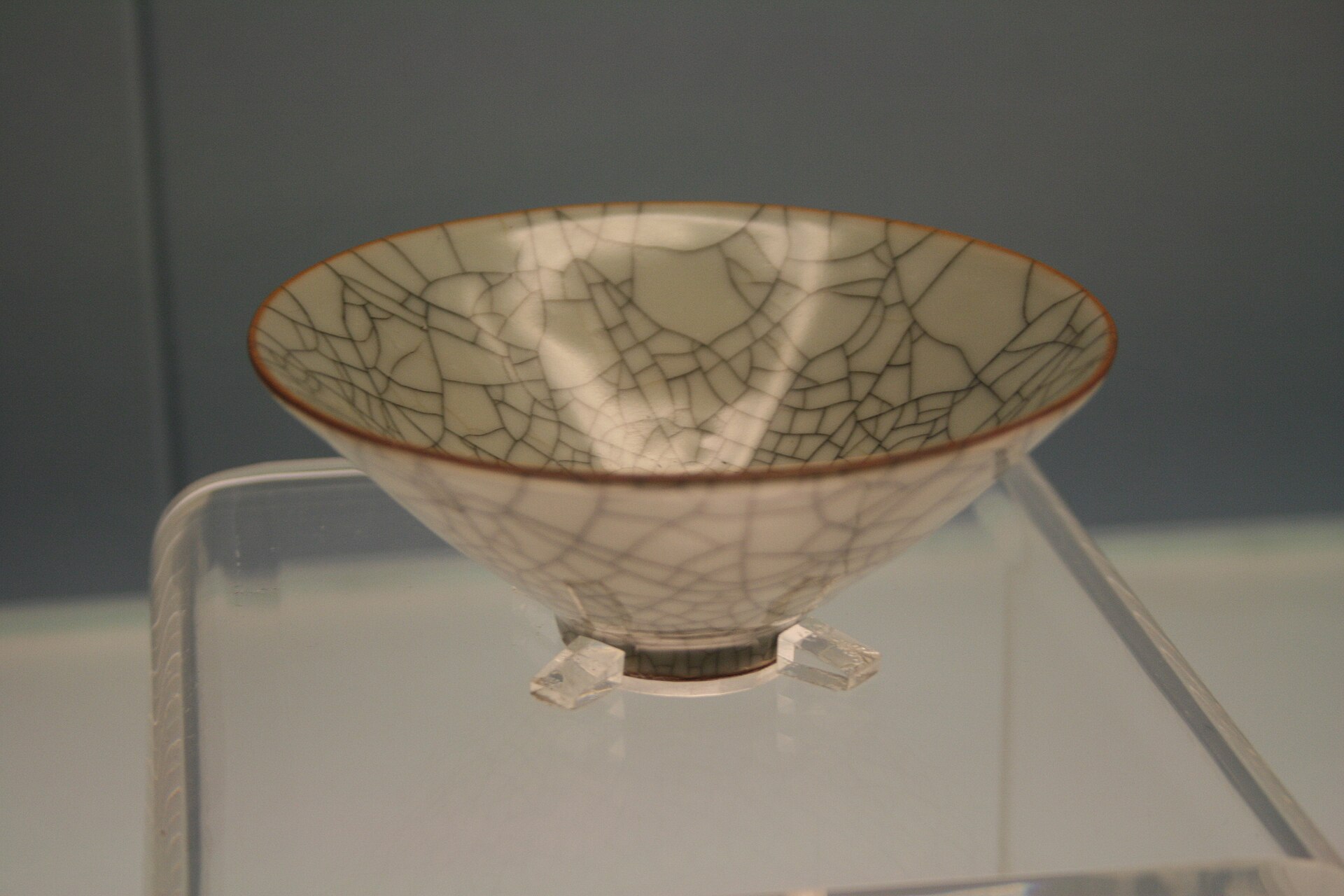
The reign's ceramic output is also, quietly, an antiquarian programme. Alongside the doucai and the blue and white, the Chenghua kilns produced imitations of Song dynasty wares, and a crackle-glazed conical bowl of Ge type in the Shanghai Museum, filed to the reign, is one of them. The Macau exhibition of excavated Chenghua material organised its 118 pieces into exactly four groups, and Song-style imitations were one of the four. A court factory that spends part of its capacity reproducing the ceramics of a dynasty five hundred years dead is making a claim about lineage, and the same claim is being made two centuries later, in reverse, every time a Kangxi potter writes Chenghua on the base of his best bowl.

The window closed early. Palace bowl production has been placed in a maturing phase from about 1481 and the finest wares confined to the decade before 1485, when the imperial kilns halted production; on one reading the whole classic phase runs to about seven years. The emperor outlived his kilns by two years. That is the fundamental reason Chenghua imperial porcelain is rare, and it has nothing to do with breakage.

Not only doucai, and not only cups

The reign is known in the market for eight-centimetre doucai wine cups, and the market's picture is too narrow.

The blue and white palace bowls are the type most scholars would defend as the reign's highest achievement. They are around fourteen to fifteen centimetres across, decorated on the exterior with a continuous scrolling design and usually left blank inside, and painted in the soft domestic cobalt with a great deal of white porcelain left showing. Nicolas Chow points to a compositional trick in them that he says was never repeated, even in the Qing: a motif is repeated three times and then the scroll simply breaks. Cleveland's example with lily scrolls, 14.5 centimetres across and 6.9 high, is a clean specimen of the type and is reproduced as plate 35a in Harry Garner's Oriental Blue and White of 1954.

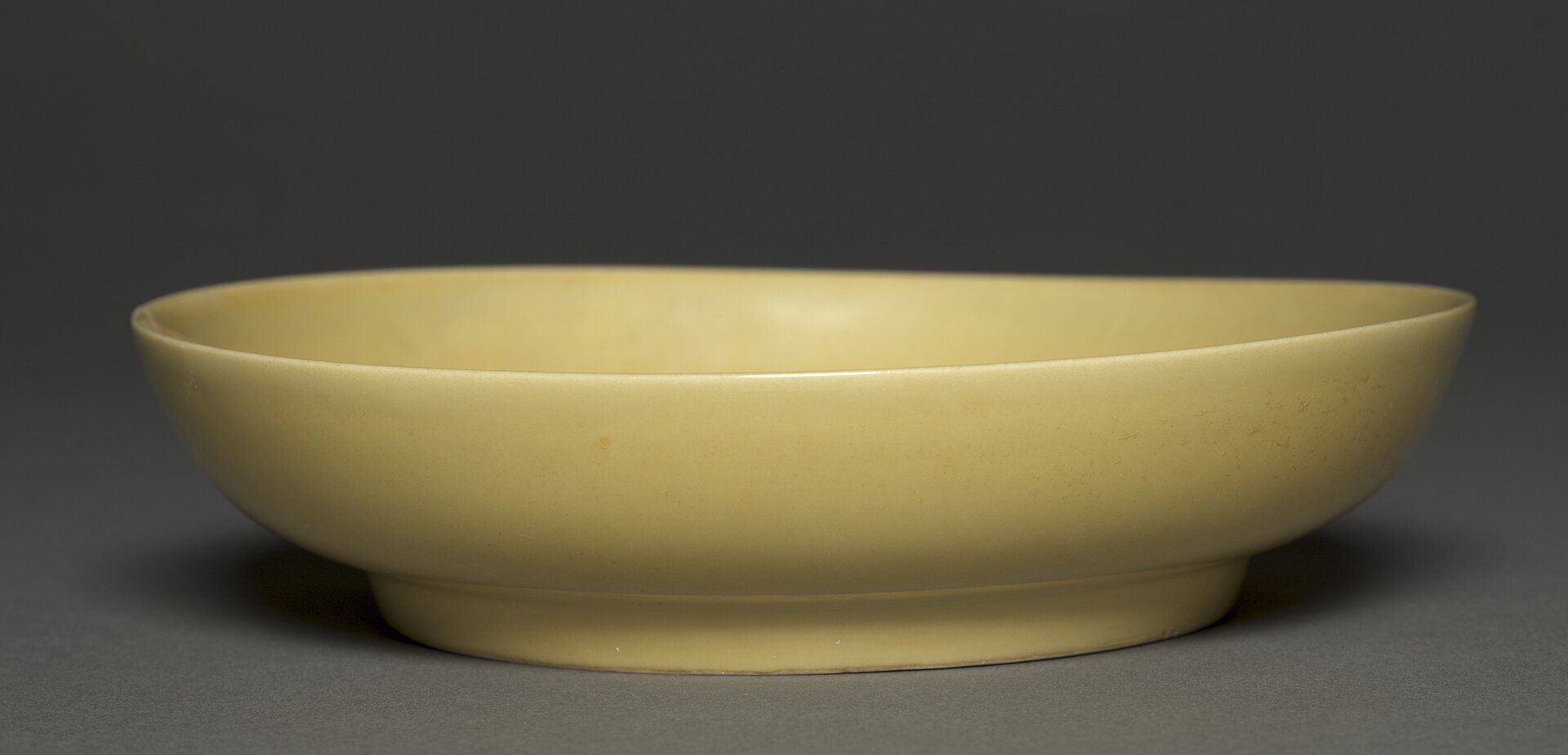
The kilns also made monochromes at the top of their range. A Chenghua dish in Cleveland, accession 1989.288, is 21.5 centimetres across, glazed in a plain even yellow with no decoration whatever, and marked with the same six characters. Sherman Lee, Cleveland's director and the author of the standard survey, treated the refinement of monochrome porcelain as the major theme of the whole Chinese ceramic tradition and held that the Ming and Qing gave equal attention to monochrome reds and yellows as to painted wares. What the dish was for is not stated in the museum record and is not guessed at here.

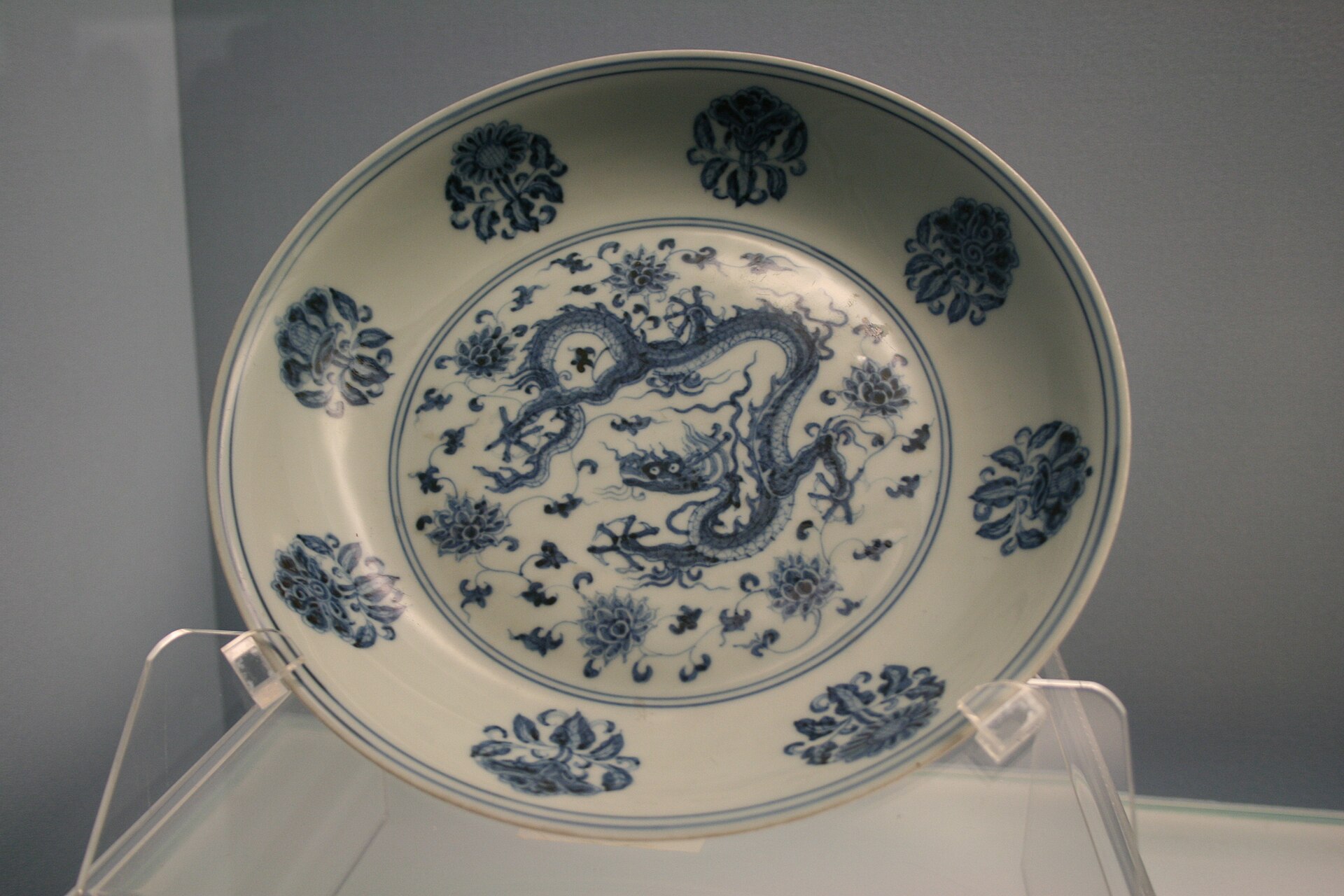
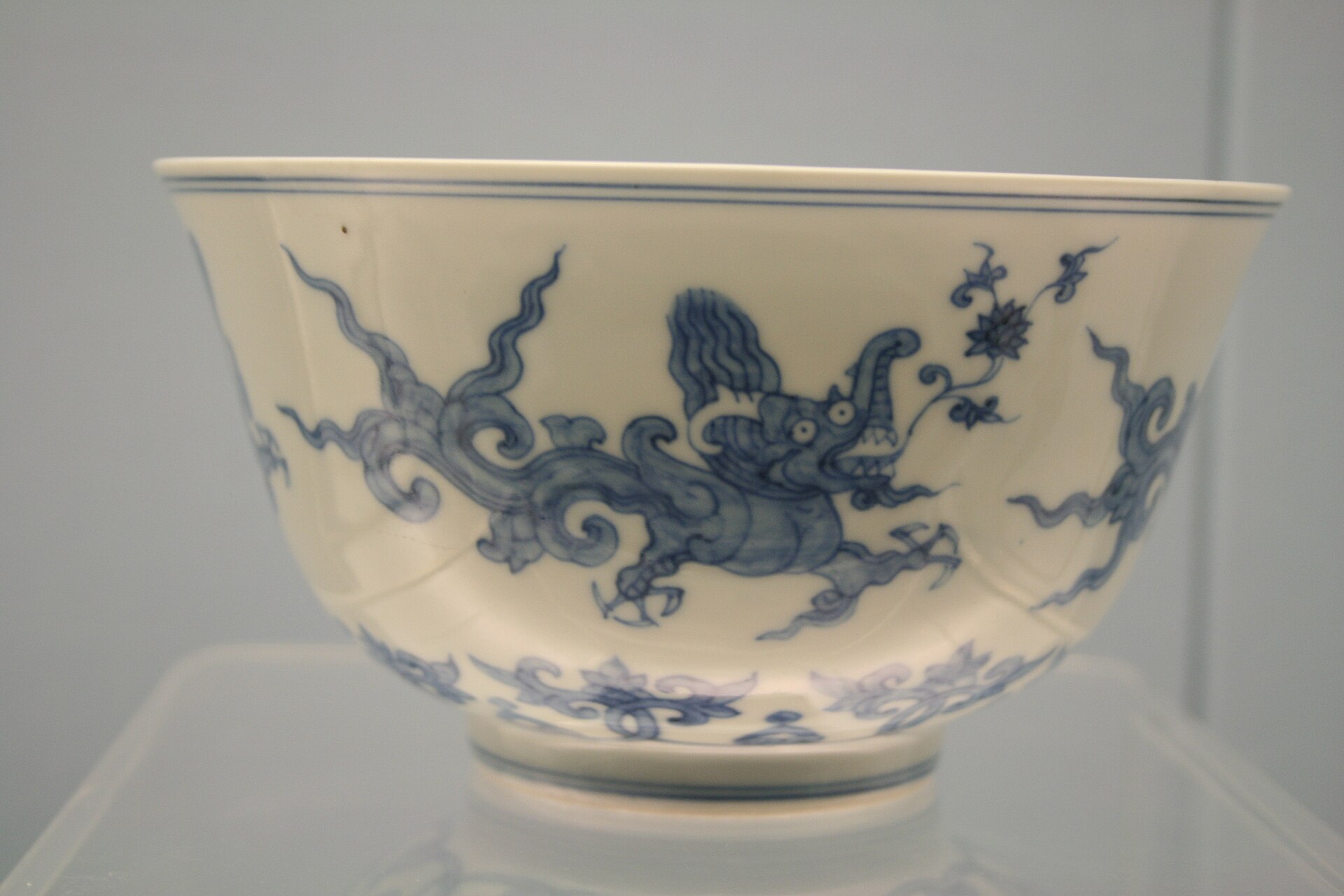
Then there are the imperial forms that carry the state's own symbols. A Chenghua dish in the Shanghai Museum is painted with a five-clawed dragon among lotus scrolls with floral medallions around the cavetto; another Shanghai bowl carries a five-clawed dragon among clouds pursuing a flaming pearl; a third carries a winged mythical beast with a lotus spray. The claw count is not ornament. Five claws were the imperial standard and a miscount was grounds for destruction, as the rejected Chenghua dragon and phoenix dish from the Zhushan excavations demonstrates. When the 1433 order specified 443,500 pieces all with dragon and phoenix designs, it was specifying an emblem of legitimacy in an industrial quantity.

Set against that range, the doucai cups are a small, late, technically extreme corner of the output. They are also the corner the market has decided to pay for, which is why the reign's reputation now rests on the class of object most vulnerable to imitation and least likely to survive.

The reign that would not stay in its century

Chenghua wares were expensive within a hundred years of being made and they have never stopped being expensive, which is unusual and which has consequences for how the material reaches us.

The National Palace Museum's own record of its chicken cup cites the scholar Cheng Zhe for a valuation under the Wanli Emperor, reigning 1572 to 1620, of a hundred thousand cash for a pair. The Qianlong Emperor, reigning 1736 to 1795, wrote an ode in praise of chicken cups. A chicken cup turns up as a plot detail in Cao Xueqin's Hong lou meng, the great eighteenth-century novel, used by accident by a character who should not have had it. By the time the Qing potters were producing their homages, the object being honoured was already a literary reference.

The Qing revival is where the doucai technique reached its second peak and where the confusion begins. A pair of doucai cups in the Art Institute of Chicago, accession 1941.701a-b, made in the Yongzheng reign between 1723 and 1735, shows how far it went: floral medallions delicately outlined in pale cobalt, glazed, fired, then filled with soft translucent enamels that sit so exactly inside the outlines that the museum uses them to explain the term. The Yongzheng Emperor was himself an artist and connoisseur and took a personal role in overseeing the imperial kilns. And that pair carries a six-character mark in regular script inside a double square reading Da Qing Yongzheng nian zhi: its own reign, honestly. The Qing potter who signed Chenghua instead was not obliged to. He chose the earlier name.

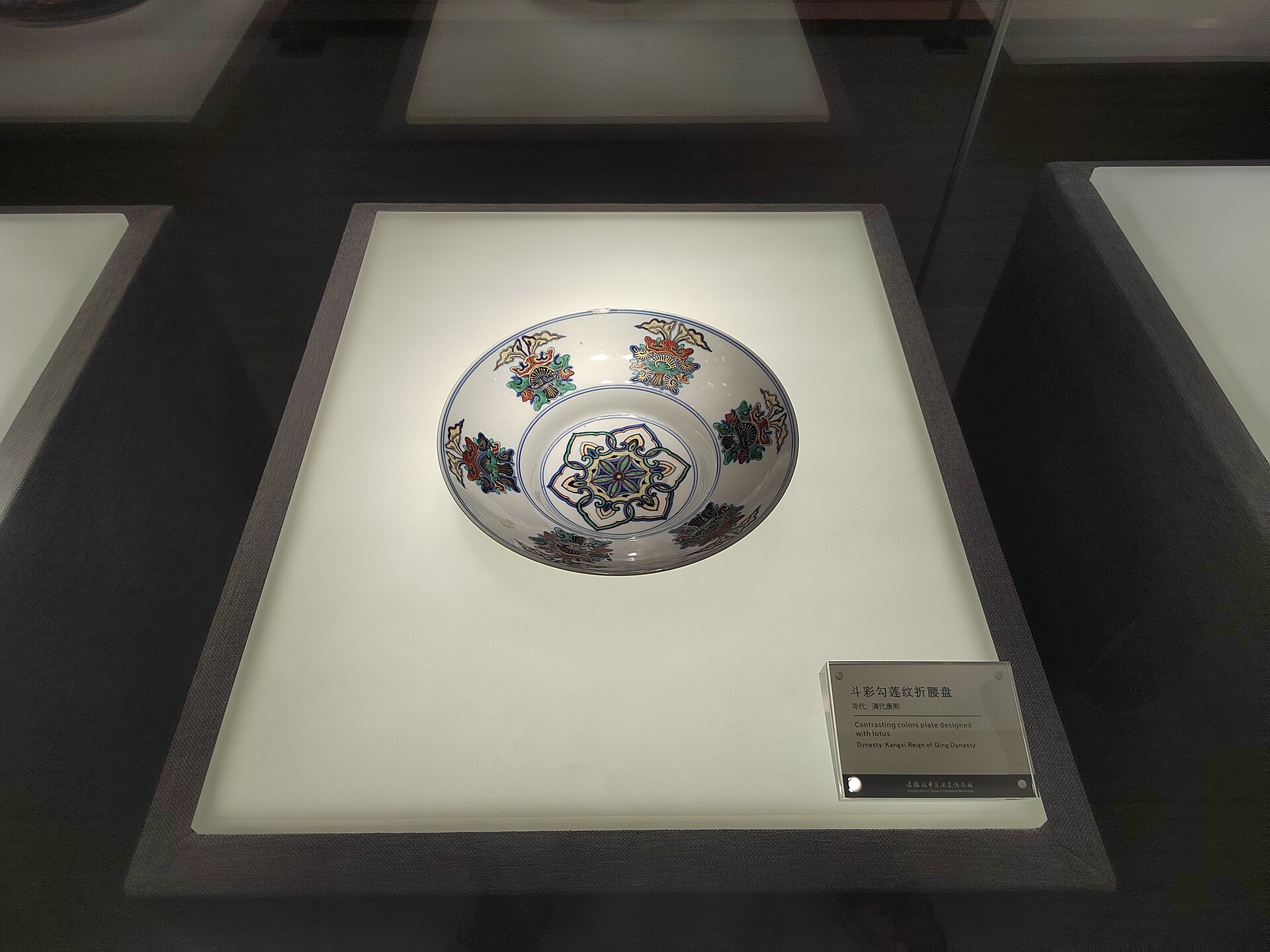
Doucai continued at Jingdezhen through the Qing and is still being made there. The Jingdezhen China Ceramics Museum displays a Kangxi doucai dish with lotus under a bilingual label calling it a contrasting-colours plate. Reproductions of Chenghua cups are produced in quantity for the antique markets and sold both as declared replicas and as something else.

The result is a five-hundred-year continuum of objects that all say the same six characters and mean different things by them, and no instrument on the base can tell them apart. The reign mark on a Chenghua porcelain is the most valuable inscription in Chinese ceramics and the least reliable, and both halves of that sentence have to be held at once by anyone who intends to buy, catalogue or publish one.

Images

12 plates
Chenghua palace bowl with lily scrolls, Cleveland 1967.64
Chenghua palace bowl with lily scrolls, Cleveland 1967.64A blue and white palace bowl, 14.5 cm across and 6.9 cm high, Jingdezhen, Chenghua mark and period, inscribed <em>Da Ming Chenghua nian zhi</em> on the base. This is the classic type of the reign: a continuous scrolling design on the exterior, the interior left plain, and a great deal of white porcelain left showing, in deliberate contrast to the filled surfaces of the earlier fifteenth century. The blue is the soft domestic cobalt of Leping. The bowl passed through the Eumorfopoulos sale at Sotheby's London in May 1940 as lot 238 and was reproduced by Harry Garner in 1954; it reached Cleveland as a gift of John D. Rockefeller III with a purchase from the Severance Fund.Cleveland Museum of Art, gift of John D. Rockefeller III and purchase, John L. Severance Fund, 1967.64
Five claws, and what a miscount cost
Five claws, and what a miscount costA Jingdezhen dish of the Chenghua reign in the Shanghai Museum, painted in underglaze blue with a dragon among lotus scrolls in the well and floral medallions around the cavetto. Count the claws. Five was the imperial standard and it was enforced: a Chenghua dragon and phoenix dish recovered from the kiln site at Zhushan carries one dragon with six claws and another with four, and was smashed and buried for it. Nothing was wrong with the potting, the glaze or the blue on that dish. A drawing error was enough.Shanghai Museum; photograph by Gary Lee Todd, released CC0 via Wikimedia Commons
Winged beast bowl, Shanghai Museum
Winged beast bowl, Shanghai MuseumA Chenghua bowl in the Shanghai Museum, painted in underglaze blue with a winged mythical beast striding through cloud scrolls beside a lotus spray, with a lotus band round the foot and double line borders at the rim. The drawing is confident and economical, and the blue is even and undiffused, without the pooling and dark iron flecks that the imported cobalt of the Yongle and Xuande reigns produces. That evenness is the domestic ore from Leping doing what it does, and it is one of the primary period tests.Shanghai Museum; photograph by Gary Lee Todd, released CC0 via Wikimedia Commons
Chenghua yellow, Cleveland 1989.288
Chenghua yellow, Cleveland 1989.288A dish 21.5 cm across, Jingdezhen, Chenghua mark and period, glazed in a plain even yellow with no decoration of any kind and carrying the same six characters on the base as the painted wares. The reign is known in the market for eight-centimetre doucai cups, and the market's picture is too narrow: the same factory in the same decade was producing monochromes at the top of its range. Sherman Lee, Cleveland's director, treated the refinement of monochrome porcelain as the major theme of the whole Chinese ceramic tradition. What this dish was for is not stated in the museum record and is not guessed at here.Cleveland Museum of Art, bequest of Mrs Severance A. Millikin, 1989.288
The Song revival, Shanghai Museum
The Song revival, Shanghai MuseumA conical bowl of Ge type with an amber-lipped rim and a crackled grey-white glaze, in the Shanghai Museum and filed to the Chenghua reign. Imitations of Song dynasty wares were one of the four categories into which excavated Chenghua imperial material was organised for exhibition, alongside doucai, blue and white, and monochrome and coloured glazes. A court factory that spends part of its capacity reproducing the ceramics of a dynasty five hundred years dead is making a claim about lineage, and two centuries later the Qing potters would make the same claim in reverse by writing Chenghua on the bases of their own best work.Shanghai Museum; photograph by Gary Lee Todd, released CC0 via Wikimedia Commons
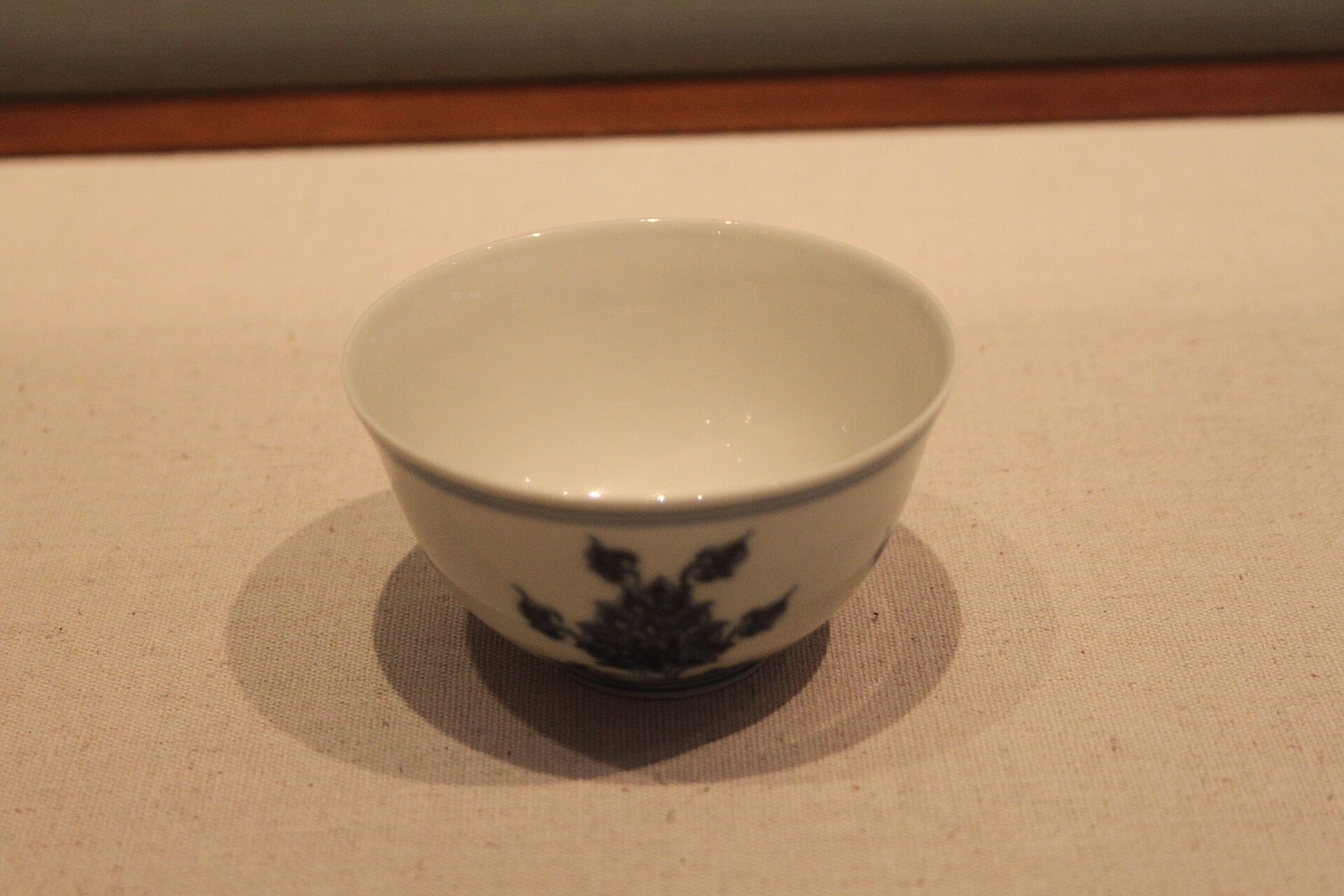
Chenghua bowl, Palace Museum, Beijing
Chenghua bowl, Palace Museum, BeijingA small blue and white bowl of the Chenghua reign in the porcelain galleries of the Palace Museum in the Forbidden City, photographed in 2009. The Palace Museum holds one half of the former imperial collection, the National Palace Museum in Taipei the other, and between 2015 and 2019 Beijing ran six exhibitions setting excavated rejects from the Jingdezhen kiln site beside surviving imperial pieces reign by reign. The Chenghua edition opened on 25 October 2016 with more than 180 porcelains.Palace Museum, Beijing; photograph by Gary Lee Todd, released CC0 via Wikimedia Commons
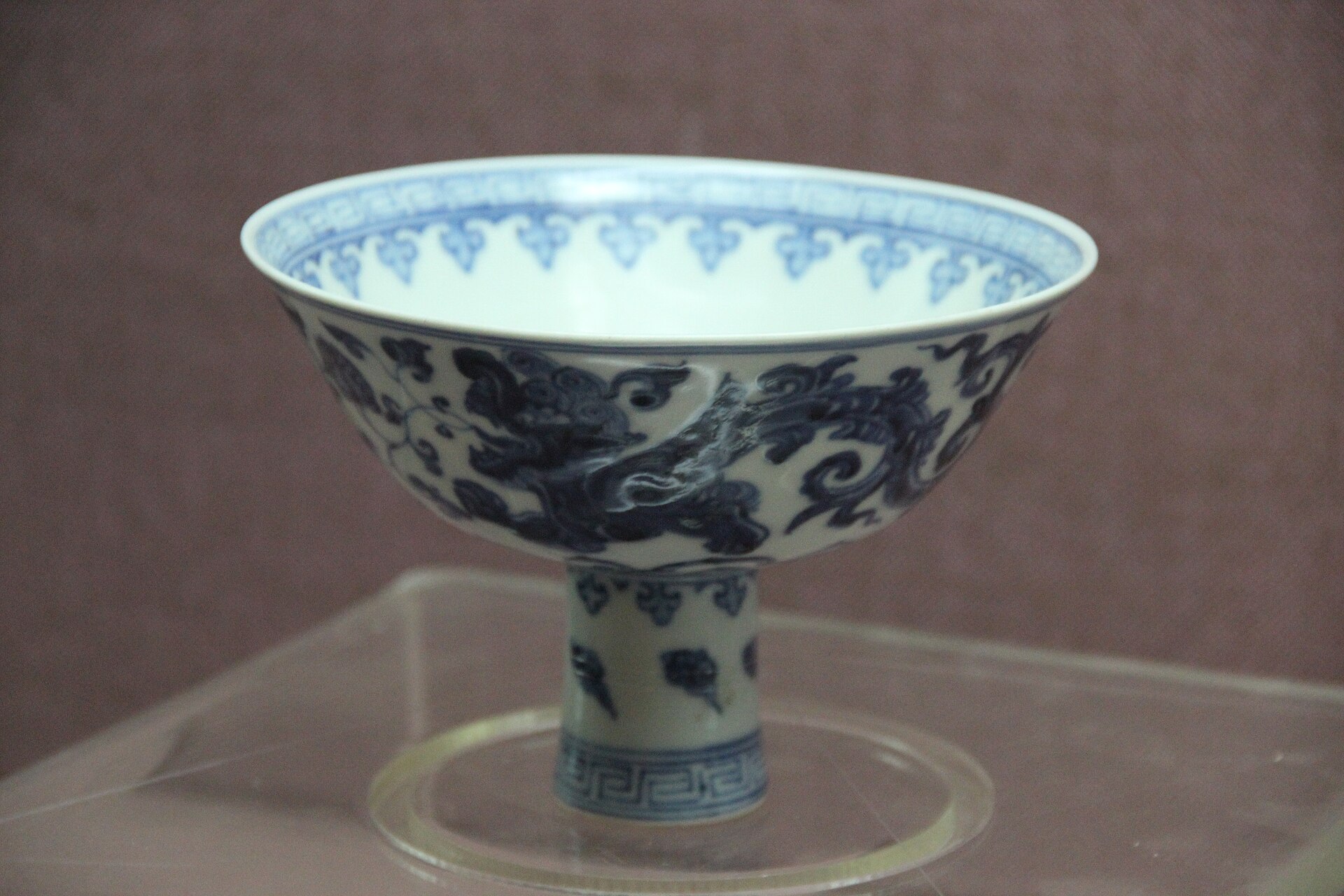
A Ming stem cup in Lhasa
A Ming stem cup in LhasaA blue and white stem cup painted with mythical beasts among cloud scrolls, with a classic-scroll band inside the rim, photographed in the ceramics gallery of the Tibet Museum in Lhasa and filed by the photographer to the Chenghua reign. Ming imperial porcelain moved as diplomatic gift as well as court supply, going to the provincial courts of Ming princes and out of the empire, and the Chenghua Emperor supported Buddhism against the objections of his Confucian officials, ordering five pagodas in the Indian style west of Beijing in 1473. The attribution of this particular cup has not been checked against the museum's own label and is carried as the photographer gives it.Tibet Museum, Lhasa; photograph by Gary Lee Todd, released CC0 via Wikimedia Commons
The museum's own definition of doucai
The museum's own definition of doucaiThe gallery label in the pottery and porcelain rooms of the National Palace Museum in Taipei, which holds more than ninety per cent of the world's Chenghua doucai. It gives the term as contending colours and the process in four clauses: outlining forms on porcelain in cobalt blue, covering the piece with transparent glaze and firing at high temperature, then filling the spaces with colours, then putting the piece into the kiln again to be fired at low temperature and completed. It also fixes the sequence of reigns, stating that the technique began under Xuande and was perfected by the time of the Chenghua Emperor, and that the wares became the object of imitation in later generations.National Palace Museum, Taipei; photograph by Gary Lee Todd, released CC0 via Wikimedia Commons
A Kangxi dish carrying a spurious Chenghua mark
A Kangxi dish carrying a spurious Chenghua markThis is NOT a Chenghua porcelain. It is a Kangxi period dish in the Victoria and Albert Museum, painted in underglaze blue with two figures in a rocky river landscape under a pine, and it carries a spurious Chenghua mark on its underside. The mark is not visible in this view, which is the practical point: the object was placed in the Kangxi reign on the evidence of the painting, the palette and the glaze, and the mark was then read as spurious rather than the other way round. It is the less known of the two well-documented museum cases of an apocryphal Chenghua mark, the other being the pair of famille verte bowls at Cleveland.Victoria and Albert Museum, London; photograph released CC0 via Wikimedia Commons
The Qing revival that signed its own name
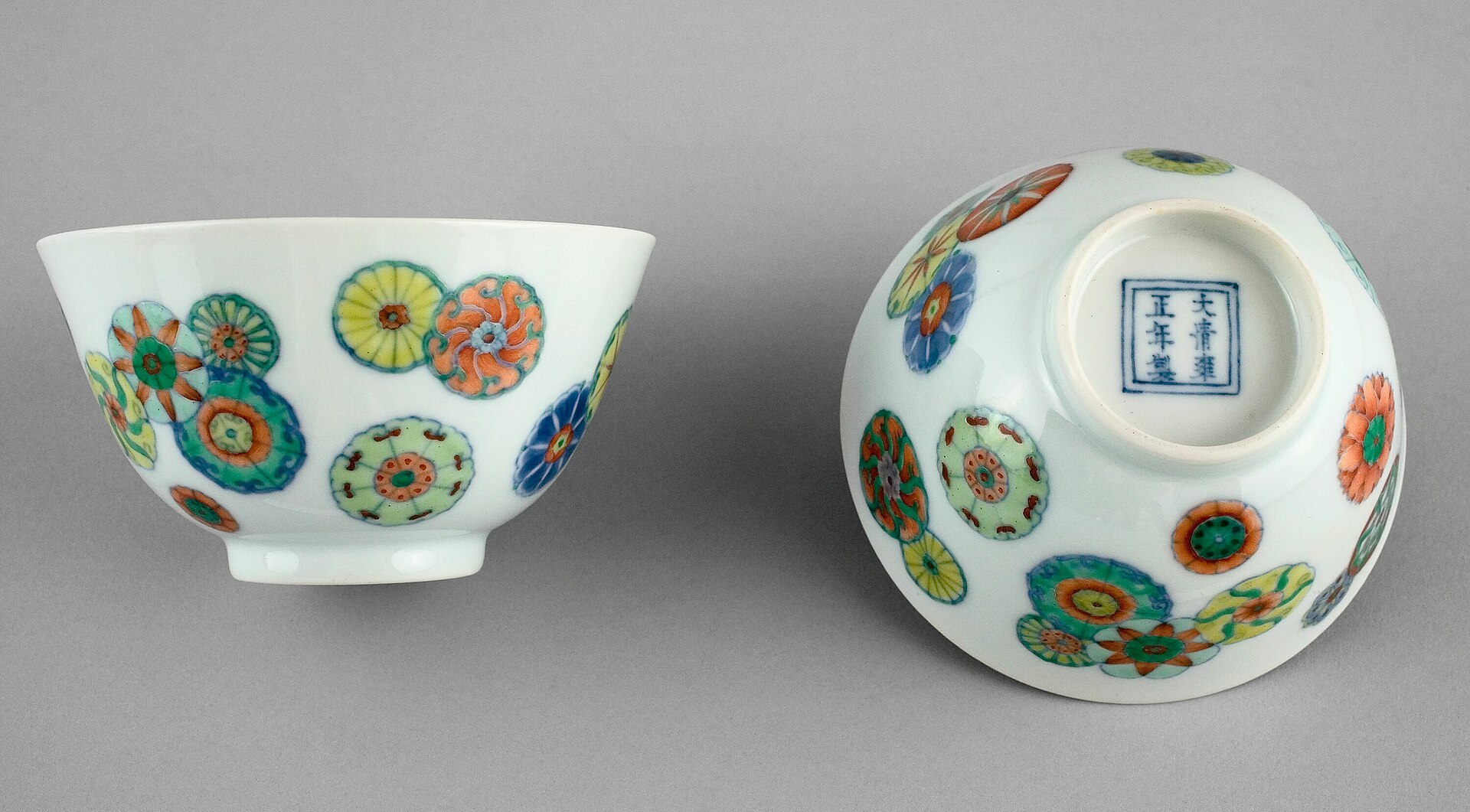
The Qing revival that signed its own nameThis is NOT a Chenghua porcelain. A pair of doucai cups made at Jingdezhen in the Yongzheng reign, 1723 to 1735, 5.7 cm high, with floral medallions outlined in pale cobalt, glazed and fired, then filled with soft translucent enamels that sit so exactly inside the outlines that the Art Institute uses them to explain the term. The Yongzheng Emperor was himself an artist and connoisseur and oversaw the imperial kilns personally. The overturned cup shows a six-character mark in regular script inside a double square reading <em>Da Qing Yongzheng nian zhi</em>: its own reign, honestly. The Qing potter who wrote Chenghua instead was not obliged to. He chose the earlier name.Art Institute of Chicago, bequest of Henry C. Schwab, 1941.701a-b
A four-character Chenghua mark in seal script
A four-character Chenghua mark in seal scriptFour characters in archaising seal script, read top to bottom and right to left, romanised <em>Chenghua nian zhi</em>, made in the Chenghua period. The imperial wares of the reign do not use this form: they carry six characters in regular script, beginning with the dynasty name, inside a double square or a double circle. A four-character seal-script version is a later convention and belongs to the enormous class of Chenghua marks that record an homage or a habit rather than a date. The Commons file gives no object, no holding institution and no source, and it is reproduced here as a specimen of the inscription rather than as evidence about any particular pot.Wikimedia Commons, source unrecorded, published as public domain on age
Doucai at Jingdezhen, two centuries later
Doucai at Jingdezhen, two centuries laterThis is NOT a Chenghua porcelain. A doucai dish with a lotus medallion and floral sprays, shown at the Jingdezhen China Ceramics Museum under a bilingual label reading contrasting colours plate designed with lotus, Kangxi reign of the Qing dynasty. Doucai did not end with the Ming: the technique perfected in the 1480s was still being worked at the same town two hundred years later and is being worked there now. The continuity is exactly what makes the reign mark useless on its own, because five centuries of objects made in one place all say the same six characters and mean different things by them.Jingdezhen China Ceramics Museum, Jiangxi; photograph released CC0 via Wikimedia Commons

Chronology

  • 1369

    The imperial kiln factory is established at Zhushan, Pearl Hill, in the centre of Jingdezhen, in the second year of the Ming dynasty, and is administered directly by the court rather than through the commercial kilns around it.11

  • 1402

    Twelve imperial kilns are operating at Jingdezhen. Production is controlled by a ministry in the capital.11

  • 1403-1424

    Reign marks are introduced for the first time under the Yongle Emperor and applied to porcelain and other luxury goods made for the imperial court.11

  • 1426-1435

    Xuande reign. Overglaze enamel decoration is developed. A doucai dish with red and green enamels of this reign is later excavated at the Jingdezhen kilns, which is how Xuande doucai came to be recognised at all. Imported cobalt is still the principal blue, with domestic ore coming into use from the middle and later part of the reign.101627

  • 1433

    A single palace order calls for 443,500 pieces of porcelain, all with dragon and phoenix designs.11

  • 1459

    The court orders 133,000 pieces from the supervisors at Jingdezhen; the order is later reduced to 80,000 because the resources are not available.25

  • 1464

    Zhu Jianshen accedes on 23 February at the age of sixteen and takes the reign name Chenghua. Lady Wan Zhen'er, born 1428 and formerly his nurse, is thirty-four.12

  • 1466

    Lady Wan bears the emperor a son, who dies within a year, and is made Noble Consort.12

  • 1473

    The emperor orders the construction of five pagodas in the Indian style west of Beijing. He supports Buddhism against the objections of Confucian officials.12

  • 1477

    The Western Depot is created as a second secret police organisation alongside the Eastern Depot, run by the eunuch Wang Zhi, who had served Lady Wan.12

  • 1483

    Wang Zhi is transferred after years of terrorising the Beijing elite.12

  • c. 1481-1485

    The classic phase of the reign at the imperial kilns. The blue and white palace bowls mature from about 1481; the finest doucai wares belong to the decade before 1485. One reading gives the whole classic phase about seven years.13

  • 1485

    The imperial kilns halt production.1

  • 1487

    The Chenghua Emperor dies on 9 September, aged thirty-nine, in the same year as Lady Wan. He is succeeded by the Hongzhi Emperor.12

  • 1566

    The practice of smashing and burying all imperial seconds at Jingdezhen ends, having run since the start of the dynasty. Everything buried before this date is a sealed archaeological deposit.1126

  • 1572-1620

    Wanli reign. Chenghua chicken cups are already expensive; the scholar Cheng Zhe records a pair valued at a hundred thousand cash. A limited revival of doucai is attempted.810

  • 1662-1722

    Kangxi reign. Large numbers of pieces are made carrying Chenghua marks as an act of reverence for the earlier reign, not as forgery. Cleveland's famille verte bowls with Xiwangmu, accession 1964.218, belong to this class and are catalogued by the museum as Kangxi with a Chenghua mark. The Victoria and Albert Museum holds a Kangxi dish with a river scene carrying a spurious Chenghua mark.5634

  • 1723-1735

    Yongzheng reign. The largest Qing revival of doucai. The emperor, himself an artist and connoisseur, oversees the imperial kilns personally. The Art Institute of Chicago's pair of doucai cups, 1941.701a-b, carries a six-character Yongzheng mark in regular script inside a double square.1031

  • 1736-1795

    Qianlong reign. The emperor writes an ode in praise of chicken cups. The National Palace Museum's chicken cup is accompanied by a Qianlong-period silk-embroidered box and can be traced through the Qing Imperial Workshop archives to the Yongzheng reign.18

  • c. 1913

    Percival David begins collecting Chinese ceramics; he first visits China in 1923.13

  • after 1927

    David acquires roughly forty pieces that had left the Forbidden City when members of the Imperial Household Department disposed of them, buying through dealers, at auction and from other collectors.13

  • 1940

    Cleveland's Chenghua palace bowl with lily scrolls passes through the sale of the Eumorfopoulos collections at Sotheby's London, 28 to 31 May, as lot 238, illustrated in the catalogue.28

  • 1950-1952

    David gives his collection to the University of London. It opens to the public at 53 Gordon Square, Bloomsbury, on 10 June 1952 as a teaching collection.13

  • 1954

    Harry Garner reproduces the Cleveland Chenghua lily-scroll bowl as plate 35a in Oriental Blue and White.28

  • 1977

    The National Palace Museum in Taipei mounts a Chenghua exhibition of 197 pieces.7

  • 1987

    The Metropolitan Museum of Art acquires a Chenghua doucai chicken cup, accession 1987.85, by purchase with the gift of Mrs Richard E. Linburn. Its published dimensions are the ones most often misapplied to other cups of the type.32

  • 1970s

    Systematic archaeological work begins at the Ming imperial kiln site at Zhushan under Liu Xinyuan. The Institute now dates its recovery of more than twenty million kiln relics to the late 1970s onward.16

  • 1982

    Extensive excavation of the Jingdezhen imperial kiln site begins, producing thousands of porcelain fragments that are subsequently restored.24

  • 1992

    The Jingdezhen Institute of Ceramic Archaeology shows excavated material jointly with the Fung Ping Shan Museum at the University of Hong Kong, reporting on excavation work directed by Liu Xinyuan.4

  • 1993

    A Legacy of Chenghua: Imperial Porcelain of the Chenghua Reign Excavated from Zhushan, Jingdezhen is published by the Jingdezhen Institute of Ceramic Archaeology and the Tsui Museum of Art, Hong Kong, with Liu Xinyuan's survey of the Chenghua kiln site and its finds. It remains the reference cited when a piece is matched to an excavated fragment.13

  • 2002-2004

    A joint excavation by the School of Archaeology and Museology at Peking University and other institutions uncovers the enclosure and courtyard wall on the north of the site, groups of gourd-shaped kiln furnaces facing steamed-bread-shaped stoves at the southern foot of Zhushan, and pits and piles of sherds that had failed selection for the court.15

  • 2003

    The National Palace Museum in Taipei mounts a second Chenghua exhibition, of 207 pieces, with a digitised catalogue.7

  • 2007-2009

    Funding fails and the Percival David Foundation's Gordon Square premises close at the end of 2007. The collection moves on long-term loan to the British Museum and opens in the purpose-built bilingual Room 95 on 23 April 2009.13

  • 2011

    Sotheby's Hong Kong offers the Meiyintang palace bowl as lot 56, sale HK0371, with an estimate of HKD 80,000,000 to 120,000,000. The catalogue note is by Regina Krahl.3

  • 2013

    118 pieces and sets of excavated Chenghua imperial porcelain are shown at the Civic and Municipal Affairs Bureau gallery in Macau, 17 May to 7 July, in four groups: doucai, blue and white, monochromes and coloured glazes, and imitations of Song wares. Quan Kuishan publishes the report of the 2002-2004 excavation in the Palace Museum Journal.1524

  • 2014

    The Meiyintang chicken cup is sold at Sotheby's Hong Kong on 8 April, hammer HKD 250,000,000 and HKD 281,240,000 with premium, then the highest auction price for any Chinese porcelain. Covered in full by the separate Iconotheca record.1

  • 2015-2019

    The Palace Museum in Beijing runs six comparative exhibitions setting excavated rejects from the Jingdezhen imperial kiln site beside the imperial collection, reign by reign.1819

  • 2016

    Sotheby's Hong Kong offers the Pilkington melon palace bowl as lot 25, sale HK0639, estimate HKD 50,000,000 to 70,000,000. The Chenghua edition of the Palace Museum comparative series opens in Beijing on 25 October with more than 180 porcelains and runs to 26 February 2017.219

  • 2017

    Two Chenghua cups are sold at Sotheby's Hong Kong on 5 April in In His Majesty's Palm: lot 3102, a blue and white cup, at HKD 33,850,000 against HKD 15,000,000 to 20,000,000, and lot 3101, a doucai stem cup, at HKD 13,300,000 against HKD 8,000,000 to 12,000,000.22

  • 2018-2019

    The sixth and final Palace Museum comparative exhibition, covering the Jiajing, Longqing and Wanli reigns, runs from 6 November 2018 to 22 February 2019 with 298 exhibits.18

  • 2019

    A Chenghua blue and white palace bowl of daylily design, 14.9 cm, is sold at Sotheby's Hong Kong on 8 October as lot 1002: estimate in excess of HKD 50,000,000, hammer HKD 48,000,000, price realised HKD 56,738,000.20

  • 2020

    The Jingdezhen Imperial Kiln Museum opens on the excavated site.1617

  • 2022

    From June, the Jingdezhen Imperial Kiln Institute builds an Ancient Ceramic Gene Bank with Tsinghua University, the Palace Museum and the Shanghai Institute of Ceramics.16

  • 2024

    On 14 November the trustees of the Sir Percival David Foundation announce the gift of 1,700 ceramics to the British Museum, valued by the museum at around one billion pounds and described as the highest value object donation in the history of British museums. A Chenghua doucai chicken cup is one of two objects named.1314

  • 2025

    The Percival David transfer completes on 2 April. In October the Institute reports more than 3,000 digitised specimens and close to 1.2 million data points in the gene bank, and a case in which seventeen comparative samples identified a dish as late Qing folk-kiln work. On 9 September Sotheby's Hong Kong offers the Palmer Palace Bowl from the Ise collection.131623

What is documented

The mark, character by character
Six characters in underglaze cobalt blue on the base, in regular script, in two vertical columns read from the top of the right-hand column downward, then the left: Da Ming (Great Ming), Chenghua (the reign era), nian zhi (made in the period). Vertical, right to left is the ordinary Chinese convention and derives from writing on bamboo strips.56
The frame is a dating tool
Chenghua marks occur inside a double circle and inside a double square. The double square is an innovation of the late Chenghua phase and is characteristic of the doucai wares; the palace bowls carry a double circle. Neither is decoration.12
Seven diagnostics of a period mark
Jan-Erik Nilsson's list: the second stroke of the first character seldom extends much beyond the first and looks stubby, its third and final stroke ending thickly; the third stroke of cheng descends straight and vertical, not curved; nian is unusually squat and square; the ninth stroke of zhi does not extend beyond the standing knife radical; the final tails on most characters are abrupt and sharp, like fish hooks; a square surround is thick with ink at each right angle; and the whole mark is faintly obscured, as if under a thin haze.4
The mark is deliberately clumsy
The Chenghua mark is inelegant, thick, often unbalanced and immature. A researcher working from the National Palace Museum's Chenghua holdings describes the brushwork as lacking the lifting-up and wrapping of the brush tip that closes a stroke, with the starting, connecting, turning and closing stages visibly incomplete. The contrast between superb doucai painting and crude calligraphy on the same object is itself characteristic of the reign.47
Whose hand wrote it is unresolved
Liu Xinyuan, who directed the Jingdezhen excavations, held that the mark reproduces the handwriting of the emperor himself, written when he was young and his hand was not good. A separate proposition holds that a single calligrapher wrote all official marks of the reign. Neither is supported by a document consulted here, and Nilsson, who heard Liu's view directly in the early 1990s, records both without adopting either.14
The mark dates nothing on its own
Chenghua is, with Xuande, the most copied reign mark in Chinese ceramics, because Chenghua imperial porcelain was considered the highest quality ever produced. Later marks of this kind are called apocryphal in the trade and were usually written out of reverence rather than to deceive. Marks are helpful, but as a general rule the last thing to trust in dating a piece of Chinese porcelain.456
The four-character seal-script form
A four-character mark, Chenghua nian zhi, written in archaising seal script rather than the six-character regular-script form of the reign, circulates widely on much later porcelain. The reign-period imperial wares do not use it.4
Rejects were destroyed on site
Pieces with the smallest flaw and pieces surplus to an imperial order were smashed and buried at the factory so that they could not reach the market. The practice ran until 1566. This is the single most important fact about imperial kiln output: the survival rate is not the production rate, because the kiln was the first and harshest editor.1126
Why individual pieces failed
The Palace Museum's comparative exhibitions put the reasons on public record: deformity, incorrect inscription, wrong painting. One rejected Chenghua dish carries a dragon with six claws and another with four. The imperial standard was five.19
Twenty million sherds
The Jingdezhen Imperial Kiln Institute gives its total recovery since the late 1970s as more than twenty million kiln relics, from the late Tang to the Republic. Its permanent display shows nearly 700 restored porcelains and thousands of sherd specimens against a holding of over 50,000 exhibit-ready items.1617
The half-finished cup
Sherds of a doucai chicken cup painted in underglaze blue only and still lacking its enamels were recovered from the third and last Chenghua stratum at Zhushan, datable to the final years of the reign. It fixes the type to the reign independently of every surviving cup and proves the sequence of the doucai process directly.1
Chenghua fragments are scarcer than Xuande
Regina Krahl records that the volume of Chenghua fragments recovered at the kiln site is less than half that unearthed from the much shorter Xuande reign, which is evidence of stringent quality control and of limited production volume rather than of poor survival.2
Two dozen in private hands
Only some two dozen porcelains of Chenghua mark and period, of any style or design, are recorded as remaining in private hands anywhere in the world. That figure covers the entire reign and every shape.2
Taipei holds the field
The largest surviving body of Chenghua porcelain from the former imperial holdings is at the National Palace Museum in Taipei. A researcher working from that collection puts more than ninety per cent of the world's Chenghua doucai there, including eight chicken cups. Taipei mounted 197 Chenghua pieces in 1977 and 207 in 2003.27
Palace bowl designs
The blue and white palace bowls were made over roughly a decade in the 1480s in about eleven or twelve designs, ten floral and one showing fruit. Twelve complete melon-design bowls survive worldwide, apparently none in Taipei or Beijing; of the daylily design only about three are known, two of them in the British Museum.22021
Doucai in one sentence
The National Palace Museum's own gallery label: outlining forms on porcelain in cobalt blue, covering the piece with transparent glaze and firing at high temperature, then filling the spaces with colours, then putting the piece into the kiln again to be fired at low temperature and completed. The technique began in the Xuande reign and was perfected under Chenghua.35
The second firing runs at 850 to 900 degrees
The overglaze enamels are fixed in a lower-temperature firing of about 850 to 900 degrees. Aubergine is transparent and can be laid over other colours, which costs a further firing wherever it appears. The repeat firings required by the process reduced the number of successfully completed pieces.110
Doucai against wucai
In doucai the entire design is outlined in underglaze blue, even where the outline is later hidden under the enamels. In wucai the blue is only partial. The distinction is not stylistic and the excavated half-finished cup at Zhushan proves it directly for the Chenghua wares.110
The blue is Chinese
The soft, watery Chenghua blue comes from pingdengqing, also called pitangqing, a domestic cobalt mined at Leping in Jiangxi, higher in manganese and lower in iron than the imported ore of the Yongle and Xuande reigns and much less prone to diffuse. It is the standard cobalt of the Chenghua and Hongzhi reigns and the effect was sought, not endured.2127
Confirmed by composition
Research by the Jingdezhen Imperial Kiln Institute with Peking University, reported in 2025, confirmed the coexistence of imported and domestic raw materials from the Xuande period onward, the same transition the connoisseurial account describes.16
The scale of an imperial order
A single palace order in 1433 called for 443,500 pieces, all with dragon and phoenix designs. In 1459 the court ordered 133,000 pieces and later cut the order to 80,000 because the resources were not available.1125
The designs came from Beijing
Court artists supplied drawn or woodblock printed designs from the capital, and supervisors were delegated to Jingdezhen from the imperial workshops at court. The pattern on a Chenghua dish was fixed roughly seven hundred miles from where it was painted.1125
Division of labour
Production employed hundreds and probably thousands of workers, with tasks split into separate trades for efficiency and consistency: cutting the firewood, purifying the clay, grinding the cobalt. By the sixteenth century Jingdezhen had hundreds of kilns and thousands of workers, at a landscape cost of stripped hillsides and permanent smoke.1125
The Percival David gift
1,700 ceramics, on loan to the British Museum since 2009 and shown in Room 95, were given outright by the Foundation's trustees on 14 November 2024, valued by the museum at around one billion pounds. The transfer completed on 2 April 2025 and requires the collection to remain on public display together in perpetuity in a dedicated gallery, with loans to the Shanghai Museum and the Metropolitan Museum of Art contemplated and Charity Commission consent required.1314
An eighteenth-century provenance
The National Palace Museum's chicken cup, 4 cm high and 8.3 cm across, can be traced through the Qing Imperial Workshop archives to the Yongzheng reign and retains a Qianlong-period silk-embroidered box. Very few Chenghua porcelains anywhere carry documentation of that age. The current accession number is K1B005192 and the cup is shown in gallery 205.89
Hammer against premium, 2019
A daylily palace bowl at Sotheby's Hong Kong on 8 October 2019, lot 1002: estimate in excess of HKD 50,000,000, hammer HKD 48,000,000, price realised HKD 56,738,000. The bid fell below the estimate and only the buyer's premium carried the total above it.20
The gene bank
Since June 2022 the Jingdezhen Imperial Kiln Institute has run an Ancient Ceramic Gene Bank with Tsinghua University, the Palace Museum and the Shanghai Institute of Ceramics. Over 3,000 specimens have been digitised, including three-dimensional models with archaeological records and analytical data, yielding close to 1.2 million individual data points. In one reported case seventeen comparative samples across the Ming and Qing identified a dragon dish as late Qing folk-kiln work.16

Technique

Body
Jingdezhen porcelain, potted extremely thin. The Chenghua bodies are described as durable and purely translucent, and the pieces are light in the hand for their size; Cleveland notes the quality of the body as one of the defining features of its Chenghua doucai cup. Thinness is part of the identification and one of the things a copy most often gets wrong.3035
Underglaze blue
Domestic cobalt, pingdengqing or pitangqing, from Leping in Jiangxi. High in manganese, low in iron, limited diffusion in the glaze, producing crisp lines and a soft, watery, greyer blue. This is the break from the imported sumaliqing of the Yongle and Xuande reigns, which is strong, saturated and prone to run and pool into dark iron spots.2127
Doucai, first firing
The complete design is drawn onto the unfired body in pale underglaze cobalt as outline only, including outlines that will later be hidden under the enamels. The piece is then glazed and fired at high temperature exactly as a blue and white vessel. What comes out is a finished white vessel carrying a blue drawing.11035
Doucai, second firing
Overglaze enamels are laid inside the blue outlines and fixed in a lower-temperature muffle firing of about 850 to 900 degrees. Any colour that will not sit beside another in the same pass, and every superimposition of one enamel on another, requires a further firing.110
Palette
Iron red in more than one tone, greens from bright to dark olive, yellow, and a transparent aubergine that can be laid over other colours at the cost of an extra firing, all inside a shaded pale underglaze blue. The specific range and quality of the enamels, together with the tone of the blue, is one of the primary tests of period.1
Monochromes
The kilns also produced monochrome glazes at the top of their range. Cleveland's Chenghua dish, 1989.288, is 21.5 cm across, glazed in a plain even yellow with no decoration at all, and carries the same six-character mark as the painted wares.29
Song-revival wares
Part of the reign's output imitates Song dynasty ceramics, including crackle-glazed Ge-type wares. Imitations of Song wares formed one of the four categories into which the excavated Chenghua material was organised for exhibition.24
Scale of vessel
Chenghua imperial wares are characteristically small: wine cups, stem cups, palace bowls of around 14 to 15 cm, dishes. The excavated material is described as comprising small decorative and functional items rather than large vessels. Qualities that read only at close range are the qualities being sought.24
Composition of the design
Palace bowls are decorated on the exterior with a continuous scrolling design and usually left blank inside, with a great deal of white porcelain left showing, in deliberate contrast to the filled surfaces of the earlier fifteenth century. Nicolas Chow points to a compositional device he says was never repeated even in the Qing: a motif repeated three times and then a break in the scroll.21
Imperial emblems
The five-clawed dragon is the imperial standard and the claw count is enforced. A Chenghua dragon and phoenix dish recovered from the kiln site carries one dragon with six claws and another with four, and was destroyed for it. The 1433 order for 443,500 pieces specified dragon and phoenix designs throughout.1119
The mark
Six characters in underglaze blue on the base in regular script, framed in a double square on the doucai wares and a double circle on the palace bowls. Thick, unbalanced, immature, and faintly hazed under the glaze. Read the mark last, and read it against the quality of the object: an imperial mark on non-imperial work is the problem, not the mark itself. The double-circle form can be seen on the base of a Chenghua turquoise-glazed dish in the Shanghai Museum, which is the plate used at the head of this page.124633
What the excavated fragments test
Because the factory destroyed and buried its own failures where and when it made them, the sherd corpus is a dated reference set of known reign, known kiln and known date against which a questioned vessel can be compared. Since 2022 that comparison is being industrialised through three-dimensional digitisation and compositional analysis in the Ancient Ceramic Gene Bank.151626

The corpus

What is accepted
There is no accepted total and there cannot be one. The imperial kiln's production records do not survive, the census question and the authentication question are the same question, and no body has authority to close the list. Three partial counts are defensible and should be kept apart. First, Regina Krahl records that only some two dozen porcelains of Chenghua mark and period, of any style or design, remain in private hands anywhere; that figure covers the entire reign. Second, counts within a design: about eleven or twelve palace bowl designs, of which twelve complete melon bowls survive worldwide and about three daylily bowls, two of the latter in the British Museum. Third, institutional concentration: the National Palace Museum in Taipei holds the largest surviving body of Chenghua porcelain from the former imperial holdings and, on one researcher's estimate, more than ninety per cent of the world's Chenghua doucai, including eight chicken cups. Against those, the excavated corpus at Zhushan runs to millions of fragments and, at the Jingdezhen Imperial Kiln Institute alone, nearly seven hundred restored vessels on permanent display out of more than fifty thousand exhibit-ready items.
What is contested
What is contested is not how many objects exist but which of them are of the period. The Chenghua mark is, with Xuande, the most copied inscription in Chinese ceramics, so every census is a set of authentication judgements presented as arithmetic. Two chicken cups in the Palace Museum, Beijing, are disputed by Western specialists and excluded from the Sotheby's census; the competing totals of sixteen, seventeen and nineteen for that type are set out in the Iconotheca record of the Meiyintang cup. The disputes run in both directions: pieces catalogued as Chenghua that are later reigns in homage, and Qing pieces with honest Chenghua marks that are collectable in their own right and are sometimes described as if they were not. The one class that is not contested is the excavated material, because it was buried by the factory that made it.
Who rules on attribution
No authentication board exists and none is recorded as ever having existed. Attribution rests with a small number of auction-house specialists, principally at Sotheby's and Christie's in Hong Kong, with the curatorial staff of the National Palace Museum in Taipei and the Palace Museum in Beijing, and increasingly with the Jingdezhen Imperial Kiln Institute, whose excavated sherd corpus is the only dated reference set in existence. Since June 2022 the Institute has been building an Ancient Ceramic Gene Bank with Tsinghua University, the Palace Museum and the Shanghai Institute of Ceramics: over 3,000 digitised specimens carrying three-dimensional models, archaeological records and analytical data, close to 1.2 million data points, used to place a questioned object against dated material by composition rather than by eye. That is the first authentication route in this field that does not depend on connoisseurship, and it is being built by an archaeological institute rather than by the trade.

Catalogue raisonne

  • Jingdezhen Institute of Ceramic Archaeology and the Tsui Museum of Art, <em>A Legacy of Chenghua: Imperial Porcelain of the Chenghua Reign Excavated from Zhushan, Jingdezhen</em>, Hong Kong, 1993, including Liu Xinyuan, A Study of the Site of the Chenghua Imperial Kiln at Jingdezhen and Related Archaeological Finds. The foundation document of modern Chenghua studies and the volume auction houses cite when matching an object to an excavated fragment. It is a catalogue of excavated material, not of surviving vessels, and that is precisely its authority. NOT READ HERE: the volume itself has not been consulted for this page and everything attributed to it comes through the Sotheby's catalogue notes that cite it.123
  • Regina Krahl, catalogue notes for Sotheby's Hong Kong: lot 56, the Meiyintang Collection, HK0371, 2011; lot 25, the Pilkington Collection of Chinese Art, HK0639, 2016; lot 1, the Meiyintang Chicken Cup, HK0545, 8 April 2014. In the absence of a catalogue raisonne these three notes are, for practical purposes, the working literature on Chenghua imperial porcelain in English. They carry the private-hands count, the design-by-design counts, the comparison of Chenghua against Xuande kiln fragments, and the dating of the palace bowl phase.123
  • Regina Krahl, <em>Chinese Ceramics from the Meiyintang Collection</em>, four volumes, 1994-2010. The catalogue of the private collection against which the modern market for Chenghua has been calibrated. NOT READ HERE.1
  • Quan Kuishan, The Archaeological Findings from the Imperial Kiln Site of the Ming-Qing Dynasty in Jingdezhen, <em>Palace Museum Journal</em>, no. 3, 2013, vol. 167, Chinese text pp. 6-19 with English abstract. The published report of the 2002-2004 joint excavation with Peking University. Gives the site architecture, the kiln furnaces and the treatment of rejected wares. English abstract read; the Chinese text has not been read here.15
  • Harry Mason Garner, <em>Oriental Blue and White</em>, London, Faber and Faber, 1954. The earlier standard on Ming blue and white; Cleveland's Chenghua lily-scroll palace bowl is reproduced as plate 35a. NOT READ HERE; cited from the Cleveland Museum's own bibliography for that object.28

The market

Chenghua is the most expensive reign in Chinese ceramics and it trades on a float of about two dozen objects in private hands. Prices are lumpy, estimates are unreliable at the top, and almost no published figure separates the hammer from the buyer's premium. Read every number below with that in mind; where the hammer is unpublished this page says so.

The cleanest recent result is the daylily palace bowl of 8 October 2019, and it is instructive precisely because the two figures diverge: the estimate was published as in excess of HKD 50,000,000, the hammer fell at HKD 48,000,000, and the price realised was HKD 56,738,000. The bid was below the estimate; only the premium carried the total above it. Anyone comparing that HKD 56.7 million against a hammer figure from another market is comparing two different things.

The ceiling is set by a single object and should not be read as a level. The Meiyintang chicken cup made HKD 250 million at hammer and HKD 281.24 million with premium on 8 April 2014, more than four times the best palace bowl result of the following decade. That is a statement about the fame of one cup, not about the price of Chenghua porcelain, and Iconotheca's record of that object covers it in full.

DateSaleWorkResultNote
2019-10-08Sotheby's Hong KongBlue and white palace bowl, daylily design, 14.9 cm, mark and period of Chenghua, lot 1002, sale Two Ming Porcelain Masterpieces from an Important CollectionHammer HKD 48,000,000
With premium HKD 56,738,000 price realised
HKD
Estimate published as in excess of HKD 50,000,000. The hammer fell below the estimate and only the buyer's premium carried the total above it. Bought on the telephone by Peter Song of Sotheby's Beijing office for an unnamed client. Only about three palace bowls of this design are known, two of them in the British Museum. NOTE ON THE SOURCE: the reporting outlet's headline gives the result as HK$56.3m while its own lot block gives HK$56,738,000; the lot block figure is used here.
2017-04-05Sotheby's Hong KongBlue and white cup, mark and period of Chenghua, lot 3102, sale In His Majesty's Palm: Exquisite Porcelain PlaythingsHammer Not separately published
With premium HKD 33,850,000 as reported
HKD
Estimate HKD 15,000,000 to 20,000,000. The single reported figure is not identified as hammer or as premium-inclusive by the source consulted and should not be assumed to be either.
2017-04-05Sotheby's Hong KongDoucai stem cup, mark and period of Chenghua, lot 3101, same saleHammer Not separately published
With premium HKD 13,300,000 as reported
HKD
Estimate HKD 8,000,000 to 12,000,000. As with lot 3102, the reported figure is not broken out.
2025-09-09Sotheby's Hong KongThe Palmer Palace Bowl, blue and white with lily design, mark and period of Chenghua, from the Ise collectionHammer Not published
With premium HKD 35,145,000 as reported
HKD
UNRECONCILED. The single source consulted gives the estimate as HKD 40,000,000 to 80,000,000 and the price as HKD 35,145,000. If that price includes the premium, the hammer would have been roughly HKD 28 to 29 million, well below the published low estimate, which is possible where a reserve sits under the estimate but is not stated. Recorded with the discrepancy flagged. Provenance given as Peter Boode, London, acquired January 1936; R. H. R. Palmer collection no. 403; Christie's Hong Kong 17 January 1989; T. T. Tsui collection, 1940-2010, and the Tsui Museum of Art, Hong Kong; Christie's Hong Kong 3 November 1996; Mayuyama and Co., Tokyo.
2016Sotheby's Hong KongBlue and white palace bowl, melon design with twenty-two fruits, mark and period of Chenghua, lot 25, sale HK0639, the Pilkington Collection of Chinese ArtHammer Not published
With premium Not published
HKD
Estimate HKD 50,000,000 to 70,000,000. The lot page does not display a result to a visitor who is not signed in. Krahl's note records twelve complete melon bowls surviving worldwide and describes this one, with twenty-two fruits against the usual sixteen, as an apparently unique version.
2011Sotheby's Hong KongBlue and white palace bowl, mark and period of Chenghua, lot 56, sale HK0371, the Meiyintang CollectionHammer Not published
With premium Not published
HKD
Estimate HKD 80,000,000 to 120,000,000. No result is displayed on the public lot page. The catalogue note, by Regina Krahl, calls palace bowls the pride or else the desideratum of any museum collection and dates the type to a phase maturing from about 1481.
2014-04-08Sotheby's Hong KongThe Meiyintang doucai chicken cup, mark and period of Chenghua, lot 1, sale HK0545Hammer HKD 250,000,000
With premium HKD 281,240,000
HKD
Then the highest auction price for any Chinese porcelain. Covered in full by the separate Iconotheca record on that object and included here only to fix the ceiling of the reign against the palace bowl results.
1940-05-28Sotheby's LondonBlue and white palace bowl with lily scrolls, mark and period of Chenghua, lot 238, the Eumorfopoulos collections, 28 to 31 May 1940Hammer Not published in the sources consulted
With premium Not applicable
GBP
The bowl now in the Cleveland Museum of Art, accession 1967.64, 14.5 cm across. Illustrated in the 1940 catalogue at pages 78 to 79 and reproduced by Harry Garner in Oriental Blue and White, 1954, plate 35a. It reached Cleveland as a gift of John D. Rockefeller III combined with a purchase from the John L. Severance Fund. Included as the earliest recoverable market appearance of a Chenghua palace bowl in this record.

Where to see the work

InstitutionCityHoldingsNote
British Museum, Sir Percival David collection, Room 95London1,700 Chinese ceramics of the tenth to eighteenth centuries, including a Chenghua doucai chicken cup and about three known blue and white palace bowls of daylily design, two of them here. Roughly forty pieces came out of the Forbidden City after 1927.On loan since 23 April 2009 and given outright on 14 November 2024, valued by the museum at around one billion pounds; the transfer completed on 2 April 2025. The terms require permanent joint display in a dedicated gallery. The gallery is bilingual and the display sets a Chenghua-mark cup beside a Qing chicken cup, which is the most honest presentation of the authentication problem available to any visitor.
National Palace MuseumTaipeiThe largest surviving body of Chenghua porcelain from the former imperial holdings, including eight chicken cups and, on one researcher's estimate, more than ninety per cent of the world's Chenghua doucai. The chicken cup is accession K1B005192, 4 cm high and 8.3 cm across, gallery 205.Mounted Chenghua exhibitions of 197 pieces in 1977 and 207 pieces in 2003, the latter with a digitised catalogue. Its chicken cup carries an eighteenth-century paper trail through the Qing Imperial Workshop archives and a Qianlong silk-embroidered box, which is more documentation than almost any Chenghua object in the West.
Palace MuseumBeijingThe other half of the former imperial collection, including Chenghua blue and white; two of its chicken cups are disputed by Western specialists and excluded from the Sotheby's census.Ran six comparative exhibitions with excavated Jingdezhen material between 2015 and 2019. The Chenghua edition ran from 25 October 2016 to 26 February 2017 with more than 180 porcelains. This is the institution that moved the centre of Chenghua scholarship from the vitrine to the excavation.
Jingdezhen Imperial Kiln Museum and Imperial Kiln InstituteJingdezhen, JiangxiMore than 50,000 exhibit-ready items from the Zhushan site, with nearly 700 restored porcelains and thousands of sherd specimens on permanent display, and a specimen research laboratory of the Ancient Ceramic Gene Bank open to the public.The only place where the material this page is about can be seen as it was found. The museum, completed in 2020, was built over the excavated Ming ruins rather than beside them. Successor to the Jingdezhen Ceramic Archaeology Research Institute, which has recovered more than twenty million kiln relics since the late 1970s.
Shanghai MuseumShanghaiChenghua Jingdezhen wares including a five-clawed dragon dish with lotus scrolls, a dragon bowl, a bowl with a winged mythical beast, a Ge-type crackle-glazed conical bowl of the Song-revival class, and a turquoise-glazed dish with lotus and fish whose underside carries the six-character mark in a double circle.The best single case for the range of the reign beyond doucai cups, and one of the few places where the reign mark itself is displayed to the visitor rather than hidden against the shelf.
Cleveland Museum of ArtCleveland, OhioBowl with Lily Scrolls, 1967.64, Chenghua mark and period, ex-Eumorfopoulos; Wine Cup with Children at Play, 1957.61, Chenghua doucai, 4.8 cm; Dish, 1989.288, Chenghua yellow monochrome, 21.5 cm; and the pair of famille verte bowls with Xiwangmu, 1964.218, Kangxi with Chenghua marks.The most useful single American holding for this subject because it contains a genuine Chenghua palace bowl, a genuine Chenghua doucai cup, a Chenghua monochrome and a documented apocryphal-mark Qing piece, all catalogued honestly and all released under CC0.
Metropolitan Museum of ArtNew YorkChicken cup, accession 1987.85, Ming dynasty, Chenghua mark and period, porcelain painted in underglaze cobalt blue and overglaze coloured enamel, Jingdezhen ware. Purchase, Mrs Richard E. Linburn Gift, 1987.Named in the terms of the Percival David gift as one of the institutions to which loans are contemplated. Its published dimensions are frequently and wrongly quoted as those of the Meiyintang cup; see the Iconotheca record of that object.
Victoria and Albert MuseumLondonA Chenghua chicken cup, and a Kangxi period dish painted with a river scene carrying a spurious Chenghua mark.The Kangxi dish is the less known of the two well-documented museum cases of an apocryphal Chenghua mark and is worth asking for alongside the genuine cup.
Fitzwilliam MuseumCambridgeA Chenghua doucai chicken cup, one of the thirteen counted in museums by Sotheby's in 2014.Recorded in the Sotheby's census; not independently verified against the museum's own catalogue for this page.
Collections BaurGenevaA Chenghua doucai chicken cup, one of the thirteen counted in museums by Sotheby's in 2014.Recorded in the Sotheby's census; not independently verified against the museum's own catalogue for this page.
Museum RietbergZurichThe bulk of the Meiyintang collection on long-term loan.The reference collection for Chinese ceramics in Europe outside London, and the context in which the Chenghua material sold through Sotheby's between 2011 and 2014 was assembled.
Long MuseumShanghaiThe Meiyintang chicken cup, bought by Liu Yiqian in 2014.Current display status is not verified by this record; see the separate Iconotheca record of that object.
Tibet MuseumLhasaMing Jingdezhen blue and white in the ceramics gallery, including a stem cup filed by its photographer to the Chenghua reign.Ming imperial porcelain travelled as diplomatic gift as well as court supply, and this is one visible end of that traffic. The attribution of individual pieces here has not been checked against the museum's own labels.
Art Institute of ChicagoChicago, IllinoisPair of Cups, 1941.701a-b, Yongzheng reign mark and period, 1723-1735, doucai, bequest of Henry C. Schwab.The control case for the Qing revival: a doucai pair of the highest quality carrying its own reign mark in regular script inside a double square, rather than borrowing the Chenghua name.

Forgeries and misattributions

The apocryphal Chenghua mark, as a class
Chenghua is, with Xuande, the most frequently copied reign mark in Chinese ceramics. A vast number of Kangxi pieces carry it. The copying is generally reverence rather than deception: the mark records an intention to honour the earlier reign and is described in the trade as apocryphal. Most Chinese porcelain carrying any reign mark carries one that does not correspond to its date of manufacture. Not from the mark. From the porcelain body and its translucency, the character and surface of the glaze, the range and quality of the enamels, the tone of the underglaze blue, the drawing and the finish of the foot, with the calligraphy read last and read against the quality of the object. An imperial-quality mark on a piece that is not of imperial quality is the tell; a crude mark on ordinary minyao ware is consistent with itself.456
Cleveland Museum of Art, pair of famille verte bowls with Xiwangmu and attendants, 1964.218
Made at Jingdezhen in the Kangxi reign between 1662 and 1722 and carrying Chenghua marks from two centuries earlier. The museum's own culture line reads Qing dynasty, Kangxi reign, but Chenghua mark. Curatorial attribution on the evidence of the enamels, the potting and the painting. Cleveland catalogues the object by what it is rather than by what its base says, which is the correct behaviour and the reason this is the standard teaching case. Discussed in the separate Iconotheca record of the Meiyintang chicken cup.5
Victoria and Albert Museum, Kangxi period dish with a river scene
A Kangxi dish painted in underglaze blue with two figures in a rocky river landscape under a pine, carrying a spurious Chenghua mark on the underside. Museum attribution. The mark is not visible in a view of the interior, which is the practical point: the object was placed in the Kangxi reign on the evidence of the painting, the palette and the glaze, and the mark was then read as spurious rather than the other way round.34
The four-character seal-script Chenghua mark
A four-character version reading Chenghua nian zhi, written in archaising seal script rather than the six-character regular script of the reign, occurs widely on later porcelain, including brown etched marks on modern wares. By form alone. The imperial wares of the reign use six characters in regular script inside a double square or double circle. A four-character seal-script version is a later convention and cannot be a period mark, whatever else the object may be.4
Modern reproductions for the antique market
Chenghua cups continue to be reproduced in quantity in China and are sold both as declared replicas and as something else. Because the mark is the cheapest feature of the object to imitate and can be added at any point in an object's life, marks cannot police the boundary. Comparison against excavated material of known reign and known date. The Jingdezhen Imperial Kiln Institute's Ancient Ceramic Gene Bank, running since June 2022 with Tsinghua University, the Palace Museum and the Shanghai Institute of Ceramics, has digitised over 3,000 specimens with three-dimensional models and analytical data and reports placing a questioned dish as late Qing folk-kiln work on seventeen comparative samples. The institute calls it a porcelain DNA test.116
Substandard imperial wares that never reached the court
Not forgeries, but the class most likely to be mistaken for them. Pieces rejected for deformity, incorrect inscription or wrong painting were smashed and buried at the factory until 1566. A Chenghua dragon and phoenix dish was destroyed because one dragon had six claws and another four against an imperial standard of five. By excavation and restoration. These objects re-entered the world through archaeology rather than through the trade, and material offered without an excavation reference has a problem that no connoisseurial opinion can cure.1926
Marks are helpful but as a general rule the last thing you should trust while trying to establishing a date on a particular piece of Chinese porcelain.Jan-Erik Nilsson, gotheborg.com, in the introduction to his chart of Ming dynasty reign marks. It is the working rule of the entire field, stated by the compiler of the most-consulted open reference on Chinese porcelain marks, on the page whose whole purpose is to reproduce those marks. He adds the observation that gives the rule its force in the other direction: because the number of hands entrusted to write the imperial mark at the imperial kilns was small, an individual handwriting can often be recognised, which makes life difficult for the fake industry.
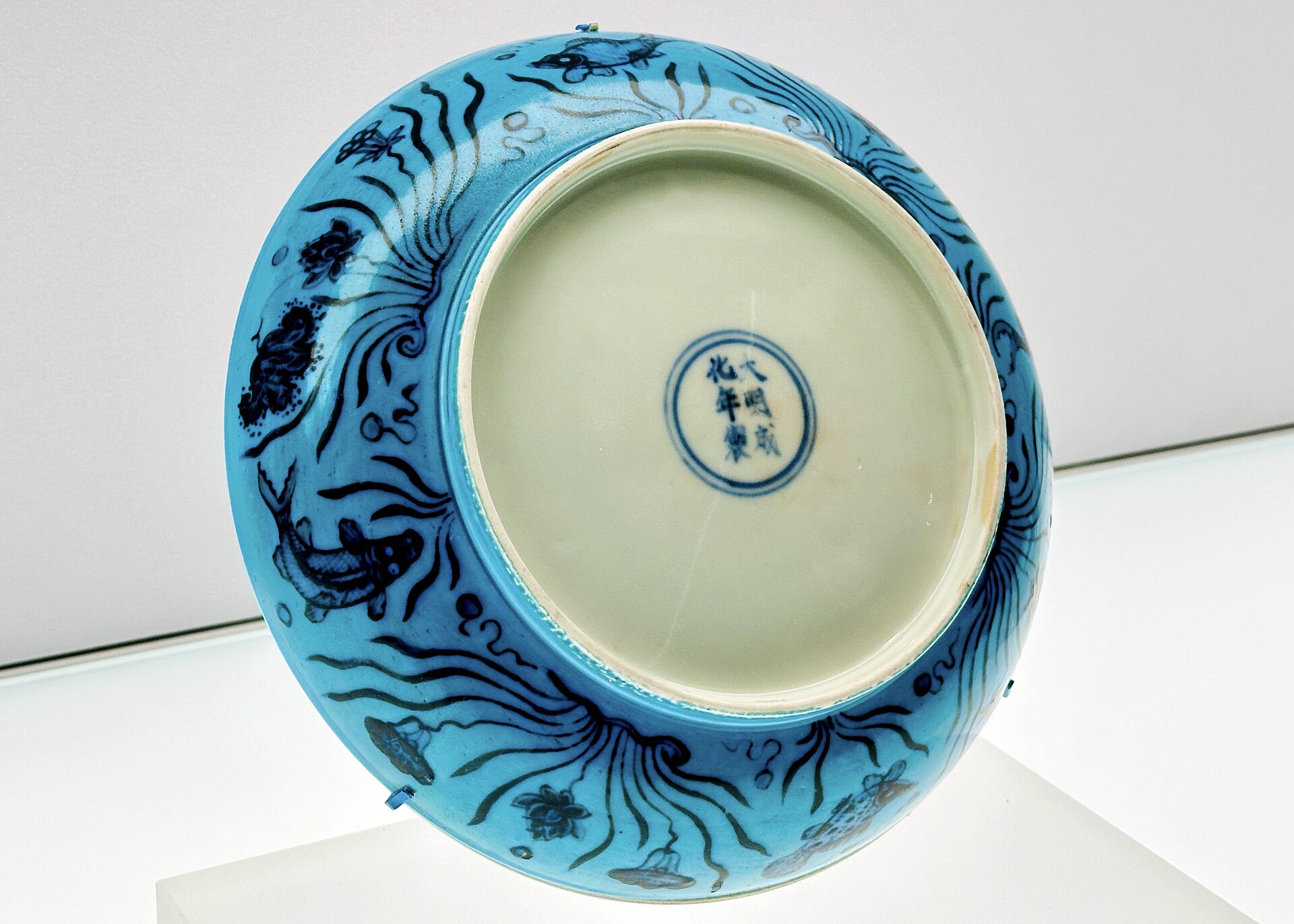
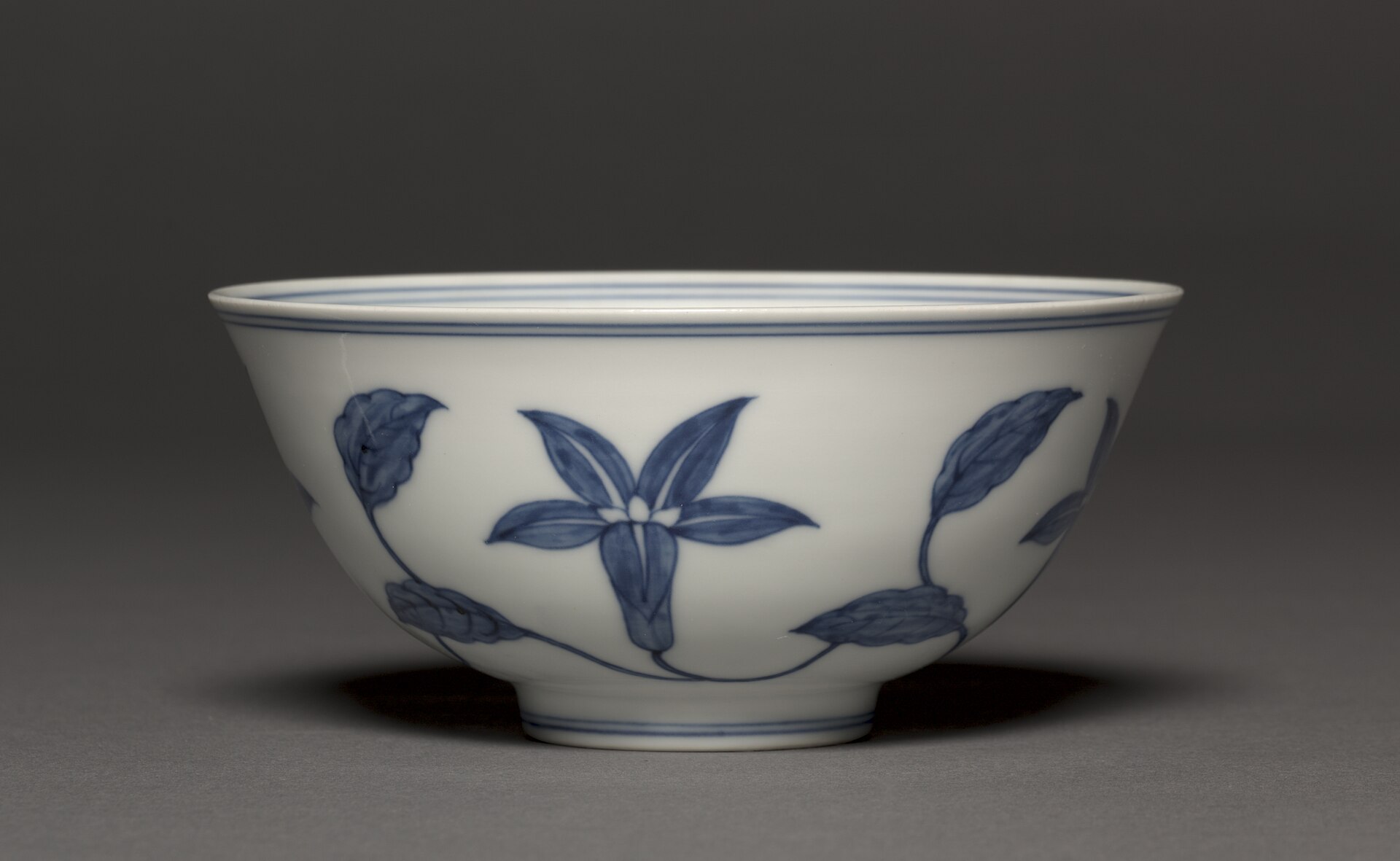
Open questions

  • Who actually wrote the Chenghua reign mark? Liu Xinyuan held that it reproduces the young emperor's own handwriting; a separate proposition holds that one calligrapher wrote all the official marks of the reign. Neither is supported by a document consulted here and no published study reachable for this page tests either against the marks themselves.
  • How many Chenghua porcelains of mark and period survive in total? Regina Krahl gives about two dozen in private hands, which is a count of a market rather than of a corpus. No published census covers the museum holdings of the whole reign, and the largest of them, in Taipei, has published exhibition counts of 197 pieces in 1977 and 207 in 2003 without stating a total.
  • What exactly did the third Chenghua stratum at Zhushan contain, and how was it dated? The unfinished chicken cup fragments are cited constantly through the Sotheby's catalogue notes, but the primary publication, Liu Xinyuan's study in the 1993 Tsui Museum catalogue, has not been read for this page and no stratigraphic section is reproduced in any source reachable here.
  • Why did the imperial kilns halt in 1485? The date is given consistently and the reason is not. No source consulted states whether production stopped by edict, by exhaustion of funds, by a supply failure or through the politics of a court dominated by Lady Wan and the eunuch establishment.
  • Is the attribution of Chenghua taste to Lady Wan Zhen'er founded on anything? The claim that her demands drove the kilns to their standard is repeated widely in the Chinese-language literature. No primary document behind it has been found for this page and it is recorded here as an argued position only.
  • What was the Chenghua yellow-glazed dish for? Cleveland catalogues 1989.288 as a masterpiece of Ming monochrome and quotes Sherman Lee on the importance of monochromes, but no source consulted states the function of an imperial yellow dish of this period, ritual or otherwise. The obvious candidates are guesses and are not offered.
  • What did the Cleveland lily-scroll palace bowl make at Sotheby's London in 1940? The Eumorfopoulos sale catalogue of 28 to 31 May 1940 is digitised and the lot is illustrated at pages 78 to 79, but no price is given in the sources consulted here and the priced copy has not been read.
  • Did the Palmer Palace Bowl sell below its low estimate on 9 September 2025? The single source consulted gives an estimate of HKD 40,000,000 to 80,000,000 and a price of HKD 35,145,000, which cannot both be right on the ordinary reading unless the reserve sat under the estimate. No hammer figure is published and the discrepancy is unexplained.
  • What were the hammer prices behind the 2017 Sotheby's results? Neither lot 3101 nor lot 3102 is broken out into hammer and premium by any source consulted, and the same is true of every Chenghua result on this page except the 2019 palace bowl and the 2014 chicken cup.
  • How many imperial kiln workers were there under Chenghua, and what were they paid? Accounts give hundreds and probably thousands of workers at Jingdezhen with tasks divided into specialities, and hundreds of kilns with thousands of workers by the sixteenth century, without a payroll, a roster or a date. No employment record for the Chenghua imperial factory has been located.
  • How much of the Zhushan Chenghua material has been published? The Institute reports more than twenty million kiln relics recovered since the late 1970s and over 3,000 specimens digitised into the gene bank. The ratio between those two numbers is the size of the unpublished archive and nobody states what it contains.
  • Which of the Percival David Chenghua pieces will travel? The 2024 gift contemplates loans to the Shanghai Museum and the Metropolitan Museum of Art while requiring the collection to stay on public display together in perpetuity in a dedicated gallery. How those two conditions are reconciled in practice, and whether the chicken cup is among the objects that will move, is not stated.

Sources

  • 1Sotheby's, lot 1, An Exceptionally Important and Fine Doucai 'Chicken Cup', Mark and Period of Chenghua, The Meiyintang 'Chicken Cup', Hong Kong, sale HK0545, 8 April 2014, catalogue note by Regina Krahl. Source for the unfinished cup sherds from the third and last Chenghua stratum at Zhushan, the halt in production around 1485 and the confinement of the finest wares to the preceding decade, the six-character mark within double squares on the countersunk base as a late Chenghua innovation, Liu Xinyuan's view that the naive calligraphy of the mark is the young emperor's own hand, the doucai palette and the effect of repeat firings on yield, the museum census, the Qianlong ode and the appearance of a chicken cup in Hong lou meng, and the citation of the 1993 Tsui Museum catalogue. https://www.sothebys.com/en/auctions/ecatalogue/2014/meiyintang-chicken-cup-hk0545/lot.1.html
  • 2Sotheby's, lot 25, An Important and Rare Blue and White 'Palace Bowl', Mark and Period of Chenghua, the Pilkington Collection of Chinese Art, Hong Kong, sale HK0639, 2016, catalogue note by Regina Krahl. Source for the statement that only some two dozen Chenghua porcelains of mark and period of any style or design remain in private hands, for twelve complete melon palace bowls surviving worldwide with none apparently in Taipei or Beijing, for eleven palace bowl designs of which ten are floral and one fruit, for the production of palace bowls over about a decade in the 1480s, for Chenghua kiln fragments amounting to less than half the volume recovered from the much shorter Xuande reign, for the six-character mark within a double circle, and for the estimate of HKD 50,000,000 to 70,000,000. https://www.sothebys.com/en/auctions/ecatalogue/2016/pilkington-collection-of-chinese-art-hk0639/lot.25.html
  • 3Sotheby's, lot 56, A Magnificent Blue and White 'Palace Bowl', Mark and Period of Chenghua, the Meiyintang Collection, Hong Kong, sale HK0371, 2011, catalogue note by Regina Krahl. Source for palace bowls as the pride or else the desideratum of any museum collection, for Chenghua porcelains as the rarest Chinese imperial porcelains, for the National Palace Museum in Taipei holding the largest number from the former imperial holdings, for a fragmentary Chenghua melon bowl recovered from the waste heaps at Zhushan, for the dating of the palace bowl phase from about 1481 and the reading that gives the classic phase perhaps seven years, and for the estimate of HKD 80,000,000 to 120,000,000. https://www.sothebys.com/en/auctions/ecatalogue/2011/the-meiyintang-collection-an-important-selection-of-imperial-chinese-porcelains-hk0371/lot.56.html
  • 4Jan-Erik Nilsson, gotheborg.com, Marks on Chinese Porcelain: Ming Dynasty (1368-1644) reign marks. Source for the seven diagnostic characteristics of a Chenghua-period mark stroke by stroke, for the statement that the mark is inelegant, thick, often unbalanced and immature, for Nilsson's first-hand report of Liu Xinyuan's explanation given at the Jingdezhen excavations in the early 1990s, for the observation that the number of hands entrusted to write the imperial mark was small enough that individual handwriting can often be recognised, for the rule that marks are the last thing to trust in dating a piece, and for the four-character Chenghua nian zhi form on later and modern wares. NOTE: WebFetch and the in-app browser both failed on this domain, the former with a certificate chain error and the latter with a navigation refusal; the page was retrieved with curl on 3 August 2026 and parsed locally. https://www.gotheborg.com/marks/mingmarks.shtml
  • 5Asian Ceramics (aziatischekeramiek.nl), Reign marks on Chinese ceramics. Source for the structure of the six-character mark, the vertical top-to-bottom and right-to-left reading order and the horizontal exception on rims, the statement that the Chenghua mark is probably the most copied apocryphal reign mark because the imperial porcelain of the period was considered of the highest quality, and for apocryphal marks under Kangxi as a sign of respect rather than forgery. https://www.aziatischekeramiek.nl/en/learn/7579-reign-marks-on-chinese-ceramics
  • 6Kate Hunt, Christie's Chinese works of art department, Chinese reign marks: a guide to identification, Antique Collecting, 25 July 2025. Source for the structure and reading order of reign marks and their derivation from bamboo-strip writing, for the trade use of the word apocryphal in catalogue descriptions, for the Chenghua mark as among the most copied and for copying out of reverence rather than deception, for Chenghua scarcity as a product of the exacting standards of imperial manufacture and the destruction of flawed pieces, and for the working test of reading the mark in conjunction with the quality of the object, including the treatment of crude marks on minyao wares. https://antique-collecting.co.uk/2025/07/25/chinese-reign-marks-a-guide-to-identification/
  • 7chinabronzes.wordpress.com, Chenghua Porcelain and reign marks: an observation based on National Palace Museum's collections, 15 December 2016. Source for the estimate that more than ninety per cent of the world's Chenghua doucai is in the National Palace Museum, Taipei, for eight chicken cups there out of about seventeen worldwide, for the Taipei Chenghua exhibitions of 197 pieces in 1977 and 207 pieces in 2003 with a digitised catalogue for the latter, for the brush-technique analysis of the mark (absence of lifting-up and of wrapping the brush tip, and incomplete starting, connecting, turning and closing stages), and for the contrast between superb doucai decoration and crude reign marks as characteristic of the period. INDEPENDENT BLOG, used for its direct observation of a named museum collection and flagged for replacement with the Taipei exhibition catalogues. https://chinabronzes.wordpress.com/2016/12/15/chenghua-porcelain-and-reign-marks-an-observation-based-on-national-palace-museums-collections/
  • 8National Palace Museum, Taipei, collection article, Chicken cup in doucai painted enamels, Chenghua reign, accession 04001036. Source for the dimensions of 4 cm high, 8.3 cm diameter and 3.7 cm base diameter, for the six-character mark in blue and white glaze on the base, for the decoration of two scenes of roosters and hens with chicks separated by China roses and orchids with three blue lines at mouth and base and a plain white interior, for the museum's statement of the doucai sequence, for the range of Chenghua doucai cup designs in the collection, for the scholar Cheng Zhe's record of a pair of chicken cups at a hundred thousand cash under the Wanli Emperor, and for the cup's traceability to the Yongzheng reign through the Qing Imperial Workshop archives with a Qianlong-era silk-embroidered box. https://theme.npm.edu.tw/selection/Article.aspx?sNo=04001036&lang=2
  • 9National Palace Museum, Taipei, 3D artefact record, Chicken cup in doucai painted enamels, accession K1B005192, gallery 205. Source for the current accession number and the description of the form, the mark and the decoration. https://theme.npm.edu.tw/3d/Content.aspx?sno=04001036&lang=2&fromCnt=0
  • 10TERTIARY. Wikipedia, Doucai. Source for the translations of the term, the two-stage firing with the second firing at about 850 to 900 degrees, the palette of red, green, yellow and transparent aubergine and the extra firing aubergine requires, the distinction between doucai and wucai on the completeness of the blue outline, the Xuande dish with red and green enamels excavated at the Jingdezhen kilns, the flowering of the technique in the last years of the Chenghua reign, and the Wanli and Yongzheng revivals. Flagged for replacement with the Zhushan excavation reports and the Taipei catalogues. https://en.wikipedia.org/wiki/Doucai
  • 11TERTIARY. Wikipedia, Jingdezhen porcelain. Source for the founding of the imperial kiln factory at Zhushan in 1369 and its direct administration by the court, for twelve imperial kilns by 1402, for control by a ministry in the capital, for the 1433 order of 443,500 pieces all with dragon and phoenix designs, for court artists supplying drawn or woodblock printed designs, for the division of labour among hundreds and probably thousands of workers, for the destruction of defective pieces on site, and for the introduction of reign marks under Yongle. Flagged for replacement with the Zhushan excavation reports and Liu Xinyuan's publications. https://en.wikipedia.org/wiki/Jingdezhen_porcelain
  • 12TERTIARY. Wikipedia, Chenghua Emperor. Source for the personal name Zhu Jianshen, the accession on 23 February 1464 and the death on 9 September 1487 at thirty-nine, for Lady Wan Zhen'er, 1428 to 1487, her age at his accession and her position, for the son born in 1466 and the account of her conduct thereafter, for the creation of the Western Depot in 1477 and the career of the eunuch Wang Zhi to his transfer in 1483, for over ten thousand eunuchs by the end of the century, for the emperor's support of Buddhism and the five Indian-style pagodas ordered west of Beijing in 1473, and for the succession of the Hongzhi Emperor. https://en.wikipedia.org/wiki/Chenghua_Emperor
  • 13TERTIARY. Wikipedia, Percival David Foundation of Chinese Art. Source for David beginning to collect around 1913 and first visiting China in 1923, for the roughly forty pieces acquired after 1927 from Forbidden City material disposed of by members of the Imperial Household Department, for the gift to the University of London in 1950 and the public opening at 53 Gordon Square on 10 June 1952, for the closure at the end of 2007, for the opening of Room 95 at the British Museum on 23 April 2009, for the approximately 1,700 pieces, for the November 2024 gift, and for the completion of the transfer in April 2025. Flagged for replacement with the Foundation's and the British Museum's own documents. https://en.wikipedia.org/wiki/Percival_David_Foundation_of_Chinese_Art
  • 14The Art Newspaper, British Museum receives 'highest value object donation in UK museum history', 14 November 2024. Source for the date of the gift, the 1,700 ceramic pieces, the valuation of approximately one billion pounds, the requirement that the collection remain on public display together in perpetuity in a dedicated gallery, the contemplated loans to the Shanghai Museum and the Metropolitan Museum of Art, the requirement of Charity Commission consent, the Foundation's chairmanship by Colin Sheaf, the loan since 2009 and the bilingual Room 95, and the naming of the doucai chicken cup of the Chenghua reign as a highlight. https://www.theartnewspaper.com/2024/11/14/british-museum-receives-highest-value-object-donation-in-uk-museum-history
  • 15Quan Kuishan, The Archaeological Findings from the Imperial Kiln Site of the Ming-Qing Dynasty in Jingdezhen, Palace Museum Journal, no. 3, 2013, vol. 167, p. 158 (English abstract; Chinese text pp. 6-19). Source for the 2002-2004 excavation carried out jointly by the School of Archaeology and Museology at Peking University and other institutes, for the enclosure and courtyard wall standing in the north of the site, for the groups of cucurbit-shaped kiln furnaces opposite steamed-bread-shaped stoves at the southern foot of Zhushan, for the small pits and piles of sherds and imperfect wares that failed selection for the court being centrally treated with others scattered nearby, and for the statement that most excavated wares are imperfect in colours and glazes while several types were discovered there for the first time. The PDF was retrieved and the text extracted locally; the Chinese article itself has not been read. https://www.dpm.org.cn/Uploads/File/2018/06/05/u5b1662a99ebb9.pdf
  • 16Qiushi (en.qstheory.cn), Jingdezhen's ancient ceramics 'gene bank' decodes the cultural legacy of Chinese porcelain, 21 October 2025. Source for more than twenty million kiln relics recovered by the Jingdezhen Imperial Kiln Institute since the late 1970s from the late Tang to the Republic, for the Ancient Ceramic Gene Bank begun in June 2022 with Tsinghua University, the Palace Museum and the Shanghai Institute of Ceramics, for over 3,000 curated samples digitised with three-dimensional models, archaeological records and analytical data yielding nearly 1.2 million individual data points, for the identification of a dragon-patterned dish as late Qing folk-kiln work from seventeen comparative samples and the phrase porcelain DNA test, and for the confirmation with Peking University of the coexistence of imported and domestic raw materials from the Xuande period. https://en.qstheory.cn/2025-10/21/c_1133871.htm
  • 17China Daily (govt.chinadaily.com.cn), Jingdezhen Imperial Kiln Institute, 4 March 2025. Source for the permanent exhibition of nearly 700 restored porcelain pieces and thousands of porcelain shard specimens, for a collection of over 50,000 exhibit-ready cultural items with emphasis on restored pieces and Ming imperial kiln ceramics unearthed from the kiln site, and for the public specimen research laboratory of the Ancient Ceramic Gene Bank. https://govt.chinadaily.com.cn/s/202503/04/WS67c66aee498eec7e1f730cba/jingdezhen-imperial-kiln-institute.html
  • 18China Daily, Palace Museum displays glory days of Ming porcelain, 13 November 2018. Source for the exhibition Imperial Ceramics and Porcelain of the Great Ming: Comparison of Excavated and Extant Ceramic Pieces from Jiajing, Longqing and Wanli Reigns, running 6 November 2018 to 22 February 2019 with 298 exhibits from the palace collections and the Jingdezhen archaeological discoveries, and for the statement that it was the sixth and final edition of a series of similar displays over the previous three years. https://www.chinadaily.com.cn/a/201811/13/WS5bea165ca310eff30328839f.html
  • 19The Value, Ming Dynasty Porcelain: Chosen Ones vs Unchosen Ones. Source for the exhibition title The Ming Imperial Porcelain: A Comparative Exhibition of Archaeological Findings at the Imperial Kiln Site in Jingdezhen and Chenghua Period Porcelain in the Collection of the Palace Museum, at the Palace Museum, Beijing, 25 October 2016 to 26 February 2017, for over 180 porcelains displayed, for the reasons pieces failed to reach the Forbidden City (deformity, incorrect inscription or wrong painting), for the restoration of unearthed fragments before exhibition, and for the blue and white dragon and phoenix dish with one six-clawed and one four-clawed dragon against an imperial standard of five. https://en.thevalue.com/articles/palace-museum-ming-dynasty-porcelain-chosen-vs-unchosen
  • 20The Value, A Rare Chenghua Blue and White Palace Bowl Sells for HK$56.3m. Source for the sale at Sotheby's Hong Kong on 8 October 2019, sale Two Ming Porcelain Masterpieces from an Important Collection, lot 1002, 14.9 cm, estimate in excess of HK$50,000,000, hammer price HK$48,000,000, price realised HK$56,738,000, the telephone bid placed by Peter Song of Sotheby's Beijing for an unnamed client, the six-character reign mark within a double circle, and the statement that only three bowls of the daylily design are known, two of them in the British Museum. The article's headline figure of HK$56.3m conflicts with its own lot block figure of HK$56,738,000; the lot block is used here and the conflict is recorded. https://en.thevalue.com/articles/sothebys-blue-and-white-nicolas-chow
  • 21The Value, Two Ming Blue and White Masterpieces: a Chenghua Palace Bowl and a Xuande Dragon Stem Bowl, with Nicolas Chow. Source for palace bowls as the classic type of Chenghua blue and white, for production in the 1480s as the peak period at Jingdezhen, for about a dozen designs, for the very soft, watery cobalt blue as a breakthrough from the strong imported cobalt of the early fifteenth century, for the liberty taken in leaving the porcelain white, and for the compositional device of a motif repeated three times followed by a break in the scroll, described as never repeated later even in the Qing. https://en.thevalue.com/articles/nicolas-chow-chenghua-palace-bowl-xuande-dragon-stem-bowl
  • 22The Value, Sotheby's Hong Kong, Imperial Porcelain Playthings, auction summary. Source for the sale In His Majesty's Palm: Exquisite Porcelain Playthings at Sotheby's Hong Kong on 5 April 2017, for lot 3102, a Chenghua blue and white cup, at an estimate of HK$15,000,000 to 20,000,000 and a reported result of HK$33,850,000, and for lot 3101, a Chenghua doucai stem cup, at an estimate of HK$8,000,000 to 12,000,000 and a reported result of HK$13,300,000. The source does not separate hammer from premium for either lot. https://en.thevalue.com/articles/sothebys-hong-kong-imperial-porcelain-playthings-auction-summary
  • 23Anthony Wu, The Ise Collection's Rare HKD 35 Million Chenghua 'Palace Bowl' and 65 Years of the Min Chiu Society in Hong Kong. Source for the Palmer Palace Bowl, a Chenghua blue and white bowl of lily design offered at Sotheby's Hong Kong on 9 September 2025, for the reported estimate of HKD 40,000,000 to 80,000,000 and price of HKD 35,145,000, and for the provenance chain from Peter Boode, London, acquired January 1936, through the R. H. R. Palmer collection no. 403, Christie's Hong Kong 17 January 1989, the T. T. Tsui collection and the Tsui Museum of Art, Christie's Hong Kong 3 November 1996, and Mayuyama and Co., Tokyo. DEALER AND SPECIALIST BLOG. The estimate and the price as given cannot both be right on the ordinary reading and the discrepancy is flagged rather than resolved. https://www.anthonywuart.com/post/a-rare-hkd-35-million-chenghua-palace-bowl-and-65-years-of-the-min-chiu-society-in-hong-kong
  • 24MOCalendar, Nature of Things: Jingdezhen Imperial Kiln Museum Collection, Excavated Chenghua Imperial Porcelain Exhibition, Civic and Municipal Affairs Bureau Gallery, 163 Avenida de Almeida Ribeiro, Macau, 17 May to 7 July 2013. Source for the 118 pieces and sets exhibited, for the statement that since 1982 extensive excavations have unearthed thousands of porcelain fragments subsequently restored, for the organisation of the material into four categories (doucai, blue and white, monochrome and coloured glazes, and imitations of Song dynasty wares), and for the characterisation of Chenghua pieces as small decorative and functional items rather than large vessels made by a meticulous double-firing process. https://mocalendar.com/en/event/nature-of-things-jingdezhen-imperial-kiln-museum-excavated-chenghua-porcelain-exhibition
  • 25Asian Ceramics (aziatischekeramiek.nl), Jingdezhen: the porcelain city. Source for imperial kiln supervisors delegated to Jingdezhen from the imperial workshops at court and introducing new designs, shapes and techniques, for the 1459 imperial order of 133,000 pieces reduced to 80,000 for want of resources, for hundreds of kilns and thousands of workers by the sixteenth century, for the assembly-line division of labour with workers specialising in single tasks such as chopping firewood, purifying clay or grinding cobalt, and for the environmental consequences of production. https://aziatischekeramiek.nl/en/learn/7535-jingdezhen-the-porcelain-city
  • 26Sotheby's, A Short History of Chinese Imperial Porcelain. Source for the statement that quality control by the court was so strict that any vessels with even the most minor flaws, and any surplus to imperial orders, were discarded and destroyed, and for the highly organised, assembly-line character of Ming production with Jingdezhen as the source of the fine and imperial wares. https://www.sothebys.com/en/articles/a-short-history-of-chinese-imperial-porcelain
  • 27koh-antique.com, Understanding the Sources of Cobalt in Ming Folk Kiln Blue-and-White Porcelain. Source for pingdengqing, also called pitangqing, mined at Leping in Jiangxi, its peak use in the Chenghua and Hongzhi reigns, its soft elegant tone and limited diffusion producing crisp lines suited to fine brushwork and doucai decoration, and for the contrast with the imported cobalts used in other Ming reigns. Consulted alongside search-indexed material on sumaliqing and on the transition from imported to domestic ore from the middle and later Xuande period. https://www.koh-antique.com/ming/ming%20cobalt.html
  • 28Cleveland Museum of Art, collection record, Bowl with Lily Scrolls, accession 1967.64, China, Jiangxi province, Jingdezhen, Ming dynasty, Chenghua mark and period, porcelain with underglaze blue decoration, diameter 14.5 cm, overall 6.9 cm, gift of John D. Rockefeller III and purchase from the John L. Severance Fund, inscribed Da Ming Chenghua nian zhi. Bibliography includes Sotheby's London, The Eumorfopoulos Collections, 28 to 31 May 1940, lot 238, mentioned and reproduced at pp. 78-79, and Harry Mason Garner, Oriental Blue and White, 1954, plate 35a. Consulted through the museum's open access API. https://openaccess-api.clevelandart.org/api/artworks/143603
  • 29Cleveland Museum of Art, collection record, Dish, accession 1989.288, China, Jiangxi province, Jingdezhen, Ming dynasty, Chenghua mark and period, porcelain with yellow glaze, diameter 21.5 cm, bequest of Mrs Severance A. Millikin, inscribed Da Ming Chenghua nian zhi, with the museum's note quoting Sherman Lee on the development and refinement of monochrome stoneware and porcelain as the major theme of the Chinese ceramic tradition. Consulted through the museum's open access API. https://openaccess-api.clevelandart.org/api/artworks/154696
  • 30Cleveland Museum of Art, collection record, Wine Cup with Children at Play, accession 1957.61, Jingdezhen, Chenghua mark and period, doucai, overall 4.8 cm, John L. Severance Fund. Source for the museum's description of the two-firing doucai sequence and of the body as thin, translucent and light in weight, and for its account of the drawing as free and spontaneous with perfect compositional balance over a very small surface. Consulted through the museum's open access API. The image of this object is used in the separate Iconotheca record of the Meiyintang chicken cup and is deliberately not repeated here. https://openaccess-api.clevelandart.org/api/artworks/135007
  • 31Art Institute of Chicago, collection record, Pair of Cups, accession 1941.701a-b, Qing dynasty, Yongzheng reign mark and period, 1723-1735, porcelain painted in underglaze blue and overglaze enamels (doucai), heights 5.7 cm, bequest of Henry C. Schwab, provenance Henry Charles Schwab, 1867-1941, Chicago. Source for the inscription recorded as a six-character reign mark in regular script reading Da Qing Yongzheng nian zhi, for the museum's account of the doucai process and of the term as joined or dovetailed colours, and for the Yongzheng Emperor's personal role in overseeing the imperial kilns. Consulted through the museum's public API. https://api.artic.edu/api/v1/artworks/42566
  • 32Metropolitan Museum of Art, collection record, Chicken cup, accession 1987.85, object 42515, Ming dynasty, Chenghua mark and period, porcelain painted in underglaze cobalt blue and overglaze coloured enamel, Jingdezhen ware, purchase, Mrs Richard E. Linburn Gift, 1987. Consulted through the museum's public collection API. https://collectionapi.metmuseum.org/public/collection/v1/objects/42515
  • 33Wikimedia Commons, File:Jingdezhen blue-and-white dish.jpg. Photograph by Alexey Yakovlev, 17 October 2024, released under CC0 by the photographer, described as a dish with lotuses and fish, Jingdezhen blue-and-white ware under turquoise glaze, Chenghua reign, and geolocated to the Shanghai Museum. The underside shows the six-character reign mark within a double circle. Licence read from extmetadata.LicenseShortName at fetch time on 3 August 2026. https://commons.wikimedia.org/wiki/File:Jingdezhen_blue-and-white_dish.jpg
  • 34Wikimedia Commons, File:Kangxi period saucer with river scene, V&A London.jpg. Released under CC0, described as a Kangxi period dish with a river scene marked with a spurious Chenghua mark, Victoria and Albert Museum, London. Licence read from extmetadata.LicenseShortName at fetch time on 3 August 2026. The identification of the mark rests on the uploader's description; the mark is not visible in the photograph and has not been checked against the museum's own catalogue. https://commons.wikimedia.org/wiki/File:Kangxi_period_saucer_with_river_scene,_V%26A_London.jpg
  • 35National Palace Museum, Taipei, gallery label 'Doucai' in the Pottery and Porcelain Gallery, photographed 8 December 2017 by Gary Lee Todd and released CC0 via Wikimedia Commons as File:Doucai (24118580727).jpg. Source, in the museum's own words, for doucai as contending colours, for the four-stage process of outlining in cobalt blue, glazing and high-temperature firing, filling the spaces with colours and refiring at low temperature, for the technique beginning in the Xuande reign and being perfected by the time of the Chenghua Emperor, and for the durability and pure translucence of the thin Chenghua bodies making the wares renowned at the time and the object of imitation in later generations. https://commons.wikimedia.org/wiki/File:Doucai_(24118580727).jpg
Last verified 2026-08-02