The Meiyintang 'Chicken Cup'
- Artist
- The imperial kilns at Jingdezhen, Chenghua reign
- Date
- 1465-1487; the Sotheby's catalogue places production of these cups in the decade before 1485, when the imperial kilns halted production
- Medium
- Porcelain painted in underglaze cobalt blue with overglaze polychrome enamels in the doucai technique, Jingdezhen ware
- Dimensions
- 8.2 cm wide
- Inscriptions
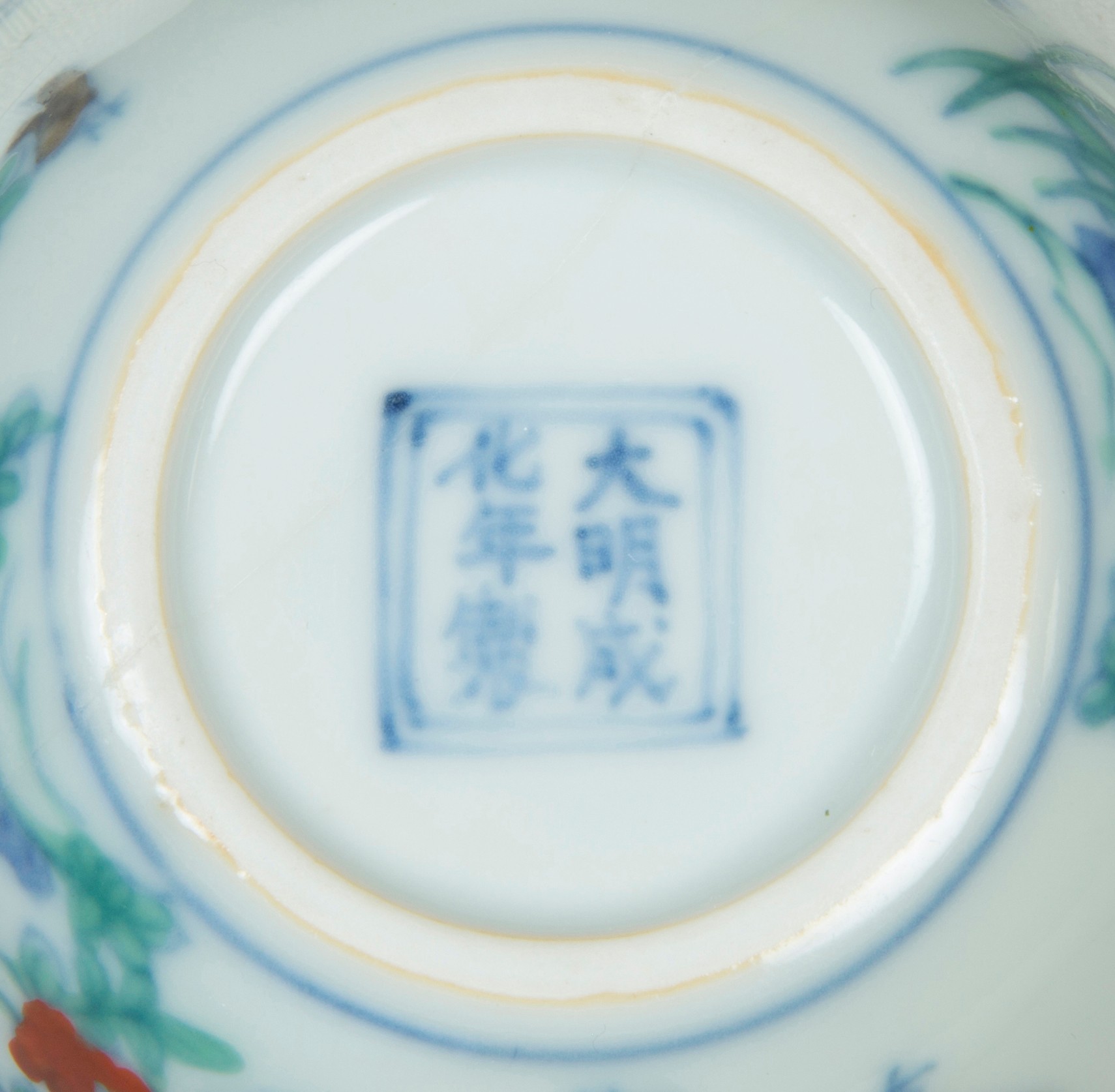
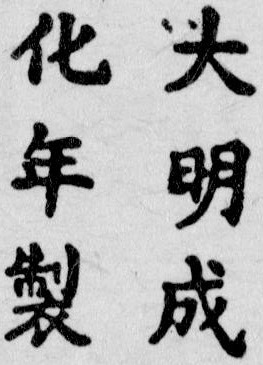
- Six-character reign mark in underglaze blue on the countersunk base, enclosed within a double square: Da Ming Chenghua nian zhi, Made in the Chenghua reign of the Great Ming. The double-square frame is itself an innovation of the late Chenghua phase and is characteristic of doucai wares.
- Attribution
- acceptedAccepted by Sotheby's, and unchallenged in the reporting consulted, as mark and period of Chenghua, that is, made in the reign whose mark it carries rather than in a later reign copying that mark. No individual maker is recorded and none can be. This is imperial kiln production: a divided, supervised workshop in which throwing, blue outlining, enamelling and firing were separate specialist jobs, and in which the object was made to a court specification rather than to a personal design. The attribution is therefore to a place, a factory and a decade, and the evidence for it is the body, the glaze, the palette, the painting and the mark taken together. Attributions of this kind carry an unusual weight of risk because the Chenghua mark is among the most copied inscriptions in the history of ceramics.
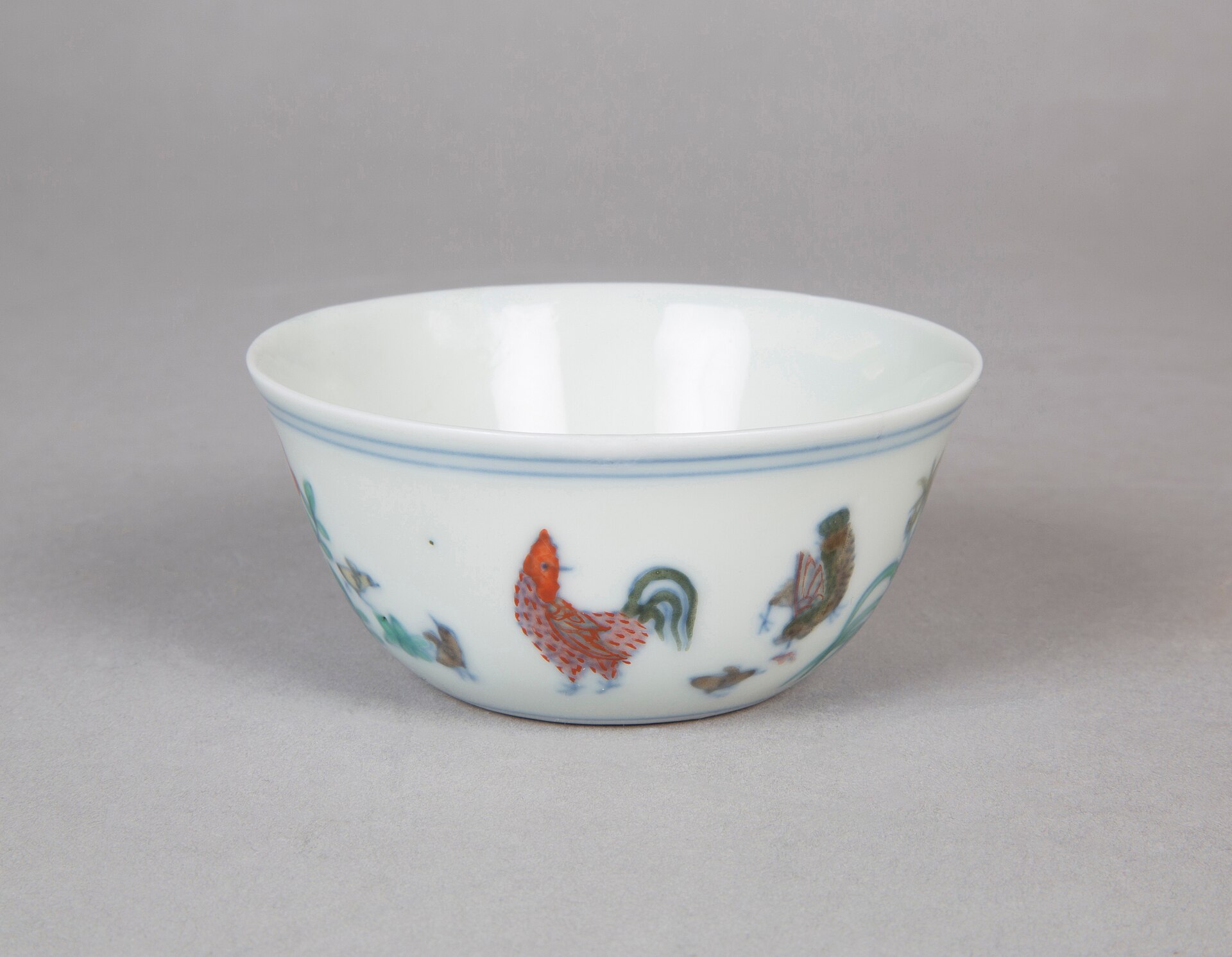
A porcelain wine cup 8.2 centimetres across, made at the imperial kilns at Jingdezhen during the Chenghua reign and painted in doucai with a cock, a hen and their chicks among rocks and flowers. On 8 April 2014 Sotheby's Hong Kong sold it from the Meiyintang collection of the Swiss brothers Stephen and Gilbert Zuellig. The hammer fell at HKD 250 million; with commission the total was HKD 281.24 million, then the highest price ever paid at auction for any Chinese porcelain. The buyer was the Shanghai collector Liu Yiqian, who settled the account with twenty-four swipes of an American Express card.
Sotheby's counted seventeen surviving Chenghua chicken cups at the time of the sale, thirteen of them in museums and four, including this one, in private hands. The National Palace Museum in Taipei alone holds eight. Two further examples in the Palace Museum in Beijing are disputed by Western specialists, and the reign has been imitated continuously for five centuries, which is why the census is contested and why the words mark and period do the heavy lifting in any description of this object.
When the cup was handed over in Hong Kong on 18 July 2014, Liu poured tea into it and drank. The photograph set off a public argument in China about what an owner of such a thing is permitted to do with it, and that argument is now part of the object's history.
Images
The artist
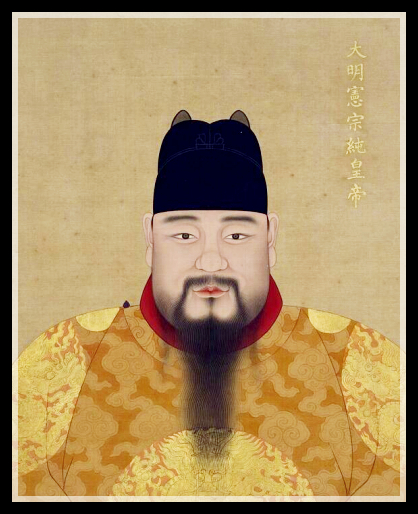
The imperial kiln factory (yuqichang) at Zhushan, Jingdezhen, under the Chenghua Emperor
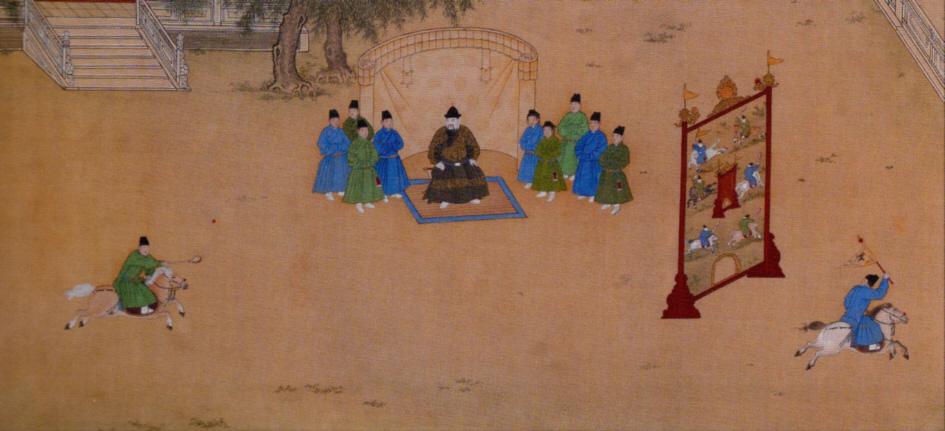
There is no artist here and there was never meant to be one. The imperial kiln factory at Zhushan in Jingdezhen was established in 1369, at the start of the Ming, and was administered directly by the court to produce porcelain exclusively for the imperial household. Work was divided into specialities to increase efficiency and consistency, which is the opposite of the conditions under which a personal hand becomes visible. The man who threw this cup did not paint it and the man who painted the blue outlines did not lay in the enamels. Court artists in the capital supplied drawn or printed designs. What we call a Chenghua chicken cup is the output of an administrative system operating to a specification, and the correct object of study is that system: how it was organised, what it destroyed, and how a piece of it can be identified five hundred years later.
The most expensive porcelain ever sold is a wine cup you could close your hand around
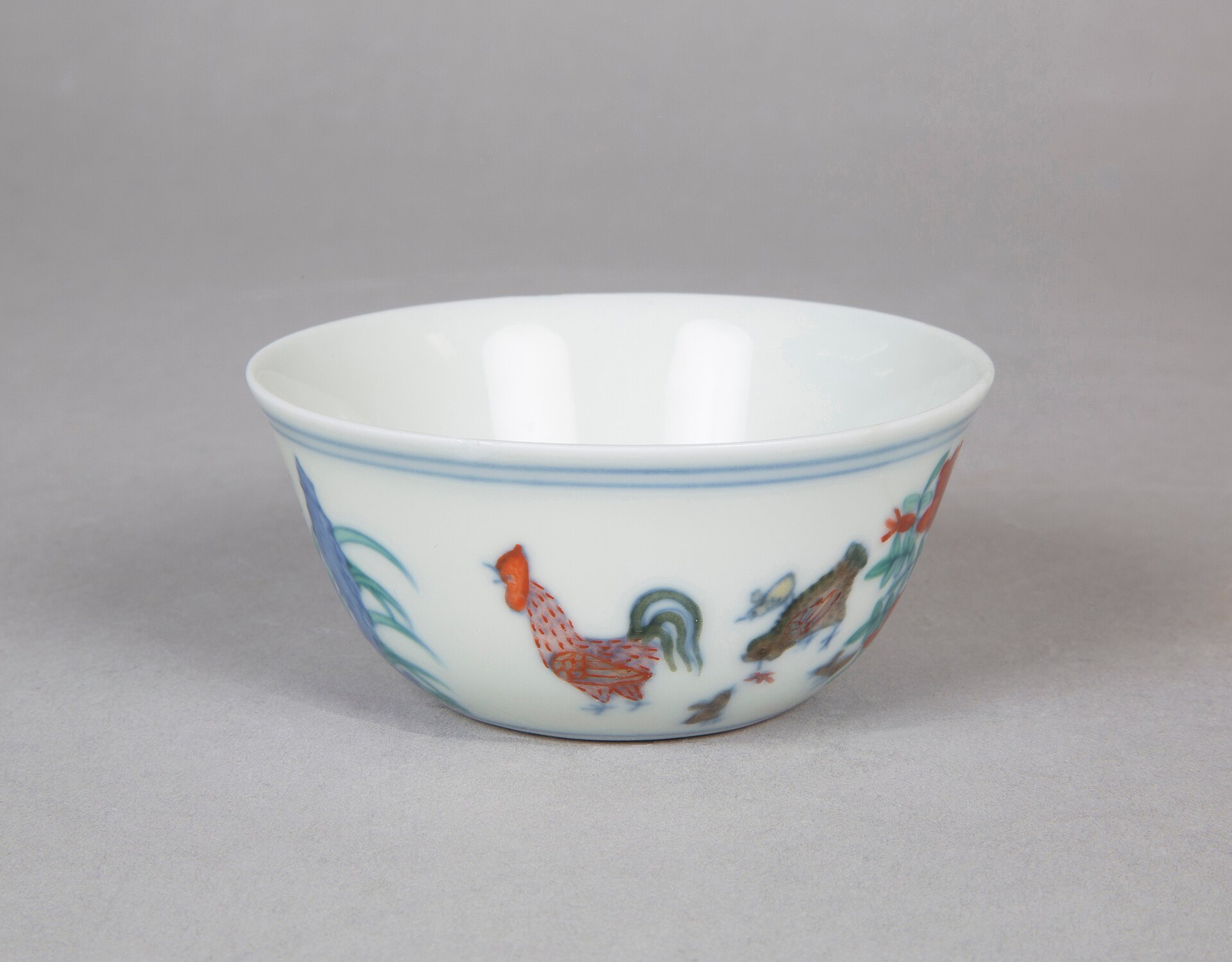
The cup is 8.2 centimetres wide. It has a flared mouth, shallow curving sides and a countersunk, ringed foot. The inside is plain white with no decoration at all. The outside carries two groups of chickens: a cock and a hen leading chicks across open ground, the hen stooping to peck, the chicks with their wings up, the two groups separated by a garden rock, peonies and orchid grass. That is the whole design. There is no gilding, no inscription on the wall, no ostentation of any kind.
It is a wine cup. It was made to be picked up and drunk from, which is a fact worth holding on to, because it becomes the crux of the argument this object set off in 2014.
Small size is not incidental to the Chenghua reputation. The reign is admired for palace bowls, stem cups and wine cups rather than for large vessels, and the qualities it is admired for are qualities that only read at close range: a body so finely potted that it transmits light, a glaze with a soft, slightly unctuous surface, and painting done at the scale of a fingernail without any loss of nerve.
Doucai is two firings, and most attempts did not survive the second
Doucai has been translated as contrasting, contending, interlocking, joined or dovetailed colours. All those readings point at the same procedure. The decoration is drawn first in cobalt blue directly on the unfired body, as outline only. The piece is then glazed and fired at high temperature exactly as a blue-and-white vessel would be. What comes out of that first firing is a finished white cup with a blue drawing on it, a coloured-in outline waiting to be filled.
The colours are then laid over the glaze inside those blue outlines, in iron red, several greens from bright to olive, yellow and pale aubergine, and the cup goes back into a lower-temperature muffle kiln to fix them. For the chickens' plumage several enamels were superimposed on one another to build a variegated surface, and each superimposition meant another pass through the fire.
The consequence is arithmetical rather than mystical. Every additional firing is another chance for the cup to crack, for an enamel to blister, for a colour to shift. The Sotheby's catalogue puts it plainly: the repeat firings necessary for the process would naturally have reduced the number of successfully completed examples. The scarcity of these cups begins in the kiln, before any question of five centuries of breakage.
The softness that specialists praise in the underglaze blue is also technical. The cobalt is domestic Chinese ore, not the imported cobalt used earlier in the Ming, and it fires to a quieter, greyer, less assertive blue. Under Chenghua that was not a limitation to be overcome. It was the effect being sought, and it is one of the things that distinguishes the period from the reigns that later imitated it.
The cup was already a legend under the Ming
This is not a modern valuation. The chicken cup was a famous object within a century of being made, and it was expensive within a century of being made.
The subject itself was new. A cock and a hen with chicks in a garden is not encountered on porcelain before the Chenghua reign, although it derives from a tradition of Song dynasty painting. Someone at court chose to put a domestic barnyard scene on an imperial wine cup, and the choice held.
The Wanli Emperor, who reigned from 1572 to 1620, is recorded as admiring Chenghua chicken cups in particular, and that admiration had already made them expensive in his own century. The figure that circulates in Chinese sources is that a pair was reckoned at a hundred thousand cash, or something close to a hundred taels of silver, in the Wanli period. The Qianlong Emperor, reigning from 1736 to 1795, wrote an ode in praise of chicken cups. Liu Yiqian's remark in 2014, that Qianlong had used it and now he had used it, was not an invented pedigree. It was a reasonably accurate reading of the object's standing.
An object that has been prestigious continuously for five hundred years accumulates two things: a market, and a body of forgeries.
Seventeen cups, and the census is contested
Sotheby's stated at the time of the sale that seventeen Chenghua chicken cups survive, four of them in private hands and the rest in museums. The catalogue note enumerates the museum side: the National Palace Museum in Taipei holds eight; the British Museum, the Victoria and Albert Museum, the Fitzwilliam Museum in Cambridge, the Metropolitan Museum of Art and the Collections Baur in Geneva hold one each. That is thirteen. Only three other Chenghua chicken cups, on the catalogue's account, appear to remain in private hands, which with this cup makes four, and thirteen plus four is seventeen. The arithmetic is internally consistent.
Other counts do not agree. Agence France-Presse reported sixteen on the day. The reference literature gives sixteen with three in private hands. The Australian National University study of the object gives nineteen. Two examples in the Palace Museum in Beijing are disputed by Western specialists and are excluded from the Sotheby's figure, which accounts for part of the spread. The rest of the spread comes from the fact that no one has authority to close the list: a census of surviving examples of a heavily forged type is an argument about authentication, not a headcount.
This record therefore states seventeen, on Sotheby's own enumeration, and states that the figure is a specialist's opinion rather than a fact. Nicolas Chow, then Sotheby's deputy chairman for Asia, described this particular cup as one of only three perfect chicken cups ever to come to the market, which is a narrower and more defensible claim than any total.
From a pair in London in 1957 to a Swiss vault
The documented chain begins in 1957, when the cup was in the possession of Mrs Leopold Dreyfus and was shown in The Arts of the Ming Dynasty at the Oriental Ceramic Society in London as catalogue number 175. The catalogue entry describes it as one of a pair. The whereabouts of the other cup of that pair is not established in the sources consulted, and it is one of the sharper unanswered questions about this object.
Sotheby's records a connection to the collector-dealer Edward T. Chow, but marks it by repute rather than as documented: the cup came in a box commissioned by Chow, which is suggestive and is not proof. It was sold at Sotheby's Hong Kong in 1980 for HKD 5.28 million to the Japanese collector Sakamoto Goro, and again at Sotheby's Hong Kong on 27 April 1999, as lot 410, for HKD 29.17 million, which was itself a world record for Chinese porcelain at the time. The buyer in 1999 was the London dealer Giuseppe Eskenazi, acting for the Meiyintang collection.
Meiyintang, which translates as Hall among Rosebeds, was assembled from the late 1950s by two brothers born in Manila, Stephen Zuellig, 1917 to 2017, and Gilbert Zuellig, 1918 to 2009, on the proceeds of a business built in the Far East. Gilbert took the early material, from the Neolithic through the Song; Stephen took Yuan, Ming and Qing porcelain and archaic bronzes. Regina Krahl catalogued the collection in four volumes between 1994 and 2010, and Eskenazi, its chief adviser, sold or acquired more than 160 pieces for it over a quarter of a century. The bulk of the collection is on long-term loan to the Museum Rietberg in Zurich. Between 2011 and 2013 Sotheby's Hong Kong sold a large part of the later porcelain, and this cup followed in 2014.
Before 1957 the chain is blank. One Chinese account places the cup with a Hong Kong collector, Qiu Yanzhi, in 1949 at a price of HKD 1,000. That claim rests on a single newspaper source and is recorded here as unverified rather than folded into the chain.
Two figures, and only one of them is a price
The sale was on 8 April 2014 at Sotheby's Hong Kong, sale HK0545, a single-lot sale built around this object. The estimate was on request. Press reporting before the sale put the expectation at around HKD 300 million at the top, or roughly USD 38.6 million.
The hammer fell at HKD 250 million. With the buyer's premium the total came to HKD 281.24 million. Those are two different numbers and they measure two different things: what the bidder bid, and what the bidder paid.
Almost every account of this sale reports one figure, in dollars, and does not say which of the two it is. The premium-inclusive total was converted at the time to USD 36.05 million, and also appears as 36.1, 36.12 and 36.3 million depending on who was doing the arithmetic and when. The hammer converts to about USD 32.2 million. The Hong Kong dollar figures are the real ones. Everything in dollars on this page is derived, and the implied rate between the two published totals is 7.80 Hong Kong dollars to the US dollar, which is where the Hong Kong currency board holds it.
The buyer bid by telephone. He was Liu Yiqian, a Shanghai collector who began as a taxi driver, made a fortune in securities and had founded the Long Museum with his wife Wang Wei. Sotheby's caps a credit card transaction at USD 1.6 million, so the settlement required twenty-four separate swipes of an American Express card. Reporting at the time established that Liu had not considered the reward points until a Bloomberg journalist raised it with him. The detail is comic and it is also the clearest single illustration of what happens when the machinery of ordinary retail payment is asked to carry a museum-grade object.
He drank from it, and that is now part of the object
The cup was handed over in Hong Kong on 18 July 2014, with Nicolas Chow presenting it. Liu picked it up, poured tea into it and drank. He then flew home to Shanghai with it.
His own account was not defensive. He told China Daily that he had been so excited when he finally saw the cup that he poured tea in and drank it without even wiping it, and that the cup had endured six hundred years, that emperors and imperial concubines might have used it, that it was magic and he could not help himself. Elsewhere he put it more flatly: Emperor Qianlong has used it, now I have used it, I just wanted to see how it felt.
The photograph went across Chinese social media and the reaction was hostile. He was called tuhao, the sneer for money without cultivation. He was accused of vanity, vulgarity, ostentation and of risking damage to the cup. One line that circulated was that this was probably the most expensive cup of tea in history. Others were blunter about civilised people not treating a cultural treasure that way.
The defence is not weak, and it was made at the time. A chicken cup is a wine cup. Use is its original function, not a violation of it; a porcelain specialist quoted by China Daily argued that there are cheap porcelains and expensive ones and they are all for people to use, and that Liu had properly appreciated what the object was for. The collector Ma Weidu had drunk from a chicken cup at a Japanese collector's house before Liu ever did. The counter-argument is equally clear: seventeen of these exist, thirteen of them are held in public trust, and an owner of one of the four remaining is in practice a custodian whether or not the law says so.
The episode had one measurable consequence. Sales of replica chicken cups on Taobao surged, with more than eight hundred listings running from a few yuan to tens of thousands. The market for copies of this object, which is five centuries old, got a fresh boost from a photograph of a man drinking tea.
Neither side of that argument is settled, and the record's position is that the argument itself is now attached to the cup as firmly as the 1957 exhibition or the 1999 hammer. An object's history does not stop when it enters a private collection.
Why the words mark and period carry the whole valuation
Everything above depends on a judgement that this cup was made between 1465 and 1487 rather than at any point in the five centuries since. The Chenghua reign mark is one of the two most frequently copied inscriptions in Chinese ceramics, alongside Xuande. Copies of doucai chicken cups were made in quantity in the early Qing, some carrying genuine Kangxi, Yongzheng or Qianlong marks and some carrying spurious Chenghua marks. The Percival David collection at the British Museum displays a Chenghua chicken cup and a Qing chicken cup within the same room, which is the most honest possible presentation of the problem.
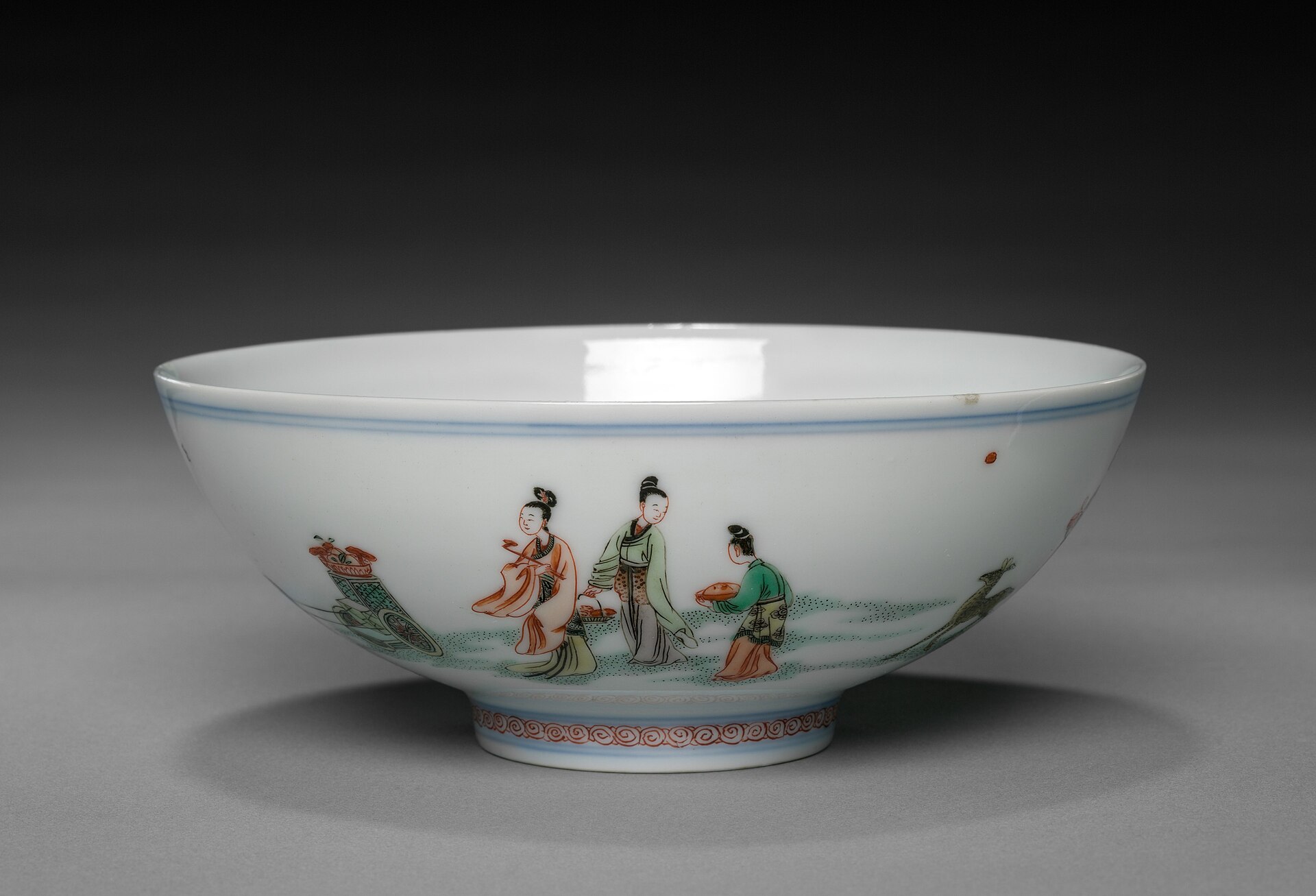
Much of that copying was not fraud. Kangxi and Qianlong potters put Chenghua marks on their finest work as homage to an acknowledged summit, openly and without deceit, and a Kangxi piece with a Chenghua mark is a collectable object in its own right. The Cleveland Museum of Art has a pair of famille verte bowls dated 1662 to 1722 that carry Chenghua marks and are catalogued as exactly what they are. Fraud came later and is still coming: cups continue to be reproduced for antique markets in China, where they are sold both as declared replicas and as something else.
Period is therefore established not from the mark but from everything the mark sits on. The body and its translucency, the character and thickness of the glaze, the specific range and quality of the enamels, the drawing, the foot and its finish, and only then the calligraphy of the six characters and the double square around them. A mark alone establishes nothing except an intention. That is the discipline behind the price, and it is why the phrase mark and period appears in the lot title of an object that sold for HKD 281.24 million.
Technical evidence
- Material and origin
- Porcelain, Jingdezhen ware, Jiangxi province. Made at the imperial kiln factory at Zhushan for court use.116
- Form
- Wine cup with a flared mouth, shallow curving sides, an everted rim and a recessed, ringed base. The interior is plain white and carries no decoration.17
- Dimensions
- 8.2 cm wide. Note that the figures of 4.1 cm high, 8.3 cm rim diameter and 3.7 cm base diameter that circulate for this cup are the published dimensions of the Metropolitan Museum's chicken cup, accession 1987.85, and should not be applied to this object without a fresh measurement.113
- Decoration
- Two groups of chickens on the exterior: a cock and a hen leading chicks across open ground, the hen stooping to peck at an insect and the chicks with wings raised. The groups are separated by a garden rock with peonies and orchid grass. The subject is not encountered on porcelain before the Chenghua reign, although it derives from Song dynasty painting.17
- Technique
- Doucai. The design is outlined in underglaze cobalt blue, glazed and fired at high temperature; overglaze enamels are then applied within the outlines and fixed in a second, lower-temperature firing.1714
- Palette
- Iron red, greens ranging from bright to olive, yellow, pale aubergine and shaded pale underglaze blue. For the chickens' plumage several enamels were superimposed to create a variegated effect, each superimposition requiring a further firing.1
- Underglaze blue
- The characteristic softness of the blue derives from domestic Chinese cobalt rather than the imported ore used in earlier Ming reigns.7
- Reign mark
- Six characters in underglaze blue on the countersunk base, framed within a double square, reading Da Ming Chenghua nian zhi. Marks enclosed in a double square are characteristic of doucai wares and were an innovation of the late Chenghua phase.1
- Firing losses
- The repeat firings required by the doucai process reduced the number of successfully completed examples. Sherds of an unfinished chicken cup were recovered from the third and last Chenghua stratum at the Zhushan kiln site.1
- Dating window
- Production of these cups appears confined to the decade before 1485, when the imperial kilns halted production.1
- Survival census
- Sotheby's counted seventeen surviving Chenghua chicken cups at the time of sale: eight at the National Palace Museum in Taipei, one each at the British Museum, the Victoria and Albert Museum, the Fitzwilliam Museum, the Metropolitan Museum of Art and the Collections Baur in Geneva, and four in private hands including this one. Competing counts are sixteen (AFP and the reference literature) and nineteen (Cui, 2017). Two examples in the Palace Museum in Beijing are disputed by Western specialists and are excluded from all of these figures. The number is a specialist judgement about authentication, not a matter of record.1479
- Condition
- Described by Sotheby's at the time of sale as one of only three perfect chicken cups ever to come to the market. No condition report is reproduced in the public sources consulted, and this record has not seen one.45
Provenance
- c. 1475 - unknownThe Ming imperial householddocumented
Made at the imperial kiln factory at Zhushan, Jingdezhen, for court use, in the decade before the kilns halted production in 1485. Sherds of an unfinished chicken cup were recovered from the third and last Chenghua stratum at the site, which anchors the type to the reign independently of any surviving cup.116
- unknown - 1957Unknownunknown
No owner is documented for roughly four and a half centuries. One Chinese newspaper account places the cup with the Hong Kong collector Qiu Yanzhi in 1949 at a price of HKD 1,000; that claim is uncorroborated and is not treated here as part of the chain.112
- unknown - unknownEdward T. Chowdisputed
Sotheby's lists Chow in the provenance but qualifies it as by repute. The physical evidence is a storage box commissioned by Chow. Chow sold more than two chicken cups at Sotheby's Hong Kong in 1980 and 1981, so the association is plausible without being established.1
- by 1957 - unknownMrs Leopold Dreyfusdocumented
Exhibited in The Arts of the Ming Dynasty, Oriental Ceramic Society, London, 1957, catalogue number 175, where it is recorded as one of a pair. This is the earliest firmly documented point in the chain. The relative order of the Dreyfus and Chow links is not established by the sources.1
- 1980 - 1999Sakamoto Goro, Japandocumented
Bought at Sotheby's Hong Kong in 1980 for HKD 5.28 million by the Japanese collector Sakamoto Goro, and held for close to two decades.1
- 1999 - 1999Eskenazi, Londondocumented
Sold at Sotheby's Hong Kong on 27 April 1999 as lot 410 for HKD 29.17 million, then a world record for Chinese porcelain. Bought by the dealer Giuseppe Eskenazi, chief adviser to the Meiyintang collection, acting on its behalf.18
- 1999 - 2014Meiyintang collection (Stephen Zuellig)documented
Meiyintang, Hall among Rosebeds, was built from the late 1950s by the brothers Stephen Zuellig, 1917-2017, and Gilbert Zuellig, 1918-2009, both born in Manila. Stephen collected the Yuan, Ming and Qing porcelain. Catalogued by Regina Krahl in four volumes, 1994-2010. The bulk of the collection is on long-term loan to the Museum Rietberg, Zurich; a large part of the later porcelain was sold through Sotheby's Hong Kong between 2011 and 2013, and this cup followed in 2014.18
- 2014 - presentLiu Yiqian, Shanghaidocumented
Bought by telephone at Sotheby's Hong Kong on 8 April 2014, sale HK0545, lot 1. Hammer HKD 250 million, HKD 281.24 million with premium. Settled with twenty-four swipes of an American Express card against Sotheby's per-transaction limit of USD 1.6 million. Handed over in Hong Kong on 18 July 2014 and flown to Shanghai. Sotheby's stated it would be shown at Liu's Long Museum; current display status is not verified by this record.1346101117
Prices realised
| Date | Sale | Estimate | Result | Note |
|---|---|---|---|---|
| 1980 | Sotheby's | Not published in the sources consulted | Hammer Not separately published With premium HKD 5.28 m reported as the price HKD | Sotheby's Hong Kong. Bought by Sakamoto Goro. The single reported figure is not identified as hammer or as premium-inclusive in any source consulted, and should not be assumed to be either. |
| 1999-04-27 | Sotheby's | Not published in the sources consulted | Hammer Not separately published With premium HKD 29.17 m reported as the price HKD | Sotheby's Hong Kong, lot 410. A world record price for Chinese porcelain at the time. Bought by Eskenazi for the Meiyintang collection. USD 3.70 m circulates as the conversion and is derived. As in 1980, the figure is not identified as hammer or premium-inclusive. |
| 2014-04-08 | Sotheby's | Estimate upon request. Pre-sale press reporting put the top expectation at about HKD 300 m, quoted in dollars as about USD 38.6 m. | Hammer HKD 250,000,000 With premium HKD 281,240,000 HKD | Sotheby's Hong Kong, sale HK0545, lot 1, a single-lot sale. Bought by telephone by Liu Yiqian. This is the correct statement of the result: the bid was HKD 250 m and the amount payable was HKD 281.24 m. All dollar figures are DERIVED conversions and are date-dependent. The premium-inclusive total was converted at the time to USD 36.05 m and also appears as USD 36.1 m, 36.12 m and 36.3 m; the hammer converts to about USD 32.2 m. The implied rate between the two published totals is 7.80 HKD to the USD, consistent with the Hong Kong currency board's band. Then the highest auction price for any Chinese porcelain. |
Related works
| Work | Relation | Where it is |
|---|---|---|
| Chicken cup Imperial kilns, Jingdezhen, Chenghua mark and period | Another of the seventeen surviving cups, not this one H. 4.1 cm; rim diameter 8.3 cm; foot diameter 3.8 cm. Purchase, Mrs Richard E. Linburn Gift, 1987. Its published dimensions are frequently and wrongly quoted as those of the Meiyintang cup. | Metropolitan Museum of Art, New York, accession 1987.85 |
| Chicken cup in doucai painted enamels Imperial kilns, Jingdezhen, Chenghua reign | Another of the seventeen, from the largest single holding Taipei holds eight authenticated Chenghua chicken cups, close to half of all known examples. | National Palace Museum, Taipei, accession 005190 |
| Chicken cup in doucai, Chenghua mark Imperial kilns, Jingdezhen | Another of the seventeen Displayed in the same room as a Qing chicken cup, which makes the comparison between original and later copy directly available to any visitor. | Percival David collection, Room 95, British Museum, London |
| Chicken cup in doucai, Qing dynasty Jingdezhen, Qing dynasty | A later copy of the type, not a Chenghua cup The control case. Chicken cups were copied in quantity from the early Qing onward, both with honest Qing reign marks and with spurious Chenghua marks. | Percival David collection, Room 95, British Museum, London |
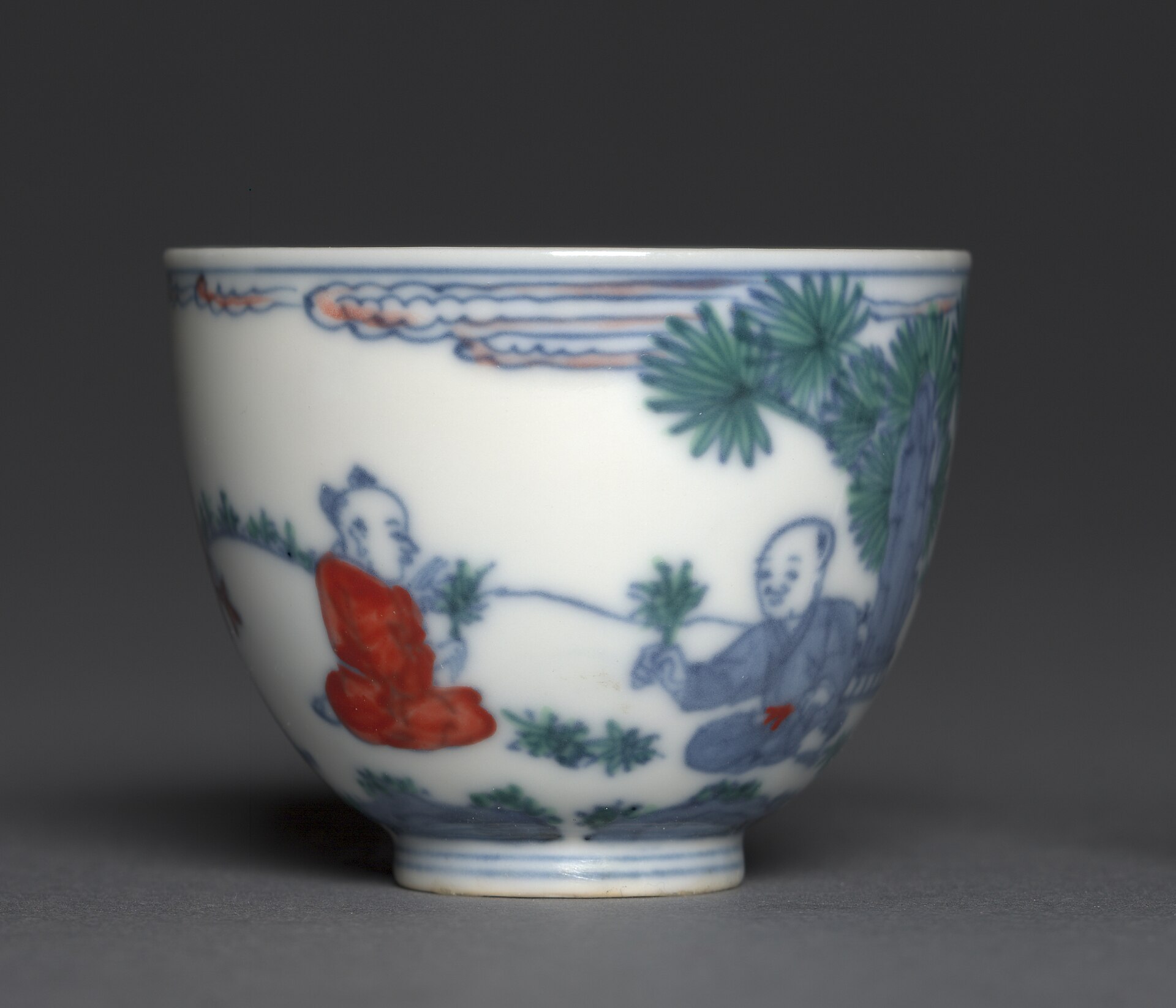
| Wine Cup with Children at Play Imperial kilns, Jingdezhen, Chenghua mark and period | Doucai wine cup of the same reign, different subject 4.8 cm high. Shows the same two-firing doucai method applied to a figural subject, and the same restraint of scale. | Cleveland Museum of Art, accession 1957.61 |
| Bowl with Xiwangmu and Attendants Jingdezhen, Kangxi reign, bearing a Chenghua mark | A Qing object carrying the Chenghua mark, catalogued honestly as Kangxi Made 1662-1722 in famille verte enamels, marked Chenghua. The clearest museum-documented example of the apocryphal Chenghua mark, and evidence that such marks were tribute rather than deception. | Cleveland Museum of Art, accession 1964.218.1 |
| Doucai cup with grape decoration Imperial kilns, Jingdezhen, Chenghua reign | Another Chenghua doucai cup type Shows that the chicken subject was one of a small group of doucai cup designs produced in the same brief window. | National Palace Museum, Taipei |
Open questions
- Where is the other cup of the pair? The 1957 Oriental Ceramic Society catalogue records this cup in the collection of Mrs Leopold Dreyfus as one of a pair. The mate is not accounted for in any source consulted, and if it survives it is one of the four cups in private hands.
- How many Chenghua chicken cups actually survive? Sotheby's enumerates seventeen, thirteen in museums and four private. AFP reported sixteen, the reference literature gives sixteen, and the Australian National University study gives nineteen. Two examples in the Palace Museum in Beijing are disputed by Western specialists. No independent published census resolves this.
- Is the Edward T. Chow ownership real? Sotheby's records it as by repute only, on the evidence of a box commissioned by Chow. No document places the cup in his collection.
- Did the cup pass through the Hong Kong collector Qiu Yanzhi in 1949 at HKD 1,000? The claim appears in a single Chinese newspaper account and is unsupported elsewhere. If true it fills part of a gap that otherwise runs from 1487 to 1957.
- What are this cup's own measurements beyond the 8.2 cm width given by Sotheby's? Height and foot diameter for the Meiyintang cup are not published in any source consulted, and the figures in general circulation belong to the Metropolitan Museum's cup.
- Is the cup currently on public display at the Long Museum in Shanghai? Sotheby's said in 2014 that it would go there, and an exhibition opened around it in December 2014, but no current museum record or label has been verified for this entry.
- Who were the underbidders in 2014, and how long did the bidding run? Neither is published in the reporting consulted, and neither is disclosed by Sotheby's.
- Was there a condition report, and what did it say? Sotheby's called the cup one of only three perfect examples to reach the market, but no condition report is public.
Sources
- 1Sotheby's, lot 1, 'An Exceptionally Important and Fine Doucai Chicken Cup, Mark and Period of Chenghua', The Meiyintang 'Chicken Cup', Hong Kong, sale HK0545, 8 April 2014. Catalogue note, provenance, exhibition and literature. The primary record for this object.
https://www.sothebys.com/en/auctions/ecatalogue/2014/meiyintang-chicken-cup-hk0545/lot.1.html - 2Sotheby's, sale page, The Meiyintang 'Chicken Cup', HK0545, Hong Kong, 08 April 2014. Establishes the sale date and number against press reports that give August.
https://www.sothebys.com/en/auctions/2014/meiyintang-chicken-cup-hk0545.html - 3AFP via TimesLIVE, 'Ming dynasty chicken cup smashes auction record'. Gives the hammer at HKD 250 m and the premium-inclusive total at HKD 281.2 m as separate figures.
https://www.timeslive.co.za/news/south-africa/2014-04-09-ming-dynasty-chicken-cup-smashes-auction-record/ - 4Associated Press via Fox News, 'Ming-era chicken cup auctioned for $36M, smashing world record price for Chinese porcelain'. Gives the winning bid at USD 32.2 m before commission and USD 36.1 m with, the Sotheby's census of seventeen surviving cups with four in private hands, and quotations from Nicolas Chow.
https://www.foxnews.com/world/ming-era-chicken-cup-auctioned-for-36m-smashing-world-record-price-for-chinese-porcelain - 5China Daily, 'Ming Dynasty chicken cup sells for record $36m', 9 April 2014. Confirms the 8 April sale date, the HKD 281.24 m total, the telephone bid, and Nicolas Chow on the three perfect cups to have reached the market.
https://www.chinadaily.com.cn/china/2014-04/09/content_17415907.htm - 6The Art Wolf, 'Chinese Chicken Cup sells for $36.05 million at Sotheby's'. Sotheby's statement that the cup would become a destination piece at Liu's Long Museum.
https://theartwolf.com/news/sothebys-chinese-chicken-cup-2014-sold/ - 7TERTIARY. Wikipedia, 'Chicken Cup (Chenghua)', for the doucai description, the domestic cobalt, the survival census of sixteen, the disputed Beijing examples, and later reproduction. Contains at least two errors this record corrects: it dates the sale to August 2014 rather than 8 April 2014, and it applies the Metropolitan Museum's dimensions to the Meiyintang cup. Replace with Regina Krahl, Chinese Ceramics from the Meiyintang Collection, and the Sotheby's printed catalogue.
https://en.wikipedia.org/wiki/Chicken_Cup_(Chenghua) - 8TERTIARY. Wikipedia, 'Meiyintang Collection', for the Zuellig brothers' dates and birthplace, the meaning of Meiyintang, the division of collecting between the brothers, Regina Krahl's four-volume catalogue of 1994-2010, Eskenazi's role, the Rietberg loan and the 2011-2013 Sotheby's dispersals. Replace with the Krahl catalogue and the Museum Rietberg loan agreement.
https://en.wikipedia.org/wiki/Meiyintang_Collection - 9Cui, Yifang, 'Speaking for the chicken cup: a case study in Chinese art collecting', MA thesis, Australian National University, 2017. hdl 1885/141068, doi 10.25911/5d6e48f3a2e4b. The only scholarly monograph found on this object. Gives nineteen as the number of surviving cups. Abstract consulted; the full text has not been read for this entry.
https://openresearch-repository.anu.edu.au/items/419f7ce0-495d-48d6-b20c-3cafbeb8eb85 - 10The China Story Yearbook 2014, 'A Storm in a Chicken Cup: A Burgeoning Market', Australian Centre on China in the World. The twenty-four American Express swipes against Sotheby's USD 1.6 m per-transaction limit, Liu's remark about Qianlong, and the criticism of vanity, vulgarity and risk of damage.
https://www.thechinastory.org/yearbooks/yearbook-2014/forum-xi-who-must-be-obeyed/a-storm-in-a-chicken-cup-a-burgeoning-market/ - 11China Daily, 'Chicken cup sip has netizens on boil', 21 July 2014. The 18 July 2014 handover, Liu's own account verbatim, the tuhao criticism, and the porcelain specialist's argument that the cup was made to be used.
https://www.chinadaily.com.cn/culture/art/2014-07/21/content_17872690.htm - 12Global Times, 'Unexpected roar'. The unverified 1949 Qiu Yanzhi link at HKD 1,000, Ma Weidu's precedent for drinking from a chicken cup, and the surge in replica listings on Taobao. Its own survival count of ten is wrong and is not used here.
https://www.globaltimes.cn/content/872007.shtml - 13Metropolitan Museum of Art, collection record, 'Chicken cup', accession 1987.85, object 42515. Ming dynasty, Chenghua mark and period. H. 4.1 cm, rim diameter 8.3 cm, foot diameter 3.8 cm. Consulted through the museum's public collection API.
https://www.metmuseum.org/art/collection/search/42515 - 14Cleveland Museum of Art, collection record, 'Wine Cup with Children at Play', accession 1957.61, Chenghua mark and period, with the museum's description of the two-firing doucai sequence.
https://www.clevelandart.org/art/1957.61 - 15Cleveland Museum of Art, collection record, 'Bowl with Xiwangmu and Attendants', accession 1964.218.1, dated 1662-1722, Kangxi reign, bearing a Chenghua mark. The museum-documented case of the apocryphal Chenghua mark.
https://www.clevelandart.org/art/1964.218.1 - 16TERTIARY. Wikipedia, 'Jingdezhen porcelain', for the founding of the imperial kiln factory at Zhushan in 1369, its direct administration by the court, the division of labour, the 1433 order for 443,500 pieces, and the destruction of defective wares on site. Replace with the Zhushan excavation reports and Liu Xinyuan's publications on the Chenghua strata.
https://en.wikipedia.org/wiki/Jingdezhen_porcelain - 17Artcentron, 'Chicken Cup Sold for $36 Million at Sotheby's Now With New Owner', 3 August 2014. The handover ceremony with Nicolas Chow presenting the cup, and the twenty-four card signatures.
https://artcentron.com/2014/08/03/sothebys-deliver-chicken-cup/
Change log
2026-08-02 — Record created at the house standard: researched narrative, technical evidence, maker dossier, graded provenance chain, prices with hammer and premium separated, related works, open questions and sources. NO VERIFIED IMAGE OF THIS OBJECT. There is no public domain or CC0 photograph of the Meiyintang cup on Wikimedia Commons. Searches run against the Commons API for 'chicken cup Chenghua', 'Meiyintang', 'Liu Yiqian', the Chinese term for chicken cup and 'Chenghua' returned nothing depicting this cup. Every plate in this record is therefore marked verified_is_this_object: false, no plate carries role