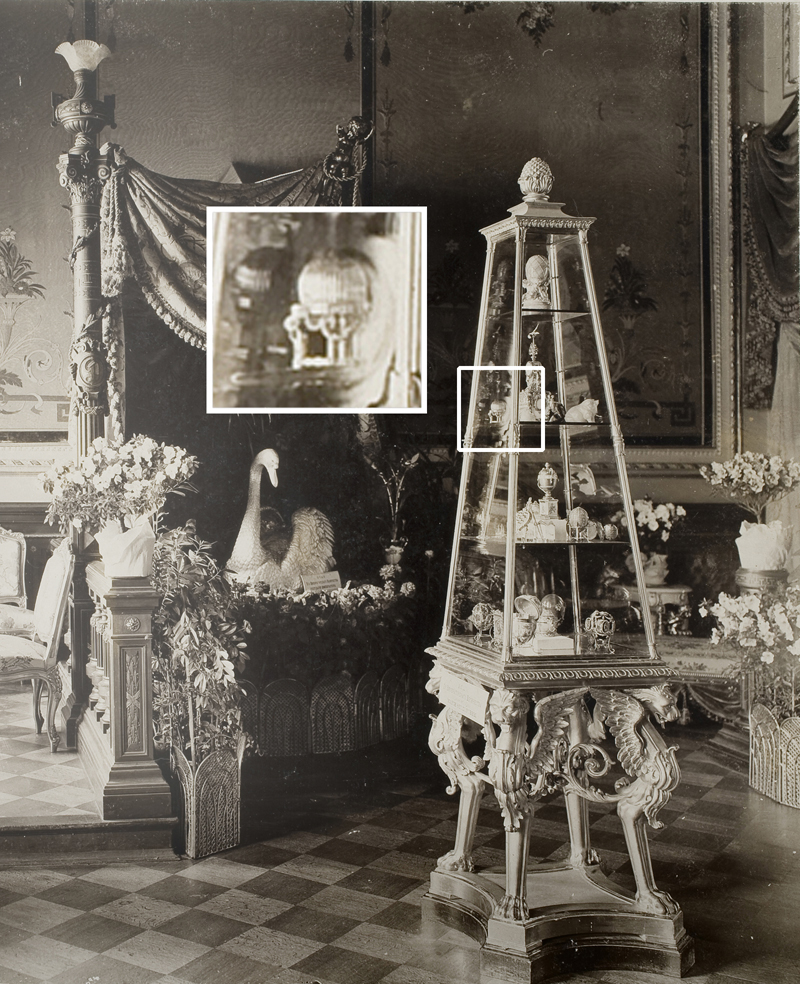
Third Imperial Easter Egg
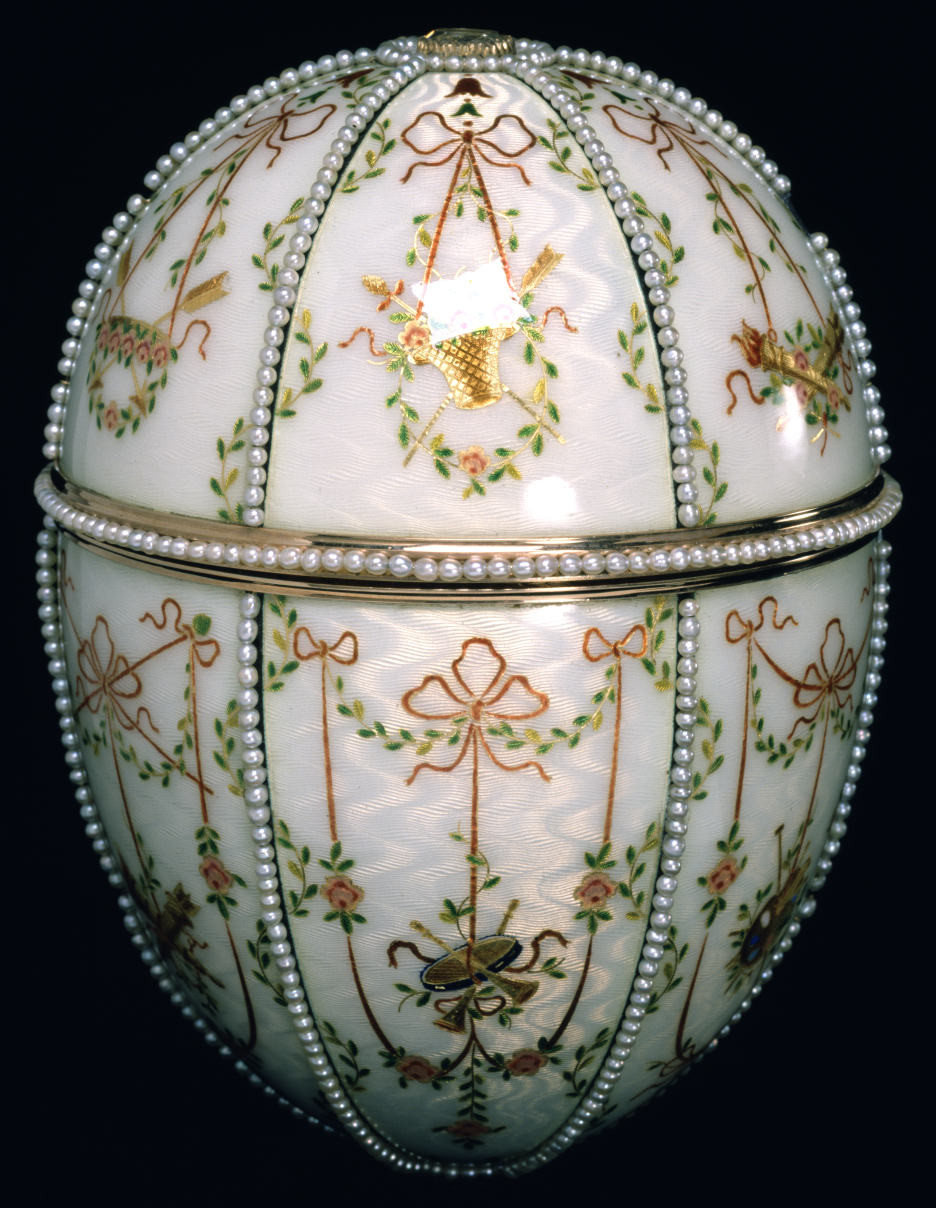
1886-1887, delivered for Orthodox Easter 1887 - Gold, cabochon sapphires, old-mine and rose-cut diamonds; the surprise is a lady's watch in gold and white enamel by Vacheron and Constantin
Peter Carl Faberge made almost nothing. He was a designer, a critic, a buyer of stones and a superb manager of other men's benches, and by the 1890s he was running a firm of about five hundred people spread across more than forty semi-independent workshops. The objects were made by workmasters who ran those workshops on exclusive contract, and each of them struck his own initials into the metal beside the firm's name. That second mark is not a decorative detail. It is the single most informative thing on most Faberge objects: it dates the piece to within a few years, places it in a named workshop in a named city, and tells you what kind of object it should be. A specialist reads the workmaster's punch before he reads anything else, and the salerooms catalogue by workmaster to this day. In December 2025 Sotheby's New York offered forty Faberge lots from one collection and identified them by Wigstrom, by Perkhin and by Aarne.
The second thing a reader needs is that the name and the firm parted company in 1937 and have never been reunited. An American named Samuel Rubin, encouraged by Armand Hammer, registered Faberge as a perfume trademark. The family found out only after the Second World War, could not afford the fight, and settled in 1951 for twenty-five thousand dollars. The name then passed through cosmetics companies, Unilever, a Cayman Islands vehicle and a gemstone miner, and in August 2025 was sold again for fifty million dollars to an American investment company. There is no continuity of workshop, of workmaster, of technique or of ownership between that trademark and the firm described on this page. A modern object marked Faberge is a modern object.
The third thing is the arithmetic. Fifty Imperial Easter eggs were delivered between 1885 and 1917, with two more designed or begun for 1917 and never handed over. Between six and seven of the fifty are unlocated, and the count differs between authorities for reasons this page sets out. Two of the eggs everybody names were not made in the years they were long assigned to, and the correction was published in 2008 by a researcher working from the firm's own invoices. Iconotheca holds a separate record for the 1887 Third Imperial Easter Egg, the one that came back through a Midwestern scrap dealer; the object's own story lives there and is not repeated here.
Gustav Faberge qualified as a master goldsmith in 1841 and opened his shop in Saint Petersburg in 1842. His son Peter Carl, born 1846, took the business over in 1872 at twenty-six, and his younger brother Agathon joined in 1882. In that year the two of them showed at the Pan-Russian Exhibition in Moscow and took a gold medal, and the firm's character changed: from a competent jeweller into an enterprise whose products were judged as works of art rather than as settings for stones.
Output grew faster than two men could supervise. The solution was structural and it defines everything that follows. Rather than build one large factory, the Faberges contracted with independent master craftsmen who kept their own premises and their own teams but undertook to work for the House of Faberge alone. The firm supplied the sketches and the models; nothing left a workshop until Carl Faberge or a deputy he appointed had approved it. More than forty such craftsmen worked in the system over its life. The business was divided by speciality, so that one workshop made large silver, another jewellery, another the enamelled gold objects of vertu, another the hardstone animals.
The scale is worth stating plainly because it is the reason so much can be passed off. Accounts give the workforce as about five hundred artisans and designers, and the output as at least a hundred and fifty thousand objects, or about two hundred thousand during Carl Faberge's thirty-five years in charge, against a figure of more than five hundred thousand for the whole life of the firm from 1842. Fifty Imperial eggs is a rounding error inside those numbers. The overwhelming majority of what Faberge sold was cigarette cases, picture frames, bell pushes, desk clocks, parasol handles, cufflinks, boxes, kovshi and small carved animals, and it is those that fill the salerooms.
Branches followed: Moscow, given as 1887 in one account, then Odessa, London and Kiev. The dates for the provincial branches are not settled. The Wikipedia biography of Carl Faberge gives Odessa 1890 and Kiev 1905; the Fauxberge article gives Odessa 1901 and Kiev 1906. London is agreed at 1903 and was managed by Henry Bainbridge, who later wrote the first English books on the firm. A branch name struck into a mark therefore constrains a date, but not as tightly as the literature sometimes implies, and the discrepancy should be resolved from the firm's own papers before anyone dates an Odessa or Kiev piece off it.
A full set of marks on a Saint Petersburg Faberge object of the imperial period comprises three things: the firm's name, the workmaster's initials, and the state assay mark. Each does different work, and only two of them are worth much.
The firm's name appears as FABERGE in Cyrillic, in script or block, or as K. FABERGE, or on small pieces as the initials K.F. in Cyrillic. The Moscow branch used K. FABERGE beneath the Imperial double-headed eagle, which the firm was entitled to display after the 1885 warrant. London pieces carry FABERGE or CF in Roman letters together with English import marks, which is the one case where a Faberge object also carries a British assay office punch.
The workmaster's initials are the dating instrument. They are struck in Cyrillic and are conventionally transliterated in the English literature: MP for Mikhail Perkhin, HW for Henrik Wigstrom, AH for August and then Albert Holmstrom, IP for Julius Rappoport, AN for Antti Nevalainen, EK for Erik Kollin. Because each man was active for a known span, and because each ran a workshop with a known speciality, the punch answers two questions at once. It brackets the date, and it tells you whether the object in front of you is the kind of thing that workshop made at all. A collector on the 925-1000 silver forum in February 2026 put the second test in one line: a silver animal-form bell push is the right sort of object for Rappoport, and an object that makes no sense for a given maker is certainly fake, because a specialist in large silver was not producing small gold jewellery.
The state assay mark dates the piece independently of the firm. Before 1899 Saint Petersburg used the city arms of two crossed anchors and a sceptre and Moscow used Saint George and the dragon, with a zolotnik number for the metal standard. Russian fineness was expressed in ninety-sixths: 56 zolotniks for fourteen-carat gold, 72 for eighteen-carat, and 84 or 88 for silver. In 1899 the whole system was replaced by the kokoshnik, the profile head of a woman in the traditional Russian headdress. One trade reference states that the head faces left until 1908 and right from 1908, and that after 1908 a Greek letter beside the head identifies the assay district, giving alpha for Saint Petersburg and delta for Moscow. Another gives iota for Saint Petersburg. That contradiction matters, because the letter is exactly the sort of detail a cataloguer copies without checking, and it should be settled against a published table of Russian assay marks before it is used to date anything.
Erik August Kollin, born at Pohja in south-west Finland on 28 December 1836 and dead in 1901, was the first of the three head workmasters. He qualified in August Holmstrom's workshop in 1868 and opened his own in Saint Petersburg in 1870. Carl Faberge put him in charge of all the firm's workshops, and objects he made for the firm before he ceased to be head workmaster carry EK beside the Faberge mark.
Kollin's speciality was archaeological. In the 1880s the firm made a series of gold copies of the Scythian treasure excavated in southern Russia and held in the Hermitage, and it was that work, exhibited in Moscow in 1882 and in Nuremberg, that first made the firm's reputation as something other than a jeweller. His other work is described as gold and silver articles in an archaic manner. He is the workmaster generally credited with the 1885 First Hen Egg, though the Faberge Research Site marks the attribution as attributed rather than documented.
The dates are contested and the disagreement is worth carrying rather than smoothing. The Wikipedia article and the Konstantin Antiques mark tables both say Kollin was head workmaster until 1886, when Perkhin replaced him, and Konstantin gives his working span as 1870 to 1886. The Faberge Research Site gives his span as 1870 to 1901, which is his death, and says separately that Perkhin replaced Kollin as chief artisan at the end of 1888. Those are three different propositions: when he stopped being head of all the workshops, when he stopped working for the firm, and when Perkhin took over. Nothing in the sources reachable here settles all three, and a piece marked EK cannot safely be dated to before 1886 on the strength of the succession alone.
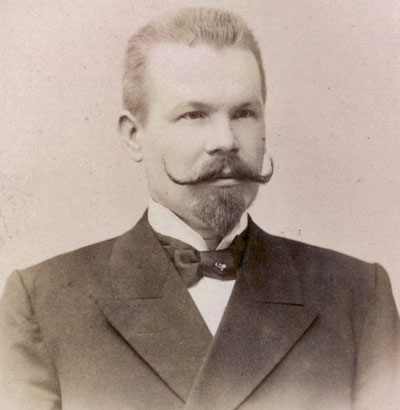
Perkhin is the workmaster whose mark carries the most weight and the highest prices. He was born in 1860 at Okulovskaya in the Olonets Governorate, in what is now the Republic of Karelia, and came to Saint Petersburg with no advantages at all. He worked as a journeyman in Kollin's workshop, qualified as a master craftsman in 1884, and was appointed head workmaster in 1886 at twenty-six. By the 1890s he held merchant status, and in 1895 he was made a personal honorary citizen. At the Paris Exposition Universelle of 1900 he took a bronze medal in his own name.
His mark is M.P. in Cyrillic. Twenty Imperial eggs are attributed to his workshop, among them the Rosebud, the Imperial Coronation, the Trans-Siberian Railway and the Gatchina Palace, and beyond the imperial series he oversaw the seven eggs made for Alexander Kelch and six further eggs for private clients. His period is generally acknowledged as the most artistically inventive the firm had, and the range of it is the point: neo-Rococo one year and Renaissance the next, with the Louis XV and Louis XVI vocabularies used with a fluency that no other Russian house matched.
What his workshop actually produced, day to day, was the enamelled gold object: boxes, desk clocks, parasol handles, miniature furniture, bowenite and nephrite mounts. The Walters Art Museum's record for the 1901 Gatchina Palace Egg gives a good measure of the workshop's finish, noting that Perkhin executed the miniature replica of the palace inside it closely enough that cannons, a flag, a statue of Paul I, parterres and trees can all be distinguished. In the 2025 saleroom his ordinary production was still setting the pace: a nephrite box of about 1890 took 139,700 dollars at Sotheby's New York in December against an estimate of 60,000 to 80,000, a study of violets of 1899 to 1903 took 226,800 euros at Christie's Paris in June, and a circular enamel desk clock took 139,700 pounds at Sotheby's London in November.
Perkhin died in Saint Petersburg in 1903. The Wikipedia article does not say what became of the workshop, but the answer is on the next page of the story: his assistant took it over intact, which is why the firm's manner changes without a break in quality.
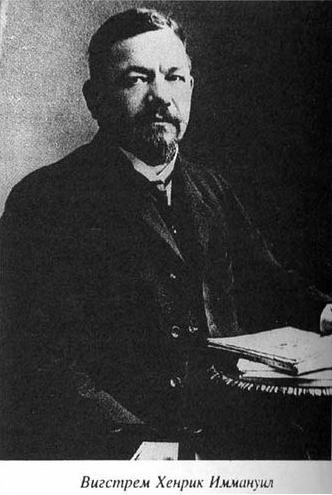
Henrik Wigstrom was born at Ekenas in Finland on 2 October 1862 and apprenticed to the Danish goldsmith Petter Madsen before moving to Saint Petersburg in 1875 at thirteen. He worked under Werner Elfstrom, and in 1884, aged twenty-two, became Perkhin's assistant. On Perkhin's death in 1903 he took over the workshop and became the third and last head workmaster, holding the position until the firm ended.
His mark is H.W. Every signed Imperial egg made after 1903 carries it. His manner differs from Perkhin's and the difference is diagnostic: where Perkhin worked in the Rococo and Renaissance idioms, Wigstrom worked in Louis XVI, Empire and neo-classical, with a cooler symmetry and a preference for restrained guilloche grounds. Nearly all the firm's hardstone animals, human figures and flower studies from his period were made under his supervision, which is why a Wigstrom attribution attaches to objects that carry no mark at all: a carved agate owl has nowhere to strike a punch, and the attribution rests on the workshop's records and on style.
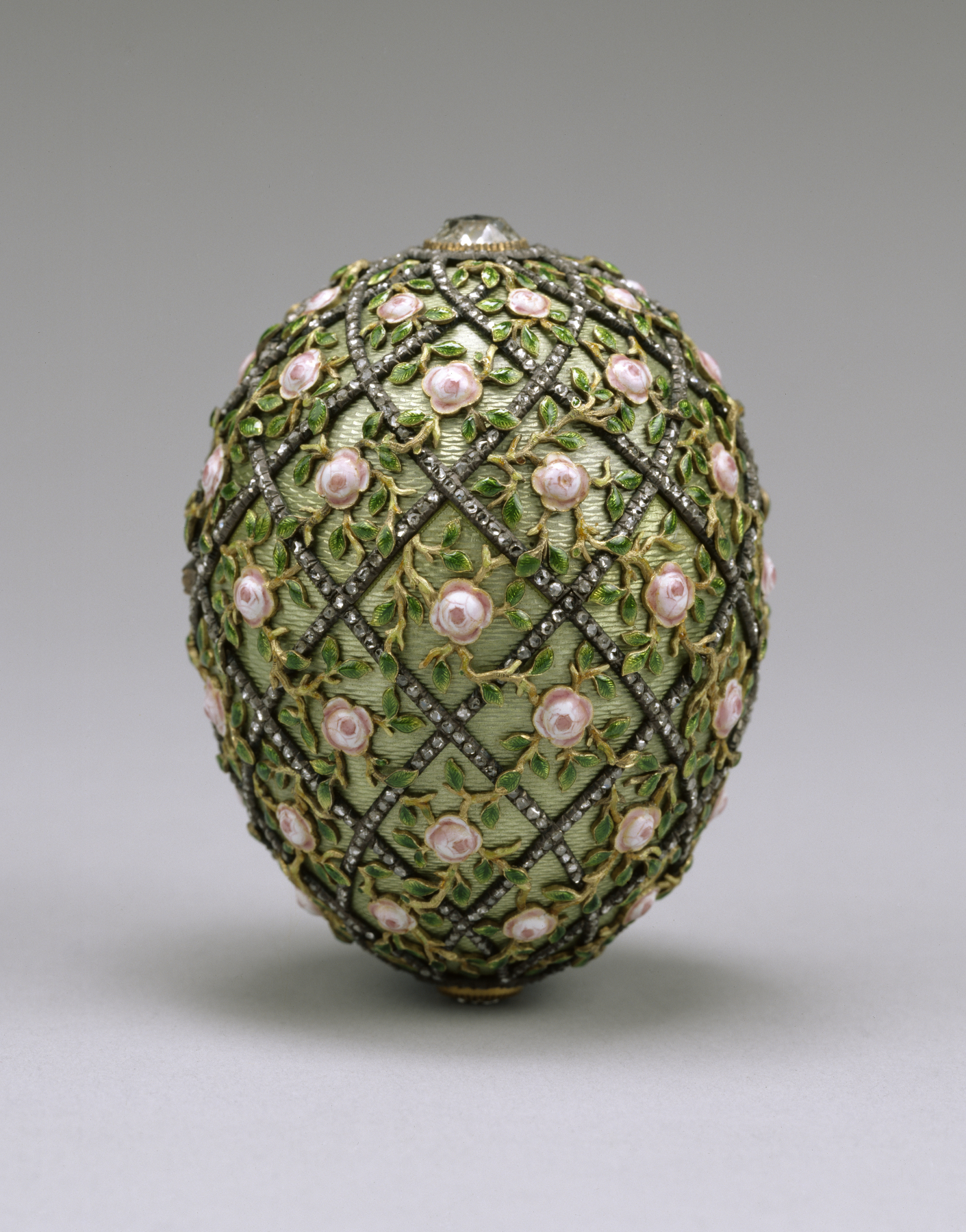
The market treats his mark as blue-chip. In 2025 a bearberry study of 1910 or 1911 took 529,200 dollars at Christie's New York against an estimate of 200,000 to 300,000; a pill box of 1904 to 1908 took 152,400 dollars at Sotheby's New York against 30,000 to 50,000; an enamel desk clock took 50,000 dollars at Heritage in Dallas. The Walters Art Museum's 1907 Rose Trellis Egg is a Wigstrom-period object with an unusually complete paper trail: the museum records Faberge's invoice, dated 21 April 1907, listing the egg at 8,300 roubles, and notes that its surprise, a diamond necklace and an ivory miniature of the Tsarevich framed in diamonds, is now lost.
The end was quiet. The war stripped his workshop of men; the revolution closed it. At fifty-six Wigstrom went to his summer house in Finland with almost nothing and lived there five more years, dying at Terijoki on 14 March 1923.
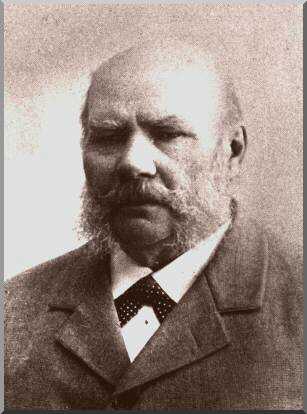
August Wilhelm Holmstrom was born in Helsinki on 2 October 1829, apprenticed under Karl Herold in Saint Petersburg from 1845 to 1850, and opened his own workshop in 1857. Gustav Faberge appointed him head jeweller, and he held that position for forty-six years, until his death in Saint Petersburg in 1903. His mark is AH. His workshop made the jewellery proper, the diamond and coloured-stone work, and it supplied components to the other workshops for composite objects, which is why his initials turn up on parts of things the trade attributes to somebody else. He also made the celebrated miniature copies of the Imperial regalia. The 1892 Diamond Trellis Egg and, on the Faberge Research Site's chronology, the 1887 Third Imperial Egg are his.
The succession was dynastic to an unusual degree. His son Albert Holmstrom, 1876 to 1925, took the workshop on his father's death and used the same AH mark, which means the punch alone does not distinguish father from son and the assay mark has to do that work. His daughter Hilma Alina Holmstrom, 1875 to 1936, worked as a designer in the family workshop. So did his granddaughter Alma Pihl.
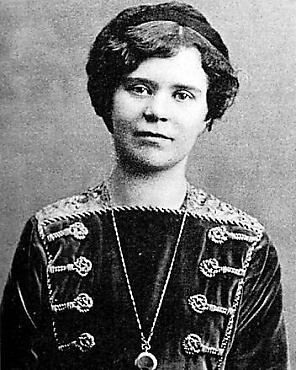
Alma Theresia Pihl, born in Moscow on 15 November 1888, was the daughter of the Moscow workmaster Knut Oskar Pihl and August Holmstrom's daughter Fanny. She joined the firm in 1909, at twenty, as a self-taught designer, and she had no mark of her own; neither she nor her brother Oskar did. She designed the snowflake jewels commissioned by Emanuel Nobel and then two Imperial Easter eggs, the Winter Egg of 1913 and the Mosaic Egg of 1914. The Winter Egg is the most expensive Faberge object ever sold at auction. It was designed by a woman of twenty-five who was not allowed a punch, executed in the workshop of Albert Holmstrom, and sold under the name of a man who did not make it. After 1917 Pihl left for Finland at thirty-two and spent about twenty-five years teaching at a Swedish-language school at Kuusankoski. She died in Helsinki on 15 July 1976, long enough to have seen her own designs make six-figure sums under somebody else's name.
Rappoport is the workmaster a collector is most likely to meet and least likely to have read about. Julius Alexander Rappoport, born Isak Abramovich in 1851 at Kovno in the Russian Empire, opened his own workshop on the Ekaterininsky Canal in Saint Petersburg in 1883 and became Faberge's principal supplier of large silver. His mark is I.P. in Latin transliteration, struck in Cyrillic as the letters corresponding to IP.
The sources differ on when he began working for Faberge. The Faberge Research Site gives his active span as 1883 to 1908; the Wikipedia article says he belonged from 1886 to 1908 to the group of four principal workmasters heading the firm's workshops. What he made is not in dispute: massive silver casting, naturalistic animal figures, table ornaments, tankards, bell pushes, and silver eggs with enamel decoration. If an object is heavy, silver, cast and animal-shaped, Rappoport is the workshop it should have come from. His workshop was taken over by the First Silver Artel, a craftsmen's cooperative, around 1909. He died in Petrograd in 1917, the year before the firm did.
His mark is also the most abused in the field, because his products sit in the price band where forgery pays. A specialist writing on the 925-1000 forum in February 2026 gave the tell: on a fake silver pig offered as Rappoport, the form was crude, the texture simplistic, the patina artificial, and the punches wrong, Rappoport's own punch having cut corners and a rounder appearance than the forger reproduced. That is the level at which these things are actually decided, and it is why the shape of the punch surround, rather than the letters inside it, is what a specialist looks at.
Antti Juhaninpoika Nevalainen was born on 1 January 1858 in the village of Kylanlahti in Pielisjarvi, in Finnish Karelia. He was an apprentice in Finland and then in Saint Petersburg from 1874, a goldworker registered as a Faberge employee from 1875, and a master goldsmith from 1885, when he opened his workshop at 35 Kazanskaya Street. He worked first under August Holmstrom, then as the head of his own workshop under exclusive Faberge contract. His mark is AN, usually struck with the K. Faberge mark. He is listed in the English literature as Anders, the Swedish form; Ulla Tillander-Godenhielm has established that his actual name was Antti, and that the Swedish version entered the record through a church register.
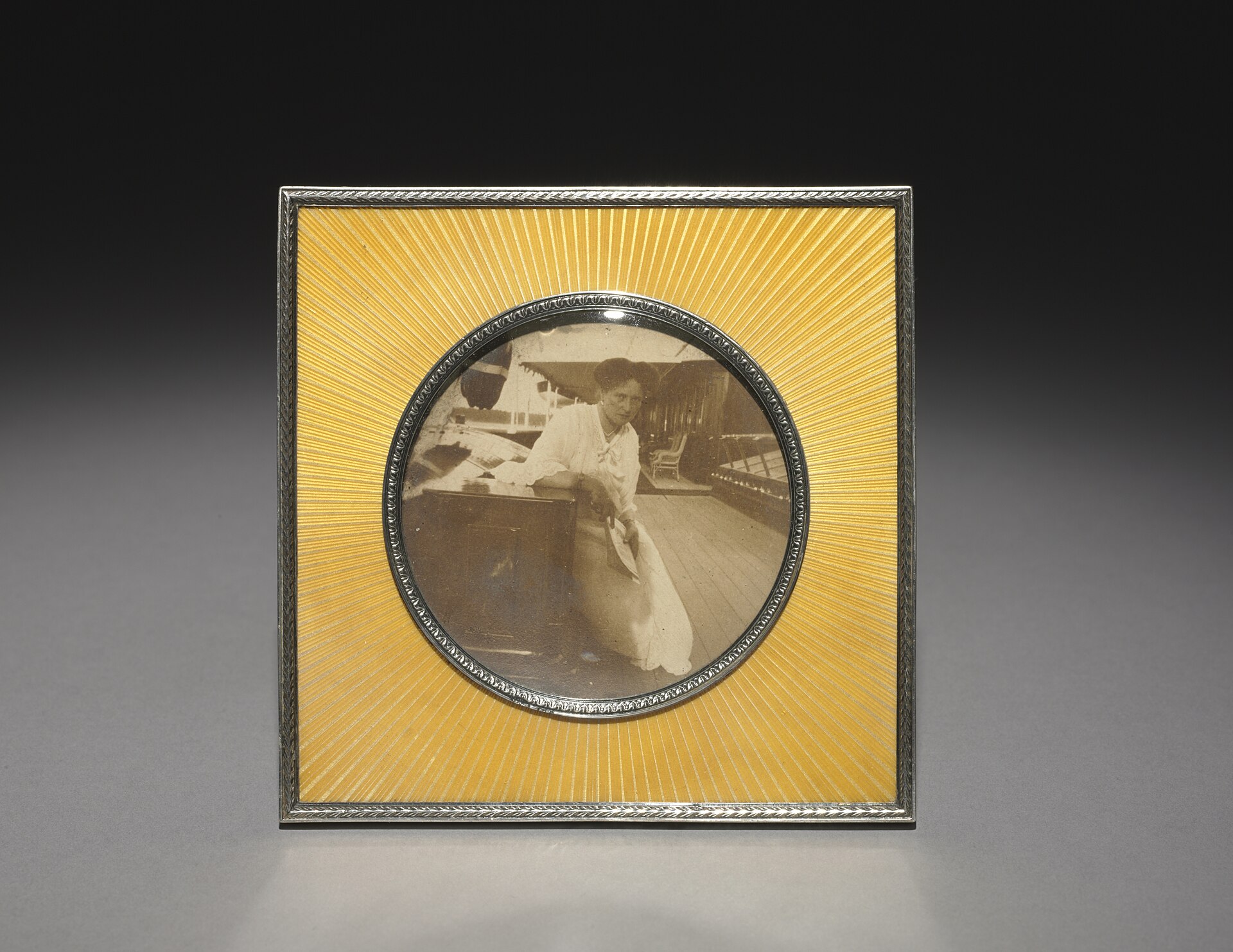
His workshop made the ordinary luxuries: silver-mounted photograph frames in birchwood, palisander and lacquer, cigarette cases in silver and gold, enamelled silver-gilt cases with leather sleeves, small silver-gilt objects. That list is the answer to a question every new collector asks, which is what a Faberge object normally is. It is a frame or a case, not an egg. The Cleveland Museum of Art holds a Nevalainen frame and a Nevalainen match case, both released under CC0, and both look like exactly what they are: extremely well-made small things for a rich household.
Prices follow the hierarchy of the marks rather than the hierarchy of the objects. In 2025 a Nevalainen bratina took 57,500 dollars at Heritage in Dallas against an estimate of 30,000 to 50,000, while a photograph frame by Johan Viktor Aarne of 1899 to 1903 took 69,850 dollars at Sotheby's New York against 25,000 to 35,000. Nevalainen returned to Finland with his family after 1917 and died at Terijoki in 1933, in the same town where Wigstrom had died ten years earlier.
The five names a specialist quotes are not the whole system. The Faberge Research Site lists, with marks and spans: Johan Viktor Aarne, mark BA, 1890 to 1904, who then returned to Finland and worked independently; Feodor Afanassiev, 1913 to 1917; Hjalmar Armfelt, 1904 to 1917; August Hollming, 1880 to 1913, whose son Vainyo continued the mark to 1916; Anders Mickelsson, 1867 to 1913; Gabriel Nykanen, 1889 to 1917; Hiskias Pendin, born Hesekil Pontinen; Alfred Thielemann, about 1890 to 1910, whose widow Elisabeth ran the workshop from 1910 to 1917 under an ET mark; and the Vakeva family of silversmiths, Stefan from 1856, his sons Konstantin and Alexander, and Konstantin's widow Jenny, who from 1902 to 1917 held a widow's mark, an arrangement the site describes as rare in Russia. Alina Holmstrom and Alma Pihl are listed as designers without marks.
Two of those entries deserve a collector's attention. The Thielemann and Vakeva widows' marks mean that an object bearing what looks like a workmaster's punch may have been made by a workshop the named man never entered, and the mark tables are the only way to know. And the Aarne span matters because he left in 1904 and worked under his own J.V.A. mark afterwards; a BA punch is therefore a hard ceiling on the date.
Moscow is a different business and is routinely misdescribed. The Moscow operation ran its own workshops making silver and the enamelled neo-Russian wares that Saint Petersburg did not make, and it drew on independent Moscow masters who sold under their own names as well as Faberge's. The most important of them is Feodor Ivanovich Ruckert, 1840 to 1917, of German origin, who came to Russia at fourteen, worked for the Yusupovs, and from 1887 supplied cloisonne enamel to Faberge while continuing to sell under his own mark. His Cyrillic F.R. appears on his objects, sometimes with the Faberge mark over it. In 2025 a Ruckert cloisonne punch set weighing seven kilograms took 750,000 dollars at Heritage in Dallas against an estimate of 700,000 to 900,000, and a Ruckert tazza took 125,000 dollars against 60,000 to 80,000: prices that make plain how much of the Moscow output the firm bought in rather than made.
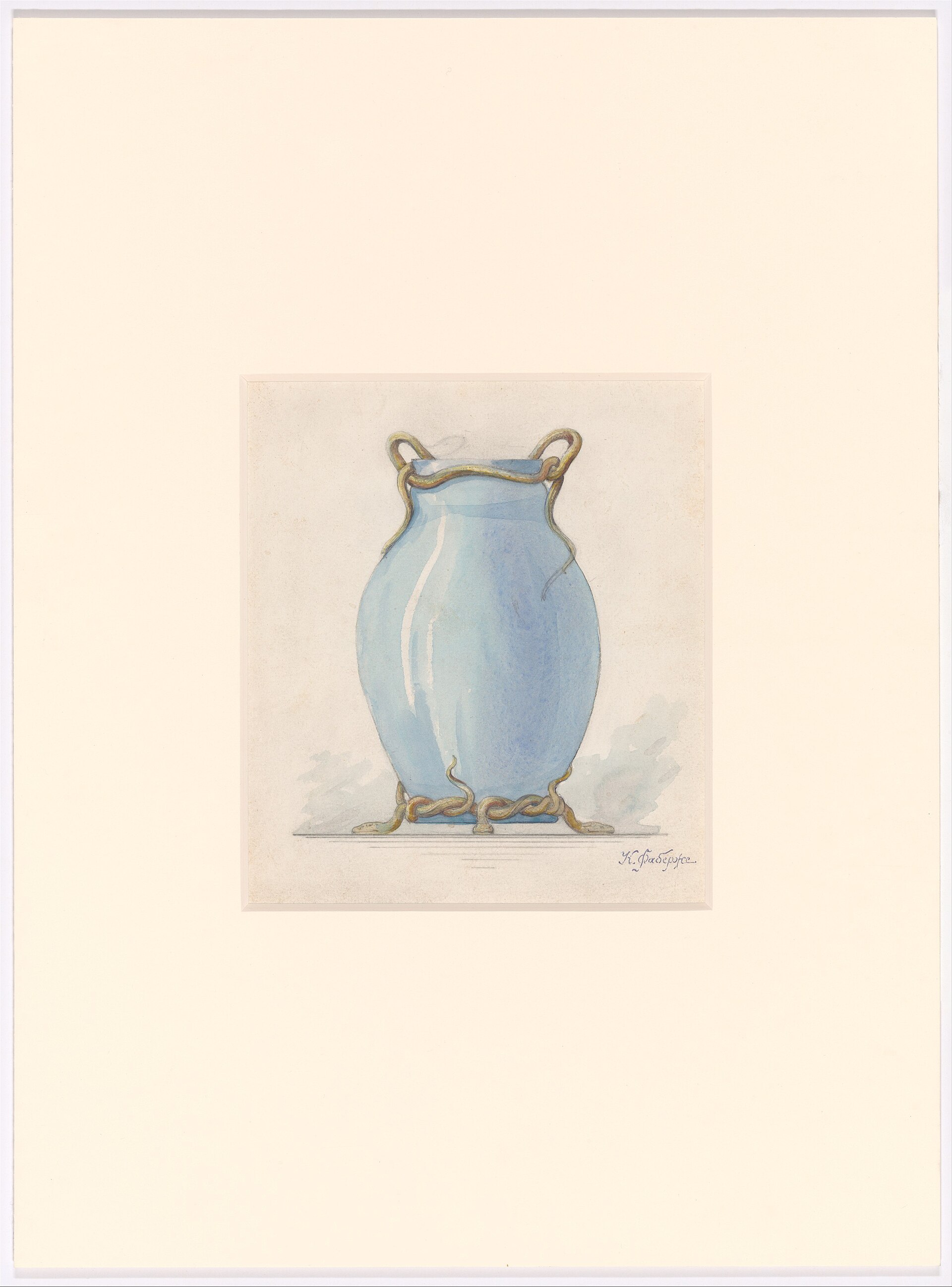
The workmaster made the object. He did not usually design it. The firm employed its own designers, and the workmasters presided over teams of craftsmen who executed what those designers had drawn and Carl Faberge had approved. That division is visible in the surviving paper. The Metropolitan Museum of Art holds Faberge design drawings of about 1899 to 1904, released under CC0, and the striking thing about them is what is written at the lower right. The sheet showing a pale blue vase with entwined gold serpent handles is signed K. Faberge in Cyrillic. The drawing is signed by the firm. The person who drew it is not named on it at all.
The head designer for most of the firm's best period was Franz Peter Birbaum, a Swiss who is usually given as 1872 to 1947, at Faberge from the mid-1890s and chief workmaster under Agathon Gustavovich Faberge. Almost everything now attributed to the firm passed his desk. He is invisible in the objects and would have stayed invisible but for an accident of archives.
In February 1990 the Faberge scholar Valentin Skurlov found, in the papers of the academician A. E. Fersman in the archive of the USSR Academy of Sciences, a manuscript by Birbaum titled Gemstone carving, jewelry and gold and silverwork of the House of Faberge, written in 1919 for a projected four-volume work on Russian gemstones. It describes the organisation of the Saint Petersburg and Moscow workshops, how the employees were distributed and specialised, biographical sketches of the workmasters including Perkhin, Wigstrom and the enameller Petrov, the manufacturing methods, the Imperial commissions and the tastes of the clients. It was published in 1992 by Tatiana Faberge and Skurlov and again in the State Hermitage's 1993 volume. It is the only substantial first-person account of the firm's interior life that exists.
It also carries a small scandal that says something about how this history has been handled. Fersman's own 1954 book, Outlines of a History of Stone, incorporated Birbaum's text without attribution, to the extent of roughly twenty-five to thirty per cent of the relevant material. The man who wrote the firm's only insider account was not credited in the book that used him, exactly as he was not credited on the drawings.
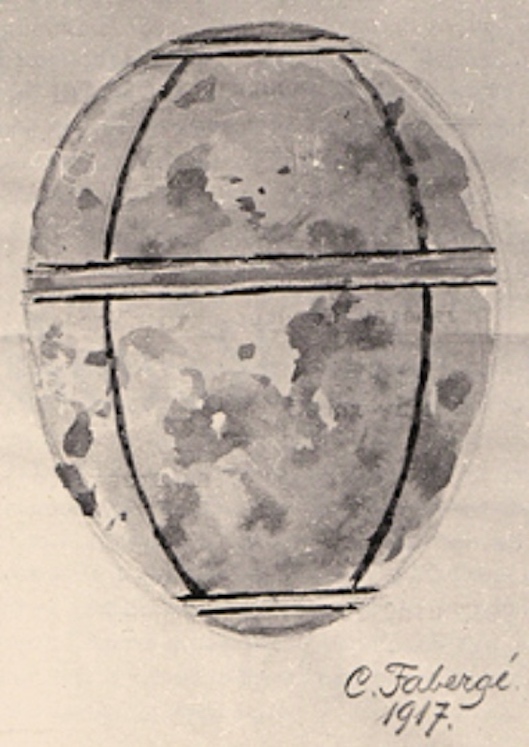
Alexander III ordered one Easter egg a year from 1885 for his wife Maria Feodorovna. Nicholas II continued the practice from 1895 and ordered two a year, one for his mother and one for his wife Alexandra Feodorovna. No eggs were presented in 1904 and 1905 because of the Russo-Japanese War and the unrest that followed. Fifty were delivered before the revolution. Two more, the Karelian Birch and the Constellation, were designed or begun for 1917 and never handed over; Faberge's own signed sketch for the Karelian Birch egg, dated 1917, survives. Fifty delivered plus two undelivered gives the figure of fifty-two that some accounts use.
How many survive is a genuinely contested number, and the contest is instructive. The Wikipedia article on the House of Faberge says forty-three of the fifty are known to have survived. The article on the eggs themselves says forty-four of the fifty exist in complete or partial form, and names six as lost: the 1886 Hen with Sapphire Pendant, the 1888 Cherub with Chariot, the 1889 Necessaire, the 1897 Mauve, the 1903 Royal Danish and the 1909 Alexander III Commemorative. Wartski, the London dealer that has handled more of these objects than anyone, says seven are missing, of which two are known to have survived the revolution.
The gap between six and seven is not carelessness. It turns on two questions of definition. The first is whether the 1887 Third Imperial Egg is counted as located, which it has been only since 2014. The second is whether the 1897 Mauve Egg counts as lost when its surprise, a heart-shaped frame, has been recovered and is in Viktor Vekselberg's collection while the egg itself is not. A count that treats a surviving surprise as a surviving egg will differ by one from a count that does not. Anybody citing a total should say which convention they are using, and almost nobody does.
The Kelch series is the standard confusion. Alexander Kelch, a Siberian industrialist, commissioned seven eggs from Perkhin's workshop for his wife Barbara between 1898 and 1904. They are not imperial, they are not unique in design, and several are described as copies of imperial models. A further group of eggs was made for private clients including the Duchess of Marlborough, the Rothschilds, the Yusupovs and Emanuel Nobel. The Resurrection Egg is the awkward case: Christopher Forbes argued that it is the missing surprise of the 1894 Renaissance Egg, on the grounds that it fits the curvature of the Renaissance shell, shares the enamel decoration on its base, and contains a pearl listed on the Renaissance invoice but absent from that egg. It carries Perkhin's mark and Saint Petersburg assay marks of before 1899. It is listed among the other Faberge eggs rather than the imperial ones. No counter-argument is recorded in the source consulted here, which is not the same as agreement.
The most useful piece of Faberge scholarship of the last twenty years was not a discovery of an object. It was a re-reading of invoices, and it moved two eggs that every book had dated wrongly.
The Blue Serpent Clock Egg had been dated 1887. In November 2008 Annemiek Wintraecken, who maintains the Mieks Faberge Eggs research archive, published a revised chronology in the Faberge Research Newsletter redating it to 1895. Her evidence was an invoice describing a blue enamel egg in the Louis XVI style at 4,500 roubles, gold marks that limit the piece to 1895 or 1896, and Marina Lopato's prior observation that neither the price nor the style fitted 1887. The consequence was immediate: the 1887 slot in Maria Feodorovna's series was suddenly empty, which meant that an unrecognised 1887 egg had to exist. It was found in 2014, and Iconotheca holds the record for it.
The same method solved a second problem. An egg long described in the literature as the missing Alexander III Portraits Egg was matched to an invoice for a blue enamel egg with six portraits of the Emperor Alexander III, set with sapphires and diamonds. The extant Twelve Monograms Egg, at Hillwood in Washington, carries six panels of monograms for Alexander III and his consort, and is now identified as that egg, dated 1896 rather than 1895. Maria Feodorovna's letter to Nicholas II of 22 March 1896, thanking him for the ideal egg with the charming portraits of his adored Papa, confirms both the year and the fact that portraits were the missing surprise. An egg that had been counted as lost and an egg that had been counted as an orphan turned out to be the same object.
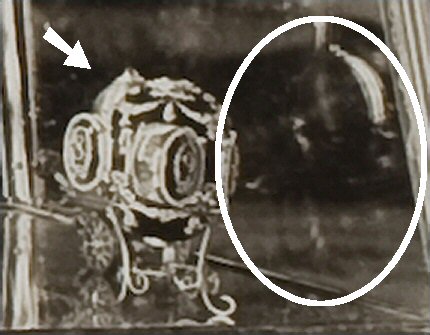
The third strand of the same research is photographic. In November 2007 Anna and Vincent Palmade, working from enlargements of the group photograph taken at the von Dervis mansion exhibition in Saint Petersburg in March 1902, identified the 1888 Cherub with Chariot Egg, hidden behind the Caucasus Egg on the bottom shelf and visible as a wheel, a chariot outline and a reflection in the vitrine glass. By elimination they also placed the 1889 Necessaire Egg, and Kieran McCarthy supplied the archival confirmation: an invoice of 4 May 1889 for a Necessaire Egg in the Louis XV style at 1,900 roubles, containing thirteen gold and diamond toilet implements. Neither egg has been seen since. The point for a reader is method rather than romance. The imperial series is being reconstructed from invoices and from one photograph, and the corrections are still coming.
In 1916 the business was reorganised as a joint-stock company with three million roubles of capital. After the October Revolution a Committee of Employees ran it until the workshops closed on Carl Faberge's instruction in 1918. The Bolsheviks nationalised the House of Faberge that year and confiscated the stock in October. Faberge left Petrograd on the last diplomatic train to Riga, disguised as a courier attached to a foreign legation; the accounts differ on the month, one giving September 1918 and another early October, and on the legation, the record held by this publication naming the British. He moved on to Bad Homburg and Wiesbaden as the revolution followed him west and reached Switzerland in June 1920. He died at Lausanne on 24 September 1920, aged seventy-four. His family said he died of a broken heart. His remains were moved to Cannes in 1929.
The Imperial treasures were concentrated in the Kremlin Armoury. Antikvariat, a department of the Ministry of Trade set up on Lenin's authority in 1921, was given the job of selling art abroad for hard currency. Its officers were Party appointees rather than specialists, and the historical record of it is ugly: art historians who hid works they judged too important to sell were arrested, and some were executed. Thirty of the forty Faberge eggs then held by the Armoury passed into its hands.
Between 1930 and 1933 fourteen Imperial eggs left Russia. The two principal channels were Armand Hammer, whose family connections to the Soviet leadership were exceptional, and Emanuel Snowman of Wartski in London, who travelled to Russia regularly and dealt with the Soviet authorities directly. The counts do not reconcile and should not be forced to. The Mieks archive credits Hammer with ten Imperial eggs and Snowman with nine acquired between 1925 and 1938; Art and Antiques says Hammer acquired fourteen from Stalin's 1931 sale. Ten plus nine is more than fourteen, so at least one of these figures counts differently, most probably by including eggs that passed through more than one pair of hands or by counting non-imperial eggs. The prices are equally instructive: Antikvariat is recorded selling the Tsarevich Egg in 1930 for 8,000 roubles, another egg the same year for 500 roubles, and one of ten eggs to Hammer Galleries for 1,500 roubles. In America the eggs sold at auction for as little as 500 dollars.
This is where most Faberge provenance chains in Western collections begin, and it is why they begin so abruptly. An object that entered the trade through Antikvariat has, in the ordinary case, no recorded owner before the Imperial family and no recorded transaction between 1917 and the 1930s.
What Hammer did with the eggs is the reason the largest public holdings of Faberge outside Russia are in Virginia, Ohio, Louisiana and Washington rather than in Europe. Acting as the United States agent for the Soviet Union, he took the objects on tour through American department stores in the depths of the Depression, mounting elaborate displays and lecturing on their history. Faberge was sold in America the way a fur coat was sold.
Four women bought accordingly. Lillian Thomas Pratt, wife of a General Motors executive, bought five Imperial eggs from Hammer, paying on her Lord and Taylor charge card. She collected from 1933 to 1946, and her earliest purchases were modest: a rhodonite clock in 1937 for 250 dollars, the Red Cross Egg in March 1943 for 4,400 dollars. She bequeathed about four hundred works to the Virginia Museum of Fine Arts in 1947, of which 167 of the museum's 190 Faberge pieces came from her. India Early Minshall of Cleveland bought two Imperial eggs and eighteen Faberge objects in all, collecting until 1961. Marjorie Merriweather Post, of the General Foods fortune, acquired the Twelve Monograms and Catherine the Great eggs; the Catherine the Great Egg was bought from Hammer Galleries in 1931 by her daughter Eleanor Barzin as a birthday present. Matilda Geddings Gray of Louisiana acquired three Imperial eggs and, around 1957, the disputed 1885 First Hen Egg from Hammer.
The market's later shape was set by one man and undone by one transaction. Malcolm Forbes began in 1965 by buying the Duchess of Marlborough Egg at auction for nearly three and a half times its estimate and went on to assemble fifteen eggs, eleven of them then believed imperial. In February 2004 his family sold the entire collection of 194 Faberge pieces, including every egg but the Nobel Ice Egg, to Viktor Vekselberg for a reported one hundred million dollars, in a private treaty transaction that pre-empted the Sotheby's auction already announced. Vekselberg's Link of Times foundation went on to acquire more than four thousand works, restored the Naryshkin-Shuvalov Palace on the Fontanka between 2006 and 2013, and opened the Faberge Museum in Saint Petersburg on 19 November 2013 with nine Imperial eggs, six other Faberge eggs and the surviving heart-shaped surprise from the lost Mauve Egg.
Two consequences matter to a buyer. The first is that a very large share of the best material is now in institutional or quasi-institutional hands and will not come back. The second is that the Forbes sale removed at a stroke the only assembled private collection that had regularly supplied the market, which is part of why estimates on the surviving eggs have behaved so erratically since.
This is the section a buyer should read twice. There is no legal, corporate or craft continuity between the House of Faberge and any entity that has used the name since 1918, and the chain of ownership of the word is fully documented.
In 1924 Carl's sons Alexander and Eugene opened Faberge et Cie in Paris, trading in and restoring objects by the old firm as well as selling general jewellery. They used the trademark FABERGE, PARIS specifically to distinguish their goods from Russian pieces marked simply Faberge. That is the last business run by the family under the name.
In 1937 Samuel Rubin, an American who had wound up his Spanish Trading Corporation because of the Spanish Civil War, registered Faberge Inc to make perfume and toiletries. The suggestion came from Armand Hammer, whose collection of genuine Faberge objects, acquired in Soviet Russia in the 1920s, supplied the association Rubin wanted; one account gives the perfume trademark registration as 1943 and another gives a United States registration for jewellery in 1946. The family discovered the use only after the Second World War, in 1945. Unable to fund the litigation, they settled out of court in 1951 for twenty-five thousand dollars, on terms restricting Rubin to perfume.
From there the name behaves like any other consumer asset. In 1964 Rubin sold Faberge Inc for twenty-six million dollars to George Barrie and Rayette Inc, which became Rayette-Faberge and then, in 1971, Faberge Inc; Barrie launched Brut cologne and, in 1976, the perfume Babe. In 1984 the McGregor Corporation, controlled by the financier Meshulam Riklis, acquired the company for six hundred and seventy million dollars and discontinued many of the lines. In 1989 an American subsidiary of Unilever bought Faberge Inc together with Elizabeth Arden for one and a half billion dollars, renamed the business Elida Faberge, registered the name across a wide range of merchandise internationally and licensed it to third parties. In the same year the Pforzheim jeweller Victor Mayer received an exclusive licence to make heirloom-quality Faberge eggs and jewellery; one account dates that licence from 1989 and another describes the authorised limited editions as running from 1998 to 2009. By 2001 Unilever had folded the business into Lever Faberge and had taken the name off its products altogether.
On 3 January 2007 Pallinghurst Resources announced that a portfolio company had acquired Unilever's entire global portfolio of Faberge trademarks, licences and associated rights for thirty-eight million dollars. The rights went into a newly formed Faberge Limited, registered in the Cayman Islands. In January 2013 Faberge Limited was sold to the gemstone miner Gemfields for 142 million new Gemfields shares valued at ninety million dollars. On 11 August 2025 Gemfields announced that it had signed an agreement to sell its entire interest in Faberge Limited to SMG Capital LLC, an American investment company owned by the London-based technology entrepreneur Sergei Mosunov, for fifty million dollars: forty-five million payable on completion, expected on 28 August 2025, and five million by quarterly royalty payments at eight per cent of Faberge's revenue.
The 2007 acquisition produced the one piece of litigation that tells a collector something useful, because it required a court to look at what the Faberge trademark actually earned.
Viktor Vekselberg, who had bought the Forbes collection three years earlier and is the largest private owner of Imperial eggs, had backed Brian Gilbertson's investment firm Pallinghurst Resources with about one hundred and fifty million dollars from around 2004. Vekselberg's case was that Gilbertson, a former chief executive of BHP Billiton, breached his fiduciary obligations by directing the Faberge opportunity away from Renova Resources Private Equity, Vekselberg's fund, and taking it for himself and other investors. Vekselberg said in the proceedings that he had intended to give the brand to his wife as a Christmas present. Gilbertson's answer was that days before the Unilever deal closed Vekselberg demanded ownership of the intellectual property and most of the resulting company in return for his funding, and that he assembled other investors because he was concerned Vekselberg would ruthlessly pursue his own agenda.
The action was brought in the Grand Court of the Cayman Islands as Renova Resources Private Equity Limited against Gilbertson and others, and was reported as an eighty-two million dollar claim, about fifty-two million pounds. Judgment on liability went to Renova; Essex Court Chambers announced on 3 September 2012 that its counsel had secured the finding that Gilbertson had breached his fiduciary duties by taking Faberge for himself and other wealthy investors and muscling Renova out of the acquisition from Unilever in 2007.
The remedy is the part worth remembering. The court awarded Renova no compensation, on the ground that Faberge had not been profitable since Gilbertson acquired it. A court examined the finances of the most famous name in the decorative arts and concluded that a claimant deprived of it had lost nothing measurable. Gilbertson meanwhile raised a further sixty million dollars, opened in Geneva, launched jewellery at seven million dollars a piece and valued the business at one hundred and seventy-three million with talk of a billion. Thirteen years later Gemfields sold it for fifty million.
Two practical conclusions follow. First, the word Faberge on a modern object is a licensed brand asset that has changed hands six times since 1937 and has, on the finding of a court, generated no profit through at least the first five years of its most recent revival. Second, no living member of the Faberge family owns or controls it, and no descendant's involvement in a modern venture makes an object a product of the historical firm.
Geza von Habsburg coined the term in Art and Auction in 1994 and used it again in the catalogue of his 1996 exhibition Faberge in America, where he wrote that unless they are offered by a reputable dealer or auction house, Faberge items available on the American market today are forgeries. Peter L. Schaffer of A La Vieille Russie in New York has said there may be more fake Faberge than any other name brand in the decorative arts, and that fakes proliferated after the collapse of the Soviet Union in 1991 when demand and prices rose together.
The forgery has three distinct histories. The first is the marks. Edward Jay Epstein's book Dossier: The Secret History of Armand Hammer documents that Hammer possessed a set of the signature stamps of the Faberge workshops; Hammer's brother Victor said that Stalin's trade commissar Anastas Mikoyan had supplied them. With genuine punches, unsigned Russian objects could be turned into Faberge at will, and the man who did more than anyone to establish the name in America was equipped to do it. The second is the Soviet workshops. In the 1960s Naum Nicolaevsky, Vasily Konovalenko and Edward Singer stripped authentic marks from enamelled objects by other makers and replaced them with Faberge's; their greatest success was in carved stone figurines sold to Western collectors. Other Soviet-era stonecutters named in the same account are Mikhail Monastyrsky, Yuri Toptunov and Alexander Solomonovich Leventhal. The third is industrial. In January 2021 the dealer Andre Ruzhnikov publicly attacked the Hermitage exhibition Faberge: Jeweller to the Imperial Court, held from November 2020 to March 2021, asserting that about forty per cent of the ninety-one exhibits were fake, including five eggs. Sixty-five of the ninety-one came from private collections: forty-six from the Baden-Baden Faberge Museum and eleven from the Russian National Museum in Moscow, both associated with Alexander Ivanov, and eight from the Museum of Christian Culture in Saint Petersburg. Geza von Habsburg and Alexander von Solodkoff questioned the objects. Ivanov is said to have been given permission in 1999 to photograph Faberge pieces at the Fersman Mineralogical Museum and to have had copies made from the catalogue images, including more than a hundred stone elephants from workshops including Leventhal's, opened in Saint Petersburg in 2002. The Fersman's chief curator Mikhail Generalov said of one Ivanov piece that it was so shamefully made it was a shame for Faberge.
Against that background the working rules of the trade are unusually blunt. Schaffer's is the shortest: marks can be added, quality cannot. Habsburg established that Faberge used a maximum of two stamps on a piece, so an object carrying a crowd of marks is announcing itself. Modern fakes can be marked by laser tracing a genuine punch, which makes the mark itself nearly worthless as evidence, and the Antiques Roadshow appraiser Sebastian Clarke notes that most genuine Faberge pieces are not marked at all. Auction language encodes the distinction: stamped Faberge is a warranty, bears the mark of Faberge is not.
Set the marks aside and the tests are stylistic, material and typological, in that order.
Quality first. Genuine Faberge is described by everyone who handles it as having a tactile balance and a unified vision of luxury; fakes read as clumsy, garish and over-embellished on sight. The firm used more than a hundred and forty enamel colours, polished to a finish, and forgers stick to two or three and repeat the same designs. A guilloche enamel cigarette case by Faberge is, to a trained eye, unmistakable.
Then the mark as a physical object rather than as a set of letters. Hallmarking in Russia was a legal obligation carried out before finishing, so genuine marks are often partly obliterated and read as faint traces; a mark that is too crisp is a warning rather than a comfort. Struck marks are sharp; cast marks, produced when the fake is cast as a whole with the punch already in the mould, are soft, blurred and uneven in depth. The outline of the punch is workmaster-specific, and getting the surround wrong is one of the commonest failures: Rappoport's punch has cut corners and a rounder appearance than forgers reproduce.
Then internal consistency. A Moscow branch mark beside a Saint Petersburg workmaster's initials is impossible. A state hallmark of a given period beside the initials of a workmaster who was dead before it came into use is impossible. Those combinations catch forgers who have copied individual marks correctly from published tables without understanding what they mean together.
Then typology, which is the test most amateurs never apply. Each workshop made particular kinds of object. A silver animal bell push is right for Rappoport; small gold jewellery is not. An object that makes no sense for the maker whose punch it carries is fake, and no amount of correct-looking marks saves it.
Then the things around the object. Faberge fakes very frequently arrive in a Faberge box, and the box is often the fastest tell, because it was made recently and looks it. Hardstone animals are the hardest class of all: they carry no marks unless some element is in gold, experts still disagree about particular carvings, and the diagnostics are the aliveness of the modelling, the bulk of the form, the surface quality and the setting of the stone eyes.
The published advice from every quarter converges on the same conclusion, which is uncomfortable but honest: authentication here is comparative, it requires having handled many genuine objects, and books do not confer it because forgers own the same books.
The Faberge market has two tiers that behave differently and should never be discussed together. The Imperial eggs are a market of about fifty objects, most of which will never sell again. Everything else is a functioning trade in cases, frames, clocks, animals and flower studies, priced by workmaster, condition and charm, in which several hundred lots change hands a year.
At the top the record has moved three times in twenty-three years and each time it has been the same egg or a comparable one. The 1913 Winter Egg made 9.6 million dollars at Christie's New York in 2002, having made 5.6 million dollars at Christie's Geneva in 1994, itself a world record for Faberge at the time. The 1902 Rothschild Clock Egg took it in 2007. The Winter Egg took it back on 2 December 2025 in a sale Christie's built around it in London: bidding opened at seventeen million pounds, the hammer fell at 19.5 million, and the price with premium was 22,895,000 pounds, about 30.2 million dollars. The buyer was in the room, and he was Kieran McCarthy of Wartski, the same firm that first bought the egg out of Soviet Russia in the 1930s and the same specialist who authenticated the Third Imperial Egg in 2012. The object cost 24,700 roubles in 1913, was designed by Alma Pihl and made in Albert Holmstrom's workshop.
This is one of the few Faberge results where hammer and premium are separately published, and the difference is 3,395,000 pounds. Most published Faberge figures are premium-inclusive totals with no hammer disclosed, including the Rothschild Egg, where the Mieks archive gives a hammer of eight million pounds and a total with premium of 8.98 million, and every one of the 2025 results listed below. Any comparison across houses or across decades that ignores this is comparing different quantities.
The second tier is where a collector actually operates, and 2025 gives an unusually clear picture of it. Estimates in this field are systematically low at the good end: a sapphire mouse of about 1900 estimated at 50,000 to 70,000 dollars made 355,600; an obsidian rhinoceros estimated at 55,000 to 75,000 Swiss francs made 279,400; a bloodstone ant-eater estimated at 50,000 to 70,000 francs made 254,000. Forty Faberge lots from the Crosby Collection at Sotheby's New York on 18 December totalled 1.93 million dollars. Heritage in Dallas sold 143 of 164 lots of A La Vieille Russie stock on 16 December for 1.3 million dollars, and 159 of 190 lots the next day for 2.8 million. Against that, the surrounding Russian market has collapsed: Andre Ruzhnikov records Tsarist porcelain falling from 35,000 dollars a plate in the 2011 Safra sales to 3,540 in 2025, and observes that hardly anyone collects it any more.
The trajectory over a century is the most useful single fact on this page for anyone thinking about value. In 1930 Antikvariat sold an Imperial egg to Hammer Galleries for 1,500 roubles, and eggs were making as little as 500 dollars at American auction. In December 2025 one made 22.9 million pounds. Nothing about the objects changed. What changed was who was permitted to want them.
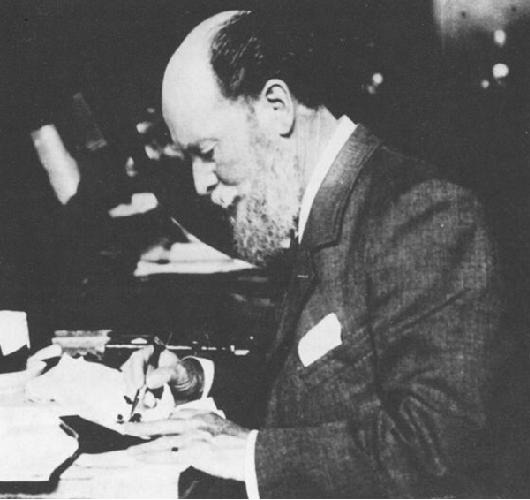
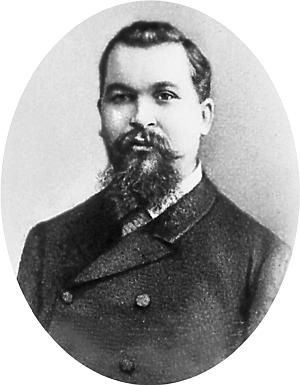
Gustav Faberge completes his apprenticeship as a master goldsmith and marries Charlotte Jungstedt.1
Gustav Faberge founds the firm in Saint Petersburg.1
Peter Carl Faberge born in Saint Petersburg.1
August Wilhelm Holmstrom, born Helsinki 2 October 1829 and apprenticed to Karl Herold from 1845, opens his own workshop and is made Faberge's head jeweller.38
Erik Kollin qualifies as a workmaster in August Holmstrom's workshop.11
Kollin opens his own workshop in Saint Petersburg and is put in charge of all the Faberge workshops as first chief workmaster.311
Carl Faberge takes over the running of the business at twenty-six.12
Antti Nevalainen apprenticed in Saint Petersburg, and from 1875 registered as a Faberge employee.10
Henrik Wigstrom, aged thirteen, moves from Finland to Saint Petersburg.7
Kollin's workshop makes gold copies of the Scythian treasure in the Hermitage, the work that first establishes the firm's artistic reputation.311
Agathon Faberge, Carl's younger brother, joins the business. The firm exhibits at the Pan-Russian Exhibition in Moscow and takes a gold medal.1
Julius Rappoport opens his workshop on the Ekaterininsky Canal and becomes Faberge's principal supplier of large silver.39
Perkhin qualifies as a master craftsman. Wigstrom, aged twenty-two, becomes Perkhin's assistant.67
The First Hen Egg is delivered and the firm is appointed Goldsmith by special appointment to the Imperial Crown. The egg is attributed to Kollin's workshop. Nevalainen qualifies as a master goldsmith and opens his workshop at 35 Kazanskaya Street.131016
Mikhail Perkhin appointed head workmaster at twenty-six. The Konstantin Antiques tables date the end of Kollin's tenure to this year; the Faberge Research Site puts Perkhin's replacement of Kollin at the end of 1888.346
The Hen with Sapphire Pendant Egg delivered to Maria Feodorovna. It has never been located.15
The Third Imperial Egg delivered, workmaster given as August Holmstrom. Moscow branch opened in this year on one account.116
Feodor Ruckert begins supplying cloisonne enamel to Faberge from Moscow while continuing to sell under his own mark.13
The Cherub with Chariot Egg delivered. Unlocated since the revolution; identified in the 1902 exhibition photograph in November 2007.1517
Invoice of 4 May for the Necessaire Egg in the Louis XV style at 1,900 roubles, containing thirteen gold and diamond toilet implements.17
Johan Viktor Aarne begins as a Faberge workmaster, mark BA, until 1904. Odessa branch opened on the dating given in the Carl Faberge biography.23
The Diamond Trellis Egg, workmaster August Holmstrom.16
Perkhin made a personal honorary citizen. Nicholas II begins ordering two eggs a year, one for his mother and one for his wife.615
The Blue Serpent Clock Egg is delivered. It was dated 1887 in the literature until 2008.17
Maria Feodorovna writes to Nicholas II on 22 March thanking him for the ideal egg with the charming portraits of his adored Papa. The egg is the extant Twelve Monograms Egg, long misdated to 1895.18
The Mauve Egg delivered. Only its surprise, a heart-shaped frame, has been recovered.15
The kokoshnik replaces the city assay marks throughout the Russian Empire, giving a hard boundary for dating any marked object.436
Exposition Universelle, Paris. Carl Faberge sits on the jury and exhibits hors concours; the House takes a gold medal and he is made a knight of the Legion of Honour. Two of his sons and his senior workmaster are also honoured. Perkhin takes a bronze medal.26
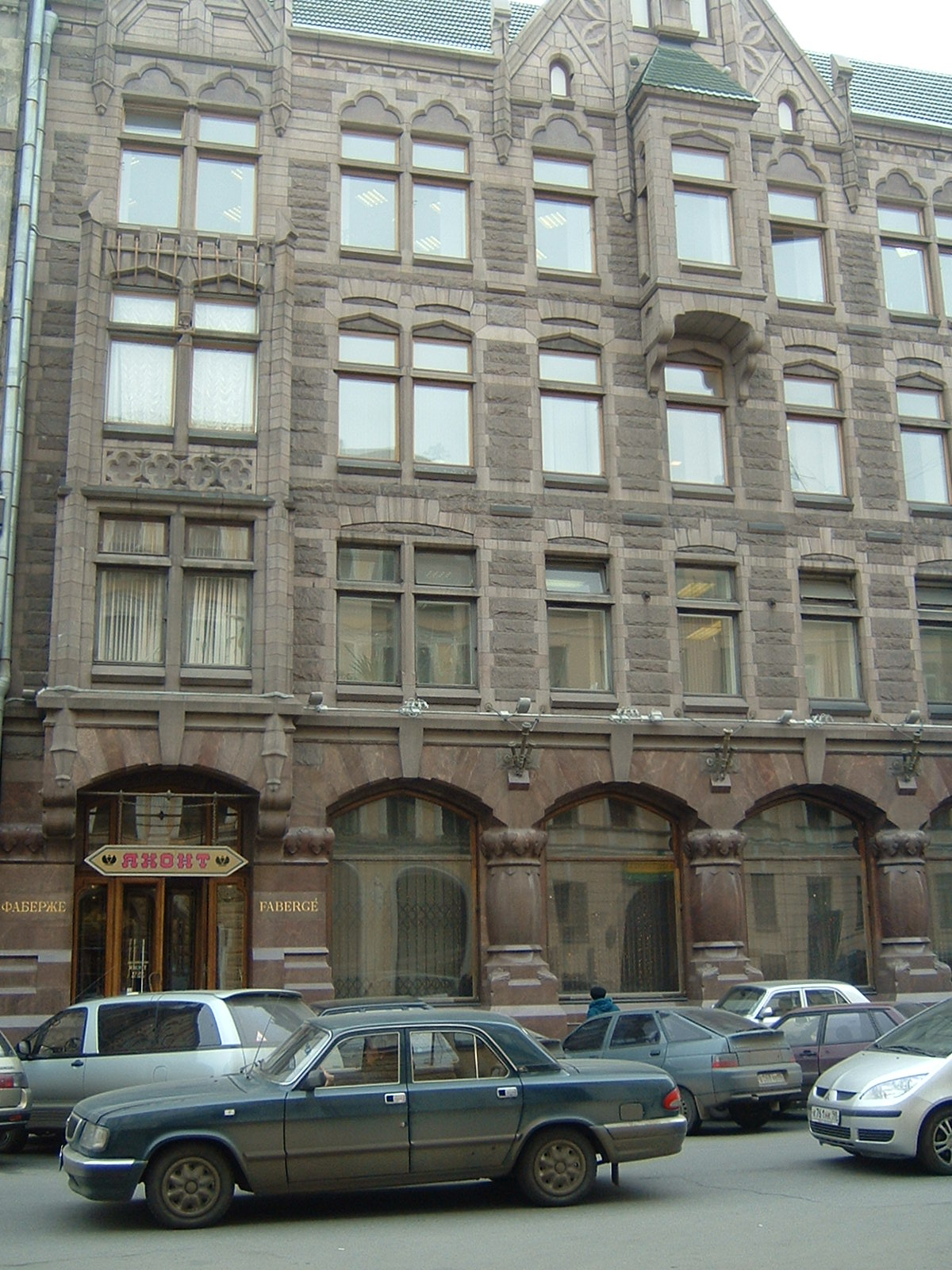
The firm moves into the purpose-built house at Bolshaya Morskaya 24, which holds shop, studio and workshops together.1
March: the von Dervis mansion exhibition in Saint Petersburg, photographed by Karl Bulla. The photographs are the only visual record of several eggs and remain the primary evidence in the search for the missing ones.17
Perkhin dies. Wigstrom takes over the workshop and becomes the third and last head workmaster. August Holmstrom dies; his son Albert takes the jewellery workshop and continues the AH mark. Hjalmar Armfelt begins, mark to 1917.3678
The London branch opens under Henry Bainbridge. The Royal Danish Egg is delivered; it has never been located.215
No Imperial eggs presented, because of the Russo-Japanese War and the unrest that followed.1516
Kiev branch opened on the dating given in the Carl Faberge biography; the Fauxberge article gives 1906.230
Faberge's invoice of 21 April lists the Rose Trellis Egg at 8,300 roubles. Its surprise, a diamond necklace and an ivory miniature of the Tsarevich, is now lost.42
Rappoport's association with the firm ends. His workshop is taken over by the First Silver Artel around 1909.39
Alma Pihl joins the firm at twenty as a self-taught designer. She never has a mark of her own. The Alexander III Commemorative Egg is delivered; it has never been located and no photograph of it is known.1215
The Winter Egg, designed by Alma Pihl and made in Albert Holmstrom's workshop, invoiced at 24,700 roubles.1238
The Mosaic Egg, also designed by Alma Pihl.12
The business is reorganised as a joint-stock company with three million roubles of capital.2
The Karelian Birch and Constellation eggs are designed or begun and never delivered. Faberge's own signed sketch for the Karelian Birch egg survives, dated 1917. Julius Rappoport dies in Petrograd.915
A Committee of Employees runs the firm after the October Revolution until the workshops close on Carl Faberge's instruction.2
The House of Faberge is nationalised and the stock confiscated in October. Carl Faberge leaves Petrograd on the last diplomatic train to Riga disguised as a legation courier; accounts give the month as September or early October.12
Franz Birbaum writes his account of the firm for a projected work on Russian gemstones. It is the only substantial insider record of the workshops that exists.14
Carl Faberge reaches Switzerland in June and dies at Lausanne on 24 September, aged seventy-four.12
Antikvariat established by Lenin as a department of the Ministry of Trade to sell confiscated art abroad. Thirty of the forty Faberge eggs then in the Moscow Armoury pass into its hands.21
Henrik Wigstrom dies at Terijoki in Finland on 14 March.7
Alexander and Eugene Faberge open Faberge et Cie in Paris, using the mark FABERGE, PARIS to distinguish their work from the Russian pieces.125
Carl Faberge's remains are moved from Lausanne to Cannes.2
Fourteen Imperial eggs leave Russia, chiefly through Armand Hammer and Emanuel Snowman of Wartski. Antikvariat sells the Tsarevich Egg in 1930 for 8,000 roubles, another egg the same year for 500 roubles, and one egg to Hammer Galleries for 1,500 roubles.22
Hammer arrives in New York with Russian works of art to sell on Soviet account and tours the eggs through American department stores. Eleanor Barzin buys the Catherine the Great Egg from Hammer Galleries as a birthday present for her mother, Marjorie Merriweather Post.2223
Lillian Thomas Pratt buys the first of her five Imperial eggs from Hammer, paying on her Lord and Taylor charge card.2223
Samuel Rubin registers Faberge Inc in the United States to make perfume and toiletries, on Armand Hammer's suggestion.25
Pratt buys the Red Cross Egg in March for 4,400 dollars. Rubin's perfume trademark registration is dated to this year in one account; a jewellery registration of 1946 is given in another.2225
The Faberge family discovers that the name is in use in America.25
Pratt dies and bequeaths about four hundred works to the Virginia Museum of Fine Arts, including five Imperial eggs.23
Wartski holds the first Western exhibition devoted to Faberge, at its Regent Street premises in November. The Necessaire Egg is shown anonymously.20
The family settles out of court with Rubin for twenty-five thousand dollars, restricting him to perfume.25
Wartski sells the Necessaire Egg on 19 June for 1,250 pounds to a buyer recorded in its ledgers only as A Stranger. It has not been seen since.20
Matilda Geddings Gray acquires the disputed 1885 First Hen Egg from Hammer.22
Rubin sells Faberge Inc for twenty-six million dollars to George Barrie and Rayette Inc, which becomes Rayette-Faberge and, in 1971, Faberge Inc.25
Malcolm Forbes buys the Duchess of Marlborough Egg at auction for nearly three and a half times its estimate and begins the collection that will define the market for forty years.22
McGregor Corporation, controlled by Meshulam Riklis, acquires Faberge for six hundred and seventy million dollars.25
An American subsidiary of Unilever buys Faberge Inc with Elizabeth Arden for 1.55 billion dollars. Victor Mayer of Pforzheim receives an exclusive licence for heirloom Faberge eggs and jewellery.125
In February Valentin Skurlov finds Birbaum's 1919 manuscript in Fersman's papers in the archive of the USSR Academy of Sciences.14
Birbaum's account published by Tatiana Faberge and Skurlov, and again in the State Hermitage volume of 1993.14
Geza von Habsburg coins the term Fauxberge in Art and Auction. The Winter Egg makes 5.6 million dollars at Christie's Geneva, a world record for Faberge at the time.3038
Habsburg writes in the Faberge in America catalogue that unless offered by a reputable dealer or auction house, Faberge on the American market is forgery.31
The Winter Egg makes 9.6 million dollars at Christie's New York and is bought by Sheikh Saud bin Muhammed Al Thani.38
February: the Forbes family sells 194 Faberge pieces, including every egg but the Nobel Ice Egg, to Viktor Vekselberg for a reported one hundred million dollars, pre-empting the announced Sotheby's auction.2224
3 January: Pallinghurst Resources announces the acquisition of Unilever's entire global Faberge trademark portfolio for thirty-eight million dollars, placed in a new Faberge Limited registered in the Cayman Islands. 28 November: the Rothschild Clock Egg makes eight million pounds hammer, 8.98 million with premium, at Christie's London, bought by Alexander Ivanov. November: Anna and Vincent Palmade identify the Cherub with Chariot and Necessaire eggs in the 1902 photograph.172537
November: Annemiek Wintraecken publishes a revised Imperial egg chronology in the Faberge Research Newsletter, redating the Blue Serpent Clock Egg from 1887 to 1895 and reidentifying the Twelve Monograms Egg as the 1896 Alexander III Portraits Egg. The 1887 position falls vacant.1718
3 September: Essex Court Chambers announces that the Grand Court of the Cayman Islands has found Brian Gilbertson in breach of his fiduciary duties over the 2007 Faberge acquisition, in an eighty-two million dollar claim, but awards Renova no compensation because Faberge had not been profitable since the acquisition.28
January: Faberge Limited sold to Gemfields for 142 million new shares valued at ninety million dollars. 19 November: the Faberge Museum opens in the Naryshkin-Shuvalov Palace, Saint Petersburg, with nine Imperial eggs.124
January: Andre Ruzhnikov attacks the Hermitage exhibition Faberge: Jeweller to the Imperial Court, asserting that about forty per cent of the ninety-one exhibits are fake.30
11 August: Gemfields signs an agreement to sell Faberge Limited to SMG Capital LLC for fifty million dollars, forty-five million on completion expected 28 August and five million by quarterly royalties at eight per cent of revenue.129
2 December: the Winter Egg sells at Christie's London for 19.5 million pounds hammer, 22,895,000 with premium, about 30.2 million dollars, to Kieran McCarthy of Wartski bidding in the room. It is the auction record for any Faberge object.394041
Two markets, priced by different logics. The Imperial eggs are about fifty objects, most permanently held, trading perhaps once a decade and setting headline records when they do. Everything else is a working trade of several hundred lots a year in cases, frames, clocks, animals and flower studies, priced by workmaster first, then by condition and charm.
Hammer is published for the Winter Egg in 2025 and for the Rothschild Egg in 2007 and for almost nothing else. Read every other figure below as a total including buyer's premium, and treat cross-decade comparisons with care: the 1994 and 2002 Winter Egg figures and the 2004 Forbes transaction are reported as single numbers with no breakdown, and the Forbes figure is a reported price for a private treaty sale, not a published one.
Two structural features are worth more than the headline numbers. Estimates at the good end of the second tier are systematically low, by factors of three to seven in the 2025 results below, which is a symptom of a field where cataloguers cannot always tell what they have. And the surrounding Russian market has fallen hard: Tsarist porcelain that made 35,000 dollars a plate in the 2011 Safra sales made 3,540 dollars in 2025. Faberge has decoupled from the culture it came out of and is now traded as a brand of its own.
| Date | Sale | Work | Result | Note |
|---|---|---|---|---|
| 1930 | Antikvariat, Moscow, to Hammer Galleries, New York | One of ten Imperial Easter eggs | Hammer Not applicable, a state sale With premium 1,500 roubles Roubles | The same source records the Tsarevich Egg sold in 1930 for 8,000 roubles and another egg the same year for 500 roubles. These are the transactions at which most Western Faberge provenance chains begin. |
| 1930s | American auction, various | Imperial Easter eggs | Hammer Not published With premium As little as 500 dollars USD | Recorded by Art and Antiques as the level at which eggs sold at auction while Hammer was touring them through department stores in the Depression. It is the floor of the entire market and it is fifteen years after the objects were made. |
| 1943-03 | Private purchase from Hammer | Red Cross Egg | Hammer Not applicable With premium 4,400 dollars USD | Bought by Lillian Thomas Pratt, who had earlier bought a rhodonite clock in 1937 for 250 dollars. She paid for the eggs on her Lord and Taylor charge card. |
| 1952-06-19 | Wartski, London, private sale | Necessaire Egg, 1889 | Hammer Not applicable With premium 1,250 pounds GBP | Sold to a buyer recorded in Wartski's ledgers only as A Stranger. The egg has not been seen since and is one of the missing. Wartski has published this because it is looking for it. |
| 1994 | Christie's Geneva | Winter Egg, 1913 | Hammer Not published With premium 5,600,000 dollars USD | A world record for a Faberge object at the time. Reported as a single figure with no breakdown. |
| 2002 | Christie's New York | Winter Egg, 1913 | Hammer Not published With premium 9,600,000 dollars USD | Bought by Sheikh Saud bin Muhammed Al Thani, Qatar's Minister of Culture from 1997 to 2005. Held the Faberge record for five years. |
| 2004-02 | Private treaty, pre-empting Sotheby's | The Forbes collection: 194 Faberge pieces, including every egg but the Nobel Ice Egg | Hammer Not applicable With premium Reported at 100,000,000 dollars USD | Bought by Viktor Vekselberg. The sale removed the only assembled private collection that regularly supplied the market, and the figure is a reported one for a private transaction rather than a published result. |
| 2007-11-28 | Christie's London | Rothschild Clock Egg, 1902 | Hammer 8,000,000 pounds With premium 8,980,000 pounds, given as about 18.5 million dollars GBP | Bought by Alexander Ivanov, director of the Russian National Museum. Claimed at the time as three records at once: the most expensive timepiece, the most expensive Russian work of art and the most expensive Faberge. It is a private commission, not an Imperial egg. Ivanov's collections were later at the centre of the 2021 Hermitage authenticity dispute. |
| 2025-02-07 | Christie's New York | Bearberry study by Henrik Wigstrom, 1910 or 1911 | Hammer Not published separately With premium 529,200 dollars USD | Estimate 200,000 to 300,000 dollars. A flower study, the class Wigstrom's workshop supervised, and a good measure of what a first-rank workmaster's mark carries on a small object. |
| 2025-05 | Sotheby's Geneva | Hardstone animals: obsidian rhinoceros; bloodstone ant-eater; agate hoopoe; agate owl | Hammer Not published separately With premium CHF 279,400; CHF 254,000; CHF 127,000; CHF 101,600 CHF | Estimates were CHF 55,000 to 75,000; 50,000 to 70,000; 50,000 to 70,000; and 45,000 to 65,000 respectively. Every one made three to five times the low estimate. These are the objects that carry no marks at all and are attributed on modelling alone. |
| 2025-06-27 | Christie's Paris, online | Violets study by Mikhail Perkhin, 1899 to 1903 | Hammer Not published separately With premium 226,800 euros EUR | Estimate 200,000 to 300,000 euros. Sold inside estimate, which in this field is the exception. |
| 2025-11-25 | Sotheby's London | Circular enamel desk clock by Perkhin, 1899 to 1903 | Hammer Not published separately With premium 139,700 pounds GBP | Estimate 120,000 to 180,000 pounds. In the same sale a triangular enamel Perkhin clock failed to reach a 150,000 pound reserve and was unsold, which is the corrective to any impression that the mark alone sells an object. |
| 2025-12-02 | Christie's London | The Winter Egg, 1913, designed by Alma Pihl, workmaster Albert Holmstrom | Hammer 19,500,000 pounds With premium 22,895,000 pounds, about 30,200,000 dollars GBP | Sale: The Winter Egg and Important Works by Faberge from a Princely Collection. Bidding opened at 17 million pounds. Bought in the room by Kieran McCarthy of Wartski, the firm that first bought the egg out of Soviet Russia in the 1930s. The auction record for any Faberge object, and one of very few where hammer and premium are separately published: the difference is 3,395,000 pounds. In the same sale a hardstone model of a Street Painter of 1916 made 1,500,000 pounds. |
| 2025-12-18 | Sotheby's New York | The Crosby Collection: 40 Faberge lots | Hammer Not published separately With premium 1,930,000 dollars for the Faberge lots USD | Individual results show the estimate problem clearly: a pill box by Wigstrom of 1904 to 1908 made 152,400 dollars against 30,000 to 50,000; a nephrite box by Perkhin of about 1890 made 139,700 against 60,000 to 80,000; a photograph frame by Aarne of 1899 to 1903 made 69,850 against 25,000 to 35,000; a sapphire mouse of about 1900 made 355,600 against 50,000 to 70,000; a seated lion of 1916 made 317,500 against 300,000 to 500,000. The catalogue identifies the lots by workmaster. |
| 2025-05-13 | Heritage Auctions, Dallas | Feodor Ruckert cloisonne punch set, seven kilograms; bratina by Nevalainen, 1899 to 1908 | Hammer Not published separately With premium 750,000 dollars; 57,500 dollars USD | Estimates 700,000 to 900,000 and 30,000 to 50,000. The Ruckert result is the measure of how much of the Moscow output the firm bought in from independent masters rather than made. |
| 2025-12-16 | Heritage Auctions, Dallas | 164 lots of A La Vieille Russie stock | Hammer Not published separately With premium 1,300,000 dollars for 143 lots sold USD | An 87 per cent sell-through on the dispersal of a New York dealer's stock, followed the next day by 159 of 190 lots for 2,800,000 dollars. Included for the shape of the ordinary market rather than for any single object. |
| Institution | City | Holdings | Note |
|---|---|---|---|
| Kremlin Armoury Museum | Moscow | Ten Imperial Easter eggs, including the Memory of Azov, the Bouquet of Lilies Clock, the Trans-Siberian Railway, the Clover Leaf, the Moscow Kremlin, the Alexander Palace, the Standart Yacht, the Alexander III Equestrian, the Romanov Tercentenary and the Steel Military. | The single largest holding, and the survivors of the group that Antikvariat drew on between 1930 and 1933. Armoury curators are recorded as having hidden the most important pieces to keep them off the market. |
| Faberge Museum, Naryshkin-Shuvalov Palace | Saint Petersburg | Nine Imperial eggs, six other Faberge eggs and more than four thousand works of Russian decorative art, built on the Forbes collection bought in February 2004. | Opened 19 November 2013 after seven years of restoration of the palace at 21 Fontanka River Embankment. Holds the heart-shaped surprise from the lost 1897 Mauve Egg, which is the reason the count of lost eggs varies. |
| Virginia Museum of Fine Arts | Richmond, Virginia | Five Imperial eggs and about 190 Faberge pieces, of which 167 came from the 1947 bequest of Lillian Thomas Pratt. | The largest public collection outside Russia, and the direct product of Armand Hammer's department-store campaign. Pratt bought most of it between 1933 and 1946. |
| Hillwood Estate, Museum and Gardens | Washington, District of Columbia | The Twelve Monograms Egg of 1896, now identified as the Alexander III Portraits Egg, and the Catherine the Great Egg of 1914, with the wider Marjorie Merriweather Post collection of Russian art. | The Twelve Monograms Egg is the object at the centre of the 2008 redating and is the best place to see what an invoice-based reattribution actually rests on. |
| The Walters Art Museum | Baltimore, Maryland | The Gatchina Palace Egg of 1901, workmaster Perkhin, and the Rose Trellis Egg of 1907, workmaster Wigstrom. | The museum publishes its object records with the original invoice figures, including 8,300 roubles for the Rose Trellis Egg on 21 April 1907, and releases its photography for free reuse. One of the few institutions where a student can cite both the object and its period price from the same page. |
| The Cleveland Museum of Art | Cleveland, Ohio | The India Early Minshall collection, including the 1915 Red Cross with Triptych Egg and a large group of frames, boxes, animals, flower studies and miniatures. | Catalogued by workmaster, with Perkhin, August Holmstrom, Nevalainen and Aarne separately credited, and released under CC0. The best free resource anywhere for seeing what each workshop actually produced. |
| The Matilda Geddings Gray Foundation Collection | New Orleans, Louisiana | Three Imperial eggs: the Danish Palaces of 1890, the Caucasus of 1893 and the Napoleonic of 1912, together with the disputed 1885 First Hen Egg acquired from Hammer about 1957. | Shown at the New Orleans Museum of Art. The Hen Egg attribution is the oldest unresolved question in the imperial series. |
| The Royal Collection | London | Three Imperial eggs, the Basket of Flowers of 1901, the Colonnade of 1910 and the Mosaic of 1914, plus the Kelch Twelve Panel Egg of 1899, within a very large holding of Faberge assembled by Queen Alexandra, Queen Mary and later. | The Mosaic Egg is Alma Pihl's. The collection is also the best evidence of the London branch's clientele, since much of it was bought new. |
| Fondation Edouard et Maurice Sandoz | Lausanne and Pully, Switzerland | The Swan Egg of 1906, the Peacock Egg of 1908 and the Yusupov Egg of 1907. | A private foundation holding, shown periodically. The two automaton eggs are the strongest surviving demonstration of the firm's mechanical work. |
| The State Hermitage Museum | Saint Petersburg | Russian goldsmiths' work including Faberge, and the Rothschild Clock Egg, given to the museum after its 2007 sale. | Also the venue of the November 2020 to March 2021 exhibition Faberge: Jeweller to the Imperial Court, in which Andre Ruzhnikov asserted that about forty per cent of the ninety-one exhibits were fake. Read the exhibition and the dispute together. |
| Dorothy and Artie McFerrin Collection | Houston, Texas | The Diamond Trellis Egg of 1892, the Kelch Rocaille Egg of 1902 and the Nobel Ice Egg of about 1914. | The Nobel Ice Egg is the one object the Forbes family retained in 2004 and is Alma Pihl's snowflake work in its purest form. |
| Wartski | London | A trading stock rather than a collection, but the firm has handled more Imperial eggs than any other and publishes its own research. | Emanuel Snowman bought Faberge out of Soviet Russia between 1925 and 1938; Kieran McCarthy authenticated the Third Imperial Egg in 2012 and bought the Winter Egg in the room in 2025. Its published account of the missing Necessaire Egg, including the 1952 ledger entry, is a model of how a dealer's archive should be used. |
| A La Vieille Russie | New York | Trading stock of Russian and Faberge material since the 1930s. | The source of the working rule quoted throughout this page, that marks can be added and quality cannot. A large part of its stock was dispersed at Heritage in Dallas in December 2025. |
| Bolshaya Morskaya 24 | Saint Petersburg | The building itself, purpose-built for the firm and occupied from 1900, holding shop, studio and workshops in one structure. | Still lettered FABERGE in Latin and Cyrillic on the granite either side of the door, and occupied by a different jeweller. The nearest thing to a monument the firm has. |