Evelyn De Morgan
 English · 1855-1919
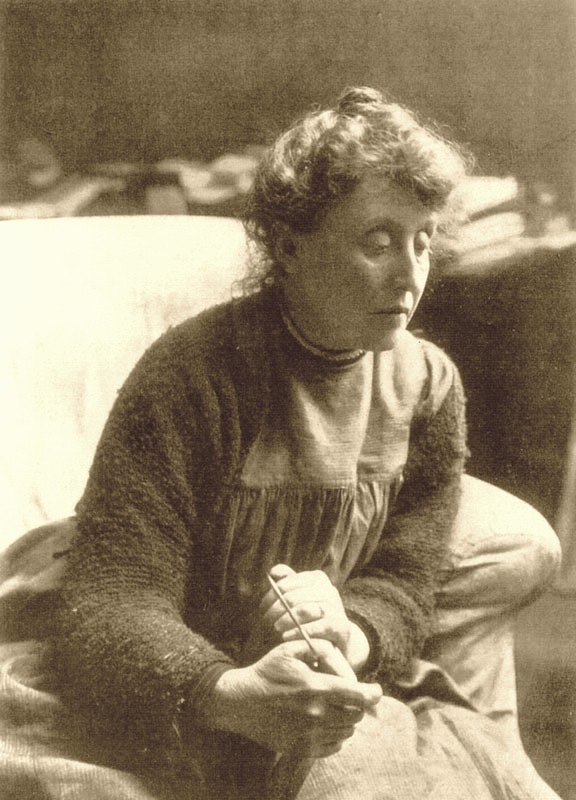
Photograph of Evelyn De Morgan seated with a thin tool in her hands. Commons gives it as 'Photo of Evelyn De Morgan', source the De Morgan Foundation website, with photographer and date unknown, and the Foundation's own older exhibition page carries the same image labelled Evelyn De Morgan, so the identification is the Foundation's. The photographer and date are not known, so the public-domain rationale on Commons cannot be checked independently.
Photographer unknown; via the De Morgan Foundation and Wikimedia Commons (public domain per Commons)| Full name | Mary Evelyn De Morgan, nee Pickering |
|---|---|
| Worked as | Painter, Draughtswoman, Automatic writer (with her husband William) |
| Born | 30 August 1855 · 6 Grosvenor Street, London |
| Died | 2 May 1919 · London (buried at Brookwood Cemetery, Surrey) |
| Nationality | English |
| Movement | Later Pre-Raphaelite, Aesthetic Movement, Symbolist painting |
| Sources | 36 cited |
| Last verified |
About this page Last verified · 36 sources cited
On this page 13 sections
ContentsClose
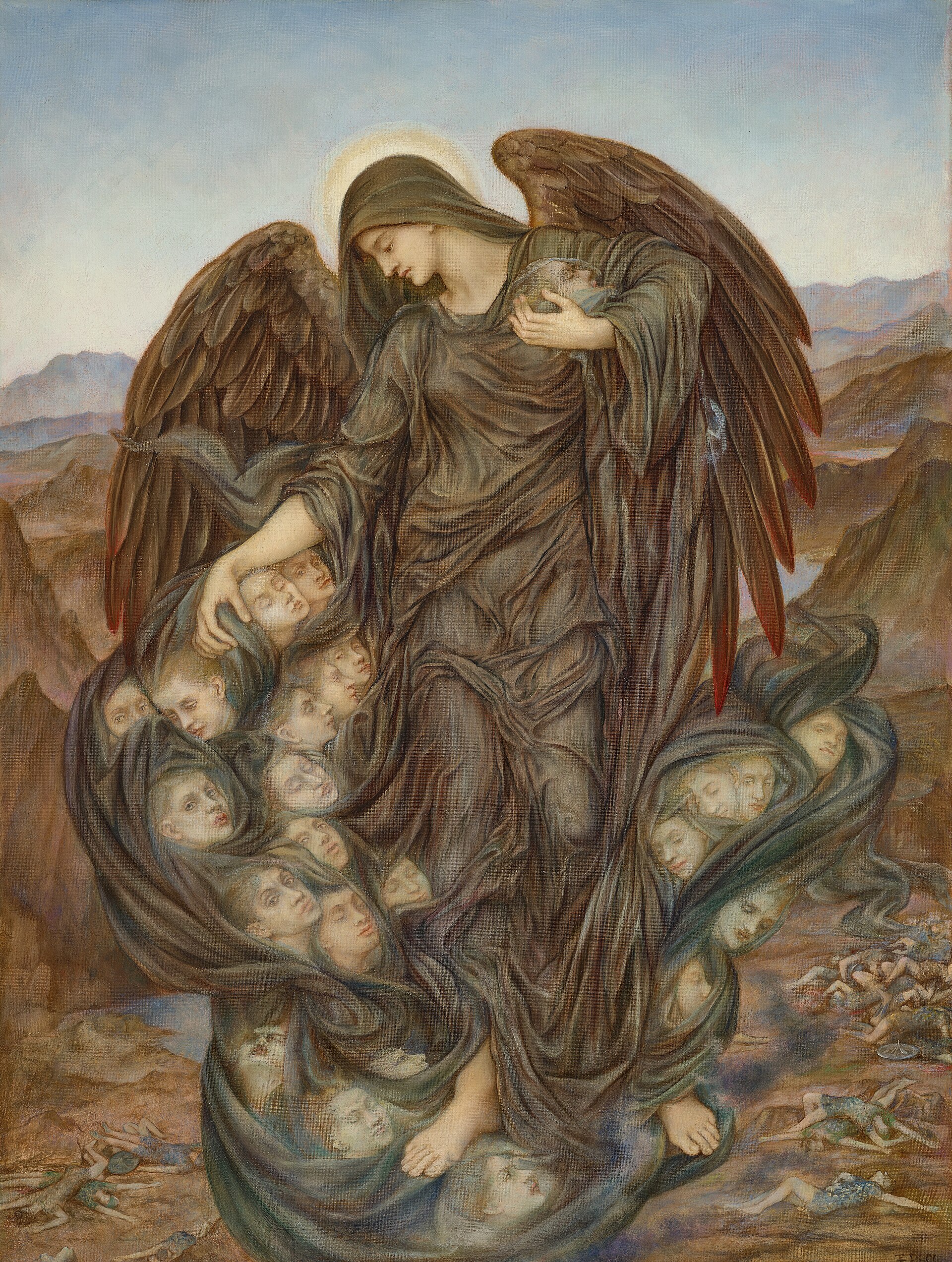
Evelyn De Morgan painted about one hundred oil pictures in a career of roughly fifty years, and the single most useful fact about her is where they went. She did not leave her paintings to a museum. Her will told her executors to sell every picture in her Edith Grove studio by public auction for the benefit of blinded soldiers, and the works that survive as a body do so because her younger sister Wilhelmina Stirling bought them back, in one case for GBP 5, fought her brother the executor for the ones he called refuse, and left them in trust. The De Morgan Foundation, which holds 56 to 60-odd of the oils depending on which of its own pages you read, is the direct product of that sister's collecting.
The record she left in her own hand is thin. Emma Merkling of the Courtauld, who found the only adult list of her reading, says plainly that Evelyn left no adult diaries or notebooks and only a few letters. Almost everything said about what she believed comes through Stirling's 1922 book, the Foundation's own writing and a small number of scholars, so this page grades each belief by whether she owned the book, wrote the line or sat at the table, or whether a later writer is making an argument.
The thing a reader probably does not know: for about twenty years one of her early pictures hung in Bournemouth as a Burne-Jones, because its initials had been altered. A picture of hers was sold under a more famous man's name, and the correction came from her sister, not from a laboratory.
Images
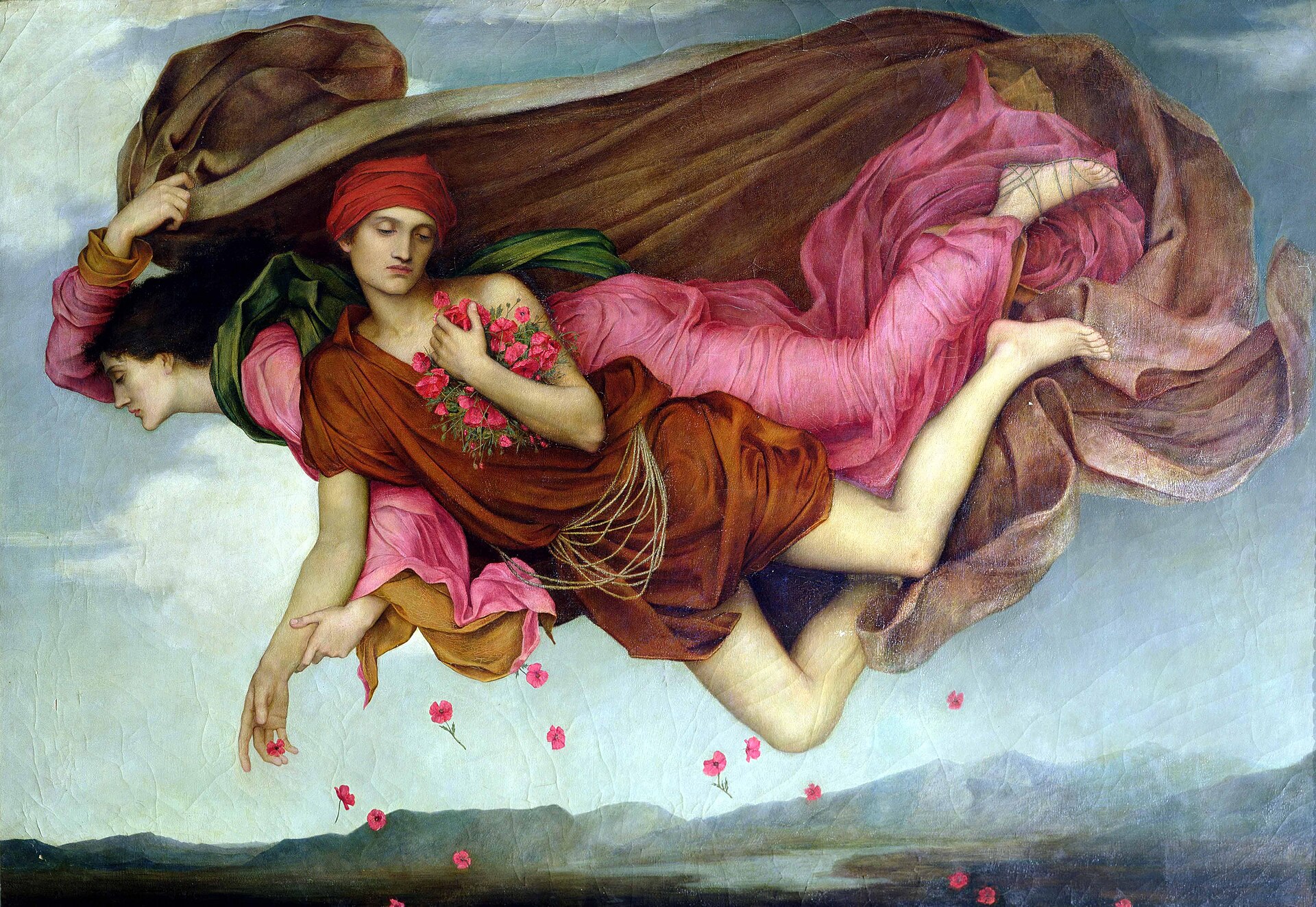
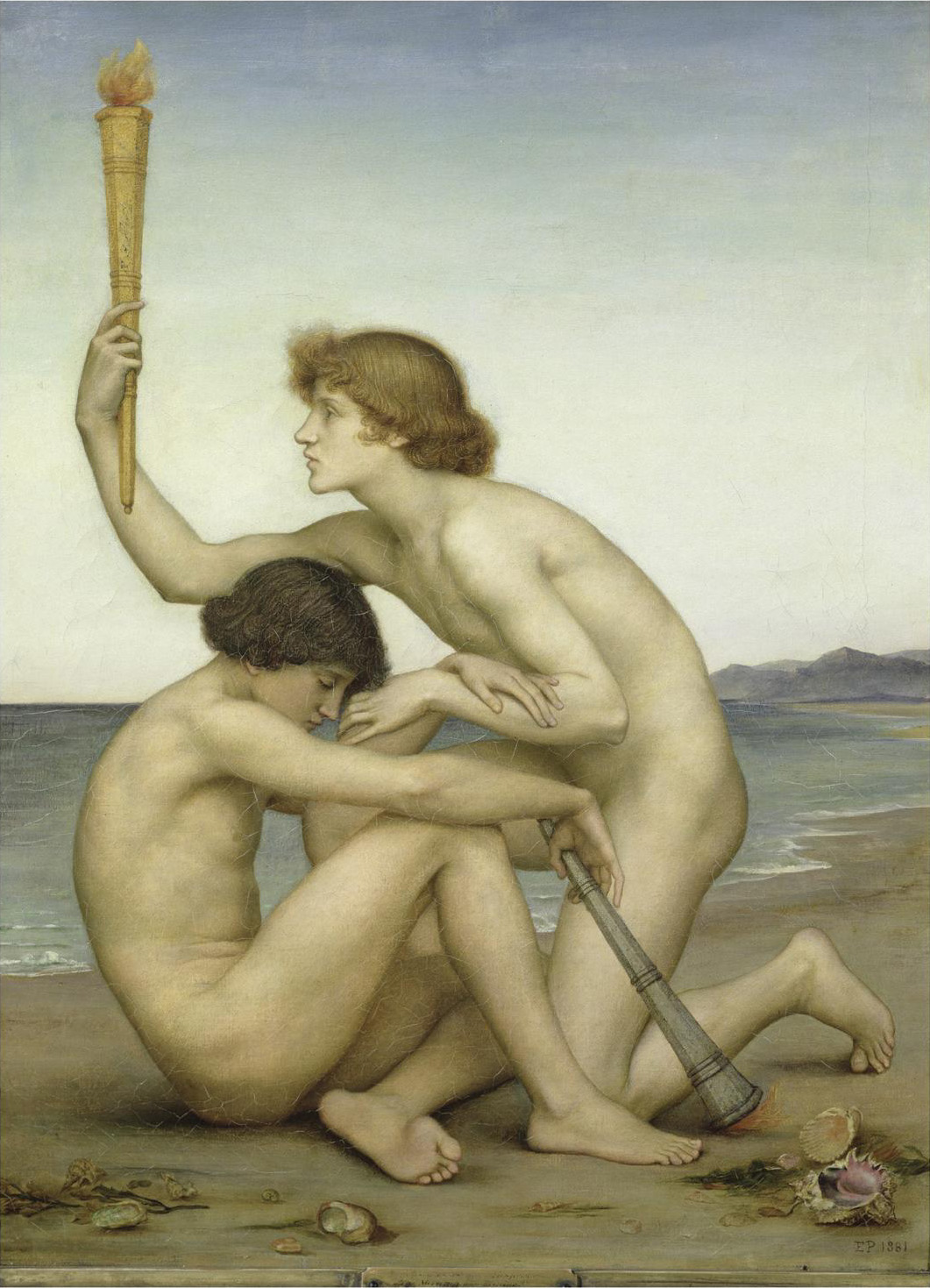
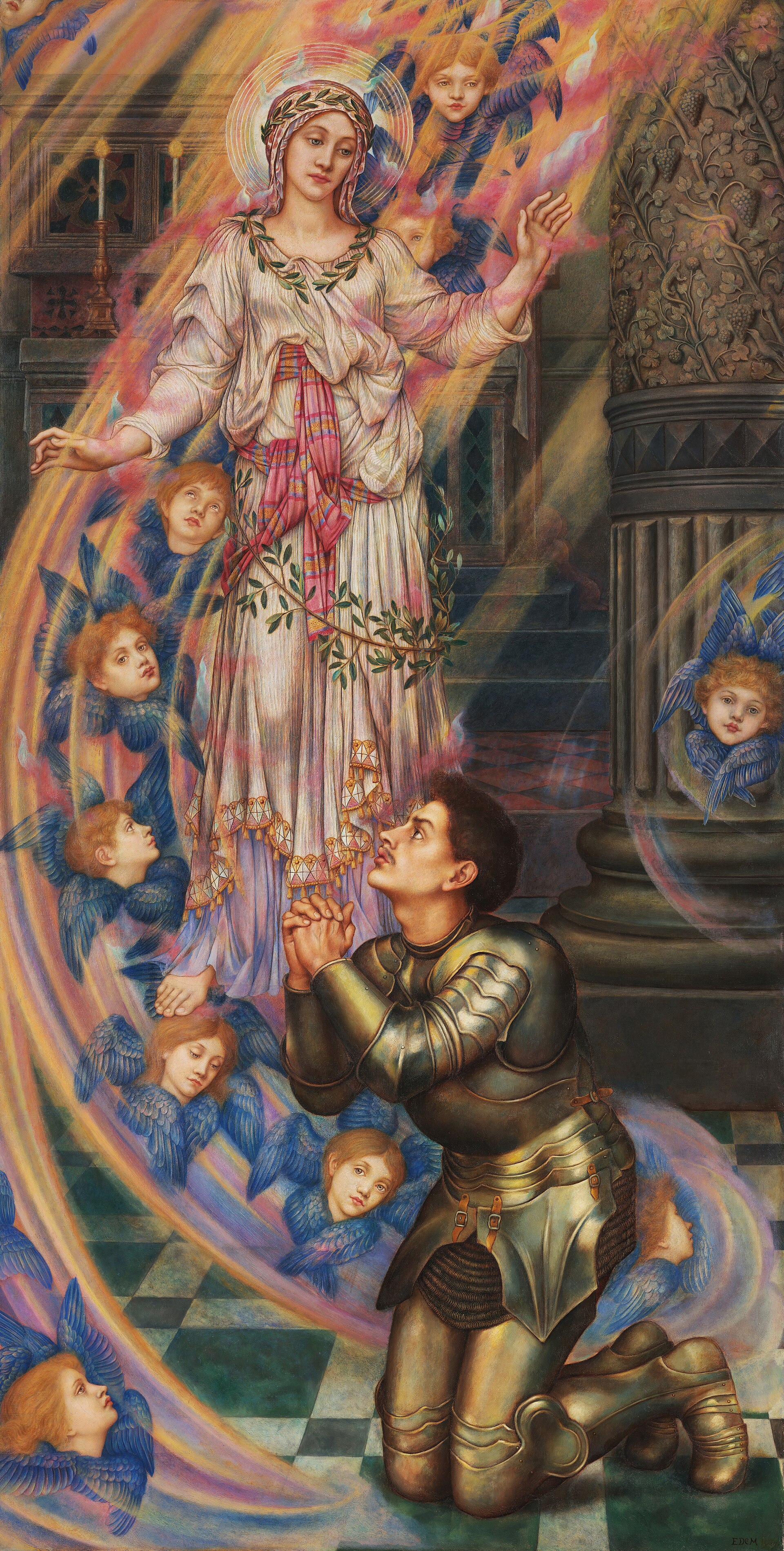
Chronology
- 1855
Born Mary Evelyn Pickering on 30 August at 6 Grosvenor Street, London, eldest of four children; niece of the painter John Roddam Spencer Stanhope.172
- 1868-1870
Writes the poems and short stories now in the Foundation archive, aged 13 to 15.229
- 1872
Seventeenth birthday diary, 30 August: 'I will make up for it now.' Some months at the South Kensington National Art Training School.12
- 1873
Enters the Slade School under Edward Poynter as one of the first women there; Stirling gives the first prize for painting from the Antique for 1873-4.12
- 1874-1875
First prize for painting from the Life and the Slade Scholarship (Stirling); she then gives up the scholarship.1
- 1876
St Catherine of Alexandria shown at the Dudley Gallery, bought by Lord Henry Somerset.2
- 1877
Grosvenor Gallery opens in May; Ariadne in Naxos is bought at the private view by John Mundella. Around this year she writes the reading list found by Merkling.128
- 1880
Stanhope settles at Villa Nuti, Bellosguardo; Florence becomes her second home (Stirling).1
- 1883
Meets William De Morgan (August, per Wikipedia).17
- 1887
Marries William De Morgan on 5 March. Signs Clytie 'EP' this year; exhibited at the Grosvenor Gallery in 1887.1710
- 1889
- 1890s
William Imrie of Liverpool orders eight pictures, among them Flora (1894) and Gloria in Excelsis.12
- 1901
The Walker Art Gallery buys Life and Thought Emerging from the Tomb (1893), per the Foundation.26
- 1906
Exhibition in Bruton Street, London; Lord Lovelace buys a mermaid picture and dies the next month. William's Joseph Vance appears the same year.120
- 1907
Solo show at Wolverhampton Art Gallery under J. J. Brownsword. On 28 June Christie's sells Imrie's Gloria in Excelsis for 25 guineas.2113
- 1909
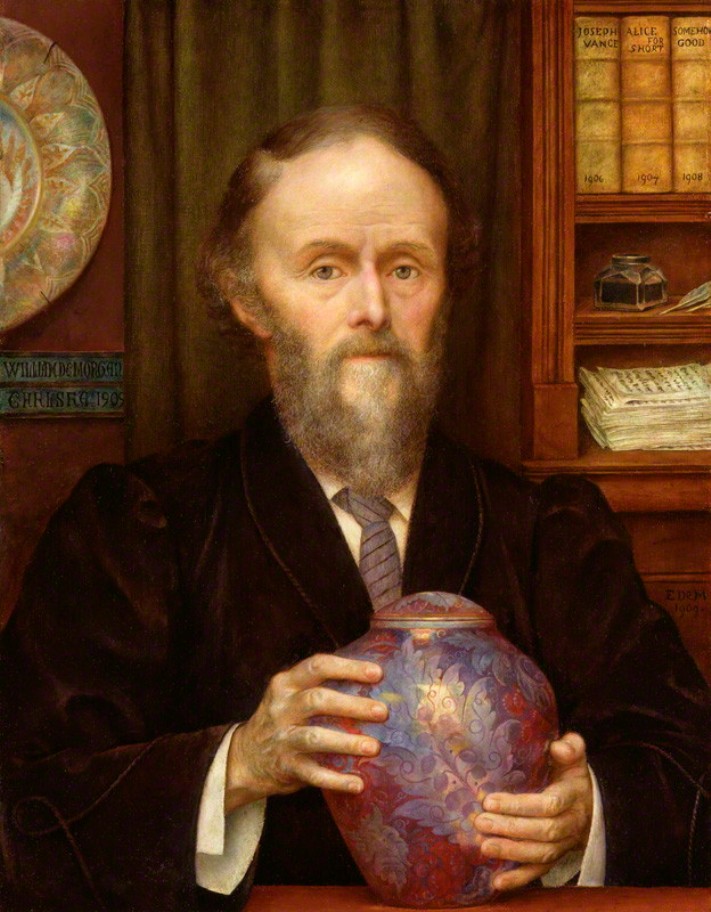
The Result of an Experiment published anonymously; Stirling credits the couple. She paints William's portrait holding a lustre vase.18
- 1914-1916
War pictures painted at Edith Grove; The Vision and S.O.S. are dated to these years.92
- 1916
Studio exhibition of the war pictures for the English and Italian Red Cross; Moscheles writes on 20 March.19
- 1917
William dies; she gives the V&A 1,200 of his drawings and a great number of ceramics.5
- 1919
Dies 2 May. Her will sends the studio pictures to St Dunstan's for sale; Wilhelmina buys The Vision for GBP 5 and fights her brother over 'refuse' pictures.159
- 1922
Stirling's William De Morgan and His Wife published in New York by Henry Holt.1
- 1931
Stirling and her husband take a lifetime lease on Old Battersea House.3
- 1961
Ken Russell's BBC Monitor film Old Battersea House with Wilhelmina Stirling, aged 96.3
- 1965
Wilhelmina Stirling dies in August; the collection passes in trust. The Foundation is registered as charity 310004 in 1970.34
- 1989
21 November: The Crown of Glory sells at Sotheby's London for GBP 143,000 (Art Renewal Center, secondary).16
- 1991
October: fire at Bourlet's art store destroys more than fifteen of her paintings. On 25 October Christie's sells Clytie and The Angel with the Serpent.23101117
- 1996
Catherine Gordon's De Morgan Foundation catalogue Evelyn De Morgan: Oil Paintings; The Vision is no. 88.9
- 1997
Wightwick Manor accepts a bequest of De Morgan pictures and ceramics from Phyllis Pickering.20
- 2002
The De Morgan Centre opens in Wandsworth (to 28 June 2014); Lawton Smith's book appears.18
- 2013
The Lost Paintings of Evelyn De Morgan exhibition, 1 February to 20 April.23
- 2016
The De Morgan Foundation and the National Trust agree the Wightwick gallery.20
- 2019
Merkling publishes the discovery of the reading list.8
- 2020
10 December: Gloria in Excelsis sells for GBP 622,500 at Christie's London.13
- 2024-2025
Painted Dreams at Wolverhampton recreates the 1907 show (19 October 2024 to 9 March 2025); Guildhall Art Gallery exhibition runs 4 April 2025 to 4 January 2026.2122
The market
Her auction record is GBP 622,500 for Gloria in Excelsis at Christie's London on 10 December 2020, a result reported by the aggregator Art Salon, which does not say whether fees are included; Christie's own lot page was blocked and could not be read. The same picture sold at Imrie's sale in 1907 for 25 guineas. Before it, the record was USD 360,500 with premium for Clytie at Sotheby's New York in May 2017, according to the Antiques Trade Gazette. No source read gives a hammer figure for these three; the only hammer price found for her is the Dominic Winter result below.
What moves price is condition of provenance and format: Imrie patron pictures with named histories, nude single figures like Clytie, war allegories (The Field of the Slain, GBP 88,200 in 2022 against an estimate of GBP 30,000 to 50,000), and gold pastel drawings, where the Foundation holds almost all the supply. Estimates only, results not seen: Sotheby's 2011 The Vision at GBP 20,000 to 30,000; Sotheby's 2017 The Angel with the Serpent at GBP 40,000 to 60,000; Sotheby's 2009 and 2014 drawings at GBP 3,000 to 5,000 and GBP 1,500 to 2,000. No period-wage comparison and no tax-relief or dation transfer of a work by her was found.
| Date | Sale | Work | Result | Note |
|---|---|---|---|---|
| 28 June 1907 | Christie's London (William Imrie sale) | Gloria in Excelsis (lot 125) | Hammer 25 guineas (GBP 26 5s, DERIVED) to McLean With premium none recorded GBP (guineas) | Provenance line printed by Christie's in 2020 and repeated by Art Salon. |
| 1919 | St Dunstan's, private sale to Wilhelmina Stirling | The Vision (1914) | Hammer not an auction; GBP 5 With premium none GBP | Per Sotheby's provenance. A separate offer for the group of refused pictures was GBP 240. |
| 21 November 1989 | Sotheby's London | The Crown of Glory | Hammer not stated With premium GBP 143,000 (USD 224,067) as reported; basis not stated GBP and USD | Estimate GBP 40,000 to 60,000. Secondary source (Art Renewal Center, 2010 text); superseded record. |
| 2015-06 | Christie's London | Study of Grief for In Memoriam, black and white chalk | Hammer not stated With premium GBP 14,000 as reported GBP | Reported by the Antiques Trade Gazette as the previous drawing high. |
| 2017-05 | Sotheby's New York, European Art | Clytie, signed EP and dated 1886-7, 106 x 44.5 cm | Hammer not published in the sources read With premium USD 360,500 with premium (about GBP 279,460 per the Gazette) USD | Estimate USD 300,000 to 500,000. Provenance: Rev. George Tugwell, from the artist 1907; by descent; C. F. Armstrong (Sotheby's Belgravia, 20 June 1972, lot 28); Pre-Raphaelite Trust Inc. (Christie's London, 25 October 1991, lot 57). The Gazette says this more than doubled its 1991 price; the 1991 figure was not found. |
| 11 July 2018 | Christie's London, Victorian Pre-Raphaelite and British Impressionist Art, lot 103 | Portraits of Alice Mildred and Winifred Julia Spencer Stanhope, 1884 | Hammer not published in the sources read With premium GBP 125,000 as reported by Art Salon; basis not stated GBP | Estimate GBP 20,000 to 30,000; in the original frame; bought by the previous owner about 1960 from Stanley Woolston, Cambridge. |
| 8 November 2018 | Dominic Winter, South Cerney | The Angel of Death, gold pastel and black chalk on dark wove paper, 1885, 44 x 36 cm | Hammer GBP 39,000 With premium buyer's premium 19.5 per cent per the Gazette; premium-inclusive about GBP 46,605 (DERIVED, before any VAT on the premium) GBP | Estimate GBP 8,000 to 12,000; the first gold pastel by her believed to reach auction; from the collection of a descendant of M. D. E. Clayton-Stamm; bought by a London agency for a private client. |
| 10 December 2020 | Christie's London, Joe Setton Collection, lot 8 | Gloria in Excelsis | Hammer not published in the sources read With premium GBP 622,500 as reported by Art Salon; basis not stated GBP | Estimate GBP 250,000 to 350,000. Provenance: William Imrie (bought from the artist); Imrie sale 1907; Thomas McLean; a US private collection; Julian Hartnoll, London, where bought for the Setton collection. |
| 2022-06-30 to 2022-07-14 | Christie's London online, Isabel Goldsmith Collection, lot 40 | The Field of the Slain, 1916, 62 x 46.3 cm | Hammer not published in the sources read With premium GBP 88,200 as reported by Art Salon; basis not stated GBP | Estimate GBP 30,000 to 50,000; signed with initials E DE M. |
Hammer is the price at which the bidding stopped; with premium adds the fee the house charges the buyer on top. Hammer price and buyer's premium in the glossary.
Where to see the work
| Institution | City | Holdings | Note |
|---|---|---|---|
| De Morgan Museum, Cannon Hall | Barnsley | The Foundation's own museum on the top floor of the house, home of the Stanhope family. | Foundation home page gives Thursday to Sunday, 11am to 4pm; confirm before travelling. |
| Wightwick Manor, Malthouse Gallery (National Trust, with the Foundation) | Wolverhampton | A purpose-built De Morgan gallery with several oils, drawings, her sketchbooks and William's ceramics and tile library; the Mander family collection also holds the sketchbook with her reading list. | Foundation page gives daily 10am to 4pm; sketchbooks are archive items, ask the Trust. |
| Watts Gallery, Artists' Village | Compton, Surrey | Foundation loans; an archived 2015 Foundation page gives its address as the Curator's House on the estate. | Displays change; confirm. |
| Walker Art Gallery | Liverpool | Life and Thought Emerging from the Tomb (1893), WAG 3074, bought 1901. | Check whether on display. |
| Russell-Cotes Art Gallery and Museum | Bournemouth | Aurora Triumphans (BORGM 00665), the picture once sold as a Burne-Jones. | Hung in Gallery II. |
| National Portrait Gallery | London | Portrait of William De Morgan holding a lustre vase (1909), bequeathed by Evelyn according to Stirling. | The NPG's own page could not be fetched; confirm accession and display. |
| Brookwood Cemetery | Brookwood, Surrey | The Grade II listed monument to William and Evelyn, with a relief she designed. | Historic England doubts the Frampton attribution. |
| Leighton House Museum | London | The gold study Victoria Dolorosa, per the Antiques Trade Gazette. | Not confirmed on the museum's own site. |
Forgeries and misattributions
- Aurora Triumphans, signature altered from EP to EBJ
- Sold to the Russell-Cotes family as a Burne-Jones with a monogram reading EBJ 1870 (Foundation); believed so for about twenty years (Stirling, 1922). Stirling calls the change a forgery; the Foundation says an unscrupulous art dealer altered the initials and added a date, which is still visible at the lower right. The dealer is not named. Buyer and year disagree: Merton Russell-Cotes in 1901 (Foundation), his son Herbert about 1922 (Wikipedia). Recognised by her sister, who remembered Evelyn painting it and held preparatory sketches. No technical examination was found.161930
- No other deliberate forgery found; the live risk is confusion with Burne-Jones, Leighton and Stanhope
- The Foundation says her drawings are often mistaken for Leighton's and Burne-Jones's; Merkling thinks a Foundation sketchbook assigned to her may be by Stanhope; Clytie is illustrated in the 1973 Burne-Jones monograph by Harrison and Waters (fig. 272), the reason for which was not established. By Gordon's catalogue and the Foundation's archive; there is no board.23810
The essay
Chapter 1A scholarship she gave back and a name that read as a man's
Evelyn Pickering was born on 30 August 1855 into a London family with money, land in Yorkshire and a painter uncle, John Roddam Spencer Stanhope.
Evelyn Pickering was born on 30 August 1855 into a London family with money, land in Yorkshire and a painter uncle, John Roddam Spencer Stanhope. The Foundation says she was taught at home with her brothers in Latin, Greek, French, German and Italian, in literature, mythology and science. Her seventeenth birthday diary, which Stirling prints in full, reads in part: 'Art is eternal, but life is short, and each minute idly spent will rise, swelled to whole months and years, and hound me in my grave.' She spent some months at the South Kensington National Art Training School in 1872 and entered the Slade in 1873 as one of the first women there, under Edward Poynter.
The accounts of how the Slade ended disagree. The Foundation says she won a full scholarship of GBP 50 a year. Stirling, who was ten years younger and wrote from family memory, says she took the first prize for painting from the Antique in 1873-4 and the first prize for painting from the Life in 1874-5, won the scholarship the same year and then threw it up, because she judged there was little left to learn and wanted to work on independent lines. A blog on the Eclectic Light Company site, a tertiary source, says she left in 1876. Nothing read gives a leaving date from a Slade record.
Stirling also records the anecdote everyone repeats: men students reading the posted scholarship list found one name, which Stirling calls ambiguous in its gender, at the head of it and asked angrily who this fellow Evelyn Pickering was, while she walked past unnoticed. That is documented in the family biography. What the Foundation and the Wolverhampton Art Gallery add, that she chose to submit under her middle name rather than Mary so that the work would be judged on merit, is stated as fact in their texts, but no sentence of hers saying so was found. Treat the effect as documented and the motive as the institutions' reading.
Her father's diary, which the Foundation says it holds, shows him paying for private drawing lessons in the 1870s with a tutor named Green and letting her travel with her uncle to France and Italy. Her mother, by the Foundation's account of Stirling's book, wanted a 'daughter, not an artist'. That second claim was not found in the scanned text of Stirling and rests on the Foundation's paraphrase.
Chapter 2The Grosvenor, the New Gallery and a Liverpool shipowner who wanted a single figure in white
Her first picture to be shown, St Catherine of Alexandria, went to the Dudley Gallery in 1876 and, the Foundation says, was bought directly by Lord Henry Somerset.
Her first picture to be shown, St Catherine of Alexandria, went to the Dudley Gallery in 1876 and, the Foundation says, was bought directly by Lord Henry Somerset. In May 1877 the Grosvenor Gallery opened as the rival to the Royal Academy and she was in it: Ariadne in Naxos was bought at the private view by the Right Hon. John Mundella, a purchase Stirling and the Foundation both record. Stirling counts more than twenty-five Grosvenor exhibits, then a move to the New Gallery when the Grosvenor ended, and says neither she nor her uncle ever offered anything to the Academy. Some pictures went through the Fine Art Society, some were commissions, some went to public galleries and, Stirling says, many went to America.
Her steadiest patron was William Imrie of Holmstead, Liverpool (1836-1906), who the Foundation calls a Scottish shipping magnate associated with the White Star Line. Both Stirling and the Foundation say he ordered eight pictures. Stirling adds that he 'distracted her much' by asking for a single figure, preferably in white, instructions the young artist did not attempt to follow. The Foundation argues he probably had a say in what he bought, because the Imrie group is so alike and the pictures she painted for herself are so different. Stirling's list names seven: Flora, Gloria in Excelsis, The City of Light, The Crown of Glory, a Dryad, Helen of Troy and Cassandra, with later purchases 'untraced'. Helen of Troy and Cassandra were already in Stirling's own possession by 1922.
The Foundation calls Flora (1894) her most celebrated picture, built on Botticelli's Primavera with an Italian scroll that names Florence, and notes a second scroll that refers to Scotland, Imrie's home, as a nod to the patron. Where she lived while painting it is reported two ways: the Foundation says she wintered in Florence from 1890, Wikipedia that she spent half of every year there from 1895 until 1914. Stirling says the connection began with Stanhope's move to Villa Nuti at Bellosguardo from 1880 and an annual visit.
Imrie died in 1906 and his pictures were sold. Gloria in Excelsis appears in the provenance Christie's printed in 2020 as 'Christie's, London, 28 June 1907, lot 125 (25 gns to McLean)', then Thomas McLean the dealer. Twenty-five guineas is GBP 26 5s (DERIVED: 25 x 21 shillings). The same picture made GBP 622,500 in 2020.
Chapter 3The only adult paper trail: a reading list in a sketchbook
Merkling's 2019 note on the Foundation's site is the best piece of evidence there is about what Evelyn read.
Merkling's 2019 note on the Foundation's site is the best piece of evidence there is about what Evelyn read. She found a list of book titles in her own hand in the back of a small sketchbook, about 10 cm by 15.5 cm and some 40 leaves, in the Wightwick Manor archive (NT 1288042, also catalogued WIG/D/176). It carries sketches for Cadmus and Harmonia and Ariadne in Naxos (both 1877), Venus and Cupid (1878) and The Grey Sisters (1880-81), which is why Merkling dates it to no later than 1877. The titles are mostly 1860s and 1870s publications.
The list names John Addington Symonds's The Renaissance (1863, or possibly his later Renaissance in Italy), William Stanley Jevons's The Principles of Science (1874), George Henry Lewes's Problems of Life and Mind (1874), John Ruskin's The Crown of Wild Olive, three lectures on work, traffic and war (1866) and William Rathbone Greg's Rocks Ahead, or the Warnings of Cassandra (1874), with an excerpt from Keats's Hyperion. Merkling reads the science titles as evidence of an interest in the scientific method and psychophysiology, and says her dissertation will be the first to treat the list directly.
Grade: documented that she wrote these titles down in 1877 or earlier. Not documented that she read them through, owned them or used them. Merkling also warns that the Foundation holds a small sketchbook of notes whose authorship is contested between Evelyn and her uncle, and thinks Stanhope is the likelier hand. Merkling lists three things in Evelyn's own hand that survive: some childhood notebooks, a teenage diary and a few letters. The Cumper essay on the Foundation's site says the archive holds some of Evelyn's diaries. The two statements do not agree, and Merkling's is the more specific.
Chapter 4Automatic writing with her husband, and what can and cannot be said about it
What is documented, from a source close to the couple, is the practice.
What is documented, from a source close to the couple, is the practice. Stirling, writing in 1922, says William and Evelyn decided to set aside a quiet time after dinner each evening for automatic writing and to admit no friends, sitting with a pencil and a sheet of paper while one placed a hand on the other's wrist. After many months of nonsense the writing changed: 'Angels' professed to write, and a course of teaching was carried on by what purported to be the spirit of a man who in life had been a leper. Stirling says the experiment was eventually abandoned because the output had become a repetition of the first letters. She presents all of it as belief on their part that an influence outside their own minds was producing every phrase, and adds that they feared fraud in such work and wished to keep what they felt was sacred away from mockery.
The family background is documented too. William's mother Sophia De Morgan practised table-turning and mesmerism, published From Matter to Spirit; William's father Augustus wrote its preface. Stirling quotes William on the word itself, from a passage in Joseph Vance that she presents as his own pronouncement: he wanted the word Spiritualist to describe himself but could not use it, because of Mrs Guppy and the Davenport brothers. So the husband held the belief with a reservation about the label. For Evelyn no equivalent statement was found.
The authorship of the book that came from the sittings is only argued. The Result of an Experiment appeared in 1909, anonymous. Stirling credits the couple, and her account of their nightly sessions is the only one found. Merkling says directly that no primary record of their authorship has yet turned up, so the attribution cannot be counted as hard evidence. The headstone inscription is the one text tied to the automatic script by Stirling: she says the words came from one of the letters from 'Angels'.
How the paintings relate to the script is graded. Documented: Stirling, in 1922, links the pictures to the script and describes The Kingdom of Heaven Suffereth Violence as an image of a soul's gradual rise and A Soul in Hell as a man in a hell of his own making. She also reports a visitor taking the picture Realities to mean that the angelic figures were the dreams and the women on the shore the realities, and Evelyn answering only, 'I see differently.' Argued: Elise Lawton Smith (2002) reads even a mythological picture like Aurora Triumphans as a spiritualist metaphor, in her words her power derives not from her mythological status but from her role as one, quoted here from the Wikipedia article on the painting; Merkling's 2023 Art History article on her spiritualist portraits is titled 'Physics, Psychical Research, and the Self' (Art History, vol. 46, issue 3, title confirmed from an abstract listing; the article was not read); a 2024 Brigham Young master's thesis by Mary Daylin Paul argues Spiritualism is the central influence on the subject matter of her pictures about death. The Foundation's own writers say the same of the dawn and night pictures. Not found anywhere in the 1922 text read: the words Theosophy or Theosophical. No membership of a society or subscription is documented.
Chapter 5One tomb picture, two readings
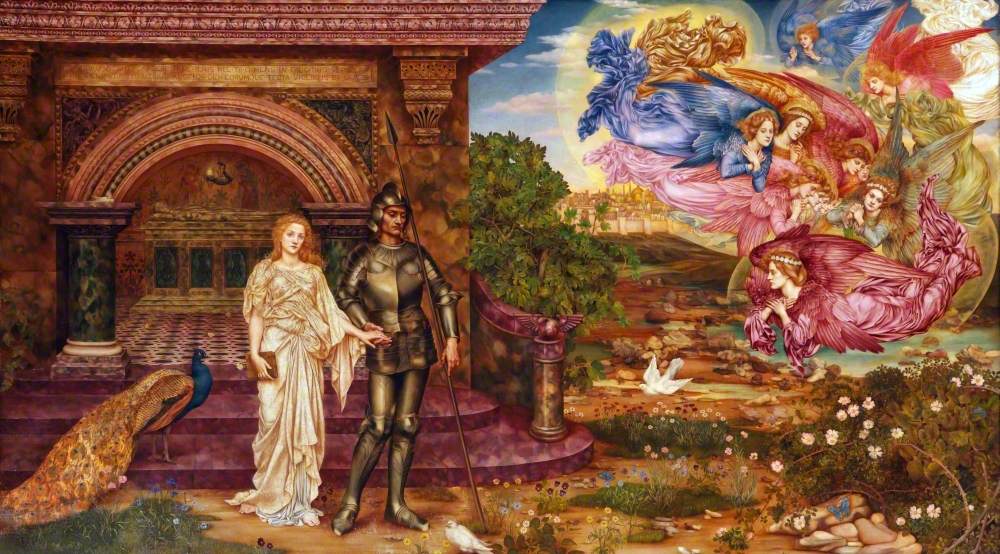
Life and Thought Emerging from the Tomb (1893) is the clearest case of an iconographic source set against a later reading.
Life and Thought Emerging from the Tomb (1893) is the clearest case of an iconographic source set against a later reading. The Walker Art Gallery in Liverpool, which holds it as WAG 3074, says in its own label that Tennyson's poem The Deserted House compares a corpse to an empty house that Life and Thought have left for the great and distant city of immortality, with the male figure as Life and the female as Thought, and treats the peacock, doves, butterfly and carved snakes as traditional signs of life after death. The Foundation adds that a stanza of the Tennyson poem accompanied the picture when it was first shown at the New Gallery, so the literary source is documented by the exhibition itself, and that the Walker bought it in 1901.
The Foundation's own blog then offers a different reading: a spiritualist answer to the Christian empty tomb, in which what leaves is the human spirit rather than a body. The post is unsigned on the page read. It states that earlier writers had not interpreted the Christian imagery and had focused on Tennyson. That is an argument by a named institution, not a statement by the painter. Both readings are reconcilable and neither tells us what she intended beyond the exhibited stanza.
Chapter 6Thirteen war pictures, a studio and an entrance fee
Evelyn brought pictures from Italy at the start of the war and kept them in the Edith Grove studio, a rented studio described as Chelsea by Sotheby's and Fulham by the City of London.
Evelyn brought pictures from Italy at the start of the war and kept them in the Edith Grove studio, a rented studio described as Chelsea by Sotheby's and Fulham by the City of London. Stirling says she agreed to hold an exhibition of the series of symbolic war pictures she had been painting, that none of the work was for sale and that money came from entrance fees only, giving a considerable sum to the English and Italian Red Cross. Sotheby's, writing the catalogue note for The Vision in 2011, says it was one of thirteen oil paintings sold for the benefit of the Red Cross in 1916. These cannot both be right as stated. The Foundation and the City of London only say the show raised money. Whether pictures were sold in 1916 is a question for the exhibition ledger, which was not found.
The artist Felix Moscheles, then in his eighty-fifth year and in Stirling's words a senior member of the International Peace Bureau, wrote to her on 20 March 1916 that he had seen the pictures, that her triumphant angels repulsed 'the Demon of War' and that her colours were merged like those of the rainbow that promises peace. Stirling prints the letter. It is a contemporary witness to how the pictures were read in her own studio.
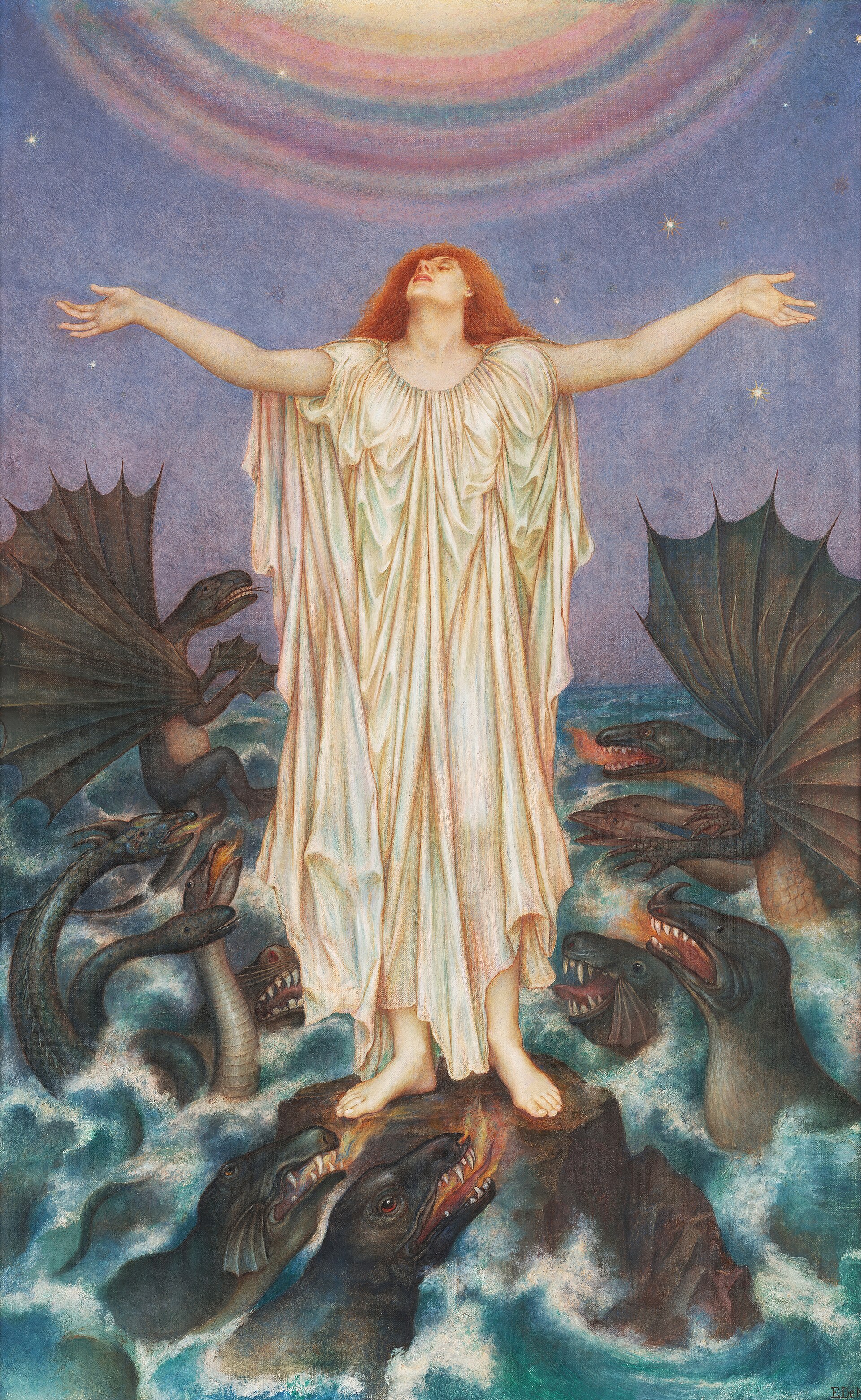
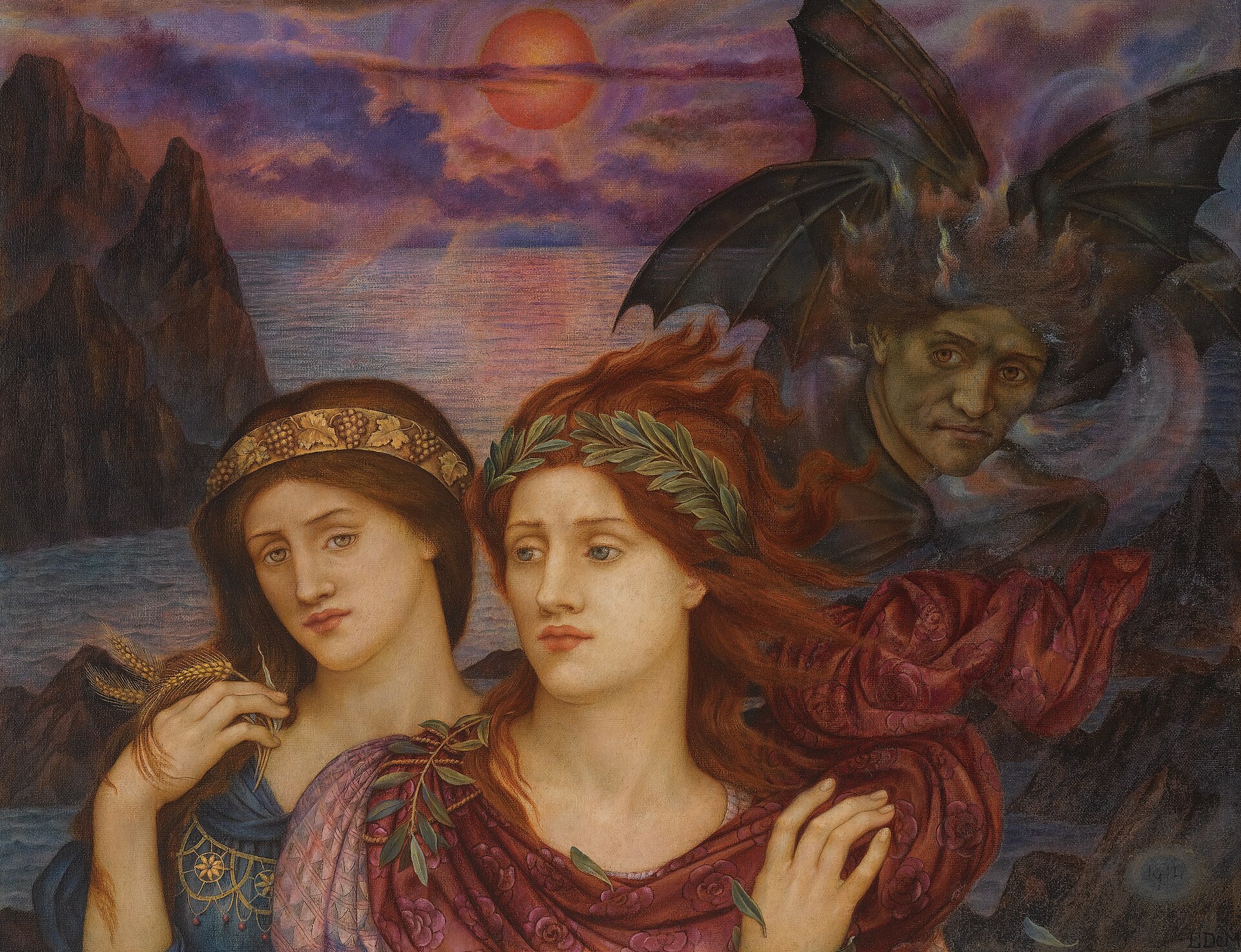
The 1916 exhibition catalogue, quoted by Sotheby's, says The Vision (1914) shows the threatening horror dawning on Peace and Purity: a maiden in a golden band with barley, Peace in red with an olive wreath and a bat-winged figure with flames in its hair who stands for the destruction of war. The Foundation reads S.O.S. as a woman on a rock in a stormy sea ringed by dragons, reaching up to a rainbow, standing for the hope of peace for an isolated Britain, and notes that she painted demons and dragons because she could not depict the front. That reading is the Foundation's. The Foundation says the title is taken from the Morse code for save our souls.
Pacifism is treated by every source as her position, but nothing found in her hand states it. Stirling's account of the war years quotes William, not Evelyn, and the quoted William is a bellicose one: in October 1914 he wrote that he would die content if he could kill two junkers. Evelyn's reading list does contain Ruskin's lecture volume on work, traffic and war, which shows a documented interest in the subject in the 1870s and nothing more. The pictures are the evidence, and a letter from Mrs Stillman that Stirling quotes from the last winter of her life shows the reaction of one viewer: the Peace Madonna was healing, while several later pictures frightened her.
One of the last pictures was lost. A Scrap of Paper, a crowned figure of Civilization among the wreckage of temples and palaces with a torn document at her feet, was among five lost pictures the Foundation revisited in a 2013 exhibition. Stirling had described it as nearly complete in autumn 1918.
Chapter 7A will that sold the studio for blinded soldiers
The Foundation says that in 1917, just after William died, Evelyn gave the Victoria and Albert Museum 1,200 of his drawings and a great number of his ceramics and asked May Morris for an obituary of...
The Foundation says that in 1917, just after William died, Evelyn gave the Victoria and Albert Museum 1,200 of his drawings and a great number of his ceramics and asked May Morris for an obituary of him in the Burlington Magazine, which it uses to show she understood how to preserve a legacy. Stirling's own caption to a lustre vase says Evelyn bequeathed it to the museum, so gift and bequest are not told alike. She took no such measures for herself. Stirling's 1922 account says Evelyn bequeathed all the pictures in her studio to be sold by public auction for the soldiers blinded in the war, and left the finest of William's lustre ware to the V&A. His 1909 portrait by her went to the National Portrait Gallery by bequest, as Stirling's own plate caption states.
The Foundation's reading of her will is blunter: she left the disposal of her estate to her brother Spencer Pickering and to her late husband's partner Halsey Ricardo, and the will explicitly said all studio pictures were to be sold to raise money for St Dunstan's, now Blind Veterans UK. A phrase in the will about 'refuse' pictures that might not be good enough to sell caused a family rift. Wilhelmina, horrified, offered to buy those pictures directly from St Dunstan's for GBP 240; when her brother heard, he forced St Dunstan's to return her cheque and made her give the pictures back, because as executor he had not signed a permission slip. Her letter called him neither mentally nor physically fit to be acting as an executor. The Foundation adds that he first bought the better pictures for himself.
This is where the market information begins. Sotheby's gives the chain for The Vision (1914) as bought from St Dunstan's by Mrs Wilhelmina Stirling in 1919 for GBP 5 and given to the Foundation; it came to auction at Sotheby's on 18 September 1970 catalogued as Ceres, Proserpina and Pluto, a title that has since been dropped. Two other pictures she rescued, according to the Foundation, were St Christina Giving Her Father's Jewels to the Poor (1904) and The Gilded Cage; the first was later destroyed in the 1991 fire. The Foundation says Wilhelmina eventually secured all the pictures her brother had bought, after his death in 1922. Sotheby's and the Cumper essay give his years as 1858 to 1920. The date is unresolved.
Chapter 8Mrs Stirling made the collection and most of the reputation
Anna Maria Diana Wilhelmina Pickering (1865-1965) married Charles Goodbarne Stirling in 1901, according to the Foundation's collecting essay by Vanessa Cumper, and spent her life collecting and...
Anna Maria Diana Wilhelmina Pickering (1865-1965) married Charles Goodbarne Stirling in 1901, according to the Foundation's collecting essay by Vanessa Cumper, and spent her life collecting and writing under the name A. M. W. Stirling. Her 1922 book is described by the Foundation as the starting point for all researchers. The couple took a lifetime lease on Old Battersea House in 1931 after a campaign to save it from demolition and filled it with De Morgan pictures and pottery. The National Trust says that over her lifetime she collected nearly 70 oil paintings and 600 ceramics, and that her friendship with the Mander family of Wightwick Manor was such that they offered to store the entire collection there away from the London Blitz in the Second World War.
A film by Ken Russell for the BBC's Monitor series in 1961, when she was ninety-six, shows her giving a tour of the house. She died in August 1965, days before her hundredth birthday. The Foundation describes the collection as passing to the trust on her death and being registered as charity no. 310004 in 1970. Its own pages give three dates for the founding: 1965 on the home page, 1967 in the Cumper essay and in a 2010 Art Renewal Center text, 1970 for the registration. The 1970 figure is the only one tied to a registration.
After her death the collection was shown at Cardiff Castle, Cragside and Knightshayes Court, and from 2002 until 28 June 2014 at the De Morgan Centre in the former Wandsworth library at West Hill, according to Wikipedia. It is now shown at the De Morgan Museum at Cannon Hall, Barnsley, at Watts Gallery in Surrey and at the Malthouse Gallery at Wightwick Manor. At Wightwick the National Trust notes it had accepted since at least 1997 a bequest of De Morgan pictures and ceramics from Evelyn and Wilhelmina's niece Phyllis Pickering, and that the Foundation and the Trust formally collaborated in 2016. Wikipedia says Old Battersea House became derelict after Stirling's death and was acquired by Malcolm Forbes in 1970.
How many oil paintings the Foundation owns depends on the page. Its biography page says around 100 oils were completed in a fifty-year career, 56 of them in its collection. Its collection highlights page says over 60 oils and 600 drawings. Wikipedia says 58. The Cumper essay says fifty-six framed oils and over six hundred drawings. None of the pages gives a date for the count.
Chapter 9Sixteen canvases in one night
In October 1991 a fire at the Bourlet's art storage unit destroyed a large part of the Foundation's holding.
In October 1991 a fire at the Bourlet's art storage unit destroyed a large part of the Foundation's holding. Wikipedia says sixteen of Evelyn's canvases were lost; the Foundation's exhibition text says more than fifteen, and The Lost Paintings of Evelyn De Morgan, held at the De Morgan Centre from 1 February to 20 April 2013, revisited five of them with studies and colour photographs: Ignoto, Attainment, The Marriage of St Francis and the Holy Poverty, St Christina Giving Her Father's Jewels to the Poor and A Scrap of Paper. The Victorian Web copy of the press text gives the dates as 2012 in its title and 2013 in the body, and the archived Foundation page gives 2013. Dominic Winter's 2018 sale report says the 1890 oil Angel of Death was lost in the fire.
No source read gives the cause of the fire or any insurance value. Other works have since been recreated rather than found: the Wolverhampton Art Gallery says its 2024 show Painted Dreams included three lost works, Victoria Dolorosa, Mercy and Truth and Spear of Ithuriel, recreated by the local artist Paul Francis-Walker following De Morgan's own process.
A coincidence worth recording and not over-reading: on 25 October 1991, the same month, Christie's London sold Clytie (lot 57) from the Pre-Raphaelite Trust Inc. and The Angel with the Serpent (lot 55), according to the later Sotheby's provenances. No source read connects the sale to the fire.
Chapter 10The Burne-Jones signature on Aurora Triumphans
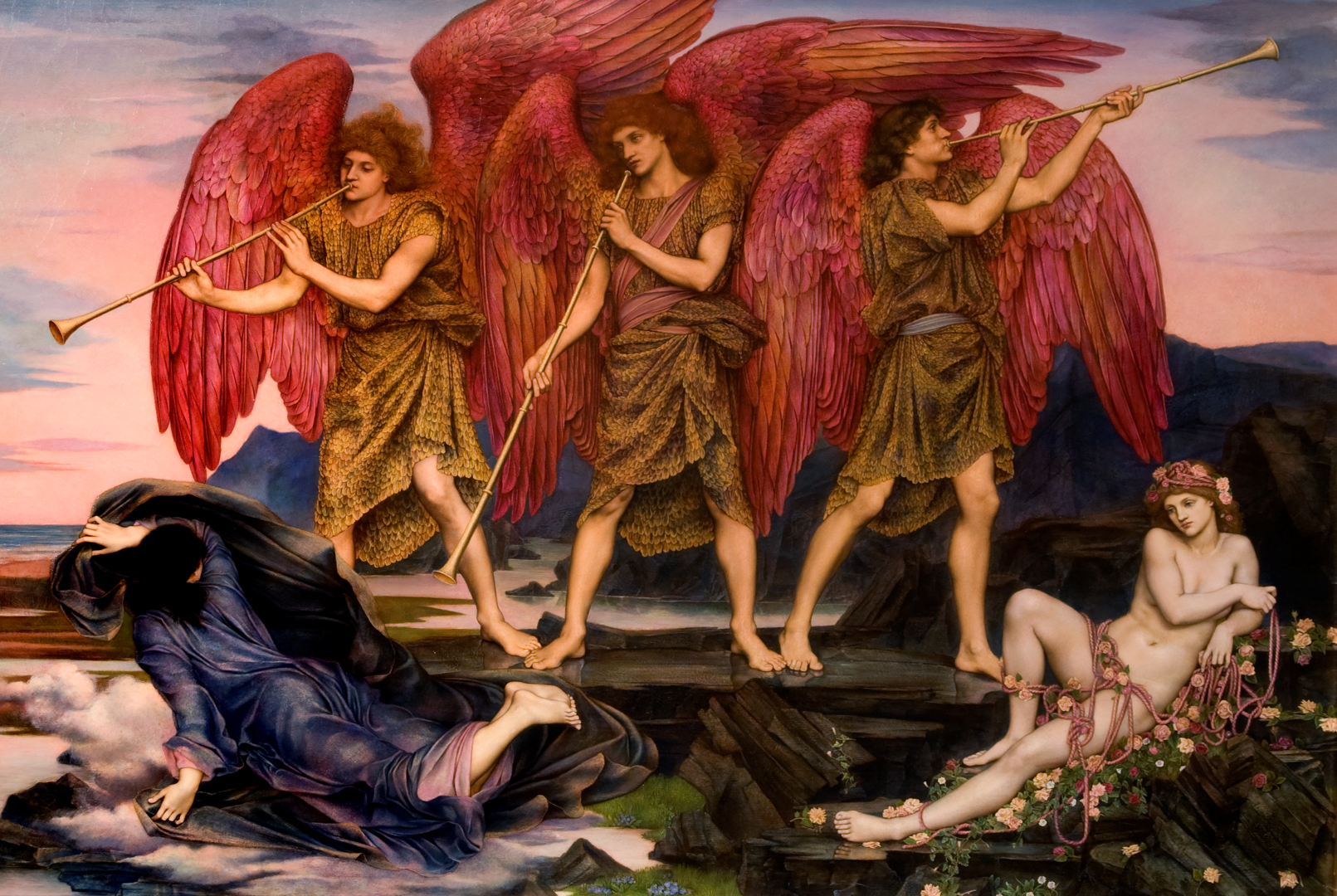
Aurora Triumphans shows Aurora, bound in roped roses, at the lower right, Night swirling away at the lower left and three red-winged angels with trumpets above.
Aurora Triumphans shows Aurora, bound in roped roses, at the lower right, Night swirling away at the lower left and three red-winged angels with trumpets above. It is now in the Russell-Cotes Art Gallery and Museum in Bournemouth (BORGM 00665). Stirling says in 1922 that Evelyn painted it at twenty-two, that it was exhibited, and that her initials E.P. were 'by a forgery' changed to E.B.J., so that for twenty years it was believed to be the work of Edward Burne-Jones.
The Foundation tells the story in more detail. It says Merton Russell-Cotes bought the painting in 1901 with a monogram reading EBJ 1870 and that it hung at East Cliff Hall for twenty years. Wilhelmina learned of it, remembered her sister painting it and had some of the sketches for it. In the Foundation's account 'an unscrupulous art dealer' had changed the EP into an EBJ and added a date. The Foundation says this can still be seen at the lower right. Wikipedia gives a different buyer and date, saying Merton's son Herbert bought it about 1922 and that the dealer painted over the signature; the Eclectic Light Company says it came to market about 1922 with the signature overpainted. No one names the dealer. Dates for the picture itself run from 1877-78 (Stirling and the Foundation heading) and about 1876 (Eclectic) to 1886 (Russell-Cotes and Victorian Web), and the 1886 Grosvenor exhibition date is the one Wikipedia gives.
The detection was by an informed family member with drawings, not by technical analysis, and no source read describes a technical examination. The museum's present text credits De Morgan outright and does not mention the episode.
Chapter 11What the hand does: method and materials
The Foundation describes a fixed route from loose compositional sketches to detailed life studies, mainly in pencil and pastel on grey wove paper, then to detailed compositional studies that she sold...
The Foundation describes a fixed route from loose compositional sketches to detailed life studies, mainly in pencil and pastel on grey wove paper, then to detailed compositional studies that she sold as works in their own right. Studies in gold on dark grey wove paper are unusual, and it notes Burne-Jones made similar ones. Hundreds of figure studies exist, including paired clothed and nude studies of the same pose. A Foundation exhibition text adds that once a composition was settled she rarely deviated, and that the surviving oils show very little reworking.
For the oils the Foundation says she normally used Roberson's pre-stretched double-lined canvas and Winsor and Newton paints, so that she did not prepare supports or grind pigment. She painted some panels, such as The Dryad, experimented with suspending oils in glycerine in a method she called 'the process', worked out with William, and used it on only two pictures, Clytie and The Soul's Prison House. The Foundation says she found it ineffective. Flora's luminosity is attributed to coloured oils over gold leaf, a method it calls her own invention borrowed from medieval altarpieces.
There is independent confirmation for Clytie. Sotheby's quotes her 1907 reply to Rev. George Tugwell, who had asked about removing two leaves of the sunflower: it would be impossible, 'as the picture was painted in a peculiar method to obtain the brilliancy of the colour and varnished', so any alteration would damage the quality. Sotheby's conservator in 2017 found the canvas lined with wax and very fine cracking slightly raised throughout.
Chapter 12How her market formed
The price history is short and recent. A 1907 sale of an Imrie picture made 25 guineas, and a war picture from her own studio changed hands in 1919 for GBP 5.
The price history is short and recent. A 1907 sale of an Imrie picture made 25 guineas, and a war picture from her own studio changed hands in 1919 for GBP 5. The first published result found for a significant oil is the Art Renewal Center's report of The Crown of Glory at Sotheby's London on 21 November 1989 for GBP 143,000, which it called a record; that page is from 2010 and its account of the record is superseded. Clytie made USD 360,500 with premium at Sotheby's New York in May 2017, described by the Antiques Trade Gazette as a record that more than doubled its previous price in 1991. An artist-record then moved to Christie's London on 10 December 2020: Gloria in Excelsis, Imrie's picture of 1907, at GBP 622,500, against an estimate of GBP 250,000 to 350,000.
Works on paper have also moved. In November 2018 a gold pastel The Angel of Death of 1885, estimated GBP 8,000 to 12,000, was knocked down at GBP 39,000 at Dominic Winter and beat the previous drawing high of GBP 14,000 for a study for In Memoriam at Christie's in June 2015, according to the Antiques Trade Gazette. The Dominic Winter specialist told the paper that prices were on the rise. The Gazette says she made just a handful of works in gold, all but one held by the Foundation, the exception being Victoria Dolorosa at Leighton House Museum, and that the 1885 lot was believed to be the first gold pastel by her to appear at auction; the two statements sit awkwardly together and were not reconciled.
Chapter 13How reliable is the main source
Every account of her private life leans on Stirling's William De Morgan and His Wife, published by Henry Holt in New York in 1922 and read here from the New York Public Library scan.
Every account of her private life leans on Stirling's William De Morgan and His Wife, published by Henry Holt in New York in 1922 and read here from the New York Public Library scan. It is written by a sister who is also the collector who made the reputation, and she says so herself. Elise Lawton Smith, according to the Foundation's Cumper essay, dismisses Stirling on the grounds that her memory would have been unreliable some years after her sister's death and that Evelyn is an afterthought in a book about William, and sees her as heroicizing her sister. Cumper's defence is that the Foundation's archive holds some of Evelyn's diaries. Merkling, as above, says none survive from adulthood.
Where this page used Stirling it has tested her against another source: her Slade prizes agree in kind with the Foundation's list; the Aurora forgery matches the Foundation; the tomb inscription reads 'Sorrow is only of Earth' in Stirling and 'of the earth' in the Historic England listing, but 'of the flesh' in Wikipedia, which is therefore wrong; and her description of the relief, a mourner extinguishing a torch beside a winged Psyche, differs from Historic England's, an angel pleading with a figure of Death with an inverted torch. The listing also says the attribution of the monument to Sir George Frampton is perhaps open to question, whereas Stirling says it was carved in marble under his supervision.
What is documented
Technique
The surviving work
- What is accepted
- No published count of accepted works. The Foundation gives about 100 oils in a fifty-year career and holds 56 (biography page), over 60 (highlights page) or 58 (Wikipedia). Gordon's 1996 catalogue numbers reach at least 88. Over 600 drawings are in the Foundation. Counts undated.
- What is contested
- One documented tampered attribution: Aurora Triumphans, altered from EP to EBJ and sold as Burne-Jones. The Foundation holds a small sketchbook whose authorship is contested between Evelyn and her uncle Stanhope; Merkling thinks it more likely his. The Foundation says her drawings are often mistaken for Leighton's and Burne-Jones's.
- Who rules on attribution
- No authentication board or committee was found. The De Morgan Foundation describes itself as the leading authority on the De Morgans and has an online searchable collection database; Gordon's 1996 catalogue is the reference for the oils. No catalogue of the drawings was found.
Catalogue raisonne
- Catherine Gordon (ed.), Evelyn De Morgan: Oil Paintings, De Morgan Foundation, London, 1996. The printed catalogue of the oils, cited by Sotheby's for The Vision (cat. 88), Clytie (cat. 30) and The Angel with the Serpent (cat. 1). Its full text was not read.91011
- Elise Lawton Smith, Evelyn Pickering De Morgan and the Allegorical Body, Fairleigh Dickinson University Press, 2002. The standard scholarly monograph, cited in Sotheby's Clytie entry; not a catalogue.1017
- A. M. W. Stirling, William De Morgan and His Wife, Henry Holt, New York, 1922. Primary family source and a partial inventory; Stirling says the earlier pictures are dispersed and that Evelyn kept no record of them.1
Questions about Evelyn De Morgan
Who was Evelyn De Morgan?
Painter; Draughtswoman; Automatic writer (with her husband William). 1855-1919.
When did Evelyn De Morgan live?
Born 30 August 1855, 6 Grosvenor Street, London; died 2 May 1919, London (buried at Brookwood Cemetery, Surrey).
How are fakes and misattributions of Evelyn De Morgan detected?
Aurora Triumphans, signature altered from EP to EBJ. Sold to the Russell-Cotes family as a Burne-Jones with a monogram reading EBJ 1870 (Foundation); believed so for about twenty years (Stirling, 1922). Stirling calls the change a forgery; the Foundation says an unscrupulous art dealer altered the initials and added a date, which is still visible at the lower right.
Where can you see work by Evelyn De Morgan?
De Morgan Museum, Cannon Hall (Barnsley); Wightwick Manor, Malthouse Gallery (National Trust, with the Foundation) (Wolverhampton); Watts Gallery, Artists' Village (Compton, Surrey); Walker Art Gallery (Liverpool); Russell-Cotes Art Gallery and Museum (Bournemouth); National Portrait Gallery (London).
What does the market for Evelyn De Morgan look like?
Her auction record is GBP 622,500 for Gloria in Excelsis at Christie's London on 10 December 2020, a result reported by the aggregator Art Salon, which does not say whether fees are included; Christie's own lot page was blocked and could not be read. The same picture sold at Imrie's sale in 1907 for 25 guineas.
What is still unresolved about Evelyn De Morgan?
Who altered the initials on Aurora Triumphans, and which sale date is right: 1901, about 1922 or later? The Foundation, Wikipedia and Art UK give different buyers and years.
Open questions
- Who altered the initials on Aurora Triumphans, and which sale date is right: 1901, about 1922 or later? The Foundation, Wikipedia and Art UK give different buyers and years.
- Were pictures sold at the 1916 Edith Grove war exhibition? Stirling says nothing was for sale and money came from entrance fees; Sotheby's says thirteen oils were sold for the Red Cross.
- Which pictures did Spencer Pickering buy in 1919, where are they now, and did he die in 1920 or 1922?
- Where are Imrie's other pictures, which Stirling calls untraced, and The Thorny Way, which Stirling placed 'now in Africa'?
- Who wrote The Result of an Experiment? Stirling's attribution is uncorroborated; Merkling found no primary record.
- What was the Pre-Raphaelite Trust Inc., which sold Clytie on 25 October 1991, and did its sale have anything to do with the fire that month?
- Did she write or say anything of her own about war and peace? Nothing in her hand was found.
- Which year was the Foundation founded: 1965, 1967 or 1970, and what did each date record?
Sources
- 1A. M. W. Stirling, William De Morgan and His Wife (New York: Henry Holt, 1922), full text from the New York Public Library scan on the Internet Archive. Primary family source, written by Evelyn's sister; read directly, including the passages cited (the 1872 diary, the Slade, Imrie, the automatic writing, the 1916 exhibition, the death and bequest). archive.org/details/...
- 2De Morgan Foundation, 'Evelyn De Morgan (1855 - 1919)', biography page. demorgan.org.uk/discover/...
- 3De Morgan Foundation, 'Wilhelmina Stirling (1865 - 1965)'. demorgan.org.uk/discover/...
- 4De Morgan Foundation, 'About Us' (charity no. 310004, registered 1970). demorgan.org.uk/discover/...
- 5De Morgan Foundation, 'A Passion to Preserve Evelyn's Paintings', 3 June 2020 (the will, St Dunstan's, GBP 240 offer, Spencer Pickering). demorgan.org.uk/a-passion-to-preserve-evelyns-paintings
- 6De Morgan Foundation, 'Misattribution of Aurora', 3 July 2020. demorgan.org.uk
- 7De Morgan Foundation, 'Evelyn De Morgan's dawns', 11 July 2020 (a curatorial reading of the dawn pictures, argued). demorgan.org.uk
- 8Emma Merkling (Courtauld Institute), 'Evelyn De Morgan's reading lists: A discovery in the archives', De Morgan Foundation, May 2019 (Wightwick Manor sketchbook NT 1288042 / WIG/D/176). Primary scholarly report of an archive discovery. demorgan.org.uk
- 9Sotheby's, Victorian and Edwardian Art, 2011, lot 62, Evelyn de Morgan, The Vision, 1914: provenance, exhibition, literature and catalogue note. Results not shown on the page. sothebys.com/en/...
- 10Sotheby's, European Art, New York, 2017, lot 9, Evelyn Pickering de Morgan, Clytie: provenance, exhibition, literature, condition report and the 1907 letters. Results not shown on the page. sothebys.com/en/...
- 11Sotheby's, Victorian, Pre-Raphaelite and British Impressionist Art, 2017, lot 21, The Angel with the Serpent: provenance and catalogue note on the sitter Spencer Pickering. sothebys.com/en/...
- 12Learn Antiques, 'Evelyn takes De Morgan spotlight' (repost of an Antiques Trade Gazette report, December 2018): Dominic Winter result and the 2017 Sotheby's New York price. learnantiques.com.au/evelyn-takes-de-morgan-spotlight
- 13Art Salon, Gloria in Excelsis, Christie's London, 10 December 2020, lot 8: estimate, price realised and provenance. Aggregator; the Christie's lot page was blocked and should replace it. art.salon/artwork/...
- 14Art Salon, The Field of the Slain, Christie's online, Isabel Goldsmith Collection, 2022, lot 40. Aggregator; Christie's page blocked. art.salon/artwork/...
- 15Art Salon, Portraits of Alice Mildred and Winifred Julia Spencer Stanhope, Christie's London, 11 July 2018, lot 103. Aggregator; Christie's page blocked. art.salon/artwork/...
- 16Art Renewal Center, Evelyn de Morgan biography page (sale of The Crown of Glory, 21 November 1989; the page cites the De Morgan Foundation, 2010). Secondary. artrenewal.org/artists/...
- 17Wikipedia, 'Evelyn De Morgan'. Gear (doi:10.1093/ref:odnb/45491), which was not read. en.wikipedia.org/wiki/...
- 18Wikipedia, 'De Morgan Foundation'. en.wikipedia.org/wiki/...
- 19Wikipedia, 'Aurora Triumphans' (quotes Elise Lawton Smith, 2002, p. 241). en.wikipedia.org/wiki/...
- 20National Trust, 'The De Morgan Gallery at Wightwick' (Wilhelmina Stirling, the Manders, the 1997 Pickering bequest, the 2016 collaboration, the 1906 and 1907 shows). nationaltrust.org.uk/visit/...
- 21City of Wolverhampton Council, press release on Painted Dreams: Evelyn De Morgan, 2 September 2024. wolverhampton.gov.uk/news/...
- 22City of London Corporation, news release on the Guildhall Art Gallery exhibition, 10 February 2025. news.cityoflondon.gov.uk/evelyn-de-morgan-makes-triumphan...
- 23De Morgan Foundation, 'The Lost Paintings of Evelyn De Morgan' exhibition page (archived copy, 2013 dates), with the Victorian Web copy of the press text. web.archive.org/web/...
- 24Historic England listing for the Monument to William and Evelyn De Morgan, Brookwood Cemetery (list entry 1391033), text read on the British Listed Buildings mirror. britishlistedbuildings.co.uk/101391033-tomb-of-william-an...
- 25National Museums Liverpool, 'Life and Thought Emerging from the Tomb', WAG 3074. liverpoolmuseums.org.uk/artifact/...
- 26De Morgan Foundation, 'The Empty Tomb - A hopeful symbol for an Easter' (Walker purchase 1901; spiritualist reading). Unsigned on the page. demorgan.org.uk
- 27De Morgan Foundation, 'Collection Highlights'. demorgan.org.uk/discover/...
- 28Vanessa Cumper, 'Wilhelmina Stirling - Collecting De Morgan', De Morgan Foundation blog (Stirling's marriage, the Foundation 'formalised in 1967', Lawton Smith's criticism of Stirling). demorgan.org.uk
- 29De Morgan Foundation, 'Evelyn De Morgan's Spiritual Journey: From Poetry to Painting' (lecture to the Birmingham and Midland Institute, 24 November 2018). demorgan.org.uk
- 30Russell-Cotes Art Gallery and Museum, 'Aurora Triumphans' collection page (BORGM 00665). russellcotes.com/collection-piece/...
- 31The Eclectic Light Company, 'Evelyn De Morgan 1: Night and Sleep', 29 October 2020. eclecticlight.co/2020/...
- 32Wikimedia Commons, Category: Evelyn de Morgan and Paintings by Evelyn de Morgan: file pages and LicenseShortName read for every plate. commons.wikimedia.org/wiki/...
- 33De Morgan Foundation, home page (established 1965; De Morgan Museum at Cannon Hall opening hours). demorgan.org.uk
- 34Wikipedia, 'Old Battersea House' (Forbes 1970). en.wikipedia.org/wiki/...
- 35Mary Daylin Paul, 'The Result of Her Experiment: Evelyn De Morgan's Spiritualist Message of a Hopeful Death', MA thesis, Brigham Young University, 2024 (abstract read only). scholarsarchive.byu.edu/etd/...
- 36Victorian Web, 'The Lost Paintings of Evelyn De Morgan' (press text; title line says 2012, body 2013). victorianweb.org/painting/...
Last verified