National Museum of Art, Architecture and Design
Nasjonalmuseet for kunst, arkitektur og design · Founded 2003 (merger of four state museums); current building at Vestbanen opened 11 June 2022
The National Museum's core strength is breadth under a single roof: Norway's principal collection of historical and modern painting and sculpture, its largest collection of works on paper, its national design and crafts collection, and its national architecture archive, all previously split across four separate buildings and now shown together for the first time. The Munch holdings, 58 paintings and 175 works on paper including the museum's own 1893 Scream, sit inside a wider collection whose depth in some areas - Norwegian applied arts from the 18th century in particular - is matched by comparatively thin holdings in others, a direct legacy of how differently each of the four predecessor museums collected before 2003.
| Local name | Nasjonalmuseet for kunst, arkitektur og design |
|---|---|
| Founded | 2003 (merger of four state museums); current building at Vestbanen opened 11 June 2022 |
| Address | Brynjulf Bulls plass 3, 0250 Oslo, Norway |
| City and country | Oslo, Norway |
| Website | https://www.nasjonalmuseet.no/en/ |
| Status | Open, confirmed 2026-08-13 |
| Record last verified | 2026-08-13 |
Visiting
- Admission
- Adult NOK 220
- Under 25 NOK 100
- Students under 30 NOK 120 ID required; sold at the ticket counter only, not online
- Children and youth 0-17 Free Free
Free entry: National Museum members, unlimited entry for the member plus one guest. Norwegian kindergarten and school groups (primary and upper secondary), plus art students at Norwegian institutions with a valid student card. Holders of an active Oslo Pass, on presentation at the ticket counter. ICOM/ICAM cardholders and members of a list of Norwegian professional associations for artists, architects and curators named on the museum's free-entry page- Hours
- Tuesday, Wednesday 10:00 to 20:00
Thursday, Friday, Saturday, Sunday 10:00 to 17:00
Monday 10:00 to 17:00 Open Mondays only from 1 June to 31 August; the museum's own schedule implies Monday is closed the rest of the year - see notes_for_editor - Also note
- Monday, outside 1 June-31 August. 24-26 December. 31 December-1 January.
- Booking
- Not required; tickets can be bought online in advance or at the counter on arrival, though the museum recommends booking ahead for busy periods and specific exhibitions.
- Address
- Brynjulf Bulls plass 3, 0250 Oslo, Norway
- Getting there
- Tram: Line 12 stops at Aker Brygge; lines 11 and 13 stop at Nationaltheatret, both a short walk from the main entrance.
Subway: Nationaltheatret station, served by all Oslo metro lines.
Train: Nationaltheatret station.
Bus: Lines 33 and 81 stop at Dokkveien; lines 30 and 31 stop at Nationaltheatret. - Website
- nasjonalmuseet.no/en
- Telephone
- +47 21 98 20 00
- [email protected]
- How long
- The permanent display covers roughly 10,000 square metres across two full floors plus the Light Hall; visitor accounts commonly describe needing three to four hours to see the collection and one temporary exhibition properly.
- Access
- Step-free access throughout by lift; visitors can use their own wheelchair or borrow one from museum staff. Companions of visitors with disabilities are admitted free on presentation of a companion certificate.
- Photography
- Non-flash photography is allowed in most of the permanent galleries; restrictions can apply in temporary exhibitions.
- Bags
- Bags under A4 size may be carried in if checked by security staff; larger bags, umbrellas and outerwear go in the lockers in the basement cloakroom.
- Eating
- A cafe on the first floor and a Lounge on the second floor inside the museum, plus the separately run Sirkus Renaa cafe next door in the historic Station Master's House.
- Shop
- A museum shop selling design objects, books and gifts, plus a separate online shop.
Prices and hours change. We take them from the institution's own pages and print the day we read them, and you can check the current position at the source we used. Confirm before you travel.
What is inside
Ground floor - Design and crafts
Design objects spanning antiquity to the present day, together with Norwegian and international crafts from 1970 onward, shown in a sequence of enfilade rooms with smaller side cabinets, including furniture, glass, silver and fashion.
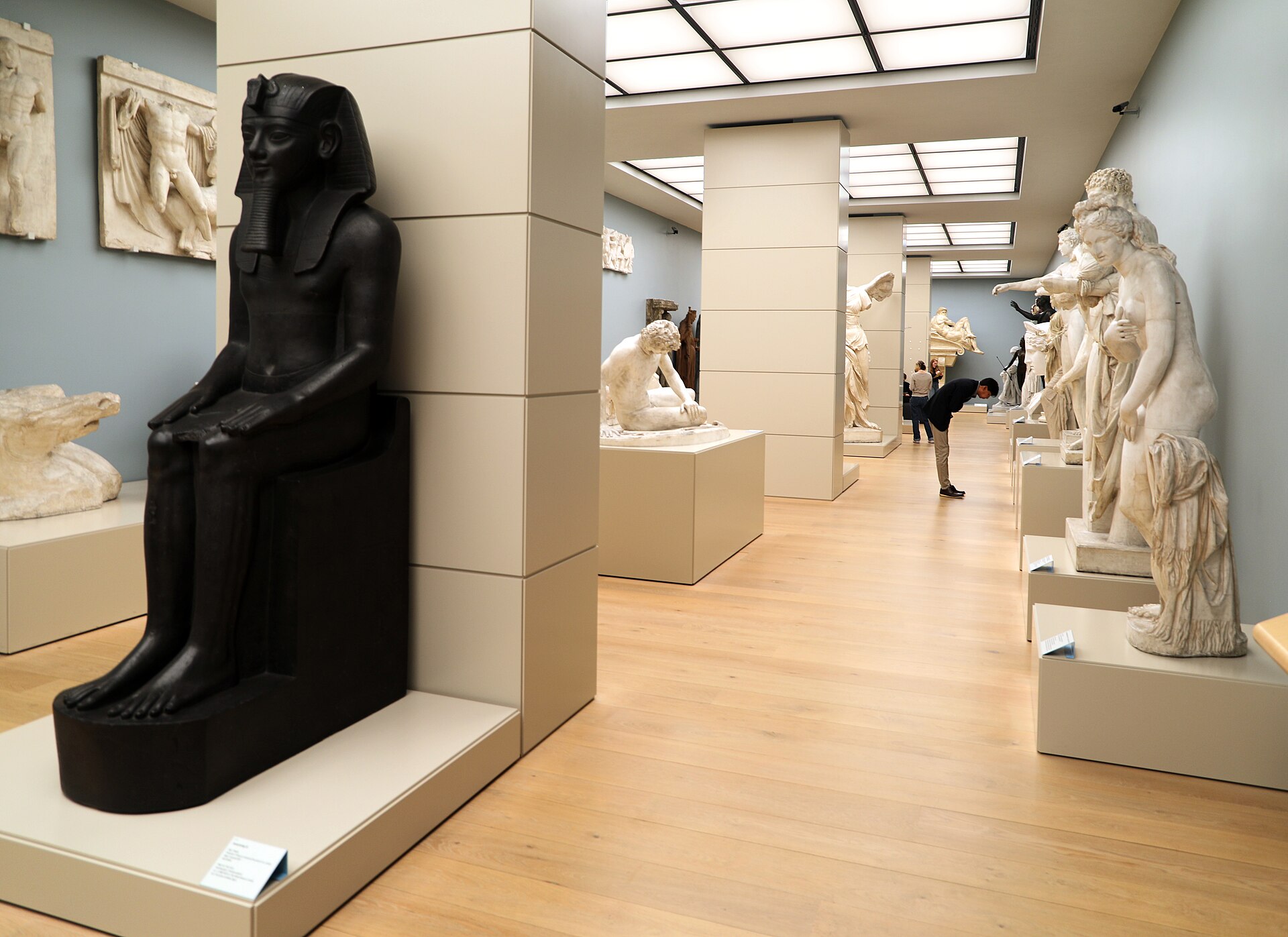
Photograph by Francesco Bini · CC BY-SA 4.0 Second floor, east wing - Old Masters and the plaster casts
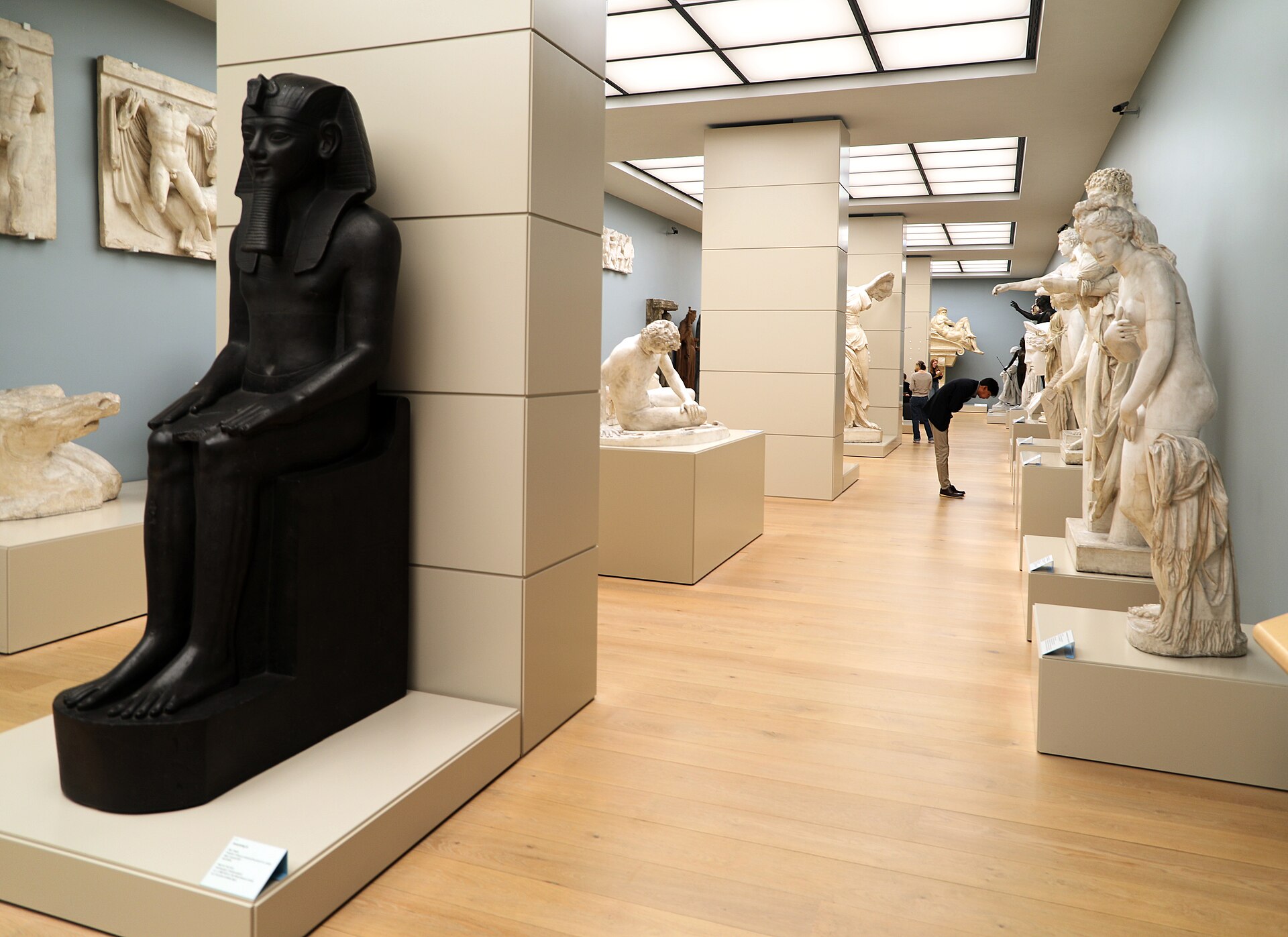
Nordic and international painting from the 16th to the 19th century, including J.C. Dahl, Adolph Tidemand, Hans Gude and Harriet Backer, alongside a room of historical full-scale plaster casts after classical and Renaissance sculpture.
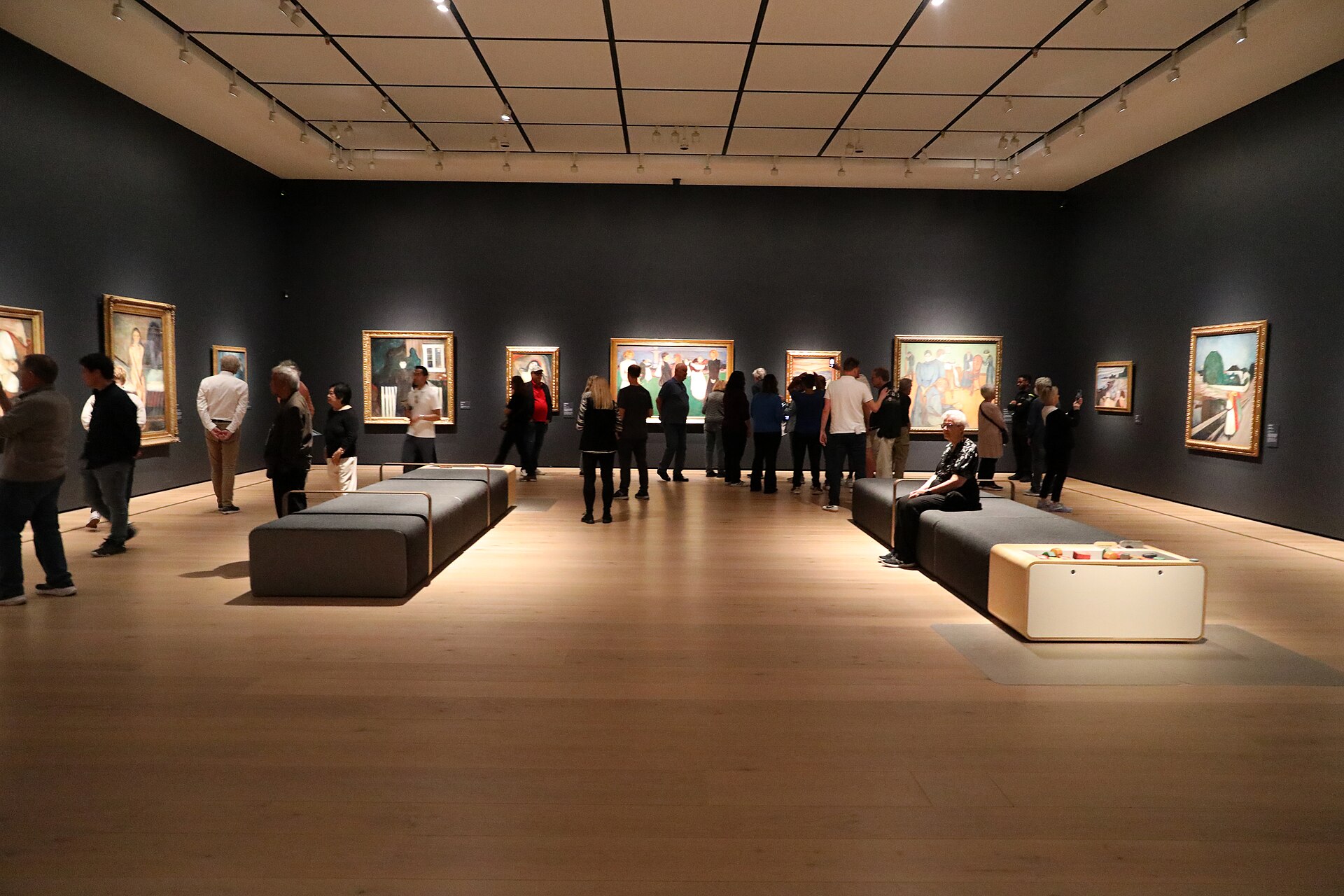
Photograph by Francesco Bini · CC BY-SA 4.0 The Munch Room, second floor
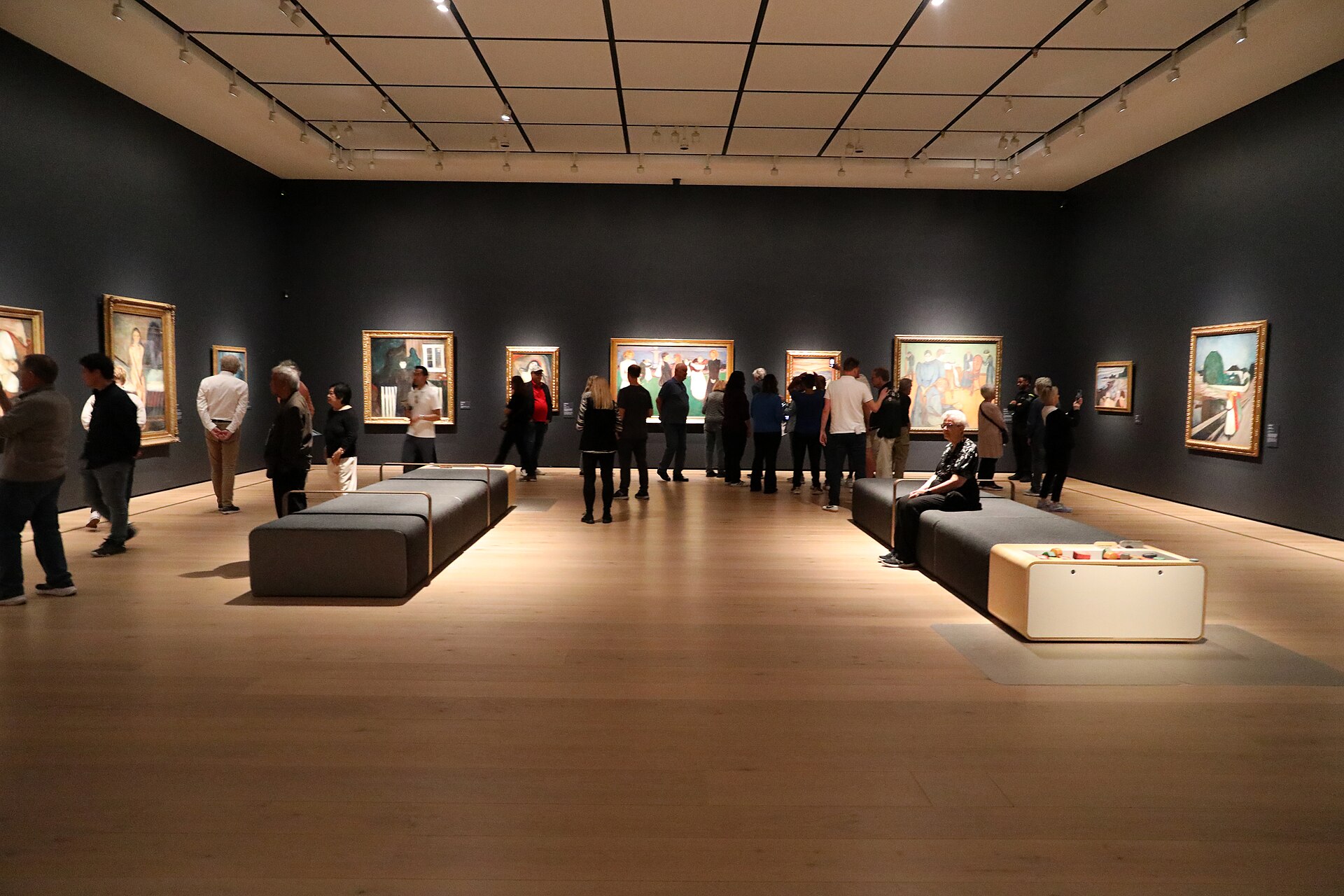
A dedicated chronological hang of the museum's Munch holdings, 58 paintings and 175 works on paper including the 1893 Scream, reinstated as a single dedicated room in 2011 after a contested 2005 rehang had split his work among contemporaries.
Second floor, west wing - Contemporary art
Post-1945 and contemporary work shown in a looser sequence of larger rooms toward the back of the building, changing more often than the historical galleries and used for the museum's rotating contemporary programme.
The architecture rooms
Two rooms devoted to Norwegian architecture from the early 19th century to the present, drawn from a collection of more than 300,000 drawings, models and archives including material from Sverre Fehn and Arne Korsmo.
The Light Hall, third floor
A 426-foot glass-and-marble hall on the roof, purpose-built for large-scale contemporary installations and travelling exhibitions that cannot be wall-hung, with one section equipped for artists who work with water.
What to see first
The Scream
Edvard Munch, 1893The earliest of Munch's several painted and pastel versions of this image, on permanent display here rather than at MUNCH, the separate Munch museum across town.13
Winter Night in the Mountains
Harald Sohlberg, 1901-1914Once voted Norway's national painting in a public poll; Sohlberg worked the composition from a single 1899 ski-trip sketch through several exhibited versions before finishing this one.11
Baldishol Tapestry
Unidentified Norwegian weaver, about 1150-1190One of very few European tapestries surviving from before 1200 woven in the Gobelin technique, and the only one of its kind from the Nordic countries, found under a demolished church floor in 1879.12
The Munch Room
Curatorial display, reinstated 2011Holds the core of the museum's 58 Munch paintings and 175 works on paper in a dedicated chronological hang, restored after a contested 2005 rehang had scattered his work among contemporaries.2
The historical plaster cast collection
19th-century casts after antique and Renaissance originalsA room of full-scale plaster casts after Greek, Roman and Renaissance sculpture, a once-common teaching collection type now rarely seen displayed intact inside a national museum.10
The architecture collection
Includes Sverre Fehn, Arne Korsmo and othersMore than 300,000 drawings, models and archives spanning two centuries of Norwegian building, including material from Sverre Fehn, the only Norwegian architect to win the Pritzker Prize.2
The Light Hall
Kleihues + Schuwerk, architectsA 426-foot glass-and-marble hall on the roof with no walls to hang from, built for large installations and travelling shows the museum's older buildings never had room for.14
On here now
Five museums folded into one
The National Museum of Art, Architecture and Design was created on 28 April 2003 by merging four existing Norwegian state museums into a single institution: the National Gallery (the country's main painting collection since 1842), the Museum of Decorative Arts and Design (founded 1876, one of Europe's earliest museums of its kind), the Museum of Contemporary Art (opened 1990 in a former bank building), and the Museum of Architecture (founded 1975). Each had outgrown its own building by the early 2000s, and the merger was driven as much by that shared shortage of space as by any curatorial ambition to show the four collections together.
For nearly two decades after the merger the National Museum still operated out of its four separate historic buildings around central Oslo, closing them one by one as the new building at Vestbanen took shape: the Decorative Arts museum in October 2016, the Museum of Contemporary Art in September 2017, and the old National Gallery building in January 2019.
Fourteen years from competition to opening
The government chose the Vestbanen site, the former West Station grounds by the Aker Brygge waterfront, in spring 2008. An international design competition followed, won in November 2010 by the German firm Kleihues + Schuwerk with a scheme the architects called Forum Artis. The Norwegian parliament approved a construction budget of 5.327 billion kroner in June 2013, and building work began not long after.
The building opened to the public on 11 June 2022, roughly fourteen years after the site was chosen and a little under two decades after the 2003 merger that created the institution it now houses. At 588,000 square feet, with about 140,000 square feet of that given over to galleries, it is now described as the largest art museum in the Nordic countries.
A deliberately unassuming building, and the arguments over it
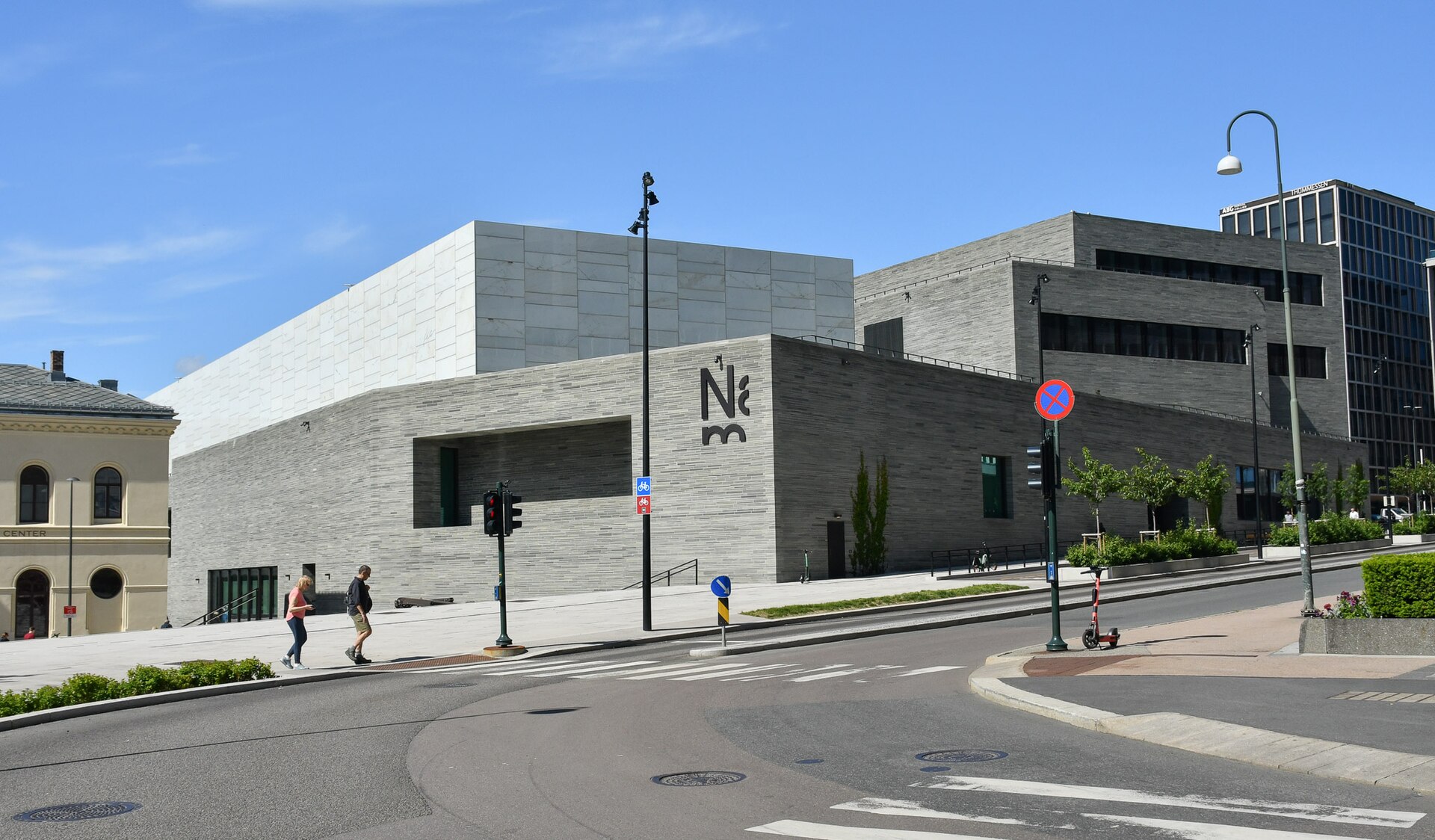
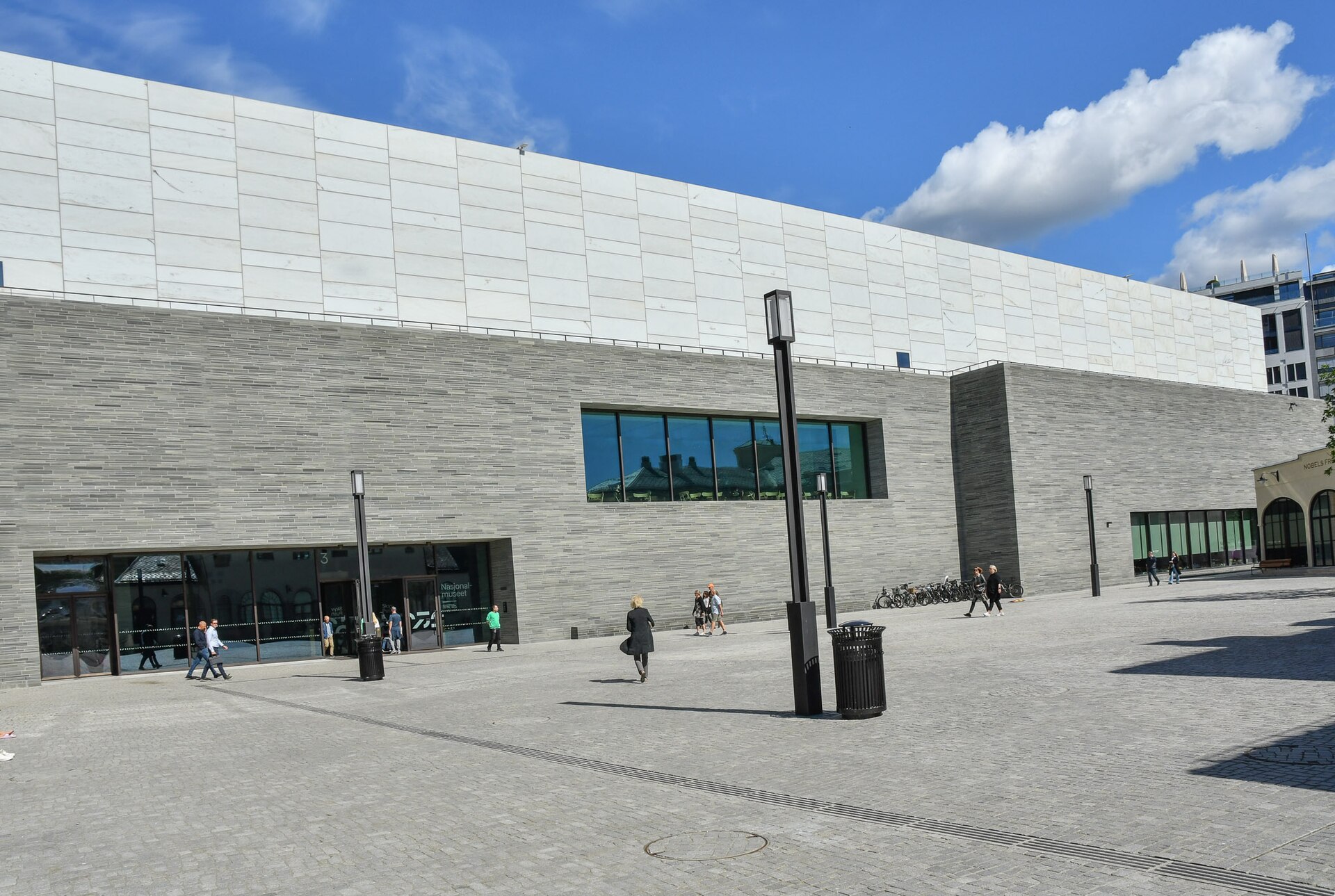
Klaus Schuwerk, the building's co-architect, has said the design was conceived specifically to avoid the showy, single-gesture approach of museums such as the Guggenheim's branch buildings, so the new museum would not overshadow Oslo's own cityscape; he has spoken of designing it to last two centuries rather than to make a singular architectural statement. The result is a low, L-shaped complex clad largely in vertically cut slate that reads, from the ground, as closer to an exposed cliff face than a landmark building.
That restraint has not settled the argument over whether it works. Reviewing the building for The Architect's Newspaper shortly after it opened, critic Jonathan Hilburg judged it surprisingly unassuming, a quality he suggested might be the key to the design's longevity, while also flagging a genuinely awkward side effect: the L-shaped floor plan gives the chronological galleries a nonlinear flow, so a visitor can drift from a room of royal court dresses into 1960s industrial design without quite meaning to. Norwegian commentary has been less measured, with the grey stone exterior mocked in the local press as resembling a prison.
Two floors built to hold four different museums' collecting histories
The collection display is organised in two main parts. The ground floor covers design from antiquity to the present and crafts from 1970 onward, arranged as a sequence of similarly sized rooms with smaller side cabinets, a layout the museum's own planning materials describe as familiar from 19th-century museum buildings. The second floor is split into three sections: an enfilade of rooms for painting and sculpture up to 1900, a more loosely organised wing for early 20th-century modern art, and a sequence of larger rooms at the western end for contemporary work. Two further rooms are set aside for architecture.
The museum's own account of the display explains why the two floors are treated so differently: the collection itself arrived from four separate predecessor museums with uneven collecting histories, so 18th-century design holdings are unusually deep while painting from the same period is comparatively thin, and the architecture collection barely predates the 19th century at all. Rather than smooth that unevenness out, the room-by-room organisation is built around it.
The Light Hall, and a Munch Room that has already been rewritten once
The building's signature space is the Light Hall on the roof, a 426-foot, glass-and-marble gallery with no walls to hang paintings from; everything shown there has to be suspended from the ceiling or anchored to the floor instead, and one section is specially equipped for artists who work with water. It is used for large temporary installations and travelling exhibitions that the museum's older, smaller buildings could never have accommodated.
The Munch Room, on the second floor, has a more contested history. A 2005 rehang of the old National Gallery, promoted under the title Everyone is Talking About the Museum, deliberately split Munch's paintings among works by his contemporaries and abandoned chronological display altogether; the change proved unpopular enough that a 2011 rehang reinstated both a dedicated, chronologically arranged Munch Room and the broader chronological principle across the rest of the galleries. That reinstated approach, rather than the 2005 experiment, is what continues into the room bearing his name in the new building today.
What the collection actually holds
Behind the building debate is a collection that, taken as a whole, is the largest of its kind in Norway: more than 400,000 objects in total, of which roughly 6,500 are on display at any one time. The pre-1945 holdings alone run to about 4,500 paintings and 900 sculptures, plus some 50,000 works on paper from the Middle Ages to the present, alongside the design, craft and architecture collections that came in through the 2003 merger. Very little of that range could be shown at once in the four older buildings; the new galleries were sized specifically to change that.
What a visitor actually gets from a single ticket is the range itself: Norwegian Romantic landscape painting next to Munch, next to a 12th-century tapestry, next to 1960s Norwegian furniture design, next to a working architecture archive, under one roof for the first time in the institution's history.
What visitors say
Visitors consistently describe the National Museum as far larger and more comprehensively laid out than the four separate museums it replaced, praising how easily the collection can be explored in one visit and how bright the top-floor galleries feel, while architecture critics and a good number of visitors have been notably cooler about the reserved, slate-clad building itself and its strict entry checks.
Consistently
- Praised: The scale and range of the collection now under one roof - old masters, Munch, design, crafts and architecture together instead of split across four separate buildings, which reviewers and the museum's own visitor materials both flag as the biggest change from the old museums.
- Praised: The layout and central location, which Tripadvisor's own review summary describes visitors calling intuitive to navigate, with the Oslo Pass and student discounts noted as good value.
- Praised: The Light Hall and the amount of gallery space now available for large temporary shows, one of the stated reasons for building a single new museum in the first place.
- Criticised: The building's severe grey slate exterior has drawn open mockery as well as praise; The Architect's Newspaper judged the design surprisingly unassuming next to Oslo's newer, more adventurous buildings, and Norwegian commentary has gone further, comparing the facade to a prison.
- Criticised: The L-shaped, chronologically arranged second floor produces a circulation The Architect's Newspaper called nonlinear - it is easy to drift from a room of royal court dresses into 1960s industrial design without meaning to.
- Criticised: Tripadvisor's own review summary notes visitors flagging strict security and bag checks at the entrance as a point of friction, even among otherwise positive reviews.
Aggregate ratings, tertiary
Google: 4.6 from 9,426 ratings, read 13 August 2026
Tripadvisor: 4.4 from 3,526 ratings, read 13 August 2026
A platform average is a tertiary source: it moves, it is not audited, and we quote no visitor's words.
Questions about National Museum of Art, Architecture and Design
Where is National Museum of Art, Architecture and Design?
Brynjulf Bulls plass 3, 0250 Oslo, Norway.
How much does it cost to visit National Museum of Art, Architecture and Design?
Adult: NOK 220; Under 25: NOK 100; Students under 30: NOK 120; Children and youth 0-17: free. As confirmed 2026-08-13.
When is National Museum of Art, Architecture and Design open?
Tuesday, Wednesday 10:00-20:00; Thursday, Friday, Saturday, Sunday 10:00-17:00; Monday 10:00-17:00. Monday, outside 1 June-31 August. 24-26 December. As confirmed 2026-08-13.
How do you get to National Museum of Art, Architecture and Design?
Tram: Line 12 stops at Aker Brygge; lines 11 and 13 stop at Nationaltheatret, both a short walk from the main entrance; Subway: Nationaltheatret station, served by all Oslo metro lines; Train: Nationaltheatret station; Bus: Lines 33 and 81 stop at Dokkveien; lines 30 and 31 stop at Nationaltheatret.
What should you see at National Museum of Art, Architecture and Design?
The Scream (Edvard Munch, 1893); Winter Night in the Mountains (Harald Sohlberg, 1901-1914); Baldishol Tapestry (Unidentified Norwegian weaver, about 1150-1190); The Munch Room (Curatorial display, reinstated 2011); The historical plaster cast collection (19th-century casts after antique and Renaissance originals); The architecture collection (Includes Sverre Fehn, Arne Korsmo and others).
Open questions
- Whether the museum has published any provenance review of its pre-1945 holdings against the Washington Principles on Nazi-confiscated art; nothing in the material reviewed for this record documents such a review either way.
- Whether the L-shaped second floor's nonlinear circulation, flagged by The Architect's Newspaper in 2022, has been addressed in any collection rehang since, or remains as built.
- Annual attendance figures for the new building broken out by year are not published on the museum's own site in the material reviewed for this record; only the 6,500-object display figure and the total collection size are given.
Images
Sources
- 1Wikidata, National Museum of Art, Architecture and Design, Q1132918 (tertiary, identity and coordinates only) wikidata.org/wiki/Q1132918
- 2Wikipedia, National Museum of Norway (tertiary, merger history, predecessor institutions, architecture collection) en.wikipedia.org/wiki/National_Museum_of_Norway
- 3Nasjonalmuseet, official site, The National Museum - opening hours and admission overview, read live 13 August 2026 nasjonalmuseet.no/en/visit/locations/the-national-museum/
- 4Nasjonalmuseet, official site, Entry tickets nasjonalmuseet.no/en/tickets/entry-tickets/
- 5Nasjonalmuseet, official site, Free entry nasjonalmuseet.no/en/visit/locations/the-national-museum/discounted-entrance/
- 6Nasjonalmuseet, official site, How to find us nasjonalmuseet.no/en/visit/locations/the-national-museum/how-to-find-us/
- 7Nasjonalmuseet, official site, Contact us nasjonalmuseet.no/en/about-the-national-museum/contact-us/
- 8Nasjonalmuseet, official site, Practical information for your visit to the National Museum nasjonalmuseet.no/en/visit/locations/the-national-museum/practical-information-for-your-visit-to-the-national-museum/
- 9Nasjonalmuseet, official site, The collection presentation: concept and structure nasjonalmuseet.no/en/exhibitions-and-events/national-museum/exhibitions/2021/collection-exhibition/the_collection_presentation/
- 10Nasjonalmuseet collection database, Highlights: Art from Antiquity to 1945 (collection statistics, plaster cast collection) samling.nasjonalmuseet.no/en/folder/33
- 11Nasjonalmuseet collection database, Harald Sohlberg, Winter Night in the Mountains, NG.M.01185 nasjonalmuseet.no/en/collection/object/NG.M.01185
- 12Nasjonalmuseet collection database, Baldishol tapestry, OK-02862 nasjonalmuseet.no/en/collection/object/OK-02862
- 13Nasjonalmuseet collection database, Edvard Munch, The Scream, 1893, NG.M.00939 nasjonalmuseet.no/en/collection/object/NG.M.00939
- 14The Architect's Newspaper, Jonathan Hilburg, 'Playing It Safe: Can a staid new National Museum make Oslo the art capital of Europe?', 28 July 2022 archpaper.com/2022/07/can-staid-new-national-museum-oslo-art-capital-europe/
- 15Google Maps listing, Nationalmuseum/Nasjonalmuseet, Oslo, aggregate rating, read 13 August 2026 google.com/maps/search/Nasjonalmuseet,%20Brynjulf%20Bulls%20plass%203,%20Oslo
- 16Tripadvisor, The National Museum, Oslo, aggregate rating and AI-generated review summary, read 13 August 2026 tripadvisor.com/Attraction_Review-g190479-d24051441-Reviews-Nasjonalmuseet_National_Museum-Oslo_Eastern_Norway.html
- 17Wikimedia Commons, Category:Nasjonalmuseet for kunst, arkitektur og design and Category:Nye Nasjonalmuseet, file pages and extmetadata for all images used, licence verified per file at fetch time commons.wikimedia.org/wiki/Category:Nasjonalmuseet_for_kunst,_arkitektur_og_design