Juan de Pareja (ca. 1608-1670)
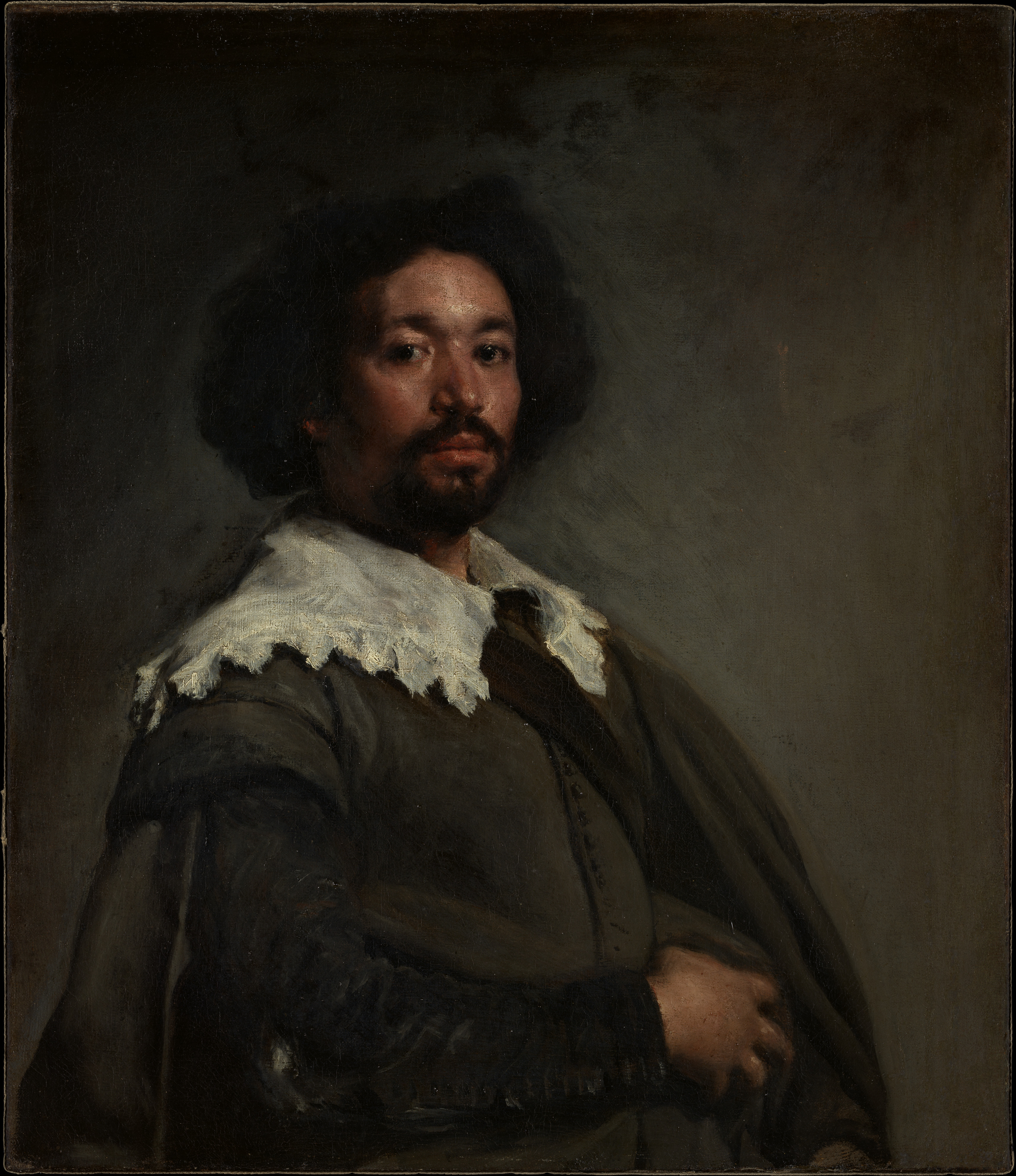
- Artist
- Diego Rodriguez de Silva y Velazquez
- Date
- 1650
- Medium
- Oil on canvas
- Dimensions
- 81.3 x 69.9 cm (32 x 27 1/2 in.)
- Inscriptions
- None. The Metropolitan Museum's online record for this painting carries no Signatures, Inscriptions and Markings section, unlike its records for several neighbouring pictures.
- Attribution
- acceptedGiven to Velazquez without serious dissent. A slightly smaller version now at the Hispanic Society of America, formerly with the Earls of Carlisle at Castle Howard, has at times been argued to be the original; the Metropolitan Museum's catalogue entry describes it as a highly accomplished early copy of the Met picture. The one eighteenth-century claim that the portrait belonged to Cardinal Acquaviva, made by Preciado in 1765, was judged by Everett Fahy in 1971 to describe a copy rather than this canvas.
- Where it is now
- The Metropolitan Museum of Art, New York, 1971.86
- Object type
- Painting
- Period
- Spanish, seventeenth century
A portrait painted in Rome in 1650 of a man the painter legally owned. Juan de Pareja was enslaved in Velazquez's household and workshop for at least two decades; within months of sitting for this canvas he was signed towards freedom, and he went on to a documented career as a painter in Madrid with signed altar-scale pictures now in the Prado.
The picture then passed through a Roman cardinal's collection, a British envoy's palazzo in Naples, a Yorkshire antiquary and a hundred and fifty-nine years at Longford Castle before Christie's sold it on 27 November 1970 for 2,200,000 guineas. That is 2,310,000 pounds, the first painting ever to make more than a million at auction, and in 1970 there was no buyer's premium at all, so the bid and the invoice were the same number. The underbidder was Thomas Agnew and Sons, acting for the National Gallery of Art in Washington; the National Gallery in London keeps the firm's account of the loss under the title The One That Got Away.
Images
The artist
Diego Rodriguez de Silva y Velazquez
Velazquez is the rarest kind of old master: a court painter with a small, secure and almost entirely documented output, roughly 110 to 120 known canvases, working for one patron for thirty-seven years. The attribution problems that dominate records of Cimabue or Rembrandt barely arise. What arises instead, and what most accounts of him skirt, is that his household contained an enslaved man who was also a painter, and that the practice was ordinary in the Spanish painting trade rather than peculiar to him.
A portrait of a man the painter owned
Oil on canvas, 81.3 by 69.9 centimetres, painted in Rome in 1650. The sitter stands in three-quarter view against a plain ground, in a worn grey-green doublet with a broad collar of Flemish lace that is the one expensive thing in the picture, and looks out of it directly. The paint is thin and fast. The lace is put in with a few loaded strokes that do not describe a single thread and read at three paces as a whole collar.
The fact at the centre of the picture is not stylistic. Juan de Pareja was of African descent, born in southern Spain, and was enslaved in Velazquez's studio and household for at least two decades, including on the day he sat for this. The Metropolitan Museum states it in those words on its own object page, and states in the same paragraph that enslaved artisanal labour was widespread in the workshops of Spanish painters, sculptors, silversmiths and woodworkers of the period.
Two men worked beside Velazquez for years. One was Juan Bautista Martinez del Mazo, who married the painter's daughter and succeeded him as usher at court. The other was owned. The Met holds a Mazo in the same department.
The sitter was a painter, and the pictures are signed
Pareja is not only a sitter. After his manumission he built a career in Madrid and left works that carry his own name. The Museo Nacional del Prado holds his Calling of Saint Matthew, into which he painted a self-portrait, and his Baptism of Christ of 1667, signed and dated by means of letters rendered as though chiselled into a rock at the lower left. The Met's curator David Pullins describes surviving works by him in Spain that run to over eleven feet wide.
The Calling of Saint Matthew places its self-portrait between a figure identifiable as the Madrid painter Jose Antolinez and an unidentified patron. Carmen Fracchia argued in 2012 that Pareja consciously associated himself with the apostle who evangelised in Ethiopia, a figure whom the Afro-Hispanic poet Juan Latino had earlier turned into a biblical Ethiopian. That is an argued reading with a named scholar behind it, not a settled fact about the painter's intention, and it is recorded here as such.
The Met mounted Juan de Pareja: Afro-Hispanic Painter in 2023 and published a volume of the same name edited by Pullins and Vanessa Valdes. The exhibition is the reason the museum's own catalogue entry on this canvas was revised twice, in 2019 and again in 2023.
Rome, 1650, and what the portrait was for
Velazquez left Spain for Italy a second time in 1649, taking Pareja with him. The immediate purpose of the journey was buying: pictures and antiquities for Philip IV. The portrait was made in Rome in 1650, in the months before Velazquez painted Innocent X, and the two canvases are usually read together, the first as the demonstration piece that secured him the second.
An early biography records that Velazquez showed the portrait in Rome, and that when he sent it round to friends by the hand of Pareja himself they looked from the man to the picture without knowing which to address. The anecdote is repeated in every account of the picture and it is worth being precise about what it is: a story told by a biographer about the effect of a likeness, not a document of a commission.
The manumission
Within months of finishing the portrait Velazquez signed papers that would liberate Pareja by 1654. The Met states the date of the freedom papers as November 1650 in its wider record of the two men. What the documents contain is a delayed manumission: the freedom took effect after a further term of service, which is why the two dates, 1650 and 1654, both appear in the literature and both are correct.
The temptation is to read the picture as the cause of the freedom, and the Rijksmuseum curator Stephanie Archangel has publicly refused that reading on the Met's own audio guide, on the ground that Velazquez had worked beside Pareja for years and would not have needed a canvas to notice him. This record follows her in treating the sequence as a sequence and not as a proof of motive.
A cardinal, an envoy and thirty-nine guineas
The picture surfaces in Rome in the collection of Cardinal Tommaso Ruffo, who had it by 1704 and inventoried it in 1734. It descended through two dukes of Baranello in Naples, and in 1776 Vincenzo Ruffo sold it to Sir William Hamilton, the British envoy to the court of Naples. Hamilton's own inventory of 14 July 1798 says the portrait came from the Baranello collection, and that sentence is what welds the Neapolitan half of the chain to the English half.
Hamilton sold up at Christie's in London on 27 and 28 March 1801. The Velazquez was lot 59 and made 40 pounds 19 shillings. William Buchanan, writing in 1824 about pictures imported into England since the French Revolution, gives the same sale as 39 guineas to a buyer he spells Parkes. The two figures are the same money: 39 guineas is 819 shillings, which is 40 pounds 19 shillings. Anyone reading the two sources side by side without knowing the guinea will record a discrepancy that does not exist.
The buyer was Thomas Lister Parker of Browsholme Hall, a Lancashire antiquary who catalogued his collection in 1808 with this picture as no. 30. By 1 May 1811 the 2nd Earl of Radnor had bought it for 151 pounds 14 shillings and 5 pence, a figure recorded in the Radnor collection catalogue of 1909. A Velazquez that had made 39 guineas at auction in 1801 fetched roughly four times that in a private sale ten years later, and both numbers are documented rather than inferred.
A hundred and fifty-nine years at Longford Castle
From 1811 to 1970 the portrait hung at Longford Castle in Wiltshire. Waagen listed it as picture 147 there in 1857; the house catalogue of 1909 gives it as no. 87; Stirling-Maxwell had already described the Radnor portrait in 1848 as perhaps the exercise Velazquez painted before he undertook Innocent X.
Longford is the same collection that later sold Holbein's Ambassadors and two Holbein portraits to the National Gallery. A great English country-house collection selling its Spanish picture in 1970 was therefore not an isolated event but the late stage of a long unwinding, and the price it made was the reason the unwinding became national news.
The sale: 2,200,000 guineas, and no premium
Christie's sold the picture in King Street on 27 November 1970 as lot 110. The bidding was in guineas and it stopped at 2,200,000 of them, which is 2,310,000 pounds. It was the first painting to make more than a million pounds at auction anywhere, and it was the world record for any picture.
There was no buyer's premium. Christie's and Sotheby's introduced the modern 10 per cent premium in London in September 1975, five years after this sale, and the dealer walkout it provoked belongs to a later chapter of the trade. In November 1970 the number the auctioneer called and the number on the invoice were the same, which is why the hammer and the total are one figure in this record and not two.
The guinea is the only complication, and it is a complication on the seller's side, not the buyer's. Under the old convention a lot was bid in guineas, the vendor was accounted in pounds and the odd shilling in each guinea, five per cent, stayed with the auctioneer as commission. That is exactly why 2,200,000 guineas converts to 2,310,000 pounds. A modern reader who sees a five per cent uplift and assumes a buyer's premium has the mechanism backwards.
A dollar figure of 5,544,000 was widely reported. It is a conversion at the rate of the day, and it is derived. It is not a second price and it should never be set beside the sterling figures as though it were.
The underbidder, and who he was bidding for
Alec Wildenstein made the winning bid on behalf of the Metropolitan Museum. That much is in every account. Who pushed him there is not, and it is the most useful single fact in this record for anyone trying to establish how deep the 1970 price really was.
The National Gallery in London holds, under the reference NGA27/24/17/15, two copies of Geoffrey Agnew's account of his firm's attempt to buy the Velazquez. Agnew was bidding for the National Gallery of Art in Washington. The archive catalogues the item under the title The One That Got Away.
So the room contained two American museums bidding through two dealers, and the price was set by a contest between Washington and New York rather than by a single determined buyer. An underbidder establishes the depth of a price in a way that a hammer alone never can, and this one shows the 1970 record was not an outlier bid but a floor agreed by two institutions.
The Italian journal Antichita viva reported at the time that Wildenstein had bought for the National Gallery in Washington. That is the mirror image of what happened and the Met's own reference list flags it as an error. Contemporary trade reporting of this sale is not reliable on who bought what.
A Velazquez for export
The picture left Britain, and the leaving was contested. The Burlington Magazine ran an editorial in February 1971 headed A Velasquez for Export? and Apollo ran one the same month called The End of an Era. Country Life covered the sale in the issue of 4 February 1971. Whatever the legal position, the trade press treated the departure as a national loss rather than a transaction.
This record does not state what happened inside the British export licensing system, because the sources consulted do not establish it. The Reviewing Committee on the Export of Works of Art existed in 1970 and the Waverley criteria applied to a picture of this standing; whether a licence application was made, whether it was deferred, and whether any British institution was given a matching period are all questions this record leaves open rather than filling with a plausible sentence. The one thing that is documented is that the strongest British-linked bid in the room, Agnew's, was placed on behalf of an American museum.
Condition, and the strip of canvas that was folded under
Hubert von Sonnenburg published the technical account in the Metropolitan Museum of Art Bulletin in June 1971, in the same double issue as Everett Fahy's provenance and Theodore Rousseau's appreciation. Three findings matter.
The canvas has never been relined. For a picture of 1650 that has crossed the Alps, the Channel and the Atlantic and hung for a century and a half in an English country house, that is unusual and it is the main reason the surface reads as freshly as it does.
Part of the canvas had been folded over rather than cut, and the conservation carried out after the purchase returned the picture to its original dimensions by unfolding it. A fold is a reversible loss; a trim is not. This picture was lucky in a way that the Met's Caravaggio, cut on all four sides, was not.
Sonnenburg also observed that the technique is related to sixteenth-century Venetian practice, which is the technical form of the standard art-historical claim that the second Italian journey changed how Velazquez put paint on cloth.
The other version, and why it is not this one
A slightly smaller version of this composition is at the Hispanic Society of America in New York. It was formerly with the Earls of Carlisle at Castle Howard and it has at times been argued to be Velazquez's original. The Met's catalogue entry states plainly that it is a highly accomplished early copy of the Met's portrait.
That is the version trap on this object and it is a live one, because the Castle Howard picture has its own aristocratic English provenance, its own literature and its own photographs in circulation. Any reproduction captioned only Velazquez, Juan de Pareja needs to be checked against dimensions and holder before it is attached to this record.
The eighteenth-century Acquaviva claim is the same problem in an earlier form. Preciado wrote in 1765 that Cardinal Acquaviva owned a Velazquez portrait of Pareja; Fahy concluded in 1971 that Preciado had seen a copy. Two portraits of the same man by the same hand have been in circulation as a claim since at least the eighteenth century, and only one of them is in Gallery 625.
Technical evidence
- Support
- Canvas, never relined. Part of the canvas had been folded over and was returned to the original dimensions during the conservation carried out after the 1970 purchase.1
- Medium
- Oil on canvas.12
- Dimensions
- 81.3 x 69.9 cm (32 x 27 1/2 in.).12
- Signature and inscriptions
- None recorded. The Metropolitan Museum's object record for this painting carries no Signatures, Inscriptions and Markings section.1
- Technique
- Hubert von Sonnenburg, publishing the conservation account in 1971, described the state of preservation as excellent and related the handling to sixteenth-century Venetian practice.1
- Imaging
- An x-radiograph was published with the 1971 Bulletin, together with colour plates before, during and after treatment.1
- Open access
- The Metropolitan Museum publishes the primary photograph of this painting as open access under CC0, verified against the museum's own isPublicDomain flag at fetch time.2
Provenance
- 1650 - 1704Unrecordedunknown
No owner is documented for the half-century after the picture was painted. Francisco Preciado wrote in 1765 that a portrait of Pareja by Velazquez had belonged to Cardinal Acquaviva; Everett Fahy, publishing the detailed provenance in the Metropolitan Museum of Art Bulletin in 1971, concluded that what Preciado saw was a copy. The Met's chain therefore begins with Cardinal Tommaso Ruffo, by 1704.1
- by 1704 - 1753Cardinal Tommaso Ruffo, Romedocumented
In Ruffo's collection by 1704 and recorded in his inventory of 1734. The Ruffo family of Naples is the same house that commissioned from Rembrandt; this branch held the picture for three generations.1
- 1753 - 1772Litterio Ruffo, 2nd duca di Baranello, Naplesdocumented
By descent on the cardinal's death in 1753.1
- 1772 - 1776Vincenzo Ruffo, 3rd duca di Baranello, Naplesdocumented
Sold by him to Sir William Hamilton in 1776.1
- 1776 - 1801Sir William Hamilton, Palazzo Sessa, Naplesdocumented
British envoy to the court of Naples, collector of vases and volcanoes, and the buyer of the picture from the Ruffo family. His own inventory of 14 July 1798 states that the portrait came from the Baranello collection at Naples, which is the document that anchors the Ruffo link.1
- 1801 - 1808Thomas Lister Parker, Browsholme Hall, Yorkshiredocumented
Bought at the Hamilton sale, Christie's, London, 27-28 March 1801, lot 59, for 40 pounds 19 shillings. William Buchanan, writing in 1824, gives the same transaction as 39 guineas to a buyer he spells Parkes; 39 guineas is exactly 40 pounds 19 shillings, so the two figures are one figure in two currencies. Still with Parker in 1808, when it appears as no. 30 in his catalogue.1
- 1811 - 1828Jacob Pleydell-Bouverie, 2nd Earl of Radnor, Longford Castle, Wiltshiredocumented
Recorded at Longford by 1814, but the Radnor catalogue of 1909 indicates that the 2nd Earl bought it on 1 May 1811 for 151 pounds 14 shillings and 5 pence. In ten years the price had risen roughly fourfold, and both figures are documented rather than inferred.1
- 1828 - 1968The Earls of Radnor, Longford Castledocumented
By descent for a hundred and forty years, catalogued in 1909 as no. 87. Waagen listed it as picture 147 at Longford Castle in 1857.1
- 1968 - 1970Jacob Pleydell-Bouverie, 8th Earl of Radnor, Longford Castledocumented
Consigned to Christie's, London, and sold on 27 November 1970 as lot 110 to Wildenstein acting for the Metropolitan Museum.1
- 1971 - presentThe Metropolitan Museum of Art, New Yorkdocumented
Accession 1971.86. The credit line records purchase from the Fletcher and Rogers Funds and the bequest of Adelaide Milton de Groot by exchange, supplemented by gifts from friends of the Museum. On view in Gallery 625 as of August 2026.12
Prices realised
| Date | Sale | Estimate | Result | Note |
|---|---|---|---|---|
| 1801-03-27 | Christie's The Sir William Hamilton sale, London, 27-28 March 1801, lot 59 | Not published in the sources consulted | Hammer GBP 40.19.0 (39 guineas) With premium None. No buyer's premium existed at a London auction house in 1801. GBP | The Met's provenance gives 40 pounds 19 shillings; Buchanan's 1824 account of pictures imported into England since the French Revolution gives 39 guineas. A guinea was 21 shillings, so 39 guineas is 819 shillings, which is 40 pounds 19 shillings exactly. Two sources, one price, no conflict. |
| 1970-11-27 | Christie's The Earl of Radnor sale, King Street, London, lot 110 | Not published in the sources consulted | Hammer 2,200,000 guineas, that is GBP 2,310,000 With premium None charged to the buyer. Christie's and Sotheby's introduced the modern 10 per cent buyer's premium in London in September 1975, five years after this sale, so the sum bid and the sum invoiced were the same. GBP (bidding in guineas) | The first painting to sell for more than one million pounds at auction and the world record for any painting at the time. The dollar figure of USD 5,544,000 that circulated is a conversion at the rate of the day and is derived, not a second price. Because the bidding was in guineas, the shilling in every pound went to the auctioneer as commission from the seller under the old guinea convention, which is why the sterling total is exactly five per cent above the guinea number. Nothing was added to the buyer's side. |
Related works
| Work | Relation | Where it is |
|---|---|---|
| Juan de Pareja After Velazquez | Early copy, frequently confused with this picture Slightly smaller than the Met canvas. Formerly with the Earls of Carlisle at Castle Howard and sometimes claimed as the original; the Met's catalogue entry calls it a highly accomplished early copy. | The Hispanic Society of America, New York |
| Portrait of Innocent X Velazquez | Painted in Rome immediately after this portrait Stirling-Maxwell suggested in 1848 that the Pareja was the exercise painted before the pope. | Galleria Doria Pamphilj, Rome |
| The Calling of Saint Matthew Juan de Pareja | By the sitter, with his self-portrait Carmen Fracchia argued in 2012 that Pareja associated himself with the apostle who evangelised in Ethiopia. | Museo Nacional del Prado, Madrid |
| The Baptism of Christ Juan de Pareja | By the sitter, signed and dated 1667 Signed by means of letters painted as though chiselled into a rock at the lower left, three years before his death. | Museo Nacional del Prado, Madrid |
| Don Gaspar de Guzman, Count-Duke of Olivares Juan Bautista Martinez del Mazo | By Velazquez's free studio assistant and son-in-law Mazo succeeded Velazquez as usher at court in 1634. He and Pareja worked in the same studio under entirely different legal conditions. | The Metropolitan Museum of Art, New York, 52.125 |
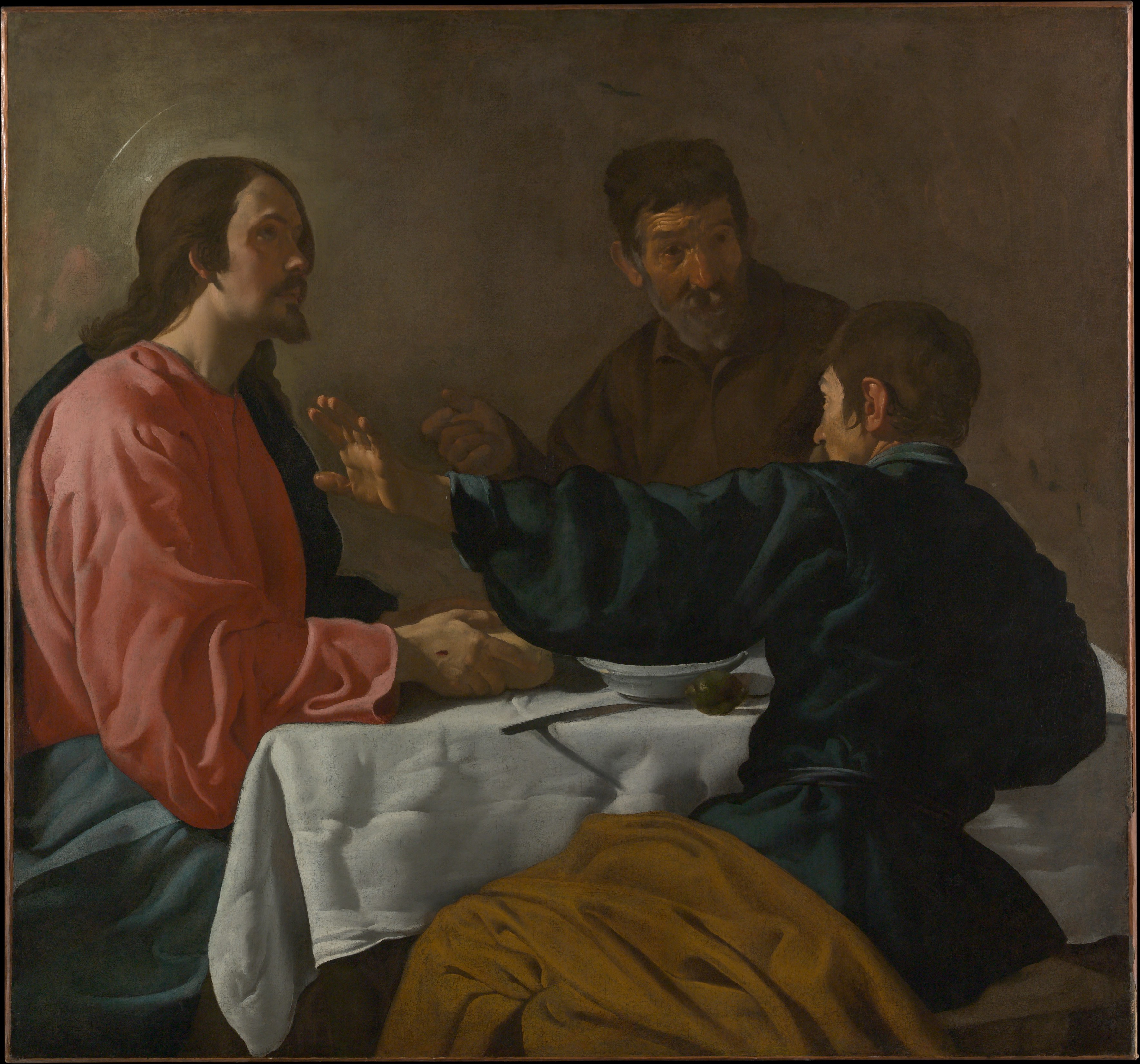
| The Supper at Emmaus Velazquez | Early Seville work by the same painter Painted 1622-23, nearly thirty years before the Pareja, and the measure of how far the handling travelled. | The Metropolitan Museum of Art, New York, 14.40.631 |
Open questions
- Where was the portrait between 1650 and 1704? Half a century after it left Velazquez's hands is undocumented.
- Did Cardinal Acquaviva own a version of this portrait, as Preciado wrote in 1765, and if so which one? Fahy concluded in 1971 that Preciado saw a copy, but the copy he saw has not been identified with the Hispanic Society picture or with any other.
- Was a British export licence application made after the 1970 sale, and was it deferred under the Waverley criteria? The trade press treated the departure as a scandal, but the sources consulted for this record do not establish what the Reviewing Committee did.
- What was Agnew's ceiling on behalf of the National Gallery of Art in Washington? The National Gallery archive holds his account of the attempt; the figure is not published in the sources consulted.
- From whom did the 2nd Earl of Radnor buy the picture on 1 May 1811, and had it passed through another hand after Thomas Lister Parker's 1808 catalogue?
- What were the terms of the delayed manumission signed in November 1650, and where is the document now?
Sources
- 1The Metropolitan Museum of Art, object record 437869, Velazquez, Juan de Pareja (ca. 1608-1670), accession 1971.86. Consulted for the tombstone, the catalogue entry by Xavier F. Salomon revised by Keith Christiansen and David Pullins, the full provenance, the exhibition history and the bibliography, which supplies Buchanan 1824, Stirling-Maxwell 1848 and 1855, Waagen 1857, Fahy 1971, Sonnenburg 1971, the Burlington and Apollo editorials of February 1971 and the Antichita viva error.
https://www.metmuseum.org/art/collection/search/437869 - 2The Metropolitan Museum of Art Open Access API, object 437869. Consulted for isPublicDomain, primaryImage, medium, dimensions, accession number and credit line.
https://collectionapi.metmuseum.org/public/collection/v1/objects/437869 - 3National Gallery, London, Archive, item NGA27/24/17/15, 'Velasquez's Juan de Pareja: The One That Got Away', 1970. Two copies of Geoffrey Agnew's account of the firm's attempt to buy the picture for the National Gallery of Art, Washington, and of losing to Alec Wildenstein's bid for the Metropolitan Museum.
https://www.nationalgallery.org.uk/research/research-centre/archive/record/NGA27/24/17/15 - 4Wikipedia, 'Buyer's premium'. Tertiary. Used only for the statement that the modern buyer's premium was introduced at 10 per cent by Christie's and Sotheby's in London in September 1975. Replace with the auction houses' own 1975 conditions of sale or the Antiques Trade Gazette coverage of the dealer walkout.
https://en.wikipedia.org/wiki/Buyer%27s_premium - 5Wikipedia, 'Diego Velazquez'. Tertiary. Used for the biography, the 1623 sitting, the two Italian journeys, the Order of Santiago in 1659, the corpus of 110 to 120 canvases and the November 1650 freedom papers. Replace with the Met's own Heilbrunn Timeline essay and with Lopez-Rey's catalogue raisonne.
https://en.wikipedia.org/wiki/Diego_Vel%C3%A1zquez - 6Wikipedia, 'Portrait of Juan de Pareja'. Tertiary. Used for the 1970 sale figures in guineas, pounds and dollars and for the statement that Alec Wildenstein bid on behalf of the Metropolitan Museum. The guinea and sterling figures are corroborated by the Met's own provenance; the dollar figure is a conversion and is treated as derived.
https://en.wikipedia.org/wiki/Portrait_of_Juan_de_Pareja - 7The Metropolitan Museum of Art, exhibition page, 'Juan de Pareja, Afro-Hispanic Painter', 2023.
https://www.metmuseum.org/exhibitions/juan-de-pareja
Change log
2026-08-04 - Record created at the house standard: researched narrative, technical evidence, maker dossier, graded provenance chain, prices with hammer and premium separated, related works, open questions and sources.