Bandit's Roost, 59 1/2 Mulberry Street
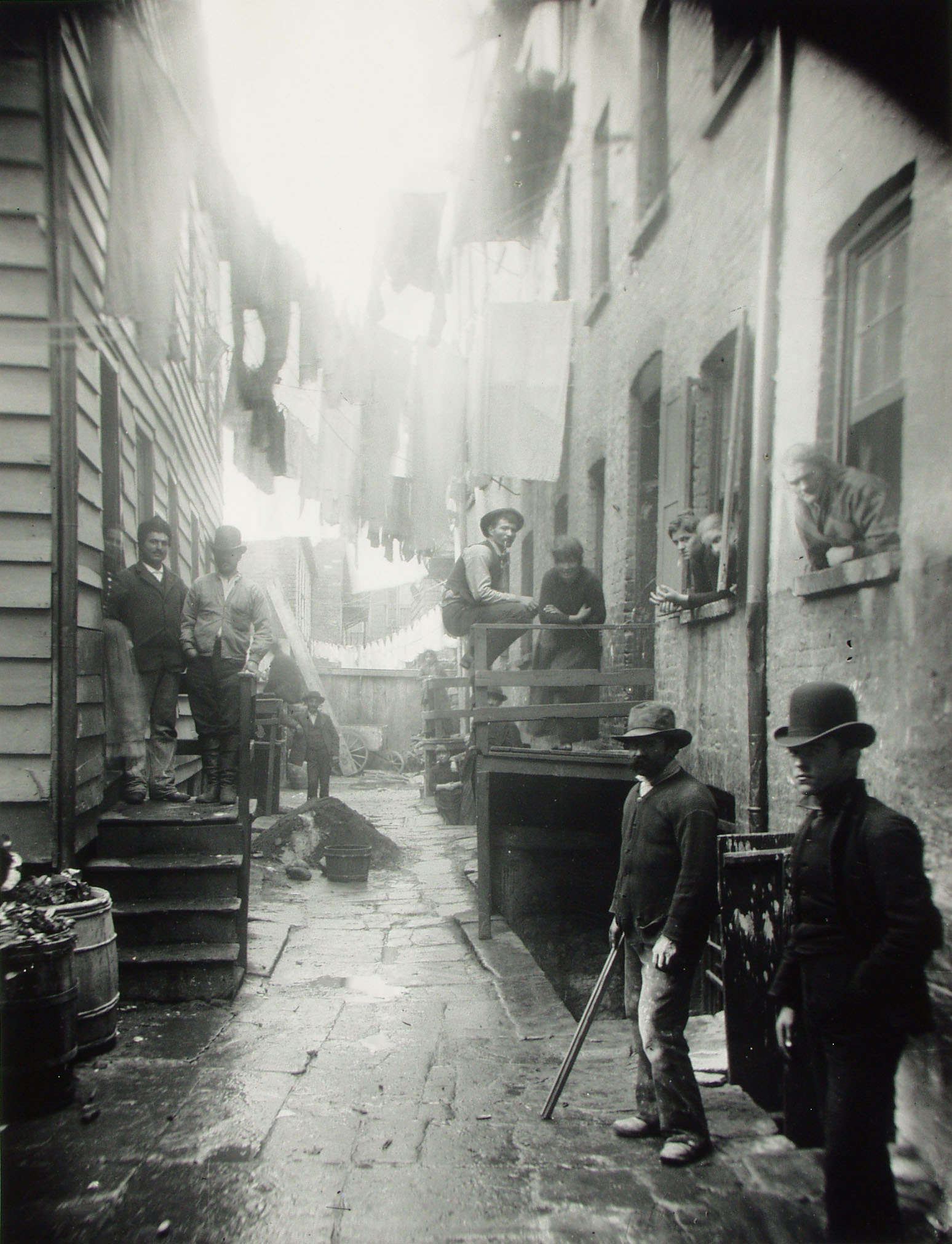
The record subject. Verified via the Wikimedia Commons file's own extmetadata: licensed Public domain, dated 1888, credited to Jacob Riis, and described as depicting "Bandit roost (59 Mulberry Street in New York City)," matching the institutional catalogue descriptions used throughout this record.
| Artist | Jacob A. Riis |
|---|---|
| Date | 1888 (some secondary research argues for autumn 1887; see open questions) |
| Medium | Gelatin silver print from a dry-plate glass negative, made with magnesium flash powder |
| Dimensions | Varies by print, since no source consulted publishes the negative's own dimensions. Documented prints: International Center of Photography, image 13 9/16 x 10 1/2 in (34.4 x 26.6 cm); Museum of Modern Art, 1958 print, 19 3/16 x 15 1/2 in (48.7 x 39.4 cm); Yale University Art Gallery, sheet 9 13/16 x 8 1/8 in (25 x 20.6 cm) |
| Inscriptions | The Yale University Art Gallery print bears the graphite notations "JR-55" and "PF40607" on the recto, lower center; the museum's own record does not explain what either code refers to. |
| Attribution | disputed Credited in almost every reproduction, including the Museum of the City of New York's own accession record, to Jacob Riis alone. But the negative was made during the joint slum-photography campaign Riis ran in 1887-88 with the amateur photographers Dr. Henry G. Piffard and Richard Hoe Lawrence, and several secondary sources, including a stereograph caption reproduced by Yale University Art Gallery's own historic documentation, credit the image jointly to 'Jacob A. Riis, Richard Hoe Lawrence, Henry G. Piffard.' The MCNY curator and Riis scholar Bonnie Yochelson has argued, in the standard modern study of the corpus, that authorship was not a category Riis himself cared about: he could not operate a camera competently in the campaign's first year and relied on Piffard and Lawrence to work the equipment while he directed the subject and wrote the accompanying text, so a meaningful share of the pictures now shown under his name alone were physically taken by one of the other two men. No source consulted resolves which of the three actually pressed the shutter for this specific negative; the record states the position of each side rather than adjudicating between them. |
| Where it is now | Museum of the City of New York, New York (the original glass negative, in the Jacob A. Riis Collection), 90.13.4.104 (MCNY catalog number, Gift of Roger William Riis) - the 90.13 prefix and the 90.13.4.xxx structure are confirmed directly on MCNY's own site for a sibling Riis negative in the same gift (Five Cents a Spot is catalogued 90.13.4.158), but this record could not independently retrieve MCNY's own catalog page for Bandit's Roost itself; the .104 suffix rests on secondary aggregation of the museum's data rather than a page this desk fetched directly. Treat the exact suffix as provisional pending direct confirmation. |
| Object type | Photograph |
| Period | American, nineteenth century - Progressive Era documentary and reform photography |
A single dry-plate glass negative made in a slum alley off Mulberry Street in 1888, using magnesium flash powder to light a space that had almost never been photographed because it had almost never been lit. It became the best-known image in Jacob Riis's How the Other Half Lives (1890) and one of the most reproduced photographs in American history, yet for roughly three decades after Riis's death in 1914 nobody could find the negative at all.
It survived by accident. Riis's son Roger William Riis kept a box of his father's negatives, lantern slides and prints in the attic of the family's house in Richmond Hill, Queens, and did nothing with it until the photographer and preservationist Alexander Alland tracked him down and, over several years, persuaded him to look. What Alland found in the mid-1940s became the basis of the Museum of the City of New York's 1947 exhibition The Battle With the Slum and of the museum's entire Jacob A. Riis Collection, including this negative.
Who actually took the picture is not settled. Riis ran the 1887-88 campaign with two amateur photographers, Henry G. Piffard and Richard Hoe Lawrence, and the scholarly consensus built by the Riis biographer Bonnie Yochelson is that a real share of the images now shown under Riis's name were physically exposed by one of the other two men while Riis directed and later wrote. This record treats that as an open, live question rather than a settled one, exactly as the museum record itself does not resolve it.
Images
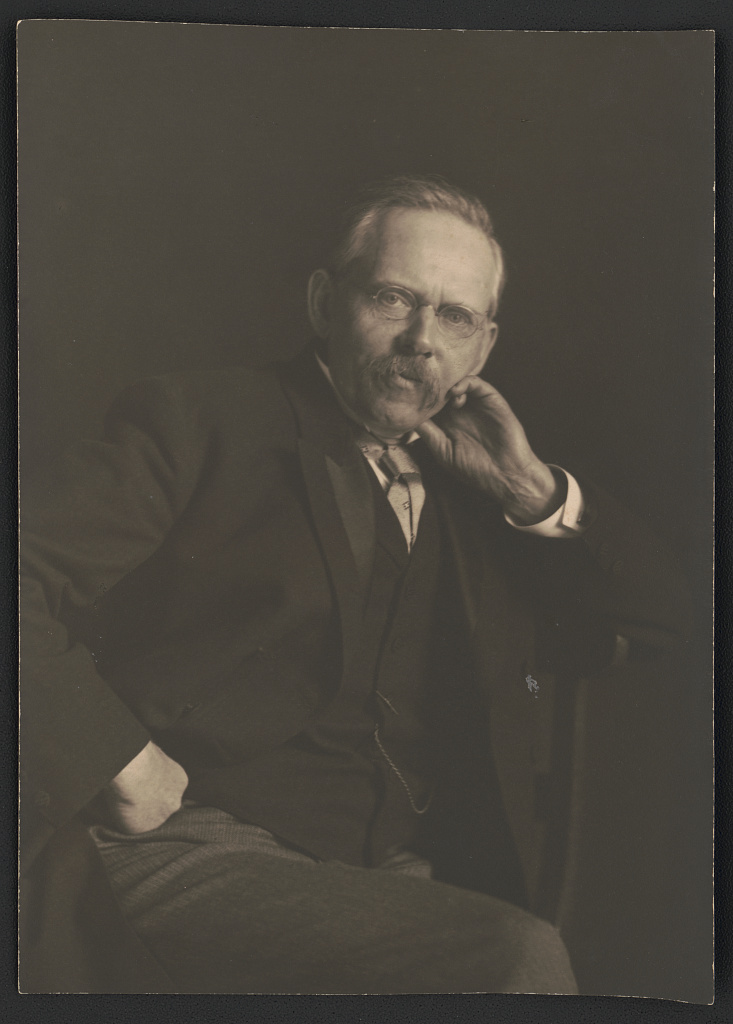
The artist
Jacob August Riis
Riis is catalogued here as the credited photographer because that is how the negative is universally reproduced and how the Museum of the City of New York itself lists it. But Riis regarded himself, throughout his life, as a writer and reformer who used photography as one tool among several, not as a photographer in the studio sense, and for the first year of his slum-photography campaign he did not own or reliably operate a camera at all. Reading his dossier as an artist's biography, in the ordinary sense this site uses for a painter or sculptor, risks overstating a role Riis did not claim for himself.
What the negative shows
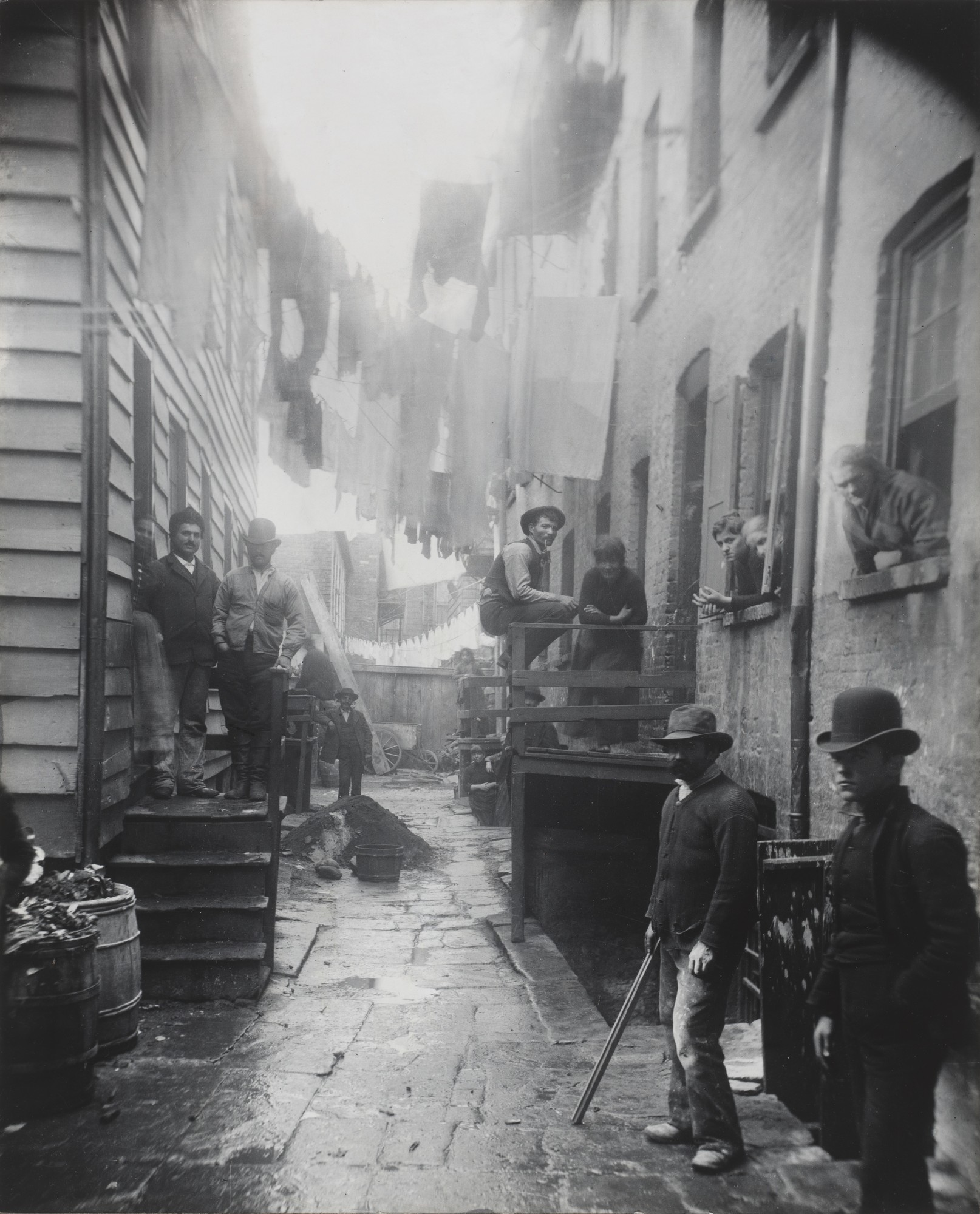
A narrow, wet, refuse-strewn alley running back from Mulberry Street, walled in by a sagging wood-frame tenement on one side and a brick one on the other, closed at the far end by a plank fence. Roughly sixteen people are visible: men grouped on a flight of open wooden stairs at the left, figures leaning out of upper windows, two more emerging from a basement doorway, and, closest to the lens, two men who stop and look directly into the camera, one carrying a length of wood.
The composition is not candid in the modern sense. A dry-plate exposure lit by a single burst of flash powder required its subjects to hold still, and several of the figures are plainly posed for the instant of the flash rather than caught unaware. That tension, between a documentary claim and a staged apparatus, runs through nearly everything Riis's campaign produced.
Whose picture this actually is
Riis is not disputed as the campaign's organiser, its writer and its public face. What is disputed is whether he is the person who exposed this particular negative. In early 1887 he read about the German flash-powder process developed by Adolf Miethe and Johannes Gaedicke and set out, with the physician and amateur photographer Henry G. Piffard and the amateur Richard Hoe Lawrence, to photograph the tenements and alleys he had spent a decade covering as a police reporter. Their first published account of the work appeared in The Sun on 12 February 1888. Riis did not buy his own camera and become self-sufficient at the technical side of the work until January 1888, which places this negative close to, or before, the point at which he was operating equipment independently.
Several institutional and scholarly sources credit the image to all three men jointly rather than to Riis alone; a stereographic negative of the same view, cited in Yale University Art Gallery's own historic documentation, is captioned "Jacob A. Riis, Richard Hoe Lawrence, Henry G. Piffard." Bonnie Yochelson, the Museum of the City of New York's former curator of prints and photographs and the scholar who has done the most sustained archival work on this question, argues in Rediscovering Jacob Riis that authorship was simply not a category Riis cared about, and that a meaningful number of the photographs long presented as "his" were taken by Piffard or Lawrence while Riis directed the scene and, later, wrote the caption. No source consulted for this record states definitively which of the three released the shutter on this specific exposure. That is not a gap this record can close, and it is recorded as open rather than resolved in either direction.
How it was made: flash powder in a dark alley
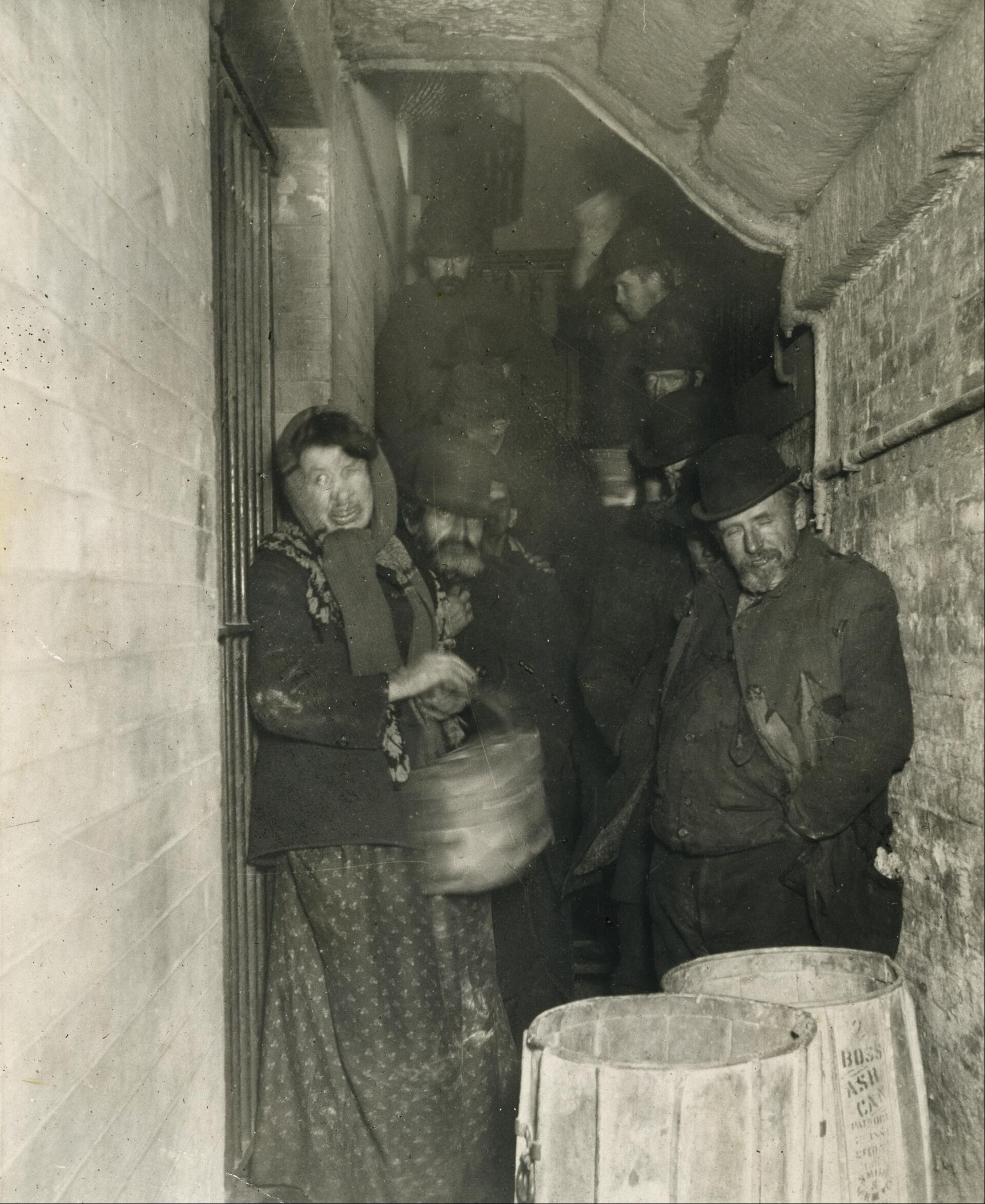
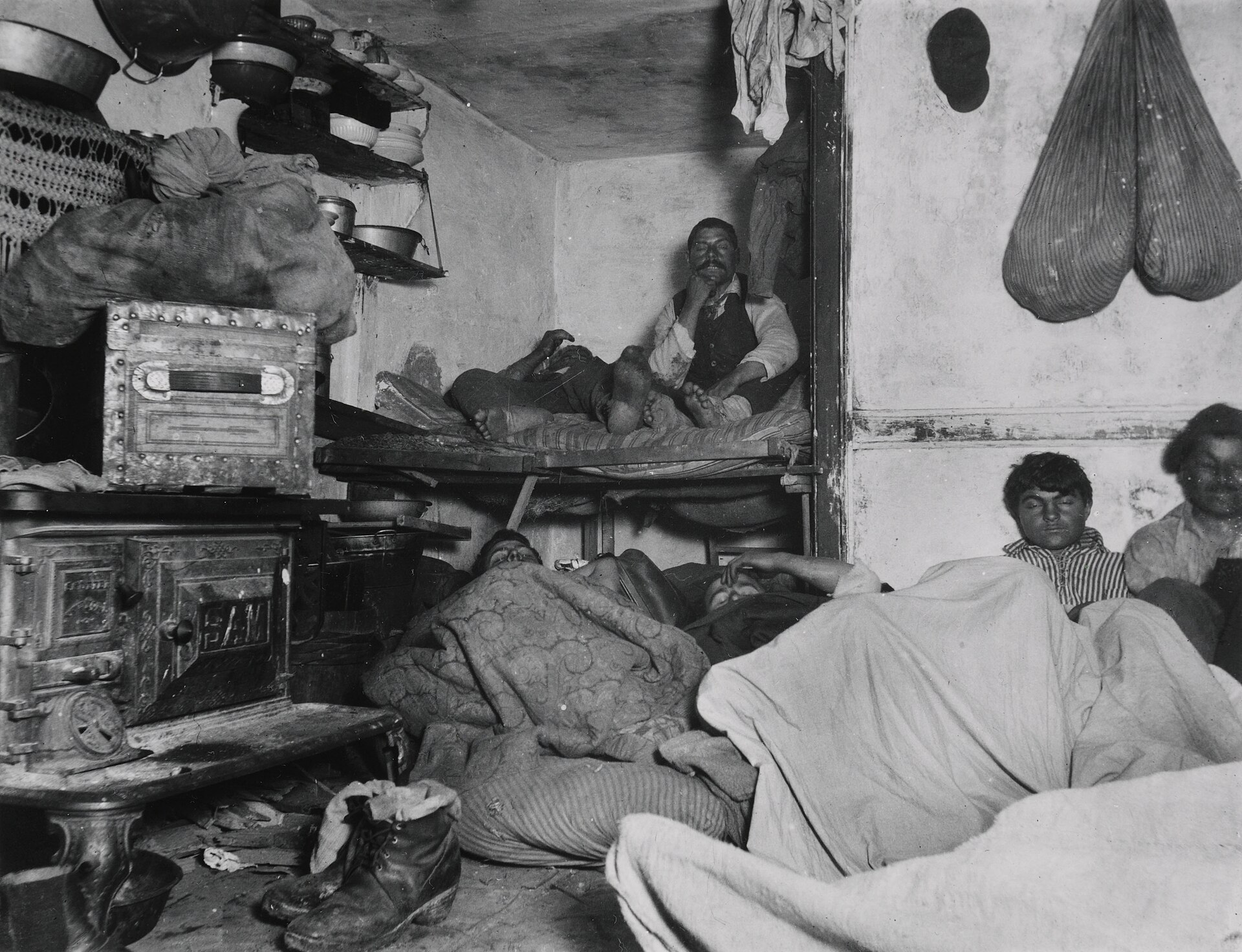
Bandit's Roost and the rooms it led to were dark enough, day and night, that no photographic process before 1887 could have recorded them at all. Riis's team used a form of Blitzlichtpulver, magnesium powder mixed with potassium chlorate and a stabiliser, set off from a pistol-like device or simply ignited on a frying pan while the lens cap was removed and then replaced. The result was a controlled explosion at close range, indoors and outdoors, in front of people who in some documented cases had not agreed to be photographed and who were startled, sometimes badly, by the flash.
Riis himself later wrote about the physical risk of the method, and secondary accounts describe him setting fire to his own clothing and, on at least one occasion, his house, while perfecting it. The ethical dimension is inseparable from the technical one: this was photography of people in their own homes and alleys, at night, without meaningful consent, undertaken in the service of a reform campaign that Riis believed justified the intrusion. Modern writing on Riis treats both facts as true at once, and this record does the same rather than resolving them into a single verdict.
The alley itself, and a naming question
Bandit's Roost was one of several named passages inside Mulberry Bend, alongside Bottle Alley and Ragpickers' Row, and sat behind 59 1/2 Mulberry Street on a curve of the street that gave the district its name, "the Bend." It was, by Riis's own account and by contemporary press coverage, understood as a haunt of the neighbourhood's street gangs.
Independent research into period newspapers has raised a specific naming question worth recording rather than smoothing over: at least one 1884 source locates a place called "Bandits' Roost" beside a different address, roughly a third of a mile north on Crosby Street, several years before Riis's photograph. Whether that is the same name reused for two places, an error in one source, or evidence that the Mulberry Street alley only acquired the name after Riis's photograph made it famous, is not established in the sources consulted. It is flagged here as an unresolved point about the object's own naming, not dismissed.
Publication: lantern slides first, then the book
Riis began lecturing with lantern slides made from his photographs in 1888, two years before How the Other Half Lives appeared in book form in 1890. The book was one of the earliest uses of halftone reproduction to carry photographic evidence directly into a popular trade publication, at a moment when most illustrated books still relied on wood engravings redrawn from photographs. Bandit's Roost became, in the century since, probably the single most reproduced image the book contains, used repeatedly as visual shorthand for the whole tenement-reform movement it helped to launch.
Lost, then found: the Alland rediscovery
When Riis moved from Richmond Hill, Queens, to Massachusetts before his death in 1914, his photographic material, negatives, lantern slides and prints together, was left behind in the attic of the family house rather than brought with him. For roughly three decades it was neither exhibited nor, so far as the record shows, examined by anyone.
The photographer and preservationist Alexander Alland, who had already built a practice of locating and reprinting the negatives of earlier documentary photographers (he had done the same for Lewis Hine from 1939), located Riis's son Roger William Riis and spent several years pressing him to search the house before it was sold. According to the Alexander Alland Papers finding aid at the New-York Historical Society, Alland tracked down the glass negatives in 1946. Roger Riis had the box brought down from the attic; secondary sources differ on the precise count of what it held, one giving roughly 400 negatives, 300 lantern slides and almost 200 prints, another giving the more specific figures of 412 negatives, 161 lantern slides and 193 prints. This record cannot resolve which figure is correct and gives both rather than silently choosing one. Alland reprinted the negatives, and the resulting exhibition, The Battle With the Slum, 1887-1897, opened at the Museum of the City of New York in 1947, the show that is generally credited with re-establishing Riis's reputation as a photographer rather than only a reformer and writer.
How the museum came to hold it
The negatives, slides and prints that came out of the Richmond Hill attic were given to the Museum of the City of New York by Roger William Riis and are catalogued together as accession group 90.13, described in the museum's own online listing as the "Gift of Roger Williams Riis." A sibling negative from the same gift, Five Cents a Spot, carries the museum's own confirmed number 90.13.4.158; this record's own number for Bandit's Roost, 90.13.4.104, follows the same pattern but rests on secondary sourcing rather than a museum catalog page this desk could fetch directly, and should be checked against MCNY's collections portal before being treated as final. Separately, prints made from the same negative, not separate objects, entered other public collections through Alland himself: the International Center of Photography's gelatin silver print (accession 235.1982) is a direct gift of Alexander Alland Sr., and Yale University Art Gallery's print (accession 2008.205.1) is dated "circa 1888, printed after 1946," which is to say printed from the negative only after Alland's rediscovery. The Museum of Modern Art holds a further print, dated 1888 and printed 1958. Wikipedia additionally lists the Ackland Art Museum as a holder of a print of this image; that claim is tertiary and is flagged here for direct verification rather than treated as confirmed.
What happened to the actual place
The alley no longer exists. Mulberry Bend, the crescent of tenements and passages that Riis's photographs and writing turned into the most notorious address in the city's reform politics, was demolished by the city beginning in 1897, in substantial part because of the case Riis had made in print and in his lantern-slide lectures. A public park, laid out by Calvert Vaux, opened on the cleared ground the same year. It was renamed Columbus Park in 1911. A Wikipedia account attributes a 1911 redesign of the park jointly to Frederick Law Olmsted and Calvert Vaux; both men were dead by then (Vaux since 1895, Olmsted since 1903), so that specific attribution is almost certainly a conflation with their successor firm rather than the two principals in person, and it is flagged here rather than repeated as fact. What is not in doubt is the sequence: photograph, campaign, demolition, park, rename. The alley Bandit's Roost depicts is gone; the ground it stood on is now part of Columbus Park, at the edge of Manhattan's Chinatown.
Afterlife of the image
The photograph has been reproduced continuously since 1890 and was included in Time's 100 Photographs project as one of the images judged most influential in photographic history. It has also been cited as an inspiration for a scene set decades earlier in Martin Scorsese's 2002 film Gangs of New York, an example of the image supplying the visual grammar for a period it does not itself depict. Its reach as an illustration has consistently outrun public knowledge of its own object history: most popular reproductions carry no more caption than "Jacob Riis, 1888," with neither the authorship question nor the three-decade disappearance of the negative mentioned at all.
Technical evidence
| Negative | Dry-plate glass negative, exposed with magnesium flash powder. The original negative is held by the Museum of the City of New York; no source consulted publishes its plate dimensions.39 |
|---|---|
| Print medium | Gelatin silver print (later prints from the negative are sometimes catalogued as "Photo-Gelatin silver").45 |
| Dimensions (documented prints only) | ICP print: image 13 9/16 x 10 1/2 in (34.4 x 26.6 cm). MoMA print (1958): 19 3/16 x 15 1/2 in (48.7 x 39.4 cm). Yale print: sheet 9 13/16 x 8 1/8 in (25 x 20.6 cm).435 |
| Print dating relative to the negative | Every documented print outside MCNY postdates the 1940s rediscovery of the negative by decades: Yale's is catalogued "circa 1888, printed after 1946"; MoMA's is dated 1888 but printed 1958; ICP's came to the museum as a 1982 gift from Alexander Alland Sr. This is a rediscovered-negative object, and its print history should be read as evidence of that, not of a lost original print tradition.534 |
| Attribution | Credited to Jacob Riis in virtually all reproduction, but at least one institutional caption (Yale's historic documentation for a related stereographic negative) credits the image jointly to Riis, Richard Hoe Lawrence and Henry G. Piffard. Unresolved; see attribution and narrative.56 |
| Flash apparatus | Blitzlichtpulver-type magnesium flash powder (magnesium, potassium chlorate, antimony sulfide stabiliser), fired from a pistol-like device or ignited on a hand-held pan, with the lens cap removed and replaced around the flash.79 |
| Inscriptions | The Yale print carries graphite notations "JR-55" and "PF40607" on the recto; unexplained in the museum's own record.5 |
Provenance
- 1888 - 1912Jacob A. Riisdocumented
The negative was made during Riis's 1887-88 flash-powder campaign with Henry G. Piffard and Richard Hoe Lawrence and remained in Riis's own possession, along with the rest of his photographic material, at the family home in Richmond Hill, Queens.8
- 1912 - c. 1946Left in the Richmond Hill, Queens attic; passed to Riis's son Roger William Riis on Jacob Riis's death in 1914unknown
Riis moved to Massachusetts before his death in 1914 and left his negatives, lantern slides and prints behind. The material sat unexamined in the attic for roughly three decades; no source consulted documents anyone looking at it in this period.78
- c. 1946 - 1947Roger William Riis, working with the photographer Alexander Allanddocumented
Alland tracked down the negatives in 1946, per the Alexander Alland Papers finding aid at the New-York Historical Society, after several years pressing Roger Riis to search the house. Alland reprinted the material, leading to the 1947 exhibition The Battle With the Slum, 1887-1897 at the Museum of the City of New York.7
- 1947 - presentMuseum of the City of New Yorkdocumented
The negative entered MCNY as part of accession group 90.13, the gift of Roger William Riis, alongside the rest of the recovered negatives, lantern slides and prints. The museum's own site confirms the 90.13.4.xxx numbering for a sibling negative from the same gift (Five Cents a Spot, 90.13.4.158); this record's specific number for Bandit's Roost (90.13.4.104) rests on secondary aggregation and needs direct confirmation.9
- 1946-1982 - presentPrints (not the negative) distributed to other public collectionsdocumented
Separately from the negative's path into MCNY, prints made from it entered other collections at different dates: Yale University Art Gallery holds a print catalogued 'printed after 1946'; the Museum of Modern Art holds a print dated 1888, printed 1958; the International Center of Photography holds a print given directly by Alexander Alland Sr. in 1982 (accession 235.1982). These are prints of the same negative, not separate objects.534
Related works
| Work | Relation | Where it is |
|---|---|---|
| Lodgers in a Crowded Bayard Street Tenement, "Five Cents a Spot" Jacob A. Riis | Another negative from the same 1888-89 flash-powder campaign, from the same MCNY gift group (90.13) MCNY's own confirmed accession number for this negative anchors the 90.13.4.xxx numbering pattern used to place Bandit's Roost within the same gift. | Museum of the City of New York (accession 90.13.4.158) and other collections |
| Waiting to Be Let in the Mulberry Street Station Jacob A. Riis | A separate, later Riis photograph (1892) of the same street, showing homeless men waiting outside the police station a short walk from Bandit's Roost Included for street-level context only. This is a different negative of a different subject; it is not a version of the object described in this record. | Museum of Fine Arts, Houston (via Google Art Project) |
| The Battle With the Slum, 1887-1897 (1947 exhibition) Organised by Alexander Alland from the rediscovered Riis negatives | The exhibition that first reintroduced this negative, and the rest of the 90.13 gift group, to the public after roughly three decades in an attic Named after Riis's own 1902 book of the same title. | Museum of the City of New York |
| Rediscovering Jacob Riis: Exposure Journalism and Photography in Turn-of-the-Century New York Bonnie Yochelson and Daniel Czitrom | The standard modern scholarly study underlying this record's account of the authorship dispute and the rediscovery Cited here in secondary form (search-derived summaries of its findings); this desk did not read the book directly and flags it for a primary check. | University of Chicago Press |
Open questions
- Who physically exposed this negative: Riis, Piffard, or Lawrence? No source consulted names an individual; the joint credit and Yochelson's general argument about the campaign are the closest anything comes to an answer.
- Is the negative's date 1888, as institutions consistently catalogue it, or autumn 1887, as one piece of independent research argues from the subjects' clothing? This record follows the institutional date but records the dispute.
- Did the name "Bandit's Roost" already belong to a different alley, on Crosby Street, in 1884, before Riis's photograph made the Mulberry Street name famous? Not resolved in the sources consulted.
- What is MCNY's own confirmed catalog number for this specific negative? This record uses 90.13.4.104 from secondary aggregation; the museum's own collections portal could not be fetched directly and the number needs direct confirmation.
- How many negatives, slides and prints did Alexander Alland actually recover from the Richmond Hill attic? Secondary sources give two different counts (roughly 400/300/200 versus 412/161/193) and neither could be traced to a single primary tally in the sources consulted.
- Does the Ackland Art Museum genuinely hold a print of this image, as Wikipedia states? Not independently verified by this desk.
- Was the 1911 redesign of the park on this site (renamed Columbus Park) actually the work of Frederick Law Olmsted and Calvert Vaux personally, as one source states, given that both men were dead by 1911? Very likely a conflation with their successor firm; not resolved here.
Questions about this object
What is Bandit's Roost, 59 1/2 Mulberry Street?
Photograph, Gelatin silver print from a dry-plate glass negative, made with magnesium flash powder, 1888 (some secondary research argues for autumn 1887; see open questions).
Who made Bandit's Roost, 59 1/2 Mulberry Street, and is the attribution settled?
The attribution to Jacob A. Riis is recorded here as disputed. Credited in almost every reproduction, including the Museum of the City of New York's own accession record, to Jacob Riis alone. But the negative was made during the joint slum-photography campaign Riis ran in 1887-88 with the amateur photographers Dr. Henry G. Piffard and Richard Hoe Lawrence, and several secondary sources, including a stereograph caption reproduced by Yale University Art Gallery's own historic documentation, credit the image jointly to 'Jacob A. Riis, Richard Hoe Lawrence, Henry G. Piffard.' The MCNY curator and Riis scholar Bonnie Yochelson has argued, in the standard modern study of the corpus, that authorship was not a category Riis himself cared about: he could not operate a camera competently in the campaign's first year and relied on Piffard and Lawrence to work the equipment while he directed the subject and wrote the accompanying text, so a meaningful share of the pictures now shown under his name alone were physically taken by one of the other two men. No source consulted resolves which of the three actually pressed the shutter for this specific negative; the record states the position of each side rather than adjudicating between them.
Where is Bandit's Roost, 59 1/2 Mulberry Street now?
Museum of the City of New York, New York (the original glass negative, in the Jacob A. Riis Collection), 90.13.4.104 (MCNY catalog number, Gift of Roger William Riis) - the 90.13 prefix and the 90.13.4.xxx structure are confirmed directly on MCNY's own site for a sibling Riis negative in the same gift (Five Cents a Spot is catalogued 90.13.4.158), but this record could not independently retrieve MCNY's own catalog page for Bandit's Roost itself; the .104 suffix rests on secondary aggregation of the museum's data rather than a page this desk fetched directly. Treat the exact suffix as provisional pending direct confirmation. As recorded 2026-08-27. Descended in the Riis family, rediscovered in the 1940s, and given to the museum by Riis's son Roger William Riis as part of a larger gift of negatives, lantern slides and prints (accession group 90.13); see the provenance block for the full chain.
What is still unknown about Bandit's Roost, 59 1/2 Mulberry Street?
Who physically exposed this negative: Riis, Piffard, or Lawrence? No source consulted names an individual; the joint credit and Yochelson's general argument about the campaign are the closest anything comes to an answer.
Sources
- 1Wikipedia, "Bandits' Roost, 59 1/2 Mulberry Street." Tertiary; flagged for replacement with the MCNY catalogue entry once it can be fetched directly.
https://en.wikipedia.org/wiki/Bandits'_Roost,_59_1/2_Mulberry_Street - 2Wikimedia Commons, File:Bandit's Roost by Jacob Riis.jpeg, file description and extmetadata (LicenseShortName, ImageDescription, DateTimeOriginal).
https://commons.wikimedia.org/wiki/File:Bandit's_Roost_by_Jacob_Riis.jpeg - 3Museum of Modern Art, collection object page for Bandits' Roost, 59 1/2 Mulberry Street (accessed via Wikimedia Commons file metadata for the corresponding Commons file, since a direct fetch of moma.org returned a 403 error).
https://www.moma.org/collection/works/50859 - 4International Center of Photography, object record for Bandits' Roost (accession 235.1982, Gift of Alexander Alland Sr.).
https://www.icp.org/browse/archive/objects/bandits-roost - 5Yale University Art Gallery, object record for Bandit's Roost, Mulberry Bend (accession 2008.205.1).
https://artgallery.yale.edu/collections/objects/130317 - 6Bonnie Yochelson and Daniel Czitrom, Rediscovering Jacob Riis: Exposure Journalism and Photography in Turn-of-the-Century New York (University of Chicago Press). Cited in secondary form via search-derived summaries of the book's argument on authorship; flagged for a primary read.
https://press.uchicago.edu/ucp/books/book/chicago/R/bo19171456.html - 7New York University Special Collections, Alexander Alland photograph collection finding aid (New-York Historical Society), for the 1946 date of Alland's rediscovery of the negatives and the 1947 exhibition.
https://findingaids.library.nyu.edu/nyhs/pr110_alexander_alland/ - 8Wikipedia, "Jacob Riis," for biographical dates, the 1887 start of the flash campaign, the 12 February 1888 Sun report, and the January 1888 camera purchase. Tertiary; flagged for replacement with a scholarly biography.
https://en.wikipedia.org/wiki/Jacob_Riis - 9Museum of the City of New York, Prints & Photographs collection page, confirming the 90.13.4.xxx accession numbering for the Roger Williams Riis gift via the sibling negative Five Cents a Spot (90.13.4.158).
https://www.mcny.org/collections/prints-photographs - 10Wikipedia, "Mulberry Bend," for the 1897 demolition, Calvert Vaux's park design, and the 1911 renaming to Columbus Park. Tertiary; flagged for replacement with NYC Parks' own history record.
https://en.wikipedia.org/wiki/Mulberry_Bend - 11Wikipedia, "Columbus Park (Manhattan)," for the 1911 redesign and renaming claim (including the Olmsted/Vaux attribution flagged as chronologically doubtful in this record). Tertiary.
https://en.wikipedia.org/wiki/Columbus_Park_(Manhattan) - 12Tom Hunt, "About 'Bandits' Roost' in Manhattan," independent research substack citing period newspapers on the alley's location, dating and the 1884 Crosby Street naming question. Secondary/self-published; flagged for verification against the primary newspaper sources it cites.
https://mobhistory.substack.com/p/about-bandits-roost-in-manhattan - 13Hyperallergic, "Jacob Riis's Photographic Battle with New York's 19th-Century Slums," for the 1912 relocation to Massachusetts, the attic archive, and Alland's reprinting.
https://hyperallergic.com/jacob-riiss-photographic-battle-with-new-yorks-19th-century-slums/ - 14International Center of Photography, artist page for Jacob Riis, for the size of ICP's Riis holdings and the general rediscovery narrative.
https://www.icp.org/browse/archive/constituents/jacob-riis

Change log
2026-08-27 - Record created at the house standard: researched narrative, technical evidence, maker dossier, graded provenance chain, prices with hammer and premium separated, related works, open questions and sources.