Desk and Bookcase
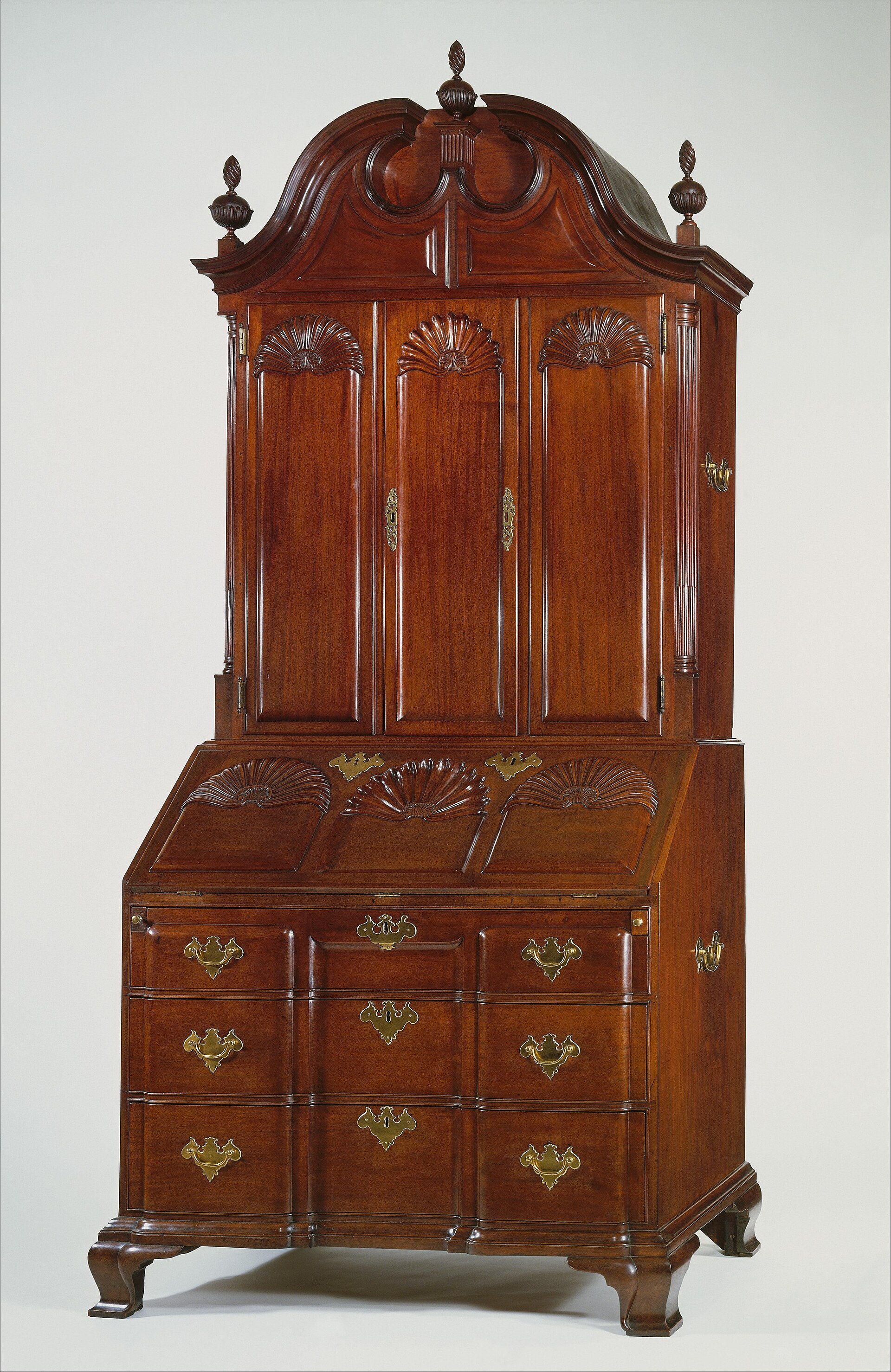
- Artist
- Unidentified Newport (or Providence) cabinetmaking shop, within the Goddard-Townsend tradition
- Date
- 1760-90 (Metropolitan Museum's own catalogue bracket for the piece). Brock Jobe's 2001 study captions this specific example about 1760-1770, a narrower range not reconciled with the Museum's bracket in any source consulted.
- Medium
- Mahogany, with chestnut, white pine, yellow pine, yellow poplar (tulip poplar) and cedar as secondary woods; brass hardware
- Dimensions
- 99 1/8 x 44 1/8 x 25 3/4 in. (251.8 x 112.1 x 65.4 cm)
- Inscriptions
- Incised on the outer edge of the right-hand loper: Z H. Incised on the top edge: A M. Inscribed in ink: P. No maker's signature, label or inscription is recorded on this desk in any source consulted.
- Attribution
- unknownThe Metropolitan Museum names no maker for this desk. Brock Jobe's 2001 construction-based survey of the whole group of nine surviving Newport block-and-shell desk-and-bookcases finds that the identities of the cabinetmakers behind the subgroup that includes this example 'remain a mystery,' and proposes Christopher Townsend and Job Townsend only as 'better candidates,' not as confirmed makers. John Townsend, the one member of the family who habitually signed and dated his work, is explicitly excluded by Jobe from having made any surviving desk-and-bookcase. Even the single inscription anywhere in the group naming John Goddard, on a different desk entirely, cannot be proven by Jobe's own account to reflect true authorship. No name is attached to this specific object with documentary confidence, and this record does not assign one.
- Where it is now
- Metropolitan Museum of Art, New York, on permanent view in Gallery 753, The American Wing, 15.21.2
- Object type
- Furniture
- Period
- American, eighteenth century
A nine-foot mahogany desk and bookcase made in Newport, Rhode Island sometime between about 1760 and 1790, one of roughly nine surviving examples of the block-and-shell form that scholars treat as the summit of American colonial furniture-making. The Metropolitan Museum has owned it since 1915, when it was purchased with the Rogers Fund from the estate of Richard Canfield, the New York casino operator and Whistler collector who is the only documented owner before the Museum.
No maker's name survives on it. The construction-based study that finally moved this group away from a single loose attribution to John Goddard can only place this particular desk in a subgroup of unidentified Newport hands, naming Christopher Townsend and Job Townsend as candidates without confirming either. It is not the desk that Christie's sold at record price in 1989, and it is not the Nicholas Brown desk this archive holds separately: those facts, and that price, belong to a different, still privately owned object.
What is documented is the object itself: the tripartite blocked front and its carved shells, the cubbyholes and drawers behind the bookcase doors where a Newport merchant kept his papers, and a plain institutional sentence on the Museum's own label connecting this kind of monumental workstation to the Rhode Island trade in enslaved people that paid for it.
Images
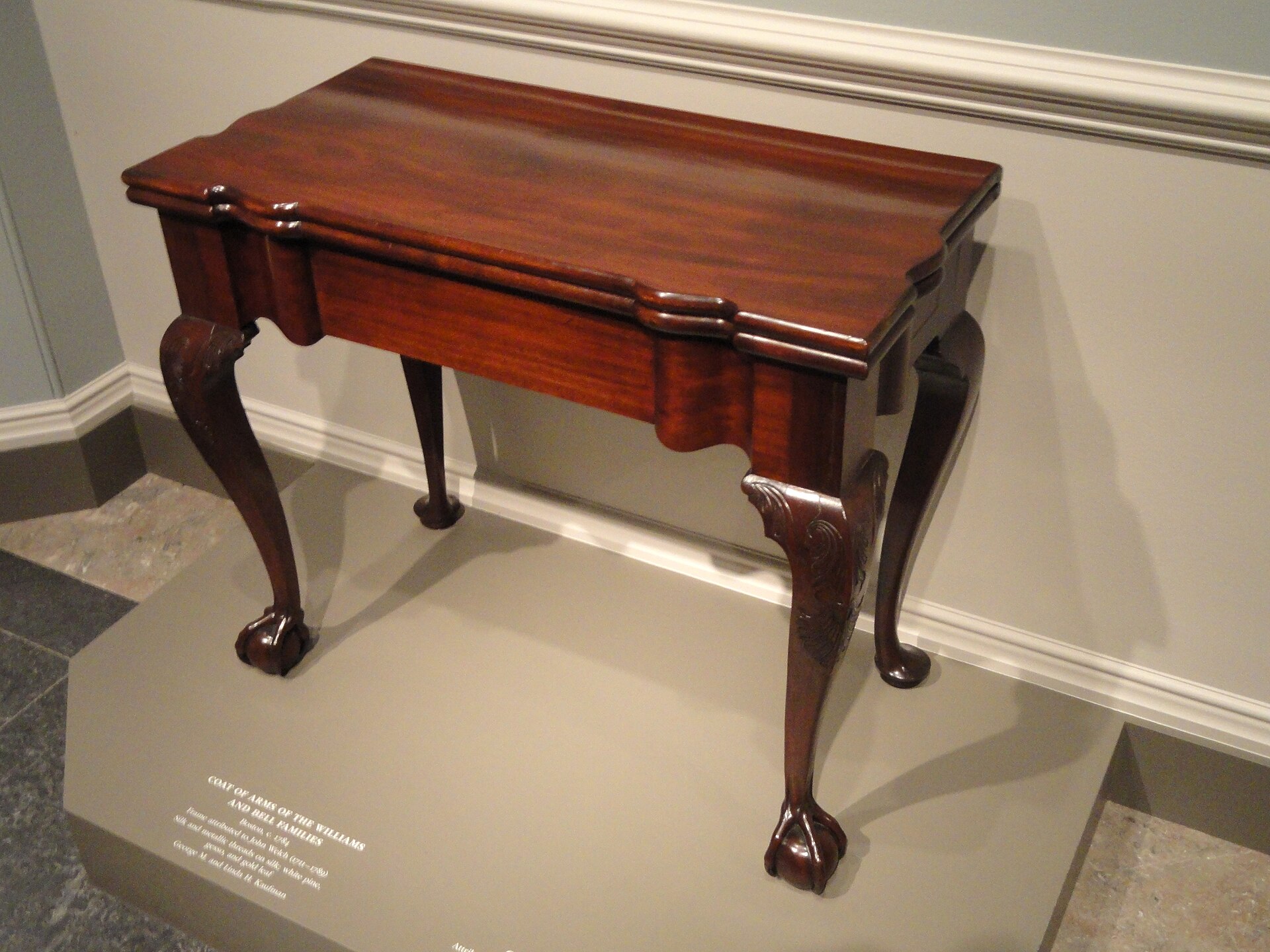
The artist
The Goddard-Townsend cabinetmaking families of Newport, Rhode Island (no individual maker identified for this desk)
No person can be named as the maker of this desk with documentary confidence, so this dossier covers the workshop culture it came out of rather than an individual. The Goddard and Townsend families of Newport intermarried and trained together across three generations, sharing techniques closely enough that construction detail, not style, is now the only reliable way to separate one shop's work from another's. What follows is what is actually documented about that culture, and about the specific finding that keeps this desk unattributed.
What it is
The desk and bookcase stands 99 1/8 inches high, 44 1/8 inches wide and 25 3/4 inches deep, close to eight feet three inches tall, in solid mahogany with chestnut, white pine, yellow pine, yellow poplar and cedar used inside for the secondary structure, and brass for the drawer pulls and escutcheons. It is built in two stacked cases. The lower case is a fall-front desk: three blocked drawer fronts, alternating convex and concave, rise to meet a hinged writing surface carved with three shells in the same alternating rhythm. The upper case is a bookcase, its two doors continuing the same tripartite, shell-topped design, crowned by an arched, broken-scroll pediment with turned finials.
Behind the bookcase doors sit an array of small drawers and open compartments, cubbyholes in the plain sense, built to hold papers rather than books in any quantity. That detail matters more than the architecture on top of it: this is a business machine built to look like a monument, made for a Newport or Providence merchant to conduct trade from and to be seen owning.
How the block-and-shell was made, and why it has no ancestor
The convex-concave-convex blocking is carved from the solid mahogany plank, not built up or applied, and the shells at the top of each blocked section are carved with lobes that curve in opposite directions: some read as convex, domed forms, others as concave, hollowed ones, on the same fall front. A Metropolitan Museum gallery talk with the woodworker and furniture historian Sharon Mehrman makes the ordinary point worth keeping in mind in front of any of these desks: carving one shell with that many lobes, at that scale, in solid wood, is a serious technical undertaking, and the makers of this group did it in triplicate, on both the desk and the bookcase, over and over across nine known survivors.
The Metropolitan Museum's own published scholarship is specific about what this form is not. In its account of the transition from Queen Anne to Chippendale furniture in the colonies, the Museum credits the Townsend and Goddard families with developing block-and-shell case pieces that have, in the Museum's own words, no known parallel in European furniture or contemporary furniture books, and it illustrates that claim with this exact object, accession 15.21.2. Thomas Chippendale's The Gentleman and Cabinet-Maker's Director shaped a great deal of colonial American furniture in this period, but not this. The block-and-shell desk-and-bookcase is not a colonial translation of an English design; on the Museum's own account it is a Newport invention with no printed source to translate from.
Brock Jobe's construction-based study of the whole surviving group finds that this desk shares fixed, identically profiled bookcase partitions with at least one other example in the group, evidence he uses to place it in a production subgroup distinct from the desks at the Rhode Island School of Design and elsewhere, which instead have removable partitions with double-beaded edges. The distinction is a construction detail, not a name, and Jobe does not put a maker's name on this subgroup.
The only marks it carries are not a maker's
The Metropolitan Museum's own catalogue records three inscriptions on this desk: incised on the outer edge of the right-hand loper, the pull-out arm that supports the fall-front writing surface, the letters Z H; incised on the top edge, the letters A M; and inscribed in ink, the single letter P. None of these reads as a cabinetmaker's signature, and the Museum's own object record names no maker for the piece at all.
The contrast that matters is with John Townsend, the one member of the extended Goddard-Townsend family who routinely signed and dated his work. The Metropolitan Museum's 2005 exhibition John Townsend: Newport Cabinetmaker, curated by Morrison H. Heckscher, drew together some forty works by Townsend precisely because his habit of signing and dating let scholars reconstruct his stylistic development with real certainty, something Heckscher himself called out as unique among colonial American cabinetmakers. This desk carries none of that. Whatever Z H, A M and P mark, whether an owner, a repairer or a workman keeping stock in order, they are not the kind of mark that settles an attribution, and this record treats them as what they are: initials without an identified bearer.
The attribution problem
The Goddard and Townsend families of Newport intermarried and shared a workshop culture across three generations. John Goddard, born in 1724 to a Quaker shipwright family recently arrived from Dartmouth, Massachusetts, apprenticed under Job Townsend and married Job's daughter Hannah; Goddard's brother James married Hannah's sister. Between them the two families produced something like twenty cabinetmakers over three generations, working in overlapping shops, sharing techniques and, on the evidence of the surviving furniture, sharing forms closely enough that construction detail rather than style is now the only reliable way to tell one shop's work from another's.
Michael Moses's 1984 study Master Craftsmen of Newport: The Townsends and Goddards remains the standard connoisseurship-based reference for the group and is listed here as literature; its specific treatment of this exact desk was not verified for this record and should be checked directly. The more recent and more skeptical word belongs to Brock Jobe, whose 2001 Chipstone Foundation study surveyed the whole surviving group by construction rather than by style. Jobe's conclusion is blunt: the nine known desk-and-bookcases represent the output of at least four, and possibly five, distinct Newport shops, and for the subgroup that includes the Metropolitan's desk, in Jobe's own words, the identities of the cabinetmakers that made them remain a mystery. He proposes Christopher Townsend and Job Townsend only as better candidates than the alternatives, not as confirmed makers, and he explicitly removes John Townsend from consideration for any of the surviving desk-and-bookcases despite ranking his work at the summit of Newport craftsmanship.
Even the Goddard name, the one the trade has used longest, rests on a single piece of evidence in the whole group, and it is not evidence about this desk. It is an inscription inside the Lisle desk-and-bookcase at the Rhode Island School of Design, reading that the piece was made by John Goddard in 1761 and repaired by his son Thomas in 1813. Jobe's own verdict, about the one object in the entire surviving group that carries Goddard's name at all, is that Goddard's construction of it cannot be proven at this time. Nothing comparable exists for the Metropolitan's desk. No name belongs to it with documentary confidence, and this record assigns none.
One of about nine, and not the other two this archive has touched
This desk is one of roughly nine surviving examples of the Newport block-and-shell desk-and-bookcase form, the group Brock Jobe's 2001 study treats as a single, closely related census. It should not be confused with two other objects that circulate in the same conversation.
It is not the desk-and-bookcase made for the Providence merchant Nicholas Brown. That desk descended in the Brown family for five generations, was sold by Christie's New York on 3 June 1989 under the title The Magnificent Nicholas Brown Desk and Bookcase, catalogued at the time as the work of John Goddard, and brought a reported USD 12.1 million, a world record for a piece of furniture, bought by the dealer Harold Sack for an unnamed client. It remains privately held and has not been seen publicly since. That desk is a different physical object with a different, five-generation ownership history, and this archive covers it separately in its own record. No fact, price or image belonging to that desk is used here.
It is also not, for the avoidance of doubt, a third object distinct from the 1989 sale: the desk Christie's sold in 1989 and the Nicholas Brown desk are one and the same, sold under its own dedicated catalogue that year. The Metropolitan's desk, the subject of this record, was already in the Museum's collection for seventy-four years by the time that sale happened, and played no part in it.
The Metropolitan's own desk carries its own name in the literature: Jobe and the trade both refer to it as the Canfield example, after Richard Canfield, its documented owner before the Museum. That is the name this record uses to keep it distinct from the Nicholas Brown desk, the Lisle desk at the Rhode Island School of Design, the John Brown desk at Yale, and the other surviving members of the group.
Richard Canfield, the gambler who owned it
The only owner the Metropolitan Museum names before its own acquisition is Richard Canfield, and the Museum's provenance note is a single line: Richard Canfield, New York. Canfield ran some of the most fashionable illegal gambling houses in the northeastern United States, faro parlors in Pawtucket and Providence, Rhode Island, before establishing a high-stakes casino at 5 East 44th Street in New York and running the Saratoga Clubhouse from 1893 to 1907, which earned him the trade nickname Prince of Gamblers.
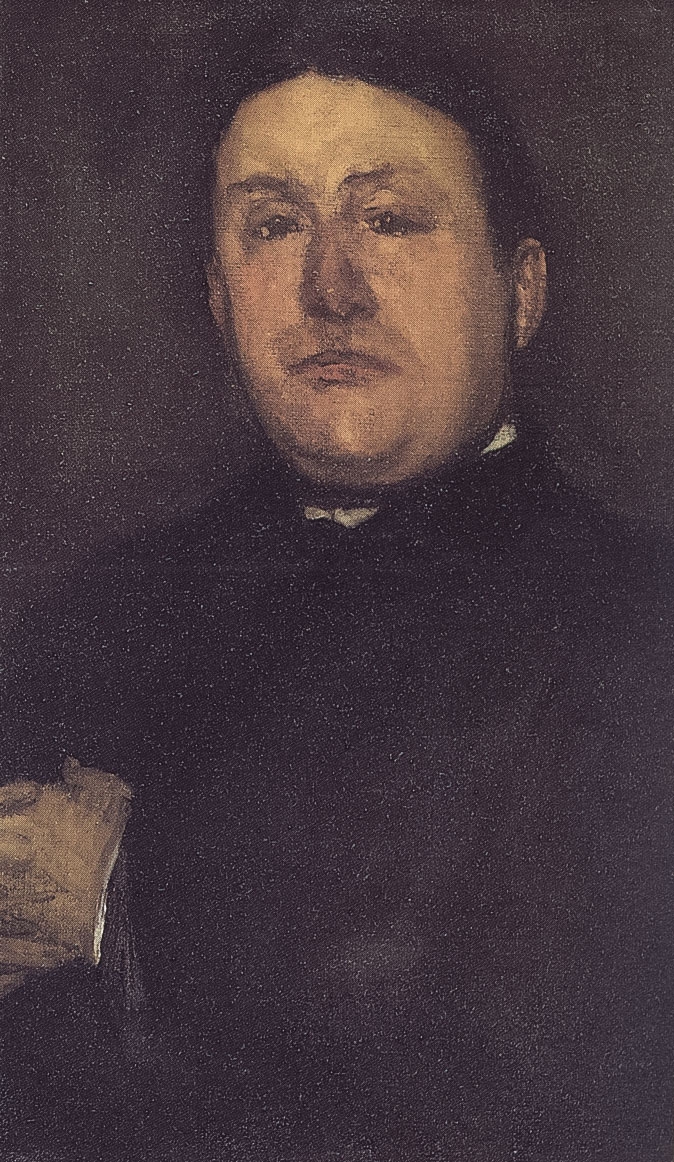
He was also a serious collector, of early American and Chippendale furniture, tapestries, Chinese porcelain and Barye bronzes, and above all of the work of James McNeill Whistler, amassing what was reported to be the most important collection of Whistler's work in America after Charles Lang Freer's. In May 1901 Canfield commissioned a portrait from Whistler himself; he sat for it intermittently over nearly two years, finishing sittings on 16 May 1903, and the picture became Whistler's last completed portrait. Whistler, by then ill, gave it the ironic nickname His Reverence for the deceptive air of respectability it lent its sitter, a gambler dressed for painting like a bishop. A few months before his death Canfield sold his Whistler collection, etchings, lithographs, drawings and paintings together, to the dealer Roland Knoedler for USD 300,000.
Canfield died from a fractured skull after a fall on the steps of the Fourteenth Street subway station in New York on 11 December 1914. Brock Jobe's 2001 study places Canfield's acquisition of this desk-and-bookcase only approximately, possibly in Providence, at roughly the same period, the 1880s, that the collector and dealer Charles Pendleton was assembling his own Newport desk-and-bookcase for what became the Pendleton House collection at the Rhode Island School of Design. No source consulted for this record gives an exact date, a seller's name or a price for Canfield's purchase.
How it reached the Museum
Canfield's estate was handled by his attorney, Luke Vincent Lockwood, a Brooklyn-born lawyer who practiced law for fifty-five years and was, in the same period, building the foundations of American furniture scholarship: his 1901 book Colonial Furniture in America is credited as the first serious survey of the field. It was Lockwood, wearing the furniture historian's hat rather than the lawyer's, who negotiated the sale of Canfield's desk-and-bookcase to the Metropolitan Museum of Art. The Museum purchased it in 1915 with the Rogers Fund, and it has remained in the collection since, accession number 15.21.2.
One detail in the Museum's own record does not square with the rest of what is documented about Canfield. The Metropolitan's provenance note reads Richard Canfield, New York, died 1915. Every other source consulted for this record, independently, gives 11 December 1914 as his date of death, including a specialist catalogue project unconnected to the sale of this desk. The discrepancy is recorded here rather than silently resolved in either direction, and it is listed among the open questions below.
What it was for
The Metropolitan Museum's own label text for this object states plainly what kind of thing it is and where the money behind it came from: many colonial Rhode Island families made their livelihoods through the transatlantic exchange of enslaved people, sugar and other commodities, and this monumental workstation, in the Museum's own words, embodies the superior craftsmanship of Newport cabinetmakers while implicating the destructive commerce and consumption of the Triangle Trade. That is not this record's interpretation; it is the acquiring institution's own current cataloguing language, stated on the object's public page.
The form supports the claim on its own terms. A desk of this size and cost was a business instrument before it was an heirloom: the cubbyholes and small drawers behind the bookcase doors were built to hold the correspondence, accounts and bills of exchange of a Newport or Providence merchant's Atlantic trade, and the Museum's own catalogue elsewhere notes that these desks were also symbols of their owners' business achievements, citing the well-documented case of the four Brown brothers of Providence, each of whom owned one. The mahogany itself came from the same Atlantic economy the Museum's label names: Caribbean mahogany had, by the mid-eighteenth century, become the wood of choice for exactly this kind of high-end American case furniture, imported on the same trade routes and, in significant part, cut by the same coerced and enslaved labor that the Museum's label describes.
The census: nine desks, at least four shops
Brock Jobe's 2001 study is the most recent attempt to place all the known survivors of this form in one list. He counts nine known examples: the Lisle desk-and-bookcase at the Rhode Island School of Design, the only one carrying an inscription naming Goddard; an example at Winterthur Museum; two separate examples at the Museum of Fine Arts, Boston, one from the Helme or Potter family and one from the M. and M. Karolik Collection; the desk made for John Brown at Yale University Art Gallery, now attributed by Yale's own Rhode Island Furniture Archive to Daniel Spencer; this desk, the Canfield example, at the Metropolitan Museum of Art; an example in the Bayou Bend Collection at the Museum of Fine Arts, Houston; the desk made for Nicholas Brown, sold at Christie's in 1989 and now in an unnamed private collection; and a further example associated with the Updike family.
Jobe's construction analysis divides that census into at least four, and possibly five, separate Newport shop traditions, distinguished by details like bookcase partition profiles and dovetail work rather than by carving style, which is shared closely enough across the group to be useless for telling one shop from another on its own. The Canfield desk sits in a subgroup Jobe identifies by its fixed bookcase partitions, alongside at least one sibling; none of the subgroups in Jobe's analysis is confidently assigned to a single named cabinetmaker.
What is happening to it now
The desk is on permanent view at the Metropolitan Museum's Fifth Avenue building, in Gallery 753 of the American Wing, and the Museum's own collection database flags it as a highlighted object. It carries a museum audio guide, stop number 4015, in which the woodworker and furniture historian Sharon Mehrman walks a listener through the physical difficulty of carving the shells and the scale of the undertaking the original makers took on.
The Museum's Heilbrunn Timeline of Art History, an ongoing scholarly reference maintained by the American Wing, uses this specific object, cited by its own accession number, as the illustration for its claim that Newport's block-and-shell case furniture has no parallel anywhere in European furniture or pattern books. Of the nine known survivors of this form, this is the one the Museum has chosen, in its own published scholarship, to stand for the whole innovation. Its images are released under a CC0 public domain dedication as part of the Museum's Open Access program, and this record uses one of them as its lead plate.
Technical evidence
- Form
- Two-part block-and-shell desk and bookcase. Lower case: fall-front desk with three blocked, alternating convex-concave-convex drawer fronts terminating in carved shells. Upper case: bookcase with two doors continuing the same tripartite, shell-carved design, under an arched broken-scroll pediment with turned finials. Behind the bookcase doors, an array of small drawers and open compartments (cubbyholes) for papers.12
- Dimensions
- 99 1/8 x 44 1/8 x 25 3/4 in. (251.8 x 112.1 x 65.4 cm).12
- Materials
- Mahogany (primary); chestnut, white pine, yellow pine, yellow poplar (tulip poplar) and cedar (secondary, interior structure); brass hardware.12
- Inscriptions
- Incised on the outer edge of the right-hand loper: Z H. Incised on the top edge: A M. Inscribed in ink: P. Read as owner's, workman's or later hand's marks, not a cabinetmaker's signature.1
- Maker attribution
- None given by the Metropolitan Museum. Brock Jobe's construction-based study finds the makers of this desk's subgroup unidentified, naming Christopher Townsend and Job Townsend only as unconfirmed candidates, and explicitly excludes John Townsend from the whole group of surviving desk-and-bookcases.23
- Dating
- Metropolitan Museum's own catalogue bracket: 1760-90, the range used across its whole Newport late-colonial holdings. Brock Jobe's 2001 study captions this specific example about 1760-1770, a narrower bracket. The two datings are not reconciled in any source consulted.123
- Subgroup and construction
- Jobe groups this desk with at least one sibling on the evidence of fixed bookcase partitions of identical profile, distinguishing it from the Rhode Island School of Design examples, which have removable, double-beaded partitions. This is a construction-based grouping, not a maker attribution.3
- Acquisition mechanism
- Purchased with the Rogers Fund in 1915, negotiated through Richard Canfield's estate by his attorney, the furniture historian Luke Vincent Lockwood. No purchase price for this transaction was found in any source consulted.12315
- Display and rights status
- On permanent view, Gallery 753, The American Wing, Metropolitan Museum of Art. Flagged as a highlight object in the Museum's own collection database. Images released CC0 under the Museum's Open Access policy; licence verified per file from the Wikimedia Commons API.29
Provenance
- c. 1760 - c. 1790Unidentified original owner, Newport or Providence, Rhode Islandunknown
Made by an unidentified Newport (or possibly Providence) cabinetmaking shop within the Goddard-Townsend tradition. The Metropolitan Museum dates the piece 1760-90; Brock Jobe's 2001 study narrows it to about 1760-1770. No maker's label, signature or documented commission survives, and the first owner is not named in any source consulted.123
- c. 1790 - c. 1880sUnrecorded owner or ownersunknown
Nothing is documented about how the desk left its original household or how it moved through the early-to-mid nineteenth century before it is first recorded in Richard Canfield's collection. This is a real gap and is recorded as one, not bridged with a guess.3
- c. 1880s - 1914Richard Canfield (1855-1914), New Yorkdocumented
Canfield, the New York and Newport casino operator and art collector, owned the desk before his death. Brock Jobe's study places his acquisition of it 'possibly in Providence,' at roughly the period, the 1880s, that the collector-dealer Charles Pendleton was assembling his own Newport desk-and-bookcase in Providence. The exact date, seller and price of Canfield's purchase are not recorded in any source consulted.137
- 1914 - 1915Estate of Richard Canfield, negotiated by his attorney Luke Vincent Lockwooddocumented
Canfield died in December 1914 (see open questions for the 1914/1915 discrepancy in the Museum's own note). Lockwood, a practicing lawyer and, separately, the author of the pioneering 1901 survey Colonial Furniture in America, negotiated the sale of the desk from Canfield's estate to the Metropolitan Museum.315
- 1915 - presentMetropolitan Museum of Art, New Yorkdocumented
Purchased with the Rogers Fund, 1915. Accession number 15.21.2. On permanent view in Gallery 753, The American Wing, as of 2026.12
Prices realised
NO AUCTION SALE OF THIS OBJECT IS KNOWN. This desk passed from Richard Canfield's estate to the Metropolitan Museum by a negotiated purchase with the Rogers Fund in 1915, not at public auction, and no price for that transaction was found in any source consulted. It must not be confused with the desk-and-bookcase made for the Providence merchant Nicholas Brown, a different, still privately owned example of this same form, which Christie's New York sold at public auction on 3 June 1989 for a reported USD 12.1 million, then a world record for a piece of furniture. That sale, its buyer and its price belong to the Nicholas Brown desk, not to the object in this record, and are covered separately in this archive's own record on that desk.
Literature
- Michael Moses, Master Craftsmen of Newport: The Townsends and Goddards (MMI Americana Press). The standard connoisseurship-based reference for the group. Its specific treatment of this desk was not verified for this record; flagged for direct consultation before further claims are drawn from it.
- Brock Jobe, 'The Lisle Desk-and-Bookcase: A Rhode Island Icon,' American Furniture 2001 (Chipstone Foundation). The construction-based reassessment that identifies at least four or five distinct Newport shops behind the nine known desk-and-bookcases and places this desk, unattributed, in one subgroup.
- Morrison H. Heckscher, American Furniture in The Metropolitan Museum of Art: Late Colonial Period, Vol. II, The Queen Anne and Chippendale Styles (Metropolitan Museum of Art). The Museum's own catalogue of this collection area; description and citation verified, full 384-page text not read for this record.
- Morrison H. Heckscher, John Townsend: Newport Cabinetmaker, exhibition catalogue (Metropolitan Museum of Art, distributed by Yale University Press).
Related works
| Work | Relation | Where it is |
|---|---|---|
| The Nicholas Brown Desk and Bookcase Unidentified Newport or Providence cabinetmaker; catalogued by Christie's in 1989 as John Goddard | A different example of the same form. Sold at Christie's New York, 3 June 1989, for a reported USD 12.1 million, then a world auction record for furniture. Now privately held. Covered separately, unpublished, elsewhere in this archive. Descended in the Brown family for five generations before the 1989 sale. Not to be confused with the object in this record; no fact, price or image from that desk belongs here. | Private collection, United States |
| Desk and Bookcase made for John Brown Attributed by Yale's Rhode Island Furniture Archive to Daniel Spencer | The closest surviving relative in Brock Jobe's census, and the object on which infrared examination revealed chalk and graphite maker's marks, the strongest evidential attribution anywhere in the group Nicholas Brown's brother John commissioned this desk; the two are frequently conflated in the literature because each of the four Brown brothers owned one. | Yale University Art Gallery, accession 1940.320 |
| The Lisle Desk-and-Bookcase Traditionally John Goddard; Brock Jobe holds his construction of it cannot be proven | The only object in the entire surviving group of nine that carries an inscription naming Goddard The inscription, 'Made by John Goddard 1761 and repaired by Thomas Goddard his Son 1813,' was written by the son twenty-eight years after the father's death. | Rhode Island School of Design, bequest of Martha B. Lisle |
| Desk and bookcase, Bayou Bend Collection Unidentified | Another member of Brock Jobe's nine-piece census of the surviving Newport block-and-shell form Listed by Jobe among the surviving group; not examined for this record. | Museum of Fine Arts, Houston |
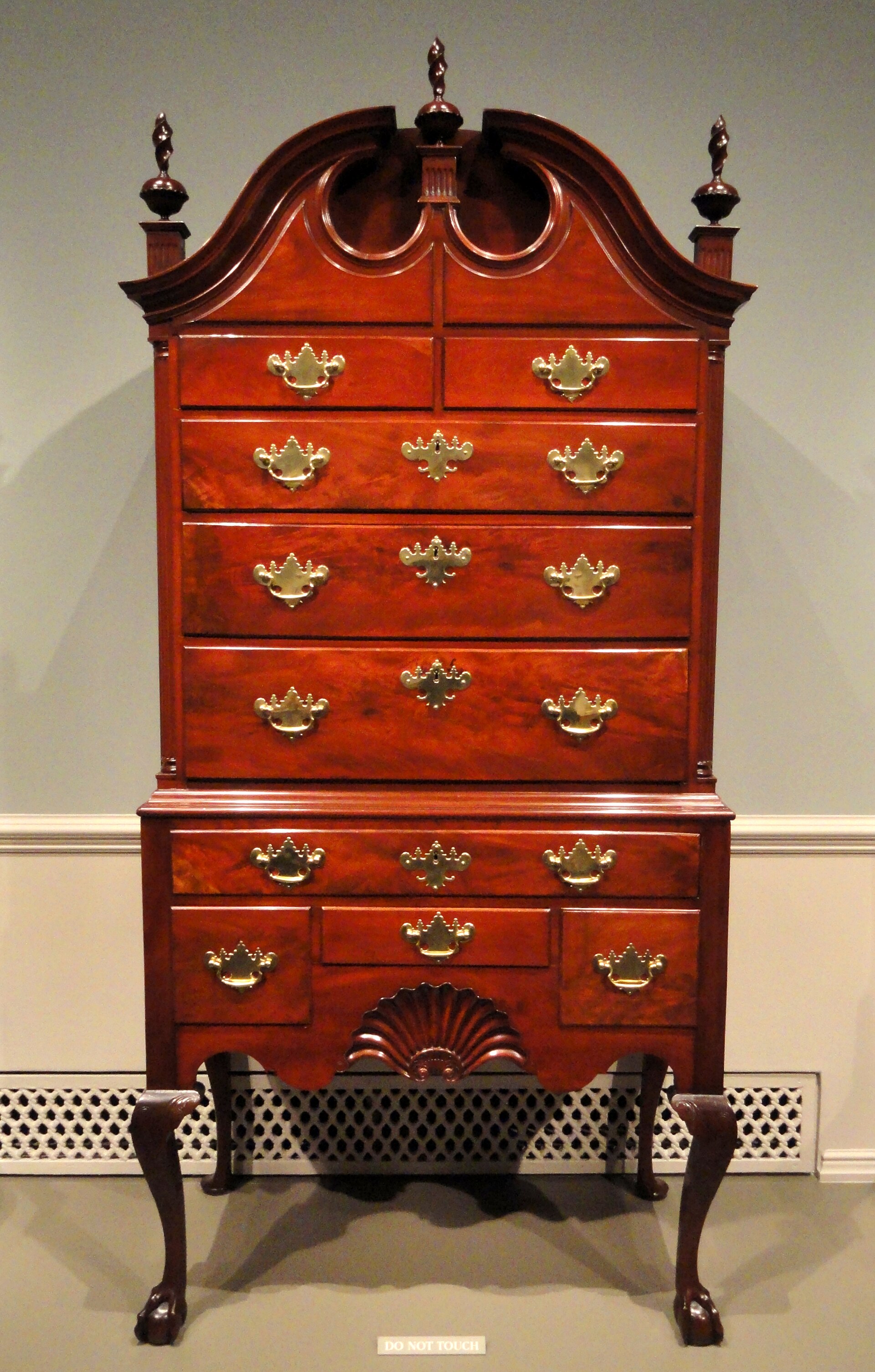
| High Chest Attributed to John Townsend | Comparandum, not the same object or form: a Newport case piece carrying an individual attribution, illustrating what the group looks like when a name can be proposed with more confidence than exists for the Canfield desk Dated 1765-1770. Shown to contrast an attributed Townsend case piece against the unattributed desk in this record. | National Gallery of Art, Washington |
Open questions
- Who made this desk? No maker's name survives on it, and Brock Jobe's construction-based study can only place it in a subgroup of unidentified Newport shops, naming Christopher Townsend and Job Townsend as unconfirmed candidates among several.
- Where, when and from whom did Richard Canfield acquire it? Jobe places the purchase only approximately, possibly in Providence, around the 1880s; no bill of sale, dealer's name or exact date was found in any source consulted.
- Did Richard Canfield die in 1914 or 1915? Independent biographical sources give 11 December 1914; the Metropolitan Museum's own provenance note for this object reads 'died 1915.' The conflict is not resolved here.
- Is the desk properly dated to 1760-90 or narrowed to 1760-1770? The Metropolitan Museum uses the broader bracket across its Newport holdings; Brock Jobe's 2001 study captions this specific example with the narrower range. Neither source explains its reasoning against the other.
- Whose initials are Z H, A M and P? Incised and inked inside the desk, no source consulted proposes an identification for any of them.
- What did the Metropolitan Museum pay for the desk in 1915? No purchase price for this transaction was found in any source consulted.
- What does Michael Moses's 1984 study Master Craftsmen of Newport say specifically about this example? The book is the standard connoisseurship reference for the group; its treatment of this desk was not verified for this record and should be checked directly before further claims are added.
Sources
- 1Metropolitan Museum of Art, collection object page for 'Desk and bookcase,' accession 15.21.2 (Overview, Signatures/Inscriptions/Markings, and Provenance tabs read directly).
https://www.metmuseum.org/art/collection/search/3141 - 2Metropolitan Museum of Art, Collection API record for object ID 3141 (accession number, credit line, medium, dimensions, gallery, public-domain and highlight-object flags).
https://collectionapi.metmuseum.org/public/collection/v1/objects/3141 - 3Brock Jobe, 'The Lisle Desk-and-Bookcase: A Rhode Island Icon,' American Furniture 2001, Chipstone Foundation. Source for the nine-piece census, the Canfield desk's subgroup and dating, Canfield's approximate acquisition and Lockwood's role in the 1915 sale, the Goddard inscription and its unproven status, and the exclusion of John Townsend from the group.
https://chipstone.org/article.php/657/American-Furniture-2001/The-Lisle-Desk-and-Bookcase:-A-Rhode-Island-Icon - 4Nicholas C. Vincent, 'American Furniture, 1730-1790: Queen Anne and Chippendale Styles,' Heilbrunn Timeline of Art History, The Metropolitan Museum of Art, December 2009. Source for the 'no known parallel in European furniture or contemporary furniture books' claim, illustrated with this object's own accession number, and for the Caribbean mahogany trade context.
https://www.metmuseum.org/essays/american-furniture-1730-1790-queen-anne-and-chippendale-styles - 5Metropolitan Museum of Art, press release, 'John Townsend: Newport Cabinetmaker,' 7 March 2005. Source for John Townsend's dates, his practice of signing and dating his work, and Morrison Heckscher's curatorial framing of the attribution problem across the family group.
https://www.metmuseum.org/press/exhibitions/2005/john-townsend-newport-cabinetmaker - 6Metropolitan Museum of Art, MetPublications listing for Morrison H. Heckscher, American Furniture in The Metropolitan Museum of Art, Late Colonial Period, Vol. II (1985). Description and bibliographic details only; full catalogue text not read for this record.
https://www.metmuseum.org/met-publications/american-furniture-in-the-metropolitan-museum-of-art-late-colonial-period-vol-ii-the-queen-anne-a - 7Wikipedia, 'Richard Albert Canfield.' TERTIARY. Source for Canfield's dates, gambling career, art collecting and cause and date of death. Flagged for replacement with a primary obituary or biography.
https://en.wikipedia.org/wiki/Richard_Albert_Canfield - 8New England Historical Society, 'The Hidden Treasures of Newport Cabinetmaker John Goddard.' TERTIARY. Source for John Goddard's birth, family, apprenticeship, marriage and death. This publication has misdated the 1989 sale elsewhere and is used here only for biographical detail, flagged for replacement with a scholarly source.
https://newenglandhistoricalsociety.com/desk-sold-12-million-john-goddard-died-broke/ - 9Whistler Paintings Catalogue, University of Glasgow, entry YMSM 547, 'Portrait of Richard A. Canfield.' Source for the commission date, sitting history, the painting's status as Whistler's last completed portrait, and its nickname 'His Reverence.'
https://whistlerpaintings.gla.ac.uk/catalogue/display/?mid=y547&xml=sub - 10Wikimedia Commons file page for the Metropolitan Museum's desk and bookcase, accession 15.21.2. Licence verified at fetch time via the Commons API: LicenseShortName 'CC0'.
https://commons.wikimedia.org/wiki/File:Desk_and_bookcase_MET_DT167.jpg - 11Wikimedia Commons file page for James McNeill Whistler's 'Portrait of Richard A. Canfield' (1901-1903). Licence verified at fetch time via the Commons API: LicenseShortName 'Public domain'.
https://commons.wikimedia.org/wiki/File:Whistler_-_Portrait_of_Richard_A._Canfield_(1901-1903)_y547.jpg - 12Wikimedia Commons file page for a high chest attributed to John Townsend, National Gallery of Art, Washington. Licence verified at fetch time via the Commons API: LicenseShortName 'CC0'.
https://commons.wikimedia.org/wiki/File:High_Chest,_attributed_to_John_Townsend,_Newport,_1765-1770,_mahogany,_brass_-_National_Gallery_of_Art,_Washington_-_DSC08769.JPG - 13Wikimedia Commons file page for a card table attributed to John Goddard, National Gallery of Art, Washington. Licence verified at fetch time via the Commons API: LicenseShortName 'CC0'.
https://commons.wikimedia.org/wiki/File:Card_Table_attributed_to_John_Goddard,_Newport,_1760-1770,_mahogany_-_National_Gallery_of_Art,_Washington_-_DSC09683.JPG - 14Deseret News (Associated Press), '1760s desk set sells for record $12.1 million,' 4 June 1989. Source, independently fetched for this record, confirming the 1989 Christie's sale was of the Nicholas Brown desk, a different object from the one in this record, at USD 12.1 million.
https://www.deseret.com/1989/6/4/18809775/1760s-desk-set-sells-for-record-12-1-million/ - 15Wikipedia, 'Luke Vincent Lockwood.' Source for Lockwood's dates, his career as a lawyer, and his 1901 book Colonial Furniture in America.
https://en.wikipedia.org/wiki/Luke_Vincent_Lockwood

_y547.jpg)


Change log
2026-08-07 - Record created at the house standard: researched narrative, technical evidence, maker dossier, graded provenance chain, prices with hammer and premium separated, related works, open questions and sources.