"Etat" Cabinet
- Artist
- Emile-Jacques Ruhlmann
- Date
- designed 1922; this example manufactured 1925-26
- Medium
- Macassar ebony, amaranth and ivory marquetry on an oak, poplar, chestnut and lumber-core plywood carcase, with mahogany, silvered brass fittings
- Dimensions
- 128.2 x 84.4 x 35.6 cm (50 1/2 x 33 1/4 x 14 in); 38.1 kg
- Inscriptions
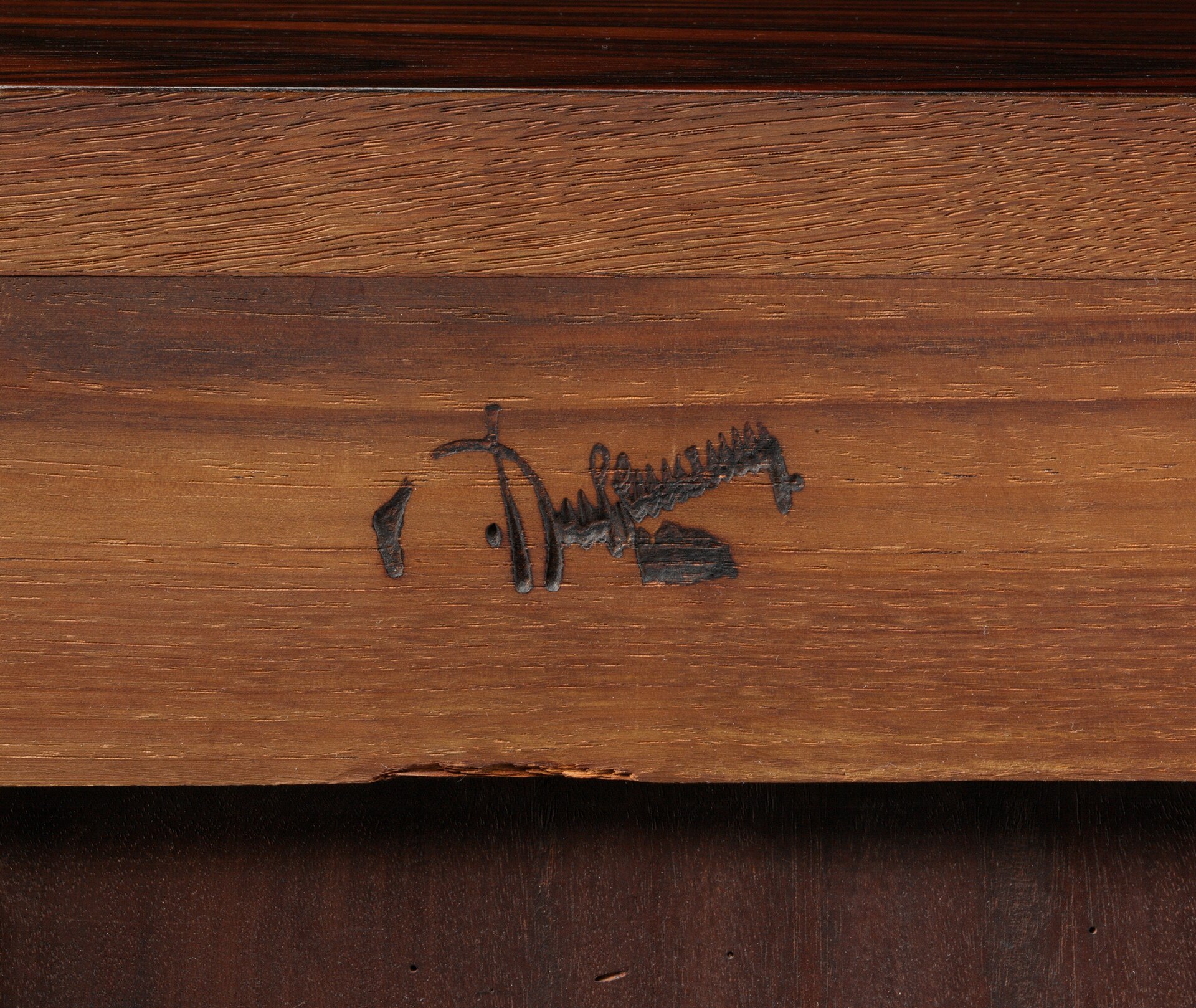
- No inscription or model number for this specific example has been published in the sources consulted.
- Attribution
- acceptedCommissioned directly from Ruhlmann by the Metropolitan Museum of Art in 1925 and manufactured in his workshop in 1925-26, seven to eight years before his death in November 1933. The commission itself is the attribution record: there is no intermediary, no dealer and no gap between maker and first owner. This is explicitly a lifetime work, made under Ruhlmann's own supervision, not one of the posthumous editions his nephew Alfred Porteneuve was later authorized to produce and stamp separately.
- Where it is now
- Metropolitan Museum of Art, New York, 25.231.1
- Object type
- Furniture
- Period
- French, Art Deco, 1920s
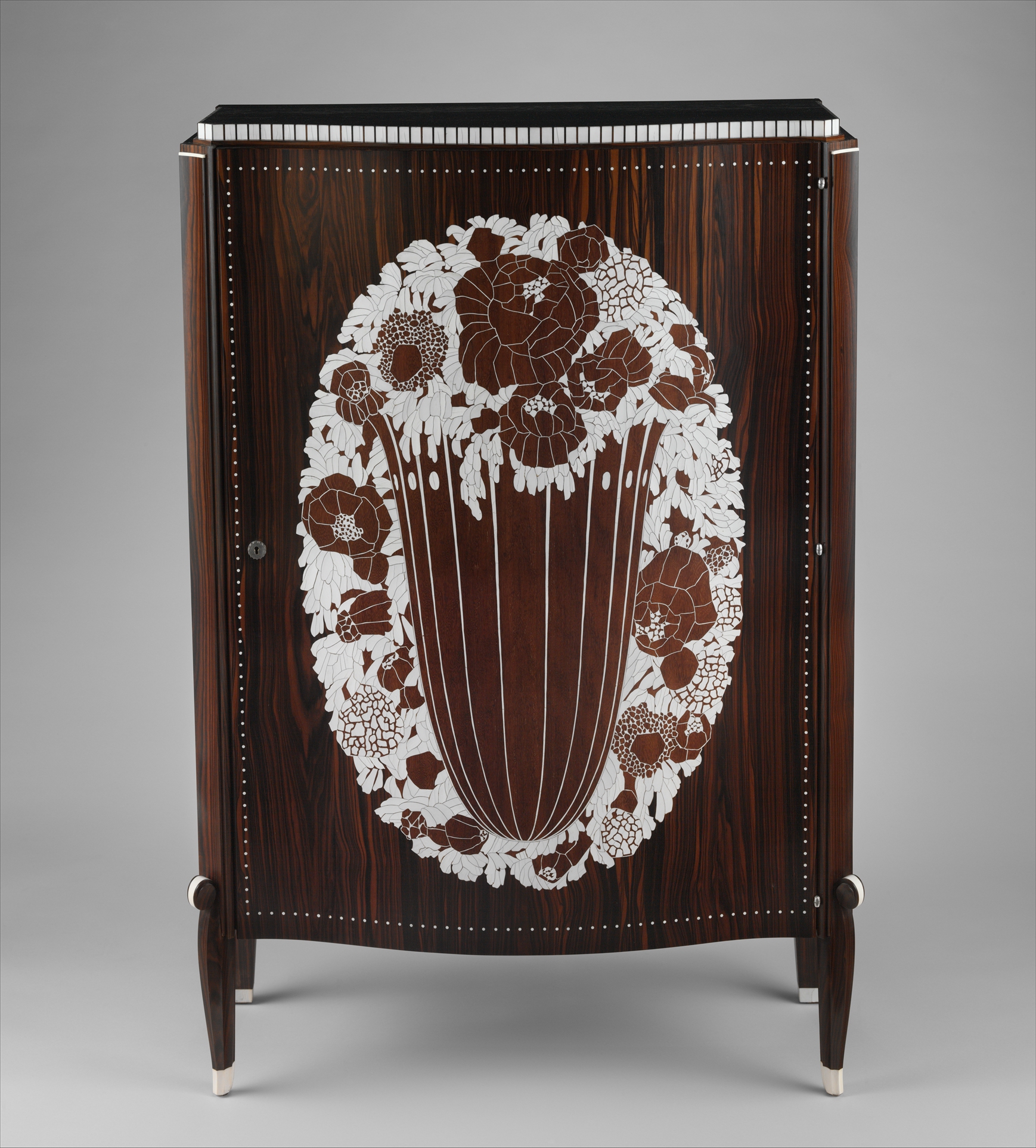
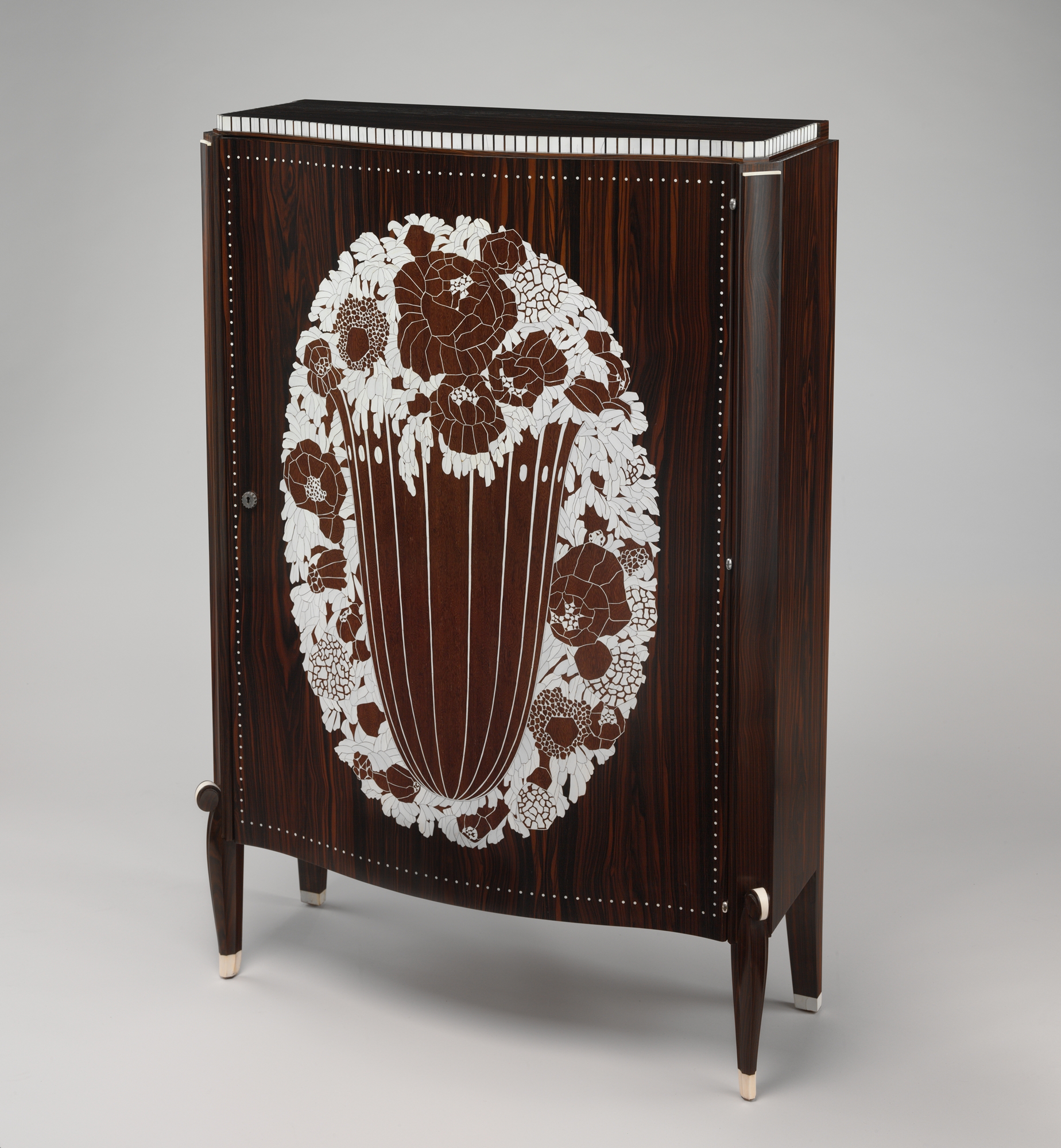
A small cabinet in Macassar ebony with a floral bouquet of ivory and ebony marquetry, commissioned directly from Emile-Jacques Ruhlmann by the Metropolitan Museum of Art in 1925 and made in his workshop the following year. It carries the model name "Etat" because a related example of the same design was shown at the 1925 Exposition Internationale des Arts Decoratifs in Paris and bought on the spot by the French state.
The Museum's own catalogue calls its cabinet a variant, not a duplicate, of the state's example, and that single word is the whole story this record exists to explain. Ruhlmann repeated his popular models with the decoration and dimensions changed piece to piece, so at least four separately owned cabinets today carry the same model name and family resemblance: this one, the French state's, one built for a Roubaix textile industrialist, and one in Chicago. Telling them apart, and keeping straight which one belongs to which owner, is the ordinary daily work of Ruhlmann connoisseurship.
The problem is sharper than a coincidence of taste. Ruhlmann closed his firm by his own order on his death in 1933, then authorized his nephew Alfred Porteneuve to keep producing a short list of models from the old designs, stamped separately to mark them as posthumous. Every Ruhlmann cabinet on the market since has to be sorted against that fact before it is sorted against anything else. This one is documented at every step from commission to gallery wall, which is exactly why it is useful: it shows what a clean file looks like, and what a piece without one is missing.
Images
The artist
Emile-Jacques Ruhlmann
Ruhlmann trained in no formal design school. He inherited his father's Paris construction and decorating business in 1907 and began designing furniture on the side, for his own apartment, before the First World War. By 1925 he was the designer most identified with the Exposition Internationale des Arts Decoratifs et Industriels Modernes, the exhibition that gave Art Deco its name, and his workshop's output remains the benchmark against which the style's luxury end is measured. He built for the very rich, said so plainly, and closed his firm by his own order the moment he could no longer personally supervise it.
What it is
A single-door cabinet in Macassar ebony, 128.2 by 84.4 by 35.6 centimetres and weighing 38.1 kilograms, its front decorated with a bouquet of flowers built from interlocking pieces of ivory and ebony marquetry set into amaranth veneer. The carcase beneath the veneer is oak, poplar, chestnut and lumber-core plywood; the fittings are silvered brass. The Museum's own description of the marquetry work calls the joinery of the inlay pattern reminiscent of a jigsaw puzzle, which is a fair description of how finely the individual pieces of veneer interlock to build the floral image.
It is a small, self-contained piece meant to stand against a wall in a private room, not a grand case piece built for display in a hall. That scale is typical of Ruhlmann's domestic commissions of the 1920s: refined, expensive in materials and labor relative to its size, and built for a single collector's apartment rather than a public interior.
Why it is called Etat
The name is not descriptive of the object. It records an event. An example of this cabinet model was shown at the 1925 Exposition Internationale des Arts Decoratifs et Industriels Modernes in Paris, the exhibition that gave Art Deco its name, and the French state bought it there. Etat is simply French for state. Once that sale happened, the model itself came to be called by the buyer's name rather than by any feature of its design.
The model existed before that sale. Ruhlmann had designed it in 1922 and shown an example at that year's Salon d'Automne, where a critic's notice described it only as a precious piece in Macassar ebony with ivory marquetry, no state involved. The 1925 sale renamed a three-year-old design after its most prestigious buyer, and the Metropolitan's own catalogue entry for this object repeats that account directly: the Museum's cabinet is a variant of the piece bought by the French state that year.
How the Museum came to own it
The Museum did not buy its cabinet at the 1925 Exposition and it did not buy the state's example. It went directly to the source. Joseph Breck, curator of the Department of Decorative Arts, had established the Metropolitan's first gallery for modern design in 1923 and had a standing fund for acquisitions in this area, endowed in 1922 by Edward C. Moore Jr. Breck used that fund to commission a cabinet directly from Ruhlmann's workshop in 1925, in the wake of the Exposition's success. Ruhlmann's studio delivered the finished object in 1925-26.
That means the commission and the manufacture happened inside a single continuous transaction between an American public museum and a living French maker, with no dealer, no auction and no gap in the chain. It is about as clean a beginning as an object's provenance file can have, and it sets the terms for everything that follows: every later claim about this specific cabinet can be checked against a single, documented point of origin.
Variant, not duplicate
The word the Metropolitan uses for its own cabinet, in its own catalogue, is variant. That word is doing real work. Ruhlmann's workshop did not build a fixed edition of the Etat rectangle model and distribute identical copies to different buyers. It built the same basic cabinet form to order, several times, changing the decoration, the exact dimensions and sometimes the interior fittings according to what each commission called for.
The measurements make the point without needing an argument. The Metropolitan's cabinet is 128.2 by 84.4 by 35.6 centimetres. A second surviving example of the model, now at the Musee des Arts Decoratifs in Paris, measures 126.7 by 84 by 31.5 centimetres by that museum's own record, or 126 by 85 by 32 centimetres in the French state's Joconde database - the two French figures themselves differing by a centimetre, which is its own small lesson in how measurement precision degrades even within a single institution's paperwork. Either way, neither French figure matches the Metropolitan's, and depth in particular is not close: 35.6 centimetres against roughly 32. These are not two records of the same object measured by two different people. They are two different objects.
The other Etat cabinets
The Musee des Arts Decoratifs in Paris publishes the fullest account of how many examples of this model are known. Its own cabinet came from the apartment of Edouard Rasson, a textile industrialist in Roubaix who was one of Ruhlmann's regular private clients and who also owned the first example of Ruhlmann's Ambassadeur desk. Rasson's daughters, Mmes Albert and Raymond Wattinne, gave the cabinet to the museum in 1969 in accordance with their father's wishes; it carries inventory number 42786 and, according to the Joconde database of French national collections, the workshop's own model reference 2233 NR, also recorded as 1521 AR.
Beyond the Paris and New York examples, the Musee des Arts Decoratifs identifies two more rectangular Etat cabinets, at the Mobilier National in Paris and the Art Institute of Chicago, plus two corner-form variants of the same family, at the Brooklyn Museum and the Virginia Museum of Fine Arts. That is six institutionally held examples of one Ruhlmann cabinet type, each individually documented, each with its own decoration and measurements, and each requiring its own provenance file rather than a single shared one. This record covers only the Metropolitan's example and does not extend any claim made here to the other five.
The posthumous problem this piece avoids
Ruhlmann learned in 1933 that his illness was terminal and ordered that his firm close on his death, which came that November. He did not want the workshop to continue under other hands and produce work under his name that he had not personally supervised. He made one narrow exception: his nephew, Alfred Porteneuve, who had joined the firm in 1927 to manage its exhibition work, was authorized to keep making a limited number of Ruhlmann's models after 1933, on the condition that they be branded separately, as a model designed by Ruhlmann but issued by Porteneuve, rather than sold as an unqualified Ruhlmann.
That branding requirement exists because Ruhlmann understood, before his own death, that the gap between a piece he personally built and a piece built later from his drawings would need to be kept visible or the market would eventually lose track of it. It has not always stayed visible. Pieces described only as after Ruhlmann or in the manner of Ruhlmann circulate in the trade today, some from the Porteneuve years and some later still, and separating an authentic lifetime example from a later edition or an outright imitation is now routine due diligence for any Ruhlmann sale. The standard reference used for that work is Florence Camard's catalogue raisonne of Ruhlmann's output, the closest thing the field has to the numbered-catalogue discipline that bronze founders and their scholars use to sort an original cast from a later strike.
The Metropolitan's cabinet does not carry that risk, and it is worth stating plainly why. It was commissioned and built in 1925-26, seven years before Ruhlmann's death, directly between the Museum and the maker's own workshop, with the acquisition and the manufacture recorded by the buyer at the time. There is no posthumous branding question to resolve here because there is no posthumous gap in the chain. That is not true of every cabinet that carries this model's name, which is exactly why the distinction has to be made piece by piece rather than assumed for the type.
Breck, Moore and the Museum's early modern design collection
The Metropolitan's Etat cabinet is one result of a specific institutional decision, not an isolated purchase. Joseph Breck opened the Museum's first gallery dedicated to modern design in 1923, two years before the Paris Exposition, and reinstalled it repeatedly as new acquisitions arrived. The Edward C. Moore Jr. Gift, established in 1922, gave him a standing source of funds for exactly this kind of purchase, independent of any single year's general acquisitions budget.
When the 1925 Exposition opened, Breck was already positioned to buy from it immediately rather than wait for the work to filter into the market. His purchases that year and the next, financed by the Moore fund, included a Ruhlmann desk and chair, the sister Fuseaux cabinet now catalogued alongside this one under the same 1925 accession group, and this Etat cabinet, commissioned directly rather than bought off a stand. The Metropolitan's later curatorial writing describes these as among the earliest acquisitions of Art Deco material by any public museum anywhere, made while the style still had no settled name.
What the record does not resolve
Two things remain genuinely open rather than merely unresearched. First, the exact purchase price the Museum paid Ruhlmann in 1925 has not been located in the sources consulted for this record; museum acquisition prices from this period were not always published and this one has not surfaced in the Museum's own public materials. Second, this record has not independently confirmed the Mobilier National's holding of the French state's 1925 exposition example through the Mobilier National's own catalogue; the claim rests on the Musee des Arts Decoratifs' published account of the model's known examples, which is a credible source but not the holding institution's own record for that specific object.
Both gaps are stated here rather than smoothed over, in keeping with the difference between a documented chain and an invented one.
Technical evidence
- Materials
- Macassar ebony, amaranth and ivory marquetry veneer over a carcase of oak, poplar, chestnut and lumber-core plywood, with mahogany and silvered brass fittings.1
- Dimensions
- 128.2 x 84.4 x 35.6 cm (50 1/2 x 33 1/4 x 14 in); weight 38.1 kg (84 lb).1
- Marquetry
- The front carries a floral bouquet built from interlocking pieces of ivory and ebony veneer set into the ground; the Museum's own published description likens the piece-by-piece construction of the pattern to a jigsaw puzzle.16
- Accession and credit
- Accession number 25.231.1. Purchase, Edward C. Moore Jr. Gift, 1925. Department of Modern and Contemporary Art.12
- Model reference (comparandum, not this object)
- The Musee des Arts Decoratifs' example of the same model carries the workshop reference 2233 NR, also recorded as 1521 AR, in the French Joconde database. No model reference number for the Metropolitan's own example has been published in the sources consulted; the two objects are related by model type, not by a shared reference number.8
- Comparative dimensions
- The Musee des Arts Decoratifs example measures 126.7 x 84 x 31.5 cm by that museum's own published record and 126 x 85 x 32 cm in the Joconde database entry for the same object; the Metropolitan's cabinet, at 128.2 x 84.4 x 35.6 cm, is measurably deeper than either French figure for the Paris example, consistent with the two objects being individually made variants rather than copies of a fixed pattern.178
Provenance
- 1922 - 1925The model, first shown by Ruhlmanndocumented
The Etat rectangle cabinet was designed as a model by Ruhlmann in 1922 and first shown that year at the Salon d'Automne, where a critic described it as 'a precious furniture piece in Macassar ebony with ivory marquetry.' The model was not yet called Etat at this point; the name was applied afterward, once the French state bought an example in 1925. This particular Museum object was not the piece exhibited in 1922 - it was fabricated three to four years later - but it shares the same underlying model.78
- 1925 - 1925French statedocumented
An example of the Etat rectangle cabinet was shown at the 1925 Exposition Internationale des Arts Decoratifs et Industriels Modernes in Paris and purchased directly by the French state, which is the origin of the model's name. This is the Metropolitan Museum's own account of why its cabinet is called Etat. The French state's own exposition example is reported by the Musee des Arts Decoratifs, Paris, as one of the identified surviving Etat rectangle cabinets, held in the collection of the Mobilier National; this record has not independently verified an object record on the Mobilier National's own database and treats the MAD's published statement as the source.127
- 1925 - 1926Metropolitan Museum of Art, commissioned directly from Ruhlmanndocumented
Joseph Breck, curator of the Department of Decorative Arts and founder in 1923 of the Museum's first gallery devoted to modern design, used the fund established in 1922 by Edward C. Moore Jr. to commission a cabinet directly from Ruhlmann in 1925, following the curator's visit to the Exposition. The Museum's own catalogue entry describes the result as 'a variant of a similar cabinet shown the same year at the Paris exposition that was purchased by the French state.' The object was completed and accessioned as 25.231.1; the Museum's own record gives the manufacture date as 1925-26.1234
- 1926 - presentMetropolitan Museum of Art, New Yorkdocumented
The cabinet has remained in the Metropolitan's Department of Modern and Contemporary Art since its manufacture, with no recorded gap, sale or loan out of the collection. It has been shown in at least two of the Museum's own exhibitions of its holdings: Ruhlmann: Genius of Art Deco / Art Deco Paris (2004) and Masterpieces of Modern Design: Selections from the Collection (2008), the latter of which singled out the cabinet's marquetry as 'reminiscent of a jigsaw puzzle.'13456
Exhibited
- 2004 Ruhlmann: Genius of Art Deco / Art Deco Paris Metropolitan Museum of Art, New York (8 June - 5 September 2004)
- 2008 Masterpieces of Modern Design: Selections from the Collection Helen and Milton A. Kimmelman Gallery, Metropolitan Museum of Art, New York (opened 6 May 2008)
Related works
| Work | Relation | Where it is |
|---|---|---|
| Etat rectangle cabinet (ex-Edouard Rasson) Emile-Jacques Ruhlmann | Same model, separately commissioned and built example Commissioned by textile industrialist Edouard Rasson of Roubaix; the model's first documented example, shown at the 1922 Salon d'Automne. Given to the museum in 1969 by Rasson's daughters. Measurably smaller in depth than the Metropolitan's cabinet. | Musee des Arts Decoratifs, Paris (inv. 42786) |
| Etat rectangle cabinet, French state's 1925 exposition purchase Emile-Jacques Ruhlmann | Same model; the example whose 1925 purchase by the French state gave the model its name Not independently verified against the Mobilier National's own catalogue in the sources consulted for this record. | Reported by the Musee des Arts Decoratifs as held by the Mobilier National, Paris |
| Etat rectangle cabinet Emile-Jacques Ruhlmann | Same model, separate example Listed by the Musee des Arts Decoratifs among the identified surviving examples of this cabinet model; not otherwise researched for this record. | Art Institute of Chicago |
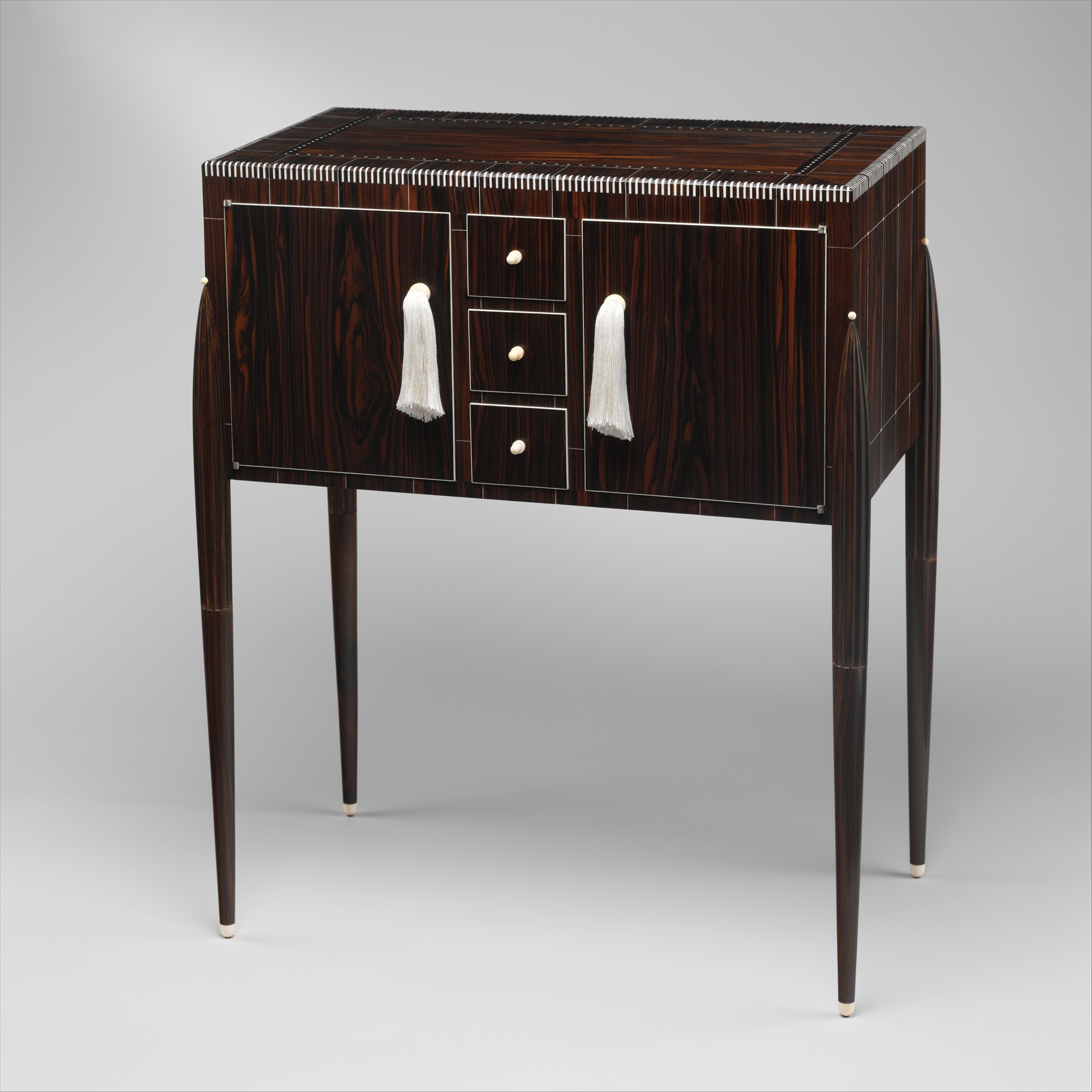
| "Fuseaux" Cabinet Emile-Jacques Ruhlmann | Acquired by the Metropolitan Museum in the same 1925 Edward C. Moore Jr. Gift purchase group Macassar ebony, ivory, silk and silvered bronze. A different model from the Etat cabinet, bought as part of the same 1925 push by curator Joseph Breck. | Metropolitan Museum of Art, New York (25.231.2) |
| Corner-form Etat cabinets (Etat d'angle) Emile-Jacques Ruhlmann | Related corner-cabinet variant of the same design family Listed by the Musee des Arts Decoratifs as the corner-form counterparts to the rectangular Etat cabinets; not otherwise researched for this record. | Brooklyn Museum, New York; Virginia Museum of Fine Arts, Richmond |
Open questions
- What did the Metropolitan Museum pay Ruhlmann for this commission in 1925? The figure has not been published in the sources consulted.
- Does the Mobilier National in Paris in fact hold the French state's 1925 exposition purchase of this model, and under what inventory number? This record relies on the Musee des Arts Decoratifs' published list of known examples and has not verified the claim against the Mobilier National's own catalogue.
- What decoration and interior fittings distinguish the Art Institute of Chicago's example from the Metropolitan's and the Musee des Arts Decoratifs' cabinets? Not researched for this record.
- Was this specific cabinet stamped or numbered by Ruhlmann's workshop in the way the Rasson example (2233 NR / 1521 AR) was? No mark or model number for the Metropolitan's object has been published in the sources consulted.
- How many further examples or fragments of the Etat model, beyond the six institutional holdings identified by the Musee des Arts Decoratifs, remain in private hands or have passed through the trade unrecorded?
Sources
- 1Metropolitan Museum of Art, collection record for the "Etat" Cabinet by Emile-Jacques Ruhlmann, accession 25.231.1, object 487424.
https://www.metmuseum.org/art/collection/search/487424 - 2Metropolitan Museum of Art, essay "The Philanthropist and the Curator," on Edward C. Moore Jr. and Joseph Breck's 1920s acquisitions of French Art Deco material.
https://www.metmuseum.org/essays/the-philanthropist - 3Metropolitan Museum of Art, press release, "Ruhlmann: Genius of Art Deco / Art Deco Paris," 2003-2004 exhibitions.
https://www.metmuseum.org/press-releases/ruhlmann-genius-of-art-decoart-deco-paris-2003-exhibitions - 4Metropolitan Museum of Art, exhibition listing, "Ruhlmann," 2004.
https://www.metmuseum.org/exhibitions/listings/2004/ruhlmann - 5Metropolitan Museum of Art, press release, "Masterpieces of Modern Design: Selections from the Collection," 2008.
https://www.metmuseum.org/press-releases/masterpieces-of-modern-design-selections-from-the-collection-2008-exhibitions - 6Wikidata, item Q98843236, "Etat Cabinet," Metropolitan Museum of Art.
https://www.wikidata.org/wiki/Q98843236 - 7Musee des Arts Decoratifs, Paris, collection page for the "Etat rectangle" cabinet, inventory 42786, including provenance (Edouard Rasson, gift of the Wattinne family, 1969) and the list of other identified examples of the model.
https://madparis.fr/etat-rectangle-cabinet - 8Joconde database (French Ministry of Culture, Plateforme Ouverte du Patrimoine), record for "Cabinet ; Etat rectangle fleurs," Musee des Arts Decoratifs, giving the workshop model reference and dimensions.
https://pop.culture.gouv.fr/notice/joconde/50210001752 - 9TheArtStory.org, biography of Emile-Jacques Ruhlmann, covering his death, the closure of his firm, Alfred Porteneuve's posthumous production and branding, and his design philosophy. Tertiary source; flagged for replacement with Florence Camard's catalogue raisonne.
https://www.theartstory.org/artist/ruhlmann-jacques-emile/ - 10Wikipedia, "Emile-Jacques Ruhlmann," for biographical dates, the family construction business and the 1925 Exposition. Tertiary source; flagged for replacement with a scholarly monograph.
https://en.wikipedia.org/wiki/%C3%89mile-Jacques_Ruhlmann - 11Palais de la Porte Doree, Paris, biographical note on Jacques-Emile Ruhlmann, covering his training, cabinetmaking method, the Ecole Boulle workshops and the Hotel du Collectionneur.
https://monument.palais-portedoree.fr/en/the-great-names-of-the-palais/jacques-emile-ruhlmann - 12Musee des Arts Decoratifs, Paris, collection page on the Pavillon du Collectionneur (Hotel du Collectionneur), Ruhlmann's pavilion at the 1925 Exposition.
https://madparis.fr/pavillon-du-collectionneur-ruhlmann - 13Dezeen, on Ruhlmann's production costs relative to his prices and his elite clientele, cited via secondary aggregation; original Dezeen article could not be directly retrieved for this record and this fact should be checked against it directly before republication.
https://www.dezeen.com/2025/03/28/emile-jacques-ruhlmann-art-deco-centenary/ - 14Reference to Florence Camard's monograph and catalogue raisonne, "Ruhlmann," as the standard authentication and dating reference for Ruhlmann's furniture, noted via auction-market and dealer citations of the book rather than the book itself, which this record's author has not read directly. Flagged for replacement with a direct citation to the monograph.
https://www.abebooks.com/book-search/title/ruhlmann/author/florence-camard/ - 15Wikimedia Commons, file and licence verification for the Metropolitan Museum's photographs of the "Etat" and "Fuseaux" cabinets, confirming CC0 status via the API's extmetadata.LicenseShortName field.
https://commons.wikimedia.org/wiki/File:%22%C3%89tat%22_Cabinet_MET_DP105993.jpg

Change log
2026-08-06 - Record created at the house standard: researched narrative, technical evidence, maker dossier, graded provenance chain, prices with hammer and premium separated, related works, open questions and sources.