Versailles, Fountain of Enceladus
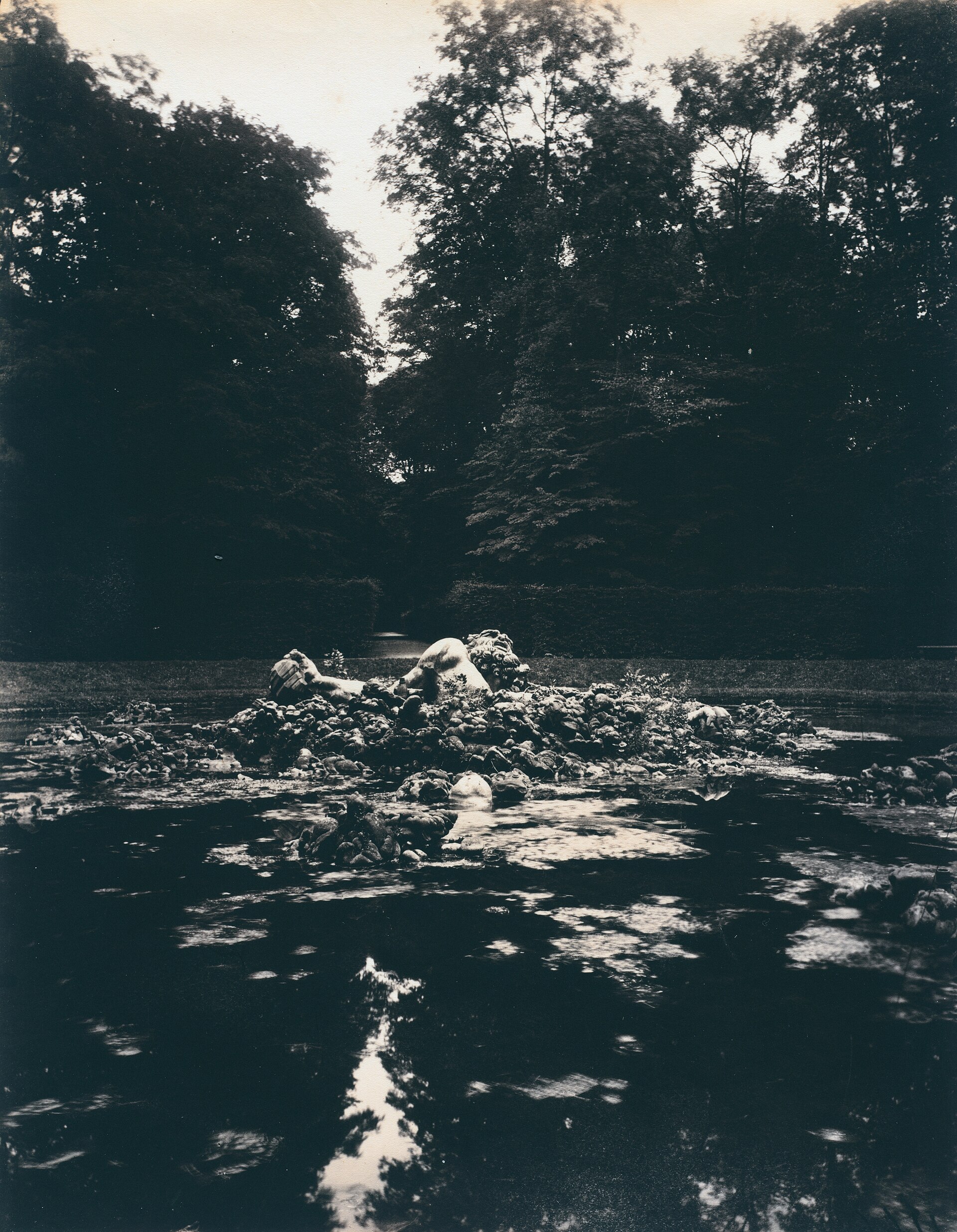
The record subject. Albumen print, gold toned, 1922-1923, by Eugene Atget. Cleveland Museum of Art, accession 1985.117, confirmed CC0.
| Artist | Eugene Atget |
|---|---|
| Date | 1922-1923 |
| Medium | Albumen print, gold toned |
| Dimensions | Image 22.5 x 17.8 cm (8 7/8 x 7 in.); mounted and matted to 45.7 x 35.6 cm (18 x 14 in.) |
| Inscriptions | Written in pencil on the verso: VERSAILLES BASSIN DE L'ENCELADUS 1166 |
| Attribution | accepted Catalogued by the Cleveland Museum of Art as the work of Eugene Atget. The sheet is not signed on its face; the attribution rests on the museum's own curatorial record and on the pencil inscription on the verso, VERSAILLES BASSIN DE L'ENCELADUS 1166, which follows Atget's own negative-numbering convention used across his documented Versailles corpus. No dispute over the attribution has been found in the sources consulted. |
| Where it is now | Cleveland Museum of Art, Cleveland, Ohio, 1985.117 |
| Object type | Photograph |
| Period | French, twentieth century |
A late Atget: an albumen print, gold toned, made in 1922 or 1923 when the photographer was in his sixties and returning to a subject, the gardens of Versailles, he had first taken up more than two decades earlier. It shows the Enceladus fountain, a lead-and-gilt giant crushed under rock, made by Gaspard Marsy after a drawing by Charles Le Brun in 1675-76 and still standing in the Bosquet de l'Encelade today.
Atget sold his work as documents for artists and died in 1927 largely unrecognized; the reputation now attached to his name was built afterward by Berenice Abbott, who bought what remained of his estate, and by the Museum of Modern Art, which acquired the bulk of the surviving negatives and prints from Abbott and the dealer Julien Levy in 1968. This particular sheet did not travel with that collection. It reached the Cleveland Museum of Art separately in 1985, alongside a companion Atget Versailles print whose own published provenance runs through the Estate of Atget and the Julien Levy Collection, a chain this record treats as probable for this sheet too, but not documented for it specifically.
Cleveland catalogues the print as albumen paper; the standard technical account of Atget's career has him moving off true albumen stock after the First World War, which leaves the exact printing paper of this 1922-23 sheet an open, unresolved question rather than a settled one.
Images
The artist
Jean Eugene Auguste Atget
Atget spent most of his working life almost entirely unrecognized as an artist. He described his own photographs as documents for artists and sold them for modest fees to architects, decorators, painters and public libraries, not as pictures in their own right. The reputation that now surrounds his name was built almost entirely after his death, by people who were not him: an American photographer who bought what was left of his estate, a New York dealer who helped her hold onto it through the Depression, and a museum curator who put it on a wall forty years later. Reading any claim about Atget as an artist, this record's own subject included, means reading it through that gap between what he thought he was doing and what later viewers decided he had done.
What the print shows
An upright albumen print, gold toned, 22.5 by 17.8 centimetres, mounted and matted to 45.7 by 35.6 centimetres. It shows the lead-and-gilt Enceladus fountain in the gardens of Versailles: the giant half-buried in a mound of rock, caught by Atget in the raking light and long shadow that mark his later garden work. The photograph is not a record shot in the plain sense. Atget has placed the camera low and close enough that the rockwork fills the lower half of the frame and the gilded torso rises out of it, so the sculpture reads as something still struggling rather than as an inventory item in a formal garden.
On the verso, in pencil, is Atget's own working inscription: VERSAILLES BASSIN DE L'ENCELADUS 1166. The number belongs to Atget's own negative-numbering system, the same convention that lets this print be cross-referenced, in principle, against other surviving prints and against the glass negative itself, if the negative survives.
The fountain Atget photographed
The sculpture is not anonymous garden ornament. It was made by Gaspard Marsy, one of the sculptors Louis XIV's building works kept in near-continuous employment at Versailles, after a drawing supplied by Charles Le Brun, the king's first painter and the effective artistic director of the whole Versailles campaign. Payment records cited by the Chateau de Versailles' own sculpture inventory show Marsy paid on account for the Enceladus fountain on 28 November 1675, with a final payment of 1,600 livres on 9 May 1676 marking completion; the gilding was carried out the same year by the painters de la Porte and Trottier.
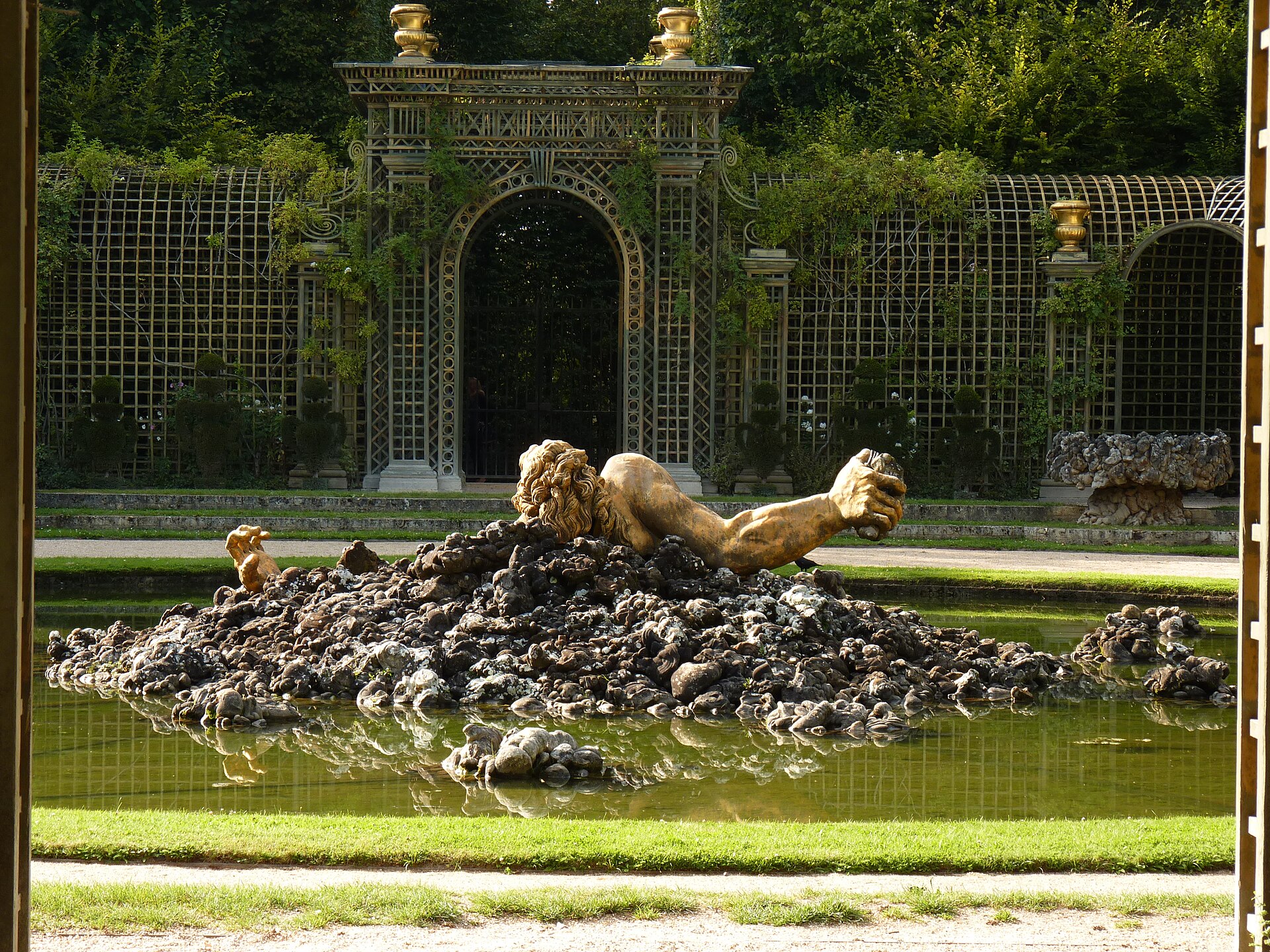
The subject is the Gigantomachy: Enceladus, one of the giants who rose against Olympus, crushed under a mound of rock by the gods he tried to overthrow, his open mouth and the water jet that rises from it standing for a scream that has no other outlet. The lead figure is just over a metre high and more than three metres long, half-submerged in its own rockwork. In 1706 Jules Hardouin-Mansart redesigned the grove around it, removing the original trelliswork and small subsidiary basins and opening the space into the crossroads form it still has. The sculpture itself was extensively conserved between August 1995 and April 1996 by the Fondation de Coubertin, including repositioning of the torso and one hand, and was re-gilded in 1996-97 by the Gohard workshops. It remains in place in the Bosquet de l'Encelade today, which is what Atget's negative documents: a specific, still-surviving seventeenth-century object, not a lost one.
Atget's documentary project
Eugene Atget was born in Libourne, near Bordeaux, in 1857, and came to photography late, at about forty-one, after work as a sailor and then a modest career in acting and painting. He set up in a small apartment and darkroom in Montparnasse and sold his prints, cheaply, as what he called documents for artists: reference material for painters, sculptors, architects and decorators rather than art in a gallery sense. His own surviving notebook, the Repertoire, records several hundred individual clients across his working life.
Institutions bought from him too, and did so early. The Musee Carnavalet and the Bibliotheque historique de la ville de Paris were purchasing his photographs from 1898, and the latter gave him, around 1906, a standing commission to photograph old buildings in Paris systematically before they were demolished or altered. The Bibliotheque Nationale bought whole albums of his subject series from around 1910. In 1920, the Service Photographique des Monuments Historiques purchased just over 2,600 of his glass negatives outright, the largest single sale of his working life and a formal, state-backed acknowledgment that his documentary record of Old Paris had become a public asset rather than a private stock in trade.
Atget at Versailles
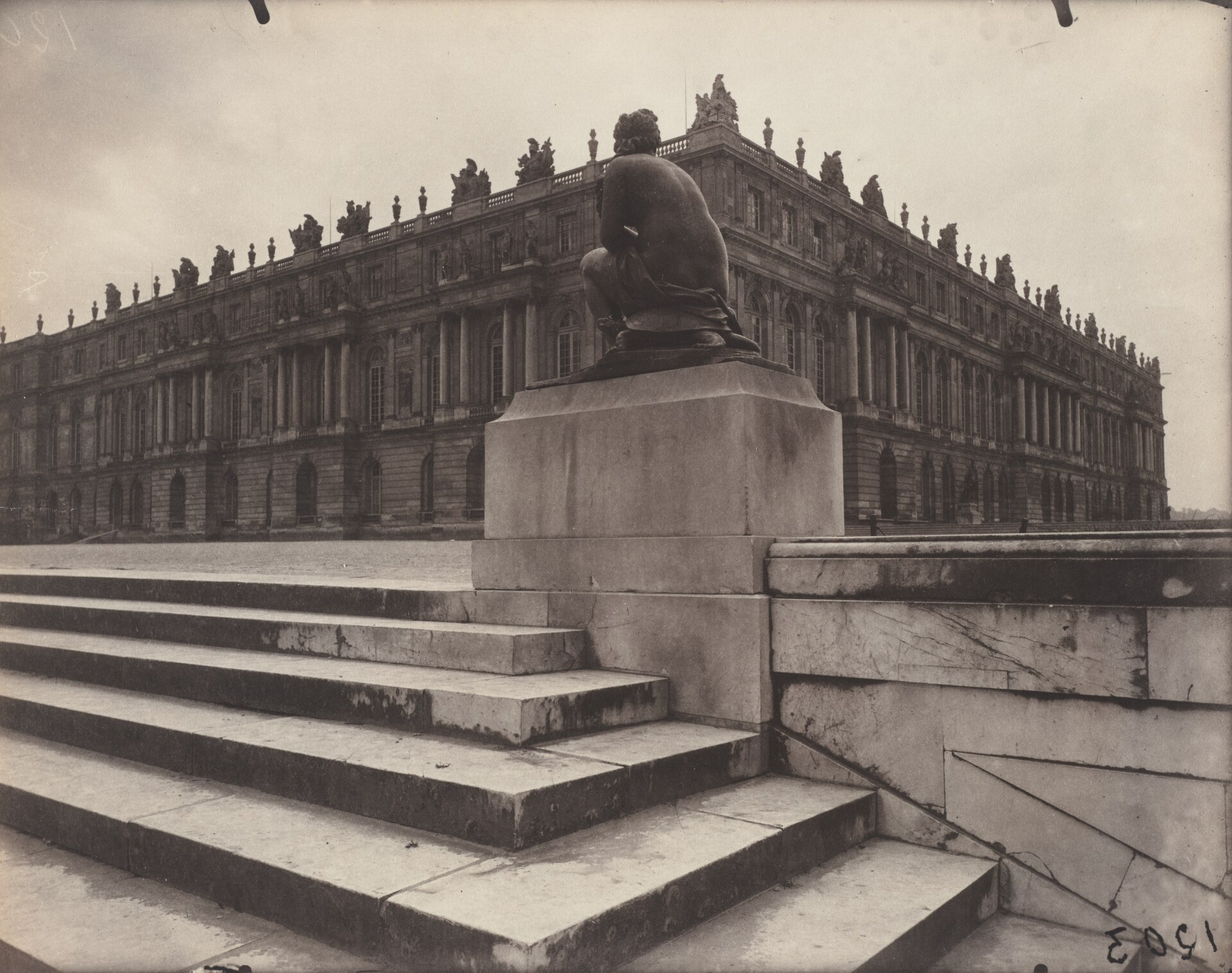
Versailles was not a one-time subject for Atget. He began photographing its park and gardens in 1901, alongside the grounds at Saint-Cloud and Sceaux, and returned to it repeatedly over more than two decades rather than treating it as a single finished campaign. The Cleveland Museum of Art's own curatorial description places this particular negative in what it calls his later campaign of photographing at Versailles during the 1920s, distinct from the fountains and statuary he had already photographed in his first Versailles years around 1901 to 1906. That distinction matters for reading this print: it is a return visit, made by a photographer then in his sixties, to a subject he had already worked for two decades, rather than a first encounter with the site.
Death, and the rescue by Berenice Abbott
Atget died in Paris on 4 August 1927. His friend Andre Calmettes, an actor and filmmaker, took charge of what was left in the studio: he gave roughly 2,000 negatives documenting Old Paris to the French state, and sold the remaining negatives and surviving prints to Berenice Abbott, an American photographer then working as an assistant in Man Ray's Paris studio. Abbott had befriended Atget in his last years and had already bought a number of prints directly from him before his death; the purchase from Calmettes let her take on the remaining bulk of the estate rather than a handful of individual sheets.
How the archive survived and was promoted
Abbott spent the following four decades championing Atget's work in the United States through exhibitions, articles and publications, at a time when he was still largely unknown outside a small circle of artists and photographers who had bought from him directly. During the Depression she sold half her holding to the dealer Julien Levy to raise money, while keeping her advocacy for the work going. In 1968, Abbott and Levy together sold what remained of the whole collection to the Museum of Modern Art in New York: 1,415 glass negatives and close to 8,000 vintage prints, drawn from more than 4,000 distinct negatives, acquired with the aid of a gift from Shirley C. Burden. MoMA's own press materials describe it as the largest single acquisition in the history of the museum's photography department. The museum opened an exhibition simply titled Atget, curated by John Szarkowski, on 1 December 1969.
Szarkowski's own description of the work, issued in the museum's press release for that show, is the closest thing to a critical verdict this record can cite directly: his pictures are as plain and transparent and precious as water, and individually they are like short beautiful sentences made of small and common words, but collectively they are a testament to the simplicity of genius.
Vintage prints, dispersal, and a genuine connoisseurship problem
The ratio in the 1968 acquisition, nearly 8,000 vintage prints from just over 4,000 negatives, is itself evidence of something specific: a large number of Atget's negatives survive today in more than one print, made at different times, and print quality across those sheets is not uniform. The Museum of Modern Art's own press release for the 1969 exhibition notes that one hundred duplicate original prints from the collection were put up for sale at the Robert Schoelkopf Gallery in New York once the exhibition opened, in a show titled Photographs by Atget: Original Prints by Eugene Atget running 6 to 24 December 1969. That sale is a plausible, though not here confirmed, route by which vintage Atget prints reached other American museums through the 1970s and 1980s.
The paper itself changed over Atget's career in a way that bears directly on how a sheet like this one should be described. Atget printed exclusively on true albumen paper for most of his working life, but that stock became unavailable after the First World War, after which he moved to industrially produced matte albumen paper and to gelatin-based printing-out paper sold as aristotype, which is aesthetically close to albumen, being similarly toned and printed out in daylight rather than developed, but is not chemically the same material. Print quality varies considerably across his output as a result of these paper changes, his own printing and gold-toning practice, and later storage and handling; some aristotype sheets are recorded with sulphuration stains from imperfect fixing or washing. Cleveland catalogues this sheet, made in 1922 or 1923, as an albumen print, gold toned. Given that true albumen paper was already scarce or unavailable to Atget by that date on the standard technical account of his career, that description may reflect a loose, conventional use of the term rather than a technical determination that this specific sheet is true albumen rather than a later matte albumen or aristotype paper. No published technical examination of this print has been found to resolve the point either way, and this record does not resolve it either.
How this print reached Cleveland
The Cleveland Museum of Art accessioned this print on 27 August 1985, purchased with the John L. Severance Fund. A companion print, also by Atget, also of a Versailles subject, was accessioned by Cleveland on the same day under the same fund: Versailles, Chaste Venus, accession 1985.113, showing a different statue elsewhere in the gardens. For that companion print, Cleveland's own published record gives a provenance: Estate of Eugene Atget, then the Julien Levy Collection. For this print, 1985.117, Cleveland's published record carries no provenance list at all. Given that the two prints share an accession date and an acquisition fund and were plainly bought as part of the same purchase, the same Atget-estate-to-Levy chain probably applies here too, but this record states that as a probability grounded in the sibling accession, not as a documented fact about this specific sheet, because Cleveland has not published it as one.
The print was reproduced in Tom E. Hinson's Catalogue of Photography, published by the Cleveland Museum of Art in 1996, at page 88, and has been shown twice: in the museum's Year in Review 1985 exhibition of February to April 1986, noted in the museum's own Bulletin, and in Drawn with Light: Pioneering French Photography from the Cleveland Museum of Art, an exhibition of the museum's own photography holdings running 26 February to 16 June 2005. No conservation statement or treatment record has been published for this specific sheet, and it is not currently on view.
What is still unresolved
What this record cannot answer, because the sources consulted do not answer it, is the exact path this particular sheet took between Atget's death in 1927 and Cleveland's purchase in 1985, whether its paper is technically albumen or a later aristotype catalogued loosely as albumen, what the museum actually paid for it, and whether the glass negative behind it, Atget's own number 1166, still exists anywhere. None of those gaps has been bridged with a guess here; they are recorded as open questions instead.
Technical evidence
| Medium and process | Albumen print, gold toned. Printed out in contact with the glass negative and toned in gold before fixing and washing, in the manner Atget used throughout his career.17 |
|---|---|
| Dimensions | Image 22.5 x 17.8 cm (8 7/8 x 7 in.); mounted and matted to 45.7 x 35.6 cm (18 x 14 in.).1 |
| Inscription | Written in pencil on the verso: VERSAILLES BASSIN DE L'ENCELADUS 1166, in Atget's own negative-numbering convention.1 |
| Support and printing paper | Catalogued by the Cleveland Museum of Art as albumen paper. On the standard technical account of Atget's career, true albumen stock became unavailable to him after the First World War, after which he printed on matte albumen or gelatin-based aristotype paper, materials that look close to albumen but are not chemically identical. Whether this sheet has been examined at that level of technical detail is not stated in the sources consulted.17 |
| Rights status | share_license_status recorded as CC0 in the Cleveland Museum of Art's own open access API; is_nazi_era_provenance recorded as false in the same record. Confirmed 2026-08-30.1 |
| Accession | Accessioned 27 August 1985 as 1985.117, purchased with the John L. Severance Fund. Legal status recorded by the museum as accessioned.1 |
Provenance
- 1922-1923 -Eugene Atgetdocumented
Negative exposed and printed during Atget's later campaign of photographing at Versailles in the 1920s. The verso inscription VERSAILLES BASSIN DE L'ENCELADUS 1166 is Atget's own negative number.1
- 1927 -Estate of Eugene Atget, then Berenice Abbott and Julien Levyunknown
Atget died 4 August 1927. His remaining negatives and prints passed through Andre Calmettes to Berenice Abbott, and half of Abbott's holding was later sold to the dealer Julien Levy. This general chain is well documented for Atget's estate as a whole and, specifically, for this print's companion, Cleveland accession 1985.113, whose own published provenance reads Estate of Eugene Atget; Julien Levy Collection. Cleveland has not published a provenance for this print, 1985.117, itself, so this entry records the probable chain without asserting it as documented for this exact sheet.1268
- - 1985Unknown intermediate market historyunknown
No dealer, sale, or intermediate owner between the Levy Collection and the Cleveland Museum of Art's 1985 purchase has been identified in the sources consulted.
- 1985 - presentCleveland Museum of Artdocumented
Purchased with the John L. Severance Fund and accessioned 27 August 1985, the same day as the companion print 1985.113. Confirmed CC0 under the museum's own open access program as of 2026-08-30.1
Related works
| Work | Relation | Where it is |
|---|---|---|
| Versailles, Chaste Venus Eugene Atget | Companion Atget Versailles print accessioned by the Cleveland Museum of Art on the same day, under the same fund Not this object; shows a different Versailles statue, a Venus, elsewhere in the gardens. Its published provenance, Estate of Eugene Atget then the Julien Levy Collection, is probably shared by this record's print but is not separately documented for it. | Cleveland Museum of Art, accession 1985.113 |
| Versailles, Bassin de Neptune Eugene Atget | A different Atget photograph of a different Versailles fountain, from a different institutional holding Not this object and not the Enceladus fountain. Included to show that Atget's Versailles negatives were dispersed to multiple American museums by routes independent of the 1968 Museum of Modern Art acquisition. | Art Institute of Chicago, accession 1963.992 |
| Fontaine de l'Encelade (the sculpture itself) Gaspard Marsy, after a design by Charles Le Brun | The seventeenth-century sculpture Atget's negative records Lead, gilded 1676; conserved 1995-96 and re-gilded 1996-97; remains in situ. | Bosquet de l'Encelade, gardens of the Chateau de Versailles |
| The Atget collection acquired from Abbott and Levy Eugene Atget | The negatives and vintage prints through which the rest of Atget's Versailles work is chiefly known This Cleveland print is not part of that holding; it reached Cleveland by a separate route, probably via Julien Levy and the market, in 1985. | Museum of Modern Art, New York (1,415 glass negatives and roughly 8,000 vintage prints, acquired 1968) |
Open questions
- What did the Cleveland Museum of Art pay for this print in 1985? The John L. Severance Fund purchase price has not been published in the sources consulted.
- Did this print pass through the Estate of Eugene Atget and the Julien Levy Collection before reaching Cleveland, as its companion print 1985.113 explicitly did? Cleveland's own published record does not state a provenance for 1985.117 itself.
- Is the printing paper technically true albumen, or a post-First World War matte albumen or gelatin aristotype paper catalogued loosely as albumen? No technical examination of this specific sheet has been published in the sources consulted.
- Does the glass negative, Atget's own number 1166, survive, and if so where? It is not recorded among the 1,415 negatives the Museum of Modern Art acquired from Abbott and Levy in 1968, and no other holding has been identified here.
- Exactly when within 1922-1923 was the negative exposed, and was this sheet printed by Atget himself at that time or from the negative afterward? Cleveland's own date range covers both possibilities and does not resolve which applies.
Questions about this object
What is Versailles, Fountain of Enceladus?
Photograph, Albumen print, gold toned, 1922-1923.
Who made Versailles, Fountain of Enceladus, and is the attribution settled?
The attribution to Eugene Atget is recorded here as accepted. Catalogued by the Cleveland Museum of Art as the work of Eugene Atget. The sheet is not signed on its face; the attribution rests on the museum's own curatorial record and on the pencil inscription on the verso, VERSAILLES BASSIN DE L'ENCELADUS 1166, which follows Atget's own negative-numbering convention used across his documented Versailles corpus. No dispute over the attribution has been found in the sources consulted.
Where is Versailles, Fountain of Enceladus now?
Cleveland Museum of Art, Cleveland, Ohio, 1985.117. As recorded 2026-08-30. Purchased with the John L. Severance Fund, accessioned 27 August 1985. Confirmed CC0 via the Cleveland Museum of Art's own openaccess API (share_license_status = CC0; is_nazi_era_provenance = false), retrieved 2026-08-30.
What is still unknown about Versailles, Fountain of Enceladus?
What did the Cleveland Museum of Art pay for this print in 1985? The John L. Severance Fund purchase price has not been published in the sources consulted.
Sources
- 1Cleveland Museum of Art, Open Access API, record for accession 1985.117, Versailles, Fountain of Enceladus. Retrieved 2026-08-30; share_license_status = CC0.
https://openaccess-api.clevelandart.org/api/artworks/?q=Enceladus%20Versailles%20Atget - 2Cleveland Museum of Art, Open Access API, record for accession 1985.113, Versailles, Chaste Venus, the companion print acquired the same day. Retrieved 2026-08-30.
https://openaccess-api.clevelandart.org/api/artworks/?q=Chaste%20Venus%20Versailles%20Atget - 3Cleveland Museum of Art, object page for accession 1985.117.
https://www.clevelandart.org/art/1985.117 - 4Wikimedia Commons, file and extended metadata for File:Eugene Atget - Versailles, Fountain of Enceladus - 1985.117 - Cleveland Museum of Art.jpg, confirming Public Domain / CC0 status.
https://commons.wikimedia.org/wiki/File:Eug%C3%A8ne_Atget_-_Versailles,_Fountain_of_Enceladus_-_1985.117_-_Cleveland_Museum_of_Art.jpg - 5Sculptures et jardins de Versailles (Chateau de Versailles), notice for Gaspard Marsy, Encelade: commission, payment record, gilding, and 1995-97 conservation history.
https://sculptures-jardins.chateauversailles.fr/notice/notice.php?id=385 - 6Museum of Modern Art, press release no. 146, ATGET AT THE MUSEUM OF MODERN ART, 1 December 1969.
https://assets.moma.org/documents/moma_press-release_326657.pdf - 7Art Gallery of New South Wales, Atget's technique, education resource summarizing Szarkowski and Hambourg's technical study of Atget's printing papers.
https://www.artgallery.nsw.gov.au/education/exhibition-kits/eugene-atget/technique/ - 8Wikipedia, Eugene Atget. Flagged as a tertiary source, consolidating biography, client base and the Calmettes-Abbott-Levy-MoMA chain; retained here only for facts corroborated by the Museum of Modern Art's own 1969 press release. Flagged for replacement with a scholarly monograph (Szarkowski and Hambourg, The Work of Atget, 1981-85).
https://en.wikipedia.org/wiki/Eug%C3%A8ne_Atget - 9Wikidata, Q79936333, Versailles, Fountain of Enceladus.
https://www.wikidata.org/wiki/Q79936333

Change log
2026-08-30 - Record created at the house standard: researched narrative, technical evidence, maker dossier, graded provenance chain, prices with hammer and premium separated, related works, open questions and sources.